(Today’s NaPoWriMo prompt was for a list poem based in made-up names, so I invented a few species of troll to populate this bit of creepy nonsense.)
When trees are swimming deep in fog
And stars are dull as old eggnog,
The trolls come out to hunt and roam
Where humans dare not make their home.
The stankenlops and flicklepines
Emerge from their abandoned mines
And greet the trarterstumps and groyts
Embarking on their own exploits.
The nibblelungers beat their chests,
And grindlefangers make conquests,
And no one knows what skleeblers do
Since even trolls think it taboo.
No sheep or goat or man is safe
When hunted by a narberwafe,
And blattercrones’ deep moans are known
To chill a grown man to the bone.
The night is theirs but does not last,
And soon each lerpt and pincherclast
Will shrink back to their darkened pits
To wait till when the night permits.
____________________
MPAA rating: PG-13
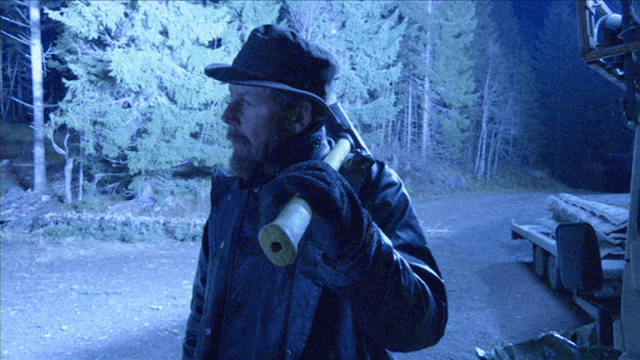
The found-footage style gets a bad rap because of its gimmicky nature and its overuse in often poor quality horror movies since The Blair Witch Project. Yet it does have its bright spots, like the mind-bending “documentary” Lunopolis and the 2010 Norwegian import Trollhunter. Of all the monsters to chase with a camera, trolls don’t seem like an obvious choice, but Trollhunter strikes a unique blend of giant monster thrills and occasional dark comedy that gives the big-nosed brutes an outlet other than Middle-Earth.
The “filmmakers” in this case are three students from Volda University College, who think they’re investigating a bear poacher only to stumble upon the rough-hewn Hans (Otto Jespersen, who’s apparently a comedian) and his secret government-sanctioned job of hunting trolls. Tired of toiling in obscurity, Hans lets the trio follow him around on his troll control missions and explains the details purposely kept from the public, like the various species of troll, how power lines are really electric fences to keep them in, or the fact that trolls can smell the blood of a Christian man. (In that case, remind me not to move to Norway because I wouldn’t last long.)
The found-footage aspect is fairly standard as far as the shaky camera and often insufficient lighting, though there are some stand-out moments, such as the use of night vision to get a glimpse of the dangerous creatures. The biggest asset is Jespersen as Hans, who goes about his dirty fantasy job with weary competence, seemingly unfazed by the fact he gets paid to flash lights at three-headed giants. The special effects are also quite effective. While the trolls are often clearly CGI, their grotesque appearance somehow makes it look realistic too, and the finale with a mountain-sized troll is an awesome edge-of-your-seat sequence.
Trollhunter follows a lot of the usual found-footage tropes, but it does them well, managing to find a balance between absurdity and realism, like how a veterinarian explains the “scientific” reason that trolls turn to stone or explode when exposed to sunlight. Already something of a cult classic, the abundance of Norwegian culture and impressive scenery makes it an entertaining option for exploring Scandinavian cinema, though I doubt the prospect of trolls has helped tourism.
Best line: (the Norwegian Prime Minister, with a slip of the tongue at a press conference) “Few people find power grids attractive. I certainly don’t. Norwegians are pro-electricity, but against power lines. That won’t work in the long run. Norway has trolls, so more power lines are needed. That’s just the way it is.”
I sit here with my pen prepared
To dish out justice undeclared,
And when I write, no one is spared,
For who’s more right than I?
Most secret of dictatorships
With death upon my fingertips,
I munch upon potato chips
And choose who’s next to die.
They’ll fear the killer none can see
And puzzle at the mystery,
Not knowing it was always me
Who hands out just rewards.
Repaying vengeance now is mine;
The world will bend by my design.
How wise the man who wrote the line
That pens kill more than swords!
___________________
MPAA rating: R (for brief graphic violence and frequent language)
I’ve been nervous about checking out Netflix’s live-action Death Note movie, especially based on the reviews I’d read. Movie adaptations of anime have about the same track record as those based on video games, yet I really hoped that Netflix’s Death Note movie would be the one to break the mold. (I know it was originally a manga, but I mainly know the anime.) Its story has all the ingredients of a great psychological thriller, a battle of wills between a megalomaniacal teen with a killer notebook and a genius detective intent on bringing him to justice. I was never that invested in Ghost in the Shell or Dragonball and thus didn’t much care when their American versions flopped, but I am a definite fan of the Death Note anime. That’s why the recent American adaptation was such a disappointment, even as I saw traces of the good movie it almost was.
I suppose I’ll address the casting controversy first, allegations of whitewashing that I honestly don’t get. An American version has every right to be set in America, and moving the story from Japan to Seattle makes casting white actors perfectly reasonable. Japan does the same thing, even when it goes against the source material; just look at the all-Japanese casts of Attack on Titan or Fullmetal Alchemist, both of which are supposed to have European settings and characters, for the most part. Casting good actors should take precedence, which is why I also don’t mind Keith Stanfield as a black version of L, since he at least acts closer to the original character than the other actors.
As that last statement implies, Death Note misses the mark most, not as a film in general, but as an adaptation. It may seem like a strange comparison, but it’s a lot like last year’s live-action Beauty and the Beast; they both could be reasonably fine movies if they weren’t entirely overshadowed by exceptionally better animated originals. The basics are there. Formerly named Light Yagami, Light Turner (Nat Wolff) is a gifted but resentful high school student who finds the mysterious Death Note, which claims to kill anyone whose name is written in it, usually by an unexplained heart attack unless a different method is specified. Goaded by a demonic death god named Ryuk (Willem Dafoe) and believing he can right all the wrongs of the world and become godlike, Light sets out to rid the world of criminals as the killer called Kira but runs into conflict with the eccentric detective known only as L.
Those are the basics, and the film follows them and asks similar moral questions of how one might use power over life and death. Yet there’s so much changed as well, from minor details to entire character arcs, and the changes are generally for the worse. Light and L start off close to their animated counterparts but end up with vastly different goals and mindsets. As I said Stanfield is appropriately weird and intense as L, though he’s shaken (by events that didn’t happen in the anime) to act with uncharacteristic rage at one point. Likewise, Wolff has a good sense of normalcy about him, making him unlikely to be suspected as Kira, but he also overacts on occasion, like the epic meltdown he has upon meeting Ryuk for the first time. He comes off as intelligent and crafty but hardly the self-assured genius from the anime; that Light went to painstaking lengths to avoid detection by anyone, while this Light brings the Death Note to school and uses it to show off to a girl named Mia (Margaret Qualley). This Mia (formerly Misa in the source material) is the biggest change of all; instead of being an airheaded Kira groupie with a Death Note of her own, she becomes a driving force for Light’s crimes and even tries to outsmart him, which is actually a more interesting direction for her character. The best direct translation to live-action is oddly enough the CGI one; Dafoe is perfectly cast as the sinister Ryuk, employing his Green Goblin voice with relish.
In addition to all the character changes, the plot spins along trying to carve its own path while muddling its story. The Death Note in the anime did have a lot of rules as to its various uses, but the film loads on more to confusing effect and even seems to break a few. For example, people whose names are written in the note can be controlled for two days prior to their death, and Light tries to use this detail by writing someone with a single-word name, which I always assumed was fake. If he can do that, why not do it with L? The ending is actually pretty thrilling and finally reveals the depths of Light’s Sherlockian foresight and cleverness, but it also exaggerates the note’s abilities to the point of seemingly predicting the future rather than just controlling people.
As one last complaint, I also was disappointed that it had to be R-rated, likely thanks to director Adam Winguard’s reputation for horror. I enjoyed the anime because it gradually developed as a dark and compelling narrative, and did so without a single F-word or graphic decapitation. It was proof that you can explore dark material without going to extremes for extreme’s sake, something I wish Hollywood and Netflix would have learned. Oh, and what was with the soundtrack? Some of the songs were complementary, but others clashed really strangely, like playing Air Supply over the ending scenes.
By the end, it seems open for a sequel, yet certain characters know things they shouldn’t and there’s no easy way to see how the story could continue in any direction that remotely resembles the original. There are traces of brilliance in the climax and in the confrontations between Light and L, yet I would much sooner recommend the anime over this misguided adaptation. Actually, I wish Netflix would take a real chance and make a movie out of Death Note: The Musical, courtesy of composer Frank Wildhorn, who is apparently popular enough in Japan that he was asked to musicalize Death Note. It’s actually quite good, and you can find it on YouTube, like here. I’ll just have to wait a little longer for that really good live-action anime adaptation (Your Name maybe) because sadly this isn’t it.
Best line: (L, to Light) “You’re the one who flew into the sun; I’m just here to make sure you burn!”
For those familiar with Death Note, here’s a little parody video combining it with The Fairly OddParents that cracked me up, since they changed Light’s last name to Turner.
Everybody, young and old,
Desires that their life be told
One day with fondness in past tense.
We think that we must spread our name
And earn our quarter hour of fame
To be remembered decades hence.
We need not awe the world so vain
When others close at hand remain
For us to serve and love instead.
The world may never know, it’s true,
How you have lived, but those who do
Are those who matter once we’re dead.
___________________
MPAA rating: PG
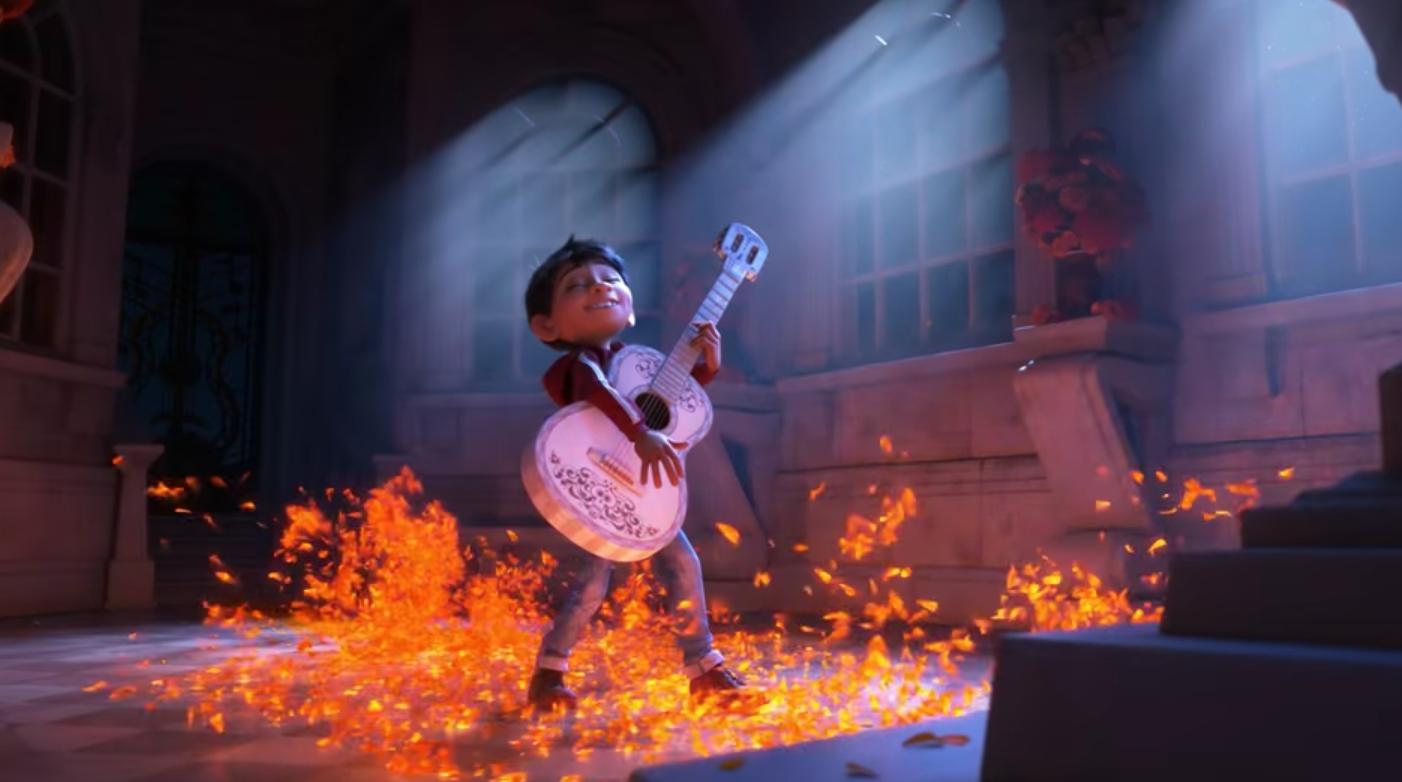
It’s nice to know that in a pretty lackluster year for American animation, Pixar can still come through. Coco was undoubtedly a risky film for the famous studio, their first musical and one delving into another country’s culture as none of their past movies have. Even dicier, it threatened to be one of Pixar’s least original stories, coming three years after The Book of Life already did the whole Day of the Dead theme in animation. Yet Pixar not only beat the odds but hit them out of the park. (Am I mixing my idioms? Anyway….)
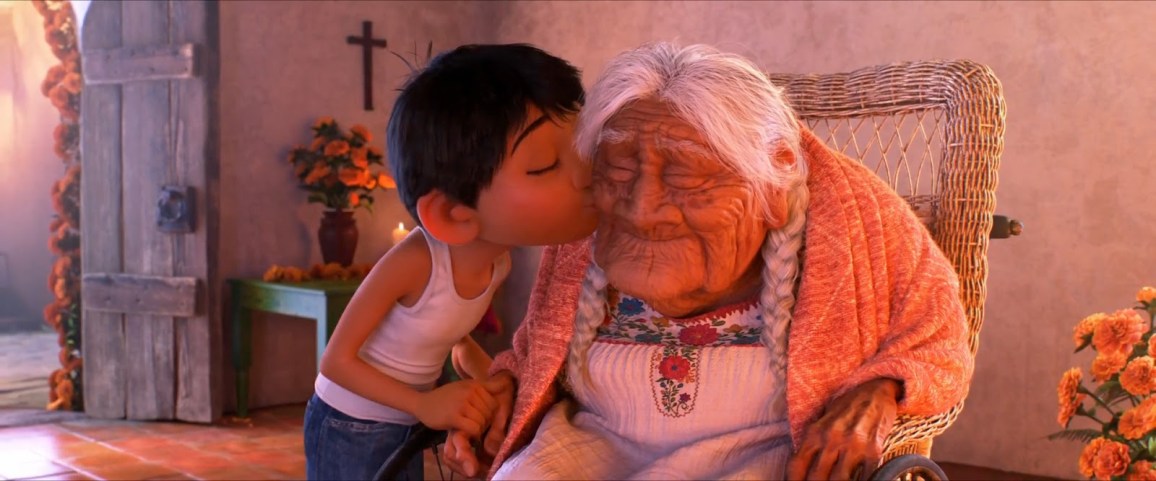
Starting with a prologue explaining why the Rivera family has hated music for generations, Coco introduces us to Miguel Rivera (Anthony Gonzalez) and his extended family of shoemakers, including his rocking chair-bound great-grandmother Coco. Although his Abuelita (grandmother) forbids music of any kind, Miguel is an unashamed fan, particularly of the dead superstar Ernesto de la Cruz (Benjamin Bratt). While the rest of his family celebrates the traditional Mexican holiday of Día de Muertos or the Day of the Dead, the one day their dead relatives can visit them, Miguel’s passion for music accidentally transfers him to the Land of the Dead, and, if he doesn’t want to become a skeleton himself, he must find a way back before the end of the day, accompanied by a misfit named Héctor (Gael García Bernal).
It’s true that Coco isn’t the most exceptionally original film in Pixar’s canon. It not only reuses some elements of The Book of Life (skeletons in the Land of the Dead, musical aspirations suppressed by the family business) but will certainly remind some of Ratatouille in the way its talented protagonist dreams of emulating his dead idol against the wishes of his stern family. There are echoes of Up as well, but that might go into spoiler territory. Yet from these all too familiar ingredients, Coco still finds ways to enchant, impress, and touch in ways we haven’t seen before.
For one thing, Pixar continues to reach new heights in the quality of their CGI animation. From the semi-2D prologue told through traditional Mexican paper cuttings (papel picado) to the glory of the Land of the Dead’s fantasy metropolis and its bridge of marigold petals, the level of detail on display is spectacular. I saw Coco with my dad, and it seemed like I heard him whisper “Wow” every ten minutes or so.
Simply put, the animation is flawless, but I was glad to see that the same effort went into the story. It undoubtedly captures the traditions and culture of Mexico (it’s now the highest grossing film there), from its exclusively Hispanic cast to the exuberant gritos (the equivalent of a yahoo) to the particulars of celebrating Día de Muertos, yet it backs up that cultural specificity with themes that are universal, especially familial love and devotion. Strengthened by the Oscar-nominated song “Remember Me,” the emotions run deep toward the end, and although Pixar didn’t bring me to tears this time, I can easily see why many viewers’ hearts have melted, especially those who have lost family members.
There are a few points to maybe not object to but at least mention, which run a bit deeper than a bizarre moment or two. Despite Mexico’s Catholic heritage, Día de Muertos does include pagan and mythological elements, and its concept of the afterlife isn’t exactly a Christian one. Despite the laudable lesson in both Coco and The Book of Life of remembering those who have died, I don’t believe that their existence in the afterlife is dependent on our memory. It’s a concept that works well for the story and its fantasy aspects but one that parents should probably discuss with their kids afterward.
That being said, Coco is still a triumph for Pixar, from its funny and poignant moments to its catchy soundtrack (I loved the final song especially). Its twists and turns may be guessable or not, but they do leave an impact. In typical Pixar fashion, it also appeals to kids and adults on different levels. Kids can root for Miguel’s love for music, but as they get older, they might pick up more on how an excess of that passion is problematic, putting him in more danger than was necessary. This may not have been intentional, but a couple parts even seemed to comment on the whole Confederate statue debate, offering a little support for both sides of the argument. Or maybe I’m just reading into it, but the point is that you don’t find such subtlety and food for thought in the majority of Western animation. It’s easily better than The Book of Life, and I’ll probably have to update my Top Twelve Pixar Movies now. As much as I’m still miffed at the Academy for spurning A Silent Voice for a Best Animated Feature nomination, I must admit that even if they had, Coco deserves to win.
Best line: (Miguel) “Although you may never forgive him, you should never forget him!”
Turn left and right, then left again,
Through passageways unknown to men,
Escorted by the walls so wide
That hedge your path on either side.
It’s left again, or was it right?
Dead ends about, despite foresight,
And going forth and going back
Will likely both lead you off-track.
The walls can lie, the clues mislead,
In hopes that you may not be freed,
But when you round the final bend
And then at last you reach the end,
Perhaps you’ll find your former pen
Worth wandering through once again.
_____________________
MPAA rating: PG
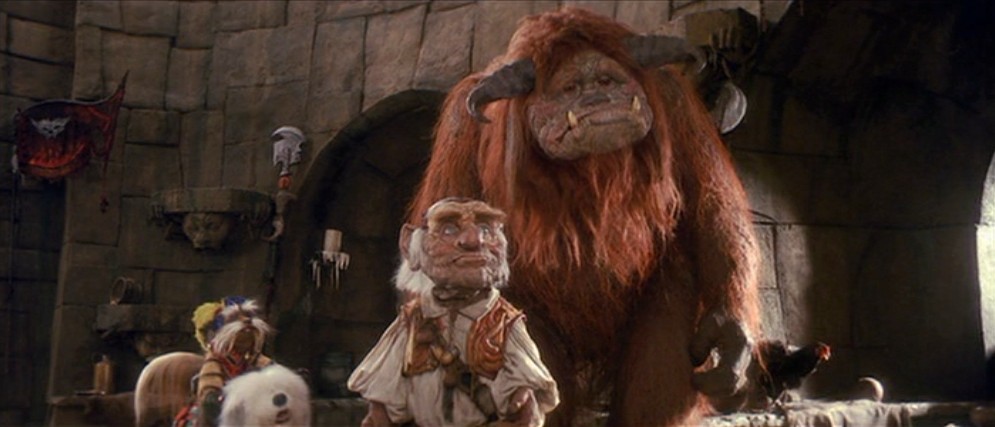
You know what Jim Henson’s Labyrinth most reminds me of? The Wizard of Oz, with muppets. I’m sure I’m not the first to point out that similarity, but I never noticed it when I first saw Labyrinth years ago. The film also explicitly credits Maurice Sendak for inspiration, so Henson had some true children’s classics to draw from as he endeavored to craft one of his own. Whether it is one might be up to each viewer’s nostalgia and “inner child,” but it’s at least a cult classic for some.
In only her fourth movie role, Jennifer Connelly plays Dorothy, I mean Sarah, an imaginative fifteen-year-old who gets fed up with her annoying baby stepbrother Toby (Toby Froud) and wishes he were taken away by goblins. Naturally, she is shocked when he is actually spirited away by the Goblin King Jareth (alluringly hairy David Bowie), who challenges her to make it through his huge labyrinth to save her brother. Like The Wizard of Oz, she braves various obstacles and misadventures, while gaining three companions along the way, who manage to save her after she’s trapped in a dream, not unlike Dorothy in the field of poppies.
Bowie may have been one of the big draws for Labyrinth, but in all honesty, the real star is Henson’s puppetry. The sheer number of fancifully designed creatures is impressive, and some boast a “how did they do that?” mastery, such as Sarah’s first grudging friend Hoggle, who apparently had a dwarf in a costume but a face radio-controlled by a team of puppeteers. (When his name is misremembered as Hogwart at one point, I couldn’t help but wonder if J.K. Rowling had been taking notes.) The characters can be alternately cute and grotesque, so when baby Toby is crying surrounded by partying goblins, I doubt there was any acting required. The other part that jumps out at me is the door riddle with the two guards that either lie or tell the truth. I remember that riddle being asked at camp once, and no one could remember the answer. Heck, I’m still not sure I understand its logic. While the film’s box-office disappointment hurt Henson, he had much to be proud of here, since the puppets outshine the humans for the most part.
Attractive as all get-out, Connelly handles her interactions with them earnestly, but her early “curse” against her brother is so over-the-top, it’s hard to believe she went on to win an Oscar. Bowie, on the other hand, is suave and charismatic from start to finish and strangely fits in with the goblins better than expected. Along with the wonderfully ‘80s-sounding soundtrack, he gets to sing too, with the most memorable tune being the endlessly catchy “Magic Dance.”
I feel that Labyrinth might have been one of my fond favorites too if I’d seen it more than once when I was a kid (like The Neverending Story), since its mixture of dark fantasy and puppet silliness only worked so far watching it now as an adult. By the end of Sarah’s coming-of-age journey, though, it’s hard not to feel a bit of nostalgia as Hoggle and her friends offer to be there for her, “should you need us.” That’s exactly what childhood favorites are for, reminding you “every now and again in…life, for no reason at all” of the adventures that once so enthralled and enchanted you, even if you know they’re things of the past. Labyrinth may be uneven overall, but it’s still a triumph of puppetry skill and set design, notably a staircase maze modeled after the work of M.C. Escher. Perhaps I just need to revisit it myself a few more times for the magic to fully hit me.
Best line: (Sarah, a true teenager) “That’s not fair!” (Jareth) “You say that so often, I wonder what your basis for comparison is?”
We laud and admire explorers who dare
To venture to regions unknown,
Who journey to jungles with risk in the air
Where most men would heed all the signs to beware,
But not they who roam to the eye of nowhere
And cherish each uncharted zone.
Yet one thing to note of these men who beseech
The thrill of what’s hidden ahead:
Although they may find every mountain and beach
And give all the teachers more titles to teach
And seek out the truths that lie just out of reach,
Most of them do end up dead.
______________________
MPAA rating: PG-13 (some of the violence is rather strong, though)
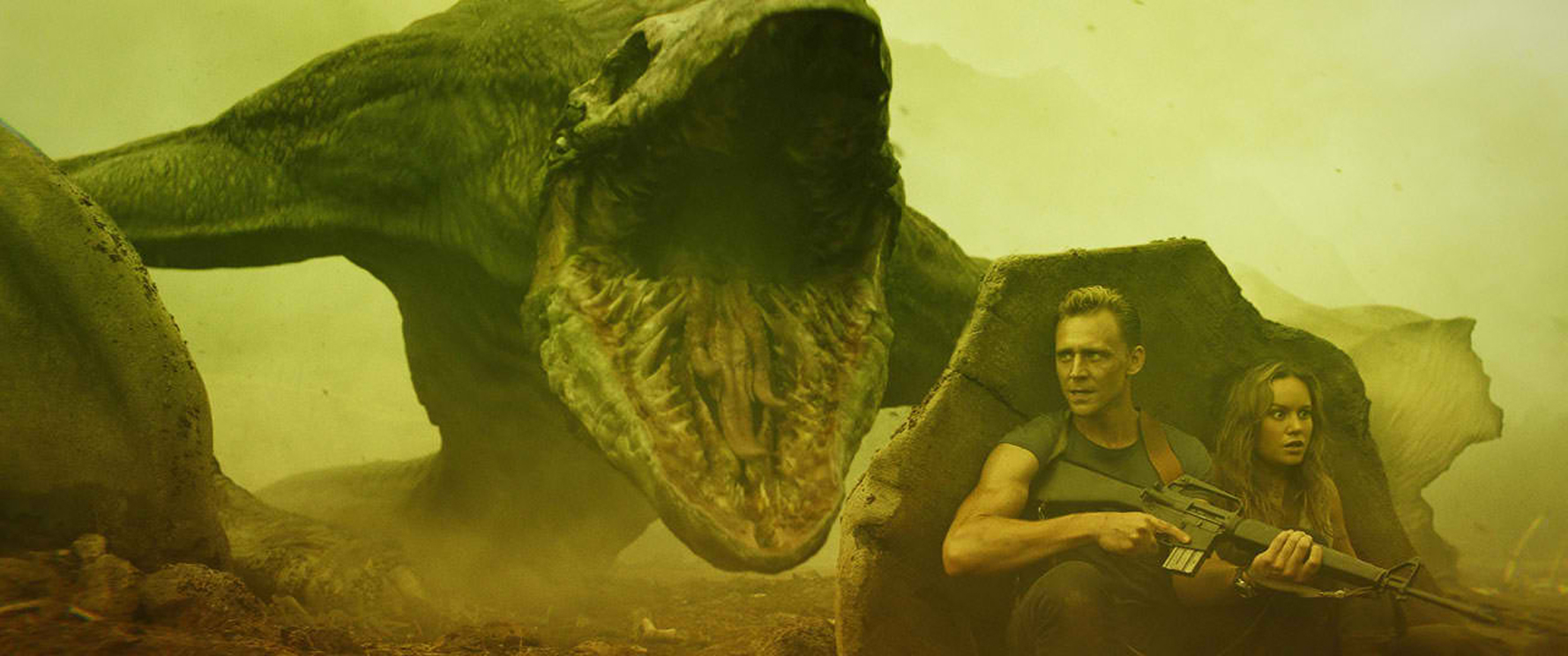
If you thought the world didn’t need another remake of King Kong, you’d be right, but that’s not about to stop Hollywood. Following 2014’s Godzilla and paving the way for 2020’s Godzilla vs. Kong prize fight of the so-called MonsterVerse, Kong: Skull Island isn’t the same story in past films featuring the giant ape. There’s no film crew, no screaming damsel in distress, no Empire State Building, so it might seem that Kong: Skull Island simply features a different (and much larger) version of the character and isn’t an actual remake. But it is, just a remake of the first half of the original King Kong tale, that being the story of ill-fated visitors to Kong’s home of giant critters. As much as the film tries to make a whole out of this half-story, it doesn’t quite work.
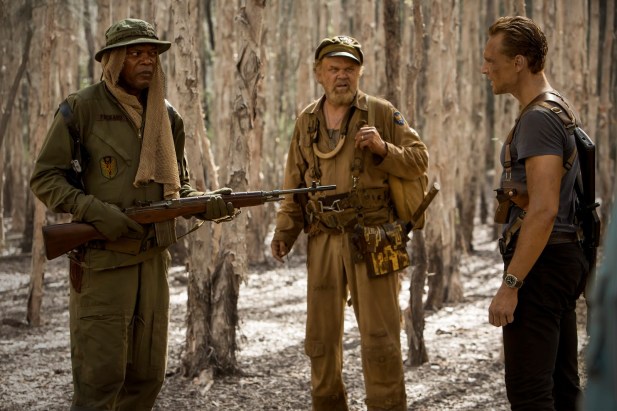
Those ill-fated visitors include a team of surveyors, a military escort fresh from Vietnam, and a few scientists from Monarch (the secret monster-studying organization from Godzilla), all led by the shady desire of Bill Randa (John Goodman) to explore the newly discovered Skull Island. There are plenty of big names here, from Goodman to Tom Hiddleston’s manly tracker to Brie Larson’s intrepid photojournalist to Samuel L. Jackson’s overly devoted army commander, boasting plenty of Jacksonian intensity. In addition, the Vietnam War-era setting warrants a great soundtrack of 1970s rock staples that make the team assembly of the first half quite enjoyable and promising. And when we actually see Kong himself, skyscraper-sized and none too happy about the unwanted guests and their explosives, it’s an action-packed debut that reminds us how frightening a giant gorilla can be.
Yet as the film wears on, and the dangers of Skull Island make themselves known, it becomes clear that this is less of an adventure movie and more of a CGI-laden horror film. Oversized creatures take out redshirt after redshirt, often in gruesome ways, until the only source of mystery is who’s going to be on the menu next. By the time one unsuspecting fellow was carried off by lizard birds and torn apart in silhouette, my VC had had enough of the carnage and didn’t want to keep watching. It might help if the characters had some meat to them (literal or otherwise), but they’re really only there as potential beast fodder, even Hiddleston and Larson whose roles are clearly main character material yet don’t really go anywhere. It was also annoying that the military immediately makes the stupid decision in these films of “shoot the giant monster” instead of retreating, like any sensible person would in that situation.
There are bright spots. John C. Reilly livens up the cast significantly as a castaway stranded on the island since World War II, offering some good heart and humor and exposition for the island’s inhabitants, including a tribe of natives much more sympathetically depicted than in past versions. The big battles with Kong are also CGI wonders, perhaps not on par with Peter Jackson’s triple T. Rex fight but still marvelous to watch.
Despite the relatively positive reviews for both Godzilla and Kong: Skull Island, I’m still not sold on this MonsterVerse franchise. The monsters created are well visualized with properly awesome action, but the human characters are thin as paper. It’s not a good sign when the scene played during the end credits has more human interest than the whole rest of the film. And I have other questions, like “How are Kong and Godzilla supposed to battle when Godzilla is still much bigger?” or “Will it turn out the same as the 1962 Japanese version of King Kong vs. Godzilla?” or “Will none of the surviving characters from Skull Island return, considering they will have aged between the ‘70s and the modern-day time frame of Godzilla?” Basically, Kong: Skull Island is about a bunch of people who go to an island, and a lot of them die. There has to be more than that for me to care.
Best (and most ironic) line: (Randa, as hippies in D.C. protest the war) “Mark my words. There’ll never be a more screwed up time in Washington.”
Sometimes old houses are just empty shells,
Still mourning their past occupier’s farewells,
But sometimes you feel something sinister dwells
In ramshackle relics and haunted hotels.
The dust and mistrust of these dark citadels
We try to ignore, but their menace compels.
Who knows what nightmares and nefarious spells
Can lurk in old homes with their own private hells?
__________________
MPAA rating: PG
Halloween is almost upon us yet again, and since I don’t really celebrate it (except with more candy than usual), I haven’t done much this month in honor of everyone’s favorite scary holiday. However, I think I’ll change that and do what I did last year, four horror reviews in a row leading up to the big day, when I will no doubt contribute to the great November candy shortage of 2017. As with last year (when I reviewed Abbott and Costello Meet Frankenstein, The House That Dripped Blood, Poltergeist, and The Babadook), each of my picks will fit roughly into a different era of horror and will try to buck my wussy aversion to the genre.
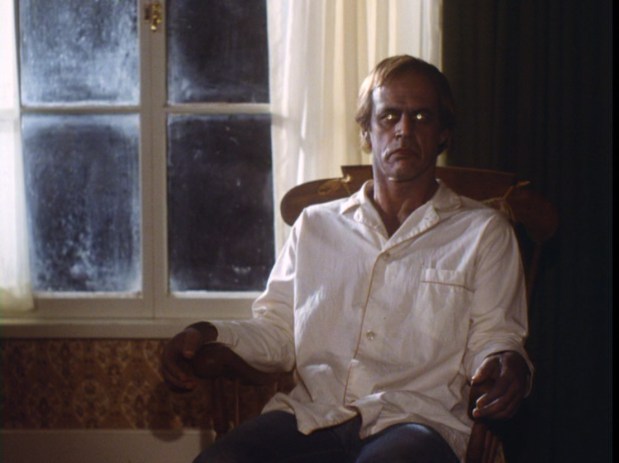
First off is the 1979 television adaptation of Stephen King’s Salem’s Lot, something my VC urged me not to see because she recalls it with such terror (probably like me and that clown scene in Poltergeist). I still did, of course, and found it to be quite the credible frightfest, although in a dated way. There are scenes that I could see causing nightmares, but compared with modern horrors like The Babadook, I don’t expect Salem’s Lot to keep me up at night. Still, as far as vampire flicks go, this one hits all the right beats, and I could see how it has influenced the genre since, particularly the glowing eyes and the antler scene in The Lost Boys.
Salem’s Lot is set in Maine and the main character Ben Mears (David Soul) is a writer, which is so unlike Stephen King’s work that I don’t know where to begin! In all seriousness, though, Salem’s Lot is very King-y, from those trademarks of his I mentioned to the idea of a dark evil lurking in a sleepy small town. In fact, it’s very much like It, with Pennywise being replaced by incoming vampires as the protagonists wise up to what’s going on and set out to stop it.
Directed by Tobe Hooper of Poltergeist and The Texas Chain Saw Massacre, the three-hour miniseries does a fine job at establishing its large cast of suckable characters: the visiting writer who used to live in Salem’s Lot, the girl who falls for him after one date (Bonnie Bedelia), her doctor father (Ed Flanders), the sinister old man who just bought the local mansion of evil (James Mason), the realtor (Fred Willard), his mistress (Julie Cobb), her jealous husband (George Dzundza), the boy who loves scary stuff (Lance Kerwin), the cemetery keeper (Geoffrey Lewis), and quite a few more besides. It was rather fun playing “Spot the Familiar Face” as I watched, such as recognizing the constable as Kenneth McMillan, who played the gross Harkonnen villain in Dune. It was also good to see Ed Flanders from St. Elsewhere, and his co-star Bonnie Bartlett playing his wife, though she was William Daniels’ wife on the show. James Mason is particularly well-cast as Straker, the forboding newcomer to Salem’s Lot, who you just know has a vampire tucked away somewhere, like maybe in that moving box.
As I said, the horror is a bit dated but still effective, pervaded by a nicely creepy atmosphere and punctuated by periodic jump scares. As with horror in general, it also has its fair share of supernatural foolishness, like allowing inside a fanged loved one floating outside your window or waiting till late afternoon to storm a vampire’s fortress. I thought too that there would be more to Mears’ backstory and his distrust of the Marston house, but that’s never elucidated. There were also a few lapses in the storytelling, or at least questions. Some excellent early tension is wrung from the cheating realtor’s subplot, but when one character is killed, the other two just drop out of the story entirely. The fates of several other characters are left vague as well, as are the circumstances behind the love story’s “resolution.” I’m sure these details are probably better explained in the book, but the miniseries could have clarified them better. I also don’t think it should have started with a flash-forward because that immediately let me know which characters would survive.
Even so, Salem’s Lot is a compelling King story that may not have a lot of story surprises but still spooks with its vampire mythos and general creepiness. The appearance of the main vampire is particularly menacing, clearly inspired by Nosferatu, though I understand that’s a departure from King’s book. I’m by no means an expert on Stephen King adaptations, but Salem’s Lot seemed to do him justice.
Best line: (Straker) “You’ll enjoy Mr. Barlow. And he’ll enjoy you.”
Is life not a game
Where there’s no one to blame
If the rules seem unfair
And the ends are the same?
You’re tempted to quit,
Raise your hands in forfeit,
For the game doesn’t care
Where the losers will sit.
But wait! None will mind
The misfits of mankind,
For the arrogant player
Is conveniently blind.
Who heeds the has-been
When his triumphs begin?
Those who haven’t a prayer
In the game can still win.
_____________________
MPAA rating: PG-13
Although I’ve come to really enjoy anime movies over the last several years, I’d never seen an anime film in the theater. Thus, it was a special treat to see No Game No Life: Zero on the big screen, especially with it being such a visually spectacular film. After being impressed by the trailers for months before its July opening in Japan, I thought for sure I’d have to wait perhaps a year before I’d get to see an American release, so I’m grateful to Sentai Filmworks and Fathom Events for distributing the English dub so quickly.
I wouldn’t doubt that non-anime fans have no idea what No Game No Life is. It’s a series of Japanese light novels, but most in the West would know it from the anime adaptation that is surprisingly popular for having only a single twelve-episode season. It centers on the gaming prowess of eighteen-year-old Sora and his eleven-year-old stepsister Shiro, two genius-level shut-ins who are transported by the god of games Tet to a fantasy world where all conflicts are decided by wagering on games of any kind. Humanity (known as Imanity in this world) is the lowest and least powerful of all the fantasy races, so Sora and Shiro take it upon themselves to lift up the humans and conquer the world through the likes of chess, word chain, and first-person shooters. Just as WarGames fans say “Shall we play a game?”, No Game No Life fans say “Aschente,” the mutual pledge before starting a game.
The show itself is played mainly for laughs and to marvel at the Sherlock-level strategy and foresight the siblings command even when at a disadvantage, but it boasts a broader fantasy appeal too, especially with unseen backstory about a horrific war that only ended when Tet became god and made the world game-centric. The characters and situations are quite entertaining for the most part, though No Game No Life isn’t among my favorite series for one simple reason: fan service. There’s plenty of sexual harassment, near-nudity, and risqué humor, mainly from Sora, and while much of it is funny, a lot is just uncomfortable and annoying. Plus, I’m not usually a fan of the kind of anime with silly faces and exaggerated reactions (I know that’s the majority of anime), which is why I lean more toward dramatic series or movies, which are usually easier to take seriously.
That’s why I was so eager to see No Game No Life: Zero, a film centering on an extended flashback of the pre-Tet war, a subject which lends itself to much more drama and emotion, and indeed the film is a complete contrast from the humorous tone of the series. (By the way, the Zero in the title seems to be an example of the naming convention for works that are connected yet somehow separate from an established series [e.g. Fate/Zero, Steins;Gate 0, etc.].) No Game No Life is notable, and sometimes disliked, for its hypersaturated colors, boasting more bright hues than a Crayola factory, and while the movie retains the same style, it limits its palette more to complement the darker storyline. Instead of the shiny fantasy land into which Sora and Shiro are literally dropped, this war-torn world 6000 years earlier is dominated by reddened skies and skin-burning ash, leaving no doubt as to humanity’s desperation, caught in the crossfire between the more powerful magical races. Just look at the contrast between the worlds below, the first from the show, the second from the film.
Although there’s still a lot left unseen, the film wonderfully expands our knowledge of the war, showing us why the modern-day races still hate each other. Jibril, an immortal angel-like creature called a Flugel, was one of the best characters on the show, conceited and charming at the same time, but her appearance in the film fits the description of an “angel of death,” proving that those memories of slaughter she fondly reminisces about in the show were not exaggerated. The film also intentionally echoes the series with its “new” character designs. Riku, the leader of the remaining humans, looks a lot like Sora, just as Shuvi, an Ex Machina android intent on learning the value of the human heart, looks much like Shiro. (They’re even voiced by the same voice actors in the excellent English dub that I saw.) The main design difference may be that their hair colors are reversed, but these new characters have their own personalities and griefs that set them apart from their later incarnations, and instead of a brother and sister relationship, theirs is destined for love. I will say it takes a certain amount of disconnect from the series to accept a romance between two characters who look like the siblings we know, but the film spends a good amount of time developing their relationship, even if it starts on a very awkward note.
The trailers mainly focused on the romance angle and an epic fight between Shuvi and Jibril, but I was glad to see that the movie does explain the war’s formerly vague resolution. Instead of the explicit games of the series, the game concept, along with humanity’s struggle, becomes more of a running theme as the characters engage in a literal game of “Global Thermonuclear War.” Some have complained about the pacing of the movie’s final third, but that’s where I thought it truly found its stride and consistently impressed. I loved the way victory is snatched from apparent defeat, utilizing the fact that the Ex Machina are a lot like the Borg from Star Trek, and the sad circumstances became sublimely bittersweet by the end. It spoke to how the most important people in history often remain unsung heroes, their names sometimes only remembered by God.
No Game No Life: Zero was a pleasure to watch in the theater, especially because it elevated the series it was based on, focusing on the fantasy with just a taste of the original’s humor and chucking the unnecessary fan service. (There’s still some stylized nudity, but it’s more forgivable here.) The animation is particularly stunning, especially during that epic battle I mentioned, and the score beautifully enhanced the emotions of each scene, with the lovely ending theme “There Is a Reason” earning entrance into my End Credits Song Hall of Fame. By the end, as the film tied itself directly into where the series left off, I even found myself feeling surprisingly nostalgic and fond for a show I thought I only moderately liked. Many think this film is a prelude for a potential second season, and the movie will certainly strengthen that hope. No Game No Life may be a series I wouldn’t quite recommend to everyone, but, with the right background information, this movie is. (By the way, I’ve included the first teaser trailer down below to give a taste of the awesome animation and music.)
Best line: (Riku) “Yes, humans are fools, but it takes a great fool to not let that foolishness get themselves killed.”
Shall I sit here all alone
And wait for death to call me home?
Now that I am stranded here,
Have worth and meaning flown?
Shall I push uphill my stone
And watch it roll back down and groan
And wish that life had chanced to veer
Somewhere less sorrow-prone?
Perhaps I’ll work myself to bone
And die unloved and thus unknown,
But if somebody could appear
And comfort give to persevere,
I’d gladly bear my daily stone
With one to call my own.
_________________
MPAA rating: PG
This review is my contribution to the Colours Blogathon hosted by Catherine of Thoughts All Sorts, focusing on all manner of movies with colorful titles. I chose The Red Turtle not only for the color in its name, but because I was curious about this feature-length silent film that earned an Oscar nomination for Best Animated Feature when Your Namedidn’t. Now that I’ve seen it, I completely agree that it deserved such an honor because this story of a shipwrecked man stranded on an island is a piece of cinematic art. So many cartoons these days rely on hyperactive humor that something like The Red Turtle is an anomalous reminder that animation can offer compelling stories without jokes or even words through simple mastery of the medium, allowing silence to make it universal.
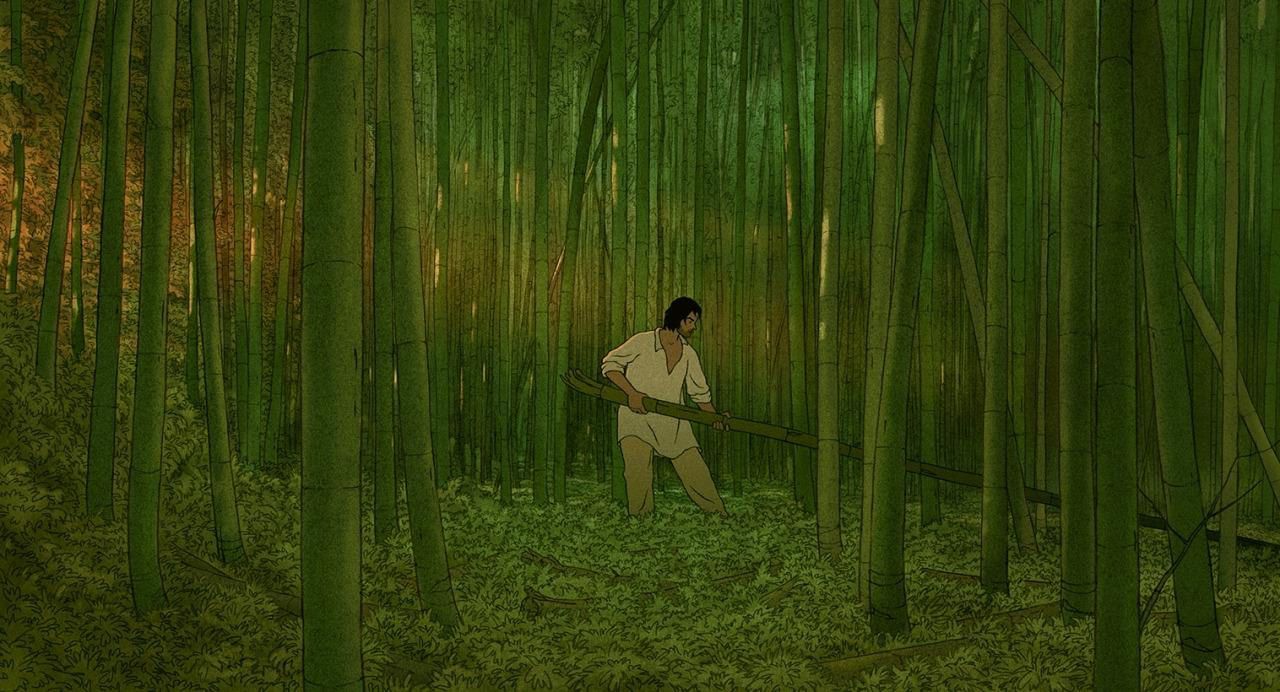
The beautifully simple animation is the product of a collaboration between Dutch director Michaël Dudok de Wit, winner of the 2001 Animated Short Film Oscar for the lovely Father and Daughter, and the not-yet-defunct Studio Ghibli. I’m still surprised at Ghibli’s involvement because The Red Turtle has no resemblance to anime, except maybe in the attention to natural detail, yet I’m reminded that anime is not limited by the usual big-eyed style. The Oscar-winning short film La Maison en Petits Cubes has a European aesthetic similar to The Red Turtle, but, despite the French name, it was a Japanese production. So you could say that The Red Turtle is a best of both worlds, combining the visual imaginations of its animators in a surprisingly accessible, almost watercolor style.
Silent animation is usually the realm of short films, and it must have been a risk to protract what could have been vastly shortened to a feature-length story. Those with short attention spans will likely be bored by the third raft-making attempt, but the patient should find the narrative rewarding in its ambiguity. As with Cast Away, actions speak louder than words, and the painterly animation is so superb in its simplicity that I was rarely bored. It’s all in the details, like the humorous characterization of the crabs watching the man’s efforts or the lush island greenery swaying in the breeze, and the realistic water is worth particular praise, whether serene on the horizon or violent in its outbursts.
I don’t want to say much about the actual plot since it’s best experienced with the intended visuals to tell the story, but it very much fits its description as a fable, a seemingly straightforward tale that can be appreciated on its surface or on a deeper, more symbolic level. The Red Turtle itself remains something of an enigma, even as it becomes a profoundly important part of the castaway’s life, infusing the film and its ending with a bittersweet emotion that is strongly felt, if not fully understood.
So, yes, The Red Turtle is absolutely Oscar-worthy and, if not for last year’s hefty competition, might well have won. Why couldn’t a film like this come out in 2006 or 2011, when Disney/Pixar wasn’t a shoo-in? I suppose I can now turn my blame on My Life as a Zucchini (the only nominee I haven’t yet seen) for Your Name’s lack of nomination last year because The Red Turtle is more than deserving. Despite its slow narrative that could have been a short film, it’s a piece of modern art that is becoming rarer and rarer in the world of feature-length animation.
Dreams in the night
Carry darkness or light
Into minds at the height of their delicacy.
Deep in our slumber,
Charades without number
Parade through our heads, entertainment for free.
They charm us and threaten
With visions they let in,
But who holds the keys to such reveries sown?
What nightmare dimensions
With clashing intentions
Have displaced our thoughts with ideas of their own?
____________________
MPAA rating: Not Rated (should be R, mainly for language)
After ranking Ink at #11 on my Top Twelve Underrated Movies, I thought I should give this low-budget cult hit a full-fledged review. Written and directed by independent auteur Jamin Winans, Ink is so many things at once that it’s hard to classify it. It’s a fantasy about the clashes between invisible forces of good and evil. It’s a redemption tale of a father returning to his estranged daughter’s life. It’s a visually inventive head trip following a monster’s kidnapping of a girl’s soul. How it merges all these disparate components into a mostly cohesive and surprisingly meaningful whole is quite the experience, one that doesn’t let its budget limitations hinder it too much.
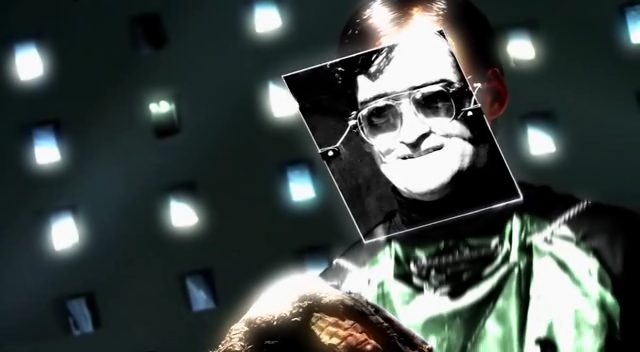
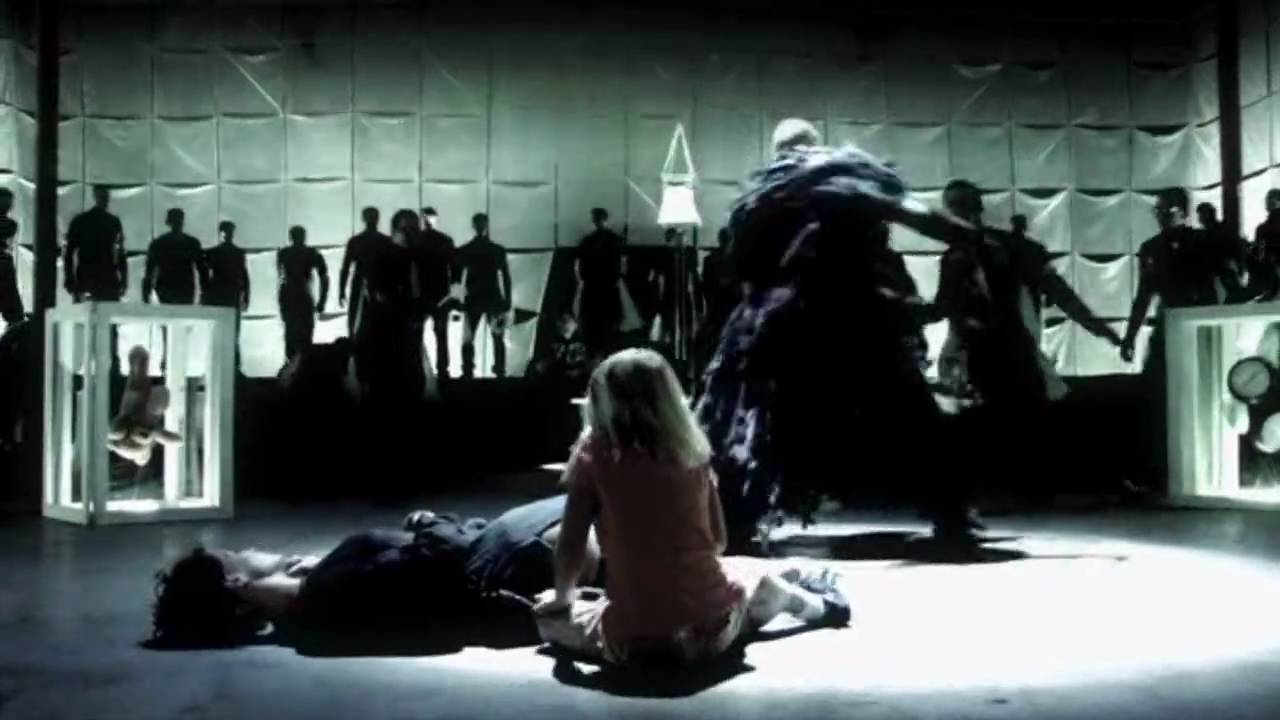
Chris Kelly plays John Sullivan, the father I mentioned, whose wife’s death caused him to lose contact with his daughter Emma (Quinn Hunchar), whom he kept at arm’s length even when they were together. Bitter, he throws himself into his work, not even caring when she later falls into a coma. This side of the story is fairly down-to-earth, but the reason for Emma’s coma goes off into an ever more ambitious dark fantasy. For starters, there are Storytellers, invisible spirits who disseminate sweet dreams like the Sandman from Rise of the Guardians, and Incubi, creepy screen-faced baddies who plant disturbing nightmares. Amidst this nightly battle, a hulking creature named Ink dressed in black rags steals Emma, or rather her spirit, from her bed and plans to trade her to the Incubi.
On one hand, you can tell it’s a low-budget production. The camerawork lacks the Hollywood polish we’ve come to expect, and some of the effects look like they’re from a Disney Channel movie. Yet the film continually manages to impress where it counts. For example, Ink’s initial confrontation with the Storytellers trying to save Emma has some amazingly well-choreographed action, with the unique twist of time rewinding to return every smashed object to its original condition. This is the spirit world, after all. Likewise, the editing ranges from overly jerky at times to downright brilliant during an exceptional scene where an eccentric “Pathfinder” (Jeremy Make) creates an unforeseen chain reaction that ties in to an earlier scene. It reminded me a lot of that sequence from The Curious Case of Benjamin Button where the narrator describes all the little cause-and-effects that brought about an accident.
Sadly, Ink is occasionally spoiled by some strong language, mostly from Chris Kelly (his first line is a tantrum of F-bombs), and I do feel it could earn a wider audience without it since the rest is grim but not overly objectionable. I also thought a few characters were trying too hard to be eccentric at times. Plus, a certain revelation might bend time and minds a bit too much to make total sense, but it’s a twist that has kept me thinking since and adds enormous layers to the film’s narrative.
I don’t know how Jamin Winans views God and religion since they’re never explicitly brought up here, though his next film The Frame seems to regard God as an absentee controller. Yet, there are several scenes in Ink that hold strong spiritual meaning, especially the Best Line below that seems to sum up how God sees his broken creation. The Storytellers are easily compared to angels as well, as the Incubi are to demons whispering hate and pride into people’s minds, and I loved a climactic scene toward the end that switches back and forth between the calm mortal world that John sees and an intense, invisible battle happening all around him. I wouldn’t doubt such unknown struggles happen every day between good and evil.
Oh, yeah, how could I forget the reason I discovered Ink, namely its moving score by Winans himself, which I heard in a collection of movie soundtracks. It’s a perfect atmospheric accompaniment to the film and its emotion, and one notable track called “The City Surf” was even sampled as “Into the Fray” in the film The Grey. As I said, Ink’s plot has multiple layers to peel back, ranging from flashbacks to metaphors and symbols to varying the level of color depending on the world shown, all of which add up to a profound reflection on life, death, and regret. It’s a film that sticks in the mind long after it’s over, which has understandably earned it a 100% on Rotten Tomatoes. It’s clever and well-crafted proof of the potential of indie filmmaking, causing me to wish that it had the overall technical quality to match its ambition. I’ve said it before, but someone get Winans a bigger budget!
Best line: (Ink) “I am ruined, why can’t you see that?” (Liev, a Storyteller) “Because I choose to see you for what you were intended to be, not what you’ve become.”
That jolly ol’ Darby O’Gill
At the pub would be drinking his fill,
Earning chuckles and yawns
Telling of leprechauns,
Half-believed out of simple good will.
Not caring what doubters may think,
Darby’d go home at last with a wink,
To natter and sing
With the leprechaun king,
And together they too shared a drink.
_________________
MPAA rating: G
Live-action Disney movies tend to fall into two categories: childhood-shaping classics (Mary Poppins, Homeward Bound, Swiss Family Robinson) and severely lame duds (The Shaggy Dog, The Million Dollar Duck, The Computer Wore Tennis Shoes). I wasn’t sure which one Darby O’Gill and the Little People would fit in, but I’d gladly place it in the first group, though I doubt this obscure little gem is shaping many childhoods nowadays.
Apparently based on two books by Herminie Templeton Kavanagh, Darby O’Gill feels as genuinely Irish as The Quiet Man but with a more fantastical basis in Irish folklore. Albert Sharpe is a folksy joy as Darby, a good ol’ boy and father of young Katie (Janet Munro of Swiss Family Robinson) in the town of Rathcullen, who loves to recount his stories of leprechaun interactions with everyone at the local pub. They may only half-believe him, but he’s still a beloved member of the community, which sticks up for him against the mocking of the local brute Pony Sugrue (Kieron Moore), who reminded me a lot of Gaston in Beauty and the Beast, just as Darby is like a more respected version of Maurice. After his job is handed off to a younger man (Sean Connery, so young he barely looks or sounds like the Connery I know), Darby has another run-in with the king of the leprechauns Brian Connors (Jimmy O’Dea) and finagles three wishes that might not turn out as he’d hoped.
Darby O’Gill and the Little People has a lot of the charm of other Disney movies from that era, just with a healthy Irish zest that makes you want to dance a jig and crave shepherd’s pie. At times, the Irish brogues are a little thick to fully understand without subtitles, but for the most part, it adds to the authenticity, as does the music, which consists only of a sweet little ballad and an epic but slightly overlong fiddle dance. The special effects, for the most part, are also well-done, consisting mostly of shrinking the leprechauns to be only as tall as Darby’s knees, a visual trick that reminded me of the miniaturized hobbits in The Lord of the Rings. Also effective is the more dated creation of a ghostly banshee and death-coach-driving dullahan; Disney movies have their fair share of nightmare fuel, but I can easily see one scene in particular terrifying the very young.
Most people may not have seen or even heard of Darby O’Gill and the Little People, but that’s a bit of a shame. Where else can you get to see Sean Connery croon about his sweetheart? I especially liked the good-natured rivalry between Darby and Brian and the twist at the end that builds nicely on what came before and rounds it out for a satisfying end. If it were a modern movie, I’d say that Darby O’Gill doesn’t quite do enough with its fanciful concept, perhaps because the special effects could be better utilized, but as an Irish jaunt from yesteryear, it’s an underrated Disney classic that may well have earned placement on my List if I’d seen it as a kid.
Best line: (Darby, of his daughter Katie) “She should be the caretaker. She’s got a tongue would clip a hedge.”
















 Rhyme and Reason