(I’m catching up after the fact, but for Day 15 of NaPoWriMo, the prompt was for a six-line poem characterized by simple language and enthusiasm, so I focused on the film itself this time.)
I played the games when I was young. I guess I’ll go watch the movie. Looks fun. It’s not as if I’ve been waiting for this, But all my friends saw it. I don’t want to miss The tragic backstory, Jim Carrey’s full glory, ooh, that scene was peak! Shut up, I’m no geek…. ______________________
MPA rating: PG
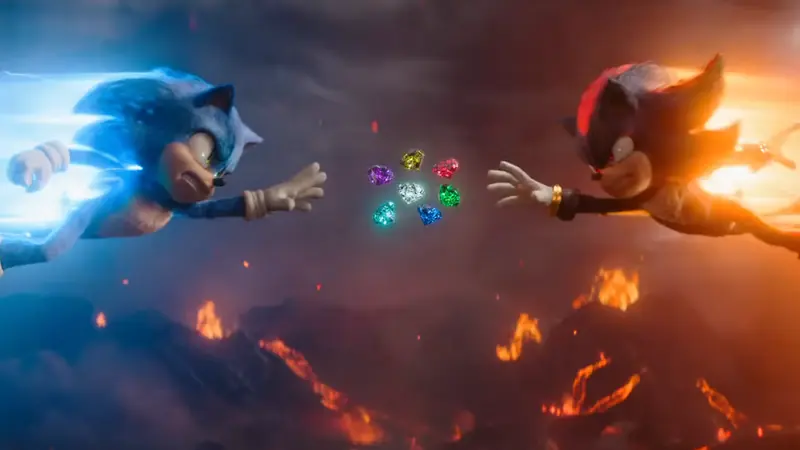
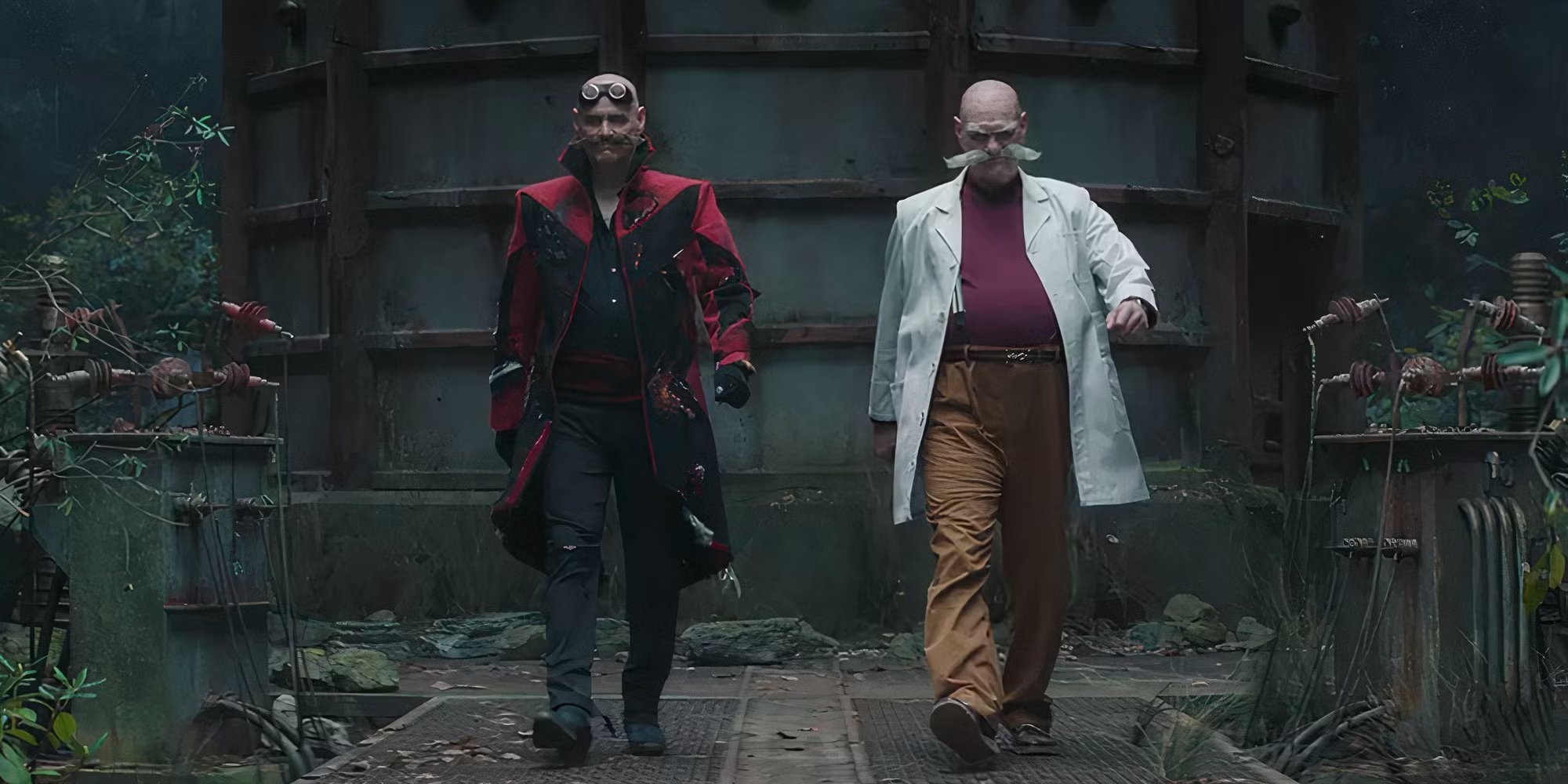
It honestly feels like a minor miracle that the Sonic the Hedgehog franchise has translated to the big screen as well as it has. It seemed as if it would be a bomb on arrival after the poorly received initial design for the title character, but three live-action movies and a streaming show later, it’s proven to be remarkably fun. In this third outing (did I never review the sequel? Guess not.), a powerful black and red hedgehog called Shadow (Keanu Reeves) is freed from decades-long imprisonment and embarks on a spree of vengeance, leading Sonic (Ben Schwartz), Tails (Colleen O’Shaughnessey), and Knuckles (Idris Elba) to team with the non-shockingly not dead Dr. Robotnik (Jim Carrey) to bring him down.
While the Knuckles series got rather dumb as it dragged out, the movies have found the right secret sauce for Team Sonic, with Sonic’s quippy super-speed antics bouncing well off of Tails’ earnest tech support and Knuckles’ headstrong aggression. Add in a self-serious straight man in the form of Shadow, a villain very much in the mold of Mewtwo from Pokémon, and the film is able to find a surprising balance between silly action and emotional stakes. It also helps that James Marsden and Tika Sumpter as Sonic’s adoptive parents are given more to do this time, while Jim Carrey pulls eccentric double duty as both the returning mad scientist Ivo Robotnik and his even madder grandfather Gerald.
Sonic the Hedgehog 3 gives every indication that this franchise has the potential to keep getting better, with yet another character from the games teased at the end for a sequel. One dance scene between the Robotniks will no doubt go down as one of Carrey’s finest and most hilarious moments and well worth his return from retirement. And though there’s nothing revolutionary about the plot or themes, the overall entertainment value makes this a film to please nostalgic nerds and present kids alike.
Best line: (Shadow) “The light shines, even though the star is gone.”
(For Day 28 of NaPoWriMo, the prompt was for a poem about “music at a ceremony or event of some kind,” like for instance a birthday.)
“Happy Birthday!” everyone sang. The sound of unity in my ears rang. Everyone loved me, at least for a song That needed more verses to feel at all long, And oh, how I wished, as the candles were blown, That mom would stop yelling and put down her phone And dad would stop cursing and pointing his finger, That both would just stay as a smiling singer And love me enough to not hate one another. Not too much to ask for a father and mother. I knew what would happen but blew all the same. Then maybe the candles would carry the blame. _____________________
MPA rating: PG
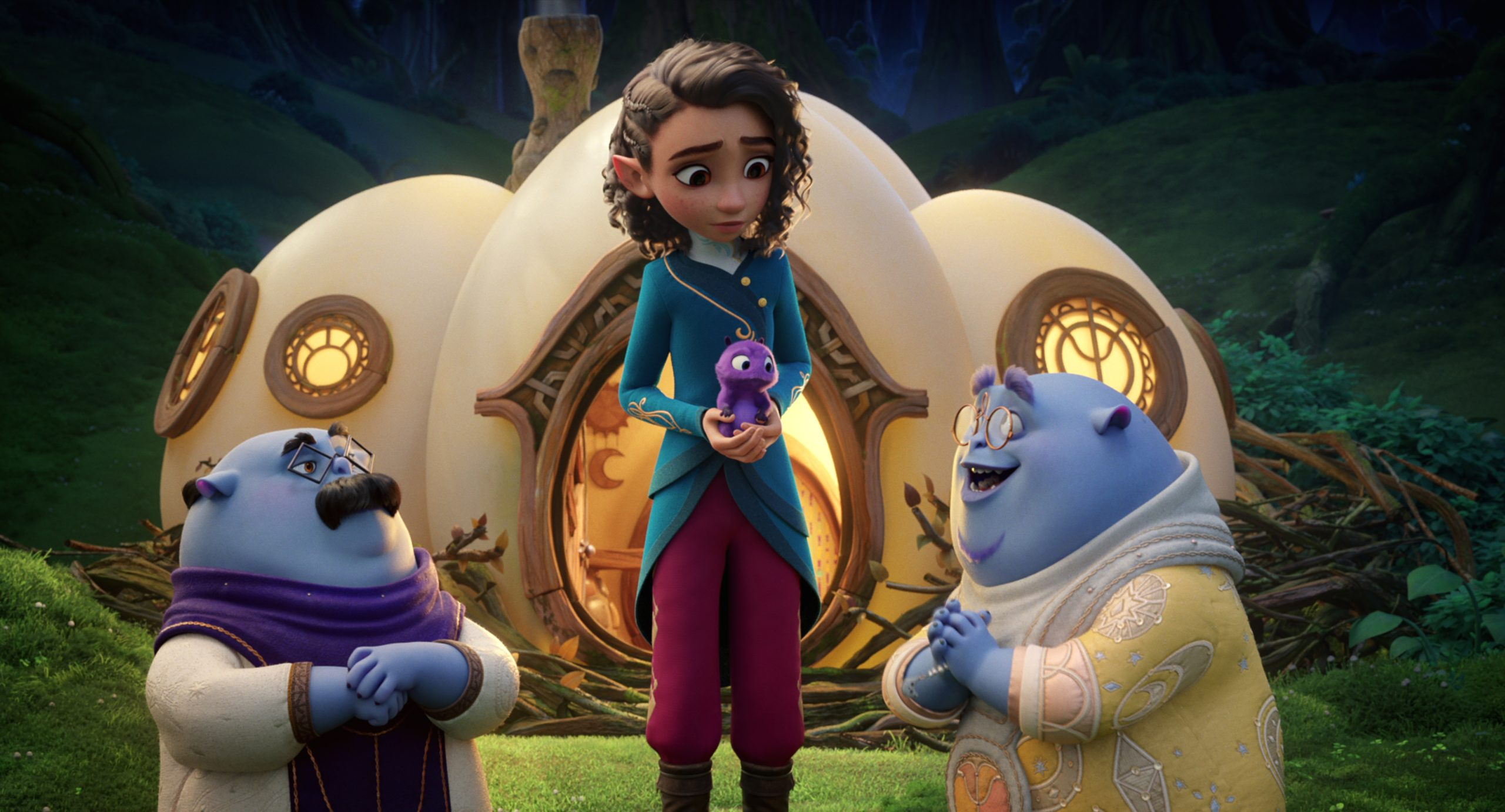
Sometimes a film so clearly wants to be like its predecessors that you have to at least admire the effort that went into its earnest attempt. Mary and the Witch’s Flower comes to mind in trying to live up to Studio Ghibli’s legacy, while Skydance Animation’s Spellbound aspires to be like the Disney princess musicals of yore. It certainly has a pedigree with producer John Lassiter, director Vicky Jenson of Shrek, and songs by the great Alan Menken. In it, Princess Ellian (Rachel Zegler) of the fantasy kingdom of Lumbria desperately tries to keep secret from the citizens that her royal parents (Javier Bardem, Nicole Kidman) have been transformed into animal-like monsters running amok in the palace. Seeking the help of two magical Oracles (Nathan Lane and Titus Burgess as an unspoken gay couple), Ellian takes her parents on a dangerous journey to transform them back to humans.
Spellbound has a lot of great ideas to its credit, particularly in the world-building, from a waterfall used as a massive gate to a desert that turns to quicksand under cloud shadows or a tunnel where sounds become projectiles. The songs are quite good too, though still don’t hold a candle to Menken’s best work, and the voice cast is on point, especially Zegler’s original spunky princess role and John Lithgow as her long-suffering adviser/sidekick.
But it’s hard to escape the feeling that Spellbound is a pale imitation that needed more fleshing out to avoid its own plot holes, like how the monster king and queen escape the palace when their cages are left open yet had been free to wander the palace for months before that. And then there’s the message that makes itself known rather late in the runtime, clarifying the monster situation as a metaphor for divorce and saying many of the right things for a resolution while not diving deep enough to make it land emotionally. Spellbound is a valiant effort, often funny, cute, and imaginative, but its muddled tone and oversimplified lesson keep it from rising to the level of its forerunners.
Best line: (Queen Ellsmere, to her daughter) “The best thing about us is you. And it always has been.”
(For Day 14 of NaPoWriMo, the prompt was for a poem describing a place in terms of the animals and natural sounds, so I thought of a certain humanless island from a recent animated film.)
The island was peaceful, no humans as kings, Serene with the sounds of dying things. Nature was spinning the circle of life That ends with a cry and then silence. The ocean was beating its breast on the rocks, As the yelp of a whelp and the laugh of a fox Echoed through trees as indifferent as death, So soothing (ignoring the violence).
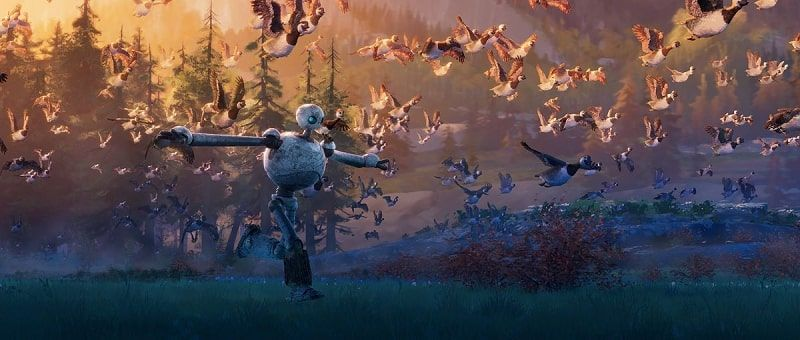
The geese were declaring their edge over ducks, The does were all teases outrunning the bucks, The woodpeckers gifted headaches to the squirrels, And nothing was likely to change. But then a new creature came, bringing new noises, The whirring of servos, the shock that a voice is, No fur and no feathers, just a fool metal jacket, A new kind of racket, exciting and strange. ________________________
MPA rating: PG
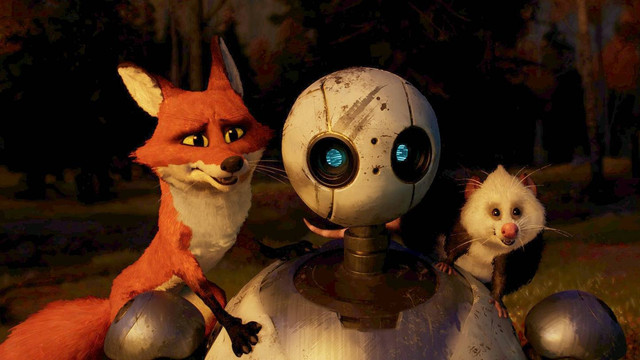
My favorite film of 2024, The Wild Robot is further proof that DreamWorks can match and even surpass Disney at its best. Based on a 2016 children’s novel by Peter Brown, the first in a trilogy, this animated adventure set in the future sees an unprogrammed robot, ROZZUM Unit 7134 or “Roz” (Lupita Nyong’o), wash up on an unpopulated island full of unfriendly wildlife. Seeking some meaningful service to offer, Roz stumbles into the care of a baby gosling eventually named Brightbill (Kit Connor), raising it with the aid of a crafty fox (Pedro Pascal) and gradually weaving herself into the ecosystem in a way none would have guessed.
The early scenes of Roz exploring the island, before she is able to communicate with the animals, bring to mind the beginning of WALL-E, near-wordless storytelling at its finest. And once she does make contact, the film is surprisingly candid about the dog-eat-dog nature of nature, slipping in some darker-than-expected humor for a kids movie. The film’s emotional core lies in Roz’s connection to Brightbill, a poignant bond of adoptive motherhood that is likely to draw out tears from the tenderhearted, especially when backed by Kris Bowers’ moving, instantly iconic score.
The animation is also a sheer joy to behold, a gorgeous watercolor style that puts other 3D animation to shame with its warmth and natural detail, and, although I quite enjoyed Flow too, it’s a crime that this didn’t win the Best Animated Feature Oscar. Nyong’o brings an excellent balance of robotic coolness and burgeoning emotion as the voice of Roz, while Pascal is a special delight as the wise-cracking fox she befriends. And did I mention the score? It still gives me goosebumps.
It’s true there’s nothing particularly new about The Wild Robot’s themes, borrowing from the likes of The Iron Giant and Wolf Children, and the latter half has some holes (the exciting climax feels a bit pointless by the end). But this fable of a robot learning humanity even without humans around is exceptionally well-crafted otherwise and will always hold a special place in my heart. I’m skeptical whether the planned sequel can match it, but I hope so.
Best line: (Roz) “Sometimes, to survive, we must become more than we were programmed to be.”
(For Day 12 of NaPoWriMo, the prompt was a doozy: a multi-section poem drawing from myths and legends featuring rhyme and mixed formal and informal language. So, with this film in mind, I mused on what to do if offered three wishes by a genie.)
Wish 1
To access wishes, surely I Must be in dire straits myself. Trapped within a tomb of stone Or stranded on an icy shelf, Marooned upon an isle alone Or chained in jail, condemned to die.
For my first wish, therefore, I must Escape the fate that brought me here, Wish myself above the ground Or make what threatens disappear, Unstuck, unbound, uncooked, undrowned, Ideally somewhere I can trust.
Wish 2
My second wish Depends on much.
Has the djinn at least been kind, Or left half of me behind?
Am I truly free from harm, Or acquired a new alarm?
Am I not falling from the sky With no faculty to fly?
Is my friend in peril somewhere? Do I like them enough to care?
Does the djinn insist on rules, Like no death or love or ghouls?
And, unlike the foolish herds, Am I careful with my words?
If yes to all above, Then I guess I’ll side with love For my friend who’s so in need And ensure they’re also freed. Aren’t I nice? I am indeed.
Wish 3
Assuming both my prior wishes Haven’t spiraled far awry, Now that I’m not about to die, I have an epic choice ahead.
The world is mine to seize and form. With but a wish, I’d gain renown, A merry harem, a sultan’s crown, A sorcerer or god instead.
In place of a dark lord or queen, The world will love me and despair! I’m kidding, no, I wouldn’t dare, But I have to end this with a bang.
Hypnosis, health, wisdom, wealth? Would they be subject to some twist? I wish I knew the perfect wish To satisfy me… dang. _________________________
MPA rating: Approved (a likely G)
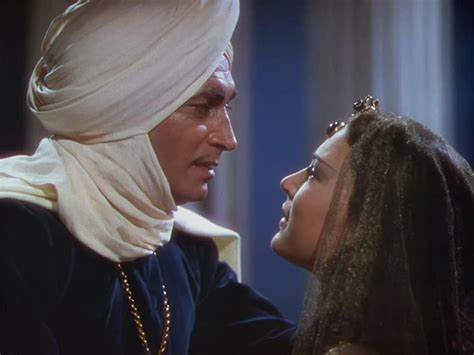
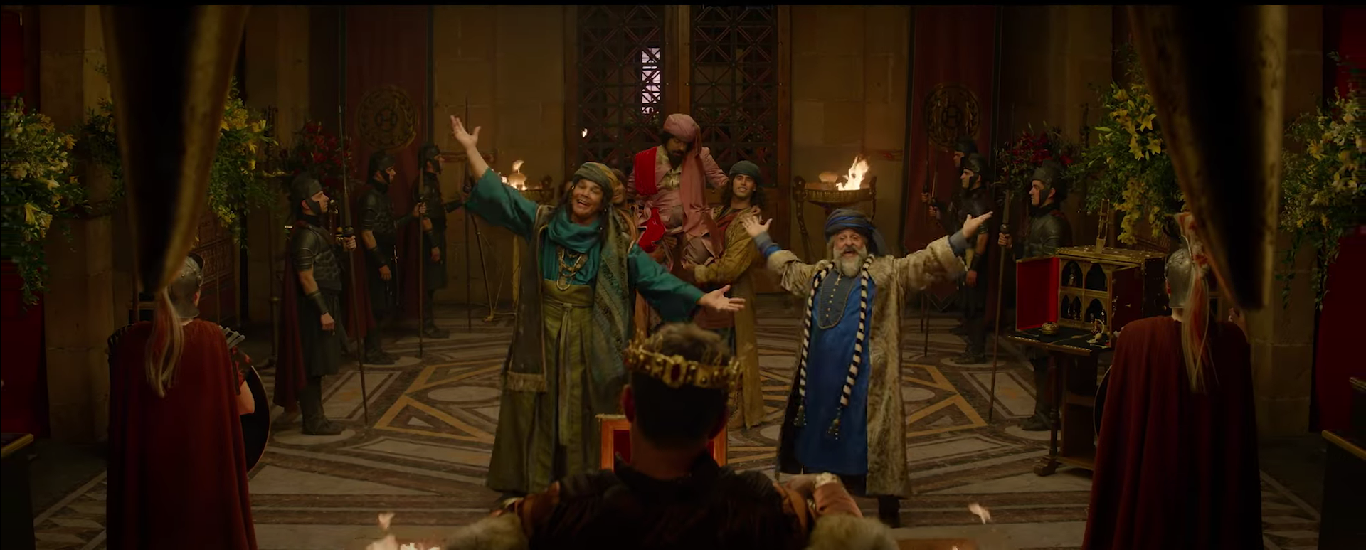
Having grown up with The Wizard of Oz, I’ve loved it from the start, viewing its dated or hokey elements as charming rather than a detraction, and I suspect the same would be true for The Thief of Bagdad, had it been an old childhood favorite as well. Boasting 100% on Rotten Tomatoes, this fantasy adventure draws elements from the One Thousand and One Nights to tell a partially non-linear tale of the betrayed Prince Ahmad of Bagdad (John Justin) and his wily friend/thief Abu (young Indian actor Sabu) as they fight against the evil vizier Jaffar (Conrad Veidt) and save a princess (June Duprez).
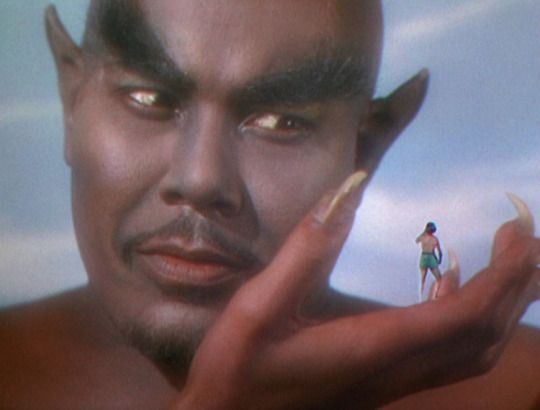
It was especially amusing to see how many aspects of Disney’s Aladdinwere borrowed directly from this film. Sharing a name with Aladdin’s monkey, Abu flees a crowd with stolen food in an early scene, instantly bringing to mind the opening number from the animated film. In addition, you have a vizier named Jaffar/Jafar, a weak-minded sultan (Miles Malleson) who loves toys and is looking to give his daughter in marriage, a sheltered royal sneaking out of the palace to mingle with the common folk, and a genie and magic carpet aiding the heroes. The Djinn/genie (Rex Ingram) is quite different, though, more malevolent and helping Abu grudgingly, and there are plenty of other differences to set it apart.
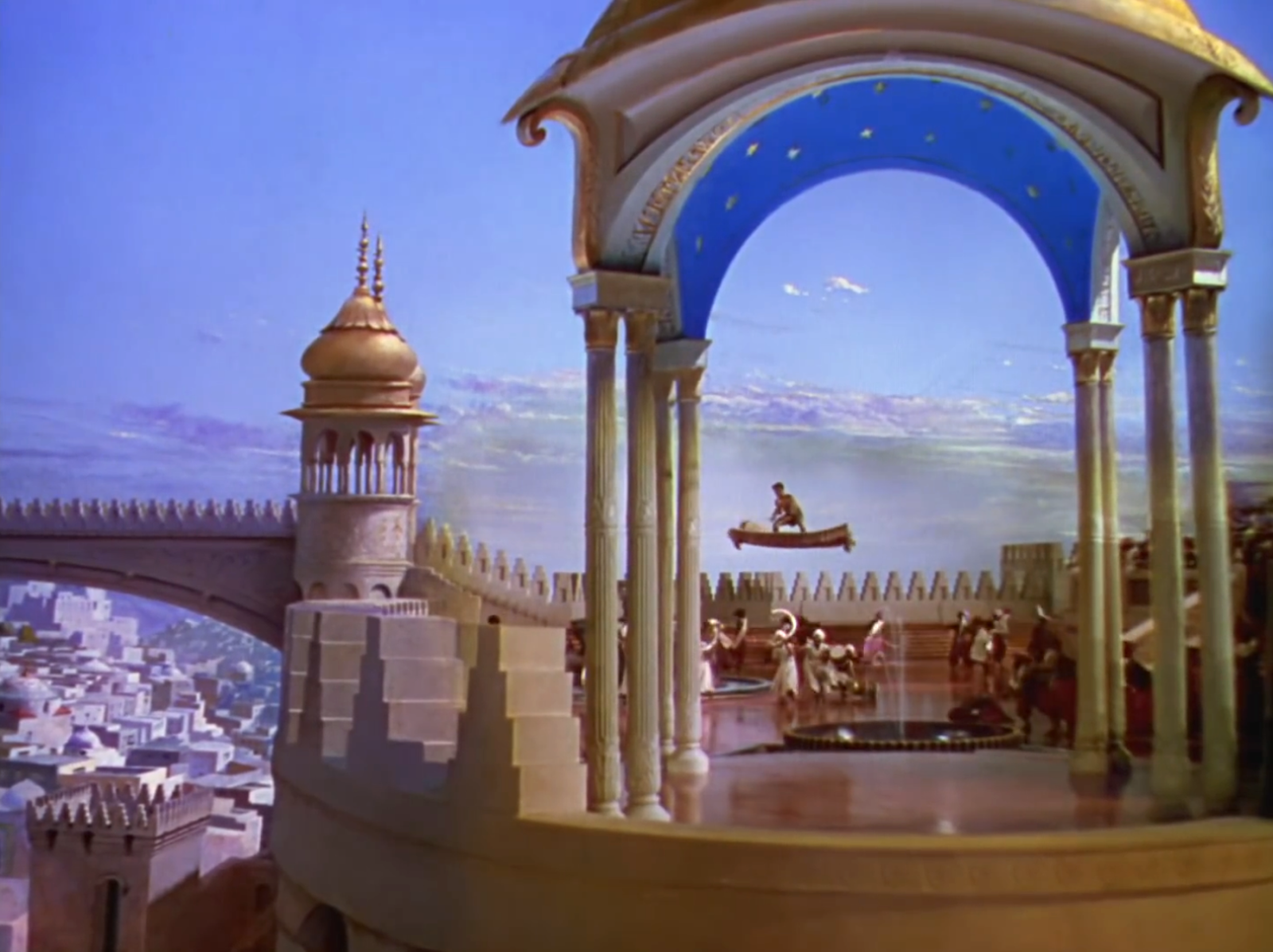
Sabu and Justin make an appealing heroic team, while Veidt has an excellent Vincent Price-like coldness that made him a popular villain actor at the time. Of course, it’s a bit odd that most of the main roles (save for Sabu) are clearly white actors surrounded by Middle Eastern extras and settings, but I suppose that’s just due to the time period. The sets and props really add to the world-building, and the film is known for pioneering the first use of bluescreen/greenscreen to place Sabu within the extravagant special effects sequences of the latter half. While The Thief of Bagdad starts off a bit awkwardly before the plot gets rolling, it’s a genre classic that deserves wider appreciation as an entertaining fantasy of Old Hollywood.
Best line: (the Djinn, to Abu) “You’re a clever little man, little master of the universe, but mortals are weak and frail. If their stomach speaks, they forget their brain. If their brain speaks, they forget their heart. And if their heart speaks [laughing], they forget everything.”
(For Day 1 of NaPoWriMo, the prompt was to use a new-to-me music or art term, so I opted for the film-appropriate term chroma – “the intensity of a given color.”)
I wonder sometimes what I can see That nobody else can. How would I know? How would you know? Isn’t it normal for such to be so? Isn’t it true we rely on our eyes To fill in the gaps that are left by the wise? What differs is mystery.
I wonder sometimes what I can hear That nobody else can. Could I be wrong? Is that a song? And is there someone who might sing along? If I can only hit half of the notes, Who hears the other half, voice in our throats? Maybe they’ll lend me an ear.
I wonder sometimes what I can try That nobody else can. What can I play? What can I say That’s more than a fact we agree on today? I have a private monopoly on The unwritten song, the image undrawn, And the chroma of my sky. _________________________________
MPA rating: PG
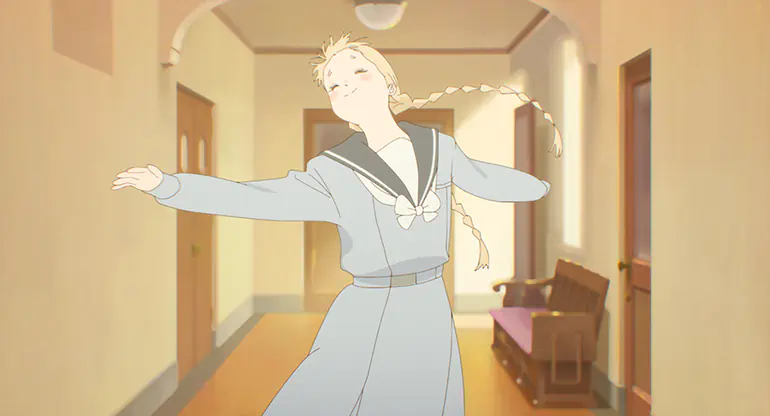
Considering how long we had to wait and catch up on anime films sometimes years after their release, it’s a special modern treat for fans like me to be able to see them in American theaters only months after their Japanese premiere, complete with a choice of English dub or subs. I caught the English dub of The Colors Within back in January, comparatively soon after its August 2024 release in Japan, and it did not disappoint. Directed by Naoko Yamada of A Silent Voice fame, this low-key high school drama is a gentle-hearted tribute to music’s power to foster friendship and self-discovery.
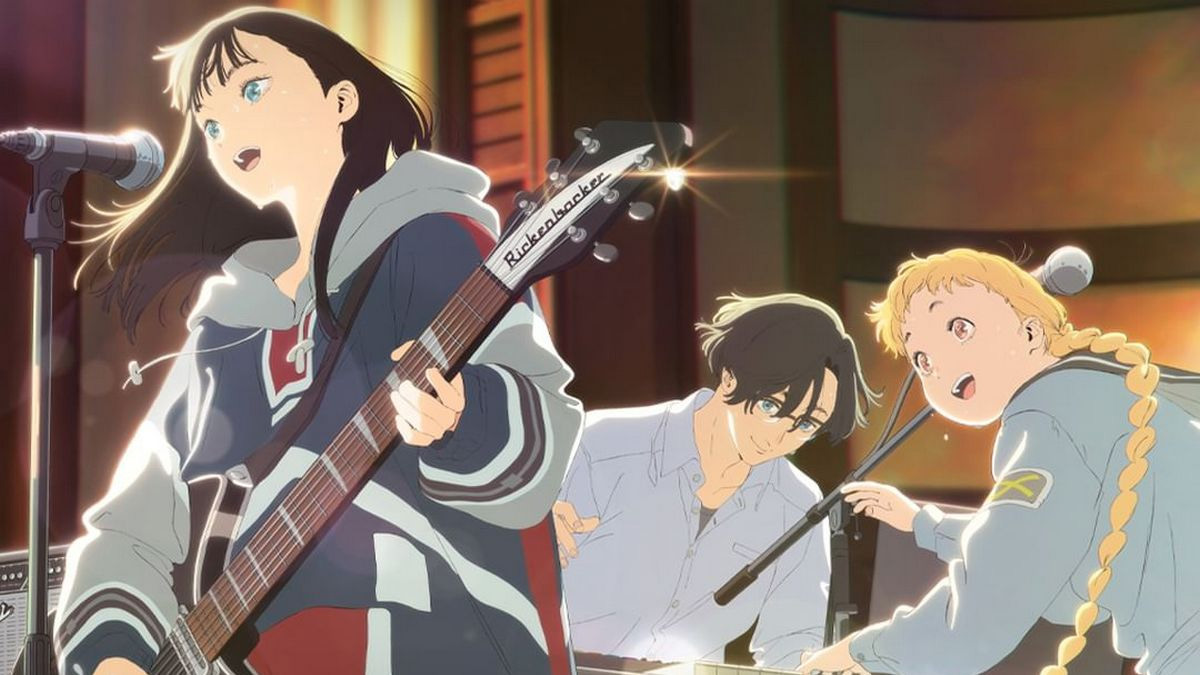
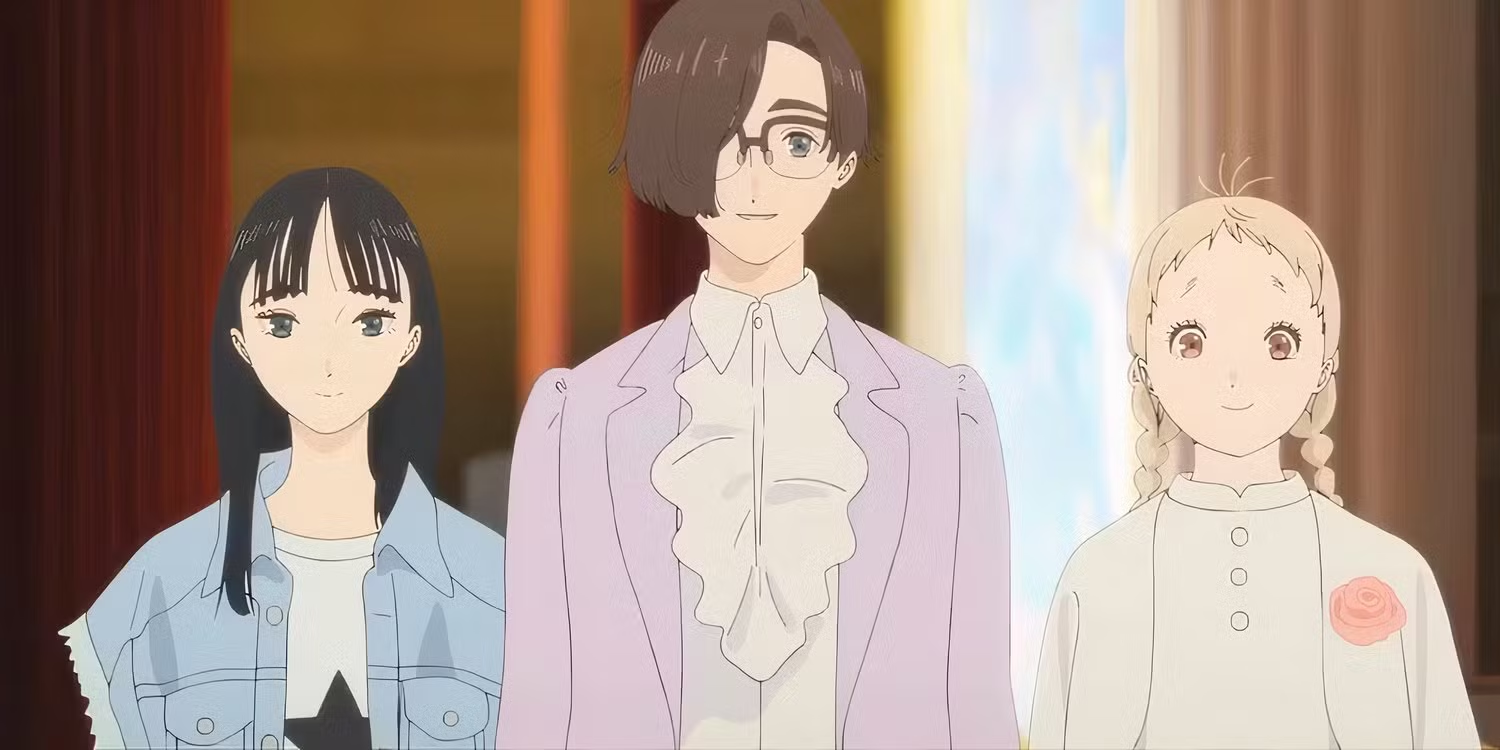
Set in a Catholic girls boarding school, the film follows ingenuous student Totsuko Higarashi, who experiences a visual synesthesia where she sees people in specific colors, often awestruck by an invisible beauty that no one else can appreciate. Drawn to an especially stunning blue coming from fellow student Kimi, Totsuko’s interest in her leads to the two stumbling into forming a band with a local boy and instrument collector named Rui. As the trio practice in secret and write their own songs, they endeavor to work through their individual personal and family struggles.
The Colors Within is a thoroughly sweet film, where the conflict stays at the level of contending with school rules and familial expectations, and there’s a special delight to be found in the creative joy the three teens derive from their simple musical ambitions. Totsuko’s wide-eyed experimentation with lyrics and notes and the collaboration of the three as they bond are enough to spark anyone’s curiosity to maybe start a band of their own (if only it was that easy). And the result of their teamwork is three outstanding songs, courtesy of musician Kensuke Ushio, two of them catchy pop tunes and one peaceful and ethereal. Going above and beyond, the excellent dub even translated the songs into English, with Kimi’s voice actor Kylie McNeill showcasing the singing chops she also brought to 2021’s Belle.
One unique element to The Colors Within is its earnest portrayal of Catholicism. Totsuko prays frequently and worries about going to confession after lying, Rui plays a moving rendition of the “Tantum ergo” on a theremin, and the nuns teaching at the girls’ school are largely presented as affectionate and supportive rather than strict caricatures. While not really a plot focus, it’s nice to see Christianity shown in a positive light as simply a part of the characters’ lives, even informing Totsuko’s song lyrics performed near the end.
As for the animation, director Yamada has traded in her prior collaborations with Kyoto Animation for the equally acclaimed studio Science Saru, known for highly dynamic animations like Ride Your Wave or last year’s hit series Dandadan. Compared with those, The Colors Within is far more grounded, full of pastel softness and painterly details, highlighted at times by the more abstract colors that Totsuko is able to see on those around her.
All in all, The Colors Within is a coming-of-age charmer. Totsuko’s fascination with Kimi could be read as a budding girl crush, but considering the setting and air of innocence, I thought it was more of a wholesome friendship. As someone working on song lyrics and basic tunes of my own for my musical, I related to the band members gradually developing their style, and the climactic performance of the end product was a joy of sight and sound. Totsuko’s character development may be ultimately on the thin side, but the colors on display here are beautiful.
Long time, no see, eh? I wish I had a better reason for dropping completely out of the blogosphere since May. I have been working on my musical still, and I had a wonderful trip to Europe in the meantime, but the absence simply boiled down to my not having the drive and interest to write about movies, even though I’ve still seen quite a few. With the new year approaching, I would like to change that and return to a somewhat more regular posting schedule, especially since I have a backlog of films to cover. So sorry for the long disappearance, but I’m back and with a movie musical no less! _________________________
Wicked is as wicked does as wicked is perceived. The good, by virtue of their virtue, always are believed. And no one stops to question if there’s something to be grieved When wicked people get what they deserve.
They surely had a childhood, a life before their fall, A point of view, a friend or two, a favorite book or doll, But something changed in them or us, though what I can’t recall, To slide them down a steep and shameful curve.
The public judge, of course they do, a jury of our peers, And when the executioner is playing on their fears, They’ll brand a person “wicked” to a hundred thousand cheers If only they will get what they deserve. And surely we all know what they deserve…. _________________________
MPA rating: PG
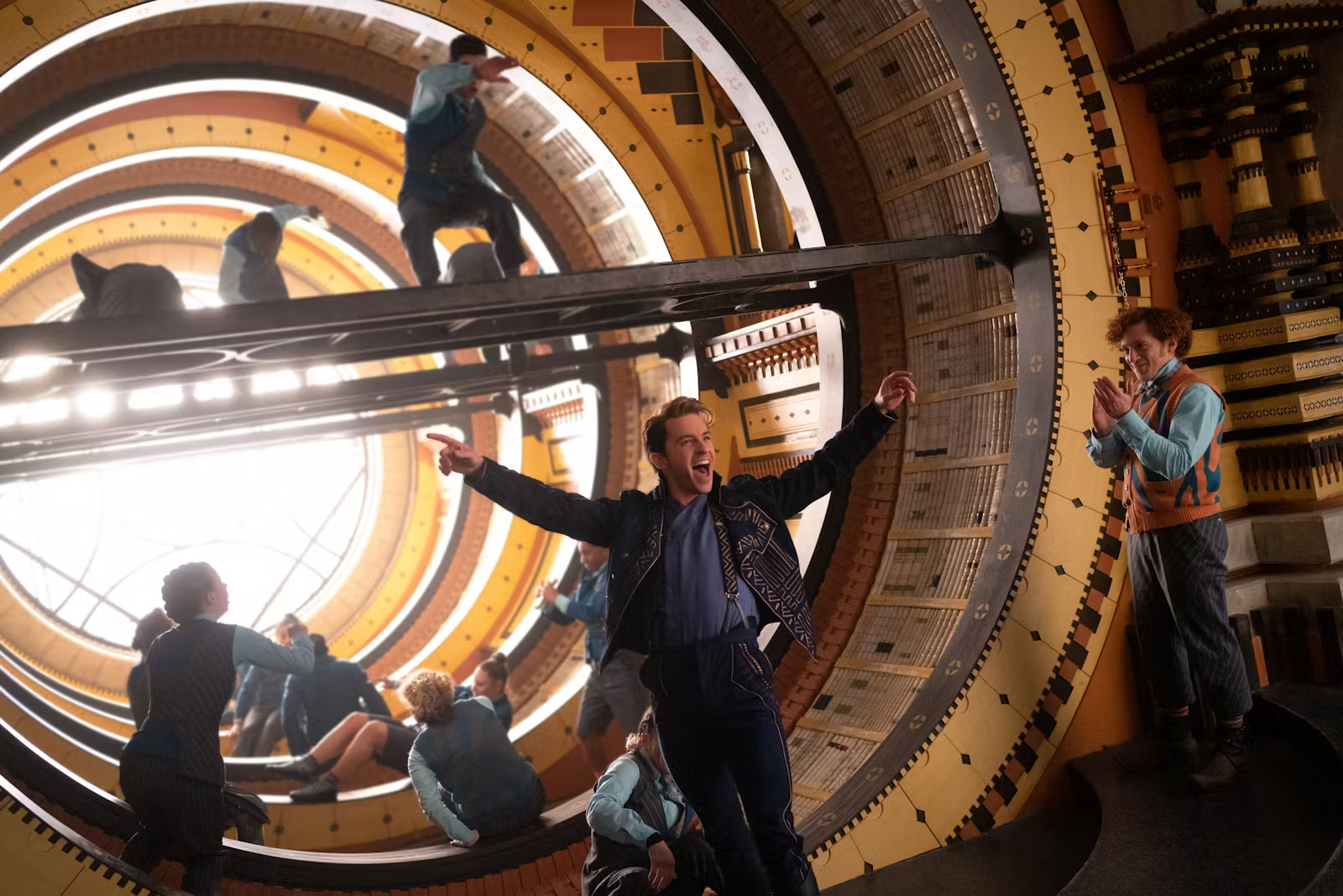
Despite my love of musical theater, I’m actually a comparative newcomer to the fandom of Wicked. I knew very little about it until a TV special celebrating the show’s 15th anniversary in 2018 (which featured Ariana Grande). I didn’t actually get to see a touring production of the show until earlier this year, so I feel like the timing of my interest in Wicked was far more convenient than for the ardent fans who have been waiting twenty-one years for this movie’s release. Even so, it’s finally here (Part 1 at least), and it’s a hit!
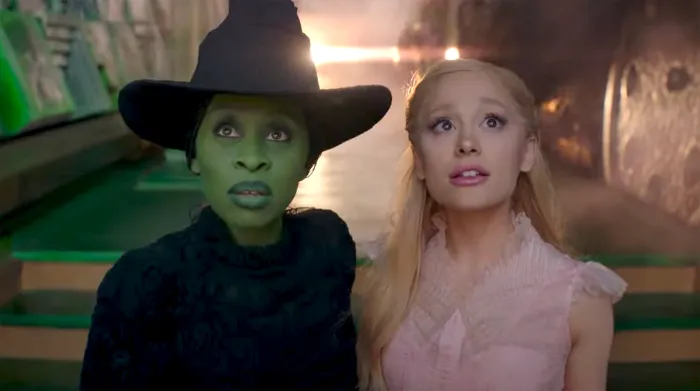
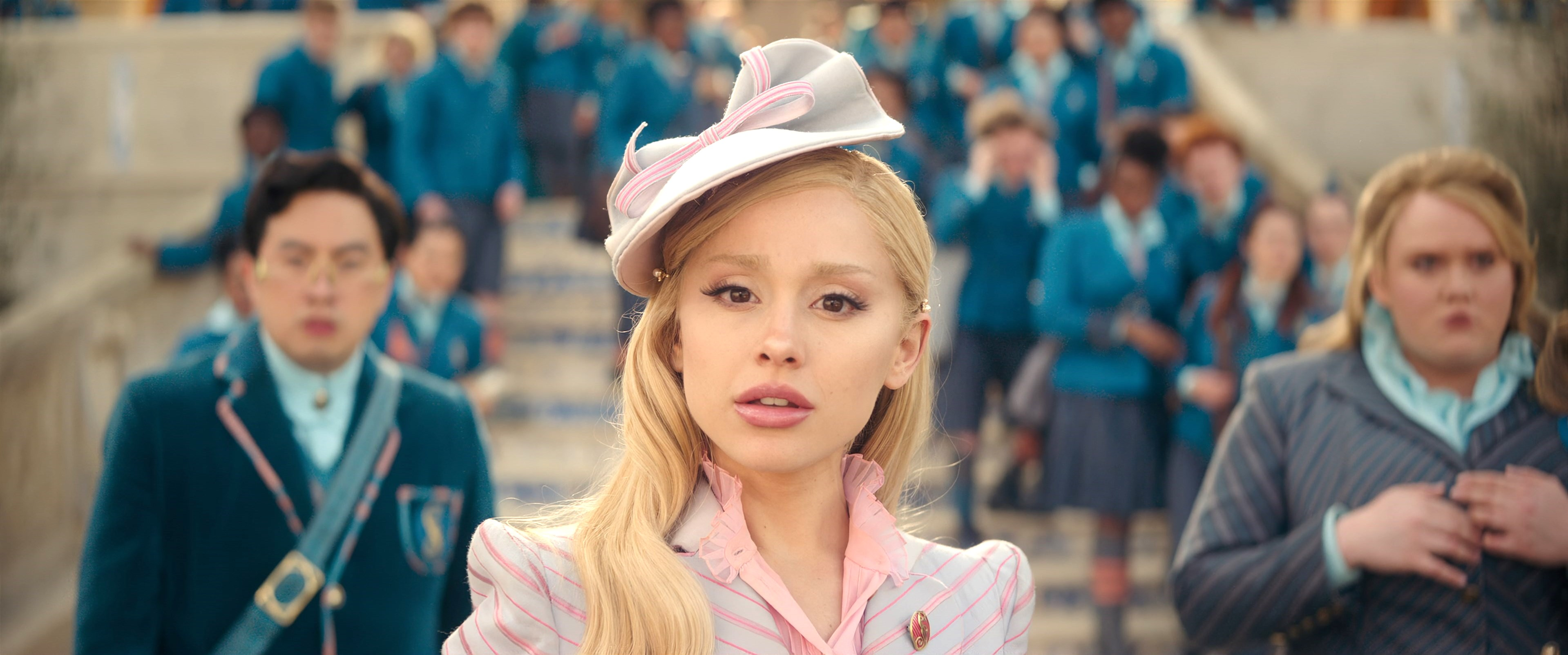
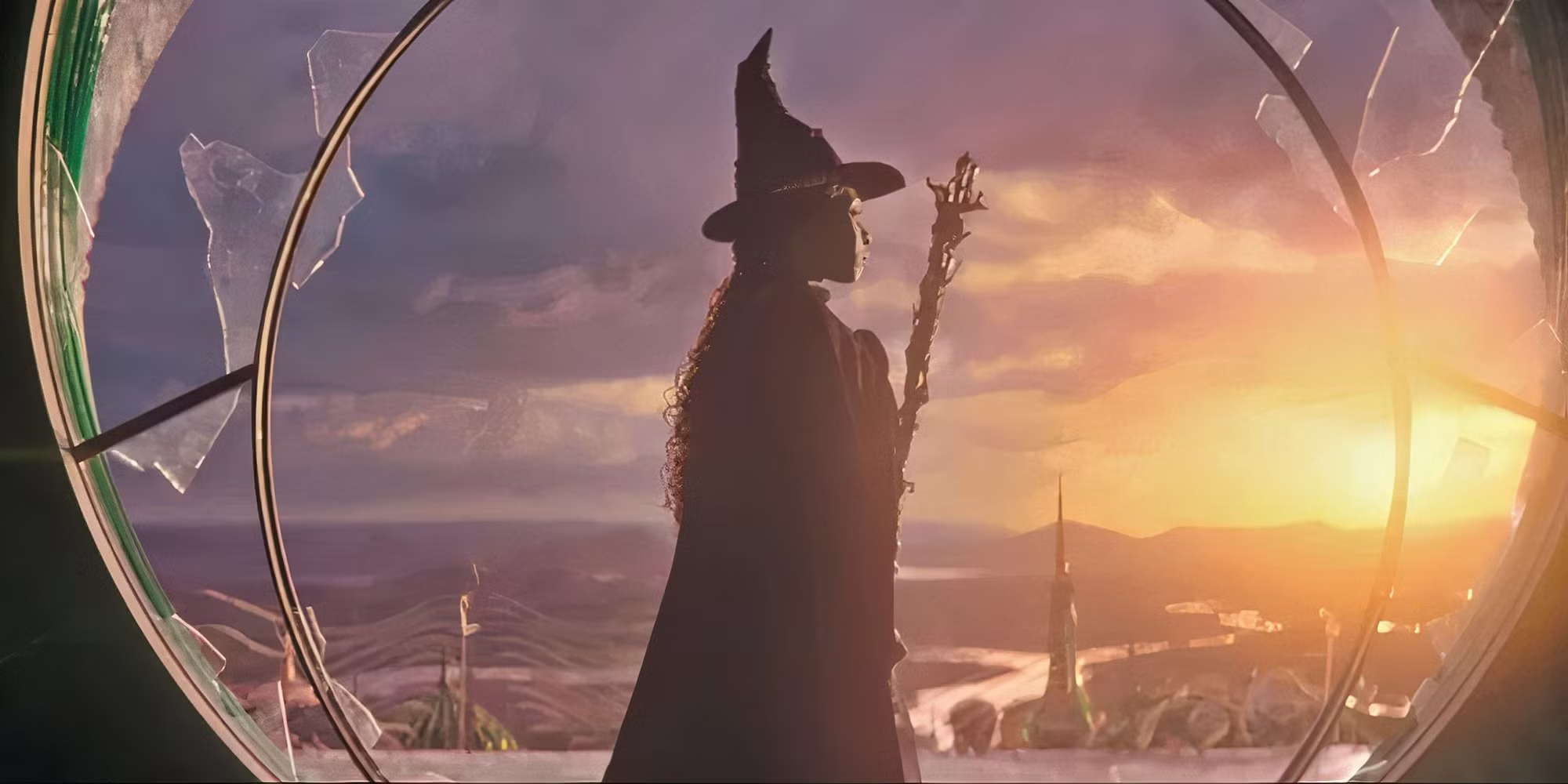
For those who still don’t know, Stephen Schwartz’s Broadway musical Wicked is based on the 1995 novel by Gregory Maguire, a then-innovative twisting of the classic Wizard of Oz storyline to make the Wicked Witch of the West, the green-skinned Elphaba, a more sympathetic main character. While I haven’t read the book myself, I’ve heard the musical and movie are a lighter PG version of the tale that nonetheless touches on themes of acceptance, persecution, and the perils of public perception, all amid a host of now-iconic showtunes. Here in Part 1, covering the first half of the stage show, Elphaba (Cynthia Erivo) is a new student at Oz’s prestigious Shiz University, unpopular but skilled with magic, alongside the more fashionable Galinda (Ariana Grande-Butera). Both dream of meeting the famous Wizard and making their mark on the world, and, though their initial interactions are strained, a friendship eventually blossoms, a bond to be tested by the different directions their ambitions take them.
While it didn’t gain mainstream success, I was a big fan of Jon M. Chu’s previous musical adaptation In the Heights, and Wicked further cements Chu as the premier director for movie musicals. The energy and choreography of the dance scenes are especially thrilling on a big screen, particularly “Dancing Through Life,” the carefree anthem of Fiyero (Jonathan Bailey), the girls’ dreamy Winkie love interest. Much has been said of the decision to split Wicked into two films, but I think it was a smart move. A common complaint of musical adaptations is that fans’ favorite songs or moments end up on the cutting room floor (ahem, Dear Evan Hansen), but Wicked is almost obsessively faithful to its source material, with every song accounted for and many in-between scenes expanded. Does that make its two-hour-and-forty-minute runtime a bit overlong, considering this first half is nearly as long as the whole stage show? Well, yes, but with few exceptions, I appreciate the extended runtime, which lets the relationships grow more naturally and gives the non-musical scenes some breathing room.
I may have had some reservations about the casting when the lead roles were first announced, but Erivo and Grande more than deliver, both of them ardent fans of the show who have publicly championed their commitment to Elphaba and Glinda. Erivo is an outstanding actress and singer and reliable as ever in the lead role, while Grande is more of a surprise. Considering her early acting role as the ditzy Cat Valentine on Nickelodeon, I doubted that she was a serious enough actress for Glinda, even if she was a superfan (and had already contributed to this Mika song that samples and remixes “Popular”). But she brings surprising depth to a character who could easily be written off as a vain blonde but whose connection to Elphaba feels genuine and sweet. It helps too that both lead actresses have amazing voices, with Erivo’s “The Wizard and I” and “Defying Gravity” and Grande’s “Popular” as auditory standouts. There are instances of the movie interrupting a song with some pause or vocal trick that didn’t need to be there, but that’s a minor critique.
Funnily enough, it seems that Wicked fans are the ones poking the most holes in the movie, whether it be a supposedly lackluster color palette or the overly indulgent superhero-style awakening of Elphaba’s witch persona at the end. Yet I as a casual fan found a lot to love and very little I would change. I thought one musicless dance scene was overly awkward and long, but I’ve seen others praise it as an emotional high point, so to each their own. I especially loved some pitch-perfect cameos in the Emerald City sequence, and I certainly think the practical sets and elaborate costumes deserve some Oscar love.
Now, with only a year to wait before part two (subtitled For Good) comes out, I am thrilled with what we have so far and hesitant for what is to come. The second half of Wicked is darker, has fewer memorable songs, and has a lot of stuff happening offstage that is easier to accept in a stage format. With the work they’ve done on extra characterization here, such as with Fiyero and Ethan Slater’s Boq, I do wonder how they’ll handle all that as a movie. But for now, its chill-inducing showstoppers still fresh in my mind, Wicked is a triumph and a treat for musical fans, already outgrossing all other Broadway adaptations, and one I hope to see again soon.
Best line: (the Wizard, played by the fitting Jeff Goldblum) “The best way to bring folks together is to give them a real good enemy.”
(For Day 27 of NaPoWriMo, the prompt was for an American sonnet, which is described as just a sonnet with “fewer rules.” For some reason, I couldn’t bring myself to abandon rhyme entirely, so I defaulted to the Shakespearean form, albeit in iambic heptameter.)
If opposites attract, then why are opposites so cruel? If different groups can get along, we marvel at the sight. So why is concord the exception rather than the rule, The urge to differ stronger than the wisdom to unite? We see the danger first, for every difference is a threat, A threat to what is “normal,” our bubble near the pin. Imagining the worst of people we have never met, We need the reassurance never needed from our kin. Then there are bad impressions left by others of their kind. If one is bad, then all are bad, all nuances be damned! Yet we have evil brothers too; by them are we maligned And earn a matching stigma, the traded hateful brand. If history could be erased enough to meet anew, Then maybe opposites could prosper, just like me and you. ______________________________
MPA rating: PG
Pixar isn’t quite the guaranteed powerhouse it once was, and with the easy availability of Disney+, its films are no longer must-sees at the theater. To be honest, I still haven’t gotten around to seeing Luca or Turning Red since they just felt like lesser efforts based on the trailers. But Soul proved the studio had some of its old magic, and Elemental is thankfully a confirmation of that.
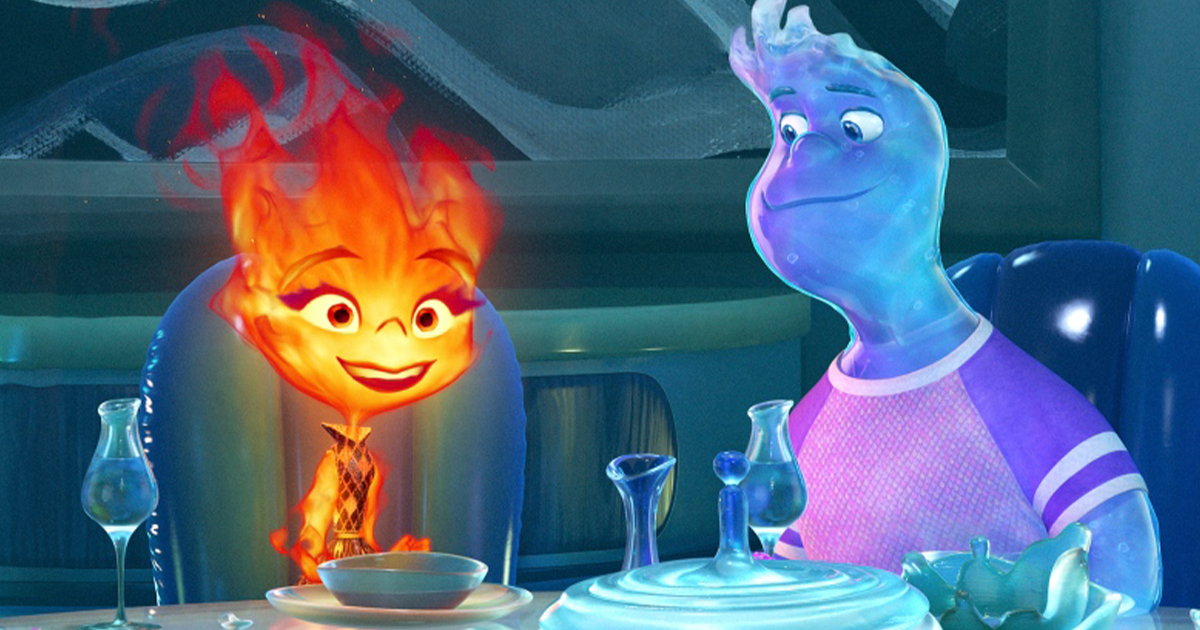
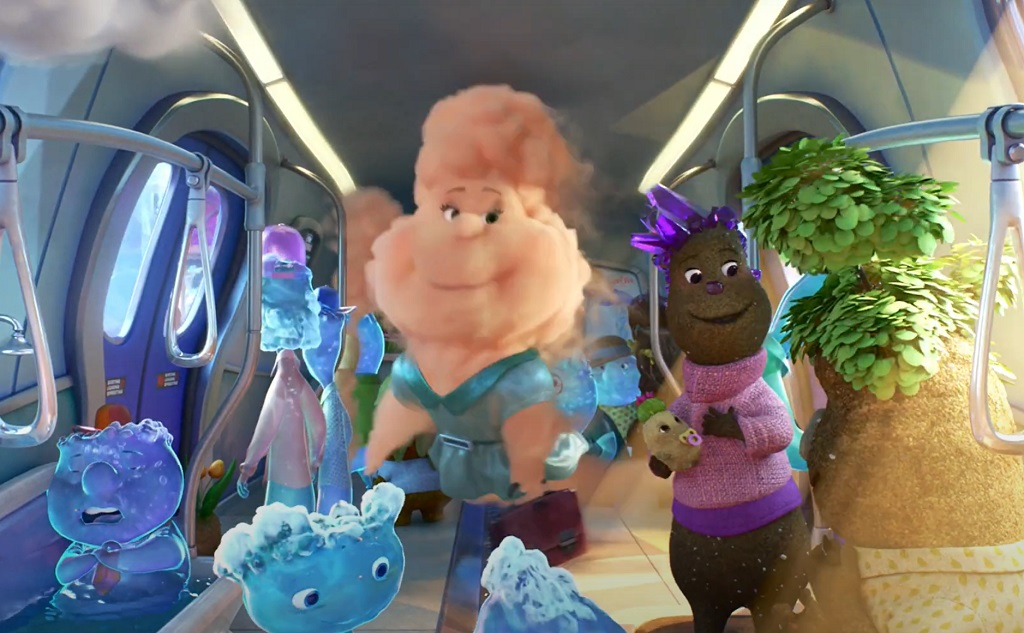
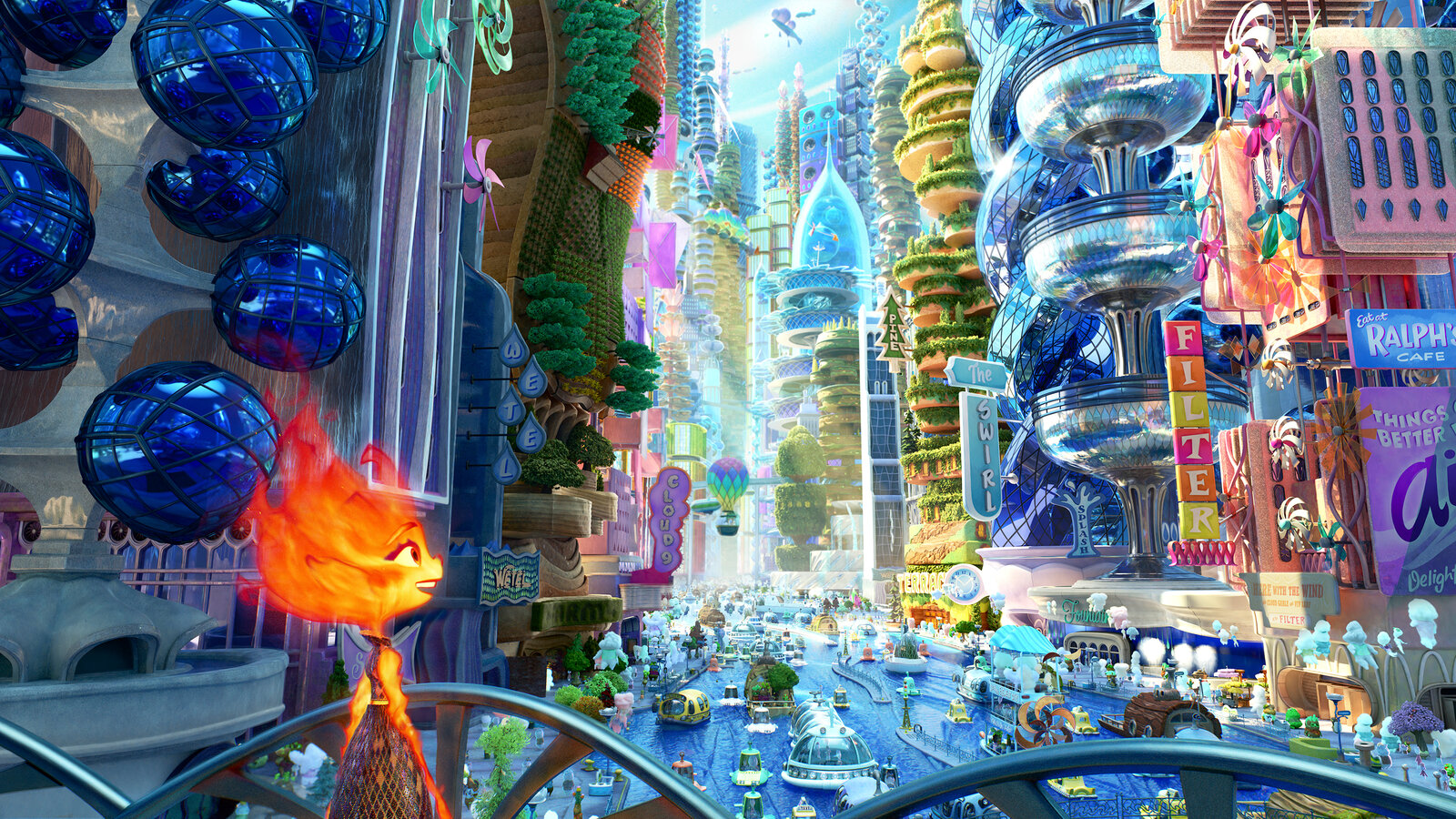
Continuing their time-honored tradition of anthropomorphized otherworlds, Elemental breathes life into the four classical elements – fire, water, earth, and air. In the metropolis of Element City, the citizens made of water, earth, and air have a well-established rapport living alongside each other, while fire elementals Bernie and Cinder Lumen (Ronnie del Carmen, Shila Ommi) are met with hostility moving there from Fire Land (represented as analogous to East Asia, likely director Peter Sohn’s ancestral Korea). Nevertheless, they establish a thriving store in the city’s Fire Town district, which their daughter Ember (Leah Lewis) hopes to inherit one day. After an unceremonious meet cute with the watery Wade Ripple (Mamoudou Athie), the two contrasting elements start to fall for each other, despite their natural differences and familial pressures.
While Pixar has featured love stories before, like WALL-E or the beginning of Up, Elemental is the first of their films to embrace the rom-com formula, hinging its success on the chemistry of lead characters Ember and Wade, and thankfully, they make a cheer-worthy couple. With its excess of elemental puns, the film might have relied too heavily on stereotypes, Ember with her fiery temper and Wade with his sappy sensitivity making him cry at the drop of a hat. Yet the two prove to be more than one-note with their relatable stresses around family responsibility or awkward anxiety.
Likewise, the film finds subtleties in its very obvious racism metaphor of fire as the outsider element. In a way, it’s understandable why fire people are viewed skeptically; fire burns plants, boils water, and is generally destructive. That hostility has affected how Ember’s father Bernie behaves toward the world, harboring resentment toward the water that is similarly destructive toward his kind. When both sides foster prejudices or barriers they feel are justifiable, it is no easy feat to break the cycle of bias, and Ember and Wade themselves have doubts about how their connection could even work. Yet it’s still a bond worth the effort.
Like Cars, I can’t deny that there are aspects of this fantasy world that strain credulity of how things work (how many fire people die if they forget an umbrella when near the city’s water train?), but what is presented is full of fun and bustling imagination. The beautifully fluid animation allows these elemental characters to do all kinds of funny and non-human actions, from slipping through cracks to melting and reshaping glass, and every scene is full of world-building details that make this universe a visual marvel.
I particularly liked how Elemental didn’t feel the need to have a traditional villain. Societal and familial expectations (and random accidents) are enough of a source of conflict, allowing for timely immigrant parallels and room for growth on all sides. Though it may be missing something from Pixar’s golden age when I was growing up, Elemental most definitely recalls those classics and thrives on its own visionary and romantic charm.
Best line: (Ember, voicing the unhealthy mindset of many an immigrant kid) “The only way to repay a sacrifice so big is by sacrificing your life too.”
(For Day 14 of NaPoWriMo, the prompt was for a poem of at least ten lines featuring anaphora, or starting each line with the same word. Such repetition is a good way of setting the rhythm, and the word “north” seemed only appropriate for this animated journey.)
North – the direction I’m going. North to the ends of the earth. North where the blizzard is blowing. North to prove my own worth.
North where the polar bear shivers. North where all hotheads are cooled. North where aurora-light quivers. North where the sky is bejeweled.
North where the sea is unstable. North where the glacier ice looms. North where presumption is fatal. North where the icebergs are tombs.
North where the sun is unblinking. North where the ocean is heaving. North has my wiser side thinking… North – the direction I’m leaving For home. _________________________
MPA rating: PG
Unless the Academy happens to nominate one for Best Animated Feature (i.e., Persepolis, Ernest and Celestine, I Lost My Body, last year’s Robot Dreams), most people are probably unaware of animated films from overseas. Anime has its built-in fanbase, but there are plenty of low-profile international cartoons out there worth attention. Long Way North, a French-Danish production from director Rémi Chaye, is a prime example.
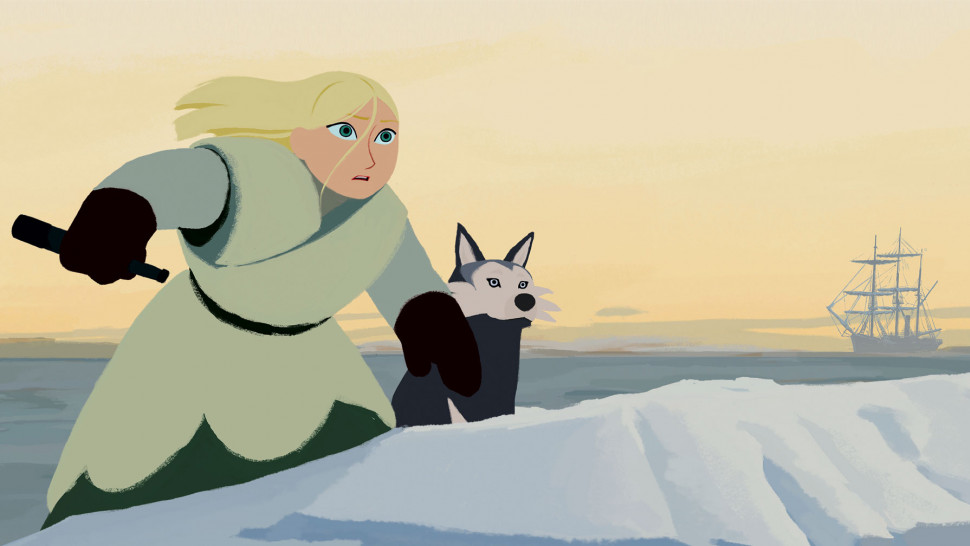
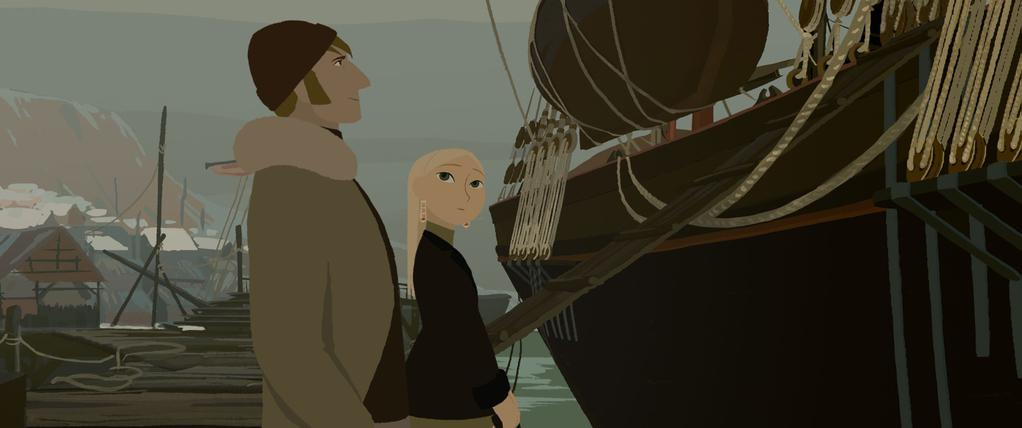
In 1882, young Russian aristocrat Sasha (Christa Théret) idolizes her explorer grandfather, who disappeared on a voyage to the North Pole, and while all the search parties have come up empty, she believes she knows how to locate his specially designed ship. Leaving her life of comfort and social expectations, she makes her way north, intent on convincing a crew to take her into the harsh and forbidding Arctic Circle.
Long Way North has a simple plot with little in the characterization that hasn’t been seen before, but the film executes its story flawlessly. Sasha is an admirable protagonist, able to prove her mettle alongside the hardened sailors while also receiving a Captains Courageous-style eye-opening to the harsh realities of the laboring class. The lineless animation style has a gorgeous simplicity to its colors and shadows, and I loved the true-to-life depictions of breaking through ice floes while navigating the half-frozen ocean. Long Way North may not stand out next to the big dogs of animation, but it’s a lovingly crafted indie adventure.
Are you new in Oz? I bet so because You’ve the look of someone lost, Exhausted, star-crossed, Like you’ve never seen a witch Or a road of yellow brick Or a beast with perfect pitch. Plus, you strike me as homesick.
But that’s no big deal; I know how you feel, Like a friend I miss a lot, Distraught, but fear not. See, we’ve done this all before, She got home still safe and sound. If what’s past is what’s in store, I’ve no doubt you’re homeward bound. _________________________
MPA rating: G (though PG fits better with some of the imagery and costumes)
Since 2024 marks the 85th anniversary of The Wizard of Oz and the first Broadway revival of The Wiz since its original 1970s run, it seemed like a good time to finally watch and review the film version of The Wiz. (We’ll ignore that this should have been done last year for my Blindspot list.) A modern retelling of L. Frank Baum’s classic story with an all-Black cast and different music, The Wiz was a definite Broadway hit, as its seven Tonys can attest, but I knew nothing about the film, beyond Michael Jackson playing the Scarecrow. So it was interesting going in blind to this version of Oz that has gone from a bomb to a cult classic in the 46 years since its release.
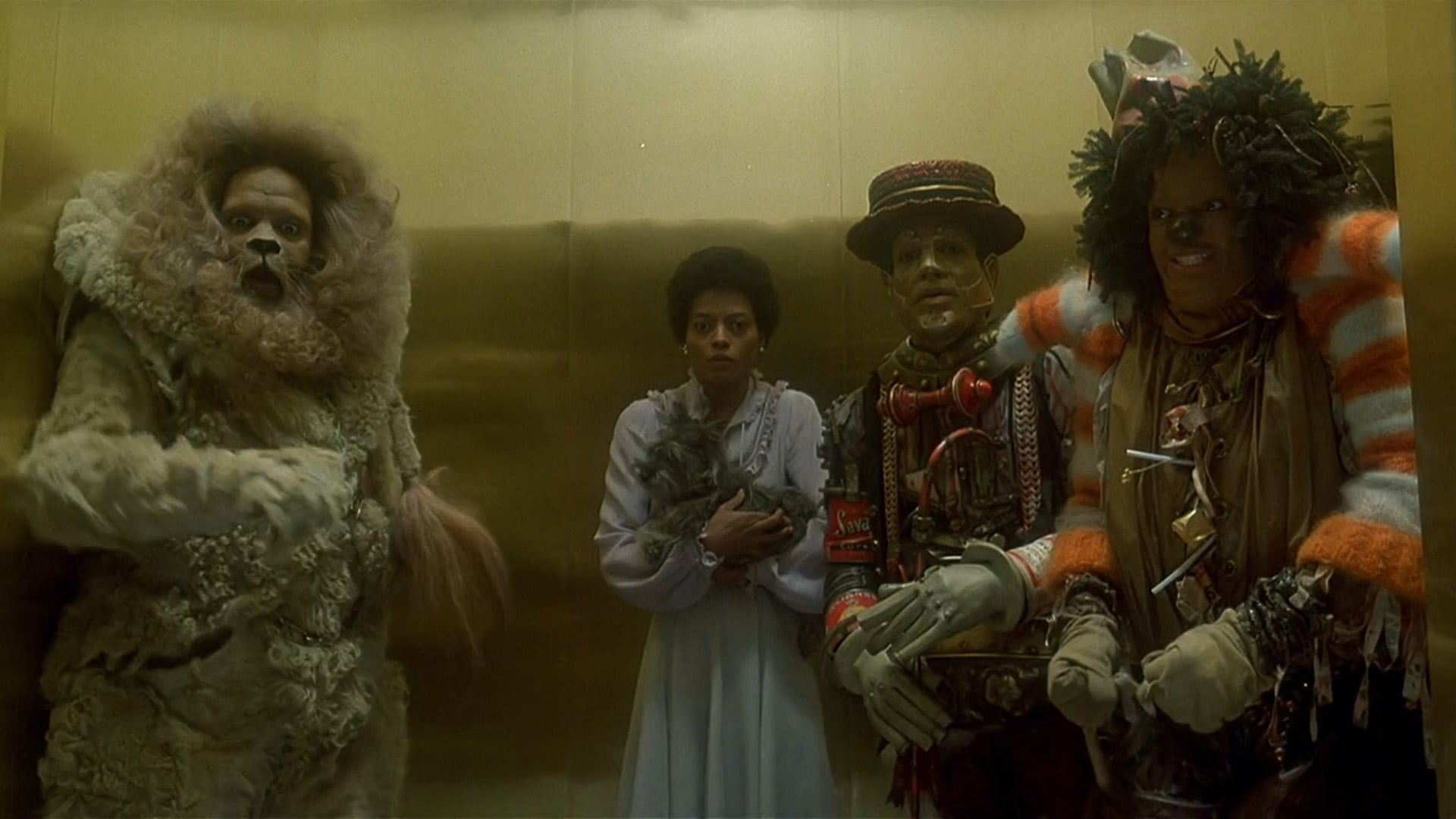
While the core isekai story remains the same, The Wiz is quite visually distinct from the Judy Garland classic, relocating from Kansas to urban Harlem and making the child Dorothy into an adult schoolteacher (Diana Ross) nervous to move away from her family neighborhood. When a freak snow twister (happens all the time in Harlem, I’m sure) transports her and her dog Toto to the dystopian land of Oz, the timid girl gathers companions (Jackson, Nipsey Russell, Ted Ross) on her way to ask the Wizard (Richard Pryor) to send her back home.
The Wiz takes some time to find its footing because I was surprisingly bored through initial set-up, and Diana Ross’s affected diffidence was more annoying than sympathetic. It wasn’t until the arrival of Michael Jackson’s Scarecrow and especially Ted Ross’s Cowardly Lion that I began truly enjoying it as a musical. Jackson plays the Scarecrow as a bashful doormat, pulling quotes out of his stuffing like a burlap Mrs. Who from A Wrinkle in Time, while Nipsey Russell is an affable carny Tin Man with some repressed trauma. But Ross as the Lion truly steals the show, matching the mix of insecurity and self-puffery that Bert Lahr brought to the original film, so it’s no wonder he won a Tony for the same role on Broadway. He also proves to be the MVP of the journey, saving the whole group from a subway come to life, in one of several nightmare-fuel sequences that must have haunted some childhoods. Pryor is a decently mousy Wizard, though he doesn’t have enough screen time to make an impression and doesn’t even provide any insight to the other characters; in researching the Broadway production, I was mainly floored to learn that André De Shields of Hadestown fame played the same role on stage.
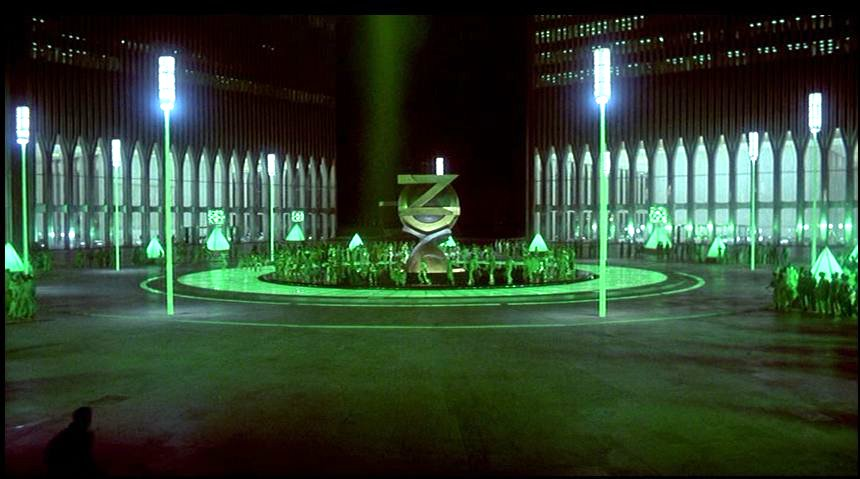
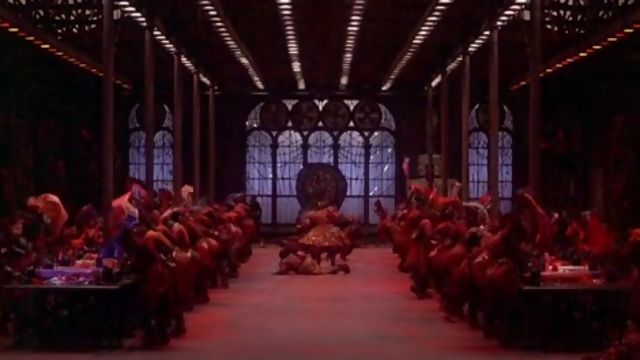
As for the music, “Ease on Down the Road” is the film’s most famous number, but “I’m a Mean Ole Lion” and “Don’t Nobody Bring Me No Bad News” are fitting showstoppers for the Lion and the Wicked Witch of the West Evillene (Mabel King), respectively. The disco “Emerald City Sequence” also has some gobsmacking set and costume design that illustrates the Wizard’s power as a trendsetter and contrasts with the urban decay of much of the production design. But the true star of the soundtrack is “Everybody Rejoice/A Brand New Day,” Luther Vandross’s utterly catchy and joyful group dance number with the ensemble celebrating Evillene’s defeat, even if it’s made a tad weird by the freed Winkies cavorting in only their underwear.
The Wiz has zero chance of replacing the 1939 film as the definitive Wizard of Oz musical, but it gives the material a worthy spin. I found some of the exaggerated acting a bit strange or overly childish at first, but the 1939 film was guilty of the same and simply benefits from decades of nostalgia, so I can see why time has been kind to people’s perception of The Wiz. It’s certainly uneven but not a total trainwreck, and its high points are worth the price of admission to its strange urban odyssey.
Best line: (Scarecrow) “Success, fame, and fortune, they’re all illusions. All there is that is real is the friendship that two can share.” (Dorothy) “That’s beautiful! Who said that?” (Scarecrow, modestly) “I did.”
At the turning of the centuries, Though no one knew it then, A babe was born to save the world, Incarnate God. Amen!
But surely you have heard all this; By now it might be trite, The midnight clear, the first Noel, That timeworn silent night.
It’s easy for familiar truths, Traditions every year, To not have quite the gleam they bore When times were more sincere.
Perhaps we may have changed with time, But truths stand hard and fast. Traditions, like God’s promises, Are comfort, for they last.
Although we know them all by heart, We need reminding still, That what the carols advertise Rings true and always will. ____________________________
MPA rating: PG
To complete this trilogy of musical posts, here’s a more recent release from this year. I feel like someone, assumedly director and songwriter Adam Anders, watched The Nativity Story and thought to himself, “This would be even better as a musical” and then made it so. Journey to Bethlehem takes the well-trodden Biblical story of Jesus’ birth and injects a pop-music sensibility that both adds entertainment value while also slightly watering it down.
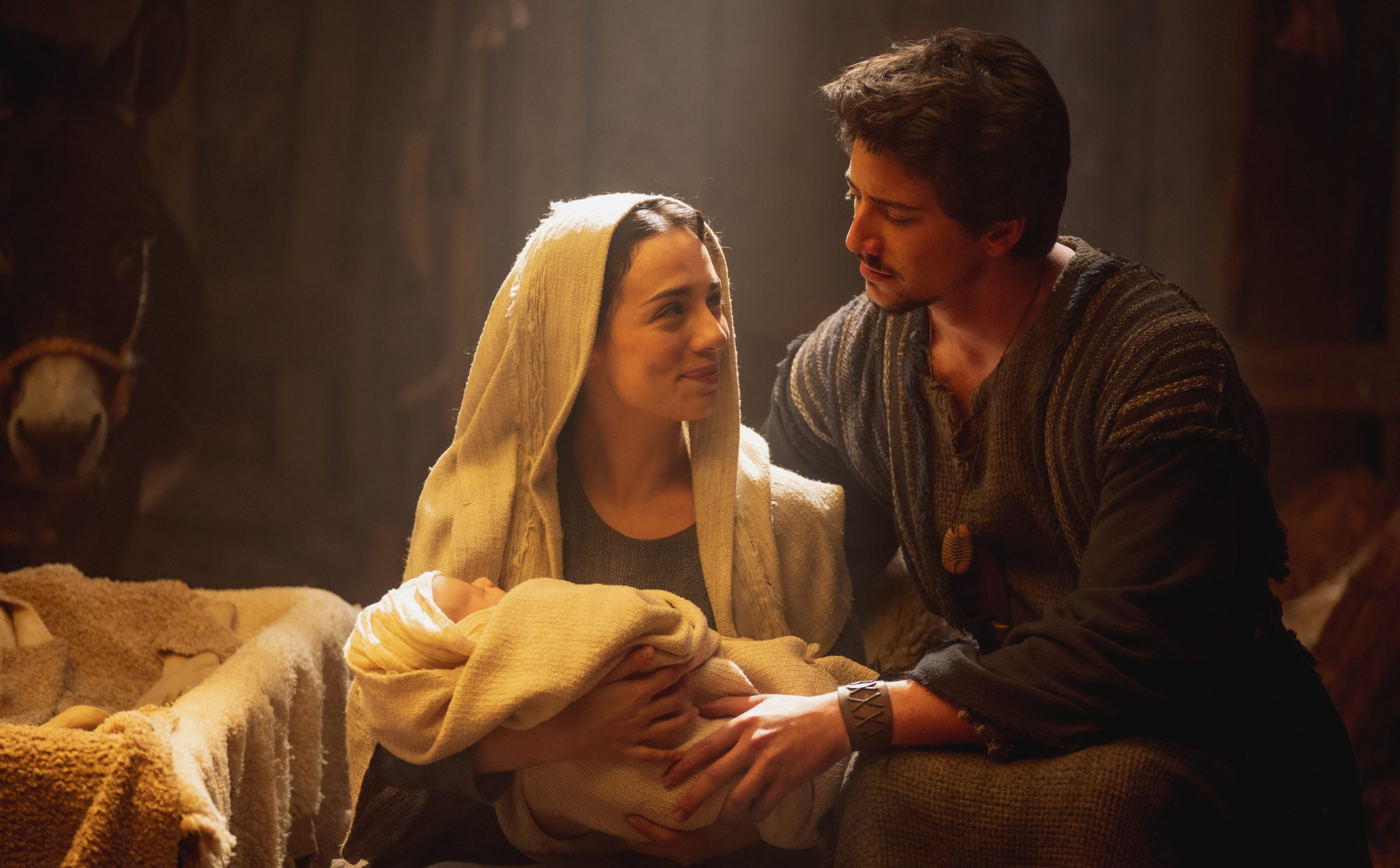
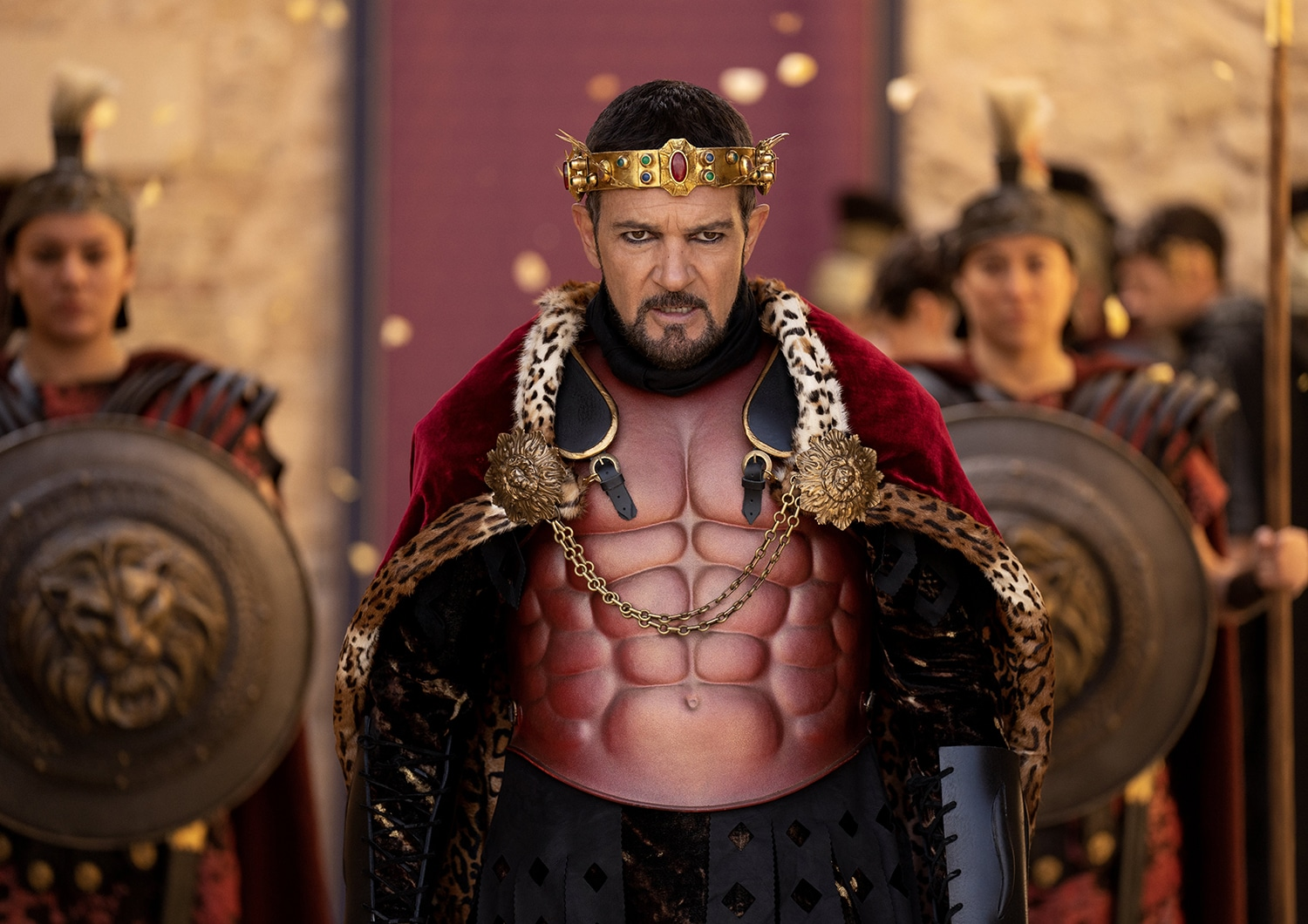
From the second song, in which Mary is bemoaning her expected role of marrying someone she’s never met, I thought that this was like the High School Musical version of the Christmas story, so I felt vindicated when I read that Anders co-wrote the script with Peter Barsocchini, who also wrote all three HSM movies (of which I remain a fan). So the character types and conflicts are all too familiar, yet the actors make the most of them, with Fiona Palomo as Mary and Milo Manheim (a recent Disney star from the Zombies franchise) as Joseph having an easy chemistry and excellent songs both together and solo. The soundtrack delivers on many levels, some better than others, but highlights include the opening title song and “Mother to a Savior and King,” which explores Mary’s own self-doubt. And I mustn’t forget Antonio Banderas as King Herod, who seems to be having fun mugging through his one song “Good to Be King.”
The plot of Journey to Bethlehem was clearly tweaked from the Biblical record to add peril to the climax and to better space out the musical numbers, so I can understand the decisions on a pure story basis. Yet it felt at times like I was trying to keep track of how many deviations there were from the established narrative. In this film, Herod tries to ignore Rome’s census order but is persuaded to use it solely as a means to find the mother of the foretold Messiah, leading to several close calls where it’s assumed Mary would be immediately recognized as such if she were to be caught. It was also surprising to give a redemption arc to Herod’s son Antipater (Joel Smallbone of the band For King and Country), who gets one of the best songs as well.
Likewise, the wise men, here a trio of bickering comic relief figures (Rizwan Manji, Geno Segers, Omid Djalili), come to Herod even before the census or Jesus’ birth and then leave for Bethlehem (which isn’t far from Jerusalem) to hang out with the shepherds for months perhaps so that they also are witnesses to the heavenly angel chorus. Plus, there are odd omissions, like the absence of Mary’s acceptance of the role declared by Gabriel (Christian rapper Lecrae) during the Annunciation scene or the inclusion of Zechariah’s muteness without any subsequent depiction of his son’s birth.
Yet for all the little things that nagged at me, Journey to Bethlehem is still an entertaining Christmas film, and I never got the sense that the changes were intentionally trying to subvert or undermine the meaning behind the story, which is refreshing. It also boasts impressive costumes and choreography that are far better than they would have been if this were made ten or fifteen years ago. It’s proof of how far Christian films have come. While I’m not quite sure if this movie rises to the level of a perennial classic to watch every Christmas, it’s still a laudable version of the Nativity with a soundtrack that deserves appreciation even outside its target audience.