• Home
  • About Me
  • THE LIST Through the Years
  • Top Twelves and More
  • The End Credits Song Hall of Fame

Rhyme and Reason

~ Poetry Meets Film Reviews

Rhyme and Reason

Tag Archives: Fantasy

The Red Turtle (2016)

08 Friday Sep 2017

Posted by sgliput in Blogathon, Movies, Poetry, Reviews, Writing

≈ 7 Comments

Tags

Animation, Drama, Fantasy, Foreign, Romance

Image result for the red turtle film

Shall I sit here all alone
And wait for death to call me home?
Now that I am stranded here,
Have worth and meaning flown?

Shall I push uphill my stone
And watch it roll back down and groan
And wish that life had chanced to veer
Somewhere less sorrow-prone?

Perhaps I’ll work myself to bone
And die unloved and thus unknown,
But if somebody could appear
And comfort give to persevere,
I’d gladly bear my daily stone
With one to call my own.
_________________

MPAA rating: PG

This review is my contribution to the Colours Blogathon hosted by Catherine of Thoughts All Sorts, focusing on all manner of movies with colorful titles. I chose The Red Turtle not only for the color in its name, but because I was curious about this feature-length silent film that earned an Oscar nomination for Best Animated Feature when Your Name didn’t. Now that I’ve seen it, I completely agree that it deserved such an honor because this story of a shipwrecked man stranded on an island is a piece of cinematic art. So many cartoons these days rely on hyperactive humor that something like The Red Turtle is an anomalous reminder that animation can offer compelling stories without jokes or even words through simple mastery of the medium, allowing silence to make it universal.
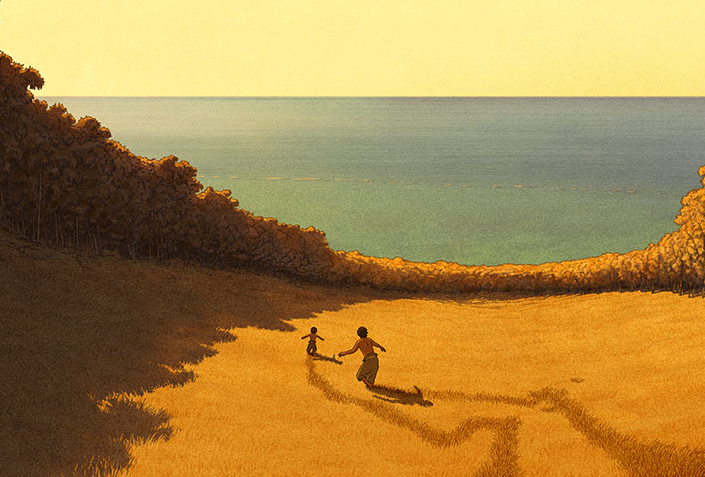
Image result for the red turtle film

The beautifully simple animation is the product of a collaboration between Dutch director Michaël Dudok de Wit, winner of the 2001 Animated Short Film Oscar for the lovely Father and Daughter, and the not-yet-defunct Studio Ghibli. I’m still surprised at Ghibli’s involvement because The Red Turtle has no resemblance to anime, except maybe in the attention to natural detail, yet I’m reminded that anime is not limited by the usual big-eyed style. The Oscar-winning short film La Maison en Petits Cubes has a European aesthetic similar to The Red Turtle, but, despite the French name, it was a Japanese production. So you could say that The Red Turtle is a best of both worlds, combining the visual imaginations of its animators in a surprisingly accessible, almost watercolor style.

Silent animation is usually the realm of short films, and it must have been a risk to protract what could have been vastly shortened to a feature-length story. Those with short attention spans will likely be bored by the third raft-making attempt, but the patient should find the narrative rewarding in its ambiguity. As with Cast Away, actions speak louder than words, and the painterly animation is so superb in its simplicity that I was rarely bored. It’s all in the details, like the humorous characterization of the crabs watching the man’s efforts or the lush island greenery swaying in the breeze, and the realistic water is worth particular praise, whether serene on the horizon or violent in its outbursts.

I don’t want to say much about the actual plot since it’s best experienced with the intended visuals to tell the story, but it very much fits its description as a fable, a seemingly straightforward tale that can be appreciated on its surface or on a deeper, more symbolic level. The Red Turtle itself remains something of an enigma, even as it becomes a profoundly important part of the castaway’s life, infusing the film and its ending with a bittersweet emotion that is strongly felt, if not fully understood.
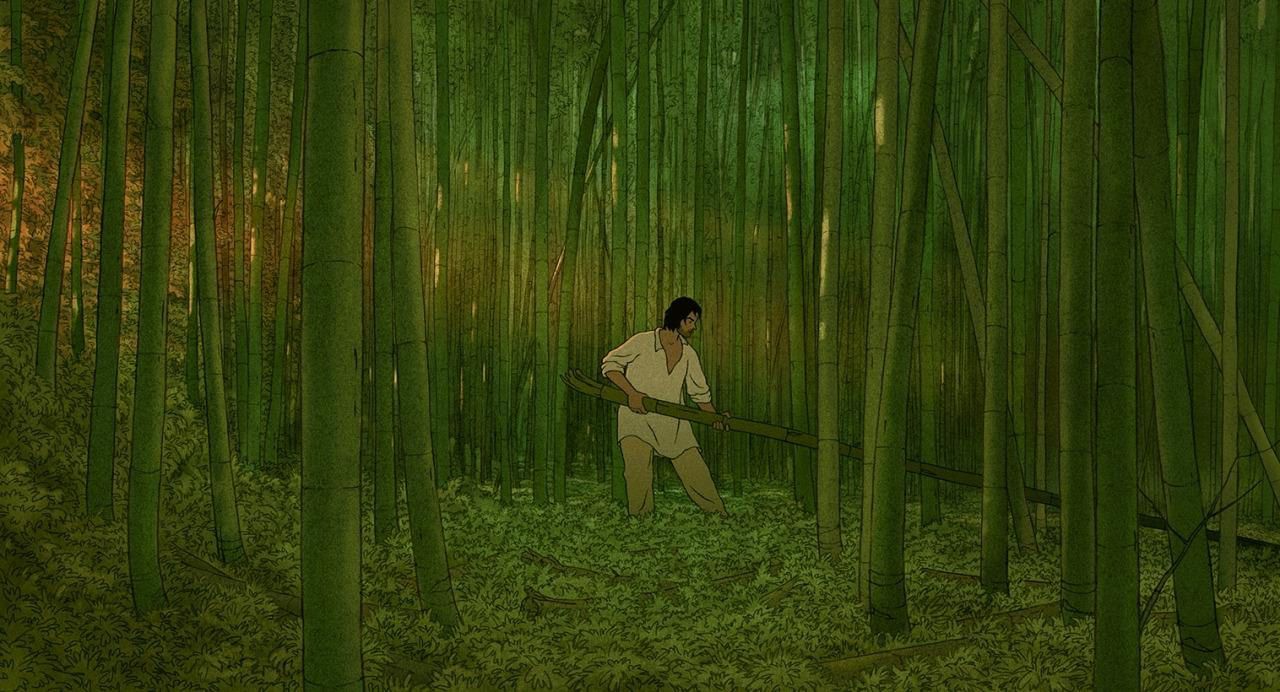
Image result for the red turtle film

So, yes, The Red Turtle is absolutely Oscar-worthy and, if not for last year’s hefty competition, might well have won. Why couldn’t a film like this come out in 2006 or 2011, when Disney/Pixar wasn’t a shoo-in? I suppose I can now turn my blame on My Life as a Zucchini (the only nominee I haven’t yet seen) for Your Name’s lack of nomination last year because The Red Turtle is more than deserving. Despite its slow narrative that could have been a short film, it’s a piece of modern art that is becoming rarer and rarer in the world of feature-length animation.

Best line:  (the man’s only line) “Heeeeey!”


Rank: List Runner-Up


© 2017 S.G. Liput
506 Followers and Counting


Ink (2009)

03 Sunday Sep 2017

Posted by sgliput in Movies, Poetry, Reviews, Writing

≈ 2 Comments

Tags

Drama, Fantasy

Image result for ink jamin winans

Dreams in the night
Carry darkness or light
Into minds at the height of their delicacy.
Deep in our slumber,
Charades without number
Parade through our heads, entertainment for free.

They charm us and threaten
With visions they let in,
But who holds the keys to such reveries sown?
What nightmare dimensions
With clashing intentions
Have displaced our thoughts with ideas of their own?
____________________

MPAA rating: Not Rated (should be R, mainly for language)

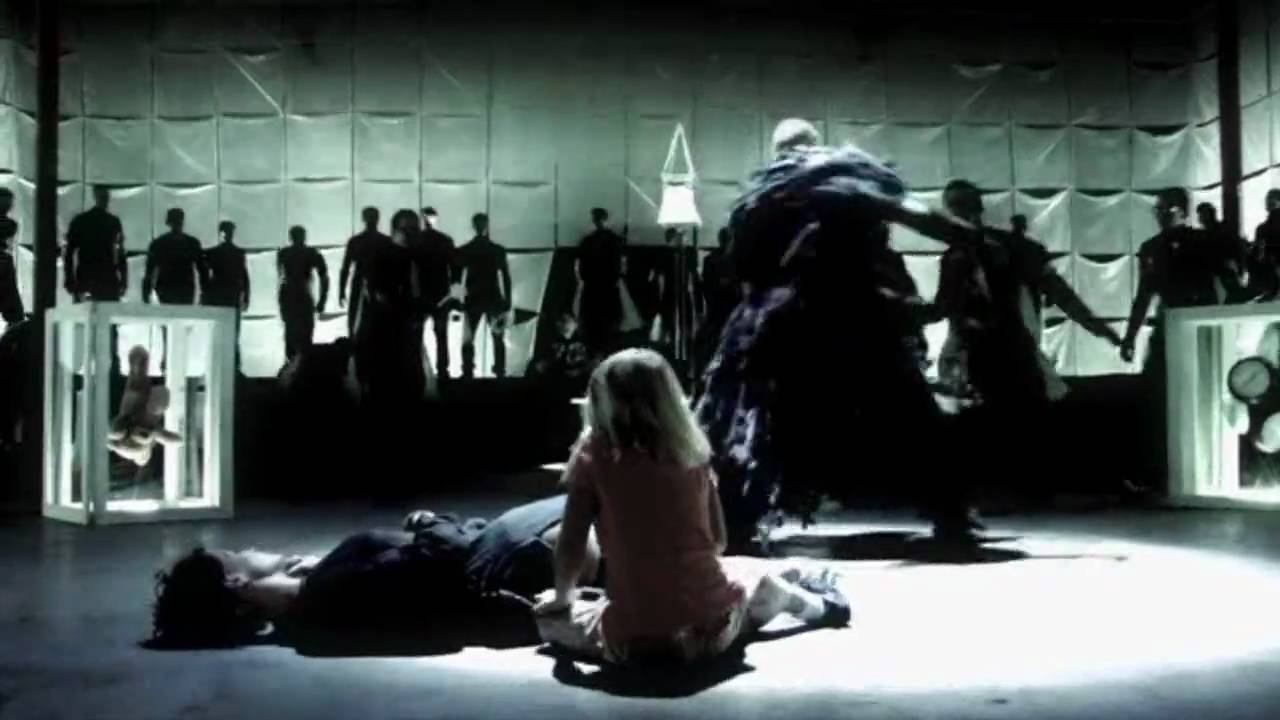
After ranking Ink at #11 on my Top Twelve Underrated Movies, I thought I should give this low-budget cult hit a full-fledged review. Written and directed by independent auteur Jamin Winans, Ink is so many things at once that it’s hard to classify it. It’s a fantasy about the clashes between invisible forces of good and evil. It’s a redemption tale of a father returning to his estranged daughter’s life. It’s a visually inventive head trip following a monster’s kidnapping of a girl’s soul. How it merges all these disparate components into a mostly cohesive and surprisingly meaningful whole is quite the experience, one that doesn’t let its budget limitations hinder it too much.

Image result for ink jamin winans

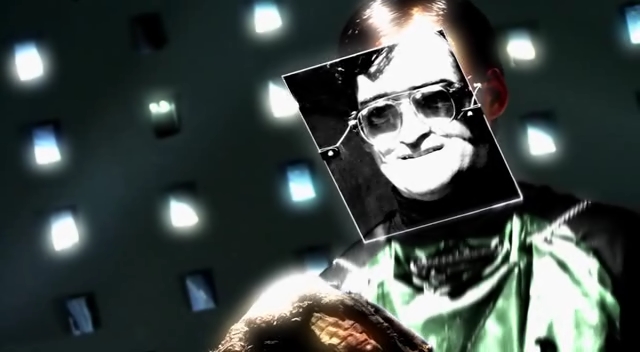
Chris Kelly plays John Sullivan, the father I mentioned, whose wife’s death caused him to lose contact with his daughter Emma (Quinn Hunchar), whom he kept at arm’s length even when they were together. Bitter, he throws himself into his work, not even caring when she later falls into a coma. This side of the story is fairly down-to-earth, but the reason for Emma’s coma goes off into an ever more ambitious dark fantasy. For starters, there are Storytellers, invisible spirits who disseminate sweet dreams like the Sandman from Rise of the Guardians, and Incubi, creepy screen-faced baddies who plant disturbing nightmares. Amidst this nightly battle, a hulking creature named Ink dressed in black rags steals Emma, or rather her spirit, from her bed and plans to trade her to the Incubi.

On one hand, you can tell it’s a low-budget production. The camerawork lacks the Hollywood polish we’ve come to expect, and some of the effects look like they’re from a Disney Channel movie. Yet the film continually manages to impress where it counts. For example, Ink’s initial confrontation with the Storytellers trying to save Emma has some amazingly well-choreographed action, with the unique twist of time rewinding to return every smashed object to its original condition. This is the spirit world, after all. Likewise, the editing ranges from overly jerky at times to downright brilliant during an exceptional scene where an eccentric “Pathfinder” (Jeremy Make) creates an unforeseen chain reaction that ties in to an earlier scene. It reminded me a lot of that sequence from The Curious Case of Benjamin Button where the narrator describes all the little cause-and-effects that brought about an accident.

Image result for ink jamin winans

Sadly, Ink is occasionally spoiled by some strong language, mostly from Chris Kelly (his first line is a tantrum of F-bombs), and I do feel it could earn a wider audience without it since the rest is grim but not overly objectionable. I also thought a few characters were trying too hard to be eccentric at times. Plus, a certain revelation might bend time and minds a bit too much to make total sense, but it’s a twist that has kept me thinking since and adds enormous layers to the film’s narrative.

I don’t know how Jamin Winans views God and religion since they’re never explicitly brought up here, though his next film The Frame seems to regard God as an absentee controller. Yet, there are several scenes in Ink that hold strong spiritual meaning, especially the Best Line below that seems to sum up how God sees his broken creation. The Storytellers are easily compared to angels as well, as the Incubi are to demons whispering hate and pride into people’s minds, and I loved a climactic scene toward the end that switches back and forth between the calm mortal world that John sees and an intense, invisible battle happening all around him. I wouldn’t doubt such unknown struggles happen every day between good and evil.

Image result for ink 2009 film

Oh, yeah, how could I forget the reason I discovered Ink, namely its moving score by Winans himself, which I heard in a collection of movie soundtracks. It’s a perfect atmospheric accompaniment to the film and its emotion, and one notable track called “The City Surf” was even sampled as “Into the Fray” in the film The Grey. As I said, Ink’s plot has multiple layers to peel back, ranging from flashbacks to metaphors and symbols to varying the level of color depending on the world shown, all of which add up to a profound reflection on life, death, and regret. It’s a film that sticks in the mind long after it’s over, which has understandably earned it a 100% on Rotten Tomatoes. It’s clever and well-crafted proof of the potential of indie filmmaking, causing me to wish that it had the overall technical quality to match its ambition. I’ve said it before, but someone get Winans a bigger budget!

Best line: (Ink) “I am ruined, why can’t you see that?”   (Liev, a Storyteller) “Because I choose to see you for what you were intended to be, not what you’ve become.”


Rank: List Runner-Up


© 2017 S.G. Liput
506 Followers and Counting


2017 Blindspot Pick #8: Darby O’Gill and the Little People (1959)

29 Tuesday Aug 2017

Posted by sgliput in Blindspot, Movies, Poetry, Reviews, Writing

≈ Leave a comment

Tags

Classics, Disney, Family, Fantasy, Romance

Darby O'Gill and the Little People (1959) - Alternate Ending ...

That jolly ol’ Darby O’Gill
At the pub would be drinking his fill,
Earning chuckles and yawns
Telling of leprechauns,
Half-believed out of simple good will.

Not caring what doubters may think,
Darby’d go home at last with a wink,
To natter and sing
With the leprechaun king,
And together they too shared a drink.
_________________

MPAA rating: G

Live-action Disney movies tend to fall into two categories: childhood-shaping classics (Mary Poppins, Homeward Bound, Swiss Family Robinson) and severely lame duds (The Shaggy Dog, The Million Dollar Duck, The Computer Wore Tennis Shoes). I wasn’t sure which one Darby O’Gill and the Little People would fit in, but I’d gladly place it in the first group, though I doubt this obscure little gem is shaping many childhoods nowadays.

Darby O'Gill and the Little People (1959) Review |BasementRejects

Apparently based on two books by Herminie Templeton Kavanagh, Darby O’Gill feels as genuinely Irish as The Quiet Man but with a more fantastical basis in Irish folklore. Albert Sharpe is a folksy joy as Darby, a good ol’ boy and father of young Katie (Janet Munro of Swiss Family Robinson) in the town of Rathcullen, who loves to recount his stories of leprechaun interactions with everyone at the local pub. They may only half-believe him, but he’s still a beloved member of the community, which sticks up for him against the mocking of the local brute Pony Sugrue (Kieron Moore), who reminded me a lot of Gaston in Beauty and the Beast, just as Darby is like a more respected version of Maurice. After his job is handed off to a younger man (Sean Connery, so young he barely looks or sounds like the Connery I know), Darby has another run-in with the king of the leprechauns Brian Connors (Jimmy O’Dea) and finagles three wishes that might not turn out as he’d hoped.

Darby O’Gill and the Little People has a lot of the charm of other Disney movies from that era, just with a healthy Irish zest that makes you want to dance a jig and crave shepherd’s pie. At times, the Irish brogues are a little thick to fully understand without subtitles, but for the most part, it adds to the authenticity, as does the music, which consists only of a sweet little ballad and an epic but slightly overlong fiddle dance. The special effects, for the most part, are also well-done, consisting mostly of shrinking the leprechauns to be only as tall as Darby’s knees, a visual trick that reminded me of the miniaturized hobbits in The Lord of the Rings. Also effective is the more dated creation of a ghostly banshee and death-coach-driving dullahan; Disney movies have their fair share of nightmare fuel, but I can easily see one scene in particular terrifying the very young.

Image result for darby o'gill and the little people banshee

Most people may not have seen or even heard of Darby O’Gill and the Little People, but that’s a bit of a shame. Where else can you get to see Sean Connery croon about his sweetheart? I especially liked the good-natured rivalry between Darby and Brian and the twist at the end that builds nicely on what came before and rounds it out for a satisfying end. If it were a modern movie, I’d say that Darby O’Gill doesn’t quite do enough with its fanciful concept, perhaps because the special effects could be better utilized, but as an Irish jaunt from yesteryear, it’s an underrated Disney classic that may well have earned placement on my List if I’d seen it as a kid.

Best line: (Darby, of his daughter Katie) “She should be the caretaker. She’s got a tongue would clip a hedge.”

Rank: List Runner-Up

© 2017 S.G. Liput
506 Followers and Counting
Moana (2016)

04 Friday Aug 2017

Posted by sgliput in Movies, Poetry, Reviews, Writing

≈ 1 Comment

Tags

Animation, Comedy, Disney, Family, Fantasy, Musical

Image result for moana film

Out on the ocean, with sea on all sides,
The wind as your engine, the stars as your guides,
You are your own island, though roaming between
The land you called home and another unseen.

To blaze the blue courses no human has plied,
You must navigate more than tempest and tide.
To know destination and where you’ll return,
Your place in the ocean of life you must learn.
__________________

MPAA rating: PG

Most would agree that 2016 was a strong year for Disney (and animation in general), releasing two movies in the same year and both nominated for Best Animated Feature: Zootopia, which I loved, and Moana, which I wish I loved more. I’ve waited to review Moana because I wanted to see it again to see if I liked it better than my initial viewing, and I did, but not nearly as much as everyone else. While others are ranking it among Disney’s best, I’ve got it tucked in the middle of the “I like it” section, and I’m not even completely sure why.

The common complaint is that Moana recycles plot elements and the stern authoritarian father figure from The Little Mermaid, also directed by Disney veterans Ron Clements and John Musker, but that didn’t bother me much. There’s plenty else to set it apart, including the obvious subversion that King Trident wanted to keep Ariel in the sea and away from things of the land, while Moana’s father (Temuera Morrison, who played Jango Fett in Star Wars: Episode II) tries to keep her on their island of Motonui and away from the sea. Literally chosen by the sentient ocean to return the fabled Heart of Te Fiti and stop a spreading darkness, Moana (Auli’i Cravalho) sets out on her own (not unlike Mulan) to find the shapeshifting demigod Maui (Dwayne Johnson) and return the Heart.

Image result for tamatoa moana

Before I get into my nitpicking, I must give credit where credit is due. The animation is a new CGI high for Disney, with special attention paid to the lush island greenery and the photorealistic water, and I don’t think any movie since Finding Nemo has contained this much stunningly animated water. It’s a technical marvel, and one more sign that Disney is handily keeping up with Pixar’s animation quality. The music is also well done, courtesy of Hamilton’s Lin Manuel-Miranda, score composer Mark Mancina, and South Pacific musician Opetaia Foa’i. I still think it’s not as memorable as past Disney soundtracks, yet most of the songs have gotten stuck in my head at some point.  My least favorite has to be the still lyrically clever “Shiny,” sung by the oddly accented crab monster Tamatoa (Jemaine Clement), but Moana’s “How Far I Go” and Maui’s “You’re Welcome” are soon-to-be-classic highlights, making me wish there were more musical numbers throughout.

I’m still trying to figure out why Moana didn’t hit me as it did so many others. I don’t think it’s the Pacific island pagan mythology, since Disney has explored other culture’s religions in the past, like the ancestors of Mulan and the spirits of Brother Bear. So what then? The best answer I can give is that I simply didn’t connect with the setting and, by extension, the story. I personally have no love for tropical islands (I used to live in Florida and moved to get away from that kind of climate), so that could be a factor, whereas I found it easy to enjoy Brother Bear since I love Alaska and its mountain scenery. Likewise, as strong as the main two characters were, I felt there was something lacking in the script, perhaps in the humor department. Moana’s repeated self-motivation got old after a while, and the reason for why the ocean chose her, a question that haunts her throughout, is somewhat glossed over in favor of stirring self-confidence. And why did the ocean, controlling itself like the water column from The Abyss, only help her at some points and not others?

Image result for te ka moana

As with so many of my less-than-positive reviews, I don’t want to make it sound as if I didn’t like it. I did. Moana is a solid addition to the Disney canon, boasting colorful and beautifully rendered animation and outstanding voicework. It took some time, but I really enjoyed the dynamic between Moana and Maui and how it grew along their voyage, as well as his tattoo mini-Maui. There’s much to praise, particularly in how Disney has created an admirable dark-skinned heroine and independent role model for kids, much more successfully than in The Princess and the Frog. All I can say is that it’s not one of my favorites, and I understand if people disagree with my gripes. I love Brother Bear and don’t get why some people hate it. One of the many great things about Disney’s canon is how varied it is, and for every lukewarm entry, there’s one to absolutely love. Moana does continue Disney’s streak of winners, but I thought Zootopia was better and deserved its Best Animated Feature win. But that’s just me.

Best lines: (Moana) “Okay, first, I am not a princess. I’m the daughter of the chief.”
(Maui) “Same difference.”
(Moana) “No.”
(Maui) “If you wear a dress and have an animal sidekick, you’re a princess.”

and

(Moana, as Tamatoa tries to take her necklace) “Don’t! That’s my gramma’s!”
(Tamatoa, the crab monster, mocking) “’That’s my gramma’s!’ I ate my Gramma! And it took a week, ’cause she was absolutely humongous.”


Rank: List Runner-Up


© 2017 S.G. Liput
499 Followers and Counting
 

2017 Blindspot Pick #7: In Your Eyes (2014)

30 Sunday Jul 2017

Posted by sgliput in Blindspot, Movies, Poetry, Reviews, Writing

≈ 2 Comments

Tags

Drama, Fantasy, Romance

Image result for in your eyes film

Loneliness can be your lot
And leave you empty and distraught,
Even when alone you’re not
In daily life’s ordeal.
For life seems like an afterthought
When no one else knows how you feel.

But then the loneliness can fade,
No longer stressed, no more afraid,
When love more real cuts through charade,
And lonely souls are paired.
For newer joys are worth the trade
When feelings, thoughts, and love are shared.
_____________________

MPAA rating: Not Rated (could have been PG-13, but more R due to periodic profanity and some sensuality)

I chose In Your Eyes as one of my Blindspots because of the positive reviews I’d seen from some of my fellow bloggers, and my interest was further piqued by comparisons to last year’s anime hit Your Name. Whereas Your Name involves two strangers actually switching bodies, In Your Eyes features a telepathic (or more accurately, empathic) link between two random people on opposite sides of the country. Based on a decades-in-the-making screenplay by Joss Whedon and directed by Brin Hill, this supernatural romance certainly has its odd parts but incorporates a lot of what I love about the genre.

Image result for in your eyes michael stahl-david film

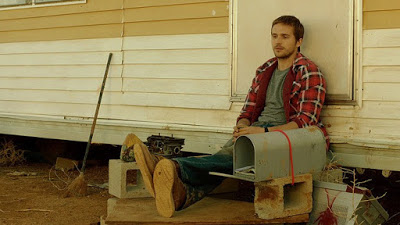
The two leads are played by Cloverfield’s Michael Stahl-David and Ruby Sparks’ Zoe Kazan, the former as a New Mexico parolee named Dylan and the latter as a New Hampshire trophy wife named Rebecca. Little do they know that they have shared a mental link since childhood, when one’s sledding accident somehow affected them both, but suddenly, it becomes strong enough to allow them to converse with each other and see what the other is seeing. I was a bit annoyed at first that there was no explanation or trigger to the sudden strengthening of their bond, aside from “Why not?” But then I recalled that Your Name didn’t have a very clear reason either, so it’s perhaps best to just roll with it since these cosmic movie connections are hard to clarify in reality.

Despite being separated for most of the film, Kazan and Stahl-David have engaging chemistry to spare. Their long-distance conversations feel natural to us since it’s as if they’re talking on the phone, but to everyone else, it looks like they’re talking to themselves or suffering bizarre outbursts that elicit worry and sideways glances from those nearby. (My VC actually thought it was stupid that they kept talking to each other out loud with no thought to how crazy they looked to others.) As with Taki and Mitsuha in Your Name, they learn a lot about each other, from past stresses to present foibles, through the rare opportunity of vicariously witnessing the other’s life. I especially liked how one tends to comment on what’s happening to the other, a voice in the head they have to try to ignore, like the hologram Al from Quantum Leap.

Image result for in your eyes zoe kazan film

Also worth noting are the direction and cinematography, which infuse many scenes with a luminous quality that enhances the enchantment of their unusual bond. The contrasting settings also heighten the distance between them, from Dylan’s orange desert to Rebecca’s blue-tinged snowscapes. The editing does well in visualizing their shared feelings, culminating in a bizarre but sensual bedroom scene. (Is there even a word for that? Long-distance intimacy?)

As much as I enjoyed both the romance and fantasy aspects, I must admit I didn’t love In Your Eyes quite as much as I’d hoped. It isn’t just the lack of explanation or the oddness of the very concept. The climax builds to a satisfying final scene, but all the events leading up to it are left open-ended, making me think there will be lots of unaddressed bumps on the road to a happy ending. Plus, as good as In Your Eyes is, I think Your Name did a similar story better, just as it did with The Lake House. Even so, In Your Eyes deserves a lot more attention than the few bloggers who have tried to promote it. For any fan of unorthodox romance or extramundane relationships, it’s definitely worth your time.

Best line: (Rebecca, realizing who she’s talking to the first time) “Wait, you’re real. You’re a real person!”   (Dylan) “Oh, that’s the sweetest thing anybody’s said to me all day.”


Rank: List Runner-Up


© 2017 S.G. Liput
497 Followers and Counting


Kung Fu Panda 3 (2016)

21 Friday Jul 2017

Posted by sgliput in Movies, Poetry, Reviews, Writing

≈ Leave a comment

Tags

Action, Animation, Comedy, Dreamworks, Family, Fantasy

Image result for kung fu panda 3 film

Between one parent and one child,
Their love is uncomplicated,
Even if they’re not related
Or may feel somehow exiled.

Will it change, their love compiled,
If a parent is located
From which they were separated
And the two are reconciled?

Some may fear they’ll be reviled
At reunions long-awaited,
Yet how can love be ever faded
Between a parent and their child?
________________

MPAA rating: PG

It may have seemed that DreamWorks was just planning to milk its past success with minimum effort when it released a third Kung Fu Panda in the usually lackluster month of January last year. However, Kung Fu Panda 3 managed to exceed expectations and end the franchise on a surprisingly solid note, building on its prequels with a satisfying conclusion.

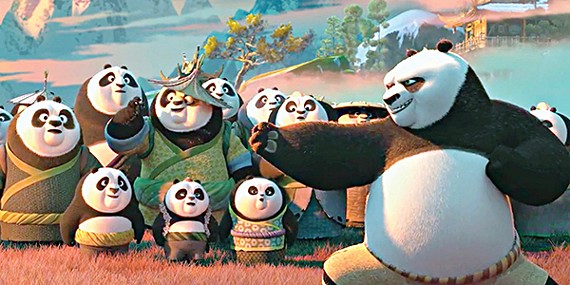
After the final scene of Kung Fu Panda 2, where Po’s real not-dead father Li Shang (Bryan Cranston) realizes his son is alive, we get to see father and son reunite early on, only to be threatened by a new adversary named Kai (J.K. Simmons), a yak from the Spirit World who drains others’ chi energy. While Kai builds an army by turning kung fu masters into jade zombies (yes, jombies), Po (Jack Black) follows his father to his home in a distant village of pandas, where Po hopes to train but ends up enjoying the life among his own kind that he never knew.

Image result for kung fu panda 3 li mr. ping

Kung Fu Panda 3 continues the strengths and weaknesses of its predecessors, including some stellar fight choreography and animation, as well as a lack of character development for Poe’s comrades, the Furious Five, except for Tigress (Angelina Jolie). Where it excels in the character department is Po and his two fathers, adoptive goose father Mr. Ping (James Hong) and his biological father Li. I love how Mr. Ping has grown from an eyebrow-raising gag in the first film to a real source of heart for these movies. Here, he finds himself jealous of Po’s excitement at finding his father and wrestles with how to react to this new monopolizer of Po’s attention. Meanwhile, Li may seem selfish or unwise at times, but it’s easy to sympathize with both fathers. In addition, the fact that Li seeks out Po after realizing he’s alive makes his absence a whole lot more understandable than, say, the willing separation of Hiccup’s mom in How to Train Your Dragon 2.

Kung Fu Panda 3 does a lot to bring the franchise full circle, particularly in the return of the deceased Master Oogway (Randall Duk Kim). True, it sidelines formerly major characters like Shifu (Dustin Hoffman) and bears similarities to the first film, but Po’s family dynamic and the Spirit World villain help it stand apart. The village full of Po’s fellow lazy pandas was also cute and endearing for the most part, where I expected it to be lame and silly. Aside from the action sequences, I especially admired one underplayed sacrifice that was easily Poe’s most heroic moment of the series.

Image result for kung fu panda 3 kai

All in all, Kung Fu Panda 3 is a worthy and funny finale for a series I didn’t expect to like when the first film was released back in 2008. DreamWorks has maintained its quality in both animation and story, creating a trilogy where it’s hard to say which of the three is the best, though I’m partial to the second movie. Why it was released in January, I don’t know, but Kung Fu Panda 3 is one of DreamWorks Animation’s stronger sequels.

Best line: (Shifu) “If you only do what you can do, you’ll never be better than what you are.”


Rank: List-Worthy (joining the other two)


© 2017 S.G. Liput
497 Followers and Counting


Harvey (1950)

09 Sunday Jul 2017

Posted by sgliput in Movies, Poetry, Reviews, Writing

≈ Leave a comment

Tags

Comedy, Drama, Fantasy

Image result for harvey film

Imaginary friends are such
That we don’t miss them very much
And so forget the joy that comes
From pals we cannot see or touch.

The fanciful are easy to mock.
We question sanity and gawk,
But everyone needs someone else
With whom to drink and laugh and talk.

And what the “sane” perhaps don’t see
In what we call imaginary
Is something we too often miss
In our mundane reality.
__________________

MPAA rating: Not Rated (easily G)

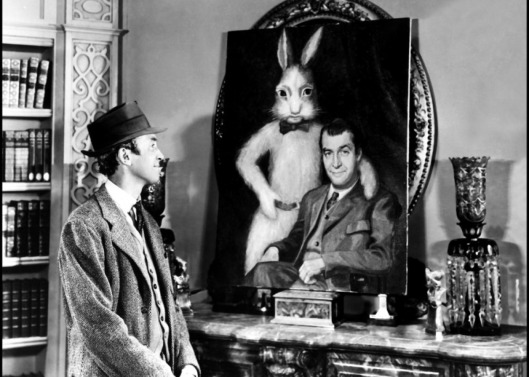
I watched Harvey for two main reasons: (1) It’s one of those universally liked classics that all fans of film should or feel like they should see, and (2) I love Jimmy Stewart, who earned an Oscar nomination for the kind of role that doesn’t initially seem worthy of an Oscar. As Elwood P. Dowd, he’s a genial, soft-spoken alcoholic happy to while away the hours visiting the bar and inviting strangers home for dinner. The trouble is that he’s utterly sincere in his friendship with a six-foot-plus invisible rabbit by the obvious name of Harvey.

Image result for harvey film

While I have been familiar with the basic concept of Harvey for years, I didn’t know what to expect from the actual storyline. My VC had seen it long ago and remembered it as vaguely weird, and that was largely my opinion through the first half, or the first two-thirds really. Dowd obliviously walks around introducing acquaintances to his large unseen pal, while his sister Veta (Oscar-winning Josephine Hull) and his niece (Victoria Horne) bemoan the damage this does to their social reputation and vow to lock him away in a sanitarium. There are plenty of comical misadventures for secondary characters that drive the plot, most of which Dowd remains heedless of, and I found myself more annoyed than amused that much of the humor relied on misunderstandings that could easily be solved by a simple turn of the head or a more careful choice of words.

Yet, the latter third of the film places Dowd’s potential “mental illness” into a wider context of fantasy vs. reality and dull normalcy vs. eccentric kindness. Whereas what came before was simply Dowd’s peculiar routine, which seemed deranged to the outside eye, Stewart gives him more depth with some simple but keenly heartfelt conversations that make the prospect of an invisible pooka more enviable than pitiable. While Hull’s busybody panic and Stewart’s sincerity make the most of a rather uninvolving beginning/middle, the end helped me see Harvey’s classic appeal. It will never be among my favorites, but, like Dowd himself, it had a gentle charm and was, above all, “pleasant.”

Best line: (Aunt Veta, to her niece) “Myrtle Mae, you have a lot to learn, and I hope you never learn it.”


Rank: Honorable Mention


© 2017 S.G. Liput
494 Followers and Counting


Storks (2016)

25 Sunday Jun 2017

Posted by sgliput in Movies, Poetry, Reviews, Writing

≈ 2 Comments

Tags

Animation, Comedy, Family, Fantasy


Image result for storks film

I wrote to the storks with a simple request,
A baby, just one, and I wanted the best.
I wanted him perfect, no colic or crying
Or being a pest by not always complying.
And potty-trained too, with no changing a diaper,
And energy neither too boring or hyper.
And give him a lovable heart of pure gold,
To love me, respect me, and care when I’m old.
So when there’s a well-behaved angel on earth
In stock, send at once. (So much simpler than birth!)

And what did those long-necking lummoxes send
But a baby like so many others to tend?!
Since he first arrived, he’s incessantly cried
And stunk before I even brought him inside.
And all the bird left me was this little note:
“We’ve tried to match most of the wishes you wrote.
But you should just know that the son you desired
Has years of hard work of assembly required.”
____________________

MPAA rating: PG

Storks didn’t look all that impressive when it came out last year, just another maverick animated film struggling to reach even DreamWorks quality. When I actually gave it a chance, though, it turned out to be a pleasant surprise, more humorous and heartwarming than I would have guessed, and a solid if hyperactive cartoon that the Warner Animation Group (who also produced The Lego Movie) can be proud of.

There’s no denying that the premise of Storks is a bit gonzo, making an entire, half-baked plot out of the myth of storks delivering babies, which I can only assume was invented so parents could appease their kids’ curiosity without broaching the birds-and-bees speech. In this world, storks have switched from baby delivery to package delivery (after all, someone says, “there are other ways of making babies”), after an incident left them unable to deliver young Tulip to her family. Tulip (Katie Crown) grows up as a ward of the storks’ Amazon-like company called Cornerstore.com, and, after she impetuously activates the abandoned baby factory and creates a little girl, she and the corporate ladder-climbing Junior (Andy Samberg) try to deliver the baby to her family without alerting their authoritarian boss Hunter (Kelsey Grammer).

Image result for storks film

The storyline is loose and frenetic, with enough rapid-fire jokes that the plot often seems like just an excuse to string together random gags. The upside is that many of these gags are actually funny, particularly a baby-loving pack of wolves who somehow manage to morph themselves into vehicles to give chase. While the action draws inspiration from the likes of Monsters, Inc. and Shark Tale, the constant jokes keep it fresh, and things move along at a pleasant clip. Most of the voice actors do good work as well, especially Katie Crown, whose exuberance makes Tulip a lovably upbeat character. The animation is also quite good, easier on the eyes than the hyper-detail of The Lego Movie and occasionally stunning with the bigger set pieces.

That being said, there’s bound to be a joke or two along the way that falls flat, and some do. The worst, though, is the character of an attention-seeking pigeon (Stephen Kramer Glickman) who tries desperately to be integral to the plot, such that the writers obviously thought he was hilarious. Yet his awkwardness is so aggressively unfunny that it drags the film down every time he appears onscreen. If ever there was a side character that needed to be rewritten or cut altogether, it’s the pigeon.

Image result for storks film

Overall, though, Storks was a fun watch with some surprising heart. Despite the innate weirdness of the whole storks-making-babies thing, there are some touching moments and themes, like the value of spending time as a family and achieving a sense of belonging, with some familiar overtones of Meet the Robinsons thrown in. In addition, I liked that there was a subtle, though probably unintentional, pro-life sentiment in how Hunter and Junior refer to the infant as “it” to avoid a connection while Tulip insists on calling it a baby. Storks may be too hyper and scattershot to win any awards or popularity contests, but it’s an amusing jaunt of absurdity.

Best line: (Hunter) “Look at that sunrise. How can you not look at it?”   (Junior, trying to humor his boss) “If I go blind, it’s worth it!”


Rank: List Runner-Up


© 2017 S.G. Liput
491 Followers and Counting


Wonder Woman (2017)

08 Thursday Jun 2017

Posted by sgliput in Movies, Poetry, Reviews, Writing

≈ 16 Comments

Tags

Action, Drama, Fantasy, Superhero, Thriller, War

Image result for wonder woman 2017

I wonder what wonders the world has beheld:
More than seven, no doubt,
More than those learned about,
But must they be spectacles unparalleled,
Gloried feats unsurpassed,
Or more simply contrast?

A light among shadows, a gem among stones,
An unshakable stand
Against failure’s demand,
A rare certainty in a world of unknowns,
An encouraging word
That despair hasn’t heard,

A dream among cynics, a float in rough water,
Shooting stars overhead
When all hope was thought dead,
A lamb among wolves with no worry of slaughter—
The world’s wonders don’t last,
But the weak and steadfast
Can find hope in contrast.
_______________________

MPAA rating: PG-13

I honestly never thought I’d see a DC movie on its opening weekend, but a half-planned trip to the theater left Wonder Woman as the most convenient show time available, and the positive reviews I’d heard convinced my VC and me to give it a try. I had come to the conclusion that the DC Extended Universe (DCEU) is a lost cause, with Man of Steel, Batman v. Superman, and Suicide Squad being either unwieldy, joyless, or overblown. Yet here at last is Wonder Woman, helmed by Patty Jenkins, the first female director of a major superhero film, and DC finally gets a movie that can hold its own against Marvel.

I’ll admit I don’t know much about Wonder Woman from the comics and only ever saw her as a member of the animated Justice League on TV, as well as her animated origin film from 2009. The latest live-action movie begins much like its cartoon counterpart, with the Princess Diana (Gal Gadot) of the Amazons residing on the hidden island of Themyscira, training to be a great warrior, until the crash-landing of American pilot Steve Trevor (Chris Pine) awakens her sense of duty and interest in the outside world. Unlike the animated version set in the modern day, 2017’s Wonder Woman has the key difference of taking place during World War I, making its retro setting more than a little reminiscent of Captain America: The First Avenger. (Her origin apparently took place during World War II in the comics, so I guess the change was intended to avoid being too similar to Cap’s first outing.) There are plenty of parallels, from an evil German antagonist (Danny Huston) with a diabolical scientist (Elena Anaya) under him to a climactic sacrifice involving a death-carrying plane, but there’s enough originality here that the similarities never detract from the story.

Image result for wonder woman 2017

The best thing Wonder Woman has in its favor is Gal Gadot. Neither an overly familiar face nor a struggling newbie, she’s an effortlessly perfect fit for the role, her slight Israeli accent giving her an exotic touch while she nails the assertive and noble appeal of the character. She’s also attractive no matter what she does, whether in secretarial incognito or in the heat of battle. And speaking of battle, her first moment of truth fighting against the German army is spectacular, taking ownership of “No Man’s Land” with feats that Lynda Carter could only dream of. Alongside her, Chris Pine is his usual likable self, and while he can’t compare with Diana’s abilities, I liked that he was still an active and valiant match for her rather than a weakling to make her look better. Plus, in contrast to Batman and Superman of late, there’s actually some humor, perhaps not at Marvel’s levels, but it’s refreshing that DC seems to have learned something from the competition. (Suicide Squad may have had more jokes, but it’s a barely connected oddity as far as I’m concerned.)

As much as I enjoyed what is clearly DC’s best film to date, it’s not above a few nitpicks, such as stereotypical villains and one scene with some cynically feminist jabs as Steve and Diana awkwardly discuss sex and marriage. Most of the climactic battle has the same excessive bombast as the end of Batman v. Superman, which I guess is only a negative if you disliked it then. The strongest criticism for me is the muddy mythology that comes to a head toward the end. Wonder Woman has always drawn freely from Greek mythology, which works for the loose backstory at the beginning, and Diana understands Zeus to be man’s creator and Ares to be the corrupting god of war, roles that here distinctly echo the Christian God and devil. She’s convinced with apparent naiveté that Ares is controlling mankind to wage this Great War, and while her understanding is challenged and widened, it’s left in doubt by the end just how right she was and what that implies for history and religion in general.

Image result for wonder woman 2017

If you don’t think about that too hard, though, Wonder Woman absolutely fulfills its potential as the first superheroine blockbuster, and my VC quite enjoyed it as well, even without having seen the previous DC entries. (Coincidentally, the very day I saw it, I came home to find the old 1970s TV show with Lynda Carter on, and compared with that cheese, the film is a masterpiece.) Aside from Gadot herself, I most appreciated the fact that this is a genuinely heroic tale of a warrior discerning why she defends mankind. Not many superhero movies tackle that topic so directly, and especially considering how DC has loused up even the most iconic of heroes, Superman, Wonder Woman’s experiences of both the evil and the noble that man is capable of provide her with a persuasive reason for her defense of the world, beyond the idealistic zeal that she and Captain America had from the start. Her gallantry and girl-power status as a role model are a far cry from the broody skepticism of Batman v. Superman or the psychopathic half-villainy of Suicide Squad, and this “light among shadows” seems to indicate that there might actually be hope for the DCEU yet, though I undoubtedly still prefer Marvel. Wonder Woman may not quite be an unqualified success, but it’s a welcome success nonetheless.

Best line: (Hippolyta, as Diana leaves the island, echoing many parents, I’m sure) “You are my greatest love. Today, you are my greatest sorrow.”


Rank: List-Worthy


© 2017 S.G. Liput
488 Followers and Counting


Version Variations: Pete’s Dragon (1977, 2016)

23 Tuesday May 2017

Posted by sgliput in Movies, Poetry, Reviews, Writing

≈ 3 Comments

Tags

Animation, Drama, Family, Fantasy, Musical, Version Variations

Image result for pete's dragon 1977

Image result for pete's dragon 2016

To some, a forest holds mere trees,
With empty air between,
While one who knows to notice sees
A firmament of green,
Of life and lives and rarities
That few have ever seen.

What wonderments may hide out there
I cannot dare to guess,
But those who speak of creatures rare,
Withdrawn from man’s progress,
Perhaps perceive that empty air
Cannot be magicless.
_________________

MPAA rating for 1977 version: G (maybe PG)
MPAA rating for 2016 version: PG

With Disney so dedicated now to translating its past canon of animated classics into live-action films, it’s rather disconcerting that their attempts thus far have been fan favorites, like Sleeping Beauty or Beauty and the Beast, but not the lesser entries in Disney’s catalog. While remakes of The Black Cauldron and The Sword in the Stone are supposedly in the works and would be welcome, Pete’s Dragon is the first recent remake that actually had a chance of surpassing the original simply because the original is fairly lame. Yet, even though a simple updating of the tale could have sufficed, writer-director David Lowery took the essentials of the first story and transformed them into something closer in spirit to E.T. than to their source, providing an example of improvement for future Disney remakes to follow.

Image result for pete's dragon 1977 helen reddy

Let’s take a look at the original, a film whose “classic” status is more reliant on its age than anything else. The first Pete’s Dragon sees young Pete and his sometimes invisible dragon Elliott escape from a wicked foster family and seek a home in the seaside town of Passamaquoddy, where kind lighthouse keepers (Mickey Rooney, Helen Reddy) take him in and sneaky snake-oil salesmen (Jim Dale, Red Buttons) plot to capture Elliott. It’s a family-friendly musical in the vein of Mary Poppins, Bedknobs and Broomsticks, and Chitty Chitty Bang Bang, the key difference being that it came out in 1977, a less innocent time when ultra-sincere stories like this began tasting too saccharine.

The silly musical numbers and childish wish fulfillment simply don’t work as well here, thanks to some dreadfully gee-whiz acting from young Sean Marshall as Pete. There’s a notable lack of Disney magic, perhaps due to a new generation of animators (including Don Bluth) taking the reins at the time, and some elements are downright unpleasant, like the abusive backwoods Gogans, headed by Shelley Winters, who want Pete as their personal slave. The songs range from forgettable to embarrassing, but Helen Reddy’s “Candle on the Water” is a beautiful exception and even earned an Oscar nomination.

Image result for pete's dragon 1977

I suppose I shouldn’t be too hard on the original Pete’s Dragon. If I’d seen it as a kid, maybe I’d consider it a classic, as I do Chitty Chitty Bang Bang. The merging of animation and live-action is actually done quite well, and there are some fun moments sprinkled throughout the tiresome ones, like Mickey Rooney’s panic over seeing Elliott or the visiting mountebank who can’t pronounce the name of the town he claims to love. It was also neat seeing Jim Backus of Gilligan’s Island appearing as the town’s mayor. By the overly heartwarming ending, I even was able to recognize why others might find this as charming as Elliott himself. Yet my adult sensibilities couldn’t let me overlook its glaring flaws and often laughable excesses, like the soap opera twist at the end that explains away a character’s year-long absence with amnesia. With these earnest family films, it’s a fine line between delightful and cloying, and Pete’s Dragon is one member of the Disney canon that could have certainly benefited from a remake done right.

Thankfully, almost forty years later, that remake arrived. I debated on whether to call this review a Cartoon Comparison or a Version Variation since the original’s dragon was animated and the latest Elliot was CGI, but since CGI is still animation, I opted for a Version Variation. (Did anyone else notice that the 1977 dragon was named Elliott with two t’s, while the more recent one was Elliot with one t?) Yes, in the 2016 version of Pete’s Dragon, there’s still a boy named Pete and a giant invisible green dragon, but that’s really all this film has in common with the original. Gone are the brutish hillbillies. Gone is Dr. Terminus, the greedy charlatan. Gone are the musical numbers and the silly tone. Whereas established fairy tale films are expected to follow the same beats as their predecessors, Pete’s Dragon took the bare minimum of inspiration from the 1977 movie and made something new yet affectionate out of it.

Image result for pete's dragon 2016 bryce dallas howard

Young Pete (Oakes Fegley) is still an orphan, but the beginning actually shows the loss of his parents and how his first encounter with Elliot saves him, after which the boy grows up as a wild child with his protective dragon friend in the remote woods of the Pacific Northwest. In place of Helen Reddy’s beer cask-skipping lighthouse keeper, Bryce Dallas Howard is pleasantly down-to-earth as Forest Ranger Grace Meacham, and her father (Robert Redford) still tells tall tales of spotting an enormous dragon out in the woods. When Pete is discovered and falls into Grace’s charge, the same familial bonds and adoptive hopes develop as in the first film, only done better and with more subtlety. In lieu of the covetous swindler who wants Elliott for elixir ingredients, the villain role goes to Karl Urban as Gavin, the brother of Grace’s lumberjack boyfriend. His desire to capture a fantastical creature isn’t the most original element, but he’s more like Peter Coyote’s man with the keys from E.T. than an outright villain, and a good moment toward the end reaffirms that he does care more for his family than about fame and fortune.

The latest Pete’s Dragon is perhaps a bit too slow in spots, but it’s an appealing contrast to the frantic comedy of most family fare these days. Unlike the 1977 film, all of the human performances are natural and endearing, and Elliot himself is masterfully brought to life in all his fluffy green dragon glory, behaving like a giant dog at times, which is perhaps different from the whistling original but not at all in a negative way. And as a huge Lindsey Stirling fan, I have to mention her lovely and wistful song “Something Wild” that easily makes my End Credits Song Hall of Fame and was my #4 song of last year.

Image result for pete's dragon 2016

Of all the live-action remakes Disney has created and planned, Pete’s Dragon seemed an unlikely contender, with a lackluster original with limited appeal. Yet even if it’s not the most entertaining entry, Pete’s Dragon may be the best live-action translation yet. While Cinderella and The Jungle Book did their sources justice, 2016’s Pete’s Dragon blows its predecessor out of the water, from the much more intimate change in tone to the uplifting final scene that offers a happy ending to Elliot as well as Pete. Notably distinct without the need to be edgy or revisionist, it’s a gentle remake that Disney would do well to learn from.

Best line from 1977 version:  (Merle Gogan) “Say, have you seen anything of a mean, fresh kid, about yea big? Answers to the name of Pete.”  (Hoagy) “Half of the kids here in this town answer to Pete. Other half don’t answer.”

Best line from 2016 version:  (Mr. Meacham) “There’s magic in the woods, if you know where to look for it.”


Rank for the 1977 version: Dishonorable Mention
Rank for the 2016 version: List Runner-Up


© 2017 S.G. Liput
484 Followers and Counting


← Older posts
Newer posts →

Recent Posts

  • Dust Bunny (2025)
  • Don’t Breathe (2016)
  • The Sheep Detectives (2026)
  • The Black Phone (2021)
  • Godzilla Minus Zero (2026)

Recent Comments

The Sheep Detectives… on Wildwood (2026)
The Sheep Detectives… on #40: Babe (1995)…
The Black Phone (202… on Halloween Kingathon – Mi…
Godzilla Minus Zero… on Godzilla Minus One (2023)
If You Were the Last… on The Martian (2015)

Archives

  • November 2026
  • September 2026
  • June 2026
  • May 2026
  • January 2026
  • December 2025
  • May 2025
  • April 2025
  • March 2025
  • February 2025
  • January 2025
  • December 2024
  • May 2024
  • April 2024
  • March 2024
  • February 2024
  • January 2024
  • December 2023
  • November 2023
  • October 2023
  • September 2023
  • July 2023
  • June 2023
  • May 2023
  • April 2023
  • March 2023
  • February 2023
  • January 2023
  • December 2022
  • November 2022
  • October 2022
  • September 2022
  • August 2022
  • July 2022
  • June 2022
  • May 2022
  • April 2022
  • March 2022
  • February 2022
  • January 2022
  • December 2021
  • November 2021
  • October 2021
  • September 2021
  • August 2021
  • July 2021
  • June 2021
  • May 2021
  • April 2021
  • March 2021
  • February 2021
  • January 2021
  • December 2020
  • November 2020
  • October 2020
  • September 2020
  • August 2020
  • July 2020
  • June 2020
  • May 2020
  • April 2020
  • March 2020
  • February 2020
  • January 2020
  • December 2019
  • November 2019
  • October 2019
  • September 2019
  • August 2019
  • July 2019
  • June 2019
  • May 2019
  • April 2019
  • March 2019
  • February 2019
  • January 2019
  • December 2018
  • November 2018
  • October 2018
  • September 2018
  • August 2018
  • July 2018
  • June 2018
  • May 2018
  • April 2018
  • March 2018
  • February 2018
  • January 2018
  • December 2017
  • November 2017
  • October 2017
  • September 2017
  • August 2017
  • July 2017
  • June 2017
  • May 2017
  • April 2017
  • March 2017
  • February 2017
  • January 2017
  • December 2016
  • November 2016
  • October 2016
  • September 2016
  • August 2016
  • July 2016
  • June 2016
  • May 2016
  • April 2016
  • March 2016
  • February 2016
  • January 2016
  • December 2015
  • November 2015
  • October 2015
  • September 2015
  • August 2015
  • July 2015
  • June 2015
  • May 2015
  • April 2015
  • March 2015
  • February 2015
  • January 2015
  • December 2014
  • November 2014
  • October 2014
  • September 2014
  • August 2014
  • July 2014
  • June 2014
  • May 2014
  • April 2014
  • March 2014
  • February 2014
  • January 2014
  • December 2013

Categories

  • Blindspot
  • Blogathon
  • Christian
  • Movies
  • Music
  • NaPoWriMo
  • Poetry
  • Reviews
  • TV
  • Writing

Meta

  • Create account
  • Log in
  • Entries feed
  • Comments feed
  • WordPress.com

Blog at WordPress.com.

  • Subscribe Subscribed
    Rhyme and Reason
    Join 799 other subscribers

    Have a WordPress.com account? Log in now.

  • Rhyme and Reason
    View site in Reader
    Manage subscriptionsSign upLog in
    Report this content
    Collapse this bar