• Home
  • About Me
  • The List
  • THE LIST (2016 Update)
  • THE LIST (2017 Update)
  • THE LIST (2018 Update)
  • THE LIST (2019 Update)
  • THE LIST (2020 Update)
  • THE LIST (2021 Update)
  • THE LIST (2022 Update)
  • Top Twelves and More
  • The End Credits Song Hall of Fame

Rhyme and Reason

~ Poetry Meets Film Reviews

Rhyme and Reason

Tag Archives: Family

Zootopia (2016)

10 Sunday Jul 2016

Posted by sgliput in Movies, Poetry, Reviews, Writing

≈ 1 Comment

Tags

Animation, Comedy, Disney, Family

Image result for zootopia film


To stay in good graces,
Most stay in their places,
Their happy, expected, and preordained spaces
Among their preferred and familiarized faces.
It’s fine, and it’s true,
But in some special cases,

We aren’t just contented
With life as presented
But strive to be more and to live reinvented.
Such paths can be ridiculed, feared, or resented
But that’s nothing new
When you’re unprecedented.
_________________

MPAA rating: PG
Disney has certainly been on a roll lately. Rising from the lameness of Chicken Little and The Wild, it’s been delivering consistently original CGI gems, films like Tangled, Wreck-It Ralph, Big Hero 6, and now Zootopia (also called Zootropolis in Europe, supposedly to avoid confusion with an actual zoo over there). A box-office hit on par with Frozen’s success, Zootopia takes the idea of a world of anthropomorphic mammals and fills it with a winning blend of colorful characters, outstanding animation, and a universal moral message, three prime ingredients at which Disney excels.

Judy Hopps (chipper Ginnifer Goodwin) dares to be the first bunny cop, against her family’s worry and conventional wisdom, since most police officers are rhinos or elephants or something big enough to combat crime. When she actually realizes that dream and joins the force in the multi-species metropolis of Zootopia, her naïve idealism clashes with her chief (Idris Elba) and with the con artist fox Nick Wilde (smug Jason Bateman). Soon, Judy and Nick must form an uneasy alliance to solve a slew of missing mammal cases with unseen repercussions.

Right from the start, as Judy sees the city for the first time through a train’s observation deck, there’s enough visual detail and creative imagination to rival the world-building of Pixar. There are boroughs designed as habitats, from the lush rain forest to the frigid tundra, and a plethora of animalized modern conveniences: hamster-tunnel hallways, drink elevators for giraffes, sloths at the DMV (okay, that’s an inconvenience). So many scenes are full of varied pedestrians and fast-paced activity that the backgrounds alone are worth watching. Luckily, the script never lets its humorous potential go to waste, making Zootopia the funniest Disney movie in recent memory. I especially love how Alan Tudyk has become the John Ratzenberger of Disney, to the point that he’s now getting his own gags in reference to past roles (specifically, the Duke of Weselton in Frozen).

Aside from the vibrant animation and consistent jokes, there’s a layered message to Zootopia, a familiar one of tolerance and embracing differences over prejudice, in this case between prey and predator. Some may consider it preachy or heavy-handed, and I can understand why; one misunderstanding in particular seemed overly sensitive, like many perceived offenses nowadays that aren’t really that bad when you think about it. After all, unintended “insults” are often less offensive than people’s reactions to them. Despite this, Zootopia takes its lesson seriously. The finger isn’t just wagged at insensitivity; it’s also aimed at anyone stuck in complacency or those seeking to create problems where there were none. It isn’t all negative either; Judy herself is a wholly admirable female role model, not content to live under others’ expectations but rising to her dream and urging others to do the same. Now that’s a message worth lauding!

All in all, Zootopia is a fun buddy-cop mystery that plays to Disney’s non-musical strengths, even with a few weaknesses. I could have done without an awkward scene at a nudist spa, and it’s still a bit unusual to see modernized animated animals playing with cell phone apps. There are also a few unanswered questions, such as what exactly do predators eat if they’ve evolved past their carnivorous tendencies. Ice cream? I also couldn’t help wondering where all the non-mammals were, fish, birds, reptiles, and such. “Try Everything,” the catchy theme song sung by Shakira, even mentions birds but I never saw any. Have they not become sentient, or are they perhaps enslaved by their mammal overlords? My VC says I’m overthinking this, and I hope so. (She loved the movie too, as did my parents.)

Regardless, ever since John Lasseter was put in charge, Disney Animation continues to impress and entertain with a consistency only Pixar has shown thus far. Talking animals are nothing new, but Zootopia gives them a fresh spin that hits its intended message without ever forgetting to stay amusing. Like Big Hero 6, it’s also a film for which I can easily envision sequels, and based on the talent that created this original, my hopes are high.

Best line: (Judy, calculating Nick’s income to blackmail him) “Two hundred dollars a day, three hundred sixty-five days a year since you were twelve; that’s two decades, so times twenty which is… one million four hundred sixty thousand – I think, I mean I am just a dumb bunny, but we are good at multiplying.”


Rank: List-Worthy


© 2016 S. G. Liput
393 Followers and Counting


Cartoon Comparisons: Sleeping Beauty (1959) / Maleficent (2014)

19 Sunday Jun 2016

Posted by sgliput in Movies, Poetry, Reviews, Writing

≈ 6 Comments

Tags

Animation, Disney, Family, Fantasy, Musical


There she lies, fair Sleeping Beauty,
Cursed to slumber and to wait.
Those who kiss for wealth or duty
Cannot change her dreamless fate.

Only true love can awaken
And unlock her heavy eyes.
Fear not that she is forsaken.
Love will find her where she lies;
He will come, and she will rise.
________________


MPAA rating for Sleeping Beauty: G
MPAA rating for Maleficent: PG


Now that my cable has been restored after a bad storm knocked it out for a few days, it’s time once again for a Cartoon Comparison, this time between Disney’s classic Sleeping Beauty and its subversive live-action counterpart Maleficent. Sleeping Beauty was the last cinematic fairy tale of Walt Disney’s lifetime and really the last traditional fairy tale until The Little Mermaid thirty years later. Since it’s widely considered one of Disney’s best, modern Disney executives decided to use it (and Alice in Wonderland) to kick off their crusade to translate the entire canon to CGI-filled live-action. So how do these two compare?

I’ll be honest: Despite its reputation, Sleeping Beauty has never been among my favorite Disney films, which is why I haven’t reviewed it until now. Even compared with Disney’s classics, I’ve always leaned more toward Cinderella and Fantasia, simply because I grew up watching them more. I probably saw Sleeping Beauty once or twice as a kid and not since, and I was pleasantly surprised when this latest viewing reminded me of why it truly is a Disney classic. At first, some of the opening animation appears simple and angular, like an illustration from the Middle Ages, but as it continues, backgrounds become increasingly detailed. Close-ups of stone walls and tree trunks border on photo-realistic, and the layering of the forest adds beautiful depth as trees stretch away into the distance. As much as I love Disney’s follow-ups like One Hundred and One Dalmatians or The Jungle Book, the animation quality clearly started declining after this, making Sleeping Beauty, in a sense, the height of early Disney animation.

Not so much, though, when it comes to the story. One thing I always associated with Sleeping Beauty was its namesake being rather boring, and indeed Aurora herself is basically a placeholder, a damsel in distress who doesn’t do things as much as things happen to her. What I forgot was how enjoyable the fairies are. The three colorful fairy godmothers Flora, Fauna, and Merryweather are the true protagonists here, first blessing baby Aurora, then hiding her away from the evil Maleficent, raising her, and playing a key role in the famous climax. Their likable bickering over method and favorite color adds humor to scenes that otherwise might be dull. Likewise, Maleficent is a memorably evil villainess (voiced by Eleanor Audley, who also voiced Lady Tremaine in Cinderella), whose dragon transformation is the most thrilling scene of the movie.

While the film and the story it’s based on are undoubtedly classics, Sleeping Beauty does have more than its fair share of flawed fairy tale logic. For instance, why does King Stefan ban spinning wheels and force his kingdom into sixteen years without thread when Aurora is hidden anyway? Why do the fairies bring Aurora back to the castle the day of the curse rather than the day after, just to be safe, and then promptly give her some risky “alone time?” Why do the fairies put everyone to sleep when, for all they know, Aurora’s true love could be right there and unable to awaken her if he’s asleep too? Regardless of little plot holes like these, Sleeping Beauty has that timeless Disney touch that still captures imaginations, especially during the forest dance between Aurora and Prince Philip as they waltz to Tchaikovsky.

And then, fifty-five years after Sleeping Beauty, someone at Disney had a grand thought and asked, “Why is Maleficent so evil? She just wants to curse this baby out of spite for not being invited to her christening? Traditionally, evil villains are so old-fashioned, so why don’t we turn her into a good guy?” Thus, borrowing a page from Wicked minus the musical numbers, what should have been dismissed then as a foolish idea became 2014’s Maleficent, a film I fully intended to dislike. I’m not wholly against these live-action remakes, but Disney should be trying to honor and flesh out its classics, not transform them into their opposites.

As I watched Maleficent, I began to accept that it’s honestly not a bad film nor a bad fairy tale. It’s just not Sleeping Beauty, and unfortunately the comparison does make it a bad film. Gone is the line about Maleficent using “all the powers of hell”; instead, she’s just a cute little girl fairy who happens to have big devil horns and eagle wings and a name implying harm and destruction. She starts out good, the guardian of a magical realm called the Moors, whose one meaningful relationship with a human ends in betrayal, pain, and bitterness. As far as villain backstories go, I can actually accept this; the writers do a decent job in providing a reason for Maleficent’s hatred. Once the baby Aurora is born, though, and we get a re-creation of Sleeping Beauty’s opening scene, the sorry consequences of these story changes play out.

Eventually, Maleficent’s rage dwindles to annoyance as she watches Aurora from afar, repeatedly saving her from the thoughtlessness of the three “good” fairies, renamed Knotgrass, Flittle, and Thistlewit, whose bickering loses all its likability when it becomes clear what morons they are. Over the course of sixteen years, Maleficent and her shapeshifting raven Diaval (not Diablo as in the cartoon) are Aurora’s real caretakers, and by the time the curse is to be fulfilled, Maleficent tries first to cancel it and then to break it. Something just doesn’t feel right about giving all these laudable duties to the villain; in making Maleficent good at heart, every other character suffers. The three fairies, or pixies, are negligent fools; Aurora’s father King Stefan is the real villain, an obsessive monster who cares more about killing Maleficent than about his own wife and is nothing like his cartoon counterpart singing “Skumps!”; even Prince Phillip is deprived of everything that made him an appealing character in the original. By the time “true love’s kiss” rolls around, the story borrows a page from Frozen, reminding us that true love doesn’t have to be romantic in nature. That worked in Frozen because it was original; don’t mess with something that is supposed to be romantic!

Basically, everything worthwhile about Maleficent is original. Every time it thinks for itself, it entertains (the magical Moors, the battle scenes, Diaval’s transformations). Every time it tries to borrow from Sleeping Beauty, it pales in comparison (the fairies and their gifts, Aurora and Phillip’s unmemorably unmusical meeting, Phillip’s ineffectual kiss). Perhaps fans of Angelina Jolie could look past all this, but I’m not one of them, and nothing in her turn as Maleficent changed that. I did rather like Elle Fanning as the buoyant Aurora, but most of the cast was intentionally unpleasant, with the girl power message effectively ruining every male character. It’s not just I as a man who felt that way too; my VC felt the same distaste.

Maleficent is a prime example of where Disney should have left well enough alone, letting its past animations speak for themselves. It might have worked better as an original story, but when a voiceover tries to convince us that this live-action subversion with the cool visuals is the real story, it loses credibility. Please, I know the real story, and it’s from 1959.

Best line from Sleeping Beauty: (Merryweather, as Flora uses her as a dummy to make Aurora’s dress) “It looks awful.”   (Flora) “That’s because it’s on you, dear.”

Best line from Maleficent: (Aurora, practicing to tell her aunties) “You’ve been very good to me…well, except that time you fed me spiders.”


Rank for Sleeping Beauty: List Runner-Up
Rank for Maleficent: Dishonorable Mention


© 2016 S. G. Liput
388 Followers and Counting


Wolf Children (2012)

08 Sunday May 2016

Posted by sgliput in Movies, Poetry, Reviews, Writing

≈ 2 Comments

Tags

Animation, Anime, Drama, Family, Fantasy


Mothers are angels, by parenthood wrought,
And unsung saints, whether they know it or not.
Their job is to lead through each giggle and tear
And make angels too of the rascals they rear.

They’re makers of breakfast and takers of guff
And mentors who know when enough is enough.
They’re huggers or kissers, though all aren’t the same,
Who take it in stride when kids think it a shame.

When needed the most, they’re a wide-open door,
The builders of life starting at the ground floor.
All this mothers are, or should be by design,
All worthy of honor, and why I love mine.
__________________

MPAA rating: PG

Happy Mother’s Day to all! I have no idea why it’s taken me this long to review the film that placed #6 on my Top 12 Anime List, but Mother’s Day seemed like the perfect opportunity to review this affectionate tribute to a mother’s love. After strong films like The Girl Who Leapt through Time and Summer Wars, I think Mamoru Hosoda clinched his growing reputation as the next Hayao Miyazaki with Wolf Children, a favorite of many anime fans.

As a college student, Hana meets and gradually falls in love with a young man she meets in class, a strong, silent type with a kind heart. Her love for this unnamed man is not diminished when he reveals that he is part wolf, able to transform at will but choosing to live as a human. What follows is a warmhearted montage of domestic bliss to rival the beginning of Up, along with an equally tragic end when Hana is left alone to care for their two wolf children Yuki and Ame.

While an early scene implies the uncomfortable idea of interspecies romance, almost everything else about this film is sweet and tender in the most appealing way. The usual stresses of raising children are given a unique spin with the werewolf aspect (should she take them to a pediatrician or a vet?). Hana knows nothing about raising kids on her own, let alone the half-wolf variety, but she learns and loves through every sleepless night, cranky tantrum, and potential emergency. While she keeps Ame and Yuki away from the world for the most part to protect them, she is a superlative example of the hard-working, underappreciated single mother.

When the two kids begin to outgrow their small apartment, she decides to move to the distant countryside, where they will have the freedom to choose whether to be wolves or humans. The move to a large dilapidated home (reminiscent of the beginning of My Neighbor Totoro) only means more work for Hana and more opportunities for both fun and danger for assertive Yuki and timid Ame. Hana’s tenacity is tested and affirmed, as is the good will of her charitable neighbors. The lush, hilly setting offers some gorgeous scenery, which captivates one of the children more than the other. In particular, two scenes of natural splendor are the epitome of animated beauty, and the family’s frolic through the snow is accompanied by a winsomely elegant score that always gives me chills.

The unfortunate drawback to Wolf Children’s appeal is a semi-unsatisfying ending. With time to consider both perspectives, I’ve come to forgive the bittersweet climax, which is like the reverse of The Jungle Book’s ending, if that makes sense. Even so, everything Hana did for her children is worthy of the deepest love and appreciation, and the end smacks of adolescent ingratitude. Despite that caveat for the climax, Wolf Children, for me, is not a film to simply like or dislike but to be fond of. My fondness for this film runs deep, and it will forever rank among my favorite depictions of maternal love.


Rank: List-Worthy


© 2016 S. G. Liput
385 Followers and Counting


Ragnarok (2013)

30 Saturday Apr 2016

Posted by sgliput in Movies, NaPoWriMo, Poetry, Reviews, Writing

≈ 3 Comments

Tags

Action, Drama, Family, Fantasy, Foreign, Thriller


(Today’s final NaPoWriMo/GloPoWriMo prompt was to write a translated poem, so I tried to write something homophonically similar to “The Half-Finished Heaven” by Swedish poet Tomas Transtromer. Doing that, I could have ended up with something as inscrutable as some of Gerard Manley Hopkins’ work, so instead I simply began each line of the poem below with the same letter as the original poem and chose a Scandinavian film to review.)

Mid-look was my life cut short,
Aghast at the proven report.
Goodbye to my daughter and son;
Dear father will never see port.

A brave man was I, no mistake.
Oh, Vikings would never forsake.
Vigor was rife in our bones,
Alas, till they littered the lake.

Veiled are we here in our sleep,
Veiled in the dangerous deep.
Still does our conqueror live,
Drowsing upon our corpse heap.

Valiant and foolish to tarry
Is he who finds our cemetery.
______________

MPAA rating: PG-13

Ragnarok may be the first Norwegian film I’ve seen, in a way the Norwegian equivalent of a late-summer blockbuster. Perhaps the closest thing I can compare it to is 2008’s Journey to the Center of the Earth with Brendan Fraser, loaded as both are with clichés and genuinely thrilling moments. Both films start out much the same; like Fraser’s volcanologist, archaeologist Sigurd Swenson (good Scandinavian name!) is desperate for funding, and when an enigmatic clue arises, he brings along his two kids Ragnhild and Brage and a couple colleagues on an ill-advised search for answers that doesn’t go as planned. In lieu of a Jules Verne novel as inspiration, Norse mythology stands in with the story of Ragnarok, a.k.a. the end of the world.

The expedition walks into danger when they raft across a remote, far-north lake to a central island where both Vikings and Russians once visited, never to leave again. It’s an effective build-up to what is ultimately a creature feature. The monster hidden below the surface and the foolish decisions of the humans will bring to mind films like Jaws, Eragon, and Jurassic Park III, but this Norwegian equivalent of those movies usually manages to make the material its own. A few set pieces involving a zip line and a bunker are edge-of-your-seat highs, and my VC was far more terrified than I at one prolonged suspense scene.

It may not be entirely original, but Ragnarok is an entertaining action adventure with some tense thrills that never become un-family friendly. The special effects are usually as good as most American productions, and the isolated Arctic scenery makes for a stunningly rich setting. I will be interested to see how Marvel’s Thor: Ragnarok compares. For a first accessible foray into Norwegian cinema, I’d recommend Ragnarok, though don’t watch the English dub. Most dubs don’t bother me, but when children are screaming and some English voiceover dully says “Help me,” it kinda ruins the moment.

Rank: List Runner-Up

© 2016 S. G. Liput

385 Followers and Counting


Newsies (1992)

26 Tuesday Apr 2016

Posted by sgliput in Movies, NaPoWriMo, Poetry, Reviews, Writing

≈ 4 Comments

Tags

Disney, Drama, Family, Musical


(Today’s NaPoWriMo prompt was to write a call-and-response poem, with a repeated refrain or chorus. I applied such a refrain to a news crier like those in a certain musical.)


Read all about it: the latest taboos!
-I’ll buy a paper; I do love the news.

Read all about it: new victims accuse!
-I’ll buy a paper; I do love the news.

Read all about it: strike workers refuse!
-I’ll buy a paper; I do love the news.

Read all about it: new game with horseshoes!
-I’ll buy a paper; I do love the news.

Read all about it: the war was a ruse!
-I’ll buy a paper: I do love the news.

Read all about it: your favorite teams lose!
-I’ll buy a paper: I do love the news.

Read all about it: erased interviews!
-I’ll buy a paper: I do love the news.

Read all about it: a new witness sues!
-I’ll buy a paper: I do love the news.

Read all about it: a brave few refuse
To stand by and watch those in power abuse
Their privilege and threaten the rights and the views
Of people whose justice nobody pursues!
-. . . Where’s the Enquirer? I want real news.
___________________________

MPAA rating: PG

Despite all the bad reviews and Razzie nominations it garnered upon release, I watched Newsies expecting and hoping to like it, both because I enjoy musicals and because it was the directorial debut of Kenny Ortega, who helmed my beloved teenage High School Musical films. Unfortunately, Newsies did not live up to my hopes, but neither was it as awful as the 39% Rotten Tomatoes score indicates. It was trying to be a grand, heartwarming musical but didn’t succeed, and I can’t even put my finger on why.

Set in 1890s New York, Newsies fictionalizes the real-life story of the newsboys who began their own strike when Joseph Pulitzer (an overwrought Robert Duvall) increased the cost of the papers that provided their meager income. Leading the charge against Pulitzer is a very young Christian Bale as Jack “Cowboy” Kelly, whose Brooklyn accent covers up Bale’s British accent with panache. Accompanied by new friend David (David Moscow, the young Josh Baskin in Big) and a single ally from a rival newspaper (Bill Pullman), Kelly unites the newsies of New York while trying to stay ahead of the corrupt orphanage keeper (Lost alert for Kevin Tighe, who does play a good meanie).

Newsies is at its best when the limber cast are belting out Alan Menken’s songs and performing Ortega’s remarkable choreography. The opening anthem “Carrying the Banner” and the now semi-classic “King of New York” are the high points, but Bale also gets a solo in the wishful “Santa Fe,” and none of the songs are what I would call bad. Sadly, there’s not enough of them, and long stretches of unengaging drama in between the musical numbers made much of the film unfortunately boring. I could tell that both the writers and the young actors were trying to create something potentially classic, but the necessary level of interest just wasn’t there. Not to mention, the strike scenes included some of the aspects that bug me about unions, such as the persecution of “scabs” who can’t afford not to do their job.

While it might be considered a misfire for Disney, I do admire Newsies for being one of the few non-animated musicals to be entirely original without being based on an earlier Broadway play. In fact, more songs were added to a stage production in 2011, and it later became a hugely popular, Tony-winning Broadway musical. That musical has its roots in this film, so I believe everyone involved in it can still be proud. Newsies does have something of a cult following, and I wonder now whether I would enjoy it more if it had been a mainstay of my childhood. Plenty of people hate the High School Musical films, but my nostalgia helps me forgive whatever they criticize. Perhaps if I’d seen Newsies at a much younger age, I would have enjoyed it more.

Best line: (Crutchy, one of the boys) “It’s this brain of mine; it’s always makin’ mistakes. It’s got a mind of its own.”


Rank: Honorable Mention


© 2016 S. G. Liput

384 Followers and Counting


The Last Sin Eater (2007)

06 Wednesday Apr 2016

Posted by sgliput in Christian, Movies, NaPoWriMo, Poetry, Reviews, Writing

≈ Leave a comment

Tags

Drama, Family


(Today’s NaPoWriMo prompt was to write a poem about food. I had to stretch the topic a bit, but here it applies to a ritualistic meal.)


In olden days, when Death dropped by
To whisk away a willing soul,
The folk believed that sin’s control
Still clung to what was left.
And so one chosen with a sigh
Was tasked with eating bread and wine
That represented as a sign
The dead one’s every lie and theft.

How heavy was this obligation,
Living only for the dead!
The taste of wine and sin-soaked bread
Lay bitter on the tongue.
This ritual owed its foundation
To the oldest of traditions,
But the cure for superstitions
Lay in faith held by the young.
_________________

MPAA rating: PG-13

My VC has grown extremely fond of the works of Francine Rivers, a best-selling Christian author whose one hit to garner a film adaptation is The Last Sin Eater. One of the weaknesses of Christian films is that the evangelical message is often the only reason it exists, at the expense of a worthwhile story. Luckily, The Last Sin Eater, directed by Michael Landon, Jr., has a good story. Focusing on an obscure but fascinating 19th-century tradition of some Celtic immigrants of Appalachia, the film paints a compelling tale of guilt amid a rural community with a surprisingly dark secret.

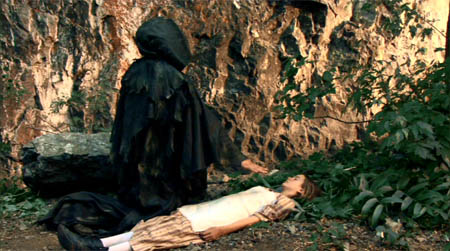
Young Cadi Forbes (Liana Liberato) is overcome with guilt for the death of her sister and seeks out the village’s reclusive Sin Eater to take away her iniquity. The Sin Eater dresses in a black robe and is treated like the boogeyman of a horror movie, even though he’s merely a victim of an alienating tradition. When Cadi meets a man of God (a grown-up Henry Thomas from E.T.), she becomes dubious of the necessity of a sin eater in light of someone named Jesus. This Christian element is key to the story’s resolution, but the core mystery remains separate and interesting.

While the acting isn’t always entirely convincing, Liberato is an earnest Cadi, and Henry Thomas and Louise Fletcher add some star power to an otherwise lesser-known cast. The woodland cinematography is also charmingly picturesque and a step above other low-budget films, even if the special effects aren’t. While it may please mainly faith-based audiences, The Last Sin Eater is a quaint and positive tale of redemption which, according to my VC, is not quite as good as the book.


Rank: Honorable Mention


© 2016 S. G. Liput

373 Followers and Counting


Miracles from Heaven (2016)

27 Sunday Mar 2016

Posted by sgliput in Christian, Movies, Poetry, Reviews, Writing

≈ Leave a comment

Tags

Drama, Family


I’ve not beheld a parted sea
Or outlived an emergency.
I’ve never seen a patient healed
Or glimpsed divine eternity.

I’ve never viewed a battlefield
With some celestial might revealed.
I wish I had, for maybe then
My faith in God would be more sealed.

Despite the things beyond my ken,
I’ve seen the warmth and faith of men,
And maybe that’s a miracle
Worth noticing time and again.
______________________

MPAA rating: PG

I had considered watching Risen or The Young Messiah for Easter, but the only faith-based film with a good show time (and an A+ CinemaScore) was Miracles from Heaven, which I’m rather glad I ended up seeing. I wasn’t won over by Heaven Is For Real, the previous film from producers T.D. Jakes and Joe Roth; it was an intriguing story but not one to sustain a full-length film, and the conflict felt forced coming from supposed people of faith. While that film showed a child’s heavenly vision early on and focused on people’s reactions, Miracles from Heaven does better in leaving it for the climax and focusing on a more relatable crisis of faith, with a far better chance for both smiles and tears.

Based on the true story of the Beam family from Burleson, Texas, the film depicts the family of five as real people whose faith is just one part of their lives. The parents flirt with each other; one daughter is obsessed with Taylor Swift; and another has a passion for soccer championships. Tragedy is the last thing they expect or deserve. Jennifer Garner outdoes herself as Christy Beam, who lives every parent’s worst nightmare when her daughter Anna (Kylie Rogers) is diagnosed with a severe and incurable gastrointestinal disease. Already stressed financially, she must endure constant worry, hospital waiting lists, incompetent doctors who won’t do more, competent doctors who can’t do more, and a host of unanswered prayers. Skeptics aren’t the only ones who question the goodness of God when bad things happen, and Christy’s faith becomes buried in feelings of grief and abandonment. Why did this have to happen to a sweet little girl? No one can offer her answers.

Obviously, the title indicates that something miraculous happens, but it’s more than that. In following this mother and daughter to their darkest point, moments of light shine out the brighter. Queen Latifah plays a kind waitress who befriends them while away from home and offers needed comic relief, and Eugenio Derbez is splendid as a Patch Adams-style child specialist who balances cheerful encouragement with inner knowledge that most of his patients will die. In these and many more side characters, the film reminds us that big miracles come from God, but small ones can originate in those random acts of kindness of which anyone is capable.

Doubt is everyone’s first reaction to miracles, and the film doesn’t forget that, nor does it try to explain why some people are so blessed while others are not. Miracles are rare but no less extraordinary, and for those willing, the unexplainable can remind people of hope when they have none. Miracles from Heaven has a few moments of familiar Christian themes that might get atheists rolling their eyes, but it’s an inspiring, well-acted, and emotional tale with which anyone who believes or hopes in miracles can identify.

Best line: (Christy) “Miracles are God’s way of telling us He’s here.”


Rank: List Runner-Up


© 2016 S. G. Liput

370 Followers and Counting


Akeelah and the Bee (2006)

09 Wednesday Mar 2016

Posted by sgliput in Movies, Poetry, Reviews, Writing

≈ 2 Comments

Tags

Drama, Family


Some have their goals and their futures all mapped,
People who know where their aptitudes lie, but
Endless potential is often untapped,
Loath to step out and wholeheartedly try, but
Longing one day to catch somebody’s eye.

You may have dreams that remain in your head
Only to wither away over time.
Useless are hopes overlooked and unsaid, and
Rare is the victor unwilling to climb.

Hear not the people who doubt every rung,
Echoing doubts they themselves have received.
Attend to the words of the more fruitful tongue,
Ready and willing, no thoughts preconceived,
To trust and to see what great deeds are achieved.

Open your notions of what you can do;
Utter a cheer for still others like you, and
Try, for indeed that is how dreams come true.
____________________

MPAA rating: PG

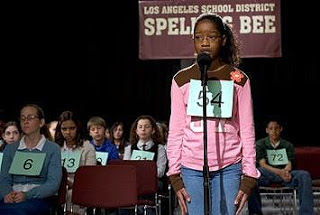
I’ve often enjoyed watching the Scripps National Spelling Bee, a contest that mainly serves as an outlet for everyone to marvel at how kids can do what so many adults can’t. While it’s heartbreaking to watch the loser’s hopes dashed with the ding of a bell after words like ptyalagogue and apparatchik, the winning moment is a well-deserved shot of feel-good triumph, for the winner and those watching. Such is the appeal of Akeelah and the Bee, a story of hard work rewarded.

Keke Palmer is excellent as Akeelah Anderson, a young black girl who tries to merely blend in at her inner-city school. What makes her different, though, is her uncommon interest in spelling, which is little more than a hobby, but when she is urged to take part in the school’s spelling bee, it becomes more than that. Suddenly, her principal (Curtis Armstrong) has high hopes for her and encourages her to train with Dr. Larabee (Laurence Fishburne), who himself participated in the National Spelling Bee as a child. Though her own confidence is fragile, she commits to the effort of studying and preparing for the National Bee.

Akeelah and the Bee could easily have been a ho-hum inspirational tale, but its nuance and heart win the day. Akeelah is almost trapped by a system that expects the least of her, while others see her potential. Fishburne is especially admirable as her spelling coach, acting not unlike Sydney Poitier in To Sir, with Love, patient with his pupil’s progress but adamant that she not become complacent or “talk ghetto” when their focus is the English language. He enshrines a quote by Marianne Williamson as his cogent argument against self-doubt, and even as he feels himself getting more invested in Akeelah than he had planned, he provides an example for her and an implicit call for her to be a role model for others.

The Scripps National Spelling Bee itself is recreated perfectly, right down to the same moderator whose recognizably uninflected voice reads out those difficult terms that no one would really use in a sentence. The pressure on the contestants is also very real and not just for Akeelah. Her rival Dylan Chiu (Sean Michael Afable) is constantly pressured by his father to win, and some scenes made me question the merit of putting kids under so much strain for the sake of an unlikely win. Yet Akeelah also makes friends through her newfound ambition, and even wins the encouragement of her mother (Angela Bassett) and her entire community. One seemingly shady punk named Derrick briefly reveals a softer side that seems to have been quashed by his environment, and his backing of Akeelah’s goals is like a chance to lend the support he never gave his own.

Akeelah and the Bee occasionally drifts into predictable territory, but by the end, the plot and characters take the unexpected high road to a happy ending well-earned. It’s hard to find fault when a film’s message of self-confidence and accomplishment is so earnestly and realistically presented (for the most part), and Akeelah and the Bee is a perfect example of an inspirational story done right.

Best line: (Derrick) “Kick his butt, Akeelah! B-U-T-T, butt!”


Rank: List-Worthy


© 2016 S. G. Liput

367 Followers and Counting


When Marnie Was There (2014)

21 Sunday Feb 2016

Posted by sgliput in Movies, Poetry, Reviews, Writing

≈ Leave a comment

Tags

Animation, Anime, Drama, Family, Mystery


Out in the marsh where the sandpipers wade
And the reeds allow breezes to bend every blade,
Visions appear in the moonlight and fade
And leave witnesses with a curious scare.

Some think they’re nothing but eyes playing tricks,
And others fear ghosts have escaped from the Styx,
But some explore further with sorrows to fix
And find answers they didn’t know would be there.
___________________


MPAA rating: PG


Studio Ghibli has been crafting outstanding animations for the last three decades, and now that co-founder Hayao Miyazaki is officially retired (again), it looks as if its present hiatus may be permanent. Before the hiatus, though, the studio gave us one more Ghibli gift in When Marnie Was There. Is it among the best Ghibli has to offer? No, but it still has a magical and earnest quality that can hold fast with the likes of Porco Rosso and The Secret World of Arrietty (also directed by Hiromasa Yonebayashi).

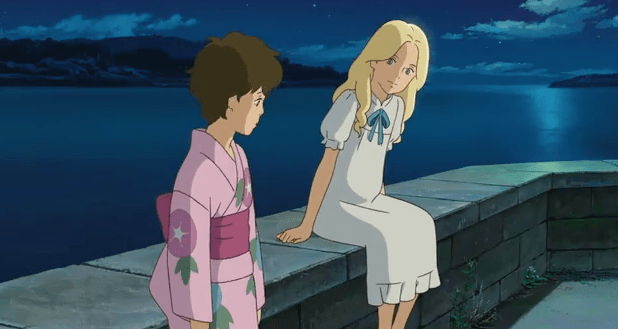
Based on Joan G. Robinson’s 1965 YA novel, which is one of Miyazaki’s favorites, When Marnie Was There is also one of Ghibli’s more mature works, not in a graphic sense like Princess Mononoke, but in an emotional sense. Anna (voiced by Hailee Steinfeld in the English dub) is a deeply troubled girl who keeps all of her griefs inside. As she says, she hates herself, for having asthma, for not fitting in at school, for not feeling at home with her foster parents. When she is sent to the countryside to live with friendly relatives, she remains uncomfortably stoic until she encounters a rundown mansion and the mysterious blonde girl Marnie (Kiernan Shipka) who only appears to her. When Anna crosses the tidal marsh to the mansion, she seems to step back in time, and their friendship grows, allowing Anna to regain her emotions and her self-confidence.

Many Ghibli films are leisurely paced, and this is no exception. The beginning takes time in establishing the characters: the nosy but nice would-be friend, the laconic neighborhood fisherman, the habitual painter fond of Marnie’s mansion. This community is merely a quaint backdrop for the central friendship and mystery between Anna and Marnie. The slowness of the mystery taxes the patience more than the film overall, but luckily there is a payoff, even if the line between dreams and reality becomes more ambiguous over time.

Some comments on the film have considered the girls’ bond in a romantic context with words like “infatuation,” and there were times that I was wondering where exactly their relationship was going. By today’s standards, when two twelve-year-olds meet secretly and dance in the moonlight and express their love, romance is assumed over friendship, while the opposite probably would have been true in the past. Perhaps modern sensibilities have colored people’s perceptions, like the humorous assumptions on Sherlock or the way some people mistake Sam and Frodo’s brotherly camaraderie in The Lord of the Rings for longing. Ultimately, the girls are meant to be only friends, yet the solving of the mystery reveals that their connection is indeed deeper than first thought. Actually, the revelation casts certain scenes in a much more tender and meaningful light, with subtle psychological details unseen in most Ghiblis. (Note the doll that Anna holds during a painful flashback.)

Though it’s not obvious at first, Anna’s greatest misery is being ignored or not wanted. Even the nicest people who seem to pay her attention are easily distracted, leaving her with nothing but personal distaste. Is Marnie merely the subconscious product of her desire for attention or a supernatural answer to it? By the end, it doesn’t really matter. Wishing to belong is nothing new in family films, but When Marnie Is There supplies a satisfying reply with more realistic resonances than most. With so much emotional depth, it’s unfortunate that the film’s visual style can’t quite match it. It has its fair share of memorable Ghibli-style scenes (a moonlit rowboat, wading through a rising tide), but its beauty just doesn’t compare with their best. Though Marnie has earned a nomination for Best Animated Feature, Inside Out is still a shoo-in. Despite this, When Marnie Is There is a bittersweet swan song for one of the great animation studios.

Best line: (Anna, watching her classmates) “In this world, there’s an invisible magic circle. There’s an inside, and an outside. Those people are inside the circle, and I’m outside.”


Rank: List Runner-Up


© 2016 S. G. Liput

364 Followers and Counting


The Book of Life (2014)

27 Wednesday Jan 2016

Posted by sgliput in Movies, Poetry, Reviews, Writing

≈ Leave a comment

Tags

Animation, Comedy, Family, Fantasy, Musical, Romance


Life is full of love and song
For those with both within their hearts;
But why must death and sleep be different
From their former counterparts?

Grief will mark a soul’s departure
Here on earth where all lives cease;
But from grief comes celebration
In another life of peace.
__________________
 

MPAA rating: PG


While Pixar has been rumored to be working on a project called Coco about the Mexican Day of the Dead (supposedly for a 2017 release), Reel FX and 20th Century Fox Animation beat them to the punch with 2014’s The Book of Life. This inventively animated romance starts out with a frame story reminiscent of The Princess Bride, with a confident museum guide recounting a story to a collection of rowdy schoolkids, who interject their occasional thoughts and worries as the tale progresses.

While these kids have a more typical cartoon human appearance, the characters in the tale being told are intentionally modeled as wooden puppets, with visible joints but no strings. This aesthetic combines with the off-kilter animation to give the CGI film a stop-motion aspect, not unlike The Lego Movie. The story itself follows three childhood friends, Manolo Sanchez (Diego Luna), Maria (Zoe Saldana), and Joaquin (Channing Tatum), who are destined to grow up into a love triangle. Just as viewers often debate who will get the girl in any number of series, the trio attract the attention of the two rulers of the afterlife, the lovely La Muerte of the Land of the Remembered and the bitter Xibalba of the Land of the Forgotten. Ron Perlman as Xibalba seems knowingly reminiscent of Hades in Hercules as he makes a game-changing bet with his counterpart as to which boy will marry Maria.

The Book of Life has a lot of positives. The animation is frequently enchanting and the characters surprisingly personable. While the characterization sometimes falters, I liked how one suitor was clearly meant as Maria’s soul mate, but the other was still given a chance to be heroic rather than being turned into a villain. The film also offers a uniquely positive view of death, treating it not as the end but as a second stage to reunite with loved ones and join in one big fiesta.

On the other hand, these same themes of death strike me as problematic. The depiction of the afterlife rings with Mexican culture but is entirely irreligious, as is the notion that our departed loved ones live on in happiness only as long as we remember them. The film’s conflict makes a point of noting that, without anyone to remember them, the dead will pass into the hellish Land of the Forgotten, which makes me wonder why no one is bothered by the fact that this will happen anyway within a few generations. I don’t remember my great-great-great grandfather; that doesn’t mean he’s not in Heaven. This idea of the afterlife is meant as a secular comfort but not a lasting one.

The Book of Life is also marred by tired clichés about being oneself against an overbearing parent; some awkwardly out-of-left-field pop songs, as if it’s trying to emulate Shrek; and oddly by the same animation I praised earlier. When I first saw the animation style, it reminded me of the Nickelodeon show El Tigre: The Adventures of Manny Rivera (picture below), and sure enough, director Jorge Gutierrez was also that show’s creator and apparently just translated the animation from 2D to 3D. While it works most of the time, certain scenes look strangely cheap with elaborate mustaches and protuberant noses that aren’t even trying for realism.

Here I go again, sounding all critical as if I dislike anything with flaws. Not so. The Book of Life rises as a delightful, energetic, and uniquely cultural change of pace from the usual stylings of Disney and DreamWorks while not coming off as low quality. Its themes of family and life and telling our own stories are commendable, and I enjoyed it, as I think most fans of animation will.

Best line: (one of the distraught schoolkids) “What is it with Mexicans and death?!”


Rank: List Runner-Up


© 2016 S. G. Liput

360 Followers and Counting


← Older posts
Newer posts →

Recent Posts

  • We Didn’t Start 2025 (Recap)
  • NaPoWriMo 2025 Recap (Finally)
  • Sonic the Hedgehog 3 (2024)
  • It Happened One Night (1934)
  • Spellbound (2024)

Recent Comments

associatesofshellymann's avatarassociatesofshellyma… on My Top Twelve La La La So…
Kit's avatarKit Nichols on Bonnie and Clyde (1967)
lifelessons's avatarlifelessons on Look Back (2024)
Carol Jackson's avatarCarol Jackson on The Thief of Bagdad (1940…
Stephen's avatarStephen on Love Story (1970)

Archives

  • January 2026
  • December 2025
  • May 2025
  • April 2025
  • March 2025
  • February 2025
  • January 2025
  • December 2024
  • May 2024
  • April 2024
  • March 2024
  • February 2024
  • January 2024
  • December 2023
  • November 2023
  • October 2023
  • September 2023
  • July 2023
  • June 2023
  • May 2023
  • April 2023
  • March 2023
  • February 2023
  • January 2023
  • December 2022
  • November 2022
  • October 2022
  • September 2022
  • August 2022
  • July 2022
  • June 2022
  • May 2022
  • April 2022
  • March 2022
  • February 2022
  • January 2022
  • December 2021
  • November 2021
  • October 2021
  • September 2021
  • August 2021
  • July 2021
  • June 2021
  • May 2021
  • April 2021
  • March 2021
  • February 2021
  • January 2021
  • December 2020
  • November 2020
  • October 2020
  • September 2020
  • August 2020
  • July 2020
  • June 2020
  • May 2020
  • April 2020
  • March 2020
  • February 2020
  • January 2020
  • December 2019
  • November 2019
  • October 2019
  • September 2019
  • August 2019
  • July 2019
  • June 2019
  • May 2019
  • April 2019
  • March 2019
  • February 2019
  • January 2019
  • December 2018
  • November 2018
  • October 2018
  • September 2018
  • August 2018
  • July 2018
  • June 2018
  • May 2018
  • April 2018
  • March 2018
  • February 2018
  • January 2018
  • December 2017
  • November 2017
  • October 2017
  • September 2017
  • August 2017
  • July 2017
  • June 2017
  • May 2017
  • April 2017
  • March 2017
  • February 2017
  • January 2017
  • December 2016
  • November 2016
  • October 2016
  • September 2016
  • August 2016
  • July 2016
  • June 2016
  • May 2016
  • April 2016
  • March 2016
  • February 2016
  • January 2016
  • December 2015
  • November 2015
  • October 2015
  • September 2015
  • August 2015
  • July 2015
  • June 2015
  • May 2015
  • April 2015
  • March 2015
  • February 2015
  • January 2015
  • December 2014
  • November 2014
  • October 2014
  • September 2014
  • August 2014
  • July 2014
  • June 2014
  • May 2014
  • April 2014
  • March 2014
  • February 2014
  • January 2014
  • December 2013

Categories

  • Blindspot
  • Blogathon
  • Christian
  • Movies
  • Music
  • NaPoWriMo
  • Poetry
  • Reviews
  • TV
  • Writing

Meta

  • Create account
  • Log in
  • Entries feed
  • Comments feed
  • WordPress.com

Recent Posts

  • We Didn’t Start 2025 (Recap)
  • NaPoWriMo 2025 Recap (Finally)
  • Sonic the Hedgehog 3 (2024)
  • It Happened One Night (1934)
  • Spellbound (2024)

Recent Comments

associatesofshellymann's avatarassociatesofshellyma… on My Top Twelve La La La So…
Kit's avatarKit Nichols on Bonnie and Clyde (1967)
lifelessons's avatarlifelessons on Look Back (2024)
Carol Jackson's avatarCarol Jackson on The Thief of Bagdad (1940…
Stephen's avatarStephen on Love Story (1970)

Archives

  • January 2026
  • December 2025
  • May 2025
  • April 2025
  • March 2025
  • February 2025
  • January 2025
  • December 2024
  • May 2024
  • April 2024
  • March 2024
  • February 2024
  • January 2024
  • December 2023
  • November 2023
  • October 2023
  • September 2023
  • July 2023
  • June 2023
  • May 2023
  • April 2023
  • March 2023
  • February 2023
  • January 2023
  • December 2022
  • November 2022
  • October 2022
  • September 2022
  • August 2022
  • July 2022
  • June 2022
  • May 2022
  • April 2022
  • March 2022
  • February 2022
  • January 2022
  • December 2021
  • November 2021
  • October 2021
  • September 2021
  • August 2021
  • July 2021
  • June 2021
  • May 2021
  • April 2021
  • March 2021
  • February 2021
  • January 2021
  • December 2020
  • November 2020
  • October 2020
  • September 2020
  • August 2020
  • July 2020
  • June 2020
  • May 2020
  • April 2020
  • March 2020
  • February 2020
  • January 2020
  • December 2019
  • November 2019
  • October 2019
  • September 2019
  • August 2019
  • July 2019
  • June 2019
  • May 2019
  • April 2019
  • March 2019
  • February 2019
  • January 2019
  • December 2018
  • November 2018
  • October 2018
  • September 2018
  • August 2018
  • July 2018
  • June 2018
  • May 2018
  • April 2018
  • March 2018
  • February 2018
  • January 2018
  • December 2017
  • November 2017
  • October 2017
  • September 2017
  • August 2017
  • July 2017
  • June 2017
  • May 2017
  • April 2017
  • March 2017
  • February 2017
  • January 2017
  • December 2016
  • November 2016
  • October 2016
  • September 2016
  • August 2016
  • July 2016
  • June 2016
  • May 2016
  • April 2016
  • March 2016
  • February 2016
  • January 2016
  • December 2015
  • November 2015
  • October 2015
  • September 2015
  • August 2015
  • July 2015
  • June 2015
  • May 2015
  • April 2015
  • March 2015
  • February 2015
  • January 2015
  • December 2014
  • November 2014
  • October 2014
  • September 2014
  • August 2014
  • July 2014
  • June 2014
  • May 2014
  • April 2014
  • March 2014
  • February 2014
  • January 2014
  • December 2013

Categories

  • Blindspot
  • Blogathon
  • Christian
  • Movies
  • Music
  • NaPoWriMo
  • Poetry
  • Reviews
  • TV
  • Writing

Meta

  • Create account
  • Log in
  • Entries feed
  • Comments feed
  • WordPress.com

Blog at WordPress.com.

  • Subscribe Subscribed
    • Rhyme and Reason
    • Join 814 other subscribers
    • Already have a WordPress.com account? Log in now.
    • Rhyme and Reason
    • Subscribe Subscribed
    • Sign up
    • Log in
    • Report this content
    • View site in Reader
    • Manage subscriptions
    • Collapse this bar