• Home
  • About Me
  • The List
  • THE LIST (2016 Update)
  • THE LIST (2017 Update)
  • THE LIST (2018 Update)
  • THE LIST (2019 Update)
  • THE LIST (2020 Update)
  • THE LIST (2021 Update)
  • THE LIST (2022 Update)
  • Top Twelves and More
  • The End Credits Song Hall of Fame

Rhyme and Reason

~ Poetry Meets Film Reviews

Rhyme and Reason

Tag Archives: Drama

Newsies (1992)

26 Tuesday Apr 2016

Posted by sgliput in Movies, NaPoWriMo, Poetry, Reviews, Writing

≈ 4 Comments

Tags

Disney, Drama, Family, Musical


(Today’s NaPoWriMo prompt was to write a call-and-response poem, with a repeated refrain or chorus. I applied such a refrain to a news crier like those in a certain musical.)


Read all about it: the latest taboos!
-I’ll buy a paper; I do love the news.

Read all about it: new victims accuse!
-I’ll buy a paper; I do love the news.

Read all about it: strike workers refuse!
-I’ll buy a paper; I do love the news.

Read all about it: new game with horseshoes!
-I’ll buy a paper; I do love the news.

Read all about it: the war was a ruse!
-I’ll buy a paper: I do love the news.

Read all about it: your favorite teams lose!
-I’ll buy a paper: I do love the news.

Read all about it: erased interviews!
-I’ll buy a paper: I do love the news.

Read all about it: a new witness sues!
-I’ll buy a paper: I do love the news.

Read all about it: a brave few refuse
To stand by and watch those in power abuse
Their privilege and threaten the rights and the views
Of people whose justice nobody pursues!
-. . . Where’s the Enquirer? I want real news.
___________________________

MPAA rating: PG

Despite all the bad reviews and Razzie nominations it garnered upon release, I watched Newsies expecting and hoping to like it, both because I enjoy musicals and because it was the directorial debut of Kenny Ortega, who helmed my beloved teenage High School Musical films. Unfortunately, Newsies did not live up to my hopes, but neither was it as awful as the 39% Rotten Tomatoes score indicates. It was trying to be a grand, heartwarming musical but didn’t succeed, and I can’t even put my finger on why.

Set in 1890s New York, Newsies fictionalizes the real-life story of the newsboys who began their own strike when Joseph Pulitzer (an overwrought Robert Duvall) increased the cost of the papers that provided their meager income. Leading the charge against Pulitzer is a very young Christian Bale as Jack “Cowboy” Kelly, whose Brooklyn accent covers up Bale’s British accent with panache. Accompanied by new friend David (David Moscow, the young Josh Baskin in Big) and a single ally from a rival newspaper (Bill Pullman), Kelly unites the newsies of New York while trying to stay ahead of the corrupt orphanage keeper (Lost alert for Kevin Tighe, who does play a good meanie).

Newsies is at its best when the limber cast are belting out Alan Menken’s songs and performing Ortega’s remarkable choreography. The opening anthem “Carrying the Banner” and the now semi-classic “King of New York” are the high points, but Bale also gets a solo in the wishful “Santa Fe,” and none of the songs are what I would call bad. Sadly, there’s not enough of them, and long stretches of unengaging drama in between the musical numbers made much of the film unfortunately boring. I could tell that both the writers and the young actors were trying to create something potentially classic, but the necessary level of interest just wasn’t there. Not to mention, the strike scenes included some of the aspects that bug me about unions, such as the persecution of “scabs” who can’t afford not to do their job.

While it might be considered a misfire for Disney, I do admire Newsies for being one of the few non-animated musicals to be entirely original without being based on an earlier Broadway play. In fact, more songs were added to a stage production in 2011, and it later became a hugely popular, Tony-winning Broadway musical. That musical has its roots in this film, so I believe everyone involved in it can still be proud. Newsies does have something of a cult following, and I wonder now whether I would enjoy it more if it had been a mainstay of my childhood. Plenty of people hate the High School Musical films, but my nostalgia helps me forgive whatever they criticize. Perhaps if I’d seen Newsies at a much younger age, I would have enjoyed it more.

Best line: (Crutchy, one of the boys) “It’s this brain of mine; it’s always makin’ mistakes. It’s got a mind of its own.”


Rank: Honorable Mention


© 2016 S. G. Liput

384 Followers and Counting
 

The Social Network (2010)

25 Monday Apr 2016

Posted by sgliput in Movies, NaPoWriMo, Poetry, Reviews, Writing

≈ 3 Comments

Tags

Drama, History


(Big thanks to NaPoWriMo.net for featuring my Austenland poem today! Today’s prompt, though, was to write a poem beginning with a line from another poem. I’ve actually had in mind to do that for this review for a while, so I incorporated a line from one of my favorite poems, Longfellow’s “A Psalm of Life.”)


Lives of great men all remind us
Even they can act like jerks,
Even when they build a website
Quick to grow that really works.

Websites are a dime a dozen,
But when fame and wealth are earned,
Some regret their path because in
Burning bridges, all are burned.

When one’s social enterprising
Gains more enemies than friends,
Even great men ask while rising
If the means made worth the ends.
__________________

MPAA rating: PG-13

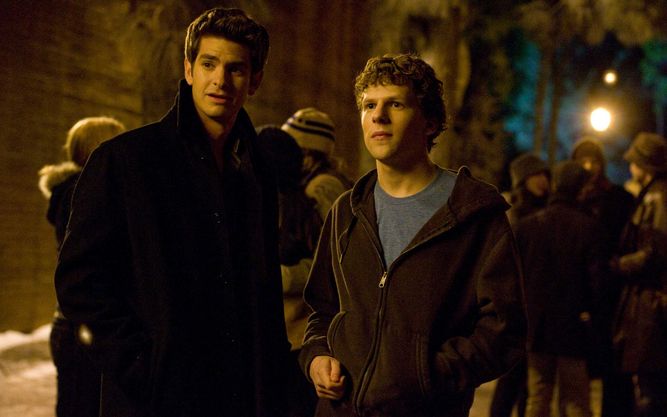
Despite all the awards and adulation and bloggers including it among their favorite movies, I honestly had little desire to see The Social Network and for one simple reason: I don’t use Facebook. I know that seems weird for a college guy in today’s hashtagging, selfie-loving world, but social networking has never been of interest to me; and while Mark Zuckerberg’s rise to millionaire is an American success story, I didn’t expect to be interested in a film about the creation of something I don’t use.

Leave it to Aaron Sorkin to prove me wrong. Some screenwriters just know how to write dialogue (Nora Ephron, for example), and then there are the few like Sorkin who write dialogue on steroids. His Oscar-winning screenplay probably boasts two or three times as many words as the typical Oscar nominee, and the consistently talented cast articulate it with the cadence of a machine gun, particularly Jesse Eisenberg as Zuckerberg.

Eisenberg’s version of the college-age billionaire is obviously so smart that he never even has to think before responding, though he’d surely have more friends if he did think, since his responses usually come with enough caustic banter to make Will Hunting blush. His capabilities with website creation are quickly made clear after losing his girlfriend turns into a drunken blog rant and then a sophisticated, network-crashing girl comparison site. Approached by the Winklevoss twins (both played by Armie Hammer) and Divya Narendra (Max Minghella) to develop a dating site for Harvard, Zuckerberg instead teams with his friend Eduardo Saverin (surprisingly excellent Andrew Garfield) to create The Facebook, the concept and extent of which evolves swiftly into what so many people now check one hundred times a day. Unfortunately, as Zuckerberg expands and gains the dubious collaboration of Napster founder Sean Parker (also surprisingly excellent Justin Timberlake), Saverin gets left behind both technologically and financially, and both he and the Winklevosses file separate lawsuits against Zuckerberg. If placed at the end, these legal proceedings would have dragged the film down, so instead the depositions are expertly sprinkled among flashbacks.

Winning Oscars for Best Adapted Screenplay, Best Score, and Best Film Editing, The Social Network boldly confirms the fact that nerds will inherit the earth, but even bolder is the fact that such a high-profile biopic was made about a 26-year-old (at the time) creator of a six-year-old website, which might have easily been a fading fad like Myspace. One might consider it an honor, but the film’s depiction of Zuckerberg could hardly be called flattering. While key, real-life events were used in the story, Zuckerberg himself has written much of the film off as fiction, which I find rather probable. He criticized the characters’ wild partying, for example, and I too believe that multi-billion-dollar corporations are most likely built on a bit more restraint and discipline, which aren’t as entertaining in a movie.

Despite the likely liberties taken by Sorkin, his treatment of Facebook itself is laudably balanced. On the one hand, he shows that it revolutionized how collegiate students and everyone else interact with one another. On the other, that very cultural revolution is sarcastically faulted for the shallow change in social life that has kept me away from Facebook in the first place. Likewise, the film’s Mark is a genius and a visionary deserving of praise, but a regrettable current of callousness often lurks beneath the admirable. While I have a better appreciation for it, I must admit that I won’t be joining Facebook any time soon.

Best line: (Zuckerberg) “I’m not a bad guy.”
(Marylin Delpy, a lawyer) “I know that. When there’s emotional testimony, I assume that 85% of it is exaggeration.”
(Zuckerberg) “And the other fifteen?”
(Delpy) “Perjury. Creation myths need a devil.”


Rank: List-Worthy


© 2016 S. G. Liput

384 Followers and Counting


Time of Eve (2010)

23 Saturday Apr 2016

Posted by sgliput in Movies, NaPoWriMo, Poetry, Reviews, Writing

≈ 6 Comments

Tags

Animation, Anime, Drama, Sci-fi


(Today’s NaPoWriMo prompt was to write a sonnet, which can be considered an essay in verse. Thus, I chose a Spenserian sonnet inspired by a fascinating film well worth an essay or two.)


As God made Man in image same as He,
For years mankind has tried the same rare feat,
Creating sculpture, doll, and effigy,
And now most recently the great conceit
Of making human service obsolete
With robots meant to wear a human guise.
Can such attempts end only in defeat?
If not, has playing God been ever wise?
As children, we may gaze deep in their eyes,
Intent on some faint flicker of a soul;
While lack of one should come as no surprise,
Perhaps it’s but too much under control.
Within and out, this can of worms we dread,
And yet progress proceeds full steam ahead.
__________________

MPAA rating: Not Rated (should be PG)

Time of Eve was a series of six fifteen-minute Japanese animations released online from 2008 into 2009, which were then combined with slight additions into a 2010 film. It also is one of the most thought-provoking entries in the robot genre and an exceptional example of speculative fiction, allowing its themes to play out in an advanced world that remains decidedly plausible.

As the opening sentences explain, “in the future, probably Japan” (which is undoubtedly Japan, based on all the signs and names), “’humanoid robots’ (androids) have come into common use.” Their uses range from office duties to making coffee, and they are often owned by a family and treated more like an appliance than a maid, with their passive expressions and a glowing holographic ring above their heads distinguishing them from their masters. After studying the memory logs of his houseroid Sammy, highschooler Rikuo notices a mysterious log labelled “Are you enjoying the Time of Eve?,” a repeated question with the same uncertain mystique as “Who is John Galt?” When Rikuo tracks down the location of the log with his friend Masaki, who protests too much that he doesn’t own a robot, they discover the titular café, where a sign prominently declares that no one may discriminate between humans and robots here.

Over the course of several days, the boys visit and get to know the regular patrons, all lacking the holographic ring, in this gray zone flouting governmental robot laws: the cordial barista Nagi, whose enforcement of the rule doesn’t really extend beyond annoyed warnings; outgoing Akiko; a pair of lovers Koji and Rina; the grandfatherly Shimei and young Chie; and discreet Setoro, who often just reads in the corner. As Rikuo gets to know these customers, analyzing their personalities and actions to see if they are machine or human, his own opinions are challenged. When robots begin acting on their own, can they really be considered nothing but tools? If they can be considered even close to being human, is not the constant prejudice shown them worth opposing? Rikuo is at first troubled and then intrigued by what the café represents, and knowing Isaac Asimov’s Three Laws of Robotics about how robots must protect and obey humans, he explores how his robotic acquaintances manage to test their independence with humans and each other.

While most of the story has a straightforward focus on Rikuo, his explorations are clearly part of a bigger whole. The enigmatic Ethics Committee is a persistent presence with TV ads warning against the over-personalization of robots, and constant peer pressure from friends and the danger of being labeled a robo-freak often guilt people from even thinking to thank machines for their help. One of the creative choices that makes Time of Eve special is what it doesn’t explain. Key plot points are often hinted at early with merely a brief scene or still (which rewards repeat viewings), while clues about forces in the background supporting or resisting the Ethics Committee are left intentionally ambiguous. It’s the stuff of fan theories, but the filmmakers give just enough information that the uncertainty adds to rather than detracts from the story.

The narrative’s emotional involvement crept up on me with profound emotions hidden behind even a small smile, and the challenging of Rikuo’s views also challenged my own. While I personally don’t think that robots will progress to the point of sentience, the world is well on its way to trying. Just recently, Chinese scientists created a realistic-looking female robot named Jia Jia, prompting Ethics Committee-style headlines that included words like disturbing and creepy. If androids should ever reach the level of humanity seen in Time of Eve, I might even be open to considering them people, though the idea of a soul is a different debate. Still, there would be a line at which only truly human-like machines would earn my sympathy, yet Time of Eve challenges that too, suggesting that even primitive intelligences are worthy of pity or comfort. Even if real-life robotics never reaches that point (and I hope it doesn’t), the questions raised by this animated tale have remained with me.

Time of Eve: The Movie is not much different from the series, simply tying the episodes together, but small additions provide a little more clarity to the original’s ambiguity. It may not have the action and fantasy of other anime, but within its subdued tone and handsomely intimate animation, its provocative themes surpass many better-known titles. In fact, though I’ve already compiled my Top 12 Anime List, I think Time of Eve would now replace Princess Mononoke as my #12 favorite. In addition to the cogent sci-fi drama, I also liked the small touches of humor, some of it awkward, some of it genuinely funny, especially a great moment at the end that lightens up the most poignant scene. It even ends in my favorite Neverending Story-style fashion, suggesting further stories for another time and (at least in the series) adding a barely visible question mark to The End. There’s no shortage of robot movies, from Short Circuit to A.I.: Artificial Intelligence, Bicentennial Man to Ex Machina, but Time of Eve ranks up there with the best.

Best line: (Official Ashimori, quoting another barely seen character) “Preconceptions distract from the truth.”


Rank: List-Worthy


© 2016 S. G. Liput

383 Followers and Counting


Everest (2015)

22 Friday Apr 2016

Posted by sgliput in Movies, NaPoWriMo, Poetry, Reviews, Writing

≈ 3 Comments

Tags

Disaster, Drama, History


(Today’s NaPoWriMo prompt was inspired by Earth Day, which I incorporated as a mountain-shaped acrostic below.)


Everest:
As ladybugs climb,
Reaching toward the apex,
Toward the one place from which to fly,
Humans will strive for the summit, but do they know why?
Do we know why we cherish a challenge, perhaps our muscles to flex?
A conqueror’s motives are not so complex, and yet the worst danger or risk he expects is stoking his soul to the sky and arms him with courage to live or to die.
Your trials, O Nature, are hopelessly high, and yet mankind eagerly seeks to defy and, foolish or fearless, adventurers try and search for what you have next.
____________________

MPAA rating: PG-13

I haven’t seen many mountain-climbing movies, but the 1996 Everest disaster is such a fascinating example of human hubris gone wrong that it has warranted several books and films on the subject. My VC is well-versed on Jon Krakauer’s bestselling account Into Thin Air, and I somewhat remember the 1997 TV movie Into Thin Air: Death on Everest with Christopher McDonald. In light of more recent deadly incidents, like last year’s avalanche caused by the Nepal earthquake, the 1996 events seemed like a timely tragedy worth giving the big-screen, star-studded Hollywood treatment, and this is one example of the Hollywood treatment doing it right.

One of the shortcomings of the Into Thin Air movie and one of the causes of the deaths in the first place was the sheer number of climbers involved. The original film had so many characters whose faces were usually covered by necessary goggles or masks that I had trouble telling them apart. Everest fixes that problem by sacrificing some realism; I was much better able to distinguish between actors, but that was because they kept illogically removing their masks. My VC pointed out that impracticality, and considering the extreme cold endured by everyone, it became more noticeable yet still forgivable from a movie standpoint.

The presence of many famous actors didn’t detract the overall believability at all, from rising stars like Jason Clarke as expedition founder Rob Hall to better-known A-list actors like Jake Gyllenhaal as second team leader Scott Fischer or Keira Knightley as Hall’s pregnant wife, who gets the most emotional scenes. As for the climbers, we get to know the most important with some well-paced calm-before-the-storm introductions: Josh Brolin’s adventurous family man Beck Weathers; John Hawkes (Lost alert!) as desperate-to-summit Doug Hansen; Naoko Mori as Yasuko Namba, who has only Everest to complete her climbs of all Seven Summits; and a host of other amateurs and professionals (Sam Worthington, Martin Henderson). While the introductions aren’t thorough, it’s fair to say that everyone is worth liking and rooting for, and my ignorance of who survived and who didn’t made the eventual tragedy all the more potent.

In addition to the talented ensemble (who filmed on location only as high as base camp), the vision of Everest itself is immense and thrilling, with cinematography that easily could have earned an Oscar nomination. Sadly, disaster movies are no longer the award magnets of Irwin Allen’s day, and save for a lone SAG and Saturn award, Everest has been mostly snubbed. Even without the physical accolades, Everest deserves the positive reviews it has earned, and I rather wish I’d been able to experience it on the big screen. It is a sad story open to miracles that reminds us just how dangerous a sleeping giant can be.

Best line: (Doug Hansen) “I’m climbing Mount Everest… because I can… because to be able to climb that high and see that kind of beauty that nobody ever sees, it’d be a crime not to.”


Rank: List-Worthy


© 2016 S. G. Liput

383 Followers and Counting


Room (2015)

20 Wednesday Apr 2016

Posted by sgliput in Movies, NaPoWriMo, Poetry, Reviews, Writing

≈ 2 Comments

Tags

Drama


(Today’s NaPoWriMo prompt was to incorporate kennings, or colorful indirect descriptions of something, like calling the sea a “whale road.” That something, in this case, was the main setting of one of last year’s best films.)


Surrounding me always, you indigent cube,
You keep me from life as I knew.
I’ve watered your walls with my unheeded tears,
Yet nothing but misery grew.

The walls have no ears, but no lack of blind eyes,
Blank slates too hard-hearted to shatter.
They’re vertical wastelands combined to confine
And convince me we no longer matter.

Yet you, my dear son, see a whole different Room,
A pocket of space minus time,
Where you are not bound but contently surrounded
By vertical playgrounds to climb.

I yearn to be free from these monolith graves,
For if you see joy in their gray,
I wait for the day that your rose-colored eye
May witness the world kept at bay.
__________________

MPAA rating: R (for language and the very situation)

A small but widely admired film, Room is an emotionally compressed powerhouse. Much of the film is set in a Room, a small shed where Joy Newsome (Brie Larson) has been held for seven years as little more than a sex slave. The one bright spot of her captive life is her son Jack (Jacob Tremblay), who was born in Room and knows nothing of the outside world. When Jack turns five, Joy recruits him in a risky escape attempt.

In light of horrific news stories like the Ariel Castro kidnappings in Cleveland, the setup is both unthinkable and sadly believable. What Joy endures is disturbing on multiple levels, but I appreciated the filmmakers’ restraint. Some Oscar contenders don’t hold back on the objectionable content, but the rapes and nudity are out of view of both the audience and Jack, whose mother protects him with a passion. We see most events through Jack’s innocent, naïve perspective, and Tremblay does a marvelous job playing a credible five-year-old, with all the devotion, defiance, and curiosity that age entails. From the beginning, we see how Joy has endeavored to make Room a fun semblance of home for Jack, even as he remains oblivious to what he is missing and just how depressed she is.

I don’t want to include any spoilers, but Room seems to evoke different emotions in different people. Many reviewers have noted how there’s an exciting sense of wonder as Jack experiences new things and the unavoidable sensory overload. My VC, who liked the film less than I, came away depressed and somber. I was left with a sense of gratitude. The line that jumped out at me was when Joy tells Jack of her childhood friends, and when asked what happened to them, she bitterly replies that they merely lived their lives with nothing happening. How easy it is for us to take the very normalcy of our lives for granted! There are people enslaved to this day, whether in physical or sexual bondage, and next to them, my problems seem small. Seeing all the things of which Jack and Joy were deprived only made me more thankful that I had a stocked fridge and available health care and an open door.

While Tremblay is excellent, Brie Larson undoubtedly deserved her Best Actress Oscar. Her gazes of weariness are deeply felt, and her bond with and dependence on Jack is definite and heart-tugging. Though the acting is beyond reproach, the pacing does lag at times trying to emphasize the tedium of being trapped, and there are really no explanations until a half hour in. Thus, patience is required but rewarded. Room ends in a perfect echo of its beginning, and hope mixes beautifully with grief.

Best line: (Jack, in true five-year-old fashion) “When I was small, I only knew small things. But now I’m five, I know everything!”


Rank: List-Worthy


© 2016 S. G. Liput

383 Followers and Counting


How to Make an American Quilt (1995)

19 Tuesday Apr 2016

Posted by sgliput in Movies, NaPoWriMo, Poetry, Reviews, Writing

≈ 7 Comments

Tags

Drama, Romance


(Today’s NaPoWriMo prompt was for a didactic “how to” poem, and I just so happened to have the perfect film in mind.)

How does one make an American quilt?
How is a life or a good marriage built?
Not from one cloth but from many combined:
It’s fashioned from stories, gold thread of mankind,
From tales and details
And the blazing of trails,
From losses and crosses
And dead albatrosses
And windmills at which many tilt.

Gather the patches that everyone gives,
The plugs for the holes in our memories’ sieves,
And just as our fortunes are linked to our neighbors’,
Sew up the loose swatches of everyone’s labors.
Recall passion’s thrall,
Both its rise and its fall.
Every weakness or peak
Of which few live to speak.
Love, guilt and tears spilt
Make a worthwhile quilt
That warns us and warms us and lives.
__________________

MPAA rating: PG-13

Marriage is a tough business. Not that I have personal experience with it, but there are enough soured romances in books, films, and personal accounts that it’s clearly not easy. Falling in love is simple; it’s what comes after that’s hard. Such is the main lesson of How to Make an American Quilt, a female ensemble about an engaged woman named Finn (Winona Ryder) who has second thoughts about marriage after hearing the various stories of the women in her grandmother’s quilting bee.

This is undoubtedly a chick flick, with everything coming from the women’s perspective. The accounts of their past loves are rather varied, ranging from one-night stands, impulsive affairs, disappointing married lives, and unfulfilled dreams, most of which casts marriage and particularly husbands in an unavoidably depressing light. Finn has trouble with commitment in her academic life, and hearing all these tales of woe is the last thing she should be doing on the eve of marriage. It’s no surprise then that her engagement is endangered.

It’s not all bad. The acting is consistently good, particularly from old pros like Anne Bancroft, Ellen Burstyn, Jean Simmons, and Alfre Woodard, and I was surprised at some small roles for Jared Leto, Claire Danes, and Mykelti Williamson. While their individual stories are full of repeated disillusionment, little details become more significant as these stories do indeed weave themselves into a tapestry or quilt of life, from which different meanings may be drawn. Thus, How to Make an American Quilt seems to endorse hope and a willingness to try for success, even though the idea of marriage itself doesn’t quite recover from all the disillusionment that came before.

P.S. To be honest, the main reason I found this worth watching was Winona Ryder. I never realized just how gorgeous she was, based on the roles I’ve seen of hers, like Beetlejuice. Here, she’s like a cross between Kate Winslet in Titanic and Shailene Woodley in The Fault in Our Stars. I can’t help but feel I have a new screen crush.

Best line: (Finn) “Young lovers seek perfection. Old lovers learn the art of sewing shreds together and of seeing beauty in a multiplicity of patches.”


Rank: List Runner-Up


© 2016 S. G. Liput

382 Followers and Counting


Fried Green Tomatoes (1991)

18 Monday Apr 2016

Posted by sgliput in Movies, NaPoWriMo, Poetry, Reviews, Writing

≈ 3 Comments

Tags

Comedy, Drama

(Today’s NaPoWriMo prompt was a challenge to capture “the sound of home,” which in my family would be the South. Since my Floridian background isn’t nearly as colorful, I found inspiration and dialect in my mom’s memories of Alabama, which tied in nicely with this film.)


Well, honey, God’s given me plenty o’ years,
And plenty o’ troubles I’ve faced.
I reckon those years have had laughter and tears,
But not one o’ them was a waste.

Oh, bless her heart, Mama was wringing her hands
And said when my kids earned a lick,
I’d learn the stuff only a mom understands
Faster than you slap a tick.

When I was knee-deep in a whole heap o’ trouble,
I sure do remember each friend
Who offered a solace or busted my bubble
When phonier folk would pretend.

When I lie awake, doin’ poorly or well,
I listen with stubborn persistence,
Like when I was young, for the comforting swell
Of a train whistle off in the distance.

I even remember that whole murder mess,
But I don’t mean to ramble, my dear.
If you fancy to hear an old girl reminisce,
Y’all come on back now, ya hear?
____________________

MPAA rating: PG-13

Based on Fannie Flagg’s novel, Fried Green Tomatoes could be considered another VC pick, because my VC sincerely likes it and I…can’t quite bring myself to do the same. Well, that’s not exactly right. I enjoy almost all of it, but it’s a rare example of a film that is almost completely undermined by one key plot point which turned me utterly against it.

First, I’ll focus on the good, most notably the actors. The casting is perfection, both in the 1980s present day and the Depression-era flashbacks, and both pairs of actresses have stellar chemistry. Kathy Bates as depressed housewife Evelyn draws confidence from the engaging stories of Jessica Tandy’s elderly Ninny (and utters one of the most empowering lines for middle-aged women everywhere). The subjects of those stories are equally appealing, with Mary Stuart Masterson playing the loyal tomboy Idgie to Mary-Louise Parker’s abused Ruth. A mystery plot involving the murder of Ruth’s brutish husband is competently strung along amidst both real and potential tragedy, a good deal of Southern charm and fond reminiscences, and the winsome establishment of Ruth and Idgie’s Whistle Stop Café. (I’m pretty sure there are several, but I’ve actually visited a Whistle Stop Café in Kentucky and sampled their fried green tomatoes while surrounded by memorabilia from the movie.)

With all this to appreciate, why then can I not quite embrace Fried Green Tomatoes? It all comes down to a climactic revelation in the murder mystery, which I won’t spoil, but no matter how much my VC has tried to justify the characters’ decision, it sickens me. Is it supposed to be empowering to women, as so many other parts of the film did so much better, like Bates’s priceless, hormone-fueled tirade against male injustice? Regardless, the-twist-that-shall-not-be-named comes late enough in the film that it left a bad taste in my mouth, even after the sweet ambiguity of the final scenes. I can usually look past a movie’s negative aspects, but this is one error in narrative judgment that sadly dampens an otherwise affable film.

Best line: (two obnoxious girls who steal a parking space) “Face it, lady, we’re younger and faster!” (Evelyn, after declaring the battle cry “Towanda!” and crashing into their car) “Face it girls, I’m older, and I have more insurance.”

VC’s best line: (Evelyn, caught up in her empowerment) “Towanda! Righter of Wrongs, Queen Beyond Compare!”   (Ninny) “How many of them hormones you takin’, honey?”


Rank: Semi-Dishonorable List Runner-Up


© 2016 S. G. Liput

382 Followers and Counting


VC Pick: The Ghost and Mrs. Muir (1947)

17 Sunday Apr 2016

Posted by sgliput in Movies, NaPoWriMo, Poetry, Reviews, Writing

≈ 14 Comments

Tags

Classics, Drama, Fantasy, Romance


(Today’s NaPoWriMo prompt suggested using at least ten words from a specialty dictionary. In honor of Rex Harrison’s ghostly captain, I chose nautical terms, many of which were used in the film.)


A seaman in the truest sense is ne’er content on land,
And I have lived a life of which a captain may be proud:
Kept my ship in Bristol fashion,
Kept my crew content with rations,
Kept alert for mares’ tails warning tempests to withstand.
Yet now I wish, my beard more ashen,
That I’d found a second passion,
Plucking me a darling from the vast landlubber crowd.

I don’t mean some brief harbor love, although I’ve had a few;
I mean the kind worth waiting for through months before the mast.
I’d hoist the anchor eagerly
To reunite with such as she
And boast from stern to scuttlebutt to share a love so true.
The ship may list from weather to lee
And on her beam ends she may be,
But I’d have stronger cause to live and hold the tiller fast.

A lover in the truest sense is ne’er content at sea
But charts and stays the swiftest course from ocean unto wife.
When in the offing I appeared,
She’d stand upon a headland, cheered
And counting seconds till we both could reach the nearest quay.
I wish in such a course I’d steered
Before grey crept into my beard,
But maybe love can find a seaman even after life.
________________

MPAA rating: Not Rated (might as well be G)

It’s been a while since my trusty Viewing Companion (a.k.a. VC) got to choose a movie, and The Ghost and Mrs. Muir is one of her favorite romances. I’ve seen it a few times before, and for some reason, its full appeal never hit me until this latest viewing.

Gene Tierney plays the widowed Mrs. Lucy Muir, who moves with her daughter (Natalie Wood) and maid (Edna Best) to a large house by the English seaside, which she comes to realize is haunted by the deceased Captain Gregg (Rex Harrison). After a halfhearted attempt to scare her off, Gregg admires her spunk enough to let her stay, and the two of them allow their testily heartfelt conversations to bloom into unadmitted love. The captain’s blustery manner complements Mrs. Muir’s obstinance, and while she cares for the house they both love, he acts as her friend, security system, and inspiration to write a money-making memoir. Of course, romance can be strained between flesh and blood and spirit, and their relationship is soon threatened by the suavely courting Miles Fairley (George Sanders, known as the deep voice of Shere Khan in 1967’s The Jungle Book), who might be more seductive if he didn’t have a creepy disregard for personal space.

Both Tierney and Harrison are at the top of their games here, with Harrison in particular exceeding all but his My Fair Lady role in bringing to life the gruffly affectionate captain (whose coarse sailor language never extends beyond “blasted”). One scene in which he remains invisible to Lucy’s unwelcome in-laws seems to anticipate the similar dynamic between Sam and the holographic Al in Quantum Leap, while the tear-jerking final scenes match the best romantic endings. I also find it interesting to note that The Ghost and Mrs. Muir was turned into a 1968 sitcom, in which the ghost was played by Edward Mulhare, who also took over Harrison’s role of Professor Henry Higgins in My Fair Lady on Broadway.

Sometimes it takes several viewings to help one fully appreciate a film, and The Ghost and Mrs. Muir deserves such appreciation and its 100% Rotten Tomatoes score. It’s a well-scripted, non-physical romance of the best kind, managing to be mildly spooky, delightfully charming, or tenderly bittersweet when it needs to be. It may not make my VC cry anymore, but it arouses the same emotions (minus the tears) in both of us.

Best line: (Lucy Muir) “You can be much more alone with other people than you are by yourself, even if it’s people you love.”


Rank: List-Worthy


© 2016 S. G. Liput

381 Followers and Counting


Persepolis (2007)

16 Saturday Apr 2016

Posted by sgliput in Movies, NaPoWriMo, Poetry, Reviews, Writing

≈ 6 Comments

Tags

Animation, Drama, History


(Today’s NaPoWriMo prompt involved writing a poem based off of answers to an almanac questionnaire. In this case, question subjects like “Childhood dream,” “lover,” “hometown memory,” and “today’s news headline” brought to mind this animated drama.)


A culture builds a person
In a way they cannot hide.
By fine degrees, their memories
Instill a private pride.

I’m proud of where I come from,
And I love the U.S.A.,
But others feel an equal zeal
For countries far away.

I hear news full of chaos,
And my sense of pity grows,
For other nations have frustrations
Worse than Western woes.

Yet, being sympathetic,
I must not presume their shame:
Despite the vultures, other cultures
In the midst of flame
Have dignity and pride to be
Both different and the same.
________________

MPAA rating: PG-13

I’ve stated before that I love animation that can tackle mature themes without wallowing in mature content. This is why I’m often drawn to anime and why I admire 2007’s Persepolis, which lost the Best Animated Feature Oscar (barely but deservedly) to Pixar’s Ratatouille.

The Iranian Revolution isn’t the first topic I’d think of for a cartoon, but Iranian expatriate Marjane Satrapi translated her personal experiences first into a French comic/graphic novel and then into this feature film. She did so not only with insight and honesty but with the perfect reason for siding with animation over live-action: that animated characters are far more universal in appeal and connection, allowing audiences worldwide to relate to something that is not inherently “foreign.” She succeeded. Her childhood home in Tehran seems like any number of world cities, and her personal tastes in movies and music (Bruce Lee, Iron Maiden, etc.) remind us that pre-Revolution Iran wasn’t entirely different from the West. (I liked how the young Marji enjoyed ABBA until her friends guilted her into considering them uncool. My mom has mentioned that it was much the same with her in 1970s America.)

Thus, when the actual revolution takes place, bringing Islamic fundamentalists to power, the sudden forced changes to the culture are understandably jarring, as women are compelled to wear head scarves while alcohol and all things Western are banned. While my knowledge of the politics of the time is limited, I was intrigued by how Marjane’s opinions were formed by her parents and dissident uncle, who opposed the Shah but were also persecuted by the new government. The sequence of events reminded me of the Russian revolution in Doctor Zhivago, particularly when Marji’s mother comments, “Well, whatever the outcome is, it can’t be worse than the Shah.” The shortsightedness of revolutions is still an issue today and just one of the many thought-provoking facets of Persepolis.

Marjane’s rebellious spirit eventually forces her to move to Europe, where she grows into a wayward young woman. Her activities range from communing with thoughtless anarchists to unsuccessful love affairs, and while much of it is rather depressing, the storytelling manages to incorporate a smart mix of profundity (such as the wisdom of Marji’s grandmother, a sterling example of an honorable elder) and amusement (such as Marjane’s post-breakup rant against her ex, which resembles and predates a similar scene in (500) Days of Summer).

Satrapi has insisted her graphic novel should be called a comic book, and though it’s more mature than many animations, in several ways Persepolis is a cartoon. The black-and-white simplicity of the flashbacks (which is the majority of the film) is usually realistic, but sometimes reactions are exaggerated, dreams become surreal, or certain scenes are hyperbolized as only animation can. Other times, serious moments are reduced to silhouettes, like a deadly flight from police across rooftops.

While the ending is both fitting and disappointingly melancholy, what comes before is not without its shortcomings. The depiction of the Islamic government is clearly negative, but the overall political message remains muddled from varied character opinions and a dream sequence associating Karl Marx with God. Though not too profane, some of the language is also a tad harsh, and the PG-13 rating is deserved. (There’s also an odd preoccupation with Marjane’s grandmother’s breasts, which are discussed three separate times, perhaps because of a distinct memory she had.) Persepolis is a wholly unique animation, a coming-of-age tale that views a tumultuous time through the eyes of both a child and a young woman, whose subsequent real-life success makes it that much more praiseworthy.

Best line: (Marjane) “We were so eager for happiness, we forgot we weren’t free.”


Rank: List Runner-Up


© 2016 S. G. Liput

380 Followers and Counting


Maze Runner: The Scorch Trials (2015)

15 Friday Apr 2016

Posted by sgliput in Movies, NaPoWriMo, Poetry, Reviews, Writing

≈ 2 Comments

Tags

Action, Drama, Sci-fi, Thriller


(Today’s NaPoWriMo prompt, inspired by this month’s halfway point, is to write a poem incorporating doubles. Thus, I chose to write in couplets and picked a sequel to review.)


Run, run, run, through glade and through maze;
Run and trust not this new world set ablaze.

Run from the torchbearers firm in their cause,
So sure of its virtues, no thought for its flaws.

Run from the dangers that line every path;
The world is less suited to kindness than wrath.

Run from the greedy, who serve themselves first,
And those who do wrong, by good reasons coerced.

Run till you realize your flight is in vain;
When all the world’s crazy, you stand and be sane.
____________________

MPAA rating: PG-13

I very much enjoyed the first Maze Runner film and was looking forward to continuing the intriguing mystery set before the characters. It was a darker installment in the YA dystopian genre and a bit more intense than others of its ilk. The Scorch Trials both strengthens and weakens the series, which is to say it both entertained and disappointed me, which is to say it’s good but could have been better, which is to say . . . oh, I’ll just explain.

After escaping from the maze, Thomas and his Glade buddies are whisked away to a locked-down compound where they find other rescued inhabitants from other mazes and a great many secrets. One common complaint about the first film is the lack of answers, and The Scorch Trials does supply some, such as why the young people are so important and why Thomas joined the Gladers. We still don’t know what exactly the Maze was for, but there’s still another film yet to come. While the first film was almost completely confined, this one has a much wider scope as Thomas and the gang are introduced to the scorched wasteland and a zombie-like plague that has caused a breakdown in society.

I wasn’t expecting this to turn into a zombie apocalypse movie since we’ve had even more of those than YA dystopias, but it works quite well. In lieu of the first film’s Grievers, those infected with the Flare virus offer the same awesome, edge-of-your-seat action and lots and lots of running. A key part of zombie scenarios is how people deal with them, and the film includes a believable variety of responses, from ruthless science to mercenary self-interest. One reason I avoid zombie movies is my aversion to gore, and I did appreciate this film’s restraint, proving (like World War Z) that it can be done effectively.

Sadly, with so much eventfulness, the characters are little more than placeholders. Thomas (Dylan O’Brien) is the leader making things up as he goes along, and he connects with a couple new characters, but everyone from the first film is just following along. This film so relies on the first one to establish its “main” characters that my VC didn’t even remember one of the expendables along for the ride.

Another gripe is that The Maze Runner was fascinatingly original while this one seems content to borrow plot elements and even specific scenes from other sources. Watching the film, I kept pointing out what such-and-such reminded me of. The zombie setup and search for a cure brought to mind I Am Legend and World War Z. Zombies in a mall seemed like a Dawn of the Dead reference. Oh, that scene is like the beginning of Mad Max: Fury Road. Oh, that’s like Coma, and Aliens, and The Way Back, and Fallout, and The Lost World: Jurassic Park. When a film constantly brings other franchises to mind, more than its originality suffers.

Thus, The Scorch Trials furthers the plot and little else, but that’s luckily still enough to keep me interested and entertained. The stage is set for the final chapter, and I’m glad the characters have something to run toward instead of always away. Time will tell if this trilogy can end on the high note with which it began.

Best line: (Thomas, at a pivotal scene) “I’m tired of running.”


Rank: List-Worthy (joining the first film)


© 2016 S. G. Liput

380 Followers and Counting


← Older posts
Newer posts →

Recent Posts

  • We Didn’t Start 2025 (Recap)
  • NaPoWriMo 2025 Recap (Finally)
  • Sonic the Hedgehog 3 (2024)
  • It Happened One Night (1934)
  • Spellbound (2024)

Recent Comments

associatesofshellymann's avatarassociatesofshellyma… on My Top Twelve La La La So…
Kit's avatarKit Nichols on Bonnie and Clyde (1967)
lifelessons's avatarlifelessons on Look Back (2024)
Carol Jackson's avatarCarol Jackson on The Thief of Bagdad (1940…
Stephen's avatarStephen on Love Story (1970)

Archives

  • January 2026
  • December 2025
  • May 2025
  • April 2025
  • March 2025
  • February 2025
  • January 2025
  • December 2024
  • May 2024
  • April 2024
  • March 2024
  • February 2024
  • January 2024
  • December 2023
  • November 2023
  • October 2023
  • September 2023
  • July 2023
  • June 2023
  • May 2023
  • April 2023
  • March 2023
  • February 2023
  • January 2023
  • December 2022
  • November 2022
  • October 2022
  • September 2022
  • August 2022
  • July 2022
  • June 2022
  • May 2022
  • April 2022
  • March 2022
  • February 2022
  • January 2022
  • December 2021
  • November 2021
  • October 2021
  • September 2021
  • August 2021
  • July 2021
  • June 2021
  • May 2021
  • April 2021
  • March 2021
  • February 2021
  • January 2021
  • December 2020
  • November 2020
  • October 2020
  • September 2020
  • August 2020
  • July 2020
  • June 2020
  • May 2020
  • April 2020
  • March 2020
  • February 2020
  • January 2020
  • December 2019
  • November 2019
  • October 2019
  • September 2019
  • August 2019
  • July 2019
  • June 2019
  • May 2019
  • April 2019
  • March 2019
  • February 2019
  • January 2019
  • December 2018
  • November 2018
  • October 2018
  • September 2018
  • August 2018
  • July 2018
  • June 2018
  • May 2018
  • April 2018
  • March 2018
  • February 2018
  • January 2018
  • December 2017
  • November 2017
  • October 2017
  • September 2017
  • August 2017
  • July 2017
  • June 2017
  • May 2017
  • April 2017
  • March 2017
  • February 2017
  • January 2017
  • December 2016
  • November 2016
  • October 2016
  • September 2016
  • August 2016
  • July 2016
  • June 2016
  • May 2016
  • April 2016
  • March 2016
  • February 2016
  • January 2016
  • December 2015
  • November 2015
  • October 2015
  • September 2015
  • August 2015
  • July 2015
  • June 2015
  • May 2015
  • April 2015
  • March 2015
  • February 2015
  • January 2015
  • December 2014
  • November 2014
  • October 2014
  • September 2014
  • August 2014
  • July 2014
  • June 2014
  • May 2014
  • April 2014
  • March 2014
  • February 2014
  • January 2014
  • December 2013

Categories

  • Blindspot
  • Blogathon
  • Christian
  • Movies
  • Music
  • NaPoWriMo
  • Poetry
  • Reviews
  • TV
  • Writing

Meta

  • Create account
  • Log in
  • Entries feed
  • Comments feed
  • WordPress.com

Recent Posts

  • We Didn’t Start 2025 (Recap)
  • NaPoWriMo 2025 Recap (Finally)
  • Sonic the Hedgehog 3 (2024)
  • It Happened One Night (1934)
  • Spellbound (2024)

Recent Comments

associatesofshellymann's avatarassociatesofshellyma… on My Top Twelve La La La So…
Kit's avatarKit Nichols on Bonnie and Clyde (1967)
lifelessons's avatarlifelessons on Look Back (2024)
Carol Jackson's avatarCarol Jackson on The Thief of Bagdad (1940…
Stephen's avatarStephen on Love Story (1970)

Archives

  • January 2026
  • December 2025
  • May 2025
  • April 2025
  • March 2025
  • February 2025
  • January 2025
  • December 2024
  • May 2024
  • April 2024
  • March 2024
  • February 2024
  • January 2024
  • December 2023
  • November 2023
  • October 2023
  • September 2023
  • July 2023
  • June 2023
  • May 2023
  • April 2023
  • March 2023
  • February 2023
  • January 2023
  • December 2022
  • November 2022
  • October 2022
  • September 2022
  • August 2022
  • July 2022
  • June 2022
  • May 2022
  • April 2022
  • March 2022
  • February 2022
  • January 2022
  • December 2021
  • November 2021
  • October 2021
  • September 2021
  • August 2021
  • July 2021
  • June 2021
  • May 2021
  • April 2021
  • March 2021
  • February 2021
  • January 2021
  • December 2020
  • November 2020
  • October 2020
  • September 2020
  • August 2020
  • July 2020
  • June 2020
  • May 2020
  • April 2020
  • March 2020
  • February 2020
  • January 2020
  • December 2019
  • November 2019
  • October 2019
  • September 2019
  • August 2019
  • July 2019
  • June 2019
  • May 2019
  • April 2019
  • March 2019
  • February 2019
  • January 2019
  • December 2018
  • November 2018
  • October 2018
  • September 2018
  • August 2018
  • July 2018
  • June 2018
  • May 2018
  • April 2018
  • March 2018
  • February 2018
  • January 2018
  • December 2017
  • November 2017
  • October 2017
  • September 2017
  • August 2017
  • July 2017
  • June 2017
  • May 2017
  • April 2017
  • March 2017
  • February 2017
  • January 2017
  • December 2016
  • November 2016
  • October 2016
  • September 2016
  • August 2016
  • July 2016
  • June 2016
  • May 2016
  • April 2016
  • March 2016
  • February 2016
  • January 2016
  • December 2015
  • November 2015
  • October 2015
  • September 2015
  • August 2015
  • July 2015
  • June 2015
  • May 2015
  • April 2015
  • March 2015
  • February 2015
  • January 2015
  • December 2014
  • November 2014
  • October 2014
  • September 2014
  • August 2014
  • July 2014
  • June 2014
  • May 2014
  • April 2014
  • March 2014
  • February 2014
  • January 2014
  • December 2013

Categories

  • Blindspot
  • Blogathon
  • Christian
  • Movies
  • Music
  • NaPoWriMo
  • Poetry
  • Reviews
  • TV
  • Writing

Meta

  • Create account
  • Log in
  • Entries feed
  • Comments feed
  • WordPress.com

Blog at WordPress.com.

  • Subscribe Subscribed
    • Rhyme and Reason
    • Join 814 other subscribers
    • Already have a WordPress.com account? Log in now.
    • Rhyme and Reason
    • Subscribe Subscribed
    • Sign up
    • Log in
    • Report this content
    • View site in Reader
    • Manage subscriptions
    • Collapse this bar