• Home
  • About Me
  • The List
  • THE LIST (2016 Update)
  • THE LIST (2017 Update)
  • THE LIST (2018 Update)
  • THE LIST (2019 Update)
  • THE LIST (2020 Update)
  • THE LIST (2021 Update)
  • THE LIST (2022 Update)
  • Top Twelves and More
  • The End Credits Song Hall of Fame

Rhyme and Reason

~ Poetry Meets Film Reviews

Rhyme and Reason

Tag Archives: Drama

The 33 (2015)

14 Thursday Apr 2016

Posted by sgliput in Movies, NaPoWriMo, Poetry, Reviews, Writing

≈ 5 Comments

Tags

Disaster, Drama, History


(Today’s NaPoWriMo prompt was for a san san, in which three words or ideas are repeated three times each in a eight-line rhyme scheme of a-b-c-a-b-d-c-d. Since san san is Chinese for “three three,” I thought the perfect film for this was last year’s The 33 about the Chilean miners.)


The sun was swapped for stone, above our heads and in our hearts.
With patience, we awaited news from those who thought us dead.
We lived within our hollow grave, refusing to be still.
How many lack the patience that a hollow grave imparts,
No choice but to bemoan in hope the stone above our heads?
Anticipating sky again, we found our patience heaven-sent
And looked beyond the stone above our heads, as doomed men will.
Arising from a hollow grave is not without its precedent.
__________________

MPAA rating: PG-13

I’m sure most recall the rollercoaster of emotions that accompanied news of the Chilean miners who were trapped by a cave-in for 69 days in the San Jose mine. The international rescue effort and the strong faith of the miners turned the 2010 mining accident into one of the most inspirational true-life stories in years, and as soon as the last miner reached the surface, I knew it was only a matter of time before a movie dramatized the incident.

Honestly, I thought it would be much sooner than five years, but here we have the based-on-a-true-story film for which we’ve been waiting. I expected it to be great, but I’m content that it’s good. The filmmakers succeed in presenting a comprehensive account of what happened before, during, and after the accident, and it’s hard to fault their efforts. The beginning introduces the most notable of the thirty-three miners: Mario Sepúlveda (Antonio Banderas), who acted as the leader of the buried miners; Luis Urzúa (Lou Diamond Phillips), the danger-conscious foreman; Álex (Mario Casas), the family man with a baby on the way; Darío, who is estranged from his sister (Juliette Binoche); Yonni (Oscar Nunez), whose extramarital affair comes to a head during the crisis; and numerous others who aren’t given enough screen time to make an impression. It’s easy to confuse the characters at first, but time and some earnest character moments help to distinguish the most important.

Above ground, the drilling plans are spearheaded by both professionals (James Brolin; Gabriel Byrne, who I never would have considered for a Hispanic role) and politicians (Bob Gunton, also pretending to be Latino; and Brazilian actor Rodrigo Santoro, known to me as the much-maligned Paulo on Lost). After the search effort turns into a rescue effort, the details of the operation are prudently depicted through real-life news reports.

I suppose the worst thing I can say about The 33 is that it feels inconsistent. The actual accident is spectacular, if a bit hard to see in the dark, but then the emotions and tensions of the subsequent waiting and anticipating come in fits and starts depending on which miners are on-screen. One potentially powerful final meal strikingly captures the men’s hopes and fears, but the tone oddly drifts between heavy and light.

Despite the inconsistencies, The 33 triumphs where it matters most, that climactic rescue that had people around the world wiping tears from their eyes. The ending will come as no surprise to those who know the story, but the film manages to give its audience further understanding of how the miners and their families felt and represents the solidarity both below and aboveground. It may not be the Oscar-worthy powerhouse I feel it could have been, but the pre-credits depiction of all thirty-three real-life miners ends the film on the highest note possible.

Best line: (one of the miners, answering why he doesn’t hate an outcast) “Hate is for children.”


Rank: List Runner-Up


© 2016 S. G. Liput

380 Followers and Counting


Mr. Holmes (2015)

12 Tuesday Apr 2016

Posted by sgliput in Movies, NaPoWriMo, Poetry, Reviews, Writing

≈ 1 Comment

Tags

Drama, Mystery


(Today’s NaPoWriMo prompt was for an index poem made up of unconnected snippets of words. Since this experimental idea typically results in a “poem” that defies interpretation, I chose a more traditional form instead.)


When I am in the twilight of my years,
And memories are brittle as each bone,
I wonder if my life will be worth tears
Or only a gravestone.

By then, I will have little need to fret,
But ere my mortal body’s fully worn,
I feel I’ll leave this world with less regret
If someone’s left to mourn.

I could go through this life with blinded eye
Toward anyone whose worth I overlook,
But fools are those who do not verify
The cover of a book.

I could live life content in solitude,
With intellect my only confidante,
But when my mind and body come unglued,
A friend is all I’ll want.
____________________

MPAA rating: PG

With so many adaptations of Sherlock Holmes stories, including Young Sherlock Holmes, it was only a matter of time before a film focused on the detective in retirement, as in last year’s Mr. Holmes (which might well have been titled Old Sherlock Holmes). Ian McKellen fills the title role superbly, though he emphasizes the 93-year-old Holmes’s fragility by showing his own obvious age. (He’s currently 76.) The understated but tremendous acting also extends to Laura Linney and Milo Parker, who play the mother and son who care for the aging Holmes. I should also note (Lost alert!) that Hiroyuki Sanada, who portrayed Dogen in Lost’s final season, plays Mr. Umezaki, an embittered reader who invites Holmes to Japan in search of a plant to aid his failing memory.

Despite the illustrious thespianism on display, the pacing of this unhurried mystery is positively glacial, making it a film to be best watched and appreciated when fully awake. Sherlock Holmes productions are known for foreshadowing and weaving together varied threads to the mystery, and though elements like Holmes’s beekeeping habits and his final case involving a glass armonica and a glove don’t necessarily influence each other, Holmes himself is the touchstone of these several aspects. His current retirement and friendship with young Roger (Parker) serve as a foundation from which Holmes struggles to remember his guilt-ridden past.

One key ingredient of Holmes’s character that so many adaptations have incorporated is his unequivocal bluntness, which often borders on insulting. While not obvious, the personal toll of this habit is finally detailed here. The failure of Holmes’s final case is owed to his self-satisfied assertion of the facts without fully understanding the emotions behind them, and his admirer Roger seems to follow in his footsteps in correcting and humiliating his mother with impertinent disregard for her feelings. So many Sherlock Holmeses, from Benedict Cumberbatch to Robert Downey, Jr., never seem to fully grasp their insensitivity, and seeing an older Holmes express his regret at alienating others is a believable development for the character.

Although Mr. Holmes may threaten one’s consciousness, its muted, handsomely mounted drama is a somber but fulfilling conclusion to the famed detective’s career. It’s also a sterling example of an aging actor proving he’s still got it.

Best line: (Holmes) “And thus concludes the true story of a woman who died before her time, and a man who, until recently, was certain he had outlived his.”


Rank: List Runner-Up


© 2016 S. G. Liput

379 Followers and Counting


Teachers (1984)

11 Monday Apr 2016

Posted by sgliput in Movies, NaPoWriMo, Poetry, Reviews, Writing

≈ 2 Comments

Tags

Comedy, Drama


(Today’s NaPoWriMo prompt was to write a description poem with a seemingly abstract ending. It’s not exactly abstract, but the final lines are a bit of a twist on what comes before.)


Welcome to hell, but you knew that, of course.
I thought I’d warn you about joining the force.
In this job, you’ll witness both folly and filth
And other things many find bad for their health.

The hoodlums round here are a menacing bunch,
Who’ll likely have mugged your coworkers by lunch.
If one pulls a knife or a gun or an axe,
Just pay and be grateful he doesn’t charge tax.

First day on the job, I saw somebody shot,
And three cars were stolen from our parking lot,
And years before Tyson changed boxing frontiers,
Our district was famed for the biting of ears.

I’m off to warn your fellow teaching recruits.
Good thing the school managed to find substitutes.
__________________

MPAA rating: R

Few movies make me grateful that I did not attend public school like 1984’s Teachers. This dark comedy gives a comprehensive look at everything that can and does go wrong in the public school system, from exaggerated ruckus like two teachers starting a fight to surprisingly earnest true-to-life situations like a pregnant student seeking an abortion. At the heart of the film is Nick Nolte as slacker social studies teacher Alex Jurel, who floats through his job earning admiration from his students while never giving a thought to his responsibility for their futures. A lawsuit headed by a former student and crush (JoBeth Williams) forces him to take stock of his duty to his students, particularly one delinquent (Ralph Macchio) with a troubled family life and an even more troubled friend (Crispin Glover). Nolte is especially good as everyone’s favorite teacher who just needs a rekindling of his zeal for teaching, although I still find it weird watching him before his more recent transformation into a grizzled old man. The highlight of the film, though, is Richard Mulligan as a substitute teacher with greater eccentricities than usual.

Somehow I expected Teachers to be more comedic in tone, and certain parts are drolly wacky in depicting the excesses of public school life, from the apathy of teachers to the rowdiness of students. Yet most of the film’s satire is grounded in seriousness. The brief abortion section with Laura Dern avoids treating the matter flippantly and parallels the desensitizing of Alex and his peers to everything wrong at the school. In addition to the lawsuit that challenges Alex to play along with his bosses (Judd Hirsch, Lee Grant) or take a stand, several of the minor plotlines are cynically insightful in their lessons, such as how a crazy man can teach better than the sane or how lazy indifference can be hard to distinguish from death.

The message of teachers taking more responsibility for their students reminded me of similar ideals in films like Won’t Back Down and Here Comes the Boom, but though it ends on a triumphant note, the details of how to fix the problem are left rather vague. Aside from the frequent language, I also felt one climactic scene was taken too literally in order to throw in some nudity. Despite this, Teachers views its educational themes through a bleak but incisive lens that still acknowledges humor and hope.

Best line: (Alex) “There’s nothing worse than a female lawyer with a cause.”   (Lisa) “Except a male teacher without one.”


Rank: List-Worthy (tied with Won’t Back Down)


© 2016 S. G. Liput

378 Followers and Counting


Rope (1948)

09 Saturday Apr 2016

Posted by sgliput in Movies, NaPoWriMo, Poetry, Reviews, Writing

≈ Leave a comment

Tags

Drama, Hitchcock, Thriller


(Today’s NaPoWriMo prompt was to write something you’re afraid to say, so here’s an opinion that might be unpopular.)


Though my opinion may not count compared with greater critics,
Who see more cinematic worth with fancy analytics,
There’s something rather overblown that most would not dare knock,
And that’s the reputation of the great Alfred Hitchcock.

His reputation’s such that everybody knows his skill
Long before they may or may not glean from him a thrill.
He was a master filmmaker and could make showers tense,
But does he merit being called “the master of suspense?”

Perhaps we have been spoiled with more recent horror thrillers,
With darker shades of wickedness and more alarming killers,
But looking at Rebecca, Rope, Notorious, and such
Just doesn’t make my mind or heart start racing very much.

I freely will admit that Psycho is a masterwork;
Rear Window gets good at the end, though Jimmy plays a jerk;
And while The Birds does have its moments of anxiety,
The lead-up that should hold my breath gets boring, honestly.

In films like Dial M for Murder, tension’s at its best
In one distinct, iconic scene, but who recalls the rest?
So though most may cry blasphemy, I feel it must be stated
That many of “the master’s” works are tedious and dated.
No offense, but for suspense, he’s rather overrated.
_____________________

MPAA rating: PG

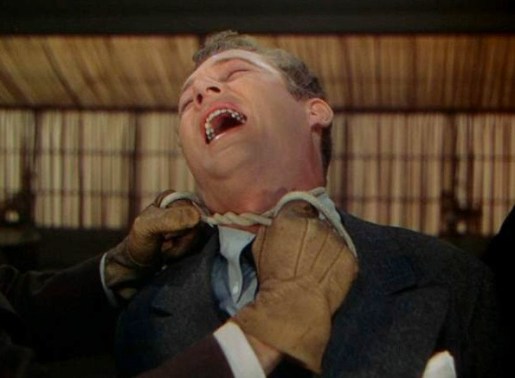
Having seen Alfred Hitchcock’s most successful films like Psycho and The Birds, I thought I’d check out one of his smaller and more inventive efforts. Rope is based on a play and one of the most purely translated plays, enclosed as it is in a single apartment with careful attention to its setting and structure. Decades before Birdman, Hitchcock experimented with long takes and a bare minimum of cuts, which are craftily hidden, sometimes obviously, sometimes not.

Clearly based on the infamous Leopold and Loeb murder, the plot revolves around two arrogant school chums Brandon and Phillip (John Dall and Farley Granger) who strangle a classmate with rope merely to prove their superiority and then invite the victim’s family and friends for a dinner party over the hidden body. As an intellectual experiment, Rope is intriguing and thought-provoking. As a thriller from the master of suspense, it’s rather disappointing. There is far more talking and plotting than actual tension, and the plot hinges on the revelation of how the truth will come out rather than if. One point of contention I didn’t see was rumors about the assumed homosexuality of the killers. Sure, they live together as roommates, but if there was such a subtext, it was so subtle to avoid controversy that I didn’t even recognize it.

Like the motivation for the crime, Rope’s message is more cerebral than visceral. The murderers make it clear that their “superior” ideology stemmed from their teacher Rupert Cadell, played by a serious James Stewart. At the party, Rupert confirms his elitist leanings but only in theory and only until he sees cause for grief. It’s all innocent discussion to debate who is more or less intelligent, cultured, or worthy of life, but such philosophy can be put into action by the unprincipled, like the two killers or Nazi Germany. Rupert was not involved in the murder, but Rope emphasizes that the seed of an immoral idea can be just as regrettable as the crime itself.

Best line: (Mrs. Atwater, a guest) “Do you know when I was a girl I used to read quite a bit.”   (Brandon) “We all do strange things in our childhood.”


Rank: Honorable Mention


© 2016 S. G. Liput

376 Followers and Counting


Cabin in the Sky (1943)

08 Friday Apr 2016

Posted by sgliput in Movies, NaPoWriMo, Poetry, Reviews, Writing

≈ 2 Comments

Tags

Comedy, Drama, Fantasy, Musical


(I decided to forgo today’s NaPoWriMo prompt about flowers, because really, how many movies about flowers are there? At least one of the characters in this random choice is named Petunia.)


When your mind is debating on whether or not
You should go for that third piece of pie,
Or whether you’re better off tying the knot
With a sinner or saint worth a try,
You may not be able to see who is there
As they whisper advice you might take,
But angels and devils are rapt in midair,
Intent on your every mistake.

So next time you manage to fend off temptation
And choose to obey that red light,
Or when you hold in your off-color frustration
At stubbing your toe late at night,
Just know that, although you may not hear a sound,
Your good choices made someone upset,
And that someone is probably pounding the ground,
Because you just lost him a bet.
_________________

MPAA rating: might as well be G

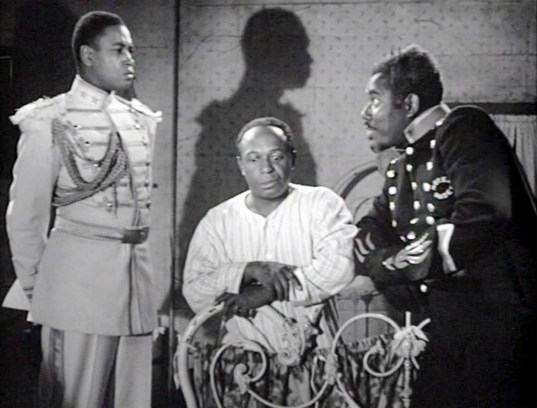
One day not long ago, I decided to just watch this random old movie for no other reason than it was there. Directed by Vincente Minnelli, Cabin in the Sky is a notable film due to its entirely African-American cast, which was unheard-of back in 1943, and it surprised many by performing well with white audiences too, perhaps because the vices, virtues, and caricatures on display are not exclusively black.

Little Joe (Eddie “Rochester” Anderson) can’t seem to shake his gambling addiction, despite the insistence of his religious wife Petunia (excellent Ethel Waters, who reprised her role from the play from which the film was adapted). After his bad habit ends up killing him, Little Joe is confronted by demons eager to take him to hell, but his wife’s prayers earn him a temporary second chance to straighten out his life. Aside from the fact that the plot seems to have inspired a memorable Tom and Jerry cartoon (“Heavenly Puss” if I’m not mistaken), it was a rather fun dynamic watching literal versions of a shoulder angel and devil pulling the characters in different directions. Once Little Joe returns to life, he doesn’t remember or see the spirits, and watching the spiritual enemies vying for him to make right or wrong choices is like a lighthearted version of The Screwtape Letters.

Where Cabin in the Sky falls is in its status as a musical. A musical number is supposed to enhance emotions or be generally enjoyable, but the few songs here just drag the pace to an unnecessary standstill. “Happiness Is a Thing Called Joe” is the only one worth hearing and earned an Oscar nomination for Best Song, but the rest are wholly forgettable, with one wince-inducing number confirming that Eddie Anderson’s scratchy voice was not meant for singing. Duke Ellington and Louis Armstrong have small roles, but it was odd that Armstrong never even got to sing.

The music aside, Cabin in the Sky is a reasonably charming old movie with good work from its black cast, including Lena Horne as Little Joe’s worst temptation. If you’re looking for a random movie to watch, you could do worse.

Best line: (Georgia, played by Horne) “I’m just speaking my mind.”   (Petunia) “And I ain’t heard nothing yet.”


Rank: Honorable Mention


© 2016 S. G. Liput

376 Followers and Counting


The Last Sin Eater (2007)

06 Wednesday Apr 2016

Posted by sgliput in Christian, Movies, NaPoWriMo, Poetry, Reviews, Writing

≈ Leave a comment

Tags

Drama, Family


(Today’s NaPoWriMo prompt was to write a poem about food. I had to stretch the topic a bit, but here it applies to a ritualistic meal.)


In olden days, when Death dropped by
To whisk away a willing soul,
The folk believed that sin’s control
Still clung to what was left.
And so one chosen with a sigh
Was tasked with eating bread and wine
That represented as a sign
The dead one’s every lie and theft.

How heavy was this obligation,
Living only for the dead!
The taste of wine and sin-soaked bread
Lay bitter on the tongue.
This ritual owed its foundation
To the oldest of traditions,
But the cure for superstitions
Lay in faith held by the young.
_________________

MPAA rating: PG-13

My VC has grown extremely fond of the works of Francine Rivers, a best-selling Christian author whose one hit to garner a film adaptation is The Last Sin Eater. One of the weaknesses of Christian films is that the evangelical message is often the only reason it exists, at the expense of a worthwhile story. Luckily, The Last Sin Eater, directed by Michael Landon, Jr., has a good story. Focusing on an obscure but fascinating 19th-century tradition of some Celtic immigrants of Appalachia, the film paints a compelling tale of guilt amid a rural community with a surprisingly dark secret.

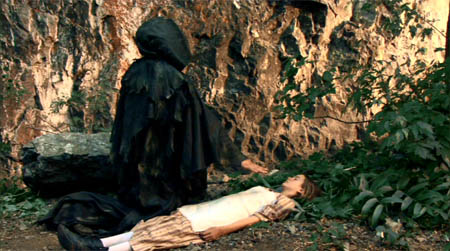
Young Cadi Forbes (Liana Liberato) is overcome with guilt for the death of her sister and seeks out the village’s reclusive Sin Eater to take away her iniquity. The Sin Eater dresses in a black robe and is treated like the boogeyman of a horror movie, even though he’s merely a victim of an alienating tradition. When Cadi meets a man of God (a grown-up Henry Thomas from E.T.), she becomes dubious of the necessity of a sin eater in light of someone named Jesus. This Christian element is key to the story’s resolution, but the core mystery remains separate and interesting.

While the acting isn’t always entirely convincing, Liberato is an earnest Cadi, and Henry Thomas and Louise Fletcher add some star power to an otherwise lesser-known cast. The woodland cinematography is also charmingly picturesque and a step above other low-budget films, even if the special effects aren’t. While it may please mainly faith-based audiences, The Last Sin Eater is a quaint and positive tale of redemption which, according to my VC, is not quite as good as the book.


Rank: Honorable Mention


© 2016 S. G. Liput

373 Followers and Counting


Z for Zachariah (2015)

05 Tuesday Apr 2016

Posted by sgliput in Movies, NaPoWriMo, Poetry, Reviews, Writing

≈ 5 Comments

Tags

Drama


(Today’s NaPoWriMo prompt was to write a poem inspired by an unusually named fruit or vegetable, and…I got nothing, at least as far as movies. So here’s a poem that mentions fruit.)


When Adam and Eve in the garden dwelt,
They had no sin to tempt their heart,
But even after the fruit was dealt,
One kind of vice had yet to start.

For jealousy to turn one green,
Another man must bear his glare,
And envy chanced to grow between
The sons of Adam, heir to heir.

As soon as two men shared the earth,
One’s jealousy did thin the herd,
And every day as more give birth,
More envy burgeons undeterred.
____________________

MPAA rating: PG-13

Post-apocalyptic stories are all the rage these days, as are films about isolation (Moon, The Martian, Room). Based loosely off a 1974 novel, Z for Zachariah combines these two trends into a slow but intriguing drama. After some unspecified nuclear disaster, Ann Burden (Margot Robbie) occupies a rare safe zone, where her family’s farm is protected by the natural valley. Into this valley comes John Loomis (Chiwetel Ejiofor), a scientist dependent till now on a radiation suit. Their relationship is respectful but restrained, since they both know that they would never be attracted if not for these dire circumstances. Despite their differences, such as their religious views, they seem to understand that a man and a woman alone will most likely go the way of Adam and Eve. However, potential bliss is hindered by the arrival of another survivor named Caleb (Chris Pine).

Z for Zachariah makes the most of its triad cast, with all three delivering excellent performances. The setting is also beyond reproach, with the briefly seen nuclear ruins outside the valley contrasting starkly with the lush greenery of Ann’s home. Where the film could easily lose viewers is in the pacing. On the one hand, the film’s leisurely pace is building up the bond between the characters and how it’s tested. On the other hand, you may be too bored to really care. I liked how the ending was a bit ambiguous, leaving room for some hope of a different outcome from the obvious. Strengthened mainly by its trio of fine actors, Z for Zachariah is a surprisingly restrained post-apocalyptic fable that illustrates how even the smallest of communities can turn “Adam and Eve” into “Cain and Abel.”


Rank: Honorable Mention


© 2016 S. G. Liput

373 Followers and Counting


Labor Day (2013)

04 Monday Apr 2016

Posted by sgliput in Movies, NaPoWriMo, Poetry, Reviews, Writing

≈ 3 Comments

Tags

Drama, Romance


(Today’s NaPoWriMo prompt was to describe “the cruelest month.” While I wouldn’t go as far as cruel, I applied it to the month of a certain fateful holiday.)


Of all the months throughout the year,
September haunts my soul.
The summer wanes; its dying pains
Serenely take their toll.

The children mourn that school awaits
And wish that time would freeze.
It never does; so says the buzz
Of insects in the trees.

When Labor Day arrives once more
And time begins to slow,
My mind returns and softly yearns
For that time years ago—

When he was in my mother’s house
And shared his every skill
Till Labor Day was snatched away
And trembling hearts were still.

As long as we are incomplete,
September days are dim.
The luster waits to gild those dates
Until we welcome him.
___________________________

MPAA rating: PG-13

Labor Day is the most romantic movie you’ll ever see about an escaped murderer taking a mother and son hostage. What sounds like a horror movie set-up becomes heartfelt and touching instead. Frank Chambers (Josh Brolin) gives his keepers the slip and hitches a ride home with Adele (Kate Winslet) and her adolescent son Henry (Gattlin Griffith). Instead of threatening them in the basement or the like, Frank instead fixes doors and pipes, changes tires, and bakes pies, and when he ties up Adele strictly for show and then cooks for her and spoon-feeds her, it’s almost surreal. Quickly, it becomes clear that Frank is not dangerous, and Adele’s fragile need for intimacy becomes one more trouble Frank can fix. Of course, he’s a wanted man, and the police are closing in.

Labor Day excels in its warm atmosphere. The radiant summer and subtle quietude brought to mind the tone of some of Studio Ghibli’s calm films, and I could believe how a three-day weekend could have felt much longer to the characters. I did also like the thoughtful details, like hearing a snippet of a Jerry Lewis telethon that used to air every Labor Day weekend. Kate Winslet and Josh Brolin are darn near perfect and have instant chemistry together, although their relationship transitions from dubious to surreal to madly in love a bit too easily. By the end, the film could have become one of those bittersweet tearjerkers that tear me up inside (like Somewhere in Time), but it wasn’t quite involving enough to trigger the waterworks. I’m unsure why, but it was still a poignant romance/coming-of-age tale that touches the heart in all the right ways.

Best line: (Henry) “I don’t think losing my father broke my mother’s heart, but rather losing love itself.”


Rank: List Runner-Up


© 2016 S. G. Liput

373 Followers and Counting


The Piano Lesson (1995)

02 Saturday Apr 2016

Posted by sgliput in Movies, NaPoWriMo, Poetry, Reviews, TV, Writing

≈ 3 Comments

Tags

Drama


(Today’s NaPoWriMo prompt was to involve a family portrait. I went a little unorthodox and saw a movie heirloom as a different kind of portrait.)


Photographs fade with the passing of time.
Families usually settle for that.
But one family has a sturdier portrait:
A weathered piano where fathers have sat.

One gifted forefather made art from the wood
And carved images of his daughter and wife
And kept right on carving as long as he could,
Remembering many a long-faded life.

There that piano sits, solid as ever.
The faces hewn into its surface still stare,
And when someone plays on those ivory keys,
The faces almost seem to whisper a prayer.

Now some fail to see that piano as more
Than a heavy old relic with stale memories,
But portraits, pianos, and relics can store
Significance only their family sees.
____________________

MPAA rating: PG

The Piano Lesson is a Hallmark Hall of Fame movie adapted from the all-black Broadway play by August Wilson. Several of the actors from the play grace the screen as well, including Charles S. Dutton and Carl Gordon (who also co-starred on the ‘90s TV show Roc). Dutton plays Boy Willie, who visits his sister Berniece (Alfre Woodard) in Pittsburgh in order to sell her antique piano for land.

What The Piano Lesson has is a debate-worthy dilemma of the best kind. As I described in the poem, the piano is carved with images of their ancestors, dating back to slavery, the kind of keepsake that Berniece could never imagine parting with. Yet Boy Willie views its worth in monetary terms: if he can sell it (and the truckful of watermelons he brought along), he can return to the South and buy the very land their ancestors once worked as slaves. The piano is a gift, but is it one to be kept and admired, or used to benefit the family? Both Berniece and Boy Willie have good points, so who’s right?

The Piano Lesson is also a warm picture of African-Americans in the 1930s. At first glance, the politically correct might disapprove of the poor dialect and grammar spoken, names like Boy Willie or Wining Boy, or the sight of black people with watermelons. Yet August Wilson himself was black and included such elements for a reason. After all, Boy Willie is showing initiative and business savvy by selling the watermelons and seeks to keep on progressing away from slavery. Religion, superstition, and music are also elemental to the story, with an a cappella rendition of “Berta, Berta” being a highlight.

All of the actors give great performances, but the story itself doesn’t quite know how to resolve its provocative argument. The culmination of the dispute takes a supernatural turn that is not well visualized and ends up just confusing. Even so, I’m glad the playwright sided with my opinion on how the piano ought to be used. The Piano Lesson might have ended better, but it’s a thought-provoking portrait of African-American heritage.


Rank: Honorable Mention


© 2016 S. G. Liput

372 Followers and Counting


Miracles from Heaven (2016)

27 Sunday Mar 2016

Posted by sgliput in Christian, Movies, Poetry, Reviews, Writing

≈ Leave a comment

Tags

Drama, Family


I’ve not beheld a parted sea
Or outlived an emergency.
I’ve never seen a patient healed
Or glimpsed divine eternity.

I’ve never viewed a battlefield
With some celestial might revealed.
I wish I had, for maybe then
My faith in God would be more sealed.

Despite the things beyond my ken,
I’ve seen the warmth and faith of men,
And maybe that’s a miracle
Worth noticing time and again.
______________________

MPAA rating: PG

I had considered watching Risen or The Young Messiah for Easter, but the only faith-based film with a good show time (and an A+ CinemaScore) was Miracles from Heaven, which I’m rather glad I ended up seeing. I wasn’t won over by Heaven Is For Real, the previous film from producers T.D. Jakes and Joe Roth; it was an intriguing story but not one to sustain a full-length film, and the conflict felt forced coming from supposed people of faith. While that film showed a child’s heavenly vision early on and focused on people’s reactions, Miracles from Heaven does better in leaving it for the climax and focusing on a more relatable crisis of faith, with a far better chance for both smiles and tears.

Based on the true story of the Beam family from Burleson, Texas, the film depicts the family of five as real people whose faith is just one part of their lives. The parents flirt with each other; one daughter is obsessed with Taylor Swift; and another has a passion for soccer championships. Tragedy is the last thing they expect or deserve. Jennifer Garner outdoes herself as Christy Beam, who lives every parent’s worst nightmare when her daughter Anna (Kylie Rogers) is diagnosed with a severe and incurable gastrointestinal disease. Already stressed financially, she must endure constant worry, hospital waiting lists, incompetent doctors who won’t do more, competent doctors who can’t do more, and a host of unanswered prayers. Skeptics aren’t the only ones who question the goodness of God when bad things happen, and Christy’s faith becomes buried in feelings of grief and abandonment. Why did this have to happen to a sweet little girl? No one can offer her answers.

Obviously, the title indicates that something miraculous happens, but it’s more than that. In following this mother and daughter to their darkest point, moments of light shine out the brighter. Queen Latifah plays a kind waitress who befriends them while away from home and offers needed comic relief, and Eugenio Derbez is splendid as a Patch Adams-style child specialist who balances cheerful encouragement with inner knowledge that most of his patients will die. In these and many more side characters, the film reminds us that big miracles come from God, but small ones can originate in those random acts of kindness of which anyone is capable.

Doubt is everyone’s first reaction to miracles, and the film doesn’t forget that, nor does it try to explain why some people are so blessed while others are not. Miracles are rare but no less extraordinary, and for those willing, the unexplainable can remind people of hope when they have none. Miracles from Heaven has a few moments of familiar Christian themes that might get atheists rolling their eyes, but it’s an inspiring, well-acted, and emotional tale with which anyone who believes or hopes in miracles can identify.

Best line: (Christy) “Miracles are God’s way of telling us He’s here.”


Rank: List Runner-Up


© 2016 S. G. Liput

370 Followers and Counting


← Older posts
Newer posts →

Recent Posts

  • We Didn’t Start 2025 (Recap)
  • NaPoWriMo 2025 Recap (Finally)
  • Sonic the Hedgehog 3 (2024)
  • It Happened One Night (1934)
  • Spellbound (2024)

Recent Comments

associatesofshellymann's avatarassociatesofshellyma… on My Top Twelve La La La So…
Kit's avatarKit Nichols on Bonnie and Clyde (1967)
lifelessons's avatarlifelessons on Look Back (2024)
Carol Jackson's avatarCarol Jackson on The Thief of Bagdad (1940…
Stephen's avatarStephen on Love Story (1970)

Archives

  • January 2026
  • December 2025
  • May 2025
  • April 2025
  • March 2025
  • February 2025
  • January 2025
  • December 2024
  • May 2024
  • April 2024
  • March 2024
  • February 2024
  • January 2024
  • December 2023
  • November 2023
  • October 2023
  • September 2023
  • July 2023
  • June 2023
  • May 2023
  • April 2023
  • March 2023
  • February 2023
  • January 2023
  • December 2022
  • November 2022
  • October 2022
  • September 2022
  • August 2022
  • July 2022
  • June 2022
  • May 2022
  • April 2022
  • March 2022
  • February 2022
  • January 2022
  • December 2021
  • November 2021
  • October 2021
  • September 2021
  • August 2021
  • July 2021
  • June 2021
  • May 2021
  • April 2021
  • March 2021
  • February 2021
  • January 2021
  • December 2020
  • November 2020
  • October 2020
  • September 2020
  • August 2020
  • July 2020
  • June 2020
  • May 2020
  • April 2020
  • March 2020
  • February 2020
  • January 2020
  • December 2019
  • November 2019
  • October 2019
  • September 2019
  • August 2019
  • July 2019
  • June 2019
  • May 2019
  • April 2019
  • March 2019
  • February 2019
  • January 2019
  • December 2018
  • November 2018
  • October 2018
  • September 2018
  • August 2018
  • July 2018
  • June 2018
  • May 2018
  • April 2018
  • March 2018
  • February 2018
  • January 2018
  • December 2017
  • November 2017
  • October 2017
  • September 2017
  • August 2017
  • July 2017
  • June 2017
  • May 2017
  • April 2017
  • March 2017
  • February 2017
  • January 2017
  • December 2016
  • November 2016
  • October 2016
  • September 2016
  • August 2016
  • July 2016
  • June 2016
  • May 2016
  • April 2016
  • March 2016
  • February 2016
  • January 2016
  • December 2015
  • November 2015
  • October 2015
  • September 2015
  • August 2015
  • July 2015
  • June 2015
  • May 2015
  • April 2015
  • March 2015
  • February 2015
  • January 2015
  • December 2014
  • November 2014
  • October 2014
  • September 2014
  • August 2014
  • July 2014
  • June 2014
  • May 2014
  • April 2014
  • March 2014
  • February 2014
  • January 2014
  • December 2013

Categories

  • Blindspot
  • Blogathon
  • Christian
  • Movies
  • Music
  • NaPoWriMo
  • Poetry
  • Reviews
  • TV
  • Writing

Meta

  • Create account
  • Log in
  • Entries feed
  • Comments feed
  • WordPress.com

Recent Posts

  • We Didn’t Start 2025 (Recap)
  • NaPoWriMo 2025 Recap (Finally)
  • Sonic the Hedgehog 3 (2024)
  • It Happened One Night (1934)
  • Spellbound (2024)

Recent Comments

associatesofshellymann's avatarassociatesofshellyma… on My Top Twelve La La La So…
Kit's avatarKit Nichols on Bonnie and Clyde (1967)
lifelessons's avatarlifelessons on Look Back (2024)
Carol Jackson's avatarCarol Jackson on The Thief of Bagdad (1940…
Stephen's avatarStephen on Love Story (1970)

Archives

  • January 2026
  • December 2025
  • May 2025
  • April 2025
  • March 2025
  • February 2025
  • January 2025
  • December 2024
  • May 2024
  • April 2024
  • March 2024
  • February 2024
  • January 2024
  • December 2023
  • November 2023
  • October 2023
  • September 2023
  • July 2023
  • June 2023
  • May 2023
  • April 2023
  • March 2023
  • February 2023
  • January 2023
  • December 2022
  • November 2022
  • October 2022
  • September 2022
  • August 2022
  • July 2022
  • June 2022
  • May 2022
  • April 2022
  • March 2022
  • February 2022
  • January 2022
  • December 2021
  • November 2021
  • October 2021
  • September 2021
  • August 2021
  • July 2021
  • June 2021
  • May 2021
  • April 2021
  • March 2021
  • February 2021
  • January 2021
  • December 2020
  • November 2020
  • October 2020
  • September 2020
  • August 2020
  • July 2020
  • June 2020
  • May 2020
  • April 2020
  • March 2020
  • February 2020
  • January 2020
  • December 2019
  • November 2019
  • October 2019
  • September 2019
  • August 2019
  • July 2019
  • June 2019
  • May 2019
  • April 2019
  • March 2019
  • February 2019
  • January 2019
  • December 2018
  • November 2018
  • October 2018
  • September 2018
  • August 2018
  • July 2018
  • June 2018
  • May 2018
  • April 2018
  • March 2018
  • February 2018
  • January 2018
  • December 2017
  • November 2017
  • October 2017
  • September 2017
  • August 2017
  • July 2017
  • June 2017
  • May 2017
  • April 2017
  • March 2017
  • February 2017
  • January 2017
  • December 2016
  • November 2016
  • October 2016
  • September 2016
  • August 2016
  • July 2016
  • June 2016
  • May 2016
  • April 2016
  • March 2016
  • February 2016
  • January 2016
  • December 2015
  • November 2015
  • October 2015
  • September 2015
  • August 2015
  • July 2015
  • June 2015
  • May 2015
  • April 2015
  • March 2015
  • February 2015
  • January 2015
  • December 2014
  • November 2014
  • October 2014
  • September 2014
  • August 2014
  • July 2014
  • June 2014
  • May 2014
  • April 2014
  • March 2014
  • February 2014
  • January 2014
  • December 2013

Categories

  • Blindspot
  • Blogathon
  • Christian
  • Movies
  • Music
  • NaPoWriMo
  • Poetry
  • Reviews
  • TV
  • Writing

Meta

  • Create account
  • Log in
  • Entries feed
  • Comments feed
  • WordPress.com

Blog at WordPress.com.

  • Subscribe Subscribed
    • Rhyme and Reason
    • Join 814 other subscribers
    • Already have a WordPress.com account? Log in now.
    • Rhyme and Reason
    • Subscribe Subscribed
    • Sign up
    • Log in
    • Report this content
    • View site in Reader
    • Manage subscriptions
    • Collapse this bar