• Home
  • About Me
  • The List
  • THE LIST (2016 Update)
  • THE LIST (2017 Update)
  • THE LIST (2018 Update)
  • THE LIST (2019 Update)
  • THE LIST (2020 Update)
  • THE LIST (2021 Update)
  • THE LIST (2022 Update)
  • Top Twelves and More
  • The End Credits Song Hall of Fame

Rhyme and Reason

~ Poetry Meets Film Reviews

Rhyme and Reason

Tag Archives: Classics

The Dirty Dozen (1967)

08 Wednesday Nov 2017

Posted by sgliput in Movies, Poetry, Reviews, Writing

≈ 4 Comments

Tags

Action, Classics, War

When Nazis are doing what Nazis will do,
And you’re busy planning for D-Day’s debut,
Too busy to spare a commando or two
To send on a raid that could likely get you
Fired if it were to fail or fall through,
Who wouldn’t think, “I’ve an idea to pursue!
I’ll gather a murderous felon or two
Or twelve and I’ll line them all up in a queue
And train them to do what I want them to do.
Who cares if they misbehave out of my view
Or turn psycho, causing a hullabaloo?
It’s not my fault if something bad should ensue.
I know it’s a risk, and it’s dangerous too,
As my bosses would tell me if they only knew,
But expendability has its value.”
Who would think that? That’s right, very few.
___________________

MPAA rating: Not Rated (should be PG-13)

Considering I only saw it once years and years ago, I thought it was about time I reminded myself why The Dirty Dozen is so popular. After all, its memory brought Tom Hanks and Victor Garber to tears in Sleepless in Seattle. While it didn’t quite leave me choked up like them, I must admit it’s a unique classic of the war genre, full of surly machismo and a highly talented cast. And despite having practically the same basic premise, it’s way better than Suicide Squad.

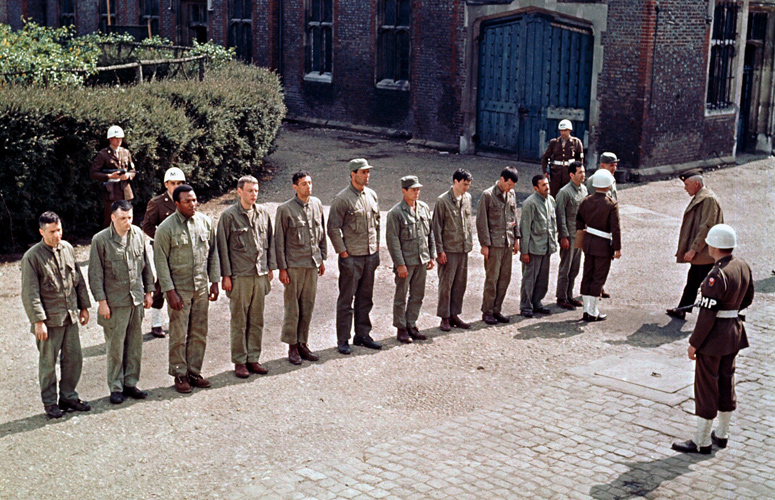
In the months leading up to D-Day, Lee Marvin’s Major Reisman is put in command of an experimental unit of twelve convicted prisoners, who are to be trained and sent on a probable suicide mission for the Allied cause.  Half of them plucked from death row, this “Dirty Dozen,” as they’re later explicitly called, is full of murderers and rebels, and despite being offered amnesty if they survive, they aren’t about to become model soldiers overnight. Thus, the no-nonsense Reisman pulls no punches in whipping them into shape and encouraging them to work together for their own (and the army’s) best interest.
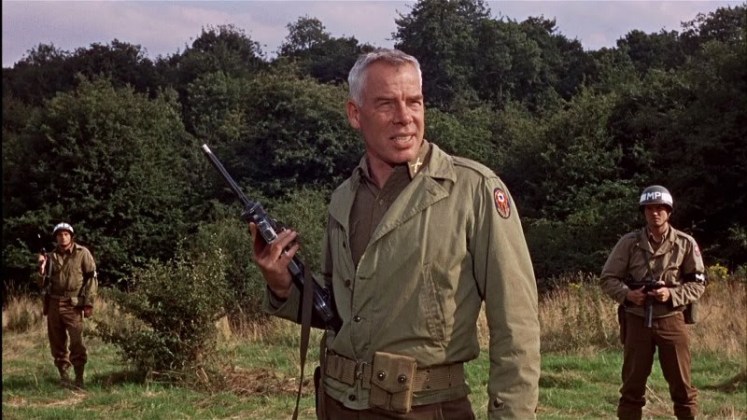
The main thing I recalled from my first viewing was that I had trouble telling the men apart. Obviously, I could recognize Jim Brown as the only black member, but the others all blended together to the point that the deaths toward the end didn’t mean much to me since they were all interchangeable. While not everyone stood out this time either, I was better able to distinguish the actors I’d seen elsewhere, such as Donald Sutherland as Pinkley, Charles Bronson as Wladislaw, and John Cassavetes as Franko, plus Ernest Borgnine and George Kennedy as officers. Others stood out for their distinct personalities, such as Clint Walker’s shy Posey and Telly Savalas’s psycho Maggott. That’s still only half of the Dozen that I could pick out of a lineup from memory, but at least it’s better than my first go-round.

When I ignored trying to tell the other six apart, I was able to just enjoy the movie, which starts out slow but gets better with time. Periodic humor keeps the tone relatively light, such as Pinkley impersonating a general, and although the Dozen are labeled as bad men, there were levels to their “dirtiness.” Some like Maggott with his religious zealotry were downright crazy, but others were simply high-strung and bitter in their defiance. A few even had mitigating circumstances to their crimes that made them more sympathetic than others. This was something that Suicide Squad didn’t do well in making all the villains psychopaths, along with some of the “good guys” too. There has to be someone the audience can sympathize with, and at least a few of the men in The Dirty Dozen were worth caring about.

While the training and the war games scenes were rather fun to watch, the best part is the actual mission against the Nazis to which everything else builds. With the high body count and higher bullet count, this is war action at its best, even if I’m still not sure where and when everyone who died bit the dust. The film got a fair amount of criticism at the time for its violence, and I was a bit shocked too by the ruthlessness of killing both Nazi officers and their potentially innocent escorts, though I suppose such is war and the mission at hand. The Dirty Dozen lives up to its reputation as a “man’s movie,” but my VC enjoyed it too. Even with its large cast, it wrings plenty of excitement from the risk of its somewhat implausible but entertaining premise.

Best line: (Reisman, leaving the room after a racist comment starts a brawl) “Oh, the gentleman from the South had a question about the dining arrangements. He and his comrades are discussing place settings now.”


Rank: List Runner-Up


© 2017 S.G. Liput
517 Followers and Counting


The Inn of the Sixth Happiness (1958)

08 Sunday Oct 2017

Posted by sgliput in Movies, Poetry, Reviews, Writing

≈ Leave a comment

Tags

Biopic, Classics, Drama, History, Romance

Image result for the inn of the sixth happiness

Some may wish five happinesses
On both traveler and friend:
The hope for wealth from their successes,
And a long life ere the end.

Third, may good health cause increase,
And virtue fortify your soul,
And lastly, may you die in peace,
Having met your every goal.

Though five would fill most purposes,
A sixth and final happiness
I wish to all, but what it is
Is up to each of us to guess.
____________________

MPAA rating: PG

Ingrid Bergman is one movie star who hasn’t been much on my classic film radar, aside from Casablanca and Gaslight (which are great). To remedy that, I decided to check out one of her later roles in the semi-epic The Inn of the Sixth Happiness, in which she plays Gladys Aylward, a real-life missionary to China who rose to fame with her humanitarian efforts during the Sino-Japanese War of the 1930s.

I call it a semi-epic because, though it doesn’t quite boast the sweeping storytelling of Ben-Hur or Doctor Zhivago, there’s enough of it in Aylward’s decades-long mission that the magnitude of her story rises above others of its day. At the beginning, Aylward displays an indomitable passion for China, feeling it is where God has called her for His purposes, and at her own expense and peril, she journeys there to join an already established missionary (Athene Seyler). There in Yang Cheng, they open an inn for travelers, whose hunger for stories they plan to meet with the Bible, but many difficulties stand in the way, from uncooperative leaders to the obvious language barrier. And even when she earns the trust and love of the people, Aylward’s commitment to China also puts her in harm’s way when the Japanese invade in the years leading up to World War II, and she takes it upon herself to lead a hundred orphans to safety.

Image result for the inn of the sixth happiness

While The Inn of the Sixth Happiness doesn’t quite make my List, it’s the kind of film that might have if I’d seen it long ago and built it up in my head as a classic. (That is how it works sometimes.) There’s much to love about it, not least of all is Bergman’s performance as Aylward. Even if she looks and sounds nothing like the woman she’s playing (just one of the film’s many historical liberties), she certainly captures her commitment and love for the Chinese people. Like Mother Teresa, she goes to serve as both servant and example rather than force conversion on the people. She doesn’t merely go to China for a couple years to fulfill a duty; instead, she immerses herself in the land and culture, even becoming a Chinese citizen, and dedicates her entire life to her mission of love and social reform. It is this kind of Christian commitment that is most persuasive, and when she does find success and respect in the eyes of both the Chinese and her fellow missionaries, it’s immensely satisfying and touching. I’ve even heard reports that playing such a godly woman led Ingrid Bergman to become a Christian.

Strong supporting roles are filled by Curt Jurgens as a half-Chinese colonel and love interest and Robert Donat (his last film role before his death) as the local mandarin of Yang Cheng. Of course, neither actor is Chinese, leading to retroactive criticisms of the film for whitewashing, but they both are excellent still, especially Donat, and they’re not at all insulting like Mickey Rooney’s caricature in Breakfast at Tiffany’s. Plus, the vast majority of the cast are still played by Chinese actors, including many children from a Chinese community in Liverpool. Especially affecting is the commitment of Aylward’s two Chinese helpers who assist her along the way, as well as an emotional scene between Aylward and one of her adopted Chinese daughters.

Image result for the inn of the sixth happiness

It’s not without its flaws, from an overlong runtime to some loose ends that are left unresolved by the end. Plus, it’s up to each viewer how much the historical changes bother you; Aylward herself wasn’t a fan of the film’s depiction of her or Curt Jurgens’ character. Yet the mountainous setting adds a good deal of authenticity to Aylward’s travails, aided by terrific cinematography, and even if director Mark Robson was the only member of the production to earn an Oscar nomination, the quality of the performances and overall film seem deserving of far more. The Inn of the Sixth Happiness isn’t strongly evangelical, still being a Hollywood production, but the faith of its subject is unmistakable and inspiring.

Best line: (Aylward) “You have to interfere with what you feel is wrong, if you hope to make it right.”


Rank: List Runner-Up


© 2017 S.G. Liput
514 Followers and Counting


Genre Grandeur – The Wages of Fear (1953) / Sorcerer (1977) – Rhyme and Reason

01 Sunday Oct 2017

Posted by sgliput in Movies, Poetry, Reviews, Writing

≈ 1 Comment

Tags

Classics, Drama, Thriller, Version Variations

Here is my contribution to MovieRob’s September Genre Grandeur of Remade Movies. I reviewed both the classic French thriller The Wages of Fear with its American counterpart Sorcerer, comparing and contrasting them as one of my Version Variations.

movierob's avatarMovieRob

For this month’s first review for Genre Grandeur – Re-Made Movies, here’s a review of The Wages of Fear (1953) / Sorcerer (1977)) by SG of Rhyme and Reason

Thanks again to Robb of Red Bezzle for choosing this month’s genre.

Next month’s Genre has been chosen by Kira of Film and TV 101 and it is Western CrossoverMovies.

Literally any film from any genre with western elements to it; comedy/drama/musical or even thrillers or horror.

Please get me your submissions by the 25th of October by sending them to westerncrosskira@movierob.net

Try to think out of the box! Great choice Kira!

Let’s see what SG thought of these movies:

_________________________________

The Wages of Fear (1953) / Sorcerer (1977)


You don’t know what fear is, son.

You’ve felt it flicker and then fade.

But none can say they’ve fully felt

The fear that makes men’s spirits melt

Until their nerves…

View original post 1,236 more words

Marooned (1969)

10 Sunday Sep 2017

Posted by sgliput in Movies, Poetry, Reviews, Writing

≈ Leave a comment

Tags

Classics, Drama, Sci-fi, Thriller

Image result for marooned film

Although it looks down at mankind from the sky,
And we behold it every night,
The dark void of space is no friend or ally.
‘Tis death on our borders to push and defy,
An ever-black vacuum that wills us to die
If we from our atmosphere venture too high,
Which man will endeavor despite,
Despite the dread silence our fears amplify,
Despite the expanses too vast for the eye.
Despite all the dangers that could go awry,
Mankind will dare every new height.
___________________

MPAA rating: G (should be PG, for light language)

This one is a special request of my mom’s. I’ve been putting off reviewing Marooned for a long time, despite my mom’s insistence, because I remember her showing it to me as a kid, and I was bored out of my skull. Since that first viewing, I’ve always viewed it as boredom incarnate. To my mind for the last several years, it’s been “Marooned = dull.” Yet she finally convinced me to give it another chance, and I must admit it’s better than I recalled, perhaps because I’ve grown in patience over the years. (Plus, I have a new standard for boring-as-heck cinema, which I’ll review soon.)

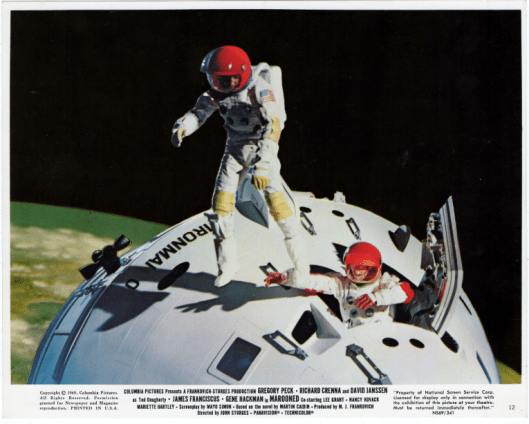
It might seem that this story of a space shuttle mission gone wrong drew inspiration from the Apollo 13 incident, but surprisingly it came out shortly after Apollo 11, a year before the similar events of Apollo 13. Richard Crenna, Gene Hackman, and James Franciscus play the three NASA astronauts who are stranded in their capsule (called Ironman One) when main engine failure leaves them without enough fuel to return home or to their space station. Unable to do anything but conserve oxygen and wait, the astronauts rest their hopes on Mission Control, led by Gregory Peck’s flight director Charles Keith, and a daring last-ditch rescue mission.

Image result for marooned film gregory peck

Marooned is still rather slow in its execution, but my mom has a special connection with any movie about NASA, this included, since my grandfather worked on the Mercury, Gemini, and Apollo missions at Cape Canaveral and she also worked there during the Space Shuttle Program. In fact, she sees her dad in Gregory Peck’s administrator and, as a kid, imagined her father similarly calling the shots, though he actually played more of a background role. I too have that fondness to some extent, which helped me appreciate Marooned more than I was expecting this time.

One thing that I recognized with this viewing is how Marooned has influenced other stranded-in-space films. Ron Howard’s Apollo 13 is an obvious comparison, though that had a direct historical basis, while this is fictional. I could also point, though, to the rallying of support and resources for a risky rescue that was also seen in The Martian, and the emotional farewells between the astronauts and their wives were echoed in the video goodbyes of the space crew in Deep Impact. And of course, the desperate space-walking finale bears some resemblance to the whole concept of Gravity, though Gravity’s jaw-dropping effects make the Oscar-winning effects in Marooned look pitiful. (They’re decent, but at one point, I could see a string suspending a supposedly floating object.) In a way, this climax represents the problem with Marooned: it’s meant to be tense and gripping, but the now-hokey effects and lack of music (only space sounds) make it anticlimactic and far less engaging than it was meant to be, especially when we have films like Gravity that took similar ingredients and did them better.

Image result for marooned film

Yet I can’t be too hard on Marooned anymore. It does feature some excellent performances, exemplified in the tearful calls between the astronauts and their wives, and Gregory Peck is in top form. Plus, that investment in the space program that must be in my blood helped me appreciate it overall, especially Keith’s impassioned defense of space travel, regardless of regrettable losses incurred, making the scrapping of our modern space program all the more disappointing. It’s still a bit dry, procedural, and overlong for my taste, but Marooned has at least moved up in my estimation, which at least should make my mom happy.

Best line: (reporter) “Are the results you’ve gained worth the lives you’ve lost?”  (Keith) “You’re damn right they are! You want to know what they accomplished living up there in a tin can for five months? Because of men like these, we’ve taken the first step off this little planet. A trip to the moon was just a walk around the block; we’re going to the stars, to other worlds, other civilizations. Men will be killed in this effort, just as they’re killed in cars and airplanes and bars and in bed.”


Rank: Honorable Mention


© 2017 S.G. Liput
506 Followers and Counting


2017 Blindspot Pick #8: Darby O’Gill and the Little People (1959)

29 Tuesday Aug 2017

Posted by sgliput in Blindspot, Movies, Poetry, Reviews, Writing

≈ Leave a comment

Tags

Classics, Disney, Family, Fantasy, Romance

Darby O'Gill and the Little People (1959) - Alternate Ending ...

That jolly ol’ Darby O’Gill
At the pub would be drinking his fill,
Earning chuckles and yawns
Telling of leprechauns,
Half-believed out of simple good will.

Not caring what doubters may think,
Darby’d go home at last with a wink,
To natter and sing
With the leprechaun king,
And together they too shared a drink.
_________________

MPAA rating: G

Live-action Disney movies tend to fall into two categories: childhood-shaping classics (Mary Poppins, Homeward Bound, Swiss Family Robinson) and severely lame duds (The Shaggy Dog, The Million Dollar Duck, The Computer Wore Tennis Shoes). I wasn’t sure which one Darby O’Gill and the Little People would fit in, but I’d gladly place it in the first group, though I doubt this obscure little gem is shaping many childhoods nowadays.

Darby O'Gill and the Little People (1959) Review |BasementRejects

Apparently based on two books by Herminie Templeton Kavanagh, Darby O’Gill feels as genuinely Irish as The Quiet Man but with a more fantastical basis in Irish folklore. Albert Sharpe is a folksy joy as Darby, a good ol’ boy and father of young Katie (Janet Munro of Swiss Family Robinson) in the town of Rathcullen, who loves to recount his stories of leprechaun interactions with everyone at the local pub. They may only half-believe him, but he’s still a beloved member of the community, which sticks up for him against the mocking of the local brute Pony Sugrue (Kieron Moore), who reminded me a lot of Gaston in Beauty and the Beast, just as Darby is like a more respected version of Maurice. After his job is handed off to a younger man (Sean Connery, so young he barely looks or sounds like the Connery I know), Darby has another run-in with the king of the leprechauns Brian Connors (Jimmy O’Dea) and finagles three wishes that might not turn out as he’d hoped.

Darby O’Gill and the Little People has a lot of the charm of other Disney movies from that era, just with a healthy Irish zest that makes you want to dance a jig and crave shepherd’s pie. At times, the Irish brogues are a little thick to fully understand without subtitles, but for the most part, it adds to the authenticity, as does the music, which consists only of a sweet little ballad and an epic but slightly overlong fiddle dance. The special effects, for the most part, are also well-done, consisting mostly of shrinking the leprechauns to be only as tall as Darby’s knees, a visual trick that reminded me of the miniaturized hobbits in The Lord of the Rings. Also effective is the more dated creation of a ghostly banshee and death-coach-driving dullahan; Disney movies have their fair share of nightmare fuel, but I can easily see one scene in particular terrifying the very young.

Image result for darby o'gill and the little people banshee

Most people may not have seen or even heard of Darby O’Gill and the Little People, but that’s a bit of a shame. Where else can you get to see Sean Connery croon about his sweetheart? I especially liked the good-natured rivalry between Darby and Brian and the twist at the end that builds nicely on what came before and rounds it out for a satisfying end. If it were a modern movie, I’d say that Darby O’Gill doesn’t quite do enough with its fanciful concept, perhaps because the special effects could be better utilized, but as an Irish jaunt from yesteryear, it’s an underrated Disney classic that may well have earned placement on my List if I’d seen it as a kid.

Best line: (Darby, of his daughter Katie) “She should be the caretaker. She’s got a tongue would clip a hedge.”

Rank: List Runner-Up

© 2017 S.G. Liput
506 Followers and Counting

The Glenn Miller Story (1954)

20 Sunday Aug 2017

Posted by sgliput in Movies, Poetry, Reviews, Writing

≈ Leave a comment

Tags

Biopic, Classics, Drama, Musical, Romance

Image result for the glenn miller story

(Best sung to “Little Brown Jug”)

Music once was full of brass;
Dance halls dripped with the sound of class.
Rock and roll had yet to grow,
But folks all knew Glenn Miller, though.

Ha, ha, ha, what a sound,
The kind to make Miller’s band renowned!
Ha, ha, ha, songs that stay,
The kind today’s elevators play!
__________________

MPAA rating: G

My mom has been urging me to check out more Jimmy Stewart movies lately, which I don’t mind since he’s one of my favorite actors, with a natural likability rivaling Tom Hanks. My latest exploration of his filmography is The Glenn Miller Story, which I hadn’t thought to see before because I didn’t know who Glenn Miller was. I’m sorry for my youthful ignorance now because it’s really an excellent role for Stewart and focuses on a style of music I rarely consider.

Image result for the glenn miller story

For those like me who may recognize Glenn Miller’s name but don’t know who he was, he was a big band leader in the 1930s and ‘40s whose band’s famous recordings include “Moonlight Serenade,” “In the Mood,” and “Pennsylvania 6-5000.” I was familiar with almost all of these songs, especially “Little Brown Jug,” which I learned to play on piano as a kid, but because most of them don’t have lyrics, they’re typically relegated to background music, making them recognizable but not necessarily known. Yet before rock and roll got off the ground in the ‘50s, this jazzy orchestra music ruled the dance halls of America, and like Stewart’s Lindbergh biopic The Spirit of St. Louis, it was made at a time when people still remembered these pre-war events.

The film recounts Glenn’s early struggles, such as repeatedly pawning his trombone in between shows, and his eventual rise to stardom, always in search of “the sound” that would set his band apart. It also focuses on his romance with Helen Burger (June Allyson), whose initial wariness of Glenn’s rootless vocation melts into wholehearted support of his dream. Stewart is his usual lovable self, letting his charm overshadow his character’s frequent inconsiderate treatment of others, which is more out of preoccupation than malice. He also does a fine job pretending to play the trombone. Allyson, though, almost outshines him, bringing considerable warmth to the usual encouraging spouse role and making me like her as an actress even more than I already did from Good News. I was also surprised to see a young Harry Morgan of M*A*S*H fame, and an abundance of famous musicians who knew Miller cameo and perform, though due to that youthful ignorance I mentioned, I only recognized Louis Armstrong.

Image result for the glenn miller story

What I especially liked about The Glenn Miller Story is that it didn’t fall into the problem I usually have with musical biopics. Most biographical films like this (think Ray, for instance) typically leave me with a more negative impression of its subject than I had before, exposing marital infidelity and drug use that taint their public image. It may be true, but it’s sad. Glenn Miller doesn’t do that, probably due to when it was made, instead depicting the music and romance of its title character without aiming to blemish his legacy. If I had a greater love for the big band style, this movie would easily make my list, but even if it just misses the cut, I greatly enjoyed its story and lead performances. My mom likes it even more, since she grew up with her parents listening to this kind of music, and it always puts a big, nostalgic smile on her face to hear it again. I feel bad now for putting off seeing it and not knowing of the talented Glenn Miller.

Best line: (Helen, several times) “Honestly!”  (I’ll think of this movie now every time I hear that.)


Rank: List Runner-Up (a very high one)


© 2017 S.G. Liput
506 Followers and Counting


Good News (1947)

10 Wednesday May 2017

Posted by sgliput in Movies, Poetry, Reviews, Writing

≈ 4 Comments

Tags

Classics, Comedy, Musical, Romance

I was featured on The Classic Movie Marathon link party

Image result for good news 1947

I’ve good news and bad news for those still alone,
Who pine for somebody to love as their own.
The good news is that there is someone for you,
Who’s hoping there’s someone for them to love too.
They’re out there, out somewhere, far off or close by;
You’re made for each other, as tales testify.

The bad news is that things may get in the way,
Like not recognizing true romance at play.
In not waiting long enough, you might pick wrong,
And they may do likewise, not where they belong.
Beware the missed moments and chances you shirk;
Your own asininity may be at work.

So keep an eye out for that promised soul mate,
And you may have good news to soon celebrate.
___________________

MPAA rating: Approved (an easy G)

After enjoying the compilation of classic MGM musical numbers in That’s Entertainment! and its Part II, I had to satisfy my curiosity over at least one of the featured films that caught my eye. The educational setting and youthful dance scenes of Good News made me think of it as a forerunner to High School Musical, and indeed that’s what it is. Just as Grease predated High School Musical, Good News anticipated Grease, and its romantic entanglements backed by buoyant musicality are still entertaining all these decades later.

Image result for good news 1947

While those later films were set in high school, though, Good News takes place at Tait College, the kind of carefree movie college where studies take a backseat to parties and football games. Peter Lawford plays the ever-confident athlete Tommy, while June Allyson fills the role of the mousy school librarian Connie, both of whom discover each other when Lawford’s smitten hotshot tries to impress the gold-digging it-girl, played by Patricia Marshall. The wholesome interactions between romance-seeking students brought to mind the original Archie comics, even incorporating a jealous bully named Beef (as opposed to Moose) who makes up part of an adjacent love triangle.

The story may remind you of many imitators since, but Good News is good clean fun, though I understand it’s a remake of a racier Pre-Code version from 1930. The best part is clearly the musical scenes, many of which feel like lesser-known classics, like “The Best Things in Life Are Free” or “Lucky in Love,” which benefits from the smooth voice of Mel Tormé.  Between the lyrical cleverness (“The French Lesson”) and the exuberant dancing (“Pass That Peace Pipe,” which was nominated for a Best Song Oscar), Good News has tuneful talent and charm to spare.

Best line: (Tommy, when chided on speaking French) “Guess I can’t help it, Poochy. Language comes easy to me. I’ve only been in class five days, and already I speak like a native. I don’t know of what country, but, uh, like a native.”


Rank: List Runner-Up


© 2017 S.G. Liput
480 Followers and Counting


The Man Who Never Was (1956)

18 Friday Nov 2016

Posted by sgliput in Movies, Poetry, Reviews, Writing

≈ 4 Comments

Tags

Classics, History, War

Image result for the man who never was


I dreamed a man deprived of soul
Had drifted to the shore.
He waited, though I did not know
What he was waiting for.

At last, a passerby took note,
And, soon borne by a crowd,
The body seemed within my dream
To be uniquely proud.

The passive face had made its way
From sea to land to grave,
And none could tell this empty shell
Had come more lives to save.

I wouldn’t know myself, except,
I saw his soul, which wore
A knowing glance, pleased with the chance
To be worth waiting for.
______________________

MPAA rating: G

Hollywood loves to find those fascinating true-life stories, especially if they involve war, Nazis, and spies, and The Man Who Never Was proves that was the case even back in the 1950s. Based off a novel written by Ewen Montagu, who headed the World War II operation that occurred only thirteen years before the film’s release, The Man Who Never Was details the British plan to convince the Axis Powers that the Allies would invade Greece rather than Sicily, a plan that involved an anonymous dead body and fake intelligence reports.

After a half-serious suggestion from his assistant (Robert Flemyng), Navy Lieutenant Commander Ewen Montagu (Clifton Webb) ponders how to possibly divert German forces from Sicily, where the Allies will invade within months. He decides that the enemy could be misled by a dead body found with false documents but only if the ruse is convincing enough. It seems like a straightforward plan and one that had actually been used in the past, but the film presents this Operation Mincemeat as quite a tricky challenge, as Montagu and his team ensure that every detail is thoroughly persuasive in crafting the persona of “Major William Martin.” Nothing is taken for granted, from the signatures of real generals endorsing the fake letters to the everyday contents of the man’s pockets, which must appear to reflect Martin’s habits and even his love life. And of course, there’s the sticky task of cajoling the family of the recently deceased to release his body for an unspecified undertaking for the greater good.

Image result for the man who never was 1956

In many ways, I doubt The Man Who Never Was could have been made nowadays, at least in its original form. The military strategies are never dull, but there’s no wow factor that would make this a blockbuster. It fascinates with its procedural shrewdness and attention to detail. Even when the mostly true story embellishes with a Nazi spy (Stephen Boyd, three years before playing Messala in Ben-Hur) sent to London to verify Martin’s identity, his tactics are subtle, and the climax is a rare example of the best course of action being no action at all. As Montagu says with a well-placed poem quote from Milton, “They also serve who only stand and wait.”

The only element that keeps this film from being List-Worthy in my opinion is Gloria Grahame, who plays the lover of a real soldier while doubling as William Martin’s fake fiancée. In a film where every other performance is kept earnest and believable, Grahame’s emotional histrionics feel out of place, even if they do play a role in the plot. Plus, her face seemed strangely shiny in all of her scenes, though that’s a personal quibble on my part.

As realistic spy stories go, The Man Who Never Was is an understated gem, with a well-deserved 100% on Rotten Tomatoes. While it appears several details fall short of historical accuracy, it’s a thoughtful and well-acted procedural sure to please those in search of neglected tales from World War II.

Best line: (Admiral Cross, after hearing the plan) “It’s the most outrageous, disgusting, preposterous, not to say barbaric idea I’ve ever heard, but work out full details and get back to me in the morning!”   (Montagu) “Thank you, sir!”


Rank: List Runner-Up


© 2016 S.G. Liput
422 Followers and Counting
 

Counterpoint (1967)

09 Thursday Jun 2016

Posted by sgliput in Movies, Poetry, Reviews, Writing

≈ 2 Comments

Tags

Classics, Drama, Thriller, War


The wave of the constant conductor’s baton
Arises and dips as each note’s liaison.
It nods to the strings
As the clarinet sings
And the audience clings
To the melody’s wings.

The music is steady and blind to the world,
Where battle is brutal and bullets are hurled.
The music will stay,
If the artists still play
And the hearers, like they,
Let war’s din fade away.
_____________________

MPAA rating: Might as well be PG

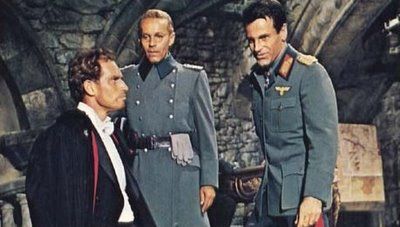
In the annals of semi-classic Hollywood, there are bound to be undiscovered gems, and I’m glad to say I found one, a World War II thriller worthy of being mentioned in the same breath as The Great Escape. Counterpoint begins on the front lines of the European theater, where a USO symphony orchestra plays for the troops only to have their performance cut short by the advancing German army. Quickly captured by the Nazis, the orchestra’s director Lionel Evans (Charlton Heston) demands they be released, but the Germans have orders to kill any and all prisoners. The only thing that saves them is the cultured admiration of the Nazi General Schiller (Maximilian Schell), who wants a concert and offers no guarantees of what is to follow it.

Heston and Schell make an outstanding pair of rivals, both self-absorbed and confident and used to getting their own way. Evans’ personality is summed up by an early line to his orchestra: “Each one of you will be responsible for your instruments, your music, and yourselves, in that order of importance.” Only two members of the seventy-member orchestra are actual characters (Leslie Nielsen, Kathryn Hays), but they and the rest know Evans’ ego all too well, and when he refuses to give in to General Schiller’s demands, they assume he’s satisfying his own opinions at their expense. Below the surface, however, he does care for his people and tries to stall the shooting squad that awaits them once the concert hall goes silent. Opposite Heston, Schell has a grinning, scheming charisma, looking perfectly at ease as he threatens his “guests”, like a precursor of Hans Landa in Inglourious Basterds. His treatment of an antique chair implies that he cares little for art, yet he’s a firm admirer of Evans and trades sharp-witted barbs with him to either convince or coerce him into submission. With one of his underlings clamoring for the prisoners’ blood, Schiller wants his concert before the war must resume.

I’m honestly surprised that Counterpoint isn’t a better-known film. The Nazis’ periodic acts of aggression keep the tension high, and close calls and narrow escapes are juxtaposed with the grandeur of the Los Angeles Philharmonic playing Tchaikovsky, Brahms, and Wagner. The climax even kept me guessing right up to the end. It’s not necessarily an award magnet that got spurned, but it’s an excellent and thoroughly underrated film that deserves far more recognition.

Best line: (Schiller) “To paraphrase Napoleon, morality is on the side of the heaviest artillery.”   (Evans) “Whatever happened to Napoleon?”


Rank: List-Worthy


© 2016 S. G. Liput
386 Followers and Counting


VC Pick: The Ghost and Mrs. Muir (1947)

17 Sunday Apr 2016

Posted by sgliput in Movies, NaPoWriMo, Poetry, Reviews, Writing

≈ 14 Comments

Tags

Classics, Drama, Fantasy, Romance


(Today’s NaPoWriMo prompt suggested using at least ten words from a specialty dictionary. In honor of Rex Harrison’s ghostly captain, I chose nautical terms, many of which were used in the film.)


A seaman in the truest sense is ne’er content on land,
And I have lived a life of which a captain may be proud:
Kept my ship in Bristol fashion,
Kept my crew content with rations,
Kept alert for mares’ tails warning tempests to withstand.
Yet now I wish, my beard more ashen,
That I’d found a second passion,
Plucking me a darling from the vast landlubber crowd.

I don’t mean some brief harbor love, although I’ve had a few;
I mean the kind worth waiting for through months before the mast.
I’d hoist the anchor eagerly
To reunite with such as she
And boast from stern to scuttlebutt to share a love so true.
The ship may list from weather to lee
And on her beam ends she may be,
But I’d have stronger cause to live and hold the tiller fast.

A lover in the truest sense is ne’er content at sea
But charts and stays the swiftest course from ocean unto wife.
When in the offing I appeared,
She’d stand upon a headland, cheered
And counting seconds till we both could reach the nearest quay.
I wish in such a course I’d steered
Before grey crept into my beard,
But maybe love can find a seaman even after life.
________________

MPAA rating: Not Rated (might as well be G)

It’s been a while since my trusty Viewing Companion (a.k.a. VC) got to choose a movie, and The Ghost and Mrs. Muir is one of her favorite romances. I’ve seen it a few times before, and for some reason, its full appeal never hit me until this latest viewing.

Gene Tierney plays the widowed Mrs. Lucy Muir, who moves with her daughter (Natalie Wood) and maid (Edna Best) to a large house by the English seaside, which she comes to realize is haunted by the deceased Captain Gregg (Rex Harrison). After a halfhearted attempt to scare her off, Gregg admires her spunk enough to let her stay, and the two of them allow their testily heartfelt conversations to bloom into unadmitted love. The captain’s blustery manner complements Mrs. Muir’s obstinance, and while she cares for the house they both love, he acts as her friend, security system, and inspiration to write a money-making memoir. Of course, romance can be strained between flesh and blood and spirit, and their relationship is soon threatened by the suavely courting Miles Fairley (George Sanders, known as the deep voice of Shere Khan in 1967’s The Jungle Book), who might be more seductive if he didn’t have a creepy disregard for personal space.

Both Tierney and Harrison are at the top of their games here, with Harrison in particular exceeding all but his My Fair Lady role in bringing to life the gruffly affectionate captain (whose coarse sailor language never extends beyond “blasted”). One scene in which he remains invisible to Lucy’s unwelcome in-laws seems to anticipate the similar dynamic between Sam and the holographic Al in Quantum Leap, while the tear-jerking final scenes match the best romantic endings. I also find it interesting to note that The Ghost and Mrs. Muir was turned into a 1968 sitcom, in which the ghost was played by Edward Mulhare, who also took over Harrison’s role of Professor Henry Higgins in My Fair Lady on Broadway.

Sometimes it takes several viewings to help one fully appreciate a film, and The Ghost and Mrs. Muir deserves such appreciation and its 100% Rotten Tomatoes score. It’s a well-scripted, non-physical romance of the best kind, managing to be mildly spooky, delightfully charming, or tenderly bittersweet when it needs to be. It may not make my VC cry anymore, but it arouses the same emotions (minus the tears) in both of us.

Best line: (Lucy Muir) “You can be much more alone with other people than you are by yourself, even if it’s people you love.”


Rank: List-Worthy


© 2016 S. G. Liput

381 Followers and Counting


← Older posts
Newer posts →

Recent Posts

  • We Didn’t Start 2025 (Recap)
  • NaPoWriMo 2025 Recap (Finally)
  • Sonic the Hedgehog 3 (2024)
  • It Happened One Night (1934)
  • Spellbound (2024)

Recent Comments

associatesofshellymann's avatarassociatesofshellyma… on My Top Twelve La La La So…
Kit's avatarKit Nichols on Bonnie and Clyde (1967)
lifelessons's avatarlifelessons on Look Back (2024)
Carol Jackson's avatarCarol Jackson on The Thief of Bagdad (1940…
Stephen's avatarStephen on Love Story (1970)

Archives

  • January 2026
  • December 2025
  • May 2025
  • April 2025
  • March 2025
  • February 2025
  • January 2025
  • December 2024
  • May 2024
  • April 2024
  • March 2024
  • February 2024
  • January 2024
  • December 2023
  • November 2023
  • October 2023
  • September 2023
  • July 2023
  • June 2023
  • May 2023
  • April 2023
  • March 2023
  • February 2023
  • January 2023
  • December 2022
  • November 2022
  • October 2022
  • September 2022
  • August 2022
  • July 2022
  • June 2022
  • May 2022
  • April 2022
  • March 2022
  • February 2022
  • January 2022
  • December 2021
  • November 2021
  • October 2021
  • September 2021
  • August 2021
  • July 2021
  • June 2021
  • May 2021
  • April 2021
  • March 2021
  • February 2021
  • January 2021
  • December 2020
  • November 2020
  • October 2020
  • September 2020
  • August 2020
  • July 2020
  • June 2020
  • May 2020
  • April 2020
  • March 2020
  • February 2020
  • January 2020
  • December 2019
  • November 2019
  • October 2019
  • September 2019
  • August 2019
  • July 2019
  • June 2019
  • May 2019
  • April 2019
  • March 2019
  • February 2019
  • January 2019
  • December 2018
  • November 2018
  • October 2018
  • September 2018
  • August 2018
  • July 2018
  • June 2018
  • May 2018
  • April 2018
  • March 2018
  • February 2018
  • January 2018
  • December 2017
  • November 2017
  • October 2017
  • September 2017
  • August 2017
  • July 2017
  • June 2017
  • May 2017
  • April 2017
  • March 2017
  • February 2017
  • January 2017
  • December 2016
  • November 2016
  • October 2016
  • September 2016
  • August 2016
  • July 2016
  • June 2016
  • May 2016
  • April 2016
  • March 2016
  • February 2016
  • January 2016
  • December 2015
  • November 2015
  • October 2015
  • September 2015
  • August 2015
  • July 2015
  • June 2015
  • May 2015
  • April 2015
  • March 2015
  • February 2015
  • January 2015
  • December 2014
  • November 2014
  • October 2014
  • September 2014
  • August 2014
  • July 2014
  • June 2014
  • May 2014
  • April 2014
  • March 2014
  • February 2014
  • January 2014
  • December 2013

Categories

  • Blindspot
  • Blogathon
  • Christian
  • Movies
  • Music
  • NaPoWriMo
  • Poetry
  • Reviews
  • TV
  • Writing

Meta

  • Create account
  • Log in
  • Entries feed
  • Comments feed
  • WordPress.com

Recent Posts

  • We Didn’t Start 2025 (Recap)
  • NaPoWriMo 2025 Recap (Finally)
  • Sonic the Hedgehog 3 (2024)
  • It Happened One Night (1934)
  • Spellbound (2024)

Recent Comments

associatesofshellymann's avatarassociatesofshellyma… on My Top Twelve La La La So…
Kit's avatarKit Nichols on Bonnie and Clyde (1967)
lifelessons's avatarlifelessons on Look Back (2024)
Carol Jackson's avatarCarol Jackson on The Thief of Bagdad (1940…
Stephen's avatarStephen on Love Story (1970)

Archives

  • January 2026
  • December 2025
  • May 2025
  • April 2025
  • March 2025
  • February 2025
  • January 2025
  • December 2024
  • May 2024
  • April 2024
  • March 2024
  • February 2024
  • January 2024
  • December 2023
  • November 2023
  • October 2023
  • September 2023
  • July 2023
  • June 2023
  • May 2023
  • April 2023
  • March 2023
  • February 2023
  • January 2023
  • December 2022
  • November 2022
  • October 2022
  • September 2022
  • August 2022
  • July 2022
  • June 2022
  • May 2022
  • April 2022
  • March 2022
  • February 2022
  • January 2022
  • December 2021
  • November 2021
  • October 2021
  • September 2021
  • August 2021
  • July 2021
  • June 2021
  • May 2021
  • April 2021
  • March 2021
  • February 2021
  • January 2021
  • December 2020
  • November 2020
  • October 2020
  • September 2020
  • August 2020
  • July 2020
  • June 2020
  • May 2020
  • April 2020
  • March 2020
  • February 2020
  • January 2020
  • December 2019
  • November 2019
  • October 2019
  • September 2019
  • August 2019
  • July 2019
  • June 2019
  • May 2019
  • April 2019
  • March 2019
  • February 2019
  • January 2019
  • December 2018
  • November 2018
  • October 2018
  • September 2018
  • August 2018
  • July 2018
  • June 2018
  • May 2018
  • April 2018
  • March 2018
  • February 2018
  • January 2018
  • December 2017
  • November 2017
  • October 2017
  • September 2017
  • August 2017
  • July 2017
  • June 2017
  • May 2017
  • April 2017
  • March 2017
  • February 2017
  • January 2017
  • December 2016
  • November 2016
  • October 2016
  • September 2016
  • August 2016
  • July 2016
  • June 2016
  • May 2016
  • April 2016
  • March 2016
  • February 2016
  • January 2016
  • December 2015
  • November 2015
  • October 2015
  • September 2015
  • August 2015
  • July 2015
  • June 2015
  • May 2015
  • April 2015
  • March 2015
  • February 2015
  • January 2015
  • December 2014
  • November 2014
  • October 2014
  • September 2014
  • August 2014
  • July 2014
  • June 2014
  • May 2014
  • April 2014
  • March 2014
  • February 2014
  • January 2014
  • December 2013

Categories

  • Blindspot
  • Blogathon
  • Christian
  • Movies
  • Music
  • NaPoWriMo
  • Poetry
  • Reviews
  • TV
  • Writing

Meta

  • Create account
  • Log in
  • Entries feed
  • Comments feed
  • WordPress.com

Blog at WordPress.com.

Is this your new site? Log in to activate admin features and dismiss this message
Log In
  • Subscribe Subscribed
    • Rhyme and Reason
    • Join 814 other subscribers
    • Already have a WordPress.com account? Log in now.
    • Rhyme and Reason
    • Subscribe Subscribed
    • Sign up
    • Log in
    • Report this content
    • View site in Reader
    • Manage subscriptions
    • Collapse this bar