
• Home
  • About Me
  • The List
  • THE LIST (2016 Update)
  • THE LIST (2017 Update)
  • THE LIST (2018 Update)
  • THE LIST (2019 Update)
  • THE LIST (2020 Update)
  • THE LIST (2021 Update)
  • THE LIST (2022 Update)
  • Top Twelves and More
  • The End Credits Song Hall of Fame

Rhyme and Reason

~ Poetry Meets Film Reviews

Rhyme and Reason

Tag Archives: Classics

In the Heat of the Night (1967)

03 Thursday Sep 2015

Posted by sgliput in Movies, Poetry, Reviews, Writing

≈ 6 Comments

Tags

Classics, Drama, Mystery

In the heat of the night, there is murder;
In the heat of the night, there is crime.
There is prejudice pointing the critical finger
And a murderer biding his time.

One must see where his biases blind him;
One must see where his aptitudes end.
If another can help, shouldn’t one get behind him,
Even if he’s more ally than friend?

There are many who won’t understand it;
There are many who’ll say it’s not right,
But stretching convention may help to expand it,
And pay off in the heat of the night.
__________________

Rating: G (perhaps PG would be better)

Here’s another Oscar winner I can cross off my list of classics yet unseen. In a strong year with films like Guess Who’s Coming to Dinner and Cool Hand Luke, I was interested to see what made this mystery drama so much more worthy of Best Picture and Best Actor (for Rod Steiger). While the film itself is an excellent police drama, it’s clear that it was the right film released at the right time, and even if it ruffled some contemporaries’ feathers, it made history by doing so.

For starters, a police patrol car winds through the small Southern town of Sparta, passing some of the key players, only to stumble upon the dead body of the richest man in town. While Steiger’s Chief Bill Gillespie chews his bubblegum vehemently, a black man waiting for a train is arrested on a groundless suspicion and reveals himself to be Officer Virgil Tibbs from Philadelphia (Sidney Poitier). Now Tibbs and Gillespie must collaborate to solve the crime.

While the setup seems simple enough and many films since have forced black and white characters to work together, not many carry the tension of these two men who clearly hate their present situation. Gillespie wants only to get Tibbs out of town, but he knows this case is beyond him and that he needs the other’s expertise as a forensics specialist. Tibbs likewise cooperates only under orders, but eventually his sense of pride and responsibility drives him to uncover the truth. Gillespie would gladly condemn the first suspect, and Tibbs isn’t infallible either, but the two of them complement each other in ways they don’t fully recognize at the time.

The period and place turn out to be the most challenging aspects, since Tibbs’s race angers nearly everyone in town as he pokes around for the truth. He earns some respect for his deductions, but whenever someone acts hostile or refuses to cooperate, we’re never sure if they’re acting guilty or simply expressing their racism. The film’s greatest and most famous scene is the infamous slap, in which Tibbs gives as well as he gets and leaves everyone shocked. To be honest, I wasn’t aware of the scene and was equally surprised, considering the when and where the film is set. Considering this was the time of Martin Luther King, Jr., who was killed less than a year after its release, this scene really is a brilliant microcosm of the civil rights movement; Tibbs remains calm as he questions the suspect, but when he is struck, he returns in kind, as any equal man would. I doubt anyone could have pulled it off as effectively as Sidney Poitier, and I thought he deserved the Oscar more than Steiger. (Seriously, Poitier had this role, Guess Who’s Coming to Dinner, and To Sir, with Love [my favorite of the three] all in the same year, but didn’t get one Oscar nomination?)

As a mystery, In the Heat of the Night takes its time with the reveal, employing subtle foreshadowing, though the timeline of events on the fateful night could have been better explained. Ultimately, this is a film about respect, hard-won respect between two outsiders who shouldn’t have judged each other too quickly. For a film tackling difficult issues like race and abortion, In the Heat of the Night is both a hard-hitting product of its time and a dual character study that is still relevant today.

Best line: (Virgil) “They call me MISTER Tibbs!”

Rank: List-Worthy

© 2015 S. G. Liput

337 Followers and Counting
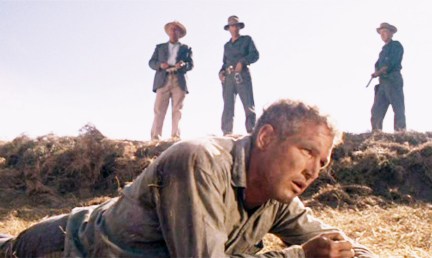
Cool Hand Luke (1967)

03 Friday Jul 2015

Posted by sgliput in Movies, Poetry, Reviews, Writing

≈ 7 Comments

Tags

Classics, Drama

Welcome to the chain gang, Luke,
Where slightest back talk earns rebuke.
Forget your crime was just a fluke.
You’re here to pay your debt.

You’ll learn the rules at any rate,
For you will quickly learn your fate
If “failure to communicate”
Remains a running threat.
_________________

Rating: PG

Most of the films I’ve seen were released since the 1970s, and while I love classics like Gone with the Wind and Miracle on 34th Street, there are still quite a few “classic” films that I have yet to see. One of these movies that critics and the AFI love to laud is Cool Hand Luke, a film that, before now, was only a name and a famous quote to me. Now I have my own opinion.

Seeing this star-making role for Paul Newman was fascinating in many ways, particularly in how this chain gang tale influenced other prison films like The Shawshank Redemption (betting on new arrivals, escape attempts), Holes (prison buddy nicknames, escape attempts), and even Toy Story 3 (the famous box speech). A scene involving paving a road brought to mind Bessie from Cars and made me wonder if that’s why Pixar cast Paul Newman in that film. The story of Luke Jackson’s imprisonment is a worth-while one, featuring all the Oscar-worthy acting and tenacious style that attracts critical praise and a 100% score on Rotten Tomatoes. Newman, in particular, has some moments of phenomenal acting, and I thought he deserved an Oscar more than George Kennedy (who won Best Supporting Actor) as his rival-turned-friend Dragline. The work camp includes quite a few recognizable faces as well, including Strother Martin (the horse dealer in True Grit), Ralph Waite (Pa from The Waltons), Wayne Rogers (TV’s M*A*S*H), Harry Dean Stanton (the first victim in Alien), and Dennis Hopper (Speed, Hoosiers). It’s a well-made film, but as with One Flew over the Cuckoo’s Nest, I take issue with the way its message is conveyed.

Basically, what Cool Hand Luke reminds me of is a less uplifting version of The Shawshank Redemption, but fused with the anti-establishment theme of Cuckoo’s Nest. Luke himself is an anti-hero who’s tamer than R. P. McMurphy but still problematic. Instead of being rebellious for the sake of fun or feeling free, he’s ultimately rather shallow and just seems to be masochistic and stupid. A drunken mistake lands him in prison, and a boxing match with later friend Dragline proves Luke’s capacity for his own suffering, with no clear motivation. Later on, that suffering is far less willing, but Luke still brings it on himself. Who but an idiot would try to escape with less than a year of his sentence to go, knowing it would add on more? And it isn’t as if Luke’s time there was insufferable. Everyone could still smoke and drink and gamble (unrealistic for jail time), and aside from an early power play, the guards aren’t too cruel until Luke gives them reason to be. Thus, the impetus for Luke’s rebellion just doesn’t make sense.

On top of that, there are several instances of religious symbolism drawing a comparison between Luke and Jesus, though their only similarity is that both their punishments were overly severe. I like, even admire, character parallels to Christ, but when they include no sign of sacrifice, they fall flat, as in this case. To his fellow inmates, he becomes a hero, but only because he’s willing to do things they don’t have the backbone for or, better put, things they have the common sense not to do. He talks to God but not with any reverence, more like Robert Green Ingersoll challenging the “old man” to prove He’s there. The Christian comparison is sometimes rather explicit, but serves no purpose due to Luke being nothing like Jesus: Luke doesn’t help his fellow prisoners in any way (aside from winning Dragline a bet), he isn’t innocent, and his mother (Jo Van Fleet) ain’t no Virgin Mary. Therefore, why make the comparison?

Again, I must point to Shawshank as the shining example of how to do this anti-establishment freedom theme right. It’s always best when the good guy is innocent and the bad guy is undoubtedly evil. (POW films usually succeed too, since the roles of good and bad typically conform to who won or lost the war.) I realize not every film can have this setup, but those that don’t just don’t work, at least for me. As I said, this is a good film, one worth watching and preserving, but other films have built on its themes far more persuasively. Critics can praise the character of Luke, but when an iconic role is dominated by nothing more than a “because I can” attitude, I’m unsure why its faults aren’t more recognized.

Best line: (both the Captain and Luke) “What we’ve got here is failure to communicate.”

Rank: Honorable Mention

© 2015 S. G. Liput

324 Followers and Counting

#4: It’s a Wonderful Life (1946)

09 Monday Feb 2015

Posted by sgliput in Movies, Poetry, Reviews, Writing

≈ 3 Comments

Tags

Christmas, Classics, Drama, Family, Fantasy

George Bailey lives in Bedford Falls
But does not wish to stay.
“This crummy little town” just palls
Against lands far away.
 
His father barely keeps afloat
The ol’ Building and Loan,
Which causes George to miss his boat,
Or simply to postpone.
 
Young Mary Hatch has always had
A crush on George; the two
Soon hit it off, and Mary’s glad
That wishes do come true.
 
When George’s plans are shot once more
Because of the depression,
His business doesn’t close its door,
Through Mary’s intercession.
 
For years in little Bedford Falls,
George serves the friendly poor,
While stopping greedy Potter’s calls
To yield what George stands for.
 
But then one day, some carelessness
Misplaces needed cash,
And desperation’s stressful press
Tempts George to make a splash.
 
An angel staves off suicide,
And Clarence tries to warn
By giving George a glimpse untried
Of if he’d not been born.
 
This other world without George Bailey
Is dark and forlorn;
He sees the difference he made daily
Since he had been born.
 
He begs his life back, no more dull,
And finds to his delight
The life he sees is wonderful
And friends that aid his plight.
________________
 

My mom and I share my #1 film, but my dad’s personal favorite at least made it to my #4. My highest black-and-white film, It’s a Wonderful Life stands out as Frank Capra’s best film, sentimental in the best sense of the word, full of moments that inevitably bring my dad to tears. My mom loves it too, having first seen it after learning it was Roger Ebert’s favorite film back in the 80s. Though not successful upon release, it has grown in esteem over the years to become one of those perennial Christmas traditions, a reminder of all that can be good in this world.

In addition to a splendid screenplay, the casting is excellent. Jimmy Stewart is the ideal everyman, whether as a decent Joe Schmo in a world of dirty politics or a selfless son/brother/husband/father that changes his town in ways he never could have imagined. Here his acting talent is at its most diverse, evoking a wide range of deeply felt emotions, from disappointment to helpless despair to rebounding joy that tugs effortlessly on every viewer’s heartstrings. Other examples of exceptional casting include a glowing Donna Reed as Mary Bailey, Thomas Mitchell as forgetful Uncle Billy, child-like Henry Travers as guardian angel Clarence Odbody, and Lionel Barrymore as Mr. Potter, an utterly despicable villain in a town of otherwise pleasant folk.

Watching the film now, after so many prior viewings, it’s hard to believe that George Bailey could consider himself a failure, after saving a couple of lives and personally presiding over happy homecomings (most people don’t even do that). Yet the microscope of anxiety leads him to cruel panic, and a series of hardships, one after the other, plausibly drives him to consider suicide. While the film implies that guardian angels are deceased humans (which isn’t true), the intervention of Clarence is more charming and divinely sent than, say, the ghosts in A Christmas Carol. In trying to convince George of his own worth, the film serves as encouragement for its audience. Who hasn’t felt like a failure at some point in his/her life? Who hasn’t wondered if it was all for naught? Yet, like the tapestry argument about how focusing on one thread does not comprehend the full pattern, we never know how and how often our lives touch others’. By now, the interconnection of lives has become a well-worn lesson, from Liberty Mutual commercials to countless films, but It’s a Wonderful Life does it best, giving a full sense of just how essential one man can be to the happiness of an entire town.

My VC and I had a brief debate over whether the film could be considered a “meet-‘em-and-move-on” movie. I at first thought so because of the many people with whom George interacts throughout his life and the infinitely feel-good reunion of an ending. Yet she pointed out that, even if George doesn’t fully appreciate all his friends until the end, nobody really moves on. It all takes place in the same quiet little New York town, a place George at first views as a cage but, like nostalgic viewers, eventually comes to appreciate it as his home. (By the way, the entire town of Bedford Falls was one long outdoor set.) Thus, while It’s a Wonderful Life isn’t technically a “meet-‘em-and-move-on,” it does bear certain similarities, especially by the jubilant end. (Again by the way, as wonderful as it is for everyone in town to donate to George, it probably wasn’t enough to make up for the missing $8,000; it really all came down to his friendship with wealthy Sam Wainwright. Hee-haw!)

Though his films were often derided as “Capra-corn,” Frank Capra was certainly one of the great early Hollywood directors, simply choosing to focus on the good, the charming, and the uplifting rather than the more cynical stuff some critics prefer. His personal favorite of his films, It’s a Wonderful Life exemplifies simple, feel-good messages in an entertaining package sure to break and warm the heart.

Best line: (Clarence) “Strange, isn’t it? Each man’s life touches so many other lives. When he isn’t around, he leaves an awful hole, doesn’t he?”

 
Rank: 60 out of 60
 

© 2015 S. G. Liput

284 Followers and Counting

#5: The Sound of Music (1965)

06 Friday Feb 2015

Posted by sgliput in Movies, Poetry, Reviews, Writing

≈ 1 Comment

Tags

Classics, Drama, Family, Musical, Romance

(Best sung to “My Favorite Things”)
 
Austria’s hills hold a thrill for Maria;
Her fellow nuns simply have no idea
Just how to manage this angel of stress,
So she’s sent off as a new governess.
 
The children of Captain von Trapp, lucky seven,
Are quite a handful and no seventh heaven.
Though Captain formally keeps them in line,
Governesses find them less than benign.
 
Fraulein Maria is warm and kindhearted,
And soon her musical love is imparted.
Captain’s away so the children will play,
Learning to sing in the happiest way.
 
When the day ends,
Captain is mad,
But the children sing.
Reminded of music, he’s suddenly glad,
And soon they have him crooning.
 
Baroness Schraeder, whom Captain is dating,
Causes Maria to leave just by stating
That he’s in love with Maria, a fact
That brings her back in the next-to-last act.
 
After Maria and Captain are married,
Problems arise from the views he has carried.
Told by the Nazis that he’s to report,
Captain realizes that their time is short.
 
Leaving the country to keep from conforming,
They buy some time by that evening performing.
As they escape to the convent nearby,
Nazis close in to prevent their goodbye.
 
To the mountains,
The von Trapps flee
Into Switzerland.
Barely escaping, the family now free
Continue through vistas grand.
___________________
 

The musical genre is one of my favorites, presumably because I enjoy music itself so much. I love how stories can be told succinctly through song, and the music of whatever I watch typically gets stuck in my head for some time afterward. The most recent favorite I found is a 2009 musical of The Count of Monte Cristo (hasn’t been filmed yet); before that, it was Frozen; before that, the discovery of Les Miserables. Yet as fun as it is to unearth exceptional new musicals, I always return to the greatest of them all: The Sound of Music.

After her Oscar-winning performance as Mary Poppins the previous year, Julie Andrews outdid herself as beloved nun-turned-governess-turned-wife Maria. She has both the voice and the charisma to make Maria genuinely endearing even while everyone else grouses about her. I particularly liked how the life of a nun was not derided as less worthy than married life but simply not for her, a fact that the Mother Superior recognized before Maria. On the opposite end of the spectrum, Christopher Plummer found his most famous role as Captain Georg von Trapp, the icy father who just needs a headache of a governess to reawaken his love of music and his own children.

I will admit that I find many of Hollywood’s Golden Age musicals rather boring, particularly straight dramatic adaptations like West Side Story, but The Sound of Music sidesteps that concern with its classic Rodgers and Hammerstein soundtrack, peppered with much humor and delightful character moments. Whenever it threatens to drag, a well-spaced musical number livens things up, or we get a laugh from the endearingly candid Maria or the “charming sponge” Max Detweiler (Richard Haydn). By the end, “fuzzy camera” romance gives way to a nail-biting thriller finale that shouldn’t leave anyone bored.

Along the way are stunning mountain vistas and some of the finest show tunes this side of Salzburg. Nowhere are these so well-combined as in “Do-Re-Mi,” a song about singing that brims with joie de vivre and ends on an unrivalled high note that always gives my VC goosebumps. The rest of the songs are equally marvelous, with not a dud in the bunch. “My Favorite Things” is always a joy, and the puppeteered “The Lonely Goatherd” is possibly the most exuberant and fun musical number that Hollywood ever offered. Even the slower songs range from intimate to inspirational and are the kind of hummable music that effortlessly ingrains itself into the listener’s ears and heart.

My family has always enjoyed The Sound of Music. My mom was Gretl’s age when it came out, and Maria’s wedding dress and veil stuck in her mind to influence her own wedding train. She even enjoyed the recent live television version with Carrie Underwood, a production that couldn’t compare with the original in any way but was a respectable effort nonetheless. Even if the film is not historically accurate about the real von Trapp family and thus none too popular in Austria, The Sound of Music is my favorite musical and Julie Andrews’ finest hour, a feast for the ears from start to finish.

Best lines: (Captain von Trapp) “It’s the dress. You’ll have to put on another one before you meet the children.”   (Maria) “But I don’t have another one. When we entered the abbey, our worldly clothes were given to the poor.”   (Captain) “What about this one?”   (Maria) “The poor didn’t want this one.”

(“Uncle” Max) “I like rich people. I like the way they live. I like the way I live when I’m with them.”

 
Rank: 60 out of 60
 

© 2015 S. G. Liput

284 Followers and Counting

#27: Ben-Hur (1959)

07 Wednesday Jan 2015

Posted by sgliput in Movies, Poetry, Reviews, Writing

≈ 1 Comment

Tags

Action, Biblical, Classics, Drama

Beneath the mighty Roman yoke,
The Jewish people still invoke
The promise of a Christ to come
Who’ll save them from the Romans’ thumb,
And many eagerly provoke.
 
Returning to Jerusalem,
Messala comes to manage them
And reconnects with his old friend,
With Judah Ben-Hur to extend
A jilted offer to condemn.
 
Their friendship strained by Hur’s dissent,
It’s worsened by an accident.
While Judah’s made a galley slave,
His mother and his sister brave
Long years in prison and torment.
 
A naval battle frees Ben-Hur
By making him a rescuer,
And he becomes a Roman son,
Remembering the evil done
And vengeance promised to occur.
 
A skilled and lauded charioteer,
He goes back home to reappear
To cold Messala and demand
His family’s freedom close at hand,
But they are lepers, sparking fear.
 
Believing they are dead, no trace,
Ben-Hur competes within a race,
A chariot battle at high speeds.
Against Messala, he succeeds;
The fallen grieves him to his face.
 
He finds his mother and his sister,
Forced to live apart and fester,
And through mourning, he then tries
To seek out Jesus ere one dies,
At the urge of lovely Esther.
 
But the prophet is on trial,
Soon to die in savage style.
A kindness for which Hur once yearned
Is unexpectedly returned,
And healing springs from death worthwhile.
__________________
 

Hollywood still makes epics, even the Biblical kind it so enjoys messing up, yet all of the special effects and big names can’t compare with some of the best of yesteryear, especially 1959’s Ben-Hur, the first of only three films to win eleven Academy Awards. Indeed, this film that garnered one of the greatest Oscar sweeps of all time deserved every one; the sets, the scope, the emotions, the acting, the moral message are all conjured so impressively from the pages of Lew Wallace’s bestseller that no film has bested its number of Oscars, only equaled.

Coming only three years after Charlton Heston’s other Biblical epic The Ten Commandments, Ben-Hur weaves a story of lost friendship, vengeance, and redemption alongside brief but potent glimpses from the life of Jesus, whose face is shrewdly hidden, allowing the viewer to imagine his appearance as they will. Heston won Best Actor for his title role, which may not be as imposing as his turn as Moses but carries far more emotion. Unlike Cecil B. DeMille’s Exodus story, vain histrionics are kept to a minimum in favor of excellent dramatic acting from Jack Hawkins as Quintus Arrius, Stephen Boyd as Messala, Haya Harareet as Esther, and Oscar winner Hugh Griffith as Sheikh Ilderim. While the film is most notable for its action scenes, the character moments are often powerful; the scenes of mercy between Judah and Jesus are quietly profound high points.

Even so, the film boasts some of the most thrilling scenes of Hollywood’s golden age, full of magnificent sets, a cast of thousands, and some brief but unusually violent images for 1959. The galley battle is a vivid turning point for the film, creating both a provident moment of grace and a memorably rare depiction of ancient naval warfare. Of course, the film’s most intense sequence is the famous chariot race, about nine minutes of action filmmaking at its finest. The upcoming Ben-Hur remake will no doubt rely on CGI for this part, but the original is all the more monumental for its reality and lack of computer enhancement.

I don’t watch Ben-Hur but once a year typically, mainly because of its exhaustive length (over 3½ hours), but it will always be a milestone of epic cinema.

Best line: (Quintus Arrius) “In His eagerness to save you, your God has also saved the Roman fleet.”

 
Rank: 58 out of 60
 

© 2015 S. G. Liput

278 Followers and Counting

#33: Oliver! (1968)

24 Wednesday Dec 2014

Posted by sgliput in Movies, Poetry, Reviews, Writing

≈ 4 Comments

Tags

Classics, Drama, Family, Musical

(Best sung to “Reviewing the Situation”)
 
Young Oliver Twist is a boy,
Orphanage-bound, just a boy,
Who one day attempts to step out and to beg for some more,
But all he receives from adults are insults and the door.
 
Then departing his situation,
He decides to make his way to London town,
Find his fortune and salvation,
And is welcomed gladly rather than put down.
He falls into the thieving crowd,
The drinking and deceiving crowd.
Old Fagin has been profiting
From all his boys’ pickpocketing.
Bill Sykes provides the bigger loot,
But Fagin fears the bigger brute.
Dear Oliver just tags along with them.
 
He’s caught by police for a crime,
But he’s released from the crime.
He is taken in by a rich man, his great-uncle in fact,
But Fagin and Bill will not risk the law he might attract.
 
They abduct him from his location,
And Bill’s girlfriend Nancy bears a guilty heart.
She tries risking Bill’s irritation
To return the boy before things fall apart.
Bill catches them before she can
And beats her, a remorseless man.
He knows police soon will arrive,
But they will not take Bill alive.
He takes the boy to see new heights,
But Bill’s undoing reunites
Young Oliver with happiness again.
_______________
 

As a lover of musicals, how could I not include one of the few to win the Best Picture Academy Award? I’ve enjoyed watching Oliver! since I was a kid, and I never tire of its alternately rousing and fun musical numbers and Onna White’s outstanding choreography, which was awarded a special Oscar as well. As an adaptation of a stage musical based on Dickens’s book Oliver Twist, the film hits all the right notes of the story while serving up memorable characters and some of my favorite stage songs.

Mark Lester is downright adorable as Oliver, and though his voice is weak (I’ve read he was actually dubbed by the musical director’s daughter), it captures his gentle fragility. Ron Moody originated the role of Fagin on stage, and he earned and deserved a Best Actor nomination for his sneaky yet strangely sympathetic performance. Jack Wild was also nominated for Best Supporting Actor for his role as the Artful Dodger; Harry Secombe is an excellent operatic Mr. Bumble; and Shani Wallis plays the lovely Nancy, emoting her inner conflict between doing the right thing for Oliver and submitting to her abusive man. Other adaptations have tried to make Bill Sikes intimidating, but Oliver Reed is the best, progressing from a stoic punk to a coldblooded murderer. Considering how fun most of the music is, the film’s climax is surprisingly tense (or maybe I’m just afraid of heights).

The Oscar- and Tony-winning score really is the best part. Because of it, Oliver! ranks among my VC’s top 20 movies; she once bought the soundtrack and the sheet music and even saw a dinner theater production. Most great musicals still have an occasional dud, but even the slower songs are excellent and further the story’s plot or emotional development. Some songs have the stage quality of being restricted to a single room, while others take full advantage of the space and freedom that musical cinema affords. The first song “Food, Glorious Food” begins the film on a somber high note, but the film’s grandeur truly begins with the sprawling welcome of “Consider Yourself,” which is a wonder of set design, choreography, and Oscar-winning direction. I always enjoy Fagin’s numbers, “You’ve Got to Pick a Pocket or Two” and “Reviewing the Situation,” while my VC is partial to Nancy’s, particularly “It’s a Fine Life” and the euphemistic “Oom-Pah-Pah.” My favorite, though, would have to be “Who Will Buy?” at the beginning of the second half, a gradually building, layered song which becomes another stunningly choreographed spectacle and which I’ve caught myself singing a few times.

One of the last great Golden Age musicals and the last G-rated Best Picture winner, Oliver! captures the unfair cruelty that was the point of Dickens’s novel, while balancing humor, tension, Oscar-worthy sets and costumes, and amazing music to create one of the finest musical adaptations.

Best line: (Oliver Twist) “Please, sir, may I have some … more?” (followed by Mr. Bumble’s) “More?!”

VC’s best line:  (a drunk Mr. Sowerberry, when Oliver’s cruel foster family have trapped him in a coffin) “Well, having a rest, Mr. Bumble?”  (Noah) “He’s sitting on Oliver.”  (Mr. Sowerberry) “Quite right, we must all sit on Oliver.”

  
Rank: 58 out of 60
 

© 2014 S. G. Liput

272 Followers and Counting

#37: Doctor Zhivago (1965)

19 Friday Dec 2014

Posted by sgliput in Movies, Poetry, Reviews, Writing

≈ 1 Comment

Tags

Classics, Drama, Romance

When Yuri Zhivago was orphaned still young,
The friendly Gromekos arrived and agreed
To take him in, care for, and raise him among
The wealthy of Moscow, a life guaranteed.
 
Becoming a poet and doctor, he grew
To love his stepsister, dear Tonya by name.
Meanwhile, a young woman out of his view
Is drawn from her innocence into deep shame.
 
Victor Komarovsky takes Lara to bed,
Which causes the girl to attempt execution.
Escaping from Moscow, she chooses to wed
Her loyal friend Pasha, who craves revolution.
 
The first great World War comes to ravage the land,
And doctoring Yuri meets Lara by fate.
The Bolsheviks see their best chances, as planned,
And war soon gives way to a Communist State.
 
His life back in Moscow has changed for the worse,
And scarcity reigns as starvation takes hold.
His half-brother Yevgraf suggests they traverse
The far western Urals, which are less controlled.
 
He meets Lara’s husband while on his way there,
A violent guerrilla now called Strelnikov.
His family soon settles, until an affair
With Lara splits Yuri’s attention and love.
 
He’s captured to serve with the army for years,
Before he returns home, his wife and son gone.
He hides out with Lara till Victor appears,
To take Lara for her own safety at dawn.
 
He wanders henceforth, without lover or wife,
And leaves this pained world in a pitiful way,
And yet his poems live on beyond his short life,
As does daughter Tonya and her gift to play.
_______________
 

I’m not much of a fan of David Lean’s epics; as critically lauded as they are, Lawrence of Arabia and The Bridge on the River Kwai simply don’t appeal to me. I find both overblown and often boring but for a few impressive action sequences.  Though both of them won Best Picture, I prefer his adaptation that was only nominated, Doctor Zhivago. Based on Boris Pasternak’s long novel set before, during, and after the Russian Revolution, Lean’s film bridges the gap between sweeping storytelling and intimate romance, allowing for credible human drama amid the epic coursing of history.

Omar Sharif is at his very best playing the title character, and my VC has mentioned (many times) how she finds him utterly attractive with his trademark mustache. Though he is a flawed protagonist and some of his sorrows are due to his own moral decline, his naïve desire to live and love without the weight of politics and war is entirely sympathetic. By the heartbreaking end, his life has become a definitive tragedy of how lives are swallowed by mankind’s most degrading ideologies. The same goes for his secret lover Lara, played with resilient beauty by Julie Christie; her desire for a simple life is undermined by her husband’s dedication to supposedly justified violence, and she is ultimately lost to everyone who loved or knew her. Supporting players are consistently masterful: the slimy allure of Rod Steiger’s Komarovsky, the stoic interest of Alec Guinness’s Yevgraf, the gentle faithfulness of Geraldine Chaplin’s Tonya (that’s Charlie Chaplin’s daughter), the wide-eyed apprehension of Rita Tushingham’s Tonya, the allegiance-turned-zealotry of Tom Courtenay’s Pasha/Strelnikov.

I haven’t read Pasternak’s novel, but my VC has and considers the film an improvement, better plotted and more restrained in objectionable content. The film doesn’t carry quite as many plot points as the book, such as Komarovsky’s involvement in Yuri’s father’s death, but it’s complex and extensive enough and manages to still focus on smaller details, such as a skeletal branch tapping on Yuri’s window after his mother’s funeral.

The lilting violins of Maurice Jarre’s effervescent score make Doctor Zhivago memorable to the ear, just as the scopious mountain cinematography does to the eye. (The 2002 miniseries has its good points as well, including closer adherence to the book in certain instances, but, as good as he and Keira Knightley are, Hans Matheson can’t compare with Sharif.) Though some critics accused it of glossing over history, the story is meant to be from the perspectives of Yuri and Lara. Their firsthand experiences of war, destitution, and desperation are vividly portrayed, even if the ambitions and nuances creating them are not spelled out in documentary fashion, though there’s some of that too. Despite (or due to) its length, Dr. Zhivago is a pillar of Russian literature, and its film version a tribute to what is personal and an exemplar of tragic, epic filmmaking.

Best line: (Yuri) “It seems you’ve burnt the wrong village.”  (Strelnikov) “They always say that, and what does it matter? A village betrays us, a village is burned. The point’s made.”  (Yuri) “Your point—their village.”

  
Rank: 58 out of 60
 

© 2014 S. G. Liput

270 Followers and Counting

#53: Lilies of the Field (1963)

01 Monday Dec 2014

Posted by sgliput in Movies, Poetry, Reviews, Writing

≈ 1 Comment

Tags

Classics, Drama

Homer Smith is passing through and needs a bit of water,
But Mother Maria sees him as the answer to her prayers.
The unsuspecting clay within the deft hands of the Potter,
He’ll build for them a chapel as she certainly declares.
 
Smith merely is a black man seeking payment for his work,
Repeatedly held up by Mother ere her blessing runs.
He’s glad to lend a helping hand and isn’t one to shirk,
But he has better things to do than aid a bunch of nuns.
 
Although Maria never thanks her irritated “slave,”
He halfway builds a wall until he lays their final stone.
Despite the urge to doubt and nearly losing whom God gave,
Maria’s prayers are answered by parishioners they’ve known.
 
As Homer’s chapel rises, he is filled with inner pride
At building something special with his own two humble hands.
The sisters are ecstatic at the church God did provide,
And Homer moves along, perhaps to where God’s will commands.
________________
 

Lilies of the Field is Sidney Poitier’s finest film, as evidenced by his becoming the first African-American man to win the Best Actor Oscar. A simple story of faith and hard work, Lilies of the Field depicts ecumenical fellowship, community rallying, and a memorable call-to-meetin’ gospel song that is nearly synonymous with the film itself.

There are many atypical film pairs—old and young (Up), hot shot and mad scientist (Back to the Future), black and Chinese (Rush Hour)—but an unusual dynamic is formed here between a black Baptist and a Catholic nun. Homer Smith/Schmidt is a hard-working traveler whose wish for payment becomes a desire to prove his value and consequence, while Mother Maria is a stubborn German matriarch whose faith in God alone is so strong that she neglects God’s chosen means. Both are admirable in their own way—Smith’s skill and diligence, Maria’s ascetic convictions—and both have their flaws—Smith’s impatience, Maria’s obstinate single-mindedness. Despite her asperity, Maria is never too overbearing, since Homer could have departed at any time, and ultimately her prayers are answered while Homer achieves a bit of unanticipated permanence that leaves him satisfied.

From the potentially creepy opening (with the nuns following Smith’s car), to a Tower-of-Babel moment in which he takes charge, to Smith’s eventual departure, the entire film feels like merely an extended stop on Smith’s wayward journey. Though he resists at first, his good-natured assistance with the nuns’ English lessons belies an eagerness to help. Nothing is said of him personally, where he came from or where he’s going, and his presence certainly seems heaven-sent. He’s quite human, prone to drink and doubt, yet he and the community at large fulfill the nuns’ every need in realistic ways that indicate an unseen Hand of benevolence, as reflected by the film’s title based on Matthew 6:28-33. After all, one need not be a saint to be used of God.

Though the talented Jerry Goldsmith provided the score, the film’s musical highlight is the hymn “Amen,” sung by the nuns and the song’s composer Jester Hairston, who provided the vocals for tone-deaf Poitier. It really is a joy to see Baptists and Catholics together belting out a rousing hymn of praise. It’s the high point of a true classic, one of my favorite black-and-white films.

Best line: (Homer Smith, after being served one egg) “That’s a Catholic breakfast, ain’t it?”

 
Rank: 57 out of 60
 

© 2014 S. G. Liput

262 Followers and Counting

#55: Mary Poppins (1964)

29 Saturday Nov 2014

Posted by sgliput in Movies, Poetry, Reviews, Writing

≈ 4 Comments

Tags

Classics, Comedy, Disney, Family, Fantasy, Musical

(Best sung to “Supercalifragilisticexpialidocious”)
 
Since nannies are commodities that rarely stick around,
George Banks decides to advertise, and ugly ones abound,
But then comes Mary Poppins, floating gently to the ground,
Poppins proves prodigiously the proper one’s been found.
 
She shows the kids to make a game
From every daily chore,
To jump into a chalky frame
For holidays galore,
 
To laugh their way into the air
With jubilant come-uppance
And note the woman in the square
Who sells bird seed for tuppance.
 
A visit to their father’s bank creates a sudden run,
And Mr. Banks’s temper scares his daughter and his son.
They flee to Bert the chimney sweep for roof-cavorting fun.
He suggests their father needs some help like everyone.
 
Mr. Banks is overwhelmed by miseries of late,
As if dear Mary Poppins came his life to desecrate,
But then he sees the comedy and joy most underrate,
And Mary Poppins leaves them in a more-than-happy state.
__________________
 

The height of Disney-esque whimsy, Mary Poppins is one of the most beloved family musicals of all time and lies within my VC’s top 20 films. Though she loves it a tad more than I, there’s no denying the fanciful joy of this adaptation of P. L. Travers’ literary nanny.

Julie Andrews won a Best Actress Oscar for her no-nonsense charm as Mary Poppins herself, and Dick Van Dyke matches her with his usual vigorous charisma, despite his affected British accent. The entire cast is wonderful, though if I had to find fault, I’d say that Karen Dotrice and Matthew Garber as Jane and Michael Banks don’t have much character aside from generic cuteness, though I suppose that allows for ease in audiences placing themselves in their shoes. (Trivia note: Most of those nannies gathered at the Banks home before Mary Poppins arrives were actually male stuntmen. No wonder they were ugly.)

The film’s greatest strength is its music, provided by the unrivalled Sherman Brothers, whose jolly tunes and clever lyrics are instant classics. Not every one is hummable, but “A Spoonful of Sugar,” “Let’s Go Fly a Kite,” and the Oscar-winning “Chim Chim Cheree” continue to reside in the mind of countless viewers. “I Love to Laugh” and Poppins’ bipolar Uncle Albert always earn a smile from my family, though my favorites would have to be “Jolly Holiday” and “Supercalifragilisticexpialidocious,” thanks to the expertly composited animation sequences that Travers herself so despised. “Step in Time” is one of the film’s many high points too, though more due to the rigorous choreography than the comparatively simple lyrics. Despite the film’s overall joyous appeal, “Feed the Birds” (with or without the words) somehow brings tears to my VC’s eyes every time.

After having seen Saving Mr. Banks, there were certain scenes on this latest viewing that I couldn’t help but recall that making-of drama, such as Mr. Banks’s lament over Mary Poppins’ frustrating influence, which supposedly mirrored the annoyance caused by Travers and her nitpicking. The 2013 film also deepened the sorrows of Mr. Banks, which I never fully understood as a kid. While Saving Mr. Banks surpasses Mary Poppins as far as dramatic narrative, there’s no replacing the sheer fun and inventiveness of the original.

Mary Poppins is not only Uncle Walt’s best live action film, but arguably his best during his lifetime. Possessing a childish delightfulness that nullifies criticism, it’s a film of true magic (and not just the cleverly creative effects), a magic every child should experience.

Best line: (Mary Poppins, reading her self-descriptive tape measure) “As I expected. ‘Mary Poppins, practically perfect in every way.’”

VC’s best line: (Bert) “Speakin’ o’ names, I know a man with a wooden leg named Smith.”  (Uncle Albert) “What’s the name of his other leg?”

 
Rank: 57 out of 60
 

© 2014 S. G. Liput

260 Followers and Counting

#66: Willy Wonka & the Chocolate Factory (1971)

18 Tuesday Nov 2014

Posted by sgliput in Movies, Poetry, Reviews, Writing

≈ 6 Comments

Tags

Classics, Comedy, Family, Fantasy, Musical

(Best sung to “I’ve Got a Golden Ticket”)
 
Charlie has little reason to
Hope for a bit of luck anew,
But then golden tickets, just a few,
Make their abrupt debut.
 
He dreams of a golden ticket,
Even as four other dreams come true.
 
Suddenly golden hopes arise;
Charlie receives a chance to see
Old Willy Wonka’s big surprise,
His chocolate factory.
 
Along with four other winners,
Charlie is shown wonders one can chew.
 
As they are led from room to room,
Four rotten brats near meet their doom,
And Charlie is the last one.
Even though Wonka tries him still,
Charlie’s sweet heart imparts goodwill,
And suddenly, the testing is done.
He finds that he’s won!
 
Though all the other children fell,
Charlie has proven he is right
For Wonka’s secrets him to tell,
To everyone’s delight.
 
Because of that golden ticket,
Charlie is fulfilled and flying high,
And Willy Wonka’s found the apple of his eye.
_____________
 

My earlier review of Tim Burton’s Charlie and the Chocolate Factory essentially stated that Burton gets nearly everything right, except Willy Wonka; the original Willy Wonka & the Chocolate Factory gets nearly everything right, including Willy Wonka. The classic children’s musical doesn’t have the visuals or the polished look of Burton’s remake, but it has the same wonky, daftly absurd combination of humor and heart that made Roald Dahl’s book such a success.

Though I actually prefer now Freddie Highmore’s Charlie, Peter Ostrum is still admirable as the lone good apple of the bunch, and his relationship with Jack Albertson’s Grandpa Joe is more familial and evident than in the remake, possibly due to the absence of Mr. Bucket. All of the children are appropriately detestable in different ways, with Julie Dawn Cole as Veruca Salt being the most insufferable, and their comeuppances are all the more satisfying for their impudence. Of course, the star of the picture (aside from Charlie) is Willy Wonka himself, and Gene Wilder is perfect as the titular candy maker, even though Dahl had preferred Spike Milligan for the role. Whereas Johnny Depp’s Wonka displayed peculiarities more disturbing than endearing, Wilder spouts classical quotations and jumps between languages effortlessly, playing the candy man as eccentric and only occasionally trending toward insane. Granted, that boat ride is downright creepy (a chicken’s head being cut off? really?), but the rest of Wonka’s antics have a fun weirdness which, as Charlie says, is not necessarily bad. Wilder captures that ideal gray area between sanity and insanity that a character like Willy Wonka requires (and that Johnny Depp couldn’t quite attain), though I would have liked some indication that the bratty kids were indeed all right, as the book and remake did.

Roald Dahl himself despised the film’s changes to his book, and though I agree that the “fizzy lifting drinks” part was unnecessary and detracted from Charlie’s natural goodness, I think that Willy Wonka & the Chocolate Factory still does his work justice (of course, purely from a reader’s standpoint). Various annoying habits are properly skewered, such as gum-chewing, gluttony, and television addictions, while Charlie’s decency is allowed to shine and be rewarded. The sheer imagination of Dahl’s book is brought to colorful life in the chocolate room sequence; who wouldn’t want to cavort through those edible fields? Though Dahl’s own songs from the book are omitted (and later utilized in Burton’s remake), Willy Wonka’s Oscar-nominated soundtrack is full of memorable ditties that live on from childhood, reaching high points with “I’ve Got a Golden Ticket” and “I Want It Now.”

Other films may have appealed to Dahl’s odd sensibilities more, such as Matilda, James and the Giant Peach, The Fantastic Mr. Fox, or Burton’s take on the Chocolate Factory, but none are quite as delectably appealing as this first Dahl film adaptation. Willy Wonka has only grown in popularity over the years, becoming somewhat of a cult film, and continues to be a scrumdiddlyumptious delight for young and old.

Best line: (Mr. Salt, boarding the Wonkatania) “Ladies first, and that means Veruca.”   (Grandpa Joe, to Charlie) “If she’s a lady, I’m a Vermicious Knid.”

 
Rank: 56 out of 60
 

© 2014 S. G. Liput

249 Followers and Counting

← Older posts
Newer posts →

Recent Posts

  • We Didn’t Start 2025 (Recap)
  • NaPoWriMo 2025 Recap (Finally)
  • Sonic the Hedgehog 3 (2024)
  • It Happened One Night (1934)
  • Spellbound (2024)

Recent Comments

associatesofshellymann's avatarassociatesofshellyma… on My Top Twelve La La La So…
Kit's avatarKit Nichols on Bonnie and Clyde (1967)
lifelessons's avatarlifelessons on Look Back (2024)
Carol Jackson's avatarCarol Jackson on The Thief of Bagdad (1940…
Stephen's avatarStephen on Love Story (1970)

Archives

  • January 2026
  • December 2025
  • May 2025
  • April 2025
  • March 2025
  • February 2025
  • January 2025
  • December 2024
  • May 2024
  • April 2024
  • March 2024
  • February 2024
  • January 2024
  • December 2023
  • November 2023
  • October 2023
  • September 2023
  • July 2023
  • June 2023
  • May 2023
  • April 2023
  • March 2023
  • February 2023
  • January 2023
  • December 2022
  • November 2022
  • October 2022
  • September 2022
  • August 2022
  • July 2022
  • June 2022
  • May 2022
  • April 2022
  • March 2022
  • February 2022
  • January 2022
  • December 2021
  • November 2021
  • October 2021
  • September 2021
  • August 2021
  • July 2021
  • June 2021
  • May 2021
  • April 2021
  • March 2021
  • February 2021
  • January 2021
  • December 2020
  • November 2020
  • October 2020
  • September 2020
  • August 2020
  • July 2020
  • June 2020
  • May 2020
  • April 2020
  • March 2020
  • February 2020
  • January 2020
  • December 2019
  • November 2019
  • October 2019
  • September 2019
  • August 2019
  • July 2019
  • June 2019
  • May 2019
  • April 2019
  • March 2019
  • February 2019
  • January 2019
  • December 2018
  • November 2018
  • October 2018
  • September 2018
  • August 2018
  • July 2018
  • June 2018
  • May 2018
  • April 2018
  • March 2018
  • February 2018
  • January 2018
  • December 2017
  • November 2017
  • October 2017
  • September 2017
  • August 2017
  • July 2017
  • June 2017
  • May 2017
  • April 2017
  • March 2017
  • February 2017
  • January 2017
  • December 2016
  • November 2016
  • October 2016
  • September 2016
  • August 2016
  • July 2016
  • June 2016
  • May 2016
  • April 2016
  • March 2016
  • February 2016
  • January 2016
  • December 2015
  • November 2015
  • October 2015
  • September 2015
  • August 2015
  • July 2015
  • June 2015
  • May 2015
  • April 2015
  • March 2015
  • February 2015
  • January 2015
  • December 2014
  • November 2014
  • October 2014
  • September 2014
  • August 2014
  • July 2014
  • June 2014
  • May 2014
  • April 2014
  • March 2014
  • February 2014
  • January 2014
  • December 2013

Categories

  • Blindspot
  • Blogathon
  • Christian
  • Movies
  • Music
  • NaPoWriMo
  • Poetry
  • Reviews
  • TV
  • Writing

Meta

  • Create account
  • Log in
  • Entries feed
  • Comments feed
  • WordPress.com

Recent Posts

  • We Didn’t Start 2025 (Recap)
  • NaPoWriMo 2025 Recap (Finally)
  • Sonic the Hedgehog 3 (2024)
  • It Happened One Night (1934)
  • Spellbound (2024)

Recent Comments

associatesofshellymann's avatarassociatesofshellyma… on My Top Twelve La La La So…
Kit's avatarKit Nichols on Bonnie and Clyde (1967)
lifelessons's avatarlifelessons on Look Back (2024)
Carol Jackson's avatarCarol Jackson on The Thief of Bagdad (1940…
Stephen's avatarStephen on Love Story (1970)

Archives

  • January 2026
  • December 2025
  • May 2025
  • April 2025
  • March 2025
  • February 2025
  • January 2025
  • December 2024
  • May 2024
  • April 2024
  • March 2024
  • February 2024
  • January 2024
  • December 2023
  • November 2023
  • October 2023
  • September 2023
  • July 2023
  • June 2023
  • May 2023
  • April 2023
  • March 2023
  • February 2023
  • January 2023
  • December 2022
  • November 2022
  • October 2022
  • September 2022
  • August 2022
  • July 2022
  • June 2022
  • May 2022
  • April 2022
  • March 2022
  • February 2022
  • January 2022
  • December 2021
  • November 2021
  • October 2021
  • September 2021
  • August 2021
  • July 2021
  • June 2021
  • May 2021
  • April 2021
  • March 2021
  • February 2021
  • January 2021
  • December 2020
  • November 2020
  • October 2020
  • September 2020
  • August 2020
  • July 2020
  • June 2020
  • May 2020
  • April 2020
  • March 2020
  • February 2020
  • January 2020
  • December 2019
  • November 2019
  • October 2019
  • September 2019
  • August 2019
  • July 2019
  • June 2019
  • May 2019
  • April 2019
  • March 2019
  • February 2019
  • January 2019
  • December 2018
  • November 2018
  • October 2018
  • September 2018
  • August 2018
  • July 2018
  • June 2018
  • May 2018
  • April 2018
  • March 2018
  • February 2018
  • January 2018
  • December 2017
  • November 2017
  • October 2017
  • September 2017
  • August 2017
  • July 2017
  • June 2017
  • May 2017
  • April 2017
  • March 2017
  • February 2017
  • January 2017
  • December 2016
  • November 2016
  • October 2016
  • September 2016
  • August 2016
  • July 2016
  • June 2016
  • May 2016
  • April 2016
  • March 2016
  • February 2016
  • January 2016
  • December 2015
  • November 2015
  • October 2015
  • September 2015
  • August 2015
  • July 2015
  • June 2015
  • May 2015
  • April 2015
  • March 2015
  • February 2015
  • January 2015
  • December 2014
  • November 2014
  • October 2014
  • September 2014
  • August 2014
  • July 2014
  • June 2014
  • May 2014
  • April 2014
  • March 2014
  • February 2014
  • January 2014
  • December 2013

Categories

  • Blindspot
  • Blogathon
  • Christian
  • Movies
  • Music
  • NaPoWriMo
  • Poetry
  • Reviews
  • TV
  • Writing

Meta

  • Create account
  • Log in
  • Entries feed
  • Comments feed
  • WordPress.com

Blog at WordPress.com.

Is this your new site? Log in to activate admin features and dismiss this message
Log In
  • Subscribe Subscribed
    • Rhyme and Reason
    • Join 814 other subscribers
    • Already have a WordPress.com account? Log in now.
    • Rhyme and Reason
    • Subscribe Subscribed
    • Sign up
    • Log in
    • Report this content
    • View site in Reader
    • Manage subscriptions
    • Collapse this bar