
• Home
  • About Me
  • The List
  • THE LIST (2016 Update)
  • THE LIST (2017 Update)
  • THE LIST (2018 Update)
  • THE LIST (2019 Update)
  • THE LIST (2020 Update)
  • THE LIST (2021 Update)
  • THE LIST (2022 Update)
  • Top Twelves and More
  • The End Credits Song Hall of Fame

Rhyme and Reason

~ Poetry Meets Film Reviews

Rhyme and Reason

Tag Archives: Drama

Being There (1979)

18 Sunday Oct 2015

Posted by sgliput in Movies, Poetry, Reviews, Writing

≈ 3 Comments

Tags

Comedy, Drama

Being there is everything,
To look and listen silently,
Even if you may not understand or feel the need to ponder.
Whether poor or richest king,
No good came from an absentee,
And though the wise may disagree, mere presence makes the heart grow fonder.
_________________

MPAA Rating: PG (PG-13 would be better)

Some actors trade in great early roles for lackluster later ones, but Peter Sellers went out on a high note in his last film released during his lifetime, Being There. A heavy mix of absurdist comedy and social drama, Being There seems to foreshadow Forrest Gump fifteen years later in placing an apparent moron in ever more unlikely and beneficial positions, even meeting the President. Whereas Forrest, though, was self-aware and achieved his status through action in addition to luck, Sellers as Chance the gardener goes literally from rags to riches through a series of ridiculous yet effective coincidences.

Kept in seclusion within a large townhouse, Chance knows nothing about the world except gardening and what he sees on television. He’s been cared for his entire life and is as helpless as he is oblivious. The reasons for his isolation and care by the wealthy “old man” are never made clear, but Chance is an afterthought when his benefactor dies. Thrust into the wilds of Washington, D.C., one would expect him to be either beaten up by punks as a weirdo or ignored to the point of death. (He can’t even prepare his own meals.) Yet against all probability, he ends up the guest of aging businessman Ben Rand (Oscar winner Melvyn Douglas), who sees unexpected wisdom in Chance’s clueless silences and vague gardening tips. With his passive demeanor and assumed sophistication, Chance captures the attention of the nation and of Rand’s wife Eve (Shirley MacLaine).

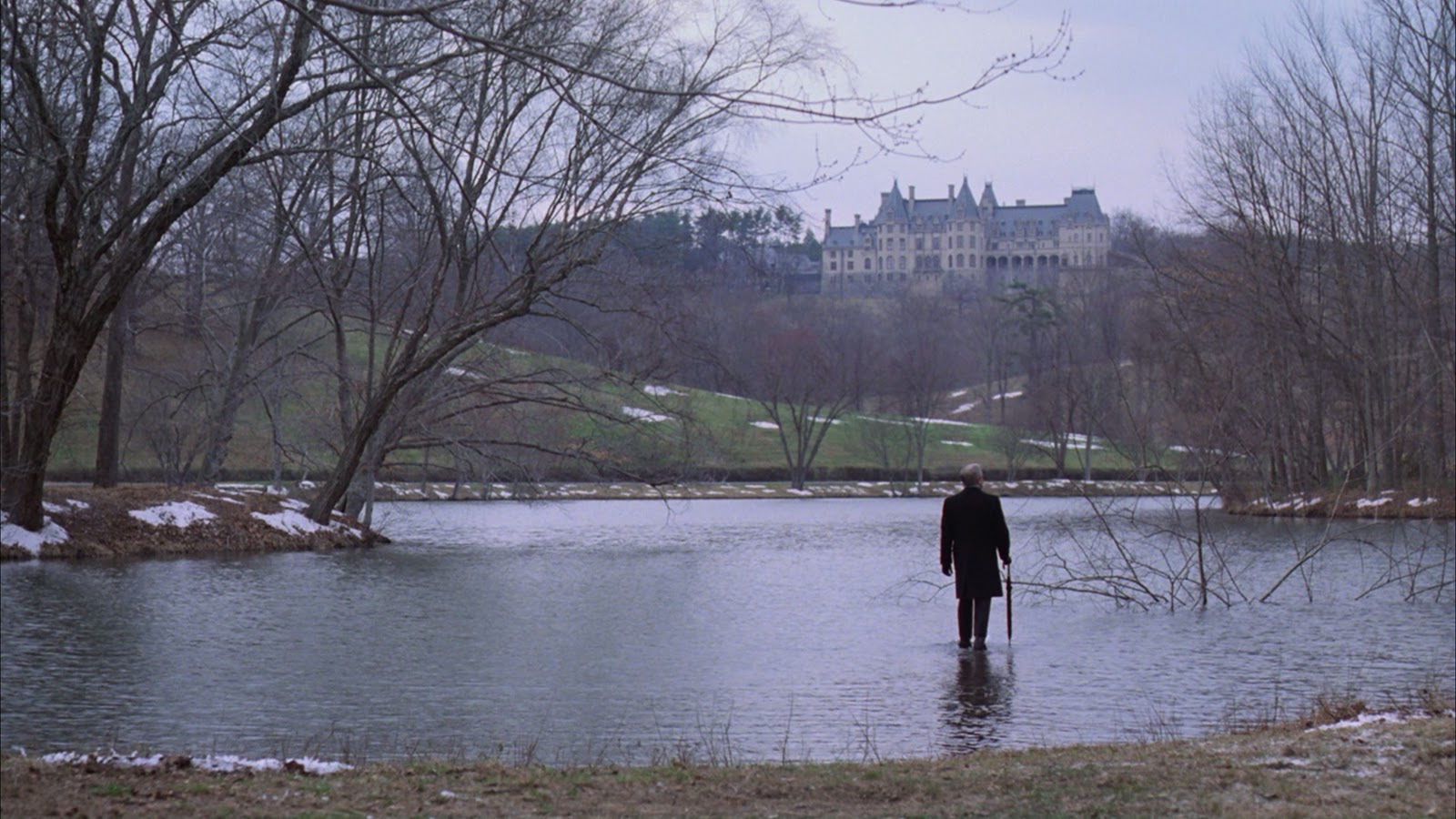
While the Oscar went to Douglas for his thoughtful performance as a dying millionaire, this is Sellers’ film. His presence is uncanny in its earnest simplicity. He smiles, he nods, he provides basic responses, and he remains entirely unmoved by his effect on others. While people are praising him or reminiscing to him or throwing themselves passionately at him, he stays placid and blank. Of course, this is where much of the humor comes from. Probably the funniest scene is a series of outtakes that play over the end credits, in which not even Sellers could utter his droll lines with a straight face. (He supposedly blamed this scene for his failure to win Best Actor, but I think Dustin Hoffman in Kramer vs. Kramer deserved to edge him out.) Indeed, Douglas and MacLaine turn in excellent performances as well, the latter offering a semi-explicit sex scene that is both awkward and hilarious. The film also stands out for its location shooting at the lavish Biltmore Estate in Asheville, North Carolina, which I recognized from my own visit to the grand property.

Being There becomes something a bit deeper in its final scenes, in which Chance begins to take on almost messianic qualities. With this, the filmmakers seem to be encouraging debate over the meaning of it all. Is it that the most important people achieve their status by their mere presence rather than their actions? Is it that simplicity and gentle innocence are so refreshing that they can get you further in life than the opposite? Shakespeare’s Macbeth said that life “is a tale told by an idiot,” so is Being There implying that only a complete idiot can effectively traverse it? Does the film mean to expose the inanity of business and power by comparing politics with nonsense? Yes to one or all, the film remains ripe for whatever interpretation you please. Films with this kind of ambiguity are rare and rarely as good as Being There.

Best line: (Chance, who is naturally misunderstood) “I like to watch.”

Rank: List-Worthy

© 2015 S. G. Liput

340 Followers and Counting

Quiz Show (1994)

11 Sunday Oct 2015

Posted by sgliput in Movies, Poetry, Reviews, Writing

≈ 2 Comments

Tags

Drama, History

Can you be sure of where you stand
And how you’ll keep your footing when
A bit of guile gets out of hand,
And lies are needed once again?

They say the truth can set you free,
But when has someone crossed the line
Of giving up on honesty
Because to err is not divine?

When baby steps grow up too fast
And liars find them ill-advised,
They see the slope that cannot last
Began when first they compromised.
________________

Rating: PG-13 (solely for language)

For a year like 1994 that had acclaimed films like Forrest Gump, The Shawshank Redemption, and Pulp Fiction, it’s not surprising that a good but lesser film would be swept under the rug, so to speak. With so many good films that year, Quiz Show remained an afterthought, both during the awards season and for my own to-watch list, even if it was directed by Robert Redford. This really is a shame because this is a potent exploration of intellectual and personal honesty and might have performed much better in a less competitive year (1996 perhaps).

Quiz Show is based on the memoir of Richard Goodwin, an investigator for the Legislative Oversight Committee of the House of Representatives back in the 1950s. Rob Morrow plays Goodwin in the film, a lawyer who notices some peculiarities on a popular quiz show called Twenty One and follows a hunch to investigate. Apparent genius and champion Herb Stempel (John Turturro) is told to take a dive by the show’s producers (David Paymer and Hank Azaria) and loses on an easy question to allow the advent of Charles Van Doren (Ralph Fiennes). As likable Van Doren’s star rises, Stempel is ignored as he alleges corruption on the supposedly upstanding quiz show. As the investigation progresses, ethics are stretched, and new information comes to light that blurs the lines of right and wrong.

Thanks to excellent casting, Turturro and Fiennes really steal the show here. The missing teeth and, shall we say, homely appearance of the former ideally casts him as the ugly step-contestant, while the verbal grace and perfect hair of the latter offer a striking contrast to his predecessor. It leaves no doubt as to the reasoning of the showrunners. To them, Stempel should be the pitiful reject who can’t cope with losing, and Van Doren should be the shining example of virtue and erudition. In the hands of a lesser filmmaker, Stempel might have become the browbeaten underdog and Van Doren the haughty record holder. Yet while these characterizations are somewhat true, there are many more nuances and complex motivations behind them.

Van Doren, in particular, is depicted as a right decent chap, one who values honesty and intelligence but edges down a slippery slope. Fame can be quite the drug. Why else do so many people do such stupid stunts and post them on the internet? Why else would a successful college professor risk his career for a game show? One might take comfort in the “no one will ever know” mentality, but Van Doren seemed from the start as someone to respond with the “I would know” answer and refuse. Yet the web is woven. He revels in his newfound popularity but buckles under the weight of his own complicity, all while remaining entirely likable, both to us and to Mr. Goodwin. Though liberties are said to have been taken with the details, the ethical conflict rings true for this true story. After all, game shows are still watched as a matter of trust that they aren’t rigged. (I remember when Ken Jennings lost shockingly to a one-night wonder on Jeopardy! several years back. He claims that he simply didn’t know the final question, but I still have my doubts, though I tend to think he might have gotten tired of it all and “taken a dive” on his own without any behind-the-scenes intervention.)

Redford paints the moral dilemmas with a steady hand and, like some statements during the Congressional hearings near the end, offers sympathy when proper and reproof when needed. Quiz Show’s strength is that it is far from black and white. Like other films such as The Prestige or Rashomon, there is no clear-cut good guy to root for, just many victims and varying levels of blame. In the end, justice may be said to be done, but not perfectly. Corporate string-pulling proves too persuasive, but Quiz Show isn’t just about an official scandal or the innate duplicity of show business. It’s about honesty, whether tested, lost, or regained.

Best line: (Herb Stempel, offering rugalach to Goodwin) “Come on, they’re a Jewish delicacy. Before Toby eats it.” (Toby Stempel, his wife) “I’m retaining water, for your information.”   (Herb) “You and the Grand Coulee Dam.”

Rank: List-Worthy

© 2015 S. G. Liput

341 Followers and Counting

Frozen River (2008)

04 Sunday Oct 2015

Posted by sgliput in Movies, Poetry, Reviews, Writing

≈ 1 Comment

Tags

Drama, Thriller

Who would cross a frozen river,
Doubtful of its permanence,
And brave the temperature extremes?
One lacking lawful common sense
Or thawing frozen hopes and dreams?

Who would risk the little had
To aim for better plans ahead?
Perhaps one with a choice to face,
Where desperation dims the dread
And needed greed can turn to grace.
__________________

MPAA rating: R (solely for language)

When you hear stories on the news about illegal activities like smuggling, it’s easy to imagine that the perpetrators are wicked scum-of-the-earth types. While there are undoubtedly plenty of this sort out there, sometimes it takes a movie like Frozen River to put people’s actions in context.

Melissa Leo plays Ray Eddy, a woman just trying to get by on her dollar store paycheck while raising two sons. Intent on leasing a larger mobile home, her plans are devastated by her husband after he disappears with the money to satisfy his gambling addiction. Set against the freezing temperatures of upstate New York, the situation immediately gives the viewer reason to pity Ray’s predicament. From there, her gradual introduction into one leg of a smuggling operation is entirely believable, even as the movie earns its thriller classification with the tension of her potentially being caught. Ray isn’t alone in being sympathetic. Lila Littlewolf (the late Misty Upham), the Mohawk woman who persuades her to help transport illegal immigrants across the Canadian border, has problems of her own with her health, family, and job prospects. While she knows the ins and outs of the smuggling process, she’s no hardened criminal, and the two women form a tenuous but profitable bond.

With all of the debates about illegal immigration in this country, Frozen River thankfully doesn’t have an agenda. Like the Italian film Bicycle Thieves, it doesn’t try to justify the actions of its characters but rather helps us comprehend their motivations. Those scum-of-the-earth types are certainly part of the operation, but Ray and Lila are simply putting their family above the law, which is understandable if not altogether right. Moments of selfishness and concern give way to compassion and maternal solidarity, and though the ending could have benefited from an extra scene of closure, the moral climax plays out as it should. I certainly see why Leo earned a Best Actress nomination (and went on to win for The Fighter), and director Courtney Hunt also received an Oscar nod for her screenplay, which clarifies that not all who break the law have bad intentions.

Rank: List Runner-Up

© 2015 S. G. Liput

341 Followers and Counting

United 93 (2006)

30 Wednesday Sep 2015

Posted by sgliput in Movies, Poetry, Reviews, Writing

≈ 2 Comments

Tags

Drama, History, Thriller

Another day, another morning, not unlike the ones before,
The sun was shining without warning of the tragedy in store.
Another day of normal business, little slated to befall,
The kind to sink into the past without a reason to recall.

Some went about their own routines and kissed their families goodbye,
No knowledge of the future scenes to note suspicion in the sky.
Some woke to smoke and disbelief at holes in buildings unforeseen,
And average folk observed in grief the horrors on their TV screen.

A few of those who woke that day believing they’d have many more,
Above the fields of Pennsylvania, heard the early sins of war.
They perished there as victims of a sudden sorrow we regret,
But challenged it as selfless heroes whom we never will forget.
________________

MPAA rating: R

After hearing so many positive reviews of United 93, I decided I ought to watch it myself, and though I had hoped to see it around the anniversary of 9/11, its power doesn’t rely on when it is seen. Many films based on history try to recreate events accurately, but even if they avoid anachronisms and errors, they rarely transcend their status as a re-creation. Even with historical films I love like Titanic and Chariots of Fire, the presence of recognizable stars, artistic license, and that Hollywood polish belie the fact that I am watching a movie. United 93 is one of the few films that suspended that understanding and temporarily convinced me that I could be watching real events.

Obviously this was the goal for director Paul Greengrass (Captain Phillips), who purposely employed hand-held cameras for their realism and chose unknown actors or, in the case of the ground crews, many of the actual flight controllers who were working on September 11, 2001. The events of 9/11 are widely known, and by focusing on one plane’s story, the film never lets us forget that the viewer is watching a tragedy in progress. Because United Airlines Flight 93 was the only plane where the passengers fought back, its story is clearly the most dramatic in nature, yet its narrative is as convincing as a documentary and never feels theatrical.

From the time of the plane’s takeoff, events play out in real time. Normal people go about their business, making phone calls, taking pills, ordering breakfast, chatting about their kids, and ignoring the four overly silent Arabs who board Flight 93 out of Newark. Because we all know what will happen, the tension builds naturally, as reports come in of American 11 and United 175, which targeted the World Trade Center before Flight 93 had even been hijacked. Realistic interchanges between the air traffic controllers in different cities and the military reflect the confusion of that day, along with all the fear and uncertainty. When the awaited hijacking actually does happen, the tension and anticipation reset as the hostages, like the terrorists before, wait for the right moment to make their move. Difficult decisions and teary phone calls and desperate prayers are made, and even though I knew the outcome, the film made me hope and believe that the passengers might be successful.

Perhaps the most affecting scene is the glimpse we get of the field near Shanksville, Pennsylvania, where the plane crashed. On one of our vacations, my mom and I visited the Flight 93 National Memorial there and walked along the wall of names and saw the boulder that marks the impact point. It was cold and nearly deserted at that time of day, but I got a sense of the importance and grief behind the memorial. Though the film doesn’t even attempt to name the passengers, I felt United 93 only deepened my admiration and sorrow for these fallen heroes who never planned to be heroes.

Best line: (flight attendant Sandra Bradshaw, making a heartbreaking phone call) “But, baby, I promise you, if I get out of this, I’m quitting tomorrow. I’ll quit tomorrow. I promise, I’ll quit tomorrow.”

Rank: List-Worthy

© 2015 S. G. Liput

340 Followers and Counting

Source Code (2011)

20 Sunday Sep 2015

Posted by sgliput in Movies, Poetry, Reviews, Writing

≈ 4 Comments

Tags

Action, Disaster, Drama, Sci-fi


Time moves forward, onward toward
A future none can change or guess,
A train that all must get aboard
And some debark with suddenness.

But what if one could board again
To pick up pieces not yet broke,
To change the now before it’s then,
To douse the fire before the smoke?
____________

Rating: PG-13


Have you ever noticed a movie that you immediately wanted to see because you could tell solely from the trailer or the premise that you would like it but for some reason or other you just never got around to seeing it even years after it came out? That never happens, right? Well, that’s what happened with me and Source Code, but finally I saw it and found it to be exactly the kind of film I was hoping for and expecting: fast-paced, compelling, and mind-challenging.

When Captain Colter Stevens (Jake Gyllenhaal) wakes up in the body of random commuter Sean Fentress on his way to Chicago, he is shocked at having no memory of how he got there and even more shocked when the train explodes and kills him. Next, he wakes up somewhere else and is told he is part of a secret government experiment for “time reassignment,” which can repeatedly give him the last eight minutes of Fentress’ life in order to figure out the identity of the bomber. Instructed by a sympathetic adviser (Vera Farmiga) and the demanding creator of this Source Code technology (Jeffrey Wright), Stevens returns to the train, where every passenger is a suspect and every repeat reveals something new.

If it seems like a mix of Quantum Leap and Groundhog Day, well, it is, and there’s not a thing wrong with that. I love the concepts of both, and fusing the two was what initially attracted me. Yet as easy as it might be to write the film off as unoriginal, Source Code takes some unexpected turns that not only question the morality of Stevens’s situation but bend its sci-fi idea to turn a no-win scenario into an oddly satisfying ending. (My VC was of a different mind and felt the ending was too unbelievable to be fulfilling.)

Throughout it all, Gyllenhaal provides a surprisingly emotional performance through his eight-minute missions, and the mystery was both enjoyable and urgent. (It was cool how the filmmakers incorporated Quantum Leap’s Scott Bakula for a brief but significant unseen role.) There are certainly unanswered questions, such as the overcomplicated details of how the Source Code actually works and what happens to the real Sean Fentress every time Stevens jumps into him. Nevertheless, like Groundhog Day, Source Code overcomes all its repetition and deserves multiple viewings; just remember, “everything is going to be okay.” Here’s a funny parody from MAD that made me want to see it even more:


Best line: (Stevens) “Christina, what would you do if you knew you had less than one minute to live?” (Christina, a fellow passenger) “I’d make those seconds count.”


Rank: List-Worthy


© 2015 S. G. Liput

340 Followers and Counting


Ordinary People (1980) / Colorful (2010)

13 Sunday Sep 2015

Posted by sgliput in Movies, Poetry, Reviews, Writing

≈ 5 Comments

Tags

Animation, Anime, Drama, Triple A

So many reasons to throw in the towel,
To give up the ghost or abandon all hope.
Most are ignored with a tear or a scowl,
But some pile up on the few who can’t cope.
Life can be cruel, like the people who fill it,
But there are more ways to improve it than death.
Life can be bright for the people who will it,
Who see all the reasons to take their next breath.
_______________

Ordinary People’s Rating: R (for language)
Colorful’s Rating: PG-13 (for thematic material)

I haven’t done a double review since my comparison of I Am Legend and World War Z, and I thought it was about time for another, especially because I’ve found two similar films of late. It may seem odd to compare an Oscar-winner from 1980 with a recent anime film that few outside of Japan have heard of, but both movies share a particularly moving brand of family drama, depicted through the experiences of a suicidal boy.

Ordinary People marked the directorial debut of Robert Redford and also confirmed that Mary Tyler Moore could handle much more dramatic roles than her comedic TV persona. A favorite of my VC’s and what I term a AAA movie (because it’s All About the Acting), the Best Picture winner of 1980 features Timothy Hutton as Conrad Jarrett, a troubled boy who seems perfectly ordinary on the outside, as does his encouraging father (Donald Sutherland) and distant mother (Moore). He’s part of the choir, he’s on the swim team, and his parents go to dinner parties. Yet behind this ordinary façade lie demons that led him to try to take his own life. Through the insight of a psychiatrist (Oscar nominee Judd Hirsch), feelings of guilt and love are exposed like a raw nerve, and his relationships are both strengthened and strained by his coming to terms with the past. The powerful scenes between Conrad and Dr. Berger won Hutton a Best Supporting Actor Oscar and foreshadowed similar psychiatric purging in films like Good Will Hunting. In addition, the tension between Conrad and his glacial mother is both pitiable and realistic, especially for those who have endured similar indifference from a parent. While trauma endures and relationships are not all wrapped up cleanly with a bow by the end, there is hope that happiness and recovery are attainable for those who can let go of the past. (It was also interesting seeing early roles for Adam Baldwin and [Lost alert] Fredric Lehne.)

Colorful, which was nominated as an Excellent Animation of the Year at the 2010 Japanese Academy Awards, begins with an unnamed sinful soul in the afterlife being given a second chance. He is to be placed in the body of a boy named Makoto who committed suicide and will be given a limited time to make amends for his own past sins while learning why Makoto killed himself. This Quantum Leap-inspired premise is consistently intriguing as the new Makoto struggles to adapt to his new environment while being somewhat guided by an invisible “angel” of sorts (similar to the hologram Al). He learns that his mother had an affair and that his middle school crush is no better morally, and bullying played a role as well. Whereas Ordinary People pits the mother against the son, here it is “Makoto” who will not forgive his mother, always believing the worst of her and of most people, until he begins to look past himself.

Unlike Ordinary People, though, Colorful has some very apparent flaws, mainly in the character interactions. While the rotoscoped backgrounds are quite realistic, many conversations are strangely stilted in ways that go beyond the average English dub, particularly in scenes with an awkward girl who won’t leave Makoto alone. Yet, while I was considering writing the film off for its weaknesses, its poignant strength sneaked up on me. The pacing is slow and sometimes dragged out, but tension often emerges in quiet ways, in contrast to the emotional fireworks of Ordinary People. Characters that initially seem odd or distant turn out to have much more depth, and the eventual familial catharsis was disarmingly powerful. Despite its faults, Colorful boasts the kind of emotions that would probably earn acting Oscars if adapted properly to live action.

While these two films may seem very different visually, both Ordinary People and Colorful feature ultimately life-affirming messages in the wake of attempted suicide. While the former explores survivor guilt and loveless parents, the latter depicts the difficulty of forgiveness and the cost of infidelity. Both are beautiful films in their own way as they highlight how ordinary families cope with tragedy and how a single friend can make an enormous difference in one’s life.

Best line (from Ordinary People): (Dr. Berger) “A little advice about feelings, kiddo: don’t expect it always to tickle.”

Rank for Ordinary People: List-Worthy
Rank for Colorful: List Runner-Up

© 2015 S. G. Liput

338 Followers and Counting

In the Heat of the Night (1967)

03 Thursday Sep 2015

Posted by sgliput in Movies, Poetry, Reviews, Writing

≈ 6 Comments

Tags

Classics, Drama, Mystery

In the heat of the night, there is murder;
In the heat of the night, there is crime.
There is prejudice pointing the critical finger
And a murderer biding his time.

One must see where his biases blind him;
One must see where his aptitudes end.
If another can help, shouldn’t one get behind him,
Even if he’s more ally than friend?

There are many who won’t understand it;
There are many who’ll say it’s not right,
But stretching convention may help to expand it,
And pay off in the heat of the night.
__________________

Rating: G (perhaps PG would be better)

Here’s another Oscar winner I can cross off my list of classics yet unseen. In a strong year with films like Guess Who’s Coming to Dinner and Cool Hand Luke, I was interested to see what made this mystery drama so much more worthy of Best Picture and Best Actor (for Rod Steiger). While the film itself is an excellent police drama, it’s clear that it was the right film released at the right time, and even if it ruffled some contemporaries’ feathers, it made history by doing so.

For starters, a police patrol car winds through the small Southern town of Sparta, passing some of the key players, only to stumble upon the dead body of the richest man in town. While Steiger’s Chief Bill Gillespie chews his bubblegum vehemently, a black man waiting for a train is arrested on a groundless suspicion and reveals himself to be Officer Virgil Tibbs from Philadelphia (Sidney Poitier). Now Tibbs and Gillespie must collaborate to solve the crime.

While the setup seems simple enough and many films since have forced black and white characters to work together, not many carry the tension of these two men who clearly hate their present situation. Gillespie wants only to get Tibbs out of town, but he knows this case is beyond him and that he needs the other’s expertise as a forensics specialist. Tibbs likewise cooperates only under orders, but eventually his sense of pride and responsibility drives him to uncover the truth. Gillespie would gladly condemn the first suspect, and Tibbs isn’t infallible either, but the two of them complement each other in ways they don’t fully recognize at the time.

The period and place turn out to be the most challenging aspects, since Tibbs’s race angers nearly everyone in town as he pokes around for the truth. He earns some respect for his deductions, but whenever someone acts hostile or refuses to cooperate, we’re never sure if they’re acting guilty or simply expressing their racism. The film’s greatest and most famous scene is the infamous slap, in which Tibbs gives as well as he gets and leaves everyone shocked. To be honest, I wasn’t aware of the scene and was equally surprised, considering the when and where the film is set. Considering this was the time of Martin Luther King, Jr., who was killed less than a year after its release, this scene really is a brilliant microcosm of the civil rights movement; Tibbs remains calm as he questions the suspect, but when he is struck, he returns in kind, as any equal man would. I doubt anyone could have pulled it off as effectively as Sidney Poitier, and I thought he deserved the Oscar more than Steiger. (Seriously, Poitier had this role, Guess Who’s Coming to Dinner, and To Sir, with Love [my favorite of the three] all in the same year, but didn’t get one Oscar nomination?)

As a mystery, In the Heat of the Night takes its time with the reveal, employing subtle foreshadowing, though the timeline of events on the fateful night could have been better explained. Ultimately, this is a film about respect, hard-won respect between two outsiders who shouldn’t have judged each other too quickly. For a film tackling difficult issues like race and abortion, In the Heat of the Night is both a hard-hitting product of its time and a dual character study that is still relevant today.

Best line: (Virgil) “They call me MISTER Tibbs!”

Rank: List-Worthy

© 2015 S. G. Liput

337 Followers and Counting

A Shine of Rainbows (2009)

29 Saturday Aug 2015

Posted by sgliput in Movies, Poetry, Reviews, Writing

≈ 2 Comments

Tags

Drama, Family

Where’er a rainbow touches earth or dives into the sea,
There our share of pain we bear in love most happily.
For as the bow that spans the sky but briefly holds earth’s hand,
So our connections slip away and often end unplanned.
Yet we don’t mourn the rainbow when its brilliant colors fade;
We find those colors elsewhere and remember them arrayed.
When grief and love remind us how the rainbow calmed our fears,
We wait through heaven’s tears for when another one appears.
__________________

Rating: PG

Based on Lillian Beckwith’s novel, A Shine of Rainbows may seem on the same level as a predictable Hallmark film, but it’s endearing enough to give you that warm satisfaction that only a good Hallmark film can.

Early on, young Tomas (John Bell) is adopted by the kindhearted Maire (Connie Nielsen), who ushers him out of the drab, unfriendly orphanage to her Irish island home. While the technique isn’t used again, this beginning mirrors other films like Pleasantville or The Wizard of Oz in emphasizing the contrast of Tomas’s near-black-and-white dejection thus far with the bright and happy colors of his new parent. The rest of the film is full of lush greens and reds and blues that carry an intentional magical quality, making the setting of this Celtic paradise the film’s greatest strength.

I was surprised to learn that John Bell, the little boy who plays Tomas, went on to play Bain, the son of Bard the Bowman in the latter two Hobbit films. Here, he is a shy and sensitive lad, coaxed to happiness by Maire and scared to silence by her husband Alec (Aidan Quinn). Tomas’s intimidation every time he sees Alec grows tiresome after a while, but Maire makes up for Alec’s coldness with warm lessons and stories. After Tomas’s initial introduction to this new family life, there’s the familiar storyline of an indifferent father figure needing to open his heart, and while I could see where the plot was going, it still carried enough heartbreak and warm fuzzies to be engaging.

To be honest, what this film most reminded me of was 2014’s animated Song of the Sea, another Irish family film with Gaelic myths of a stone giant, a distant father, and a climax involving helpful seals. Song of the Sea is much more fanciful, but the Irish accents and some of the themes kept bringing it to mind. Winsome subplots fill out the story, such as Tomas’s friendships with local kids and his care for a cute, obviously animatronic seal. While I enjoyed Song of the Sea more, A Shine of Rainbows is an appealing family drama that should please any lover of Irish scenery.

Rank: List Runner-Up

© 2015 S. G. Liput

337 Followers and Counting

VC Pick: My Bodyguard (1980)

21 Friday Aug 2015

Posted by sgliput in Movies, Poetry, Reviews, Writing

≈ 2 Comments

Tags

Comedy, Drama, Family, VC Pick

Schools have plenty, I suppose,
Of classmates easy to befriend,
The kind that never give you cause to fret,
But schools are also home to those
Who like to bully and pretend
That they’re the toughest kids they ever met.

If you are having troubled days
With greedy bullies on the prowl,
Get yourself a bodyguard to sturdily defend,
But difficulties still can faze
The biggest bodyguards that scowl,
And even they could use a caring friend.
___________________

Rating: PG

My VC has a habit of recommending films from the 70s and 80s I’ve never heard of, and this is only the most recent. My Bodyguard is a respectable high school film, sometimes cute and sometimes hard to watch.

After starting at a new school and antagonizing the local bully Moody (Matt Dillon), young Clifford (Chris Makepeace) sees a way out of this abuse by enlisting the local scary kid Ricky Linderman (Adam Baldwin) as his bodyguard. While Linderman is the subject of murderous gossip and does the least he possibly can for Cliff, Cliff recognizes him as a boy deeply in need of a friend and reaches out when no one will. Throughout the film, I kept thinking how much this reminded me of a feature length episode of Hey, Arnold!, the Nickelodeon show about a good city-dwelling kid who helps people. The movie shares certain similarities with the show such as the boy’s eccentric grandmother (Ruth Gordon in the film), his family’s business (a hotel in the film vs. a boarding house in the show), and a plot about bullies and misunderstood potential friends that easily could have been shortened to episode length. This comparison isn’t a complaint since I’ve always liked Hey, Arnold!, and it’s interesting to think how films like this might have influenced it.

Having had a little experience with them in the past, I personally can’t stand bullies, the kind who lord their toughness over the weak and ambush the helpless. My Bodyguard doesn’t show bullying at its worst, but there are still several scenes that made me angry at cruel intimidators whom no one will stop. Of course, this is meant to make their just desserts sweet for everyone else, and though the comeuppance was slow in coming, it was realistic enough to be satisfying and encourage viewers to fight their own battles.

My Bodyguard isn’t quite a high school classic, but it incorporates some realistic darker elements to make the friendship between Clifford and Linderman difficult but rewarding. It also serves as one of those before-they-were-famous films, with recognizable young faces like Dillon and Joan Cusack, as well as the debut for Jennifer Beals (in a very small role) and Adam Baldwin (known as Jayne Cobb to us Firefly fans). Baldwin is perhaps the best here, turning in a quietly damaged performance that anticipated good things to come.

Best line: (Moody) “You broke my nose!”   (Linderman) “It looks better that way!”

Ranking: List Runner-Up

© 2015 S. G. Liput

337 Followers and Counting

The Neverending Story (1984)

19 Wednesday Aug 2015

Posted by sgliput in Movies, Poetry, Reviews, Writing

≈ 11 Comments

Tags

Drama, Family, Fantasy

You think this story’s like the rest,
Like all the books you’ve read before?
It holds a secret none have guessed,
Real quests and dangers to explore.

Can any book draw you inside,
Where wonders wait on every page?
Can characters that there reside
Become dear friends at any age?

Perhaps, yes, any good book can,
But this is no mere written tale.
Just read wherever it began
And lift the word-begotten veil.
______________

Rating: PG

Anyone who’s looked closely at my Gravatar might have noticed that I’m holding Michael Ende’s The Neverending Story, one of my favorite books. I’ve loved this German-to-English fantasy since the first time I read it. I love how each of the twenty-six chapters begins with a different letter of the alphabet, how Uyulala the Oracle speaks only in rhyme, how the lines of fantasy and reality are blurred to draw Bastian and the reader into the land of Fantastica, how it questions the little things of adventure epics like why bathroom breaks are never mentioned, how extraordinary creatures and characters come and go, friends and foes. And of course, I adore how every minor character is given his own untold tale and dismissed with one of my favorite lines of this or any book: “But that is another story and shall be told another time.” No doubt, you’ll be seeing that line elsewhere on this blog.

So then, if I love the book so much, why has it taken me so long to write about the film adaptation from 1984? It’s hard to say; I grew up watching the movie version long before I had read the book, but once I’d been introduced to the novel, the film simply paled by comparison and dropped off my favorites list. It’s not that I dislike it; it captures some of the magic of the book and generally follows the book’s plot, though only the first half of it. Bastian (Barrett Oliver) is a dreamer, a lover of books who is compelled to steal a very special book and follow the adventures of Atreyu the warrior (Noah Hathaway) and Falkor the luckdragon and the Childlike Empress, even as he himself is drawn into the story to battle the Nothing. As a child’s film, it’s a bit darker than the usual fare, akin to Labyrinth or The Dark Crystal. Like those films, it utilizes detailed puppetry to bring many of the book’s characters to life, such as Falkor and Gmork the fearsome wolf and Morla the Aged One. I also like to think the gnomes Engywook and Urgl might have influenced the characters of Miracle Max and his wife in 1987’s The Princess Bride.

Yet while the similarities to the source material are recognizable, there are so many details that are changed. Some are understandable due to the limits of special effects at the time, such as leaving out Ygramul the spider or not making Cairon (Moses Gunn) a centaur, but others just beg the question “Why?” Why did the filmmakers change the name of the magical land from Fantastica to Fantasia (and why did Disney allow it)? Why did they call Atreyu’s necklace the AURYN when the book specifically leaves out the the? Why did they not let the Southern Oracle speak in rhyme? Why did they throw in nudity with the Sphinx gate, knowing this is supposed to be a kid’s tale? Why did they so poorly dub Deep Roy’s voice in the early scene and call him Teeny Weeny as opposed to a “tiny”? They even left out part of that favorite line of mine! All these differences do add up, making for a very inconsistent adaptation, one which displeased the author and prompted him to file an unsuccessful lawsuit.

The visual effects, like the adaptation, are hit-and-miss; while I’m sure they were astounding for the time, some hold up better than others. The Rock Biter (rock chewer in the book), Morla, and the destruction at the end are incredibly well-realized, considering the lack of computer assistance, but many of the puppets and blue-screen shots are very obvious by today’s standards. Likewise, the acting is satisfactory, even though some of it carries a hefty amount of 1980s/child actor cheesiness.

All in all, The Neverending Story is a film I’d recommend to any child who loves books and anyone who loves fantasy. It’s a childhood darling that halfway holds up with its message of imagination and hope, and I do still admire the score for the American version by Klaus Doldinger and Giorgio Moroder. Even so, to anyone who likes this film, I recommend you read the book and see the full scope of The Neverending Story (and ignore the film sequels). The novel is a classic that may someday get a more faithful adaptation, though I ought to check out the HBO miniseries, “but that is another story and shall be told [hopefully] another time.”

Best line: (since my line wasn’t included in its entirety, this is a decent runner-up) (Falkor) “Never give up, and good luck will find you.”

Rank: List Runner-Up

© 2015 S. G. Liput

336 Followers and Counting

← Older posts
Newer posts →

Recent Posts

  • We Didn’t Start 2025 (Recap)
  • NaPoWriMo 2025 Recap (Finally)
  • Sonic the Hedgehog 3 (2024)
  • It Happened One Night (1934)
  • Spellbound (2024)

Recent Comments

associatesofshellymann's avatarassociatesofshellyma… on My Top Twelve La La La So…
Kit's avatarKit Nichols on Bonnie and Clyde (1967)
lifelessons's avatarlifelessons on Look Back (2024)
Carol Jackson's avatarCarol Jackson on The Thief of Bagdad (1940…
Stephen's avatarStephen on Love Story (1970)

Archives

  • January 2026
  • December 2025
  • May 2025
  • April 2025
  • March 2025
  • February 2025
  • January 2025
  • December 2024
  • May 2024
  • April 2024
  • March 2024
  • February 2024
  • January 2024
  • December 2023
  • November 2023
  • October 2023
  • September 2023
  • July 2023
  • June 2023
  • May 2023
  • April 2023
  • March 2023
  • February 2023
  • January 2023
  • December 2022
  • November 2022
  • October 2022
  • September 2022
  • August 2022
  • July 2022
  • June 2022
  • May 2022
  • April 2022
  • March 2022
  • February 2022
  • January 2022
  • December 2021
  • November 2021
  • October 2021
  • September 2021
  • August 2021
  • July 2021
  • June 2021
  • May 2021
  • April 2021
  • March 2021
  • February 2021
  • January 2021
  • December 2020
  • November 2020
  • October 2020
  • September 2020
  • August 2020
  • July 2020
  • June 2020
  • May 2020
  • April 2020
  • March 2020
  • February 2020
  • January 2020
  • December 2019
  • November 2019
  • October 2019
  • September 2019
  • August 2019
  • July 2019
  • June 2019
  • May 2019
  • April 2019
  • March 2019
  • February 2019
  • January 2019
  • December 2018
  • November 2018
  • October 2018
  • September 2018
  • August 2018
  • July 2018
  • June 2018
  • May 2018
  • April 2018
  • March 2018
  • February 2018
  • January 2018
  • December 2017
  • November 2017
  • October 2017
  • September 2017
  • August 2017
  • July 2017
  • June 2017
  • May 2017
  • April 2017
  • March 2017
  • February 2017
  • January 2017
  • December 2016
  • November 2016
  • October 2016
  • September 2016
  • August 2016
  • July 2016
  • June 2016
  • May 2016
  • April 2016
  • March 2016
  • February 2016
  • January 2016
  • December 2015
  • November 2015
  • October 2015
  • September 2015
  • August 2015
  • July 2015
  • June 2015
  • May 2015
  • April 2015
  • March 2015
  • February 2015
  • January 2015
  • December 2014
  • November 2014
  • October 2014
  • September 2014
  • August 2014
  • July 2014
  • June 2014
  • May 2014
  • April 2014
  • March 2014
  • February 2014
  • January 2014
  • December 2013

Categories

  • Blindspot
  • Blogathon
  • Christian
  • Movies
  • Music
  • NaPoWriMo
  • Poetry
  • Reviews
  • TV
  • Writing

Meta

  • Create account
  • Log in
  • Entries feed
  • Comments feed
  • WordPress.com

Recent Posts

  • We Didn’t Start 2025 (Recap)
  • NaPoWriMo 2025 Recap (Finally)
  • Sonic the Hedgehog 3 (2024)
  • It Happened One Night (1934)
  • Spellbound (2024)

Recent Comments

associatesofshellymann's avatarassociatesofshellyma… on My Top Twelve La La La So…
Kit's avatarKit Nichols on Bonnie and Clyde (1967)
lifelessons's avatarlifelessons on Look Back (2024)
Carol Jackson's avatarCarol Jackson on The Thief of Bagdad (1940…
Stephen's avatarStephen on Love Story (1970)

Archives

  • January 2026
  • December 2025
  • May 2025
  • April 2025
  • March 2025
  • February 2025
  • January 2025
  • December 2024
  • May 2024
  • April 2024
  • March 2024
  • February 2024
  • January 2024
  • December 2023
  • November 2023
  • October 2023
  • September 2023
  • July 2023
  • June 2023
  • May 2023
  • April 2023
  • March 2023
  • February 2023
  • January 2023
  • December 2022
  • November 2022
  • October 2022
  • September 2022
  • August 2022
  • July 2022
  • June 2022
  • May 2022
  • April 2022
  • March 2022
  • February 2022
  • January 2022
  • December 2021
  • November 2021
  • October 2021
  • September 2021
  • August 2021
  • July 2021
  • June 2021
  • May 2021
  • April 2021
  • March 2021
  • February 2021
  • January 2021
  • December 2020
  • November 2020
  • October 2020
  • September 2020
  • August 2020
  • July 2020
  • June 2020
  • May 2020
  • April 2020
  • March 2020
  • February 2020
  • January 2020
  • December 2019
  • November 2019
  • October 2019
  • September 2019
  • August 2019
  • July 2019
  • June 2019
  • May 2019
  • April 2019
  • March 2019
  • February 2019
  • January 2019
  • December 2018
  • November 2018
  • October 2018
  • September 2018
  • August 2018
  • July 2018
  • June 2018
  • May 2018
  • April 2018
  • March 2018
  • February 2018
  • January 2018
  • December 2017
  • November 2017
  • October 2017
  • September 2017
  • August 2017
  • July 2017
  • June 2017
  • May 2017
  • April 2017
  • March 2017
  • February 2017
  • January 2017
  • December 2016
  • November 2016
  • October 2016
  • September 2016
  • August 2016
  • July 2016
  • June 2016
  • May 2016
  • April 2016
  • March 2016
  • February 2016
  • January 2016
  • December 2015
  • November 2015
  • October 2015
  • September 2015
  • August 2015
  • July 2015
  • June 2015
  • May 2015
  • April 2015
  • March 2015
  • February 2015
  • January 2015
  • December 2014
  • November 2014
  • October 2014
  • September 2014
  • August 2014
  • July 2014
  • June 2014
  • May 2014
  • April 2014
  • March 2014
  • February 2014
  • January 2014
  • December 2013

Categories

  • Blindspot
  • Blogathon
  • Christian
  • Movies
  • Music
  • NaPoWriMo
  • Poetry
  • Reviews
  • TV
  • Writing

Meta

  • Create account
  • Log in
  • Entries feed
  • Comments feed
  • WordPress.com

Blog at WordPress.com.

  • Subscribe Subscribed
    • Rhyme and Reason
    • Join 814 other subscribers
    • Already have a WordPress.com account? Log in now.
    • Rhyme and Reason
    • Subscribe Subscribed
    • Sign up
    • Log in
    • Report this content
    • View site in Reader
    • Manage subscriptions
    • Collapse this bar