• Home
  • About Me
  • The List
  • THE LIST (2016 Update)
  • THE LIST (2017 Update)
  • THE LIST (2018 Update)
  • THE LIST (2019 Update)
  • THE LIST (2020 Update)
  • THE LIST (2021 Update)
  • THE LIST (2022 Update)
  • Top Twelves and More
  • The End Credits Song Hall of Fame

Rhyme and Reason

~ Poetry Meets Film Reviews

Rhyme and Reason

Tag Archives: Drama

The Hours (2002)

14 Friday Aug 2015

Posted by sgliput in Movies, Poetry, Reviews, Writing

≈ Leave a comment

Tags

Drama

As the hours tick away,
Can you find
A peace of mind?
Ere the debt that all men pay,
Will you stress
For happiness?

Will you leave this earth too soon,
Slack to strive
And stay alive?
From life’s grief, none are immune,
And some begin
To give in.

I, for one, refuse, however,
To relent
To discontent.
Ties weren’t made for me to sever;
Life will grow,
Despite the woe.
_______________

Rating: PG-13

The Hours profoundly embodies that famous quote from Henry David Thoreau, asserting that “Most men lead lives of quiet desperation and go to the grave with the song still in them.” In the case of this film, that quiet desperation is the realm of women, whether it be an unstable author in 1923, a depressed housewife in 1951, or an overwhelmed hostess in 2001. There is little relief from this oppressive despair, yet the film has artistry to spare, with a superb score from Philip Glass, vivid cinematography from Seamus McGarvey, and poignant performances from three Oscar-winning actresses and Ed Harris.

On a purely superficial level, The Hours has a haunting allure as it eloquently jumps between timelines and slowly reveals their connections, but as I delve deeper into its messages, I find them more and more dubious, even appalling. Let’s start with the three storylines. In Plot 1, Virginia Woolf (Oscar winner Nicole Kidman in a false, uglifying nose) begins her novel Mrs. Dalloway, preparing for visitors and mourning her unsatisfying country existence. In Plot 2, Laura Brown (Julianne Moore) stumbles through the simplest activities and mourns her unsatisfying suburban existence. In Plot 3, bisexual Clarissa Vaughan (Meryl Streep) plans a party for her dying writer friend Richard (Ed Harris) and buckles under the weight of her unsatisfying urban existence. Obviously this is not a “happy” film, but even tearjerkers can offer some hope or peace or gratification in the midst of trials. Based on its three paragons of sorrow, The Hours seems to imply that life and society are inherently unsatisfying and can only be improved by abandonment of society, of responsibility, of life itself.

Setting aside moral qualms about the characters, I find Meryl Streep’s Plot 3 to be the only one that doesn’t deeply vex me, since it at least captures the sorrow and emptiness that this abandonment causes. Plots 1 and 2 are a different story. Both feature their heroines in clear social anguish, yet I find it hard to sympathize with either one since both of them share a galling selfishness. Mrs. Woolf goes out of her way to annoy the servants and complains about protective measures her husband did out of love, though her history of mental illness at least explains her behavior. Mrs. Brown of Plot 2 is the most perplexing of the three, since she acts as if daily life is an unbearable torture when there’s nothing particularly torturous going on. She doesn’t have a mental illness; she doesn’t have a friend dying. I kept asking, “What is your problem?” and as she decided on different forms of “escape,” I wanted her to just look at her little son and recognize that he alone, a gift of God and the envy of her neighbors, ought to be reason enough for her to bear whatever emotional constipation she was enduring.

I see why The Hours was so acclaimed. Between the acting, the haunting music, and the overall artistry, it’s a film to be studied rather than enjoyed. In particular, I liked the writer details, such as how Virginia Woolf decides to write her book based on the first sentence she develops or how she explains why a character must die. There is good, but as the film nears its end, there is an intellectual, venomous bad as well. The abandonment I mentioned earlier takes center-stage, and instead of being rebuked, it is sympathized and even admired. This mirrors the novel Mrs. Dalloway as well, and Woolf’s ideas in it have clearly affected the scholastic view of her own life and suicide. In watching a behind-the-scenes feature on the DVD, I was shocked at how critics and academics used words like “bold” and “courageous” in describing how she took her own life. I’m sorry, but I find nothing courageous or admirable about the tragedy of suicide nor the actions of several sufferers in The Hours. When one character attempts to explain those actions and comments that she had “no choice,” my feelings toward the movie were clinched. Woolf in the film mentions how we should “love [life] for what it is” but then “put it away”; I disagree. One doesn’t put life away; I could counter with one of the film’s own quotes: “You cannot find peace by avoiding life.”

Best line: (Woolf’s sister Vanessa, to her own daughter) “Your aunt is a very lucky woman, Angelica. She has two lives: the life she is living, and the book she is writing.”

Rank: Dishonorable Mention

© 2015 S. G. Liput

334 Followers and Counting

Predestination (2014)

07 Friday Aug 2015

Posted by sgliput in Movies, Poetry, Reviews, Writing

≈ 1 Comment

Tags

Drama, Sci-fi, Thriller

Destiny knocks
On paradox
And grants the wise
A big surprise.
______________

Rating: R (for frequent obscenities and two scenes of nudity, which are easily anticipated)

Predestination is an Australian film that is hard to describe without spoilers, but I’ll do my best. It revolves completely around the secrets and connections of its characters, creating one of the most paradoxical stories imaginable, courtesy of Robert Heinlein’s short story “’—All You Zombies—.’”

Stating the early facts, there’s a mysterious time-traveling agent intent on stopping a mysterious bomber, which then segues into a conversation between said agent as a Bartender (Ethan Hawke) and a confession writer who writes under the pen name “The Unmarried Mother” (Sarah Snook). (I thought Loretta Modern might have been a good pseudonym too.) From this intriguing start, there are flashbacks and quantum leaps and some fascinatingly subtle time-jumping effects, which all lead to a conclusion that I sadly already knew going in. I’m sorry; I just usually like to know what I’m getting into instead of going into a film cold, but in this case, I wish I hadn’t known, if only to see how much I would have guessed as the story progressed.

Sarah Snook earned the most acclaim for her versatility in playing a highly malleable role, and both she and Ethan Hawke carry the film almost by themselves. As I said, the twists are everything. Whereas most films use them to progress the story, here they are the story, which makes for a compelling puzzle but not so much a satisfying conclusion. Even I who knew what would generally happen still had trouble wrapping my head around everything, and it’s a film that would certainly reward a second viewing. Compared with many blockbusters, Predestination is high science fiction, with an ambitious story that goes a bit too high for my middlebrow tastes.

Best line: (the Bartender) “Preparation is the key to successful, inconspicuous time travel. Luck is the residue of design.”

Rank: List Runner-Up

© 2015 S. G. Liput

329 Followers and Counting

Balzac and the Little Chinese Seamstress (2002)

05 Wednesday Aug 2015

Posted by sgliput in Movies, Poetry, Reviews, Writing

≈ 1 Comment

Tags

Drama, Foreign, Romance

How provincial is the province where no one has heard the name
Of Dumas or Dostoyevsky or the books that earned them fame!
Why are some so sadly eager to commit the page to flame?

Do not heed the narrow tyrant quick to outlaw and condemn.
Read the words or listen close, and you may find a worthy gem,
But beware that written words have ravished many, changing them.
_______________

Rating: G (should be PG for light language and a few mature themes)

Language: Chinese and French w/ English subtitles

Born in China and now settled in France, director Dai Sijie obviously has deep ties to the story of Balzac and the Little Chinese Seamstress, which he adapted himself from his first novel of the same name. Set during China’s Communist Cultural Revolution, it follows his own personal experience of spending three years in a rural re-education camp from 1971 to 1974.

From the very start, the film’s tone is clear. While the village’s devoted Communist Chief promptly burns a cookbook for mentioning chicken because it is too bourgeois, the new arrivals Ma and Luo convince him to preserve Ma’s violin by insisting that Mozart wrote music with Chairman Mao in mind. Like the film overall, the scene is a little pitiful and a little funny, but it clinches the role that music and Western civilization play in helping the oppressed feel human again. Love can do the same thing, and when a tailor visits with his beautiful granddaughter, this “Little Seamstress” wins the hearts of both young men. She, like most of these country folk, is sadly ignorant, and they commit themselves to transform her with their “reactionary” Western ideas.

Based on the mention of re-education camps, I might have thought that this was some dark, murderous picture of persecution like The Killing Fields, but it’s not. In fact, there’s a notable lack of life-or-death danger here. With their forbidden books, the three friends are always in danger of being found out by the semi-vigilant Chief. As an authority figure, though, he’s less like a severe commandant and more like an inattentive parent, who barely notices when his charges sneak behind him with banned ideas and hidden abortions and fibs that prey on his ignorance.

At the same time, these work camps are rather effective, forcing many into a mindset of fear and submission. Yet the stories and concepts that Ma and Luo and the Seamstress keep and slowly spread to others also disseminate a starry-eyed freedom. Can you imagine such a beautiful, exotic name as Ursule Mirouet? Can you imagine a poor man becoming a wealthy count like Edmond Dantes? It’s ironic that, at a time when burning a bra was seen as liberating to women in the U.S., its introduction had an empowering effect on the Little Seamstress, leading to a bittersweet choice.

There’s a “Hitler Reacts” YouTube video (parodying a famous scene from Downfall), in which he decries Balzac’s ending and questions the point of the entire story. However, the film overall has that romantic quality of someone reminiscing, perhaps not of the best years of their life but the most memorable. Like all memories, they are swallowed by the floods of time but not forgotten.

Rank: List Runner-Up

© 2015 S. G. Liput

329 Followers and Counting

The Fault in Our Stars (2014)

31 Friday Jul 2015

Posted by sgliput in Movies, Poetry, Reviews, Writing

≈ Leave a comment

Tags

Drama, Romance

They say that pain demands to be felt,
And we’re the ones to feel it,
The ones to bear the cards we’re dealt,
Unable to conceal it.

But pain is not the only one
Demanding our attention,
Although it blinds us like the sun
From others’ intervention.

Yet if we look beyond the pain
To love without regret,
We’ll see that neither is in vain
If love’s demands are met.
_____________________

Rating: PG-13 (for language, sexuality, and some heavy themes)

The first time I heard about The Fault in Our Stars was when a female coworker of mine gushed over how much she loved it and how much she cried and how much she loved crying at it. Thus, I thought it was merely some weepy chick flick. Then I heard all kinds of buzz about the movie adaptation and its talented young stars. Then my VC read the book and was wholly unimpressed, finding the character of Hazel Grace Lancaster so ill-tempered and somber as to be irritating.

Thus, I didn’t know what my opinion would be once I finally saw the blockbuster tearjerker of 2014, and I must say that it deserved its praise. Shailene Woodley is indeed melancholy as Hazel Grace, but with good reason: riddled with cancer since the age of thirteen, she has few joys in life. All the normal teenage pleasures of friends and such have yielded to chemotherapy sessions and constant fears about those who fear for her. Her morbidity is understandable and, as my VC pointed out, off-putting, but that only makes the subsequent romance more surprising and heart-winning.

As Augustus Waters, Ansel Elgort is the nicest guy imaginable, able to keep his spirits high with life-affirming metaphors and willing to part with everything from trophies to wishes for the sake of his friends. Like me and Pat from Silver Linings Playbook, he can’t abide unsatisfying endings, and he won’t accept that life is meaningless. He’s “kind of awesome” and almost too good to be true, but therein lies his appeal. My VC and I both love Elizabethtown, and I pointed out to her that Orlando Bloom’s character in that film also starts out depressed and obsessed with death (with only good looks being a reason for anyone to be attracted to him), yet he is captivated and encouraged by Kirsten Dunst’s Claire, who seems to consider his happiness her mission. Augustus is the same way. When Hazel desires further information about her favorite book (which happens to be about cancer), his efforts on her behalf are more than enough to win her heart.

Based on what I’ve written so far, this may seem like a happy, uplifting story that starts low but keeps on getting better, “a rollercoaster that only goes up,” but such is not the case. Like life itself, there are ups and downs and a tear for every smile. The film is sometimes shockingly abrupt in ungilding the lily, but even then it achieves a touching balance of bitterness and humor, of cynicism and sentiment.

That’s not to say that it is without fault. I didn’t care for how the lone Christian character is mocked as a sincere but inept “Kumbaya” advocate. It’s easy for cynicism to slough off the assurances of religion, but I for one can’t imagine finding meaning in suffering without faith (Christianity, in my case). As convinced as Hazel is from the start, I don’t believe in oblivion, and it’s a bit sad that even the most buoyant character can only say he believes in a heavenly “something.”

Even so, The Fault in Our Stars treads the line between the two viewpoints, Hazel’s sarcastic pessimism and Gus’s vague optimism, and retains a unique intelligence within its familiar romantic storyline, acknowledging that one deep love can be life-affirming. While it’s essentially this generation’s Love Story, The Fault in Our Stars engages both mind and heart far better than the usual tearjerker, though it can still jerk the tears with the best of them.

Best line: (Augustus, to the mother of his friend’s ex-girlfriend) “Hello, ma’am. Your daughter, she’s done a great injustice, so we’ve come here seeking revenge. You see, we may not look like much, but between the three of us, we have five legs, four eyes, and two and a half pairs of working lungs, but we also have two dozen eggs, so if I were you, I would go back inside.”

Rank: List-Worthy

© 2015 S. G. Liput

328 Followers and Counting

Winter’s Tale (2014)

22 Wednesday Jul 2015

Posted by sgliput in Movies, Poetry, Reviews, Writing

≈ 2 Comments

Tags

Drama, Fantasy, Romance

“What if the war between darkness and light
Decided if stars would fluoresce in the night?
What if a thief and a horse snowy white
Could save an enigma at destiny’s tasking?

“What if, when angels and demons do spar,
They fight for the miracles human souls are?
What if we die and become a new star?”
“Quite simply, we don’t, silly girl, so stop asking!”
________________

Akiva Goldsman has had a mixed career; he did win an Oscar for his screenplay for A Beautiful Mind, but that was after also writing Batman and Robin. His directorial debut Winter’s Tale plays to both his strengths and weaknesses, with a story that is sometimes fancifully rich but also stumbles in trying to sustain that richness.

Winter’s Tale is an unusual blend of real-world romance and parallel fantasy. On the human side, the story follows Peter Lake (Colin Farrell), a thief who falls in love with Beverly Penn (Jessica Brown Findlay). In 1916, she is dying of tuberculosis and has some odd opinions about the afterlife. On the fantastical side, a mobster named Pearly Soames (Russell Crowe) is really an undercover demon who wants Peter dead and is part of a covert “dark side” intent on preventing humans from fulfilling their inner miracles and becoming stars. Apparently in this story, Beverly’s beliefs are correct, though there’s no indication of how she learned about the whole romantic “star” mumbo jumbo, nor why this version of New York City has angels and demons but no sign of traditional religion, nor why it is ostensibly the real world but no one seems to have noticed flying horses or men who don’t age.

As the story progressed, I was unsure where it was going, though I was more confused than intrigued. Still, now that I understand the full picture, I believe Winter’s Tale is a worthwhile story that unfortunately loses its way. I admire its themes of hope and good triumphing over evil, as well as the message that our destiny is rarely what we expect. The period setting and intermittent effects are also well-crafted for the most part, and I found the acting quite good, especially Crowe as the snarling villain.

Yet it’s hard to ignore its weaknesses, particularly the gushingly romantic, sometimes poetic dialogue about stars and the universe, which stand in for heaven and God, respectively. In addition, one of my complaints about The Notebook was that Ryan Gosling is reduced to a lovesick recluse without his sweetheart and for far too long. Here, that weakness is extended for decades with no end in sight, a state that our hero accepts with little to no change.

Winter’s Tale has merit but not enough of it to make it a must-see, even for fantasy fans. Some aspects surprisingly work (such as Will Smith’s cameo as the devil), but others are just hard to believe (such as the flying horse who is really a dog who is really an angel. Huh?). I would see it again, but I wouldn’t seek it out.

Best line: (Beverly Penn, in an instance where her voiceover rings true) “But be warned: as we seek out the light, darkness gathers and the eternal contest between good and evil is not fought with great armies… but one life at a time.”

Rank: Honorable Mention

© 2015 S. G. Liput

328 Followers and Counting

VC Pick: Cannery Row (1982)

17 Friday Jul 2015

Posted by sgliput in Movies, Poetry, Reviews, Writing

≈ Leave a comment

Tags

Comedy, Drama, Romance, VC Pick

Some funny folk know
Where to go,
Even though
There aren’t any canners on Cannery Row.

‘Tis not a disgrace
To embrace
Such a place.
You’ll see when you meet these new friends face to face.

In this blithe domain,
It is vain
To be sane.
Just mix with the locals, and they’ll entertain.
____________
Rating: PG (would probably be PG-13 nowadays, due to profanity)

My VC has often mentioned how much she enjoys this film and how she likes it more with every viewing, but somehow I had never gotten around to seeing it for myself…until now. Adapted from John Steinbeck’s book Cannery Row and (to a greater extent) its sequel Sweet Thursday, this Depression-era charmer has all the quirk of a cult classic, though it isn’t one to my knowledge. The actual storyline, set on the California coastline, is rather thin, and instead the film relies on humorous vignettes, establishing its cast of lovably screwed-up characters and letting them interact as only amiable neighbors can.

There’s Doc (Nick Nolte in one of the few roles I’ve seen of his before his “grizzled old man” makeover), the benevolent marine biologist who has special plans for some captured octopi. There’s Mack (M. Emmet Walsh), the leader of a quintet of goodhearted bums, and Hazel (Frank McRae), the anxious dimwit fated to become President of the United States but who may be wiser than even he knows. There’s Joseph and Mary, owner of the local grocery who happens to accept frogs as currency (and yes, that’s the name of one man). There’s Fauna, proprietress of Cannery Row’s friendly neighborhood brothel, and the Seer, a homeless codger who has visions and plays his trumpet to the rising sun. And then there’s Suzy (Debra Winger, possibly at her prettiest), the newcomer in need of a roof, a job, and maybe a little love.

All these colorful personalities bounce off each other perfectly, aided by the droll narration of John Huston himself (known to me as Gandalf in the Rankin/Bass version of The Hobbit) Thus, they do have quite a bit of waggish fun: party fiascoes, unprecedented frog hunts, dance challenges, beer milkshakes, rattlesnake conversations, and so on. Where else are you going to hear a line like “A man sentenced to be President of the United States could not go to a party as a dwarf”? In addition, Cannery Row itself happens to be an ideal backdrop for these amusing misadventures, a huge set (which is clearly a set) of dirty inlets beneath salt-encrusted boardwalks and nocturnal serenades of bluesy jazz, although there’s a good deal of classical and swing music too.

By the end, the jocularity gives way to some buried guilt and dark possibilities, yet the story’s irresistible charm still wins out. Both my VC and I were left smiling as the credits rolled, satisfied that this endearing microcosm of friendliness and romance had found its “greased grooves.”

Best line: (Hazel) “I love Doc! He was a character witness for me, and I ain’t got no character.”

VC’s best line: (Suzy, to Doc) “Look, every time I talk to you, I get more confused. I like you just fine when you’re not around.”

Rank: List-Worthy

© 2015 S. G. Liput

327 Followers and Counting

The Son (2003)

15 Wednesday Jul 2015

Posted by sgliput in Movies, Poetry, Reviews, Writing

≈ Leave a comment

Tags

Drama

Grief can make it hard to live,
And even harder to forgive,
And when we see someone to blame,
It’s easy to despise the same.

Yet kindness can bear added weight
When aimed at someone we could hate.
We might be able to start living
If we first attempt forgiving.
_______________

Rating: Unsure (Nothing objectionable I recall)

The Son (or Le Fils in French) is a critic’s movie; that is to say, it’s the kind of film that critics swoon over while ordinary movie watchers scratch their heads asking, “Is this great filmmaking?” Granted, I’ve never seen anything else by the French Dardenne brothers, but I had only heard good things and was expecting much more from these Cannes favorites.

The plot itself is extremely simple, the kind of story that could have been just as (or more) effective with a half-hour running time. I agree that Cannes Best Actor Olivier Gourmet is quietly persuasive as Olivier, a teacher of carpentry at a vocational school. In the beginning, there’s a drawn-out mystery when a new student named Francis applies, causing Olivier to stalk and leer and act almost creepy as he allows the boy into his class. Disclosing the secret taxed my patience, but its eventual revelation is shrewd and gradual. Let’s just say that Olivier has reason to not be so kind to Francis, and Olivier is well aware of it, even subconsciously. A perceptive example is when he calls all his students by name but refers to Francis as “you.” This standoffish benevolence puzzles Olivier himself, his ex-wife, the boy, the audience, and (according to the Dardennes) even the filmmakers themselves, yet I consider this up-to-interpretation uncertainty more of a weakness than a strength. There’s a subtle and admirable theme of forgiveness versus revenge, one that was lauded by critics for its naturalism, but in this case, the abrupt ending might have benefited from some additional dialogue, since even the words “I’m sorry” don’t make an appearance.

This somewhat stilted “naturalism” carries over to the camera work too. Olivier Gourmet is a good actor; it’s a shame that I mainly saw the back of his head. For the majority of the film, it is as if we are looking over his shoulder, as he walks down corridors, runs, drives, carries beams, and performs various other mundane activities. It reminded me of the beginning of Captain Phillips, but whereas that film only employed this technique for the opening car ride, The Son gets tiresome with its overuse. I will admit that certain scenes utilize this method strongly, such as when Olivier looks straight into the camera when backing up his car, but these are few and far between.

Perhaps when I see more from the Dardennes, I’ll see that this approach is simply their preferred style. Perhaps I just didn’t “get” it like all the real critics did. Perhaps further exploring their filmography will give me a greater appreciation for their artistry. Or perhaps I’ll simply watch something far more appealing, like Inside Out.

Rank: Dishonorable Mention

© 2015 S. G. Liput

327 Followers and Counting

Roman Holiday (1953)

11 Saturday Jul 2015

Posted by sgliput in Movies, Poetry, Reviews, Writing

≈ 3 Comments

Tags

Comedy, Drama, Romance

For visiting tourists, there’s no place like Rome;
For young Princess Ann, it’s too much like home
And all of the cities in which she’s a slave,
Condemned to repeat boring answers and wave.

Escaping outside for a chance to be free,
She’s found by a grudging reporter, and he
Will grant all her wishes for leisure and fun,
As long as an interview comes, one on one.

But Rome is a place where romances pervade,
And many big plans yield to memories made.
___________________

Rating: Not Rated (might as well be G)

One of those acclaimed older movies I’ve never seen before now, Roman Holiday is a renowned classic, and unlike The Philadelphia Story, it deserves that hallowed status. Audrey Hepburn’s original Oscar-winning role, at only about 24 years old, impressed Gregory Peck enough to earn her top billing, even though she was just being introduced. While she deserved it, Peck’s actions also indicate his generosity, and watching two earnest, utterly likable actors of Hollywood’s Golden Age remains a treat, thanks also to a shrewdly written screenplay.

It’s a plot that has been reused many times over in TV shows since: a discontented royal sneaks away for a day of fun and escape. Hepburn looks as regal as the reformed Eliza Doolittle, thanks to her natural beauty and the Oscar-winning costume design, and she performs certain scenes of immaturity splendidly, scenes that could have been ridiculous with a less talented Princess Ann. How she meets reporter Joe Bradley (Peck) is far from ideal, but it sets up quite a few laughs. Once the two of them start touring Rome, though, accompanied by photographer Irving (chuckle-worthy Eddie Albert), the on-location film becomes cinematic sightseeing at its best, despite being in black and white. Piazzas and landmarks like the Spanish Steps and the Mouth of Truth serve as a romantic backdrop for the trio’s jaunt; the famed Mouth of Truth scene made me feel rather ignorant, since I had no idea where its central gag originated (I only knew it from National Treasure: Book of Secrets).

(Some spoilers ahead.) While Bradley’s motivations in escorting Ann around town seem selfish at first, his plans evolve imperceptibly over the course of the day. I kept waiting for him to broach the subject of his demanding an interview, but by the time that opportunity passes, we’re left to wonder what it was that changed his mind. For Bradley and the princess, duty and affection take opposite paths, but loyalty remains their common bond and a common separation. As a romantic comedy, Roman Holiday elicits plenty of smiles but chooses the less predictably rosey path, a bittersweet sendoff that chooses nostalgia over love.

Best line: (Princess Ann) “What do you sell?”   (Joe, the newspaper writer) “Er, fertilizer.”

Rank: List-Worthy

© 2015 S. G. Liput
327 Followers and Counting

Silver Linings Playbook (2012)

08 Wednesday Jul 2015

Posted by sgliput in Movies, Poetry, Reviews, Writing

≈ 7 Comments

Tags

Comedy, Drama, Romance

When the dark is at its worst,
Some people may despair,
But some, refusing to be cursed,
See silver linings there.

Those linings may be hard to hold,
But promise they contain,
And when life’s strains are uncontrolled,
Think not they are in vain.

In bearing aches of head and heart,
Nobody is alone,
And silver linings may impart
New chances never known.
_________________

Rating: R

What do you get when you combine a talented writer/director with a uniformly Oscar-worthy cast of actors? Most of the time, you get a hit, and most of the time, that’s what David O. Russell’s Silver Linings Playbook is. As the first film since Reds to earn all four acting nominations at the Academy Awards, it features four excellent actors who know what they’re doing, even if it’s more the stuff of Oscar nominations rather than wins, though Jennifer Lawrence still won Best Actress.

This is the kind of romantic comedy that makes you feel better about yourself, because at least your life (hopefully) isn’t as messed-up as these people’s. Bipolar Pat Solitano, Jr. (Bradley Cooper), is lucky to have two loving and understanding parents like Robert De Niro and Jacki Weaver, who allow him to stay with them after his release from a psychiatric hospital. While he hopes to pick up with his wife, whose cheating caused his initial mental breakdown, he meets grieving widow Tiffany (Jennifer Lawrence), who’s also lucky to have two loving and understanding parents. At first glance, they might seem perfect for each other, two mentally unstable people who might be able to support each other, but between Pat’s obsession with his unfaithful wife and their tendency to pity the other, things are as complicated as real life or more so. (I admire Pat’s commitment to his wife, but it’s one-sided and delusional.) Throw in a dance competition, financial risks, and a Stevie Wonder phobia, and who knows if new love may bloom?

The relatable drama balances the headaches of mental illness with comedic touches that seem like ideas drawn from real life rather than spawned in a writer’s head. I’ve personally felt Pat’s dissatisfaction with an unhappy ending, though I wouldn’t go as far as he does, except in the blogosphere. While not everyone approved of the depiction of mental illness, the Oscar-nominated screenplay by Russell fosters this sense of realism in being unafraid to allow the “sloppy and dirty,” imperfections and natural flaws in both the characters and their actions. Nothing is idealized, not even the climactic dance number, but it’s all good enough to be satisfying and win over an audience.

My one complaint would have to be the crudity of the language. I know it doesn’t bother most people, but why must F-bombs be thrown around so casually in “great” movies? I’m not one to condemn a film only for foul language, but it just seems so unnecessary, making it less watchable for those sensitive to it. Robert De Niro, in particular, has an upset scene in which every other word begins with F. I suppose that’s realistic too, and I know this film is far from the worst offender, but without the language, you’d still have the outstanding performances and direction and miss nothing. Maybe it’s just me….

Nevertheless, Silver Linings Playbook is one of the better modern romantic dramedies, urging everyone to find their silver lining and illustrating love as a complex mix of empathy, madness, chance, and bribery. And it makes me want to try some “crabby snacks and homemades.”

Best line: (Tiffany) “You let me lie to you for a week?”   (Pat) “I was trying to be romantic.”

Rank: List Runner-Up
© 2015 S. G. Liput
325 Followers and Counting

Cool Hand Luke (1967)

03 Friday Jul 2015

Posted by sgliput in Movies, Poetry, Reviews, Writing

≈ 7 Comments

Tags

Classics, Drama

Welcome to the chain gang, Luke,
Where slightest back talk earns rebuke.
Forget your crime was just a fluke.
You’re here to pay your debt.

You’ll learn the rules at any rate,
For you will quickly learn your fate
If “failure to communicate”
Remains a running threat.
_________________

Rating: PG

Most of the films I’ve seen were released since the 1970s, and while I love classics like Gone with the Wind and Miracle on 34th Street, there are still quite a few “classic” films that I have yet to see. One of these movies that critics and the AFI love to laud is Cool Hand Luke, a film that, before now, was only a name and a famous quote to me. Now I have my own opinion.

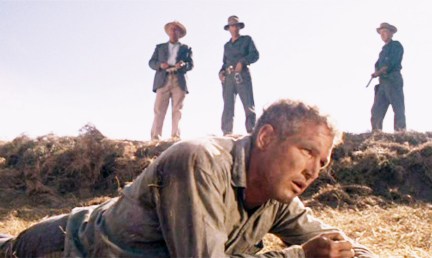
Seeing this star-making role for Paul Newman was fascinating in many ways, particularly in how this chain gang tale influenced other prison films like The Shawshank Redemption (betting on new arrivals, escape attempts), Holes (prison buddy nicknames, escape attempts), and even Toy Story 3 (the famous box speech). A scene involving paving a road brought to mind Bessie from Cars and made me wonder if that’s why Pixar cast Paul Newman in that film. The story of Luke Jackson’s imprisonment is a worth-while one, featuring all the Oscar-worthy acting and tenacious style that attracts critical praise and a 100% score on Rotten Tomatoes. Newman, in particular, has some moments of phenomenal acting, and I thought he deserved an Oscar more than George Kennedy (who won Best Supporting Actor) as his rival-turned-friend Dragline. The work camp includes quite a few recognizable faces as well, including Strother Martin (the horse dealer in True Grit), Ralph Waite (Pa from The Waltons), Wayne Rogers (TV’s M*A*S*H), Harry Dean Stanton (the first victim in Alien), and Dennis Hopper (Speed, Hoosiers). It’s a well-made film, but as with One Flew over the Cuckoo’s Nest, I take issue with the way its message is conveyed.

Basically, what Cool Hand Luke reminds me of is a less uplifting version of The Shawshank Redemption, but fused with the anti-establishment theme of Cuckoo’s Nest. Luke himself is an anti-hero who’s tamer than R. P. McMurphy but still problematic. Instead of being rebellious for the sake of fun or feeling free, he’s ultimately rather shallow and just seems to be masochistic and stupid. A drunken mistake lands him in prison, and a boxing match with later friend Dragline proves Luke’s capacity for his own suffering, with no clear motivation. Later on, that suffering is far less willing, but Luke still brings it on himself. Who but an idiot would try to escape with less than a year of his sentence to go, knowing it would add on more? And it isn’t as if Luke’s time there was insufferable. Everyone could still smoke and drink and gamble (unrealistic for jail time), and aside from an early power play, the guards aren’t too cruel until Luke gives them reason to be. Thus, the impetus for Luke’s rebellion just doesn’t make sense.

On top of that, there are several instances of religious symbolism drawing a comparison between Luke and Jesus, though their only similarity is that both their punishments were overly severe. I like, even admire, character parallels to Christ, but when they include no sign of sacrifice, they fall flat, as in this case. To his fellow inmates, he becomes a hero, but only because he’s willing to do things they don’t have the backbone for or, better put, things they have the common sense not to do. He talks to God but not with any reverence, more like Robert Green Ingersoll challenging the “old man” to prove He’s there. The Christian comparison is sometimes rather explicit, but serves no purpose due to Luke being nothing like Jesus: Luke doesn’t help his fellow prisoners in any way (aside from winning Dragline a bet), he isn’t innocent, and his mother (Jo Van Fleet) ain’t no Virgin Mary. Therefore, why make the comparison?

Again, I must point to Shawshank as the shining example of how to do this anti-establishment freedom theme right. It’s always best when the good guy is innocent and the bad guy is undoubtedly evil. (POW films usually succeed too, since the roles of good and bad typically conform to who won or lost the war.) I realize not every film can have this setup, but those that don’t just don’t work, at least for me. As I said, this is a good film, one worth watching and preserving, but other films have built on its themes far more persuasively. Critics can praise the character of Luke, but when an iconic role is dominated by nothing more than a “because I can” attitude, I’m unsure why its faults aren’t more recognized.

Best line: (both the Captain and Luke) “What we’ve got here is failure to communicate.”

Rank: Honorable Mention

© 2015 S. G. Liput

324 Followers and Counting

← Older posts
Newer posts →

Recent Posts

  • We Didn’t Start 2025 (Recap)
  • NaPoWriMo 2025 Recap (Finally)
  • Sonic the Hedgehog 3 (2024)
  • It Happened One Night (1934)
  • Spellbound (2024)

Recent Comments

associatesofshellymann's avatarassociatesofshellyma… on My Top Twelve La La La So…
Kit's avatarKit Nichols on Bonnie and Clyde (1967)
lifelessons's avatarlifelessons on Look Back (2024)
Carol Jackson's avatarCarol Jackson on The Thief of Bagdad (1940…
Stephen's avatarStephen on Love Story (1970)

Archives

  • January 2026
  • December 2025
  • May 2025
  • April 2025
  • March 2025
  • February 2025
  • January 2025
  • December 2024
  • May 2024
  • April 2024
  • March 2024
  • February 2024
  • January 2024
  • December 2023
  • November 2023
  • October 2023
  • September 2023
  • July 2023
  • June 2023
  • May 2023
  • April 2023
  • March 2023
  • February 2023
  • January 2023
  • December 2022
  • November 2022
  • October 2022
  • September 2022
  • August 2022
  • July 2022
  • June 2022
  • May 2022
  • April 2022
  • March 2022
  • February 2022
  • January 2022
  • December 2021
  • November 2021
  • October 2021
  • September 2021
  • August 2021
  • July 2021
  • June 2021
  • May 2021
  • April 2021
  • March 2021
  • February 2021
  • January 2021
  • December 2020
  • November 2020
  • October 2020
  • September 2020
  • August 2020
  • July 2020
  • June 2020
  • May 2020
  • April 2020
  • March 2020
  • February 2020
  • January 2020
  • December 2019
  • November 2019
  • October 2019
  • September 2019
  • August 2019
  • July 2019
  • June 2019
  • May 2019
  • April 2019
  • March 2019
  • February 2019
  • January 2019
  • December 2018
  • November 2018
  • October 2018
  • September 2018
  • August 2018
  • July 2018
  • June 2018
  • May 2018
  • April 2018
  • March 2018
  • February 2018
  • January 2018
  • December 2017
  • November 2017
  • October 2017
  • September 2017
  • August 2017
  • July 2017
  • June 2017
  • May 2017
  • April 2017
  • March 2017
  • February 2017
  • January 2017
  • December 2016
  • November 2016
  • October 2016
  • September 2016
  • August 2016
  • July 2016
  • June 2016
  • May 2016
  • April 2016
  • March 2016
  • February 2016
  • January 2016
  • December 2015
  • November 2015
  • October 2015
  • September 2015
  • August 2015
  • July 2015
  • June 2015
  • May 2015
  • April 2015
  • March 2015
  • February 2015
  • January 2015
  • December 2014
  • November 2014
  • October 2014
  • September 2014
  • August 2014
  • July 2014
  • June 2014
  • May 2014
  • April 2014
  • March 2014
  • February 2014
  • January 2014
  • December 2013

Categories

  • Blindspot
  • Blogathon
  • Christian
  • Movies
  • Music
  • NaPoWriMo
  • Poetry
  • Reviews
  • TV
  • Writing

Meta

  • Create account
  • Log in
  • Entries feed
  • Comments feed
  • WordPress.com

Recent Posts

  • We Didn’t Start 2025 (Recap)
  • NaPoWriMo 2025 Recap (Finally)
  • Sonic the Hedgehog 3 (2024)
  • It Happened One Night (1934)
  • Spellbound (2024)

Recent Comments

associatesofshellymann's avatarassociatesofshellyma… on My Top Twelve La La La So…
Kit's avatarKit Nichols on Bonnie and Clyde (1967)
lifelessons's avatarlifelessons on Look Back (2024)
Carol Jackson's avatarCarol Jackson on The Thief of Bagdad (1940…
Stephen's avatarStephen on Love Story (1970)

Archives

  • January 2026
  • December 2025
  • May 2025
  • April 2025
  • March 2025
  • February 2025
  • January 2025
  • December 2024
  • May 2024
  • April 2024
  • March 2024
  • February 2024
  • January 2024
  • December 2023
  • November 2023
  • October 2023
  • September 2023
  • July 2023
  • June 2023
  • May 2023
  • April 2023
  • March 2023
  • February 2023
  • January 2023
  • December 2022
  • November 2022
  • October 2022
  • September 2022
  • August 2022
  • July 2022
  • June 2022
  • May 2022
  • April 2022
  • March 2022
  • February 2022
  • January 2022
  • December 2021
  • November 2021
  • October 2021
  • September 2021
  • August 2021
  • July 2021
  • June 2021
  • May 2021
  • April 2021
  • March 2021
  • February 2021
  • January 2021
  • December 2020
  • November 2020
  • October 2020
  • September 2020
  • August 2020
  • July 2020
  • June 2020
  • May 2020
  • April 2020
  • March 2020
  • February 2020
  • January 2020
  • December 2019
  • November 2019
  • October 2019
  • September 2019
  • August 2019
  • July 2019
  • June 2019
  • May 2019
  • April 2019
  • March 2019
  • February 2019
  • January 2019
  • December 2018
  • November 2018
  • October 2018
  • September 2018
  • August 2018
  • July 2018
  • June 2018
  • May 2018
  • April 2018
  • March 2018
  • February 2018
  • January 2018
  • December 2017
  • November 2017
  • October 2017
  • September 2017
  • August 2017
  • July 2017
  • June 2017
  • May 2017
  • April 2017
  • March 2017
  • February 2017
  • January 2017
  • December 2016
  • November 2016
  • October 2016
  • September 2016
  • August 2016
  • July 2016
  • June 2016
  • May 2016
  • April 2016
  • March 2016
  • February 2016
  • January 2016
  • December 2015
  • November 2015
  • October 2015
  • September 2015
  • August 2015
  • July 2015
  • June 2015
  • May 2015
  • April 2015
  • March 2015
  • February 2015
  • January 2015
  • December 2014
  • November 2014
  • October 2014
  • September 2014
  • August 2014
  • July 2014
  • June 2014
  • May 2014
  • April 2014
  • March 2014
  • February 2014
  • January 2014
  • December 2013

Categories

  • Blindspot
  • Blogathon
  • Christian
  • Movies
  • Music
  • NaPoWriMo
  • Poetry
  • Reviews
  • TV
  • Writing

Meta

  • Create account
  • Log in
  • Entries feed
  • Comments feed
  • WordPress.com

Blog at WordPress.com.

  • Subscribe Subscribed
    • Rhyme and Reason
    • Join 814 other subscribers
    • Already have a WordPress.com account? Log in now.
    • Rhyme and Reason
    • Subscribe Subscribed
    • Sign up
    • Log in
    • Report this content
    • View site in Reader
    • Manage subscriptions
    • Collapse this bar