• Home
  • About Me
  • The List
  • THE LIST (2016 Update)
  • THE LIST (2017 Update)
  • THE LIST (2018 Update)
  • THE LIST (2019 Update)
  • THE LIST (2020 Update)
  • THE LIST (2021 Update)
  • THE LIST (2022 Update)
  • Top Twelves and More
  • The End Credits Song Hall of Fame

Rhyme and Reason

~ Poetry Meets Film Reviews

Rhyme and Reason

Tag Archives: Drama

2020 Blindspot Pick #5: Fargo (1996)

01 Tuesday Dec 2020

Posted by sgliput in Blindspot, Movies, Poetry, Reviews, Writing

≈ Leave a comment

Tags

Drama, Thriller

See the source image

Now sit right on down on a carpet or quilt
And lend me an ear for a minute.
I’ve got here a story of greed and of guilt,
And there’s death and dishonesty in it.

You may have heard tell of some murders up north
Around Brainerd not far from the border.
It started with three deaths (or was there a fourth?);
Regardless, it shocked the reporter.

It didn’t take long for the local police
To kick off the investigation,
And boy, what a puzzle! They gathered each piece
With no lack of luck and frustration.

Turns out the two culprits behind it were wicked,
But there was a right normal guy
Who stuck his nose right where you don’t want to stick it
And hired those two on the sly.

It came down to money to finance the lie
That set off the kidnapping fraud,
Which led to the murder when things went awry,
For even the best plans are flawed.

It’s hard to imagine some schmo you might know
Doing something to cause homicide.
It just goes to show how lies snowball and grow,
And you don’t know what folks have to hide.
________________________

MPA rating:  R

Back now to the ol’ Blindspot list, which I’ll unfortunately be hard-pressed to finish before the end of the year. Perhaps this opinion is just based on ignorance, but 1996 has always struck me as a weak year for cinema with few must-see award-worthy films. Yet Fargo has some ardent fans, even spawning a spin-off TV series nearly twenty years later, so I felt impelled to see what the fuss was about. The Coen brothers are an acquired taste, but their uniquely dark humor distinguishes this tale of fraud and murder from what could have been pedestrian.
See the source image

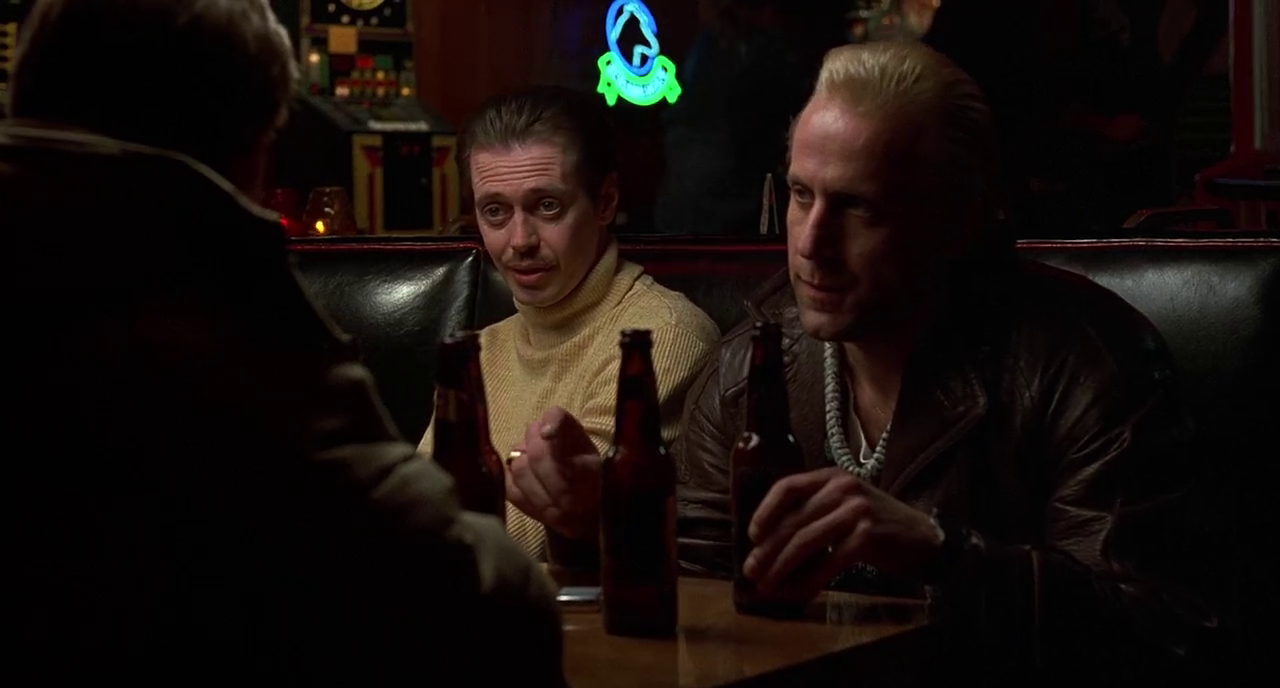
All I knew about Fargo going in was the famous Midwestern accents (“Don’tcha know”) and that scene of Frances McDormand standing next to a car wreck in the snow. I was sort of expecting a mystery and was surprised then to see the crime start from the very beginning, with Jerry Lundegaard (William H. Macy) meeting two mercenaries (Steve Buscemi, Peter Stormare) in a dive bar in Fargo, North Dakota, to arrange for the fake kidnapping of his wife, with the expected ransom set to pay off all involved. It took longer than expected for McDormand’s Marge Gunderson to arrive on the scene, following the clues that the naïve Jerry and ruthless hitmen leave in their wake. Watching everything unfold was like observing one of those true crime stories in action, knowing whodunnit but awaiting the culprits to meet their comeuppance as they dig their graves deeper.

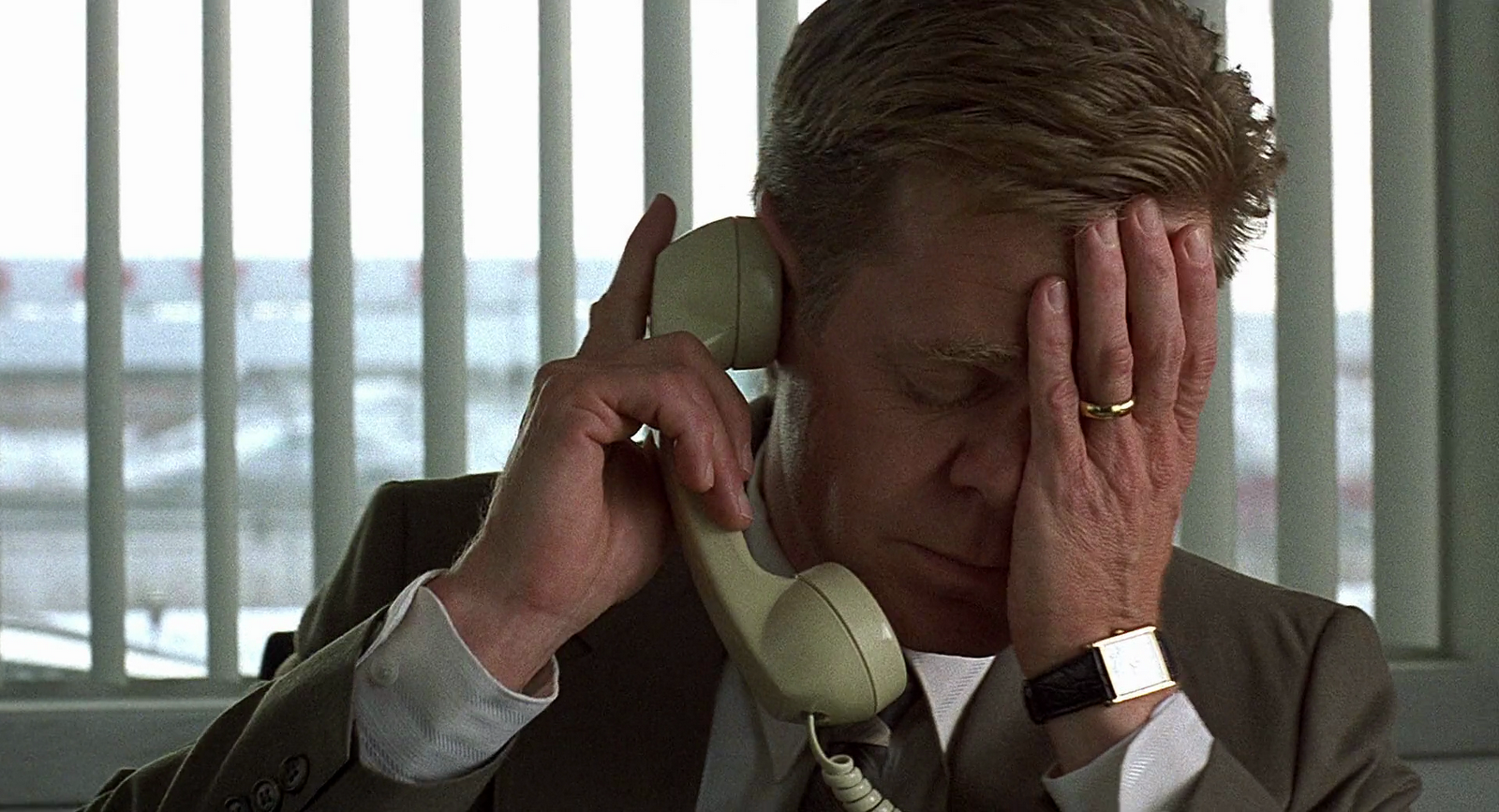
In a way, my opinion of Fargo is an odd mix of appreciation and overhype. It’s not a film that I automatically love or would want to immediately include in the National Film Registry (which it was only ten years after its release), yet I’ll admit there’s something intriguing about the way the story plays out. For example, I hate profanity as a rule and rarely think it adds anything to a movie, but in Fargo’s case, there’s a clear contrast in how only the hitmen and their ilk cuss while Marge and the other law-abiding Minnesotans are content with “for Pete’s sake” and “aw, jeez” and a surfeit of “yah”s. Jerry’s thin veneer of good-natured smarminess is gradually peeled back as he realizes how deep in over his head he is, even as the folksy mannerisms of him and Marge give the proceedings a wry sense of humor.
See the source image

Despite her late introduction, McDormand is certainly the star and deserved her Best Actress Oscar, imbuing her pregnant policewoman with all the levelheaded practicality needed to ground the film and provide the audience someone to root for. The Coens’ Oscar-winning screenplay also stands out, though there were several unresolved tangents that could have been better explained, such as the lack of explanation for Jerry’s need for money or the inclusion of an old classmate of Marge’s who adds nothing to the main story. Plus, isn’t it odd that the film is called Fargo when only the very first scene actually happens in North Dakota? My VC and I were dreading the “wood chipper scene” we’d heard about, thinking it would be overly gruesome, but it honestly could have been worse. (Maybe I’ve just been desensitized by Criminal Minds.) I’m slowly working my way through the Coens’ eccentric filmography, so I’m glad to add Fargo to my watched list. It uses small-town quirk to its advantage to make a shocking murder story into something more distinctive, an exemplar of the saying “Oh, what a tangled web we weave when first we practice to deceive.”

Best line: (Marge, kneeling at the crime scene) “Oh, I just think I’m gonna barf…” [standing up again after a moment] “Well, that passed. Now I’m hungry again.”

Rank:  List Runner-Up

© 2020 S.G. Liput
703 Followers and Counting!

Journey’s End (2017)

11 Wednesday Nov 2020

Posted by sgliput in Movies, Poetry, Reviews, Writing

≈ Leave a comment

Tags

Drama, History, War

See the source image

(I wrote this in the style of Robert Service, one of my favorite poets, who wrote several poems inspired by his time as an ambulance driver in World War I.)

There’s a time in the life of a soldier entrenched
When he cannot endure anymore,
When his teeth are like glass having been so long clenched
And he’s numb to the screams and the gore,

When his mind barely registers pleasure or pain
And his nerve’s on the edge of a knife,
When his soul is unlikely to wash out the stain
Of the ongoing ending of life,

When the order to “Go” couldn’t move his clay feet
Even if he had will to obey,
When war seems no more than the grinding of meat
For some heinous, infernal buffet.

At times such as these, when one’s mettle and wits
Have been wrung further than they extend,
The heroes decide alongside hypocrites
How they choose to meet their journey’s end.
_________________________________

MPA rating:  R (I consider it a light R, for a few violent moments and occasional F words)

Though it may seem I’m destined to only post on holidays, I am trying to get to a more consistent schedule. It seemed only fitting to review a war movie on Veteran’s Day, and a World War I movie seemed even more fitting, considering the significance of November 11, when the armistice ending that terrible war was signed. Journey’s End brings the desperation of that war to life in a wholly compelling way, making it a must-watch for anyone interested in WWI.

See the source image

Based on a 1928 play by war veteran R. C. Sherriff, which has already been adapted four other times, Journey’s End doesn’t try to provide a sweeping look at the whole war, instead focusing on a single week in March of 1918, as British troops braced themselves for an expected German offensive. Fresh-faced 2nd Lieutenant Raleigh (Asa Butterfield) asks to be assigned to Company C, commanded by his former school friend Captain Stanhope (a tortured Sam Claflin). He finds his old pal changed by the horrors of war, and his initial opinion of a war raid as “exciting” is quickly sobered by experiencing them firsthand.

What Journey’s End does best is capture snapshots of the feeling of trench warfare, albeit mainly from an officer’s perspective. We feel the tension of soldiers wishing something would happen, followed by the grim resignment of being chosen for that something; the seeming indifference of superior officers; the conflict of different coping mechanisms; the helplessness of men at the end of their own rope having to comfort others at the end of theirs; and the mental anguish of wishing someone both “goodbye” and “good luck,” possibly for the last time. Plenty of small details add to the realism, such as the men getting a dose of rum and emptying their bladders before going “over the top.”

See the source image

The obvious comparison for me in appraising a WWI movie is judging it next to last year’s 1917, and, while Journey’s End can’t quite compare on technical proficiency, it surpasses the newer film in characterization, with Paul Bettany’s personable second-in-command being a particular light among the dull grays of the trenches. In addition to the acting, the cinematography is also excellent, though, with a few comparatively short tracking shots bringing 1917 to mind. War films can be hard to sit through, but those like Journey’s End are a constant reminder of how lucky we are to be able to sit around on couches watching movies when we could just as easily have been down to our last nerve in muddy trenches, but for the distance of 100 years. To all veterans, thank you!

Best line: (Bettany’s Lieutenant Osborne, writing home) “There is a job to be done. It ought never to have arisen, but that is not the point. I have had so very much out of life, but all these youngsters do not realize how unlucky they are, so new are they to their very existence.”

Rank:  List Runner-Up

© 2020 S.G. Liput
701 Followers and Counting!
Doctor Sleep (2019)

31 Saturday Oct 2020

Posted by sgliput in Movies, Poetry, Reviews, Writing

≈ Leave a comment

Tags

Drama, Fantasy, Horror

See the source image

We all have our ghosts,
And we carry them close,
An undying weight
Doctors can’t diagnose.

Our parents, our fears
Echo on through the years,
And so many drown them
In vices and beers.

The shaft of despair
Has no bottom down there
But does have a top
If we’d only seek air.

Yourself you may yield,
With no hope to be healed,
But the sight of another
In need of a shield,

Unbent, hopeful yet,
In the path of a threat,
Just might be enough
To redeem your regret.

__________________

MPA rating: R (for horror violence, language, and that creepy naked ghost from The Shining)

Where has October gone? I’m thinking I should probably stop apologizing for the long stretches in between posts since the demands of full-time work and school just make it hard to find enough time for anything else. Nevertheless, I felt like Halloween was a good time to make my return to the blogosphere and resurrect my annual tradition of reviewing a scary movie that I watched by myself late at night. Past notables include The Conjuring, The Babadook, and Under the Shadow, and this year’s is also up there with the best.

See the source image

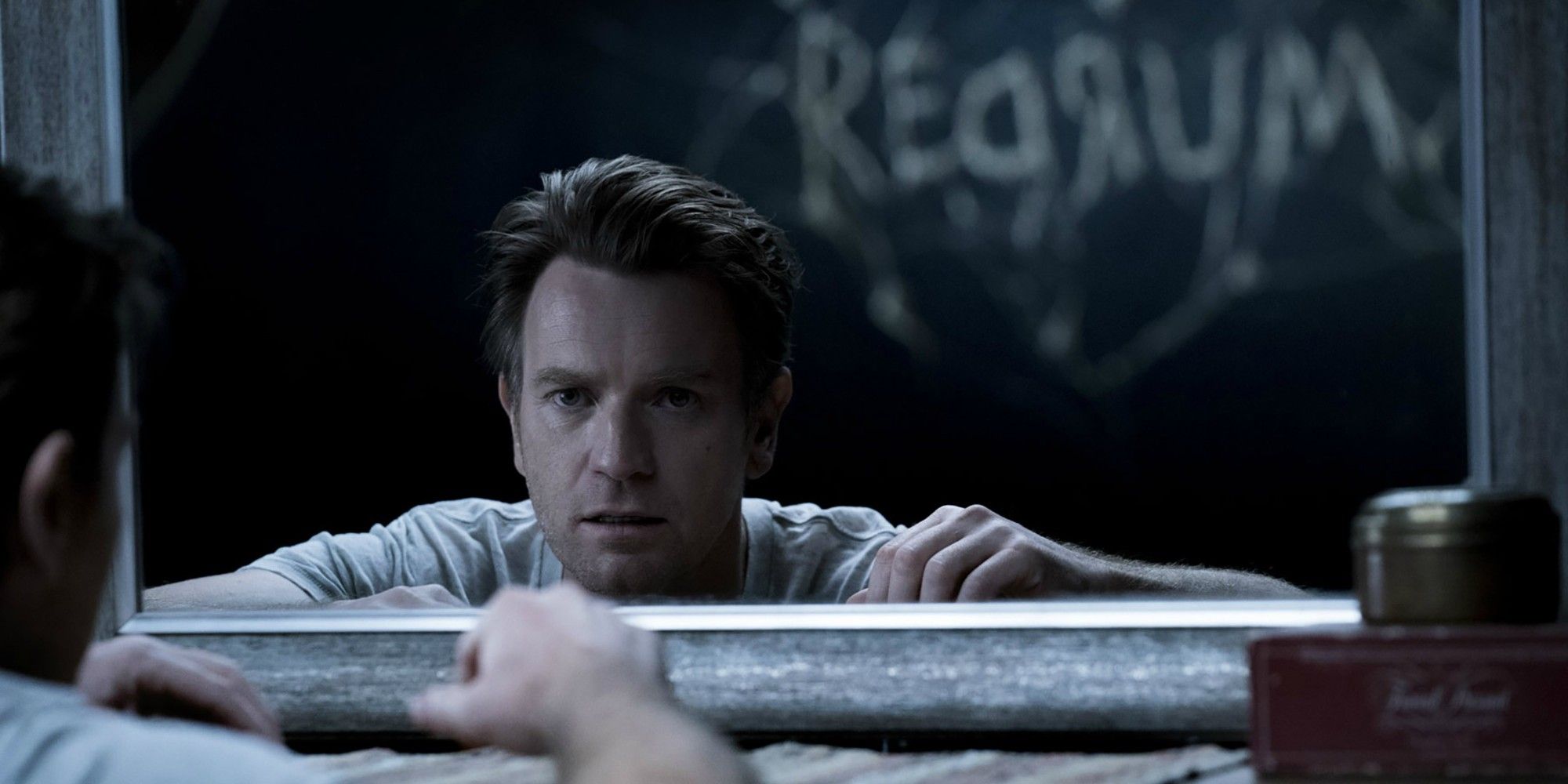
With so many sequels being made to cash in on thirty-to-forty-year-old classics, it was easy to underestimate Doctor Sleep, the long-delayed follow-up to The Shining and likewise based on Stephen King’s novel of the same name. Stanley Kubrick’s adaptation of the original may have been divisive, but it’s iconic enough that you would think Hollywood would have the sense to leave it alone. (Then again, look at Ready Player One.) Yet this subsequent story about a grown-up Danny Torrance (Ewan McGregor) turns out to be more than worthy of its celebrated ancestor and creates a surprisingly mature and entertaining tale built on the trauma of the Overlook Hotel.

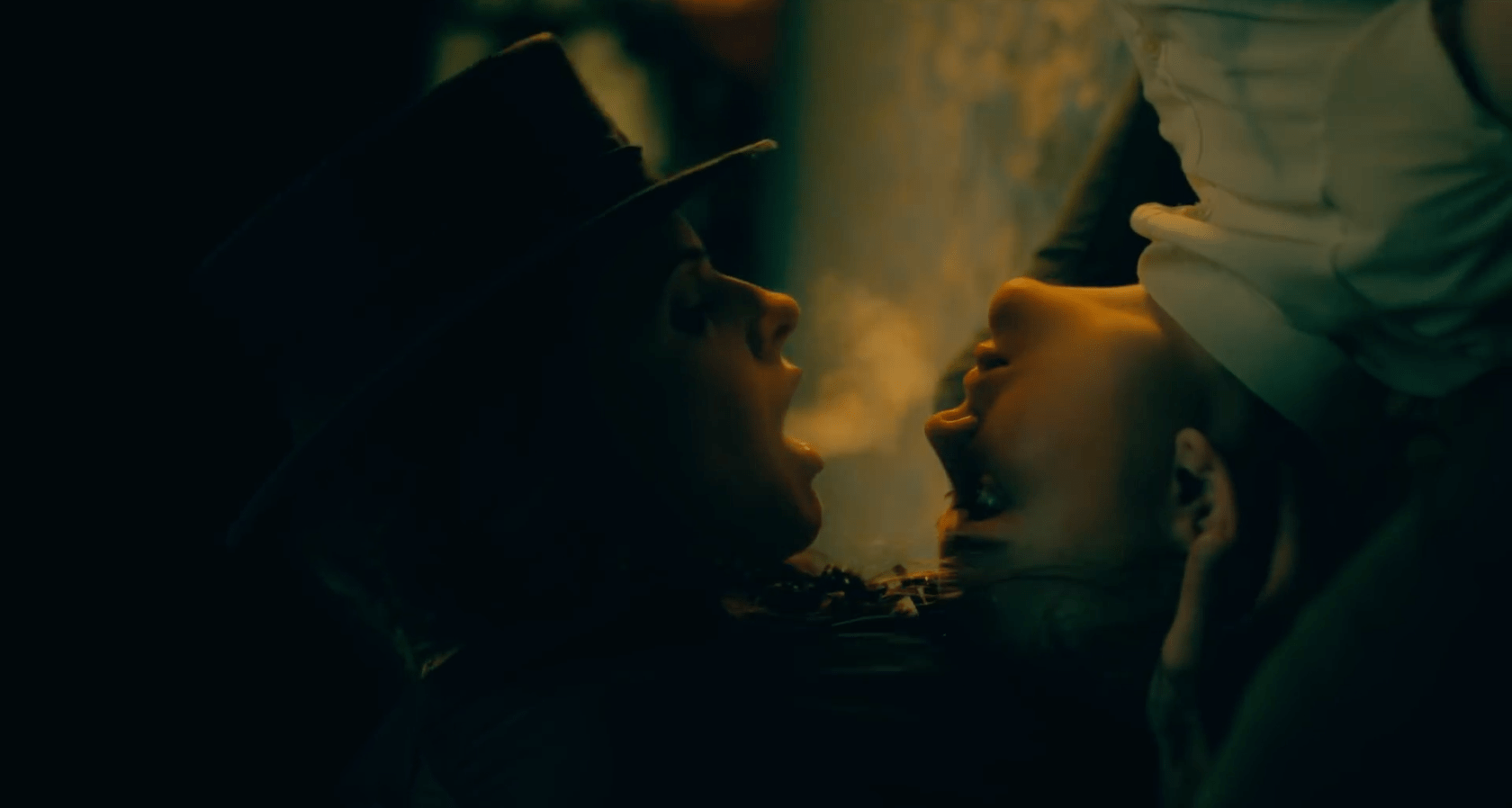
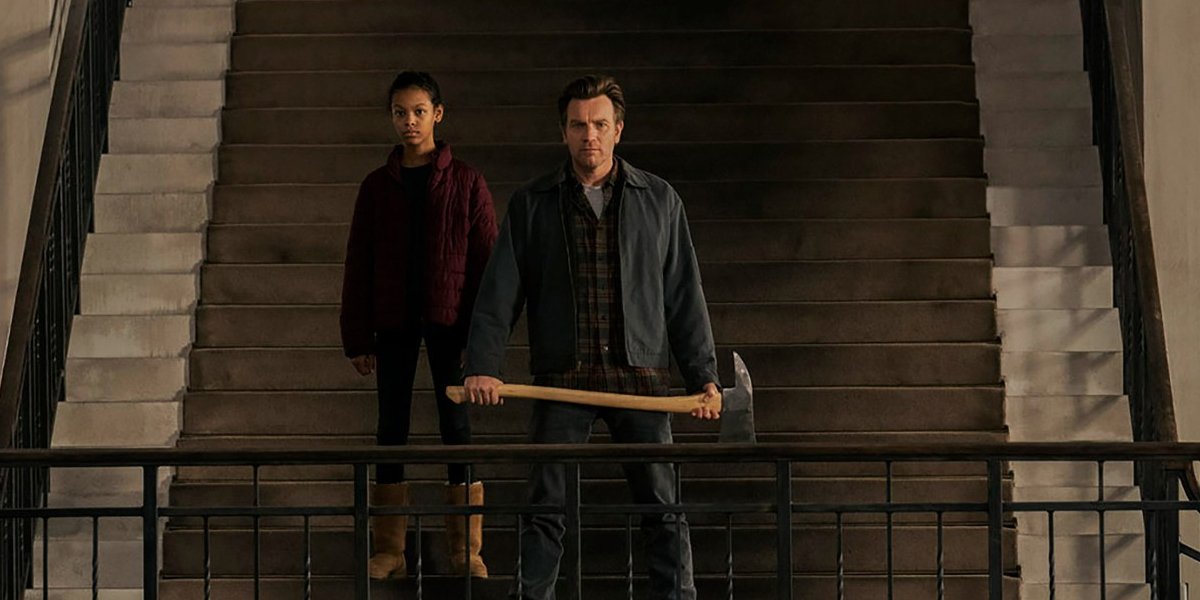
Whereas many of these decades-later sequels are content to rehash more or less the same story as the original, Doctor Sleep goes the other way, showing far more interest in the underdeveloped psychic abilities of Danny and others than in the haunting of malicious ghosts. This “shining” or “steam” that only a few individuals possess makes those people targets, not just for spirits but for a vampiric cult called the True Knot, led by the top-hatted Rose (Rebecca Ferguson), who seek out such gifted children to torture and consume their essence. Over the years, Danny has sunk into alcoholism and despair, yet when the spunky Abra (Kyliegh Curran), a particularly powerful wielder of the “shining,” makes herself known, Danny decides to help her fend off the unholy villains craving her power.

See the source image

One of the most interesting aspects of Doctor Sleep is that it almost feels like a superhero origin story. While Danny thought he had to suppress his psychic talents, young Abra revels in them and proves to be a match for Rose herself, putting the girl in even more danger. In that superhero vein, the good guys are unfailingly sympathetic, even lovable (I liked recognizing a RWBY figurine and poster in Abra’s room, perhaps connecting her own gifts with that show’s concept of semblance abilities), while the bad guys are irredeemably despicable. One scene of child torture could have been worse but went on uncomfortably long for my taste, even if it confirmed just how wicked the True Knot were.

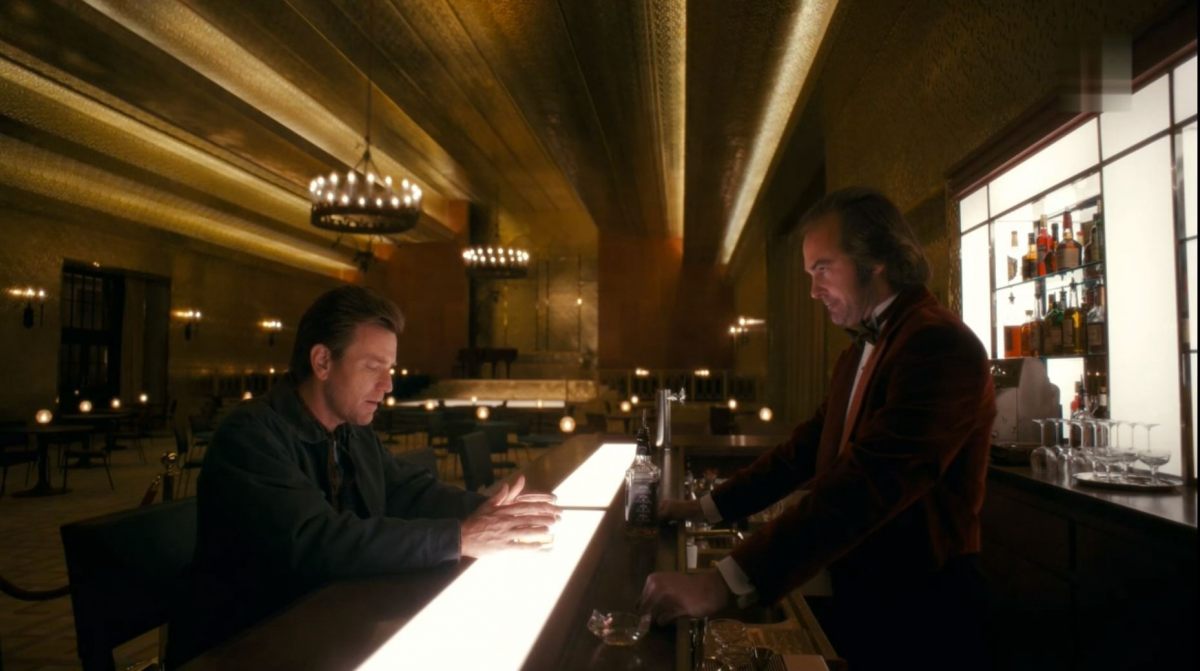
Of course, I would have liked it to be less R-rated, but the story itself and its thoughtful script is masterfully composed, from the gradual development of the True Knot’s nature to the psychic friendship between Danny and Abra to Danny’s overcoming of his latent shame and terror surrounding his childhood. One scene between Danny and the ghost of his father has some powerful dramatic tension that almost overshadows the horror tension that follows. It seems too long at two and a half hours, but it’s a length that feels deserved rather than unnaturally stretched like, say, the Hobbit movies. Another interesting creative choice is the recasting of Jack Nicholson, Shelley Duvall, and Scatman Crothers with very close lookalikes (including Henry Thomas as Jack Torrance) rather than any attempt at digital manipulation, which feels more natural even if the difference is unmistakable. And the film definitely points back to its roots by the end, providing some difficult catharsis that The Shining lacked.

See the source image

I’ve never been a huge fan of The Shining, even if I appreciate the iconic terror of its most memorable scenes. Too much was left unexplained for my taste, and as I said, it offered no closure to its tale of insanity. In contrast to the claustrophobia of the first film’s secluded setting, Doctor Sleep builds up a far more expansive world without wasting Danny’s history, an accomplishment that transcends its status as a horror movie. While The Shining prided itself on dread and insanity, Doctor Sleep actually manages some hope as well, which makes it the superior film, in my opinion. Director Mike Flanagan is no slouch when it comes to horror, and Doctor Sleep is a testament to his skill as writer and director. Even Stephen King himself said it “redeemed” his dislike for the first film, which is as high praise as any adaptation sequel could wish.

Best line: (Danny) “Our beliefs don’t make us better people. Our actions make us better people.”

Rank:  List Runner-Up

© 2020 S.G. Liput
701 Followers and Counting!

Happy Halloween, everyone!

2020 Blindspot Pick #4: Pom Poko (1994)

05 Monday Oct 2020

Posted by sgliput in Blindspot, Movies, Poetry, Reviews, Writing

≈ 1 Comment

Tags

Animation, Anime, Comedy, Drama, Fantasy

See the source image

Nature weeps “Farewell”
As mankind bids it “Hello.”
Neither understands.
_____________________

Some may look at the fact that I’m only reviewing #4 of my list of 12 Blindspots for the year in October as a sign of being way behind and perhaps despair because of it. I prefer to think, “Wow, I’ll have such a great sprint of good movies around the holidays!” Either way, I’m finally returning to my Blindspot series with Studio Ghibli’s Pom Poko.

See the source image

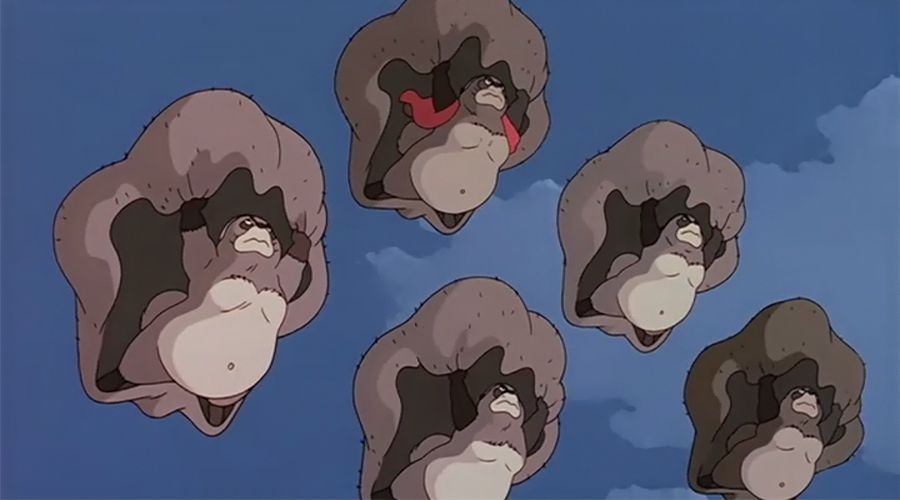
I’m very fond of the majority of the studio’s work, including the heartrending Grave of the Fireflies from the same director, but Pom Poko has never gotten much of a spotlight. Even in montages of various Ghibli movies, Pom Poko is pretty much relegated to one notable scene: a comical battle between two warring tribes of tanuki (Japanese raccoon dogs), which happens to be one of the very first scenes in the film. The rest of the movie was a mystery to me, so I was quite curious to see the rest of the story. Now that I have, I can see why it’s counted among the B-list of Ghibli classics, with the studio’s trademark charm and weirdness being overextended by length and repetition.

From the humorous battle scene on, the film often plays like a mythological nature documentary, explaining the many eccentricities of tanuki pulled straight from Japanese legend: their mischievous antics, shapeshifting abilities, penchant for parties, belly drumming, and…um, their prominent testicles. Yeah, more than anything else, that last point is probably why Pom Poko never hit it off in America. Folk tales tell of the many uses tanuki have for their shapeshifting male parts, and the movie runs with that (the English dub using the euphemistic “raccoon pouch”) as they’re shown expanding their “pouches” into parachutes and weapons. Just writing this feels bizarre, but hey, myths can be weird, especially considering raccoon dogs are a real species.

See the source image

As with many other Ghibli films, the story is an environmentalist fable, detailing the loss of the tanuki’s forest habitat as man and technology encroach further and further. (I find it interesting that the comic strip Over the Hedge debuted just a year after this film with a similar basic premise.) Much of the movie is spent with the creatures attempting to fight back, leading to some highly entertaining sections where they use their supernatural abilities to scare the unsuspecting humans away. However, from the moment they realize mankind’s threat to the point of no return, there are far too many scenes of the leaders debating their strategy, weighing their options, and trying the same things repeatedly. At nearly two hours, I felt like the film could have easily shed a half hour with little loss.

Director Isao Takahata, Miyazaki’s compatriot in heading the studio’s early releases, won my heart with Grave of the Fireflies, but nothing quite compares with that tragic masterpiece. Pom Poko is at least a visual treat, and the character animation swings wildly in depicting the tanuki as realistic animals, anthropomorphic bipeds, or cartoony caricatures, depending on the mood of the scene. The English dub (which Americanizes the tanuki as just “raccoons”) also boasts a talented voice cast, including Jonathan Taylor Thomas, Clancy Brown, Maurice LaMarche, Tress MacNeille, and J.K. Simmons.

See the source image

Aside from Spirited Away, Pom Poko might be the Ghibli film most wedded to Japanese culture; one extended scene has a master tanuki conjuring a horde of illusory yokai (Japanese spirits) to scare the humans, referencing stories that are no doubt far more familiar to Japanese audiences than Western ones. Plus, despite its cartoonish aspects, its themes and a few story elements are geared for somewhat older audiences compared to the more kid-friendly Ghibli options. Pom Poko is weird, overlong, creative, frequently delightful, wacky, and even bittersweet by the ending. It’s not likely to become a favorite, but I’m glad to have seen another entry from a legendary studio.

Best line: (Narrator, with a line you’ll never find in any other film) “They used their balls as weapons in a brave kamikaze attack.”

Rank:  Honorable Mention

© 2020 S.G. Liput
701 Followers and Counting!

42 (2013)

07 Monday Sep 2020

Posted by sgliput in Movies, Poetry, Reviews, Writing

≈ Leave a comment

Tags

Biopic, Drama, History

See the source image

Hate has a sound, neither quiet nor calm.
It’s harsh as a screaming match, loud as a bomb.
It hides where it can, but when called to resist,
It bursts on the scene, and it cannot be missed.

By fruits, you shall know it, by fire and fear,
By people too busy condemning to hear,
By pointing of fingers and counting of sins,
And seeing, not people, but labels and skins.

But how does one fight it? More fire and fear?
More yelling in hopes that bystanders will hear?
No mind has been changed meeting rancor with wrath,
But by the more difficult, opposite path.
_______________________

MPA rating:  PG-13 (mainly for multiple racial slurs and a few profanities)

Like so many others, I was heartbroken at the news of Chadwick Boseman’s passing on August 28, the very day that MLB was celebrating a belated Jackie Robinson Day, since it’s the day Robinson and Branch Rickey first met. The premature loss of a talented actor who played so many African-American icons has prompted a resurgence of regard for his past work, and it seemed only right to revisit 42, the story of baseball trailblazer Jackie Robinson. I had seen it years ago and, not being a baseball fan, vaguely logged it in the “good, not great” category, but I recall my dad really liking it and watching it several times. Now rewatching it with my mom, I enjoyed even more this true story that has become timelier with age.

See the source image

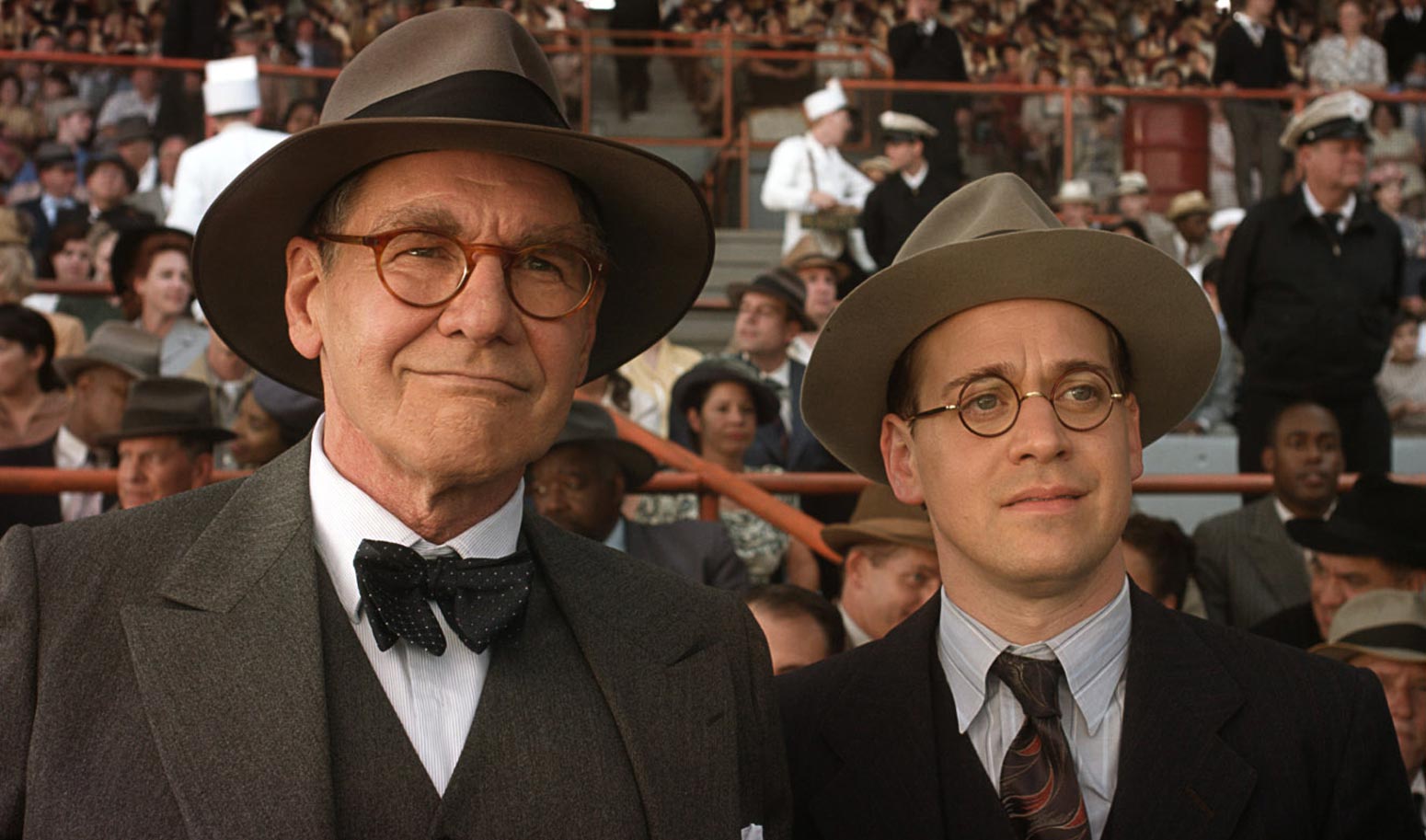
Aside from his history book summary, I wasn’t very familiar with Jackie Robinson’s story, but I was pleased when some further reading revealed how historically accurate much of 42 is, from individual lines of dialogue to the shared Methodist faith of Robinson (Boseman) and Dodgers owner Branch Rickey (Harrison Ford). It would have been so easy to turn the colorful Rickey into a mere caricature or lose the nuance of Robinson’s restraint. Yet both Ford and Boseman do outstanding work here, filling both characters with a realistic dynamism, Ford trying to disappear behind facial prosthetics and a Southern growl and Boseman embodying Christ-like nobility. The film itself might have been too pedestrian to be an awards contender, but I rather wish that the two of them could have gotten a nomination or two for their performances. In light of Boseman’s death, lines like “He was made to last” have also taken on a more bittersweet tone than before.

Perhaps the film’s themes are a bit on-the-nose at times, such as one mocked scene where a hesitant white boy starts yelling slurs at Jackie when he sees his father do the same. Yet I don’t doubt that such interactions do serve to perpetuate prejudices. That same boy is later shown looking regretful when he sees Jackie’s teammate Pee Wee Reese (Lucas Black, grown up since Tokyo Drift) put an arm around Jackie on the field. I know it feels a little manufactured since the kid probably would have been raised to be used to such language, but it still serves as an example of how children can be shaped by what they see and hear. Bigotry or its opposite don’t come from society as a whole, at least not anymore, but from individual interactions that shape how we view each other, so the film’s message still rings true.

See the source image

At a time when racial disparities and injustices have come to the forefront of national debate, 42 feels like a shining example of how to combat racism on a one-on-one level. While Robinson later assisted Martin Luther King, Jr. in the civil rights movement, he epitomized King’s principle of nonviolence on the field, having “the guts not to fight back”, as Rickey tells him, even while being lobbed by blatant abuse. I loved the perceptive line “Echo a curse with a curse, and they’ll hear only yours,” while the alternative plays out beautifully when Robinson’s hesitant teammates take his side over the sneering vitriol of an opposing team’s manager (Alan Tudyk). Turning the other cheek has gone out of fashion in our modern society, but the stronger the contrast between offender and victim, the more support there will be from good people to address such indignities. In every new or daring pursuit, there must always be a first, and, as the first, Jackie Robinson did untold good in moving the sport of baseball and the country closer to its ideals.

Best line: (Jackie Robinson) “You want a player who doesn’t have the guts to fight back?”
(Branch Rickey) “No. No. I want a player who’s got the guts not to fight back. People aren’t gonna like this. They’re gonna do anything to get you to react. Echo a curse with a curse, and they’ll hear only yours. Follow a blow with a blow, and they’ll say, “The Negro lost his temper,” that “The Negro does not belong.” Your enemy will be out in force… and you cannot meet him on his own low ground. We win with hitting, running, fielding, only that. We win if the world is convinced of two things: that you are a fine gentleman and a great baseball player. Like our Savior… you gotta have the guts… to turn the other cheek. Can you do it?”
(Jackie) “You give me a uniform… you give me a, heh, number on my back… and I’ll give you the guts.”

Rank:  List-Worthy

© 2020 S.G. Liput
699 Followers and Counting

I Lost My Body (2019)

20 Monday Jul 2020

Posted by sgliput in Movies, Poetry, Reviews, Writing

≈ Leave a comment

Tags

Animation, Drama, Fantasy, Foreign, Romance

See the source image

A hand without a body or a man without a hand –
Which would be more piteous or prone to reprimand?
The hand is guiltless, lacking fault; its owner bears the blame
Of entering a situation liable to maim.
The hand is helpless, lacking mind; its owner bears the thought
That they may wish to clap and clasp two hands and yet cannot.
The hand is listless, lacking will; its owner bears the task
Of moving on and living life behind a fragile mask.

The former owner bears so much, yet his lot I’d prefer
Than that poor hand that cannot even know how things once were.
Pity the hand but love the stump and all to it attached.
At bouncing back from tragedy, we humans are unmatched.
____________________________

Rating: TV-MA (should be PG-13)

I take the Best Animated Feature Oscar perhaps more seriously than others do. After superb anime films like Your Name or Maquia have been spurned in recent years, I take notice when the Academy deems other foreign films worthy of the honor of nomination. The seventh French production to earn such a nomination was last year’s I Lost My Body, a strangely poetic meditation on loss that happens to involve a severed hand.

See the source image

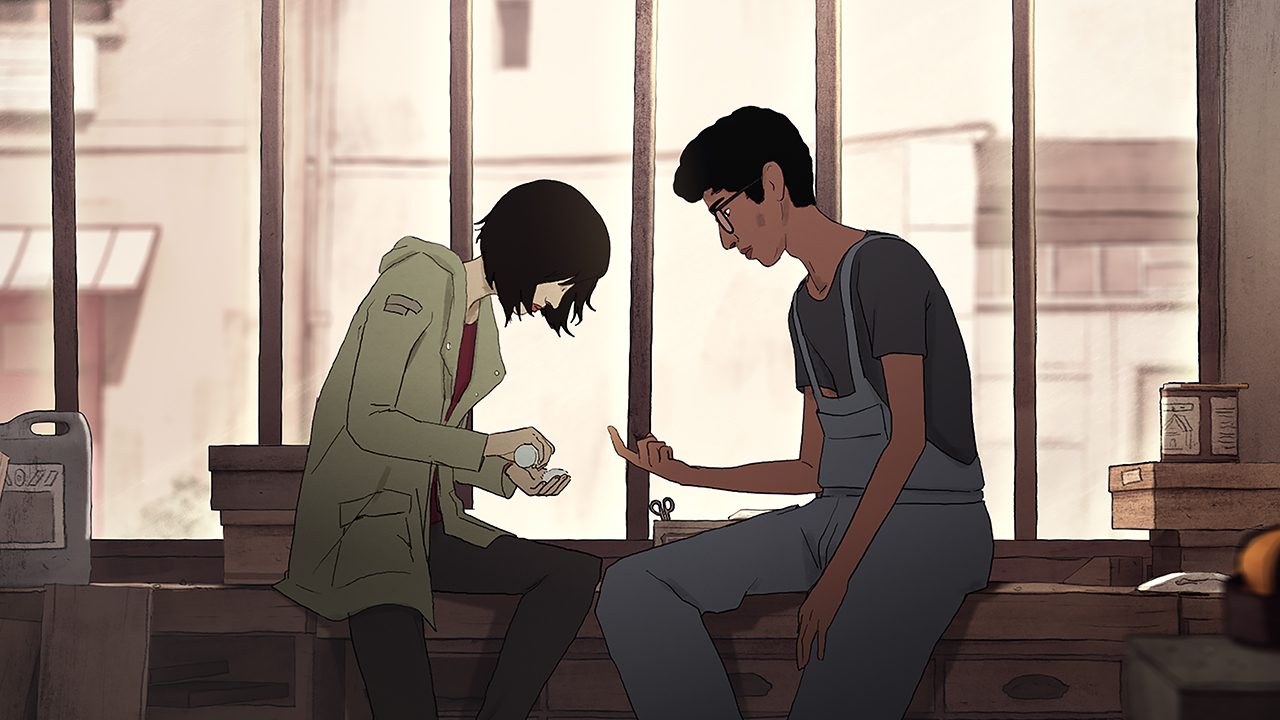
At first, we don’t know how the severed hand came to be, though; the film starts out with the appendage “waking up” in the macabre fridge of a hospital and figuring out how to walk and jump with its fingers, like a more mobile Thing from The Addams Family. Cut then to the past and sullen pizza delivery guy Naoufel (Dev Patel in the quite good English dub), whose childhood of joy and trauma is recounted in flashback throughout the film. In failing to deliver a pizza, he becomes acquainted with a librarian named Gabrielle (Alia Shawkat) and takes up a job as a woodworker to get closer to her. Edited into this more grounded story, Naoufel’s future hand (which is evident from a scar they both have) makes its way across Paris in search of its owner.

It’s hard to call any movie about an animate severed hand anything but strange and morbid, but I Lost My Body treats it as an extended metaphor, which, as I said before, grows surprisingly poetic, heightened by a memorably haunting score. The close calls of the hand’s travels across a dangerous urban landscape provide thrilling visuals, while Naoufel’s struggles offer bittersweet human drama. Naturally, the film’s ultimate lead-up is to how the hand and its owner were separated, which is both cringeworthy and deeply symbolic.See the source imageAs an art film that happens to be animated, I Lost My Body’s main drawback for me is how open-ended it is, not offering much closure beyond what viewers choose to interpret. What does the hand represent? It’s up to you, I suppose. At one point, Naoufel is criticized for not knowing another character is sick and accused of not truly caring; the film never mentions it again, so I guess the film doesn’t care much either. Despite this, I’ve often said that I enjoy animations that can delve into mature themes without wallowing in mature content, and I Lost My Body fits that laudable mold. Amid last year’s nominations, Missing Link was the weak link that should have been replaced last year, preferably with Weathering with You; while imperfect, I Lost My Body is a worthy nominee.

Best line: (Gabrielle) “Once you’ve dribbled past fate, what do you do?”
(Naoufel) “You try to keep away from it. You run blindly… and keep your fingers crossed.”


Rank: List Runner-Up


© 2020 S.G. Liput
697 Followers and Counting


Henry V (1989)

10 Friday Jul 2020

Posted by sgliput in Movies, Poetry, Reviews, Writing

≈ Leave a comment

Tags

Drama, History, War

See the source image

It seems the English language is intent on, over time,
Discarding excess letters, which are just an uphill climb.
In Milton’s and in Shakespeare’s era, words were often longer,
So literarians believe their eloquence was stronger.
Yet, slowly we have shed the eths and ests that ended verbs
And kicked the gifts of diction to their metaphoric curbs.
Not “dost” but “do,” not “thou” but “you,” not “wherefore,” no, but “why,”
And going back in time to read can make you want to die.

Yet, even now the language still is mutating in place,
With idioms and acronyms it can’t help but embrace.
The letter-shedding carries on with “YOLO”, “app,” and “ref”
And “LOL, JK, IDK WTF.”
Abbreviations have their place; archaic words as well;
For me, too much of either one is glossolalic hell.
So savor language while you can, for generations hence
May not know what the heck we’re saying when it’s in past tense.
________________________

MPA rating: PG-13 (for battlefield violence)

Since it’s been hard fitting this blog into my busy schedule of work and college, I’ve decided to try to shorten my reviews so I don’t end up posting only twice a month. Let’s start the compressed reviews with Shakespeare, shall we? I am not a fan of William Shakespeare. I’ve read Julius Caesar, Macbeth, and a few sonnets, and that’s quite enough for me. Even so, I feel I need to be familiar with his work, if only to be prepared for when I some day get on Jeopardy. So surely watching Henry V is better than reading it, right? I think so, at least, especially when brought to life by the accomplished Kenneth Branagh, who both directed this 1989 epic and played the title character.

See the source image

Knowing nothing of the original play, I was intrigued by the framing device of a one-man Chorus (Derek Jacobi) providing an introduction and occasional commentary throughout. Branagh is intense and committed as the young King Henry, who sets out on a supposedly justified war to claim kingship of France, and he delivers the big speeches with enough stirring authority that you can believe the patriotism he inspires in his men. I recognize that Shakespeare’s poetry-flecked prose is eloquence epitomized, but the simple fact is that it was a constant effort to understand what was being said, which would have been even harder without captions. The action on-screen made it clearer at least, so perhaps it would be easier to read the play now that I know what happens. Plus, the presence of seasoned thespians elevated the production even more, such as Brian Blessed, Ian Holm, Paul Scofield, and even early roles for Christian Bale and Emma Thompson (who married Branagh the same year).

Henry V might well be one of the finest faithful Shakespeare adaptations; I just haven’t seen many others to give it due comparison. Branagh’s treatment, though, is certainly praiseworthy, and one climactic tracking shot after the Battle of Agincourt was awe-inspiring to behold. You can’t do that on any stage, after all. With its nearly three-hour runtime, I was tempted to give up, but I typically try to finish any movie I start, and I’m glad I did. (Still not a Shakespeare fan, though.)

See the source image

Best line: (Henry, addressing the troops) “And Crispin Crispian shall ne’er go by from this day until the ending of the world but we in it shall be remembered. We few, we happy few, we band of brothers, for he today who sheds his blood with me shall be my brother. Be he ne’er so vile, this day shall gentle his condition, and gentlemen in England now abed shall think themselves acursed they were not here, and hold their manhoods cheap whilst any speaks, that fought with us upon St. Crispin’s day!”


Rank: Honorable Mention


© 2020 S.G. Liput
697 Followers and Counting

Knives Out (2019)

29 Monday Jun 2020

Posted by sgliput in Movies, Poetry, Reviews, Writing

≈ Leave a comment

Tags

Drama, Mystery, Thriller

See the source image

I don’t quite believe that the truth is subjective,
A trite protocol
That changes and varies
‘Twixt contemporaries,
From person to person.
Such thoughts only worsen
The idea that truth isn’t out there at all.

No, no, there is truth, even-handed, objective,
But often concealed
In worry and caring,
Fake news and red herring.
It leads us on chases
To unpleasant places.
The few who keep up get to see it revealed.
__________________________

MPA rating: PG-13 (a bit heavy on language, as much as they could fit in while retaining its rating)

I still have Blindspots to catch up on, but it seemed past time to watch a movie that I’ve been wanting to see since it came out last year (until a certain virus kept me from the second-run theater I was planning to visit). The murder mystery genre has fallen by the wayside in recent years, but if any film can revitalize it, Rian Johnson’s Knives Out is the one to do it. Being a fan of Johnson’s contentious The Last Jedi, I was eager to see what he’d do next, and Knives Out did not disappoint.

See the source image

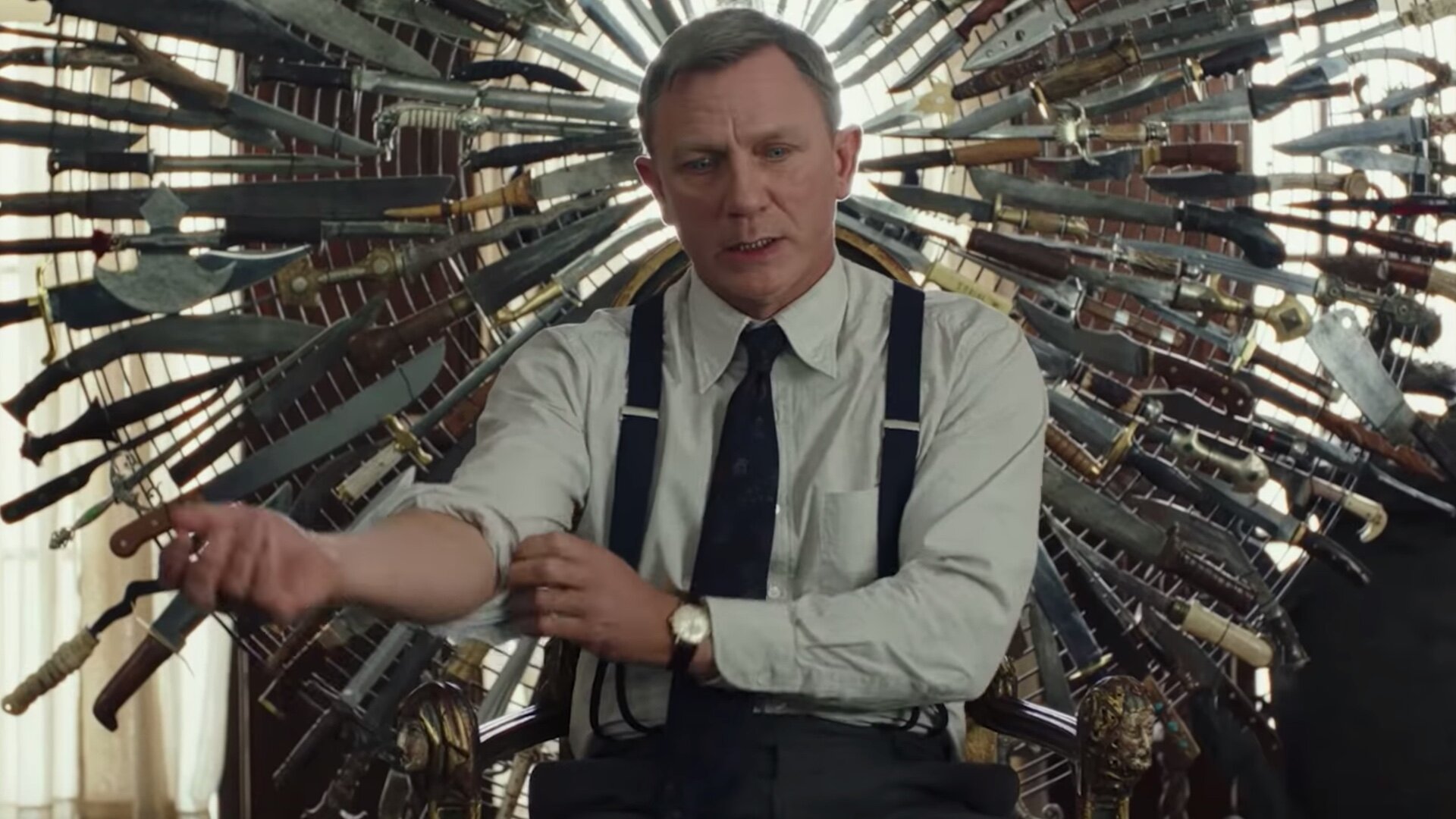
Named after the Radiohead song of the same name, the film doesn’t waste time getting to the murder, as the first scene involves the morning discovery of mystery writer Harlan Thrombey’s body (Christopher Plummer) after he apparently cut his throat in his study sometime during the night. Like so many other classic mysteries, the large ensemble cast is full of splashy characters, most of whom have a potential motive for the Thrombey patriarch’s death. At first, there doesn’t seem to be a main character as detectives (Lakeith Stanfield, Noah Segan) interview Harlan’s discordant family: his arrogant daughter (Jamie Lee Curtis) and her husband (Don Johnson), his insecure son (Michael Shannon), and his self-absorbed daughter-in-law (Toni Collette), among others. Gradually, though, famed Detective Benoit Blanc (Daniel Craig, handily covering his British accent with a Southern drawl) takes the stage, as does Marta Cabrera (Ana de Armas), Harlan’s personal nurse who physically cannot tell a lie.

Replete with flashbacks to the night of Thrombey’s death, Knives Out is artfully organized to show only what Rian Johnson wants to show, which is often more than you’d expect. In fact, the story seems to show its cards much earlier than you’d expect from a film over two hours long, seeming to go from a mystery to a cover-up, but it still has plenty of twists to trigger second-guessing and culminates in true murder mystery form with some climactic revelations. And through it all, the story’s convolutions and colorful characters played by actors in peak form (including Chris Evans) make for prime entertainment.

Craig is likably hammy as his Benoit Blanc doesn’t always seem as self-aware as a master sleuth should, though he proves his deductive abilities by the end; and Ana de Armas is a special stand-out in what is likely a star-making role, considering she was singled out for a Golden Globe nomination, as was Craig. Considering the overwhelmingly positive reception Knives Out has received, including being named one of AFI’s Top Ten Films of the Year, I’m actually a bit surprised it didn’t get more attention at the Oscars beyond a Best Original Screenplay nod; with all the flashbacks in the Thrombey mansion, I would think it deserved some attention for editing or production design.

See the source image

The murder mystery genre has been so oversaturated over the years, from cozy Hallmark mysteries to decades of primetime series, that it’s a noteworthy exception when one can warrant this kind of all-star cast and big-screen appeal, subverting and embracing clichés in equal measure. Boasting a sly political subtext that paints both sides negatively and lauding compassion over selfishness, Knives Out proves that, in the right hands, any genre can be resurrected. Rian Johnson hit gold here, and I can’t wait to see if he can hit it again with the inevitable sequels to which Benoit Blanc lends himself.

Best line: (Blanc) “The complexity and the gray lie not in the truth but what you do with the truth once you have it.”


Ranking: List-Worthy


© 2020 S.G. Liput
695 Followers and Counting

2020 Blindspot Pick #3: Annie Hall (1977)

15 Monday Jun 2020

Posted by sgliput in Blindspot, Movies, Poetry, Reviews, Writing

≈ Leave a comment

Tags

Comedy, Drama, Romance

See the source image

Love is hard to pin down –
What it is, where it’s from,
Why it makes you a clown
Or remarkably dumb,
Why it strokes you one minute with gentle caress
And pounds you the next with a cold callousness,
Why it fills you with joy at a memory made
That turns bittersweet as the joyful times fade,
Why it brings you to tears
At the thought of a laugh,
Why the grain is so worth
The abundance of chaff.
No, I can’t explain it, doubt anyone could.
You’ll know when you feel it, the bad and the good.
________________________

MPA rating: PG (should be PG-13 nowadays)

Have you ever watched a movie that you can appreciate for everything it does well but still just not connect with it? That was my reaction to Annie Hall. This Best Picture-winning rom com is among Woody Allen’s most iconic films, and I can see why. From innovative storytelling to an insightful script, it deserved acclaim, but I can only offer it so much.

Allen himself plays Alvy Singer, a neurotic Jewish comedian, who after a couple failed marriages, falls for the offbeat beauty Annie Hall (Diane Keaton), with whom he shares a rollercoaster of a romance. The longer I watched Annie Hall, the more a thought continued to grow in my mind: “This is just like (500) Days of Summer!” Sure, Alvy has little in common with Joseph Gordon-Levitt’s character in that much later film, but there were so many parallels: the non-linear storyline, the quirky girlfriend, the occasional use of split-screen, the digressions with unconventional styles (an animated sidebar here vs the musical number in the other), the ultimate depression as a once happy romance peters out. The 2009 film is practically a remake, though not exactly, sort of how I felt about the plot similarities between Hidden and A Quiet Place.

See the source image

Annie Hall has so many creative choices that just feel unique and revolutionary even, such as Alvy repeatedly breaking the fourth wall, the visual representation of how a lover feels distant, characters’ inner thoughts being shown as subtitles to contrast with what they’re saying, or his discussions with random people on the street as if they were parts of his subconscious. And then there were the plethora of cameos, from Paul Simon and Carol Kane in larger roles to Christopher Walken used for a one-off gag, not to mention certain stars who had yet to become famous, like Jeff Goldblum, John Glover, and Sigourney Weaver.

And yet, for all those strengths that I enjoyed, I was left feeling oddly cold. For the film being considered the 4th greatest comedy by AFI, I recall a chuckle here and there but no big laughs; it was full of lines where I didn’t laugh but instead thought, “That’s humorous,” which doesn’t seem like what a comedy should do. Perhaps it was the presence of Woody Allen himself. His overly neurotic Alvy, obsessed with death and Jewish discrimination, is quite a character, but I couldn’t stand to be around someone like him in real life. Plus, there’s the mental baggage of the real-life Allen and the scandalous allegations surrounding him. My VC says he makes her skin crawl and didn’t enjoy the film because of him; the only film with him she rather liked was The Curse of the Jade Scorpion, in which he’s constantly disparaged.

See the source image

So, I guess I can count Annie Hall with so many other classics that just didn’t quite live up to expectations, right alongside the likes of The Third Man and The Philadelphia Story. I can appreciate it for its groundbreaking eccentricities, but when I consider that it won Best Picture over Star Wars, I just have to shake my head. Considering all the things I liked in Annie Hall, I just thought I would like the whole package more.

Best line: (Alvy Singer’s Therapist) “How often do you sleep together?”
(Annie Hall’s Therapist) “Do you have sex often?”
(Alvy, lamenting) “Hardly ever. Maybe three times a week.”
(Annie, annoyed) “Constantly. I’d say three times a week.”


Rank: Honorable Mention


© 2020 S.G. Liput
692 Followers and Counting


2020 Blindspot Pick #2: Double Indemnity (1944)

01 Monday Jun 2020

Posted by sgliput in Blindspot, Movies, Poetry, Reviews, Writing

≈ 1 Comment

Tags

Classics, Drama, Romance, Thriller

See the source image

A murderer for money never thinks that he or she
Will be found out like all the rest who murdered foolishly.
“Those others never thought it through; they never planned it out;
They just weren’t careful to remove the slightest shred of doubt.
They acted on an impulse, failed to hide the fatal flaw,
But we would know exactly how to circumvent the law.
We’re smarter, right? More clever, right? When one of us commits,
No justice could contend in this, the coldest war of wits.”

Deep down within the killer’s mind, unconsciously or not,
They soothe themselves with thoughts like these to justify their plot.
And always they delude themselves, for justice, soon or late,
Will find out every criminal and lead them to their fate.
________________________

Rating: Passed/Approved (an easy PG)

Darn, I did not expect to post only one review in the whole month of May, but college is as college does. Nevertheless, I’m back to continue my long-delayed Blindspot series. (Now I’m only four behind this year!) I’ve heard of Double Indemnity for years, noticing its high placement on lists by AFI and other film organizations, yet I never really knew what the name even meant, not being versed in insurance terminology. As it turns out, I’ve seen versions of this plot plenty of times on true crime shows, but this influential film noir treatment brought it to a national audience way back in 1944.

See the source image

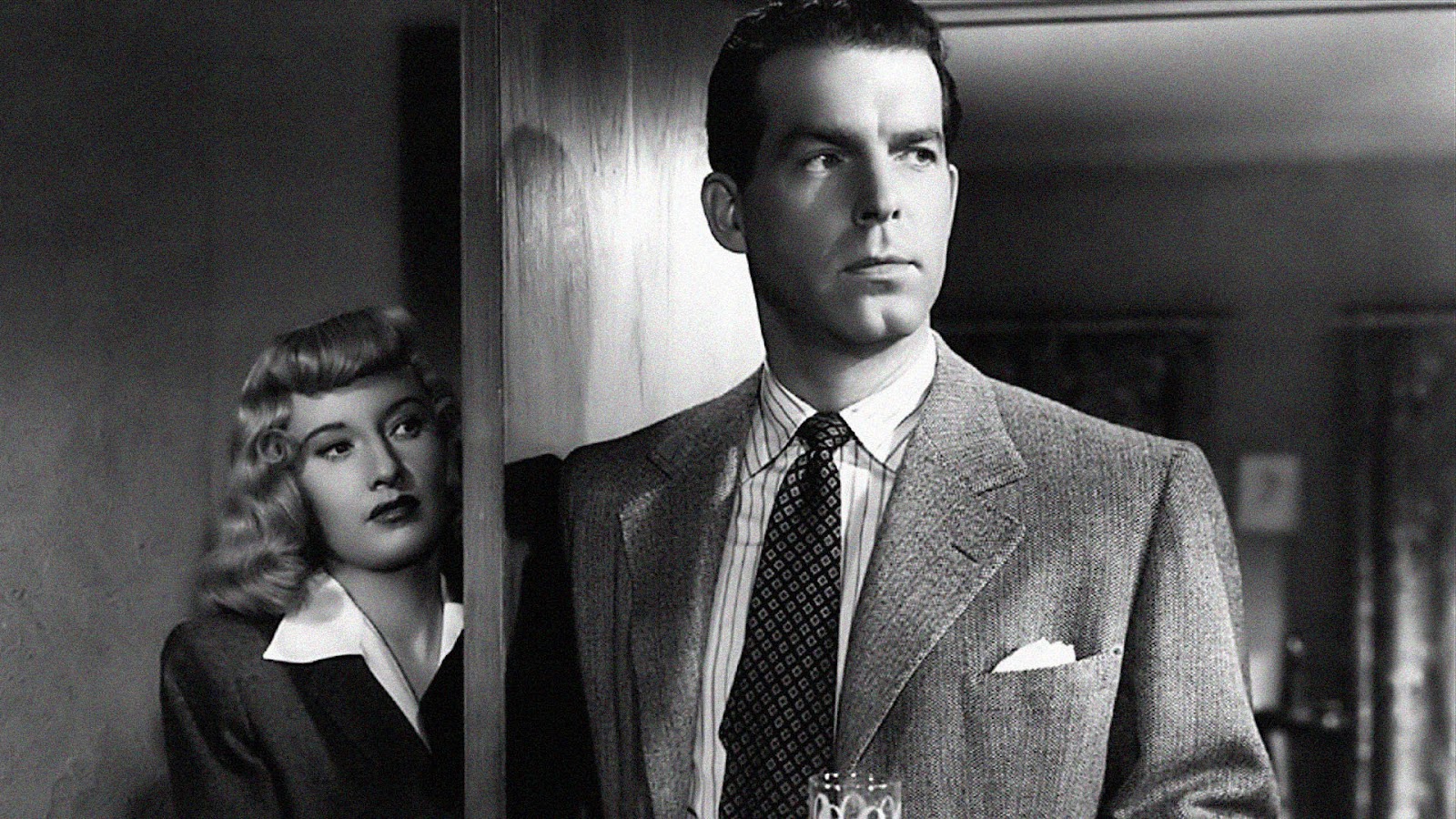
Based on a James M. Cain novella, the script for Double Indemnity was the result of a tenuous collaboration between director Billy Wilder and famed detective novelist Raymond Chandler. As such, it utilizes a clever tool for narration; right from the beginning, insurance salesman Walter Neff (Fred McMurray) admits into a dictaphone his role in the death of a man named Dietrichson, beginning an extended flashback of his plot. After meeting the man’s alluring wife Phyllis Dietrichson (Barbara Stanwyck), Neff allows her to talk him into a murder conspiracy to get rid of her distant husband and collect on some ill-gotten life insurance, with Neff using his insurance experience to sweeten the pot with a double indemnity clause (which doubles the payment in the case of certain unlikely causes of death, such as a train accident). Yet, their “perfect crime” slowly unravels as Neff’s boss (Edward G. Robinson) becomes more and more suspicious during the investigation.

I haven’t seen many films of the film noir genre, but Double Indemnity certainly fits the bill with its shadowy angles and conspiratorial tension and indeed predates the widespread use of the term by a couple years. Plus, Barbara Stanwyck is a quintessential femme fatale figure, manipulating McMurray’s everyman character into taking charge of the plot she initiates. The film was apparently controversial for its portrayal of murder, which is tame by today’s standards, but the characters’ growing anxiety after the deed is done translates well to the audience. As Neff is forced to “assist” Robinson’s skeptical insurance man in following a trail that leads back to him, I happened to think of other similar plots that must have taken some inspiration from this one, such as 1987’s No Way Out.

See the source image

Double Indemnity is a Grade-A film noir, but I can’t say it’s a new favorite since film noir is far from my favorite genre. Neff and Stanwyck do a fine job as the conspirators, but their cynically flowery dialogue, sometimes clever, is also sometimes a bit much, carrying on metaphors in ways people just don’t talk, though that’s mainly at the beginning. Robinson, though, is in top form here, stealing his scenes with a vocal panache that can’t be taught. I don’t always have to love a film to recognize it as a classic, and Double Indemnity is, another cinematic testament to the lesson “crime does not pay.”

Best line: (Neff) “Do I laugh now, or wait till it gets funny?”


Rank: List Runner-Up


© 2020 S.G. Liput
689 Followers and Counting

← Older posts
Newer posts →

Recent Posts

  • We Didn’t Start 2025 (Recap)
  • NaPoWriMo 2025 Recap (Finally)
  • Sonic the Hedgehog 3 (2024)
  • It Happened One Night (1934)
  • Spellbound (2024)

Recent Comments

associatesofshellymann's avatarassociatesofshellyma… on My Top Twelve La La La So…
Kit's avatarKit Nichols on Bonnie and Clyde (1967)
lifelessons's avatarlifelessons on Look Back (2024)
Carol Jackson's avatarCarol Jackson on The Thief of Bagdad (1940…
Stephen's avatarStephen on Love Story (1970)

Archives

  • January 2026
  • December 2025
  • May 2025
  • April 2025
  • March 2025
  • February 2025
  • January 2025
  • December 2024
  • May 2024
  • April 2024
  • March 2024
  • February 2024
  • January 2024
  • December 2023
  • November 2023
  • October 2023
  • September 2023
  • July 2023
  • June 2023
  • May 2023
  • April 2023
  • March 2023
  • February 2023
  • January 2023
  • December 2022
  • November 2022
  • October 2022
  • September 2022
  • August 2022
  • July 2022
  • June 2022
  • May 2022
  • April 2022
  • March 2022
  • February 2022
  • January 2022
  • December 2021
  • November 2021
  • October 2021
  • September 2021
  • August 2021
  • July 2021
  • June 2021
  • May 2021
  • April 2021
  • March 2021
  • February 2021
  • January 2021
  • December 2020
  • November 2020
  • October 2020
  • September 2020
  • August 2020
  • July 2020
  • June 2020
  • May 2020
  • April 2020
  • March 2020
  • February 2020
  • January 2020
  • December 2019
  • November 2019
  • October 2019
  • September 2019
  • August 2019
  • July 2019
  • June 2019
  • May 2019
  • April 2019
  • March 2019
  • February 2019
  • January 2019
  • December 2018
  • November 2018
  • October 2018
  • September 2018
  • August 2018
  • July 2018
  • June 2018
  • May 2018
  • April 2018
  • March 2018
  • February 2018
  • January 2018
  • December 2017
  • November 2017
  • October 2017
  • September 2017
  • August 2017
  • July 2017
  • June 2017
  • May 2017
  • April 2017
  • March 2017
  • February 2017
  • January 2017
  • December 2016
  • November 2016
  • October 2016
  • September 2016
  • August 2016
  • July 2016
  • June 2016
  • May 2016
  • April 2016
  • March 2016
  • February 2016
  • January 2016
  • December 2015
  • November 2015
  • October 2015
  • September 2015
  • August 2015
  • July 2015
  • June 2015
  • May 2015
  • April 2015
  • March 2015
  • February 2015
  • January 2015
  • December 2014
  • November 2014
  • October 2014
  • September 2014
  • August 2014
  • July 2014
  • June 2014
  • May 2014
  • April 2014
  • March 2014
  • February 2014
  • January 2014
  • December 2013

Categories

  • Blindspot
  • Blogathon
  • Christian
  • Movies
  • Music
  • NaPoWriMo
  • Poetry
  • Reviews
  • TV
  • Writing

Meta

  • Create account
  • Log in
  • Entries feed
  • Comments feed
  • WordPress.com

Recent Posts

  • We Didn’t Start 2025 (Recap)
  • NaPoWriMo 2025 Recap (Finally)
  • Sonic the Hedgehog 3 (2024)
  • It Happened One Night (1934)
  • Spellbound (2024)

Recent Comments

associatesofshellymann's avatarassociatesofshellyma… on My Top Twelve La La La So…
Kit's avatarKit Nichols on Bonnie and Clyde (1967)
lifelessons's avatarlifelessons on Look Back (2024)
Carol Jackson's avatarCarol Jackson on The Thief of Bagdad (1940…
Stephen's avatarStephen on Love Story (1970)

Archives

  • January 2026
  • December 2025
  • May 2025
  • April 2025
  • March 2025
  • February 2025
  • January 2025
  • December 2024
  • May 2024
  • April 2024
  • March 2024
  • February 2024
  • January 2024
  • December 2023
  • November 2023
  • October 2023
  • September 2023
  • July 2023
  • June 2023
  • May 2023
  • April 2023
  • March 2023
  • February 2023
  • January 2023
  • December 2022
  • November 2022
  • October 2022
  • September 2022
  • August 2022
  • July 2022
  • June 2022
  • May 2022
  • April 2022
  • March 2022
  • February 2022
  • January 2022
  • December 2021
  • November 2021
  • October 2021
  • September 2021
  • August 2021
  • July 2021
  • June 2021
  • May 2021
  • April 2021
  • March 2021
  • February 2021
  • January 2021
  • December 2020
  • November 2020
  • October 2020
  • September 2020
  • August 2020
  • July 2020
  • June 2020
  • May 2020
  • April 2020
  • March 2020
  • February 2020
  • January 2020
  • December 2019
  • November 2019
  • October 2019
  • September 2019
  • August 2019
  • July 2019
  • June 2019
  • May 2019
  • April 2019
  • March 2019
  • February 2019
  • January 2019
  • December 2018
  • November 2018
  • October 2018
  • September 2018
  • August 2018
  • July 2018
  • June 2018
  • May 2018
  • April 2018
  • March 2018
  • February 2018
  • January 2018
  • December 2017
  • November 2017
  • October 2017
  • September 2017
  • August 2017
  • July 2017
  • June 2017
  • May 2017
  • April 2017
  • March 2017
  • February 2017
  • January 2017
  • December 2016
  • November 2016
  • October 2016
  • September 2016
  • August 2016
  • July 2016
  • June 2016
  • May 2016
  • April 2016
  • March 2016
  • February 2016
  • January 2016
  • December 2015
  • November 2015
  • October 2015
  • September 2015
  • August 2015
  • July 2015
  • June 2015
  • May 2015
  • April 2015
  • March 2015
  • February 2015
  • January 2015
  • December 2014
  • November 2014
  • October 2014
  • September 2014
  • August 2014
  • July 2014
  • June 2014
  • May 2014
  • April 2014
  • March 2014
  • February 2014
  • January 2014
  • December 2013

Categories

  • Blindspot
  • Blogathon
  • Christian
  • Movies
  • Music
  • NaPoWriMo
  • Poetry
  • Reviews
  • TV
  • Writing

Meta

  • Create account
  • Log in
  • Entries feed
  • Comments feed
  • WordPress.com

Blog at WordPress.com.

  • Subscribe Subscribed
    • Rhyme and Reason
    • Join 814 other subscribers
    • Already have a WordPress.com account? Log in now.
    • Rhyme and Reason
    • Subscribe Subscribed
    • Sign up
    • Log in
    • Report this content
    • View site in Reader
    • Manage subscriptions
    • Collapse this bar