• Home
  • About Me
  • The List
  • THE LIST (2016 Update)
  • THE LIST (2017 Update)
  • THE LIST (2018 Update)
  • THE LIST (2019 Update)
  • THE LIST (2020 Update)
  • THE LIST (2021 Update)
  • THE LIST (2022 Update)
  • Top Twelves and More
  • The End Credits Song Hall of Fame

Rhyme and Reason

~ Poetry Meets Film Reviews

Rhyme and Reason

Tag Archives: Anime

2018 Blindspot Pick #10: Into the Forest of Fireflies’ Light (2011)

20 Tuesday Nov 2018

Posted by sgliput in Blindspot, Movies, Poetry, Reviews, Writing

≈ 2 Comments

Tags

Animation, Anime, Drama, Fantasy, Romance

See the source image

When the forest’s green carpet was dappled with light,
The trees standing stolid in blithe oversight,
I cried, a mere child, alone on my knees,
And lost with no help from the untroubled trees.

I don’t know how long I stayed, venting vain tears,
For he found me, as when a rainbow appears,
And though I perhaps should have harbored unease,
I beamed at the man, standing masked among trees.

I tried to embrace him, but he dodged the act
And said he would vanish from human contact,
For spirits like him are too fragile to squeeze,
And so we stood separate, surrounded by trees.

I doubted his words, yet I welcomed his care,
As he led us back homeward, a curious pair.
And though he said not to, tomorrow the breeze
Will lead me back to him, a ghost among trees.
______________________

MPAA rating: Not Rated (easily a G as far as content)

Blindspot picks are supposed to be films that one has been meaning to see for a long time and hasn’t gotten around to it. Into the Forest of Fireflies’ Light (or Hotarubi no Mori e) certainly fits that definition for me. It has long been included in other people’s lists of favorite anime, typically alongside Studio Ghibli films, and I couldn’t put it off anymore. I was even proud that I had been able to avoid spoiling the ending, and now that I’ve seen it… I don’t want to say I’m disappointed, just that I thought there would be more to it.

See the source image

I should have known not to expect too much, based on positive reviews noting its simplicity, and indeed that simplicity is one of its key strengths. The story follows the relationship of a girl named Hotaru who, while lost in a forest at six years old, meets a young man in a mask. Though he insists that no human should touch him, lest he disappear forever, she continues to visit him, and the two become close friends. Despite the invisible barrier of physical contact, they even begin to love each other, as the girl grows older, returning to the spirit forest year after year.

That’s as much as I knew going in, and while there’s a bittersweet payoff that admittedly does hit the emotions hard, that’s pretty much the whole story. There aren’t any subplots and not many extra characters, and frankly the tale didn’t need them. As seen in Makoto Shinkai’s works, such as The Garden of Words, anime films don’t necessarily have to be of feature length to realize their intended effect, and 44 minutes was just right for this one.

See the source image

I will say that it could have been very easy for the story to come off as creepy by nature. After all, a lost little girl meets a masked man in the woods, who hits her with a stick (when she tries to touch him). It might have been a hard sell just describing the plot like that, but instead it’s a sweet friendship/romance that might leave many a viewer brushing away tears. Perhaps its length kept it from hitting me hard enough for that, or perhaps I was just expecting too much, but Into the Forest of Fireflies’ Light still worked well as a mini-tearjerker with some lovely animation from the studio Brain’s Base, albeit nothing exceptional. With a few traces of Ghibli-esque whimsy, it’s a touching little fantasy for those looking for a tug on the ol’ heartstrings.

Best line: (Hotaru) “Time might separate us some day. But, even still, until then, let’s stay together.”


Rank: Honorable Mention


© 2018 S.G. Liput
594 Followers and Counting


Flavors of Youth (2018)

20 Monday Aug 2018

Posted by sgliput in Movies, Poetry, Reviews, TV, Writing

≈ 1 Comment

Tags

Animation, Anime, Drama, Romance

See the source image

I’ve had the chance to learn and grow
From where I was ten years ago,
And though time’s neither fast nor slow,
It’s galloped past me even so.

I know,
I know,
I’m not that old.
Not old enough to be consoled
For past regrets and words untold
When still on destiny’s threshold.

Yet worry knows no age or race.
It’s but a trace time can’t erase,
Not even at its breakneck pace.
And such are truths we all must face
As past and future we embrace.
_____________________

Rating: TV-PG (nothing objectionable, just themes best appreciated by adults)

For those who loved Makoto Shinkai’s Your Name, it’s naturally a grueling wait for his next anticipated feature, but in the meantime, CoMix Wave Films, the production studio for Shinkai’s movies, has filled the gap nicely by teaming with the Chinese animation house Haoliners. In place of Shinkai, Flavors of Youth has three different directors, each delivering a dramatic entry for this Netflix anthology film. Surprisingly, the result is a satisfying substitute that boasts both visual beauty and honest emotion in equal measure (as well as a solid English dub).

See the source image

While the names and settings are clearly Chinese rather than Japanese, Flavors of Youth has all the aesthetic quality of a well-crafted anime film, and while Japanese animation can so often be associated with explosive battles and yelling, this belongs to the more introspective and relatable side of anime. The first of the three short stories revolves around a young man’s memories of the San Xian noodles he ate while growing up, which may seem overly simple, but the true-to-life details and poetic narration by narrator extraordinaire Crispin Freeman (of Haruhi Suzumiya fame) added to its impact. The second film was a bit less engaging for me, focusing on two sisters in the fashion world, but the story ended nicely and didn’t detract from the film overall. The third, though, entitled “Shanghai Love Story,” is especially affecting with its likable characters and sad irony, and any fan of Shinkai is bound to admire it.

While the themes are far from niche, I felt that the individual stories were aimed precisely at people like me, twenty-somethings uncertain about the future and nostalgic for good ol’ days which weren’t all that long ago yet seem to be fading before our eyes. The first story best encapsulated these sentiments and the way that memories and regrets always outlive their source. Cherished businesses close, loved ones die, and modern replacements never quite reach the glory of our recollections and hopes.

See the source image

Yet unlike some other films I could name (I’m looking at you, 5 Centimeters Per Second), Flavors of Youth doesn’t settle with being depressing and finds hope in the promise that comes with building off those precious memories. This anthology may fall that little bit short of greatness, but those who enjoyed Shinkai’s work, such as The Garden of Words, should not miss it; just don’t expect another Your Name, and certainly nothing supernatural. I feel like I’ve grown fonder of this film since first seeing it, thanks especially to an after-credits scene that barely tied the stories together, and it’s a gratifying sign that Shinkai’s influence is clearly spreading. There are several anime films I’m dying to see this year, especially Maquia and Mirai of the Future, so I’m grateful that Netflix supplied this wistful little film while I wait.


Rank: List Runner-Up


© 2018 S.G. Liput
589 Followers and Counting


In This Corner of the World (2016)

24 Tuesday Apr 2018

Posted by sgliput in Movies, NaPoWriMo, Poetry, Reviews, Writing

≈ 5 Comments

Tags

Animation, Anime, Drama, Foreign, History, Romance, War

See the source image

(Today’s NaPoWriMo prompt was for a hopeful elegy, so I wrote mine about the mourning of a way of life.)


What’s almost as sad as a person’s death
Is the death of the way that they lived.

They once woke up, knowing what their day
Would likely hold,
And they’d watch unfold
A normal we’d say
Was strange and old,
But they took pride
And personified
A life that bloomed till the world went cold.

Disasters sudden or a cancer slow
Or new breakthroughs
Would cause them to lose
What was status quo.
They could not refuse,
For who can tell
A dead bloom, “Get well,”
When its winter’s come and it’s paid its dues?

But people live on, like roots that remain
For new blooms to rise
Once the former dies
And forgets the pain
Of its sad demise.
Our ways of life fade
Daily and are remade.
Remember that grief is short-lived for the wise.
___________________

MPAA rating: PG-13

And the number of award-worthy animated films of 2016 just keeps on growing. When I heard that a crowdfunded project called In This Corner of the World had beaten out Your Name and A Silent Voice for Japan’s Best Animated Feature award, I rolled my eyes that anything could top those two emotional hits. I still would have preferred one of them to win, but I can now at least see why In This Corner of the World would deserve to win. (It’s also further proof that the American Academy can’t seem to recognize an award-worthy animation if it hails from another country.)

Set before, during, and after the Hiroshima bombing of August 6, 1945, this Japanese period drama has a slice-of-life charm and simplicity that endures the ever-looming shadow of death. In many ways, it is reminiscent of Grave of the Fireflies (a painful favorite of mine), yet while that film is essentially grief and desperation from start to finish, In This Corner of the World uses its long runtime to show the daily life of its characters and how the approaching war changed that way of life for the sake of survival.

See the source image

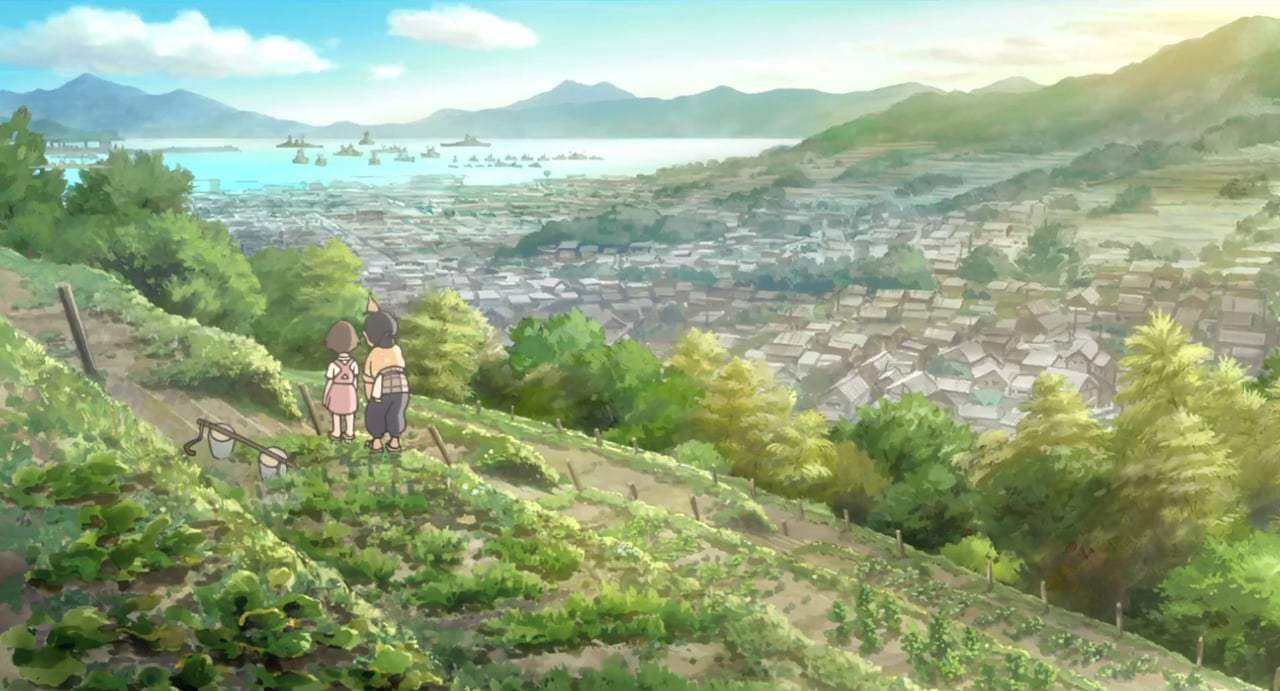
It begins with the childhood of Suzu Urano, an often absent-minded artist who grows up in an idyllic seaside town close to Hiroshima. After receiving an offer of marriage from a man she doesn’t know, she hesitantly leaves her own family to marry into the Hojo family in Kure, a Navy dockyard about an hour away by train. There is a wealth of humorous vignettes as Suzu adjusts to her new surrounding and family members, including a short-tempered sister-in-law and her daughter, and many aspects of their daily life are steeped in Japanese culture, from the fashioning of kimonos and later pants to the preparation of traditional field-to-table meals, which require resourcefulness once wartime rationing is implemented. From amusing asides and sweet romantic moments, the tone gets more and more serious and even dire as the war gets closer, the bombing raids become more frequent, and we the audience wait for the inevitable bomb to drop, wondering how it will affect Suzu and her loved ones.

The abrupt editing of all those vignettes does contribute to a sometimes unfocused storyline that puts certain details in doubt, and a few forays into Suzu’s imagination left me confused as to whether surrounding scenes were supposed to be real or not. Yet such negatives don’t detract too much from the humane power of the whole. Perceptive details and lovely snapshots abound, notably a post-war scene where the town’s lamps are uncovered (no longer in fear of air raids) and one by one shine into the night. The animation is not your typical anime style, with more of a gentle, hand-drawn impressionism that can be reminiscent of either a comic strip or a museum piece, depending on the tone of the scene. It’s surprisingly effective in its consistency depicting both Suzu’s carefree early life and the grief-stricken toll of war, and the filmmakers put great and laudable care into re-creating the pre-bomb city of Hiroshima accurately.

See the source image

Once again, I’m torn on how to rank what is clearly a great film, trying to judge my personal opinion of it. It’s absolutely worthy of Japan’s top animation prize, and I can see why they would opt for the more historically significant choice, even over the box-office juggernaut that was Your Name. Despite its winsome animation and gradually developed poignancy, it didn’t bring me close to tears like Your Name or A Silent Voice or Grave of the Fireflies, which matters to me as a way of measuring the emotional impact. Even so, I feel like I’m growing fonder of this film the more I think about it. Perhaps its ultimate ranking is a wait-and-see. It requires some patience, but I highly recommend In This Corner of the World for its touching civilian-level view of World War II.

Best line: (Suzu, comparing her current life to a dream) “I don’t want to wake up because I’m happy to be who I am today.”   (Shusaku, her husband) “I see. The past and the paths we did not choose, they’re like a dream.”


Rank: List Runner-Up (for now)


© 2018 S.G. Liput
564 Followers and Counting


Girls und Panzer der Film (2015)

09 Monday Apr 2018

Posted by sgliput in Movies, NaPoWriMo, Poetry, Reviews, Writing

≈ 3 Comments

Tags

Action, Animation, Anime, Comedy, War

See the source image

(Today’s NaPoWriMo prompt was to combine something big and something small, like maybe tanks and girls for example. Inspired by this silly anime, I wrote a fake account of how tank warfare might become a girls’ sport.)


Years past, the tanks rolled into town
And terrorized the folk.
With dread renown,
Each new crackdown
Would paint the sky in smoke.

They came in force to crash and kill
And crush with cannon fire.
Such lethal will
They did fulfill;
The people’s need was dire.

One fateful day, a young girl eyed
An empty tank left bare.
She seized with pride
This chance supplied
By carelessness and prayer.

Against all odds and common sense,
She drove the tank somehow.
Her zeal intense,
In her town’s defense,
She raised every eyebrow.

She shocked the foe, confused their ranks,
And drove them from the land;
And it’s all thanks
To her that tanks
And girls go hand in hand.
_____________________

MPAA rating: Not Rated (PG is fine)

Anime has given us a lot of weird and wonderful concepts over the years, the kind you should just enjoy for their silliness and not think about too deeply, but making tank warfare a girl’s sport takes the cake for me. Even though I’ve never been particularly fond of tanks or the cute girl genre, Girls und Panzer was an admittedly fun ride, made even more fun by its big-screen follow-up.

See the source image

The 2012 TV series featured a ragtag group of girls from Ōarai High School rallying under the leadership of skilled but reluctant transfer student Miho in order to win a series of tank war games and stave off the closing of their school and town, which happen to be on top of a giant aircraft carrier (yes, really). The characters are simple and likable, with most development reserved for Miho and her four closest friends. The rest of the vast cast gets the most basic development possible as members of other clubs that nonetheless contribute to the tank warfare, which seems to use real ammunition and has no regard for property damage, since the government underwrites everything as an official sport. The set-up is enjoyable enough, but the real draw here is the tank battles, explosive clashes between war machines that are depicted with surprising historical accuracy for the most part. At only twelve episodes long, the series is short but doesn’t lack thrills, as the underdog Ōarai team faces off against more accomplished high school teams that each conform to the trappings and tactics of a different nation (Americans, Russians, Italians, Germans, etc.).

See the source image

If any of this sounds entertaining, go watch it because it’s nice and short, and I’m about to spoil the ending. It’s probably no surprise, but Ōarai wins. Yet the movie doesn’t let that victory stand for long; one exhibition match later, the government is eager to shut the school down again, putting Ōarai in the exact same position of betting their school’s fate on a giant tank battle, this time against a University team. With this battle, however, they’re so hopelessly outmatched that their former rivals beaten during the series come to their aid and take part in one big tank free-for-all.

Like the series, there is some confusion at times over who’s in which tank, and what’s happening is not always as clear as it should be. Yet the battles are still quite well planned, putting different styles of tank to good use and employing some very clever strategy along the way. (One planning session between the allied teams is like an argument between the tactical methods of all the major countries of World War II.) While the show had some semblance of realism in the tank’s capabilities, albeit small, the movie goes full-out bonkers with tanks flying through the air, sliding down rollercoaster tracks, and zooming around like high-capacity bumper cars. Some of the casualties would carry more weight if anyone was actually in danger, but that apparently never happens in this sport, and it’s perfectly fine to stick your head out the top hatch while being shelled (really).

See the source image

This isn’t the first anime film I’d recommend to anyone, but it’s now high on my list of guilty pleasures just for how gleefully crazy and bombastic it gets. By the time the battle moves into a theme park to use the rides as unconventional weapons, I was just enjoying the outlandishness of it all, and finding unexpected satisfaction with every enemy tank disabled. Sure, it’s silly and predictable, but that’s sometimes the very definition of fun. There’s a whole future series of films planned, but it’s hard to imagine how they’ll top this one.


Rank: List Runner-Up


© 2018 S.G. Liput
552 Followers and Counting

Here’s a good representation of what to expect, if you’re curious:
 

Death Note (2017)

18 Sunday Mar 2018

Posted by sgliput in Movies, Poetry, Reviews, Writing

≈ Leave a comment

Tags

Anime, Drama, Fantasy, Horror, Thriller

See the source image


I sit here with my pen prepared
To dish out justice undeclared,
And when I write, no one is spared,
For who’s more right than I?
Most secret of dictatorships
With death upon my fingertips,
I munch upon potato chips
And choose who’s next to die.

They’ll fear the killer none can see
And puzzle at the mystery,
Not knowing it was always me
Who hands out just rewards.
Repaying vengeance now is mine;
The world will bend by my design.
How wise the man who wrote the line
That pens kill more than swords!
___________________

MPAA rating: R (for brief graphic violence and frequent language)

I’ve been nervous about checking out Netflix’s live-action Death Note movie, especially based on the reviews I’d read. Movie adaptations of anime have about the same track record as those based on video games, yet I really hoped that Netflix’s Death Note movie would be the one to break the mold. (I know it was originally a manga, but I mainly know the anime.) Its story has all the ingredients of a great psychological thriller, a battle of wills between a megalomaniacal teen with a killer notebook and a genius detective intent on bringing him to justice. I was never that invested in Ghost in the Shell or Dragonball and thus didn’t much care when their American versions flopped, but I am a definite fan of the Death Note anime. That’s why the recent American adaptation was such a disappointment, even as I saw traces of the good movie it almost was.

I suppose I’ll address the casting controversy first, allegations of whitewashing that I honestly don’t get. An American version has every right to be set in America, and moving the story from Japan to Seattle makes casting white actors perfectly reasonable. Japan does the same thing, even when it goes against the source material; just look at the all-Japanese casts of Attack on Titan or Fullmetal Alchemist, both of which are supposed to have European settings and characters, for the most part. Casting good actors should take precedence, which is why I also don’t mind Keith Stanfield as a black version of L, since he at least acts closer to the original character than the other actors.

See the source image

As that last statement implies, Death Note misses the mark most, not as a film in general, but as an adaptation. It may seem like a strange comparison, but it’s a lot like last year’s live-action Beauty and the Beast; they both could be reasonably fine movies if they weren’t entirely overshadowed by exceptionally better animated originals. The basics are there. Formerly named Light Yagami, Light Turner (Nat Wolff) is a gifted but resentful high school student who finds the mysterious Death Note, which claims to kill anyone whose name is written in it, usually by an unexplained heart attack unless a different method is specified. Goaded by a demonic death god named Ryuk (Willem Dafoe) and believing he can right all the wrongs of the world and become godlike, Light sets out to rid the world of criminals as the killer called Kira but runs into conflict with the eccentric detective known only as L.

Those are the basics, and the film follows them and asks similar moral questions of how one might use power over life and death. Yet there’s so much changed as well, from minor details to entire character arcs, and the changes are generally for the worse. Light and L start off close to their animated counterparts but end up with vastly different goals and mindsets. As I said Stanfield is appropriately weird and intense as L, though he’s shaken (by events that didn’t happen in the anime) to act with uncharacteristic rage at one point. Likewise, Wolff has a good sense of normalcy about him, making him unlikely to be suspected as Kira, but he also overacts on occasion, like the epic meltdown he has upon meeting Ryuk for the first time. He comes off as intelligent and crafty but hardly the self-assured genius from the anime; that Light went to painstaking lengths to avoid detection by anyone, while this Light brings the Death Note to school and uses it to show off to a girl named Mia (Margaret Qualley). This Mia (formerly Misa in the source material) is the biggest change of all; instead of being an airheaded Kira groupie with a Death Note of her own, she becomes a driving force for Light’s crimes and even tries to outsmart him, which is actually a more interesting direction for her character. The best direct translation to live-action is oddly enough the CGI one; Dafoe is perfectly cast as the sinister Ryuk, employing his Green Goblin voice with relish.

See the source image

In addition to all the character changes, the plot spins along trying to carve its own path while muddling its story. The Death Note in the anime did have a lot of rules as to its various uses, but the film loads on more to confusing effect and even seems to break a few. For example, people whose names are written in the note can be controlled for two days prior to their death, and Light tries to use this detail by writing someone with a single-word name, which I always assumed was fake. If he can do that, why not do it with L? The ending is actually pretty thrilling and finally reveals the depths of Light’s Sherlockian foresight and cleverness, but it also exaggerates the note’s abilities to the point of seemingly predicting the future rather than just controlling people.

As one last complaint, I also was disappointed that it had to be R-rated, likely thanks to director Adam Winguard’s reputation for horror. I enjoyed the anime because it gradually developed as a dark and compelling narrative, and did so without a single F-word or graphic decapitation. It was proof that you can explore dark material without going to extremes for extreme’s sake, something I wish Hollywood and Netflix would have learned. Oh, and what was with the soundtrack? Some of the songs were complementary, but others clashed really strangely, like playing Air Supply over the ending scenes.

See the source image

By the end, it seems open for a sequel, yet certain characters know things they shouldn’t and there’s no easy way to see how the story could continue in any direction that remotely resembles the original. There are traces of brilliance in the climax and in the confrontations between Light and L, yet I would much sooner recommend the anime over this misguided adaptation. Actually, I wish Netflix would take a real chance and make a movie out of Death Note: The Musical, courtesy of composer Frank Wildhorn, who is apparently popular enough in Japan that he was asked to musicalize Death Note. It’s actually quite good, and you can find it on YouTube, like here. I’ll just have to wait a little longer for that really good live-action anime adaptation (Your Name maybe) because sadly this isn’t it.

Best line: (L, to Light) “You’re the one who flew into the sun; I’m just here to make sure you burn!”


Rank: Dishonorable Mention


© 2018 S.G. Liput

540 Followers and Counting


For those familiar with Death Note, here’s a little parody video combining it with The Fairly OddParents that cracked me up, since they changed Light’s last name to Turner.
 

Cartoon Comparison: Train to Busan (2016) / Seoul Station (2016)

07 Wednesday Feb 2018

Posted by sgliput in Movies, Poetry, Reviews, Writing

≈ 2 Comments

Tags

Action, Animation, Anime, Cartoon Comparisons, Drama, Foreign, Horror, Thriller

See the source image

See the source image

When certain death surrounds you,
You’d be foolish not to fear,
To run and hide and save yourself
And those few you hold dear.

Yet in the face of jeopardy,
What will you sacrifice?
Your conscience and humanity?
For those too have a price.

For some, to care for more than self,
The risk may be too high,
But ask yourself how proud you’ll be
Both if and when you die.
________________________

MPAA rating for Train to Busan: Not Rated (I guess R but it’s not as bad as some)
MPAA rating for Seoul Station: Not Rated (should be R)

If someone had told me last year that the first movie I’d love in 2018 was a South Korean zombie flick, I’d never have believed it. I only half-believed all the positive buzz around Train to Busan because hey, it’s a zombie movie, and I don’t watch zombie movies. I’ve never seen Dawn of the Dead or The Walking Dead and have only really liked a precious few of that genre (World War Z, Warm Bodies). The living dead concept is intriguing, but usually it seems like an excuse for excessive gore and end-of-the-world futility. But for some reason I checked out Train to Busan, which I can now say is my favorite of the genre and honestly one of my favorite horror films period, mainly because it goes beyond its horror limitations to deliver exceptional thrills and emotional stakes worth caring about too. Since I loved Train to Busan then, I had to check out its animated prequel, if only for comparison’s sake, a prequel that reminded me exactly why I don’t typically enjoy zombie movies.

See the source image

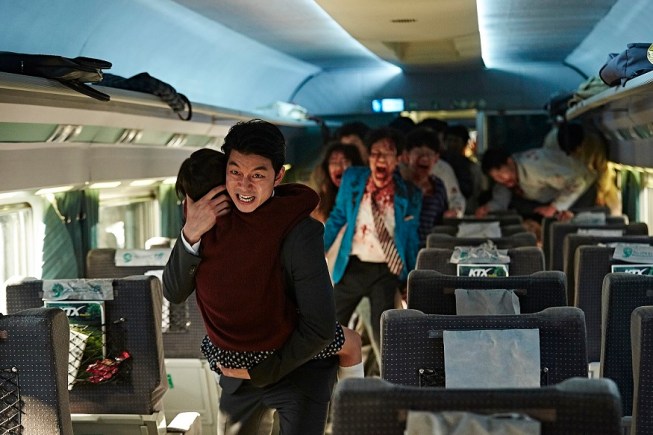
First, let’s focus on the good one. Train to Busan seems like such a simple idea: zombies on a train. It could easily have been the concept of a B-grade cheesefest, but the filmmakers went above and beyond to make it gripping. A big part of that is giving us worthwhile characters, particularly Seok-woo (Gong Yoo), a disengaged father who decides to accompany his young daughter Soo-an (Kim Su-an) as she returns to his ex-wife in Busan. There are various other passengers that quickly stand out as “survivor characters”: a man and his pregnant wife, a traumatized tramp, two high school students, and a self-serving businessman, among others. Things seem to start normally as the train sets out, but an abundance of warning signs builds the tension as a zombie outbreak engulfs the nation and the train itself. From there, it’s an all-out flight of survival with a few much-needed moments to catch one’s breath (even a disarming chuckle or two), but the suspense is ever-present. I don’t think I’ve been this tense during a movie since Dunkirk.

What’s impressive about Train to Busan is that it delivers the scares and shocks alongside an insightful character arc without sacrificing either. Seok-woo starts out as an apparent coward, fearfully closing a door in the face of someone fleeing the zombie onslaught, yet his self-first philosophy is called out in the criticisms of his daughter, while also playing out to an extreme in the uncaring actions of other passengers. The contrast between these mindsets imparts to the action some deeper themes behind it. There are sacrifices aplenty, some meaningful, some pointless, but the film seems to affirm the importance of helping others in the face of desperation rather than just oneself. To that end, the conclusion is surprisingly emotional as well, right up to the film’s anxious final moments.See the source imageSince I’ve said I don’t like the gory side of zombie movies, I should address that part of it. There is blood, but Train to Busan is still greatly restrained compared with a lot of others out there. Heck, some of the commercials for Walking Dead are worse than anything in Train to Busan. A big part of that is the absence of knives and guns, which draw maximum blood while also dehumanizing the still human-like zombies. (Sorry, but all the head-shots and such bother me.) Here, baseball bats are as bad as it gets, and most of the blood comes from the initial outbreak of zombies biting people’s necks. The fact that the victims quickly “turn” also does away with the whole flesh-eating element while also making the ever-growing horde even scarier. So I was thankful that the film didn’t rely on violence for its scares. In fact, after the initial outbreak, it’s really more of a fast-paced thriller than a horror. The zombies are the running type also seen in World War Z, and there are several moments that had me going “oh my gosh” as things devolve from bad to worse, often making great use of the visual effects.

How then does Seoul Station, from the same director Yeon Sang-ho, compare? It’s not exactly anime since it’s Korean rather than Japanese, but it has a similar visual style. I think it purports to be a prequel showing the origin of the zombie apocalypse, but it doesn’t really give any further details about the actual cause. A wounded homeless man is apparently patient zero, and while he slowly “turns,” we meet a runaway girl named Hye-sun who has a falling out with her cash-strapped and selfish boyfriend. The boyfriend is soon confronted by her father, and the two of them go in search for Hye-sun right as the city starts spiraling into zombie-infested chaos.See the source imageSeoul Station has some merit to it, mainly in the strictly horror department. There are some moments of genuine terror, particularly a white-knuckle encounter with a crazy woman, so if you enjoy zombie movies for the situational tension alone, you might like it. I, however, found plenty to dislike. For one, the animation, while mostly good, has the stilted look that 3-D-ish anime hasn’t gotten past, such as the way the characters walk. In addition, the gore and foul language (subtitled) are more pronounced here than in Train to Busan, and the characters are dumber compared to the rather clever survival techniques in its live-action counterpart. For one thing, everyone seems very slow to grasp the idea of a zombie outbreak, as if they’ve never heard of a zombie before, whereas Train to Busan showed that “zombies” were exactly where people’s minds went.

Still, I could look past most of that if the ending were worthwhile, but this is one case where the ending completely ruined it for me. The film pulls out a dark twist that pounds in the whole end-of-the-world futility I mentioned earlier I didn’t like. The characters are far less sympathetic, and the end only amplifies that. I didn’t hate the movie as I was watching it, but by the end, I did. Seoul Station tries harder to focus on its themes of class warfare, which were much more subtle in Train to Busan, yet it comes off as a cheaper offshoot of a much better original.See the source imageI’ve said before that I have very particular tastes when it comes to horror movies, but seeing two ostensibly similar zombie films side by side made me consider why exactly I loved one and hated the other. I can say I prefer genuine creepiness and atmosphere over gore, but in this case, I think it comes down to this (spoiler warning): I don’t like stories whose main purpose is killing off its characters. If there’s no survivor by the end, then everything that came before was pointless. If I actually care about the characters who live and die, then the end product becomes even better. That’s why Train to Busan exceeded my expectations. Clearly, I’m not about to become a fan of zombie movies in general, but I’m glad to have found one member of the genre that truly impressed me.

Best line (from Train to Busan): (Soo-an, pricking her father’s conscience) “Dad, you only care about yourself. That’s why mommy left.”


Rank for Train to Busan : List-Worthy
Rank for Seoul Station: Dishonorable Mention


© 2018 S.G. Liput
536 Followers and Counting


The Disappearance of Haruhi Suzumiya (2010)

18 Monday Dec 2017

Posted by sgliput in Movies, Poetry, Reviews, TV, Writing

≈ Leave a comment

Tags

Animation, Anime, Christmas, Drama, Mystery, Sci-fi

See the source image

The world can vex,
Annoy, perplex,
Explicitly and in subtext,
Till one objects
“Life’s too complex!
Just pain in our collective necks.”

Yet when life’s skewed
And comes unglued
And changes unforeseen intrude,
One’s sour mood
And attitude
Can be renewed by gratitude.
___________________

MPAA rating: Not Rated (should be PG-13)

Setting aside the multitude of stand-alone anime films, like those from Studio Ghibli, there are just as many movies based on anime series, which tend to fall into certain categories. There are those that essentially provide a recap for the series, such as the first two films based on Puella Magi Madoka Magica. Then there are those that tie into a series but can stand apart and be enjoyed with or without prior knowledge of the franchise, such as Cowboy Bebop: The Movie. But more often than not, a film designed to follow up the events of a TV series relies on previous knowledge of said series, which is hard to get just right. Sometimes it’s difficult to capture the same magic the show had or the spin-off just falls flat; as much as I loved the time travel story of Steins;Gate, for example, its reasonably good film continuation didn’t feel necessary. (By the way, I highly recommend all these shows I’m namedropping.) Yet if any movie proves that it’s possible to revive a series and deepen everything that came before, it’s The Disappearance of Haruhi Suzumiya.
See the source image

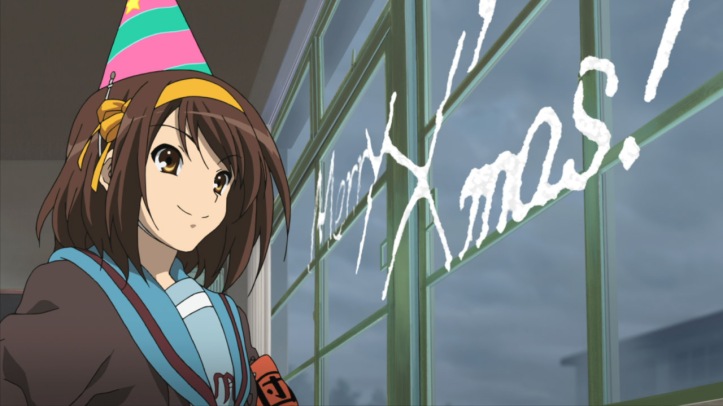
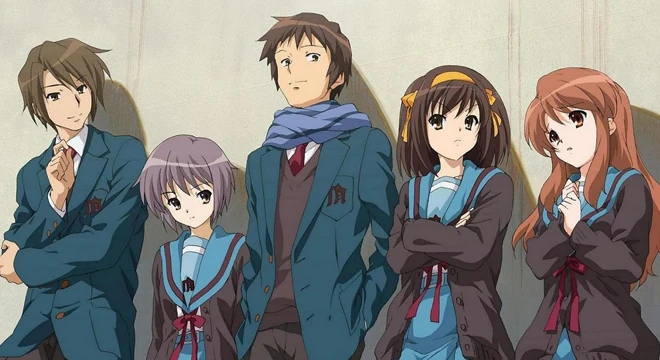
For those who don’t know, The Melancholy of Haruhi Suzumiya is a 2006 anime adaptation of a light novel series, which quickly grew in popularity, and its title character is one of the more recognizable anime icons. The main character, though, is Kyon (in the middle above), a high school student who falls into the orbit of the lovely, pushy, and highly capricious Haruhi (with the headband), involuntarily becoming a member of her new fun-seeking club dubbed the SOS Brigade. The other three club members Haruhi recruits turn out to be less-than-normal students and inform Kyon that Haruhi has godlike powers to reshape reality, which she doesn’t and mustn’t know about. Thus, the 2-season series follows their everyday adventures with the robot-like alien observer Yuki Nagato (the girl with purple hair), the time-traveling pushover Mikuru Asahina (girl with orange hair), and the good-natured but mysterious esper/psychic and king of exposition Itsuki Koizumi (the boy on the far left).

All of that information is much easier to digest in the series, which is light-hearted and charming for the most part. Haruhi tends to be obnoxiously bossy, such as exploiting poor Miss Asahina for sex appeal, but her craziness is nicely contrasted by Kyon’s straight man, who always complains and offers some perfectly amusing deadpan commentary. It’s a series that periodically incorporates science fiction into its prosaic high school setting and can be both fantastically complex and aggressively mundane, such as one episode with a four-minute stretch of nothing but Nagato silently reading or the infamous Endless Eight, in which eight consecutive episodes replayed the same events because the characters were stuck in a time loop. (The show gets a lot of heat and accusations of laziness for the Endless Eight, but it’s actually pretty impressive that the animators found eight different ways to present the same events and redrew each one.)

See the source image

If you’re not sure if all this sounds worth watching, it is, and not just because there’s a murder mystery and a talking cat and a giant alien cricket. It’s not because Melancholy itself is particularly amazing or great, though it is pretty entertaining. It’s because the show allows you to fully enjoy The Disappearance of Haruhi Suzumiya, the 2010 movie that supposedly drew plot from season 2 and forced the showrunners to fill time with the Endless Eight. It’s quite a feat that the movie makes the show worth watching, rather than the other way around. I honestly can’t think of another series-based movie that can say the same.

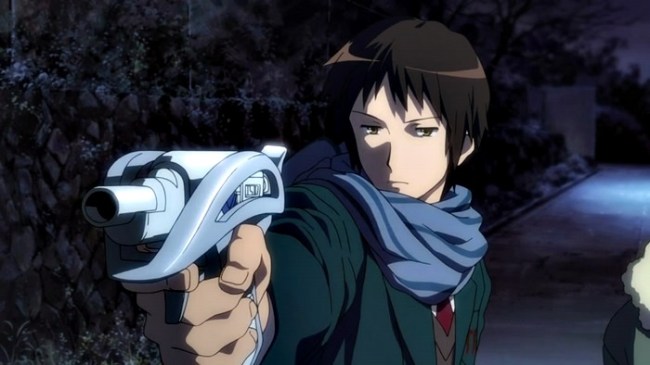
I’ve heard all kinds of praise for Disappearance, with fans naming it their favorite anime movie or claiming it ought to place in iMDB’s Top 250 (it’s currently #42 on iMDB’s animation list). And now that I’ve seen it, I can’t say I disagree. It’s an outstanding piece of animation that surpassed my expectations in every way. As the title indicates, Haruhi suddenly vanishes on December 18 (yes, I waited till today to post this review), the world apparently rewritten so that no one remembers her, except for Kyon, who is understandably perplexed at this inexplicable change. All the supernatural characters seem to be ordinary people now, and Kyon must figure out how to return the world to “normal” and perhaps even question which world is better.
See the source image

One of the more notable aspects of Disappearance is that it’s 163 minutes long, making it the second longest animated film of all time. It’s basically the equivalent of eight episodes of the series, yet despite its length, I was never bored. It’s hard to explain how unusual that is because the film is by no means action-packed. In contrast to the humor of the series, its tone is slow, serious, and melancholy. Unlike most anime films, there are no sweeping vistas or high-flying adventure; instead, it’s mostly winter cityscapes and interior scenes. How is it then that it held my attention from start to finish?

Well, aside from the fact that I’ve grown very fond of these characters, the plot manages to maintain interest in both the story and characters with some truly incredible pacing. Even with such a long runtime, there’s a lot of plot to cover, and the increased time allows characters’ motivations and the significance of their actions to sink in and add so much to their development. I don’t usually like to watch long movies, but this is one case where its length is carried largely by narrative and dialogue alone, and I’m glad nothing was cut, though I suppose Kyon’s awkward disorientation over his changed life could have been shortened.

See the source image

Whenever the pace threatens to lag, something significant is revealed and the moving orchestral score kicks in, making for some memorable scenes that feel like momentous turning points (the kind of scenes that would probably end an episode if this were broken up as part of the series). For example, the reappearance of one murderous character who should be dead is filled with the same looming menace as the coming of Jaws. In addition, despite the restraint compared with more fantastical anime, the animation is exceptional and quite detailed, with special attention paid to very expressive faces and the clouds of smoke that are breathed out in the cold Christmastime weather.

As much as I wish I could say to everyone “go watch this movie” with no strings attached, I must admit that the series is a prerequisite for understanding who everyone is. Even though seventeen minutes are spent establishing the status quo before Haruhi’s disappearance, almost every episode of the show is referenced at some point, which is great for those who’ve seen it, less so for those who haven’t. To cut some corners, I’d say you’d only really have to watch the first six episodes of season 1, the first episode of season 2, and the last entry in the Endless Eight. The rest aren’t as necessary, though you may not understand little things like Kyon trying to talk to a cat. I especially loved when time travel entered the equation of the film, and we got to revisit past scenes with a Back to the Future-style altered perspective, again something new viewers could just roll with but nostalgic viewers will understand better.

See the source image

Despite its potentially burdensome length, The Disappearance of Haruhi Suzumiya is a brilliant conclusion to a good series, transforming the show’s bright charm into subtle emotion and atmosphere. Hyperactive Haruhi herself can be irritating in large doses, so her absence for part of the film actually helps it and allows for some strong development for Kyon and especially Nagato, whose typically robotic face and voice finally get to reveal emotion in this alternate world. I also must point out, as others have before, that the English dub is one of the best out there. As the most significant voice actor, Crispin Freeman as Kyon provides some extensive and superb dialogue, such as an 8-minute soliloquy justifying a fateful decision, one which manages to engender both sympathy for him and regret for how it impacts another character. I’ve seen people refer to this speech as one of the greatest interior monologues of all time and with good reason, as it’s a key validation of his character.

I can usually tell how I feel about an animated film by whether I want to immediately watch it again after it’s over, and yes, all 163 minutes of Disappearance did just that. No, it’s not my new favorite anime film, but to those hesitant to watch a series just to see an overlong movie, I’ll just say you’re missing out.

See the source image

Best line: (Haruhi, to Kyon about Christmas) “You have to believe in a dream if you want to have one in the first place. If you don’t believe, even the dreams that can come true won’t.”


Rank: List-worthy


© 2017 S.G. Liput
519 Followers and Counting



2017 Blindspot Pick #11: Giovanni’s Island (2014)

01 Friday Dec 2017

Posted by sgliput in Blindspot, Movies, Poetry, Reviews, Writing

≈ Leave a comment

Tags

Animation, Anime, Drama, History

See the source image

‘Tis futile to wish our lives never to change,
To stay in the bliss of a child’s outlook.
We’re always disturbed by the new and the strange,
Priorities puzzled as they rearrange,
Things hardly confined to the page of a book.

The friends that we make and the loved ones we lose
Accompany us just as far as they can.
And when we have finally paid all our dues
And traveled the path that each person must choose,
Perhaps we will see ‘twas all part of a plan.
____________________

MPAA rating: Not Rated (probably PG)

Boy, just like with Donnie Darko, finding a copy of this film for my Blindspot was harder than I thought, hence why I’m a day late for this November pick. I’m always on the lookout for emotional anime films, and Giovanni’s Island promised to have something of the tragic quality of Grave of the Fireflies, which still makes me cry every time I see it. Giovanni’s Island undoubtedly borrows from the 1988 film and actually reminded me of several others as well, from the Russian exile of Doctor Zhivago to the childish friendship disrupted by war of The Boy in the Striped Pajamas. It also draws explicit inspiration from the Japanese novel Night on the Galactic Railroad, which is apparently a great classic in Japan, though it’s not surprising if most are unfamiliar with it. Some knowledge of that story might help one’s understanding of certain scenes in the movie. (It does have an anime adaptation too, which is dream-like, very slow, full of symbolism and Christian references, and might have vaguely influenced The Polar Express.)

See the source image

The first parallel to Night on the Galactic Railroad is the names of the two brothers who live in a small fishing village in the far northern Japanese islands toward the close of World War II. Junpei (nicknamed Giovanni) and Kanta (nicknamed Campanella) draw their Italian-sounding names from the main characters of the book, a favorite in their family, which ignites their fascination with both the stars and trains. While the villagers expect the Americans to take control after the war is lost, it’s instead the Soviets, who waste no time in establishing themselves and commandeering the Japanese homes and school building. Despite being driven from their house, young Giovanni and Campanella befriend a Russian girl named Tanya, but the conflict and stresses of the adults around them soon strain their relationship and send the brothers away from their beloved island into the unknown.

Despite being produced by Production I.G., the same studio behind Ghost in the Shell, the animation in Giovanni’s Island is different from their other works. The sketched environments and setting details are masterful, and one scene of a front-lit toy locomotive passing between two rooms showed an amazing attention to light and shadow. The character animation, on the other hand, wasn’t bad, but I found it somewhat distracting at times. Despite all anime sharing similarities of style, character design can vary significantly, and it’s a distinction that can be very subjective with its appeal. It’s not as if it was ugly (like One Piece, in my opinion), but the look of the characters sometimes brought me out of the story, though I did get used to it with time.

See the source image

There’s a lot to enjoy about Giovanni’s Island, particularly scenes designed to tug at the heartstrings. In an early scene, the school building is divided between the Russian and Japanese children, and each classroom sings their own national songs to try to drown the other out, while each room later sings the other’s song. Similarly, Giovanni becomes quite close to Tanya, and though the language barrier is barely addressed, it was encouraging to remember that children’s interactions are so much simpler than adults harboring resentment and hate. Another touchstone seemed to be Empire of the Sun, as the two siblings are soon separated from their father and cast into the harsh post-war realities of internment camps, all seen through the eyes of a child. The parallels to Grave of the Fireflies are blatant toward the tearful end, though there are differences, such as the fact that Giovanni and Campanella are never completely abandoned, at least accompanied by their teacher and uncle most of the way. Despite the similarities, it’s not a complete ripoff since the familiarly tragic end also draws from Night on the Galactic Railroad, along with several wondrous dream sequences that recreate scenes from the book.

Giovanni’s Island has plenty of moving drama, some of it probably seen before, but it presents it with warmth and sincerity, as well as grief. It didn’t make me cry like Grave of the Fireflies, but the final scene brought me close. I’m just a sucker for those kinds of poignant death-transcending reunion scenes, so it ended on a high note for me. I also enjoyed a repeated musical cue I recognized as “Those Were the Days,” a Mary Hopkins hit from the ‘60s, which recycled the tune of a traditional Russian folk song, making its use in the film more authentic. A somber tale of loss and survival that never becomes objectionable, Giovanni’s Island may combine elements from better films, but they’re combined beautifully nonetheless.

See the source image

Also, you can click here for a somewhat less rosy review from Rachel of Reviewing All 56 Disney Animated Films and More!, who also had this as her November Blindspot.

Best line:  (Giovanni, when asked what Night on the Galactic Railroad is about) “When people die, they rise up into the heavens and become stars in the night sky. Those countless stars fill the sky, shining brightly and eternally, and we live our lives down here, basking in their light. That’s what the story is about.”


Rank: List Runner-Up


© 2017 S.G. Liput
517 Followers and Counting


Cartoon Comparison: Ghost in the Shell (1995, 2017)

05 Sunday Nov 2017

Posted by sgliput in Movies, Poetry, Reviews, Writing

≈ Leave a comment

Tags

Action, Animation, Anime, Cartoon Comparisons, Drama, Sci-fi, Thriller

Image result for ghost in the shell 1995

Machine and man will merge one day,
Inevitably, some would say,
And what that day will look like
It is hard to visualize:

Computers in our brains perhaps,
Robotic limbs that won’t collapse,
And access to the Net unlike
The world can now surmise.

Yet as the world drives faster still
Our cybernetic dreams to fill,
Did any on this Progress Pike
Doubt whether this is wise?
__________________

MPAA rating for 1995 version: Not Rated (should undoubtedly be R for violence and nudity)
MPAA rating for 2017 version: PG-13

Ghost in the Shell is widely considered a classic, a game-changer for anime and the cyberpunk genre, and its growing niche popularity was bound to get Hollywood’s attention sooner or later. I, however, had little desire to see it due to its prominent violence and nudity, and it was only when the live-action adaptation with Scarlett Johansson was released that I felt I had to see it for comparison’s sake. And to be quite honest, I’m not much of a fan of the original or its remake, though that doesn’t mean they weren’t worth watching, and I found different things to appreciate in both versions.

Image result for ghost in the shell 1995

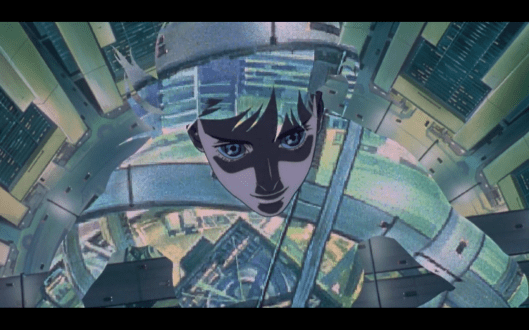
The original 1995 film has plenty of ardent fans, but I’d be lying if I didn’t admit that it’s a tad overrated. I can’t deny its influence on the cyberpunk subgenre, particularly The Matrix, which borrowed its falling lines of green data and the characters’ neck interfaces to plug into the Net. After seeing it, the Wachowskis even reportedly told producer Joel Silver that they wanted to “do that for real,” though at least they had the imagination to come up with an original story rather than a straight adaptation. Ghost in the Shell was also a forerunner for other dark cyberpunk anime like Ergo Proxy and Psycho-Pass, but I guess I just don’t find such soulless, cyberized dystopias very appealing.

Yet it’s not the world it creates that falls short, since the terrifically detailed animation doesn’t disappoint, but the story itself does. After an assassination mission that establishes Section 9 as a no-nonsense branch of the future Japanese police force, we get a convoluted tale of a rogue hacker called the Puppet Master, which has more twists than substance and culminates by the end with very little resolution. The main character named Major Makoto Kusanagi, a cyborg officer who works best without clothes, delivers sober monologues about identity and technology but doesn’t really have much personality. The side characters are actually more interesting than her, like her lens-eyed partner Batou or non-cyberized member Togusa.

Image result for ghost in the shell 1995

I suppose it’s easy for Ghost in the Shell to coast on its visuals and supposed depth; it does have some thrillingly iconic scenes, like an invisible smackdown on a fleeing thug, and some worthwhile themes about the necessity for variety and growth do manage to counter the moments of ponderous introspection. I will say the nudity is gratuitous. You could argue that Kusanagi’s thermoptic camouflage is built into her skin so she has to be naked for it to work, but other Ghost in the Shell installments show that there are entire uniforms that can go invisible. Critics have delved into deep themes like posthuman femininity, but I’m convinced it’s just fan service.

The 1995 Ghost in the Shell film is the franchise’s most famous incarnation, but it’s not the best. Even if the film left me cold, I was impressed by its two-season spinoff series called Ghost in the Shell: Stand Alone Complex. It’s got some of the same hard-to-follow philosophizing and excessive violence, but the overarching stories carry more depth when developed over a season’s length, which also allows far better characterization for Kusanagi and everyone else too, like the other members of Section 9 that are barely acknowledged in the movie. After seeing the two films that summarize Stand Alone Complex (and a follow-up film called Solid State Society), I find that the 1995 film’s story is even less impressive by comparison. I can’t bash the original Ghost in the Shell too much since it does appeal to some people more than me, but I would suggest that its fans check out the series for some much better storylines. (On a side note, Stand Alone Complex might also have had some influence in the West. For fans of The Dark Knight, remember when the Joker threatens a hospital to convince random civilians to try to kill Coleman Reese? I now see that it’s suspiciously similar to a scene from SAC’s season 1, in which a super-hacker takes over the minds of random citizens to carry out an assassination attempt. Interesting….)

Image result for ghost in the shell 1995 beatup

Now what about America’s take on Ghost in the Shell, which didn’t do much to improve people’s poor opinions of live-action anime adaptations? It’s actually not that bad an adaptation in my opinion because I consider many of its flaws to be flaws the first film had. I, for one, don’t mind Scarlett Johansson’s casting, regardless of the inevitable whitewashing accusations, since others have pointed out that the cast is still plenty diverse and needed a bankable star. Even if her character is renamed Major Mira Killian, her status as a cyborg with only her brain remaining human makes her appearance relative and changeable, and the film even works in a way to contrast her current appearance with her original identity. I’ve seen critics complain about potentially deep themes that aren’t fleshed out enough, a lack of personality for Johansson’s character, and a generally lackluster story, but I felt that was the case for the original too.

Image result for ghost in the shell 1995

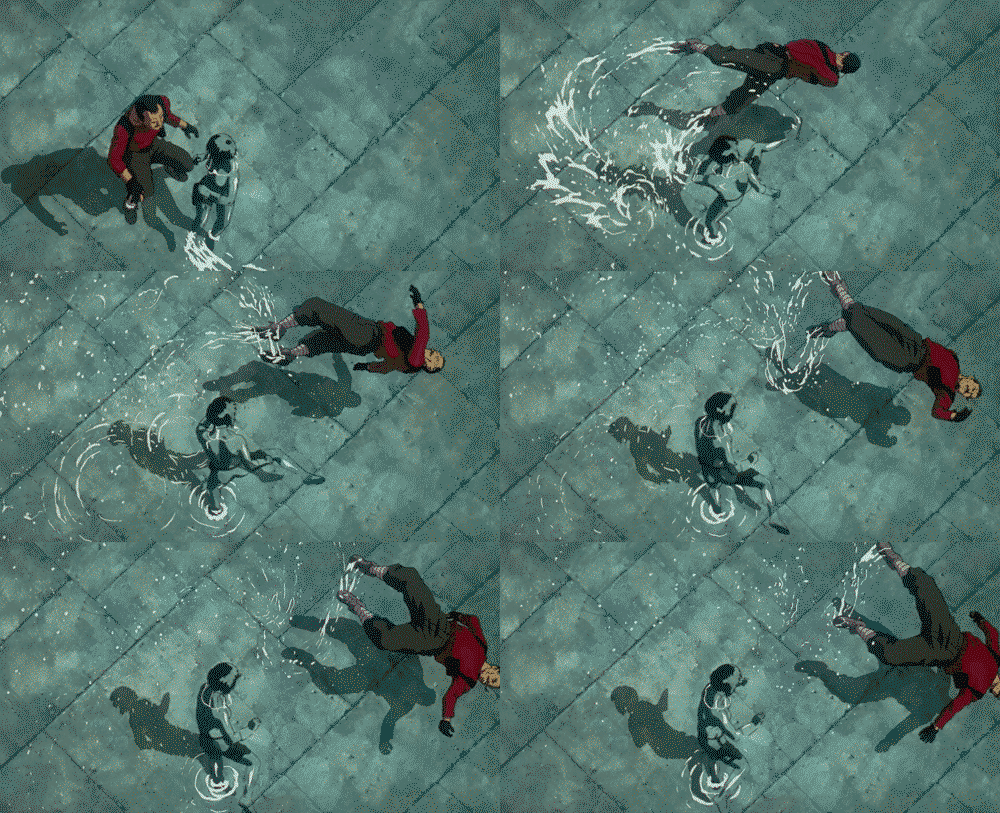
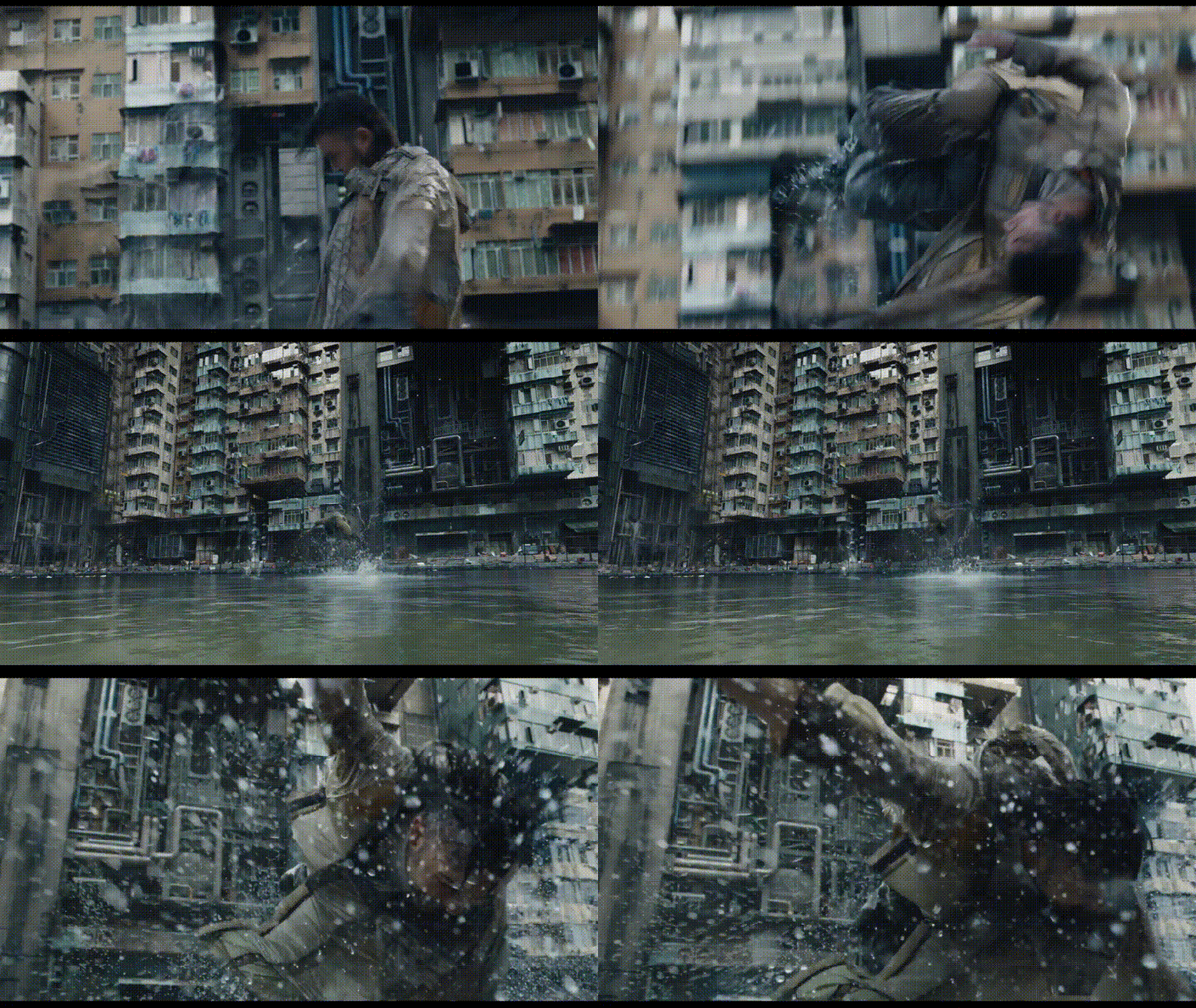
The strangest thing for me was something that I haven’t seen any other reviews point out, namely that 2017’s Ghost in the Shell isn’t just a straight remake of the 1995 one, but an odd amalgamation of several Ghost in the Shell incarnations, including the Stand Alone Complex series. There are numerous scenes lifted shot for shot from the 1995 film, like the invisible beat-up, the spider tank fight, and the opening montage of creating the Major’s body, but they are all placed in a completely different context. The first action scene with the robotic geishas is straight from the first episode of SAC. There’s also a scheme to pick off Section 9’s members (like SAC’s first season about the Laughing Man), the incorporation of Major’s antagonist/counterpart Kuze (from SAC’s second season), and a secret government kidnapping plot (from the Solid State Society movie). It was seeing all these disparate elements combined with a totally new story of Major questioning her identity that felt strange to me, like I wasn’t sure which story they would try integrating next.

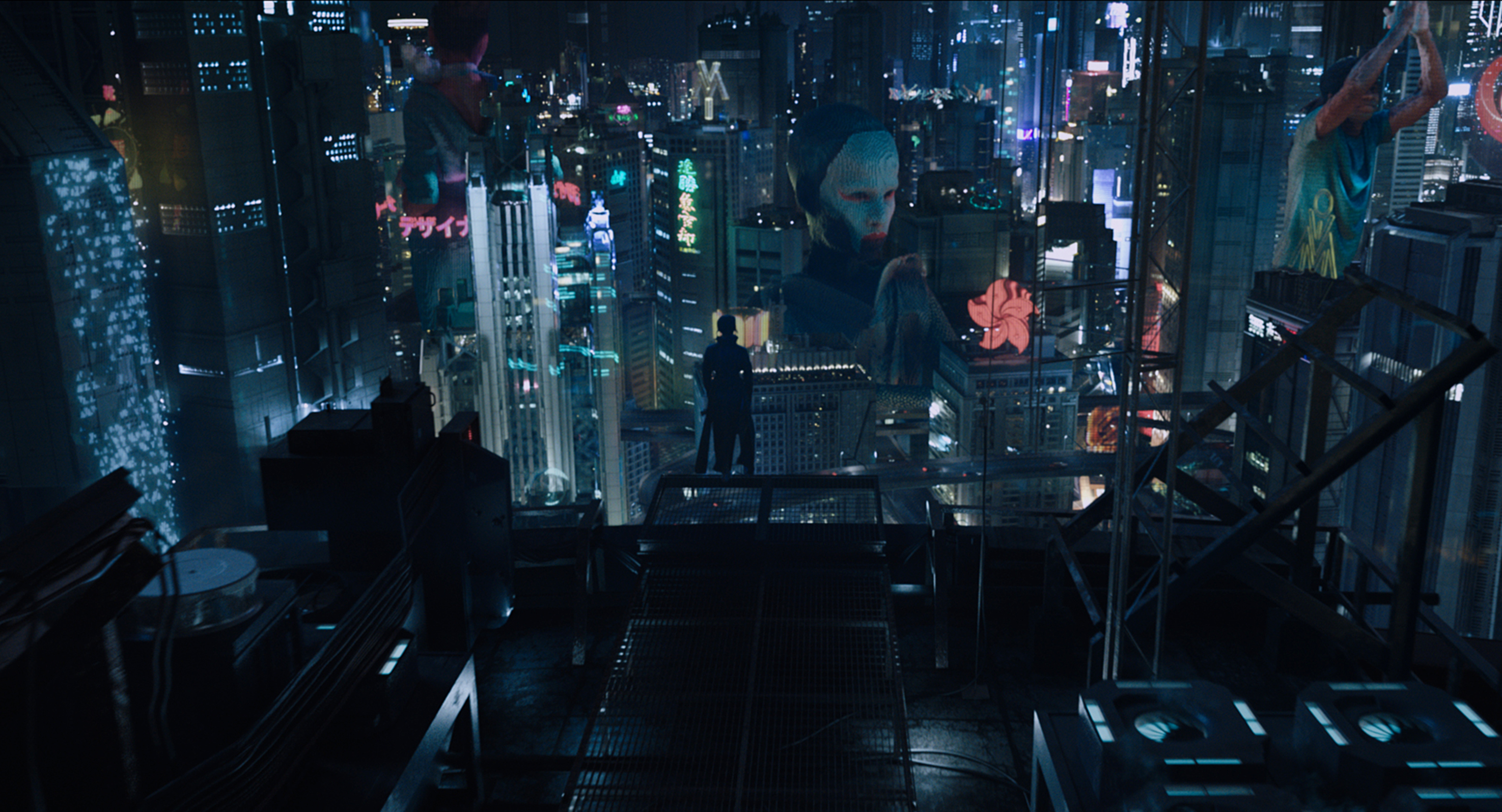
One aspect of remakes that Hollywood can be expected to get right more often than not is the impressive visuals, and like the anime, the world of seedy, hologram-laden skyscrapers it creates is far more intriguing than the characters in it. That’s not to say it’s a place I’d want to visit, but its visuals at least honor the original and its predecessors, like Blade Runner, even if it’s also alienating.

Image result for ghost in the shell 2017 batou

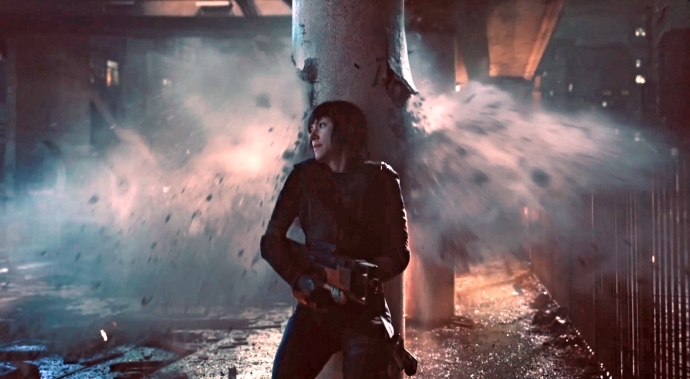
With its obvious nudity, I never would have thought a live-action Ghost in the Shell would receive a PG-13 rating, but that reflects the fact that the 2017 film tries to soften the harder edges of an anime that is definitely not for all tastes. Johansson’s robot body is more like a skin-color body suit, like the blue Mystique from the X-Men movies, and its intentionally manufactured appearance makes it less flagrant than the original. The same goes for the violence: the film does its best to make itself gritty and unpleasantly ruthless, but at least there aren’t any of the graphic head shots from the film and series. Even Major’s characterization is less stone-faced than her animated version (though I’ve heard every version of her is somehow different from the manga). In contrast to the emotionless ambiguity of the 1995 film’s ending, the search of Johansson’s Major for her past offers a shred of poignancy to hold onto, something I actually felt was an improvement.

Neither Ghost in the Shell is perfect or even close to perfect, in my opinion, but they have enough atmosphere and intrigue to be worth discussing. Both do have the repeated Ghost in the Shell plotline, which the TV series helped me recognize, that being “Super-hacker seems like bad guy until it turns out to be an evil government/corporate conspiracy.” I suppose the 1995 film could be seen as a philosophical sci-fi film with some action, while the remake is an action film with some philosophy. Although the 2017 version is considered a flop, it might be the best anime-to-live-action adaptation so far (I’m hesitant to see the widely panned Death Note), at least nailing the original’s distinct visual merit. With more anime adaptations on the way, including Your Name (please don’t ruin it, J.J. Abrams!), there might be hope for future efforts to do better with more appealing source material.

Image result for ghost in the shell 2017 water scene

Best line from 1995 film: (Kusanagi) “You talk about redefining my identity. I want a guarantee that I can still be myself.”  (Puppet Master) “There isn’t one. Why would you wish to? All things change in a dynamic environment. Your effort to remain what you are is what limits you.”

Best line from 2017 film: (Dr. Ouelet) “We cling to memories as if they define us, but they really don’t. What we do is what defines us.”


Rank for both: Honorable Mention


© 2017 S.G. Liput
517 Followers and Counting
 

No Game No Life: Zero (2017)

15 Sunday Oct 2017

Posted by sgliput in Movies, Poetry, Reviews, Writing

≈ 2 Comments

Tags

Action, Animation, Anime, Drama, Fantasy, Romance, War

Image result for no game no life zero film

Is life not a game
Where there’s no one to blame
If the rules seem unfair
And the ends are the same?

You’re tempted to quit,
Raise your hands in forfeit,
For the game doesn’t care
Where the losers will sit.

But wait! None will mind
The misfits of mankind,
For the arrogant player
Is conveniently blind.

Who heeds the has-been
When his triumphs begin?
Those who haven’t a prayer
In the game can still win.
_____________________

MPAA rating: PG-13

Although I’ve come to really enjoy anime movies over the last several years, I’d never seen an anime film in the theater. Thus, it was a special treat to see No Game No Life: Zero on the big screen, especially with it being such a visually spectacular film. After being impressed by the trailers for months before its July opening in Japan, I thought for sure I’d have to wait perhaps a year before I’d get to see an American release, so I’m grateful to Sentai Filmworks and Fathom Events for distributing the English dub so quickly.

I wouldn’t doubt that non-anime fans have no idea what No Game No Life is. It’s a series of Japanese light novels, but most in the West would know it from the anime adaptation that is surprisingly popular for having only a single twelve-episode season. It centers on the gaming prowess of eighteen-year-old Sora and his eleven-year-old stepsister Shiro, two genius-level shut-ins who are transported by the god of games Tet to a fantasy world where all conflicts are decided by wagering on games of any kind. Humanity (known as Imanity in this world) is the lowest and least powerful of all the fantasy races, so Sora and Shiro take it upon themselves to lift up the humans and conquer the world through the likes of chess, word chain, and first-person shooters. Just as WarGames fans say “Shall we play a game?”, No Game No Life fans say “Aschente,” the mutual pledge before starting a game.

Image result for no game no life zero film

The show itself is played mainly for laughs and to marvel at the Sherlock-level strategy and foresight the siblings command even when at a disadvantage, but it boasts a broader fantasy appeal too, especially with unseen backstory about a horrific war that only ended when Tet became god and made the world game-centric. The characters and situations are quite entertaining for the most part, though No Game No Life isn’t among my favorite series for one simple reason: fan service. There’s plenty of sexual harassment, near-nudity, and risqué humor, mainly from Sora, and while much of it is funny, a lot is just uncomfortable and annoying. Plus, I’m not usually a fan of the kind of anime with silly faces and exaggerated reactions (I know that’s the majority of anime), which is why I lean more toward dramatic series or movies, which are usually easier to take seriously.

That’s why I was so eager to see No Game No Life: Zero, a film centering on an extended flashback of the pre-Tet war, a subject which lends itself to much more drama and emotion, and indeed the film is a complete contrast from the humorous tone of the series. (By the way, the Zero in the title seems to be an example of the naming convention for works that are connected yet somehow separate from an established series [e.g. Fate/Zero, Steins;Gate 0, etc.].) No Game No Life is notable, and sometimes disliked, for its hypersaturated colors, boasting more bright hues than a Crayola factory, and while the movie retains the same style, it limits its palette more to complement the darker storyline. Instead of the shiny fantasy land into which Sora and Shiro are literally dropped, this war-torn world 6000 years earlier is dominated by reddened skies and skin-burning ash, leaving no doubt as to humanity’s desperation, caught in the crossfire between the more powerful magical races. Just look at the contrast between the worlds below, the first from the show, the second from the film.

Image result for no game no life disboard

Image result for no game no life zero movie

Although there’s still a lot left unseen, the film wonderfully expands our knowledge of the war, showing us why the modern-day races still hate each other. Jibril, an immortal angel-like creature called a Flugel, was one of the best characters on the show, conceited and charming at the same time, but her appearance in the film fits the description of an “angel of death,” proving that those memories of slaughter she fondly reminisces about in the show were not exaggerated. The film also intentionally echoes the series with its “new” character designs. Riku, the leader of the remaining humans, looks a lot like Sora, just as Shuvi, an Ex Machina android intent on learning the value of the human heart, looks much like Shiro. (They’re even voiced by the same voice actors in the excellent English dub that I saw.) The main design difference may be that their hair colors are reversed, but these new characters have their own personalities and griefs that set them apart from their later incarnations, and instead of a brother and sister relationship, theirs is destined for love. I will say it takes a certain amount of disconnect from the series to accept a romance between two characters who look like the siblings we know, but the film spends a good amount of time developing their relationship, even if it starts on a very awkward note.

The trailers mainly focused on the romance angle and an epic fight between Shuvi and Jibril, but I was glad to see that the movie does explain the war’s formerly vague resolution. Instead of the explicit games of the series, the game concept, along with humanity’s struggle, becomes more of a running theme as the characters engage in a literal game of “Global Thermonuclear War.” Some have complained about the pacing of the movie’s final third, but that’s where I thought it truly found its stride and consistently impressed. I loved the way victory is snatched from apparent defeat, utilizing the fact that the Ex Machina are a lot like the Borg from Star Trek, and the sad circumstances became sublimely bittersweet by the end. It spoke to how the most important people in history often remain unsung heroes, their names sometimes only remembered by God.

Image result for no game no life zero

No Game No Life: Zero was a pleasure to watch in the theater, especially because it elevated the series it was based on, focusing on the fantasy with just a taste of the original’s humor and chucking the unnecessary fan service. (There’s still some stylized nudity, but it’s more forgivable here.) The animation is particularly stunning, especially during that epic battle I mentioned, and the score beautifully enhanced the emotions of each scene, with the lovely ending theme “There Is a Reason” earning entrance into my End Credits Song Hall of Fame.  By the end, as the film tied itself directly into where the series left off, I even found myself feeling surprisingly nostalgic and fond for a show I thought I only moderately liked. Many think this film is a prelude for a potential second season, and the movie will certainly strengthen that hope. No Game No Life may be a series I wouldn’t quite recommend to everyone, but, with the right background information, this movie is. (By the way, I’ve included the first teaser trailer down below to give a taste of the awesome animation and music.)

Best line: (Riku) “Yes, humans are fools, but it takes a great fool to not let that foolishness get themselves killed.”

Rank: List Runner-Up

© 2017 S.G. Liput
516 Followers and Counting

← Older posts
Newer posts →

Recent Posts

  • We Didn’t Start 2025 (Recap)
  • NaPoWriMo 2025 Recap (Finally)
  • Sonic the Hedgehog 3 (2024)
  • It Happened One Night (1934)
  • Spellbound (2024)

Recent Comments

associatesofshellymann's avatarassociatesofshellyma… on My Top Twelve La La La So…
Kit's avatarKit Nichols on Bonnie and Clyde (1967)
lifelessons's avatarlifelessons on Look Back (2024)
Carol Jackson's avatarCarol Jackson on The Thief of Bagdad (1940…
Stephen's avatarStephen on Love Story (1970)

Archives

  • January 2026
  • December 2025
  • May 2025
  • April 2025
  • March 2025
  • February 2025
  • January 2025
  • December 2024
  • May 2024
  • April 2024
  • March 2024
  • February 2024
  • January 2024
  • December 2023
  • November 2023
  • October 2023
  • September 2023
  • July 2023
  • June 2023
  • May 2023
  • April 2023
  • March 2023
  • February 2023
  • January 2023
  • December 2022
  • November 2022
  • October 2022
  • September 2022
  • August 2022
  • July 2022
  • June 2022
  • May 2022
  • April 2022
  • March 2022
  • February 2022
  • January 2022
  • December 2021
  • November 2021
  • October 2021
  • September 2021
  • August 2021
  • July 2021
  • June 2021
  • May 2021
  • April 2021
  • March 2021
  • February 2021
  • January 2021
  • December 2020
  • November 2020
  • October 2020
  • September 2020
  • August 2020
  • July 2020
  • June 2020
  • May 2020
  • April 2020
  • March 2020
  • February 2020
  • January 2020
  • December 2019
  • November 2019
  • October 2019
  • September 2019
  • August 2019
  • July 2019
  • June 2019
  • May 2019
  • April 2019
  • March 2019
  • February 2019
  • January 2019
  • December 2018
  • November 2018
  • October 2018
  • September 2018
  • August 2018
  • July 2018
  • June 2018
  • May 2018
  • April 2018
  • March 2018
  • February 2018
  • January 2018
  • December 2017
  • November 2017
  • October 2017
  • September 2017
  • August 2017
  • July 2017
  • June 2017
  • May 2017
  • April 2017
  • March 2017
  • February 2017
  • January 2017
  • December 2016
  • November 2016
  • October 2016
  • September 2016
  • August 2016
  • July 2016
  • June 2016
  • May 2016
  • April 2016
  • March 2016
  • February 2016
  • January 2016
  • December 2015
  • November 2015
  • October 2015
  • September 2015
  • August 2015
  • July 2015
  • June 2015
  • May 2015
  • April 2015
  • March 2015
  • February 2015
  • January 2015
  • December 2014
  • November 2014
  • October 2014
  • September 2014
  • August 2014
  • July 2014
  • June 2014
  • May 2014
  • April 2014
  • March 2014
  • February 2014
  • January 2014
  • December 2013

Categories

  • Blindspot
  • Blogathon
  • Christian
  • Movies
  • Music
  • NaPoWriMo
  • Poetry
  • Reviews
  • TV
  • Writing

Meta

  • Create account
  • Log in
  • Entries feed
  • Comments feed
  • WordPress.com

Recent Posts

  • We Didn’t Start 2025 (Recap)
  • NaPoWriMo 2025 Recap (Finally)
  • Sonic the Hedgehog 3 (2024)
  • It Happened One Night (1934)
  • Spellbound (2024)

Recent Comments

associatesofshellymann's avatarassociatesofshellyma… on My Top Twelve La La La So…
Kit's avatarKit Nichols on Bonnie and Clyde (1967)
lifelessons's avatarlifelessons on Look Back (2024)
Carol Jackson's avatarCarol Jackson on The Thief of Bagdad (1940…
Stephen's avatarStephen on Love Story (1970)

Archives

  • January 2026
  • December 2025
  • May 2025
  • April 2025
  • March 2025
  • February 2025
  • January 2025
  • December 2024
  • May 2024
  • April 2024
  • March 2024
  • February 2024
  • January 2024
  • December 2023
  • November 2023
  • October 2023
  • September 2023
  • July 2023
  • June 2023
  • May 2023
  • April 2023
  • March 2023
  • February 2023
  • January 2023
  • December 2022
  • November 2022
  • October 2022
  • September 2022
  • August 2022
  • July 2022
  • June 2022
  • May 2022
  • April 2022
  • March 2022
  • February 2022
  • January 2022
  • December 2021
  • November 2021
  • October 2021
  • September 2021
  • August 2021
  • July 2021
  • June 2021
  • May 2021
  • April 2021
  • March 2021
  • February 2021
  • January 2021
  • December 2020
  • November 2020
  • October 2020
  • September 2020
  • August 2020
  • July 2020
  • June 2020
  • May 2020
  • April 2020
  • March 2020
  • February 2020
  • January 2020
  • December 2019
  • November 2019
  • October 2019
  • September 2019
  • August 2019
  • July 2019
  • June 2019
  • May 2019
  • April 2019
  • March 2019
  • February 2019
  • January 2019
  • December 2018
  • November 2018
  • October 2018
  • September 2018
  • August 2018
  • July 2018
  • June 2018
  • May 2018
  • April 2018
  • March 2018
  • February 2018
  • January 2018
  • December 2017
  • November 2017
  • October 2017
  • September 2017
  • August 2017
  • July 2017
  • June 2017
  • May 2017
  • April 2017
  • March 2017
  • February 2017
  • January 2017
  • December 2016
  • November 2016
  • October 2016
  • September 2016
  • August 2016
  • July 2016
  • June 2016
  • May 2016
  • April 2016
  • March 2016
  • February 2016
  • January 2016
  • December 2015
  • November 2015
  • October 2015
  • September 2015
  • August 2015
  • July 2015
  • June 2015
  • May 2015
  • April 2015
  • March 2015
  • February 2015
  • January 2015
  • December 2014
  • November 2014
  • October 2014
  • September 2014
  • August 2014
  • July 2014
  • June 2014
  • May 2014
  • April 2014
  • March 2014
  • February 2014
  • January 2014
  • December 2013

Categories

  • Blindspot
  • Blogathon
  • Christian
  • Movies
  • Music
  • NaPoWriMo
  • Poetry
  • Reviews
  • TV
  • Writing

Meta

  • Create account
  • Log in
  • Entries feed
  • Comments feed
  • WordPress.com

Blog at WordPress.com.

Is this your new site? Log in to activate admin features and dismiss this message
Log In
  • Subscribe Subscribed
    • Rhyme and Reason
    • Join 814 other subscribers
    • Already have a WordPress.com account? Log in now.
    • Rhyme and Reason
    • Subscribe Subscribed
    • Sign up
    • Log in
    • Report this content
    • View site in Reader
    • Manage subscriptions
    • Collapse this bar