• Home
  • About Me
  • The List
  • THE LIST (2016 Update)
  • THE LIST (2017 Update)
  • THE LIST (2018 Update)
  • THE LIST (2019 Update)
  • THE LIST (2020 Update)
  • THE LIST (2021 Update)
  • THE LIST (2022 Update)
  • Top Twelves and More
  • The End Credits Song Hall of Fame

Rhyme and Reason

~ Poetry Meets Film Reviews

Rhyme and Reason

Tag Archives: Anime

2021 Blindspot Pick #10: The Anthem of the Heart (2015)

28 Tuesday Dec 2021

Posted by sgliput in Blindspot, Movies, Poetry, Reviews, Writing

≈ Leave a comment

Tags

Animation, Anime, Drama, Romance

See the source image

If pens are mightier than swords,
Then speaking what they write is too.
And words no pen or page records
Can leave impressions deep and true
While those who spoke them have no clue.

Invisible, words plant their seeds,
Perhaps to not mature for years.
The flowers can be choked by weeds,
From tactless slurs to whispered fears
That did not settle on deaf ears.

We cannot know their full result
And may not live to see them grow,
But whether child or adult,
Our words outlive us here below.
Beware the seeds that you bestow.
___________________________

MPA rating:  Not Rated (a safe PG for light innuendo)

I always like to include at least one anime in my Blindspots, and this is one that I had just never gotten around to watching. The Anthem of the Heart has a strong pedigree with scintillating animation from A-1 Pictures and a screenplay from the queen of emotions herself Mari Okada (who would go on to direct the heart-shattering Maquia). It’s a sweet and sad story that ends up being much more of a teenage romance than a fantasy, and there’s something endearing about its simplicity.

See the source image

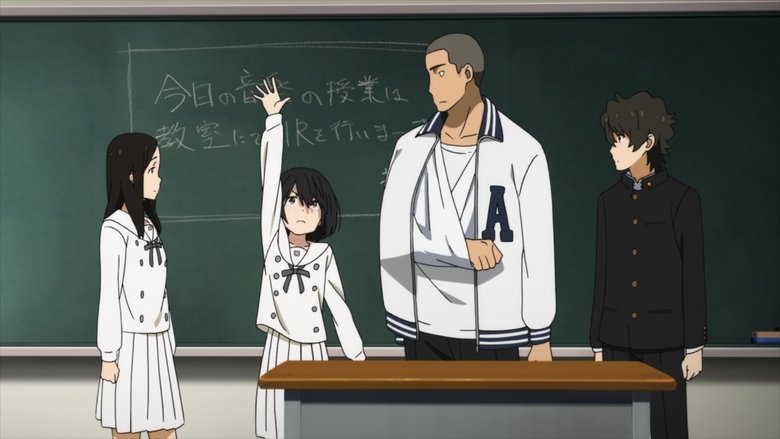
When Jun Naruse was a young girl, she caught sight of her father exiting a love hotel with another woman, and he outright blames her when her big mouth leads to her parents’ divorce. Overcome with guilt, she encounters an egg-like prince who offers to curse her and prevent her from ever hurting others with her words. Years later in high school, Naruse is known in her class and neighborhood for never speaking. When a teacher encourages her and three other classmates to collaborate on a community outreach event, they end up putting on a musical, and Naruse learns that the curse does not limit her when she tries singing her feelings, which include a growing crush on one of her new friends.

Like Sunshine on Leith, I feel like this is a film I ought to love more than I did, what with the lovely animation and the plotline of putting on a musical, which includes original lyrics added to familiar tunes like “Greensleeves” and “Over the Rainbow.” There’s a half-hearted effort at planting doubt as to whether Naruse’s condition is truly fantastical or simply a psychosomatic result of her childhood guilt, and the result is underwhelming albeit more realistic. Likewise, the love triangle/square between Naruse and some of her classmates indulges in dramatic clichés while also trying to buck them in a way that does satisfy but not in the expected way, accentuating the theme that the real world is messier than fairy tales.

See the source image

Nevertheless, The Anthem of the Heart had its fair share of strong and sincere emotions, with the climax giving me chills the way good musical drama does. Naruse’s concern about words hurting others affects more than just her story, and I liked the way it influences the supporting characters and helps her come out of her shell. The film ends up feeling like a small-scale story worth telling, one that probably would not have gotten as much love and detail put into it outside of the world of anime. It may not be a new favorite of mine, but I certainly hope to see more like it.

Best line: (Naruse) “Don’t tell people to disappear like it’s nothing. Words can hurt people. You can’t ever… You can’t ever take them back! Even if you regret, you can never take them back.”

Rank:  List Runner-Up

© 2021 S.G. Liput
748 Followers and Counting

Ocean Waves (1993)

03 Saturday Apr 2021

Posted by sgliput in Movies, NaPoWriMo, Poetry, Reviews, TV, Writing

≈ Leave a comment

Tags

Animation, Anime, Drama, Romance

See the source image

(The prompt for Day 3 of NaPoWriMo was to create a “Personal Universal Deck” of self-descriptive words, so I tried to come up with some word impressions for the characters of a lesser Ghibli film.)

Waves on the beach,
Wisdom to teach,
Woman and leech,
Scorning my speech.

Waves on my mind,
Wicked and kind,
Who she maligned
Is no longer blind.
__________________________

MPA rating:  PG-13 (for thematic material, very little objectionable)

I love so many Studio Ghibli films, but there are a few gaps I’ve been trying to fill, lesser-known works that have slipped through the cracks. Ocean Waves is one of them, an early ‘90s TV film based on a novel that was meant to give the younger animators a chance to show their stuff. It’s one of those subdued high school stories with a melodramatic love triangle that isn’t bad but can’t escape an overall dullness.

See the source image

Told largely in flashback, the tale follows Taku as a high schooler who learns his friend Yutaka has a crush on a new girl named Rikako, and Taku is soon pulled into her life and drama more than he expected or wanted. My mom initially didn’t like Forrest Gump because of the way Jenny treated Forrest, and Rikako is in a similar mold. She manipulates, lies, uses people, and barely shows any remorse, yet her actions are eventually viewed with fondness. A high school reunion near the end hits some excellent nostalgic poignancy, but the main two characters aren’t exactly typical romance material, to the point that some have said the two male friends have more chemistry than the central “couple.”

Again, Ocean Waves is well-animated and not terrible, but it’s low-tier Ghibli with very little personality of its own and many tropes that have been done much better elsewhere. In fact, my favorite Ghibli film Whisper of the Heart has a lot of the same ingredients (high school love triangle, boy and girl who dislike each other at first) and yet has so much more character and passion to it. Perhaps Ocean Waves was just the warm-up.

Rank: Honorable Mention

© 2021 S.G. Liput
722 Followers and Counting

2020 Blindspot Pick #4: Pom Poko (1994)

05 Monday Oct 2020

Posted by sgliput in Blindspot, Movies, Poetry, Reviews, Writing

≈ 1 Comment

Tags

Animation, Anime, Comedy, Drama, Fantasy

See the source image

Nature weeps “Farewell”
As mankind bids it “Hello.”
Neither understands.
_____________________

Some may look at the fact that I’m only reviewing #4 of my list of 12 Blindspots for the year in October as a sign of being way behind and perhaps despair because of it. I prefer to think, “Wow, I’ll have such a great sprint of good movies around the holidays!” Either way, I’m finally returning to my Blindspot series with Studio Ghibli’s Pom Poko.

See the source image

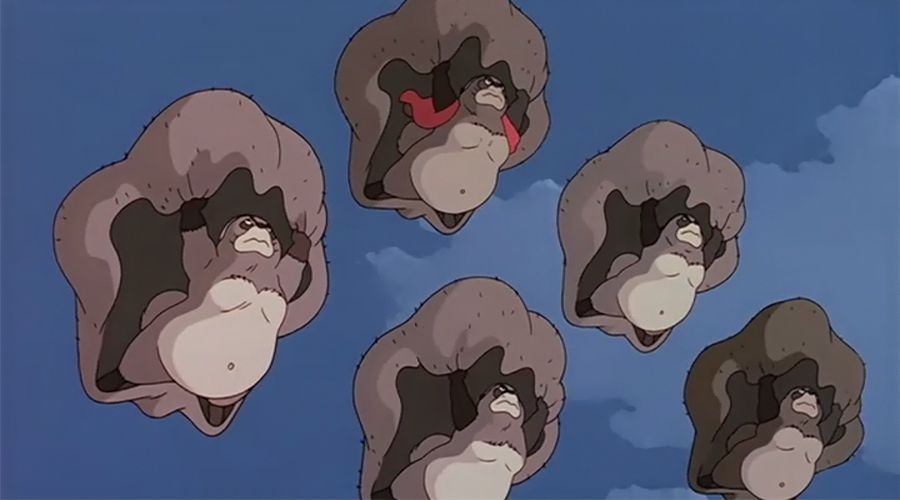
I’m very fond of the majority of the studio’s work, including the heartrending Grave of the Fireflies from the same director, but Pom Poko has never gotten much of a spotlight. Even in montages of various Ghibli movies, Pom Poko is pretty much relegated to one notable scene: a comical battle between two warring tribes of tanuki (Japanese raccoon dogs), which happens to be one of the very first scenes in the film. The rest of the movie was a mystery to me, so I was quite curious to see the rest of the story. Now that I have, I can see why it’s counted among the B-list of Ghibli classics, with the studio’s trademark charm and weirdness being overextended by length and repetition.

From the humorous battle scene on, the film often plays like a mythological nature documentary, explaining the many eccentricities of tanuki pulled straight from Japanese legend: their mischievous antics, shapeshifting abilities, penchant for parties, belly drumming, and…um, their prominent testicles. Yeah, more than anything else, that last point is probably why Pom Poko never hit it off in America. Folk tales tell of the many uses tanuki have for their shapeshifting male parts, and the movie runs with that (the English dub using the euphemistic “raccoon pouch”) as they’re shown expanding their “pouches” into parachutes and weapons. Just writing this feels bizarre, but hey, myths can be weird, especially considering raccoon dogs are a real species.

See the source image

As with many other Ghibli films, the story is an environmentalist fable, detailing the loss of the tanuki’s forest habitat as man and technology encroach further and further. (I find it interesting that the comic strip Over the Hedge debuted just a year after this film with a similar basic premise.) Much of the movie is spent with the creatures attempting to fight back, leading to some highly entertaining sections where they use their supernatural abilities to scare the unsuspecting humans away. However, from the moment they realize mankind’s threat to the point of no return, there are far too many scenes of the leaders debating their strategy, weighing their options, and trying the same things repeatedly. At nearly two hours, I felt like the film could have easily shed a half hour with little loss.

Director Isao Takahata, Miyazaki’s compatriot in heading the studio’s early releases, won my heart with Grave of the Fireflies, but nothing quite compares with that tragic masterpiece. Pom Poko is at least a visual treat, and the character animation swings wildly in depicting the tanuki as realistic animals, anthropomorphic bipeds, or cartoony caricatures, depending on the mood of the scene. The English dub (which Americanizes the tanuki as just “raccoons”) also boasts a talented voice cast, including Jonathan Taylor Thomas, Clancy Brown, Maurice LaMarche, Tress MacNeille, and J.K. Simmons.

See the source image

Aside from Spirited Away, Pom Poko might be the Ghibli film most wedded to Japanese culture; one extended scene has a master tanuki conjuring a horde of illusory yokai (Japanese spirits) to scare the humans, referencing stories that are no doubt far more familiar to Japanese audiences than Western ones. Plus, despite its cartoonish aspects, its themes and a few story elements are geared for somewhat older audiences compared to the more kid-friendly Ghibli options. Pom Poko is weird, overlong, creative, frequently delightful, wacky, and even bittersweet by the ending. It’s not likely to become a favorite, but I’m glad to have seen another entry from a legendary studio.

Best line: (Narrator, with a line you’ll never find in any other film) “They used their balls as weapons in a brave kamikaze attack.”

Rank:  Honorable Mention

© 2020 S.G. Liput
701 Followers and Counting!

Ride Your Wave (2019)

01 Wednesday Apr 2020

Posted by sgliput in Movies, NaPoWriMo, Poetry, Reviews, Writing

≈ 1 Comment

Tags

Animation, Anime, Drama, Fantasy, Romance, Sports

See the source image

(For Day 1 of NaPoWriMo, the prompt was for a metaphor poem comparing life to a particular action, so I took inspiration from a movie that heavily focused on a similar metaphor of surfing.)


I live upon a wooden board
That glides along the ocean swell.
So many others stood and fell,
So on my belly, safe I dwell.

My wiping out I can’t afford,
And so I hug the firm and known,
And watch the few whose comfort zone
Is so much wider than my own.

They call to me with one accord
To stand within the arching wave,
And though I fear it, still I crave
The confidence of being brave.

I close my eyes and let my board
Convey me to the tunneled tide
And find the worries, from inside,
Have dwindled down and liquefied.
_______________________

MPA rating: Not Rated (should be PG-13, for some adult themes and brief nudity)

I love that the last two years, I’ve been surprised by anime films I wasn’t expecting. Maquia: When the Promised Flower Blooms proved to be the anime of the year in 2018, and Masaaki Yuasa’s Ride Your Wave was a similar pleasant surprise, considering I’d never heard of it until a preview before Weathering with You. Star-crossed love is a common anime trope, but Ride Your Wave puts a uniquely emotional spin on it, also standing out for its characters being young adults rather than the usual highschoolers.

See the source image

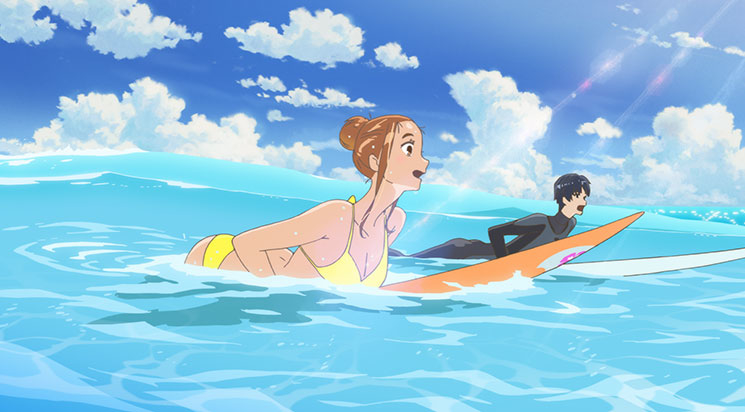
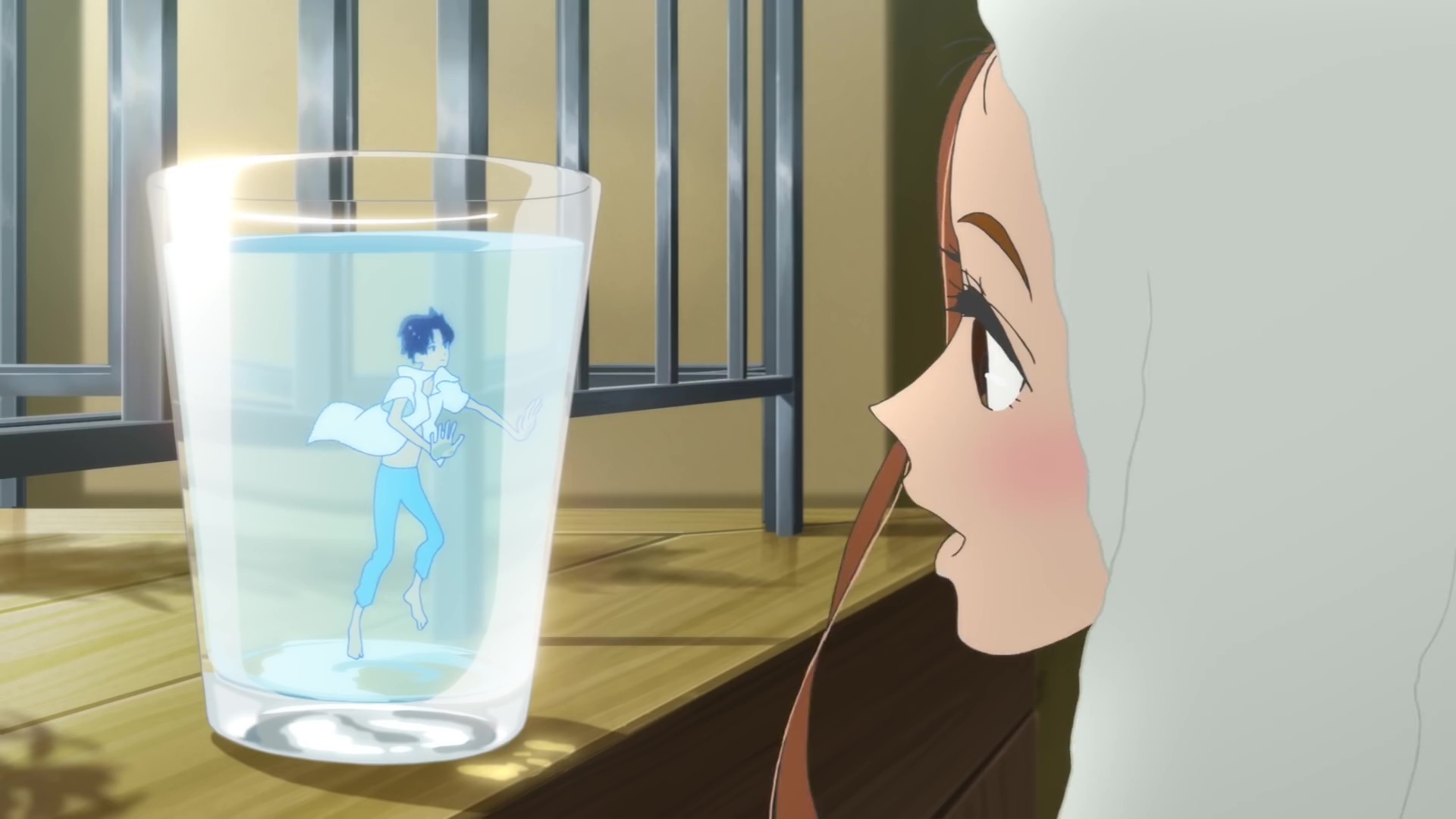
Hinako Mukaimizu has just moved into a new apartment near the ocean, allowing her to regularly partake in her favorite hobby of surfing. After a fire threatens her building, she falls in love with handsome firefighter Minato Hinageshi, and their romance is wholesomely reminiscent of the beginning of Up. And like Up, it ends in tragedy, leaving Hinako alone and unable to move on. Soon, though, she begins seeing Minato in water when she sings their favorite song, leading to hilarious misunderstandings and an unhealthy situation that clearly cannot stay the way it is.

I’ve tended to steer clear of Yuasa’s other works (like Lu Over the Wall or The Night Is Short, Walk on Girl), perhaps because his unique art style didn’t seem to appeal to me, but I must admit that I loved Ride Your Wave, and it’s made me curious to check out his past work. His hyper-fluid animation really complements the prevalence of water in the film and creates some unique angles and perspectives to ravish the eye. It’s a more cartoon-ish style than Makoto Shinkai’s photorealistic scenes, but it’s still detailed and pleasing in its own way. (It’s interesting to note the coincidence of this film and Weathering with You both coming out the same year and both featuring an emphasis on water and a notable scene with fireworks.)

See the source image

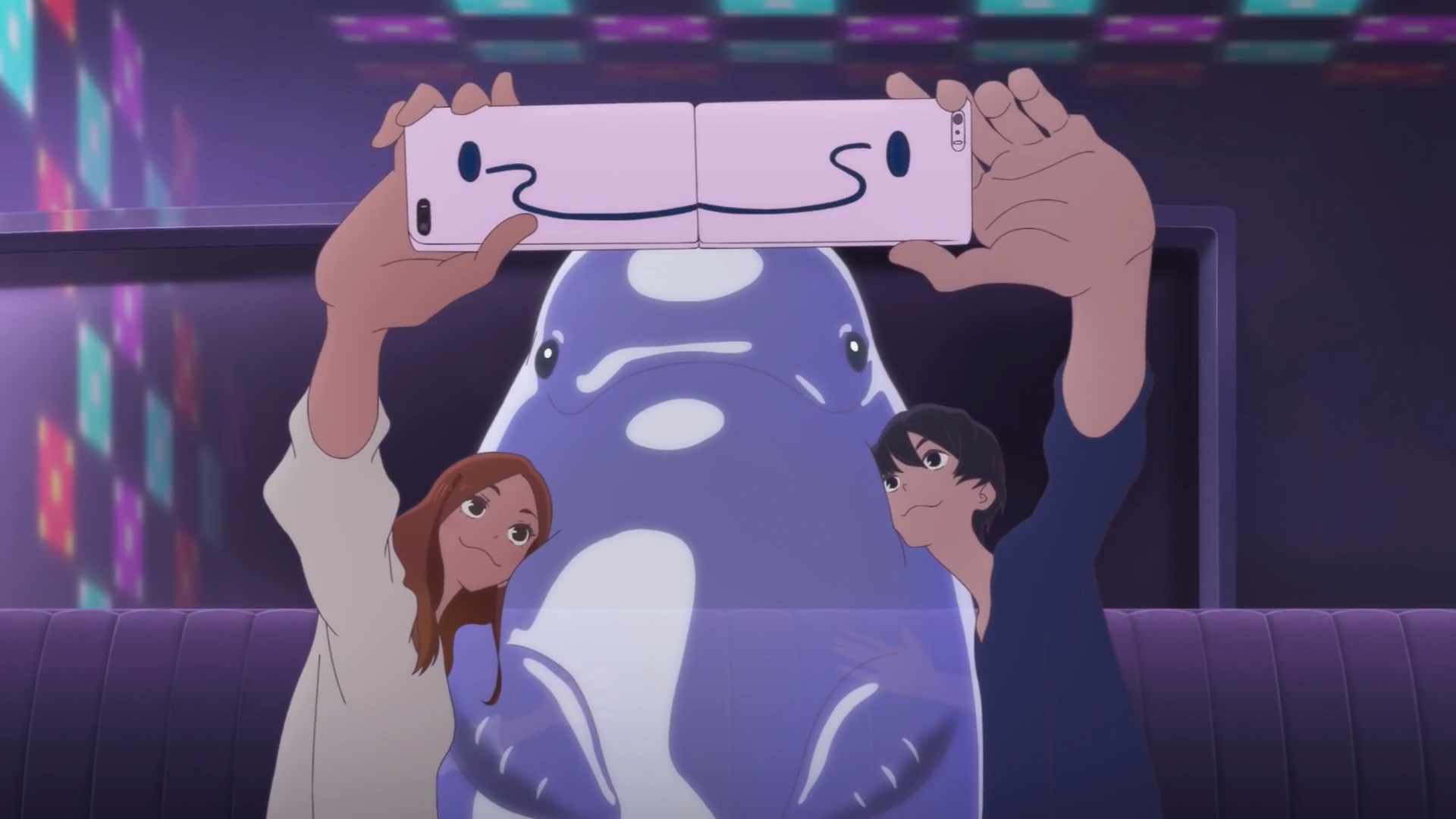
Beyond the technical, Ride Your Wave has real heart to it and does a great job developing its central couple, as well as side characters like Minato’s churlish younger sister. And that focus on likable characters is essential because there’s certainly absurdity to swallow here, such as Hinako walking around town with an inflatable porpoise filled with water (and Minato) in an effort to relive the days when Minato was still alive. The climax is wilder than that, so let’s just say it’s hard to imagine this film in anything but animation. It didn’t hit me until afterward, but the plot has many similarities to 1990’s Ghost, though with more of a rom-com sensibility than that film’s thriller elements. By the end, though, it definitely knows how to tap the emotions hard, even while retaining a sense of hope.

Since I can’t be all positive, Ride Your Wave is sometimes too on the nose with its blatant metaphor of learning to “ride the wave” of life. Plus, at only 94 minutes, the film’s relationships might feel too rushed to some, yet one could also say it presents what it needs to economically. I feel like Weathering with You is objectively a better film, yet Ride Your Wave made me feel more deeply, identifying at times with its exploration of grief. Yuasa’s blending of the poignant and the surreal is an unexpected treat for any fan of bittersweet romance.

See the source image

Best line: (Minato) “If you stay with your head underwater, you’ll never learn to ride the waves.”


Rank: List-Worthy


© 2020 S.G. Liput
670 Followers and Counting

Weathering with You (2019)

16 Sunday Feb 2020

Posted by sgliput in Movies, Poetry, Reviews, Writing

≈ 3 Comments

Tags

Animation, Anime, Drama, Fantasy, Romance

See the source image

The greatest threats and greatest wonders have their source within the sky,
Tornados with their whistle cry
And rainbows ere the air is dry,
Yet next to you, the marvels there have barely even caught my eye.

The storm can crash, the thunder clap, attempting to arrest my view,
But, whether sky be black or blue,
The sun will part the clouds on cue.
The rain will never fall as hard as I have fallen now for you.
_____________________

MPAA rating: PG-13 (for peril and brief nudity)

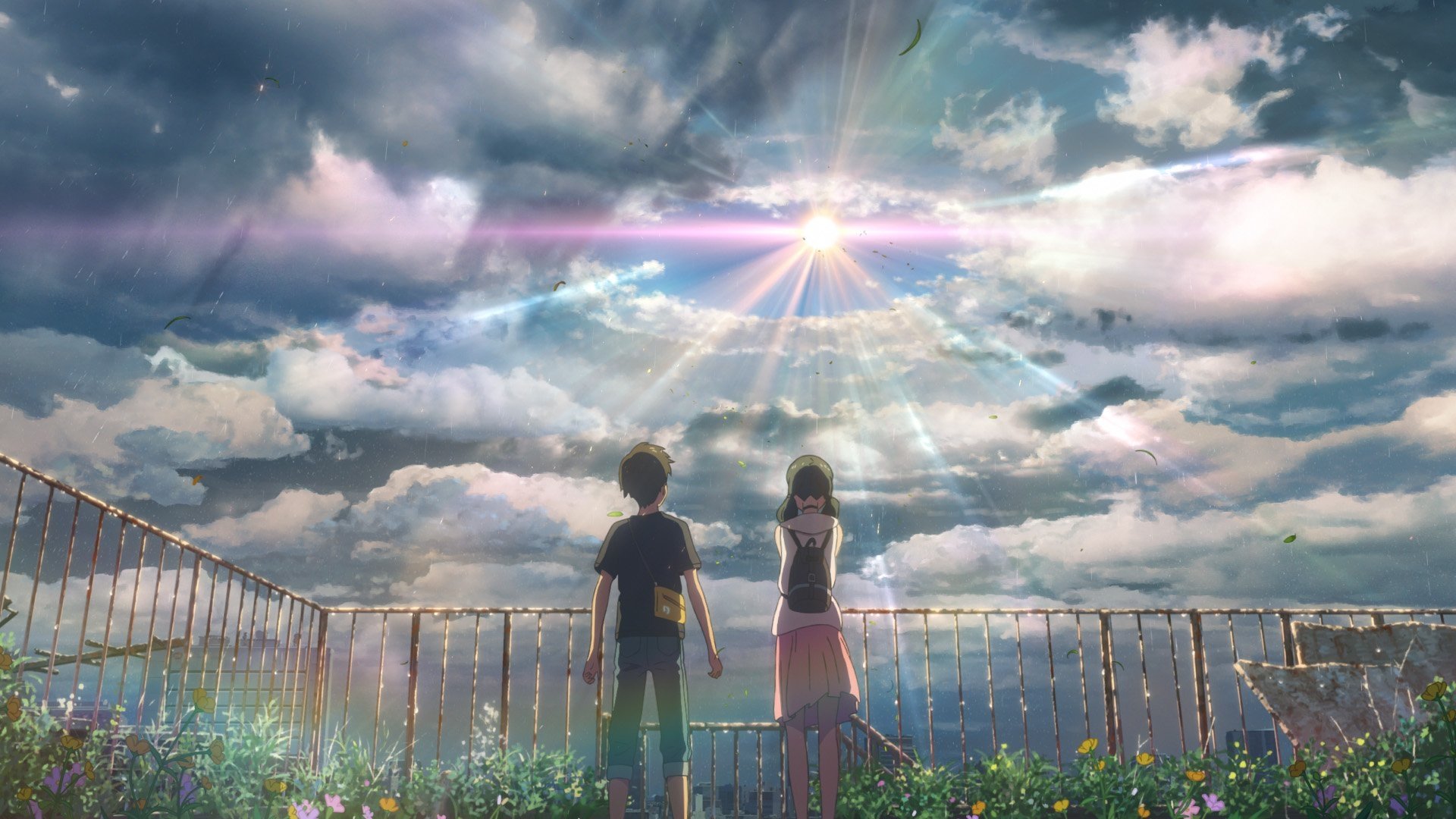
Weathering with You was #4 on last year’s list of My Top Twelve 2019 Movies I Hope Are Good, so it killed me that I had to wait until 2020 to finally see it in the theater. Makoto Shinkai had one of the toughest directorial challenges of the year, creating a follow-up to Your Name, which is still the highest-grossing anime of all time. How could Weathering with You possibly match Shinkai’s last emotional, artful powerhouse? Well, it doesn’t quite, but, boy, does it comes closer than I would have thought possible, leaving little doubt that Shinkai is in a class of his own when it comes to anime.

See the source image

Shinkai’s films have been notable for their amazingly detailed depiction of rain, in The Garden of Words especially, and Weathering with You fits perfectly in his oeuvre as the most rain-centric film yet. Hodaka is a teenage runaway, fleeing to the bustling metropolis of Tokyo with little plan and finding himself homeless in the midst of an extended rainstorm. After finding employment with a small-time tabloid publisher, Hodaka investigates the legend of the “weather maiden” (or “sunshine girl” in the very good English dub), someone whose prayers can part the clouds and bring out the sun once more. He finds her in Hina, a girl who helped him when he was struggling, and together they turn her ability into a business, clearing the weather for events. However, Hodaka’s past and the secret behind Hina’s ability threaten them both and possibly the world as well.

As with all of Shinkai’s work, the hand-drawn visuals in Weathering with You are absolutely gorgeous, with an attention to detail that puts most other 2D animation to shame. One sequence of fireworks is awe-inspiring. Likewise, anyone who enjoyed the soundtrack of Your Name, provided by the Japanese band RADWIMPS, will be pleased at their second team-up for a Shinkai project. I’m now used to the director’s music-video-like interludes that felt a bit jarring in Your Name, and they serve to highlight the songs, which in turn complement the visuals. It’s a common conceit in anime openings for characters to be shown falling through the sky, often for no apparent reason; Weathering with You not only gives a good reason but makes the scene a brilliant climax of emotion and, backed by the song “Grand Escape,” gave me genuine goose bumps.

See the source image

Animation isn’t everything, though, right? There has to be a good story and likable characters as well, and Shinkai provides those too. Hodaka and Hina aren’t quite on the same level of star-crossed YA lovers as Taki and Mitsuha in Your Name, but they’re still a cute pair worth rooting for, while the rest of the cast are enjoyably colorful as well, from Hina’s Casanova younger brother to Hodaka’s pragmatic employer. The plot does borrow some elements from Your Name – desperate running, a climactic reunion, a sudden separation that doesn’t hit quite as hard this time, a supernatural cause based in Shintoism that isn’t explained as well as I’d like – yet it’s far from a lazy copy, more like a director in his thematic comfort zone. Shinkai has stated that the story was influenced by climate change fears, which are evident by the end even if the point being made about it isn’t exactly clear, but it’s interesting and gratifying how his characters make a case for the value of the individual over collective concerns, which he thought might be controversial.

Weathering with You’s biggest problem is that it will inevitably be compared to Your Name, and it’s true that it would probably be even more impressive than it is if it hadn’t been preceded by a record-smashing older brother. (Granted, Shinkai does lean into the comparison at times, like a wink to the fans, which made me and my fellow theater-goers giddy.) Nevertheless, I thoroughly enjoyed Weathering with You and highly recommend it, even to non-anime fans. After Your Name was spurned for a Best Animated Feature nomination at the Oscars three years ago, it’s a similar travesty that Weathering with You was also unjustly overlooked. It may be Shinkai’s third best film in my estimation, but with charming characters, stunning animation, impactful music, and a poignant story, it’s further proof of his films’ greatest strengths.

See the source image

Best line: (Hodaka, to Hina) “Who cares if we can’t see any sunshine? I want you more than any blue sky.”


Rank: List-Worthy


© 2020 S.G. Liput
660 Followers and Counting


2019 Blindspot Pick #7: Royal Space Force: The Wings of Honneamise (1987)

28 Wednesday Aug 2019

Posted by sgliput in Blindspot, Movies, Poetry, Reviews, Writing

≈ 1 Comment

Tags

Animation, Anime, Drama, Sci-fi

See the source image

The depths of space have tempted man
For years while holding him at bay
Through distance, death, and lack of breath,
Insisting that we humans stay.

But mankind rarely takes a hint,
For us, a challenge is a lure,
Inviting us to sojourn thus
And learn how far we can endure.
___________________

MPAA rating: Unrated (an attempted rape scene probably would make it R, but otherwise, it’s an easy PG-13)

Unless you’re a diehard anime fan, you probably read the title of this movie and said, “What the heck is that?” Well, now that I’ve seen most of the mainstream films anime has to offer, I’m now seeking out the obscure, and I was surprised at the glowing reviews this unknown film has gotten since its 1987 release, growing into an apparent classic of the medium with 100% on Rotten Tomatoes. (Imagine my surprise when Netflix didn’t have it, but my local library did.) Royal Space Force is a hard film to categorize, but it’s undoubtedly well-made with unexpected thematic depth.

Imagine an anime mixture of The Right Stuff and Contact, and you’ve got Royal Space Force, the title referring to the poorly organized space program of the fictional country of Honnêamise. (Hun-ee-a-meece? Honey-mice? I don’t know how it’s pronounced since I don’t recall the name ever being spoken.) While no one takes the program seriously with its poor management and frequent failures, a slacker recruit named Shirotsugh Lhadatt finds a new passion and ambition for the project after a run-in with a young female evangelist named Riquinni. Despite the innate dangers of this unprecedented venture, including hostilities from a rival nation, Lhadatt literally shoots for the stars in a quest for peace and meaning.

See the source image

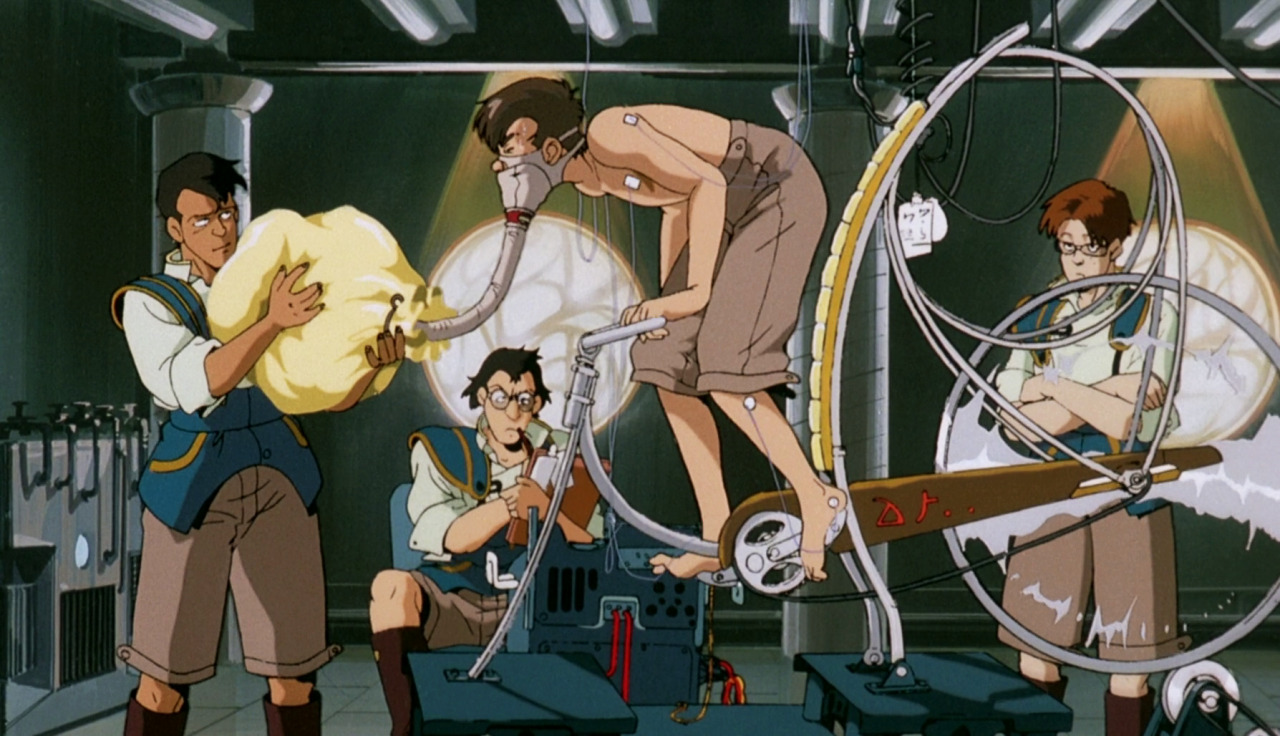
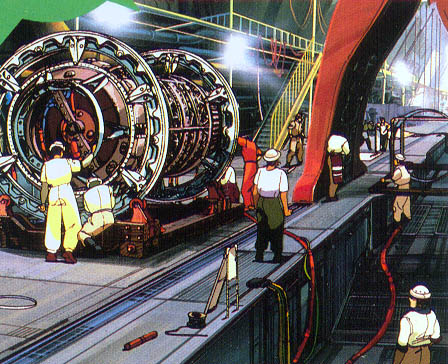
Beyond the plot or characters, what makes Royal Space Force really unique is its comprehensive world-building. It’s not quite straight fantasy or science fiction: there are a couple futuristic machines and some unique animals, but otherwise there aren’t many fantastical elements to the setting. It’s just different, a vision of what our world might have looked like during the Space Race if history had taken a different route. Windows slide downwards; plane propellers spin on the tail of the plane; currency is made up of small needle-shaped pins instead of coins. The architecture of the cities is ornate yet believable, often a mish-mash of cultural styles that create something new. I would watch it again just to appreciate the imagination on display, the fashioning of an alter-earth with creativity sadly lacking in so many other animated films.

As someone with direct family ties to the space program, I was also intrigued at how this film would approach its version. The filmmakers went to NASA to study space flight, and their efforts at authenticity mix surprisingly well with the otherworldly setting. The training contraptions for preparing Lhadatt for his mission are more slapdash and home-made than NASA’s, but their crudeness highlights how big of a scientific leap space travel is for this world, as it was for our own. And by the time the launch day comes amid self-doubt and international turmoil, the event has a similar gravitas and grandeur as the real thing.

See the source image

Another unique aspect of this film was the role of religion. Riquinni’s faith is clearly a fictional one based off a couple stories mentioned, but her discussions of God and nightly dispersal of tracts are clearly an analog to Evangelical Christianity. And unlike Contact, which annoyed me by pitting faith and science against each other as if they were antithetical, Royal Space Force depicts faith as a positive influence, encouraging Lhadatt to believe he is part of something bigger than himself and push toward a brighter future. There have been plenty of anime with Christian elements and themes, but this movie climaxes with a sincere and moving prayer that is one of the most explicit declarations of faith I’ve seen in animation.

While it’s a significant achievement in the medium, Royal Space Force does suffer somewhat from a deliberate pace and not quite enough resolution by the end. It’s not boring and has a few thrilling sections, but you shouldn’t expect constant humor or action from its grounded drama. The biggest problem is a scene of attempted rape that saps a lot of the sympathy for Lhadatt, even if he seems repentant later, and also serves no other purpose than to put the film into “mature” territory. The scene was cut in its video release, and it would have been better if the initial editors had done the same.

See the source image

Now at least, I can check off another Blindspot from my list, an anime film that has held my curiosity for some time now. I think anyone interested in the development of space travel and speculative fiction would find much to appreciate, and fans of animation even more so, since this feature was the first project of Studio Gainax, which went on to the fame of producing series like Neon Genesis Evangelion and Gurren Lagann. Royal Space Force: The Wings of Honnêamise may have an ungainly name, but it deserves its low-key classic status, making me wonder if the sequel that’s been rumored for years will ever get off the ground.

Best line: (Riquinni, reading from her holy book) “And you shall find that prayer is the greatest of all things, and it is also the smallest. You’ll find nothing more noble than prayer, nothing more humble.”

Rank: List Runner-Up

© 2019 S.G. Liput
645 Followers and Counting


Cartoon Comparisons: Alita: Battle Angel (2019) / Gunnm (1993)

29 Monday Apr 2019

Posted by sgliput in Movies, NaPoWriMo, Poetry, Reviews, Writing

≈ Leave a comment

Tags

Action, Animation, Anime, Cartoon Comparisons, Drama, Romance, Sci-fi, Thriller

(Today’s NaPoWriMo prompt was for a poem that meditates on a strong emotion, like disillusionment with the world at large.)

See the source image

See the source image

The world is not the friendly place we once had promised to ourselves
When youthful optimism held some sway within our hearts.
We like to think that’s still the case, and yet the more a person delves,
The more this human-born machine reveals its sordid parts.

It’s tragedy that truly wakes our minds to darkness come to light,
That shows how cruel the world can be, with men its messengers.
We’re ignorant of risk and stakes, and enter honestly the fight,
Too late to learn the world was not designed for amateurs.
___________________

MPAA rating: PG-13 (comes close to R with the violence)

I’ve been looking forward to Alita: Battle Angel for well over a year, ever since I heard James Cameron was planning on bringing the long-running manga Battle Angel Alita (a.k.a. Gunnm) to Hollywood. This movie fascinates me not only for its visually awesome cyberpunk future, but also because it owes its existence to one man’s passion project, bringing an extremely niche franchise to a far wider audience than it otherwise would have enjoyed. It makes me wish something similar would happen with Steins;Gate or Cowboy Bebop.

Adaptations between manga/anime and live-action have historically been more miss than hit, but Alita is finally the hit that fans have been waiting for, faithful to its origins in the best way. I, for one, have not read the manga that so enthralled James Cameron, but I have watched the 1993 OVA (Original Video Animation), which is basically like a direct-to-video anime. At only 55 minutes long, it was an imaginative if brutal sci-fi that I definitely recognized had plenty of potential for the big screen. And now that it has, I’m thrilled that such potential was not wasted.

See the source image

The manga/anime/film tells the story of the cyborg Alita (Rosa Salazar), a girl whose head is discovered in a trash heap by cybernetics expert Dr. Ido (Christoph Waltz). Finding her human brain still active, he rebuilds her body and introduces the amnesiac girl to the cutthroat world of Iron City, a sprawling dystopia patrolled by cyborg bounty hunters and festering in the shadow of the floating city known as Zalem. Trying to regain her memories, Alita becomes a Hunter Warrior herself as she falls in love with young Hugo (Keean Johnson) and navigates the plotting of Ido’s rival Dr. Chiren (Jennifer Connolly), the villainous Vector (Mahershala Ali), and his killer henchmen.

As it is, Alita might bring to mind several other films, such as Elysium with its floating city of higher class exploitation or the cyberpunk aesthetic of Ghost in the Shell, but I can’t help but feel that, if Alita had come out twenty years ago, it would be blowing people’s minds left and right. Yet the manga predates most of what it seems to borrow from, though the sport of Motorball definitely seems inspired by Rollerball.

See the source image

I’m glad, though, that Cameron wasn’t able to make Alita when he first wanted to back in 2003 because the visuals wouldn’t have been this good. Alita: Battle Angel is a sci-fi action treat, with visual effects that have a good shot at an Oscar next year. Alita herself is stunningly realized, with Rosa Salazar providing a strong motion capture performance, augmented by the effects team with those anime-sized eyes that aren’t as hard to get used to as you might think. There are a few hiccups in the animation early on that threaten to be distracting, but by the time Alita starts kicking criminal butt, she’s seamlessly a part of this world.

The live-action Ghost in the Shell was distracting for me because it was a mish-mash of various plot points from the anime film and series; Alita, on the other hand, might be the most faithful adaptation I’ve come across. Nearly everything in the anime is also in the movie, sometimes even shot for shot (like Chiren squishing a bug while telling Ido she’ll claw her way back to Zalem), though the movie’s greater length allows it to expand on many plot elements, such that watching the anime is like a highlight reel of the film. Considering how anime adaptations have flopped so hard over the years, the film’s faithfulness to its source material is laudable and likely credited to the efforts of Cameron himself as a fan of the manga. Interestingly, I understand that some differences from the manga were actually borrowed from the anime; one villainous character is killed in both versions but apparently survives much longer in the manga.

See the source imageSee the source image

That’s not to say there aren’t other differences; the source of Alita’s name and body is given more emotional weight in the film, and Ido’s former relationship with Chiren is explicitly romantic where it wasn’t before. And the film throws in entire sections that I can only assume are drawn from the manga since they weren’t in the anime, like the deadly sport of Motorball and the glimpses of Alita’s forgotten past. For me, these additions only added to the epic dystopian world-building that I so admire.

One thing I was concerned about the adaptation was just how violent it would end up being, and I was relieved that it earned a PG-13 rating and the wider audience that that entails. Don’t get me wrong; Alita: Battle Angel definitely pushes the boundary for a PG-13 film with multiple heads and limbs sent flying, but the anime is certainly more violent and bloody. The movie may have its brutal moments, but I was glad it was largely bloodless, leaving out the anime’s brief nudity and leaving some cruel moments mercifully offscreen.

See the source image

While Alita was a pleasure to watch on the big screen, I find myself struggling with how to rank it. I’m still not a fan of the mostly bitter ending common to both the anime and film, but I’m excited for whatever may come in the (hopefully forthcoming) sequel, which is uncharted territory for me. My ranking could easily change with time, but I’ll err on the side of caution and make it a List Runner-Up. Nevertheless, for the most part, Alita: Battle Angel was pure effects-heavy coolness and as good as I’d hoped it would be, proving that Hollywood can make good films based on manga/anime. Perhaps it simply takes someone like James Cameron to steer them in the right direction.

Best line: (Alita) “I do not stand by in the presence of evil!”


Rank: List Runner-Up


© 2019 S.G. Liput
628 Followers and Counting
 

Mary and the Witch’s Flower (2017)

21 Thursday Feb 2019

Posted by sgliput in Movies, Poetry, Reviews, Writing

≈ Leave a comment

Tags

Animation, Anime, Family, Fantasy

See the source image

In the deep glades of the forest
Where we humans rarely dare
Grows a flower raised on rumor
No one really thinks is there.

In this flower dwells a power,
Magic purely legend-born,
Waiting for some wanderer
To chance upon this plant forlorn.

When this power leaves its petals,
Gift for better or for worse,
Its new owner must decide
If it’s a blessing or a curse.
__________________

MPAA rating: PG

I know I was not the only person to be bitterly disappointed when Studio Ghibli announced its hiatus, which has since been reversed with Hayao Miyazaki again coming out of retirement for one more film. Even if that last film really is their last, though, there is hope yet that its imaginative spirit will live on in Studio Ponoc, a new animation studio founded by former members of Ghibli. Carrying on the legacy, Hiromasa Yonebayashi, previously director of Ghibli’s The Secret World of Arrietty and When Marnie Was There, brings much of the old Miyazaki-style magic to Studio Ponoc’s first feature, Mary and the Witch’s Flower.

See the source image

Based off a 1971 children’s book called The Little Broomstick by Mary Stewart, Mary and the Witch’s Flower follows a young British girl who discovers a mysterious flower in the woods, which grants her temporary magical powers and allows her to visit the prestigious Endor College for witches, where the magical faculty are up to no good. Beyond the very similar art style, the film draws enormous inspiration from the catalog of Studio Ghibli, as any fan of Kiki’s Delivery Service, Castle in the Sky, Spirited Away, or Howl’s Moving Castle will easily tell. It’s not just the plucky young heroine either; individual scenes are clearly echoed as well, from broomstick-riding with a black cat to climbing up the roots of a giant tree. Yet for everything it borrows, Mary and the Witch’s Flower also feels of a piece with those classics, like a respectful grandchild.

Speaking of which, there’s something refreshing about the difference between this kind of Ghibli fare and western animation. Whereas most western cartoons paint adults as either jerks or fools, the Japanese esteem for elders shines through in the respect Mary shows her grandmother. This reflects the overall gentleness of the story, again another Ghibli trait. Despite an adventurous plot involving high-flying brooms and animal experimentation, Mary lacks depth and sometimes comes off a tad too genteel, in a way with which not all adults will connect.

See the source image

Gorgeously animated, Mary and the Witch’s Flower is too derivative to compare with Ghibli at its best, but it’s a lovely film nonetheless, with enough affectionate detail and colorful whimsy to satisfy fans of the films it emulates. No doubt kids who grow up watching this movie will feel the same way about it years from now that many feel about Kiki or Arrietty. It’s certainly a sign of promise for Studio Ponoc’s future.


Rank: List Runner-Up


© 2019 S.G. Liput
607 Followers and Counting
 

Maquia: When the Promised Flower Blooms (2018)

28 Friday Dec 2018

Posted by sgliput in Movies, Poetry, Reviews, Writing

≈ 2 Comments

Tags

Animation, Anime, Drama, Fantasy

See the source image

Mother of mine,
What a trial you bore
When I, in my infancy, cried more and more!

Mother of mine,
How obliviously
Did I take for granted your keeping of me!

Mother of mine,
What a fool you held near,
No thought for a thank you, no room to revere!

Mother of mine,
How ungrateful was I
When I was at last old enough to defy!

Mother of mine,
What regret I now feel
For waiting so long for my thanks to be real,
That love all too often I tried to conceal,
That raising me had to be such an ordeal.

Mother of mine,
How I wish you to know
The love that I should have returned long ago!
_____________________

MPAA rating: Not Rated (should be PG-13 for some violence and mature themes, though nothing too explicit)

From early in 2018, I thought that Mirai would surely be the anime film of the year, but no, it’s not. That title goes to Maquia: When the Promised Flower Blooms, a film I had no idea had already come out until I heard about it from Rachel of Reviewing All 56 Disney Animated Films and More! The description alone had me desperate to see it: a high fantasy tale of an immortal girl adopting a human baby. I tried to avoid spoilers at all cost, but everything I read about this cross between Lord of the Rings and The Age of Adaline, including its growing reputation as an all-out tearjerker, only heightened my excitement. With its 100% on Rotten Tomatoes, it looked like a film I was destined to love.

See the source image

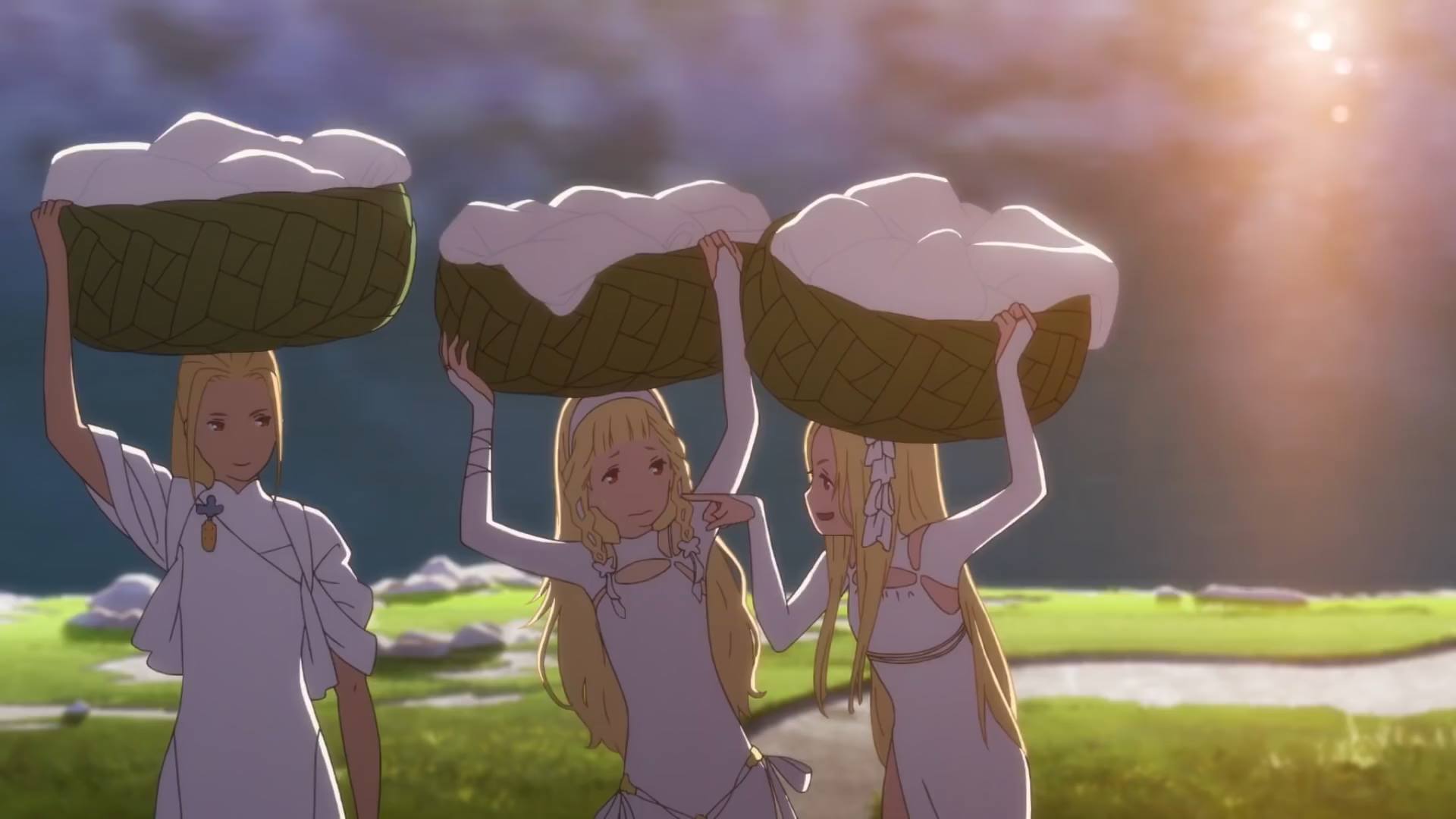
Finally, I got to see it, and though my expectations were high, Maquia met them. This may be writer/director Mari Okada’s debut film, but her first movie is a humdinger in both its emotional impact and its fantasy world-building. The titular Maquia is an orphan of the lorph clan, a small race of people who live for centuries with no aging and record their lives and histories by weaving cloth called Hibiol. A neighboring kingdom invades, taking most of the lorph captive, but Maquia escapes in despair, only to stumble upon an orphaned baby boy she names Ariel. Although she is alone, knows nothing of motherhood, and was expressly warned never to love a mortal lest she endure true loneliness, Maquia raises the child as her own, and…sniff… you’ll just have to watch it for yourself.

Anime has some amazing mothers to its credit, from Hana in Wolf Children to the mom in the tenth episode of Violet Evergarden (another tearjerker of 2018), but there’s something special about Maquia. She shares no blood or background with Ariel, not even fully understanding the physical realities of motherhood, and yet in her efforts to be a good mother, she shines as few parents do in any medium. She struggles with the task, especially as Ariel grows older while she remains the same, becoming a constant reminder that he was adopted, but she takes to heart the lessons taught by others that moms will do anything for their children and that “moms don’t cry.”

See the source image

As much as I wish I could call it a faultless film, Maquia is not without some weaknesses. There’s an extended subplot concerning two of Maquia’s lorph friends, whose paths in life are far more oppressive than hers; enduring rape and imprisonment, they serve as a contrast to the love that Maquia finds, and while their struggles remained interesting and sympathetic, I wouldn’t say they were resolved in an entirely satisfying way. Plus, one jump in time left me unsure what was going on, dropping some uncomfortable implications and keeping its full context vague.

Despite these gripes, Maquia is a beautiful film on multiple levels, from its tender moments to its exceptional animation to its affecting soundtrack. Its rich fantasy world of warring nations and dying dragons offers several striking settings reminiscent of Middle-Earth, and its themes of love and parenthood go straight to the heart, demonstrating how children can have just as much of an impact on their parents as the other way around. Plus, there’s hardly any of the stylistic exaggeration typical of anime, making it a film that fantasy lovers who may not be into anime should be able to enjoy as well.

See the source image

I don’t cry easily these days. Only two anime have left me sobbing before, and Maquia makes it three. I’ve mentioned that some sad films like The Wind Rises seem to almost pull back from full-on tearjerker mode for whatever reason; Maquia does not. I wept bitterly, though for different reasons than something like Grave of the Fireflies. There’s a scene at the end that mercilessly kicks your heartstrings while kissing them tenderly, and it still haunts me. I said yesterday that Mirai made me want to hug my mom; Maquia did the same times eleven. That’s why, for me, this is the anime of the year. The film itself represents its theme of pain being an integral part of love, a bitterness made sweet by all that came before.


Rank: List-Worthy


© 2018 S.G. Liput
600 Followers and Counting!


Mirai (2018)

27 Thursday Dec 2018

Posted by sgliput in Movies, Poetry, Reviews, Writing

≈ Leave a comment

Tags

Animation, Anime, Drama, Family, Fantasy


See the source image

When a child asks, quizzically,
“Where did I come from?”
Who knows what the most fitting answer may be?
The truth of it, physically,
May create someone,
But ‘tis but a branch of the whole family tree.

For what you’re aware of,
Your path and your parents,
Are products of precursors we’ll never know,
Dependent on their love,
Their choice and forbearance,
The roots they put down that their children may grow.
_____________________

MPAA rating:  PG

Back when I reviewed Netflix’s Flavors of Youth, I mentioned there were two new anime films I was dying to see before the end of the year, and now that I have, I also wanted to squeeze in a review for each of them. Thus, I’ll do one today and one tomorrow, starting with the one I’ve been expecting longer.

I’ve enjoyed the works of anime director Mamoru Hosoda for years (The Girl Who Leapt through Time and Wolf Children are still in my top 365 Movie List), and Mirai was one of my most anticipated movies this year. With every new feature, Hosoda has carved out a niche for animation fans, putting his own stamp on imaginative half-Ghibli-like fantasies mixed with real-world drama. In Mirai, his latest acclaimed feature, he does the same with a highly minimalist plot and a younger-than-normal protagonist.

See the source image

At its core, Mirai’s story is deceptively simple, that of a four-year-old boy named Kun accepting the presence of his newborn sister Mirai (which also means “future”). Yet the lessons he learns about jealousy, relationships, and family have surprising depth and are often taught through extended visual metaphors. I was a little surprised that any explanation for the time travel aspect was basically an afterthought. Thanks to the dad, the family’s house is an architectural curiosity with three levels, one of which is roofless with an interior yard, and anytime Kun passes the family tree, it’s as if his imagination conjures up another realm.

Sometimes, it’s the family dog transformed into a grouchy human, or his teenage sister arriving from the future, or his great-grandfather showing him how to ride a bike, and certain moments of the fantastical affecting the real world make you wonder whether it’s all in Kun’s head or not. These elements are a tad random and he sometimes tends to relearn the same lesson over again (be more patient with your parents/sister, for instance), but there’s an ingenious visual nuance to how Kun learns about his family and factoring his new role as a big brother into his identity.

See the source image

I said earlier that Hosoda excels at mixing the magical with the mundane, but it doesn’t work quite as well here as it did with, say, Wolf Children. Some of the transitions between real life and fantasy were rather weird for my taste, and I would have liked a definitive answer of what was actually going on beyond “it’s a visual metaphor.” To be honest, I found myself more interested in the day-to-day activities and struggles of Kun and Mirai’s parents. Let’s face it: Whiny kids can be annoying, especially kids in anime, so I felt more of a connection with the harried father and the long-suffering mother than with the often bratty Kun.

There’s a lot to love about Mirai, not least of which is the beautiful hand-drawn animation. (One scene in a train station is breathtaking in the amount of detail and motion on display.) Plus, it’s funny and relatable on multiple levels. I especially admired how many of the individual stories were brought together near the end to show Kun how a complex web of lives and choices combined to give him the life he had. It was profound and visually striking and helped make up for some of the plot’s earlier weaknesses.

See the source image

It’s worth noting that Mirai surprisingly received a nomination for Best Animated Feature at the Golden Globes this year, making it the first anime to be nominated. It’s certainly worthy and a sign of improvement in what gets recognized, but it irks me that they didn’t give that honor to even more deserving contenders in the past, like Your Name, Wolf Children, or A Silent Voice. But I digress…. Mirai may not be Hosoda’s best work, but it’s another laudable credit to his name. And it made me appreciate my parents a little more, so that I just had to give my mom a hug. Any film that gives me another reason to do that deserves praise.


Rank: List Runner-Up


© 2018 S.G. Liput
600 Followers and Counting!


← Older posts
Newer posts →

Recent Posts

  • We Didn’t Start 2025 (Recap)
  • NaPoWriMo 2025 Recap (Finally)
  • Sonic the Hedgehog 3 (2024)
  • It Happened One Night (1934)
  • Spellbound (2024)

Recent Comments

associatesofshellymann's avatarassociatesofshellyma… on My Top Twelve La La La So…
Kit's avatarKit Nichols on Bonnie and Clyde (1967)
lifelessons's avatarlifelessons on Look Back (2024)
Carol Jackson's avatarCarol Jackson on The Thief of Bagdad (1940…
Stephen's avatarStephen on Love Story (1970)

Archives

  • January 2026
  • December 2025
  • May 2025
  • April 2025
  • March 2025
  • February 2025
  • January 2025
  • December 2024
  • May 2024
  • April 2024
  • March 2024
  • February 2024
  • January 2024
  • December 2023
  • November 2023
  • October 2023
  • September 2023
  • July 2023
  • June 2023
  • May 2023
  • April 2023
  • March 2023
  • February 2023
  • January 2023
  • December 2022
  • November 2022
  • October 2022
  • September 2022
  • August 2022
  • July 2022
  • June 2022
  • May 2022
  • April 2022
  • March 2022
  • February 2022
  • January 2022
  • December 2021
  • November 2021
  • October 2021
  • September 2021
  • August 2021
  • July 2021
  • June 2021
  • May 2021
  • April 2021
  • March 2021
  • February 2021
  • January 2021
  • December 2020
  • November 2020
  • October 2020
  • September 2020
  • August 2020
  • July 2020
  • June 2020
  • May 2020
  • April 2020
  • March 2020
  • February 2020
  • January 2020
  • December 2019
  • November 2019
  • October 2019
  • September 2019
  • August 2019
  • July 2019
  • June 2019
  • May 2019
  • April 2019
  • March 2019
  • February 2019
  • January 2019
  • December 2018
  • November 2018
  • October 2018
  • September 2018
  • August 2018
  • July 2018
  • June 2018
  • May 2018
  • April 2018
  • March 2018
  • February 2018
  • January 2018
  • December 2017
  • November 2017
  • October 2017
  • September 2017
  • August 2017
  • July 2017
  • June 2017
  • May 2017
  • April 2017
  • March 2017
  • February 2017
  • January 2017
  • December 2016
  • November 2016
  • October 2016
  • September 2016
  • August 2016
  • July 2016
  • June 2016
  • May 2016
  • April 2016
  • March 2016
  • February 2016
  • January 2016
  • December 2015
  • November 2015
  • October 2015
  • September 2015
  • August 2015
  • July 2015
  • June 2015
  • May 2015
  • April 2015
  • March 2015
  • February 2015
  • January 2015
  • December 2014
  • November 2014
  • October 2014
  • September 2014
  • August 2014
  • July 2014
  • June 2014
  • May 2014
  • April 2014
  • March 2014
  • February 2014
  • January 2014
  • December 2013

Categories

  • Blindspot
  • Blogathon
  • Christian
  • Movies
  • Music
  • NaPoWriMo
  • Poetry
  • Reviews
  • TV
  • Writing

Meta

  • Create account
  • Log in
  • Entries feed
  • Comments feed
  • WordPress.com

Recent Posts

  • We Didn’t Start 2025 (Recap)
  • NaPoWriMo 2025 Recap (Finally)
  • Sonic the Hedgehog 3 (2024)
  • It Happened One Night (1934)
  • Spellbound (2024)

Recent Comments

associatesofshellymann's avatarassociatesofshellyma… on My Top Twelve La La La So…
Kit's avatarKit Nichols on Bonnie and Clyde (1967)
lifelessons's avatarlifelessons on Look Back (2024)
Carol Jackson's avatarCarol Jackson on The Thief of Bagdad (1940…
Stephen's avatarStephen on Love Story (1970)

Archives

  • January 2026
  • December 2025
  • May 2025
  • April 2025
  • March 2025
  • February 2025
  • January 2025
  • December 2024
  • May 2024
  • April 2024
  • March 2024
  • February 2024
  • January 2024
  • December 2023
  • November 2023
  • October 2023
  • September 2023
  • July 2023
  • June 2023
  • May 2023
  • April 2023
  • March 2023
  • February 2023
  • January 2023
  • December 2022
  • November 2022
  • October 2022
  • September 2022
  • August 2022
  • July 2022
  • June 2022
  • May 2022
  • April 2022
  • March 2022
  • February 2022
  • January 2022
  • December 2021
  • November 2021
  • October 2021
  • September 2021
  • August 2021
  • July 2021
  • June 2021
  • May 2021
  • April 2021
  • March 2021
  • February 2021
  • January 2021
  • December 2020
  • November 2020
  • October 2020
  • September 2020
  • August 2020
  • July 2020
  • June 2020
  • May 2020
  • April 2020
  • March 2020
  • February 2020
  • January 2020
  • December 2019
  • November 2019
  • October 2019
  • September 2019
  • August 2019
  • July 2019
  • June 2019
  • May 2019
  • April 2019
  • March 2019
  • February 2019
  • January 2019
  • December 2018
  • November 2018
  • October 2018
  • September 2018
  • August 2018
  • July 2018
  • June 2018
  • May 2018
  • April 2018
  • March 2018
  • February 2018
  • January 2018
  • December 2017
  • November 2017
  • October 2017
  • September 2017
  • August 2017
  • July 2017
  • June 2017
  • May 2017
  • April 2017
  • March 2017
  • February 2017
  • January 2017
  • December 2016
  • November 2016
  • October 2016
  • September 2016
  • August 2016
  • July 2016
  • June 2016
  • May 2016
  • April 2016
  • March 2016
  • February 2016
  • January 2016
  • December 2015
  • November 2015
  • October 2015
  • September 2015
  • August 2015
  • July 2015
  • June 2015
  • May 2015
  • April 2015
  • March 2015
  • February 2015
  • January 2015
  • December 2014
  • November 2014
  • October 2014
  • September 2014
  • August 2014
  • July 2014
  • June 2014
  • May 2014
  • April 2014
  • March 2014
  • February 2014
  • January 2014
  • December 2013

Categories

  • Blindspot
  • Blogathon
  • Christian
  • Movies
  • Music
  • NaPoWriMo
  • Poetry
  • Reviews
  • TV
  • Writing

Meta

  • Create account
  • Log in
  • Entries feed
  • Comments feed
  • WordPress.com

Blog at WordPress.com.

Is this your new site? Log in to activate admin features and dismiss this message
Log In
  • Subscribe Subscribed
    • Rhyme and Reason
    • Join 814 other subscribers
    • Already have a WordPress.com account? Log in now.
    • Rhyme and Reason
    • Subscribe Subscribed
    • Sign up
    • Log in
    • Report this content
    • View site in Reader
    • Manage subscriptions
    • Collapse this bar