• Home
  • About Me
  • The List
  • THE LIST (2016 Update)
  • THE LIST (2017 Update)
  • THE LIST (2018 Update)
  • THE LIST (2019 Update)
  • THE LIST (2020 Update)
  • THE LIST (2021 Update)
  • THE LIST (2022 Update)
  • Top Twelves and More
  • The End Credits Song Hall of Fame

Rhyme and Reason

~ Poetry Meets Film Reviews

Rhyme and Reason

Tag Archives: Anime

Cartoon Comparison / 2017 Blindspot Pick #9: Hear Me (2009) / A Silent Voice (2016)

15 Friday Sep 2017

Posted by sgliput in Blindspot, Movies, Poetry, Reviews, Writing

≈ Leave a comment

Tags

Animation, Anime, Cartoon Comparisons, Comedy, Drama, Foreign, Romance

Image result for hear me film

Image result for a silent voice film

Whispered rumors, mocking humor,
Overhearing words of spite,
Talk of blame and guilt and shame,
Made all the worse because they’re right—
Oh, to shut such voices out,
Unkindness barely out of sight.

Those with ears, now let them hear,
But if they can’t, do words turn rude?
Is absence of respect and love
The norm when barriers are viewed?
Perhaps it’s best the deaf don’t hear
Unkindness at such amplitude.

Those who fear the scorn they hear
May hide in deafness self-imposed,
Just as those who never chose
Their handicap can feel exposed.
Yet all who rise must recognize
Life’s eyes and ears should not be closed.
______________________

MPAA rating for Hear Me: Not Rated (should be PG)
MPAA rating for A Silent Voice: Not Rated (could be PG but probably PG-13)

In honor of  September being Deaf Awareness Month, I thought it appropriate to combine my monthly Blindspot Hear Me as a Cartoon Comparison with the anime film A Silent Voice, both of which are about a relationship between a boy and a young deaf girl. I thought to combine their reviews before I’d even seen them, but now that I have, the truth is that they’ve got far more differences than similarities. Hear Me is a Taiwanese romantic comedy with the unique distinction of being mostly in sign language, while A Silent Voice is a poignant tale of a bully’s emotional journey toward forgiveness, with romance staying on the back burner. (I thought they were both Japanese until I saw Hear Me was from Taiwan.) Yet both do address issues of deaf people and how others relate to them.

I’ll start with my Blindspot pick Hear Me, which intrigued me when I heard it was mostly in sign language. That probably won’t please anyone who doesn’t enjoy subtitles, but it makes for some very unique conversations, some of them quite dramatic yet communicated with only hands and facial expression rather than voice. Eddie Peng (who just appeared this year in The Great Wall) plays Tian Kuo, a delivery boy for his parents’ restaurant, who meets a girl named Yang Yang (Ivy Chen) at the public pool while her sister trains for the Deaflympics. Since he knows sign language, he freely converses with her over time, and their relationship goes through some familiar highs and lows, with deafness as a potential complication for their future together.

Image result for hear me film

Let me just say that Hear Me has abundant charm, thanks largely to Eddie Peng, whose goofy, lovestruck antics and faces shine through even without words. There is dialogue too, in Chinese, mainly for the humorous exchanges between Tian Kuo and his bossy mother, but sign language and relative quiet are the rule rather than the exception here. The romance is also refreshingly wholesome, with the most suggestive moment just Tian Kuo seeing Yang Yang’s feet while she’s changing, which gives him a nosebleed. (It’s funny, I’ve seen that happen in anime, but this suggests that it’s something that actually happens to Asian people when they get excited.)

Hear Me actually focuses on the dual relationships of Tian Kuo and Yang Yang, as well as Yang Yang and her deaf sister Xiao Peng (Yanxi Chen). After Tian Kuo offends his crush by disrespecting her meager income, his efforts to win her back may bring to mind John Cusack’s desperation in Say Anything, just instead of holding a boom box outside of her window, he dresses as a tree and gives her a coin bank shaped like a bird. Really similar, see? The humor comes from Tian Kuo’s side, while Yang Yang and her sister face more dramatic issues, like craving independence despite being deaf. Yang Yang earns all the money, while her sister focuses on competing as a swimmer, but when her performance suffers, Xiao Peng comes to regret and resent her own dependence on her sister, climaxing in an all-hand heart-to-heart between them.

Image result for hear me film

Hear Me makes the most of its unique sign-language dialogue, which serves the story rather than being just a gimmick. I liked how a misunderstanding was cleverly prolonged, as well as the few reminders of Yang Yang’s Christianity, since her absent father is said to be a missionary to Africa. It may not be a laugh riot, but there were definitely funny moments, especially a hilariously awkward scene where Tian Kuo’s parents sing his praises to his girlfriend. The central relationship also featured several of those heartwarmingly romantic moments that made Hear Me a pleasure to watch.

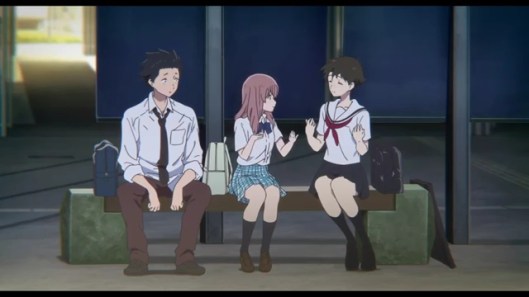
Now for A Silent Voice, or as its Japanese title Koe no Katachi translates, The Shape of Voice. While it received many accolades, A Silent Voice suffered somewhat from bad timing, being released just a month after last year’s mega-hit Your Name in Japan. (Incidentally, both were nominated for Japan’s Best Animated Feature Academy Award, but neither one won. That honor went to In This Corner of the World, which I’ll get to at some point.)  Whereas Hear Me was a romantic comedy with some moments of drama, A Silent Voice is much more dramatic in its young-adult setting and is bound to make sensitive viewers reach for the tissues more than once.

Image result for a silent voice film

The film starts with the carefree elementary school life of Shōya Ishida, who is dumbfounded at the arrival of a new student, a girl named Shoko Nishimiya who reveals through writing in her notebook that she cannot hear. While the other students are civil enough at first, the situation quickly devolves into bullying, led by Ishida. These scenes remind you how cruel kids can be and easily make your heart break for Nishimiya, who endures it all with quiet patience, still thinking the best of her classmates. When she finally is forced to change schools, the blame for her departure quickly falls on Ishida, and he takes her place as the class scapegoat and bully target. Fast forward several years to Ishida in high school, and his marginalization has only deepened, even making him consider suicide, until he tries to seek out Nishimiya and make amends.

A Silent Voice makes the uncommon choice of first portraying its main character as a bully, the kind whose maliciousness seems normal to them but traumatic to their target. Yet the same person we dislike from the outset grows into a source of sympathy as he tries desperately to put that childish cruelty behind him. I loved the creative choice of placing X’s over the faces of his fellow classmates, marking them as people he has no chance or desire of knowing, as literal “unfriends.” These X’s become a brilliant way of visualizing Ishida’s mental state and his chances of relationships with others; when he lets his guard down, actually noticing and treating someone else as a person or vice versa, the X falls from their face and allows him a chance at a friend.
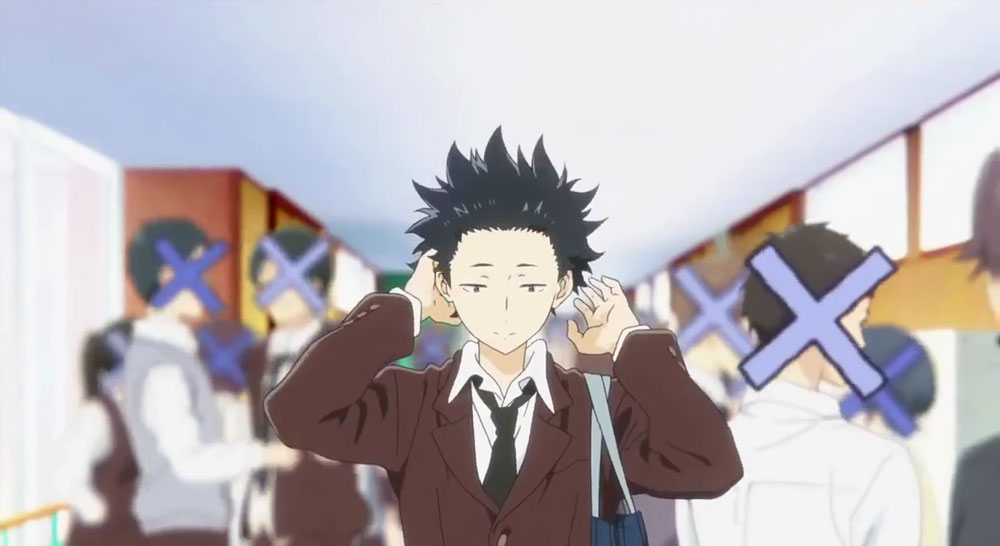
Image result for a silent voice film ending

The relationship between Ishida and Nishimiya is touching on multiple levels. They’re both broken people with agonizingly low self-esteems, Ishida because he considers his past offenses unforgivable, Nishimiya because she blames herself for any trouble around her and believes she somehow deserves it, always apologizing for everything. It’s amazing how easily she seems to accept Ishida after what he did, but it’s the mere effort of communicating with her that she values most. Also perceptive are their interactions with the friends they make and how they respond to the bullying: one girl still sees Nishimiya as insincere and worthy of her harassment, while another views herself as completely innocent, even though she watched Nishimiya’s persecution and did nothing. These bullying themes and Ishida himself meant much to me because I too have been on both sides; I was picked on by an older classmate for a time and I did the same myself, something I still regret despite it happening only once. Ishida doesn’t approach Nishimiya with any set goals of how to make it up to her, but he tries to build the relationships he once helped destroy, something any repentant bully would wish they could do as well.

Kyoto Animation has a reputation for excellence, from the popular Haruhi Suzumiya franchise to the highly anticipated Violet Evergarden, and A Silent Voice is proof of the studio’s talents. The animation is painterly with its luminous, pastel palette, and, even if some of the artsy editing makes it unclear at first what just happened in the nonlinear storyline, it looks gorgeous throughout. The abundant use of symbolism and some ambiguous scenes (like the very first and last shots) also make it a film worth analyzing and hearing others analyze. I still consider Your Name the best anime of last year, but A Silent Voice is quite simply a beautiful film that wears its emotions on its sleeve. Anytime it threatens to dip into teen melodrama, it’s revived by a sweet moment or heart-tugging conversation. I laughed out loud twice, I actually cried “No!” at one harrowing part, and the final scene gives me tearful chills every time I see it.

Image result for a silent voice fireworks scene

Going into these two movies, I really expected them both to be List Runners-Up, as so many movies I’ve seen recently have been. On its own, Hear Me probably would be a Runner-Up, but A Silent Voice earns its way onto my List and gives me an excuse to add Hear Me as a tie. Both approach their deaf subjects with great sensitivity, stressing that they are relatable people in search of the same relationships we all crave. Hear Me had far more sign language than A Silent Voice, which didn’t really bother to translate with subtitles when it was used, but both are excellent features for Deaf Awareness Month and are well worth seeing any other month, for that matter.

Best line from Hear Me: (Tian Kuo’s father, of his mother) “She’s got a knife for a mouth and tofu for a heart.”

Best line from A Silent Voice: (Kawai, a sort-of friend) “Everyone suffers in their life. But it’s like that for everyone, right? So you have to love the bad parts of yourself too and move forward.”


Rank for both: List-Worthy (tie)


© 2017 S.G. Liput
507 Followers and Counting


The Boy and the Beast (2015)

24 Monday Apr 2017

Posted by sgliput in Movies, NaPoWriMo, Poetry, Reviews, Writing

≈ Leave a comment

Tags

Action, Animation, Anime, Drama, Family, Fantasy

Image result for the boy and the beast film

(Today’s NaPoWriMo prompt was for a poem inspired by the art in the margins of medieval manuscripts, which, if you look it up, can be pretty darn bizarre. One popular subject I noticed was anthropomorphic animals standing up like humans, and this film immediately came to mind.)


What wonder-filled world have I wandered into,
So foreign to me and yet home to this zoo?
What strange sort of people inhabit this land,
Where hopefully eating the tourists is banned?

I’ve never seen animals walking like men,
Except for a viral show-off now and then,
But I, as a visitor, now must take care
To not let the seven-foot pig see me stare.

They fight and converse, like us humans, I guess;
Some threaten and hate, and some hate a bit less.
Now new cartoon worlds don’t appear every day.
The strangeness is fading; I think I may stay.
__________________

MPAA rating: PG-13

I don’t know why it took me so long to finally see The Boy and the Beast, considering how much I love director Mamoru Hosoda’s previous film Wolf Children. It feels both very similar to and very different from that film, but it carries the same creative touch that sets Hosoda’s films apart from Studio Ghibli or other anime.

The director seems to alternate the gender of his protagonists (a girl in The Girl Who Leapt through Time, a boy in Summer Wars, a young woman in Wolf Children), and The Boy and the Beast is much more of a male-centric story, as the name implies. After an introduction explaining how two fighting masters are preparing to face off for the rule of a parallel world of beasts, we’re introduced to Ren, a nine-year-old human who has run away from home and become deeply bitter after the death of his mother. A chance encounter with a hooded and gruff bear-faced stranger captures his curiosity, and he follows him through an alleyway portal to the beast world, a disorienting scene reminiscent of the spirit world’s emergence in Spirited Away. Though mocked, feared, and bullied in this land of walking, talking animals, Ren becomes the grudging apprentice of Kumatetsu, a warrior preparing to fight for his world’s lordship who also happens to be a juvenile ruffian. The two learn from each other, Karate Kid-style, and the mutual chips on their shoulders help them form a uniquely short-tempered bond.

Image result for the boy and the beast film

Among the similarities to Wolf Children (aside from the appearance of wolf-headed background characters) is the theme of choosing where one belongs. While the earlier film made Ame and Yuki choose between life as wolves or as humans, The Boy and the Beast presents Ren with an analogous decision between the rough-and-tumble warrior life among beasts or the more scholarly and even romantic pursuits among his own kind. One of my favorite sequences is when Ren is older and connects with a female student who tutors him, a very sweet montage recalling the touching beginning of Wolf Children. Yet this film also faces the dark consequences fostered by bitterness and feelings of not belonging, which can threaten to swallow up their owner, here literalized as a soul-corrupting monster to be confronted.

Where The Boy and the Beast falters is oddly enough its key dynamic, the relationship between Ren and Kumatetsu. The way their antagonism belies deeper respect and affection is well-developed, but the constant yelling at each other becomes tiring after a while, making me wish for the far quieter tone of Wolf Children. In addition, the mythological world of the beasts remains a bit alienating at times, not helped by the long Japanese names many of them possess; the story runs a bit too long; and the big, action-packed, touching, meaningful finale may look impressive, but it only makes sense because the story says it does.

Image result for the boy and the beast film

The Boy and the Beast has a lot to appreciate. I was particularly impressed by certain fluidly crafted shots, such as first-person perspectives that zoom through a scene or tracking shots that slowly extend to reveal something off-screen. The detail of the animation is beautiful, especially in that finale I mentioned, and, if you can get past the frequent yelling (which isn’t uncommon in anime), there’s an engaging tale of finding unconventional family at its core. It didn’t speak to me personally like Wolf Children did, but I can see someone else being equally as fond of it.


Rank: List Runner-Up


© 2017 S.G. Liput
473 Followers and Counting


They Were Eleven (1986)

13 Thursday Apr 2017

Posted by sgliput in Movies, NaPoWriMo, Poetry, Reviews, Writing

≈ 3 Comments

Tags

Animation, Anime, Drama, Mystery, Sci-fi

Image result for they were eleven anime

(Today’s NaPoWriMo prompt was for a ghazal, an Arab poem form of couplets with repeated last lines, into which I tried to incorporate this interesting title.)


They thought they knew what to expect, until they were eleven.
The number of chosen elect jumped from ten to eleven.

This wasn’t the plan; they were told there were ten in the test,
Until it began to unfold, and they counted eleven.

Though tempted to end it because of the unwanted guest,
This crucial attempt at advancing meant all to eleven.

No danger, no drawback would ruin their chance to be best;
Game-changers, they saw, could distinguish the ten or eleven.

The challenge was simple: survive as a team coalesced,
But must the plans alter when ten are progressed to eleven?
___________________

MPAA rating: Not Rated (should be PG, due to a little brief nudity)

In seeking out hidden gems among anime, one need not focus on current releases, since there are plenty of older films worthy of greater recognition. Based on a 1975 manga, They Were Eleven feels very much like a classic, not just classic anime but classic science fiction, the kind of story that feels like an influence on sci-fi to come. Ten finalists of what is basically Starfleet Academy have one final test to gain entrance:  a team exercise where they must survive together on a derelict ship for 53 days. The only hitch is that once the random candidates gather on the ship, they discover there’s an eleventh member, and no one knows who the extra is or what their intentions are.

Image result for they were eleven anime

With a plot that recalls Star Trek: The Next Generation and Ender’s Game and may or may not have inspired elements of them, the film does an excellent job balancing its diverse cast. This kind of ensemble in animation is rare, but the varied character designs help to differentiate the cadets on board, who include a king, a cyborg, two alien species, an apparent girl named Frol who insists she’s a man, and a young psychic named Tada, who serves as the main protagonist. All of them have different reasons for wanting to attend the academy, and their personalities often clash as they encounter obstacles, dangers, paranoia, and sabotage.

Except for a few explosive scenes, there’s nothing particularly special about the animation; it’s solid, and serves the story well enough, as does the English dub, which only feels notable because it features Steve Blum and Wendee Lee before they were paired again in the excellent Cowboy Bebop dub. They Were Eleven is a consistently interesting mystery, and while the ending isn’t exactly a big shock, it explores its sci-fi themes with intelligence, particularly Frol’s side plot that manages to both challenge and embrace traditional gender roles. It may not be well-known, but They Were Eleven deserves to be.


Rank: List Runner-Up


2017 S.G. Liput
468 Followers and Counting


The Empire of Corpses (2015)

29 Sunday Jan 2017

Posted by sgliput in Movies, Poetry, Reviews, Writing

≈ 4 Comments

Tags

Action, Animation, Anime, Drama, Sci-fi, Thriller

Image result for the empire of corpses film


When I am dead, my soul no longer here,
What happens to my body is unknown.
‘Tis but a shell, an empty souvenir
Of my time in a world from which I’ve flown.
Most likely, it will end up in the ground,
A monument for time to chip away,
But if some more productive use were found,
Its former owner would not have a say.
If man no longer buried his remains
And flouted promises of “rest in peace,”
His conscience would be numb as it disdains
What once deserved respect upon decease.
What world of Frankensteins I’d leave behind
If man were to defile his own kind!
________________

MPAA rating: should be PG-13 or maybe older

The Empire of Corpses looks like an incredible, action-packed, thought-provoking movie, but it’s not. It just looks like one. Based on a novel by a Japanese author dubbed Project Itoh, who died of cancer before the book’s completion, this anime zombie film sets up an alternative steampunk version of Victorian England, where technology has allowed mankind to reanimate the dead as essentially robotic slaves, programming them to perform menial labor as a growing workforce in the world economy. These walking corpses can be recognized by their pale gray skin and passive expressions, but though they seem to understand and follow orders, they are without a soul. Into this hypothetical world is placed an amalgamation of historic and literary figures, a la The League of Extraordinary Gentlemen. John Watson is the hero, a corpse scientist who has resurrected a dead friend he renames Friday and now searches for a way to return his soul. Blackmailed by M of the James Bond franchise, he sets out in search of the fabled research of Dr. Victor Frankenstein, aided and impeded by the likes of Ulysses Grant, Thomas Edison, and characters from The Brothers Karamazov and The Future Eve.

Image result for the empire of corpses film

While that description sounds rather awesome, especially when paired with a world full of brainwashed zombies, The Empire of Corpses seems eager to spoil a good thing. After the adventure begins on a thrilling note, it quickly descends into opaque philosophical pondering and inscrutable character motivations. After watching it all the way through, I recognize a worthwhile, imaginative story, full of food for thought, but actually watching it scene by scene can easily frustrate and confuse. By the end, the villain’s revealed plot (the second villain since one wasn’t enough) is baffling and poorly explained, making it clear just how vaguely defined the laws of this corpse technology are.

I hate to be so negative, especially when The Empire of Corpses looks so amazing. The animation is crisp and atmospheric and brings this theoretical world to life in ways that far surpass the deficient script. I’m glad I saw it, if only for the visual flair, such as the thrill of seeing a woman on the back of a galloping stagecoach mowing down zombies with a flamethrower. The action scenes are exceptional, but it makes it that much more disappointing that the rest of the film couldn’t measure up.

Image result for the empire of corpses film

The Empire of Corpses is not without its virtues; I would just like it much more if it made more sense. It does feature some intriguing themes about life and death and manages to create a unique entry in the zombie genre, complete with zombie suicide bombers. The English dub is actually quite good, but the animation is the main attraction for fans of the medium, though certain scenes can get bloody (begging the question of why a dead corpse would bleed). This film is one of three anime movies based on Project Itoh’s novels (the others being last year’s Harmony and this year’s Genocidal Organ), and I certainly hope the other two have more than visual merit alone.


Rank: Honorable Mention


© 2016 S.G. Liput
444 Followers and Counting


Puella Magi Madoka Magica Trilogy (2012, 2013)

17 Saturday Dec 2016

Posted by sgliput in Movies, Poetry, Reviews, TV, Writing

≈ Leave a comment

Tags

Animation, Anime, Drama, Fantasy, Mystery

Image result for puella magi madoka magica rebellion

Do you value your life,
All you have, all you know?
And for what would you trade it,
I wonder?
Could you ever decide
To what lengths you would go?
Would you grieve when you’d paid it,
I wonder?

I would never regret,
Says the fool, feeling smart,
To confirm his conviction
Till later.
But regrets always come
When we think with our heart.
‘Tis our own contradiction
And traitor.
___________________

MPAA rating: All not rated (should be PG-13)

Don’t judge a book by its cover, or in this case, a show by its genre. I would think most people even mildly familiar with anime have heard of magical girl shows like Sailor Moon or Cardcaptors, where a group of girls typically gain powers from some adorable talking creature and become cutesy superheroines. Not to dis those shows, but it’s the kind of formula that works well for kids yet becomes insufferable to outsiders and even older former fans, like me. Yet about six years ago, Puella Magi Madoka Magica (that’s Latin, by the way, not Japanese) revolutionized the genre under the mature eye of writer Gen Urobuchi. In American terms, that’s like Christopher Nolan directing a Barbie movie and making it awesome.

Image result for puella magi madoka magica sayaka

Since I’ve been reviewing only films up to this point, I’ll point out that Puella Magi Madoka Magica (I’ll just call it Madoka Magica to save time) isn’t just a TV show; it had a film follow-up subtitled Rebellion, and before that was released, the 12-episode series was edited and retooled as two theatrical films, the first called Beginnings, the second Eternal. Thus, that makes Madoka Magica eligible for my top movie list and well worth reviewing, since it happens to be my third favorite anime series, after Cowboy Bebop and Steins;Gate.

The odd thing about Madoka Magica is that it was marketed like any number of similar shows, light and innocent, and since it was original and not based on a manga, viewers had no idea what to expect. The opening credits are overly bright and cheery and the first couple episodes are nothing out of the ordinary, with the typical banter and buoyancy of color-coordinated middle-school girls, but don’t let that fool you. This series goes to some very dark and very emotional places, and it confirms the unwritten rule of watching at least three episodes of a given series before you write it off.

Image result for puella magi madoka magica

After school one day, Madoka (the one with pink hair) and Sayaka (blue hair) are rescued from a dangerous witch by upperclassman Mami Tomoe (yellow hair), who became a magical girl by making a deal with the talking animal-thing Kyubey: magical powers and the duty of battling witches in exchange for a single wish. At first, they’re awed by the potential of such a pact, but neither can bring themselves to trade away their old lives. Meanwhile, a black-haired new student and magical girl named Homura seems to have a mysterious mission to keep Madoka from accepting Kyubey’s deal at all costs. The story may threaten to lose your interest at first, but then comes a moment in the third episode that changes the entire tone of the show, a scene so sudden and shocking that it has burned itself into my memory, even though I knew about it beforehand. From there, the story spirals into tragedy, heartache, and themes far deeper than one would expect going in.

The characters are still young and naïve, and they buckle under the weight of the hard, regrettable choices placed upon them. They expect frilly costumes and to help people, and while there’s some of that, before long they must deal with disillusionment, death, lies, time travel, and the laws of thermodynamics. (Told you this wasn’t a typical magical girl show.) The catalyst for all this is Kyubey, who seems like a cute sidekick at first but holds much darker intentions with his Faustian contract. Even with his passive demeanor, high-pitched voice, and blank stare that gets creepier with time, he’s such a manipulative, logical little bugger that, by the end, I hated the very sight of him. He’s also essentially unkillable, but it was satisfying whenever anyone tried. Homura’s story in particular overshadows everyone else’s, and while she’s a mystery for most of the series, her backstory is remarkably compelling.

Image result for puella magi madoka magica homura

Like the story, the art style is also distinctive and layered with atmosphere. The animation of the real world is evocative on its own, often setting the mood with stylized angles and amber-tinged sunsets, and the character’s eyes have a unique sketched quality to them. Things get bizarre, though, whenever a witch appears in its labyrinth, not as a pointy-hatted antagonist but as a collage of stop-motion cutouts that go deep into surreal territory. The combination of the traditional animation with this dreamlike setting is often nightmarish and complements the story’s descent into misfortune, while certain scenes in silhouette are both beautiful and disturbing, incorporating artistic details evoking similar themes to Faust and The Little Mermaid. The action scenes are also very well-done, often with spectacular explosions. Boy, this series has everything.

I feel like I’ve been reviewing Madoka Magica the show rather than the movies, but the first two films basically are the series, with the first eight episodes making up Beginnings and the final four forming Eternal.  They actually translate quite well, skipping over some of the awkward moments at the beginning and keeping only what’s necessary to the story, while retaining important character moments, like Madoka’s insightful conversation with her mother. Eternal has one extra battle scene and some revised animation but unfortunately includes some cutesy montages that feel out of place since the story’s tone had already changed drastically from the beginning. However, it does follow the same plot to the same heart-tugging finale. The series is full of tragic events that make me want to tear up just seeing the characters, but despite some overwrought execution of the cosmic twist at the end, the conclusion is sublimely bittersweet.

Image result for puella magi madoka magica sayaka and kyoko

And then… they had to ruin it with a third movie. Rebellion may be more cinematic than the first two, but it’s nowhere near as successful. It tries to replicate the bait-and-switch of the series, with a lighthearted beginning that gets darker as it goes, but it does so by presenting an alternate version of events with an explanation far too long in coming. I suppose it’s a little satisfying to see the characters in the carefree life they thought they’d have as magical girls, but it indulges for too long. Sure, the plot eventually makes sense, but it’s not good when even those familiar with the story are utterly confused for over a half hour.

It’s not all bad. Once the plot deepens, it gets more absorbing, and the eventual reveal of the mystery reconfirms Kyubey as the most hateful cat-bunny-thing imaginable. There’s also an epic gun battle between two popular characters that is jaw-droppingly awesome and may be the action high point of the series. If only the rest of the story could live up to it. One side character has little reason for existing; the surreal visuals are the rule rather than the exception now, as if the filmmakers took turns animating their most unsettling drug trips; and the final twist took Homura’s obsession with Madoka in a wholly unsatisfying direction. And then it ends, with a brand new conflict introduced and no resolution. No! There’s talk of a fourth film in development, and while that may improve things if they can end it right, it doesn’t make the disappointment of Rebellion any better right now. Sequel-makers constantly ignore this demand, but don’t continue a series unless you can end it just as well as it already had!

Image result for puella magi madoka magica witches

The final movie aside, Puella Magi Madoka Magica is a brilliant and memorable series, well-written, poignant, and impressively visualized. The music is haunting, the animation arresting, and the character motivations powerfully nuanced yet pitiful and open to interpretation. It’s the kind of psychological story that leaves me with a persistent melancholy long after it’s over. I’m including a fan-made music video down at the bottom (set to one of my favorite Florence and the Machine songs) that might give you an idea of its peculiar power. For anyone still reading this who may be hesitant to check out a magical girl series, I can only say one thing: Don’t judge a book by its cover. You’ll be glad you didn’t.

Best line: (Kyubey, the loathsome, logical little scumball) “Why is it that when humans regret a decision they made based on their own misunderstanding, they feel resentment toward the other party?”

Tied with his punch-worthy “If you ever feel like dying for the universe, call me. I’ll be waiting.”

Rank for Beginnings and Eternal: List-Worthy
Rank for Rebellion: Dishonorable Mention

© 2016 S.G. Liput
437 Followers and Counting

Princess Mononoke (1997)

05 Monday Dec 2016

Posted by sgliput in Movies, Poetry, Reviews, Writing

≈ Leave a comment

Tags

Action, Animation, Anime, Drama, Fantasy

Image result for princess mononoke


The forest stood for centuries,
In peace made permanent by trees
Whose roots sucked deep of earthen milk,
Whose branches guarded all.
And then came humans and their ilk
Who made the trees to fall.

/\/\/\/\/\/\/\/\/\/\/\/\/\/\/\/

Mankind pushed on for centuries
Through mountains, deserts, woods, and seas.
From cave to tent to town, they rose
With wonders underway.
Too often, nature did oppose
And kept progress at bay.

/\/\/\/\/\/\/\/\/\/\/\/\/\/\/\/

Both stories hold an equal truth.
Both man and nature from their youth
Have wished romantically for truce
That ended in conquest.
Cooperation or abuse—
We choose which path is best.
___________________

MPAA rating: PG-13

Hayao Miyazaki has a filmography full of films considered great cinema, and each of them seems to fit a particular target age group. While they are all beautifully drawn, the maturity level for his features could be generally ranked something like this: Ponyo (5 years old and up), My Neighbor Totoro (6 and up), Kiki’s Delivery Service (7 and up), Castle in the Sky (8 and up), Porco Rosso (9 and up), Spirited Away (10 and up), Howl’s Moving Castle (11 and up), Nausicaä of the Valley of the Wind (12 and up), The Castle of Cagliostro (13 and up), The Wind Rises (13 and up), and the one most clearly meant for adults, Princess Mononoke (14 and up).

Princess Mononoke is different from any other Studio Ghibli film, both in its narrative complexity and its level of violence, and when I discovered the Ghibli films and had myself an anime marathon, it caught me completely off-guard. I was shocked that heads and arms were being lopped off within the first fifteen minutes, and I turned it off then and there. It took me some time to give it another try and look past the savagery of certain scenes. Luckily, those scenes are the exception rather than the rule, and I found that Princess Mononoke was something few animated films can claim to be—an epic. From the sweeping landscapes and moving Joe Hisaishi score (he really is one of my favorite movie composers) to the huge cast of characters and nuanced themes, it’s a film so ambitious that I don’t know if there’s anything else to compare it to.

Image result for princess mononoke irontown

The story follows Prince Ashitaka (Billy Crudup in the English dub) in ancient tribal Japan, before forest gods and demons became mere legends. While defending his village from a demon boar, his arm is infected with a curse, and he must journey to a distant forest in the hopes of a spiritual cure. What he finds is an ongoing struggle between industry and nature, as the hardworking folk of the lakeside Irontown battle against the forest gods, led by the giant wolf Moro (Gillian Anderson) and her adopted human daughter San (Claire Danes).

Before Spirited Away came along, Princess Mononoke had every right to be called Miyazaki’s masterpiece, and while it’s far from my favorite of his films, I certainly see why it is deserving of that distinction, more so than Spirited Away, to be honest. Princess Mononoke is as expansive an experience as one can find in an anime film, with Ghibli’s ever-detailed artwork transporting viewers to another time and place full of action, beauty, and menace. It’s not a film I connected with personally, and certain things detract from it in my eyes: the aforementioned violence, the heavy pagan mythology, some grotesque imagery, an ending that doesn’t seem to punish the character most deserving of it. Yet there’s so much to impress that objections like these seem small by comparison.

Image result for princess mononoke irontown


The plot and characters are the most impressive ingredients on display. The conflict between humans and nature has resonances of Miyazaki’s Nausicaä of the Valley of the Wind, from the strong female characters right down to the final scene of both, but there are more than two sides to the dispute, and every side has its own distinct motivations that are far from black and white or simple good and evil. There’s Lady Eboshi (Minnie Driver) and her Irontown loyalists, who are embattled with San and the wolves, while a herd of vengeful boar also joins the fray, while a devious monk (Billy Bob Thornton) plots to steal the head of the Great Forest Spirit, while some iron-greedy samurai make war too. And in the middle of everything is Ashitaka, urging peace on all sides as he seeks to heal his cursed arm, which gives him super-strength but will eventually kill him. How all these various factions clash is key to the film’s epicness, yet Miyazaki’s knack for character is also on display. Lady Eboshi, for instance, isn’t a typical villain, trying to act in the best interest of her people and demonstrating concern for the lepers and women under her care. It’s unfortunate then that the multitude of characters proves too much to negotiate by the end, where the strife is wrapped up a bit too neatly, but the bulk of the film balances it all amazingly well.

Image result for princess mononoke moro


The sheer length and scope of Princess Mononoke are enough to make it a landmark anime, even if it’s not for all ages. It played a role in bringing Studio Ghibli to greater attention in the West and, like Akira, showed audiences that anime could be intricate and mature and more than Saturday morning cartoon fare. Though I find several of his films more engaging than Princess Mononoke, if you want proof of Hayao Miyazaki’s talent as a filmmaker, this is it.

Best line: (Hii-sama, the wise woman of Ashitaka’s village) “You cannot change fate. However, you can rise to meet it, if you so choose.”


Rank: List-Worthy


© 2016 S.G. Liput
433 Followers and Counting


Your Name (2016)

22 Tuesday Nov 2016

Posted by sgliput in Movies, Poetry, Reviews, Writing

≈ 5 Comments

Tags

Animation, Anime, Comedy, Drama, Fantasy, Romance


See the source image

If someday I should forget you
Or the moment that I met you,
I hope, easing your regret, you
Know, although you fade
In memory, your soul and mine
Are too attached to disentwine.
You are the one for whom I’ll pine
Till all the world’s unmade.
__________________

MPAA rating: Not rated yet (should be PG, maybe PG-13)

I’ve been awaiting Makoto Shinkai’s next feature film for some time now, and it seems that his latest movie has finally earned him acclaim and notice outside of anime fan circles. Kimi No Na Wa, or Your Name, is being heralded as proof of Shinkai coming into his own as “the new Hayao Miyazaki,” and this his fifth feature film has been hugely successful in Japan, where it is currently the seventh highest-grossing film ever.

Honestly, I’m just thrilled that I was able to see Your Name so soon after its release (as opposed to waiting perhaps a year for the DVD), but the fact that it is such a winner for writer/director Shinkai makes it even better. I’ve had a rocky regard for his past films, which are always visually beautiful and emotional but range from confusing (The Place Promised in Our Early Days) to depressing (5 Centimeters Per Second) to absolutely wondrous (Children Who Chase Lost Voices). I can’t say Your Name is the faultless masterpiece that many reviewers are making it out to be, but it’s an enchanting and praiseworthy fantasy drama that seems like the culmination of all that his less successful films tried to be.

Image result for kimi no na wa

On the surface, Your Name is a body-swap comedy between a city boy named Taki in Tokyo and a country girl named Mitsuha. Sick of her provincial surroundings and embarrassed by her feminine duties at her grandmother’s Shinto shrine, Mitsuha wishes she could be a handsome boy in Tokyo in her next life, a fancy that soon becomes reality. At random times, the two wake up in each other’s bodies and awkwardly try to live each other’s lives until they can get back to their own the next day. Their memories of the other-body experiences remain hazy afterward, like a dream, but the reactions of their friends and family make it clear that the switch is indeed real. Through notes, advice, and complaints left for each other, they get to know each other on a deeper level than most, while having a key element of any relationship—face-to-face contact—just out of reach.

Based on the trailers, one might think the body-swap humor was the main point of the film, but it actually makes up only the first third, with the rest of the film taking a far deeper and more meaningful course. Had the film remained like the first forty minutes, it would have been a somewhat fun and strange if unremarkable story, but as long as the tonal shift doesn’t bother viewers, it’s the final hour that explains Your Name’s popular acclaim, going off in unexpected and poignant directions. While publicity shots like the one below suggest that Taki and Mitsuha have greater contact, they’re separated by more than distance for the majority of the film. When they do have fleeting connections, it’s the stuff of cosmic, tragic romance, which brings people like me close to tears, even if I don’t quite get there.

Image result for kimi no na wa

Your Name does stumble on occasion, particularly when Shinkai indulges in repeated music video-like montages, like the one at the end of 5 Centimeters Per Second. The J-pop contributions of the band Radwimps actually complement the film well, but the montages sometimes give the film a rushed quality that could have been improved. The non-linear storyline also leaves the significance of some scenes in doubt, especially at the beginning… that is, until the importance of certain flashbacks becomes clearer. I would highly recommend seeing the film more than once, since the layers of its plot are better appreciated when viewed with the whole picture.

Other traces of Shinkai’s past work actually improve on his portfolio. Like The Place Promised in Our Early Days, there are a boy and girl’s sci-fi-ish separation and the threat of massive destruction, while the presence of a comet streaking across the sky brings to mind the space probe of 5 cm. One moment toward the end was even straight out of the unsatisfying conclusion of 5 Centimeters Per Second, prompting me to say “No, don’t you dare end it like that!” Luckily, it didn’t. I also appreciated a neat little cameo for a character from Shinkai’s previous film The Garden of Words.

Your Name is as beautifully animated a film as any I’ve seen in recent memory, with Shinkai’s usual attention to detail for light and shadow being exemplified. A sojourn to an expansive crater out in the countryside is especially memorable, with some gorgeous fall colors on display. Details abound, both in the scenery and the story, and attention is paid to fleshing out not only Taki and Mitsuha but also their friends and family members, making for a comprehensively touching film.

Image result for kimi no na wa

There’s so much to admire in Your Name, from the intricate but engaging plot to the moments of visual beauty, that few should mind its weaknesses, such as the quasi-spiritual “explanation” for the body swap itself. It has a good chance at snagging a Best Animated Feature nomination at the Oscars, which would make it the first non-Studio Ghibli anime film to do so, and even if I suspect Zootopia is the favored winner, Your Name would also be deserving. I still consider Children Who Chase Lost Voices to be Shinkai’s unsung masterpiece, but films like it and Your Name are what might make him a household name one of these days.

Best line: (Mitsuha’s grandmother, to Mitsuha/Taki) “Treasure the experience. Dreams fade away after you wake up.”


Rank: List-Worthy


© 2016 S.G. Liput
424 Followers and Counting


Cartoon Comparisons: Upside Down (2012) / Patema Inverted (2014)

15 Thursday Sep 2016

Posted by sgliput in Movies, Poetry, Reviews, Writing

≈ 2 Comments

Tags

Animation, Anime, Cartoon Comparisons, Drama, Romance, Sci-fi

Image result for upside down 2012 film

Image result for patema inverted


Right-side up is upside down
To those who smile when they frown,
To those who plunge whene’er they jump
Or rise when tripping on a bump
Or gobble down and up their meals
And sink a little in high heels,
To those who elevate a bit
If they lean over, kneel, or sit,
To those who set a precedent
When they descend on their ascent.
Up and down can be subjective.
‘Tis a matter of perspective.
____________________

MPAA rating for Upside Down: PG-13
MPAA rating for Patema Inverted: should be PG

For the next Cartoon Comparison, I’ve chosen two science fiction films with wildly imaginative concepts that happen to be suspiciously similar. Both the live-action Upside Down from Canada and the anime Patema Inverted from Japan feature the idea of opposite gravities: people walking on the ceilings, objects falling up, and the unlikelihood of two oppositely oriented young people overcoming the hatred of their politically hostile worlds. What differs is the way their worlds interact and the pseudo-scientific “explanation” for the curious gravitational situation.

Upside Down came first so if there was any copying being done, the live-action film can claim to be the original. Here, as explained by the narration of Adam (Jim Sturgess), two planets orbit each other so closely that there is essentially no sky. Looking up from either world, one simply sees the other planet’s surface, about as far away as a skyscraper, echoing perhaps the folding city street in Inception. One planet is considered Up Top, full of wealth and societal power, while the other is the economically exploited Down Below, though there’s no telling how they were named, considering the potential confusion of “up” and “down.” Luckily, the extraordinary visuals elevate the film’s none-too-subtle class struggle. Even if there were moments that I wasn’t sure what I was seeing at first, the remarkable effects were a marvel to the eye.

Image result for upside down 2012 film

As for the love story, Adam from Down Below happens to meet Eden (Kirsten Dunst) from Up Top, and they share remote romantic rendezvous in the mountains until the government breaks them apart. Years later, as Adam experiments with a practical anti-gravity serum, he seizes a chance to see Eden again at Transworld, the tower-like corporate bridge between the two worlds. The two leads certainly have chemistry, but due to a certain plot point, they don’t get to take much advantage of it, and Sturgess’s behavior can be awkward at times.

Yet Adam’s quest to reunite with Eden without being caught by the authorities leads to a good deal of inventiveness, such as his attempt to weigh himself “up” and pose as a citizen of Up Top. Unfortunately, logic gets in the way at times, including the film’s own invented gravitational rules. For instance, Adam never seems to have a problem with the blood flowing to his head when upside down. Wouldn’t that be both uncomfortable and a possible give-away to anyone who might notice? In addition, one of the planetary laws is that matter from opposite worlds eventually burns, but the time it takes for this to happen seems inconsistent. By film’s end, the conclusion is peculiarly rushed, offering a blanket resolution to crucial issues it couldn’t hope to address and doesn’t try. Upside Down is brilliant in concept, less so in execution, but the visuals alone are worth the watch.

Image result for upside down 2012 film adam and eden

Upside Down may have come first, but Patema Inverted utilizes the notion of inverse gravity far better, in my opinion. Perhaps the fantastical image of falling up is simply more credible in animation rather than live-action CGI, but it certainly captured the imagination of director Yasuhiro Yoshiura, who previously directed the compelling series-turned-movie Time of Eve. (I was impressed by both Patema and Time of Eve separately but didn’t realize till afterward that they shared the same director.)

Instead of the up-front exposition of Upside Down, Patema Inverted takes its time to show and develop the gravitational anomalies as the characters discover them. Patema is a girl living in a City of Ember-like underground bunker and seems to be one of the few inhabitants to show an interest in the Forbidden Zone, where dust floats upward and “bat people” are rumored to lurk. After a close encounter, she finds herself dangling from a fence with the sky looming “below” her. Luckily, she is saved by the equally curious surface boy Age, who seems upside down to her. Age lives under a totalitarian dystopian government, whose leader is determined to root out the surviving inverts, who made their way underground after a catastrophic accident sent most of them falling into the sky years ago.

Image result for patema inverted

Upside Down basically lacked any sky; there was only so far someone could fall. Patema Inverted, however, makes the sky an imposing threat, a beautiful but dangerous abyss ready to swallow Patema without Age’s assistance. The animation is frequently dazzling, especially when the point of view shifts to contrast Age’s perspective with Patema’s. As Patema ventures into Age’s world and he ventures into hers, the distinction of up and down becomes fluid. The plot even takes some initially confusing twists that challenge the viewer’s perceptions and require some extra thought to fully comprehend. Some might be befuddled, but I found it fascinating. Plus, the musical score is enchanting and perfectly complements the film, including the gorgeous credits song “Patema Inverse,” which is sung in Esperanto and earns a place in the End Credits Song Hall of Fame. Between this and Time of Eve, I’m definitely hoping that Yoshiura continues to create such intriguing films.

I will admit that Patema Inverted seems to draw some inspiration from Upside Down. The cause of the inverted gravity differs (natural phenomenon vs. manmade disaster), but how the two gravities interact is the same: the lesser weight lightens the gravity of the other. This leads to the couples in both films holding on to each other to prevent the other from falling away, and being able to defy gravity by using each other’s weight. Writing about it doesn’t seem to do it justice, but it’s clever, cool, and undeniably similar in both films. As original as Patema Inverted is, I can’t help but wonder how much inspiration it drew from the earlier film. In addition, Patema is also rather slow in its gradual plot progression, and the villain is stereotypically bad for bad’s sake.

Image result for patema inverted


Despite these minor “down”-sides, Patema Inverted is easily the better film. Upside Down may have brought gravitational sci-fi to life first, but its conventional plot can’t compare with the thought-provoking vision of its animated counterpart.

Best line from Upside Down: (Adam) “Gravity, they say you can’t fight it. Well, I disagree. What if love was stronger than gravity?”

Best line from Patema Inverted: (Age, when holding onto Patema) “I get it! Your weight makes me light.”  (Patema) “Girls don’t like it when you talk like that!”


Rank for Upside Down: List Runner-Up
Rank for Patema Inverted: List-Worthy


© 2016 S. G. Liput
408 Followers and Counting

King of Thorn (2010)

21 Sunday Aug 2016

Posted by sgliput in Movies, Poetry, Reviews, Writing

≈ Leave a comment

Tags

Action, Animation, Anime, Drama, Horror, Mystery, Sci-fi, Thriller

Image result for king of thorn film


The world was collapsing
With panic forecast
And death in the news everyday,
Yet we were persuaded
That one short sleep passed
Would sweep the dark future away.

We woke to a nightmare
More dire than the last,
Confronted and hunted and trapped.
We slept to thwart death,
Which would not be outclassed
By sleepers with secrets untapped.
________________

MPAA rating: Not Rated (should be R)

One movie-watching emotion that I especially love and rarely get the chance to experience is the feeling of having my mind blown. The best example I can point to for that would be Inception, and to a lesser extent The Prestige, both Christopher Nolan features with unspoiled twists and a provocative narrative boldness. All too often the twist is either spoiled for me (Predestination, The Sixth Sense) or it’s not all that surprising (The Usual Suspects, Interstellar), so when a film provides me with that rare blend of shock and wonder, I treasure it. King of Thorn did just that.

I had heard that this anime film was a combination of Inception, Aliens, and Lost, and…that’s exactly what it is, with a little Matrix and Akira thrown in for good measure. In the first scene, we see a woman commit suicide by jumping off a building, but when she lands, her body shatters, revealing the effects of a new fatal disease dubbed the Medusa virus. This plague that turns humans to stone quickly becomes a worldwide pandemic; in response, the Venus Gate organization selects 160 infected individuals to be put into a Cold Sleep until a cure can be found. When the diverse group is awakened from stasis, surrounded by thorny vines, a horde of monsters attacks them, thinning the herd (not unlike the plane crash at the beginning of Lost) in a scene sure to make you even more afraid of falling down an elevator shaft. Only seven survive, including timid Kasumi, who had to leave her twin sister behind and now must survive with the others and escape from this nightmare.

Now the typical viewer might think that they slept in stasis for hundreds of years to awaken in a post-apocalyptic future, and that’s actually exactly what the characters assume at first. But let’s just say there’s more to it, a lot more. Almost every character has a secret or a past trauma, and the plot twists just keep coming. Like Lost, the film even teases suggestions of what is really going on. Is all of this a dream? Did Kasumi and her sister somehow switch places? There’s no way I’m going to spoil it, though, and I guarantee you that you’ll be kept guessing right up to the last ten minutes.

Because King of Thorn is so packed with plot, from repeated flashbacks that slowly reveal more to overly explanatory references to Sleeping Beauty, it’s not surprising that not everything gets a resolution. Some plot points are dropped without a second glance, and the ending doesn’t even try to address a major uncertainty. Plus, even if I think I understand how everything came about, I’m not sure I get why it all happened the way it did, perhaps due to the significant omissions from the manga the film is based upon (which everyone who’s read it seems to agree is better than the film). Yet the fast-paced action and thought-provoking narrative made up for these faults. If you’re one of those people who hated all the loose threads in Lost, King of Thorn will leave you equally perplexed; but I for one didn’t mind at all, and I know quite a few friends and fellow bloggers who would find this film fascinating. I’ve already introduced it to a friend of mine, and he loved it.

Image result for king of thorn film


On the down side, it’s a film worthy of an R rating, with gruesome killings and a little nudity toward the end. Yet, the gore was far from constant, and like Aliens, it’s the kind of violence one can easily see coming and just turn away from at the right moment. At least, that’s what I did. As for the question of whether to see the subtitled or dubbed version, both have their strengths. The English dub features accents that make it clear that the survivors are from around the world (British, Italian, American, Australian), but it also has the foul language one would expect from an R-rated horror thriller. If you care about avoiding profanity, the original subtitles have far less.

Despite the few negatives, King of Thorn is an exceptional sci-fi thriller that played with my mind in the best way and even managed to touch the heart. The cast of characters are all unique and sympathetic as their back stories are clarified, and the music adds to an epic sense of mystery, especially in the early scenes. (The song “Edge of This World” also earns entrance to the End Credits Song Hall of Fame.) The animation beautifully brought to life both the thrilling and the grotesque, and even if some might complain about the occasional merging of 2D and 3D animation in the action scenes, I didn’t find it distracting. In the days since I first saw it, King of Thorn has only risen in my estimation, and while it might further mess up my original Top Twelve Anime List, I think I’ve got another favorite to add.

Best line: (Marco) “Even if you’re overcome by unspeakable loneliness, endure it and encourage someone who can follow where you left off.”


Rank: List-Worthy


© 2016 S. G. Liput
404 Followers and Counting


Wolf Children (2012)

08 Sunday May 2016

Posted by sgliput in Movies, Poetry, Reviews, Writing

≈ 2 Comments

Tags

Animation, Anime, Drama, Family, Fantasy


Mothers are angels, by parenthood wrought,
And unsung saints, whether they know it or not.
Their job is to lead through each giggle and tear
And make angels too of the rascals they rear.

They’re makers of breakfast and takers of guff
And mentors who know when enough is enough.
They’re huggers or kissers, though all aren’t the same,
Who take it in stride when kids think it a shame.

When needed the most, they’re a wide-open door,
The builders of life starting at the ground floor.
All this mothers are, or should be by design,
All worthy of honor, and why I love mine.
__________________

MPAA rating: PG

Happy Mother’s Day to all! I have no idea why it’s taken me this long to review the film that placed #6 on my Top 12 Anime List, but Mother’s Day seemed like the perfect opportunity to review this affectionate tribute to a mother’s love. After strong films like The Girl Who Leapt through Time and Summer Wars, I think Mamoru Hosoda clinched his growing reputation as the next Hayao Miyazaki with Wolf Children, a favorite of many anime fans.

As a college student, Hana meets and gradually falls in love with a young man she meets in class, a strong, silent type with a kind heart. Her love for this unnamed man is not diminished when he reveals that he is part wolf, able to transform at will but choosing to live as a human. What follows is a warmhearted montage of domestic bliss to rival the beginning of Up, along with an equally tragic end when Hana is left alone to care for their two wolf children Yuki and Ame.

While an early scene implies the uncomfortable idea of interspecies romance, almost everything else about this film is sweet and tender in the most appealing way. The usual stresses of raising children are given a unique spin with the werewolf aspect (should she take them to a pediatrician or a vet?). Hana knows nothing about raising kids on her own, let alone the half-wolf variety, but she learns and loves through every sleepless night, cranky tantrum, and potential emergency. While she keeps Ame and Yuki away from the world for the most part to protect them, she is a superlative example of the hard-working, underappreciated single mother.

When the two kids begin to outgrow their small apartment, she decides to move to the distant countryside, where they will have the freedom to choose whether to be wolves or humans. The move to a large dilapidated home (reminiscent of the beginning of My Neighbor Totoro) only means more work for Hana and more opportunities for both fun and danger for assertive Yuki and timid Ame. Hana’s tenacity is tested and affirmed, as is the good will of her charitable neighbors. The lush, hilly setting offers some gorgeous scenery, which captivates one of the children more than the other. In particular, two scenes of natural splendor are the epitome of animated beauty, and the family’s frolic through the snow is accompanied by a winsomely elegant score that always gives me chills.

The unfortunate drawback to Wolf Children’s appeal is a semi-unsatisfying ending. With time to consider both perspectives, I’ve come to forgive the bittersweet climax, which is like the reverse of The Jungle Book’s ending, if that makes sense. Even so, everything Hana did for her children is worthy of the deepest love and appreciation, and the end smacks of adolescent ingratitude. Despite that caveat for the climax, Wolf Children, for me, is not a film to simply like or dislike but to be fond of. My fondness for this film runs deep, and it will forever rank among my favorite depictions of maternal love.


Rank: List-Worthy


© 2016 S. G. Liput
385 Followers and Counting


← Older posts
Newer posts →

Recent Posts

  • We Didn’t Start 2025 (Recap)
  • NaPoWriMo 2025 Recap (Finally)
  • Sonic the Hedgehog 3 (2024)
  • It Happened One Night (1934)
  • Spellbound (2024)

Recent Comments

associatesofshellymann's avatarassociatesofshellyma… on My Top Twelve La La La So…
Kit's avatarKit Nichols on Bonnie and Clyde (1967)
lifelessons's avatarlifelessons on Look Back (2024)
Carol Jackson's avatarCarol Jackson on The Thief of Bagdad (1940…
Stephen's avatarStephen on Love Story (1970)

Archives

  • January 2026
  • December 2025
  • May 2025
  • April 2025
  • March 2025
  • February 2025
  • January 2025
  • December 2024
  • May 2024
  • April 2024
  • March 2024
  • February 2024
  • January 2024
  • December 2023
  • November 2023
  • October 2023
  • September 2023
  • July 2023
  • June 2023
  • May 2023
  • April 2023
  • March 2023
  • February 2023
  • January 2023
  • December 2022
  • November 2022
  • October 2022
  • September 2022
  • August 2022
  • July 2022
  • June 2022
  • May 2022
  • April 2022
  • March 2022
  • February 2022
  • January 2022
  • December 2021
  • November 2021
  • October 2021
  • September 2021
  • August 2021
  • July 2021
  • June 2021
  • May 2021
  • April 2021
  • March 2021
  • February 2021
  • January 2021
  • December 2020
  • November 2020
  • October 2020
  • September 2020
  • August 2020
  • July 2020
  • June 2020
  • May 2020
  • April 2020
  • March 2020
  • February 2020
  • January 2020
  • December 2019
  • November 2019
  • October 2019
  • September 2019
  • August 2019
  • July 2019
  • June 2019
  • May 2019
  • April 2019
  • March 2019
  • February 2019
  • January 2019
  • December 2018
  • November 2018
  • October 2018
  • September 2018
  • August 2018
  • July 2018
  • June 2018
  • May 2018
  • April 2018
  • March 2018
  • February 2018
  • January 2018
  • December 2017
  • November 2017
  • October 2017
  • September 2017
  • August 2017
  • July 2017
  • June 2017
  • May 2017
  • April 2017
  • March 2017
  • February 2017
  • January 2017
  • December 2016
  • November 2016
  • October 2016
  • September 2016
  • August 2016
  • July 2016
  • June 2016
  • May 2016
  • April 2016
  • March 2016
  • February 2016
  • January 2016
  • December 2015
  • November 2015
  • October 2015
  • September 2015
  • August 2015
  • July 2015
  • June 2015
  • May 2015
  • April 2015
  • March 2015
  • February 2015
  • January 2015
  • December 2014
  • November 2014
  • October 2014
  • September 2014
  • August 2014
  • July 2014
  • June 2014
  • May 2014
  • April 2014
  • March 2014
  • February 2014
  • January 2014
  • December 2013

Categories

  • Blindspot
  • Blogathon
  • Christian
  • Movies
  • Music
  • NaPoWriMo
  • Poetry
  • Reviews
  • TV
  • Writing

Meta

  • Create account
  • Log in
  • Entries feed
  • Comments feed
  • WordPress.com

Recent Posts

  • We Didn’t Start 2025 (Recap)
  • NaPoWriMo 2025 Recap (Finally)
  • Sonic the Hedgehog 3 (2024)
  • It Happened One Night (1934)
  • Spellbound (2024)

Recent Comments

associatesofshellymann's avatarassociatesofshellyma… on My Top Twelve La La La So…
Kit's avatarKit Nichols on Bonnie and Clyde (1967)
lifelessons's avatarlifelessons on Look Back (2024)
Carol Jackson's avatarCarol Jackson on The Thief of Bagdad (1940…
Stephen's avatarStephen on Love Story (1970)

Archives

  • January 2026
  • December 2025
  • May 2025
  • April 2025
  • March 2025
  • February 2025
  • January 2025
  • December 2024
  • May 2024
  • April 2024
  • March 2024
  • February 2024
  • January 2024
  • December 2023
  • November 2023
  • October 2023
  • September 2023
  • July 2023
  • June 2023
  • May 2023
  • April 2023
  • March 2023
  • February 2023
  • January 2023
  • December 2022
  • November 2022
  • October 2022
  • September 2022
  • August 2022
  • July 2022
  • June 2022
  • May 2022
  • April 2022
  • March 2022
  • February 2022
  • January 2022
  • December 2021
  • November 2021
  • October 2021
  • September 2021
  • August 2021
  • July 2021
  • June 2021
  • May 2021
  • April 2021
  • March 2021
  • February 2021
  • January 2021
  • December 2020
  • November 2020
  • October 2020
  • September 2020
  • August 2020
  • July 2020
  • June 2020
  • May 2020
  • April 2020
  • March 2020
  • February 2020
  • January 2020
  • December 2019
  • November 2019
  • October 2019
  • September 2019
  • August 2019
  • July 2019
  • June 2019
  • May 2019
  • April 2019
  • March 2019
  • February 2019
  • January 2019
  • December 2018
  • November 2018
  • October 2018
  • September 2018
  • August 2018
  • July 2018
  • June 2018
  • May 2018
  • April 2018
  • March 2018
  • February 2018
  • January 2018
  • December 2017
  • November 2017
  • October 2017
  • September 2017
  • August 2017
  • July 2017
  • June 2017
  • May 2017
  • April 2017
  • March 2017
  • February 2017
  • January 2017
  • December 2016
  • November 2016
  • October 2016
  • September 2016
  • August 2016
  • July 2016
  • June 2016
  • May 2016
  • April 2016
  • March 2016
  • February 2016
  • January 2016
  • December 2015
  • November 2015
  • October 2015
  • September 2015
  • August 2015
  • July 2015
  • June 2015
  • May 2015
  • April 2015
  • March 2015
  • February 2015
  • January 2015
  • December 2014
  • November 2014
  • October 2014
  • September 2014
  • August 2014
  • July 2014
  • June 2014
  • May 2014
  • April 2014
  • March 2014
  • February 2014
  • January 2014
  • December 2013

Categories

  • Blindspot
  • Blogathon
  • Christian
  • Movies
  • Music
  • NaPoWriMo
  • Poetry
  • Reviews
  • TV
  • Writing

Meta

  • Create account
  • Log in
  • Entries feed
  • Comments feed
  • WordPress.com

Blog at WordPress.com.

Is this your new site? Log in to activate admin features and dismiss this message
Log In
  • Subscribe Subscribed
    • Rhyme and Reason
    • Join 814 other subscribers
    • Already have a WordPress.com account? Log in now.
    • Rhyme and Reason
    • Subscribe Subscribed
    • Sign up
    • Log in
    • Report this content
    • View site in Reader
    • Manage subscriptions
    • Collapse this bar