• Home
  • About Me
  • The List
  • THE LIST (2016 Update)
  • THE LIST (2017 Update)
  • THE LIST (2018 Update)
  • THE LIST (2019 Update)
  • THE LIST (2020 Update)
  • THE LIST (2021 Update)
  • THE LIST (2022 Update)
  • Top Twelves and More
  • The End Credits Song Hall of Fame

Rhyme and Reason

~ Poetry Meets Film Reviews

Rhyme and Reason

Tag Archives: Animation

The Emoji Movie (2017)

17 Friday Apr 2020

Posted by sgliput in Movies, NaPoWriMo, Poetry, Reviews, Writing

≈ 2 Comments

Tags

Animation, Comedy, Family, Fantasy

See the source image

(Today’s NaPoWriMo prompt was for a poem about outdated technology, so I went a little into the future to see how generations yet to come might look back on a present-day craze.)


The primitive Egyptians had their hieroglyphic font,
A picture-style penmanship to decorate the wall.
And slightly less archaic humans later chose to flaunt
Another image language on the phones they used to call.

You see here all the tiny illustrations they would use
To message, manage, and react in digital discourse.
We’re not sure why developed people (for the time) would choose
To discard words in favor of these mini-metaphors.

From faces showing every mood to smiling excrement,
These symbols were exchanged among them by the gadget-full.
These hands betoken clapping, and this sobbing shows lament,
And no one’s really sure about this purple vegetable.

It took a while for mankind at last to move beyond
This graphical vocabulary sent through cyberspace.
Now who will raise your hand and tell us what replacement dawned?
What new communication took the poor emoji’s place?
______________________________

MPA rating: PG

I watched The Emoji Movie at the end of a terrible day, thinking that, if it was truly as terrible as everyone said, I would associate it with that day and never want to see it again. It’s been lambasted so many times that it’s practically a meme to hate on it. Yet despite all the loathing, four Razzies, and the 7% Rotten Tomatoes score, I must admit it’s not that bad.

See the source image

The premise is straight out of Inside Out or Wreck-It Ralph, but instead of emotions or video game characters, the cast consists of various emojis living within the digital city of Textopolis, inside the phone of a high schooler named Alex. Gene (T.J. Miller) is the son of two “meh” emojis, and although he is meant to personify indifference, he tends to “break character,” so to speak, and show emotions he shouldn’t, which eventually gets him in trouble and sends him on a dangerous journey through the phone and its many apps.

Would I characterize The Emoji Movie as good? No. It’s frequently dumb or crude humor is lackluster, and the climax, in which a single emoji somehow saves the day and causes an instant change in the direction of the plot, is socially myopic at best, not saying much good for the communication skills of the next generation. Yet, is that really enough reason to label it one of the worst films of the decade?

Other reviews I’ve read have insisted that this film has no redeeming qualities whatsoever, which is a pretty absolute statement for an adult to lob at a film aimed at kids. I thought the animation was colorfully fun and polished, and the world inside the phone, while obviously derivative, had some sparks of creativity, like visualizing Spotify as a series of literal “streams” of music to ride. Though some are grating, I didn’t mind the voice actors either (James Corden, Anna Faris, Maya Rudolph). I do cringe at Patrick Stewart voicing the poop emoji, but Steven Wright as Gene’s “meh” father was an inspired choice.

See the source image

So The Emoji Movie may be “meh” overall and is so tied to present-day technology that it’s sure to age poorly, but I don’t see what makes it worse than some similarly dumb blockbuster like Minions. There are many other films out there worth hating more.


Rank: Honorable Mention


© 2020 S.G. Liput
679 Followers and Counting

Sing (2016)

15 Wednesday Apr 2020

Posted by sgliput in Movies, NaPoWriMo, Poetry, Reviews, Writing

≈ Leave a comment

Tags

Animation, Comedy, Family, Musical

See the source image

(Today’s NaPoWriMo prompt was for a poem inspired by a favorite musical genre. So I wrote my own lyrics to the beautiful Leonard Cohen classic “Hallelujah,” which was used in this film, and it’s best sung to that tune.)

I heard there was a big contest
Where people sang to prove they’re the best,
But who would try when all the world sees through ya?
Yet trying is a practice sport,
It’s hard to start, easier to thwart,
But still I saw a chance for hallelujah!

I answered to the casting call;
I saw so many give their all,
But not too much or else they’d have to sue ya.
Then my turn came, and I stepped sincere;
I flung my lungs to the judges’ ear
And hoped to God I’d find my hallelujah.

The echoes waned, and I waited there,
And one leaned backward in his chair,
And said, “If I produced, I would pursue ya.
But this audition’s meant for dance,”
So clearly I did not advance,
But still I got a chance at hallelujah.
It is true-ya,
But who knew-ya?
My debut-ya,
My limelight, but not quite,
Hallelujah.
____________________

MPA rating: PG

At first glance, Sing looks very generic, especially with Illumination largely meh record (The Secret Life of Pets, Despicable Me). Anthropomorphic animals? Seen it, that same year actually with Zootopia. A singing competition? That’s only been done, oh, about 100 times. So what does Sing offer? Well, nothing new really, but it does present its familiar elements in a highly crowd-pleasing way with an all-star voice cast and bright animation to rival its competitors.

See the source image

A koala named Buster Moon (Matthew McConaughey) owns an old failing theater with great passion and nostalgia, and when the bank threatens to foreclose on it, he decides to hold a singing competition to revive the venue’s reputation, accidentally offering a cash prize he doesn’t have. A motley crew of animal characters then audition for the show with their eyes on the prize, and things go both very wrong and very right.

The most notable aspect of Sing is the sheer number of pop standards it includes, over 60, sometimes only for a few seconds, an expense that reportedly used up 15% of the film’s budget. From Taylor Swift and Frank Sinatra to Queen and Stevie Wonder, it’s a veritable auditory feast of well-produced popular music, which also offered me the surprise of realizing how well actors like Scarlett Johansson can sing, even as a porcupine. Plus, I have little doubt that Taron Egerton’s rendition of “I’m Still Standing” helped clinch his casting as Elton John in Rocketman.

The diverse characters and personalities – mice, porcupines, pigs, gorillas, elephants – all get basic but relatable character development, and I liked how every one of the contestants had a different reason for wanting to sing and win the money, whether for selfish needs, a chance to start over, or for more personal hopes and dreams. There was charm to spare in the voice cast, which also included Reese Witherspoon, Seth MacFarlane, Tori Kelly, John C. Reilly, and Peter Serafinowicz, and the animation was smooth and colorful, particularly an impressively rendered scene involving a flood.

See the source image

So ultimately, Sing is an enjoyable film built on a lackluster base. It’s easily criticized for its lack of originality, yet all the ingredients come together to make it surprisingly… likable, I guess is the word. It’s easily Illumination’s best film, in my book. Plus, I do love the original song “Faith,” sung by Stevie Wonder and Ariana Grande, which deserves a place in my End Credits Song Hall of Fame. Sing doesn’t step far out of any box, but it’s a thoroughly amusing and pleasant watch sure to get your toe tapping.

Best line: (Buster, showing Ash a garish costume) “Isn’t this a great color for you?”
(Ash) “I can’t tell. It’s melting my eyes.”


Rank: List Runner-Up


© 2020 S.G. Liput
679 Followers and Counting

The Secret Life of Pets 2 (2019)

06 Monday Apr 2020

Posted by sgliput in Movies, NaPoWriMo, Poetry, Reviews, Writing

≈ Leave a comment

Tags

Animation, Comedy, Family

See the source image

(Today’s NaPoWriMo prompt was to write a poem from the viewpoint of a character or creature from Hieronymus Bosch’s The Garden of Earthly Delights, which is so full of bizarre imagery that he must have been high on something for the twenty years he painted it. After drawing an initial blank, I decided to write something from the viewpoint of the animals since Creation.)

I’m a pet, and you’re a pet,
But let us never once forget
That, when the world was new at birth,
We animals ruled all the earth.
The dogs and cats and tall giraffes,
The fish and lizards, foals and calfs
Held full dominion over all,
Utopia before the Fall!

And then the next day, God made man,
And nothing since has gone to plan.
________________________

MPA rating: PG

I wasn’t expecting much out of The Secret Life of Pets 2. It seems that, with any recent American animation that isn’t Disney or Pixar, it’s best to lower your expectations. Occasionally, you find a pleasant surprise like Klaus. More often, you get a cute movie that you’ll likely only ever watch again if you have kids. That’s The Secret Life of Pets 2.

See the source image

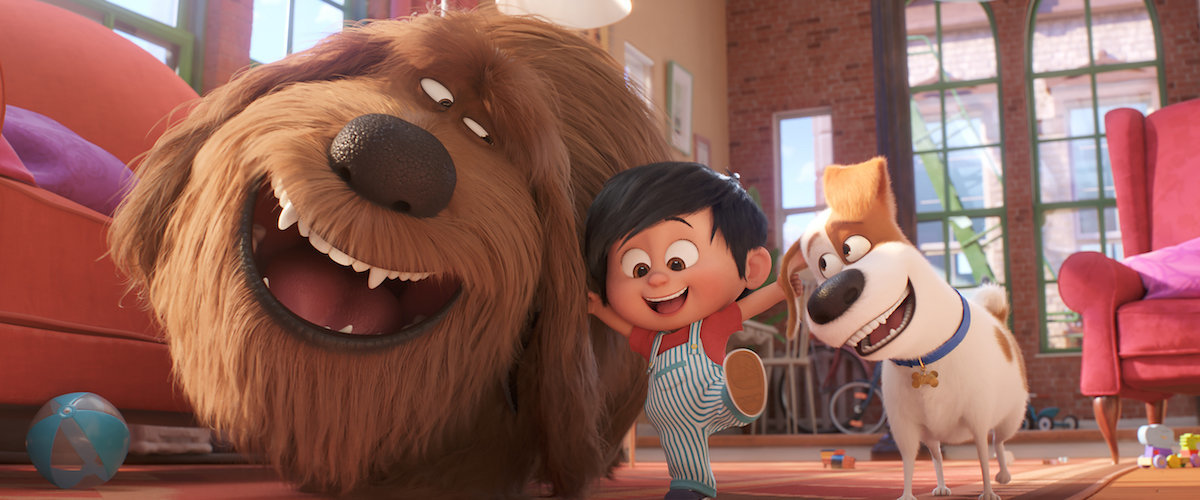
It’s not bad, just uninspired, but so was the first one too, with its mish-mash of Toy Story with pets. The obvious imitation of the Woody/Buzz conflict with dogs Max and Duke was resolved in the first film, so the second has a little more room to do its own thing with its charming cast of characters, such as little dog Max (Patton Oswalt, replacing Louis C.K. after the latter’s scandal) wanting to rediscover his fearless side during a weekend farm visit, or tough-guy bunny Snowball (Kevin Hart) trying to pass himself off as a superhero by saving a tiger.

New additions include Harrison Ford as a pleasantly grizzled farm dog and Tiffany Haddish as a Shih Tzu with attitude. As a cat lover, I especially got a kick out of Chloe’s (Lake Bell) teaching the way of the cat to Pomeranian Gidget (Jenny Slate), who is still the best thing about this franchise and gets the funniest scenes.

See the source image

It’s all cute and harmless with very little depth, but some clever comedic moments make it enjoyable and perhaps a bit better than the first film. Even when the plot tries to bring its many loose threads together at the end, it still feels like a bunch of potential TV episodes pasted into a feature film. This is clearly a franchise meant to appeal to the kids with little effort for their parents, but I can see those kids growing up with fond memories of it. Not every animated film has to break the mold, I suppose.

Best line: (Snowball) “I just freed a tiger. That’s not bragging; I’m just saying what happened. When you’re awesome, everything you say sounds like bragging.”


Rank: Honorable Mention


© 2020 S.G. Liput
676 Followers and Counting

Ride Your Wave (2019)

01 Wednesday Apr 2020

Posted by sgliput in Movies, NaPoWriMo, Poetry, Reviews, Writing

≈ 1 Comment

Tags

Animation, Anime, Drama, Fantasy, Romance, Sports

See the source image

(For Day 1 of NaPoWriMo, the prompt was for a metaphor poem comparing life to a particular action, so I took inspiration from a movie that heavily focused on a similar metaphor of surfing.)


I live upon a wooden board
That glides along the ocean swell.
So many others stood and fell,
So on my belly, safe I dwell.

My wiping out I can’t afford,
And so I hug the firm and known,
And watch the few whose comfort zone
Is so much wider than my own.

They call to me with one accord
To stand within the arching wave,
And though I fear it, still I crave
The confidence of being brave.

I close my eyes and let my board
Convey me to the tunneled tide
And find the worries, from inside,
Have dwindled down and liquefied.
_______________________

MPA rating: Not Rated (should be PG-13, for some adult themes and brief nudity)

I love that the last two years, I’ve been surprised by anime films I wasn’t expecting. Maquia: When the Promised Flower Blooms proved to be the anime of the year in 2018, and Masaaki Yuasa’s Ride Your Wave was a similar pleasant surprise, considering I’d never heard of it until a preview before Weathering with You. Star-crossed love is a common anime trope, but Ride Your Wave puts a uniquely emotional spin on it, also standing out for its characters being young adults rather than the usual highschoolers.

See the source image

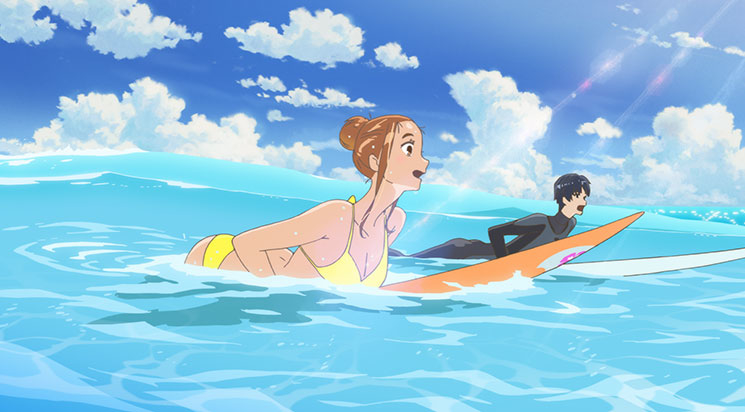
Hinako Mukaimizu has just moved into a new apartment near the ocean, allowing her to regularly partake in her favorite hobby of surfing. After a fire threatens her building, she falls in love with handsome firefighter Minato Hinageshi, and their romance is wholesomely reminiscent of the beginning of Up. And like Up, it ends in tragedy, leaving Hinako alone and unable to move on. Soon, though, she begins seeing Minato in water when she sings their favorite song, leading to hilarious misunderstandings and an unhealthy situation that clearly cannot stay the way it is.

I’ve tended to steer clear of Yuasa’s other works (like Lu Over the Wall or The Night Is Short, Walk on Girl), perhaps because his unique art style didn’t seem to appeal to me, but I must admit that I loved Ride Your Wave, and it’s made me curious to check out his past work. His hyper-fluid animation really complements the prevalence of water in the film and creates some unique angles and perspectives to ravish the eye. It’s a more cartoon-ish style than Makoto Shinkai’s photorealistic scenes, but it’s still detailed and pleasing in its own way. (It’s interesting to note the coincidence of this film and Weathering with You both coming out the same year and both featuring an emphasis on water and a notable scene with fireworks.)

See the source image

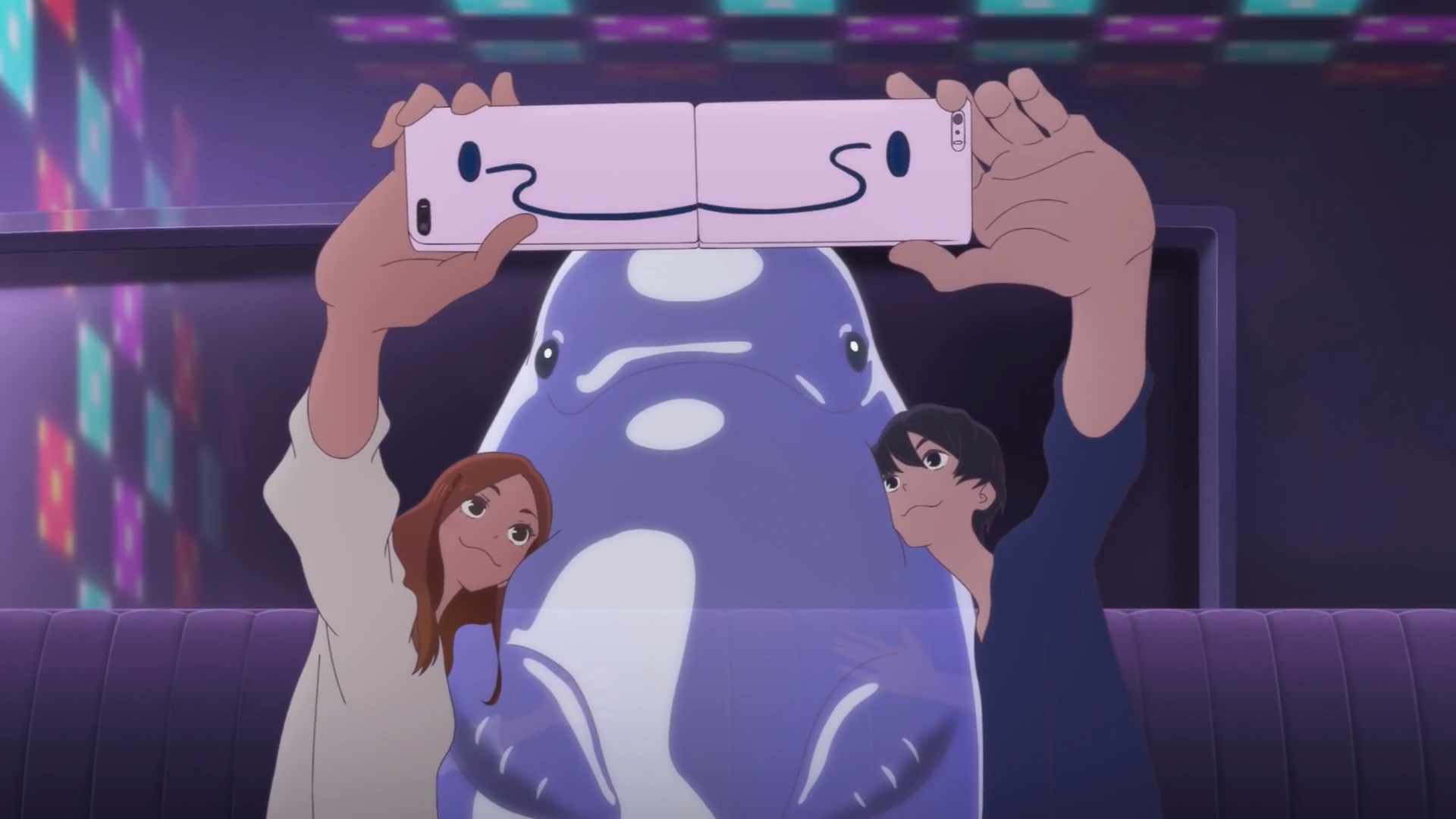
Beyond the technical, Ride Your Wave has real heart to it and does a great job developing its central couple, as well as side characters like Minato’s churlish younger sister. And that focus on likable characters is essential because there’s certainly absurdity to swallow here, such as Hinako walking around town with an inflatable porpoise filled with water (and Minato) in an effort to relive the days when Minato was still alive. The climax is wilder than that, so let’s just say it’s hard to imagine this film in anything but animation. It didn’t hit me until afterward, but the plot has many similarities to 1990’s Ghost, though with more of a rom-com sensibility than that film’s thriller elements. By the end, though, it definitely knows how to tap the emotions hard, even while retaining a sense of hope.

Since I can’t be all positive, Ride Your Wave is sometimes too on the nose with its blatant metaphor of learning to “ride the wave” of life. Plus, at only 94 minutes, the film’s relationships might feel too rushed to some, yet one could also say it presents what it needs to economically. I feel like Weathering with You is objectively a better film, yet Ride Your Wave made me feel more deeply, identifying at times with its exploration of grief. Yuasa’s blending of the poignant and the surreal is an unexpected treat for any fan of bittersweet romance.

See the source image

Best line: (Minato) “If you stay with your head underwater, you’ll never learn to ride the waves.”


Rank: List-Worthy


© 2020 S.G. Liput
670 Followers and Counting

Weathering with You (2019)

16 Sunday Feb 2020

Posted by sgliput in Movies, Poetry, Reviews, Writing

≈ 3 Comments

Tags

Animation, Anime, Drama, Fantasy, Romance

See the source image

The greatest threats and greatest wonders have their source within the sky,
Tornados with their whistle cry
And rainbows ere the air is dry,
Yet next to you, the marvels there have barely even caught my eye.

The storm can crash, the thunder clap, attempting to arrest my view,
But, whether sky be black or blue,
The sun will part the clouds on cue.
The rain will never fall as hard as I have fallen now for you.
_____________________

MPAA rating: PG-13 (for peril and brief nudity)

Weathering with You was #4 on last year’s list of My Top Twelve 2019 Movies I Hope Are Good, so it killed me that I had to wait until 2020 to finally see it in the theater. Makoto Shinkai had one of the toughest directorial challenges of the year, creating a follow-up to Your Name, which is still the highest-grossing anime of all time. How could Weathering with You possibly match Shinkai’s last emotional, artful powerhouse? Well, it doesn’t quite, but, boy, does it comes closer than I would have thought possible, leaving little doubt that Shinkai is in a class of his own when it comes to anime.

See the source image

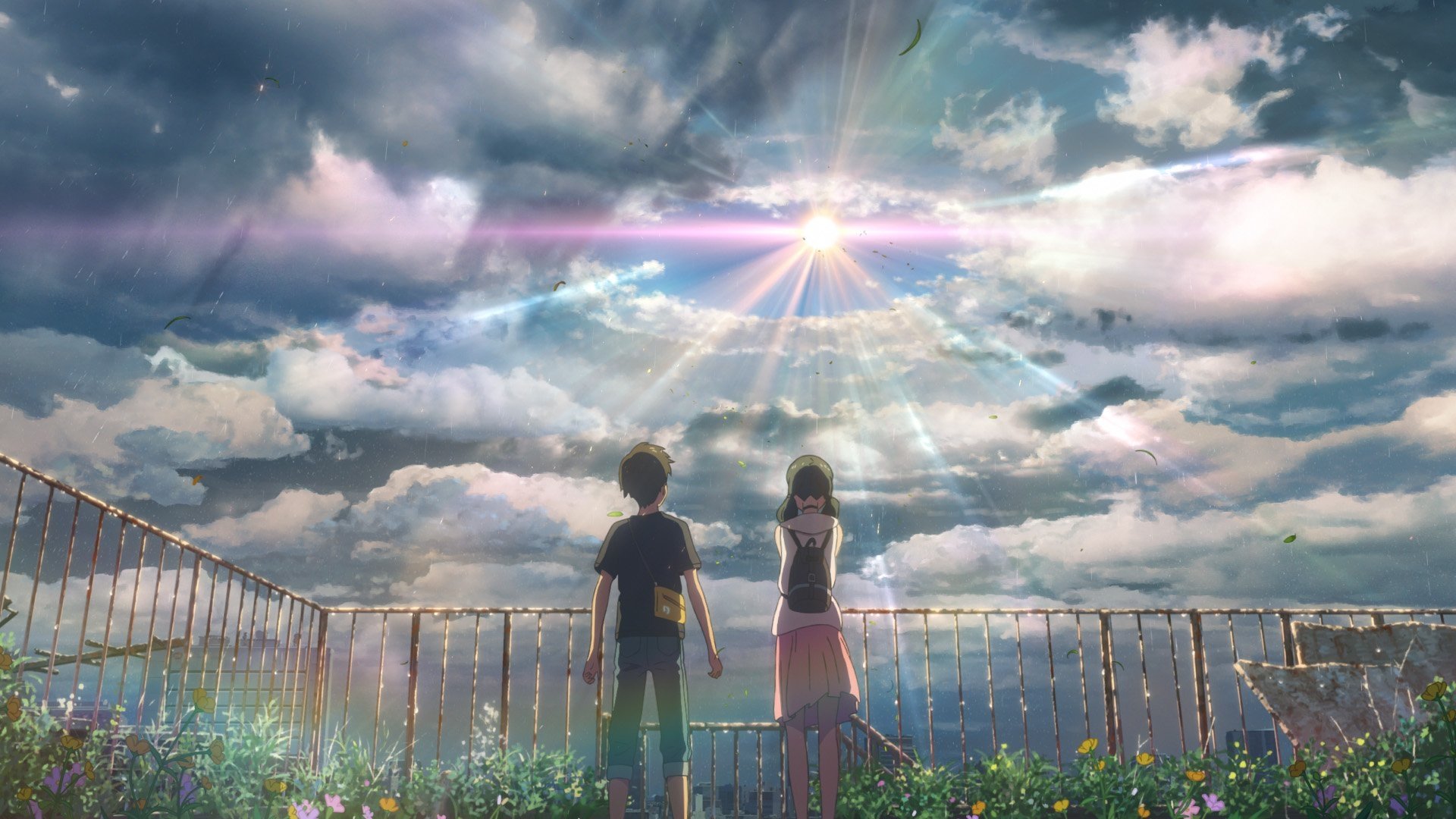
Shinkai’s films have been notable for their amazingly detailed depiction of rain, in The Garden of Words especially, and Weathering with You fits perfectly in his oeuvre as the most rain-centric film yet. Hodaka is a teenage runaway, fleeing to the bustling metropolis of Tokyo with little plan and finding himself homeless in the midst of an extended rainstorm. After finding employment with a small-time tabloid publisher, Hodaka investigates the legend of the “weather maiden” (or “sunshine girl” in the very good English dub), someone whose prayers can part the clouds and bring out the sun once more. He finds her in Hina, a girl who helped him when he was struggling, and together they turn her ability into a business, clearing the weather for events. However, Hodaka’s past and the secret behind Hina’s ability threaten them both and possibly the world as well.

As with all of Shinkai’s work, the hand-drawn visuals in Weathering with You are absolutely gorgeous, with an attention to detail that puts most other 2D animation to shame. One sequence of fireworks is awe-inspiring. Likewise, anyone who enjoyed the soundtrack of Your Name, provided by the Japanese band RADWIMPS, will be pleased at their second team-up for a Shinkai project. I’m now used to the director’s music-video-like interludes that felt a bit jarring in Your Name, and they serve to highlight the songs, which in turn complement the visuals. It’s a common conceit in anime openings for characters to be shown falling through the sky, often for no apparent reason; Weathering with You not only gives a good reason but makes the scene a brilliant climax of emotion and, backed by the song “Grand Escape,” gave me genuine goose bumps.

See the source image

Animation isn’t everything, though, right? There has to be a good story and likable characters as well, and Shinkai provides those too. Hodaka and Hina aren’t quite on the same level of star-crossed YA lovers as Taki and Mitsuha in Your Name, but they’re still a cute pair worth rooting for, while the rest of the cast are enjoyably colorful as well, from Hina’s Casanova younger brother to Hodaka’s pragmatic employer. The plot does borrow some elements from Your Name – desperate running, a climactic reunion, a sudden separation that doesn’t hit quite as hard this time, a supernatural cause based in Shintoism that isn’t explained as well as I’d like – yet it’s far from a lazy copy, more like a director in his thematic comfort zone. Shinkai has stated that the story was influenced by climate change fears, which are evident by the end even if the point being made about it isn’t exactly clear, but it’s interesting and gratifying how his characters make a case for the value of the individual over collective concerns, which he thought might be controversial.

Weathering with You’s biggest problem is that it will inevitably be compared to Your Name, and it’s true that it would probably be even more impressive than it is if it hadn’t been preceded by a record-smashing older brother. (Granted, Shinkai does lean into the comparison at times, like a wink to the fans, which made me and my fellow theater-goers giddy.) Nevertheless, I thoroughly enjoyed Weathering with You and highly recommend it, even to non-anime fans. After Your Name was spurned for a Best Animated Feature nomination at the Oscars three years ago, it’s a similar travesty that Weathering with You was also unjustly overlooked. It may be Shinkai’s third best film in my estimation, but with charming characters, stunning animation, impactful music, and a poignant story, it’s further proof of his films’ greatest strengths.

See the source image

Best line: (Hodaka, to Hina) “Who cares if we can’t see any sunshine? I want you more than any blue sky.”


Rank: List-Worthy


© 2020 S.G. Liput
660 Followers and Counting


Klaus (2019)

18 Saturday Jan 2020

Posted by sgliput in Movies, Poetry, Reviews, Writing

≈ 10 Comments

Tags

Animation, Christmas, Comedy, Family, Netflix

See the source image

The world’s getting louder and meaner and prouder,
Content to be less than the best it can be.
Our good angels shrivel when others aren’t civil,
And we follow suit with acute savagery.

The worst in a person can come out and worsen,
And wrong leads to wrong for as long as we let it.
Yet kindness courageous is also contagious.
The bar is as low or high, though, as we set it.

What good can be started by all the kindhearted
Can spread just as quickly as wickedness can.
Right actions and choices speak more than raised voices,
For goodness expressed frees the best part of man.
____________________

MPAA rating: PG

It might be too late for Christmas, but Netflix’s Klaus isn’t just a great Christmas movie; it’s a great movie. I wasn’t expecting much from Netflix’s first original animated film, but good word-of-mouth convinced me to give it a look-see, and now I’m happy to contribute to its positive buzz. Being nominated for a Best Animated Feature Oscar doesn’t hurt either.

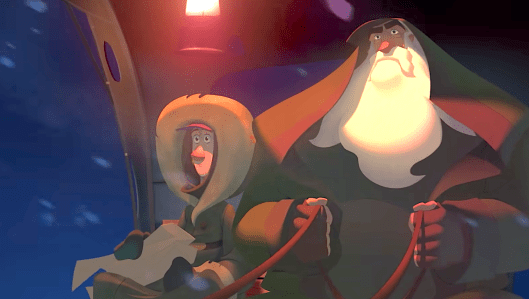
Does anyone else recall a 2000 animated film called The Life and Adventures of Santa Claus? I remember it nostalgically as a sweet origin story for Santa, and Klaus is similar in that regard. Whereas the other film featured extensive magical elements, Klaus is far more down-to-earth, gradually developing the myths and trappings surrounding Santa in a way that could feasibly happen, albeit still with some cartoonish absurdity and a dark undercurrent.

See the source image

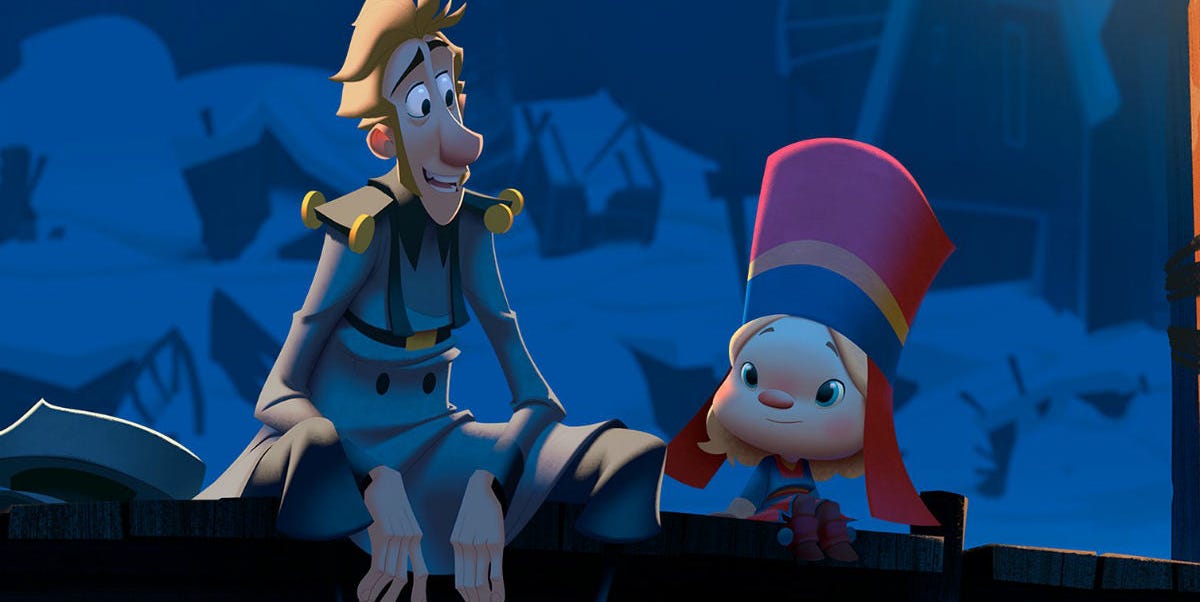
However, the titular Klaus is not the main character. Instead, it is the vain and spoiled Jesper (Jason Schwartzman), whose father, exasperated by his son’s laziness, makes him the postman for the remote and desolate island village of Smeerensburg, where a family feud has raged for generations. In a town where no one is eager to send letters to each other, Jesper concocts a plan to get the children to send letters for toys, a plan that might eventually get him transferred back to his well-to-do life. Essential to the plan is Klaus (J.K. Simmons), a mysterious woodsman with a wealth of toys, and, while Jesper’s goals begin as self-serving, he eventually starts to see the good that can come from an act of kindness.

The most noteworthy aspect of Klaus is its unique animation. In an age where most of the 2D hand-drawn animation around originates in Japan, director Sergio Pablos (creator of the Despicable Me franchise and character designer for several Disney Renaissance films) and other former Disney animators wanted to show how 2D animation might have evolved if it hadn’t been abandoned by the industry in the West. The result is gorgeously rendered and looks somewhere in between 2D and 3D, thanks to meticulous attention to shadow and shading.

See the source image

If Klaus had come out twenty years ago, I know it would have become a classic annual watch in my home, and I’d like to think it will be for this generation as well, despite its exclusivity to Netflix. The last decade has seen 2D animation flourish on the small screen, and Klaus gives me hope that it’s not dead for feature-length films as well. Despite some predictable elements, it’s filled with humor, sweetness, and a stellar voice cast (also including Rashida Jones, Norm MacDonald, and Joan Cusack) and carries the perfect heartwarming Christmas spirit that reminds us how much better it is when kindness guides our choices.

Best line: (Klaus) “A true selfless act always sparks another.”


Rank: List-Worthy


© 2019 S.G. Liput
659 Followers and Counting


Toy Story 4 (2019)

08 Sunday Dec 2019

Posted by sgliput in Movies, Poetry, Reviews, Writing

≈ Leave a comment

Tags

Animation, Comedy, Disney, Family, Pixar

See the source image

The life that you pour into somebody else’s
Is just as much fuel as a life for one’s self is,
A reason to get up each morning, assured
That you have a purpose by which you are spurred.

But what of the time when the mission is done,
The journey completed, the races well-run?
When nobody needs you and life seems bereft,
What purpose remains here? What journeys are left?

Such crises are normal for those left behind,
But purpose is everywhere. Those who seek find.
_________________

MPAA rating: G (the highest grossing G-rated movie ever, in fact)

I’m sure I wasn’t alone in my groan when Toy Story 4 was announced. Toy Story 3 ended the series with such a definitively satisfying conclusion, being handed off from college-bound Andy to little Bonnie, that I just wanted Pixar to leave it there. A cute little short would pop up occasionally, and I kept wishing they would leave the characters alone. No more sequels, or, Lord help us, a remake! Yet Pixar has pulled off the unlikely so many times before that there was no way they were going to screw up their best franchise. Toy Story 4 still feels unnecessary, but it’s a sweet epilogue to Woody and Buzz’s story.

See the source image

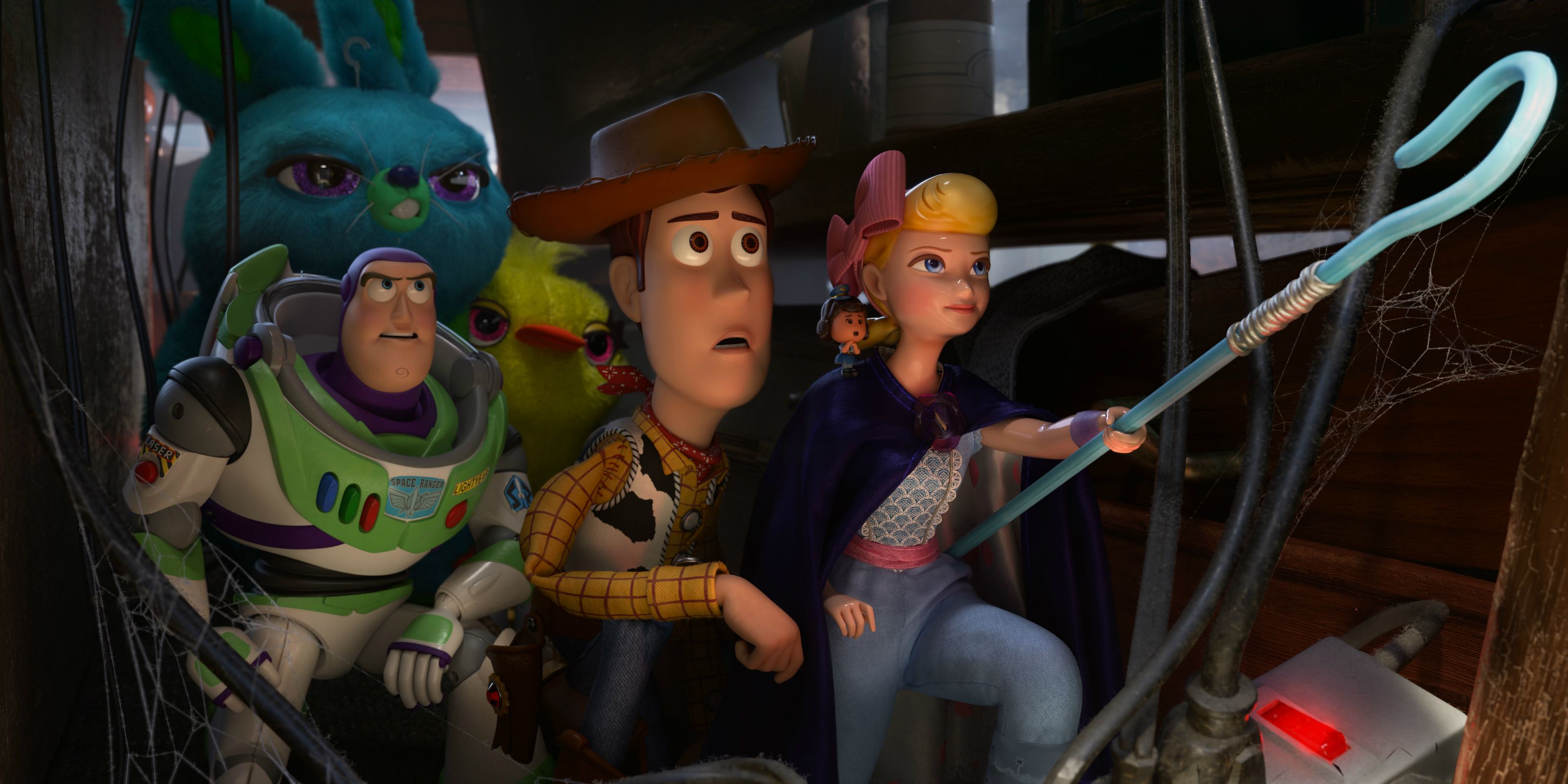
The Toy Story films have always thrived off their diverse cast of toy characters, and Toy Story 4 still does, joined by a collection of hilarious and welcome additions, but this particular tale is clearly meant to offer full-circle closure for Woody (Tom Hanks). The cowboy doll was always Andy’s favorite, and it’s no surprise that he’s lost that status in Bonnie’s room, yet he finds new purpose in protecting her newest friend, a googly-eyed spork she crafts and names Forky (Tony Hale). Being made of trash, Forky only sees himself as something to be thrown away, yet Woody strives to get the cobbled-together toy to see his own value, running into more than their fair share of trouble when the two are separated from Bonnie during a road trip.

In addition to new characters ranging from a Canadian stuntman plagued by self-doubt (Keanu Reeves) to a pair of plush carnival toys named Ducky and Bunny (Jordan Peele and Keegan-Michael Key), Woody is reunited with Bo Peep (Annie Potts), whom we get to learn much more about than in the first two films. The main change, which is practically a retcon, is that she’s a natural, daring leader who’s grown beyond needing the love of a single child. (I also learned she and her sheep were part of a lamp. Did I just not notice that before?) Also new to the cast is the genteel doll Gabby Gabby (Christina Hendricks), whose deep-seated neediness casts her in the role of villain, though the movie presents her with far more empathy than the other films’ antagonists, to the point of offering her redemption without so much as an apology to earn it (something I only realized after reading another review).See the source imageBo offers Woody an alternative to his desperate attempts to stay relevant, and I felt like this conflict resulted in some mixed messages. There’s a clear parallel between the toys watching their kids outgrow them and the empty-nest anxiety of parents, so it’s a worthwhile lesson that life doesn’t have to end once “the mission” is complete, that one can find another purpose. Yet with Woody’s repeated pleas throughout the series that “Andy/Bonnie needs us,” it vaguely feels by the end that he’s contradicting the loyalty he’s instilled in everyone else. My VC was more bothered by the end than I was, but it is a complication worth pointing out.

Yet for all these philosophical holes poked in the plot, the world and players of Toy Story never fail to entertain and remain as lovable now as they were back in 1995. With the spotlight so much on Woody, much of the extended cast, like Rex, Hamm, and Slinky, don’t get much screen time, but that doesn’t diminish the entertainment factor. (P.S. Ducky and Bunny are hilarious.) In some ways, the plot mishmashes elements from the other three films, yet it still bears that Pixar polish and lump-in-throat sweetness that never gets old.

See the source image

I hope that Pixar has now finally gotten the need for an epilogue out of their system and can let Toy Story rest in peace. Toy Story 4 is easily the least of the bunch and not quite as good an ending as the third film, but it still satisfies, as well as dwarfs most other animated fare these days. All good things come to an end, or should, Toy Story included.

Best line: (Trixie) “I have a question. No, wait. I have all the questions.” [As someone with a reputation for asking questions ad nauseum in any class, this line spoke to me.]


Rank: List-Worthy (joining its forebears)


© 2019 S.G. Liput
655 Followers and Countin

2019 Blindspot Pick #7: Royal Space Force: The Wings of Honneamise (1987)

28 Wednesday Aug 2019

Posted by sgliput in Blindspot, Movies, Poetry, Reviews, Writing

≈ 1 Comment

Tags

Animation, Anime, Drama, Sci-fi

See the source image

The depths of space have tempted man
For years while holding him at bay
Through distance, death, and lack of breath,
Insisting that we humans stay.

But mankind rarely takes a hint,
For us, a challenge is a lure,
Inviting us to sojourn thus
And learn how far we can endure.
___________________

MPAA rating: Unrated (an attempted rape scene probably would make it R, but otherwise, it’s an easy PG-13)

Unless you’re a diehard anime fan, you probably read the title of this movie and said, “What the heck is that?” Well, now that I’ve seen most of the mainstream films anime has to offer, I’m now seeking out the obscure, and I was surprised at the glowing reviews this unknown film has gotten since its 1987 release, growing into an apparent classic of the medium with 100% on Rotten Tomatoes. (Imagine my surprise when Netflix didn’t have it, but my local library did.) Royal Space Force is a hard film to categorize, but it’s undoubtedly well-made with unexpected thematic depth.

Imagine an anime mixture of The Right Stuff and Contact, and you’ve got Royal Space Force, the title referring to the poorly organized space program of the fictional country of Honnêamise. (Hun-ee-a-meece? Honey-mice? I don’t know how it’s pronounced since I don’t recall the name ever being spoken.) While no one takes the program seriously with its poor management and frequent failures, a slacker recruit named Shirotsugh Lhadatt finds a new passion and ambition for the project after a run-in with a young female evangelist named Riquinni. Despite the innate dangers of this unprecedented venture, including hostilities from a rival nation, Lhadatt literally shoots for the stars in a quest for peace and meaning.

See the source image

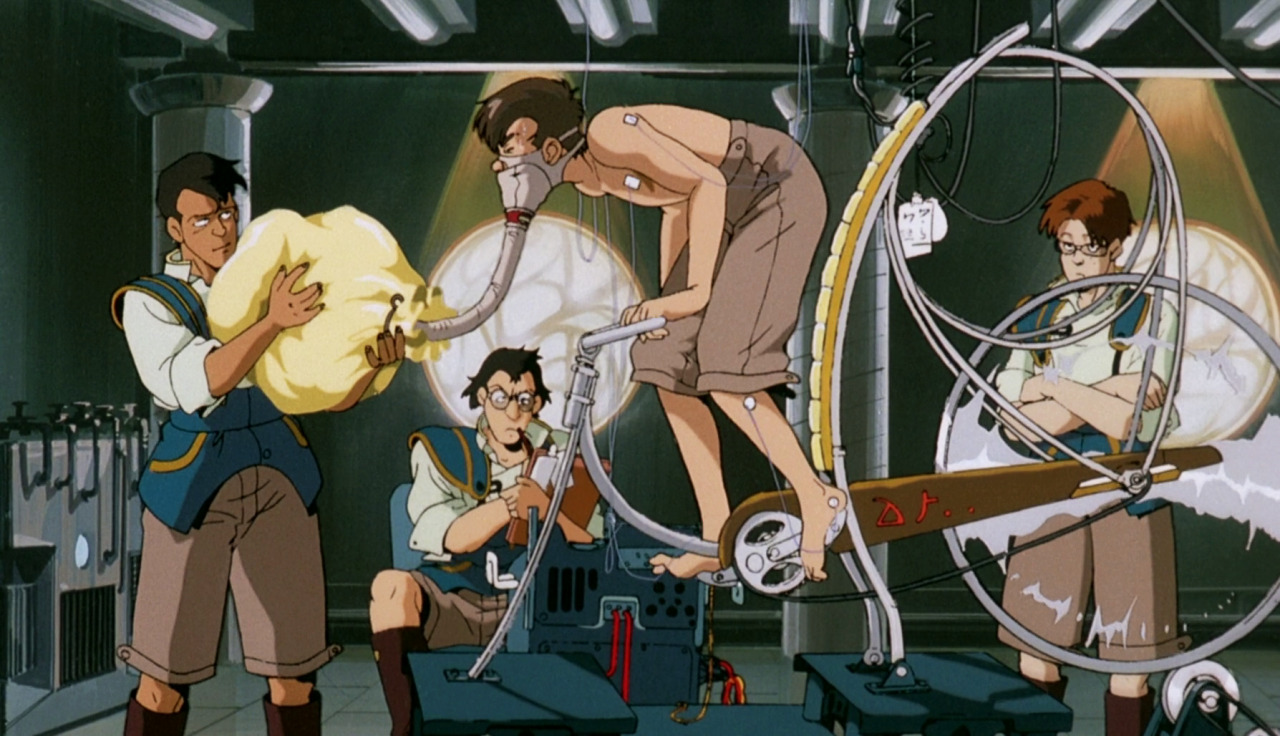
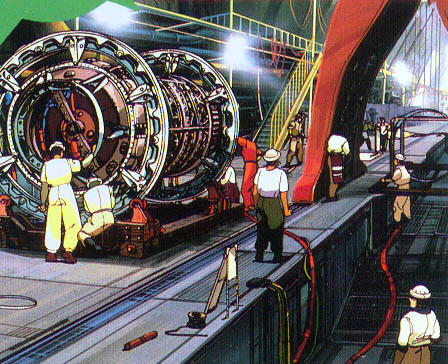
Beyond the plot or characters, what makes Royal Space Force really unique is its comprehensive world-building. It’s not quite straight fantasy or science fiction: there are a couple futuristic machines and some unique animals, but otherwise there aren’t many fantastical elements to the setting. It’s just different, a vision of what our world might have looked like during the Space Race if history had taken a different route. Windows slide downwards; plane propellers spin on the tail of the plane; currency is made up of small needle-shaped pins instead of coins. The architecture of the cities is ornate yet believable, often a mish-mash of cultural styles that create something new. I would watch it again just to appreciate the imagination on display, the fashioning of an alter-earth with creativity sadly lacking in so many other animated films.

As someone with direct family ties to the space program, I was also intrigued at how this film would approach its version. The filmmakers went to NASA to study space flight, and their efforts at authenticity mix surprisingly well with the otherworldly setting. The training contraptions for preparing Lhadatt for his mission are more slapdash and home-made than NASA’s, but their crudeness highlights how big of a scientific leap space travel is for this world, as it was for our own. And by the time the launch day comes amid self-doubt and international turmoil, the event has a similar gravitas and grandeur as the real thing.

See the source image

Another unique aspect of this film was the role of religion. Riquinni’s faith is clearly a fictional one based off a couple stories mentioned, but her discussions of God and nightly dispersal of tracts are clearly an analog to Evangelical Christianity. And unlike Contact, which annoyed me by pitting faith and science against each other as if they were antithetical, Royal Space Force depicts faith as a positive influence, encouraging Lhadatt to believe he is part of something bigger than himself and push toward a brighter future. There have been plenty of anime with Christian elements and themes, but this movie climaxes with a sincere and moving prayer that is one of the most explicit declarations of faith I’ve seen in animation.

While it’s a significant achievement in the medium, Royal Space Force does suffer somewhat from a deliberate pace and not quite enough resolution by the end. It’s not boring and has a few thrilling sections, but you shouldn’t expect constant humor or action from its grounded drama. The biggest problem is a scene of attempted rape that saps a lot of the sympathy for Lhadatt, even if he seems repentant later, and also serves no other purpose than to put the film into “mature” territory. The scene was cut in its video release, and it would have been better if the initial editors had done the same.

See the source image

Now at least, I can check off another Blindspot from my list, an anime film that has held my curiosity for some time now. I think anyone interested in the development of space travel and speculative fiction would find much to appreciate, and fans of animation even more so, since this feature was the first project of Studio Gainax, which went on to the fame of producing series like Neon Genesis Evangelion and Gurren Lagann. Royal Space Force: The Wings of Honnêamise may have an ungainly name, but it deserves its low-key classic status, making me wonder if the sequel that’s been rumored for years will ever get off the ground.

Best line: (Riquinni, reading from her holy book) “And you shall find that prayer is the greatest of all things, and it is also the smallest. You’ll find nothing more noble than prayer, nothing more humble.”

Rank: List Runner-Up

© 2019 S.G. Liput
645 Followers and Counting
 

Cartoon Comparisons: Alita: Battle Angel (2019) / Gunnm (1993)

29 Monday Apr 2019

Posted by sgliput in Movies, NaPoWriMo, Poetry, Reviews, Writing

≈ Leave a comment

Tags

Action, Animation, Anime, Cartoon Comparisons, Drama, Romance, Sci-fi, Thriller

(Today’s NaPoWriMo prompt was for a poem that meditates on a strong emotion, like disillusionment with the world at large.)

See the source image

See the source image

The world is not the friendly place we once had promised to ourselves
When youthful optimism held some sway within our hearts.
We like to think that’s still the case, and yet the more a person delves,
The more this human-born machine reveals its sordid parts.

It’s tragedy that truly wakes our minds to darkness come to light,
That shows how cruel the world can be, with men its messengers.
We’re ignorant of risk and stakes, and enter honestly the fight,
Too late to learn the world was not designed for amateurs.
___________________

MPAA rating: PG-13 (comes close to R with the violence)

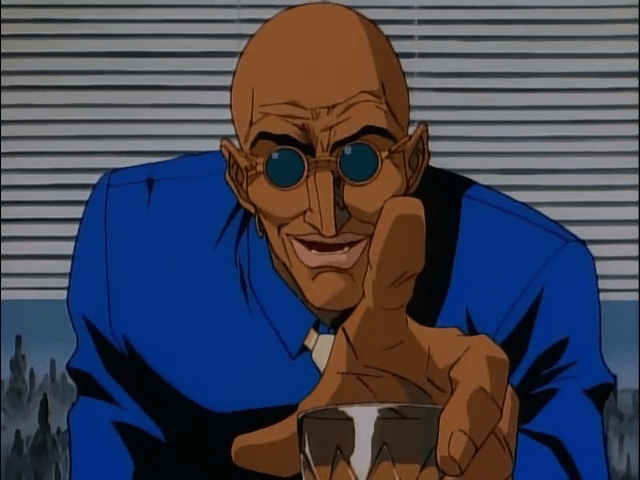
I’ve been looking forward to Alita: Battle Angel for well over a year, ever since I heard James Cameron was planning on bringing the long-running manga Battle Angel Alita (a.k.a. Gunnm) to Hollywood. This movie fascinates me not only for its visually awesome cyberpunk future, but also because it owes its existence to one man’s passion project, bringing an extremely niche franchise to a far wider audience than it otherwise would have enjoyed. It makes me wish something similar would happen with Steins;Gate or Cowboy Bebop.

Adaptations between manga/anime and live-action have historically been more miss than hit, but Alita is finally the hit that fans have been waiting for, faithful to its origins in the best way. I, for one, have not read the manga that so enthralled James Cameron, but I have watched the 1993 OVA (Original Video Animation), which is basically like a direct-to-video anime. At only 55 minutes long, it was an imaginative if brutal sci-fi that I definitely recognized had plenty of potential for the big screen. And now that it has, I’m thrilled that such potential was not wasted.

See the source image

The manga/anime/film tells the story of the cyborg Alita (Rosa Salazar), a girl whose head is discovered in a trash heap by cybernetics expert Dr. Ido (Christoph Waltz). Finding her human brain still active, he rebuilds her body and introduces the amnesiac girl to the cutthroat world of Iron City, a sprawling dystopia patrolled by cyborg bounty hunters and festering in the shadow of the floating city known as Zalem. Trying to regain her memories, Alita becomes a Hunter Warrior herself as she falls in love with young Hugo (Keean Johnson) and navigates the plotting of Ido’s rival Dr. Chiren (Jennifer Connolly), the villainous Vector (Mahershala Ali), and his killer henchmen.

As it is, Alita might bring to mind several other films, such as Elysium with its floating city of higher class exploitation or the cyberpunk aesthetic of Ghost in the Shell, but I can’t help but feel that, if Alita had come out twenty years ago, it would be blowing people’s minds left and right. Yet the manga predates most of what it seems to borrow from, though the sport of Motorball definitely seems inspired by Rollerball.

See the source image

I’m glad, though, that Cameron wasn’t able to make Alita when he first wanted to back in 2003 because the visuals wouldn’t have been this good. Alita: Battle Angel is a sci-fi action treat, with visual effects that have a good shot at an Oscar next year. Alita herself is stunningly realized, with Rosa Salazar providing a strong motion capture performance, augmented by the effects team with those anime-sized eyes that aren’t as hard to get used to as you might think. There are a few hiccups in the animation early on that threaten to be distracting, but by the time Alita starts kicking criminal butt, she’s seamlessly a part of this world.

The live-action Ghost in the Shell was distracting for me because it was a mish-mash of various plot points from the anime film and series; Alita, on the other hand, might be the most faithful adaptation I’ve come across. Nearly everything in the anime is also in the movie, sometimes even shot for shot (like Chiren squishing a bug while telling Ido she’ll claw her way back to Zalem), though the movie’s greater length allows it to expand on many plot elements, such that watching the anime is like a highlight reel of the film. Considering how anime adaptations have flopped so hard over the years, the film’s faithfulness to its source material is laudable and likely credited to the efforts of Cameron himself as a fan of the manga. Interestingly, I understand that some differences from the manga were actually borrowed from the anime; one villainous character is killed in both versions but apparently survives much longer in the manga.

See the source imageSee the source image

That’s not to say there aren’t other differences; the source of Alita’s name and body is given more emotional weight in the film, and Ido’s former relationship with Chiren is explicitly romantic where it wasn’t before. And the film throws in entire sections that I can only assume are drawn from the manga since they weren’t in the anime, like the deadly sport of Motorball and the glimpses of Alita’s forgotten past. For me, these additions only added to the epic dystopian world-building that I so admire.

One thing I was concerned about the adaptation was just how violent it would end up being, and I was relieved that it earned a PG-13 rating and the wider audience that that entails. Don’t get me wrong; Alita: Battle Angel definitely pushes the boundary for a PG-13 film with multiple heads and limbs sent flying, but the anime is certainly more violent and bloody. The movie may have its brutal moments, but I was glad it was largely bloodless, leaving out the anime’s brief nudity and leaving some cruel moments mercifully offscreen.

See the source image

While Alita was a pleasure to watch on the big screen, I find myself struggling with how to rank it. I’m still not a fan of the mostly bitter ending common to both the anime and film, but I’m excited for whatever may come in the (hopefully forthcoming) sequel, which is uncharted territory for me. My ranking could easily change with time, but I’ll err on the side of caution and make it a List Runner-Up. Nevertheless, for the most part, Alita: Battle Angel was pure effects-heavy coolness and as good as I’d hoped it would be, proving that Hollywood can make good films based on manga/anime. Perhaps it simply takes someone like James Cameron to steer them in the right direction.

Best line: (Alita) “I do not stand by in the presence of evil!”


Rank: List Runner-Up


© 2019 S.G. Liput
628 Followers and Counting


Teen Titans Go! to the Movies (2018)

28 Sunday Apr 2019

Posted by sgliput in Movies, NaPoWriMo, Poetry, Reviews, Writing

≈ Leave a comment

Tags

Action, Animation, Comedy, Family, Superhero

(Today’s NaPoWriMo prompt was for a meta-poem, so instead of just a poem about poetry, I tackled the very idea of a work being self-aware or meta, paired with a highly meta movie.)

See the source image

A meta-poem? A meta-poem?
Sure, now they want a meta-poem,
The kind that references itself
And thinks itself a better poem.

I’m not against the whole idea,
And I’ll admit it has potential.
It’s a tricky trail, however,
Getting so self-referential.

Whether it’s for thoughtful musing
Or for entertaining snark,
How can people judge a thing
That knows its own creative spark?

I might look back some years from now
And wish I’d picked a different foot.
Iambic’s fine, and yet this poem
Is analyzing my output.

Should I have used pentameter?
I’ll never be the first to ask
Because this poem is self-aware
Enough to beat me to the task.

And that’s the case with film or verse
That lets its sentience supersede.
It might cause you to roll your eyes,
But still, it’s fun to watch and read.
__________________

MPAA rating:  PG

Can a good movie come from a bad show? That’s the question I asked myself when I heard Teen Titans GO! to the Movies was getting positive reviews. I grew up devotedly watching the Teen Titans animated series on Cartoon Network, and I loved its balance its unique anime-like style and balance between lighthearted comedy and dark, high-stakes drama. That’s why I’ve been so disappointed with the more recent Teen Titans Go!, which has jettisoned the drama for all-out silliness rivaling and often surpassing that of SpongeBob.

See the source image

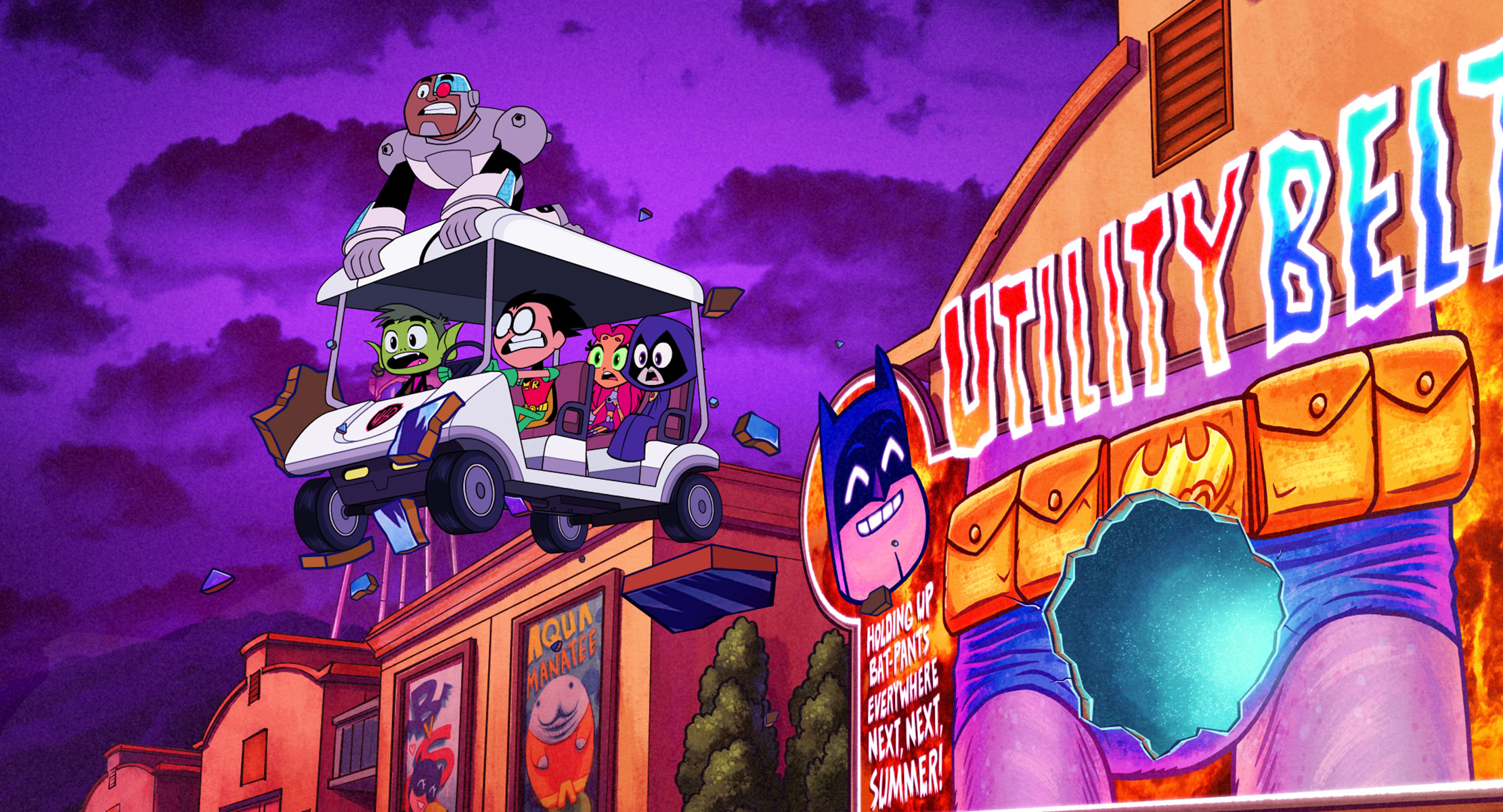
So is the movie version more of the same? Well, yes, but I still managed to have fun with it, as is likely the case with anyone steeped in comic book culture. The Teen Titans, still voiced by the same voice actors from both TV series (Scott Menville as Robin, Hynden Walch as Starfire, Greg Cipes as Beast Boy, Khary Payton as Cyborg, and Tara Strong as Raven), think of themselves as real heroes yet are continually thought of as sidekicks and jokes by the Justice League. Robin, in particular, feels that they need their own movie to be taken seriously and endeavors to be worthy of having their own arch-nemesis in the form of the evil Slade (Will Arnett, more comedic but paling in comparison to Ron Perlman in the original series).

Indeed, Teen Titans Go! to the Movies is admirably nerdy, poking fun at every level of the modern superhero genre. As a fan of superhero movies in general, I found plenty to laugh at, from digs at past DC films to a random time-travel detour to the writer’s obvious comics knowledge, throwing in obscure DC characters and a scene where Slade/Deathstroke is mistaken for Deadpool. (“Look into the camera, and say something inappropriate.”) Sometimes, it doesn’t even have to point out its own jokes, like casting Nicolas Cage as Superman (look it up, if you don’t get it). A few of its gags are even quite insightful, such as when everything about Batman is given its own movie; I couldn’t help but think of this film when I saw there’s an upcoming TV show about Alfred called Pennyworth.

See the source image

My ultimate beef with Teen Titans Go! still remains, namely that it’s sad how the characters are dumbed down to annoying levels for the sake of being kid-friendly. The first series proved that wasn’t necessary, but its successor is content to be all about the jokes. I guess that’s okay when the jokes are at least funny, which is the case here but not always on the show. Beyond the meta-humor, the film also benefits from committed voice actors, including Kristen Bell, and manages a few well-animated action scenes when it tries. If you can look past some weird moments and the juvenile stupidity of its characters, Teen Titans Go! to the Movies should earn more than a few laughs from superhero fans and is worth seeing if only for an incredibly meta cameo from Stan Lee, his only one in a DC movie.

Best line:  Probably the aforementioned line about Deadpool


Rank: List Runner-Up


© 2019 S.G. Liput
627 Followers and Counting


← Older posts
Newer posts →

Recent Posts

  • We Didn’t Start 2025 (Recap)
  • NaPoWriMo 2025 Recap (Finally)
  • Sonic the Hedgehog 3 (2024)
  • It Happened One Night (1934)
  • Spellbound (2024)

Recent Comments

associatesofshellymann's avatarassociatesofshellyma… on My Top Twelve La La La So…
Kit's avatarKit Nichols on Bonnie and Clyde (1967)
lifelessons's avatarlifelessons on Look Back (2024)
Carol Jackson's avatarCarol Jackson on The Thief of Bagdad (1940…
Stephen's avatarStephen on Love Story (1970)

Archives

  • January 2026
  • December 2025
  • May 2025
  • April 2025
  • March 2025
  • February 2025
  • January 2025
  • December 2024
  • May 2024
  • April 2024
  • March 2024
  • February 2024
  • January 2024
  • December 2023
  • November 2023
  • October 2023
  • September 2023
  • July 2023
  • June 2023
  • May 2023
  • April 2023
  • March 2023
  • February 2023
  • January 2023
  • December 2022
  • November 2022
  • October 2022
  • September 2022
  • August 2022
  • July 2022
  • June 2022
  • May 2022
  • April 2022
  • March 2022
  • February 2022
  • January 2022
  • December 2021
  • November 2021
  • October 2021
  • September 2021
  • August 2021
  • July 2021
  • June 2021
  • May 2021
  • April 2021
  • March 2021
  • February 2021
  • January 2021
  • December 2020
  • November 2020
  • October 2020
  • September 2020
  • August 2020
  • July 2020
  • June 2020
  • May 2020
  • April 2020
  • March 2020
  • February 2020
  • January 2020
  • December 2019
  • November 2019
  • October 2019
  • September 2019
  • August 2019
  • July 2019
  • June 2019
  • May 2019
  • April 2019
  • March 2019
  • February 2019
  • January 2019
  • December 2018
  • November 2018
  • October 2018
  • September 2018
  • August 2018
  • July 2018
  • June 2018
  • May 2018
  • April 2018
  • March 2018
  • February 2018
  • January 2018
  • December 2017
  • November 2017
  • October 2017
  • September 2017
  • August 2017
  • July 2017
  • June 2017
  • May 2017
  • April 2017
  • March 2017
  • February 2017
  • January 2017
  • December 2016
  • November 2016
  • October 2016
  • September 2016
  • August 2016
  • July 2016
  • June 2016
  • May 2016
  • April 2016
  • March 2016
  • February 2016
  • January 2016
  • December 2015
  • November 2015
  • October 2015
  • September 2015
  • August 2015
  • July 2015
  • June 2015
  • May 2015
  • April 2015
  • March 2015
  • February 2015
  • January 2015
  • December 2014
  • November 2014
  • October 2014
  • September 2014
  • August 2014
  • July 2014
  • June 2014
  • May 2014
  • April 2014
  • March 2014
  • February 2014
  • January 2014
  • December 2013

Categories

  • Blindspot
  • Blogathon
  • Christian
  • Movies
  • Music
  • NaPoWriMo
  • Poetry
  • Reviews
  • TV
  • Writing

Meta

  • Create account
  • Log in
  • Entries feed
  • Comments feed
  • WordPress.com

Recent Posts

  • We Didn’t Start 2025 (Recap)
  • NaPoWriMo 2025 Recap (Finally)
  • Sonic the Hedgehog 3 (2024)
  • It Happened One Night (1934)
  • Spellbound (2024)

Recent Comments

associatesofshellymann's avatarassociatesofshellyma… on My Top Twelve La La La So…
Kit's avatarKit Nichols on Bonnie and Clyde (1967)
lifelessons's avatarlifelessons on Look Back (2024)
Carol Jackson's avatarCarol Jackson on The Thief of Bagdad (1940…
Stephen's avatarStephen on Love Story (1970)

Archives

  • January 2026
  • December 2025
  • May 2025
  • April 2025
  • March 2025
  • February 2025
  • January 2025
  • December 2024
  • May 2024
  • April 2024
  • March 2024
  • February 2024
  • January 2024
  • December 2023
  • November 2023
  • October 2023
  • September 2023
  • July 2023
  • June 2023
  • May 2023
  • April 2023
  • March 2023
  • February 2023
  • January 2023
  • December 2022
  • November 2022
  • October 2022
  • September 2022
  • August 2022
  • July 2022
  • June 2022
  • May 2022
  • April 2022
  • March 2022
  • February 2022
  • January 2022
  • December 2021
  • November 2021
  • October 2021
  • September 2021
  • August 2021
  • July 2021
  • June 2021
  • May 2021
  • April 2021
  • March 2021
  • February 2021
  • January 2021
  • December 2020
  • November 2020
  • October 2020
  • September 2020
  • August 2020
  • July 2020
  • June 2020
  • May 2020
  • April 2020
  • March 2020
  • February 2020
  • January 2020
  • December 2019
  • November 2019
  • October 2019
  • September 2019
  • August 2019
  • July 2019
  • June 2019
  • May 2019
  • April 2019
  • March 2019
  • February 2019
  • January 2019
  • December 2018
  • November 2018
  • October 2018
  • September 2018
  • August 2018
  • July 2018
  • June 2018
  • May 2018
  • April 2018
  • March 2018
  • February 2018
  • January 2018
  • December 2017
  • November 2017
  • October 2017
  • September 2017
  • August 2017
  • July 2017
  • June 2017
  • May 2017
  • April 2017
  • March 2017
  • February 2017
  • January 2017
  • December 2016
  • November 2016
  • October 2016
  • September 2016
  • August 2016
  • July 2016
  • June 2016
  • May 2016
  • April 2016
  • March 2016
  • February 2016
  • January 2016
  • December 2015
  • November 2015
  • October 2015
  • September 2015
  • August 2015
  • July 2015
  • June 2015
  • May 2015
  • April 2015
  • March 2015
  • February 2015
  • January 2015
  • December 2014
  • November 2014
  • October 2014
  • September 2014
  • August 2014
  • July 2014
  • June 2014
  • May 2014
  • April 2014
  • March 2014
  • February 2014
  • January 2014
  • December 2013

Categories

  • Blindspot
  • Blogathon
  • Christian
  • Movies
  • Music
  • NaPoWriMo
  • Poetry
  • Reviews
  • TV
  • Writing

Meta

  • Create account
  • Log in
  • Entries feed
  • Comments feed
  • WordPress.com

Blog at WordPress.com.

Is this your new site? Log in to activate admin features and dismiss this message
Log In
  • Subscribe Subscribed
    • Rhyme and Reason
    • Join 814 other subscribers
    • Already have a WordPress.com account? Log in now.
    • Rhyme and Reason
    • Subscribe Subscribed
    • Sign up
    • Log in
    • Report this content
    • View site in Reader
    • Manage subscriptions
    • Collapse this bar