(For Day 9 of NaPoWriMo, the prompt was for a rhyming poem with varying line lengths, so I thought exploring time might be a good theme.)
The stone on which the house in which the chair in which I sit Has witnessed quite a bit. While flesh is quick to disappear, The bedrock lives in centuries; It waits for ice to yield to sea to yield to continental sheer And waits for errant meteors or yet another global freeze, Eroding into dust and grit, Chipped and thawed and trod and split, Ground and pressed and layered deep and never asking “what’s the year?” Giving purchase to the dirt, the firm foundation of the trees, Until at last, I came to rest Here. ____________________
MPA rating: PG-13
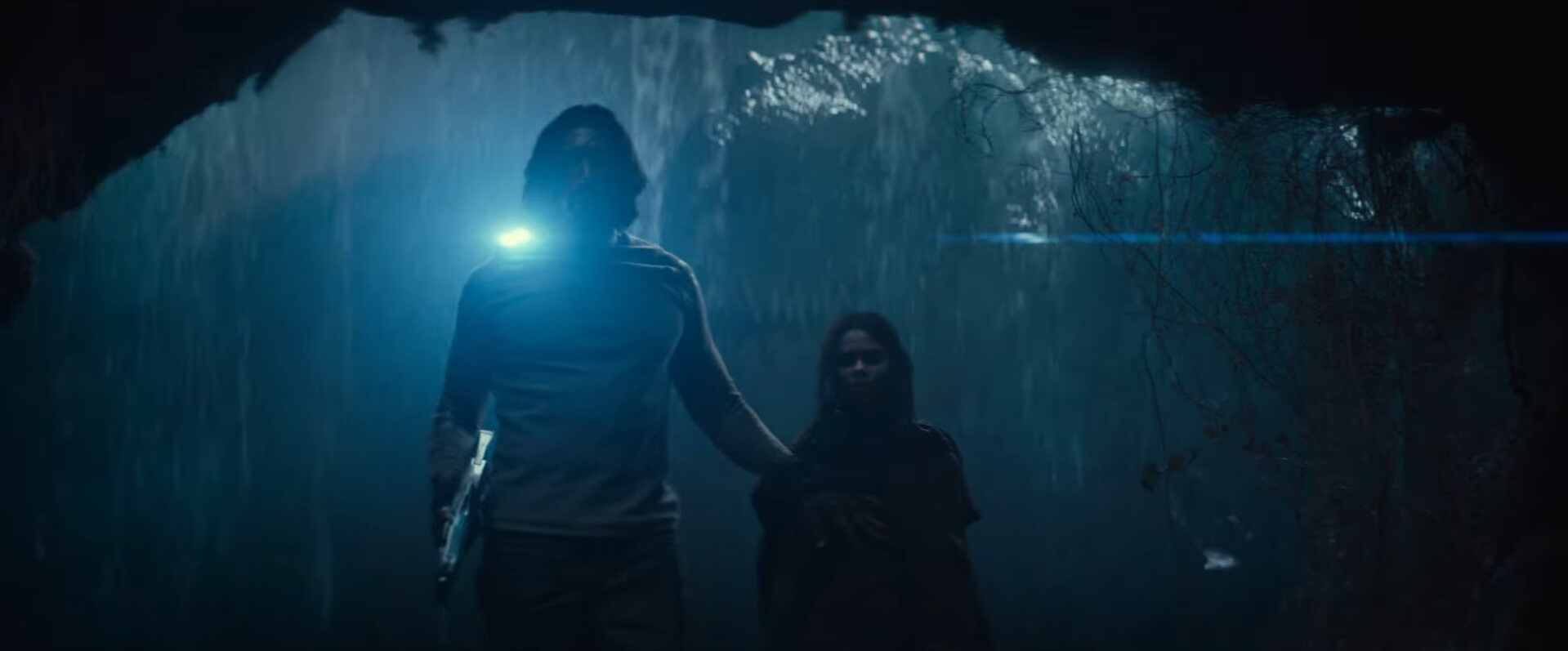
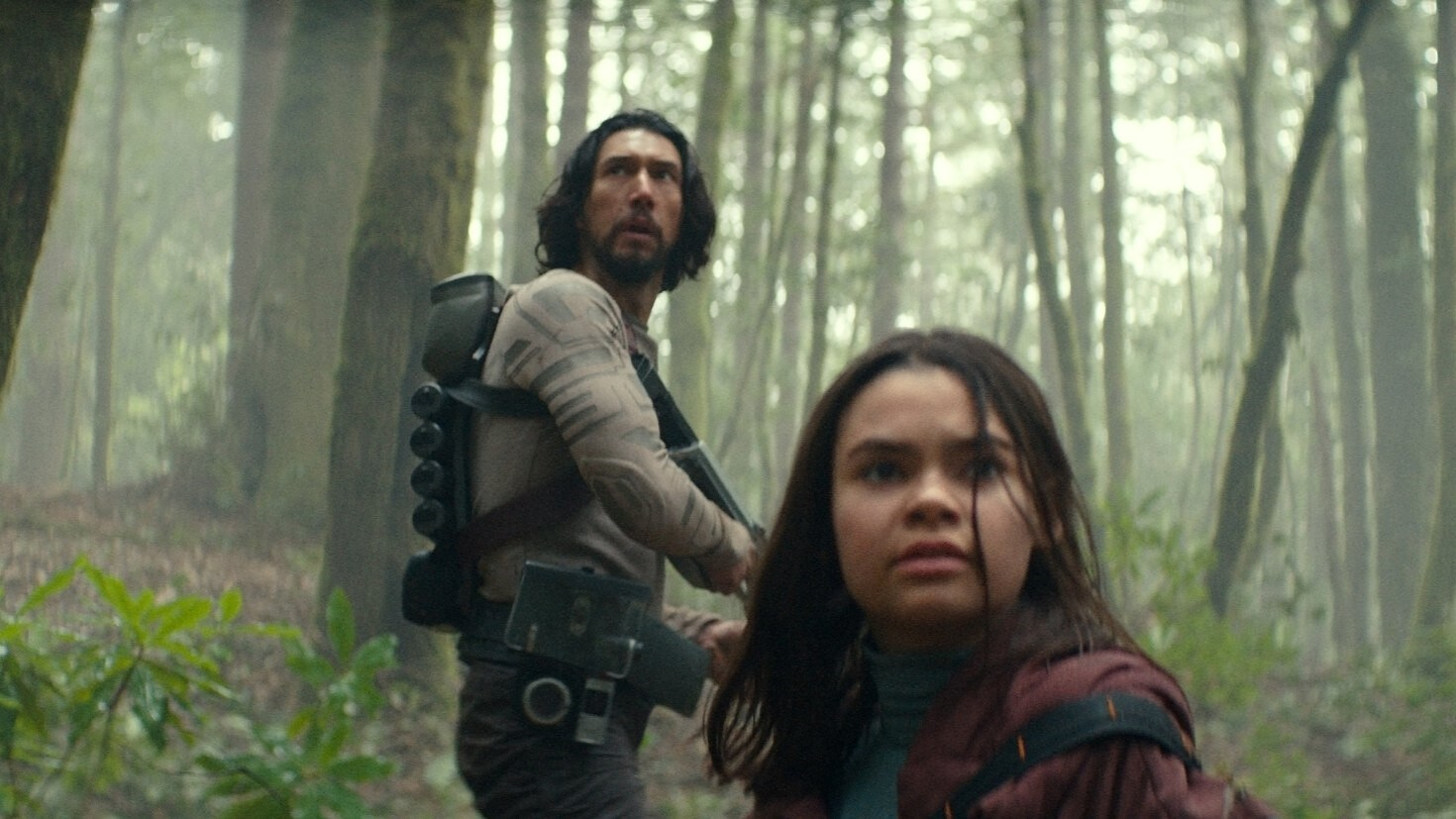
I love the idea of 65 more than I do 65 itself. I can absolutely picture the pitch meeting for the concept of aliens stumbling upon Earth in prehistoric times and being met by a dinosaur-filled death trap in the same way humans imagine inhospitable exoplanets. But it’s all in the execution, and 65 (named for the number of millions of years ago) somehow makes that thrilling notion feel ho-hum.
Adam Driver is serviceable as the main character Mills, a grieving father who left his sick daughter to pilot a space expedition, only for the ship to crash-land with only him and a young girl (Ariana Greenblatt) surviving. What follows is rather paint-by-numbers as they fight or evade dinosaurs and grow closer in their shared loss. There’s nothing particularly wrong with the plot or effects-heavy action, and it makes for a decent watch; it just never rises above a slightly futuristic Jurassic Park knock-off. Maybe films like Jurassic Park or King Kong have simply made dinosaurs less scary than they should be, at least when viewed from the comfort of our living rooms.
Best line: (Nevine, Mills’ daughter) “I know that you’re leaving. And I know it’s because of me.” (Mills) “No. It’s not because of you, it’s for you.”
(For Day 2 of NaPoWriMo, the prompt was for a poem that directly addresses someone and includes elements like an unusual simile and an anachronism. As you may guess, the addressee here is some WWII Nazis taken by surprise.)
I say, chaps, don’t gawp at me like you’re in shock; You knew this was coming (or should have at least). You can’t go around gobbling up the whole bloc And starting up wars on the west and the east.
It truly was only a matter of time Before some resourceful dissenters arrived To answer each war crime with, well, even more crime Until your dear Reich has been quite unalived.
You looked oh so smug in your grey uniforms, That swastika bent like a crime scene in chalk, But you lie with the devil, then you get the horns, A regular arsenal, loaded and cocked.
So don’t be so stunned by the Colt in your face; It’s not so irregular when you come to it. There’s action that’s needed when Nazis give chase, And always somebody, like us, who will do it. ____________________
MPA rating: R (for strong violence)
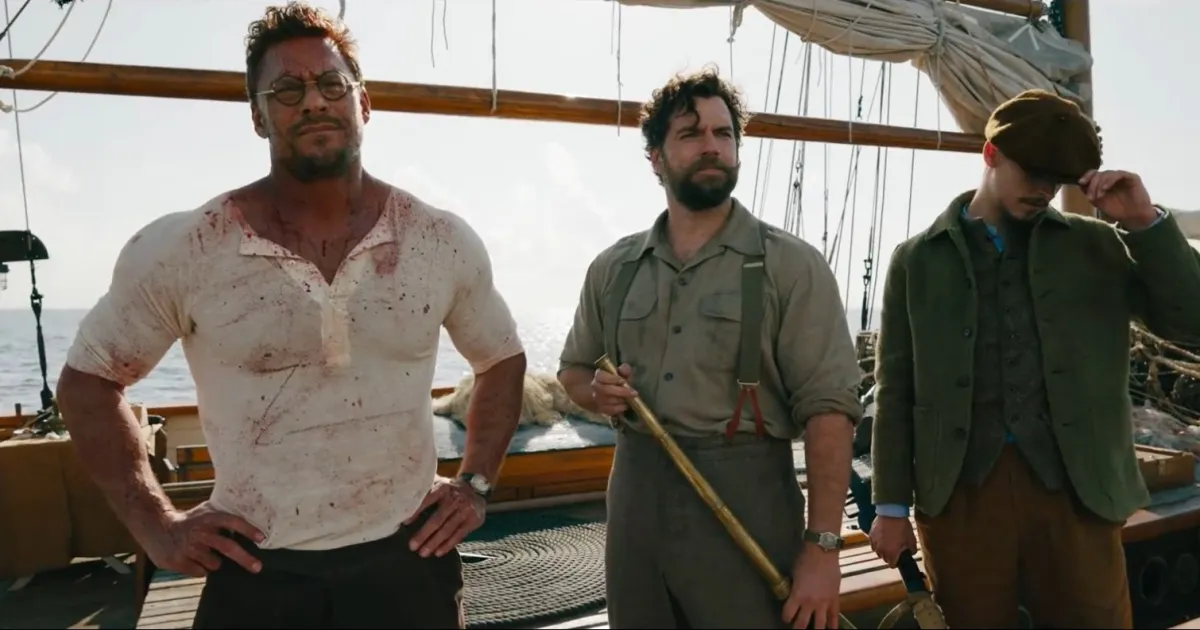
Based on a Damien Lewis book about Churchill’s secret Special Operations Executive (SOE), The Ministry of Ungentlemanly Warfare sees director Guy Ritchie leaning into that cinematic axiom that Nazis make the best villains and by extension the best victims. At the height of World War II, debonaire commando Gus March-Phillips (Henry Cavill) is recruited by one Brigadier Gubbins (Cary Elwes) and tasked with forming an elite espionage team to target Nazi operations with sabotage and guerilla warfare. Joined by a savage Dane (Alan Ritchson), an expert frogman (Henry Golding), and others, the team sets out to destroy an Italian supply ship in what would be known as Operation Postmaster.
The history of the SOE and the feats of the real-life war heroes are undoubtedly interesting, but this is obviously the Hollywood version of events. The film revels in its chance to dispatch Nazis with every sharp instrument at hand, yet, despite the danger involved, the action is so one-sided that there’s rarely any suspense for the fates of the main characters. That’s a shame too, because Cavill has an effortless charisma as the leader of the pack, complemented by the cool but ferocious Ritchson, and their characters might have shone even more with a slightly less glamorized script.
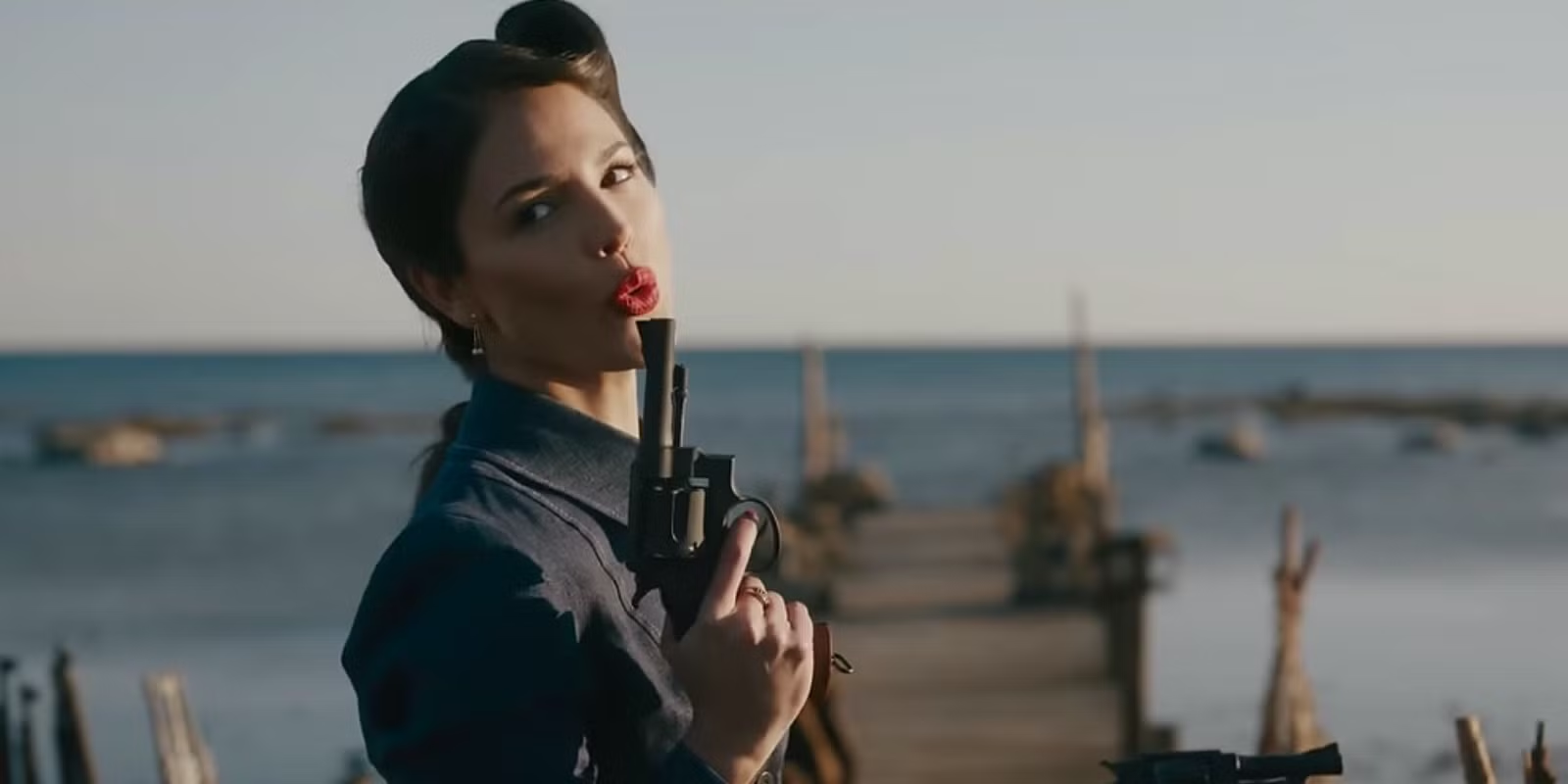
The Ministry of Ungentlemanly Warfare makes popcorn entertainment out of an under-publicized chapter of WWII history, and it does so reasonably well. From the undercover seductions of Eiza González to the shoot-em-up carnage of a tropical rescue mission, it’s sometimes brutal fun, but it also feels like empty calories in a way such intriguing history shouldn’t.
Best line: (Churchill) “If Hitler isn’t playing by the Rules, then neither shall we?”
(For Day 29 of NaPoWriMo, the prompt was for a poem inspired by one of the ten vocabulary words compiled by Merriam-Webster from various Taylor Swift songs, including incandescent, clandestine, Machiavellian, cardigan, elegy, altruism, self-effacing, albatross, antithetical, and mercurial. With more time, I might have liked to tackle using all ten, but I settled on the word clandestine for now.)
Their agents are clandestine So normal folk can rest in The peace that comes from ignorance and bliss. Not knowing we need saving, We carry on behaving. Don’t tell the targets just how near the miss.
The villains and the heroes, The neutral ones and zeroes, They trade their blows for country, cash, or crown. I doubt the average person Will mind if conflicts worsen As long as they will simply… keep it down! __________________________
MPA rating: PG-13
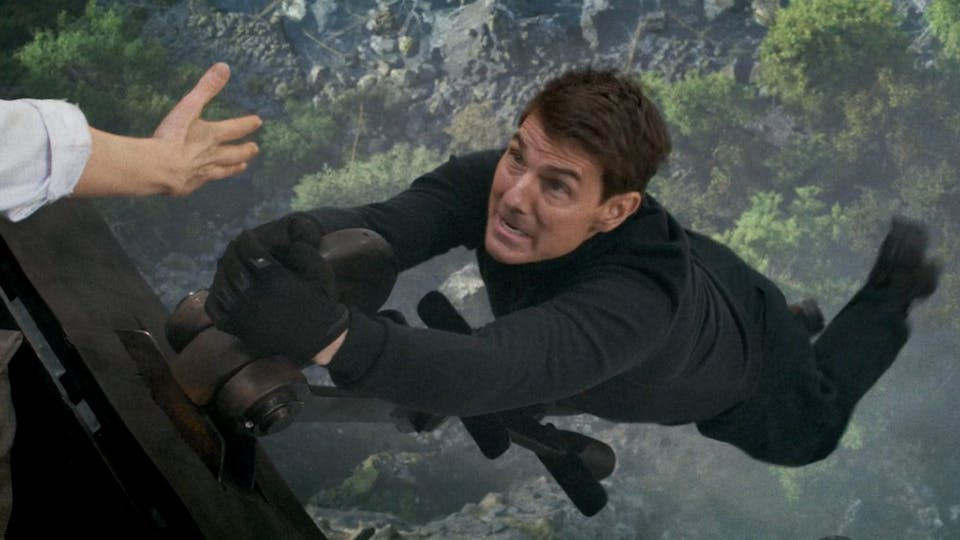
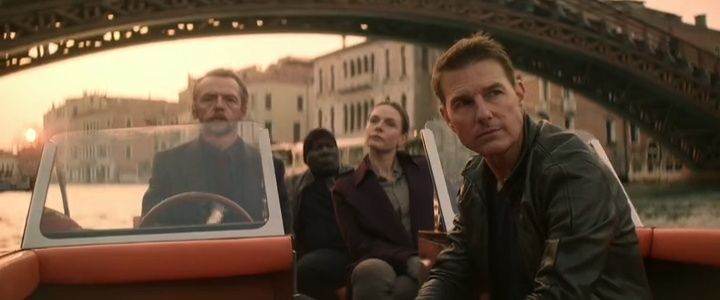
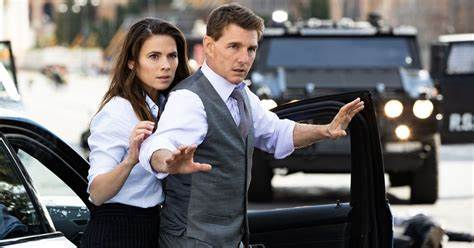
I’ve been behind the curve when it comes to the Mission: Impossible franchise, only realizing how good it was in recent years. Thus, this seventh installment in the Tom Cruise juggernaut is the first one that I was lucky enough to see in theaters. And as is the case ever since the third movie found the franchise’s stride, Dead Reckoning Part One is another winning spy thriller making full use of Cruise’s willingness for death-defying stunts.
After a Russian submarine is sunk by its own torpedo, world leaders are informed of a rogue A.I. known as the Entity, capable of manipulating any computer system. The Entity would be a game changer for whatever government procures the two-part key that can control it, so Ethan Hunt (Cruise) and his friends Luther (Ving Rhames), Benji (Simon Pegg), and the now fugitive Ilsa Faust (Rebecca Ferguson) take it upon themselves to ensure it is destroyed to preserve the global balance of power. With its predictive capabilities, the A.I. is always a step ahead of them as they contend with a self-serving thief (Hayley Atwell) and Ethan’s old nemesis (Esai Morales).
Ethan Hunt is no stranger to “going rogue,” but it’s an interesting change for him to willingly defy his government’s agenda to obtain the Entity because he doesn’t trust it in anyone’s hands, as opposed to the myriad times he’s been set up by a villain. It’s becoming cliché for A.I. to be made scary as it runs amok, and it’s perhaps unrealistic how the Entity pulls strings, seeming omniscient but not infallible, yet it works well as a change of pace from the typical terrorist or corrupt IMF agent that usually battles Hunt’s team, though Morales’ Gabriel still provides that too.
(Non-specific spoilers here) While I liked how characters from previous films were brought back, a part of me is disappointed with how the film handles a particular character, apparently having little idea what to do with them except sacrifice them for the sake of drama. And it’s clear that Hayley Atwell is meant to be the new blood for the team. While that narrative intent is unmistakable, I can’t be too mad because Atwell is a breath of fresh air, a great female foil to Ethan as they match wits until she is drawn deeper into this world of espionage than she expected. Considering Ethan let Michelle Monaghan slip through his fingers already, I think the two of them make an excellent pair.
And we mustn’t forget the action. Whether it’s a car chase through Rome or a free-for-all aboard the Orient Express, the stunts and skirmishes never disappoint, including Cruise’s well-documented motorcycle jump off of an Alpine cliff, though the train climax that follows is even better, in my opinion. It’s unfortunate that the Mission: Impossible hype has waned, leaving this Part One of a two-part story a box-office disappointment, but I sincerely hope it can bounce back even stronger (perhaps with a tighter runtime) because Cruise and this series clearly still have gas in the tank.
Best line: (Ethan, to Gabriel) “If anything happens to them, there’s no place on Earth where you or your God [the Entity] will be safe from me. There’s no place where I won’t go to kill you. THAT is written.”
Rank: List-Worthy (joining the rest of the series)
(For Day 28 of NaPoWriMo, the prompt was for a sijo, a Korean form similar to the haiku but with longer lines of 14 to 16 syllables, for a total of 44 to 46 syllables. It seems like a tricky form to get right, but I tried my best with the six-line format, ending up with 45 syllables. And of course, I had to pair it with a Korean film.)
For the dead, we spare no thought, Heedless without a gutted grave. The shells we humans wear Serve us well before our final molt. What remains is not you, not me; May it never crave your fear. ____________________________
MPA rating: Not Rated (a light R seems about right)
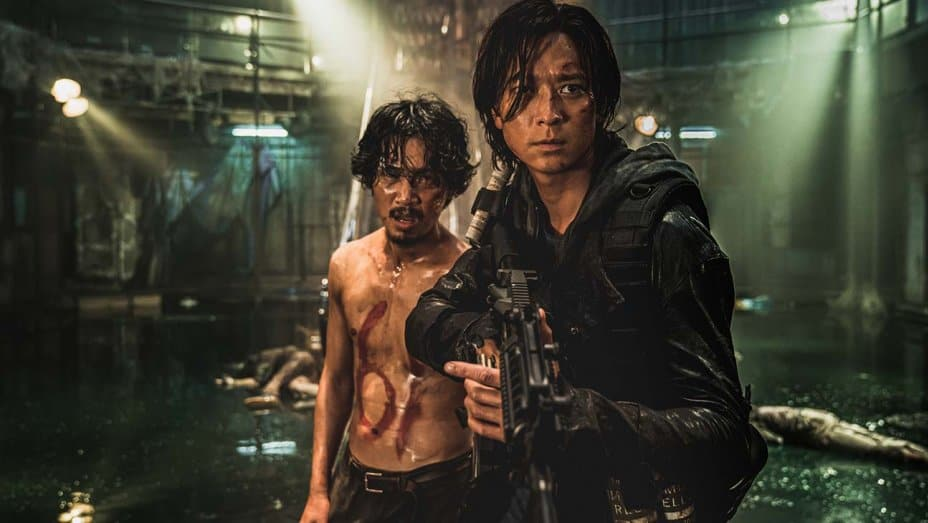
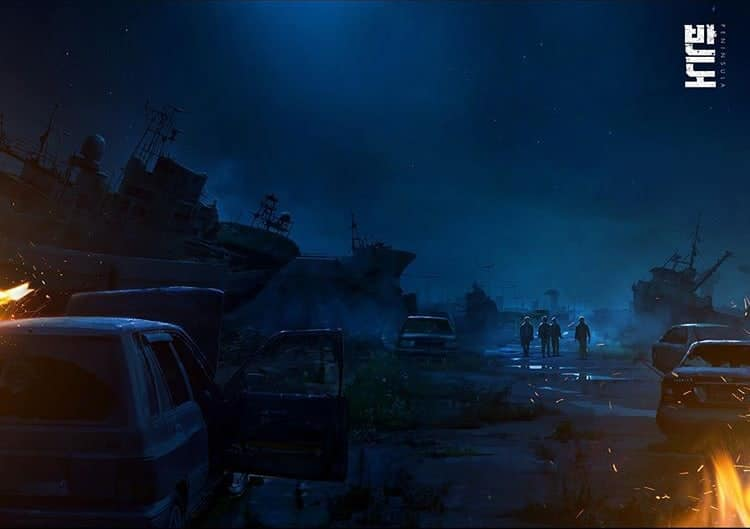
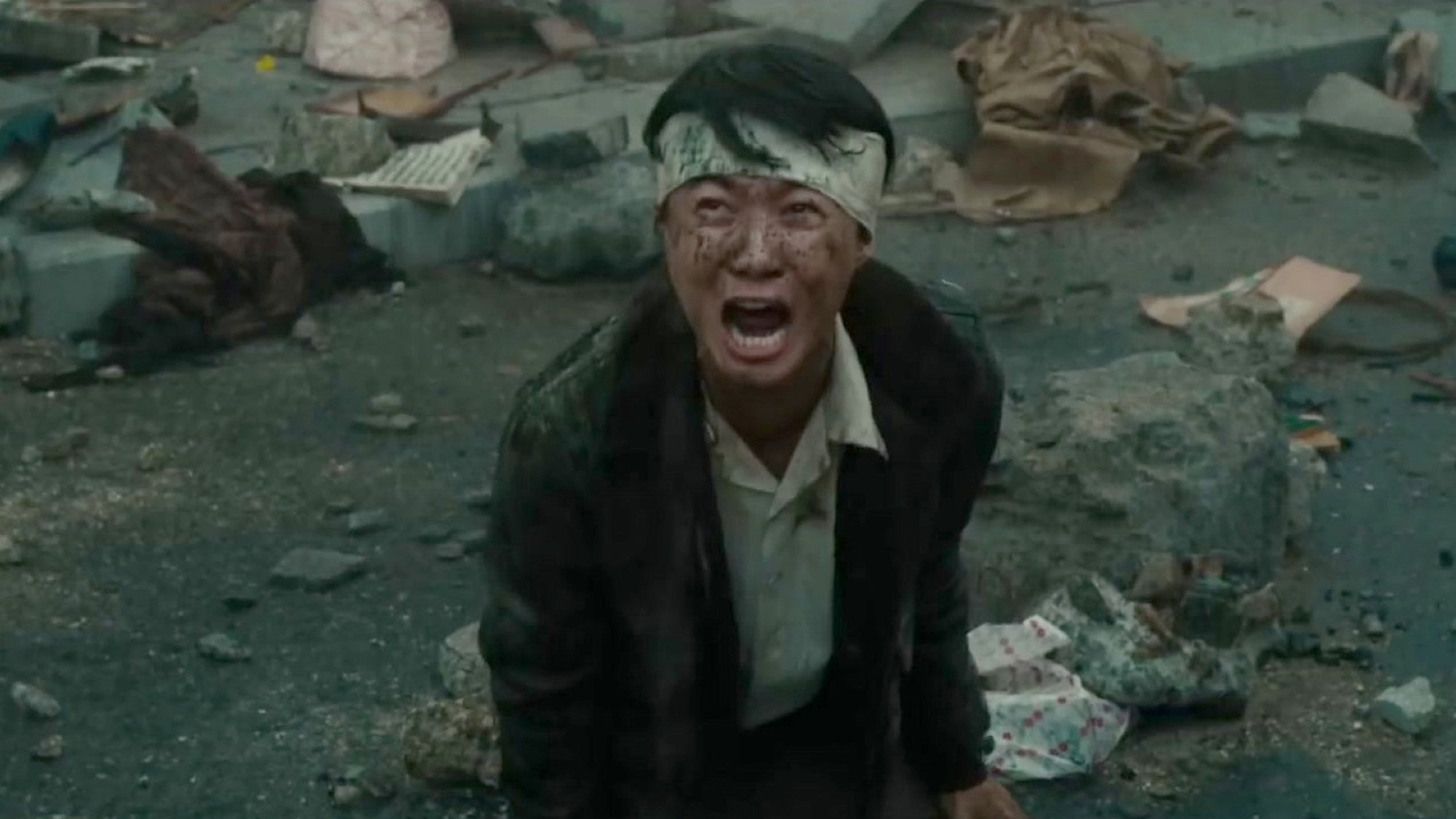
Train to Busan was an anomaly for me, a Korean zombie film that I genuinely loved as it showcased character growth and action over gross-out horror so common to the genre. The animated prequel Seoul Station only reinforced its predecessor’s uniqueness, since that was merely another exercise in apocalyptic nihilism. So I was cautious in approaching Peninsula, the standalone sequel set in the same zombie-infested South Korea as Train to Busan. While it feels more like the zombie dystopias I tend to avoid, Peninsula proved to be a pleasant surprise.
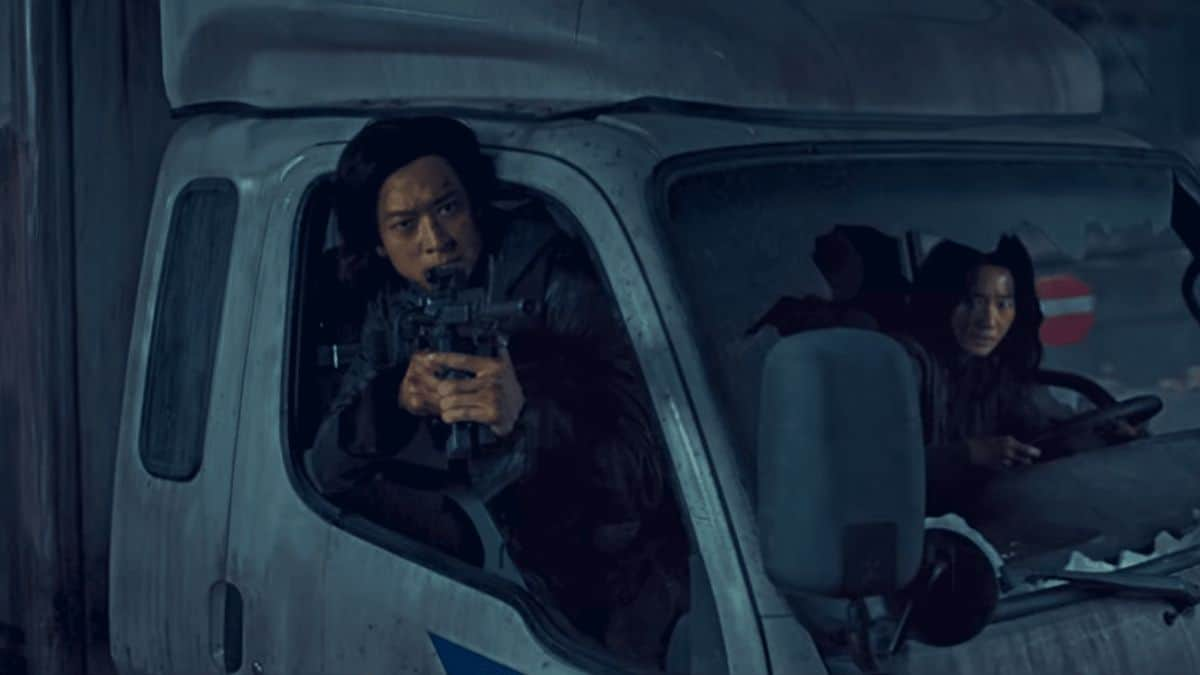
Four years after South Korea was overrun by fast-moving zombies and sealed off from the rest of the world, former Marine officer Jung-seok (Gang Dong-won) is haunted by the day his world fell apart, losing his sister and nephew in the undead chaos. When he and his bitter brother-in-law (Kim Do-yoon) are approached by mobsters to return to Korea, they sneak back into the desolated Incheon to retrieve a truck with $20 million, only to be confronted by both zombie hordes and a violent rogue military unit that has taken control of the wasteland. With a handful of resourceful survivors (Lee Jung-hyun, Lee Re), Jung-seok must outmaneuver both living and dead to find a way off the peninsula.
At first glance, Peninsula has many of the familiar trappings of the zombie movie: swarming hordes, abandoned cityscapes, evil humans acting worse than the zombies. One thing I liked about Train to Busan was that it was comparatively less violent than others of its genre, owing to the fact that the characters didn’t have access to bloodletting weapons like guns or swords. In contrast, Peninsula has no shortage of guns, making it more of a conventional shoot-em-up actioner, though it at least doesn’t turn into a full-on gorefest.
So, as many middling reviews have pointed out, this sequel doesn’t match the original for creativity or emotional payoff, but it comes closer than I would have expected. While Jung-seok doesn’t have quite the selfless character arc of Seok-woo in the first film, the way his guilt motivates him to do better still becomes poignant by the end, and the story presents a satisfying karma of evil or selfish characters getting their due. Plus, despite the “conventional actioner” complaint earlier, the action is thrilling throughout, particularly a fantastic, Mad Max-level car chase toward the end.
Though Peninsula is more violent and less inspired than its forerunner, I was glad to find that it is not a complete departure from what made Train to Busan so good. Zombie movies are such a well-worn format by now that there needs to be something to set new installments apart, and I can certainly get behind car chases, heist thriller elements, and an emotional core.
(For Day 24 of NaPoWriMo, the prompt was to borrow a line from an existing poem and take it in a different direction. Since this film has a direct connection to the poem “Lucy Gray” by William Wordsworth, I decided to start with the same opening line and use the same form.)
Oft I had heard of Lucy Gray: Her story nearly myth. We had few tales to light our day Or dreams to bargain with.
Dear Lucy Gray endured the Games, That much is widely known, But as to any other claims, They’re whispered when alone.
I’ve heard details that she was friend To Coriolanus Snow, The man who every year will end Our children as a show.
It makes me worry how a man Could dull his very heart. Was Lucy Gray part of his plan? And did it fall apart?
I cannot say, but still I hear Of rumors in the night, That Lucy Gray just may appear And offer us a light.
I wonder who awaits that more, The tyrant or the slave. We all have things we’re waiting for Along the road we pave.
Such stories make me want to pray For nigh unlikely things, To hail another Lucy Gray And see what change she brings. ________________________
MPA rating: PG-13
While The Maze Runner and Divergent struggled to match its success, there’s something about the world of The Hunger Games that stands out among young adult dystopia franchises. The concept of children being forced to kill each other for entertainment is not without precedent (ahem, Battle Royale), but the journey of Katniss Everdeen from tribute to freedom fighter is a special blend of sci-fi action and frighteningly plausible barbarism, with just the right amount of hope. It’s a testament to Suzanne Collins’s book series and their film adaptations that the world they create is able to sustain a prequel without it feeling like a cheap cash grab. Let’s just be glad it’s not a whole new trilogy.
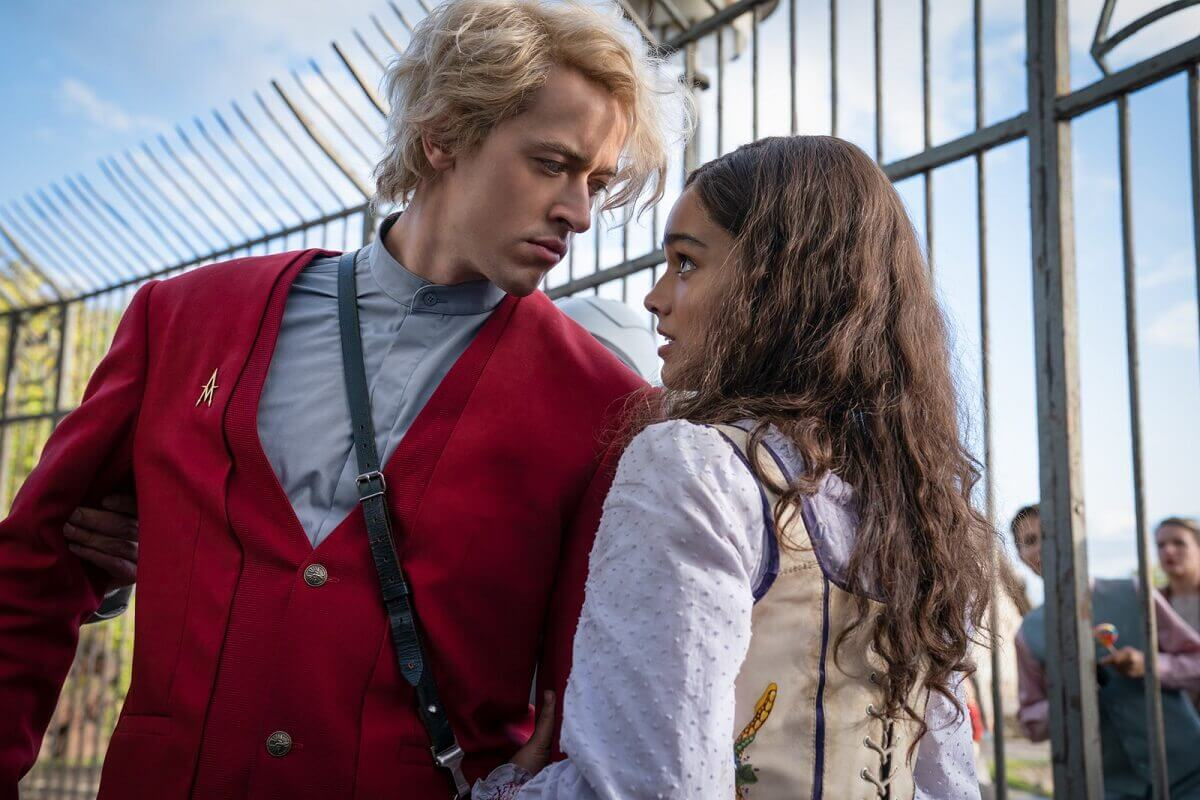
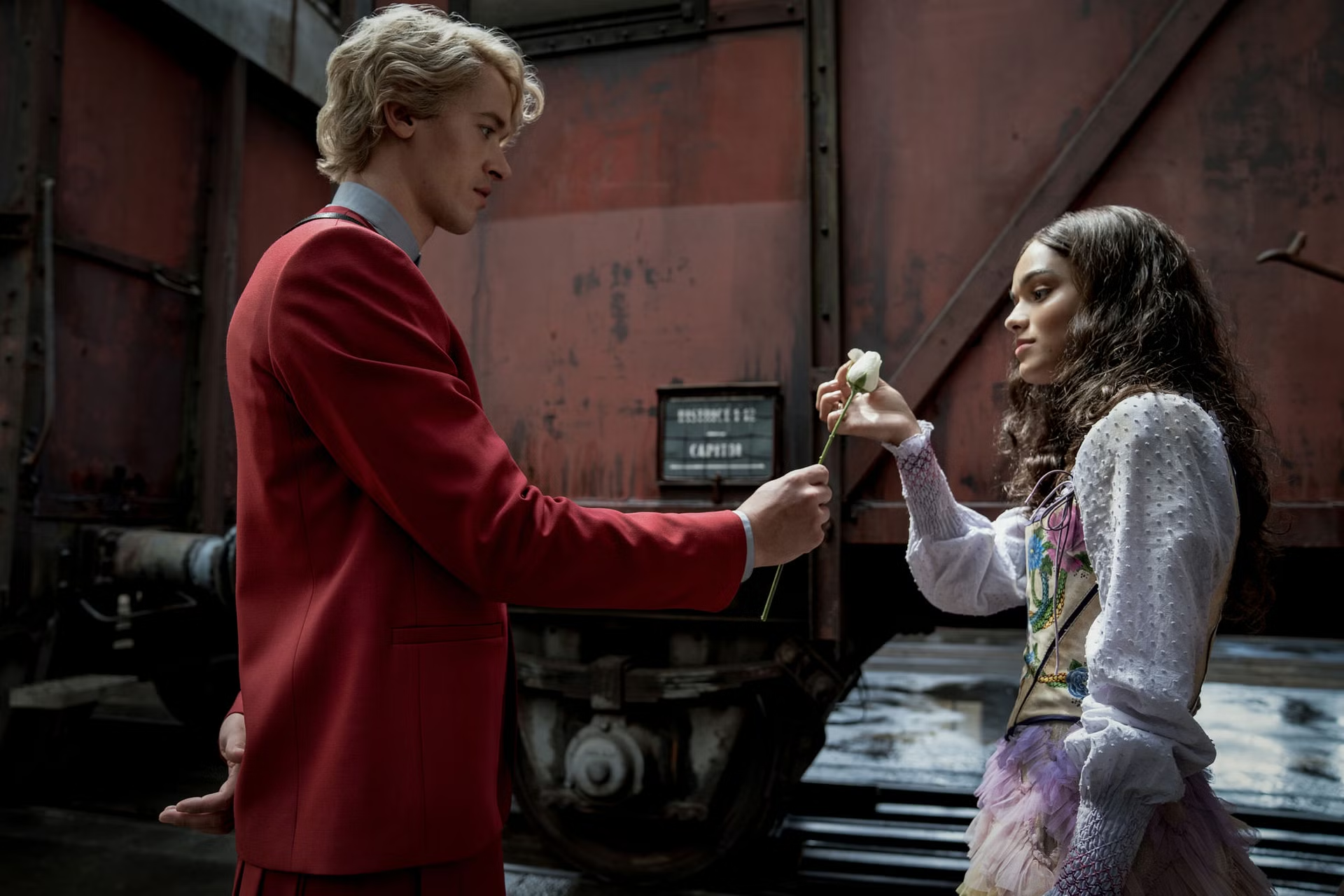
As advertised, The Ballad of Songbirds & Snakes is the origin story of Coriolanus Snow, the tyrannical villain played by Donald Sutherland in the original series. Proving that even dictators were young and hot once, “Coryo” is played here by Tom Blyth, who gives the future despot a fitting ambiguity between his tender side with his remaining family (Hunter Schafer, Fionnula Flanagan) and his growing ambition to rise above his peers. At the behest of the inventor of the Hunger Games (Peter Dinklage), the Capitol’s Academy class must serve as mentors for the upcoming Games, with Snow paired with District 12 musician Lucy Gray Baird (Rachel Zegler, never quite as compelling as Jennifer Lawrence). Eager to prove himself to the ruthless Head Gamemaker (Viola Davis), Snow conspires to keep Lucy Gray alive for both their sakes.
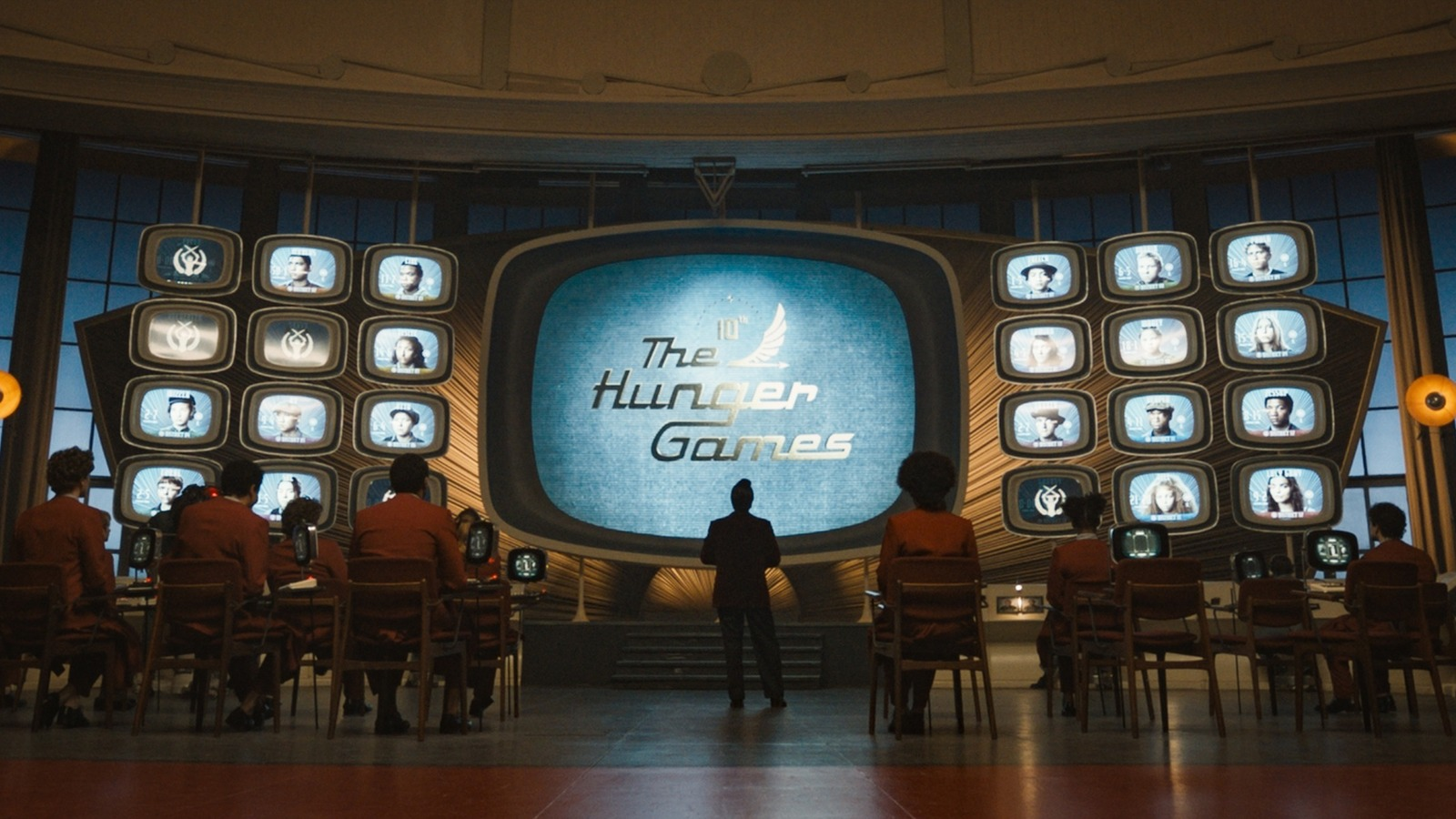
The first Hunger Games featured the 74th annual contest, so the pipeline of reaping children and training them into gladiator combat had been efficiently honed over decades by that point. In the prequel, it’s only the 10th Hunger Games, with the devastating war that prompted their creation still seared into most people’s memories. I found it fascinating to see the process Katniss experienced still in its infancy, with less refined technology and growing pains like defective drones for delivering resources to the arena. Being a tribute was not always glitz and glamor before the fighting began, and there were even vocal critics of the Games’ brutality, such as Snow’s close friend Sejanus (Josh Andrés Rivera).
The plot is broken up into three sections, and it does feel odd that the always thrilling Games make up more of a middle climax, kind of like the bomb testing in Oppenheimer, leaving the rest of the film to be potentially dull by comparison. Thus, it depends how interesting you find subtle treachery and questionable loyalties whether the latter third holds up without the action. I for one did still enjoy Snow’s gradual slide into Machiavellian deceit, as well as the little fan-service references to the other films. As for the ending, I don’t blame anyone for feeling unsatisfied by its open-ended lack of resolution, but the connection to Wordsworth’s “Lucy Gray” helped me appreciate its poetic mystique.
I mulled over how I would rank all the films with this new addition, and it would probably come in fourth, ahead of only Mockingjay – Part 1. (I loved how that film’s great “Hanging Tree” song found its origin in this film too.) That ranking speaks more to the strength of the other three movies since The Ballad of Songbirds & Snakes has plenty of merits, including a strong tragic character arc, great actors adding to the story’s gravitas, and welcome development of the history and lore of Panem. It’s certainly the most musical of the series, with Rachel Zegler flexing her singing chops perhaps too often, but I didn’t mind that. It’s hard to say how well the film works for uninitiated audiences, but this ballad is an insightful expansion for franchise fans like me.
Best line: (Lucy Gray Baird, to her captors) “Nothing you can take from me was ever worth keeping.”
Rank: List-Worthy (joining the rest of the series)
(For Day 23 of NaPoWriMo, the prompt was for a poem involving a superhero, so what better inspiration than an actual superhero movie?)
Never meet your heroes, So the sayings go. Let them be paragons up on their pedestal, Marvels, Amazing, Fantastic, Incredible, Always impressive and never forgettable, Better the less that you know.
But given the chance to be heroes, How can we resist? To get a good look at the celebratory Defenders of goodness in all of their glory, The feet made of clay, just a little bit gory, The things we would rather have missed. That’s one idol less on the list…. _________________________
MPA rating: PG-13
I think it’s clear to everyone that Marvel has lost much of its former glory. Since Infinity War and Endgame, the MCU has been deluged with more content and yet seems to be suffering from diminishing returns with every new entry. All that said, I’m still 100% along for the ride and have found much to enjoy even in the lesser installments (not Thor: Love and Thunder, though).
The Marvels has clearly been set up over time, bringing together Brie Larson’s Captain Marvel/Carol Danvers with two characters established in Disney+ series: Jersey City fangirl and mutant Kamala Khan (Iman Vellani), who gained Green Lantern-ish abilities from a magic bangle in Ms. Marvel, and former S.W.O.R.D. agent Monica Rambeau (Teyonah Parris), the daughter of Carol’s Air Force buddy, who gained light-based powers from interacting with Scarlet Witch’s Hex field in WandaVision. Some may balk at the amount of non-movie homework needed on these characters’ backstories, but The Marvels is still a mostly fun romp without that prior knowledge.
For reasons thinly explained, all three of these heroines find themselves suddenly switching places whenever they use their powers at the same time, an inconvenient development since vengeful Kree leader Dar-Benn (Zawe Ashton) is intent on stealing the resources of other planets to save her homeworld. The character interactions are often the film’s greatest strength, since Carol and Monica have a shared and strained bond through Monica’s dead mother Maria. Meanwhile, Kamala brings the Peter Parker exuberance as a diehard fan of Captain Marvel, giddy to be working alongside her childhood hero.
I won’t deny that The Marvels has glaring weaknesses, mainly in its tonal shifts. It’s full of goofy moments (including a lame scene that feels like a little girl’s fantasy that she convinced the screenwriters to somehow work in), yet the battle with Dar-Benn involves world-ending consequences, making it rather egregious that one planet is written off as doomed and never mentioned again. Dar-Benn herself is quite a generic villain who hardly seems like she should be a threat considering what Carol was capable of in Endgame. And then there’s Nick Fury (Samuel L. Jackson), an always welcome presence yet wildly more lighthearted here compared with the serious version seen in the Secret Invasion series just a few months before this film’s release.
Yet despite its weak plotting and a villain plan ripped straight from Spaceballs, I still am a sucker for Marvel’s brand of superheroics. The idea of characters swapping locations, even across the galaxy, is a fun concept well-utilized for both humor and action. Larson is still only moderately interesting as a protagonist, even with Parris for dramatic support, but Vellani is a joyful addition to inject levity where needed, and I liked how her family was kept around for laughs as well. And while it can border on cringy, the goofiness reaches its crescendo in a marvelously absurd sequence in the climax set to a Broadway showtune that had me giggling uncontrollably.
It is disappointing that The Marvels was such a comparative bomb for the MCU, the only entry to not earn back its budget. It definitely feels like a half-baked effort that could have used more time in development, but it’s still a likable and entertaining comic book movie with a healthy dose of girl power. Others may abandon ship, but there’s enough good still to keep me on board until the MCU finds its footing again.
(For Day 13 of NaPoWriMo, the prompt was both general and specific, a poem playing with rhyme and based on a “word bank” of various types of words. Taking inspiration from this recent sequel, my words included “glare,” “rumble,” “parched,” “reek,” “worm,” “divine,” and “save,” and I tried out an alternating rhyme scheme I found rather challenging. It’s imperfect but maybe that’s for the best.)
From space, the occupiers came To reap what they had never sown, Their every footfall laying claim And conquering an empty throne. Or so they thought and sought to tame This planet, stark and harsh and parched, But everywhere the jackboot trod, The sands would cover where they marched. Awaiting their crusading god, The natives hid from wanton force. Invaders rarely spare the rod Nor care enough to alter course Nor wait for saviors come to save, And so they spread their tyrant reek And swept the desert like a wave, A deadly game of hide and seek. Wherever eye could bear the glare, They flaunted strength upon the weak Who lived off prophecy and prayer.
But even worms will one day turn When hatred hounds the hot and humble. Can you feel their rancor burn, Sense immense commencing rumble Of the conquered, quick to learn The ways by which a war is waged? Plunderers, your plunder’s mine, I’m the one at whom you’ve raged, One who broke your sandy line, Tore your plan for us to shreds. Believe it human or divine, I bring justice on your heads. ____________________________
MPA rating: PG-13
As a huge fan of science fiction, I should love Dune. I rewatched Part One of Denis Villeneuve’s adaptation of the famed Frank Herbert novel, and I was struck a few times by the thought “Maybe I ought to add this to my list of favorites.” The sheer magnitude and impeccable quality of the Dune universe is a marvel to behold, yet for some reason, the story still doesn’t fully connect with me. I was hopeful that Part Two might change that, providing a fitting conclusion to the epic journey of Paul Atreides.
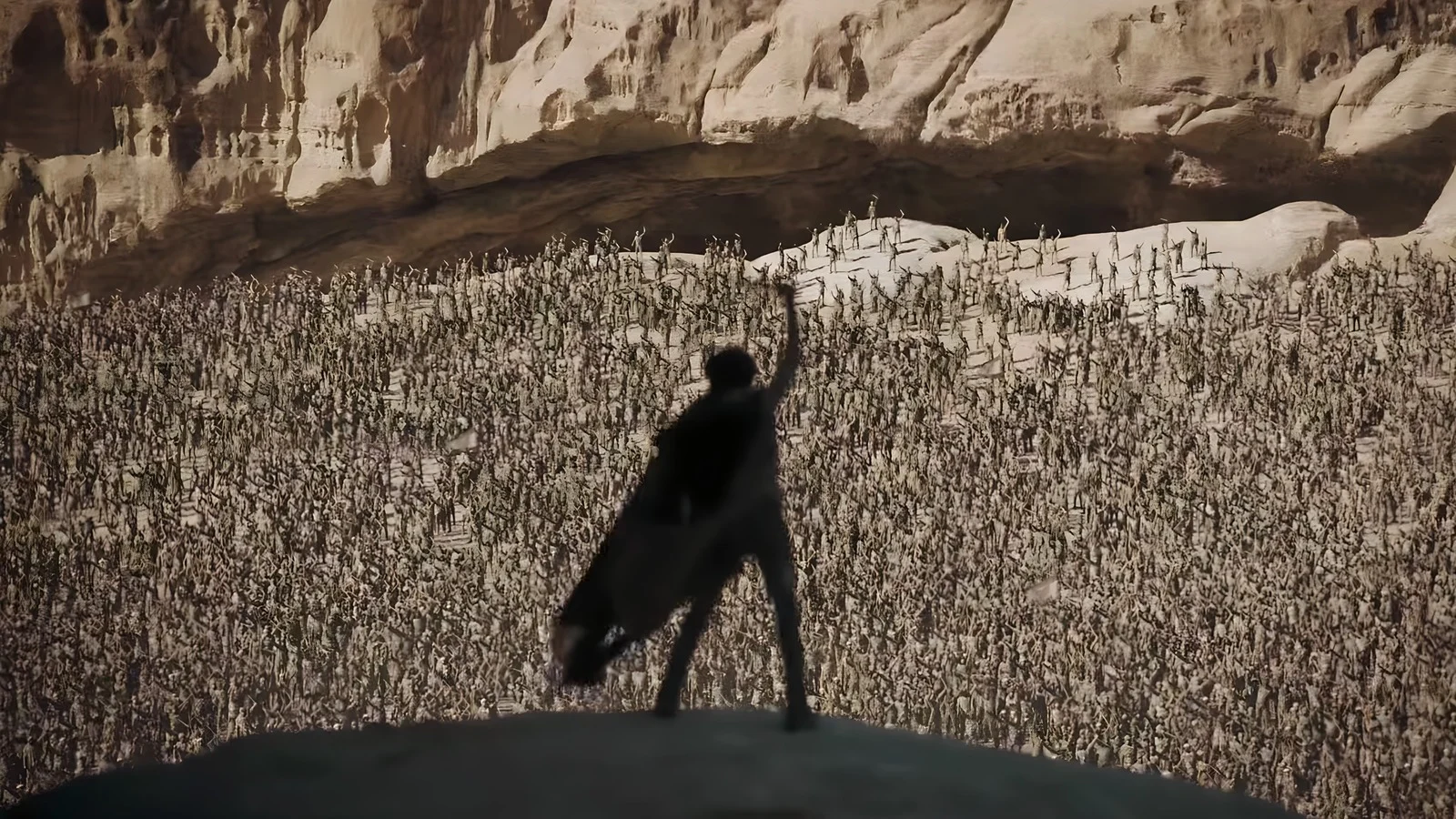
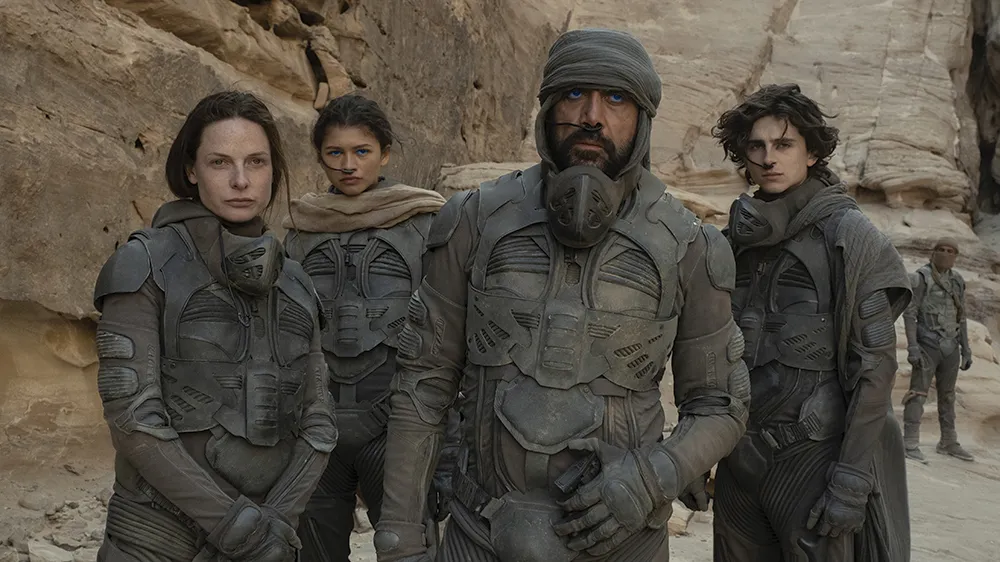
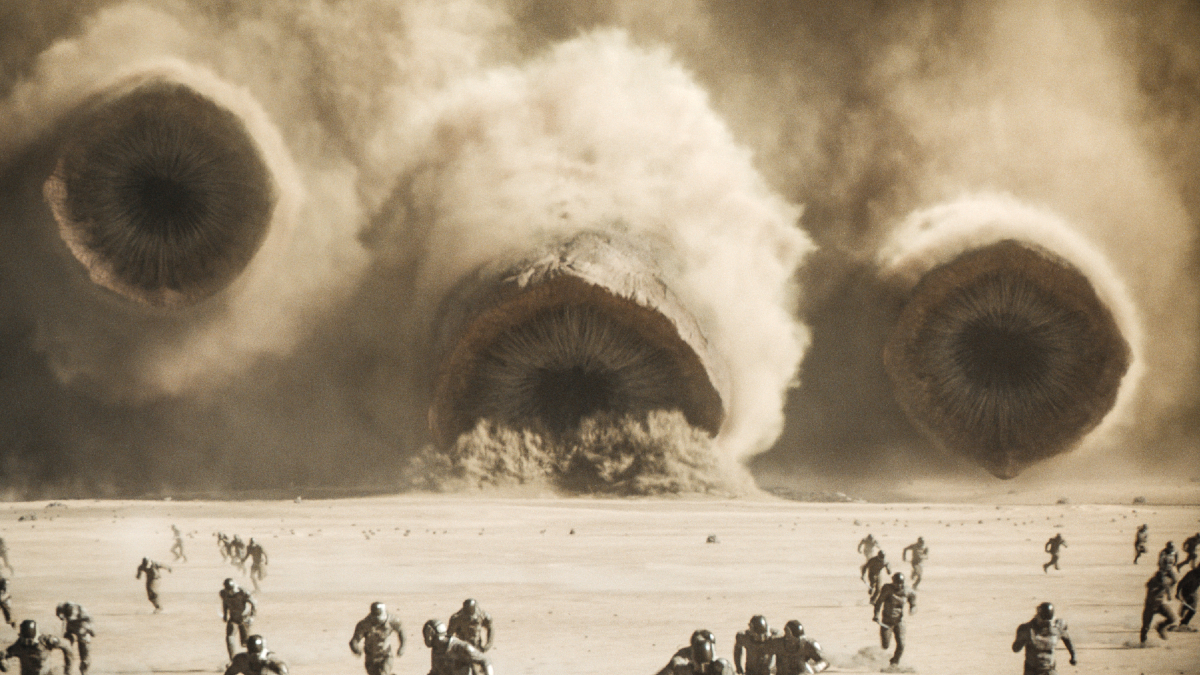
Picking up directly where Part One ended, Paul (Timothee Chalamet) and his Bene Gesserit mother Jessica (Rebecca Ferguson) are taken in by the desert-dwelling Fremen after the Atreides have been wiped out by a Harkonnen ambush. Soon, rumors spread through the Fremen that Paul might be the Lisan al Gaib, the promised messiah destined to lead them to prosperity and freedom, rumors lent credence by how easily Paul adapts to their lifestyle and the riding of the giant sandworms. As he falls in love with Fremen warrior Chani (Zendaya, finally getting more screentime), Paul must grapple with whether or not to embrace the mantle of messiah, if only to take revenge on the Harkonnens.
From Arrival to Blade Runner 2049, Denis Villeneuve has truly distinguished himself as the king of serious sci-fi and one of the finest directors working today. Dune: Part Two is further proof of his talents, continuing the same high quality of Part One and delving deeply into its themes of predestination, Machiavellian control, and religious fervor, which were mostly lost in translation in the 1984 David Lynch adaptation of Dune. (My VC is still very fond of that one for some reason.) That film presented Paul as the actual Fremen messiah, no questions asked, while Villeneuve’s version casts doubt by exploring how the Bene Gesserit have been manipulating such savior myths for centuries, now pushed onto Paul by his mother and unborn telepathic sister. It was interesting how the psychotic Harkonnen champion Feyd-Rautha (an unrecognizable Austin Butler) was shown to be part of these machinations, and quite a few details of the storyline and politics were definitely lost on me in the 1984 film’s speedrun through the plot while being properly fleshed out here and even diverging by the end.
There’s absolutely a place for Dune in the annals of top-tier sci-fi, but for all its deep world-building and desert spectacle, I still admire it more than I actually like the story. With Paul as its potential false prophet protagonist, it’s a subversion of the typical hero’s journey that leaves no one happy by the end, though I am still intrigued to see what the planned third film adapting Dune: Messiah would do, since I’m not at all familiar with what lies beyond the first book. With Oscar-worthy production values, excellent acting, battle scenes on a grand scale, and an ending that gives more finality than Part One while also leaving the door wide open for more, Dune: Part Two stands apart and above any recent film vying for the descriptor of “epic” and delivers exactly what its fans would want. I want to love it more and perhaps I will with time, but I can certainly praise its merits all the same.
Best line: (Paul Atreides) “He who can destroy the thing has the real control of it.”
(For Day 12 of NaPoWriMo, the prompt was for a poem related to a tall tale, so I borrowed a certain larger-than-life character from Tarantino.)
Now hear the tale of Django, who was once a lowly slave, But given chance and some romance, he rose as from a grave.
His finger was born itchy, and his bullets ne’er ran dry, And eye for eye meant nothing once his foe could not reply.
The white folks watched their words whenever Django wandered free, And when an N was uttered, they were dead before the G.
The hooded ones who lived off fear, of Django were afraid; And if a hundred gathered, ninety-nine would flee for aid.
They tried to hang him once, believing numbers were the key, But Django fought and with one shot, felled them and then the tree.
He was villain to the villains; he was vengeance none would dare. His story isn’t history, but Django wouldn’t care. _________________________
MPA rating: R (for very good reason)
This was definitely out of character for me. While I did previously review Once Upon a Time… in Hollywood (because it was part of a 2019 Best Picture nominee marathon at Regal), I generally steer clear of Quentin Tarantino movies. His reputation for gratuitous violence and profanity is the kind of indulgence I prefer to avoid, but Django Unchained happened to come on TV at least somewhat “cut,” so I opted to give it a chance.
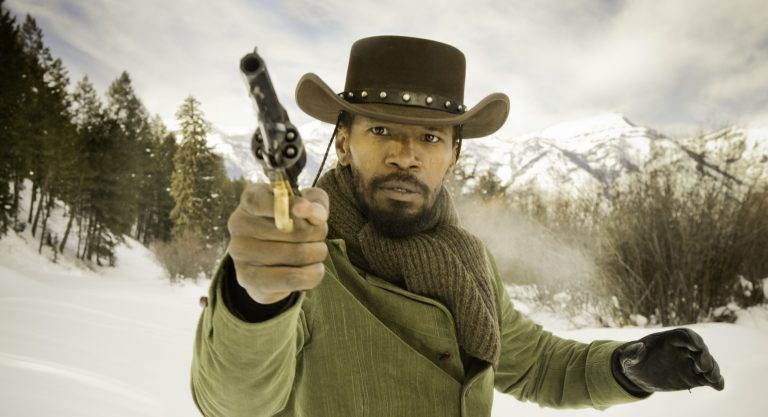
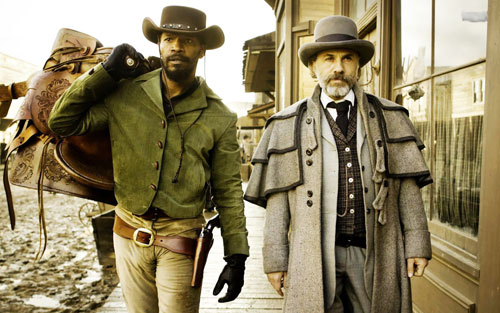
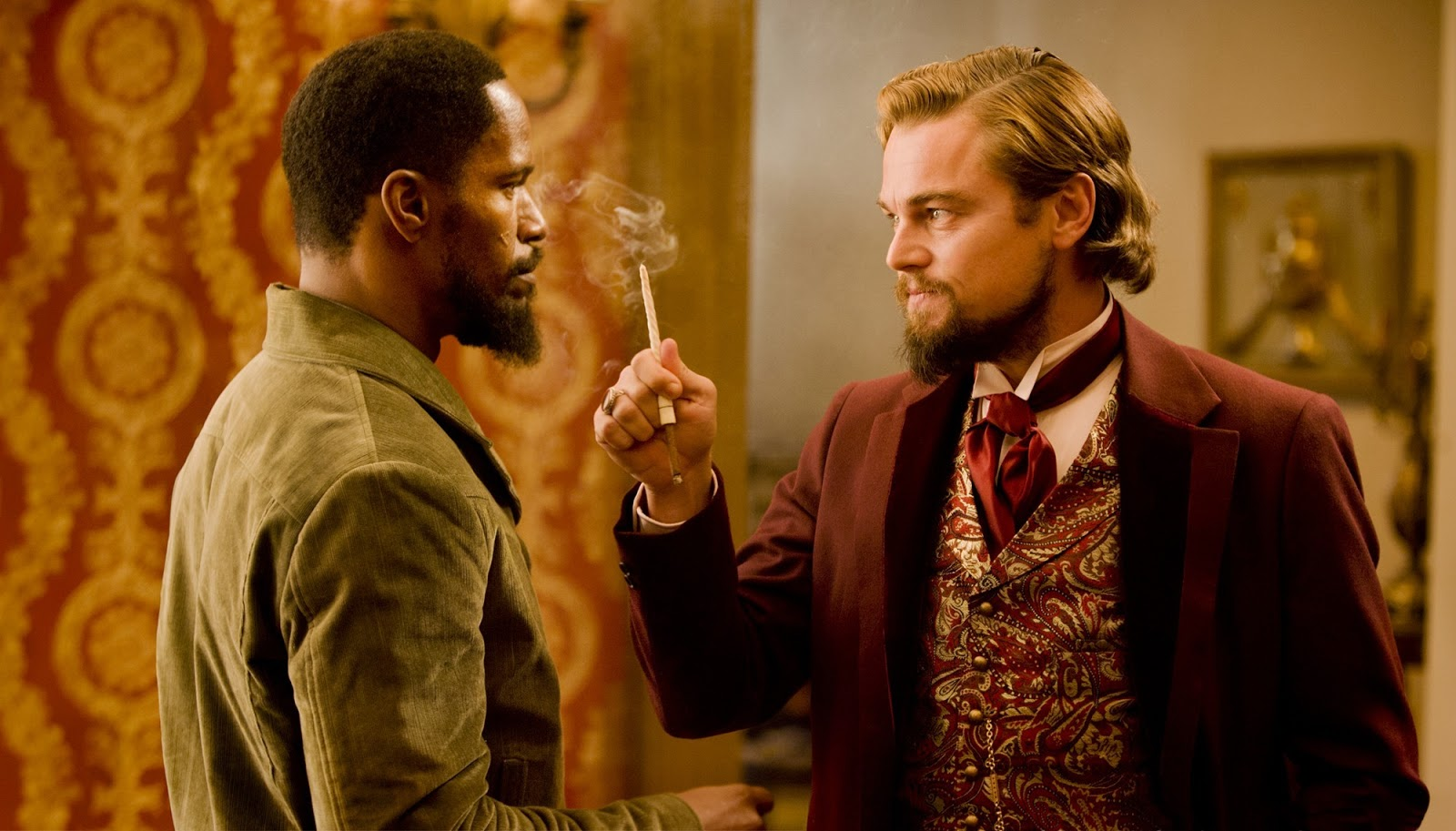
Set in the antebellum South and taking its hero’s name from the 1966 spaghetti western Django, the film follows its own Django (Jamie Foxx) as he grows from slave to avenger, thanks to the colorful intervention of Dr. King Schultz (Oscar-winning Christoph Waltz), a bounty hunter who trains him in the ways of killing bad guys for money. After some success at doling out bloody justice, the duo set their sights on the despicable Calvin Candie (Leonardo DiCaprio), a gleeful plantation owner holding Django’s wife Broomhilda (Kerry Washington) and unlikely to part with her easily.
First, the good stuff. It’s obvious from his first scene why Waltz won his second Best Supporting Actor Oscar (following his previous win for Tarantino’s Inglourious Basterds); Schultz boasts an undeniable charisma and charm to match his ruthlessness, and Waltz embodies the silver-tongued mercenary to a T. It’s a perfect case of a fine actor distinguished further by great dialogue, and, while Foxx and DiCaprio are also pitch perfect in their roles, the scenes that shine most are their interactions with Waltz. I can also appreciate Tarantino’s skill as director and storyteller, blending western and blaxploitation tropes into a compelling tale with an iconically anachronistic soundtrack.
Yet every R-rated movie for me is a balancing act between the laudable and the hard-to-watch, and which side has more weight by the end determines my opinion of it. Despite its good points, Django Unchained is excessive in multiple ways, from the cruelty of its slaveholders to the almost cartoonish amount of blood sprayed in the shootouts. (Watching on TV, I was spared the non-stop N-words and some brief nudity, but it certainly didn’t feel like a “cut” movie by most standards.)
Tarantino’s MO seems to be taking already hateful figures, whether Nazis, slaveholders, or the Manson family, and tweaking history to allow the heroes to slaughter their caricatures en masse with justifiable vengeance. Racism is terrible so why feel bad when Django shoots an unarmed woman? I get that it’s intended to be some form of catharsis, but it just leaves a bad taste in my mouth to make gory violence something cheer-worthy. The film was rightly controversial upon release as well, so even mainstream critics took some issue with its excesses. I suppose you could call it a mixed bag: entertaining and off-putting, well-made and ill-advised, impressive and nasty. I assume that was Tarantino’s intent, but, despite some masterful scenes, it’s not something I’m likely to revisit.
Best line: (Calvin Candie, after being given an exorbitant offer) “Gentlemen, you had my curiosity; now you have my attention.”
(For Day 4 of NaPoWriMo, the prompt was to draw inspiration from the quirky natural phenomena detailed in the 1958 book The Strangest Things in the World, such as “Uganda’s Miniature Dinosaur,” “Enigma of Evolution,” “The World’s Biggest Sneeze,” and “The Forest that Time Forgot.” What could be stranger than a dinosaur in the present day?)
We talk of chickens, geckos, gators Like they’re mini-dinosaurs, DNA perpetuators Winning evolution’s wars.
Look at what they’ve lost, however, Dwindling to humans’ scale. Those survivors truly clever Never would have grown so frail.
Something dodged the diminution, Surely kept its ancient reign, Some enigma evolution Cannot fathom to explain.
The biggest teeth to leave man shaken, Biggest sneeze and appetite, The biggest ire none should waken, Gorged on centuries of spite.
Where this scourge of sighs is lurking, Deep where time itself forgot, None can say; its guise is working. Pray it never leaves the spot. ___________________________________
MPA rating: PG-13
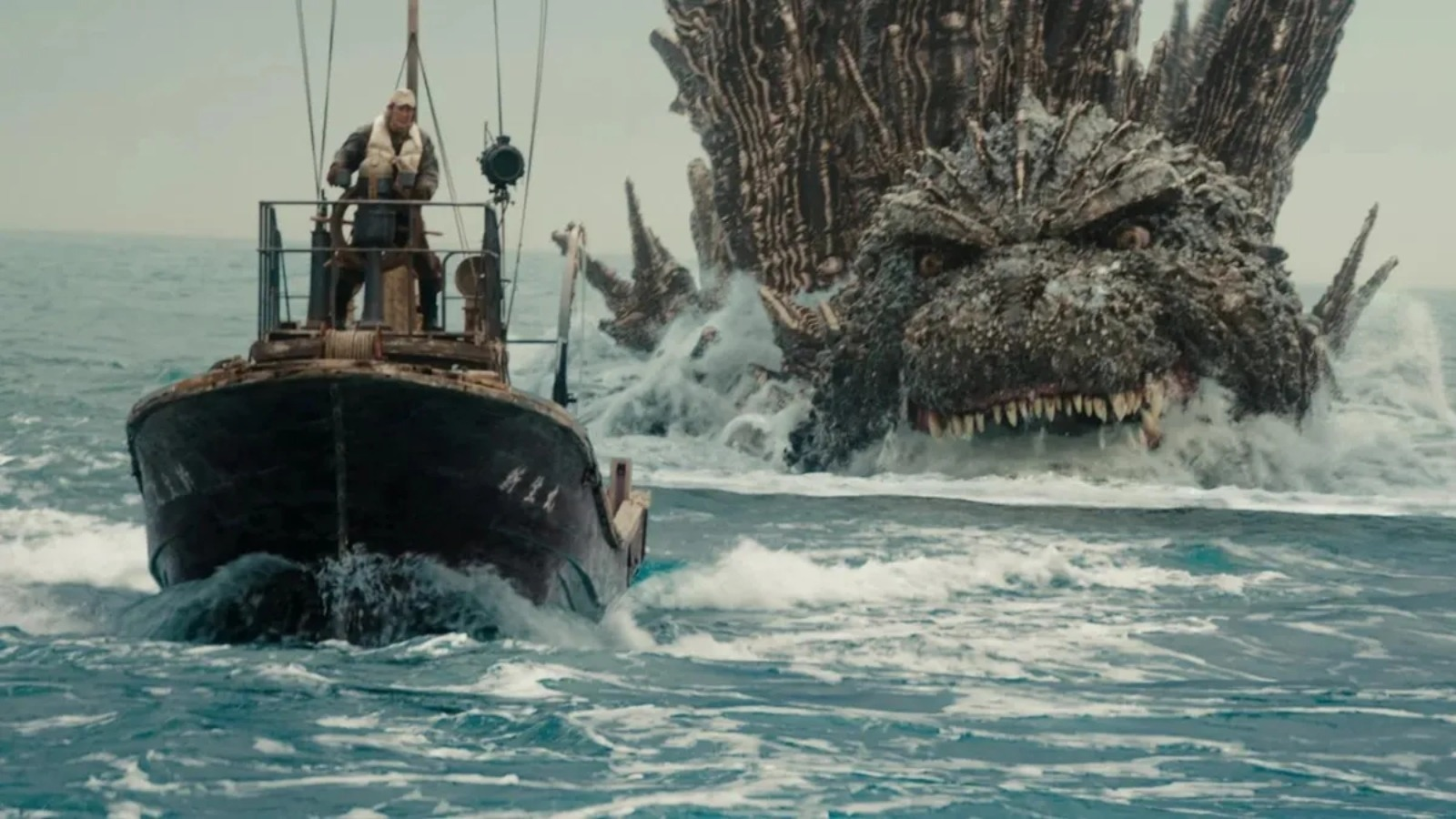
If someone had told me last year that one of my favorite films from 2023 would be a Godzilla movie, the 37th Godzilla movie at that, I would never have believed it. I’ve only seen a handful of the more modern versions of the beloved monster, including two of Legendary Pictures’ American films and Hideaki Anno’s Shin Godzilla. The latter film was praised by fans upon release, who indicated it was a step above the typical cheesy destruction of the older movies, and while it was good, it still had some cringey effects and lackluster scenes. So when similar rumbles of “dude, this is good” started to spread about Godzilla Minus One, I didn’t fully believe them. Yet as weeks passed, practically everyone who saw it seemed to be singing its praises until I finally relented and caught a late screening of the black-and-white rerelease, Godzilla Minus One/Minus Color. And I must admit, dudes, it is good.
In contrast to the worldwide monster-hunting organizations of other Godzilla movies, Minus One goes back to the creature’s roots, representing the threat of nuclear destruction in Japan shortly after the end of World War II. Yet allegory and disaster porn can only carry a film so far, and this film finally manages to tell a compelling human story in the shadow of its titan. That story belongs to Kōichi Shikishima (Ryunosuke Kamiki), a kamikaze pilot who bears the shame of having survived what should have been glorious death for his country. After yet another close encounter saddling him with even greater survivor’s guilt, he returns to civilian life, trying to pick up the pieces of his hometown devastated by the war. With time, he finds a semblance of normalcy alongside a woman (Minami Hamabe) and a little girl (Sae Nagatani), lone survivors like him, yet his PTSD strains his relationships and self-worth. When he and a crew of mine disposal sailors encounter a certain overgrown lizard, the survival of both his nation and makeshift family are threatened.
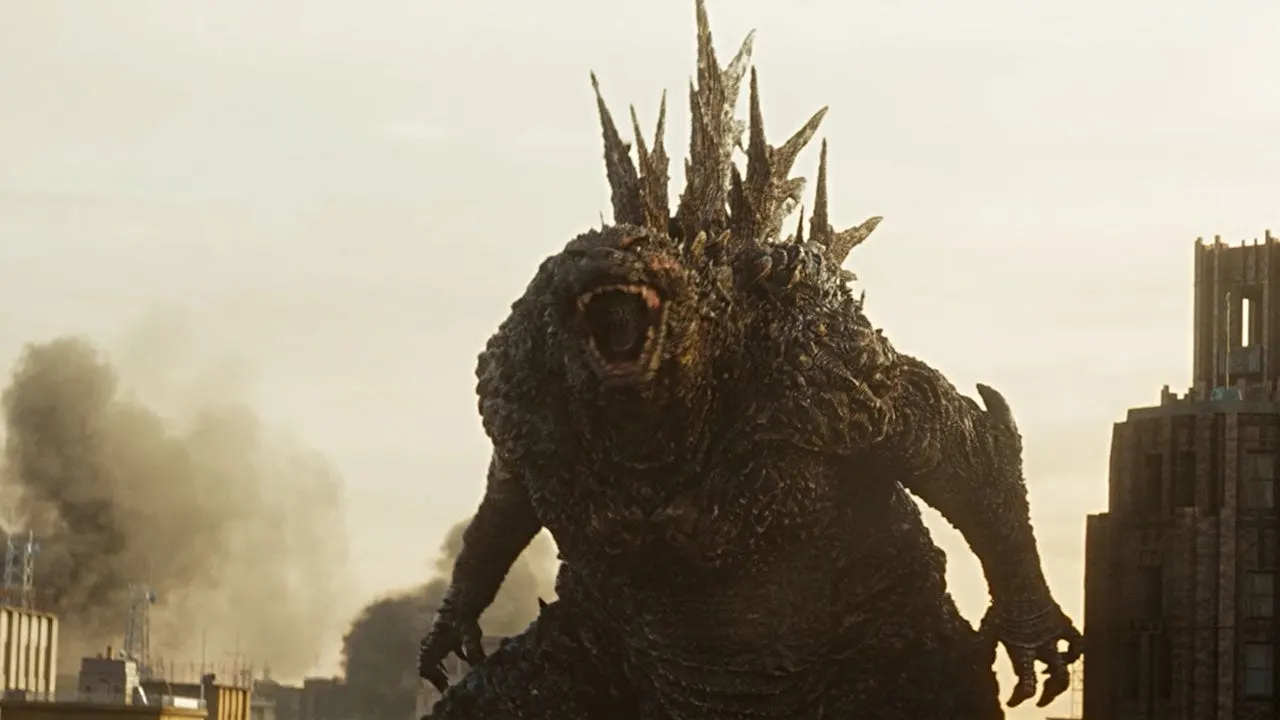
It’s hard to pin down why Minus One succeeds where others are “just another Godzilla movie.” Usually, they throw in a threatened family to garner audience sympathy, but it never goes as deep as Shikishima’s trauma and the natural way he bonds with others while grappling with it. Beyond that, Godzilla himself is far from a zipper-backed suit, but a hulking CGI monstrosity that becomes genuinely scary as we see the scale of destruction he can muster, with innocent civilians utterly powerless beneath him. He’s truly a monster and a force of nature, hardly the benevolent protector from the American version. While I tend to think Guardians of the Galaxy Vol. 3 deserved the prize a little more for the extent of its CGI, I was not upset when Godzilla Minus One managed to win the Oscar for Best Visual Effects, a first for Japan reflecting how impressive the film is despite a piddling budget compared with Hollywood’s blockbusters.
If ever a film proved how a good story and characters can refresh a well-trodden franchise, Godzilla Minus One deserves that claim. Its themes of survival and endurance denounce the culture of death that Japan had become during the war, and put Shikishima’s struggle on a level beyond a single man’s battle. The ending even brought a tear to my eye, and I’ve heard stories from others who said they wept in the theater. A crowdpleaser to rival any American production, Minus One was the biggest pleasant surprise the cinema has given me in a while, and even if I consider it a fluke for the Godzilla series (please don’t let a sequel ruin things!), I’m grateful for it.
Franchises and ruins share at least one thing in common, And no, it’s not that both attest to how the best declined. Whether we discuss the MCU or Tutankhamen, It’s that they both give hope to those in search of more to find.
For ardent archaeologists, they know there’s always more, Beneath the dirt, untapped, covert, and waiting to be found. Likewise, the nerds of fandom herds will pray as they explore, That patience be rewarded if they simply stick around.
While one digs in the future and the other in the past, They live for tiny victories, discoveries to tout. They can’t all be an ancient tomb or Endgame unsurpassed; Sometimes it’s just a broken bust they can’t do much about. ________________________
MPA rating: PG-13
I realize my output has slowed of late, but, despite struggling with my writing schedule, I have not forgotten this blog. Besides, it’s not like I’m taking fifteen-year breaks between entries like a certain Harrison Ford series. Anyway, as my past reviews and rankings might indicate, I am pretty forgiving when it comes to franchise films that others lambaste. I still like Indiana Jones and the Kingdom of the Crystal Skull more than anyone I know, and I can find plenty to enjoy from the supposed worst of Star Wars and the MCU. So I welcomed one final installment in the Indiana Jones franchise; Crystal Skull did have its issues, so perhaps one last adventure could end Indy’s cinematic journey on a high note. But though Indiana Jones and the Dial of Destiny has some bright spots, it was more of a letdown than even I was expecting.
Set mostly in 1969, this truly final adventure for Indiana Jones involves the crotchety archaeologist being pulled into another race for a potentially magical Macguffin, pursued by a former Nazi scientist (the ever reliably villainous Mads Mikkelsen) and his CIA accomplices, as well as Indy’s goddaughter Helena Shaw (Phoebe Waller-Bridge) with unscrupulous motives of her own. The titular Dial of Destiny is the Antikythera mechanism, an actual ancient Greek artifact with gears that could predict astronomical events, though here it’s a simpler device with two halves that are believed to map time instead.
Say what you will about Crystal Skull but it did at least give Indy a happy ending with a son and marriage, and I do take issue with sequels like this that justify their existence by doing away with all that to make the main character miserable at the start. Nevertheless, director James Mangold proves to be a surprisingly effective stand-in for Spielberg, bringing a great sense of fun and adventure to the film’s opening sequence. It’s an extended chase back in 1944 with a perfectly de-aged Indy back in his Nazi-thwarting prime alongside his timid friend Basil (Toby Jones), Helena’s father. If the whole film had been as good as the opening, it would be a hit recalling the franchise at its best. It’s just not the same once we jump to older Indy at his glum retirement party.
I will give credit to the fast pacing that never lets too much time go by without a chase or a tense stand-off. One extended pursuit is a hoot as Indy, Helena, her young sidekick Teddy (Ethann Isidore), the bad guys, and vengeful mobsters all chase each other through the narrow streets of Tangier. I also appreciated some welcome cameos, including John Rhys-Davies returning as Sallah and Antonio Banderas as another old friend who helps with a Mediterranean dive. With all the action, it does take some suspension of disbelief to accept the now-octogenarian Ford’s ability to keep up. He doesn’t engage in the old-fashioned fisticuffs as much, but he still jumps from vehicles, climbs cliffs, endures injury, and falls out of planes with the best of them (or at least his body double does).
Despite the caveats above, I was still enjoying Dial of Destiny for the most part and was prepared to defend it against naysayers up until the ending. Obviously, I won’t spoil it, but it takes a supernatural turn that was hard to accept, with an unsatisfying villain defeat due to their own dumb decisions and a climax of historical passion that I just didn’t buy. It’s not the worst thing ever, but it felt like the first draft of a finale rather than the finished product, a neat idea that should have gone back to the drawing board. I was sort of hoping the time travel element might wrap back around to the opening sequence a la Back to the Future Part II, but I suppose that would be too supernatural. I was also underwhelmed by Helena’s character; Waller-Bridge has a winking charisma that’s easily likable, but her ideals are in direct opposition with Indy’s (complete with a smug barb about capitalism). Though they bond a bit, it’s not clear how much moral growth, if any, she’s had by the end.
I so wanted to like Indiana Jones and the Dial of Destiny, but this is a case where I can agree with the disgruntled crowd. I would still watch it again for its good moments proving the effort that went into making this a worthy sequel and the simple fact that I love Ford in the lead role. It didn’t deserve to be the massive financial bomb it was, but sadly it’s a prime example of ending a franchise with a whimper rather than a bang.
Best line: (Indiana Jones) “I don’t believe in magic, but a few times in my life, I’ve seen things. Things I can’t explain. And I’ve come to believe it’s not so much about what you believe; it’s how hard you believe it.”