When We First Met (2018)

Tags

, ,

See the source image

(Today’s NaPoWriMo prompt was for a poem addressing our future state, which, of course, is rather hard to predict.)


The Present Me’s aware of things the Past Me would have wished he knew,
So Present Me is wondering if Future Me has secrets too.
The Future Me will only say that joys, regrets, and shocks await,
But will not pity Present Me enough to just elaborate.
And that is why the Present Me won’t bother with the Future Me
Until the one becomes the other simply through maturity.
______________________

MPAA rating: TV-14 (a.k.a. PG-13)

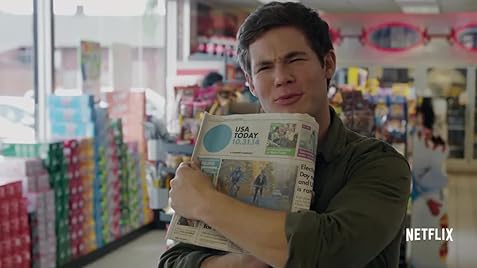
I’m always partial to movies featuring time travel, so I couldn’t resist checking out this Netflix film that echoes Groundhog Day. What I’m not partial to is lead actor Adam DeVine, who I greatly disliked as the self-absorbed Bumper in the first Pitch Perfect (he was a little better in the second), but When We First Met revealed his surprisingly likable side.

See the source image

DeVine plays Noah Ashby, who grieves the engagement of his crush Avery (Alexandra Daddario) and her pretty boy fiancé Ethan (Robbie Amell). He reminisces of how he first met Avery at a Halloween party three years earlier, only to be relegated to the friend zone. After some drunken moping, Noah enters a photo booth from their first date and finds himself three years in the past with another chance at a first impression, which takes a few tries to get right, as you may imagine.

There are definite similarities to Groundhog Day in the way Noah replays the same events at the party and uses the knowledge he gains from the repeated do-overs, but one original aspect is that he then gets to see how the changes to the timeline play out, since he then jumps ahead three years to see the unintended consequences. It’s a clever concept with some inconsistencies in execution and logic, but the cast and humor go a long way in making it work, with DeVine boasting everyman appeal and Daddario being unnaturally gorgeous.

See the source image

Unfortunately, even the good elements are inconsistent. One section in the middle where Noah tries the jerk boyfriend approach became embarrassingly unfunny and just reminded me of how much I disliked DeVine as Bumper. Yet it then bounced back to end on a sweet note that some may call predictable but still kept me invested. When We First Met is unlikely to become a perennial favorite like Groundhog Day, but it’s not a bad variation on the time travel tropes I so enjoy.

Best line: (Noah’s friend Max, with a sentiment I only half agree with) “Things happen for no reason at all, but they create opportunities.”


Rank: Honorable Mention


© 2018 S.G. Liput
554 Followers and Counting


The Man Who Invented Christmas (2017)

Tags

, , , , ,

See the source image

(Today’s NaPoWriMo prompt was for a poem featuring simultaneity, where more than one thing happens at the same time, a concept I applied to a writer’s creative process.)


The writer sat in the market square,
But that’s not all he did.
He bade “Good day” to Mrs. Wise
And fed the pigeons gathered there
And made a cat jump with surprise
And watched the vendors sell their wares.
To outward eyes,
He just sat there,
But that’s not all he did.

The mind inside the writer’s head
Was hard at work within,
Populating worlds unwritten,
Raising heroes from the dead,
Lads in love and lasses smitten,
Tales of kings that none had read,
Smiles to fit in,
Tears to shed,
And all unseen within.

So though he seemed to waste the day,
Just sitting as he did,
The writer had done no such thing.
He watched the world at work and play
And gleaned its ample offering
To shape what only he could say.
His loitering
Seemed like delay,
But that’s not all he did.
__________________

MPAA rating: PG

Considering how much I love A Christmas Carol and movies about literature, I was excited for The Man Who Invented Christmas, a yuletide biopic about Charles Dickens’ tumultuous writing of his most famous work. While I liked it quite a bit, I wonder if my hopes were too high since it wasn’t the instant classic I had thought it might be. I can’t say I was disappointed since it lived up to its trailer at least, but it didn’t surpass any of my expectations either.

See the source image

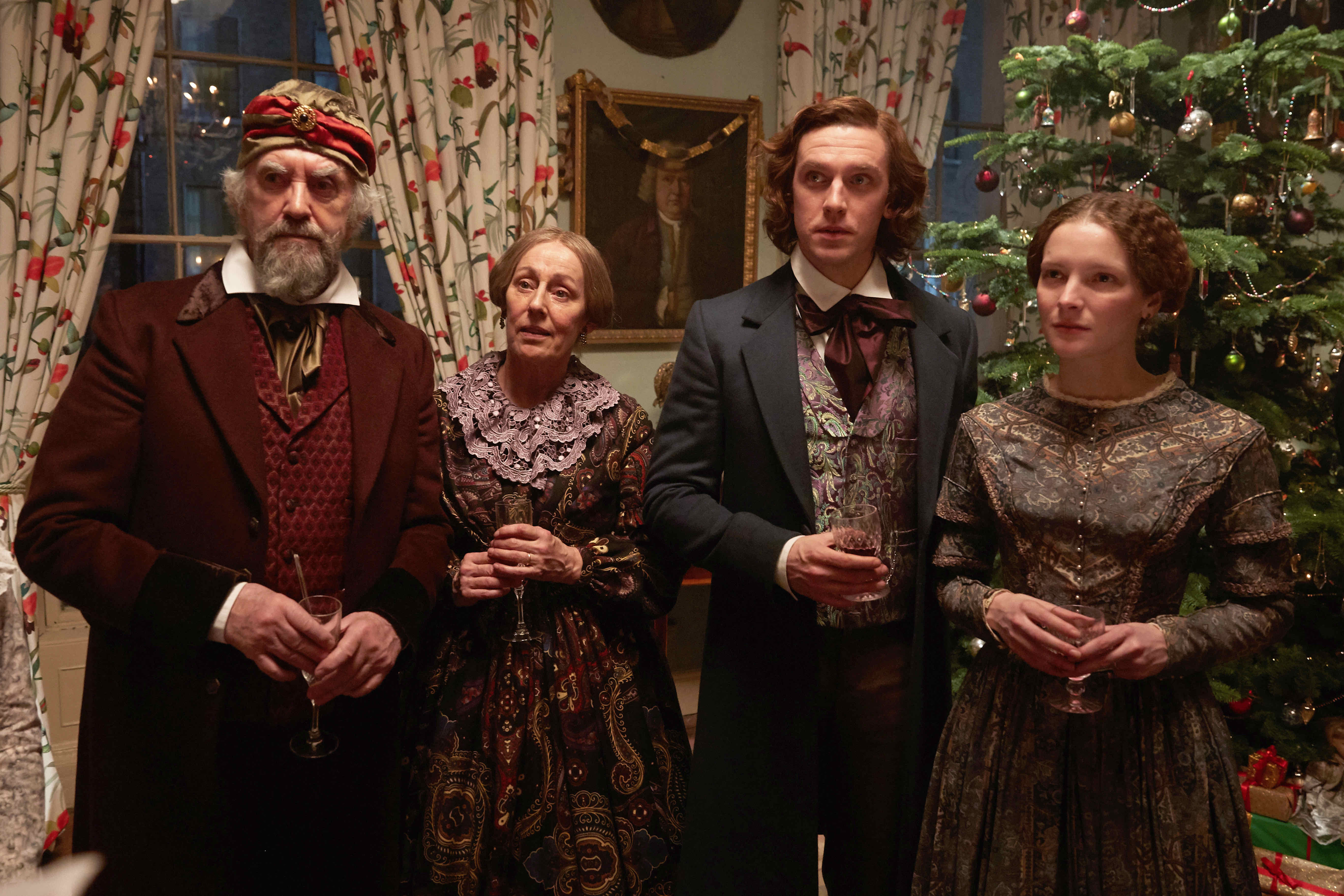
Dickens, played by Dan Stevens, hits a wall when his fame and fortune are diminished by three commercial flops in a row. After contending with writer’s block, the sight of a rich man’s funeral gives him the seed of an idea, and what the world will eventually know as A Christmas Carol speedily develops in his mind as he rushes to get it written and printed in time for Christmas sales. Along the way, he contends with his spendthrift father (Jonathan Pryce), his own past trauma, and his characters mentally coming to life, including a critical Scrooge (Christopher Plummer).

I must say that Stevens is outstanding, playing Dickens with just the right amount of ego and eccentricity, the way we imagine many creative geniuses might have been. When he entertains his children with random voices, I could imagine Robin Williams playing this role thirty years ago. Likewise, I loved the visualization of his creative process, as he interacts with characters only he can see, only to have them vanish when he is all-too-often interrupted. The story also provides a glimpse into Dickens’ difficult childhood, offering insights into what made him the ambitious but compassionate man he was, and it was interesting to see how his original plan for an unhappy ending yielded to others’ hopes and beliefs that even the worst men can change.See the source imageSo, yes, I did enjoy it, including its lesson of forgiveness and the reminder of how Dickens shaped the Christmas holiday we know today, which was not as vigorously celebrated back then. I suppose the weakest aspect was Pryce as Dickens’ father John, whose good nature is undermined by drunkenness and financial waste as he mooches off his son. Despite John’s good intentions, I didn’t blame Charles much for snapping at him at one point, and it didn’t seem entirely right that Charles is in the wrong and apologizes with little change seen on his father’s part.

Despite that objection, I’ll still gladly watch The Man Who Invented Christmas if it comes on TV around Christmastime to enjoy its well-acted, wholesome glimpse into the mind of a great author. I’m just a little sad that there was something lacking, which will make me more likely to just watch some version of A Christmas Carol instead of the story behind it.


Rank: List Runner-Up


© 2018 S.G. Liput
552 Followers and Counting


Girls und Panzer der Film (2015)

Tags

, , , ,

See the source image

(Today’s NaPoWriMo prompt was to combine something big and something small, like maybe tanks and girls for example. Inspired by this silly anime, I wrote a fake account of how tank warfare might become a girls’ sport.)


Years past, the tanks rolled into town
And terrorized the folk.
With dread renown,
Each new crackdown
Would paint the sky in smoke.

They came in force to crash and kill
And crush with cannon fire.
Such lethal will
They did fulfill;
The people’s need was dire.

One fateful day, a young girl eyed
An empty tank left bare.
She seized with pride
This chance supplied
By carelessness and prayer.

Against all odds and common sense,
She drove the tank somehow.
Her zeal intense,
In her town’s defense,
She raised every eyebrow.

She shocked the foe, confused their ranks,
And drove them from the land;
And it’s all thanks
To her that tanks
And girls go hand in hand.
_____________________

MPAA rating: Not Rated (PG is fine)

Anime has given us a lot of weird and wonderful concepts over the years, the kind you should just enjoy for their silliness and not think about too deeply, but making tank warfare a girl’s sport takes the cake for me. Even though I’ve never been particularly fond of tanks or the cute girl genre, Girls und Panzer was an admittedly fun ride, made even more fun by its big-screen follow-up.

See the source image

The 2012 TV series featured a ragtag group of girls from Ōarai High School rallying under the leadership of skilled but reluctant transfer student Miho in order to win a series of tank war games and stave off the closing of their school and town, which happen to be on top of a giant aircraft carrier (yes, really). The characters are simple and likable, with most development reserved for Miho and her four closest friends. The rest of the vast cast gets the most basic development possible as members of other clubs that nonetheless contribute to the tank warfare, which seems to use real ammunition and has no regard for property damage, since the government underwrites everything as an official sport. The set-up is enjoyable enough, but the real draw here is the tank battles, explosive clashes between war machines that are depicted with surprising historical accuracy for the most part. At only twelve episodes long, the series is short but doesn’t lack thrills, as the underdog Ōarai team faces off against more accomplished high school teams that each conform to the trappings and tactics of a different nation (Americans, Russians, Italians, Germans, etc.).

See the source image

If any of this sounds entertaining, go watch it because it’s nice and short, and I’m about to spoil the ending. It’s probably no surprise, but Ōarai wins. Yet the movie doesn’t let that victory stand for long; one exhibition match later, the government is eager to shut the school down again, putting Ōarai in the exact same position of betting their school’s fate on a giant tank battle, this time against a University team. With this battle, however, they’re so hopelessly outmatched that their former rivals beaten during the series come to their aid and take part in one big tank free-for-all.

Like the series, there is some confusion at times over who’s in which tank, and what’s happening is not always as clear as it should be. Yet the battles are still quite well planned, putting different styles of tank to good use and employing some very clever strategy along the way. (One planning session between the allied teams is like an argument between the tactical methods of all the major countries of World War II.) While the show had some semblance of realism in the tank’s capabilities, albeit small, the movie goes full-out bonkers with tanks flying through the air, sliding down rollercoaster tracks, and zooming around like high-capacity bumper cars. Some of the casualties would carry more weight if anyone was actually in danger, but that apparently never happens in this sport, and it’s perfectly fine to stick your head out the top hatch while being shelled (really).

See the source image

This isn’t the first anime film I’d recommend to anyone, but it’s now high on my list of guilty pleasures just for how gleefully crazy and bombastic it gets. By the time the battle moves into a theme park to use the rides as unconventional weapons, I was just enjoying the outlandishness of it all, and finding unexpected satisfaction with every enemy tank disabled. Sure, it’s silly and predictable, but that’s sometimes the very definition of fun. There’s a whole future series of films planned, but it’s hard to imagine how they’ll top this one.


Rank: List Runner-Up


© 2018 S.G. Liput
552 Followers and Counting

Here’s a good representation of what to expect, if you’re curious:
 

Chronesthesia (Love and Time Travel) (2016)

Tags

, , ,

See the source image

(Today’s NaPoWriMo prompt was for a poem involving mystery and magic, so I went with an idea about the magical mundane, which kind of applies to the movie too.)


“My life is just a gear at work, a daily push and pull;
I’m far too busy living life to find it magical.
I’m like a mule with blinders on, who only knows the road,
While fields stretch out on every side and might relieve my load.
I’d like to turn my head, but I don’t have the will or time
To care for what’s outside myself when there’s a hill to climb.”

What does it take to rouse such men from marching to their tombs,
To wake them to the magic that around their bubble looms?
A glimpse into the future or a strange phenomenon,
Or simply noticing the world and those by whom it’s drawn?
When life seems more a burden than the gift it should be, try
Roads you don’t know or say hello and see where wonders lie.
_____________________

MPAA rating: Not Rated (probably R, just for language)

Independent movies are funny things: you never know when one is going to be a pretentious bore or a down-to-earth charmer, but the charmers are always a pleasant surprise. Such is Chronesthesia, a New Zealand import that was given the name Love and Time Travel when released to other countries. It’s a film that I think should put debuting writer/director/star Hayden J. Weal on the map, proving alongside Peter Jackson and Taika Waititi that New Zealand is home to some first-rate filmmakers.

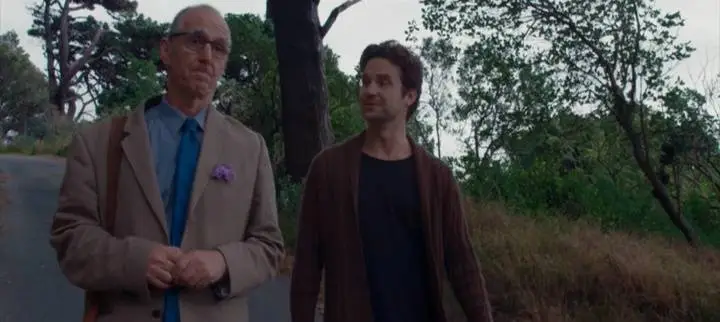
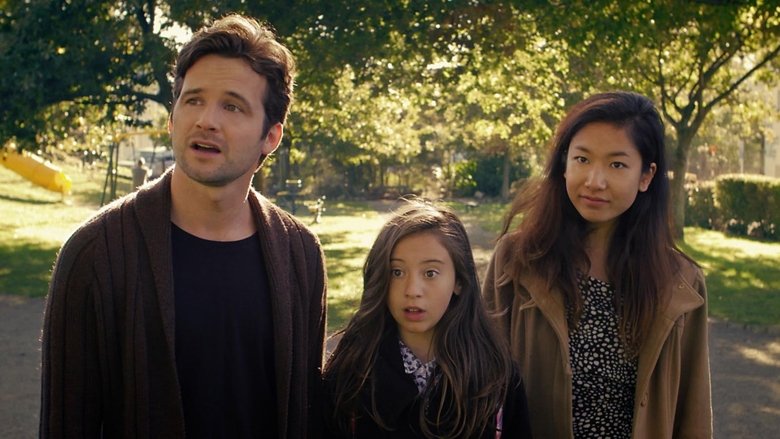
As the beginning states, chronesthesia is “a mental ability enabling awareness of one’s own future. In short, mental time travel.” Weal plays Daniel Duncombe (who at times reminded me of both Chris Pratt and Martin Freeman, strangely enough), a gloomy barista who seems none too eager to break out of his stagnant existence. He’s the sort who would rather jog alone than say a word to a stranger, keeping his earbuds in to avoid conversations. Then one day, he discovers the words “Turn Right” written on his bedroom window, followed by similarly enigmatic messages like “Alleyway” and “He misses her.” Before long, these mysterious notes lead him to meet new people and discover the unexpected connections between them.

See the source imageThat description may sound vague and generic, but it really is a story that is best experienced firsthand. Whether it’s an old man in search of someone or a young girl with a crush, everyone Dan meets helps him grow in some way, and watching him shed his taciturn cocoon was a joy to watch unfold. The biggest relationship he forms is a romance with a psychology student named Sophia (Michelle Ny), one that feels as natural as all screen romances should try to be, and she becomes a patient advocate of sympathy for those with mental illness, such as a friend of hers with schizophrenia.
Chronesthesia may hint at it strongly, but there’s very little in the way of actual science fiction here, with the time travel aspect mostly relegated to unconscious “trips” of jerkily edited flashbacks (or flashforwards). If you’re hoping for some serious sci-fi or even an explanation for Dan’s ability, you’ll be disappointed, but in this case, the time flashes are secondary to the relatable human story at work, one full of supportive empathy and improbable serendipity. The only actor I recognized was Julian Dennison, the young boy from Hunt for the Wilderpeople, but every actor does a marvelous job, particularly Weal with his gradual blossoming of humanity.See the source imageIn many ways, this is the kind of movie I just tend to like, mingling sci-fi or fantasy elements with an overarching lesson about the interconnectedness of mankind, much in the vein of fellow indie gems Shuffle and Ink. While this too is a low-budget film, it doesn’t look it, boasting lovely cinematography and a beautiful classical score as well. The script is also fraught with worthwhile themes of interpersonal connection, such as the value of listening to those in society everyone else might dismiss. Of course, there are things I could have done without, such as the unnecessary profanity, but this is a satisfying film that has only improved with time and thought, an underrated gem that deserves to be more widely known.

Best line: (Sophia) “You have no idea how much your actions affect the people around you. People have a lot more influence than they realize.”

 
Rank: List-Worthy

 
© 2018 S.G. Liput
551 Followers and Counting


The Breadwinner (2017)

Tags

,

See the source image

(Today’s NaPoWriMo prompt was to write a confrontation between a personal strength and a personal weakness, so I focused on anxiety.)


The me of my dreams aimed a finger at me,
Displaying the courage I lacked,
And said, “What do you know you of anxiety?
Why let it control how you act?

“Why live in the fear of a stranger’s outlook
When they have no sway over you?
Are there not enough lessons in movie and book
For self-confidence to ring true?

If someone outside you could see how you hide you
And all of your faith and desires,
They’d pity your doubts and perhaps stay beside you
To prove that not all are deniers.

“Are you not aware there are people elsewhere
Who endure terror dwarfing your own,
Whose lives are at risk based on what they must wear
And feel much more truly alone?

“They know what fear is, while you worry and stall
With freedom they may never know.
Compared with them, our troubles now seem so small,
Unworthy of fear; treat them so.”
____________________

MPAA rating: PG-13

While there’s plenty to criticize the Academy for, especially in the Best Animated Feature category, the nomination of The Breadwinner was well-deserved. While it couldn’t hope to match Pixar’s all-around excellence with Coco, this is a prime example of what ought to be in the running for Best Animated Feature. Following up on their fantasy-filled The Secret of Kells and Song of the Sea, Irish animation house Cartoon Saloon (along with a collection of co-production companies) tackles a far more serious and realistic story based on a Deborah Ellis children’s novel.

See the source image

Parvana is the daughter of a former schoolteacher in Afghanistan, which is plagued by the oppressive rules of the Taliban. When her father is arrested with no charge, there is nothing Parvana, her older sister, or their mother can do, since none of them are even allowed to leave their home without the presence of a male relative. (Parvana’s little brother is too young to help.) Left with no other option, Parvana cuts her hair and masquerades as a boy in order to earn enough to support her family and perhaps even save her father from prison.

While Cartoon Saloon’s previous films were set in Ireland with an art style that echoed the swirly motifs true to that country, it’s amazing how well the style translates to the Arab setting in The Breadwinner. It’s nice to see that a studio outside Japan is sticking with traditional hand-drawn animation, long after American films abandoned it in favor of CGI.

See the source image

I love animation that tackles serious subjects, and The Breadwinner is all too timely, reminding us that, even with all the female outcry in America, there is far greater injustice elsewhere in the world. The extremes of Sharia law are depicted with restrained cruelty, giving viewers every reason to care about Parvana and her beleaguered family. Certain moments of light and sympathy shine brighter for the darkness around them.

Despite the compelling narrative, an on-going and seemingly unrelated tale that Parvana tells throughout the film feels more like overly ornate padding than an integral part of the story, and the ending is more open-ended than I would have liked. Yet The Breadwinner is clearly Best Animated Feature material, with beautifully detailed animation, foreign characters that are still easy to empathize with, and a genuinely harrowing climax. I’m tempted to call Cartoon Saloon the Studio Ghibli of Ireland, but I think they’re carving their own praiseworthy niche and doing it quite well.

See the source image

Best line: (Parvana) “Raise your words, not your voice. It is rain that makes the flowers grow, not thunder.”


Rank: List Runner-Up


© 2018 S.G. Liput
550 Followers and Counting


Fits and Starts (2017)

Tags

,

See the source image

(Today’s NaPoWriMo prompt was to experiment with line breaks, so I incorporated long and short lines in a poem more about writer’s block than about this movie.)


Inspiration grows, composed through joys and woes in verse and prose;
From lows, it rose, and now it flows as dominoes fall unopposed,
But then
It froze.

I’m blank,
I fear,
As tears
Appear.
What if this fog
‘Twixt my ears
Won’t clear
For years,
My writing gears
Caught in arrears.
Goodbye, career
And world premieres!
How can I ever
Persevere?

My knack’s off track; in fact, my lack of active tact deserves a smack.
To lose my muse eschews breakthroughs. What gruesome news!
Oh, wait,
It’s back!
____________________

MPAA rating: Not Rated (should be R)

As this selection from last year’s South by Southwest illustrates, I think comedies that come from film festivals are obligated to be described as quirky. Quirky can range from sweetly unusual to downright bizarre, but Fits and Starts hits a good balance between the two and focuses on themes that any aspiring writer (like me) should relate to with amusement.

The film’s aspiring writer is David Warwik (Wyatt Cenac), a former professor who remains deeply unconfident in his unpublished novel while his wife Jennifer (Greta Lee) rakes in acclaim with her second book release. Despite David’s objections, Jennifer insists they go to her publisher’s salon, a social party of creatives and publishing people, both amateur and professional, yet circumstances force David to go by himself and meet every funny and weird cliché of the artistic elite.

David himself seems odd at first, neurotic and prone to putting his foot in his mouth, yet I could still relate to his desire to just write, without “playing the game,” all the networking and schmoozing that it apparently takes to get published. His jealousy toward Jennifer’s success brought to my mind Chevy Chase in 1988’s Funny Farm, another movie where the writer husband is overshadowed by his wife. Cenac and Lee have surprisingly good chemistry too, able to launch equally defensible accusations at each other while arguing yet also becoming a cute couple when things blow over.

See the source image


By the time David gets to the salon and interacts with all the upper-crust crazies, it’s easy to connect with him as the only normal person in the room. I’ll admit I laughed more than I expected to at the insightful caricatures he encounters, like the critic telling him he needs to change his name to something metallic or the creatives discussing ridiculous ideas like they’ve discovered the next great gift to humanity. Some humor also comes from a pair of sarcastic policemen and a multitalented opera singer, but beyond the mere jokes, there’s also worthwhile satire with a point, from the liberal shallowness of the art world to how David can’t get a straight answer from a publisher who clearly didn’t like his novel.

Unfortunately, there’s also some mature content, between the foul language (not as frequent as The Big Sick, though), an obscene drawing, and some nudity, largely from the back or from a distance. I could have done without those, but I still enjoyed Fits and Starts for its satire and its ultimately gratifying depiction of David and Jennifer’s marriage. I especially enjoyed how David’s frustrations eventually boil over into one big renunciation of the absurdities he’s endured at the party, choosing instead to value his wife and his love of literature over the others’ superficiality. As the name might imply, the quirkiness of Fits and Starts doesn’t always hit the mark, but it hit many of the right places for me.

Best line: (guy at party, as David overhears nearby) “You know, I’m thinking of moving to Detroit.”
(girl) “My friend Jeremiah moved to Detroit, and he got shot in the face.”
(guy) “Oh, my god. Jeremiah Boobar?”
(girl) “Yes, two weeks ago, he moved to Detroit and got shot in the face.”
(guy) “Did you go to the funeral?”
(girl) “No. Funeral? He’s alive and kicking. He’s gonna make a documentary about it, you know.”
(guy) “Where did he get the funding?”
(girl) “Indiegogo.”
(guy, after a pause) “I want to get shot in the face.”


Rank: List Runner-Up


© 2018 S.G. Liput
550 Followers and Counting


Munyurangabo (2007)

Tags

,

See the source image

(Today’s NaPoWriMo prompt was to find a poem in a foreign language, pretend it is about a chosen image, and write our own “translation.” I chose the picture above, a still from this foreign-language film, and tried to base my poem off of the beginning lines of the Xhosa-language poem “The Cattle Killing,” which you can find here. Hopefully, it turned out all right.)


Let it stir up,
Let it stir up
Yellowing wakenings of dreams once real—
Friendships’ longevity will fade
Away,
Disappearing with every word
Unspoken or cankered
By lies, downturned eyes, and fears that won’t fade.
I remember us, we two,
Uncankered, unafraid, arm in arm,
Before our brotherhood’s ebbing
When our fears did rise
And our eyes turned down.
As I see you again in my regrets, I wonder,
Would we still be arm in arm
If I had raised my eyes?
___________________________

MPAA rating: Not Rated (little objectionable, but I guess PG-13)

Munyurangabo has sat for so long in my Netflix queue that I can’t even remember where I first heard of it or what I was expecting from it. One thing is certain, though: this is a critic movie, the kind that critics fawn over while regular viewers say things like “It was all right, I guess,” if they even have the patience to finish it at all. It’s not an off-putting disaster like the last critic movie I saw (The Assassin, seriously one of the most grueling films I’ve sat through), but it’s hardly a film I’d watch again, even with some positive elements toward the end.

See the source image

While it was filmed in Rwanda as the first movie in the Kinyarwanda language, it was actually directed by American Isaac Lee Chung, who employed local Rwandans as amateur actors. In the film, Munyurangabo (Jeff Rutagengwa), or Ngabo for short, is a teenager traveling with his friend Sangwa (Eric Ndorunkundiye) as they journey to kill someone. On the way, they stop over at the house of Sangwa’s parents, whom he had left to move to the capital of Kigali. While revisiting friends and family, the pair find welcome, resentment, and a reminder that the two of them are each from enemy tribes.

As is common in critic movies, the story of Munyurangabo seems extremely padded to fill out its 97-minute runtime. There are long stretches of the two boys just walking together as the camera follows them from behind. The cinematography is mediocre, to me at least, and the shakiness of the camera adds both intended realism and an amateurish quality. The untrained actors themselves do all right, though there are times their lack of experience shows a bit.

See the source image

I had just about decided that this film had very little worthwhile about it when a random stranger (apparently Ugandan poet laureate Edouard Uwayo) suddenly launched into an extended poetry recitation, which might have seemed out of place if it didn’t encapsulate so eloquently the movie’s themes, much better than the rest of the film tries. As an ode to the struggles of the Rwandan nation, it’s a moving one-take scene, practically a psalm, that has little to do with the story and yet everything to do with its larger context. The moral resolution that follows also conveys the value of forgiveness in this war-torn country, even if it doesn’t really address the plight of one of the boys. In short, the last fifteen minutes of Munyurangabo resonate while the rest is dull, so you might be better off just watching the poem scene and leaving the remainder for the critics.

Best line: (part of the poem recitation) “Give the child what he needs, and he can become a king…. The rich one can prepare a gift to give to the poorest one, and how poor is he?”


Rank: Honorable Mention


© 2018 S.G. Liput
550 Followers and Counting


Wonderstruck (2017)

Tags

, ,

See the source image

(Today’s NaPoWriMo prompt was to describe an abstract concept in terms of more concrete words, so I picked the obvious choice for this film, namely wonder.)


Wonder is a pair of eyes
Wide and twice their normal size,
Rising in an optic smile
In case the mouth can’t do likewise,
Hanging open in surprise,
Not caring if it hangs awhile.

Wonder is in aeroplanes
Thrilling 1903 brains,
Moving pictures scaring crowds
Who flinched at filmed approaching trains,
And computers making gains
That no one dreamed, at least out loud.

Wonder is in works of art
Seen before they’re known by heart,
Creatures people rarely find,
The goosebumps of a ball game’s start,
Zoos, museums that impart
Their awe, and firsts of every kind.

Wonder is a city block
New, once-sheltered tourists walk,
High skyscrapers tilting heads.
It’s found in mountaintops of rock,
In galaxy and swooping hawk;
There wonder weaves its welcome threads.
_______________________

MPAA rating: PG

Did anyone else notice the preponderance of 2017 movies with “wonder” in the title? We had Wonderstruck, Wonder Woman, its biopic cousin Professor Marston and the Wonder Women, Woody Allen’s Wonder Wheel, and the inspirational Wonder with Jacob Tremblay. Amazon Studios’ Wonderstruck may have gotten lost amid all the others, but it’s the one that most strives for the actual “wonder” in its name.

See the source image

I say “strive” because it doesn’t quite reach it, though I can certainly appreciate the effort. Based on a Brian Selznick novel, the story is something of a double period piece, with two stories playing out fifty years apart. In 1977, an orphaned boy named Ben (Oakes Fegley, just as genuine and in need of a haircut as in Pete’s Dragon) suffers an accident but manages to sneak off to New York City in search of his mysterious father. Parallel to Ben’s quest is that of young Rose (Millicent Simmonds of A Quiet Place, who is actually hearing impaired), a deaf girl in 1927 who also searches New York for her mother. Each story nails the visual aesthetic of its time period, with Ben’s yellow-tinted settings, music, and surrounding fashions screaming ‘70s, while Rose’s experiences are like The Artist, all in black-and-white and silent to reflect both her deafness and the silent films she loves.

I will applaud Wonderstruck for its gentleness and commitment to remaining family-friendly when such films are rare these days. Its stylistic choices and excellent acting also add to its appeal, while the editing between the two stories can be a little too frequent at times. I suppose my main complaint is it tries too hard to inject “wonder” and mystery in a way that feels like padding by the end. Just like with Hugo, another Selznick adaptation, so much time and interest are spent on the mystery that its sort of a letdown when you find out it’s something that could have been told within minutes, making me wonder why certain characters are so cryptic. At one point, a character waits to reveal the truth until she takes Ben across town, even as he restlessly wants to get to the point, not unlike me.

See the source image

Ultimately, Wonderstruck is a curiosity, with a palpable love for museums and storytelling and a touching ending, and like Hugo, the passion on display goes a long way to keeping viewers engaged, though the visuals can’t match Scorsese’s film. It’s nice to see that a quality live-action family film can still get made, even if it’s not quite as fascinating as it means to be.


Rank: Honorable Mention


© 2018 S.G. Liput
549 Followers and Counting


Trollhunter (2010)

Tags

, , ,

See the source image

(Today’s NaPoWriMo prompt was for a list poem based in made-up names, so I invented a few species of troll to populate this bit of creepy nonsense.)


When trees are swimming deep in fog
And stars are dull as old eggnog,
The trolls come out to hunt and roam
Where humans dare not make their home.

The stankenlops and flicklepines
Emerge from their abandoned mines
And greet the trarterstumps and groyts
Embarking on their own exploits.

The nibblelungers beat their chests,
And grindlefangers make conquests,
And no one knows what skleeblers do
Since even trolls think it taboo.

No sheep or goat or man is safe
When hunted by a narberwafe,
And blattercrones’ deep moans are known
To chill a grown man to the bone.

The night is theirs but does not last,
And soon each lerpt and pincherclast
Will shrink back to their darkened pits
To wait till when the night permits.
____________________

MPAA rating: PG-13

The found-footage style gets a bad rap because of its gimmicky nature and its overuse in often poor quality horror movies since The Blair Witch Project. Yet it does have its bright spots, like the mind-bending “documentary” Lunopolis and the 2010 Norwegian import Trollhunter. Of all the monsters to chase with a camera, trolls don’t seem like an obvious choice, but Trollhunter strikes a unique blend of giant monster thrills and occasional dark comedy that gives the big-nosed brutes an outlet other than Middle-Earth.

See the source image

The “filmmakers” in this case are three students from Volda University College, who think they’re investigating a bear poacher only to stumble upon the rough-hewn Hans (Otto Jespersen, who’s apparently a comedian) and his secret government-sanctioned job of hunting trolls. Tired of toiling in obscurity, Hans lets the trio follow him around on his troll control missions and explains the details purposely kept from the public, like the various species of troll, how power lines are really electric fences to keep them in, or the fact that trolls can smell the blood of a Christian man. (In that case, remind me not to move to Norway because I wouldn’t last long.)

The found-footage aspect is fairly standard as far as the shaky camera and often insufficient lighting, though there are some stand-out moments, such as the use of night vision to get a glimpse of the dangerous creatures. The biggest asset is Jespersen as Hans, who goes about his dirty fantasy job with weary competence, seemingly unfazed by the fact he gets paid to flash lights at three-headed giants. The special effects are also quite effective. While the trolls are often clearly CGI, their grotesque appearance somehow makes it look realistic too, and the finale with a mountain-sized troll is an awesome edge-of-your-seat sequence.

See the source image

Trollhunter follows a lot of the usual found-footage tropes, but it does them well, managing to find a balance between absurdity and realism, like how a veterinarian explains the “scientific” reason that trolls turn to stone or explode when exposed to sunlight. Already something of a cult classic, the abundance of Norwegian culture and impressive scenery makes it an entertaining option for exploring Scandinavian cinema, though I doubt the prospect of trolls has helped tourism.

Best line: (the Norwegian Prime Minister, with a slip of the tongue at a press conference) “Few people find power grids attractive. I certainly don’t. Norwegians are pro-electricity, but against power lines. That won’t work in the long run. Norway has trolls, so more power lines are needed. That’s just the way it is.”


Rank: List Runner-Up


© 2018 S.G. Liput
549 Followers and Counting


Marjorie Prime (2017)

Tags

, ,

See the source image

(Today’s NaPoWriMo prompt was for a poem that plays with voice and the first-person “I.” Based on this film’s premise, below is a soliloquy of a ghost addressing his former living self.)


I don’t know
If I’m still you,
The same as you once were.
What you went through,
What I’ve been through
Has left my mind unsure.

I can tell
From those you knew
That I was well thought of,
And if I’m you,
The former you,
I too return their love.

You might ask
Why would I stay
When you, alas, could not.
To your dismay,
I came one day
To take your vacant slot.

I suppose
I’m still part of
This world and wish relief
For those you loved.
For those I love
Should not be left in grief.
_____________________

MPAA rating: PG-13

It may seem that I complain a lot about how slow artsy films can be, so eager to be avant-garde and critically studied that they forget to entertain. Yet Marjorie Prime is proof that I can still appreciate a slow and quiet movie with the right combination of acting and script. This is a prime example (get it?) of a Triple A movie (where it’s All About the Acting) and of low-key speculative fiction; there are no jaw-dropping effects or mind-bending visuals, just three or four people talking in a room and providing a very plausible vision of the future.

See the source image

At home at her seaside beach house, Marjorie (Lois Smith, who I know best as Helen Hunt’s aunt in Twister) is an elderly widow around the year 2050, who comes out to her living room to have a conversation with her husband Walter (Jon Hamm). However, he’s not her husband but a Prime of him, a holographic re-creation of Walter in his forties, designed to keep her company and help cope with her worsening Alzheimer’s. Both Marjorie and her son-in-law Jon (Tim Robbins) tell Walter Prime about the Walter they knew, and their memories help form his personality. “I’ll remember that now,” he says with every new piece of information. As you might expect, the idea of Primes doesn’t please everyone, specifically Marjorie’s anxious daughter Tess (Geena Davis), yet the realism grows with time, especially with the way Walter Prime assimilates and repeats the stories he’s been told. When he tells Marjorie of things she has since forgotten, who’s to say it’s not as genuine as the original memory?

Based on a Pulitzer-nominated play by Jordan Harrison, Marjorie Prime is full of moving subtlety in the areas of technology and memory, with a script worthy of an Oscar nomination, in my opinion. Those with little patience will likely be bored to tears, but if your mind is engaged, there’s plenty of existential meat to chew here, from the hidden family tragedy of Marjorie’s past to the way technology is depicted as neither good nor bad but simply an inevitability. In a world where people are already inviting primitive A.I.’s into their homes, it’s oddly conceivable to envision such artificial companions cushioned in the guise of a loved one. Whether that excites or disturbs you may vary, but the film is sensitive and honest in that regard and quite credible too in the way Primes are shown to develop with more information, serving as both a comfort and a painful reminder. I also liked smaller examples of their use, such as enabling future generations to “meet” their ancestors, or at least an indistinguishably close approximation of them.

See the source image

The film does morph a bit from its starting point, tragically so in fact, yet there are three phenomenal performances at its heart. Lois Smith, Tim Robbins, and Geena Davis prove what outstanding actors they are, and I’m glad Smith in particular was able to step out from her usual side roles to portray the title character, reprising her role from the stage version. Memory and unspoken emotion hang over every conversation with a Prime, making them lump-in-throat encounters that stayed with me long after the credits had rolled. Perhaps the setting can get monotonous and the artsiness of a few interim scenes drags a bit, but the familial anguish and philosophical questions posed were both restrained and deeply compelling. This is the quiet side of science fiction, but for me, it’s one more reason to love the genre.

Best line: (Marjorie) “Well, the future will be here soon enough. You might as well be friendly with it.”


Rank: List Runner-Up


© 2018 S.G. Liput
548 Followers and Counting