• Home
  • About Me
  • The List
  • THE LIST (2016 Update)
  • THE LIST (2017 Update)
  • THE LIST (2018 Update)
  • THE LIST (2019 Update)
  • THE LIST (2020 Update)
  • THE LIST (2021 Update)
  • THE LIST (2022 Update)
  • Top Twelves and More
  • The End Credits Song Hall of Fame

Rhyme and Reason

~ Poetry Meets Film Reviews

Rhyme and Reason

Tag Archives: Thriller

The Jungle Book (2016)

14 Sunday Aug 2016

Posted by sgliput in Movies, Poetry, Reviews, Writing

≈ Leave a comment

Tags

Disney, Drama, Family, Thriller

Image result for the jungle book 2016


While man has moved on from the jungle to cities, committees, and ease,
There’s something intriguing and lavish about the deep green of the trees.

We look back at creatures and corners too fierce and exotic to tame,
Caught up in an ancient attraction too dark and uncharted to name.

The beauty of virginal wilderness and wonders no eye has beheld
Still haunt we who harness the future yet still to the past are impelled.

We gladly embrace what is modern, by comfort’s convenience beguiled,
Yet even a civilized person can fall to the call of the wild.
__________________

MPAA rating: PG

I had considered reviewing Disney’s live-action version of The Jungle Book as a Cartoon Comparison, but since I’ve already covered the original 1967 feature, a separate review seemed better. Ever since Disney started in on translating their classic animated films into live-action retellings, I’ve been skeptical. Alice in Wonderland and Maleficent weren’t content to just translate the story but added in dark subtexts that ruined every shred of the original that they incorporated. I was never that fond of the animated Alice in Wonderland or even Sleeping Beauty so it was a lesser form of sacrilege to me, but I’ve always had a soft spot for The Jungle Book. How could Disney possibly do it justice? Well, I’m relieved to say they did, as almost every other reviewer seems to agree. In a world where we’ve seen CGI conjure almost everything imaginable, Disney and director Jon Favreau still managed to impress.

I’m shocked to say it, but this version might actually be better than the original because of how it fleshes out the story with material from Rudyard Kipling’s book. After we’re introduced to Mowgli (very young but good Neel Sethi), his wolf family, and the wolves’ rhyming creed plucked straight from the book, a drought causes the Peace Rock in the riverbed to be revealed, effecting a Water Truce during which predators must cooperate with prey for the sake of water. Such is the Law of the Jungle. This clever rule allows Mowgli to meet the murderous tiger Shere Khan up front, whereas the animated Mowgli isn’t as aware of Shere Khan’s threat until the end. Actually showing the restrained antagonism at the river also gives a more immediate reason for the wolves’ decision to send him back to the human village for his own safety.

The cartoon is far more episodic than many Disney films, bouncing from Kaa the python to the elephants to Baloo to King Louie to Kaa again to those Beatles-style vultures before the end. Favreau’s film follows almost the same chronology (minus the vultures and Kaa’s second appearance), but provides far better connections to create a more cohesive story. Scarlett Johansson’s Kaa, for example, isn’t just a random danger but elucidates some of Mowgli’s history during her brief scene. Christopher Walken as a more menacing Gigantopithecus King Louie instills the idea of fire’s power in Mowgli, and that fire plays a far more significant and complex role in the climax than simply appearing in a flash of lightning and scaring off Shere Khan. I don’t mind how the animated version was told, but the new filmmakers found the perfect way to tell essentially the same tale (albeit with a different ending) in a uniquely well-rounded way for modern moviegoers.

Easily the best things about the original Disney cartoon were the voicework and music. Every voice actor embodies that character, and I wasn’t sure that new voices could pull it off. One of my coworkers has an issue with talking animal movies like Babe or The Jungle Book, seeing them as an abomination of nature, and hearing recognizable voices coming out of the mouths of CGI animals did take some getting used to. At the first listen, Ben Kingsley as Bagheera and Bill Murray as Baloo don’t seem to quite suit their roles, but the more I heard them, the better they fit. Even Walken does well as a more mobster-like King Louie in the film’s biggest action scene. Probably the weakest voice casting was Johansson as the honey-voiced Kaa, but that could be due to how briefly she’s heard; plus, I’m sure Sterling Holloway seemed like an odd choice in 1967. Likewise, Idris Elba is a more fierce-sounding Shere Khan, but there’s something so sleekly villainous about George Sanders’s voice in the cartoon. Bill Murray’s Baloo managed to surprise me the most, offering the best comic relief, and even if he doesn’t quite compare with Phil Harris in the cartoon, I won’t mind future generations growing up with these revised characters. Unfortunately, the songs don’t translate as well, and while “The Bare Necessities” and “I Wan’na Be Like You” work well enough, they could have been omitted and left to the superior cartoon versions.

Image result for the jungle book 2016

Much has been said of the film’s visual quality, and the CGI animators truly outdid themselves. Like Life of Pi, the interactions between the boy and the simulated animals are seamless; CGI hasn’t quite reached the point that I can’t tell it’s still CGI, but it’s well on its way. Also, even though this is a far darker adaptation of the story, with more peril and death than the cartoon, the color pallet wasn’t limited for the sake of keeping it dark. The jungle is a lush wonder, like a live-action version of the greenery that made Disney’s Tarzan so stunning. The mood of the forest morphs depending on the tone of the scene, but it’s always a beauty.

Succeeding as both a faithful retelling and a thrilling reimagining, this latest Jungle Book does almost everything right for a remake, even making Mowgli more industrious and clever than his animated counterpart. The voices take some getting used to, but they don’t hamper the gorgeous visuals and the flow of the story. Disney doesn’t seem to be slowing down with its live-action remakes, and even if I’m still concerned about what they might do to Beauty and the Beast or The Lion King, The Jungle Book reinforced the hope that Maleficent almost destroyed.

Best line: (Mowgli) “But I’m helping Baloo get ready for hibernation.”
(Bagheera) “Bears don’t hibernate in the jungle.”
(Baloo) “Not full hibernation, but I nap a lot.”


Rank: List Runner-Up (on par with the original)


© 2016 S. G. Liput
404 Followers and Counting


Cartoon Comparisons: Batman v Superman: Dawn of Justice (2016) / The Dark Knight Returns (2012)

12 Friday Aug 2016

Posted by sgliput in Movies, Poetry, Reviews, Writing

≈ Leave a comment

Tags

Action, Animation, Cartoon Comparisons, Drama, Superhero, Thriller

Image result for batman v superman dawn of justice

Image result for the dark knight returns film


Titans once clashed in the Greek myths of old,
When swords were the weapon of man sandal-soled.
Men marveled at stories of inhuman glories,
Which none had the privilege or chance to behold.

Now the world watches for titans once more,
For angels and devils to fear or adore,
And mythical quarrels with optional morals
Are thrills for mankind, as they were long before.
_________________

MPAA rating for Batman v Superman: Dawn of Justice: PG-13
MPAA rating for The Dark Knight Returns, Part 1 and Part 2: PG-13

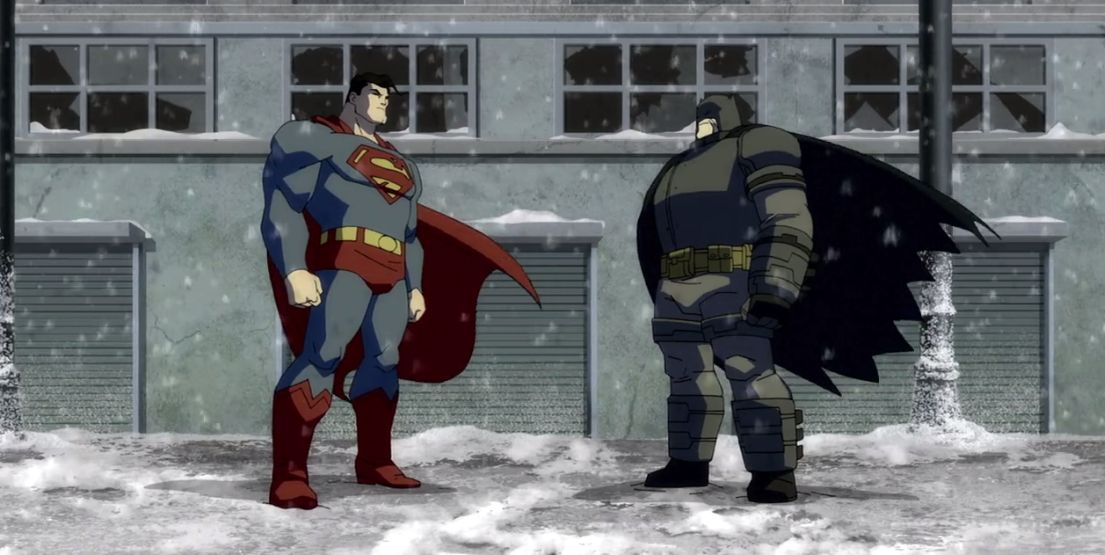
Since my Cartoon Comparisons aren’t limited to just Disney and anime, I decided to compare the recent Batman v Superman: Dawn of Justice with the animated WB adaptation of Frank Miller’s comic book miniseries The Dark Knight Returns. Both follow their own storylines, but Batman v Superman does draw some inspiration from The Dark Knight Returns, most notably in how the famous comic ends with a battle between the Dark Knight and the Man of Steel.

I should start out by saying that I am unapologetically a Marvel fan. Everyone has their preference, and I tend to think that those more drawn to DC or Marvel are more likely to forgive their movies’ faults. For example, one of my coworkers is a DC purist and loves to poke holes in Marvel movies while making excuses for films like Batman v Superman. One thing, though, that I find uncontestable (but I know many do contest) is that in recent years, Marvel films have taken the lead and DC is now struggling to keep up. Oddly, DC seems to be doing the opposite of Marvel; instead of introducing each hero in their own movie and bringing them together Avengers-style, DC is tossing in the likes of Wonder Woman and the Flash without much explanation and then providing a stand-alone film. I know DC is trying to differentiate itself from Marvel, but it’s a strange creative choice that doesn’t lend itself to a cohesive setup.

Honestly, I wasn’t too eager to see Zack Snyder’s Batman v Superman. The trailers were meh, the reviews were worse, and Man of Steel didn’t exactly thrill me as the beginning of a new superhero universe. Yet, with all the other DC films planned to follow, I felt I should give it a try, if only to keep up with the curve. Was it terrible? No. Was it anywhere near good Marvel? No. It was certainly better than I expected, and I found it to be a solid serious take on the DC heroes, particularly Batman, played with surprising intensity by Ben Affleck. While watching it, my main complaints were simply facts of its existence: it’s very dark, very serious, and very long. It still kept my interest through its 181-minute runtime with its mostly sound acting, cleverly symbolic dialogue, and periodic bursts of action, but boy, are there flaws! It’s just that its flaws were more noticeable after the fact than during the movie, and I’m not sure if that’s to the film’s advantage or detriment.

Image result for batman v superman dawn of justice

I suppose my biggest qualm going in was the very concept of Superman and Batman fighting each other, even though it has precedent in the comics. I loved Captain America: Civil War, but I don’t want the good guys to clash among themselves too much. Thankfully, that’s one thing that Batman v Superman does fairly well. Superman’s issues with Batman have to do with his shadowy vigilantism, but Batman’s objections to the Son of Krypton are more deep-seated, stemming from the rampant destruction that made Man of Steel notorious. One must keep in mind that these characters don’t know each other’s intentions, and I could understand Bruce Wayne’s distrust of a godlike alien. Even so, I felt that all of the anti-Superman rhetoric was rather narrow-minded. Most people wouldn’t blame a fireman for only being able to save half of the people in a fire, yet everyone seems to question Superman’s motivations, focusing on the one or two uncertain events instead of the countless lives he does save. No wonder Henry Cavill’s Superman acts so grim and depressed; note to the writers, Batman is supposed to be the brooding one.

There are smaller nitpicks too, such as Jesse Eisenberg’s youthful, God-haunted Lex Luthor, who seems more obviously crazy than the charisma of Gene Hackman’s original or even Kevin Spacey’s knock-off. A friend of mine said Eisenberg would have made a better Riddler, and I tend to agree. The film is also far from cohesive, with plot threads weaving all over the place, and a foreshadowing dream sequence has some unexpected predictive elements sure to confuse the uninitiated. As for the big brawl that may or may not have made DC fans geek out, it’s well set-up and well executed but ends with a semi-obvious plot twist that gets more stupid the more I think about it. Naturally, Batman and Superman couldn’t stay enemies for long, but the turnaround is sudden to the point of absurdity. At least, Gal Gadot’s Wonder Woman does make a nice if underused debut, and I’m actually more interested to see her movie than another Batman/Superman pairing. In trying so hard to set up the upcoming Justice League films, Batman v Superman offers much to appreciate and much to criticize, and it’s all a bit…much. I’m not saying Marvel is perfect either, but at least they’ve found a formula that works. DC is still struggling to find their feet, and, even if they have the spectacle, I’m dubious that they can reach the same level of entertainment.

Image result for batman v superman dawn of justice

Now for The Dark Knight Returns, which was broken up into a Part 1 and Part 2, both of which are about the same length as Batman v Superman when combined. I used to watch the animated Justice League on TV, but I’m not as familiar with the more recent direct-to-video animated films that lean more on the mature side. The Dark Knight Returns was my first exposure to these, and I see why it has been acclaimed and, despite the different storylines of each film, recognize several similarities with Batman v Superman. Among the aspects it shares with Zack Snyder’s film are the Batman/Superman fight (of course) complete with kryptonite gas, a line from Bruce reminding someone that “We’re criminals. We always have been,” repeated news reports debating the legitimacy of unsupervised heroism, an unexpected televised massacre, a nuclear explosion with Superman high in the atmosphere, and an ending funeral scene, in which the two movies have the characters’ places switched.

Unlike Batman v Superman, where Superman is still a new hero for Earth and Batman is a somewhat older than usual version, having already assumedly beaten the rogues to be seen in Suicide Squad, The Dark Knight Returns features a much older Batman in the 80s, who has retired from hero work after the death of his second Robin named Jason. With Gotham City being terrorized by a violent gang called the Mutants and the return of a supposedly rehabilitated Two-Face, Bruce Wayne decides to “return” as the hero it needs and deserves. As his crusade continues in Part 2, he also battles the once-catatonic Joker and eventually Superman himself, aided by the young Carrie Kelley as the new Robin.

Image result for the dark knight returns film

Part of what sets The Dark Knight Returns above its live-action counterpart, in addition to its more focused narrative that still covers a lot of ground, is the sense of history among the characters without showing it all. Batman is haunted by the deaths he couldn’t prevent, even telling the Joker he blames himself for allowing his foe’s killing spree to last so long, but he acts with the sureness of experience. The police have a varying reaction to the Dark Knight; those like Commissioner Gordon who remember Batman’s past heroics welcome him with a hands-off policy, while the newer recruits and incoming Commissioner Ellen Yindel see him as merely one more violent influence on Gotham City. Debates rage on the news and talk shows over whether Batman should be admired or arrested, with one know-it-all psychiatrist especially criticizing him with some good points, but the mix of opinions is a bit more balanced than the backlash in Batman v Superman. We even get some cameos from much older Selina Kyle and a grizzled Oliver Queen/Green Arrow (who has one arm for some reason, reflecting that unseen history I mentioned earlier).

The Dark Knight Returns also boasts a stellar voice cast, led by Peter Weller of Robocop as Batman. Also (Lost alert!), Michael Emerson, who played such a great villain in Ben Linus, brings a similar ruthless sneer to the Joker. As for Batman’s climactic clash with Superman, it plays out rather similarly, but for entirely different reasons. It goes back to the history they have with each other in this post-Justice League world, and interestingly the reason is more like that in Captain America: Civil War than in Batman v Superman. Unlike Zack Snyder’s Man of Steel, this Superman directly supports the U.S. government and its Reagan-esque President and is sent to put a stop to Batman’s vigilante brand of justice. They clearly disagree, but even in the heat of battle, their respect for each other causes them to hold back. And it doesn’t end with a silly twist so it’s arguably a better confrontation, which is more of a symbolic clash of ideals than the death battle in Batman v Superman.

Another point where The Dark Knight Returns has it over Batman v Superman is its depiction of Batman’s conscience. Both Batman and Superman are well-known for their refusal to kill their villains, which of course lets them come back repeatedly, but Zack Snyder seems to have ignored that fact. I didn’t notice at first, caught up in the impressive action sequences, but Affleck’s Batman doesn’t seem to mind smashing cars into people and general murder of the bad guys, perhaps owing to that “feeling of powerlessness that turns good men cruel,” as Jeremy Irons’s Alfred says. The Dark Knight Returns’s Batman, however, takes care to leave his baddies alive, only coming close to killing when pushed to his limit; one especially cool rampage in the tank-like Batmobile makes a point of using rubber bullets to incapacitate the Mutant gang without killing them.

Image result for the dark knight returns film


Despite the upheld ban on killing, there is quite a bit of violence and some nudity for a PG-13 cartoon. Some of the fistfights are vicious, and while the more gruesome scenes are left offscreen, it doesn’t shy away from blood, mainly in scenes with the Joker. Not to mention, the Joker has a Batarang sticking out of his eye for a while so I can’t help but think an R rating might have been more deserved. Likewise, Batman v Superman has its fair share of brutality, though comparatively little blood.

Both Batman v Superman: Dawn of Justice and The Dark Knight Returns have their strengths and weaknesses. The former is gritty and well-acted for the most part with a jam-packed plot that will likely reward repeat viewings, but its overstuffed length and particularly drab treatment of Superman aren’t about to make it a classic either. The Dark Knight Returns is clearly a stronger film, though that’s owed to its acclaimed source material which didn’t have to set up a whole superhero universe through cameos. The animation is nothing special but it illustrates the story well; the older Batman is a wise and responsible version of the hero who is still susceptible to human weakness and grief yet manages to even rally the citizens of Gotham to his cause. Despite the violence, some weird unexplained slang, and several loose ends left open, such as the Cold War entanglements, The Dark Knight Returns is a strong Batman movie and proves why DC often seems so much more suited to the animated realm (and TV, like Arrow). I won’t begrudge DC fans the pleasure of seeing their favorite heroes in live action on the big screen, but Marvel does it so much better. Only time will tell if that holds true for DC’s future line-up.

Best line from Batman v Superman: Dawn of Justice: (Lex Luthor, actually offering a good point) “You don’t need to use a silver bullet. But if you forge one, you don’t need to depend on the kindness of monsters.”

Best line from The Dark Knight Returns (the real best line is a spoiler but this one will do): (Alfred) “If it’s suicide you’re after, I have an old family recipe. It’s slow and painful. You’d like it.”


Rank for Batman v Superman: List Runner-Up

Rank for The Dark Knight Returns: List Runner-Up


© 2016 S. G. Liput
403 Followers and Counting


VC Pick: Minority Report (2002)

07 Sunday Aug 2016

Posted by sgliput in Movies, Poetry, Reviews, Writing

≈ Leave a comment

Tags

Action, Drama, Sci-fi, Thriller

Image result for minority report film


Some people insist that the future is written
In stone,
Worry-prone
And forever unknown.
For every mistake, we are twice shy once bitten,
Yet fate
Will dictate
Whether we are too late.

How grand it would be if the future were clearer,
To see
Finally
What we can’t guarantee.
If destiny was not a wall but a mirror,
Events
To lament
We perhaps could prevent.

Yet what if the future were actually written
In sand,
To expand
Or to change what is planned.
How could you know if the course that you fit in
Is still
To fulfill
Or to change if you will?
______________________

MPAA rating: PG-13

Since most of her movie choices thus far have been romantic comedies, my VC wanted to prove her interests do extend beyond, to science fiction, for example. Thus, she recommended Minority Report, Steven Spielberg’s adaptation of a Philip K. Dick story about a world where crime can be stopped through precognition. You can’t go wrong with Spielberg and sci-fi, and as with his later pairing with Tom Cruise in War of the Worlds, Minority Report is a darkly polished cautionary tale with no shortage of futuristic effects.

Cruise plays John Anderton, a PreCrime cop whose division prevents murders through the oracular visions of three medicated “precogs” who float in a vat of milky fluid. When you say it like that, it sounds rather, um, strange, but the technological methods and theoretical concepts employed are explained understandably enough and brought to life with all manner of futuristic gadgets, from jetpacks to hand-operated holographic screens that look suspiciously like those in Tony Stark’s garage. After dealing with the probing questions of DOJ agent Danny Witwer (Colin Farrell), Anderton finds himself on the wrong side of this supposedly flawless system when he is singled out as a would-be murderer, and as he says, “Everybody runs.”

Cruise himself delivers a solid performance as Anderton, one of his first sci-fi roles. Despite being a drug addict, Anderton is consistently sympathetic due to his grief over his son’s abduction, after which he threw himself into his Precrime work. He insists on the system’s infallibility, yet when he’s on the receiving end of the accusation of murder, he proves to have the strength and intelligence to evade capture and dig deeper into how the system works. It’s a credit to the story that, even after an apparent breakthrough moment, the plot still has more twists up its sleeve. The secrets Anderton uncovers also open up philosophical quandaries he had chosen to ignore, from the humanity of the seemingly braindead precogs to whether the future is really set in stone, particularly when that future can be foreseen.

One thing seems certain: 2054 will be a problematic year. I find it curious that at least three different dystopian sci-fi films take place in that year, Surrogates, Harrison Bergeron, and this one. I suppose it’s a year that seems close enough to still be recognizable to our current lifestyle but distant enough to hold guessable technological advances. Those advances are some of Minority Report’s greatest strengths, of which we see more as Anderton’s journey continues. Autopilot cars and vertical highways? That’s cool. Spider drones that scout out entire buildings? That’s even cooler. The practical advantages of seeing the future? That too. Eventually, these cool moments add up to an all-around cool movie with some food for thought at its heart.

In addition to the moral issue of punishing people for crimes not yet committed, the tech side of things also offers questions to consider. As convenient as it would be for cars to drive themselves or public ads to be instantly customized to you based on an eye scan, such advances are only harmless for as long as you remain in the good graces of the powers that be. Those conveniences become liabilities and dangers once Anderton goes on the run. One could say that good, law-abiding people have nothing to worry about, but what is good or law-abiding can change depending on who is in power.

Minority Report is a thought-provoking mystery and one more credit to Spielberg’s sci-fi filmography. The dark cinematography makes every source of light glow, often placing an aura or halo around people, suggesting perhaps, like many dystopian films, that this shining future is only bright on its edges with shadier secrets below. The film’s one negative, aside from an unanswered question or two, was an uncomfortable scene of an eye transplant. My VC is especially squeamish about such scenes and didn’t even want me to look.

Nonetheless, Minority Report’s style and futuristic creativity made for an entertaining what-if scenario with ethical debates that will only grow as 2054 gets closer.

Best line: (Dr. Hineman, co-founder of Precrime) “Sometimes, in order to see the light, you have to risk the dark.”


Rank: List-Worthy


© 2016 S. G. Liput
401 Followers and Counting


The Walk (2015)

29 Wednesday Jun 2016

Posted by sgliput in Movies, Poetry, Reviews, Writing

≈ 4 Comments

Tags

Drama, History, Thriller

Image result for the walk 2015


Spanning the gap                                                     between each tower,
Not a trap,                                                               but source of power,
Hangs a cord                                                            you pray is taut,
In which is stored                                                     your only shot.
Your heart is racing, mind is bracing for the danger you’re embracing,
It’s, you know,                                                         a dream worth chasing.
You stand so high                                                     upon the brink,
The edge of sky,                                                       the towers’ link.
The world must fade,                                                the thought of loss
Or accolade,                                                             to walk across
The peril you                                                            yourself have set
For public view                                                         and public fret.
You must not fear;                                                    you must not stumble.
Wisdom here                                                            will keep you humble.
Take a breath                                                           and tread with care;
Think not of death                                                    when in the air.
Dreams unskilled                                                      can get you killed,
Yet all are thrilled                                                     when they’re fulfilled.
________________________

MPAA rating: PG

Except for those who remember the headlines back in 1974, most were probably first introduced to Philippe Petit’s daring tightrope walk between the Twin Towers by 2008’s Oscar-winning documentary Man on Wire. I, however, did what anyone would do who isn’t well-versed in documentaries; I waited until Hollywood made a “real” movie about it. Luckily, Robert Zemeckis took up the project and created a film that is not only entertaining as a fact-based drama but actually makes me curious to see the “real real” story in Man on Wire.

Joseph Gordon-Levitt effortlessly adopts a French accent to play Petit from the beginning of his tightrope career to his greatest achievement. In many ways, he’s the definition of a misunderstood artist, bearing the weight of a dream that most people consider foolhardy, even his own father. We watch as he “learns the ropes” from high wire master Papa Rudy (Ben Kingsley), gains a few supporters like the lovely Annie (Charlotte Le Bon from The Hundred-Foot Journey), and draws ever closer to his ultimate dream of traversing the space between the towers of the World Trade Center, which was still under construction at the time.

Since his exploit is clearly illegal, involving much trespassing and personal risk, the lighthearted dream morphs into something of a heist, as Petit scopes out his target, meets accomplices, and memorizes careful plans that could easily go wrong. The climactic walk itself is a marvel of invisible effects work (alas, no Oscar nomination), placing Gordon-Levitt in what appears to be the most dangerous place imaginable. I happened to watch The Walk with my mom and dad on either side of me, neither of whom knew how Petit’s dream would end, and I got a huge kick out of watching their reactions. I, of course, did know and was able to watch much more calmly and chuckle as they practically went into anxious convulsions with more unrelieved tension than Petit’s tightrope. Suffice to say, the protracted finale is not for anyone even mildly afraid of heights.

The Walk is a highly enjoyable biopic that lets Petit’s dream come to fruition with pleasant fluidity, making him someone worth celebrating while acknowledging his mysterious obsession with his goal. Why does he want to walk between the towers when it’s so dangerous? To prove he can? To be the first to try? Because they can’t resist? Even though this question is asked right from the start, it’s never fully explained, but I suppose the answer isn’t far from why mountaineers climb Everest. It doesn’t make sense to us mundane folk, but the thrill and the satisfaction of accomplishment are everything to them. In recreating the Twin Towers and one man’s fascination with them, The Walk also takes on a bittersweet note in the final scene. The World Trade Center towers may no longer stand, but Petit’s dream at least lets them live on in our memory as more than just the site of tragedy.

Best line: (Barry, who works in the WTC after being told of Petit’s plans) “It’s something only a twisted, antisocial, anarchistic, pissed-off malcontent would have anything to do with…. You have your inside man!”


Rank: List-Worthy


© 2016 S. G. Liput
391 Followers and Counting


Counterpoint (1967)

09 Thursday Jun 2016

Posted by sgliput in Movies, Poetry, Reviews, Writing

≈ 2 Comments

Tags

Classics, Drama, Thriller, War


The wave of the constant conductor’s baton
Arises and dips as each note’s liaison.
It nods to the strings
As the clarinet sings
And the audience clings
To the melody’s wings.

The music is steady and blind to the world,
Where battle is brutal and bullets are hurled.
The music will stay,
If the artists still play
And the hearers, like they,
Let war’s din fade away.
_____________________

MPAA rating: Might as well be PG

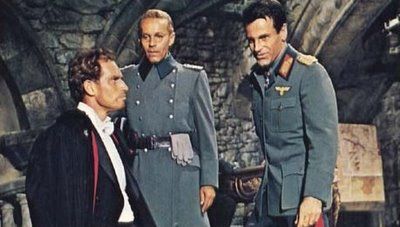
In the annals of semi-classic Hollywood, there are bound to be undiscovered gems, and I’m glad to say I found one, a World War II thriller worthy of being mentioned in the same breath as The Great Escape. Counterpoint begins on the front lines of the European theater, where a USO symphony orchestra plays for the troops only to have their performance cut short by the advancing German army. Quickly captured by the Nazis, the orchestra’s director Lionel Evans (Charlton Heston) demands they be released, but the Germans have orders to kill any and all prisoners. The only thing that saves them is the cultured admiration of the Nazi General Schiller (Maximilian Schell), who wants a concert and offers no guarantees of what is to follow it.

Heston and Schell make an outstanding pair of rivals, both self-absorbed and confident and used to getting their own way. Evans’ personality is summed up by an early line to his orchestra: “Each one of you will be responsible for your instruments, your music, and yourselves, in that order of importance.” Only two members of the seventy-member orchestra are actual characters (Leslie Nielsen, Kathryn Hays), but they and the rest know Evans’ ego all too well, and when he refuses to give in to General Schiller’s demands, they assume he’s satisfying his own opinions at their expense. Below the surface, however, he does care for his people and tries to stall the shooting squad that awaits them once the concert hall goes silent. Opposite Heston, Schell has a grinning, scheming charisma, looking perfectly at ease as he threatens his “guests”, like a precursor of Hans Landa in Inglourious Basterds. His treatment of an antique chair implies that he cares little for art, yet he’s a firm admirer of Evans and trades sharp-witted barbs with him to either convince or coerce him into submission. With one of his underlings clamoring for the prisoners’ blood, Schiller wants his concert before the war must resume.

I’m honestly surprised that Counterpoint isn’t a better-known film. The Nazis’ periodic acts of aggression keep the tension high, and close calls and narrow escapes are juxtaposed with the grandeur of the Los Angeles Philharmonic playing Tchaikovsky, Brahms, and Wagner. The climax even kept me guessing right up to the end. It’s not necessarily an award magnet that got spurned, but it’s an excellent and thoroughly underrated film that deserves far more recognition.

Best line: (Schiller) “To paraphrase Napoleon, morality is on the side of the heaviest artillery.”   (Evans) “Whatever happened to Napoleon?”


Rank: List-Worthy


© 2016 S. G. Liput
386 Followers and Counting


Hidden (2015)

04 Wednesday May 2016

Posted by sgliput in Movies, Poetry, Reviews, Writing

≈ 2 Comments

Tags

Drama, Horror, Thriller


The shadows all deepen,
While silhouettes creep in,
And light gives its nightly allowance to dark.
Most men surely worry
Of menaces blurry,
Of dangers and strangers too hazy to mark.

But when the sun’s gleaming
Is more home to screaming,
The shadows will rapidly lose their unease.
If dark once forbidden
Keeps us safe and hidden,
The risks of the light are our new enemies.
___________________

MPAA rating: R (could maybe be PG-13)

I have no idea what possessed me to watch an R-rated horror thriller sight unseen, without the complete knowledge of what to expect that I usually obtain before venturing into the genre. I hadn’t really read many reviews of this under-the-radar film from last year, but this is one instance where I’m glad that I didn’t.

Hidden is not just one of the best horror films I’ve seen of late, but really two films in one: first, a post-apocalyptic drama about a family locked within an underground bunker, and second, a heart-thumping “they’re-out-there” thriller with a shrewdly concealed twist. While my VC felt the setup was a bit too long, it was the family part that won me over. Alexander Skarsgård as Ray plays one of the most endearing father figures I can recall, encouraging his young daughter Zoe (Emily Alyn Lind of Won’t Back Down) with good humor, tender comfort, and imaginary trips to the world before whatever disaster hit. Rounding out the trio, Andrea Riseborough is the anxious mother, intent on enforcing her four Mom rules: 1. Don’t be loud; 2. Never lose control; 3. Never open the door; and 4. Never talk about the Breathers, who lurk outside in search of the family.

Despite the R rating, Hidden is fairly subdued for a horror, with hardly any language and the violence brief and often off-screen. Like The Conjuring, I tend to think the R is for its general intensity, though it’s nowhere near as chilling as that film. I think most horror connoisseurs will find it rather tame, but it’s an ideal nail-biter for wimps like me who prefer tension over gore. There were moments where my hand instinctively covered my mouth (especially when I noticed a spider dangling not far from my face at one point. I hate when that happens!). My VC felt that certain motivations didn’t entirely make sense to her, but I liked how everything was from the family’s point of view.

I don’t want to spoil Hidden. It’s best seen with no expectations. Perhaps the best way I can describe it is like a Twilight Zone episode directed by M. Night Shyamalan on one of his good days. The twist and the overall tension might be main selling points, but the marvelous acting by all three stars, especially Lind, is its greatest strength. The best horror films make you care about the characters before throwing them into alarming circumstances, and Hidden does it exceptionally well.

Best line: (Ray, encouraging Zoe on their 301st day in the bunker) “301. Now we shouldn’t have been around for any one of those days, but when we needed it, we found this shelter, and it’s given us food, a home, a life. And for all we know we could be the only ones left, the only ones still alive. So every one of those marks is really a miracle.”
(Zoe) “A miracle?”
(Ray) “That’s right, a miracle. This food is going to allow you to live another day, and that means another hash can be drawn, right?”
(Zoe) “Yeah, I guess so.”
(Ray) “So you see, those nasty, cold, mushy beans on your plate, they’re really their own kind of miracle too.”

Rank: List-Worthy

© 2016 S. G. Liput
385 Followers and Counting


Ragnarok (2013)

30 Saturday Apr 2016

Posted by sgliput in Movies, NaPoWriMo, Poetry, Reviews, Writing

≈ 3 Comments

Tags

Action, Drama, Family, Fantasy, Foreign, Thriller


(Today’s final NaPoWriMo/GloPoWriMo prompt was to write a translated poem, so I tried to write something homophonically similar to “The Half-Finished Heaven” by Swedish poet Tomas Transtromer. Doing that, I could have ended up with something as inscrutable as some of Gerard Manley Hopkins’ work, so instead I simply began each line of the poem below with the same letter as the original poem and chose a Scandinavian film to review.)

Mid-look was my life cut short,
Aghast at the proven report.
Goodbye to my daughter and son;
Dear father will never see port.

A brave man was I, no mistake.
Oh, Vikings would never forsake.
Vigor was rife in our bones,
Alas, till they littered the lake.

Veiled are we here in our sleep,
Veiled in the dangerous deep.
Still does our conqueror live,
Drowsing upon our corpse heap.

Valiant and foolish to tarry
Is he who finds our cemetery.
______________

MPAA rating: PG-13

Ragnarok may be the first Norwegian film I’ve seen, in a way the Norwegian equivalent of a late-summer blockbuster. Perhaps the closest thing I can compare it to is 2008’s Journey to the Center of the Earth with Brendan Fraser, loaded as both are with clichés and genuinely thrilling moments. Both films start out much the same; like Fraser’s volcanologist, archaeologist Sigurd Swenson (good Scandinavian name!) is desperate for funding, and when an enigmatic clue arises, he brings along his two kids Ragnhild and Brage and a couple colleagues on an ill-advised search for answers that doesn’t go as planned. In lieu of a Jules Verne novel as inspiration, Norse mythology stands in with the story of Ragnarok, a.k.a. the end of the world.

The expedition walks into danger when they raft across a remote, far-north lake to a central island where both Vikings and Russians once visited, never to leave again. It’s an effective build-up to what is ultimately a creature feature. The monster hidden below the surface and the foolish decisions of the humans will bring to mind films like Jaws, Eragon, and Jurassic Park III, but this Norwegian equivalent of those movies usually manages to make the material its own. A few set pieces involving a zip line and a bunker are edge-of-your-seat highs, and my VC was far more terrified than I at one prolonged suspense scene.

It may not be entirely original, but Ragnarok is an entertaining action adventure with some tense thrills that never become un-family friendly. The special effects are usually as good as most American productions, and the isolated Arctic scenery makes for a stunningly rich setting. I will be interested to see how Marvel’s Thor: Ragnarok compares. For a first accessible foray into Norwegian cinema, I’d recommend Ragnarok, though don’t watch the English dub. Most dubs don’t bother me, but when children are screaming and some English voiceover dully says “Help me,” it kinda ruins the moment.

Rank: List Runner-Up

© 2016 S. G. Liput

385 Followers and Counting


Maze Runner: The Scorch Trials (2015)

15 Friday Apr 2016

Posted by sgliput in Movies, NaPoWriMo, Poetry, Reviews, Writing

≈ 2 Comments

Tags

Action, Drama, Sci-fi, Thriller


(Today’s NaPoWriMo prompt, inspired by this month’s halfway point, is to write a poem incorporating doubles. Thus, I chose to write in couplets and picked a sequel to review.)


Run, run, run, through glade and through maze;
Run and trust not this new world set ablaze.

Run from the torchbearers firm in their cause,
So sure of its virtues, no thought for its flaws.

Run from the dangers that line every path;
The world is less suited to kindness than wrath.

Run from the greedy, who serve themselves first,
And those who do wrong, by good reasons coerced.

Run till you realize your flight is in vain;
When all the world’s crazy, you stand and be sane.
____________________

MPAA rating: PG-13

I very much enjoyed the first Maze Runner film and was looking forward to continuing the intriguing mystery set before the characters. It was a darker installment in the YA dystopian genre and a bit more intense than others of its ilk. The Scorch Trials both strengthens and weakens the series, which is to say it both entertained and disappointed me, which is to say it’s good but could have been better, which is to say . . . oh, I’ll just explain.

After escaping from the maze, Thomas and his Glade buddies are whisked away to a locked-down compound where they find other rescued inhabitants from other mazes and a great many secrets. One common complaint about the first film is the lack of answers, and The Scorch Trials does supply some, such as why the young people are so important and why Thomas joined the Gladers. We still don’t know what exactly the Maze was for, but there’s still another film yet to come. While the first film was almost completely confined, this one has a much wider scope as Thomas and the gang are introduced to the scorched wasteland and a zombie-like plague that has caused a breakdown in society.

I wasn’t expecting this to turn into a zombie apocalypse movie since we’ve had even more of those than YA dystopias, but it works quite well. In lieu of the first film’s Grievers, those infected with the Flare virus offer the same awesome, edge-of-your-seat action and lots and lots of running. A key part of zombie scenarios is how people deal with them, and the film includes a believable variety of responses, from ruthless science to mercenary self-interest. One reason I avoid zombie movies is my aversion to gore, and I did appreciate this film’s restraint, proving (like World War Z) that it can be done effectively.

Sadly, with so much eventfulness, the characters are little more than placeholders. Thomas (Dylan O’Brien) is the leader making things up as he goes along, and he connects with a couple new characters, but everyone from the first film is just following along. This film so relies on the first one to establish its “main” characters that my VC didn’t even remember one of the expendables along for the ride.

Another gripe is that The Maze Runner was fascinatingly original while this one seems content to borrow plot elements and even specific scenes from other sources. Watching the film, I kept pointing out what such-and-such reminded me of. The zombie setup and search for a cure brought to mind I Am Legend and World War Z. Zombies in a mall seemed like a Dawn of the Dead reference. Oh, that scene is like the beginning of Mad Max: Fury Road. Oh, that’s like Coma, and Aliens, and The Way Back, and Fallout, and The Lost World: Jurassic Park. When a film constantly brings other franchises to mind, more than its originality suffers.

Thus, The Scorch Trials furthers the plot and little else, but that’s luckily still enough to keep me interested and entertained. The stage is set for the final chapter, and I’m glad the characters have something to run toward instead of always away. Time will tell if this trilogy can end on the high note with which it began.

Best line: (Thomas, at a pivotal scene) “I’m tired of running.”


Rank: List-Worthy (joining the first film)


© 2016 S. G. Liput

380 Followers and Counting


Rope (1948)

09 Saturday Apr 2016

Posted by sgliput in Movies, NaPoWriMo, Poetry, Reviews, Writing

≈ Leave a comment

Tags

Drama, Hitchcock, Thriller


(Today’s NaPoWriMo prompt was to write something you’re afraid to say, so here’s an opinion that might be unpopular.)


Though my opinion may not count compared with greater critics,
Who see more cinematic worth with fancy analytics,
There’s something rather overblown that most would not dare knock,
And that’s the reputation of the great Alfred Hitchcock.

His reputation’s such that everybody knows his skill
Long before they may or may not glean from him a thrill.
He was a master filmmaker and could make showers tense,
But does he merit being called “the master of suspense?”

Perhaps we have been spoiled with more recent horror thrillers,
With darker shades of wickedness and more alarming killers,
But looking at Rebecca, Rope, Notorious, and such
Just doesn’t make my mind or heart start racing very much.

I freely will admit that Psycho is a masterwork;
Rear Window gets good at the end, though Jimmy plays a jerk;
And while The Birds does have its moments of anxiety,
The lead-up that should hold my breath gets boring, honestly.

In films like Dial M for Murder, tension’s at its best
In one distinct, iconic scene, but who recalls the rest?
So though most may cry blasphemy, I feel it must be stated
That many of “the master’s” works are tedious and dated.
No offense, but for suspense, he’s rather overrated.
_____________________

MPAA rating: PG

Having seen Alfred Hitchcock’s most successful films like Psycho and The Birds, I thought I’d check out one of his smaller and more inventive efforts. Rope is based on a play and one of the most purely translated plays, enclosed as it is in a single apartment with careful attention to its setting and structure. Decades before Birdman, Hitchcock experimented with long takes and a bare minimum of cuts, which are craftily hidden, sometimes obviously, sometimes not.

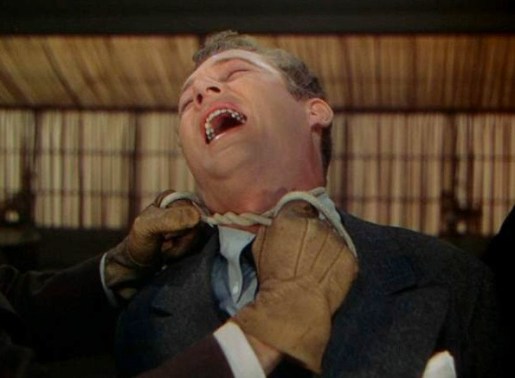
Clearly based on the infamous Leopold and Loeb murder, the plot revolves around two arrogant school chums Brandon and Phillip (John Dall and Farley Granger) who strangle a classmate with rope merely to prove their superiority and then invite the victim’s family and friends for a dinner party over the hidden body. As an intellectual experiment, Rope is intriguing and thought-provoking. As a thriller from the master of suspense, it’s rather disappointing. There is far more talking and plotting than actual tension, and the plot hinges on the revelation of how the truth will come out rather than if. One point of contention I didn’t see was rumors about the assumed homosexuality of the killers. Sure, they live together as roommates, but if there was such a subtext, it was so subtle to avoid controversy that I didn’t even recognize it.

Like the motivation for the crime, Rope’s message is more cerebral than visceral. The murderers make it clear that their “superior” ideology stemmed from their teacher Rupert Cadell, played by a serious James Stewart. At the party, Rupert confirms his elitist leanings but only in theory and only until he sees cause for grief. It’s all innocent discussion to debate who is more or less intelligent, cultured, or worthy of life, but such philosophy can be put into action by the unprincipled, like the two killers or Nazi Germany. Rupert was not involved in the murder, but Rope emphasizes that the seed of an immoral idea can be just as regrettable as the crime itself.

Best line: (Mrs. Atwater, a guest) “Do you know when I was a girl I used to read quite a bit.”   (Brandon) “We all do strange things in our childhood.”


Rank: Honorable Mention


© 2016 S. G. Liput

376 Followers and Counting


Earthquake (1974) / San Andreas (2015)

06 Sunday Mar 2016

Posted by sgliput in Movies, Poetry, Reviews, Writing

≈ Leave a comment

Tags

Action, Disaster, Drama, Thriller


Just another normal day,
Just keeping normal cares at bay,
But then to everyone’s dismay,
The ground begins to shake.
The rocks and hills begin to play,
The soundest structures start to sway,
Entire buildings fall away
Amid the sudden quake.

If you make it through the scare,
You wonder how your loved ones fare.
Do they live and how and where?
You worry more for them.
The worst disasters we must bear
At best encourage us to dare
To save the ones for whom we care,
Whom danger might condemn.
__________________

MPAA rating for Earthquake: PG
MPAA rating for San Andreas: PG-13

There’s something strangely entertaining about a disaster. Whether it be the dated survival tales of the 1970s or the modern effects-heavy world-wreckers, it seems clear that it’s not just the Joker who likes to watch the world burn. Of course, this doesn’t apply to real-life disasters. Films like The Impossible and World Trade Center are serious and painful reminders of tragedies, but others like San Andreas are enjoyed as popcorn fun simply because they’re not real. This seems like a puzzling dichotomy, but it’s no less true.

I thought I’d do a comparison of two similar films from different eras that exploit people’s fondness for destruction: 1974’s Earthquake and last year’s San Andreas. Both revolve around earthquakes blind-siding California and people’s struggles to survive. Both include experts who saw the quake coming but didn’t act fast enough, crumbling cityscapes, characters getting trapped in a parking garage, and a dam’s destruction and subsequent deluge (one at the beginning, one at the climax). While a few of the shaking scenes are even similar (both show a glimpse of a cook suffering at the hands of his stove), the two films are on entirely different levels. Earthquake was groundbreaking at the time and even won an uncontested Oscar for Best Visual Effects, but it seems quaint next to the comprehensive devastation of San Andreas, which is ironic since the quake in Earthquake is a 9.9 on the Richter scale while those in San Andreas only reach 9.6. (Yeah, only.)

I was curious to see Earthquake because of its tie-in to an episode of Quantum Leap, in which Sam leaps into a stuntman who features in a famous scene from this movie, complete with a clip showing Lorne Greene. It’s clear now as it surely was then that Earthquake is a gimmick film. Released at the height of the ‘70s disaster craze and the same year as The Towering Inferno, it seemed to be the result of producers saying to themselves, “Let’s see, we know of movies with a plane disaster, a ship disaster, a hurricane disaster, a fire disaster…What’s left? I know! An earthquake!” Plus, the film was accompanied by a new speaker system called Sensurround, which was meant to heighten the feeling of experiencing an earthquake and which was shorter-lived than the early 3-D craze. With so much effort put into accentuating the quake itself, everything else about the movie seems secondary, even though the actual shaking is relatively short.

Like other disaster films of the era, Earthquake is jam-packed with stars: Charlton Heston as a businessman unhappy with his marriage, Ava Gardner as his sullen wife, Genevieve Bujold as his lover, Lorne Greene as his boss, George Kennedy as a policeman, Richard Roundtree as a stuntman, Walter Matthau (under a pseudonym) as a drunk, and Marjoe Gortner as a psychopathic National Guardsman who uses the disaster for his own empowerment. And that’s not even half of the ensemble. It’s clear what the filmmakers were trying to do, focusing on a large swath of the population dealing with a huge disaster in different ways, yet only five or so characters really matter and even the film seems to forget about many secondaries by the end. Certain scenes are impressive for their time, and several are tense as characters try to escape the aftermath of the quake. I just wish that the cast and the narrative overall had been streamlined, perhaps with a less downbeat ending.

San Andreas, on the other hand, is everything a disaster movie should be, with all the unmitigated damage you could want. We see dams bursting, cars crashing, helicopters crashing, buildings toppled or chipped apart, and entire cities reduced to a flooded, smoking ruin, and it’s cool! Of course, it would be horrific if this actually happened (and I suppose it could), but it’s a feast for the eyes boasting an astronomical body count with no actual bodies. While I don’t really buy the causes for disasters like The Day after Tomorrow or 2012, an earthquake is more plausible and thus more alarming, though I was confused by the inclusion of a tsunami. (Seriously, wouldn’t a tsunami go out toward the sea and hit Hawaii instead of doubling back toward the source of the quake?)

Dwayne Johnson (whom everyone still calls the Rock) isn’t what most would consider a consummate actor, but he certainly knows how to play a tough, capable lead such as air rescue pilot Ray Gaines. Returning as his co-star from Race to Witch Mountain, Carla Gugino plays his soon-to-be ex-wife, whom Ray must save from certain death, along with their daughter Blake (Alexandra Daddario of the Percy Jackson films). There’s also Paul Giamatti’s worried seismologist and Ioan Gruffudd’s architect/home-wrecker, whose character is tested by stress and easily written off as selfish. While there are still many minor players, Ray’s family is the focus, which proves to be far more entertaining than the scattered attention of Earthquake. Screenwriter Carlton Cuse gives just enough emotional baggage and stress-kindled romance to be relatable, while throwing in a few moments that seemed directly drawn from his experience with Lost.

Neither film is what I’d call great cinema, but as a disaster movie, San Andreas is easily the better movie and one of the more exciting entries in the genre. I enjoyed watching it a second time even more because I got to watch my easily excitable dad jump out of his seat with two dozen “OMG” moments. Watching the two films side-by-side did emphasize one of the differences between the old wave and the new wave of disaster movies. While the likes of The Poseidon Adventure and Earthquake weren’t afraid to kill off main roles and leave the audience sharing some grief with the characters, more recent films are more concerned with keeping the protagonists together and finding a silver lining. It’s hard to say which is a better method, but one thing is for sure: movies like San Andreas and Earthquake are why I will never move to California!

Best line from Earthquake (which ties in to my elevator list): (dam caretaker, when told things seem fine after an elevator incident) “Right. People drown in elevators every damn day of the week!”

Best line from San Andreas: (young Ollie, after getting Blake’s phone number for his older brother) “I can’t wait to be twenty.”


Rank for Earthquake: Honorable Mention

Rank for San Andreas: List Runner-Up


© 2016 S. G. Liput

367 Followers and Counting


← Older posts
Newer posts →

Recent Posts

  • We Didn’t Start 2025 (Recap)
  • NaPoWriMo 2025 Recap (Finally)
  • Sonic the Hedgehog 3 (2024)
  • It Happened One Night (1934)
  • Spellbound (2024)

Recent Comments

associatesofshellymann's avatarassociatesofshellyma… on My Top Twelve La La La So…
Kit's avatarKit Nichols on Bonnie and Clyde (1967)
lifelessons's avatarlifelessons on Look Back (2024)
Carol Jackson's avatarCarol Jackson on The Thief of Bagdad (1940…
Stephen's avatarStephen on Love Story (1970)

Archives

  • January 2026
  • December 2025
  • May 2025
  • April 2025
  • March 2025
  • February 2025
  • January 2025
  • December 2024
  • May 2024
  • April 2024
  • March 2024
  • February 2024
  • January 2024
  • December 2023
  • November 2023
  • October 2023
  • September 2023
  • July 2023
  • June 2023
  • May 2023
  • April 2023
  • March 2023
  • February 2023
  • January 2023
  • December 2022
  • November 2022
  • October 2022
  • September 2022
  • August 2022
  • July 2022
  • June 2022
  • May 2022
  • April 2022
  • March 2022
  • February 2022
  • January 2022
  • December 2021
  • November 2021
  • October 2021
  • September 2021
  • August 2021
  • July 2021
  • June 2021
  • May 2021
  • April 2021
  • March 2021
  • February 2021
  • January 2021
  • December 2020
  • November 2020
  • October 2020
  • September 2020
  • August 2020
  • July 2020
  • June 2020
  • May 2020
  • April 2020
  • March 2020
  • February 2020
  • January 2020
  • December 2019
  • November 2019
  • October 2019
  • September 2019
  • August 2019
  • July 2019
  • June 2019
  • May 2019
  • April 2019
  • March 2019
  • February 2019
  • January 2019
  • December 2018
  • November 2018
  • October 2018
  • September 2018
  • August 2018
  • July 2018
  • June 2018
  • May 2018
  • April 2018
  • March 2018
  • February 2018
  • January 2018
  • December 2017
  • November 2017
  • October 2017
  • September 2017
  • August 2017
  • July 2017
  • June 2017
  • May 2017
  • April 2017
  • March 2017
  • February 2017
  • January 2017
  • December 2016
  • November 2016
  • October 2016
  • September 2016
  • August 2016
  • July 2016
  • June 2016
  • May 2016
  • April 2016
  • March 2016
  • February 2016
  • January 2016
  • December 2015
  • November 2015
  • October 2015
  • September 2015
  • August 2015
  • July 2015
  • June 2015
  • May 2015
  • April 2015
  • March 2015
  • February 2015
  • January 2015
  • December 2014
  • November 2014
  • October 2014
  • September 2014
  • August 2014
  • July 2014
  • June 2014
  • May 2014
  • April 2014
  • March 2014
  • February 2014
  • January 2014
  • December 2013

Categories

  • Blindspot
  • Blogathon
  • Christian
  • Movies
  • Music
  • NaPoWriMo
  • Poetry
  • Reviews
  • TV
  • Writing

Meta

  • Create account
  • Log in
  • Entries feed
  • Comments feed
  • WordPress.com

Recent Posts

  • We Didn’t Start 2025 (Recap)
  • NaPoWriMo 2025 Recap (Finally)
  • Sonic the Hedgehog 3 (2024)
  • It Happened One Night (1934)
  • Spellbound (2024)

Recent Comments

associatesofshellymann's avatarassociatesofshellyma… on My Top Twelve La La La So…
Kit's avatarKit Nichols on Bonnie and Clyde (1967)
lifelessons's avatarlifelessons on Look Back (2024)
Carol Jackson's avatarCarol Jackson on The Thief of Bagdad (1940…
Stephen's avatarStephen on Love Story (1970)

Archives

  • January 2026
  • December 2025
  • May 2025
  • April 2025
  • March 2025
  • February 2025
  • January 2025
  • December 2024
  • May 2024
  • April 2024
  • March 2024
  • February 2024
  • January 2024
  • December 2023
  • November 2023
  • October 2023
  • September 2023
  • July 2023
  • June 2023
  • May 2023
  • April 2023
  • March 2023
  • February 2023
  • January 2023
  • December 2022
  • November 2022
  • October 2022
  • September 2022
  • August 2022
  • July 2022
  • June 2022
  • May 2022
  • April 2022
  • March 2022
  • February 2022
  • January 2022
  • December 2021
  • November 2021
  • October 2021
  • September 2021
  • August 2021
  • July 2021
  • June 2021
  • May 2021
  • April 2021
  • March 2021
  • February 2021
  • January 2021
  • December 2020
  • November 2020
  • October 2020
  • September 2020
  • August 2020
  • July 2020
  • June 2020
  • May 2020
  • April 2020
  • March 2020
  • February 2020
  • January 2020
  • December 2019
  • November 2019
  • October 2019
  • September 2019
  • August 2019
  • July 2019
  • June 2019
  • May 2019
  • April 2019
  • March 2019
  • February 2019
  • January 2019
  • December 2018
  • November 2018
  • October 2018
  • September 2018
  • August 2018
  • July 2018
  • June 2018
  • May 2018
  • April 2018
  • March 2018
  • February 2018
  • January 2018
  • December 2017
  • November 2017
  • October 2017
  • September 2017
  • August 2017
  • July 2017
  • June 2017
  • May 2017
  • April 2017
  • March 2017
  • February 2017
  • January 2017
  • December 2016
  • November 2016
  • October 2016
  • September 2016
  • August 2016
  • July 2016
  • June 2016
  • May 2016
  • April 2016
  • March 2016
  • February 2016
  • January 2016
  • December 2015
  • November 2015
  • October 2015
  • September 2015
  • August 2015
  • July 2015
  • June 2015
  • May 2015
  • April 2015
  • March 2015
  • February 2015
  • January 2015
  • December 2014
  • November 2014
  • October 2014
  • September 2014
  • August 2014
  • July 2014
  • June 2014
  • May 2014
  • April 2014
  • March 2014
  • February 2014
  • January 2014
  • December 2013

Categories

  • Blindspot
  • Blogathon
  • Christian
  • Movies
  • Music
  • NaPoWriMo
  • Poetry
  • Reviews
  • TV
  • Writing

Meta

  • Create account
  • Log in
  • Entries feed
  • Comments feed
  • WordPress.com

Blog at WordPress.com.

  • Subscribe Subscribed
    • Rhyme and Reason
    • Join 814 other subscribers
    • Already have a WordPress.com account? Log in now.
    • Rhyme and Reason
    • Subscribe Subscribed
    • Sign up
    • Log in
    • Report this content
    • View site in Reader
    • Manage subscriptions
    • Collapse this bar