• Home
  • About Me
  • The List
  • THE LIST (2016 Update)
  • THE LIST (2017 Update)
  • THE LIST (2018 Update)
  • THE LIST (2019 Update)
  • THE LIST (2020 Update)
  • THE LIST (2021 Update)
  • THE LIST (2022 Update)
  • Top Twelves and More
  • The End Credits Song Hall of Fame

Rhyme and Reason

~ Poetry Meets Film Reviews

Rhyme and Reason

Tag Archives: Thriller

Jurassic World (2015)

24 Sunday Jan 2016

Posted by sgliput in Movies, Poetry, Reviews, Writing

≈ 3 Comments

Tags

Action, Sci-fi, Thriller


“What have we learned?” they knowingly say.
“Life has evolved to show us the way.
Dangerous creatures and habits have filled
The past, and on them the near-future will build.”

“What have we learned?” they foolishly ask.
“Our forerunners clearly weren’t up to the task.
What they could not do we will better complete.
Mistakes of the past we will never repeat.”

“What have we learned?” they say, sure of their touch.
Those who see clearly say “Clearly, not much.”
________________

MPAA rating: PG-13


In many ways, 2015 was the year of the unexpected sequel/reboot. I’d bet that not too many people wanted or expected Hollywood to resurrect franchises like Jurassic Park, Mad Max, The Terminator, or Fantastic Four. (Lots of fans wanted another Star Wars so that doesn’t count.) Some of those turned out better than others, but the mammoth hit of the summer was Jurassic World.

The film starts out with two brothers, older punk Gray and younger whiz kid Zach, as their parents send them off to a theme park on none other than Isla Nublar. The audience’s nostalgia is tapped early on as we enter the famous giant gates and behold Jurassic World in all its glory. There’s a baby dinosaur petting zoo and a big glass hamster ball for safaris and a SeaWorld-style splash show with something a little bigger than a killer whale. Tourists and merchandise are everywhere, and there’s a certain satisfaction to seeing John Hammond’s dream so triumphantly realized.

By the looks of things, the creators of the park seem to have worked out all the bugs, with financing from owner Simon Masrani (Irrfan Khan) and scientific guidance from Dr. Henry Wu (B. D. Wong, the only returning cast member from the original film). But as Ian Malcolm said in The Lost World, they’re not making the same mistakes twice, they’re “making all new ones.” Just as the whole frog DNA idea backfired for Hammond, the park runners do a little too much genetic manipulation to create an uber-dinosaur, the Indominus Rex. As the park’s operational manager, Zach and Gray’s Aunt Claire (Bryce Dallas Howard) seems coldly confident that there’s nothing wrong with toying with nature. You can guess what happens next.

Like Star Wars: The Force Awakens, Jurassic World seems to directly parallel the original film in order to balance the new with the familiar. There’s the gate entrance, a hands-on scene involving a sick/dying dinosaur, an intense glass scene that lets kids in danger look directly into a predator’s maw, a flare scene involving a T. Rex, and a vehicle being chased by a rogue dino. While I like The Force Awakens more, I have to admit that Jurassic World better differentiates those scenes from their original counterparts. It also nails the most important element of an effects-driven movie like this, the dinosaurs. Some creatures may be more obviously CGI than others, but the life-and-death action and dino duels are exhilarating to behold, if rather vicious in their body count.

Jurassic World is quite an improvement over the last two Jurassic Park sequels, but it’s a Procompsognathus next to Spielberg’s original. Its greatest weakness is its characters, who lack the appealing personalities of the first gang of ill-fated visitors. After Guardians of the Galaxy, Chris Pratt was the hot actor and the obvious choice for the hero in the latest addition to the Jurassic Park series. His role as Owen Grady is the most persuasive, acting as the practical conscience for the shocked park leaders and the personable trainer for the park’s four semi-trained Velociraptors. Pratt can’t carry the whole movie, though, and everyone else is rather interchangeable. Howard is your typical half-empowered damsel; the kids are your typical kids in danger, with a troubled home life that is left unresolved; and Vincent D’Onofrio is your typical dense, single-minded fool of a villain, who is convinced that the raptors can be used as weapons even after that very plan blows up in his face.

By the end, the human characters become almost irrelevant during a big dino brawl, dumbly running parallel to the fight and trying to just stay out of the way. The end almost reminded me of 2014’s Godzilla, in transforming a former monster into something of a hero who battles whatever rival to its superiority but leaves man alone since he’s too trivial to matter much. These last two paragraphs sound perhaps more critical than I mean to be. Jurassic World is an entertaining summer movie that revitalized the franchise; I just don’t know why it nearly became the highest grossing film of the year. Hopefully, the next installment will put a little more focus on the characters. I love a good dino flick; it just helps when I connect more to the people in danger.

Best line: (Masrani) “You created a monster!”   (Dr. Wu) “Monster is a relative term. To a canary, a cat is a monster. We’re just used to being the cat.”


Rank: List Runner-Up


© 2016 S. G. Liput

356 Followers and Counting


Memento (2000)

13 Wednesday Jan 2016

Posted by sgliput in Movies, Poetry, Reviews, Writing

≈ Leave a comment

Tags

Drama, Thriller


(In honor of this film’s unique storyline, try reading this poem backwards too.)

 
“Where am I?”
You ask and wonder;
You are someplace yet unknown,
Lacking memories of your own.
Your life’s asunder;
Know not why.

Every scar
Helps you recall
The pain that drives you every day
Without a doubt as to your prey,
Assuming all,
Here you are.
_______________

MPAA rating: R (for much language and brief violence)


Since I’ve very much enjoyed Christopher Nolan’s other films, especially Inception and The Prestige, I thought I should check out Memento, his first studio-funded project, which was based on his brother Jonathan’s short story “Memento Mori.” I watched it and found it to be everything people said it was: confusing, daring, intricate, and mind-bending, adjectives that have come to be synonymous with Nolan’s brand of filmmaking. Non-linear storytelling can be a love-it or hate-it selling point. I was willing to be confused in the hope of a payoff, while I knew from the start that this was not a film my VC would enjoy. If you want a film to enjoy casually, Memento is not it. You can watch it all the way through and still may be lost; heaven help you if you miss a piece of this tightly edited puzzle.

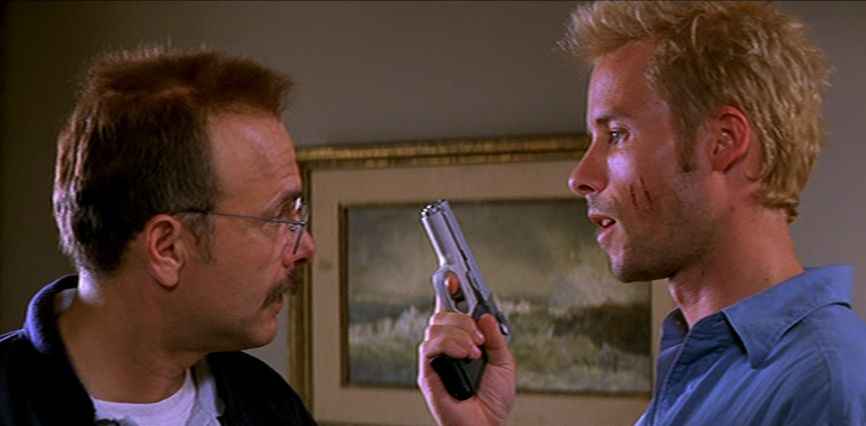
Leonard (Guy Pearce) is a man with anterograde amnesia; unable to store recent memories, his brain resets every fifteen minutes or so to completely forget where he is, how he got there, and what happened since the event that caused the amnesia. To get his bearings, he keeps photographs and notes and, for very important facts, tattoos, most of which explain to him that his wife was raped and murdered by someone named John G. whom he must seek out to exact his revenge.

In order to replicate the disorienting effect of Leonard’s lapses in memory, everything is broken up into disjointed sections that begin in medias res, with each division explaining the part before it. The film starts with a picture of a murder; then you see the murder itself. Leonard wakes in a hotel room with a man tied up in the closet; two segments later, you understand how that came about, even if Leonard himself will never remember the details.

One of the first questions for me kicked in when I wondered just how he knew the murderer was named John G. and how he obtained John G.’s license plate, despite his seemingly debilitating handicap. Doubt like that is exactly the point. Leonard’s “condition” leaves him entirely at the mercy of his notes and the explanations of others, if he chooses to listen to them. An apparent friend named Teddy (Joe Pantoliano from The Matrix) seems to want to help Leonard, but Leonard doesn’t know who he is. He could be his closest friend or his mortal enemy, and all he has to go by is a picture through which he has told himself not to trust Teddy, advice completely dependent on Leonard’s mindset at the time he wrote it. The same goes for a woman named Natalie (Carrie-Anne Moss, also from The Matrix), whose involvement with Leonard ranges from sympathetic to abusive depending on which piece of the puzzle we’re watching. Right when you think you know what’s going on, the next segment casts a new light on things.

This kind of storytelling is extremely fascinating, but confusion is unavoidable at times. It took me half the movie to realize that a series of intermixed black-and-white scenes of Leonard talking on the phone were happening chronologically in the past so that they would meet the scenes that were happening backwards. I’m still not sure I understand everything, and a second viewing is almost required.

Christopher Nolan’s first big mindbender is both his most puzzling and his most alienating work. While I was intrigued to find out what would happen (or rather what happened) and a perspective-changing tragedy tugged the mental heartstrings, the film felt cold overall. Most of Nolan’s work has some light to it, whether it be the dubiously heartwarming conclusions of Inception and Interstellar, the one-sided happy ending of The Prestige, or the humanity of the boat hostages in The Dark Knight. In Memento, there’s no satisfaction for anyone, no good will or unqualified concern. Brighter elements like these perhaps might seem out of place in a story about mental illness and revenge, but without them, Memento is not as emotionally engaging as it is mentally. Combine that with the fact that it features more foul language than all of Nolan’s later films combined, and it falls toward the bottom of his filmography for me, even if it is a riveting and wholly original piece of work.

Best line: (Leonard, to his wife while she’s re-reading a book) “I always thought the joy of reading a book is not knowing what happens next.”


Rank: List Runner-Up


© 2016 S. G. Liput

356 Followers and Counting


The Hunger Games: Mockingjay – Part 2 (2015)

17 Thursday Dec 2015

Posted by sgliput in Movies, Poetry, Reviews, Writing

≈ 2 Comments

Tags

Action, Drama, Sci-fi, Thriller


Children fought within the Games,
As posh patricians praised their names,
And through the safety of TV,
Let death abound for all to see.

Now death has bounded through the screen,
And at the urging of a teen,
The poor plebeians meant to lack
Have gained the courage to fight back.

When tyrannies use violent means
And worship death on TV screens,
It then should come as no surprise
In violence do the people rise.
For freedom, violence intervenes,
For can mankind learn otherwise?
________________

MPAA rating: PG-13


After watching the final Hunger Games film and contemplating whether I liked it or Catching Fire best, I’ve come to the conclusion that Mockingjay – Part 2 is the best installment of the series. The final chapter of any franchise is typically meant to be the grandest and most important, a rare but desirable feat that is indeed met by this last portion of Katniss Everdeen’s story.

Though I’m one of the few people not to have read the books, I’m well aware that Mockingjay is the least favored of Suzanne Collins’s trilogy, and some reviews for Mockingjay’s two film adaptations have been similarly blasé, since they say the book is better and its predecessors are better still. Yet Part 2 delivers on the setup of Part 1, trading in the previous film’s relative lack of thrills for the fast-paced intensity of the Maze Runner series.

I’ll try to be general to avoid spoilers: Katniss (ever-outstanding Jennifer Lawrence) and President Coin’s rebels aim for President Snow and the Capitol, even as the archer struggles with her split affections and Peeta’s recent brainwashing. Considering how Part 1 used Peeta’s sudden indoctrination as its climax, I was glad that it wasn’t swept away as a minor setback; instead, it becomes an ongoing risk, as well as a satisfying method of ironing out the reality among all the lies. The actual mission grows in importance as they continue, and the Hunger Games-style dangers encountered make Mockingjay – Part 2 the most intense film of the franchise, with one sequence that seemed fit for a horror movie.

Considering everything that has come before, it should be no surprise that there are many deaths along the characters’ difficult journey, and I suspect this is part of what many fans disliked. Killing off characters is most painful when it seems unfair, and such displeasing deaths can cause fans to be angrier at the storyteller than the characters responsible. (A recent example I disliked was in How to Train Your Dragon 2). Mockingjay – Part 2 has twists that aren’t exactly what fans would want or expect, but the story makes the best of them and ends up sadder but wiser, yet still fulfilling.

While the biggest complaint about Mockingjay is how it has been split into two parts for the sake of money, Part 2 actually served to vindicate that decision for me on the narrative level, at least somewhat. One hope I had for the Hobbit trilogy was that, by stretching the dwarves’ screen time, their characters would grow more familiar and not just be thirteen interchangeable companions. While Jackson failed in that regard, I felt Mockingjay succeeds. With so many new characters introduced between Parts 1 and 2, it made sense to establish some earlier on to distinguish them from the redshirts who don’t have enough screen time to leave an impression. (To use a Marvel comparison, whose death had more impact, that of Coulson, who was seen in multiple films, or that of Quicksilver, who had one?) While the decision did Part 1 no favors, it works to Part 2’s advantage.

As the capstone of The Hunger Games franchise, Mockingjay – Part 2 is both an exciting blockbuster and a dark climax for a dark series. While some elements may not satisfy, such as the resolution to the whole love-triangle friction, the majority do. The expansive cast perhaps aren’t fully utilized, but plot progression is more important than characterization at this point, since we’ve already gotten to know the important players over three films. (I was glad that Philip Seymour Hoffman’s role as Plutarch Heavensbee wasn’t much affected by his death earlier this year; his absence was only felt in one scene and was well sidestepped.) Most importantly, amid the chaotic action and sci-fi spectacle, the film reaffirms the franchise’s ultimate message. As Katniss has grown from fighting for survival to fighting for freedom or revenge, the struggle has not simply been against monosyllabic presidents but against anyone with contempt for life. It’s a theme still very much relevant today and one I hope will be ever in our favor.

Best line: (Katniss) “There are much worse games to play.”


Rank: List-Worthy (joining the other three in the series)


© 2015 S. G. Liput

349 Followers and Counting


The Silence of the Lambs (1991)

11 Friday Dec 2015

Posted by sgliput in Movies, Poetry, Reviews, Writing

≈ 3 Comments

Tags

Drama, Horror, Thriller


Evil comes in many forms,
In the loner and the swarms,
In the wielder of the knife,
In the prober of your life.
Though it hides or means to try,
It draws your interest and your eye.

Dark are deeds we’d never do,
Yet they still are dared by few.
Justice runs to halt the spread,
But if it wins, there’s still the dread.
Evil loves to carve its notch,
But why do any choose to watch?
_________________

MPAA rating: R
After years of hearing how great it is and seeing most of Anthony Hopkins’s performance through clips, I decided to finally watch the Best Picture of 1991. The Silence of the Lambs is everything critics have praised over the years: a dark mystery, a dramatic powerhouse, a compelling character study of two opposing forces, one seeking justice and the other too demented to be fully understood. It is both Hopkins’s and Jodie Foster’s finest hours, winning both of them Academy Awards, as well as Oscars for Best Director and Best Screenplay. And it is a great film which I have little desire to see again. The Silence of the Lambs is one of those movies that I can admire without being able to fully embrace as a favorite, more due to my personal sensitivities than to any flaws on the film’s part.

It’s an ingenious setup, pitting an eager but untested FBI agent-in-training (Foster) against the memorably evil serial killer Buffalo Bill (Ted Levine) with the aid of the even more memorably evil killer Hannibal Lecter (Hopkins). Clarice Starling is a woman trying to prove herself to her superior Jack Crawford (Scott Glenn) and to save other women, who are being killed and skinned by Bill across the Midwest. Jonathan Demme’s directorial tactic of filming actors as they look directly into the camera is even more effective than in his next film Philadelphia (which perhaps served to compensate for the allegedly homophobic aspects of Silence). As Crawford or Lecter or various men stare at Clarice and by extension the audience, it feels as if she is being sized up, measured, evaluated as an asset, a threat, or a toy. It’s an uncomfortable sensation but unique and intriguing enough to constantly hold our attention and keep us and Clarice on our toes.

Of course, the most remarkable element of the film is Anthony Hopkins, who amazingly won Best Actor for only sixteen minutes of screen time. He’s unflinchingly malevolent yet unsettlingly polite, a performance so captivating that it nearly dwarfs the rest of the film (hence, Best Actor rather than Best Supporting Actor). As diabolical and conniving as Lecter is, it’s Levine’s performance as Buffalo Bill that I found deeply disturbing. While Demme used much restraint in depicting the violence, Bill’s perverse cruelty doesn’t leave the mind easily, and I’ll probably just skip his scenes whenever I attempt a rewatch. It’s a wonder Levine has been able to move on from such a vile role.

Beyond Bill’s foul obsessions, I suppose my tepid appreciation stems from the fact that The Silence of the Lambs made me consider why serial killers are so popular. I don’t mean the supernatural types like Freddy Krueger (though I don’t like them either), but the modern focus on potentially real people who commit horrendous acts. Real-life killers like Ed Gein and Ted Bundy have inspired films like Psycho and Silence of the Lambs, and serial killers are still trendy in TV shows like Dexter and Hannibal. What is it that is so compelling about these experts of violence? Most people would never dream of committing such acts, and yet we watch them or hear about them; we study their modus operandi and are fascinated.

The Silence of the Lambs offers some insight into its killers, whether it be the deductive clue-chasing of the FBI agents tracking Bill down or the dehumanizing way Bill refers to his victims as “it.” Lecter represents the enthralling, psychological aspect of these butchers, while Bill epitomizes the disgust. It’s fascinating, yet I can’t help but feel guilty and repulsed by my own fascination. The Silence of the Lambs is a masterfully disturbing thriller, but I don’t often like being disturbed. I don’t want Hannibal Lecter inside my head.

Best line: (Hannibal Lecter, with his most iconic line) “A census taker once tried to test me. I ate his liver with some fava beans and a nice Chianti. Sssffff.”


Rank: List Runner-Up


© 2015 S. G. Liput

348 Followers and Counting


Frozen River (2008)

04 Sunday Oct 2015

Posted by sgliput in Movies, Poetry, Reviews, Writing

≈ 1 Comment

Tags

Drama, Thriller

Who would cross a frozen river,
Doubtful of its permanence,
And brave the temperature extremes?
One lacking lawful common sense
Or thawing frozen hopes and dreams?

Who would risk the little had
To aim for better plans ahead?
Perhaps one with a choice to face,
Where desperation dims the dread
And needed greed can turn to grace.
__________________

MPAA rating: R (solely for language)

When you hear stories on the news about illegal activities like smuggling, it’s easy to imagine that the perpetrators are wicked scum-of-the-earth types. While there are undoubtedly plenty of this sort out there, sometimes it takes a movie like Frozen River to put people’s actions in context.

Melissa Leo plays Ray Eddy, a woman just trying to get by on her dollar store paycheck while raising two sons. Intent on leasing a larger mobile home, her plans are devastated by her husband after he disappears with the money to satisfy his gambling addiction. Set against the freezing temperatures of upstate New York, the situation immediately gives the viewer reason to pity Ray’s predicament. From there, her gradual introduction into one leg of a smuggling operation is entirely believable, even as the movie earns its thriller classification with the tension of her potentially being caught. Ray isn’t alone in being sympathetic. Lila Littlewolf (the late Misty Upham), the Mohawk woman who persuades her to help transport illegal immigrants across the Canadian border, has problems of her own with her health, family, and job prospects. While she knows the ins and outs of the smuggling process, she’s no hardened criminal, and the two women form a tenuous but profitable bond.

With all of the debates about illegal immigration in this country, Frozen River thankfully doesn’t have an agenda. Like the Italian film Bicycle Thieves, it doesn’t try to justify the actions of its characters but rather helps us comprehend their motivations. Those scum-of-the-earth types are certainly part of the operation, but Ray and Lila are simply putting their family above the law, which is understandable if not altogether right. Moments of selfishness and concern give way to compassion and maternal solidarity, and though the ending could have benefited from an extra scene of closure, the moral climax plays out as it should. I certainly see why Leo earned a Best Actress nomination (and went on to win for The Fighter), and director Courtney Hunt also received an Oscar nod for her screenplay, which clarifies that not all who break the law have bad intentions.

Rank: List Runner-Up

© 2015 S. G. Liput

341 Followers and Counting

United 93 (2006)

30 Wednesday Sep 2015

Posted by sgliput in Movies, Poetry, Reviews, Writing

≈ 2 Comments

Tags

Drama, History, Thriller

Another day, another morning, not unlike the ones before,
The sun was shining without warning of the tragedy in store.
Another day of normal business, little slated to befall,
The kind to sink into the past without a reason to recall.

Some went about their own routines and kissed their families goodbye,
No knowledge of the future scenes to note suspicion in the sky.
Some woke to smoke and disbelief at holes in buildings unforeseen,
And average folk observed in grief the horrors on their TV screen.

A few of those who woke that day believing they’d have many more,
Above the fields of Pennsylvania, heard the early sins of war.
They perished there as victims of a sudden sorrow we regret,
But challenged it as selfless heroes whom we never will forget.
________________

MPAA rating: R

After hearing so many positive reviews of United 93, I decided I ought to watch it myself, and though I had hoped to see it around the anniversary of 9/11, its power doesn’t rely on when it is seen. Many films based on history try to recreate events accurately, but even if they avoid anachronisms and errors, they rarely transcend their status as a re-creation. Even with historical films I love like Titanic and Chariots of Fire, the presence of recognizable stars, artistic license, and that Hollywood polish belie the fact that I am watching a movie. United 93 is one of the few films that suspended that understanding and temporarily convinced me that I could be watching real events.

Obviously this was the goal for director Paul Greengrass (Captain Phillips), who purposely employed hand-held cameras for their realism and chose unknown actors or, in the case of the ground crews, many of the actual flight controllers who were working on September 11, 2001. The events of 9/11 are widely known, and by focusing on one plane’s story, the film never lets us forget that the viewer is watching a tragedy in progress. Because United Airlines Flight 93 was the only plane where the passengers fought back, its story is clearly the most dramatic in nature, yet its narrative is as convincing as a documentary and never feels theatrical.

From the time of the plane’s takeoff, events play out in real time. Normal people go about their business, making phone calls, taking pills, ordering breakfast, chatting about their kids, and ignoring the four overly silent Arabs who board Flight 93 out of Newark. Because we all know what will happen, the tension builds naturally, as reports come in of American 11 and United 175, which targeted the World Trade Center before Flight 93 had even been hijacked. Realistic interchanges between the air traffic controllers in different cities and the military reflect the confusion of that day, along with all the fear and uncertainty. When the awaited hijacking actually does happen, the tension and anticipation reset as the hostages, like the terrorists before, wait for the right moment to make their move. Difficult decisions and teary phone calls and desperate prayers are made, and even though I knew the outcome, the film made me hope and believe that the passengers might be successful.

Perhaps the most affecting scene is the glimpse we get of the field near Shanksville, Pennsylvania, where the plane crashed. On one of our vacations, my mom and I visited the Flight 93 National Memorial there and walked along the wall of names and saw the boulder that marks the impact point. It was cold and nearly deserted at that time of day, but I got a sense of the importance and grief behind the memorial. Though the film doesn’t even attempt to name the passengers, I felt United 93 only deepened my admiration and sorrow for these fallen heroes who never planned to be heroes.

Best line: (flight attendant Sandra Bradshaw, making a heartbreaking phone call) “But, baby, I promise you, if I get out of this, I’m quitting tomorrow. I’ll quit tomorrow. I promise, I’ll quit tomorrow.”

Rank: List-Worthy

© 2015 S. G. Liput

340 Followers and Counting

Predestination (2014)

07 Friday Aug 2015

Posted by sgliput in Movies, Poetry, Reviews, Writing

≈ 1 Comment

Tags

Drama, Sci-fi, Thriller

Destiny knocks
On paradox
And grants the wise
A big surprise.
______________

Rating: R (for frequent obscenities and two scenes of nudity, which are easily anticipated)

Predestination is an Australian film that is hard to describe without spoilers, but I’ll do my best. It revolves completely around the secrets and connections of its characters, creating one of the most paradoxical stories imaginable, courtesy of Robert Heinlein’s short story “’—All You Zombies—.’”

Stating the early facts, there’s a mysterious time-traveling agent intent on stopping a mysterious bomber, which then segues into a conversation between said agent as a Bartender (Ethan Hawke) and a confession writer who writes under the pen name “The Unmarried Mother” (Sarah Snook). (I thought Loretta Modern might have been a good pseudonym too.) From this intriguing start, there are flashbacks and quantum leaps and some fascinatingly subtle time-jumping effects, which all lead to a conclusion that I sadly already knew going in. I’m sorry; I just usually like to know what I’m getting into instead of going into a film cold, but in this case, I wish I hadn’t known, if only to see how much I would have guessed as the story progressed.

Sarah Snook earned the most acclaim for her versatility in playing a highly malleable role, and both she and Ethan Hawke carry the film almost by themselves. As I said, the twists are everything. Whereas most films use them to progress the story, here they are the story, which makes for a compelling puzzle but not so much a satisfying conclusion. Even I who knew what would generally happen still had trouble wrapping my head around everything, and it’s a film that would certainly reward a second viewing. Compared with many blockbusters, Predestination is high science fiction, with an ambitious story that goes a bit too high for my middlebrow tastes.

Best line: (the Bartender) “Preparation is the key to successful, inconspicuous time travel. Luck is the residue of design.”

Rank: List Runner-Up

© 2015 S. G. Liput

329 Followers and Counting

Buried (2010)

10 Wednesday Jun 2015

Posted by sgliput in Movies, Poetry, Reviews, Writing

≈ 3 Comments

Tags

Drama, Thriller

Within a box, a man awakens,
Buried after being taken,
Held for ransom in the ground
With little hope of being found.
In frenzied calls, he pleads for aid
From people grueling to persuade
And wonders if he’ll ever see
The light of day, above and free.
In fear and anger and distress,
He yields at times to hopelessness.
He hopes a savior can prevent
His grave from being permanent.
_______________

It’s amazing how an ending can ruin the movie experience.

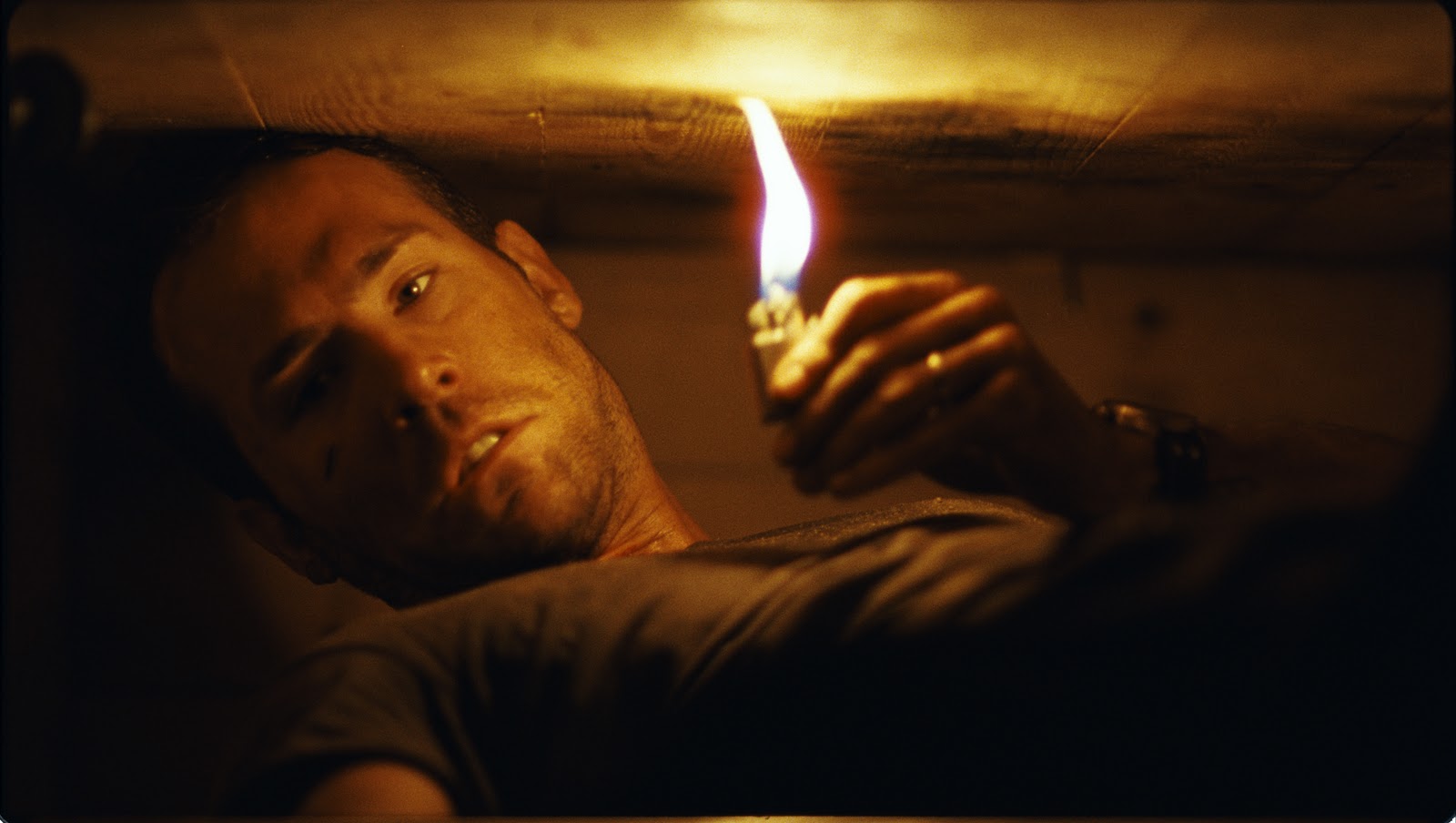
MovieRob recommended this film back during his Latin-directed Genre Grandeur month, and I was intrigued by the concept. It’s very simple but, in this case, very well-executed. Ryan Reynolds is utterly convincing as Paul Conroy, a truck driver in Afghanistan who finds himself trapped in a buried coffin with only a phone, a lighter, and a few other items. His panic is palpable, and as he places desperate calls to his wife, his employer, 911, and a hostage specialist, he evokes a rollercoaster of emotions. At times, he’s a bit hard to like as he cusses out the people who (we assume) are trying to help him, but in all honesty, I don’t know what I might say in his incredibly stressful situation, though I’d definitely be praying more.

As the film’s claustrophobia set in, I realized that I wasn’t just watching a man in a box; I was in there with him. The camerawork is brilliant, using every possible angle of Paul’s trapped body to keep the scene contained, with only sparse distant shots to reinforce his isolation. Considering the film’s limited setting, I was surprised at the amount of tension it could create with phone calls and in such a confined space, particularly when Paul gets an unwelcome visitor.

Despite the above praise, the film’s strengths are sadly undercut by an ending that I found to be deeply disappointing. [Spoilers for the rest of the review]. After all of Paul’s psychological torment, after everything he went through, the filmmakers apparently wanted to take the unexpected route and pull the rug out from the audience’s hopes. Surely the greatest expectation for a survival film is for the main character to survive. It doesn’t matter what horrors they go through, whether it’s cutting off their arm or their finger; there has to be a light at the end of the tunnel. In Buried, the filmmakers taunt us with that light, only to pull a psych-out, a false hope that leaves poor Paul Conroy dead and follows up his death with a bizarrely happy-sounding song during the end credits.

By the end, I was left with this disillusioned, empty feeling. What was the point of having sat through an hour and a half of claustrophobia? Should I have learned some lesson? I suppose the filmmakers were attempting to make some sociopolitical statement about the costs of war and illustrate how people in desperation often don’t find the help they need, how hostage situations often end in tragedy, but I’ve grown to despise films whose only ultimate message seems to be that things sometimes just don’t work out (i.e., 5 Centimeters Per Second).

It feels odd to complain about a film not having a happy ending since many of my favorite films end in grief (Grave of the Fireflies, Somewhere in Time, The Green Mile), but in all of these cases, there is either some silver lining or the film’s tragedy is clear from the outset. Buried is a survival thriller, one which puts its character and audience through the ringer with no satisfaction of being released. Some may enjoy that, but I certainly don’t. Sorry, Rob.

Best line: (Dan Brenner’s last words to Paul and maybe everyone watching) “I’m sorry, Paul. I’m so sorry.”

Rank: Dishonorable Mention

© 2015 S. G. Liput

314 Followers and Counting

The Shining (1980)

10 Sunday May 2015

Posted by sgliput in Movies, Poetry, Reviews, Writing

≈ 2 Comments

Tags

Drama, Horror, Thriller


A lonely hotel is a dangerous thing,
At least in the works of an author named King,
For no one can know what occurs in the mind
When volatile men are annoyed and confined.
 
They say, like Jack Torrance, the winter caretaker,
That past tragedies are no sign or deal breaker.
He’s simply too sane for such things to occur;
His wife is the same, and he’d never hurt her.
 
But get them alone in a desolate maze
And watch them get worse with the passing of days
And cringe as the dread and the wickedness weave,
For those at the Overlook may never leave.
__________________
 

The only part of this Stephen King adaptation I’d seen previously was the snippets of the most famous scenes in Twister. Oh, and countless parodies of that infamous send-up of Johnny Carson’s introduction. Not being a fan of horror in general, I’m not surprised I never got around to this one, but I decided to give it a try based on its reputation alone (92% on Rotten Tomatoes).

Though horror often has a stigma as a B-movie genre, frequently relying on clichés, cardboard characters, and unnecessary violence, The Shining is a film that truly deserves its iconic status and high rankings among the top scary films. While I’m not a fan of Stanley Kubrick and consider 2001 vastly overrated, I have to admit he’s quite the skillful filmmaker. The direction and cinematography are exceptional, full of those long tracking shots that leave viewers like me enraptured by the fluidity of the camerawork. The film was one of the first to fully utilize the new Steadicam, which allowed the camera to follow the characters as they stroll, creep, or flee through expansive rooms and twisting corridors. Not only is it admirable for its style, but it also heightens the tension (along with the unnervingly dissonant score) as the viewer rounds corner after corner, preparing for some inevitable surprise that may or may not come.

Equally impressive is the performance from the ever brilliant Jack Nicholson as Jack Torrance, the kind of sanity-sapping role at which Nicholson excels, though he looked at least a little unhinged even from the beginning when he was supposed to seem normal. (It’s those devilish eyebrows!) I do wonder, though, what it was exactly that triggered his maniac descent when he seemed fine for an entire month; perhaps it was merely the constant sole presence of his wife (a perfectly hysterical Shelley Duvall), whom he evidently resented on some level even beforehand. The young Danny Lloyd also gives a memorably creepy performance as son Danny Torrance, who possesses some form of ESP (referred to as “shining”) and shares a body with the ambiguous Tony, who could be anything from a split personality to an unexplained possession. While Lloyd’s scenes are highly effective, I can’t help but feel concern when films like this employ such young child actors for potentially unsettling roles, though Lloyd supposedly never realized he was filming a horror movie. Also, sharing another film with Nicholson is Scatman Crothers, the concerned cook who reminded me of that sheriff in King’s Misery in more ways than one.

While the horror genre would not be taken seriously by the Academy until Silence of the Lambs in 1991, The Shining had the potential to break that barrier first, boasting enough quality filmmaking to deserve Oscar nominations or wins for at least Best Actor, Editing, and Cinematography. Alas, it was not to be, since The Shining’s popularity was slow in coming, and it was actually nominated that year for Razzies rather than Oscars. It was criticized for its slow pace and significant differences from King’s novel, but the main flaws for me were the language and a wholly unnecessary nude scene thrown in to solidify its R rating. Despite this, the film fits the mold of the few horror films I like in focusing on restrained horror and disturbing atmosphere rather than continual gore. The Shining is one of the best examples of a psychological horror, full of taut ambience, a little inexplicable weirdness, and an enigmatic ending that has kept critics and fans debating ever since about ghosts, time travel, and psychosis. Even so, it’s not one I’d watch often and certainly not at night.

Best line: (the obvious; Jack Torrance, as he axes through a door) “Heeere’s Johnny!”

 
Rank: List Runner-Up
 

© 2015 S. G. Liput

305 Followers and Counting

Coma (1978)

02 Saturday May 2015

Posted by sgliput in Movies, Poetry, Reviews, Writing

≈ 1 Comment

Tags

Drama, Thriller


Surgeries happen every day,
Routine and clean, so doctors say.
You simply go to sleep and then
They ought to wake you up again.
 
What’s that? You’ve heard, through some mistake,
That sometimes people never wake?
That’s possible, but don’t dismay;
It’s very rare, so doctors say.
 
You need not worry of a coma;
Trust the doc and his diploma.
Never fear about foul play
That can’t occur, so doctors say.
 
Statistics prove how safe you are;
The surgeon’s been ideal so far.
He’ll deftly take the pain away,
And you’ll be fine, so doctors say.
________________
 

Michael Crichton’s second film, after Westworld, was this adaptation of Robin Cook’s novel, about (you guessed it!) comas. More specifically, it concerns the investigations of young medical resident Dr. Susan Wheeler (Genevieve Bujold), who notices suspicious similarities among routine surgeries which result in unexplained brain deaths.

I had never even heard of this film before my VC recommended it, but it was actually quite entertaining, a mystery/thriller that keeps viewers guessing with its overriding paranoia. It starts off a bit rocky with a lover’s quarrel between Drs. Wheeler and Mark Bellows (Michael Douglas), which escalates quickly with too little characterization as yet for us to know with whom we should sympathize. Add to this a slightly disturbing early scene involving a “routine” abortion, and I was dubious about whether the rest of the film would improve. It did. As Susan proceeds from apparently overthinking these cases to uncovering genuinely suspect evidence of foul play, the danger grows more and more real, with shady voyeurs and ruthless conspiracies. A couple scenes may seem like science fiction, but the film is even more frightening for the fact that its core concept is chillingly plausible. The reveals are best left for actually watching the film (don’t even see the spoiler-ific trailer), since it’s a glued-to-the-screen experience from the midpoint on.

I can’t say I’ve seen any of Bujold’s films, so I was interested to see the actress who was almost Captain Janeway on Star Trek: Voyager. To be honest, I prefer Kate Mulgrew, but Bujold could have pulled it off. She deftly carries the bulk of the film, first with some women’s lib independence, then with an increasingly paranoid race for the truth and survival. Richard Widmark, Rip Torn, and Michael Douglas also provide commendable performances, even though I’ll always see the latter as either Jack Colton from Romancing the Stone or Gordon Gekko from Wall Street. The most surprising appearances are the film debuts of not only Ed Harris, but also an ill-fated Tom Selleck.

Now that I’ve seen the original film, I should also check out the A&E miniseries remake from 2012, if only for comparison. I doubt it could match this film’s burgeoning tension, but you never know. Thanks to my VC, Coma is yet another nearly forgotten film of the ‘70s to add to my list.

Best line: (a nurse) “Doctors make the worst patients. They know too much.”

 
Rank: List-Worthy
 

© 2015 S. G. Liput

303 Followers and Counting

← Older posts
Newer posts →

Recent Posts

  • We Didn’t Start 2025 (Recap)
  • NaPoWriMo 2025 Recap (Finally)
  • Sonic the Hedgehog 3 (2024)
  • It Happened One Night (1934)
  • Spellbound (2024)

Recent Comments

associatesofshellymann's avatarassociatesofshellyma… on My Top Twelve La La La So…
Kit's avatarKit Nichols on Bonnie and Clyde (1967)
lifelessons's avatarlifelessons on Look Back (2024)
Carol Jackson's avatarCarol Jackson on The Thief of Bagdad (1940…
Stephen's avatarStephen on Love Story (1970)

Archives

  • January 2026
  • December 2025
  • May 2025
  • April 2025
  • March 2025
  • February 2025
  • January 2025
  • December 2024
  • May 2024
  • April 2024
  • March 2024
  • February 2024
  • January 2024
  • December 2023
  • November 2023
  • October 2023
  • September 2023
  • July 2023
  • June 2023
  • May 2023
  • April 2023
  • March 2023
  • February 2023
  • January 2023
  • December 2022
  • November 2022
  • October 2022
  • September 2022
  • August 2022
  • July 2022
  • June 2022
  • May 2022
  • April 2022
  • March 2022
  • February 2022
  • January 2022
  • December 2021
  • November 2021
  • October 2021
  • September 2021
  • August 2021
  • July 2021
  • June 2021
  • May 2021
  • April 2021
  • March 2021
  • February 2021
  • January 2021
  • December 2020
  • November 2020
  • October 2020
  • September 2020
  • August 2020
  • July 2020
  • June 2020
  • May 2020
  • April 2020
  • March 2020
  • February 2020
  • January 2020
  • December 2019
  • November 2019
  • October 2019
  • September 2019
  • August 2019
  • July 2019
  • June 2019
  • May 2019
  • April 2019
  • March 2019
  • February 2019
  • January 2019
  • December 2018
  • November 2018
  • October 2018
  • September 2018
  • August 2018
  • July 2018
  • June 2018
  • May 2018
  • April 2018
  • March 2018
  • February 2018
  • January 2018
  • December 2017
  • November 2017
  • October 2017
  • September 2017
  • August 2017
  • July 2017
  • June 2017
  • May 2017
  • April 2017
  • March 2017
  • February 2017
  • January 2017
  • December 2016
  • November 2016
  • October 2016
  • September 2016
  • August 2016
  • July 2016
  • June 2016
  • May 2016
  • April 2016
  • March 2016
  • February 2016
  • January 2016
  • December 2015
  • November 2015
  • October 2015
  • September 2015
  • August 2015
  • July 2015
  • June 2015
  • May 2015
  • April 2015
  • March 2015
  • February 2015
  • January 2015
  • December 2014
  • November 2014
  • October 2014
  • September 2014
  • August 2014
  • July 2014
  • June 2014
  • May 2014
  • April 2014
  • March 2014
  • February 2014
  • January 2014
  • December 2013

Categories

  • Blindspot
  • Blogathon
  • Christian
  • Movies
  • Music
  • NaPoWriMo
  • Poetry
  • Reviews
  • TV
  • Writing

Meta

  • Create account
  • Log in
  • Entries feed
  • Comments feed
  • WordPress.com

Recent Posts

  • We Didn’t Start 2025 (Recap)
  • NaPoWriMo 2025 Recap (Finally)
  • Sonic the Hedgehog 3 (2024)
  • It Happened One Night (1934)
  • Spellbound (2024)

Recent Comments

associatesofshellymann's avatarassociatesofshellyma… on My Top Twelve La La La So…
Kit's avatarKit Nichols on Bonnie and Clyde (1967)
lifelessons's avatarlifelessons on Look Back (2024)
Carol Jackson's avatarCarol Jackson on The Thief of Bagdad (1940…
Stephen's avatarStephen on Love Story (1970)

Archives

  • January 2026
  • December 2025
  • May 2025
  • April 2025
  • March 2025
  • February 2025
  • January 2025
  • December 2024
  • May 2024
  • April 2024
  • March 2024
  • February 2024
  • January 2024
  • December 2023
  • November 2023
  • October 2023
  • September 2023
  • July 2023
  • June 2023
  • May 2023
  • April 2023
  • March 2023
  • February 2023
  • January 2023
  • December 2022
  • November 2022
  • October 2022
  • September 2022
  • August 2022
  • July 2022
  • June 2022
  • May 2022
  • April 2022
  • March 2022
  • February 2022
  • January 2022
  • December 2021
  • November 2021
  • October 2021
  • September 2021
  • August 2021
  • July 2021
  • June 2021
  • May 2021
  • April 2021
  • March 2021
  • February 2021
  • January 2021
  • December 2020
  • November 2020
  • October 2020
  • September 2020
  • August 2020
  • July 2020
  • June 2020
  • May 2020
  • April 2020
  • March 2020
  • February 2020
  • January 2020
  • December 2019
  • November 2019
  • October 2019
  • September 2019
  • August 2019
  • July 2019
  • June 2019
  • May 2019
  • April 2019
  • March 2019
  • February 2019
  • January 2019
  • December 2018
  • November 2018
  • October 2018
  • September 2018
  • August 2018
  • July 2018
  • June 2018
  • May 2018
  • April 2018
  • March 2018
  • February 2018
  • January 2018
  • December 2017
  • November 2017
  • October 2017
  • September 2017
  • August 2017
  • July 2017
  • June 2017
  • May 2017
  • April 2017
  • March 2017
  • February 2017
  • January 2017
  • December 2016
  • November 2016
  • October 2016
  • September 2016
  • August 2016
  • July 2016
  • June 2016
  • May 2016
  • April 2016
  • March 2016
  • February 2016
  • January 2016
  • December 2015
  • November 2015
  • October 2015
  • September 2015
  • August 2015
  • July 2015
  • June 2015
  • May 2015
  • April 2015
  • March 2015
  • February 2015
  • January 2015
  • December 2014
  • November 2014
  • October 2014
  • September 2014
  • August 2014
  • July 2014
  • June 2014
  • May 2014
  • April 2014
  • March 2014
  • February 2014
  • January 2014
  • December 2013

Categories

  • Blindspot
  • Blogathon
  • Christian
  • Movies
  • Music
  • NaPoWriMo
  • Poetry
  • Reviews
  • TV
  • Writing

Meta

  • Create account
  • Log in
  • Entries feed
  • Comments feed
  • WordPress.com

Blog at WordPress.com.

  • Subscribe Subscribed
    • Rhyme and Reason
    • Join 814 other subscribers
    • Already have a WordPress.com account? Log in now.
    • Rhyme and Reason
    • Subscribe Subscribed
    • Sign up
    • Log in
    • Report this content
    • View site in Reader
    • Manage subscriptions
    • Collapse this bar