• Home
  • About Me
  • The List
  • THE LIST (2016 Update)
  • THE LIST (2017 Update)
  • THE LIST (2018 Update)
  • THE LIST (2019 Update)
  • THE LIST (2020 Update)
  • THE LIST (2021 Update)
  • THE LIST (2022 Update)
  • Top Twelves and More
  • The End Credits Song Hall of Fame

Rhyme and Reason

~ Poetry Meets Film Reviews

Rhyme and Reason

Tag Archives: Foreign

The Red Turtle (2016)

08 Friday Sep 2017

Posted by sgliput in Blogathon, Movies, Poetry, Reviews, Writing

≈ 7 Comments

Tags

Animation, Drama, Fantasy, Foreign, Romance

Image result for the red turtle film

Shall I sit here all alone
And wait for death to call me home?
Now that I am stranded here,
Have worth and meaning flown?

Shall I push uphill my stone
And watch it roll back down and groan
And wish that life had chanced to veer
Somewhere less sorrow-prone?

Perhaps I’ll work myself to bone
And die unloved and thus unknown,
But if somebody could appear
And comfort give to persevere,
I’d gladly bear my daily stone
With one to call my own.
_________________

MPAA rating: PG

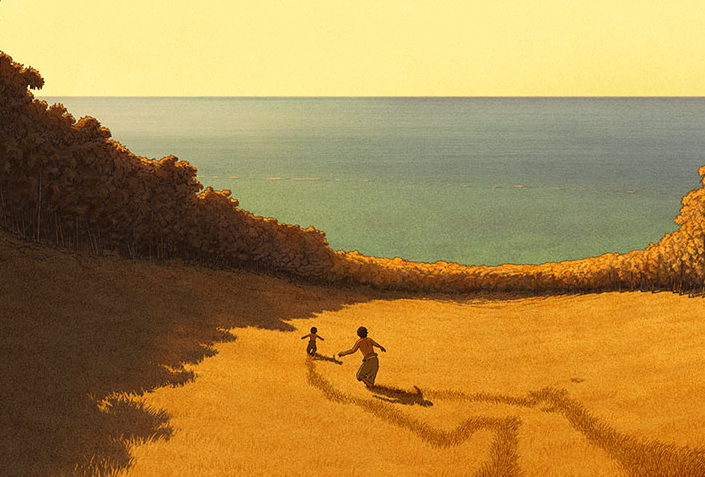
This review is my contribution to the Colours Blogathon hosted by Catherine of Thoughts All Sorts, focusing on all manner of movies with colorful titles. I chose The Red Turtle not only for the color in its name, but because I was curious about this feature-length silent film that earned an Oscar nomination for Best Animated Feature when Your Name didn’t. Now that I’ve seen it, I completely agree that it deserved such an honor because this story of a shipwrecked man stranded on an island is a piece of cinematic art. So many cartoons these days rely on hyperactive humor that something like The Red Turtle is an anomalous reminder that animation can offer compelling stories without jokes or even words through simple mastery of the medium, allowing silence to make it universal.

Image result for the red turtle film

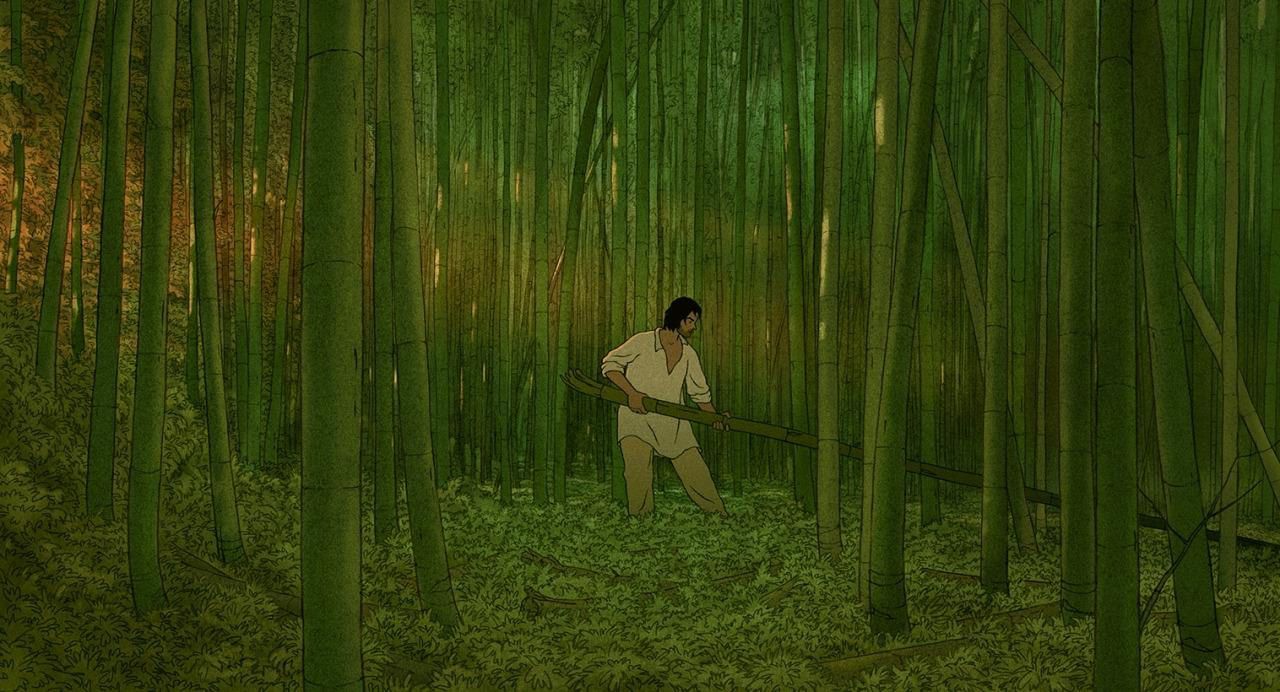
The beautifully simple animation is the product of a collaboration between Dutch director Michaël Dudok de Wit, winner of the 2001 Animated Short Film Oscar for the lovely Father and Daughter, and the not-yet-defunct Studio Ghibli. I’m still surprised at Ghibli’s involvement because The Red Turtle has no resemblance to anime, except maybe in the attention to natural detail, yet I’m reminded that anime is not limited by the usual big-eyed style. The Oscar-winning short film La Maison en Petits Cubes has a European aesthetic similar to The Red Turtle, but, despite the French name, it was a Japanese production. So you could say that The Red Turtle is a best of both worlds, combining the visual imaginations of its animators in a surprisingly accessible, almost watercolor style.

Silent animation is usually the realm of short films, and it must have been a risk to protract what could have been vastly shortened to a feature-length story. Those with short attention spans will likely be bored by the third raft-making attempt, but the patient should find the narrative rewarding in its ambiguity. As with Cast Away, actions speak louder than words, and the painterly animation is so superb in its simplicity that I was rarely bored. It’s all in the details, like the humorous characterization of the crabs watching the man’s efforts or the lush island greenery swaying in the breeze, and the realistic water is worth particular praise, whether serene on the horizon or violent in its outbursts.

I don’t want to say much about the actual plot since it’s best experienced with the intended visuals to tell the story, but it very much fits its description as a fable, a seemingly straightforward tale that can be appreciated on its surface or on a deeper, more symbolic level. The Red Turtle itself remains something of an enigma, even as it becomes a profoundly important part of the castaway’s life, infusing the film and its ending with a bittersweet emotion that is strongly felt, if not fully understood.

Image result for the red turtle film

So, yes, The Red Turtle is absolutely Oscar-worthy and, if not for last year’s hefty competition, might well have won. Why couldn’t a film like this come out in 2006 or 2011, when Disney/Pixar wasn’t a shoo-in? I suppose I can now turn my blame on My Life as a Zucchini (the only nominee I haven’t yet seen) for Your Name’s lack of nomination last year because The Red Turtle is more than deserving. Despite its slow narrative that could have been a short film, it’s a piece of modern art that is becoming rarer and rarer in the world of feature-length animation.

Best line:  (the man’s only line) “Heeeeey!”


Rank: List Runner-Up


© 2017 S.G. Liput
506 Followers and Counting


Labyrinth of Lies (2014)

22 Sunday May 2016

Posted by sgliput in Movies, Poetry, Reviews, Writing

≈ Leave a comment

Tags

Drama, Foreign, History


A monster’s a monster, regardless of size.
‘Twould be an outrage to imply otherwise.
A villain’s a villain; of that, there’s no doubt.
Do we know all villains worth knowing about?

A murderer’s evil, without an exception,
And those who assisted his crime or deception
And those who stood by to let one such go free
Are all as blameworthy as he. Disagree?

But what if you stood there and let him go by,
In fear that a critic would be next to die?
‘Tis no less wrong, is it, to stifle your tongue,
But are you still evil like those you’re among?

While evil is evil, as most should agree,
A sinner can vary by deed and degree.
Discerning a villain is right and essential,
But so is the fact we all have the potential.
________________

MPAA rating: R (for descriptions of violence and a brief bedroom scene; could easily be PG-13 with the slightest editing)

I’ve only seen three German films (3½ if I count Joyeux Noel), but Labyrinth of Lies is easily the best. Germany’s unnominated submission to the Academy Awards intrigued me with the trailer alone, and the film delivered exactly what I hoped for, an investigative new look at the semi-known stories of Auschwitz and Germany’s response to it in the years after World War II.

It’s taken for granted nowadays that most people have heard of Auschwitz and the crimes perpetrated by the Nazis, but early in Labyrinth of Lies, journalist Thomas Gnielka (André Szymanski) asks several passersby if they’d ever heard of Auschwitz. Everyone answers “No.” The year is 1958, and within one generation, the atrocities of Nazi Germany had been nearly erased where they most needed to be remembered. Nuremberg tried the Nazi leadership, but the thousands of Nazi Party members didn’t just disappear; they blended back into the populace, never telling their children what they had done. While Jewish survivors tried to forget the horrors they endured, everyone else just ignored them.

Unjust is a mild descriptor for such a situation, and when injustice runs rampant, thankfully someone steps forward for what’s right. While he seems to be a composite of several real-life figures, that someone is Johann Radmann (Alexander Fehling), a lawyer who tends to see every crime as black or white, not even yielding to overlook a minor traffic violation. Young and ambitious, he too has no idea of the Nazis’ crimes, and when his eyes are opened, he makes it his duty to bring justice to the victims. With support from his boss Fritz Bauer (Gert Voss, who died before the film’s release), he seeks out buried records, reluctant witnesses, and slippery targets – a teacher, a businessman, a baker –, determined that their own country try them for war crimes. He eventually sets his sights on Auschwitz’s monstrous doctor Josef Mengele, who was not caught after the war and escaped into hiding. As Radmann, Fehling is outstanding and often reminded me of a less baby-faced Leonardo DiCaprio; though German, he has at least appeared in Inglourious Basterds and Homeland, but he’s such a good actor that I hope he appears in more English-language roles.

Radmann is a dogged crusader for truth, even to the point of obsession, and the more lies he uncovers, the more his faith in humanity is shattered. He looks at pictures of Mengele and comments at how normal he looks. How could he have done such nightmarish deeds? How could an entire country yield to such hate and cruelty? The deeper he digs, the more blame he finds for everyone. Aside from the victims, no one was entirely guiltless, but does that mean everyone was a monster? Does remembering the bad mean disregarding the good, or vice versa?

Labyrinth of Lies deals with its subject frankly but unobtrusively. Despite the R rating, little is seen of the actual concentration camp crimes, and I prefer that, to be honest. I am fully aware of how barbaric the Nazis were, but I don’t want to see it recreated onscreen. That’s why I haven’t yet been able to bring myself to watch Schindler’s List, even though I realize I’m perpetuating to some extent the mindset of many Germans in Labyrinth of Lies, not wanting to see evil for what it was. This film deals with the horrific facts in a believably restrained manner that still underscores how they must never be forgotten. It’s encouraging that such a film came out of Germany itself, indicating the nation’s resolve to remember. Labyrinth of Lies is in German, but even haters of subtitles should give this engrossing historical drama a chance. I’m glad I did.

Best line: (Bauer) “Why have you come back?”   (Radmann) “Because the only response to Auschwitz is to do the right thing yourself.”


Rank: List-Worthy


© 2016 S. G. Liput

386 Followers and Counting


Ragnarok (2013)

30 Saturday Apr 2016

Posted by sgliput in Movies, NaPoWriMo, Poetry, Reviews, Writing

≈ 3 Comments

Tags

Action, Drama, Family, Fantasy, Foreign, Thriller


(Today’s final NaPoWriMo/GloPoWriMo prompt was to write a translated poem, so I tried to write something homophonically similar to “The Half-Finished Heaven” by Swedish poet Tomas Transtromer. Doing that, I could have ended up with something as inscrutable as some of Gerard Manley Hopkins’ work, so instead I simply began each line of the poem below with the same letter as the original poem and chose a Scandinavian film to review.)

Mid-look was my life cut short,
Aghast at the proven report.
Goodbye to my daughter and son;
Dear father will never see port.

A brave man was I, no mistake.
Oh, Vikings would never forsake.
Vigor was rife in our bones,
Alas, till they littered the lake.

Veiled are we here in our sleep,
Veiled in the dangerous deep.
Still does our conqueror live,
Drowsing upon our corpse heap.

Valiant and foolish to tarry
Is he who finds our cemetery.
______________

MPAA rating: PG-13

Ragnarok may be the first Norwegian film I’ve seen, in a way the Norwegian equivalent of a late-summer blockbuster. Perhaps the closest thing I can compare it to is 2008’s Journey to the Center of the Earth with Brendan Fraser, loaded as both are with clichés and genuinely thrilling moments. Both films start out much the same; like Fraser’s volcanologist, archaeologist Sigurd Swenson (good Scandinavian name!) is desperate for funding, and when an enigmatic clue arises, he brings along his two kids Ragnhild and Brage and a couple colleagues on an ill-advised search for answers that doesn’t go as planned. In lieu of a Jules Verne novel as inspiration, Norse mythology stands in with the story of Ragnarok, a.k.a. the end of the world.

The expedition walks into danger when they raft across a remote, far-north lake to a central island where both Vikings and Russians once visited, never to leave again. It’s an effective build-up to what is ultimately a creature feature. The monster hidden below the surface and the foolish decisions of the humans will bring to mind films like Jaws, Eragon, and Jurassic Park III, but this Norwegian equivalent of those movies usually manages to make the material its own. A few set pieces involving a zip line and a bunker are edge-of-your-seat highs, and my VC was far more terrified than I at one prolonged suspense scene.

It may not be entirely original, but Ragnarok is an entertaining action adventure with some tense thrills that never become un-family friendly. The special effects are usually as good as most American productions, and the isolated Arctic scenery makes for a stunningly rich setting. I will be interested to see how Marvel’s Thor: Ragnarok compares. For a first accessible foray into Norwegian cinema, I’d recommend Ragnarok, though don’t watch the English dub. Most dubs don’t bother me, but when children are screaming and some English voiceover dully says “Help me,” it kinda ruins the moment.

Rank: List Runner-Up

© 2016 S. G. Liput

385 Followers and Counting


Rashomon (1950)

21 Saturday Nov 2015

Posted by sgliput in Blogathon, Movies, Poetry, Reviews, Writing

≈ 1 Comment

Tags

Drama, Foreign


While weather is windy and bitterly pouring,
Four stories are told when the truth needs exploring,
Four different accounts with the witnesses warring,
But no outright answer for askers imploring.
While some simply welcome whatever’s not boring,
The doubt is too heavy for easy ignoring.
Both lies and the truth can leave consciences roaring,
But everyone’s faith is in need of restoring.
_________________

MPAA rating: Not Rated (should be PG for mature themes)


This is a last-minute contribution to the Criterion Blogathon, hosted by Criterion Blues, Speakeasy, and Silver Screenings, in order to honor the old and new film classics selected by the Criterion Collection. After thoroughly admiring Akira Kurosawa’s epic Seven Samurai, I thought I might check out his earlier work, in this case Rashomon, the film that sparked pioneering interest in Asian cinema throughout the West. The story of Rashomon is simple yet profound, intimate yet eclectic, an art film with plenty of moral insight and a technique that has inspired everything from Western remakes (The Outrage, Hoodwinked!) to TV episodes (such as Star Trek: The Next Generation’s “A Matter of Perspective”).

Rashomon itself is an abandoned gate between Kyoto and Nara, though its name always sounds to me like a character from Digimon. The rain-drenched frame story allows a woodcutter and a priest to recount a trial they just witnessed to a surly passerby as they all take shelter beneath the decrepit Rashomon gate. The two watched as the infamous bandit Tajōmaru was tried for the murder of a samurai and the rape of his wife, and both are clearly shaken, having had their faith in humanity cast in doubt.

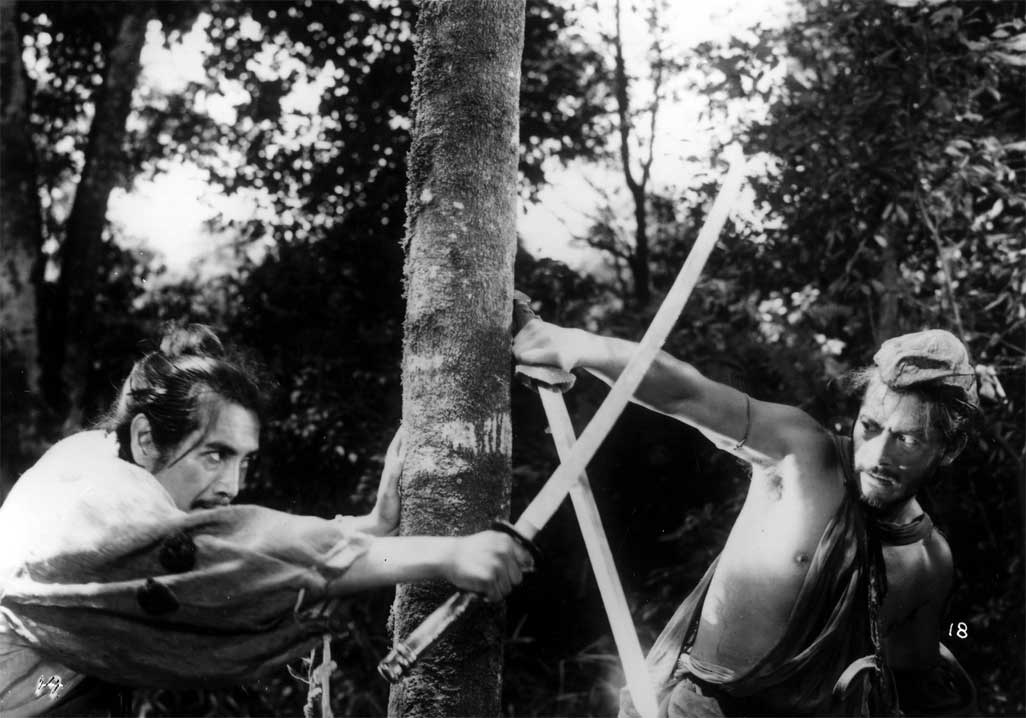
What follows are four stories of the fateful encounter from four different perspectives. All have the same outcome, yet none are the same. The bandit (Toshiro Mifune of Seven Samurai and other Kurosawa projects) boasts about his daring, recounting an admittedly impressive swordfight against the samurai (Masayuki Mori) after having his way with the woman (Machiko Kyō). The woman ignores any mention of a fight and casts herself as a victim of both men. The samurai may be dead, but a possessed medium explains his viewpoint with rather disturbing behavior, casting more blame on the woman than on the bandit. And then there’s the truth. Or is it? While the final tale seems to be the most plausible in spreading the guilt around, there’s still the smack of hypocrisy, and one can’t help but wonder what all four may be leaving out to suit their own point of view. Ambiguity and doubt are prevalent, yet Kurosawa doesn’t try to discount morality in general through his questioning of what really happened. The world may be full of liars, but human kindness can still have its say.

In addition to its morally debatable themes, Rashomon is also noted for its cinematography and tight editing. As commendable as these are, the film does embrace certain excesses in the way it is told. The opening scene, for example, in which the woodcutter wanders through the dense forest foliage before coming upon the crime scene, is meant to build tension and recall the silent film era, but it unfortunately drags, just one scene that stretches the audience’s patience to the edge of boredom. While much of the acting is subtle and faultless, other moments are acutely overacted, such as the crazy outbursts of two of the players and the woman’s incessant sobbing. These criticisms can doubtless be attributed to the acting conventions of the time, since this film is far from the only aged offender in that regard.

Yet despite the shortcomings of individual scenes, Rashomon is still the classic so many critics have hailed, well deserving of its honorary Academy Award five years before the Oscar for Best Foreign Language Film was established. Influential in its uncertainty and thought-provoking in its divergent narrative, Rashomon helped to solidify Kurosawa as an esteemed director the world over.

Best line: (the surly peasant, defending yet impugning everyone from liars to storytellers) “I don’t mind a lie if it’s interesting.”


Rank: List Runner-Up


© 2015 S. G. Liput

345 Followers and Counting


My Top Twelve Anime Films

18 Friday Sep 2015

Posted by sgliput in Movies, Reviews, Writing

≈ 19 Comments

Tags

Animation, Anime, Foreign, Lists

After last week’s Opinion Battle, I noticed that many movie reviewers perhaps have not had much exposure to anime beyond the few Studio Ghibli films that have gained acclaim outside Japan. Thus, I thought my next list would cover my favorite anime (which is just another word for a Japanese cartoon. Cue debate.)

I myself have had a varied history with anime. I grew up with the usual kids’ stuff like Pokémon and Yu-Gi-Oh! and Dragon Ball Z, but it just blended into all the animated TV shows I watched and never stood out to me as something different. Then came Spirited Away, and when it won the Oscar for Best Animated Feature in 2002, my parents and I decided to watch it pay-per-view. Nothing had prepared us for just how bizarre and, well, foreign it was (seriously, green decapitated heads rolling around?), and though I don’t recall my exact reaction other than “it was weird,” my parents totally turned their backs on anime overall. They still haven’t fully recovered.

It wasn’t until years later that a review of Grave of the Fireflies prompted me to give anime another try, and its moving and realistic story contrasted so greatly with Spirited Away that it gave me a new respect for what this genre could accomplish. A marathon of Ghibli films followed, and now I have enough favorite anime to make up a list like this. I don’t know how many like me there are, but I’m one of those people who would sooner watch an animated movie than a live-action one, and anime fits into that category. While it’s not my favorite genre, it’s among my most watchable.

I will say that I’m rather particular about my anime, and the kind I watched as a kid with all the yelling and exaggerated faces and reactions no longer appeals to me. None of the films below nor any Ghibli film I’ve seen carry these clichés, and I think they are better for it. Thus, here are my top twelve anime, and I hope that someone adventurous out there will give them a try as I did. You might find a new favorite too.

#13/Runner-Up: Princess Mononoke (1997), Studio Ghibli, directed by Hayao Miyazaki
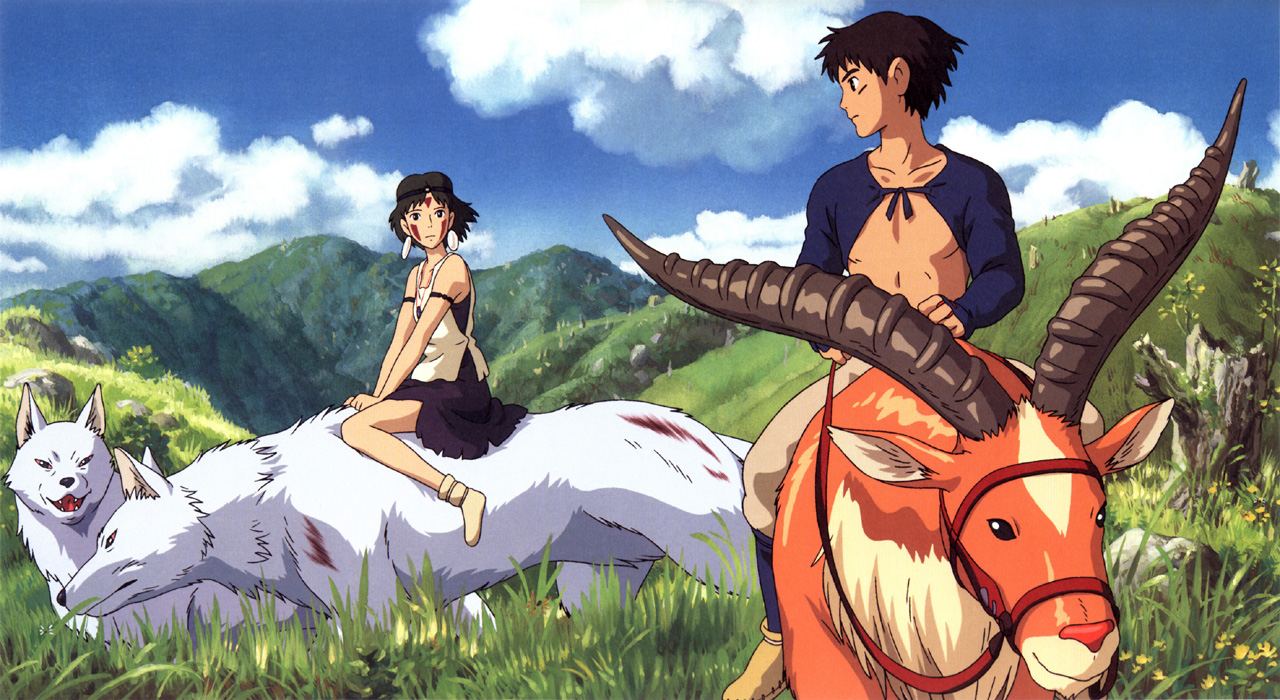
This is another film that I was not prepared for, in particular the violence. No other Ghibli film is like it and very few reviews mention how violent it is so I was shocked when heads and limbs started flying. However, when I eventually looked past this graphic element, I saw the story and artwork are amazing, and that the actual violence is a small part of the long running time. I cannot think of another animated film that I could easily call an epic, but Princess Mononoke fits that mold, as it follows Prince Ashitaka on a quest to cure a demon’s curse and restore peace to warring humans and forest gods. The pagan mythology is heavy, but the engrossing action and ambiguous characterization are exactly what made Miyazaki so famous. If only he’d left out the unnecessary violence…. (The English dub includes Claire Danes and Billy Bob Thornton.)

#12: Time of Eve (2010), Studio Rikka, directed by Yasuhiro Yoshiura

A more recent watch that displaced by previous #12, Time of Eve is a six-part web series that was combined into a thought-provoking movie about androids in the near-future. A high school student named Rikuo has always taken robots for granted as nothing more than appliances, but when he discovers a café where robots and humans are treated the same, this legal and moral gray area and its diverse patrons make him question his preconceptions about androids. Episodic and subtle, with much of the bigger picture left to the imagination, this sensitive drama will keep viewers pondering its themes long after the credits roll.

#11: Patema Inverted (2013), Purple Cow Studio, directed by Yasuhiro Yoshiura

While its premise may seem similar to the 2012 live-action film Upside Down, Patema Inverted is still a dazzling piece of work. After an experiment with the earth’s gravity goes awry and sends much of the world’s people falling into the sky, a colony of survivors live underground, despised as “inverts” by the “normal” people above…I mean, below…I mean…you know what I mean. The uncertainty of what’s up and what’s down is part of its appeal. Incredible shifting perspective shots give the viewer an idea of what different characters are seeing, and the core romance between two oppositely gravitated kids provides the heart of this sci-fi. Even if certain aspects are hard to understand, thinking about them exercises the mind (or at least it did mine). I haven’t seen Upside Down, but I’ve heard it didn’t fulfill its potential; Patema Inverted does.

#10: The Wind Rises (2013), Studio Ghibli, directed by Hayao Miyazaki

While Miyazaki’s work has been universally praised, it’s all much more appealing to the eyes and imagination than to the heart. He changed that with his final film, The Wind Rises. More down-to-earth than his fantasy films, it nonetheless flies high as it depicts the life and dreams of Jiro Horikoshi, the real-life designer of the Japanese Zero plane. The film carries some real emotional weight as Jiro falls in love and is forced to balance his engineering goals with the inevitable tragedy of loss. It’s one of the sweetest anime romances I’ve seen and an example of how creativity can lead to destruction. (The English dub includes Joseph Gordon-Levitt and Emily Blunt.)

#9: The Castle of Cagliostro (1979), Tokyo Movie Shinsha, directed by Hayao Miyazaki

Here we jump from Miyazaki’s last film to his first. The Castle of Cagliostro may seem dated compared with other more popular anime, but its entertainment value outweighs much of the competition. The James-Bond-style adventure follows the exploits of gentleman thief Lupin III as he infiltrates a European castle and crosses a dangerous count to rescue a princess and uncover a counterfeiting operation. Just one among many Lupin films, Cagliostro stands out thanks to Miyazaki, who made the main characters more likable and exhibited his early craftsmanship.

#8: Cowboy Bebop: The Movie (2001), Bandai Visual Company/Sunrise/Bones/Destination Films, directed by Shinichiro Watanabe


Cowboy Bebop is hailed as one of the greatest anime shows ever, and its follow-up movie delivered more of the same awesomeness. Set between episodes 22 and 23 of the show (right before plot threads started wrapping up), the film fits into the episodic nature of the show as just one more adventure for the futuristic bounty hunters aboard their ship, the Bebop. Thus, it’s fairly accessible to newcomers and doesn’t require prior knowledge of the characters. When a terrorist releases a biological weapon on heavily populated Mars, the astronomical bounty on his head attracts Spike, Jet, and Faye to follow his trail. With elements of film noir and crime thrillers, this film boasts stylish action and music, despite its intermittent frank violence. Just watch the opening scene to get an idea of the coolness that is Spike Spiegel.

#7: The Girl Who Leapt through Time (2006), Madhouse, directed by Mamoru Hosoda

A favorite among viewers branching out from Studio Ghibli, The Girl Who Leapt through Time is a sensitive coming-of-age tale mixed with the perks of time travel. When Makoto Konno has the worst day of her life, including being hit by a train (a reeeally bad day!), she awakes to find she has the ability to leap back and forth through time. Juvenile antics give way to unfortunate consequences, and even if plot holes abound, the film excels in both its romance and sci-fi aspects. The end of this film always leaves me with a happy feeling.

#6: Wolf Children (2012), Studio Chizu/Madhouse, directed by Mamoru Hosoda

A darling among many anime reviewers, Wolf Children is an undeniably sweet family drama, one that balances cuteness with the pains of growing up. Combining the joys and trials of parenthood with werewolves may not have been an obvious mix, but Hosoda did an excellent job here. Despite the werewolves, the story is in no way a horror; after a college student named Hana falls in love with a mysterious man, and even after she learns he is half wolf, they share a brief but touching romance reminiscent of the beginning of Up. Most of the film, though, is about how Hana raises their two children Ame and Yuki, trying to hide their wolf side while wishing only the best for them. The ending may be rather disappointing, but the majority of Wolf Children is beautiful.

#5: Children Who Chase Lost Voices (2011), CoMix Wave Films, directed by Makoto Shinkai

I don’t care for much of Shinkai’s past work (e.g. 5 Centimeters Per Second), but once he stopped focusing on abstract feelings and actually told a worthwhile story, he hit this one out of the park. Also known as Journey to Agartha, this movie combines all the best elements of Studio Ghibli’s films into an exciting and occasionally moving adventure. After young Asuna meets an enigmatic boy named Shun, she embarks on a quest to a fantasy world deep under the earth, led by her progressively obsessed teacher in search of lost love. The whole film is about saying goodbye in different ways, and it features subtle morals, thrilling action, and some of the most gorgeously detailed animation I’ve come across.

#4: Nausicaä of the Valley of the Wind (1984), Topcraft/Tokuma Shoten/Nibariki/Hakuhodo, directed by Hayao Miyazaki

This is the film that skyrocketed Miyazaki’s career and directly led to the formation of Studio Ghibli. Nausicaä is both a slightly preachy cautionary tale about pollution and an intriguing post-apocalyptic adventure. Nausicaä herself is a princess, whose peaceful valley is threatened by rival kingdoms vying for both power and a way to halt the spreading of a poisonous forest and its humongous insectoid inhabitants. A lot happens and a lot isn’t fully explained because the story is just part of Miyazaki’s much longer manga (Japanese comic), which he wrote specifically so he could convince producers to finance this film. It was a hit and remains an anime classic with one of my favorite movie scores. (The English dub includes Uma Thurman and Patrick Stewart.)

#3: Laputa: Castle in the Sky (1986), Studio Ghibli, directed by Hayao Miyazaki

Miyazaki’s very next film manages to edge out its more acclaimed forerunner. Laputa: Castle in the Sky (or just Castle in the Sky) was the first film after Studio Ghibli’s formation and my favorite of Miyazaki’s. Set in a high-flying steampunk landscape, it joins likable engineer’s assistant Pazu with young Sheeta, who floats down from the sky with a glowing crystal. Fleeing from air pirates and government agents intent on obtaining her crystal, they race to the ancient floating island of Laputa and the secret power it contains. The score is phenomenal, the characters endearing, and the setting and action stunning. Even my anime-despising mom said it was “pretty good”; Castle in the Sky is a perfect introduction for Studio Ghibli newbies. (The English dub includes Anna Paquin and Mark Hamill.)

#2: Grave of the Fireflies (1988), Studio Ghibli, directed by Isao Takahata

Though other 1988 films like My Neighbor Totoro and Akira seem to get more attention, Grave of the Fireflies is the standout anime of the year and the decade. It’s strange to rank it among my favorites since it’s a deeply depressing tragedy that tears me up inside every time. I used to cry at the drop of a hat when I was younger, but Fireflies is the only film that still makes me sob bitterly. It tells the story of siblings Seita and Setsuko, orphaned after a World War II bombing, who must survive on their own and ultimately fail. It’s not a spoiler since the first scene reveals this fact, but the recounting of how it happened is utterly heartbreaking. Grave of the Fireflies is an emotional powerhouse about the loss of innocence and the cost of war.

#1: Whisper of the Heart (1995), Studio Ghibli, directed by Yoshifumi Kondō

My #1 is probably no surprise for anyone who saw my choice for last week’s Opinion Battle, and I highly doubt that many others would rank it as I would. This is a strictly personal choice (my parents didn’t see its appeal); certainly everyone has a film that speaks to them, even if it’s to them alone, and this one spoke to me. It’s simple and a bit slow, without the fantasy of other Ghiblis, but its realism is part of its appeal. Schoolgirl Shizuku develops a gradual relationship with Seiji, and the two of them encourage each other to follow their dreams and talents. Shizuku wishes to be a writer, and the inspiration she receives has encouraged me as well. Between the creative use of “Country Roads, Take Me Home” (one of my favorite songs) and the gentle, youthful drama, Whisper of the Heart is one of my go-to films for inspiration. (The English dub includes Brittany Snow and Cary Elwes.)

Runners-Up:

Akira (1988), directed by Katsuhiro Otomo – Definitely not for kids and a bit weak on characters, but the influential animation is still amazing all these years later.

Brave Story (2007), directed by Koichi Chigira – Not a lot of explanations, but this likable video-game-style quest features elements of Spirited Away and Children Who Chase Lost Voices.

The Boy Who Saw the Wind (2000), directed by Kazuki Omori – Clearly drawing inspiration from Mizazaki’s films, this adventure fantasy also seems like an influence on Avatar: The Last Airbender.

The Cat Returns (2002), directed by Hiroyuki Morita (Ghibli) – Somewhat of a follow-up to Whisper of the Heart, like a story that Shizuku would write; I’d like it even more if the connection had been made plainer.

Colorful (2010), directed by Keiichi Hara – Like Ordinary People meets Quantum Leap.

From Up on Poppy Hill (2011), directed by Goro Miyazaki (Ghibli) – Young romance mingles with a defense of knowledge and the past in this period piece.

Howl’s Moving Castle (2004), directed by Hayao Miyazaki (Ghibli) – Imaginative fantasy about a cursed girl and a self-centered wizard with a great voice cast (Christian Bale, Billy Crystal) and the best Ghibli animation yet IMO

Interstella 5555: The 5tory of the 5ecret 5tar 5ystem (2003), directed by Kazuhisa Takenouchi – An extended Daft Punk music video that wears thin over time but will easily please Daft Punk fans

Kiki’s Delivery Service (1989), directed by Hayao Miyazaki (Ghibli) – Sweet and simple tale of a young witch coming of age

Millennium Actress (2001), directed by Satoshi Kon – A slightly confusing journey through Japanese cinema and the search for the unattainable; so-so animation but a beautifully evocative ending

Ponyo (2008), directed by Hayao Miyazaki (Ghibli) – Inspired by The Little Mermaid; a cute fantasy for the younger set

Porco Rosso (1992), directed by Hayao Miyazaki (Ghibli) – An old-school story of a hard-boiled pilot in the 1920s cursed with the head of a pig

Paprika (2006), directed by Satoshi Kon – Imaginatively surreal and moderately disturbing, this was a clear forerunner of Inception, and at least one elevator scene seems to have been directly borrowed from this mature sci-fi

The Secret World of Arrietty (2010), directed by Hiromasa Yonebayashi (Ghibli) – Simple but endearing tale based on The Borrowers

Spirited Away (2001), directed by Hayao Miyazaki (Ghibli) – Yes, I saw it again and liked it more, but it’s still very weird and not for anime newcomers

Steamboy (2004), directed by Katsuhiro Otomo – Weak on story but spectacular with the detailed steampunk visuals and much more family friendly than Akira

Summer Wars (2009), directed by Mamoru Hosoda – An entertaining balance between extended family drama, digital smackdowns, and social commentary on our Internet culture

Also, a special mention for My Neighbor Totoro, a family film that has many fans, though I’m not one of them. Its lack of plot just isn’t for me, but anyone exploring anime should still give it a try.

Now that I’ve gotten this list out, I can get off my recent anime kick, but I hope that someone out there finds a new favorite here.
Balzac and the Little Chinese Seamstress (2002)

05 Wednesday Aug 2015

Posted by sgliput in Movies, Poetry, Reviews, Writing

≈ 1 Comment

Tags

Drama, Foreign, Romance

How provincial is the province where no one has heard the name
Of Dumas or Dostoyevsky or the books that earned them fame!
Why are some so sadly eager to commit the page to flame?

Do not heed the narrow tyrant quick to outlaw and condemn.
Read the words or listen close, and you may find a worthy gem,
But beware that written words have ravished many, changing them.
_______________

Rating: G (should be PG for light language and a few mature themes)

Language: Chinese and French w/ English subtitles

Born in China and now settled in France, director Dai Sijie obviously has deep ties to the story of Balzac and the Little Chinese Seamstress, which he adapted himself from his first novel of the same name. Set during China’s Communist Cultural Revolution, it follows his own personal experience of spending three years in a rural re-education camp from 1971 to 1974.

From the very start, the film’s tone is clear. While the village’s devoted Communist Chief promptly burns a cookbook for mentioning chicken because it is too bourgeois, the new arrivals Ma and Luo convince him to preserve Ma’s violin by insisting that Mozart wrote music with Chairman Mao in mind. Like the film overall, the scene is a little pitiful and a little funny, but it clinches the role that music and Western civilization play in helping the oppressed feel human again. Love can do the same thing, and when a tailor visits with his beautiful granddaughter, this “Little Seamstress” wins the hearts of both young men. She, like most of these country folk, is sadly ignorant, and they commit themselves to transform her with their “reactionary” Western ideas.

Based on the mention of re-education camps, I might have thought that this was some dark, murderous picture of persecution like The Killing Fields, but it’s not. In fact, there’s a notable lack of life-or-death danger here. With their forbidden books, the three friends are always in danger of being found out by the semi-vigilant Chief. As an authority figure, though, he’s less like a severe commandant and more like an inattentive parent, who barely notices when his charges sneak behind him with banned ideas and hidden abortions and fibs that prey on his ignorance.

At the same time, these work camps are rather effective, forcing many into a mindset of fear and submission. Yet the stories and concepts that Ma and Luo and the Seamstress keep and slowly spread to others also disseminate a starry-eyed freedom. Can you imagine such a beautiful, exotic name as Ursule Mirouet? Can you imagine a poor man becoming a wealthy count like Edmond Dantes? It’s ironic that, at a time when burning a bra was seen as liberating to women in the U.S., its introduction had an empowering effect on the Little Seamstress, leading to a bittersweet choice.

There’s a “Hitler Reacts” YouTube video (parodying a famous scene from Downfall), in which he decries Balzac’s ending and questions the point of the entire story. However, the film overall has that romantic quality of someone reminiscing, perhaps not of the best years of their life but the most memorable. Like all memories, they are swallowed by the floods of time but not forgotten.

Rank: List Runner-Up

© 2015 S. G. Liput

329 Followers and Counting

Newer posts →

Recent Posts

  • We Didn’t Start 2025 (Recap)
  • NaPoWriMo 2025 Recap (Finally)
  • Sonic the Hedgehog 3 (2024)
  • It Happened One Night (1934)
  • Spellbound (2024)

Recent Comments

associatesofshellymann's avatarassociatesofshellyma… on My Top Twelve La La La So…
Kit's avatarKit Nichols on Bonnie and Clyde (1967)
lifelessons's avatarlifelessons on Look Back (2024)
Carol Jackson's avatarCarol Jackson on The Thief of Bagdad (1940…
Stephen's avatarStephen on Love Story (1970)

Archives

  • January 2026
  • December 2025
  • May 2025
  • April 2025
  • March 2025
  • February 2025
  • January 2025
  • December 2024
  • May 2024
  • April 2024
  • March 2024
  • February 2024
  • January 2024
  • December 2023
  • November 2023
  • October 2023
  • September 2023
  • July 2023
  • June 2023
  • May 2023
  • April 2023
  • March 2023
  • February 2023
  • January 2023
  • December 2022
  • November 2022
  • October 2022
  • September 2022
  • August 2022
  • July 2022
  • June 2022
  • May 2022
  • April 2022
  • March 2022
  • February 2022
  • January 2022
  • December 2021
  • November 2021
  • October 2021
  • September 2021
  • August 2021
  • July 2021
  • June 2021
  • May 2021
  • April 2021
  • March 2021
  • February 2021
  • January 2021
  • December 2020
  • November 2020
  • October 2020
  • September 2020
  • August 2020
  • July 2020
  • June 2020
  • May 2020
  • April 2020
  • March 2020
  • February 2020
  • January 2020
  • December 2019
  • November 2019
  • October 2019
  • September 2019
  • August 2019
  • July 2019
  • June 2019
  • May 2019
  • April 2019
  • March 2019
  • February 2019
  • January 2019
  • December 2018
  • November 2018
  • October 2018
  • September 2018
  • August 2018
  • July 2018
  • June 2018
  • May 2018
  • April 2018
  • March 2018
  • February 2018
  • January 2018
  • December 2017
  • November 2017
  • October 2017
  • September 2017
  • August 2017
  • July 2017
  • June 2017
  • May 2017
  • April 2017
  • March 2017
  • February 2017
  • January 2017
  • December 2016
  • November 2016
  • October 2016
  • September 2016
  • August 2016
  • July 2016
  • June 2016
  • May 2016
  • April 2016
  • March 2016
  • February 2016
  • January 2016
  • December 2015
  • November 2015
  • October 2015
  • September 2015
  • August 2015
  • July 2015
  • June 2015
  • May 2015
  • April 2015
  • March 2015
  • February 2015
  • January 2015
  • December 2014
  • November 2014
  • October 2014
  • September 2014
  • August 2014
  • July 2014
  • June 2014
  • May 2014
  • April 2014
  • March 2014
  • February 2014
  • January 2014
  • December 2013

Categories

  • Blindspot
  • Blogathon
  • Christian
  • Movies
  • Music
  • NaPoWriMo
  • Poetry
  • Reviews
  • TV
  • Writing

Meta

  • Create account
  • Log in
  • Entries feed
  • Comments feed
  • WordPress.com

Recent Posts

  • We Didn’t Start 2025 (Recap)
  • NaPoWriMo 2025 Recap (Finally)
  • Sonic the Hedgehog 3 (2024)
  • It Happened One Night (1934)
  • Spellbound (2024)

Recent Comments

associatesofshellymann's avatarassociatesofshellyma… on My Top Twelve La La La So…
Kit's avatarKit Nichols on Bonnie and Clyde (1967)
lifelessons's avatarlifelessons on Look Back (2024)
Carol Jackson's avatarCarol Jackson on The Thief of Bagdad (1940…
Stephen's avatarStephen on Love Story (1970)

Archives

  • January 2026
  • December 2025
  • May 2025
  • April 2025
  • March 2025
  • February 2025
  • January 2025
  • December 2024
  • May 2024
  • April 2024
  • March 2024
  • February 2024
  • January 2024
  • December 2023
  • November 2023
  • October 2023
  • September 2023
  • July 2023
  • June 2023
  • May 2023
  • April 2023
  • March 2023
  • February 2023
  • January 2023
  • December 2022
  • November 2022
  • October 2022
  • September 2022
  • August 2022
  • July 2022
  • June 2022
  • May 2022
  • April 2022
  • March 2022
  • February 2022
  • January 2022
  • December 2021
  • November 2021
  • October 2021
  • September 2021
  • August 2021
  • July 2021
  • June 2021
  • May 2021
  • April 2021
  • March 2021
  • February 2021
  • January 2021
  • December 2020
  • November 2020
  • October 2020
  • September 2020
  • August 2020
  • July 2020
  • June 2020
  • May 2020
  • April 2020
  • March 2020
  • February 2020
  • January 2020
  • December 2019
  • November 2019
  • October 2019
  • September 2019
  • August 2019
  • July 2019
  • June 2019
  • May 2019
  • April 2019
  • March 2019
  • February 2019
  • January 2019
  • December 2018
  • November 2018
  • October 2018
  • September 2018
  • August 2018
  • July 2018
  • June 2018
  • May 2018
  • April 2018
  • March 2018
  • February 2018
  • January 2018
  • December 2017
  • November 2017
  • October 2017
  • September 2017
  • August 2017
  • July 2017
  • June 2017
  • May 2017
  • April 2017
  • March 2017
  • February 2017
  • January 2017
  • December 2016
  • November 2016
  • October 2016
  • September 2016
  • August 2016
  • July 2016
  • June 2016
  • May 2016
  • April 2016
  • March 2016
  • February 2016
  • January 2016
  • December 2015
  • November 2015
  • October 2015
  • September 2015
  • August 2015
  • July 2015
  • June 2015
  • May 2015
  • April 2015
  • March 2015
  • February 2015
  • January 2015
  • December 2014
  • November 2014
  • October 2014
  • September 2014
  • August 2014
  • July 2014
  • June 2014
  • May 2014
  • April 2014
  • March 2014
  • February 2014
  • January 2014
  • December 2013

Categories

  • Blindspot
  • Blogathon
  • Christian
  • Movies
  • Music
  • NaPoWriMo
  • Poetry
  • Reviews
  • TV
  • Writing

Meta

  • Create account
  • Log in
  • Entries feed
  • Comments feed
  • WordPress.com

Blog at WordPress.com.

Is this your new site? Log in to activate admin features and dismiss this message
Log In
  • Subscribe Subscribed
    • Rhyme and Reason
    • Join 814 other subscribers
    • Already have a WordPress.com account? Log in now.
    • Rhyme and Reason
    • Subscribe Subscribed
    • Sign up
    • Log in
    • Report this content
    • View site in Reader
    • Manage subscriptions
    • Collapse this bar