• Home
  • About Me
  • The List
  • THE LIST (2016 Update)
  • THE LIST (2017 Update)
  • THE LIST (2018 Update)
  • THE LIST (2019 Update)
  • THE LIST (2020 Update)
  • THE LIST (2021 Update)
  • THE LIST (2022 Update)
  • Top Twelves and More
  • The End Credits Song Hall of Fame

Rhyme and Reason

~ Poetry Meets Film Reviews

Rhyme and Reason

Tag Archives: Drama

The Maze Runner (2014)

22 Sunday Mar 2015

Posted by sgliput in Movies, Poetry, Reviews, Writing

≈ 6 Comments

Tags

Action, Drama, Sci-fi, Thriller


Within a Glade within a Maze are boys without their memories,
Trying to survive and build the best of boy communities.
Outside the Glade, within the Maze are Grievers no one’s lived to see,
And the walls protect as well as hold them in captivity.
 
A final boy is planted here and wonders at the mysteries;
Thomas breaks the rules, impressing some but making enemies.
In search of freedom and some answers, gutsy curiosity
Opens doors as it explores and hopes to set the captives free.
_________________
 

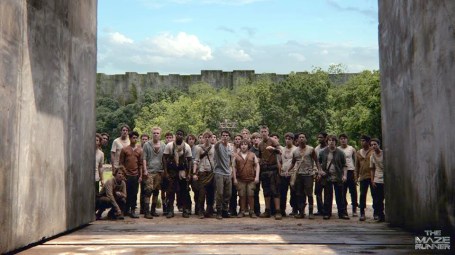
Despite the glut of young adult films based on young adult book series starring young adults, The Maze Runner was one of the few films last year that I actually wanted to see in the theater based on the trailer alone. While I didn’t get to view it until just recently, I found it to be just what I was hoping for, a better-than-average YA thriller that rises above its brethren due to sheer intensity.

Like The Hunger Games, it’s a story built around one central but entertainingly provocative concept: a collection of amnesiac boys trapped in an enigmatic maze. Honestly, I’m surprised this idea was adapted into a book and film before it became a video game, what with its survivalist circumstances, plot-specific terminology (Grievers, the Changing, etc.), and lack of in-depth characters. (I can easily envision “Mini-Games with Minho” as players map and memorize the Maze. It makes me wonder what Halo or Portal would have been like had the game not come first.) Though none of the characters have an explained backstory as yet, they all become more real and likable over time. As second-in-command Newt says, it doesn’t matter who they were but who they are now, and almost all of them are sympathetic and supportive of each other as they band together to face the unknown with surprising maturity. My VC pointed out that the script could have been full of wit or clever dialogue, but instead the character’s lines are very much what real people might say, adding to the realism of the performances.

These YA series seem to act like this generation’s Red Dawn or The Breakfast Club, introducing many fresh faces sure to have promising careers ahead of them. Dylan O’Brian and Kaya Scodelario portray the game-changers Thomas and Teresa, alongside Aml Ameen as leader Alby and Ki Hong Lee as runner Minho. I was excited to see Will Poulter as Gally, a very different role from that of weaselly cousin Eustace Scrubb in the Narnia film The Voyage of the Dawn Treader, and my favorite of the boys would have to be Newt, played by baby-faced Thomas Brodie-Sangster, known to me as the voice of Ferb on Disney Channel’s Phineas and Ferb.

While there’s no Lost alert for any of the actors, several similarities to that great show occurred to me afterward. Think about it: there is a group of people banding together in isolation, hoping to escape, while receiving supplies from a mysterious acronymed organization obsessed with experiments (DHARMA=WCKD) who leave cryptic video messages, all while being terrorized by an unseen creature which emits roars and mechanical clicking noises. On top of that, there are lies built upon lies and mysteries upon mysteries, which foster Lost-style speculation about what it all means (at least for those of us who haven’t read James Dashner’s books). According to IMDb, even director Wes Ball originally called the film “Lord of the Flies meets Lost.”

While the social commentary is not as pronounced as in The Hunger Games series, The Maze Runner surprisingly prompted far more discussion between my VC and me. We mainly debated the morality of Thomas’s search for the truth, which led to many casualties and didn’t better their situation (at least in this installment). On the one hand, she sympathized with Gally, who didn’t want to upset the status quo, a hard-fought peace that had made the Glade more or less an idyllic community. While Thomas wanted to find the truth, he did spoil that peace with his revolutionary curiosity, which ended up costing many lives. On the other hand, I countered that, as Thomas states, the situation in the Glade could not last forever, and his actions may have actually saved more lives (my reasoning behind that would be too spoiler-prone). In addition, the tantalizing idea of freedom and the desire to not be controlled or contained were understandable driving forces for his dissenting inquisitiveness.

The Maze Runner may draw a little from Aliens and The Lord of the Rings: Return of the King, mainly with respect to the frightening Grievers, but it’s an intense and intriguing first installment for a series in which I’m now thoroughly invested, full of tense moments and glowing Broadway musical reviews (after all, “Wicked is good,” right?). That being said, don’t expect a lot of answers to your questions. The ending explains a couple issues but raises even more, and since my VC was not expecting this to be a trilogy, she was unsatisfied by the conclusion. If you enjoy sci-fi thrillers and don’t mind cliffhangers, this film is a must, but if that’s not the case, you might wait to watch after all the films have been released, like I did after Lost’s final season. Guilty as charged. 🙂

Best line: (Newt, to Thomas) “He’s right. It doesn’t matter, any of it. Because the people we were before the Maze, they don’t even exist anymore. These Creators took care of that. What does matter is who we are now and what we do right now.”

 
Rank: List-Worthy
 

© 2015 S. G. Liput

286 Followers and Counting

The Count of Monte Cristo (2002)

19 Thursday Mar 2015

Posted by sgliput in Movies, Poetry, Reviews, Writing

≈ Leave a comment

Tags

Action, Drama, Romance

When Edmond Dantes dares to run
To Elba, where Napoleon
Was exiled, in hopes to save
His ailing captain from the grave,
The captive emperor commands
He take a message to the hands
Of some old friend, and in his debt,
The sailor takes it with regret.
 
When Dantes lands back in Marseilles,
He’s lauded, and his fiancée
Mercedes welcomes him with joy,
Which jealousy will soon destroy.
His friend Mondego goes too far
With envious first mate Danglars,
To have Dantes arrested for
The treason of the note he bore.
 
Before the matter comes to court,
A magistrate named Villefort,
Who might have offered him relief,
Entombs him in the Chateau D’If.
Through painful years, he sits and waits,
Endures and loses faith and hates.
When near the ending of his rope,
A fellow prisoner gives hope.
 
This priest assists him, through despair,
To dig for freedom and prepare.
They learn and burrow gradually,
And when Dantes at last is free,
He plots his vengeance, soon released,
With treasure from the caring priest.
A wealthy count, a different man,
He reaps revenge with righteous plan.
As Edmond nears his final goal,
Perhaps true love can save his soul.
_______________
 

Alexander Dumas is among the most famous of French novelists, but his memory seems often based on mere name recognition. Plenty of people have heard of The Three Musketeers, but far fewer actually know its plot. Such was the case with me and The Count of Monte Cristo, a classic tale of revenge that has resulted in countless adaptations (such as ABC’s current series Revenge), as well as a scrumptious sandwich. Though I had read the book in abridged form as a kid, I had little interest in this 2002 film version when it was released, but I recently sought it out after discovering the unproduced musical version by Frank Wildhorn (Jekyll and Hyde). I’m glad I did, for it turned out to be a clean, exciting, and undeniably entertaining swashbuckler that even manages to improve on the source material.

The evenly talented cast is composed of actors more recognizable from their other roles than from their names. Jim Caviezel as Edmond Dantes also played Jesus in The Passion of the Christ, and his suffering in the Chateau D’If mirrors that film, though Dantes hardly turns the other cheek. Guy Pearce (The King’s Speech, Iron Man 3) is the most famous of the cast and is perfectly odious as his backstabbing “friend” Mondego. Dantes’ faithful love Mercedes is played with romantic earnestness by Dagmara Dominczyk (Marguerite in The Five People You Meet in Heaven), and Richard Harris (Camelot, two Harry Potter films) brings wisdom and unshaken religiosity as Abbe Faria, Dantes’ fellow prisoner and mentor. Also notable are a young Henry Cavill as Mercedes’ son Albert, long before the fame of Man of Steel, and James Frain (known to me as the sleepy college student in Shadowlands) as Villefort, proving that he and Pierce excel at portraying despicable aristocrats.

Despite the large cast, the main point of the tale is very simple: revenge. While The Count of Monte Cristo could be considered the original revenge fantasy, it surpasses imitators like Kill Bill or Darkman by not reveling too much in the morally sticky subject of vengeance but placing it in a religious context. Certainly everyone enjoys watching villains receive their just desserts, but when one becomes an instrument of revenge, obsession and resignation to sin threaten. While there’s an entertaining “gotcha” factor to his enemies’ comeuppance, there are also friends urging Dantes to move past his hatred. It’s a sensitive balance that ultimately sides with the godly faith of Abbe Faria and is not lessened at all by its religiosity. (The only really morally problematic act of vengeance involves the Chateau D’If’s sadistic jailer [Michael Wincott of Hitchcock and Robin Hood: Prince of Thieves in yet another creepy role], but is more or less understandable considering its timing.)

The production itself sometimes has the look of a BBC television production, but with a much higher budget, seen in the ornate set design and the Count’s spectacular entrance into Parisian society. (Hint: There’s a hot air balloon!) The sword fights are riveting, the dialogue is clever, and the final confrontation between Dantes and Mondego is so much better than in the book, which ends with a mere suicide and a less happy ending for some characters. It may depart from the novel, but I prefer this version.

Having seen this film, I’m even more convinced that it would make a great musical. There have been productions in Germany and South Korea, and at BYU just two months ago (its English-language premiere), but I think it ought to be on Broadway. Listen to these examples: “I Will Be There,” a love duet between Dantes and Mercedes,

and “Hell to Your Doorstep,” a rage-fueled tirade as Dantes plans his revenge.

Doesn’t anyone else think this musical deserves more attention than it’s gotten? Then again, so does this film.

Best line: (Abbe Faria) “Here is your final lesson: Do not commit the crime for which you now serve the sentence. God said, ‘Vengeance is mine.’”   (Dantes) “I don’t believe in God.”   (Abbe Faria) “It doesn’t matter. He believes in you.”

 
Rank: List-Worthy
 

© 2015 S. G. Liput

286 Followers and Counting

Immediate Family (1989)

10 Tuesday Mar 2015

Posted by sgliput in Movies, Poetry, Reviews, Writing

≈ 1 Comment

Tags

Drama


Linda Spector wants a child, desperately, with all her heart;
Michael Spector comforts her and plays the faithful husband part.
Since they cannot force conception, they inquire to adopt
At an agency in town allowing pregnant moms to opt
Not to end their pregnancies but give their babies to the care
Of a couple like the Spectors, bearing love they want to share.
 
Soon a call comes in from Lucy in Ohio, just a teen,
Willing to give up her baby, growing in her yet unseen.
Linda and her husband welcome Lucy with a hopeful joy,
Eager to endear themselves to guarantee their baby boy.
As her pregnancy progresses, Lucy and her loving beau
Grow to be almost like family, hesitantly even so.
 
When the planning stage is over and the promised babe is held,
Motherhood begins to beckon and refuses to be quelled.
Second thoughts begin to surface, and parental honesty
Recognizes the importance of responsibility.
_________________
 

Now that I’m at the end of my movie list, I can extend my reviews to other films, ones preferred by my VC, ones I don’t like, and ones I’ve never seen, such as this lesser-known parenthood film to which my VC introduced me. I’ve also changed my scoring from the number-based system of my list to a simpler measure of a film’s list-worthiness; the truth is, there are plenty of films which could score well enough to make my list based on my previous criteria (artistry, characters/actors, visual effects, etc.) but which I don’t like as much for various reasons. Some films just possess or lack a likability factor that is not so easily broken down and measured. Thus, future films will be labeled as either List-Worthy, List Runner-Up, Honorable Mention, Dishonorable Mention, or Bottom-Dweller, films for which I bear a special distaste.

Immediate Family is a quiet but lovable drama that succeeds in making every major character entirely likable and sympathetic, even when they upset each other. Glenn Close and James Woods as Linda and Michael Spector are the picture-perfect couple to raise a child—lucrative jobs, a gorgeous Seattle home, plenty of friends with kids of their own—but for no known reason, they can’t conceive, and the sight of every child is a reminder of what they are missing. Both actors deftly express the internal stress their characters are facing, as well as the anxious excitement when they seem to discover a solution in adopting the unborn baby of Lucy Moore (Mary Stuart Masterson). Lucy and her boyfriend Sam (Kevin Dillon) are perhaps one step up from white trash, but even if their punk appearance and youthful frankness cause the wealthy Spectors some unease (humorously so), the younger couple are never disparaged as lesser people. Rather than two wild kids removing the consequences of a one-night stand, Sam and Lucy are in a committed relationship, intending to marry and have kids of their own one day; they’re just not ready yet.

It barely mentions abortion and doesn’t contain the explicit pro-life sentiments of Juno or Bella, but Immediate Family certainly leans in that direction, placing excitement and importance in Lucy’s pregnancy. When she finally gets to see and hold her baby, her attempts at thinking of him as an “it” to be handed over fail in the face of her firstborn. What follows is sad yet satisfying, idealistic yet realistic, an ending both expected and hoped for. The film doesn’t idealize parenthood, even depicting the maddening stresses that come with the job, but it represents it as a privilege that is nonetheless desirable, especially for those able to support a young life.

Best line: (Michael, after loaning his car to Lucy and Sam) “Okay, let’s have it, your most paranoid fantasy.”
(Linda) “I don’t want to talk about it.”
(Michael) “They disappear with the baby and the car, stopping only long enough to rip off a few convenience stores on the way home with a sawed-off shotgun. Am I getting close?”
(Linda) “I don’t appreciate this, Michael.”
(Michael) “And we end up on Geraldo Rivera as the most gullible couple in America.”
 
 
Rank: List-Worthy
 

© 2015 S. G. Liput

286 Followers and Counting

#1: The Lord of the Rings Trilogy (2001, 2002, 2003)

20 Friday Feb 2015

Posted by sgliput in Movies, Poetry, Reviews, Writing

≈ 3 Comments

Tags

Action, Drama, Fantasy, Meet 'em and Move on, War

(Major spoilers ahead)
 
Three films to rule them all,
Three films to top them,
Three films to contests call
And effortlessly stop them.
 
In ages long past, there were forged mighty rings,
And one was the greatest, to rule over kings.
‘Twas forged by the Dark Lord, one Sauron by name,
Who barely was beaten when men and elves came.
Isildur, however, retained the One Ring,
Which went on to spend centuries poisoning
The mind of poor Gollum, obsessed with his prize,
Until it was picked up by one of small size.
This hobbit named Bilbo returned to the Shire
And kept the Ring, growing in secret desire.
 
On Bilbo’s birthday, he intends to depart,
Although nephew Frodo is close to his heart.
The wizard Gandalf bids the hobbit farewell
But, wishing old Bilbo’s temptation to quell,
Insists that the Ring stay behind at Bag End,
For Frodo to keep safe, if not comprehend.
When Gandalf discerns that the Ring is the One,
He sends Frodo off since the hunt has begun.
With friends Samwise Gamgee and Pippin and Merry,
The hobbit seeks Bree on a life-saving ferry,
For nine fallen kings known as Ringwraiths now ride
To claim Frodo’s ring, knowing he cannot hide.
 
As Gandalf must deal with the sudden betrayal
Of white wizard Saruman, Frodo’s travail
Is still far from over, but he is defended
By Strider (or Aragorn), who’s well-descended.
When Frodo is wounded by one of the Nine,
The elf maiden Arwen assists him in time.
In Rivendell, Frodo finds rest with his friends,
Until a new journey Elrond recommends.
With Aragorn, Gandalf, Sam, Pippin, and Merry,
Plus Boromir, Legolas, and Gimli hairy,
Frodo heads to Mordor to end the Ring’s power,
As Sauron looks on from Barad-dûr’s tower.
 
When one mountain blocks them with avalanche thunder,
The Fellowship hesitantly passes under.
Through Moria’s mines and dark dangers galore
They dare, since they cannot turn back anymore.
A battle and balrog claim Gandalf, alas!
The others get out since the foe cannot pass.
Then on to Lothlórien they make their way,
Where Lady Galadriel lets the group stay.
A vision lets Frodo know what he must do,
And soon they depart down the river anew.
 
The wiles of the Ring come to tempt Boromir,
Who menaces Frodo when no one is near.
When Saruman’s fierce Uruk-hai then attack,
The men, elf, and dwarf prove that courage none lack.
Yet Boromir falls to his comrades’ dismay,
And Merry and Pippin are taken away.
As Aragorn, Legolas, Gimli, all three,
Go after the hobbits in captivity,
Both Frodo and Sam head to Mordor alone
To finish the quest in the wilds unknown.
__________________
 
As Frodo and Sam wander on with their quest,
The creature called Gollum proves more than a pest.
They catch and convince him to act as their guide;
Though Gollum assists, Sam is quick to deride.
Through labyrinths of stone and a haunted marshland,
The trio continue with threats close at hand.
They find Mordor’s entrance, the dreaded Black Gate,
Much too well-defended to now infiltrate,
So Gollum (or Sméagol as he was once known)
Suggests a dark way through a tunnel of stone.
As Frodo starts trusting him, Gollum must face
An identity crisis, one half to erase.
While traveling further through Gondor’s frontier,
They’re captured by Boromir’s kin, Faramir.
 
Meanwhile, the elf and the dwarf and the man
Are chasing the Uruks as fast as they can.
In Rohan, the creatures are slaughtered that night
By banished Rohirrim while making their flight.
While Merry and Pippin take shelter with Ents,
The shepherds of trees who ignore world events,
The others find Gandalf, alive, clad in white,
And join him to set Rohan’s monarchy right.
King Théoden sags under Saruman’s sway,
But Gandalf will not let the rogue wizard stay.
With Théoden now in his right mind once more,
He does as was done with past dangers before,
Vacating the city through mountain paths steep
And biding behind the great walls of Helm’s Deep.
 
As Saruman’s army arrives seeking blood,
The men and elves battle the sword-wielding flood.
While Merry and Pippin are sad and upset
By ponderous Ents still unmoved by the threat,
King Théoden, Aragorn, and all the rest
Defend for their lives from the Uruks, hard-pressed.
For when the foe blasts through impregnable walls,
Despair enters in as their brave defense falls.
 
While Frodo and Sam are held captive by men,
Who mishandle Sméagol, made bitter again,
The Ring allures Faramir’s inner desire
To prove himself to his unpleasable sire.
In Osgiliath, as the Nazgûl attack,
A change of heart shows strength that many men lack.
 
King Théoden rallies his warriors then
To ride out proclaiming the valor of men,
And Gandalf arrives with Rohirrim in tow
To charge with the sun and thus finish the foe.
As Helm’s Deep is won, the Ents see for themselves
That Saruman’s crimes harm not just men and elves.
They storm Isengard with a most righteous rage,
And ancients prevail in their last war to wage.
The good and the free have thus won battles twain,
But darkness will strengthen before it must wane.
The hope of all Middle-earth rests in a pair
Of hobbits whom Gollum intends to ensnare.
_________________
 
While Frodo and Sam follow Gollum, whose past
Reveals the corruption the Ring can work fast,
The rest of the Fellowship soon reunite
To celebrate triumph in their recent fight.
Yet Pippin is tempted to study a sphere,
A dangerous seeing stone called Palantir,
Which gives them a glimpse into Sauron’s next plan,
To crush Minas Tirith, the threat posed by Man.
 
When Gandalf takes Pippin to outrun the foe
And warn Gondor’s capital of coming woe,
The steward of Gondor, the Lord Denethor,
The father of Boromir, knows of the war.
He’s losing his mind and deplores Faramir
In mourning his brother, both cruel and severe.
Insisting his son display loyalty vain,
He sends him to fight where he’ll surely be slain.
Though Faramir sadly submits to his will,
The wizard Gandalf has a plan to fulfill
And sends word to Rohan to come to their aid,
Through beacon fires magnificently displayed.
 
While Merry’s preparing to fight for the peace,
Assisted by Éowyn, Théoden’s niece,
Both Frodo and Sam have a difficult time
In mounting stone stairs Sméagol says they must climb.
His influence turns Frodo’s mind against Sam,
Who’s forced to turn back by a Sméagol-y scam.
Within a dark tunnel of webbing and murk,
A monstrous spider called Shelob does lurk;
Though Gollum had hoped she would earn him the Ring,
His master escapes and sends him plummeting.
As Frodo continues, the spider surprises
Till Samwise the brave takes her down a few sizes.
 
When Elrond reforges a sword legendary
For Aragorn ever to wield and to carry,
The Grey Company leaves King Théoden’s side
To seek the assistance of traitors who died.
To grand Minas Tirith, Rohan’s armies ride
To aid the beleaguered of Gondor inside.
While Denethor’s sanity cracks from the strain
Of Faramir’s loss, though he isn’t yet slain,
The men and the wizard defend the White City
From hideous hordes that refuse to show pity.
When Théoden’s forces arrive with the sun,
The battle’s tide turns, though it isn’t yet won.
When great oliphaunts join this most epic fray,
It takes a ghost army to carry the day.
 
As Gandalf saves Faramir from Denethor,
Sam rescues poor Frodo from orcs of Mordor.
With much heroism and losses endured,
The victors, to keep Frodo’s mission obscured,
March on to the Black Gate, diverting the gaze
Of Sauron’s great eye, ever watching ablaze.
Through barren wastelands, Sam and Frodo proceed,
Weighed down by the Ring from which all must be freed.
Though Gollum attacks, Frodo reaches Mount Doom
But falls to temptation that tends to consume;
It’s not until Gollum, for his Precious’ sake,
Bites off Frodo’s finger, a deadly mistake,
That Sauron’s One Ring in the fire is cast
And evil is unmade and vanquished at last.
 
It looks like the end for the two hobbits spent,
But Gandalf retrieves the small heroes he sent.
In Rivendell, Frodo is thrilled to once more
Embrace his old Fellowship left long before.
In Minas Tirith, grateful free peoples bow down,
And Aragorn humbly accepts Gondor’s crown.
Though years of peace follow, for Frodo it seems
The scars of his quest are still haunting his dreams.
When elves take their leave of mankind’s Middle-earth,
They give final passage to heroes of worth.
As Bilbo and Gandalf depart from these shores,
It’s Frodo’s time too, and the journey restores.
Farewell to his friends, ever faithful and true;
Farewell for a time until all is made new.
_________________
 

This is it, the top of my list and, in my opinion, the greatest trilogy ever made. I know that is a tall claim, but no other film series matches the emotional power, memorable characterization, and epic scope of Peter Jackson’s original cinematic tour de force. Before their release, I had never read the books or had any exposure to J.R.R. Tolkien’s classic magnum opus, so these films came as a total surprise to my family and me; what we expected to be “just another movie” turned out to be something truly magnificent.

The Fellowship of the Ring has been acclaimed as the greatest fantasy film of all time; even with the detractions of literary purists, the film certainly succeeds in crafting a wholly convincing Middle-earth and capturing the spirit of its diverse inhabitants: the curly-haired tranquility of Hobbiton; the Stygian menace of the Nazgûl; the luminous nobility of the elves; and the repulsive terror of orcs, balrogs, and the Kraken’s second cousin. The hobbits especially are among the series’ most endearing creations, bucolic folk fond of peace, pubs, and pipes but capable of unexpected heroism.

Fellowship is more episodic than the other two films, as the travelers grow in number and pass from city to wilderness to caves to forest to river, yet amid all the walking, we get to know these characters more deeply than one would expect: hesitant Frodo, faithful Sam, the comic relief duo of Merry and Pippin, sapient Gandalf, conflicted lover Aragorn, awesome Legolas, untossable dwarf Gimli, corruptible Boromir, and so on. The film also features my favorite sequence of the entire trilogy, the tense and visually stunning journey through Moria, full of colossal architecture, subtle wisdom, fearsome creatures, and a climactic sacrifice. The showdown with the troll and the Khazad-dûm collapse were the turning point that convinced me of the immensity of this story, and Frodo’s world-weary gaze once they escape confirmed its emotional punch. By the end of the film, I’m always eager for more.

Being bookended by even greater films, The Two Towers is understandably the least of the trilogy, but it nonetheless includes some essential additions to an already exceptional cast. While the sudden introduction of Rohan’s horsemasters (with similar names like Éowyn, Éomer, Théoden, Théodred, etc.) might be confusing for the uninitiated, they add another texture to this captivating land. Though the flesh-and-blood characters are engaging enough, the special effects team outdid themselves with two brilliantly rendered eccentrics. Andy Serkis’s motion-capture performance as Gollum/Sméagol is among the film’s highlights, his raspy voice and spindling physicality perfectly capturing the creature’s tragic state and inner turmoil. Likewise, Treebeard’s lumbering presence is as convincing a living tree as one can imagine, and the deep, protracted voice of John Rhys-Davies (doubling as Gimli) fits him to a tree…I mean, tee. Again, there is no shortage of riveting action sequences, including a skirmish between riders of horses and wargs, the prodigious siege of Helm’s Deep which surpasses any other depiction of medieval warfare, and my second favorite battle sequence of all, the attack of the Ents on Isengard. The latter two battles converge in the climax for a truly epic conclusion, even as Sam delivers a heartfelt speech setting the noble yet very human stakes.

My VC was especially eager for The Return of the King and, not being familiar with the books, was constantly terrified for the beloved characters, especially Frodo. She was pretty much in tears for the entire latter half of the film, from concern and happiness and from the sheer epic scale of the images before her. While it didn’t have quite the same effect on me, I wholeheartedly agree that this third film is the greatest ever made, as the culmination of the trilogy and a monumental depiction of the triumph of good over evil. Along with Titanic and Ben-Hur, it won the most Oscars ever, eleven total, and holds the record for the greatest Oscar sweep since it won everything for which it was nominated; it’s also the only fantasy film to win Best Picture and deservedly so. After journeying through two already admired films with these characters, the emotions are in high gear, devastated grief at Faramir’s sacrifice and Frodo’s rejection of Sam, heartache at Théoden’s final moments and Shelob’s stabbing of Frodo, bittersweet joy at the quest’s success and Frodo’s relieved parting glance. Like the previous two films, there are moments of unbridled awesomeness worthy of sudden cheering, like Legolas and Éomer’s single-handedly taking down enormous oliphaunts, Éowyn’s feat of female empowerment, or Aragorn’s employing an undead ace up his sleeve. The two greatest sequences are the lighting of the beacons, a perfect combination of jaw-dropping New Zealand scenery and Howard Shore’s legendary score, which is my VC’s favorite part of the whole trilogy, and the battle of the Pelennor Fields, particularly Théoden’s charge; the looks of fear on the orcs’ faces are what I imagine will be seen when the Lord returns and evil is finally stamped out. Though the multiple endings have drawn some criticism and even mockery, none of them are needless, and all serve as most satisfying closure, perhaps just with a bit too much fading in and out. Every time the credits start to roll, I feel that I’ve watched something magnificent.

Since I first saw The Lord of the Rings trilogy, my family and I have become fast fans, buying enough merchandise to probably finance one of The Hobbit films. We’ve purchased the original books, guide books, books about the films, a documentary about the films, calendars, CDs of the score, action figure playsets, and both the original films and the extended edition box set. The extended edition is now our preferred version, contributing nearly two hours of fascinating additions that complement rather than detract from the original. It’s become a tradition for my family to watch all three films in a row, usually around Christmas, as an annual reminder of how much we love this story.

While I typically shy away from violent films, and The Lord of the Rings does contain plenty of hacking and even decapitations, the battle scenes still show considerable restraint for the most part, especially for a director known for gory horror movies; plus, the film’s fantasy setting precludes any instances of profanity or foul language, which isn’t even missed. Instead, the language carries a memorable nobility foreign to modern-set films, such as the monologues of encouragement from Gandalf or from various warriors before battle (“Ride for ruin and the world’s ending!”; “It is not this day!”) The music is also particularly marvelous, and Fellowship’s “May It Be” by Enya and The Return of the King’s “Into the West,” performed by Annie Lennox, easily make my End Credits Song Hall of Fame. (“Gollum’s Song” at the end of The Two Towers isn’t quite in the same league.) In addition, it occurred to me that one more reason I enjoy the films is that Frodo’s journey at least could be considered a “meet-‘em-and-move-on” story, since he encounters several others on his quest and is ultimately reunited with many of them. By the way, (Lost alert) I must mention Dominic Monaghan, who plays Merry as well as troubled rocker Charlie on my favorite TV show and who turned out to be a major draw for me to check out Lost, which started the year after The Return of the King was released.

(On a side note, I do want to explain my wholehearted embracing of this franchise in contrast with my dislike of the Harry Potter series. While both feature magic, however fantastical, Tolkien’s tales do not employ magic as a focus and ongoing interest for his characters, and they are set in an untouchable fantasy realm as opposed to a setting and time recognizably similar to our own. In some ways, it’s a fine line, but one that Rowling’s stories cross enough to warrant caution, to my mind. My opinions match those further expanded in this long article by film critic Steven Greydanus: http://www.decentfilms.com/articles/magic.)

The Lord of the Rings will forever stand as a landmark of cinema, especially impressive coming from an only mildly esteemed horror director like Peter Jackson, who certainly earned a name for himself. No other film can match the blend of utterly beautiful scenery, memorable music, realistic effects of every kind, Oscar-winning makeup, detailed armor and weaponry, brilliant ensemble acting, impressive artistry, unparalleled thrills, heart-wrenching pathos, and tear-worthy gratification. Some films rival or even surpass certain such aspects, but not all of them. All the awards won by the third film were undoubtedly meant for the trilogy as a whole, for no other director has shot a trilogy back to back like Jackson did, an achievement he repeated with The Hobbit and one that I don’t think is appreciated enough. George Lucas took three years between each of the Star Wars films, and James Cameron recently had to postpone his planned Avatar sequel trilogy because of the massive effort involved in shooting back-to-back films. It’s obviously harder than it seems. The Hobbit trilogy may not measure up to Jackson’s original achievement, but nothing really could. They are untouchable, masterpieces of fantasy to match their literary counterparts, despite certain alterations.

This film list of mine has been a long road, but its end is one worth revisiting again and again. I’m glad to be with you, Samwise Gamgee, here at the end of this list.

Best lines from The Fellowship of the Ring: (Gandalf, catching Sam after talking with Frodo) “Confound it all, Samwise Gamgee. Have you been eavesdropping?”
(Sam) “I ain’t been droppin’ no eaves, sir, honest. I was just cutting the grass under the window there, if you’ll follow me.”
(Gandalf) “A little late for trimming the verge, don’t you think?”
(Sam) “I heard raised voices.”
(Gandalf) “What did you hear? Speak.”
(Sam) “N-nothing important. That is, I heard a good deal about a ring, and a Dark Lord, and something about the end of the world, but… please, Mr. Gandalf, sir, don’t hurt me. Don’t turn me into anything… unnatural.”    and
 
(Frodo) “I wish the Ring had never come to me. I wish none of this had happened.”   (Gandalf) “So do all who live to see such times, but that is not for them to decide. All we have to decide is what to do with the time that is given to us. There are other forces at work in this world, Frodo, besides the will of evil. Bilbo was meant to find the Ring. In which case, you were also meant to have it. And that is an encouraging thought.”
 
Best lines from The Two Towers: (Treebeard) “I always like going south. Somehow, it feels like going downhill.”    and
 
(Sam) “Those were the stories that stayed with you, that meant something, even if you were too small to understand why. But I think, Mr. Frodo, I do understand. I know now. Folk in those stories had lots of chances of turning back, only they didn’t. They kept going. Because they were holding on to something.”   (Frodo) “What are we holding onto, Sam?”   (Sam) “That there’s some good in this world, Mr. Frodo… and it’s worth fighting for.”
 
Best lines from The Return of the King: (Gimli, after Legolas’s oliphaunt takedown) “That still only counts as one!”    and
 
(Frodo, after the success of their quest) “I’m glad to be with you, Samwise Gamgee, here at the end of all things.”
 
 
Rank: 60 out of 60
 

© 2015 S. G. Liput

286 Followers and Counting
#2: Mr. Holland’s Opus (1995)

13 Friday Feb 2015

Posted by sgliput in Movies, Poetry, Reviews, Writing

≈ 1 Comment

Tags

Drama, Meet 'em and Move on

Teacher of mine, do you doubt your own worth?
Are all of your years in your mind but a waste?
Passion in school is too rare to unearth
For you to consider your talent misplaced.
 
You started halfhearted, not giving your all,
Just placing the facts and the music before us,
But you adapted and heeded the call
And played to our interests to rouse and not bore us.
 
Class after class entered your music room,
Your hall venerating the eminent notes;
Students found counsel and guidance to bloom
And glee from the time a musician devotes.
 
Somehow you managed a family to raise,
Demanding, but higher for all of the lows.
Even to this day your influence stays,
As noble and grand as the works you compose.
 
Music meant more after your music class,
In ways at the time you and I could not guess.
Now hear your great masterpiece come to pass,
Listen to woodwinds, percussion, and brass,
And know that your impact is what they profess.
Mr. Holland, you are a success.
____________________
 

I doubt many people would share my #2 film. It didn’t generate much Oscar buzz, aside from a well-deserved Best Actor nomination for Richard Dreyfuss. It’s not The Godfather or Citizen Kane or Schindler’s List, but what it lacks in stylish camerawork or innovative storytelling, it makes up for in passion and the elevation of unsung heroes. In many cases, the film was my first introduction to certain music, like Beethoven and John Lennon, and it serves as a testament to the power and purpose of the arts in our lives.

Once again, Mr. Holland’s Opus, which is not about a comic strip penguin, is a “meet-‘em-and-move-on” film, but instead of the title teacher “moving on,” he stays put as decades of students pass under his tutelage. In many ways, it’s a combination of my previous two movies. Like Forrest Gump, it follows the triumphs and heartaches of one man through the 1960s, 70s, and beyond, employing archive footage and a well-chosen period soundtrack. Like It’s a Wonderful Life, it features a man whose restricting job comes before his preferred vocation and who, by the end, feels like a failure until an overwhelmingly supportive display of appreciation from his friends. As a fusion of these two stories and a familiar “good teacher” narrative, it becomes a musical journey of the most satisfying kind.

Richard Dreyfuss gives the best performance of his career as Glenn Holland, a composer dreaming of greatness until life gets in the way. He reminds us that teachers are humans like all of us; he deals with the difficulty of starting a marching band, the excitement of childbirth, the disappointment at learning his son is deaf, the unconscious distancing of said son due to said disappointment, and the constant struggle to keep people invested in the arts. Glenne Headley is lovely as his supportive wife Iris, who also feels the strain of having a handicapped child. Olympia Dukakis as Principal Jacobs, W. H. Macy as Vice Principal Wolters, and Jay Thomas as football coach and amateur dancer Bill Meister also give memorable performances, as well as Terrence Howard in his first significant film role as drum-wielding pupil Lou Russ.

The film is full of moments worthy of an admiring sigh. The subplot involving Mr. Holland’s temptation to run off with an aspiring young singer could have gone horribly wrong, yet the film eschews Hollywood risk-taking in favor of marital fidelity. Mr. Holland knows it’s no sin to be tempted but refuses to yield to unrealistic romantic notions. Likewise, his relationship with his deaf son is brilliantly grown over time. His bond with Cole remains undeveloped for the most part, taking a back seat to Glenn’s school and musical endeavors, until Cole himself snaps his father out of his tunnel vision, convincing him that a lack of hearing need not mean a lack of music. This builds to a rare instance of Richard Dreyfuss singing, in a heartfelt concert that makes parents hold their kids a little closer. John Lennon would be proud.

It’s a Wonderful Life always gets my dad wiping his eyes at key scenes, and I’ve told him that Mr. Holland’s Opus is my It’s a Wonderful Life. The ending, featuring Michael Kamen’s glorious “An American Symphony,” inevitably causes a profound joy and satisfaction to well up inside of me, with or without tears. As “meet-‘em-and-move-on” films go, this and The Five People You Meet in Heaven have the best reunion endings, the kind that acts as the culmination of a lifetime, as well as the film.

One more reason to love Mr. Holland’s Opus is that, except for two or three words, it is completely clean, making it a poignant music lesson for the entire family. Perhaps that’s why it didn’t receive more award attention, but I definitely think it deserved further accolades than one Oscar nomination. Even if no one else ranks it as high as I do, Mr. Holland’s Opus is definitely worthy of my #2 spot.

Best line (which sums up this “meet-‘em-and-move-on”): (adult Gertrude Lang) “Look around you. There is not a life in this room that you have not touched, and each one of us is a better person because of you. We are your symphony, Mr. Holland. We are the melodies and the notes of your opus, and we are the music of your life.”

 
Rank: 60 out of 60
 

© 2015 S. G. Liput

285 Followers and Counting

#3: Forrest Gump (1994)

10 Tuesday Feb 2015

Posted by sgliput in Movies, Poetry, Reviews, Writing

≈ 8 Comments

Tags

Comedy, Drama, History, Meet 'em and Move on, Romance

His name is Forrest, Forrest Gump,
And he has quite a tale to tell,
A decade-spanning epic life
That no one else could tell as well.
 
Although he never has been smart,
His mother told him from his youth
That he could still do anything,
Which he took as God’s honest truth.
 
He didn’t have too many friends,
Just lovely Jenny by his side.
He loved her dearly from the start,
But college kept her occupied.
 
Their paths diverged as Forrest Gump
Enlisted in the Army corps
And told his girl he soon would go
To Vietnam to fight a war.
 
His heroism rescued lives,
Including his Lieutenant Dan.
As Forrest met with Ping-Pong fame,
His friend was left as half a man.
 
When Army life was done with him,
Gump bought himself a shrimping boat
To celebrate a fallen friend
Whose life to shrimp he would devote.
 
Assisted by Lieutenant Dan,
He built himself a shrimp empire,
But a loss returned him home
To Alabama to retire.
 
Beloved Jenny’s wayward path
Of drugs, abuse, and love thought free
At last brings her to Forrest’s house
To milk his hospitality.
 
A lengthy run across the land
Brings fame to Forrest once again,
But what more strongly speeds his step
Is Jenny’s now inviting pen.
 
Though soon he loses one he loves,
He gains another suddenly,
For Forrest Gump is talented
At drifting to his destiny.
________________
 

While not the first, Robert Zemeckis’s Forrest Gump is the greatest example of the “meet-‘em-and-move-on” film, following one character throughout his life as he touches and is touched by countless others, often in ways he doesn’t even comprehend. In this case, it’s set against the backdrop of late 20th-century America, and even if Forrest doesn’t fathom the influence of his adventures, we the audience do, laughing, crying, and remembering along the way.

Tom Hanks most definitely deserved his Best Actor Academy Award for his simple yet profound portrayal of Forrest, Forrest Gump. Rather than being some caricature of the mentally handicapped, his folksy candor creates a memorable paragon of innocent observation. His unbiased impressions of some painfully turbulent years in US history act as a neutral lens through which we can view events like the Vietnam War, the Watergate scandal, and the hippie movement without any potentially alienating political opinions. They just were, and Forrest was there. It’s a simple idea, but much care and effort were made in pulling it off successfully. The Oscar-winning effects team placed Forrest into archive footage, allowing him to seamlessly interact with Presidents and celebrities. Yet through all of his adventures, he remains the same lovable mama’s boy, harboring (as the writer Eric Roth has stated) an unshakeable faith in only three things: God, his wise mother (Sally Field), and his sweetheart Jenny (Robin Wright). It’s funny, though, that Field plays Hanks’s mother here when she played his love interest in Punchline just six years earlier.

Jenny chooses the opposite approach of Forrest’s clean-cut journey through the decades. Whereas his homespun values preserve Forrest unsullied for the most part, in the world but not of the world, Jenny embraces the sex, drugs, and destructive lifestyle that captured so many in the 1960s, all the while keeping her would-be suitor at a distance. Her “spoiled goods” mentality is frustrating because of her own foolish choices, and tragic because of Forrest’s unrequited love for her, at least until the end. Forrest Gump is a prime example of how an opinion can make a 360 over time; my VC disliked the film’s ending at first, mainly due to how Jenny used Forrest’s affection for her to sneak a one-night stand and then did not contact him again until she was dying. Over time, she’s come to love the film as much as I do and to recognize more authenticity in Jenny’s deathbed declaration of love. As disheartening as their degrading lifestyles became, the eventual turnaround for Jenny and for Lieutenant Dan (a fantastic Gary Sinise) is what provides the satisfying, tear-worthy conclusion that “meet-‘em-and-move-on” films do so well. (By the way, did anyone else notice that Jenny’s abusive boyfriend in Washington, D.C., was named Wesley? Robin Wright must love that name.)

Despite the language and some sexual awakenings for Forrest, the film is a redemptive and unforgettable odyssey in which the good and decent are proven more prosperous than the edgy and bitter. The soundtrack is one of the best, providing pitch-perfect musical accompaniment for every decade Forrest encounters (the Doors are well represented), and the three-year running sequence features a spectacular blend of rocking road anthems and stunning cinematography. The quirky narration is one of my favorite elements, with sentences often being repeated by an actor right after they’ve been spoken. Sometimes narration is an unnecessary distraction, but for “meet-‘em-and-move-on” films, it often strengthens the effect of the story, as with Life of Pi and The Shawshank Redemption. Many people doubtless consider Shawshank a better film, which was overshadowed by the popularity of Tom Hanks’ best role in 1994, but though Shawshank is more mature in tone and subject, and I still love it, Forrest Gump holds a greater variety of incident, special effects, and storytelling and is just more appealing in general. It’s a special film that some may dismiss as glossing over history, but I find more reasons to love it on every viewing. (Did you notice that Forrest’s eyes are closed in every picture he takes? I didn’t till this latest time.)

Best line (a less obvious one):  (Bubba) “Anyway, like I was sayin’, shrimp is the fruit of the sea. You can barbecue it, boil it, broil it, bake it, sauté it. Dey’s uh, shrimp-kabobs, shrimp creole, shrimp gumbo. Pan fried, deep fried, stir-fried. There’s pineapple shrimp, lemon shrimp, coconut shrimp, pepper shrimp, shrimp soup, shrimp stew, shrimp salad, shrimp and potatoes, shrimp burger, shrimp sandwich. That- that’s about it.”

 
Rank: 60 out of 60
 

© 2015 S. G. Liput

284 Followers and Counting

#4: It’s a Wonderful Life (1946)

09 Monday Feb 2015

Posted by sgliput in Movies, Poetry, Reviews, Writing

≈ 3 Comments

Tags

Christmas, Classics, Drama, Family, Fantasy

George Bailey lives in Bedford Falls
But does not wish to stay.
“This crummy little town” just palls
Against lands far away.
 
His father barely keeps afloat
The ol’ Building and Loan,
Which causes George to miss his boat,
Or simply to postpone.
 
Young Mary Hatch has always had
A crush on George; the two
Soon hit it off, and Mary’s glad
That wishes do come true.
 
When George’s plans are shot once more
Because of the depression,
His business doesn’t close its door,
Through Mary’s intercession.
 
For years in little Bedford Falls,
George serves the friendly poor,
While stopping greedy Potter’s calls
To yield what George stands for.
 
But then one day, some carelessness
Misplaces needed cash,
And desperation’s stressful press
Tempts George to make a splash.
 
An angel staves off suicide,
And Clarence tries to warn
By giving George a glimpse untried
Of if he’d not been born.
 
This other world without George Bailey
Is dark and forlorn;
He sees the difference he made daily
Since he had been born.
 
He begs his life back, no more dull,
And finds to his delight
The life he sees is wonderful
And friends that aid his plight.
________________
 

My mom and I share my #1 film, but my dad’s personal favorite at least made it to my #4. My highest black-and-white film, It’s a Wonderful Life stands out as Frank Capra’s best film, sentimental in the best sense of the word, full of moments that inevitably bring my dad to tears. My mom loves it too, having first seen it after learning it was Roger Ebert’s favorite film back in the 80s. Though not successful upon release, it has grown in esteem over the years to become one of those perennial Christmas traditions, a reminder of all that can be good in this world.

In addition to a splendid screenplay, the casting is excellent. Jimmy Stewart is the ideal everyman, whether as a decent Joe Schmo in a world of dirty politics or a selfless son/brother/husband/father that changes his town in ways he never could have imagined. Here his acting talent is at its most diverse, evoking a wide range of deeply felt emotions, from disappointment to helpless despair to rebounding joy that tugs effortlessly on every viewer’s heartstrings. Other examples of exceptional casting include a glowing Donna Reed as Mary Bailey, Thomas Mitchell as forgetful Uncle Billy, child-like Henry Travers as guardian angel Clarence Odbody, and Lionel Barrymore as Mr. Potter, an utterly despicable villain in a town of otherwise pleasant folk.

Watching the film now, after so many prior viewings, it’s hard to believe that George Bailey could consider himself a failure, after saving a couple of lives and personally presiding over happy homecomings (most people don’t even do that). Yet the microscope of anxiety leads him to cruel panic, and a series of hardships, one after the other, plausibly drives him to consider suicide. While the film implies that guardian angels are deceased humans (which isn’t true), the intervention of Clarence is more charming and divinely sent than, say, the ghosts in A Christmas Carol. In trying to convince George of his own worth, the film serves as encouragement for its audience. Who hasn’t felt like a failure at some point in his/her life? Who hasn’t wondered if it was all for naught? Yet, like the tapestry argument about how focusing on one thread does not comprehend the full pattern, we never know how and how often our lives touch others’. By now, the interconnection of lives has become a well-worn lesson, from Liberty Mutual commercials to countless films, but It’s a Wonderful Life does it best, giving a full sense of just how essential one man can be to the happiness of an entire town.

My VC and I had a brief debate over whether the film could be considered a “meet-‘em-and-move-on” movie. I at first thought so because of the many people with whom George interacts throughout his life and the infinitely feel-good reunion of an ending. Yet she pointed out that, even if George doesn’t fully appreciate all his friends until the end, nobody really moves on. It all takes place in the same quiet little New York town, a place George at first views as a cage but, like nostalgic viewers, eventually comes to appreciate it as his home. (By the way, the entire town of Bedford Falls was one long outdoor set.) Thus, while It’s a Wonderful Life isn’t technically a “meet-‘em-and-move-on,” it does bear certain similarities, especially by the jubilant end. (Again by the way, as wonderful as it is for everyone in town to donate to George, it probably wasn’t enough to make up for the missing $8,000; it really all came down to his friendship with wealthy Sam Wainwright. Hee-haw!)

Though his films were often derided as “Capra-corn,” Frank Capra was certainly one of the great early Hollywood directors, simply choosing to focus on the good, the charming, and the uplifting rather than the more cynical stuff some critics prefer. His personal favorite of his films, It’s a Wonderful Life exemplifies simple, feel-good messages in an entertaining package sure to break and warm the heart.

Best line: (Clarence) “Strange, isn’t it? Each man’s life touches so many other lives. When he isn’t around, he leaves an awful hole, doesn’t he?”

 
Rank: 60 out of 60
 

© 2015 S. G. Liput

284 Followers and Counting

#5: The Sound of Music (1965)

06 Friday Feb 2015

Posted by sgliput in Movies, Poetry, Reviews, Writing

≈ 1 Comment

Tags

Classics, Drama, Family, Musical, Romance

(Best sung to “My Favorite Things”)
 
Austria’s hills hold a thrill for Maria;
Her fellow nuns simply have no idea
Just how to manage this angel of stress,
So she’s sent off as a new governess.
 
The children of Captain von Trapp, lucky seven,
Are quite a handful and no seventh heaven.
Though Captain formally keeps them in line,
Governesses find them less than benign.
 
Fraulein Maria is warm and kindhearted,
And soon her musical love is imparted.
Captain’s away so the children will play,
Learning to sing in the happiest way.
 
When the day ends,
Captain is mad,
But the children sing.
Reminded of music, he’s suddenly glad,
And soon they have him crooning.
 
Baroness Schraeder, whom Captain is dating,
Causes Maria to leave just by stating
That he’s in love with Maria, a fact
That brings her back in the next-to-last act.
 
After Maria and Captain are married,
Problems arise from the views he has carried.
Told by the Nazis that he’s to report,
Captain realizes that their time is short.
 
Leaving the country to keep from conforming,
They buy some time by that evening performing.
As they escape to the convent nearby,
Nazis close in to prevent their goodbye.
 
To the mountains,
The von Trapps flee
Into Switzerland.
Barely escaping, the family now free
Continue through vistas grand.
___________________
 

The musical genre is one of my favorites, presumably because I enjoy music itself so much. I love how stories can be told succinctly through song, and the music of whatever I watch typically gets stuck in my head for some time afterward. The most recent favorite I found is a 2009 musical of The Count of Monte Cristo (hasn’t been filmed yet); before that, it was Frozen; before that, the discovery of Les Miserables. Yet as fun as it is to unearth exceptional new musicals, I always return to the greatest of them all: The Sound of Music.

After her Oscar-winning performance as Mary Poppins the previous year, Julie Andrews outdid herself as beloved nun-turned-governess-turned-wife Maria. She has both the voice and the charisma to make Maria genuinely endearing even while everyone else grouses about her. I particularly liked how the life of a nun was not derided as less worthy than married life but simply not for her, a fact that the Mother Superior recognized before Maria. On the opposite end of the spectrum, Christopher Plummer found his most famous role as Captain Georg von Trapp, the icy father who just needs a headache of a governess to reawaken his love of music and his own children.

I will admit that I find many of Hollywood’s Golden Age musicals rather boring, particularly straight dramatic adaptations like West Side Story, but The Sound of Music sidesteps that concern with its classic Rodgers and Hammerstein soundtrack, peppered with much humor and delightful character moments. Whenever it threatens to drag, a well-spaced musical number livens things up, or we get a laugh from the endearingly candid Maria or the “charming sponge” Max Detweiler (Richard Haydn). By the end, “fuzzy camera” romance gives way to a nail-biting thriller finale that shouldn’t leave anyone bored.

Along the way are stunning mountain vistas and some of the finest show tunes this side of Salzburg. Nowhere are these so well-combined as in “Do-Re-Mi,” a song about singing that brims with joie de vivre and ends on an unrivalled high note that always gives my VC goosebumps. The rest of the songs are equally marvelous, with not a dud in the bunch. “My Favorite Things” is always a joy, and the puppeteered “The Lonely Goatherd” is possibly the most exuberant and fun musical number that Hollywood ever offered. Even the slower songs range from intimate to inspirational and are the kind of hummable music that effortlessly ingrains itself into the listener’s ears and heart.

My family has always enjoyed The Sound of Music. My mom was Gretl’s age when it came out, and Maria’s wedding dress and veil stuck in her mind to influence her own wedding train. She even enjoyed the recent live television version with Carrie Underwood, a production that couldn’t compare with the original in any way but was a respectable effort nonetheless. Even if the film is not historically accurate about the real von Trapp family and thus none too popular in Austria, The Sound of Music is my favorite musical and Julie Andrews’ finest hour, a feast for the ears from start to finish.

Best lines: (Captain von Trapp) “It’s the dress. You’ll have to put on another one before you meet the children.”   (Maria) “But I don’t have another one. When we entered the abbey, our worldly clothes were given to the poor.”   (Captain) “What about this one?”   (Maria) “The poor didn’t want this one.”

(“Uncle” Max) “I like rich people. I like the way they live. I like the way I live when I’m with them.”

 
Rank: 60 out of 60
 

© 2015 S. G. Liput

284 Followers and Counting

#6: Star Wars Trilogy (1977, 1980, 1983)

04 Wednesday Feb 2015

Posted by sgliput in Movies, Poetry, Reviews, Writing

≈ 3 Comments

Tags

Action, Drama, Sci-fi

(Well-known spoilers ahead)
 
In a galaxy far, far away,
The evil Empire holds sway.
As Darth Vader attacks,
Two robots make tracks
With plans, while the princess falls prey.
 
The humorous droids land unseen
On the desert world of Tatooine,
Where they are sold soon
To a boy of this dune,
Luke Skywalker, only nineteen.
 
A message on R2-D2
Sends Luke on a quick rendezvous.
Ben Kenobi tells him
Of his father’s fate grim,
Of the Jedi and lightsabers too.
 
When the Empire’s search has begun,
He and Ben and the droids have to run.
They arrange for a flight
With Han Solo, who might
Owe a crime lord a difficult sum.
 
The Millennium Falcon evades
The Empire’s fighter blockades
And heads for a sphere
That is no longer here;
The Death Star destroyed it in spades.
 
The Empire’s weapon surprises
The Falcon, which misjudges sizes.
From out of this mess,
They all save the princess,
Who helps as the group improvises.
 
Though Vader fells Ben with one blow,
The others escape even so.
The rebels afar
Plan to kill the Death Star
With a weakness, of which they now know.
 
Luke joins all the fighters’ attack
And shakes off the villain in black.
With a shot to the core,
The Death Star is no more,
And all rebels welcome them back.
_________________
 
On Hoth, Luke is met by a vision
Of Ben and is faced with decision.
On this planet of ice,
Rebels pay a dear price
As troopers attack with precision.
 
While most flee with Leia and Han,
Luke heads for where few men have gone;
A bog planet hides
Where old Yoda resides,
A great Jedi Master withdrawn.
 
As Yoda and Skywalker train,
The Falcon is running in vain.
At last, Han seeks out
An old friend with some clout;
This Lando seems suave and urbane.
 
When Vader appears to reveal
That he and Lando had a deal,
Luke’s friends are now bait,
And refusing to wait,
Luke disregards Yoda’s appeal.
 
In Cloud City, Solo is set
In carbonite for Boba Fett,
Who heads for the Hutt
To acquire his cut,
While Luke by Darth Vader is met.
 
Their duel ends when Vader unveils
That Luke is his son and prevails.
Confused in disgrace,
With a hand to replace,
Luke flees with his friends from his fails.
_______________
 
On Tatooine, Luke plans to save
Solo from a carbonite grave,
But Jabba intends
To watch both of their ends
And make Princess Leia his slave.
 
With Lando and Chewie’s assistance,
Our heroes escape and make distance.
Ere Yoda’s demise,
Luke then learns as he dies
Of another Skywalker’s existence.
 
His sister is Leia, he knows,
Who’s back with the Empire’s foes.
They learn a Death Star,
Though not finished so far,
Will soon be too great to oppose.
 
With Luke, they all land on Endor
To nix the shield, but not before
They’re caught unawares
By some wild teddy bears,
Ewoks, who help them with the war.
 
Luke faces his father, as well
As the Emperor, keen to compel
The boy to collide
With the Force’s Dark Side
And to watch them all die who rebel.
 
The battle below on the moon
Goes well for the rebels, who soon
Disable the shield
Ere their doom has been sealed
And find the moment opportune.
 
Both father and son fight once more,
But Luke has improved since before.
The Emperor pays
When his servant betrays,
And Vader’s no threat anymore.
 
The Death Star’s destroyed not too late,
And rebels at last celebrate.
Jedi will increase,
And, his father at peace,
Luke now has fulfilled his own fate.
__________________
 

In reviewing the original Star Wars trilogy, one of the most popular franchises of all time, I will do my best to avoid overusage of the words “iconic” and “classic,” even though nearly everything in these films fits those descriptions. Few movies have such a perfect blend of comedy, action, romance, and imagination, which have yielded such a widespread and devoted following and a universal appeal.

The first film was a bolt from the blue in 1977. My mom remembers seeing it on a recommendation, being surprised at a jam-packed theater, and being so captivated by this new level of cool that she returned to watch it 7½ more times (yes, she once paid to see only half of it; that’s all she had time for one afternoon, and that was better than not seeing it at all). Every aspect of George Lucas’s brainchild exemplifies those two words I mentioned earlier: the commanding presence and deep voice of Darth Vader (surprisingly, James Earl Jones was not credited on the first two films’ initial release), the endearing companionship of R2-D2 and C-3PO, Kenobi’s wise introduction of various mythic elements like the Force and lightsabers, the astounding size and power of the Death Star, the roguish appeal of Han Solo (the role that made Harrison Ford a true movie star), the danger and humor of their rescue of Leia, the trigger-happy escape that makes one wish for an arcade, and the explosive finale. Plot points and individual scenes have become so ingrained in popular culture that their parodies and homages are more ubiquitous than even those of The Wizard of Oz and other films that have been around much longer. Among the film’s most arresting aspects was John Williams’s music, the greatest movie score of all time. Without it (as well as the groundbreaking visual effects and Ben Burtt’s ingenious sound effects), Star Wars might have been simply a cute little sci-fi film, but the bombastic score is what truly earns it the title of space opera. By today’s standards, the characters and their interactions might be considered a tad cheesy, but like Indiana Jones, they tap into their creator’s love of pulpy adventures and are so much fun that viewers today merely enjoy the ride and quote the film verbatim. It made household names of Mark Hamill, Harrison Ford, and Carrie Fisher, and in my opinion, the original remains the best film in the entire saga.

Rarely are middle films the most popular, but The Empire Strikes Back has grown over the years to be the most esteemed of all the Star Wars films. It featured the memorable battle on Hoth, the introduction of wise outcast Yoda and dashing Lando Calrissian, the deepening of Han and Leia’s romance, and that classic shocker involving Luke’s parentage, a revelation so iconic that children today will be lucky if they can see the original surprise before some all-too-common spoof (there, I used them just once). As lauded as Empire Strikes Back is, I hold an unpopular opinion: it’s my least favorite of the original trilogy. Perhaps it is carryover from my mom recounting how she was disappointed when she first saw it, with the cliffhanger ending followed by three years of waiting, but I prefer the first and third films. Its darker tone doesn’t carry quite as much humor as its predecessor, and Luke’s training with Yoda slows everything down, even if it’s a necessary step in his progress as a Jedi. Plus, not once, not twice, but three times does the hyperdrive fail to work, a fact that allows for a great climax but a less-than-pleasing middle. I know practically everyone else disagrees, but that’s my opinion. It’s still a fantastic film that thickens the epic plot and relationships to unparalleled new levels; I just like Episodes IV and VI a bit better.

Why is Return of the Jedi just a little better? It’s not simply because of the presence of the satisfying conclusion, but the absence of any inner dislike on my part. Just as I didn’t mind Jar Jar Binks in The Phantom Menace, I don’t mind the Ewoks of Endor, who, compared with Binks, actually serve a purpose and manage to be more than just cutesy sidekicks. With all the weird and quirky aliens seen in Mos Eisley and Jabba’s palace (some of which are admittedly silly), I don’t understand why the Ewoks supposedly detract from the picture. Their primitive warfare with the Empire’s walkers creates some cheer-worthy victories; so what if they’re cute too? The slowness on Dagobah is kept to a minimum, and the film as a whole seems much more exciting than Empire. The battle on Jabba’s sail barge is one of the best, while the speeder chase through the forest is the most thrilling sequence of the whole film. (That chase also features an old-fashioned film technique at its best; the high-speed race through the trees was filmed by a camera just slowly advancing through the woods, which was then sped up for the finished product.) In the end, what this film and basically the whole saga is about is the fall and redemption of Anakin Skywalker, and, even though he had been solely villainous before Episode VI, even disregarding his depicted fall in the prequels, I actually felt sorry for Darth Vader. That’s one aspect that George Lucas definitely succeeded in; Luke’s confrontation with the Emperor and Vader’s subsequent salvation are what all the other films prepare and anticipate, a sad yet satisfying climax for one of the best trilogies of all time.

Who would have guessed that a cool idea in the mind of a young filmmaker would blossom into such a monumental success of a franchise? It’s not yet over too; by the end of this year, we’ll have the beginning of the next chapter in the Star Wars cinematic universe, courtesy of J. J. Abrams. Based on his work with Lost and Star Trek, I have high hopes for The Force Awakens this December. There’s nothing quite like the original films, though, with Luke Skywalker, Han Solo, Princess Leia, R2-D2, Darth Vader, characters as endlessly watchable as they are iconic (I couldn’t help myself).

Best line from Star Wars (could have been the whole script): (Han Solo and a general) “May the Force be with you.”
 
Best line from The Empire Strikes Back (could have been most of the script): (Darth Vader) “If you only knew the power of the Dark Side. Obi-Wan never told you what happened to your father.”   (Luke) “He told me enough! He told me you killed him!”   (Vader) “No. I am your father.”
 
Best line from Return of the Jedi: (Han Solo, captured by Jabba) “How we doin’?”   (Luke) “Same as always.”   (Han) “That bad, huh?”
 
 
Rank: 60 out of 60
 

© 2015 S. G. Liput

284 Followers and Counting

#7: Finding Nemo (2003)

02 Monday Feb 2015

Posted by sgliput in Movies, Poetry, Reviews, Writing

≈ 1 Comment

Tags

Animation, Comedy, Drama, Family, Meet 'em and Move on, Pixar

Though Marlin was once a free-spirited fish,
A tragedy filled him with fears.
For Nemo, his son, he has one simple wish,
To save him from risky frontiers.
 
One overprotective trip out from the reef
Sees Nemo abducted by men,
And Marlin is stricken with panic and grief
At sudden disaster again.
 
He’s met by a very forgetful blue tang
Named Dory, who joins Marlin’s quest.
After fish-loving sharks and an overdue bang,
They head out for Sydney southwest.
 
While Nemo is ushered to life in a tank
With fish-killing nieces expected,
His father and Dory, still drawing a blank,
Are challenged and helped and respected.
 
At last, they reach Sydney (from inside a whale)
And find Nemo after a flight.
Though Marlin considers his rescue a fail,
Both father and son reunite.
 
Employing the newest of fish common sense,
They save fellow fishes nearby,
And Marlin can now be less worried and tense
About his beloved small fry.
_________________
 

Pixar made a name for itself with the Toy Story films, but Finding Nemo truly solidified it as the premier animation studio. DreamWorks, Blue Sky, and even Studio Ghibli can’t compare with the consistent high quality of Pixar, which has only had one real dud (Cars 2), but out of an abundance of hits, my personal favorite animated film has to be Finding Nemo, for multiple reasons.

First of all, as a kid, I always insisted I’d be a marine biologist, and though my goals have changed over time, I still harbor affection for the fascinating denizens of the deep. The film also holds the record for bringing me to tears the fastest. Sure, I was under twelve when I first saw it, but I was deeply touched and invested within the first five minutes, an example of loss from a parent’s perspective rather than the usual child’s point of view.

Despite the heartbreaking beginning, Finding Nemo is arguably Pixar’s funniest film too, thanks to Ellen DeGeneres’s hilariously scatterbrained Dory, who suffers from short-term memory loss. That speaking-whale scene cracks my family up every time. Albert Brooks as Marlin is the perfect straight man to Dory’s lunacy, as well as a loving father, whose overprotective concern is revealed as true devotion in his quest to find Nemo. One more reason for me to love this film: it’s a meet-‘em-and-move-on, as many “quest” movies are. The myriad fish that Marlin and Dory encounter range from misunderstood to genuinely helpful to downright frightening, and it’s amazing how many sea creatures Pixar packed into this film, many of them with unique and comical personalities. Pixar has always excelled at introducing a large number of memorable characters in a way that seems rich and prolific rather than overstuffed, whether the toys in Andy’s room, the residents of Radiator Springs, or the colorful inmates of P. Sherman’s fish tank. (Note how the fish sound off where they were each bought, just as Andy’s toys named their respective manufacturers in Toy Story; also, I noticed that both this film and Disney’s Brother Bear that same year featured a similar joke involving a very limited game of “I Spy.” In addition, I wonder if a SpongeBob reference was intended in the naming of Sandy Plankton or Sheldon.)

The characters truly are brought to life with some of the most visually beautiful animation I’ve seen. The world of the coral reef teems with life and color, and the expressive character designs display deeply felt emotions without making them into cartoony human-fish (like DreamWorks’ paltry Shark Tale, released the following year). Most animated films take for granted the air around the characters, but Pixar outdid themselves with the underwater environment. Everything is moving, from the plants and dust around the sea floor to the realistic light and shadows filtering down from above.

With the heartfelt father-son relationship at its core, Finding Nemo is among the best animated films ever. Rather than an undeveloped dictatorial patriarch, Marlin is given clear motivation to protect his son, as well as clear reason to let go of his extreme caution in favor of trust. Before Toy Story 3, it was Pixar’s highest-grossing masterpiece, of course earning the Best Animated Feature Academy Award. With exceptional visuals and humor, Finding Nemo finds a well-deserved spot in my top ten; I’ve got my fins crossed for Finding Dory next year.

Best line: (Crush the sea turtle, voiced by director Andrew Stanton, after Marlin’s escape from the jellyfish) “Saw the whole thing, dude. First, you were all like, “Whoa”, and then we were like, “WHOA” and then you were like, “whoa….” (It’s better heard than read.)

 
Rank: 60 out of 60
 

© 2015 S. G. Liput

283 Followers and Counting

← Older posts
Newer posts →

Recent Posts

  • We Didn’t Start 2025 (Recap)
  • NaPoWriMo 2025 Recap (Finally)
  • Sonic the Hedgehog 3 (2024)
  • It Happened One Night (1934)
  • Spellbound (2024)

Recent Comments

associatesofshellymann's avatarassociatesofshellyma… on My Top Twelve La La La So…
Kit's avatarKit Nichols on Bonnie and Clyde (1967)
lifelessons's avatarlifelessons on Look Back (2024)
Carol Jackson's avatarCarol Jackson on The Thief of Bagdad (1940…
Stephen's avatarStephen on Love Story (1970)

Archives

  • January 2026
  • December 2025
  • May 2025
  • April 2025
  • March 2025
  • February 2025
  • January 2025
  • December 2024
  • May 2024
  • April 2024
  • March 2024
  • February 2024
  • January 2024
  • December 2023
  • November 2023
  • October 2023
  • September 2023
  • July 2023
  • June 2023
  • May 2023
  • April 2023
  • March 2023
  • February 2023
  • January 2023
  • December 2022
  • November 2022
  • October 2022
  • September 2022
  • August 2022
  • July 2022
  • June 2022
  • May 2022
  • April 2022
  • March 2022
  • February 2022
  • January 2022
  • December 2021
  • November 2021
  • October 2021
  • September 2021
  • August 2021
  • July 2021
  • June 2021
  • May 2021
  • April 2021
  • March 2021
  • February 2021
  • January 2021
  • December 2020
  • November 2020
  • October 2020
  • September 2020
  • August 2020
  • July 2020
  • June 2020
  • May 2020
  • April 2020
  • March 2020
  • February 2020
  • January 2020
  • December 2019
  • November 2019
  • October 2019
  • September 2019
  • August 2019
  • July 2019
  • June 2019
  • May 2019
  • April 2019
  • March 2019
  • February 2019
  • January 2019
  • December 2018
  • November 2018
  • October 2018
  • September 2018
  • August 2018
  • July 2018
  • June 2018
  • May 2018
  • April 2018
  • March 2018
  • February 2018
  • January 2018
  • December 2017
  • November 2017
  • October 2017
  • September 2017
  • August 2017
  • July 2017
  • June 2017
  • May 2017
  • April 2017
  • March 2017
  • February 2017
  • January 2017
  • December 2016
  • November 2016
  • October 2016
  • September 2016
  • August 2016
  • July 2016
  • June 2016
  • May 2016
  • April 2016
  • March 2016
  • February 2016
  • January 2016
  • December 2015
  • November 2015
  • October 2015
  • September 2015
  • August 2015
  • July 2015
  • June 2015
  • May 2015
  • April 2015
  • March 2015
  • February 2015
  • January 2015
  • December 2014
  • November 2014
  • October 2014
  • September 2014
  • August 2014
  • July 2014
  • June 2014
  • May 2014
  • April 2014
  • March 2014
  • February 2014
  • January 2014
  • December 2013

Categories

  • Blindspot
  • Blogathon
  • Christian
  • Movies
  • Music
  • NaPoWriMo
  • Poetry
  • Reviews
  • TV
  • Writing

Meta

  • Create account
  • Log in
  • Entries feed
  • Comments feed
  • WordPress.com

Recent Posts

  • We Didn’t Start 2025 (Recap)
  • NaPoWriMo 2025 Recap (Finally)
  • Sonic the Hedgehog 3 (2024)
  • It Happened One Night (1934)
  • Spellbound (2024)

Recent Comments

associatesofshellymann's avatarassociatesofshellyma… on My Top Twelve La La La So…
Kit's avatarKit Nichols on Bonnie and Clyde (1967)
lifelessons's avatarlifelessons on Look Back (2024)
Carol Jackson's avatarCarol Jackson on The Thief of Bagdad (1940…
Stephen's avatarStephen on Love Story (1970)

Archives

  • January 2026
  • December 2025
  • May 2025
  • April 2025
  • March 2025
  • February 2025
  • January 2025
  • December 2024
  • May 2024
  • April 2024
  • March 2024
  • February 2024
  • January 2024
  • December 2023
  • November 2023
  • October 2023
  • September 2023
  • July 2023
  • June 2023
  • May 2023
  • April 2023
  • March 2023
  • February 2023
  • January 2023
  • December 2022
  • November 2022
  • October 2022
  • September 2022
  • August 2022
  • July 2022
  • June 2022
  • May 2022
  • April 2022
  • March 2022
  • February 2022
  • January 2022
  • December 2021
  • November 2021
  • October 2021
  • September 2021
  • August 2021
  • July 2021
  • June 2021
  • May 2021
  • April 2021
  • March 2021
  • February 2021
  • January 2021
  • December 2020
  • November 2020
  • October 2020
  • September 2020
  • August 2020
  • July 2020
  • June 2020
  • May 2020
  • April 2020
  • March 2020
  • February 2020
  • January 2020
  • December 2019
  • November 2019
  • October 2019
  • September 2019
  • August 2019
  • July 2019
  • June 2019
  • May 2019
  • April 2019
  • March 2019
  • February 2019
  • January 2019
  • December 2018
  • November 2018
  • October 2018
  • September 2018
  • August 2018
  • July 2018
  • June 2018
  • May 2018
  • April 2018
  • March 2018
  • February 2018
  • January 2018
  • December 2017
  • November 2017
  • October 2017
  • September 2017
  • August 2017
  • July 2017
  • June 2017
  • May 2017
  • April 2017
  • March 2017
  • February 2017
  • January 2017
  • December 2016
  • November 2016
  • October 2016
  • September 2016
  • August 2016
  • July 2016
  • June 2016
  • May 2016
  • April 2016
  • March 2016
  • February 2016
  • January 2016
  • December 2015
  • November 2015
  • October 2015
  • September 2015
  • August 2015
  • July 2015
  • June 2015
  • May 2015
  • April 2015
  • March 2015
  • February 2015
  • January 2015
  • December 2014
  • November 2014
  • October 2014
  • September 2014
  • August 2014
  • July 2014
  • June 2014
  • May 2014
  • April 2014
  • March 2014
  • February 2014
  • January 2014
  • December 2013

Categories

  • Blindspot
  • Blogathon
  • Christian
  • Movies
  • Music
  • NaPoWriMo
  • Poetry
  • Reviews
  • TV
  • Writing

Meta

  • Create account
  • Log in
  • Entries feed
  • Comments feed
  • WordPress.com

Blog at WordPress.com.

  • Subscribe Subscribed
    • Rhyme and Reason
    • Join 814 other subscribers
    • Already have a WordPress.com account? Log in now.
    • Rhyme and Reason
    • Subscribe Subscribed
    • Sign up
    • Log in
    • Report this content
    • View site in Reader
    • Manage subscriptions
    • Collapse this bar