• Home
  • About Me
  • The List
  • THE LIST (2016 Update)
  • THE LIST (2017 Update)
  • THE LIST (2018 Update)
  • THE LIST (2019 Update)
  • THE LIST (2020 Update)
  • THE LIST (2021 Update)
  • THE LIST (2022 Update)
  • Top Twelves and More
  • The End Credits Song Hall of Fame

Rhyme and Reason

~ Poetry Meets Film Reviews

Rhyme and Reason

Tag Archives: Drama

X-Men: Apocalypse (2016)

28 Sunday Aug 2016

Posted by sgliput in Movies, Poetry, Reviews, Writing

≈ Leave a comment

Tags

Action, Drama, Sci-fi, Superhero

Image result for x-men apocalypse film


The X-Men are back…yet again, it would seem.
Professor X still is collecting a team
Of mighty good mutants, both young men and ladies,
But what kind of evil would threaten the ’80s?

An evil so great none remember his name,
Who’s awfully annoyed at the loss of his fame
And wants to subdue the whole world since he can.
Now that’s an original motive and plan!

A good thing for us that some teens will defend us
From egos tremendous and costumes horrendous.
Destruction is nigh…yet again, it would seem,
But we know the future, so don’t worry, team.
____________________

MPAA rating: PG-13

Most were doubtful as to whether Bryan Singer could follow up the success of Days of Future Past with a worthy sequel. X-Men: Apocalypse confirmed that those doubts were not unfounded, yet this is no The Last Stand. Singer has proven that he can produce a great X-Men movie, so it stands to reason that he can also give us a mostly good one. Even if Apocalypse is the awkward third child of the most recent reboot trilogy, it still received enough care and attention to be a worthwhile member of the family.

Set in the 1980s, ten years after mutants were revealed to the world in Days of Future Past, the film reintroduces younger versions of other characters from the original trilogy: Cyclops (Tye Sheridan), Nightcrawler (Kodi Smit McPhee), Storm (Alexandra Shipp), and Jean Grey (Sophie Turner). In Cyclops’s case, we get a firsthand example of a new student being introduced to the school (through his brother Alex Summers/Havoc from First Class) and learning about his new powers, echoing the early days of Rogue’s arrival in the first X-Men. In addition, there’s quite a bit of globe-hopping, from Magneto’s too-good-to-last family life in his native Poland to Mystique’s mutant rescue missions to Moira McTaggert’s discovery of the long-dormant super-mutant known as En Sabah Nur or Apocalypse (unrecognizable Oscar Isaac). As Apocalypse gathers empowered minions to his cause of, you know, the end of the world, it’s up to the X-Men to band together and stop him.

I do want to make it clear that I enjoyed X-Men: Apocalypse, seeing all of the characters together again, the action-packed showdowns and references to other films, from Nightcrawler’s Catholicism to an explanation for Xavier’s baldness. While the reason for his presence is never really resolved, a visit from Evan Peters’ Quicksilver proved to be the highlight of the whole movie; he got the best scene in Days of Future Past, and once again his standout moment alone was worth the price of admission.

I liked a good deal of this Apocalypse, but there are some unavoidable flaws that bothered me as well. The most noticeable issue is an excess that’s hard to put into words. Certain scenes were just a bit…much. The opening scene, in which ancient Egyptian rebels bury Apocalypse under a very poorly constructed pyramid, has a lot of noise and effects without much context. Other scenes are similarly over-the-top. One big oh-no calamity is blaringly melodramatic, intercut with worldwide reactions and an extravagant “you-are-nothing-compared-with-me” speech from Oscar Isaac. Likewise, the pacing sometimes lags in the big fights as the clearly overpowered Apocalypse delivers “I-will-destroy-you” monologues while the heroes encourage each other to “release your power!” which they, of course, do. It’s rather wearisome by the end.

The other problem is one that seems to have annoyed me more than others: continuity. I love and value attention to continuity, and it’s one of the aspects that made Days of Future Past so amazing, since it delivered a satisfying and believable closure to both timelines. Yet for the events of X-Men: Apocalypse to make any sense with the original trilogy, we must assume that Days of Future Past began an alternate timeline, such that the other films never will happen or at least not as the movies depict events. In Apocalypse, characters meet when they shouldn’t yet, Wolverine shows up with Stryker in a way that seems to ignore Origins, and the writers have given up trying to make Mystique into the villain from the first X-Men. Remember that last tantalizing little Stryker/Mystique scene from the end of Future Past? It’s entirely disregarded. The other prequels had their continuity issues too, but so much in Apocalypse has to be taken separate from the other films that it indeed feels like an alternate timeline, making one wonder why Singer had to muddy the waters. I suppose that’s not hard to believe; unlike the Marvel Cinematic Universe, the X-Men films have probably gone on far longer than anyone expected them to, leading different filmmakers to essentially make it up as they go along. It’s just made more confusing for us continuity seekers when Singer actively tries to reference events that will happen, like the whole Dark Phoenix debacle.

I’m not the first to point out Jean Grey’s self-referential line as she and her friends exit a screening of Return of the Jedi: “Well, at least we can all agree the third one’s always the worst.” As X-Men films go, Apocalypse falls squarely in the middle of the pack; it’s nowhere near the best, but DC’s efforts this year have at least saved it from being labelled the worst superhero movie of 2016. As much as I enjoy these movies, I can’t help but feel that, after nine films, the X-Men franchise might be ready to end. Hugh Jackman is supposedly hanging his claws up after one more outing as Wolverine, which is allegedly set up by the after-credits scene that will make no sense to non-comic readers. There’s so much comic material still uncovered, but I wonder if the X-Men have been played out. I wish the franchise could end on a high note like Days of Future Past, but only time will tell.

Best line: (Charles, defying Apocalypse and still able to sum up the entire point of the X-Men) “Those with the greatest power… protect those without. That’s my message to the world.”


Best line: List-Worthy (joining First Class)


© 2016 S. G. Liput
404 Followers and Counting


Inside Man (2006)

25 Thursday Aug 2016

Posted by sgliput in Movies, Poetry, Reviews, Writing

≈ 2 Comments

Tags

Drama, Thriller

Image result for inside man film


Here I sit within a bank,
With hostages at my disposal.
The cops know my demands are frank
And no suggestion or proposal.

While they scramble, stupefied,
And try to gain the upper hand,
I wait with patience here inside,
Assured in every twist I’ve planned.
__________________

MPAA rating: R

I didn’t know much about Inside Man going in, and that proved to be an advantage to take in the twists of this heist thriller as they came. Directed by Spike Lee, Inside Man begins with an enigmatic monologue from Dalton Russell (Clive Owen) about pulling off the perfect bank robbery. Within minutes, we see the heist begun by four masked robbers, who blind the surveillance cameras and take everyone in the bank hostage. The police soon react, and Detective Frazier (Denzel Washington) is sent in to assess and resolve the tense situation.

As with most heist films, the actual mechanics of the theft are the most intriguing to watch. Once the robbers seal off the building, it becomes clear that they’re not interested in the cash in the vault. They force the hostages to also dress up in masks and start drilling in a store room. While it’s unclear what their goals and motivations are, they’ve obviously thought through every contingency. The chess-like moves between gruff Frazier and mysterious Dalton are cleverly riveting, and the tension is visceral even without any shoot-em-up action. Intercut with the main story are police interviews with the hostages, who are all suspects in this puzzling caper.

The film would have done well to keep its focus on the heist, for it stumbles on the outside. Jodie Foster adds star power as a smug fixer sent in by the bank’s owner (Christopher Plummer), but she feels out of her depth in this kind of volatile situation. Her scenes mainly consist of self-confident threats; she probably does have the political connections to carry them out, but her toughness rings hollow in the face of an unpredictable criminal. Likewise, even though the climactic twist is ingenious, the ultimate outcome feels half-baked and unsatisfying. Not every question is answered, and we’re ultimately urged to sympathize with an enigma because someone else is worse. In the end, the film didn’t convince me that what should have happened did or would.

Inside Man is well-executed where it counts the most: the heist itself. The acting is serviceable, but the strategy of the “perfect bank robbery” is the main strength of the film, which also showcases the racial tension and ethnic diversity in New York (Albanian, Sikh, etc.). Heavy on the unnecessary language and occasional violence, it’s a movie left in “just good” territory, let down by only half-fulfilled promise.

Best line: (Russell) “But inevitably, the further you run from your sins, the more exhausted you are when they catch up to you. And they do.”


Rank: Honorable Mention


© 2016 S. G. Liput
404 Followers and Counting


King of Thorn (2010)

21 Sunday Aug 2016

Posted by sgliput in Movies, Poetry, Reviews, Writing

≈ Leave a comment

Tags

Action, Animation, Anime, Drama, Horror, Mystery, Sci-fi, Thriller

Image result for king of thorn film


The world was collapsing
With panic forecast
And death in the news everyday,
Yet we were persuaded
That one short sleep passed
Would sweep the dark future away.

We woke to a nightmare
More dire than the last,
Confronted and hunted and trapped.
We slept to thwart death,
Which would not be outclassed
By sleepers with secrets untapped.
________________

MPAA rating: Not Rated (should be R)

One movie-watching emotion that I especially love and rarely get the chance to experience is the feeling of having my mind blown. The best example I can point to for that would be Inception, and to a lesser extent The Prestige, both Christopher Nolan features with unspoiled twists and a provocative narrative boldness. All too often the twist is either spoiled for me (Predestination, The Sixth Sense) or it’s not all that surprising (The Usual Suspects, Interstellar), so when a film provides me with that rare blend of shock and wonder, I treasure it. King of Thorn did just that.

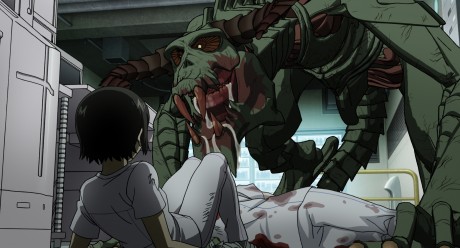
I had heard that this anime film was a combination of Inception, Aliens, and Lost, and…that’s exactly what it is, with a little Matrix and Akira thrown in for good measure. In the first scene, we see a woman commit suicide by jumping off a building, but when she lands, her body shatters, revealing the effects of a new fatal disease dubbed the Medusa virus. This plague that turns humans to stone quickly becomes a worldwide pandemic; in response, the Venus Gate organization selects 160 infected individuals to be put into a Cold Sleep until a cure can be found. When the diverse group is awakened from stasis, surrounded by thorny vines, a horde of monsters attacks them, thinning the herd (not unlike the plane crash at the beginning of Lost) in a scene sure to make you even more afraid of falling down an elevator shaft. Only seven survive, including timid Kasumi, who had to leave her twin sister behind and now must survive with the others and escape from this nightmare.

Now the typical viewer might think that they slept in stasis for hundreds of years to awaken in a post-apocalyptic future, and that’s actually exactly what the characters assume at first. But let’s just say there’s more to it, a lot more. Almost every character has a secret or a past trauma, and the plot twists just keep coming. Like Lost, the film even teases suggestions of what is really going on. Is all of this a dream? Did Kasumi and her sister somehow switch places? There’s no way I’m going to spoil it, though, and I guarantee you that you’ll be kept guessing right up to the last ten minutes.

Because King of Thorn is so packed with plot, from repeated flashbacks that slowly reveal more to overly explanatory references to Sleeping Beauty, it’s not surprising that not everything gets a resolution. Some plot points are dropped without a second glance, and the ending doesn’t even try to address a major uncertainty. Plus, even if I think I understand how everything came about, I’m not sure I get why it all happened the way it did, perhaps due to the significant omissions from the manga the film is based upon (which everyone who’s read it seems to agree is better than the film). Yet the fast-paced action and thought-provoking narrative made up for these faults. If you’re one of those people who hated all the loose threads in Lost, King of Thorn will leave you equally perplexed; but I for one didn’t mind at all, and I know quite a few friends and fellow bloggers who would find this film fascinating. I’ve already introduced it to a friend of mine, and he loved it.

Image result for king of thorn film


On the down side, it’s a film worthy of an R rating, with gruesome killings and a little nudity toward the end. Yet, the gore was far from constant, and like Aliens, it’s the kind of violence one can easily see coming and just turn away from at the right moment. At least, that’s what I did. As for the question of whether to see the subtitled or dubbed version, both have their strengths. The English dub features accents that make it clear that the survivors are from around the world (British, Italian, American, Australian), but it also has the foul language one would expect from an R-rated horror thriller. If you care about avoiding profanity, the original subtitles have far less.

Despite the few negatives, King of Thorn is an exceptional sci-fi thriller that played with my mind in the best way and even managed to touch the heart. The cast of characters are all unique and sympathetic as their back stories are clarified, and the music adds to an epic sense of mystery, especially in the early scenes. (The song “Edge of This World” also earns entrance to the End Credits Song Hall of Fame.) The animation beautifully brought to life both the thrilling and the grotesque, and even if some might complain about the occasional merging of 2D and 3D animation in the action scenes, I didn’t find it distracting. In the days since I first saw it, King of Thorn has only risen in my estimation, and while it might further mess up my original Top Twelve Anime List, I think I’ve got another favorite to add.

Best line: (Marco) “Even if you’re overcome by unspeakable loneliness, endure it and encourage someone who can follow where you left off.”


Rank: List-Worthy


© 2016 S. G. Liput
404 Followers and Counting


Casino Royale (2006) / Quantum of Solace (2008)

19 Friday Aug 2016

Posted by sgliput in Movies, Poetry, Reviews, Writing

≈ Leave a comment

Tags

Action, Drama, Thriller

Image result for casino royale 2006


An agent of will
With a license to kill
And a suavity sporting equivalent skill
With word or with fist
And a need to be kissed
Is an asset the British are brandishing still.

Yet even James Bond,
Whether black-haired or blonde,
Has the human weakness to grow overly fond.
Such a passionate path
Leads to rancor and wrath
In the cruel aftermath and the danger beyond.
__________________

MPAA rating for both: PG-13

I’ve never been particularly well-versed in the James Bond franchise. Although I didn’t grow up in the ‘80s, I was first introduced to Roger Moore as 007 so he’s always been my preferred Bond. Yet whether he’s played by Sean Connery or Pierce Brosnan, what’s there to know? He’s a dashingly handsome British spy with gadgets, who thwarts international villains while bedding international women. With such a simple premise and narrative room for plenty else, the franchise has been content churning out stand-alone features with mainly Bond and his superiors M and Q (and occasionally a villain) as the constants, even if they’ve been recast over the decades.

Thus, when I finally decided to give my attention to Daniel Craig’s now-ended run as Bond, starting with 2006’s Casino Royale, I was surprised to see that the filmmakers went with a more overarching storyline, continuing into Craig’s second film Quantum of Solace. Resurrecting Bond from the campiness of the Moore and Brosnan years, Casino Royale serves as a sort of origin story for the famous agent, even depicting how he obtained his Aston Martin; we still know little of his early years, but witnessing the beginning of his 00 career provides a larger context for Bond himself.

Craig plays the character with grim determination and only a sliver of the charm of past Bonds. He’s certainly skilled at the no-nonsense side of the job, but while his emotions do simmer beneath the spy façade, I still find him rather deadpan, even in the plaintive scenes. The always good Judi Dench as M is the only connection to past Bond films, and her scolding mother-style relationship with Bond provides a pleasant friction to the proceedings, since this less-experienced Bond is prone to rash decisions and unintended force.

Casino Royale sees Bond match wits with Le Chiffre (Mads Mikkelsen), a banker for terrorists who is pushed into holding a high-stakes poker tournament in Montenegro to satisfy his debts. Tagging along to advise and assist are Mathis (Giancarlo Giannini) and the beautiful treasury agent Vesper Lynd (Eva Green), a Bond girl whose relationship with Bond starts off with cold barbs but takes them both much further than one would expect from the famous womanizer.

The brisk action, cracking dialogue, and slick intrigue are the strongest elements, especially a thrilling “gotcha” struggle with a bomber at an airport runway, but Casino Royale takes a left turn in showing Bond truly in love rather than the usual lust, even being willing to quit MI6. Once things settle down after the card game, we get an unexpected amount of romantic bliss right before the climax. It certainly shows a different side to Bond, but it also interferes with the pacing that one would expect from a 007 movie. The final scene does make up for it, though, ending with a perfect lead-in for the subsequent film.

Image result for quantum of solace


Quantum of Solace picks up right there, not with further adventures in the meantime but right after Casino Royale. That makes it the only Bond film I can think of that will leave viewers seriously confused if they haven’t seen its predecessor. For most Bond films, certain characters rather than events are the touchstones, yet here both are equally important. Perhaps this is one of the reasons why Quantum of Solace is considered Craig’s weakest outing; by no means is it a bad film, but if one goes into this Bond movie expecting a self-contained plot, they will be disappointed. Yet for someone like me who loves continuity and didn’t have to wait two years between watching the two, I actually found Quantum of Solace better in some regards.

The most notable improvement is the pacing. It feels more like a James Bond outing, just with the action levels ratcheted up to eleven, making Quantum supposedly the most violent of any Bond movie. There are car chases, foot chases, boat chases, plane chases, Bond chasing others, others chasing Bond. The set pieces are thrilling, and Craig’s Bond continues to be a respectable combination of tough and clever, even if he has a problem with killing potential suspects. The character and plot holdovers from Casino Royale add to the story, and as the mysterious Quantum organization and its conspiracies are discovered, the vendettas pile up, both for Bond and for Bolivian companion Camille Montes (Olga Kurylenko).

Despite the introduction of the still-enigmatic Quantum, I will admit that the plot is downright convoluted. Even with the early secret agent escapades at the beginning, Casino Royale had a focused plot that can be summed up rather easily. It’s not as easy to recall the main point of Quantum of Solace; there was a double agent and a secret meeting at an opera and an evil general and something about oil and the environment that didn’t cast world governments in the best light. By the end, I couldn’t quite keep up with who had a grudge against whom, particularly in the final semi-redemptive scene where Bond confronts two previously unseen characters. (Maybe I was just too distracted by the surprise at seeing Bakshi from Agents of S.H.I.E.L.D. and Beckett from Castle together. I did like the scene’s significance once I understood it, though.)

Neither film is perfect, but as a dual foundation for Craig as the new 007, they’re among the best Bond films I’ve seen. Casino Royale is a uniquely paced debut for the stern-faced Craig and sets up the complex plot and tremendous action of Quantum, which astonishingly leaves at least one female character free of Bond’s sexual charms. I’m still partial to Roger Moore’s incarnation, and A View to a Kill is still my go-to for the series, but Craig’s more solemn version has my respect. I do think it’s laughable that, by the time of Quantum of Solace, some critics were grumbling about the overly serious tone when they used to complain that the old Bonds like Moore were too silly and lighthearted. There’s no pleasing some people, but Casino Royale and Quantum of Solace have convinced me to check out Craig’s further adventures. Skyfall, here I come.

Best line from Casino Royale: (Bond, after losing a lot of money) “Vodka-martini.”   (bartender) “Shaken or stirred?”   (Bond) “Do I look like I give a damn?”

Best line from Quantum of Solace: (Bond) “They say you’re judged by the strength of your enemies.”


Rank: Both List-Worthy


© 2016 S. G. Liput
404 Followers and Counting


The Jungle Book (2016)

14 Sunday Aug 2016

Posted by sgliput in Movies, Poetry, Reviews, Writing

≈ Leave a comment

Tags

Disney, Drama, Family, Thriller

Image result for the jungle book 2016


While man has moved on from the jungle to cities, committees, and ease,
There’s something intriguing and lavish about the deep green of the trees.

We look back at creatures and corners too fierce and exotic to tame,
Caught up in an ancient attraction too dark and uncharted to name.

The beauty of virginal wilderness and wonders no eye has beheld
Still haunt we who harness the future yet still to the past are impelled.

We gladly embrace what is modern, by comfort’s convenience beguiled,
Yet even a civilized person can fall to the call of the wild.
__________________

MPAA rating: PG

I had considered reviewing Disney’s live-action version of The Jungle Book as a Cartoon Comparison, but since I’ve already covered the original 1967 feature, a separate review seemed better. Ever since Disney started in on translating their classic animated films into live-action retellings, I’ve been skeptical. Alice in Wonderland and Maleficent weren’t content to just translate the story but added in dark subtexts that ruined every shred of the original that they incorporated. I was never that fond of the animated Alice in Wonderland or even Sleeping Beauty so it was a lesser form of sacrilege to me, but I’ve always had a soft spot for The Jungle Book. How could Disney possibly do it justice? Well, I’m relieved to say they did, as almost every other reviewer seems to agree. In a world where we’ve seen CGI conjure almost everything imaginable, Disney and director Jon Favreau still managed to impress.

I’m shocked to say it, but this version might actually be better than the original because of how it fleshes out the story with material from Rudyard Kipling’s book. After we’re introduced to Mowgli (very young but good Neel Sethi), his wolf family, and the wolves’ rhyming creed plucked straight from the book, a drought causes the Peace Rock in the riverbed to be revealed, effecting a Water Truce during which predators must cooperate with prey for the sake of water. Such is the Law of the Jungle. This clever rule allows Mowgli to meet the murderous tiger Shere Khan up front, whereas the animated Mowgli isn’t as aware of Shere Khan’s threat until the end. Actually showing the restrained antagonism at the river also gives a more immediate reason for the wolves’ decision to send him back to the human village for his own safety.

The cartoon is far more episodic than many Disney films, bouncing from Kaa the python to the elephants to Baloo to King Louie to Kaa again to those Beatles-style vultures before the end. Favreau’s film follows almost the same chronology (minus the vultures and Kaa’s second appearance), but provides far better connections to create a more cohesive story. Scarlett Johansson’s Kaa, for example, isn’t just a random danger but elucidates some of Mowgli’s history during her brief scene. Christopher Walken as a more menacing Gigantopithecus King Louie instills the idea of fire’s power in Mowgli, and that fire plays a far more significant and complex role in the climax than simply appearing in a flash of lightning and scaring off Shere Khan. I don’t mind how the animated version was told, but the new filmmakers found the perfect way to tell essentially the same tale (albeit with a different ending) in a uniquely well-rounded way for modern moviegoers.

Easily the best things about the original Disney cartoon were the voicework and music. Every voice actor embodies that character, and I wasn’t sure that new voices could pull it off. One of my coworkers has an issue with talking animal movies like Babe or The Jungle Book, seeing them as an abomination of nature, and hearing recognizable voices coming out of the mouths of CGI animals did take some getting used to. At the first listen, Ben Kingsley as Bagheera and Bill Murray as Baloo don’t seem to quite suit their roles, but the more I heard them, the better they fit. Even Walken does well as a more mobster-like King Louie in the film’s biggest action scene. Probably the weakest voice casting was Johansson as the honey-voiced Kaa, but that could be due to how briefly she’s heard; plus, I’m sure Sterling Holloway seemed like an odd choice in 1967. Likewise, Idris Elba is a more fierce-sounding Shere Khan, but there’s something so sleekly villainous about George Sanders’s voice in the cartoon. Bill Murray’s Baloo managed to surprise me the most, offering the best comic relief, and even if he doesn’t quite compare with Phil Harris in the cartoon, I won’t mind future generations growing up with these revised characters. Unfortunately, the songs don’t translate as well, and while “The Bare Necessities” and “I Wan’na Be Like You” work well enough, they could have been omitted and left to the superior cartoon versions.

Image result for the jungle book 2016

Much has been said of the film’s visual quality, and the CGI animators truly outdid themselves. Like Life of Pi, the interactions between the boy and the simulated animals are seamless; CGI hasn’t quite reached the point that I can’t tell it’s still CGI, but it’s well on its way. Also, even though this is a far darker adaptation of the story, with more peril and death than the cartoon, the color pallet wasn’t limited for the sake of keeping it dark. The jungle is a lush wonder, like a live-action version of the greenery that made Disney’s Tarzan so stunning. The mood of the forest morphs depending on the tone of the scene, but it’s always a beauty.

Succeeding as both a faithful retelling and a thrilling reimagining, this latest Jungle Book does almost everything right for a remake, even making Mowgli more industrious and clever than his animated counterpart. The voices take some getting used to, but they don’t hamper the gorgeous visuals and the flow of the story. Disney doesn’t seem to be slowing down with its live-action remakes, and even if I’m still concerned about what they might do to Beauty and the Beast or The Lion King, The Jungle Book reinforced the hope that Maleficent almost destroyed.

Best line: (Mowgli) “But I’m helping Baloo get ready for hibernation.”
(Bagheera) “Bears don’t hibernate in the jungle.”
(Baloo) “Not full hibernation, but I nap a lot.”


Rank: List Runner-Up (on par with the original)


© 2016 S. G. Liput
404 Followers and Counting


Cartoon Comparisons: Batman v Superman: Dawn of Justice (2016) / The Dark Knight Returns (2012)

12 Friday Aug 2016

Posted by sgliput in Movies, Poetry, Reviews, Writing

≈ Leave a comment

Tags

Action, Animation, Cartoon Comparisons, Drama, Superhero, Thriller

Image result for batman v superman dawn of justice

Image result for the dark knight returns film


Titans once clashed in the Greek myths of old,
When swords were the weapon of man sandal-soled.
Men marveled at stories of inhuman glories,
Which none had the privilege or chance to behold.

Now the world watches for titans once more,
For angels and devils to fear or adore,
And mythical quarrels with optional morals
Are thrills for mankind, as they were long before.
_________________

MPAA rating for Batman v Superman: Dawn of Justice: PG-13
MPAA rating for The Dark Knight Returns, Part 1 and Part 2: PG-13

Since my Cartoon Comparisons aren’t limited to just Disney and anime, I decided to compare the recent Batman v Superman: Dawn of Justice with the animated WB adaptation of Frank Miller’s comic book miniseries The Dark Knight Returns. Both follow their own storylines, but Batman v Superman does draw some inspiration from The Dark Knight Returns, most notably in how the famous comic ends with a battle between the Dark Knight and the Man of Steel.

I should start out by saying that I am unapologetically a Marvel fan. Everyone has their preference, and I tend to think that those more drawn to DC or Marvel are more likely to forgive their movies’ faults. For example, one of my coworkers is a DC purist and loves to poke holes in Marvel movies while making excuses for films like Batman v Superman. One thing, though, that I find uncontestable (but I know many do contest) is that in recent years, Marvel films have taken the lead and DC is now struggling to keep up. Oddly, DC seems to be doing the opposite of Marvel; instead of introducing each hero in their own movie and bringing them together Avengers-style, DC is tossing in the likes of Wonder Woman and the Flash without much explanation and then providing a stand-alone film. I know DC is trying to differentiate itself from Marvel, but it’s a strange creative choice that doesn’t lend itself to a cohesive setup.

Honestly, I wasn’t too eager to see Zack Snyder’s Batman v Superman. The trailers were meh, the reviews were worse, and Man of Steel didn’t exactly thrill me as the beginning of a new superhero universe. Yet, with all the other DC films planned to follow, I felt I should give it a try, if only to keep up with the curve. Was it terrible? No. Was it anywhere near good Marvel? No. It was certainly better than I expected, and I found it to be a solid serious take on the DC heroes, particularly Batman, played with surprising intensity by Ben Affleck. While watching it, my main complaints were simply facts of its existence: it’s very dark, very serious, and very long. It still kept my interest through its 181-minute runtime with its mostly sound acting, cleverly symbolic dialogue, and periodic bursts of action, but boy, are there flaws! It’s just that its flaws were more noticeable after the fact than during the movie, and I’m not sure if that’s to the film’s advantage or detriment.

Image result for batman v superman dawn of justice

I suppose my biggest qualm going in was the very concept of Superman and Batman fighting each other, even though it has precedent in the comics. I loved Captain America: Civil War, but I don’t want the good guys to clash among themselves too much. Thankfully, that’s one thing that Batman v Superman does fairly well. Superman’s issues with Batman have to do with his shadowy vigilantism, but Batman’s objections to the Son of Krypton are more deep-seated, stemming from the rampant destruction that made Man of Steel notorious. One must keep in mind that these characters don’t know each other’s intentions, and I could understand Bruce Wayne’s distrust of a godlike alien. Even so, I felt that all of the anti-Superman rhetoric was rather narrow-minded. Most people wouldn’t blame a fireman for only being able to save half of the people in a fire, yet everyone seems to question Superman’s motivations, focusing on the one or two uncertain events instead of the countless lives he does save. No wonder Henry Cavill’s Superman acts so grim and depressed; note to the writers, Batman is supposed to be the brooding one.

There are smaller nitpicks too, such as Jesse Eisenberg’s youthful, God-haunted Lex Luthor, who seems more obviously crazy than the charisma of Gene Hackman’s original or even Kevin Spacey’s knock-off. A friend of mine said Eisenberg would have made a better Riddler, and I tend to agree. The film is also far from cohesive, with plot threads weaving all over the place, and a foreshadowing dream sequence has some unexpected predictive elements sure to confuse the uninitiated. As for the big brawl that may or may not have made DC fans geek out, it’s well set-up and well executed but ends with a semi-obvious plot twist that gets more stupid the more I think about it. Naturally, Batman and Superman couldn’t stay enemies for long, but the turnaround is sudden to the point of absurdity. At least, Gal Gadot’s Wonder Woman does make a nice if underused debut, and I’m actually more interested to see her movie than another Batman/Superman pairing. In trying so hard to set up the upcoming Justice League films, Batman v Superman offers much to appreciate and much to criticize, and it’s all a bit…much. I’m not saying Marvel is perfect either, but at least they’ve found a formula that works. DC is still struggling to find their feet, and, even if they have the spectacle, I’m dubious that they can reach the same level of entertainment.

Image result for batman v superman dawn of justice

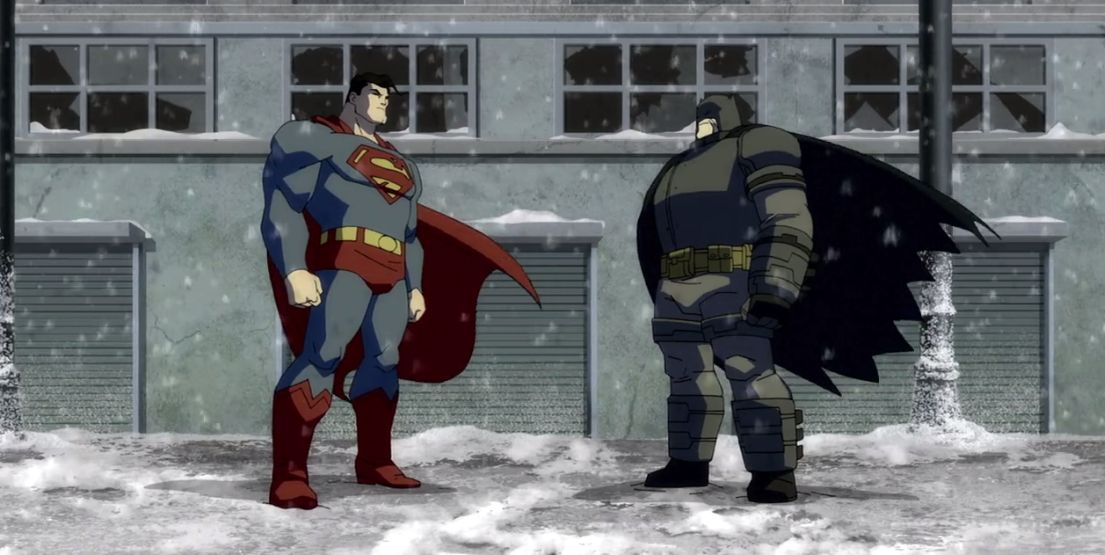
Now for The Dark Knight Returns, which was broken up into a Part 1 and Part 2, both of which are about the same length as Batman v Superman when combined. I used to watch the animated Justice League on TV, but I’m not as familiar with the more recent direct-to-video animated films that lean more on the mature side. The Dark Knight Returns was my first exposure to these, and I see why it has been acclaimed and, despite the different storylines of each film, recognize several similarities with Batman v Superman. Among the aspects it shares with Zack Snyder’s film are the Batman/Superman fight (of course) complete with kryptonite gas, a line from Bruce reminding someone that “We’re criminals. We always have been,” repeated news reports debating the legitimacy of unsupervised heroism, an unexpected televised massacre, a nuclear explosion with Superman high in the atmosphere, and an ending funeral scene, in which the two movies have the characters’ places switched.

Unlike Batman v Superman, where Superman is still a new hero for Earth and Batman is a somewhat older than usual version, having already assumedly beaten the rogues to be seen in Suicide Squad, The Dark Knight Returns features a much older Batman in the 80s, who has retired from hero work after the death of his second Robin named Jason. With Gotham City being terrorized by a violent gang called the Mutants and the return of a supposedly rehabilitated Two-Face, Bruce Wayne decides to “return” as the hero it needs and deserves. As his crusade continues in Part 2, he also battles the once-catatonic Joker and eventually Superman himself, aided by the young Carrie Kelley as the new Robin.

Image result for the dark knight returns film

Part of what sets The Dark Knight Returns above its live-action counterpart, in addition to its more focused narrative that still covers a lot of ground, is the sense of history among the characters without showing it all. Batman is haunted by the deaths he couldn’t prevent, even telling the Joker he blames himself for allowing his foe’s killing spree to last so long, but he acts with the sureness of experience. The police have a varying reaction to the Dark Knight; those like Commissioner Gordon who remember Batman’s past heroics welcome him with a hands-off policy, while the newer recruits and incoming Commissioner Ellen Yindel see him as merely one more violent influence on Gotham City. Debates rage on the news and talk shows over whether Batman should be admired or arrested, with one know-it-all psychiatrist especially criticizing him with some good points, but the mix of opinions is a bit more balanced than the backlash in Batman v Superman. We even get some cameos from much older Selina Kyle and a grizzled Oliver Queen/Green Arrow (who has one arm for some reason, reflecting that unseen history I mentioned earlier).

The Dark Knight Returns also boasts a stellar voice cast, led by Peter Weller of Robocop as Batman. Also (Lost alert!), Michael Emerson, who played such a great villain in Ben Linus, brings a similar ruthless sneer to the Joker. As for Batman’s climactic clash with Superman, it plays out rather similarly, but for entirely different reasons. It goes back to the history they have with each other in this post-Justice League world, and interestingly the reason is more like that in Captain America: Civil War than in Batman v Superman. Unlike Zack Snyder’s Man of Steel, this Superman directly supports the U.S. government and its Reagan-esque President and is sent to put a stop to Batman’s vigilante brand of justice. They clearly disagree, but even in the heat of battle, their respect for each other causes them to hold back. And it doesn’t end with a silly twist so it’s arguably a better confrontation, which is more of a symbolic clash of ideals than the death battle in Batman v Superman.

Another point where The Dark Knight Returns has it over Batman v Superman is its depiction of Batman’s conscience. Both Batman and Superman are well-known for their refusal to kill their villains, which of course lets them come back repeatedly, but Zack Snyder seems to have ignored that fact. I didn’t notice at first, caught up in the impressive action sequences, but Affleck’s Batman doesn’t seem to mind smashing cars into people and general murder of the bad guys, perhaps owing to that “feeling of powerlessness that turns good men cruel,” as Jeremy Irons’s Alfred says. The Dark Knight Returns’s Batman, however, takes care to leave his baddies alive, only coming close to killing when pushed to his limit; one especially cool rampage in the tank-like Batmobile makes a point of using rubber bullets to incapacitate the Mutant gang without killing them.

Image result for the dark knight returns film


Despite the upheld ban on killing, there is quite a bit of violence and some nudity for a PG-13 cartoon. Some of the fistfights are vicious, and while the more gruesome scenes are left offscreen, it doesn’t shy away from blood, mainly in scenes with the Joker. Not to mention, the Joker has a Batarang sticking out of his eye for a while so I can’t help but think an R rating might have been more deserved. Likewise, Batman v Superman has its fair share of brutality, though comparatively little blood.

Both Batman v Superman: Dawn of Justice and The Dark Knight Returns have their strengths and weaknesses. The former is gritty and well-acted for the most part with a jam-packed plot that will likely reward repeat viewings, but its overstuffed length and particularly drab treatment of Superman aren’t about to make it a classic either. The Dark Knight Returns is clearly a stronger film, though that’s owed to its acclaimed source material which didn’t have to set up a whole superhero universe through cameos. The animation is nothing special but it illustrates the story well; the older Batman is a wise and responsible version of the hero who is still susceptible to human weakness and grief yet manages to even rally the citizens of Gotham to his cause. Despite the violence, some weird unexplained slang, and several loose ends left open, such as the Cold War entanglements, The Dark Knight Returns is a strong Batman movie and proves why DC often seems so much more suited to the animated realm (and TV, like Arrow). I won’t begrudge DC fans the pleasure of seeing their favorite heroes in live action on the big screen, but Marvel does it so much better. Only time will tell if that holds true for DC’s future line-up.

Best line from Batman v Superman: Dawn of Justice: (Lex Luthor, actually offering a good point) “You don’t need to use a silver bullet. But if you forge one, you don’t need to depend on the kindness of monsters.”

Best line from The Dark Knight Returns (the real best line is a spoiler but this one will do): (Alfred) “If it’s suicide you’re after, I have an old family recipe. It’s slow and painful. You’d like it.”


Rank for Batman v Superman: List Runner-Up

Rank for The Dark Knight Returns: List Runner-Up


© 2016 S. G. Liput
403 Followers and Counting
 

I Am David (2003)

09 Tuesday Aug 2016

Posted by sgliput in Movies, Poetry, Reviews, Writing

≈ Leave a comment

Tags

Drama, Family, Meet 'em and Move on

Image result for i am david film


Many a time have I carelessly smiled
While others in tears are despised and exiled.
Many a time have I taken for granted
A thing that to some would seem rare and enchanted.

Many a time have I cursed my bad luck,
My vain trivialities running amok,
When many would beg for a life such as mine,
Where the greatest annoyance is no cause to whine.

I cannot know the pain others must bear,
Each has his own that he can’t always share.
Yet in the sharing, we gain a small taste
Of lives and laments that our brothers have faced.
_________________

MPAA rating: PG

I’m not entirely sure why I checked out I Am David from my local library, the diverse stock of which has provided me with an equal measure of gems and duds in recent months. There was nothing particularly intriguing about the DVD case, and its main featured actor was Jim Caviezel, who is typically good but not what I would consider A-list. Thus, I had the rare opportunity to experience a movie I’d never heard of with hardly any preconceptions, and it impressed me in a quiet, wholesome sort of way and made me now curious to read the 1963 Danish novel on which it is based.

The eleven-year-old David is played by Ben Tibber in his only film role, and the film begins with David’s escape from a Communist prison camp in Bulgaria, following the careful directions of an unseen voice. Bearing a sealed envelope, he is instructed to head for Italy and then north to Denmark, with the added caution to trust no one. David himself is a child devoid of joy. When a baker he meets asks him for a smile, he doesn’t seem to understand the concept, never having had any reason to smile back in the camp. He’s a profoundly serious boy, and Tibber plays him with earnest gravity as he encounters new people, places, and emotions along his route.

I Am David has received a good deal of criticism in addition to fond adulation. Both critics and my VC have commented on how unrealistic portions of David’s journey are; sometimes his passage seems too easy, while other times he’s met by stereotypes and dubious acting. I can’t completely argue with these points; I myself had some issue with the ending which seemed unexpectedly simple and rushed considering the slower rate of his previous travels.

Yet I Am David transcends most of these complaints by its unassuming nature. What it succeeds at is a look at the refugee experience through the eyes of an innocent. Everything that happens is through David’s eyes, eyes that have seen grief they cannot understand. Much of the dialogue is simple and straightforward, words David could easily understand. Likewise, I attributed the occasionally exaggerated acting to how David viewed things; one exchange with two friendly parents who push David when he refuses to tell them where he’s going leaves David cringing in fear, unable to comprehend any kind of discipline but cruelty. Disjointed flashbacks of David’s time in the camp and his last day with his friend Johannes (Caviezel) become more meaningful over time, as David’s guilt and fear of anyone in a uniform are both confirmed and relieved by his experiences on the outside. Despite the rushed ending, I appreciated how the connected threads of the flashbacks provided a fitting conclusion to an overall poignant film.

I was surprised to see after the fact that I Am David was the directorial debut of Paul Feig, who is much better known for directing comedies like Bridesmaids and the recent Ghostbusters remake; his beautifully-shot first feature shows a dramatic potential to which Feig is welcome to return. As I watched I Am David, I was also pleased to realize it fit into my favorite subgenre of Meet-‘em-and-Move-On movies, the type that follow a protagonist through the ups and downs of a journey and the varied acquaintances met along the way. These interactions range from a brief run-in with an ignorant American couple to an extended stay with a generous painter (Joan Plowright). Some of these meetings seem to validate David’s distrust of strangers; others challenge him to not view the world as he did in the camp. Treating its subject matter with subdued respect, I Am David seems like a perfect film to introduce young viewers to unpleasant subjects like refugees and forced labor camps, depicting their struggles but imbuing the end result with hope.

Best line: (Sophie, the painter) “David, most people are good. They have families and friends, and they just want to live their lives as happily as they can. Oh, there will always be bad people in this world, and you’ll usually know them when you meet them, or sometimes you won’t, but you can’t let that stop you from living your life fully and freely, and making friends, and seeing the goodness in people, because if you don’t do that, you’ll never find any happiness.”


Rank: List Runner-Up


© 2016 S. G. Liput
401 Followers and Counting


VC Pick: Minority Report (2002)

07 Sunday Aug 2016

Posted by sgliput in Movies, Poetry, Reviews, Writing

≈ Leave a comment

Tags

Action, Drama, Sci-fi, Thriller

Image result for minority report film


Some people insist that the future is written
In stone,
Worry-prone
And forever unknown.
For every mistake, we are twice shy once bitten,
Yet fate
Will dictate
Whether we are too late.

How grand it would be if the future were clearer,
To see
Finally
What we can’t guarantee.
If destiny was not a wall but a mirror,
Events
To lament
We perhaps could prevent.

Yet what if the future were actually written
In sand,
To expand
Or to change what is planned.
How could you know if the course that you fit in
Is still
To fulfill
Or to change if you will?
______________________

MPAA rating: PG-13

Since most of her movie choices thus far have been romantic comedies, my VC wanted to prove her interests do extend beyond, to science fiction, for example. Thus, she recommended Minority Report, Steven Spielberg’s adaptation of a Philip K. Dick story about a world where crime can be stopped through precognition. You can’t go wrong with Spielberg and sci-fi, and as with his later pairing with Tom Cruise in War of the Worlds, Minority Report is a darkly polished cautionary tale with no shortage of futuristic effects.

Cruise plays John Anderton, a PreCrime cop whose division prevents murders through the oracular visions of three medicated “precogs” who float in a vat of milky fluid. When you say it like that, it sounds rather, um, strange, but the technological methods and theoretical concepts employed are explained understandably enough and brought to life with all manner of futuristic gadgets, from jetpacks to hand-operated holographic screens that look suspiciously like those in Tony Stark’s garage. After dealing with the probing questions of DOJ agent Danny Witwer (Colin Farrell), Anderton finds himself on the wrong side of this supposedly flawless system when he is singled out as a would-be murderer, and as he says, “Everybody runs.”

Cruise himself delivers a solid performance as Anderton, one of his first sci-fi roles. Despite being a drug addict, Anderton is consistently sympathetic due to his grief over his son’s abduction, after which he threw himself into his Precrime work. He insists on the system’s infallibility, yet when he’s on the receiving end of the accusation of murder, he proves to have the strength and intelligence to evade capture and dig deeper into how the system works. It’s a credit to the story that, even after an apparent breakthrough moment, the plot still has more twists up its sleeve. The secrets Anderton uncovers also open up philosophical quandaries he had chosen to ignore, from the humanity of the seemingly braindead precogs to whether the future is really set in stone, particularly when that future can be foreseen.

One thing seems certain: 2054 will be a problematic year. I find it curious that at least three different dystopian sci-fi films take place in that year, Surrogates, Harrison Bergeron, and this one. I suppose it’s a year that seems close enough to still be recognizable to our current lifestyle but distant enough to hold guessable technological advances. Those advances are some of Minority Report’s greatest strengths, of which we see more as Anderton’s journey continues. Autopilot cars and vertical highways? That’s cool. Spider drones that scout out entire buildings? That’s even cooler. The practical advantages of seeing the future? That too. Eventually, these cool moments add up to an all-around cool movie with some food for thought at its heart.

In addition to the moral issue of punishing people for crimes not yet committed, the tech side of things also offers questions to consider. As convenient as it would be for cars to drive themselves or public ads to be instantly customized to you based on an eye scan, such advances are only harmless for as long as you remain in the good graces of the powers that be. Those conveniences become liabilities and dangers once Anderton goes on the run. One could say that good, law-abiding people have nothing to worry about, but what is good or law-abiding can change depending on who is in power.

Minority Report is a thought-provoking mystery and one more credit to Spielberg’s sci-fi filmography. The dark cinematography makes every source of light glow, often placing an aura or halo around people, suggesting perhaps, like many dystopian films, that this shining future is only bright on its edges with shadier secrets below. The film’s one negative, aside from an unanswered question or two, was an uncomfortable scene of an eye transplant. My VC is especially squeamish about such scenes and didn’t even want me to look.

Nonetheless, Minority Report’s style and futuristic creativity made for an entertaining what-if scenario with ethical debates that will only grow as 2054 gets closer.

Best line: (Dr. Hineman, co-founder of Precrime) “Sometimes, in order to see the light, you have to risk the dark.”


Rank: List-Worthy


© 2016 S. G. Liput
401 Followers and Counting


Bottom-Dweller: Seize the Day (1986)

22 Friday Jul 2016

Posted by sgliput in Movies, Poetry, Reviews, Writing

≈ Leave a comment

Tags

Bottom-Dweller, Drama

Image result for Survivors Movie Robin Williams


“Seize the day,” the proverbs say,
But what if, trying to obey,
You find your hope
A slippery slope
That lets potential slip away.

Some days are high, while others die
In grief no matter how you try.
Your only hope
Those days, to cope,
Is that the next may dry your eye.

(If you don’t like this woeful rhyme,
You’ll find this film a waste of time.)
________________

MPAA Rating: Unrated (should be PG-13)

I’d almost forgotten about my Bottom-Dwellers, six films I personally loathe and wouldn’t mind forgetting entirely. Though I still have two left to excoriate eventually, it took the arrival of a seventh to get me to return to a truly negative review. This latest Bottom-Dweller worth despising is 1986’s Seize the Day, an early dramatic turn for Robin Williams before he made that line famous in Dead Poets Society. It was the presence of Williams that got me curious to see it, but even if he does well with the material, said material is not nearly worth his talent.

On the DVD case, Seize the Day is hailed as the only adaptation of respected author Saul Bellow’s works, and it doesn’t induce me to seek out the novel at all. Williams plays Tommy Wilhelm, a struggling salesman whose years of hard work for the same company resulted in his bitter unemployment. Having left his wife, he must pay alimony, even though she refuses to grant him a divorce, for which his girlfriend (Glenne Headly) is growing impatient. Tommy travels to the city, only to find a dearth of well-paying jobs, a reminder of how disdainful and unloving his father is (Joseph Wiseman), and a slight chance at pay dirt with the stock market advice of a poker buddy called Dr. Tamkin (Jerry Stiller). Things start out bad and then get worse and worse and worse, and then it ends.

I’m not necessarily opposed to depressing movies, but there’s usually some redeeming factor. Grave of the Fireflies makes me cry every time, but there are moments of light and sweetness sprinkled throughout. The Italian classic Bicycle Thieves is another example of a “worse and worse and then it ends” kind of movie, but at least there’s a potent social commentary at its heart. Seize the Day has nothing to recommend it, except Williams’ fine acting that makes you genuinely pity this poor man as his life is stamped into the dust of an uncaring world.

I suppose you could read a warning into it, like “Never fall for a con artist who eats like a pig,” but any lesson to be had pales next to just how pathetic Tommy becomes. Perhaps the point was for him to face up to his mistakes in life (not taking his father’s career advice, leaving his vindictive wife), but so much cold callousness piles on him that all he and the audience want is a tiny bit of relief that never comes. The author described Seize the Day almost as a dark comedy, but certainly nothing seems funny at the time. The closest thing to gallows humor is the final scene (which I’ll spoil since no one should waste their time on this movie), in which Tommy finds a funeral and uses the opportune setting to break down sobbing at his shattered hopes. And then it ends. Bad days happen; I had one just yesterday (which might explain why I’m going all medieval on this movie), but there are few things less appealing than watching someone else’s day and/or life ruined.

I’ve never read Saul Bellow’s novels, but if Seize the Day is any indication, it’s no wonder why others haven’t been adapted to film. As an old HBO movie, the quality of the filmmaking is also shabby, with choppy editing and uninspired direction. But beyond such practical complaints, Seize the Day is an oppressively bleak and dismal contrast to the American dream, a story whose only goal seems to be driving its main character to suicide, and considering what became of its star, this film’s purpose of hopelessness is in retroactive bad taste. Williams’ first scene in the film is of him giving another driver the finger, a sentiment also deserved by the film itself.

Best line: (a man in an elevator) “The truth is one parent can support ten children, but ten children can’t support one parent.”


Rank: Bottom-Dweller


© 2016 S. G. Liput
399 Followers and Counting


Paper Towns (2015)

21 Thursday Jul 2016

Posted by sgliput in Movies, Poetry, Reviews, Writing

≈ Leave a comment

Tags

Comedy, Drama, Romance

Image result for paper towns film


A paper town stands as a dot on a map,
The mapmaker’s special distinguishing mark
To make it his own and to fool any sap
Who happens to visit the place on a lark.

You may well have hopes for that fake little dot,
Which only arrival can fully repeal.
When maps are affirmed by a town that is not,
The rest of the dots become all the more real.
_____________________

MPAA rating: PG-13

After John Green’s The Fault in Our Stars was translated into such a successful young-adult film in 2014, the same studio heads apparently hoped that lightning could strike again with a second Green adaptation, this time Paper Towns. Since Paper Towns was written in 2008 without all the hype of Fault in Our Stars, the film version was an understandably lesser release, and mixed reviews didn’t help. And yet…I enjoyed it a lot, perhaps not more than Fault but on something of a more personal level.

After playing Gus’s friend going blind in Fault, Nat Wolff steps up to lead character status as Quentin Jacobsen, or Q, one of those awkward, easily relatable high-schoolers that tend to be YA protagonists. As a kid, he befriended his adventurous neighbor Margo Roth Spiegelman (Cara Delevingne), but as the years passed, he settled into mundane normalcy while she became an ever more reckless local legend. His crush on Margo doesn’t diminish with their lack of contact, though, and when she unexpectedly asks for his assistance on a daring night of revenge, he tags along with sheepish compliance and has one of the best nights of his life. And then she vanishes, apparently to satisfy her wanderlust, but Q finds clues to her whereabouts and feels compelled to follow her.

Paper Towns has identifiable ingredients from other recent YA films, from The Fault in Our Stars (Green’s subtly profound dialogue, an urging to live life to the fullest) to Me and Earl and the Dying Girl (the sex-obsessed friend, the quirky family details). Whereas both of those dealt with the serious issue of cancer, Paper Towns keeps itself lighter, transitioning from enigmatic mystery to memory-making road trip, peppered with endearing character interactions. It was these small moments between the characters that left me with a smile more often than not. Q’s pals Radar and Ben are archetypal buddies, the former a slight nerd with girlfriend anxiety and the latter a swaggering goofball, but their conversations felt realistic and fun, like when they all segue into a Sean Connery accent. I do that myself sometimes! Probably my favorite moment came when a suggestion to sing leads the three to start in on the Pokémon theme song with growing exuberance. I know not everyone is into Pokémon (and I couldn’t care less about the recent Pokémon Go fad), but that original theme song is an ever appealing source of nostalgia for my generation. After all, how many people still remember the words to some show’s opening that they grew up watching? For me anyway, it was a terrific scene.

Despite the enjoyable moments, including a great little cameo, the end of the film’s journey is almost sure to disappoint the audience as much as it does the characters. It’s meant to be disappointing, and yet it still finds an uplifting message through it all. Q’s course seems analogous to that of Tom in (500) Days of Summer, keeping romantic hope alive until reality makes him recognize his target girl is someone not meant to be followed. It’s rather jarring, but the breaking of Q’s obsession helps him to see what he’s been missing and, as cliché as it may seem, to value the journey over the destination.

Paper Towns is by no means perfect or free of annoyances. I was frustrated, for instance, with how not one, but two characters bemoan how others see them when they themselves promote that very image. While the performances in Paper Towns are worthy all around, The Fault in Our Stars is probably the better film, if only for its more sober subject matter. Yet, as I said, I found myself enjoying Paper Towns more than its film predecessor, and since they’re both John Green adaptations, I don’t mind putting them on the same level in my esteem.

Best line: (Q) “What a treacherous thing to believe that a person is more than a person.”


Rank: List-Worthy (tied with The Fault in Our Stars)


© 2016 S. G. Liput
399 Followers and Counting


← Older posts
Newer posts →

Recent Posts

  • We Didn’t Start 2025 (Recap)
  • NaPoWriMo 2025 Recap (Finally)
  • Sonic the Hedgehog 3 (2024)
  • It Happened One Night (1934)
  • Spellbound (2024)

Recent Comments

associatesofshellymann's avatarassociatesofshellyma… on My Top Twelve La La La So…
Kit's avatarKit Nichols on Bonnie and Clyde (1967)
lifelessons's avatarlifelessons on Look Back (2024)
Carol Jackson's avatarCarol Jackson on The Thief of Bagdad (1940…
Stephen's avatarStephen on Love Story (1970)

Archives

  • January 2026
  • December 2025
  • May 2025
  • April 2025
  • March 2025
  • February 2025
  • January 2025
  • December 2024
  • May 2024
  • April 2024
  • March 2024
  • February 2024
  • January 2024
  • December 2023
  • November 2023
  • October 2023
  • September 2023
  • July 2023
  • June 2023
  • May 2023
  • April 2023
  • March 2023
  • February 2023
  • January 2023
  • December 2022
  • November 2022
  • October 2022
  • September 2022
  • August 2022
  • July 2022
  • June 2022
  • May 2022
  • April 2022
  • March 2022
  • February 2022
  • January 2022
  • December 2021
  • November 2021
  • October 2021
  • September 2021
  • August 2021
  • July 2021
  • June 2021
  • May 2021
  • April 2021
  • March 2021
  • February 2021
  • January 2021
  • December 2020
  • November 2020
  • October 2020
  • September 2020
  • August 2020
  • July 2020
  • June 2020
  • May 2020
  • April 2020
  • March 2020
  • February 2020
  • January 2020
  • December 2019
  • November 2019
  • October 2019
  • September 2019
  • August 2019
  • July 2019
  • June 2019
  • May 2019
  • April 2019
  • March 2019
  • February 2019
  • January 2019
  • December 2018
  • November 2018
  • October 2018
  • September 2018
  • August 2018
  • July 2018
  • June 2018
  • May 2018
  • April 2018
  • March 2018
  • February 2018
  • January 2018
  • December 2017
  • November 2017
  • October 2017
  • September 2017
  • August 2017
  • July 2017
  • June 2017
  • May 2017
  • April 2017
  • March 2017
  • February 2017
  • January 2017
  • December 2016
  • November 2016
  • October 2016
  • September 2016
  • August 2016
  • July 2016
  • June 2016
  • May 2016
  • April 2016
  • March 2016
  • February 2016
  • January 2016
  • December 2015
  • November 2015
  • October 2015
  • September 2015
  • August 2015
  • July 2015
  • June 2015
  • May 2015
  • April 2015
  • March 2015
  • February 2015
  • January 2015
  • December 2014
  • November 2014
  • October 2014
  • September 2014
  • August 2014
  • July 2014
  • June 2014
  • May 2014
  • April 2014
  • March 2014
  • February 2014
  • January 2014
  • December 2013

Categories

  • Blindspot
  • Blogathon
  • Christian
  • Movies
  • Music
  • NaPoWriMo
  • Poetry
  • Reviews
  • TV
  • Writing

Meta

  • Create account
  • Log in
  • Entries feed
  • Comments feed
  • WordPress.com

Recent Posts

  • We Didn’t Start 2025 (Recap)
  • NaPoWriMo 2025 Recap (Finally)
  • Sonic the Hedgehog 3 (2024)
  • It Happened One Night (1934)
  • Spellbound (2024)

Recent Comments

associatesofshellymann's avatarassociatesofshellyma… on My Top Twelve La La La So…
Kit's avatarKit Nichols on Bonnie and Clyde (1967)
lifelessons's avatarlifelessons on Look Back (2024)
Carol Jackson's avatarCarol Jackson on The Thief of Bagdad (1940…
Stephen's avatarStephen on Love Story (1970)

Archives

  • January 2026
  • December 2025
  • May 2025
  • April 2025
  • March 2025
  • February 2025
  • January 2025
  • December 2024
  • May 2024
  • April 2024
  • March 2024
  • February 2024
  • January 2024
  • December 2023
  • November 2023
  • October 2023
  • September 2023
  • July 2023
  • June 2023
  • May 2023
  • April 2023
  • March 2023
  • February 2023
  • January 2023
  • December 2022
  • November 2022
  • October 2022
  • September 2022
  • August 2022
  • July 2022
  • June 2022
  • May 2022
  • April 2022
  • March 2022
  • February 2022
  • January 2022
  • December 2021
  • November 2021
  • October 2021
  • September 2021
  • August 2021
  • July 2021
  • June 2021
  • May 2021
  • April 2021
  • March 2021
  • February 2021
  • January 2021
  • December 2020
  • November 2020
  • October 2020
  • September 2020
  • August 2020
  • July 2020
  • June 2020
  • May 2020
  • April 2020
  • March 2020
  • February 2020
  • January 2020
  • December 2019
  • November 2019
  • October 2019
  • September 2019
  • August 2019
  • July 2019
  • June 2019
  • May 2019
  • April 2019
  • March 2019
  • February 2019
  • January 2019
  • December 2018
  • November 2018
  • October 2018
  • September 2018
  • August 2018
  • July 2018
  • June 2018
  • May 2018
  • April 2018
  • March 2018
  • February 2018
  • January 2018
  • December 2017
  • November 2017
  • October 2017
  • September 2017
  • August 2017
  • July 2017
  • June 2017
  • May 2017
  • April 2017
  • March 2017
  • February 2017
  • January 2017
  • December 2016
  • November 2016
  • October 2016
  • September 2016
  • August 2016
  • July 2016
  • June 2016
  • May 2016
  • April 2016
  • March 2016
  • February 2016
  • January 2016
  • December 2015
  • November 2015
  • October 2015
  • September 2015
  • August 2015
  • July 2015
  • June 2015
  • May 2015
  • April 2015
  • March 2015
  • February 2015
  • January 2015
  • December 2014
  • November 2014
  • October 2014
  • September 2014
  • August 2014
  • July 2014
  • June 2014
  • May 2014
  • April 2014
  • March 2014
  • February 2014
  • January 2014
  • December 2013

Categories

  • Blindspot
  • Blogathon
  • Christian
  • Movies
  • Music
  • NaPoWriMo
  • Poetry
  • Reviews
  • TV
  • Writing

Meta

  • Create account
  • Log in
  • Entries feed
  • Comments feed
  • WordPress.com

Blog at WordPress.com.

  • Subscribe Subscribed
    • Rhyme and Reason
    • Join 814 other subscribers
    • Already have a WordPress.com account? Log in now.
    • Rhyme and Reason
    • Subscribe Subscribed
    • Sign up
    • Log in
    • Report this content
    • View site in Reader
    • Manage subscriptions
    • Collapse this bar