• Home
  • About Me
  • The List
  • THE LIST (2016 Update)
  • THE LIST (2017 Update)
  • THE LIST (2018 Update)
  • THE LIST (2019 Update)
  • THE LIST (2020 Update)
  • THE LIST (2021 Update)
  • THE LIST (2022 Update)
  • Top Twelves and More
  • The End Credits Song Hall of Fame

Rhyme and Reason

~ Poetry Meets Film Reviews

Rhyme and Reason

Tag Archives: Drama

The Age of Adaline (2015)

01 Thursday Dec 2016

Posted by sgliput in Movies, Poetry, Reviews, Writing

≈ 2 Comments

Tags

Drama, Fantasy, Romance

Image result for the age of adaline


If I had all the years ahead,
My future stretching infinite,
I’d laugh at death and waste my breath
And take my time to start and quit
And eat more than I would admit.

No matter what the daily rut,
I’d rarely worry with my glut
Of days and decades in reserve,
For patience straightens every curve
And makes all roads a new shortcut.

Or so I think….
As days and decades further sink
Into the endless stream I cross,
Along with friends and love that ends,
This gift may be an albatross.
Who wants an eternity of loss?
________________

MPAA rating: PG-13 (could even be PG)

The Age of Adaline is the kind of film that I knew I would enjoy based solely on the trailer and the ingenious title with a double meaning. I love films that follow one character through decades of drama, and The Age of Adaline does so with a fantasy twist reminiscent of The Curious Case of Benjamin Button and Winter’s Tale. As the opening narration explains, Adaline Bowman lived a normal life in the early 1900s, full of the typical joys and sorrows, but an accident that should have killed her instead gave her inexplicable longevity. She never ages past her original 29 years, and while many women would consider that a blessing, it feels more and more like a curse as the decades pass, friends and family get older, the world changes, and she doesn’t.

Blake Lively was the perfect choice for Adaline, embodying both World War II-era and modern-day elegance and giving the audience an essential glimpse into her emotional state. A tear-jerking look-back at all the dogs she has owned over the decades was a brilliant way to help us understand her magnified grief. Flashbacks are used to good effect with the same purpose, clarifying why Adaline is always on the run from potential love interests and anyone who might catch on to her secret…that is, until she meets the charismatic Ellis (Michiel Huisman) and the familiar William (Harrison Ford).

Image result for the age of adaline

The Age of Adaline fulfills its fantastical, romantic purpose with a sophisticated polish, both in the big picture and the details. (Anthony Ingruber as a young William was scarily good with his Harrison Ford impression. Look at him in the picture above; why isn’t he being considered for that Han Solo spinoff?) Unfortunately, the film does slip on occasion, specifically when Adaline’s “miracle” takes place, the narrator giving some hogwash about an undiscovered trait of DNA that freezes the aging process. Groundhog Day didn’t try to explain Bill Murray’s time loop, nor did Benjamin Button spell out Brad Pitt’s backwards aging. They didn’t have to, and The Age of Adaline’s attempt to explain the unexplainable falls flat, I’m afraid. In addition, the emotions at play aren’t as deeply wrought as in similar films, and I couldn’t help but feel that I’d seen the final scene of hopefulness somewhere else before.

My VC and I have similar tastes for this genre, and she enjoyed it too, sort of, saying afterward, “It was a great movie, except it’s ridiculous.” Blame the pseudo-science I mentioned earlier for that, but the “great movie” part still remains, thanks in large part to the outstanding performances across the board. Sometimes when a film is my kind of movie, I can forgive and even ignore its faults. The Age of Adaline fits that bill, and my expectations were met.

Best line: (Ellis) “You know they have a saying in Italy. ‘Anni, amori, e bicchieri di vino, no che contato mai.'”
(Adaline) “Years, lovers… wine cups?”
(Ellis) “Years, lovers, and glasses of wine. These are things that should never be counted.”
(Adaline) “You have no idea.”


Rank: List-Worthy


© 2016 S.G. Liput
428 Followers and Counting


Your Name (2016)

22 Tuesday Nov 2016

Posted by sgliput in Movies, Poetry, Reviews, Writing

≈ 5 Comments

Tags

Animation, Anime, Comedy, Drama, Fantasy, Romance


See the source image

If someday I should forget you
Or the moment that I met you,
I hope, easing your regret, you
Know, although you fade
In memory, your soul and mine
Are too attached to disentwine.
You are the one for whom I’ll pine
Till all the world’s unmade.
__________________

MPAA rating: Not rated yet (should be PG, maybe PG-13)

I’ve been awaiting Makoto Shinkai’s next feature film for some time now, and it seems that his latest movie has finally earned him acclaim and notice outside of anime fan circles. Kimi No Na Wa, or Your Name, is being heralded as proof of Shinkai coming into his own as “the new Hayao Miyazaki,” and this his fifth feature film has been hugely successful in Japan, where it is currently the seventh highest-grossing film ever.

Honestly, I’m just thrilled that I was able to see Your Name so soon after its release (as opposed to waiting perhaps a year for the DVD), but the fact that it is such a winner for writer/director Shinkai makes it even better. I’ve had a rocky regard for his past films, which are always visually beautiful and emotional but range from confusing (The Place Promised in Our Early Days) to depressing (5 Centimeters Per Second) to absolutely wondrous (Children Who Chase Lost Voices). I can’t say Your Name is the faultless masterpiece that many reviewers are making it out to be, but it’s an enchanting and praiseworthy fantasy drama that seems like the culmination of all that his less successful films tried to be.

Image result for kimi no na wa

On the surface, Your Name is a body-swap comedy between a city boy named Taki in Tokyo and a country girl named Mitsuha. Sick of her provincial surroundings and embarrassed by her feminine duties at her grandmother’s Shinto shrine, Mitsuha wishes she could be a handsome boy in Tokyo in her next life, a fancy that soon becomes reality. At random times, the two wake up in each other’s bodies and awkwardly try to live each other’s lives until they can get back to their own the next day. Their memories of the other-body experiences remain hazy afterward, like a dream, but the reactions of their friends and family make it clear that the switch is indeed real. Through notes, advice, and complaints left for each other, they get to know each other on a deeper level than most, while having a key element of any relationship—face-to-face contact—just out of reach.

Based on the trailers, one might think the body-swap humor was the main point of the film, but it actually makes up only the first third, with the rest of the film taking a far deeper and more meaningful course. Had the film remained like the first forty minutes, it would have been a somewhat fun and strange if unremarkable story, but as long as the tonal shift doesn’t bother viewers, it’s the final hour that explains Your Name’s popular acclaim, going off in unexpected and poignant directions. While publicity shots like the one below suggest that Taki and Mitsuha have greater contact, they’re separated by more than distance for the majority of the film. When they do have fleeting connections, it’s the stuff of cosmic, tragic romance, which brings people like me close to tears, even if I don’t quite get there.

Image result for kimi no na wa

Your Name does stumble on occasion, particularly when Shinkai indulges in repeated music video-like montages, like the one at the end of 5 Centimeters Per Second. The J-pop contributions of the band Radwimps actually complement the film well, but the montages sometimes give the film a rushed quality that could have been improved. The non-linear storyline also leaves the significance of some scenes in doubt, especially at the beginning… that is, until the importance of certain flashbacks becomes clearer. I would highly recommend seeing the film more than once, since the layers of its plot are better appreciated when viewed with the whole picture.

Other traces of Shinkai’s past work actually improve on his portfolio. Like The Place Promised in Our Early Days, there are a boy and girl’s sci-fi-ish separation and the threat of massive destruction, while the presence of a comet streaking across the sky brings to mind the space probe of 5 cm. One moment toward the end was even straight out of the unsatisfying conclusion of 5 Centimeters Per Second, prompting me to say “No, don’t you dare end it like that!” Luckily, it didn’t. I also appreciated a neat little cameo for a character from Shinkai’s previous film The Garden of Words.

Your Name is as beautifully animated a film as any I’ve seen in recent memory, with Shinkai’s usual attention to detail for light and shadow being exemplified. A sojourn to an expansive crater out in the countryside is especially memorable, with some gorgeous fall colors on display. Details abound, both in the scenery and the story, and attention is paid to fleshing out not only Taki and Mitsuha but also their friends and family members, making for a comprehensively touching film.

Image result for kimi no na wa

There’s so much to admire in Your Name, from the intricate but engaging plot to the moments of visual beauty, that few should mind its weaknesses, such as the quasi-spiritual “explanation” for the body swap itself. It has a good chance at snagging a Best Animated Feature nomination at the Oscars, which would make it the first non-Studio Ghibli anime film to do so, and even if I suspect Zootopia is the favored winner, Your Name would also be deserving. I still consider Children Who Chase Lost Voices to be Shinkai’s unsung masterpiece, but films like it and Your Name are what might make him a household name one of these days.

Best line: (Mitsuha’s grandmother, to Mitsuha/Taki) “Treasure the experience. Dreams fade away after you wake up.”


Rank: List-Worthy


© 2016 S.G. Liput
424 Followers and Counting


Skyfall (2012)

04 Friday Nov 2016

Posted by sgliput in Movies, Poetry, Reviews, Writing

≈ Leave a comment

Tags

Action, Drama, Thriller

Image result for skyfall


The sins of the past are forgotten
As soon as their echoes recede.
But sins of the past
Rarely lie where they’re cast
And will often requite
What you keep out of sight.
Ever someone will keep
In mind malice to reap
To repay an unpunished misdeed.
Of that, you may be guaranteed.
_____________________

MPAA rating: PG-13

After thoroughly enjoying Daniel Craig’s first two Bond outings, I was eager to check out Skyfall, the film that so many seem to consider the best of his Bond films. Well, they’re right. In fact, despite my fondness for the campy days of Roger Moore, I think Skyfall may be the best Bond film period.

Skyfall starts out with the kind of opening at which Bond films excel, a chase, but not just a usual car chase. Between the motorcycles zooming along rooftops and a train set piece with one of Bond’s most superhero-esque moments, it’s clear that the filmmakers are going all out, especially when Bond is shown to not be untouchable after all. The adventure that follows pits Bond and M (Judi Dench) against a mysterious antagonist (cool and calculating Javier Bardem) with a special vendetta against M and incredible foresight for his vengeful plans. Also added are government man Gareth Mallory (Ralph Fiennes) and new versions of Moneypenny (Naomie Harris) and the technology-savvy quartermaster Q (Ben Whishaw).

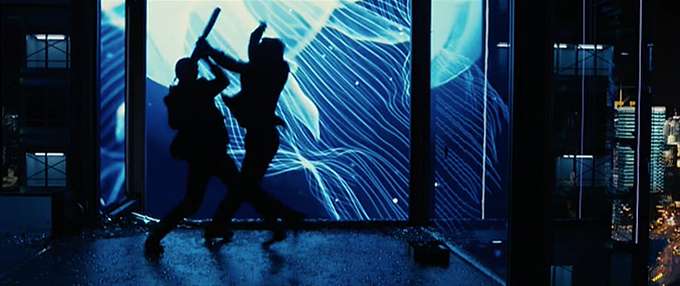
With an especially intelligent script and Sam Mendes taking over directing, Skyfall feels like a different animal from its predecessors. There’s a greater attention to artistry than your typical action film, elevating sequences that are already exciting to another level. One particularly superb scuffle sees Bond wrestle with a sniper in silhouette, all in one take and lit from behind by a colorful moving screen on a nearby building. My VC thought the silhouettes almost looked animated, but it was stunning and possibly my new favorite scene of any Bond film. The exotic settings and impressive action epitomize Bond’s appeal for thrill-lovers, and there’s an effort to keep things at least moderately realistic, with an amusing sideways jab at the gadget excesses of past adventures. That komodo dragon pit is straight out of Johnny Quest, though.

Image result for skyfall

The other element that sets Skyfall apart is that, after five decades and twenty-two movies, we actually get some character development for Bond himself that goes beyond grieving lost love interests or the vague hints of Casino Royale, and it even gives the title a significant part of the story as opposed to just something that sounds cool. Actually getting a glimpse of Bond’s roots makes him that much more human, which is an important factor to offset his superhuman feats and the extreme punishment he often endures. Bond’s prickly relationship with M also gets attention, questioning the hard decisions she’s made with him and past agents and adding depth to the testy but synergetic rapport they’ve established. The ending even takes a risk in incorporating a change in the status quo that had never been acknowledged in past installments of the franchise.

Skyfall may not be quite perfect, thanks to a semi-anticlimactic ending, but it’s as close as I’ve seen the franchise come, being more engaging than Casino Royale and more straightforward than Quantum of Solace. I’m still not entirely sold on Daniel Craig, but he makes the role his own here and rises to the acting challenge. Skyfall has all the ingredients one would predict in a Bond film, but it surprises by going beyond the typical suave escapades we’ve come to expect by adding vulnerability, consequences, and some profound Tennyson lines. Even if he’s not my favorite Bond, I must admit that Craig’s films are the best, with Skyfall at the head of the pack.

Best line: (Q) “Age is no guarantee of efficiency.”   (Bond) “And youth is no guarantee of innovation.”


Rank: List-Worthy


© 2016 S.G. Liput
418 Followers and Counting


The Babadook (2014)

30 Sunday Oct 2016

Posted by sgliput in Movies, Poetry, Reviews, Writing

≈ 5 Comments

Tags

Drama, Horror

Image result for the babadook


If it’s in a film or it’s in a book,
It might be as real as the Babadook.

Believing in fairies is darling and cute;
What is the worst they can do?
Believing in him will put him in pursuit,
And now he is after you.

You may say there’s no Babadook;
Deny it all you like.
It’s just a silly made-up book,
Until you see him strike.

The thought of him will mean he’s there,
Which means he always is.
The Babadook is everywhere,
When he decides you’re his.
____________________

MPAA rating: Not Rated (might be R for intensity and brief language, but actual content is closer to PG-13)

In the proud tradition (and bad habit) I’ve adopted of watching a scary movie alone at night (also done with The Others and The Conjuring), I decided to investigate the universally lauded Australian horror The Babadook. Like the other fright fests I mentioned, I found it to be very much my kind of horror: one with more focus on atmosphere than jumps, featuring complex relationships and psychological distress, and almost devoid of blood. But dang, is it frightening! Poltergeist is a walk in the park next to this top-hatted creature feature.

The story centers on Amelia Vanek (Essie Davis), a struggling mother still deeply grieving her husband’s death and quietly resentful of her young son Samuel (Noah Wiseman), who was born the day his father died. Samuel continually causes problems at school and obsesses over monsters he imagines himself fighting with homemade weaponry. Then comes an innocent bedtime story, where a randomly chosen pop-up book takes a swift left turn; how many books from your childhood ended with “You’re going to wish that you were dead”? After that, Sam becomes convinced the Babadook from the book is real, much to Amelia’s annoyance. When she learns that her denial makes the creature stronger, though, it begins to target her, turning her exasperation with her son into madness.

For her directorial debut, writer/director Jennifer Kent did an outstanding job with developing the mood of unease to which most horror films only aspire. With inventive camera angles and muted colors, the Vanek’s home becomes a breeding ground of anxiety, and after the picture book mentioned three knocks as the creature’s call sign, I liked how there were three knocks anytime someone was at the door, instilling worry regardless of who was really there. As I’ve said before, the most effective scares are often the simplest, and The Babadook doesn’t need set pieces or creepy dolls to freak out the audience. The most intense moment stems from the knowledge of a barely glimpsed something present, against which Amelia can only cover herself with her blanket and hope she is wrong. It’s the kind of visceral tension that hits on a child-like level. The fact that we only see flashes of the Babadook’s shape and long fingers only makes him more mysterious and frightening, a newly invented boogeyman for the ages, especially when he says his own name like some diseased Pokémon.

Image result for the babadook

What makes The Babadook so intriguing is its symbolic nature. While it can be enjoyed as a familiar haunted house picture, it also puts an emphasis on the mother/son dynamic. When Amelia falls under the Babadook’s influence, she lashes out at Samuel, and we’re left uncertain how much of her rage is possession and how much is simply being released for the first time from pressure and lack of sleep. Samuel may seem like an irritating problem child at first, but his initial belief in the Babadook allows him to defend his mother, prove his love for her, and convince her to banish her oppressive grief. On a more conjectural note, the Babadook might also represent the demonic spirit behind all these news stories of murder-suicides that no one seems to comprehend, and Amelia and Samuel are just the latest to fall under its influence. Either way, the resolution is far different from the usual “evil-wins-to-scare-another-day” ending that most horrors try to spin into a sequel, and it makes clear the film’s bittersweet metaphor of grief.

As much as I admired The Babadook and acknowledge it as one of the most chilling films I’ve seen, there is one aspect that I think allows The Conjuring to edge it out in my opinion. They both depict evil being confronted by familial love, and while that’s enough for the purely secular Babadook, The Conjuring also utilizes religion in its arsenal against the malevolent spirit at work. I appreciate that the dark presence is subdued in both films, but the role of Christianity tips the scales for James Wan’s film and makes its conquering of evil more convincing in my eyes. The Babadook still has a meaningful end, though, especially when taken more allegorically than literally.

Although some of the editing is a bit choppy toward the beginning, I see why The Babadook is considered a modern classic. Because of its cult following, they’ve even distributed copies of the Babadook’s disturbing storybook; who would want one of those around the house?! With an emotional backbone, intense performances, and moments of unbearable suspense, it’s got more than the usual chills and thrills and doesn’t rely on gory effects to make an impact.

Best line: (crazed Amelia, to Samuel) “I AM YOUR MOTHER!!!”


Rank: List Runner-Up


© 2016 S.G. Liput
415 Followers and Counting


Sophie’s Choice (1982)

23 Sunday Oct 2016

Posted by sgliput in Movies, Poetry, Reviews

≈ 3 Comments

Tags

Drama, Triple A

Image result for sophie's choice


Choices, choices, none rejoices
When they’ve no choice but to choose.
How can anyone decide when
Every option sees them lose?

The mind will race, the conscience brace
For all the doubts of if and why
You chose the lesser of two evils
Or the road less traveled by.

Choices, choices, haunted voices,
More ashamed than they’ll admit.
The deepest burden of a choice is
Learning how to live with it.
______________________

MPAA rating: R (mainly for language)

I’m that strange sort of guy who doesn’t seem to care about spoilers. Of course, that only increases the value of twists or plot developments I didn’t see coming, but typically I have few qualms about reading up on a movie before seeing it. Thus, I was rather surprised that, as famous as Sophie’s Choice is, I didn’t really know what the titular choice was. I suspected it during the film, but watching it play out was no less gut-wrenching, thanks more than anything to an incredible performance by Meryl Streep.

Based on William Styron’s novel, Sophie’s Choice is what I call a Triple A movie, one that is All About the Acting, and I would encourage anyone who thinks of Streep as an overrated actress to see Sophie’s Choice and be reminded of her in her prime. She isn’t the narrator, though; that honor goes to a young Peter MacNicol as aspiring author Stingo, who moves into a New York boardinghouse, only to witness a furious break-up between Polish immigrant Sophie (Streep) and her lover Nathan (Kevin Kline). Before long, though, his neighbors make up and warmly welcome Stingo into their friendship, as well as their personal problems.

MacNicol is a rather dull protagonist, whose main role is as a framing device to learn about Sophie and Nathan. Kline, on the other hand, in his first film role, is almost as astonishing as Streep, even if he gets the bulk of the foul language. His extremes of eloquent camaraderie and profound hatred are electric and so intense that I was not surprised by the eventual explanation for his behavior. How he was not nominated for an Oscar that year, I will never know, especially when Charles Durning was for The Best Little Whorehouse in Texas! Come on, there’s no comparison! Even so, this movie is Streep’s forever, from her meticulously assumed Polish accent to her heart-breaking flashbacks where she speaks both Polish and German; it’s no wonder her performance is considered one for the ages.

While the two central performances in Sophie’s Choice are exceptional, it’s not a film I’d watch often, and it’s not simply because of the crushing sorrow involved. Depressing films can be some of the most powerful, like Grave of the Fireflies or The Elephant Man, and I love those films. Yet Sophie’s Choice falls into another category that leaves a certain profound emptiness. When an ending feels more like a waste than a misfortune, it’s harder to admire. I’m glad I saw Sophie’s Choice, a film that always brings my VC to tears and did this time as well, but it will be some time before I revisit its upsetting story.

Best line: (Sophie, to Stingo) “The truth does not make it easier to understand, you know. I mean, you think that you find out the truth about me, and then you’ll understand me. And then you would forgive me for all those… for all my lies.”


Rank: List Runner-Up


© 2016 S.G. Liput
414 Followers and Counting


Star Trek Beyond (2016)

18 Tuesday Oct 2016

Posted by sgliput in Movies, Poetry, Reviews, Writing

≈ Leave a comment

Tags

Action, Drama, Sci-fi, Thriller

Image result for star trek beyond

Space, the final frontier
Entices the brave pioneer.
Adventures await
When cadets graduate
At the start of a thrilling career.

Yet in between alien wars
And interdimensional doors,
The truth is that space
Can be one boring place
For a hero in search of encores.

Sometimes a more perilous foe
Must devastate our status quo,
Reminding us why
We decided to fly
And where we’re committed to go.
_____________________

MPAA rating: PG-13

After the rebooted Star Trek had its glorious return in 2009 and its original-continuity-referencing sequel in 2013, it’s logical that the filmmakers for its third entry asked “What next?” Surely they thought it wise to distance Star Trek Beyond from the original series timeline and stories that so influenced the first two, and I’m glad to say they succeeded. Star Trek Beyond feels like it’s settled into the story-of-the-week format that the series had, and this particular story both references that potentially dull routine and spices it up with audacious sights we’ve never seen before.

The famous characters have already been established in prior films and pop culture, so the film doesn’t spend much time on new character development (aside from the brief but unnecessary implication that Sulu is gay). Yet the film still finds a way to insert emotional weight at the beginning, from a much more mature Kirk (Chris Pine) dealing with how the thrill is gone to Spock (Zachary Quinto) getting some sad news. We also get to see the eye-popping Yorktown, a space station so futuristically cool it makes you wonder why we’ve never seen it before in the Star Trek universe (though it does have visual echoes of Inception and Upside Down).

This setup is rather slow at the start, but once the action starts, it doesn’t let up. Before you know it, a swarm of bee-like ships are crashing into the Enterprise’s hull, and all hell breaks loose. Much of the crew become stranded on a nearby planet, hunted by a mysterious alien named Krall (Idris Elba). To make sure everyone in the ensemble gets their fair share of screen time, they’re split into twos, a method that works rather well in spreading the characters out and exposing them to different elements relevant to the plot. Also added is Sofia Boutella as another stranded ally named Jaylah, who helps the crew battle Krall.

Image result for star trek beyond

Being a fan of Star Trek: Voyager, I noticed that this latest film seemed to draw some inspiration from that show. In the third season episode “The Swarm,” Voyager runs into a fleet of small swarming ships not unlike Krall’s armada, and they even defeat the swarm in a similar manner, though admittedly with less style. Voyager also seemed to have more episodes where one or two crew members were stranded on alien planets, making that aspect of the film also feel more familiar.

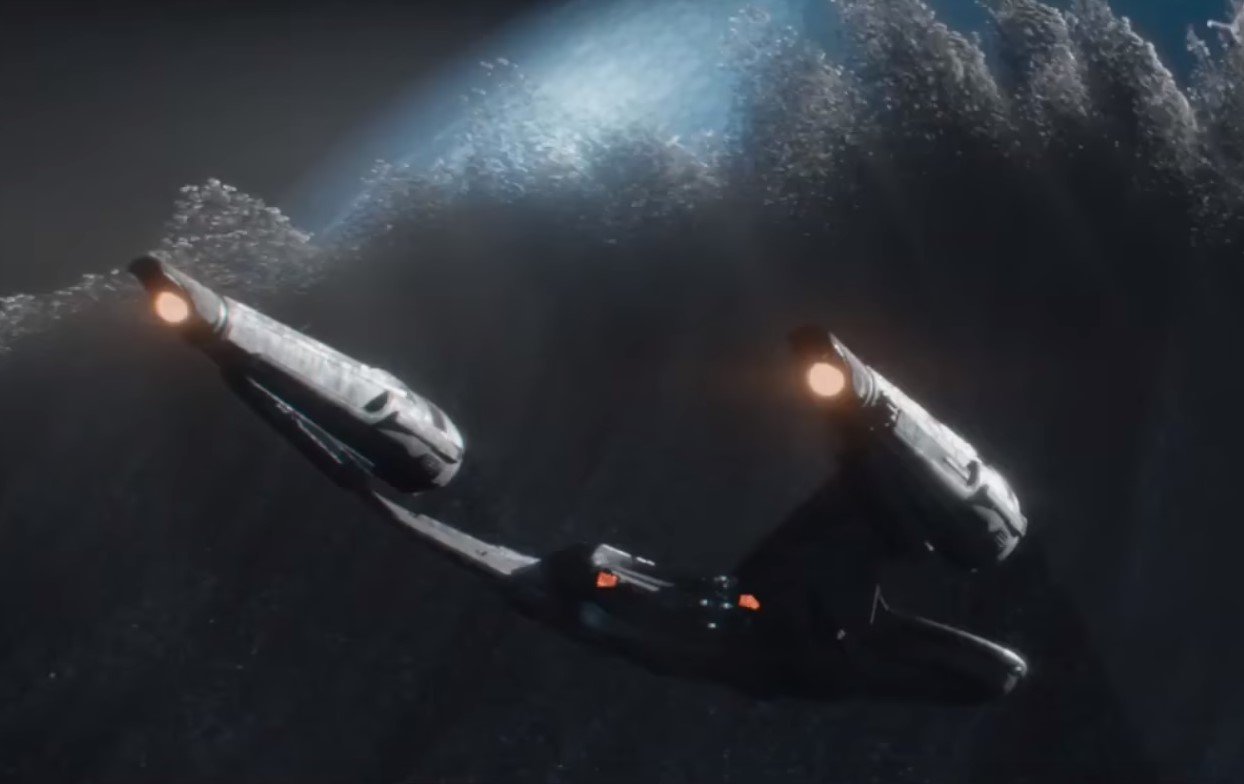
Even more than the others, Star Trek Beyond is an action movie, with new director Justin Lin bringing some flair from his experience with the Fast and Furious franchise. The camerawork makes the running and explosions a bit more frenetic and hard to follow at times, but there’s no shortage of dynamic thrills. Several impressive scenes and set pieces just left me saying “Dang!” (in a good way, of course), though if there was any Trek movie I would not want to be a redshirt in, this is it. The effects are still awesome to behold, not least of which is “that scene,” the one so many reviewers have noted as being particularly over-the-top, for good or ill. I for one thought it was brilliant and spectacular, especially on the big screen, as well as a nice musical callback to the 2009 film.

The only place Star Trek Beyond seriously stumbled was the villain. Elba is all right as Krall, though hard to understand at times, but his character’s backstory was far too ambiguous. Why did he look the way he did? Where did the fleet of alien ships come from? I’m not sure if these questions were answered and I missed it, or if the writers just glossed over those details. Either way, it could have been clearer.

Of the reboot trilogy, I still love the first most, but Star Trek Beyond is just as good and more original than Into Darkness. Couple the rousing action with the bittersweet tributes to deceased cast members Leonard Nimoy and Anton Yelchin, and Beyond becomes a well-rounded addition to the Trek canon. Yelchin’s death, in particular, throws the future of the series into doubt, but I certainly hope that there are more Star Trek stories to tell.

Best line: (Krall) “You can’t stop it. You will die.”   (Kirk) “Better to die saving lives, than to live by taking them. That’s what I was born into.”


Rank: Top-100-Worthy (Joining Star Trek into Darkness)


© 2016 S.G. Liput
413 Followers and Counting


High Plains Drifter (1973)

21 Wednesday Sep 2016

Posted by sgliput in Movies, Poetry, Reviews, Writing

≈ 3 Comments

Tags

Drama, Western

Image result for high plains drifter


Into town the stranger rode,
No history or name.
Revenge was due, a debt was owed,
And yet no other came.
All in town their worry showed
But covered up their shame,
Remembering the episode
For which they were to blame.
The still and sullen streets forebode
A secret, savage aim.
Into town the stranger rode,
And justice did the same.
________________

MPAA rating: R

For someone who loves movies, I do seem to have some glaring blind spots when it comes to expanding my repertoire. I’m a stranger to Tarantino and zombie films (though I don’t really care to be acquainted), and I’ve just recently begun exploring the most recent James Bond, Oliver Stone, and classic Hitchcock. One actor/director I know more by reputation than experience is Clint Eastwood. High Plains Drifter is actually the first western I’ve seen of his, and it confirmed why he is such a commanding screen presence.

Drawing from Eastwood’s experience with spaghetti westerns, High Plains Drifter also borrows certain elements from the likes of Seven Samurai and High Noon. Like Seven Samurai and its American remake The Magnificent Seven, the small desert town of Lago, named for the oddly located lake bordering it, lives in fear of the return of vengeful bandits and looks to a skilled stranger for salvation. Like High Noon, the film builds to the inevitable showdown between the lone defender and the encroaching enemy. A key question that sets High Plains Drifter apart, though, is “Is the town worth saving?” The townspeople in Seven Samurai and High Noon were prone to ingratitude and fear, but the settlers of Lago sit upon a cruel secret that takes much of the sympathy out of their plight.

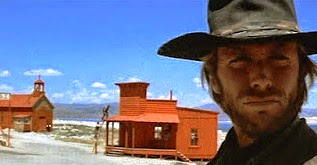
Eastwood has played many a tough guy for the ages, not least of which is the nameless Stranger who rides into town without a word, backed by Dee Barton’s spookily atmospheric score. When the Stranger proves his grit and his aim by killing Lago’s supposed defenders, the sheriff begs him to protect them, promising him anything he wants in return. Despite his distaste for the town, the Stranger agrees and proceeds to take full advantage of the open-ended offer, ordering free drinks, the entire hotel to himself, and other unreasonable demands that seem meant to punish the town as a whole. The film walks a fine line between the Stranger’s abuse and how deserving the town may be of it, crossing the line on occasion when he freely rapes two women, who unrealistically don’t seem to mind too much after the fact. Except for that needless exploitation, Eastwood’s Stranger proves to be a compellingly mysterious anti-hero, whose intentions for the town itself remain uncertain right to the end. When asked what comes after the showdown, he defiantly replies, “Then you live with it.”

Far from Eastwood’s first rodeo, High Plains Drifter is a brazen western that questions the decency of frontier folk. Aside from Eastwood, Billy Curtis plays his closest ally, the diminutive Mordecai who has also felt the town’s malice, and Richard Bull appears as a shopkeeper, a year before he played the owner of Oleson’s Mercantile on Little House on the Prairie. I can’t say how High Plains Drifter compares with Eastwood’s other westerns (yet), but it’s a somewhat haunting entry in the western genre that gives a whole new meaning to “painting the town red.”

Best line: (the Stranger, after an overdue assault from his rape victim) “Wonder what took her so long to get mad?”


Rank: List Runner-Up


© 2016 S. G. Liput
411 Followers and Counting


Experimenter (2015)

18 Sunday Sep 2016

Posted by sgliput in Movies, Poetry, Reviews, Writing

≈ 2 Comments

Tags

Drama, History

Image result for experimenter film


Our human nature is a lake
Where most content themselves to take
A shallow view for comfort’s sake,
But few will dare the deep.
The poets plumb it with their verse,
And nihilists would make it worse
While sages study to reverse
Its ever-waning creep.

When someone dives and brings to light
A bit of psyche to indict
That questions what is wrong and right,
How often do we balk!
We point the finger, hide from view,
Insist that it cannot be true,
And say we’re wiser than the few
Who failed temptation’s knock.

To fear a truth and disregard
Depravities that perish hard
Will leave us only further marred
By lessons left unlearned.
The depths we’d rather not explore
Are those we most should not ignore,
For by the schemer who knows more
Is human nature turned.
________________

MPAA rating: PG-13 (for one lone obscenity and some subject matter, could even be PG)

I had never heard of the Milgram experiment before Experimenter, but its social impact is considerable. While hearing of the shock-based college study brought to mind Venkman’s similar parody at the beginning of Ghostbusters, the actual experiment touched upon serious questions ranging from the compliance of Nazi subordinates to social engineering and people’s natural reluctance to rebel against authority. It’s thought-provoking research, which inspired an equally provocative film.

While Experimenter is a scrutiny of Stanley Milgram himself as well as a restaging of his most famous work, it begins where his fame did: the shock experiment. As Milgram (Peter Sarsgaard) watches from behind a one-way mirror, his assistant brings in two volunteers, one to answer questions and receive electric shocks for wrong answers and one to administer the questions and shocks. The shock-ee is actually part of the ruse and re-creates sounds of pain from a closed room, while the shocker is urged to continue increasing the voltage no matter what. A majority of participants lacked the will to resist and yielded to pressure to deliver supposedly life-threatening shocks, simply because they were told to. Only 35% refused.

The orchestrated scenario forms the beginning of the film but is also intercut with Milgram’s life, including meeting his eventual wife (Winona Ryder). During all this, Sarsgaard speaks directly to the audience, discussing the experiment and his findings like a purveyor of mental provocation. Indeed, that’s how he sees himself and his job as a social psychologist; he’s merely presenting facts for academia and the public to discern as they will and is surprised at the controversy he attracts. More people seem critical of how he tricked his participants than of their actual responses. Later, Milgram tries to diversify his reputation with different social experiments, like confirming the “Six Degrees of Separation” principle that applies to more than just Kevin Bacon, but he’s always pulled back to his original shock experiment, both by colleagues and in the public eye.

Throughout the film are examples of how Milgram’s work was viewed. He’s forced to conduct followup interviews to test the emotional “damage” done to participants. Uninformed strangers complain about how he shocks people, not even understanding the details of the experiment. When Milgram informs his class that President Kennedy’s been shot, no one believes him, thinking it’s just a hoax to elicit a reaction. In addition, the filmmakers employ some curious creative choices, such as changing some backgrounds into stage-like painted backdrops. At certain points during Milgram’s fourth-wall-breaking narration, an elephant appears behind him, suggesting that he is always followed by “the elephant in the room.”

Sarsgaard does an outstandingly muted job in the role of Milgram, as does Ryder as his wife, though their marital struggles are a bit too generic to compare with the social questions presented. I was surprised at some of the minor supporting players: Jim Gaffigan ventures away from comedy as one of Milgram’s accomplices, while Dennis Haysbert plays Ossie Davis, who appeared with William Shatner in a 1976 TV movie about the Milgram experiment called The Tenth Level. Even the late Anton Yelchin appears in a barely noticeable role as an aide to the experiment.

Experimenter‘s deliberate pace doesn’t make it the most entertaining of biopics, but it’s a psychologically stimulating study that, like Milgram, asks difficult questions for the viewer to consider. As one of Milgram’s colleagues posits about atrocities, “The techniques change, the victims change, but it’s still a question. How do these things happen? How are they institutionalized?” The answers may be disturbing, but they are better off acknowledged than scorned. We as humans hate to think of what any one of us could be capable of under the worst conditions, but the worst parts of human nature are not all-inclusive. Thirty-five percent refused to continue the experiment. Would that include you?

Best line: (Milgram) “Human nature can be studied but not escaped, especially your own.”


Rank: List Runner-Up


© 2016 S. G. Liput
410 Followers and Counting

Cartoon Comparisons: Upside Down (2012) / Patema Inverted (2014)

15 Thursday Sep 2016

Posted by sgliput in Movies, Poetry, Reviews, Writing

≈ 2 Comments

Tags

Animation, Anime, Cartoon Comparisons, Drama, Romance, Sci-fi

Image result for upside down 2012 film

Image result for patema inverted


Right-side up is upside down
To those who smile when they frown,
To those who plunge whene’er they jump
Or rise when tripping on a bump
Or gobble down and up their meals
And sink a little in high heels,
To those who elevate a bit
If they lean over, kneel, or sit,
To those who set a precedent
When they descend on their ascent.
Up and down can be subjective.
‘Tis a matter of perspective.
____________________

MPAA rating for Upside Down: PG-13
MPAA rating for Patema Inverted: should be PG

For the next Cartoon Comparison, I’ve chosen two science fiction films with wildly imaginative concepts that happen to be suspiciously similar. Both the live-action Upside Down from Canada and the anime Patema Inverted from Japan feature the idea of opposite gravities: people walking on the ceilings, objects falling up, and the unlikelihood of two oppositely oriented young people overcoming the hatred of their politically hostile worlds. What differs is the way their worlds interact and the pseudo-scientific “explanation” for the curious gravitational situation.

Upside Down came first so if there was any copying being done, the live-action film can claim to be the original. Here, as explained by the narration of Adam (Jim Sturgess), two planets orbit each other so closely that there is essentially no sky. Looking up from either world, one simply sees the other planet’s surface, about as far away as a skyscraper, echoing perhaps the folding city street in Inception. One planet is considered Up Top, full of wealth and societal power, while the other is the economically exploited Down Below, though there’s no telling how they were named, considering the potential confusion of “up” and “down.” Luckily, the extraordinary visuals elevate the film’s none-too-subtle class struggle. Even if there were moments that I wasn’t sure what I was seeing at first, the remarkable effects were a marvel to the eye.

Image result for upside down 2012 film

As for the love story, Adam from Down Below happens to meet Eden (Kirsten Dunst) from Up Top, and they share remote romantic rendezvous in the mountains until the government breaks them apart. Years later, as Adam experiments with a practical anti-gravity serum, he seizes a chance to see Eden again at Transworld, the tower-like corporate bridge between the two worlds. The two leads certainly have chemistry, but due to a certain plot point, they don’t get to take much advantage of it, and Sturgess’s behavior can be awkward at times.

Yet Adam’s quest to reunite with Eden without being caught by the authorities leads to a good deal of inventiveness, such as his attempt to weigh himself “up” and pose as a citizen of Up Top. Unfortunately, logic gets in the way at times, including the film’s own invented gravitational rules. For instance, Adam never seems to have a problem with the blood flowing to his head when upside down. Wouldn’t that be both uncomfortable and a possible give-away to anyone who might notice? In addition, one of the planetary laws is that matter from opposite worlds eventually burns, but the time it takes for this to happen seems inconsistent. By film’s end, the conclusion is peculiarly rushed, offering a blanket resolution to crucial issues it couldn’t hope to address and doesn’t try. Upside Down is brilliant in concept, less so in execution, but the visuals alone are worth the watch.

Image result for upside down 2012 film adam and eden

Upside Down may have come first, but Patema Inverted utilizes the notion of inverse gravity far better, in my opinion. Perhaps the fantastical image of falling up is simply more credible in animation rather than live-action CGI, but it certainly captured the imagination of director Yasuhiro Yoshiura, who previously directed the compelling series-turned-movie Time of Eve. (I was impressed by both Patema and Time of Eve separately but didn’t realize till afterward that they shared the same director.)

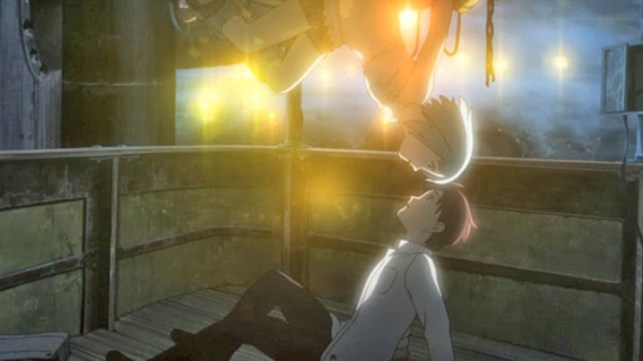
Instead of the up-front exposition of Upside Down, Patema Inverted takes its time to show and develop the gravitational anomalies as the characters discover them. Patema is a girl living in a City of Ember-like underground bunker and seems to be one of the few inhabitants to show an interest in the Forbidden Zone, where dust floats upward and “bat people” are rumored to lurk. After a close encounter, she finds herself dangling from a fence with the sky looming “below” her. Luckily, she is saved by the equally curious surface boy Age, who seems upside down to her. Age lives under a totalitarian dystopian government, whose leader is determined to root out the surviving inverts, who made their way underground after a catastrophic accident sent most of them falling into the sky years ago.

Image result for patema inverted

Upside Down basically lacked any sky; there was only so far someone could fall. Patema Inverted, however, makes the sky an imposing threat, a beautiful but dangerous abyss ready to swallow Patema without Age’s assistance. The animation is frequently dazzling, especially when the point of view shifts to contrast Age’s perspective with Patema’s. As Patema ventures into Age’s world and he ventures into hers, the distinction of up and down becomes fluid. The plot even takes some initially confusing twists that challenge the viewer’s perceptions and require some extra thought to fully comprehend. Some might be befuddled, but I found it fascinating. Plus, the musical score is enchanting and perfectly complements the film, including the gorgeous credits song “Patema Inverse,” which is sung in Esperanto and earns a place in the End Credits Song Hall of Fame. Between this and Time of Eve, I’m definitely hoping that Yoshiura continues to create such intriguing films.

I will admit that Patema Inverted seems to draw some inspiration from Upside Down. The cause of the inverted gravity differs (natural phenomenon vs. manmade disaster), but how the two gravities interact is the same: the lesser weight lightens the gravity of the other. This leads to the couples in both films holding on to each other to prevent the other from falling away, and being able to defy gravity by using each other’s weight. Writing about it doesn’t seem to do it justice, but it’s clever, cool, and undeniably similar in both films. As original as Patema Inverted is, I can’t help but wonder how much inspiration it drew from the earlier film. In addition, Patema is also rather slow in its gradual plot progression, and the villain is stereotypically bad for bad’s sake.

Image result for patema inverted


Despite these minor “down”-sides, Patema Inverted is easily the better film. Upside Down may have brought gravitational sci-fi to life first, but its conventional plot can’t compare with the thought-provoking vision of its animated counterpart.

Best line from Upside Down: (Adam) “Gravity, they say you can’t fight it. Well, I disagree. What if love was stronger than gravity?”

Best line from Patema Inverted: (Age, when holding onto Patema) “I get it! Your weight makes me light.”  (Patema) “Girls don’t like it when you talk like that!”


Rank for Upside Down: List Runner-Up
Rank for Patema Inverted: List-Worthy


© 2016 S. G. Liput
408 Followers and Counting

World Trade Center (2006)

11 Sunday Sep 2016

Posted by sgliput in Movies, Poetry, Reviews, Writing

≈ Leave a comment

Tags

Disaster, Drama, History

Image result for world trade center 2006 film


Do you recall the sirens?
The smoke-enveloped holes?
The billow blurred
And heavenward
Conveyed the victims’ souls.

Do you recall the terror
Of what was next to come,
The utter hell
As bodies fell
And minds and hearts went numb?

I didn’t watch the pictures
Ingrained on every brain.
I’ve seen them since
And felt the wince
That others bore with pain.

Like me, a generation
Has grown up towerless.
The shock and awe
That once was raw
We’ve had years to suppress.

One might regard us lucky,
The way we understand,
A distance free
From history
That many saw firsthand.

Although the blow is muted
For those younger than I,
We won’t let fade
The price once paid
By heroes when they die.
________________

MPAA rating: PG-13

Last year, I wanted to commemorate 9/11 by seeing the deeply effective United 93, and this year I did the same with World Trade Center, the slightly less acclaimed film from the same year. Based on the real-life experiences of Port Authority police officers John McLoughlin and Will Jimeno, who were buried under the rubble of Ground Zero, World Trade Center poignantly recreates the cavalcade of emotions of that infamous day.

From the first scenes, the film conjures the calm before the storm as everyday people perform their morning routines. Neither Jimeno (Michael Peña) nor his no-nonsense sergeant McLoughlin (Nicolas Cage) seems notable in their roles, yet when a plane flies into the North Tower of the World Trade Center, neither hesitates to venture into its lower levels. These early scenes highlight the uncertainty of the moment: conflicting reports of the severity of the damage, falling bodies, officers and civilians alike staring in shock at the smoking tower; and most of the scenes of the building seemed to be actual footage rather than a re-creation.

Despite the potent depiction of familiar events, most of the film is concerned with the aftermath, from McLoughlin and Jimeno struggling to stay alive beneath the debris to their worrying families. While a few scenes are confusing and the pacing becomes a bit paralyzed during their wait, the story still holds a relatable force in each family’s agonizing anticipation and the relieved cheer at any good news. Both Cage and Peña deliver excellent performances, as do Maria Bello and Maggie Gyllenhaal as their respective wives, and the ordeal is compelling enough that tears are probable by the end. (Also, Lost alert for William Mapother or “Ethan” as a Marine.)

World Trade Center is an admirable tribute to the first responders of 9/11, an impartial testimony thankfully free of the political messages for which its director, Oliver Stone, is known. I especially respect the religious overtones so often absent or limited in disaster movies; here, they extend to desperate prayers, God-led duties, and even a literal manifestation of Jesus. Even so, with its recognizable stars and anxieties common to most disaster films, it feels like a 9/11 movie, whereas United 93 felt like observing the actual events. Nonetheless, both are worthwhile commemorations of the courageous sacrifices made fifteen years ago.

Best line: (McLoughlin) “9/11 showed us what human beings are capable of. The evil, yeah, sure. But it also brought out the goodness we forgot could exist. People taking care of each other for no other reason than it was the right thing to do. It’s important for us to talk about that good, to remember. ‘Cause I saw a lot of it that day.”


Rank: List Runner-Up


© 2016 S. G. Liput
407 Followers and Counting

← Older posts
Newer posts →

Recent Posts

  • We Didn’t Start 2025 (Recap)
  • NaPoWriMo 2025 Recap (Finally)
  • Sonic the Hedgehog 3 (2024)
  • It Happened One Night (1934)
  • Spellbound (2024)

Recent Comments

associatesofshellymann's avatarassociatesofshellyma… on My Top Twelve La La La So…
Kit's avatarKit Nichols on Bonnie and Clyde (1967)
lifelessons's avatarlifelessons on Look Back (2024)
Carol Jackson's avatarCarol Jackson on The Thief of Bagdad (1940…
Stephen's avatarStephen on Love Story (1970)

Archives

  • January 2026
  • December 2025
  • May 2025
  • April 2025
  • March 2025
  • February 2025
  • January 2025
  • December 2024
  • May 2024
  • April 2024
  • March 2024
  • February 2024
  • January 2024
  • December 2023
  • November 2023
  • October 2023
  • September 2023
  • July 2023
  • June 2023
  • May 2023
  • April 2023
  • March 2023
  • February 2023
  • January 2023
  • December 2022
  • November 2022
  • October 2022
  • September 2022
  • August 2022
  • July 2022
  • June 2022
  • May 2022
  • April 2022
  • March 2022
  • February 2022
  • January 2022
  • December 2021
  • November 2021
  • October 2021
  • September 2021
  • August 2021
  • July 2021
  • June 2021
  • May 2021
  • April 2021
  • March 2021
  • February 2021
  • January 2021
  • December 2020
  • November 2020
  • October 2020
  • September 2020
  • August 2020
  • July 2020
  • June 2020
  • May 2020
  • April 2020
  • March 2020
  • February 2020
  • January 2020
  • December 2019
  • November 2019
  • October 2019
  • September 2019
  • August 2019
  • July 2019
  • June 2019
  • May 2019
  • April 2019
  • March 2019
  • February 2019
  • January 2019
  • December 2018
  • November 2018
  • October 2018
  • September 2018
  • August 2018
  • July 2018
  • June 2018
  • May 2018
  • April 2018
  • March 2018
  • February 2018
  • January 2018
  • December 2017
  • November 2017
  • October 2017
  • September 2017
  • August 2017
  • July 2017
  • June 2017
  • May 2017
  • April 2017
  • March 2017
  • February 2017
  • January 2017
  • December 2016
  • November 2016
  • October 2016
  • September 2016
  • August 2016
  • July 2016
  • June 2016
  • May 2016
  • April 2016
  • March 2016
  • February 2016
  • January 2016
  • December 2015
  • November 2015
  • October 2015
  • September 2015
  • August 2015
  • July 2015
  • June 2015
  • May 2015
  • April 2015
  • March 2015
  • February 2015
  • January 2015
  • December 2014
  • November 2014
  • October 2014
  • September 2014
  • August 2014
  • July 2014
  • June 2014
  • May 2014
  • April 2014
  • March 2014
  • February 2014
  • January 2014
  • December 2013

Categories

  • Blindspot
  • Blogathon
  • Christian
  • Movies
  • Music
  • NaPoWriMo
  • Poetry
  • Reviews
  • TV
  • Writing

Meta

  • Create account
  • Log in
  • Entries feed
  • Comments feed
  • WordPress.com

Recent Posts

  • We Didn’t Start 2025 (Recap)
  • NaPoWriMo 2025 Recap (Finally)
  • Sonic the Hedgehog 3 (2024)
  • It Happened One Night (1934)
  • Spellbound (2024)

Recent Comments

associatesofshellymann's avatarassociatesofshellyma… on My Top Twelve La La La So…
Kit's avatarKit Nichols on Bonnie and Clyde (1967)
lifelessons's avatarlifelessons on Look Back (2024)
Carol Jackson's avatarCarol Jackson on The Thief of Bagdad (1940…
Stephen's avatarStephen on Love Story (1970)

Archives

  • January 2026
  • December 2025
  • May 2025
  • April 2025
  • March 2025
  • February 2025
  • January 2025
  • December 2024
  • May 2024
  • April 2024
  • March 2024
  • February 2024
  • January 2024
  • December 2023
  • November 2023
  • October 2023
  • September 2023
  • July 2023
  • June 2023
  • May 2023
  • April 2023
  • March 2023
  • February 2023
  • January 2023
  • December 2022
  • November 2022
  • October 2022
  • September 2022
  • August 2022
  • July 2022
  • June 2022
  • May 2022
  • April 2022
  • March 2022
  • February 2022
  • January 2022
  • December 2021
  • November 2021
  • October 2021
  • September 2021
  • August 2021
  • July 2021
  • June 2021
  • May 2021
  • April 2021
  • March 2021
  • February 2021
  • January 2021
  • December 2020
  • November 2020
  • October 2020
  • September 2020
  • August 2020
  • July 2020
  • June 2020
  • May 2020
  • April 2020
  • March 2020
  • February 2020
  • January 2020
  • December 2019
  • November 2019
  • October 2019
  • September 2019
  • August 2019
  • July 2019
  • June 2019
  • May 2019
  • April 2019
  • March 2019
  • February 2019
  • January 2019
  • December 2018
  • November 2018
  • October 2018
  • September 2018
  • August 2018
  • July 2018
  • June 2018
  • May 2018
  • April 2018
  • March 2018
  • February 2018
  • January 2018
  • December 2017
  • November 2017
  • October 2017
  • September 2017
  • August 2017
  • July 2017
  • June 2017
  • May 2017
  • April 2017
  • March 2017
  • February 2017
  • January 2017
  • December 2016
  • November 2016
  • October 2016
  • September 2016
  • August 2016
  • July 2016
  • June 2016
  • May 2016
  • April 2016
  • March 2016
  • February 2016
  • January 2016
  • December 2015
  • November 2015
  • October 2015
  • September 2015
  • August 2015
  • July 2015
  • June 2015
  • May 2015
  • April 2015
  • March 2015
  • February 2015
  • January 2015
  • December 2014
  • November 2014
  • October 2014
  • September 2014
  • August 2014
  • July 2014
  • June 2014
  • May 2014
  • April 2014
  • March 2014
  • February 2014
  • January 2014
  • December 2013

Categories

  • Blindspot
  • Blogathon
  • Christian
  • Movies
  • Music
  • NaPoWriMo
  • Poetry
  • Reviews
  • TV
  • Writing

Meta

  • Create account
  • Log in
  • Entries feed
  • Comments feed
  • WordPress.com

Blog at WordPress.com.

  • Subscribe Subscribed
    • Rhyme and Reason
    • Join 814 other subscribers
    • Already have a WordPress.com account? Log in now.
    • Rhyme and Reason
    • Subscribe Subscribed
    • Sign up
    • Log in
    • Report this content
    • View site in Reader
    • Manage subscriptions
    • Collapse this bar