• Home
  • About Me
  • The List
  • THE LIST (2016 Update)
  • THE LIST (2017 Update)
  • THE LIST (2018 Update)
  • THE LIST (2019 Update)
  • THE LIST (2020 Update)
  • THE LIST (2021 Update)
  • THE LIST (2022 Update)
  • Top Twelves and More
  • The End Credits Song Hall of Fame

Rhyme and Reason

~ Poetry Meets Film Reviews

Rhyme and Reason

Tag Archives: Drama

The Outsiders (1983)

15 Friday Jul 2016

Posted by sgliput in Movies, Poetry, Reviews, Writing

≈ 4 Comments

Tags

Drama

Image result for the outsiders 1983


Youth are fools in their prime,
Adept at wasting time.
‘Tis not till age upsets,
They find time for regrets.
If grief will have its day
With innocence’ decay,
May fools find green and gold
Before they grow too old.
_______________

MPAA rating: PG-13

Francis Ford Coppola took a break from epics like The Godfather and Apocalypse Now with his far smaller and more personal adaptation of S.E. Hinton’s The Outsiders. This tragic tale of rival gangs in Tulsa, Oklahoma, is a prime example of a film that I can recognize as good without actually enjoying it. Gang movies have never been my cup of tea; I can appreciate parts of them, like the music in West Side Story, but it’s the kind of youth lifestyle I just can’t relate to in the slightest.

The best thing going for The Outsiders is the cast, a veritable who’s who of ‘80s rising stars. As friends Ponyboy Curtis and Johnny Cade, C. Thomas Howell and Ralph Macchio are two likable kids, Greasers who follow Dallas (Matt Dillon) around as the older boy hits on the prettiest girl at the drive-in (Diane Lane). Patrick Swayze and Rob Lowe join in too as Ponyboy’s elder brothers, while Emilio Estevez and even a snaggletoothed Tom Cruise show up for a few scenes. Howell, Macchio, and Dillon are the only ones to stand out, but seeing all these stars-to-be together was the film’s main pleasure.

After a lethal run-in with members of the well-to-do rival gang called the Socs (pronounced “Soashes”), Ponyboy and Johnny must hide out in an old abandoned church until tensions die down. Despite the relative lack of activity, it is this waiting that forms the high point of the film. The boys bond and read Gone with the Wind, and in a scene I included in my top twelve list of poems in movies, Ponyboy recites Robert Frost’s “Nothing Gold Can Stay,” applying its meaning to his own wish for permanence as the sunset recalls similarly staged scenes in Gone with the Wind. That grand scene is sadly fleeting as the boys must soon deal with sacrifice and gang pressures.

The rivalry between the Greasers and Socs is comparable to any gang rivalry, hinging on class warfare and revenge, but it just seems so pointless. I’m an easy-going, let’s-all-get-along kind of guy who just can’t understand the cyclical vengeance of gangs. I know that most conflicts are not easily resolved, but the small-scale scuffles on display here are the product of attitude and peer pressure and “getting even.” That’s what makes Ponyboy and Johnny so sympathetic; they’re tired of all the strife too, and though some descriptions I’ve read imply the gangs themselves are “the outsiders” of society, it’s really the two friends who stand apart from the petty rivalries into which they were more or less born and aspire to something more, something selfless.

There are glimmers of hope in The Outsiders, from the poem recitation to a scene of understanding between Ponyboy and one of the Socs, but the sad gang mentality remains. While one tragedy is given the respect it’s due, another seems like a total waste that could have been better reproved. I felt for Ponyboy and Johnny, but everyone else seemed to bring friction and violence on themselves, which is hardly something I enjoy watching.

Best line: (Johnny) “Stay gold, Ponyboy. Stay gold.”


Rank: Honorable Mention


© 2016 S. G. Liput
399 Followers and Counting


VC Pick: Waitress (2007)

12 Tuesday Jul 2016

Posted by sgliput in Movies, Poetry, Reviews, Writing

≈ 2 Comments

Tags

Comedy, Drama, Romance, VC Pick

Image result for waitress 2007 film


A pie on a plate is worth two in the sky,
So if your life’s sucking your happiness dry
With an unloving spouse
Or a big lonely house
Or the latest annoyance you greet with a sigh,

Don’t run off and have a clandestine affair,
Not even with someone with Mal Reynolds’ hair.
Just sit yourself down
And flip over that frown
With a big piece of pie to suspend your despair.

‘Tis the good kind of guilt when you pick from the shelf
A pie (if you want; I’m a cake man myself).
__________________

MPAA rating: PG-13

After seeing Waitress recently for the first time, my VC liked it enough that she insisted I review it as one of her picks. Directed, written, and co-starring the late Adrienne Shelly and recently adapted into a Broadway musical, Waitress might have had one main draw at first glance, my VC’s beloved Nathan Fillion, but as we watched it (two nights in a row actually), its overall appeal became more apparent. It’s an unconventional love story full of wry small-town charm and a craveable passion for pie. Seriously, there’s a lot of delicious pies on display, though they make them look far easier to prepare than in reality.

Keri Russell plays Jenna, whose waitress job at a Southern pie diner is one of the only things her cloddish husband Earl (Jeremy Sisto) will let her do. He’s so needy and controlling that Jenna feels positively smothered and eager to leave him, even dreaming up pies named in his dishonor, and thus she’s none too thrilled when she discovers she’s pregnant. On her first prenatal visit to the gynecologist, in comes Nathan Fillion as Dr. Pomatter, certainly no Mal Reynolds (his character from Firefly) but a likably nervous sort, and one can see his awkward chemistry with Jenna a mile away. In a predictable version of this story, there would probably be an affair with passionate smooching and a confrontation between the men and maybe a breakup before a final tearjerking declaration of love, but Waitress only borrows a few such aspects, clinging to cynical honesty before yielding to surprising sweetness. My VC was glad they kept the passionate smooching with Fillion, though.

Films aiming for quirk don’t always come off as realistic. I love the provincial antics in Doc Hollywood, for instance, but it’s full of movie characters rather than people I might expect to find in a real Southern town. Waitress has some of the same earnest loopiness but toned down to believable levels. (Okay, that may not apply to the ridiculously love-struck date of one of Jenna’s coworkers, but hey, it’s still a comedy.) The dialogue often reaches gentle amusement rather than big laughs, not only because of the dramatic side of Jenna’s depressing life but because real life isn’t always full of zingers. Sometimes, eloquence is found in frank simplicity, such as an unexpectedly straight answer about life from Jenna’s surly boss.

Image result for waitress 2007 film

Aside from the underplayed pro-life aspect of Jenna respecting her baby’s “right to thrive” despite not really wanting it, I admired how the characters were gradually developed. Most come off rather unlikable at first, whether it be Jenna’s demanding boss or the diner’s schadenfreude-prone owner Joe (Andy Griffith). Only over time are their more sympathetic facets revealed without undercutting their prickly exteriors. Even Earl with all of his loathsome clinginess shows a few glimpses of affection that could have once convinced Jenna to marry him. In addition, an important scene toward the end speaks to the immediacy of meeting someone face to face. Jenna sees two previously unseen characters for the first time, completely changing her opinions of them and the direction of her life. While what follows isn’t the fairy tale ending that one might hope or expect, it’s sweetly realistic and mature on Jenna’s part.

By the end of Waitress, my VC and I weren’t quite sure how to feel about it, but after thought, a rewatch, and some craving for pie, we both agreed in the simplest of terms: we liked it. (Did I mention, though, that she loved watching Nathan Fillion? Women.)

Best line: (Dawn, played by Shelly, speaking of her awkward beau) “They are poems that just occur to him on the spot. Last night, he said to me, ‘Dawn, your face is a brilliant moon in my empty room. Your love is like a beating drum. Ba bum ba bum ba bum ba bum.’”

VC’s best line: (Jenna, writing to her unborn baby) “Dear Baby, I hope someday somebody wants to hold you for twenty minutes straight, and that’s all they do. They don’t pull away. They don’t look at your face. They don’t try to kiss you. All they do is wrap you up in their arms and hold on tight, without an ounce of selfishness to it.”


Rank: List Runner-Up


© 2016 S. G. Liput
394 Followers and Counting


Version Variations: Of Mice and Men (1939, 1992)

07 Thursday Jul 2016

Posted by sgliput in Movies, Poetry, Reviews, Writing

≈ 4 Comments

Tags

Drama, Version Variations

Image result for of mice and men 1939

Image result for of mice and men 1992


A man’s secure within his plans,
Within his mind and strength of hands.
The world he’s in, though, makes demands
That cast his hopes in doubt,
That turn his rock to shifting sands,
His promised lands to drought.

A plan is never set in stone,
And though the future is unknown,
Both good and ill are all our own,
As it has always been.
When sown and grown and maybe blown,
New plans must then begin.
________________

MPAA rating of 1992 version: PG-13
MPAA rating of 1939 version: Approved (should be PG)

I’m one of the few people for whom John Steinbeck’s Of Mice and Men was not required reading in high school. Thus, even though I had a vague notion of the plot due to its general fame, I was able to watch Gary Sinise’s 1992 adaptation without knowing how the story would actually play out. Only after that did I also investigate the original adaptation with Burgess Meredith and Lon Chaney, Jr., one of the famous 1939 classics. In order to review both with one stone, this will be the first of a new feature called Version Variations, where I’ll be contrasting two versions of the same story. (Of course, if one happens to be animated, that will still fall under Cartoon Comparisons. Can you tell I like alliteration?)

I’ll start with the remake, the personal passion project of Gary Sinise, who directed and starred as George, the Depression-era migrant worker who travels with the large but simpleminded Lenny Small (John Malkovich). George watches out for Lenny, shielding him from trouble when possible and encouraging him with promises of a ranch of their own, complete with rabbits to pet and feed. While they both work hard and make progress toward their goals, most people probably know theirs is a tragic story; circumstances are the real enemy, and sometimes the slightest of mistakes can send things spiraling out of control.

Image result for of mice and men 1992

Sinise is just as talented a director as he is an actor, displaying a steady hand for the gut-wrenching moments and an eye for detail during the lovingly recreated harvesting scenes. As well as Sinise translates the novella to the screen, most of the credit goes to Steinbeck. As works like Lifeboat and Cannery Row illustrate, he was a master at creating distinct and sympathetic characters, like the dog-loving old man Candy (Ray Walston, aka Boothby from Star Trek: The Next Generation) and the bitter black cripple Crooks (Joe Morton). In addition to swiftly developed characters, the structure of the story is perfection, with poignant foreshadowing that only becomes clear by the end. And of course, at the heart of the film are Sinise and Malkovich, giving some of the best performances of their careers, with Malkovich in particular nailing the childlike innocence that makes Lenny all the more pitiful.

As for the 1939 adaptation, which included Steinbeck’s personal involvement and approval, it’s almost identical, testifying to the faithfulness of both versions to the book. Directed by Lewis Milestone and scored by Aaron Copland, this black-and-white version features Burgess Meredith as George and the hulking Lon Chaney, Jr., of Wolf Man fame as Lenny. One thing I liked from the outset was a clear reference to the title’s source, since “of mice and men” comes from the Robert Burns poem “To a Mouse.” Much of the characterization and dialogue are the same, with one difference being the slightly altered countenance of the only female character Mae (Betty Field in the original, Sherilyn Fenn in the remake), the bored and rebellious wife of the boss’s arrogant son Curley. The 1939 Mae is more vocal and antagonistic than the 1992 version of the character, who is known only as Curley’s wife as in the book. In addition, the 1939 film lacks the frequent profanity that Sinise included, though due to the book’s reputation for censorship I suspect Sinise was a bit more faithful in that regard.

Image result for of mice and men 1939

The quality of the performances is certainly admirable, though some of the acting feels dated and overplayed. While Chaney can’t compare with Malkovich, Meredith and Sinise are equally excellent as gruff but caring George. The one role that I found even better in the original was that of Candy (Roman Bohnen), the old farmhand urged to kill his aging dog. As good as Ray Walston is in the remake, Bohnen steals his scenes with tearjerking effect, making me wonder why he wasn’t even nominated for Best Supporting Actor.

Both versions are powerful examples of adapting a classic book. Both have their strengths, yet Sinise’s version sidesteps the original’s weaknesses and wins my preference, despite the needless profanity. Perhaps it was simply because I saw the 1992 adaptation first, but it had a much greater emotional impact for me, aided by how the eventual climax wasn’t given away as quickly as in the 1939 version. Still, the original has enough dramatic power and artistry to recommend it too, such as a scene that slowly zooms backward as George walks across the barn toward the end. Neither earned any Oscars, though the 1939 version was nominated for Best Picture, Sound Recording, Musical Scoring, and Original Score. I may or may not ever read Steinbeck’s novel, but these two adaptations do his work proud.

Best line (same in both versions): (Slim, speaking of Lenny) “A guy don’t need no sense to be a nice fella.”


Rank for 1992 version: List-Worthy
Rank for 1939 version: List Runner-Up


© 2016 S. G. Liput
393 Followers and Counting


The Walk (2015)

29 Wednesday Jun 2016

Posted by sgliput in Movies, Poetry, Reviews, Writing

≈ 4 Comments

Tags

Drama, History, Thriller

Image result for the walk 2015


Spanning the gap                                                     between each tower,
Not a trap,                                                               but source of power,
Hangs a cord                                                            you pray is taut,
In which is stored                                                     your only shot.
Your heart is racing, mind is bracing for the danger you’re embracing,
It’s, you know,                                                         a dream worth chasing.
You stand so high                                                     upon the brink,
The edge of sky,                                                       the towers’ link.
The world must fade,                                                the thought of loss
Or accolade,                                                             to walk across
The peril you                                                            yourself have set
For public view                                                         and public fret.
You must not fear;                                                    you must not stumble.
Wisdom here                                                            will keep you humble.
Take a breath                                                           and tread with care;
Think not of death                                                    when in the air.
Dreams unskilled                                                      can get you killed,
Yet all are thrilled                                                     when they’re fulfilled.
________________________

MPAA rating: PG

Except for those who remember the headlines back in 1974, most were probably first introduced to Philippe Petit’s daring tightrope walk between the Twin Towers by 2008’s Oscar-winning documentary Man on Wire. I, however, did what anyone would do who isn’t well-versed in documentaries; I waited until Hollywood made a “real” movie about it. Luckily, Robert Zemeckis took up the project and created a film that is not only entertaining as a fact-based drama but actually makes me curious to see the “real real” story in Man on Wire.

Joseph Gordon-Levitt effortlessly adopts a French accent to play Petit from the beginning of his tightrope career to his greatest achievement. In many ways, he’s the definition of a misunderstood artist, bearing the weight of a dream that most people consider foolhardy, even his own father. We watch as he “learns the ropes” from high wire master Papa Rudy (Ben Kingsley), gains a few supporters like the lovely Annie (Charlotte Le Bon from The Hundred-Foot Journey), and draws ever closer to his ultimate dream of traversing the space between the towers of the World Trade Center, which was still under construction at the time.

Since his exploit is clearly illegal, involving much trespassing and personal risk, the lighthearted dream morphs into something of a heist, as Petit scopes out his target, meets accomplices, and memorizes careful plans that could easily go wrong. The climactic walk itself is a marvel of invisible effects work (alas, no Oscar nomination), placing Gordon-Levitt in what appears to be the most dangerous place imaginable. I happened to watch The Walk with my mom and dad on either side of me, neither of whom knew how Petit’s dream would end, and I got a huge kick out of watching their reactions. I, of course, did know and was able to watch much more calmly and chuckle as they practically went into anxious convulsions with more unrelieved tension than Petit’s tightrope. Suffice to say, the protracted finale is not for anyone even mildly afraid of heights.

The Walk is a highly enjoyable biopic that lets Petit’s dream come to fruition with pleasant fluidity, making him someone worth celebrating while acknowledging his mysterious obsession with his goal. Why does he want to walk between the towers when it’s so dangerous? To prove he can? To be the first to try? Because they can’t resist? Even though this question is asked right from the start, it’s never fully explained, but I suppose the answer isn’t far from why mountaineers climb Everest. It doesn’t make sense to us mundane folk, but the thrill and the satisfaction of accomplishment are everything to them. In recreating the Twin Towers and one man’s fascination with them, The Walk also takes on a bittersweet note in the final scene. The World Trade Center towers may no longer stand, but Petit’s dream at least lets them live on in our memory as more than just the site of tragedy.

Best line: (Barry, who works in the WTC after being told of Petit’s plans) “It’s something only a twisted, antisocial, anarchistic, pissed-off malcontent would have anything to do with…. You have your inside man!”


Rank: List-Worthy


© 2016 S. G. Liput
391 Followers and Counting


The Luzhin Defence (2000)

26 Sunday Jun 2016

Posted by sgliput in Movies, Poetry, Reviews, Writing

≈ 6 Comments

Tags

Drama

Image result for the luzhin defence movie


Bishop to knight and rook to queen,
As pawns patrol the ranks and files.
Spectators gawk as masters preen
And intellects complete their trials.

Obsession is a healthy thing
While meditating o’er a board,
But once you’ve captured every king,
You’ll find the game of life ignored.
______________

MPAA rating: PG-13

There are plenty of movies about unique contests: spelling bees, dancing competitions, even ice sculpting, and in the case of The Luzhin Defense, a chess competition. Based off a book by Vladimir Nabokov, the film shows how unexpectedly intense a seemingly “boring” game like chess can be. John Turturro plays Aleksandr Luzhin, a chess prodigy with clear mental issues. He’s a strategic genius, but years of pressure to prove his brilliance have left him fragile and antisocial. At one fateful contest in Italy, Luzhin encounters his greatest fear in his manipulative former mentor (Stuart Wilson), as well as his greatest love in Natalia Katkov (Emily Watson).

Turturro is quite good as the troubled mastermind, though his personal eccentricities and obsessive tendencies make one wonder what Watson’s character sees in him. Years before her stern motherly roles in War Horse and The Book Thief, Watson manages to outshine Turturro’s attention-grabbing oddness with a performance that sells the unlikely attraction between them and makes it that much more bittersweet. While good overall, The Luzhin Defense is ultimately a less inspiring version of A Beautiful Mind, which was to follow the next year, and I’d rather see Russell Crowe’s troubled genius any day.

Best line: (Luzhin, preparing to play his rival) “As Pushkin’s doomed duelist said, ‘Let’s start if you’re willing.’”


Rank: Honorable Mention


© 2016 S. G. Liput
390 Followers and Counting


For Greater Glory (Cristiada) (2012)

24 Friday Jun 2016

Posted by sgliput in Blogathon, Christian, Movies, Music, Poetry, Reviews, Writing

≈ 4 Comments

Tags

Drama, History, War

Image result for for greater glory film
If your freedoms were taken, your rights undermined,
To worship, to write, or to speak your own mind?

Would you flee?
Would you fight?
Would you stay out of sight?
Would you trigger a war?
Would you pray less or more?
Would you just play along,
With no thought to the wrong,
And in fear knowing well
That one word could bring hell?

Would you plot and resist?
Would you cease and desist?
Would your final resort
Be but silent support?
Would you bear the blood spilt
And accept your own guilt?
Would you think yourself smarter
As traitor or martyr?

Now ask what must happen, what action or vision,
To weigh on your conscience and change your decision?
___________________

MPAA rating: R (for scenes of war and torture, could be PG-13)

This is my contribution to the Remembering James Horner Blogathon over at Film Music Central, where the music of the late great film composer is being celebrated. I’d wanted to see For Greater Glory for years now, and this gave me the perfect opportunity, while illustrating how Horner was equally at home scoring small-budget historical dramas as well as multi-million-dollar blockbusters.

I’ve been waiting for that moment when Christian filmmaking manages to keep up with Hollywood, because despite the inspirational appeal of movies like Fireproof and Miracles from Heaven, Christian films always tend to lack the polish of their secular counterparts. Thankfully, For Greater Glory has that polish, boasting cinematography, editing, and a name-recognized cast worthy of Hollywood while telling a story at once faithful, gritty, and timely.

Most people have probably never heard of the Cristero War, a Mexican revolt from 1926 to 1929 caused by the viciously anti-Catholic policies of President Plutarco Elías Calles (played by Rubén Blades). Because of the history of devout Catholicism that seems synonymous with Latin America, it came as a surprise to me that anti-religious positions were written into the Mexican constitution, and when Calles began enforcing them by deporting foreign priests and killing priests and parishioners alike, the people rose up against him with the battle cry of “Viva Christo Rey!” It’s a struggle largely forgotten but comprehensively recounted through the experiences of various freedom fighters: famed general Enrique Gorostieta (Andy Garcia), lone wolf Victoriano Ramirez (Oscar Isaac), priest-turned-general Father Vega (Santiago Cabrera), peace-seeking lawyer Anacleto Flores (Eduardo Verástegui), and pious youngster José Sánchez del Río (Mauricio Kuri).

The entire cast deliver excellent performances, from Garcia’s conflicted attitude toward defending a religion he doesn’t share to a brief but impactful role for Peter O’Toole. Garcia as General Gorostieta is the most intriguing, an atheist like Calles who nonetheless staunchly believes in religious freedom; his calls of “Viva Christo Rey” encourage the troops as they become perhaps more heartfelt, reminding me that impartial atheists can do wonders with spiritual material. (For example, Amazing Grace was directed by Michael Apted.) The sporadic action is also tense and visceral (though more worth a PG-13 than an R), with ambushes, battles, and an especially cool one-against-fourteen shoot-out with Oscar Isaac. As for Horner’s score, it’s not among his most memorable soundtracks but one which masterfully complements every scene, rousing during the war scenes and suitably intense in the most emotional moments.

Image result for for greater glory film hanging


Despite the epic scope that the film mostly achieves, it’s rather slow-paced overall, and one might have trouble telling the various characters apart at first. What makes For Greater Glory worthwhile, though, is its commitment to telling a story that has been swept under the rug of history, an injustice explained by the fact that history is told by the winning side. As the film progresses, it becomes clear that this is more tragedy than triumph, and sacrifices toward the end bring to mind death scenes in The Passion of the Christ and Butch Cassidy and the Sundance Kid. Even if none of the characters are deeply explored, the historical notes before the end credits give them the depth of reality as we learn that many have since been beatified or canonized as saints.

With ever-growing distress over religious freedom in America and throughout the world, it’s important to see where religious intolerance can lead. Again, it’s hard to imagine that, in the country of Our Lady of Guadalupe, Christians were hanged from telephone poles less than a century ago, like crosses along the ancient Appian Way. Some have considered the film to be one-sided in its blessing of the rebels who committed some glossed-over atrocities of their own, but the heroics and devotion on display are still worthy of admiration, remembrance, and prayers that such abuses may never happen again.

Best line: (Calles, speaking of Gorostieta) “Filio Diaz used to say, ‘A dog with a bone in his mouth doesn’t bark and doesn’t bite.’ In politics, everything has a price. Go find his.”


Rank: List Runner-Up


© 2016 S. G. Liput
389 Followers and Counting

Image result for for greater glory film hanging


Counterpoint (1967)

09 Thursday Jun 2016

Posted by sgliput in Movies, Poetry, Reviews, Writing

≈ 2 Comments

Tags

Classics, Drama, Thriller, War


The wave of the constant conductor’s baton
Arises and dips as each note’s liaison.
It nods to the strings
As the clarinet sings
And the audience clings
To the melody’s wings.

The music is steady and blind to the world,
Where battle is brutal and bullets are hurled.
The music will stay,
If the artists still play
And the hearers, like they,
Let war’s din fade away.
_____________________

MPAA rating: Might as well be PG

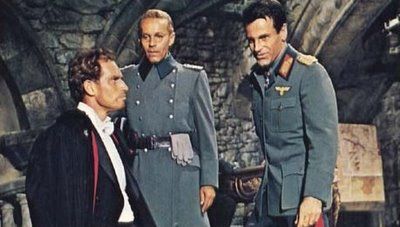
In the annals of semi-classic Hollywood, there are bound to be undiscovered gems, and I’m glad to say I found one, a World War II thriller worthy of being mentioned in the same breath as The Great Escape. Counterpoint begins on the front lines of the European theater, where a USO symphony orchestra plays for the troops only to have their performance cut short by the advancing German army. Quickly captured by the Nazis, the orchestra’s director Lionel Evans (Charlton Heston) demands they be released, but the Germans have orders to kill any and all prisoners. The only thing that saves them is the cultured admiration of the Nazi General Schiller (Maximilian Schell), who wants a concert and offers no guarantees of what is to follow it.

Heston and Schell make an outstanding pair of rivals, both self-absorbed and confident and used to getting their own way. Evans’ personality is summed up by an early line to his orchestra: “Each one of you will be responsible for your instruments, your music, and yourselves, in that order of importance.” Only two members of the seventy-member orchestra are actual characters (Leslie Nielsen, Kathryn Hays), but they and the rest know Evans’ ego all too well, and when he refuses to give in to General Schiller’s demands, they assume he’s satisfying his own opinions at their expense. Below the surface, however, he does care for his people and tries to stall the shooting squad that awaits them once the concert hall goes silent. Opposite Heston, Schell has a grinning, scheming charisma, looking perfectly at ease as he threatens his “guests”, like a precursor of Hans Landa in Inglourious Basterds. His treatment of an antique chair implies that he cares little for art, yet he’s a firm admirer of Evans and trades sharp-witted barbs with him to either convince or coerce him into submission. With one of his underlings clamoring for the prisoners’ blood, Schiller wants his concert before the war must resume.

I’m honestly surprised that Counterpoint isn’t a better-known film. The Nazis’ periodic acts of aggression keep the tension high, and close calls and narrow escapes are juxtaposed with the grandeur of the Los Angeles Philharmonic playing Tchaikovsky, Brahms, and Wagner. The climax even kept me guessing right up to the end. It’s not necessarily an award magnet that got spurned, but it’s an excellent and thoroughly underrated film that deserves far more recognition.

Best line: (Schiller) “To paraphrase Napoleon, morality is on the side of the heaviest artillery.”   (Evans) “Whatever happened to Napoleon?”


Rank: List-Worthy


© 2016 S. G. Liput
386 Followers and Counting


Bridge of Spies (2015)

06 Monday Jun 2016

Posted by sgliput in Movies, Poetry, Reviews, Writing

≈ Leave a comment

Tags

Drama, History


Before you, a bridge rises out of the mist,
The near side your own side; the far, you resist.
On your side, so many are pleased to deride
The enemy wretches on their other side
And know in their hearts that their odious foe
Hates your side in equal amount, quid pro quo.

You fear them and jeer them and anyone near them
And anyone shy or unwilling to smear them,
And they do the same with no ending in sight
As hate begets hate and the threat of a fight.
You don’t really want one, and why would they too?
But they are untrustworthy, which they call you.

One day, though, you happen to meet one of “them,”
And though your first instinct’s perhaps to condemn
Like everyone else on the bridge’s two sides,
You doubt if it’s more than a bridge that divides.
Then, having suppressed your presumptive suspicion,
You look past the cover to read the edition.

Indeed, there’s a man behind labels and threats,
Not too unlike you, full of hopes and regrets.
You still disagree, thinking your side’s the best,
But men are more kindred than one might have guessed.
The bridge separates your two sides still suspect,
But now you await the day it may connect.
__________________

MPAA rating: PG-13

The first review I heard of Steven Spielberg’s Bridge of Spies was from a coworker who described it as “really boring but really good.” While the first part is arguable, I sincerely agree with the latter. Spielberg’s latest stab at significant historical drama may not be his most accessible, but it’s a solid addition to an already legendary filmography.

I’d wager that anyone other than a history buff probably has little more than name recognition when it comes to Gary Powers and the U-2 incident; I consider myself a semi-history buff, and I had no clue of the true story behind it, which began with the capture of Soviet spy Rudolf Abel (Oscar winner Mark Rylance). Since even criminals are given due process and no lawyer actually wants to defend an enemy spy, the powers that be task attorney James Donovan (ever-watchable Tom Hanks) with the duty of representing him in court. Donovan exhibits surprising commitment to the defense of his hated client, but it quickly becomes clear that Abel has already been convicted in the minds of both public and judge, making the prosecution nothing but a show trial.

I was reminded of how John Adams defended the British soldiers responsible for the Boston Massacre and somehow succeeded in acquitting most of them, proving the impartiality of American justice. However, such open-mindedness did not extend to the Cold War; not to say that Abel was innocent, but Donovan treats him with a laudable “innocent-until-proven-guilty” mentality and earns much hate for himself in doing so. Dirty looks on the train are one thing, but when cowardly haters take potshots through Donovan’s windows, we’re reminded that people’s respect for the law extends only as far as their own prejudices. (To be fair, I’ve read that such an incident never actually happened.) Of particular note is a scene that jumps back and forth between Donovan’s work and the secret deployment of Francis Gary Powers, the U-2 pilot shot down over enemy territory; the juxtaposition is subtle, but both men perform their duty for an unappreciative nation. The court battle could have made a good film by itself, but we see little of the legal proceedings as Donovan’s efforts are put into the larger context of international espionage, placing the attorney in the unfamiliar waters of prisoner exchanges and clandestine negotiations.

I can see how Bridge of Spies may not be a riveting experience for disinterested viewers, but I found the legal and political maneuvering consistently intriguing and not nearly as opaque as it could have been. Between the Coen brother’s intermittently witty script and Spielberg’s nuanced direction, the story flows naturally from one significant event to the next. I especially admired how certain scenes were foreshadowed or mirrored, whether for a sentimental payoff or for comparison, such as the contrast between the Soviets’ rough handling of Powers and the more civil treatment of Abel by the Americans. It may not be as exceptional a performance for Hanks compared with his more acclaimed roles, but I thought his principled character still deserved an Academy Award nomination. Rylance, who did win Best Supporting Actor, deserved praise for his drily sympathetic portrayal of Abel, but honestly I’m not sure that it would have warranted an Oscar in a more competitive year. In fact, I would have appreciated a little more interaction between Abel and Donovan, whose friendship is relegated mainly to the first half.

Despite these quibbles and the deliberate pacing, Bridge of Spies is quite close to a masterpiece. The historical basis and the focus on diplomacy and “spy stuff” through a personal lens distinguish their latest collaboration as one more success of which Hanks and Spielberg can be proud.

Best line: (Abel) “What’s the next move when you don’t know what the game is?”


Rank: List-Worthy


© 2016 S. G. Liput
386 Followers and Counting


Me and Earl and the Dying Girl (2015)

25 Wednesday May 2016

Posted by sgliput in Movies, Poetry, Reviews, Writing

≈ Leave a comment

Tags

Comedy, Drama


The future looms before our eyes,
A tunnel to the next unknown.
It’s too well-traveled to surprise,
And yet we worry and postpone.

For some, the future is a wall,
A bricked-up tunnel, barred and firm.
A grim prognosis cancels all
And makes their fears of shorter term.

Small comfort ‘tis to pray and stay
With those whose lives too soon conclude,
But when our future’s underway,
Distress should yield to gratitude.
________________

MPAA rating: PG-13

Who would have thought that two young adult novels about friendship and teen cancer would be published within months of each other and both would get their own movies within three years? John Green’s The Fault in Our Stars is the more celebrated and, in my opinion, the better film, but Me and Earl and the Dying Girl does well finding its own messages and style that never feel like rip-offs of something else.

Any film set in high school is bound to have clichés, particularly the introduction to cliques and colorful characters, but this film freshens its more familiar aspects with some wildly inventive camera work. The camera zooms and flips and rushes through crowded rooms, and the drily comical narration caused my VC to compare it to the Coen brothers’ style in Raising Arizona. The eccentricities are many, as Greg (Thomas Mann) explains his school, his survival tactics, and his hobby of making ultra-low-budget parodies of classic movies (like The 400 Bros or Senior Citizen Kane) in collaboration with his friend/coworker Earl. When his mother literally nags him into submission, Greg agrees to befriend Rachel Kushner after she is diagnosed with leukemia and even tries to make a film for her benefit.

The first half of the movie has some great clever humor, such as the best hipster cat name ever, but also a good deal of casual crudity. Greg’s inherent awkwardness often manifests in crassness, Earl is impenetrably passive for the most part, and the film often feels like it’s trying too hard to sustain its quirkiness. With all the weirdness on show, Rachel is the most normal character by default; like me, she’s turned off by Greg at first but ultimately won over, and their friendship grows subtly over time, though without the romance of The Fault in Our Stars. As the title suggests, her condition worsens over time, and the film’s tone shifts into dramatic gear. After so much manipulation of the camera, one pivotal emotional scene settles in one perfect angle and is the more powerful for it.

Like Ruby Sparks, in which an off-kilter plot culminates in a perfect ending, Me and Earl and the Dying Girl ends on the right note. Does it matter that I don’t understand the movie that Greg makes for Rachel, which is as inscrutably avant-garde as some of the films he parodies? No, because like much of the “I don’t get it” art out there, it could mean anything or nothing, but it meant something to the right person at the right time. Films like this and The Fault in Our Stars can easily be seen as emotionally manipulative, but Me and Earl and the Dying Girl is at least honest about it, and as the final scenes reveal, there’s more subtlety to admire than first meets the eye.

Best line: (Earl, who after adding little to the story gets the line that inspired my poem, to Rachel) “It’s just crazy how patient you’ve been. You know, I know if it was me that had cancer, uh… I’d be upset and angry and trying to beat everybody’s a** half the time. So I’m just, I’m just amazed at how patient you’ve been. You, you make me feel blessed.”


Rank: List Runner-Up


© 2016 S. G. Liput

386 Followers and Counting


Labyrinth of Lies (2014)

22 Sunday May 2016

Posted by sgliput in Movies, Poetry, Reviews, Writing

≈ Leave a comment

Tags

Drama, Foreign, History


A monster’s a monster, regardless of size.
‘Twould be an outrage to imply otherwise.
A villain’s a villain; of that, there’s no doubt.
Do we know all villains worth knowing about?

A murderer’s evil, without an exception,
And those who assisted his crime or deception
And those who stood by to let one such go free
Are all as blameworthy as he. Disagree?

But what if you stood there and let him go by,
In fear that a critic would be next to die?
‘Tis no less wrong, is it, to stifle your tongue,
But are you still evil like those you’re among?

While evil is evil, as most should agree,
A sinner can vary by deed and degree.
Discerning a villain is right and essential,
But so is the fact we all have the potential.
________________

MPAA rating: R (for descriptions of violence and a brief bedroom scene; could easily be PG-13 with the slightest editing)

I’ve only seen three German films (3½ if I count Joyeux Noel), but Labyrinth of Lies is easily the best. Germany’s unnominated submission to the Academy Awards intrigued me with the trailer alone, and the film delivered exactly what I hoped for, an investigative new look at the semi-known stories of Auschwitz and Germany’s response to it in the years after World War II.

It’s taken for granted nowadays that most people have heard of Auschwitz and the crimes perpetrated by the Nazis, but early in Labyrinth of Lies, journalist Thomas Gnielka (André Szymanski) asks several passersby if they’d ever heard of Auschwitz. Everyone answers “No.” The year is 1958, and within one generation, the atrocities of Nazi Germany had been nearly erased where they most needed to be remembered. Nuremberg tried the Nazi leadership, but the thousands of Nazi Party members didn’t just disappear; they blended back into the populace, never telling their children what they had done. While Jewish survivors tried to forget the horrors they endured, everyone else just ignored them.

Unjust is a mild descriptor for such a situation, and when injustice runs rampant, thankfully someone steps forward for what’s right. While he seems to be a composite of several real-life figures, that someone is Johann Radmann (Alexander Fehling), a lawyer who tends to see every crime as black or white, not even yielding to overlook a minor traffic violation. Young and ambitious, he too has no idea of the Nazis’ crimes, and when his eyes are opened, he makes it his duty to bring justice to the victims. With support from his boss Fritz Bauer (Gert Voss, who died before the film’s release), he seeks out buried records, reluctant witnesses, and slippery targets – a teacher, a businessman, a baker –, determined that their own country try them for war crimes. He eventually sets his sights on Auschwitz’s monstrous doctor Josef Mengele, who was not caught after the war and escaped into hiding. As Radmann, Fehling is outstanding and often reminded me of a less baby-faced Leonardo DiCaprio; though German, he has at least appeared in Inglourious Basterds and Homeland, but he’s such a good actor that I hope he appears in more English-language roles.

Radmann is a dogged crusader for truth, even to the point of obsession, and the more lies he uncovers, the more his faith in humanity is shattered. He looks at pictures of Mengele and comments at how normal he looks. How could he have done such nightmarish deeds? How could an entire country yield to such hate and cruelty? The deeper he digs, the more blame he finds for everyone. Aside from the victims, no one was entirely guiltless, but does that mean everyone was a monster? Does remembering the bad mean disregarding the good, or vice versa?

Labyrinth of Lies deals with its subject frankly but unobtrusively. Despite the R rating, little is seen of the actual concentration camp crimes, and I prefer that, to be honest. I am fully aware of how barbaric the Nazis were, but I don’t want to see it recreated onscreen. That’s why I haven’t yet been able to bring myself to watch Schindler’s List, even though I realize I’m perpetuating to some extent the mindset of many Germans in Labyrinth of Lies, not wanting to see evil for what it was. This film deals with the horrific facts in a believably restrained manner that still underscores how they must never be forgotten. It’s encouraging that such a film came out of Germany itself, indicating the nation’s resolve to remember. Labyrinth of Lies is in German, but even haters of subtitles should give this engrossing historical drama a chance. I’m glad I did.

Best line: (Bauer) “Why have you come back?”   (Radmann) “Because the only response to Auschwitz is to do the right thing yourself.”


Rank: List-Worthy


© 2016 S. G. Liput

386 Followers and Counting


← Older posts
Newer posts →

Recent Posts

  • We Didn’t Start 2025 (Recap)
  • NaPoWriMo 2025 Recap (Finally)
  • Sonic the Hedgehog 3 (2024)
  • It Happened One Night (1934)
  • Spellbound (2024)

Recent Comments

associatesofshellymann's avatarassociatesofshellyma… on My Top Twelve La La La So…
Kit's avatarKit Nichols on Bonnie and Clyde (1967)
lifelessons's avatarlifelessons on Look Back (2024)
Carol Jackson's avatarCarol Jackson on The Thief of Bagdad (1940…
Stephen's avatarStephen on Love Story (1970)

Archives

  • January 2026
  • December 2025
  • May 2025
  • April 2025
  • March 2025
  • February 2025
  • January 2025
  • December 2024
  • May 2024
  • April 2024
  • March 2024
  • February 2024
  • January 2024
  • December 2023
  • November 2023
  • October 2023
  • September 2023
  • July 2023
  • June 2023
  • May 2023
  • April 2023
  • March 2023
  • February 2023
  • January 2023
  • December 2022
  • November 2022
  • October 2022
  • September 2022
  • August 2022
  • July 2022
  • June 2022
  • May 2022
  • April 2022
  • March 2022
  • February 2022
  • January 2022
  • December 2021
  • November 2021
  • October 2021
  • September 2021
  • August 2021
  • July 2021
  • June 2021
  • May 2021
  • April 2021
  • March 2021
  • February 2021
  • January 2021
  • December 2020
  • November 2020
  • October 2020
  • September 2020
  • August 2020
  • July 2020
  • June 2020
  • May 2020
  • April 2020
  • March 2020
  • February 2020
  • January 2020
  • December 2019
  • November 2019
  • October 2019
  • September 2019
  • August 2019
  • July 2019
  • June 2019
  • May 2019
  • April 2019
  • March 2019
  • February 2019
  • January 2019
  • December 2018
  • November 2018
  • October 2018
  • September 2018
  • August 2018
  • July 2018
  • June 2018
  • May 2018
  • April 2018
  • March 2018
  • February 2018
  • January 2018
  • December 2017
  • November 2017
  • October 2017
  • September 2017
  • August 2017
  • July 2017
  • June 2017
  • May 2017
  • April 2017
  • March 2017
  • February 2017
  • January 2017
  • December 2016
  • November 2016
  • October 2016
  • September 2016
  • August 2016
  • July 2016
  • June 2016
  • May 2016
  • April 2016
  • March 2016
  • February 2016
  • January 2016
  • December 2015
  • November 2015
  • October 2015
  • September 2015
  • August 2015
  • July 2015
  • June 2015
  • May 2015
  • April 2015
  • March 2015
  • February 2015
  • January 2015
  • December 2014
  • November 2014
  • October 2014
  • September 2014
  • August 2014
  • July 2014
  • June 2014
  • May 2014
  • April 2014
  • March 2014
  • February 2014
  • January 2014
  • December 2013

Categories

  • Blindspot
  • Blogathon
  • Christian
  • Movies
  • Music
  • NaPoWriMo
  • Poetry
  • Reviews
  • TV
  • Writing

Meta

  • Create account
  • Log in
  • Entries feed
  • Comments feed
  • WordPress.com

Recent Posts

  • We Didn’t Start 2025 (Recap)
  • NaPoWriMo 2025 Recap (Finally)
  • Sonic the Hedgehog 3 (2024)
  • It Happened One Night (1934)
  • Spellbound (2024)

Recent Comments

associatesofshellymann's avatarassociatesofshellyma… on My Top Twelve La La La So…
Kit's avatarKit Nichols on Bonnie and Clyde (1967)
lifelessons's avatarlifelessons on Look Back (2024)
Carol Jackson's avatarCarol Jackson on The Thief of Bagdad (1940…
Stephen's avatarStephen on Love Story (1970)

Archives

  • January 2026
  • December 2025
  • May 2025
  • April 2025
  • March 2025
  • February 2025
  • January 2025
  • December 2024
  • May 2024
  • April 2024
  • March 2024
  • February 2024
  • January 2024
  • December 2023
  • November 2023
  • October 2023
  • September 2023
  • July 2023
  • June 2023
  • May 2023
  • April 2023
  • March 2023
  • February 2023
  • January 2023
  • December 2022
  • November 2022
  • October 2022
  • September 2022
  • August 2022
  • July 2022
  • June 2022
  • May 2022
  • April 2022
  • March 2022
  • February 2022
  • January 2022
  • December 2021
  • November 2021
  • October 2021
  • September 2021
  • August 2021
  • July 2021
  • June 2021
  • May 2021
  • April 2021
  • March 2021
  • February 2021
  • January 2021
  • December 2020
  • November 2020
  • October 2020
  • September 2020
  • August 2020
  • July 2020
  • June 2020
  • May 2020
  • April 2020
  • March 2020
  • February 2020
  • January 2020
  • December 2019
  • November 2019
  • October 2019
  • September 2019
  • August 2019
  • July 2019
  • June 2019
  • May 2019
  • April 2019
  • March 2019
  • February 2019
  • January 2019
  • December 2018
  • November 2018
  • October 2018
  • September 2018
  • August 2018
  • July 2018
  • June 2018
  • May 2018
  • April 2018
  • March 2018
  • February 2018
  • January 2018
  • December 2017
  • November 2017
  • October 2017
  • September 2017
  • August 2017
  • July 2017
  • June 2017
  • May 2017
  • April 2017
  • March 2017
  • February 2017
  • January 2017
  • December 2016
  • November 2016
  • October 2016
  • September 2016
  • August 2016
  • July 2016
  • June 2016
  • May 2016
  • April 2016
  • March 2016
  • February 2016
  • January 2016
  • December 2015
  • November 2015
  • October 2015
  • September 2015
  • August 2015
  • July 2015
  • June 2015
  • May 2015
  • April 2015
  • March 2015
  • February 2015
  • January 2015
  • December 2014
  • November 2014
  • October 2014
  • September 2014
  • August 2014
  • July 2014
  • June 2014
  • May 2014
  • April 2014
  • March 2014
  • February 2014
  • January 2014
  • December 2013

Categories

  • Blindspot
  • Blogathon
  • Christian
  • Movies
  • Music
  • NaPoWriMo
  • Poetry
  • Reviews
  • TV
  • Writing

Meta

  • Create account
  • Log in
  • Entries feed
  • Comments feed
  • WordPress.com

Blog at WordPress.com.

  • Subscribe Subscribed
    • Rhyme and Reason
    • Join 814 other subscribers
    • Already have a WordPress.com account? Log in now.
    • Rhyme and Reason
    • Subscribe Subscribed
    • Sign up
    • Log in
    • Report this content
    • View site in Reader
    • Manage subscriptions
    • Collapse this bar