Big Eyes (2014)

Tags

, ,

(Today’s NaPoWriMo prompt was for a poem featuring alliteration, one of my favorite poetic tools, which I employed with abandon.)

“She stares her sadness through my soul,”
The mother in the market said.
“This youth is yearning to be whole,”
The art collector commented.

“This portrait proves the painter’s skill,”
The masses mused with untrained eye.
“This artless amateur’s a shill,”
The critics coughed to clarify.

Like Mona Lisa’s murky mien,
Those sightly saucers still entreat,
With varied views from clerk or queen,
Depending on the eyes they meet.
________________

MPAA rating: PG-13

I’m not the biggest fan of Tim Burton and his penchant for macabre weirdness. In fact, James and the Giant Peach and Charlie and the Chocolate Factory are the only films of his that I can say I really like, and even then with reservations (Big Fish and Batman were all right too). He’s still a talented enough director that a step away from his comfort zone of weirdness could produce something to my liking, and Big Eyes is just that. It’s a Tim Burton film that proves that his style need not be synonymous with grotesque.

While they’re not as prevalent nowadays, most people have probably seen those paintings of big-eyed waifs staring mournfully ahead, but I wasn’t aware of the story of fraud behind them. Amy Adams plays Margaret Keane, who after divorcing and moving to San Francisco with her daughter, meets the incredibly charismatic Walter Keane (Christoph Waltz). After bonding a bit on their mutual love for painting, they marry, only for Walter’s promotion of Margaret’s work to reveal his looseness with the truth. While the idea of him technically “stealing” her work and claiming to be the artist seems hard to believe, it happens gradually and credibly, the result of Walter’s charm and Margaret’s timidity. It’s a lie that quickly grows out of control, with Margaret churning out new works from a secret studio and Walter becoming ever more passionate in protecting the lie. The way it plays out in the end is a testament to the truth always coming to light, and how it does is made more satisfying by the fact that it actually happened that way.

While Big Eyes is unlikely to be counted among the best films “based on a true story,” it’s solid all the way around, particularly in the casting of its two leads. Amy Adams excels in the role of a diffident artist struggling to work up her nerve, while Waltz brings the same gregarious magnetism that won him two Oscars, making Walter an amiable if unctuous fellow from the start who gets nastier with time. The mix of their two personalities makes the tale believable, and the film does give credit to Walter for his brilliant marketing strategies in disseminating the paintings. Burton presents it all in a pleasantly eccentric but straightforward style, only veering into odd territory a couple times with a hallucination had by an over-stressed Margaret. Burton obviously prefers his beloved macabre subjects, but for those like me who view them with more appreciation than enjoyment, a film like Big Eyes is a welcome change.

Best line: (Ruben, an art dealer) “Why are their eyes so big?”  (Walter) “Eyes are the windows to the soul!”


Rank: List Runner-Up


© 2017 S.G. Liput
467 Followers and Counting

The Effect of Gamma Rays on Man-in-the-Moon Marigolds (1972)

Tags

,

Image result for the effect of gamma rays on marigolds film

(Today’s NaPoWriMo prompt was for an African-American sonnet variant called a Bop, with a particular line arrangement and repetition. Mine focuses on the themes of hope and despair found in a very strangely titled film.)


I fear life was always regret for the sad misanthropes:
A flurry of chances, a cavalcade of open doors,
A sunrise of rapt opportunities youth had distilled,
Until an incurious world put an end to their hopes,
Disbanded the chances and slammed likely doors by the scores
And made them to watch the sun set on a day unfulfilled.

For life, pain and all, is a terrible thing to resent.

They laugh, or belittle if laughter is too much to ask,
At promising youths with their sunrises yet to unveil.
They fancy they know, because they were not up to the task,
That all of mankind has the similar fortune to fail.
Perhaps it’s a comfort to slander the world as a whole,
Reminding themselves they’re but some of its victimized brood,
But how they do rage at success that was always their goal,
Reminded that all do not share their embittering mood.

For life, pain and all, is a terrible thing to resent.

A crack in the concrete will leave the slab broken enough,
But when a seed forces its shoot through the cleft to the sun,
The stone may object to the flower that rose from its pain.
But stones will be stones, their priorities wretched and rough;
The flower, however, can see from the vantage it’s won
A world so much brighter than any the stone could attain.

For life, pain and all, is a terrible thing to resent.
____________________

MPAA rating: PG (for occasional profanity)

Yes, that is the actual name of this movie. And no, it’s not some cheesy B-movie, but rather a layered look at a dysfunctional family, an extremely bitter mother (Joanne Woodward), her older daughter Ruth (Roberta Wallach, daughter of Eli Wallach), and the younger Matilda (Nell Potts). The title even makes surprising sense, deriving from the meaningful science project Matilda performs throughout the film, but it’s still quite a mouthful.

Based on a Pulitzer Prize-winning play, Marigolds was the third film directed by Paul Newman, who cast his wife Woodward and their daughter (Nell Potts) opposite each other. Newman himself actually said that he considered this to be his wife’s best performance, and I can see why. The role of Beatrice Hunsdorfer is not one to enjoy as much as endure. As a widow and single mother beset by poverty she can’t escape, she’s intensely resentful toward everyone and everything and isn’t afraid to complain at every opportunity, even calling in to a radio show to complain when no one else is around to hear her. She’s a sour and broken woman with every reaction being the worst possible kind, and even her attempts at being pleasant or comforting come off as obnoxious and insincere.

Image result for the effect of gamma rays on marigolds film rabbit

As prominent as she is in the story, it’s not so much about Beatrice as much as what kind of children such a person can raise. Ruth is spiteful and petulant, not unlike her mother, while young Matilda is quiet and intelligent, caught in the middle of an unhappy family atmosphere. While the acting is tremendous throughout, except maybe for a few of Woodward’s more strained moments, Nell Potts is the one worth connecting with, a compelling eye of sympathy in the middle of a storm of indignation. What she goes through is liable to break your heart, especially with how she responds to it.

The Effect of Gamma Rays on Man-in-the-Moon Marigolds may have one of those “what-were-they-thinking” titles, but there’s something profound to be gleaned from how its noxious mother-daughter relationship shapes Ruth and Matilda in different ways. Woodward plays a wholly unlikable character but still a complex one, a mother who can show concern for her daughter’s wellbeing while letting her own insecurities wreck that goal. The realism and not-entirely-tragic message make this film more than just an eccentric title.

Best line: (Beatrice, to Matilda) “Science, huh? Well, you tell Mr. Goodman there’s a lot of work to be done around here, so he’d better not count on you spending your days with half-life. Tell him if he wants to find out about half-life, he can come and ask me; I’m the original half-life. I’ve got one daughter with half a mind, the other who’s half a test tube, a house half-full of rabbit crap and half a corpse. That’s a half-life, all right.”


Rank: Honorable Mention


© 2017 S.G. Liput
466 Followers and Counting
 

Love and Mercy (2014)

Tags

, , ,

Image result for love and mercy film

(Today’s NaPoWriMo prompt was for a personal portrait of someone special, like someone who is a picture of unselfish love.)


Some people are draining and take what they can
Till you’re not sure how your acquaintance began,
But some, if you’re lucky, replace what you’ve lost
And give and love further, not counting the cost.

She’s one of those people, those angels on earth,
Who don’t get the credit or gold that they’re worth.
Where others step back in repulsion or fear,
She’ll take two steps forward, concerned and sincere.

When I was convinced I was flawed to my core,
She gave me the hope that I still could be more.
When I came to learn happiness can’t be bought,
She showed me that lonely need not be my lot.

Such lessons are simple, but we the unwise,
With no one to teach us, are quick to trust lies.
If all were like her, by such love overrun,
The clouds of this world could be scattered to sun.
__________________

MPAA rating: PG-13

It’s become something of a cliché for musical biopics to portray the rise and fall of their subjects, often lessening our opinions of them in the process, but Love and Mercy is just as concerned about its star rising again as it is about the initial fall. Brian Wilson of the Beach Boys is played by two different actors, Paul Dano as Wilson in the mid-1960s and John Cusack as his older 1980s self. Instead of depicting the two time periods one after the other, they alternate in advancing their stories of a man whose talent and success weren’t enough to conquer his demons on his own.

Both actors and storylines have their strengths. Dano does an outstanding job at representing Wilson at his most creative, tired of his usual surf music and eager to experiment on his personal pet project, which becomes 1966’s Pet Sounds. Here we get a rare look at a musician’s creative process that goes beyond just thinking up lyrics; the laborious spontaneity of the recording studio and a personal piano brainstorm of “Good Vibrations” capture the spirit of Wilson’s musical genius, which was challenged by his family and sadly marred by drugs and a wrongly diagnosed mental disorder.

Image result for love and mercy film

Beyond the artistic insights of Dano’s parts, the film’s emotional core lies in the relationship between Cusack’s older Wilson and Melinda Ledbetter (Elizabeth Banks), who meet while Wilson is under the controlling care of Dr. Eugene Landy (domineering Paul Giamatti). My VC had trouble understanding why Melinda would have any interest in Wilson, who is presented as acting strange and unstable from Landy’s overmedication. Yet that is what makes Banks and the real-life Melinda so admirable: she wasn’t a gold-digger or an opportunist like Landy. She had every reason and right to leave Wilson to his fate, but she instead became his way out and transformed his life for the better through her love and perseverance, laudably brought to life by Banks. She’s the kind of patient, positive influence that we wish for all troubled souls to find, even if they rarely do. Taking a line from Wilson himself, God only knows what he’d be without her.

Love and Mercy is marred somewhat by the psychedelic miasma of the drug scenes, which is compounded at times by the nonlinear storyline and both Brians’ odd behavior. It isn’t how I’d want all biopics to be told, but for something unique in an all-too-familiar genre, Love and Mercy harnesses the talents of its subject and its actors for an ultimately inspiring tale of professional and personal salvation.

Best line: (1980s Brian, to Melinda) “I want you to leave, but I don’t want you to leave me.”


Rank: List Runner-Up


© 2017 S.G. Liput
466 Followers and Counting


Deathtrap (1982)

Tags

, ,


Image result for deathtrap film

(For Day 9 of NaPoWriMo, the prompt suggested a nine-line poem, so I followed a Hungarian poetic form called the Balassi Stanza with a particular rhyme scheme and meter.)


What dark prospect it brings
To think on morbid things
In fantasy or in play.
‘Tis but a bit of fun
To execute someone
In thoughts you’d never obey.
Though violence can and will
Not make its viewers kill,
Were not all black hearts first gray?
_______________

MPAA rating: PG (PG-13 might be better)

Forget Batman v. Superman. With the pairing of Michael Caine and Christopher Reeve, Deathtrap is Alfred v. Superman! Based on Ira Levin’s hit stage thriller that produced this film adaptation at the end of its original four-year run on Broadway, this five-character shocker has enough twists and turns to satisfy any mystery lover.

Caine is the once-great playwright Sidney Bruhl, whom after despairing at his latest flop, complains to his wife Myra (Dyan Cannon) about a young up-and-comer with a killer script for a play called Deathtrap. After commenting half-jokingly that he’s tempted to kill the author and claim Deathtrap as his own, Sidney’s wife is rightfully nervous when he invites the young man (Reeve) into his beautiful, weapon-decorated home for a supposed collaboration and…stuff happens. You didn’t really think I was going to reveal anything, did you? Maybe in the callow early days of this blog but not anymore.

Image result for deathtrap film

Both Caine and Reeve are excellent here, playing off each other with a gripping unpredictability and a surprising subtext that wasn’t exactly well-received in 1982. Dyan Cannon aids the early uncertainty with her anxiety over Sidney’s intentions, though she goes overboard in one frantic scene and was nominated for a Golden Raspberry accordingly. After the first major plot twist, I didn’t know what to anticipate, and even toward the end, I was half-expecting an even wilder conclusion than what happened.

Deathtrap’s main flaw for me was the ending, not in its substance but in its execution. Like North By Northwest, it jumps wildly from the height of tension to the closing credits within one rushed scene, and the effect is sudden and jarring. (I believe the proper literary term is peripeteia. Put that in your vocabulary and smoke it!) Despite the imperfect final scenes, Deathtrap easily kept me guessing with its unstable characters, clever and menacing dialogue, and self-referential nods to murder tale conventions. Just don’t read about it beforehand!

Best line: (Myra, about the play Deathtrap) “Is it really that good?”   (Sidney) “I’ll tell you how good it is. Even a gifted director couldn’t hurt it.”


Rank: List Runner-Up


© 2017 S.G. Liput
466 Followers and Counting


Con Air (1997)

Tags

,

Image result for con air film

(Today’s NaPoWriMo prompt was for a poem utilizing repetition, so I applied this technique and maybe a little symbolism to a ‘90s action movie. Because why not?)


Upon the air, the vessel soared
To transport evil in its bowels.
Upon the air, the mongrel horde
Attacked where predator never prowls.

Upon the air, they broke their bonds,
And took control upon the air,
Upon the air where hawk absconds
With spoils telling all beware.

Upon the air, the vessel soared
With wickedness its newest norm.
The few good people left on board
Were but a candle in the storm.

Upon the air, some good endured,
And at the crash of evil’s lair,
Whose survival was assured?
‘Twas not the princedom of the air.
________________

MPAA rating: R

Few films sum themselves up as explicitly as Con Air, when Nicolas Cage’s soon-to-be-freed convict Cameron Poe states, “They somehow managed to get every creep and freak in the universe onto this one plane. And then somehow managed to let them take it over. And then somehow managed to stick us right smack in the middle.” That about sums it up. A classic ‘90s action movie based on the Die Hard formula of bad guys taking over the “fill-in-the-blank,” Con Air is a thoroughly enjoyable actioner that revels in its own testosterone.

Image result for con air film

Imprisoned for accidental manslaughter and on his way to release after serving his sentence, Cameron Poe is simply on the wrong plane at the wrong time when Cyrus the Virus (John Malkovich) and all manner of murderous convicts seize their air transport to escape. Being the upright guy with a phony Southern accent that he is, he plays along and stays to help the few decent people on board (Mykelti Williamson, Rachel Ticotin) while dealing with all the nutcases that have taken over the airborne asylum. The sheer number of recognizable faces is impressive by itself; aside from Cage and Malkovich, there are Ving Rhames, Dave Chappelle, and Danny Trejo as criminals; John Cusack and Star Trek’s Colm Meaney as bickering lawmen trying to ground the flight; M.C. Gainey as the convicts’ pilot (warranting a Lost alert for playing Mr. Smiley in my favorite show); and Steve Buscemi, who channels his inner psychopath as the flight’s own Hannibal Lecter wannabe.

Con Air isn’t anything revolutionary or high-minded; it’s simply a fun action movie, lone good guy against multiple bad guys, and it certainly excels in the action department. The explosions and mayhem are spectacular, if not entirely realistic, and you know you’re watching a ‘90s boom-fest when Nicolas Cage is running in slow motion from a blazing inferno. The various baddies provide different flavors of vileness to despise, and it’s a strange irony that the one psycho who seems like the worst actually doesn’t do anything bad onscreen and is thusly not punished.

Image result for con air film garland

I’ve often seen Con Air considered a guilty pleasure, equally ripe for entertainment or mockery (note John Cusack’s disappearing/reappearing pimple over a couple scenes), but what’s there to feel guilty about enjoying, aside from the rampant violence and language that comes with the genre? (I prefer the cut version myself.) On a side note, has anyone else noticed that Cameron Poe’s name might have inspired the name of Oscar Isaac’s character in Star Wars: The Force Awakens: Poe Dameron? Food for thought…. All in all, Con Air is first-rate punch-and-bullet action with a hero worth rooting for and plenty of villains worth hating.

Best line: (Buscemi’s Garland Greene, as the cons celebrate to “Sweet Home Alabama”) “Define irony. Bunch of idiots dancing on a plane to a song made famous by a band that died in a plane crash.”


Rank: List-Worthy


2017 S.G. Liput
465 Followers and Counting


The Lego Movie (2014)

Tags

, , ,

Image result for the lego movie

(The prompt for Day 7 of NaPoWriMo was to write a poem centered around luck or fortuitousness, such as finding something you didn’t know you’d lost.)


I found a lonely Lego head
That rolled out when I moved the bed,
A static smile on its face
And of his body not a trace.
What toys I’d played with in his stead—
He did not care, his smile said.

Where he was from, I could not say,
Nor what I’d used him for that day—
What worlds and exploits I’d created
Before he was decapitated,
Perhaps a knight as dragon prey
Or zombie falling to decay.

Though gone was every fellow piece,
His smile never seemed to cease.
Alone no more on outcast ground,
His hopes were met, and he was found.
His smile chides my lack of peace.
I wait, as well, for my release.
________________

MPAA rating: PG

When The Lego Movie burst on the scene in February of 2014, it’s safe to say that it surpassed expectations. Many smaller and lamer Lego animations had preceded it on television, and mediocrity seemed to be its destiny. Then lo and behold, the reviews came back positive, and directors Phil Lord and Christopher Miller, also behind Cloudy with a Chance of Meatballs, proved they could breathe hilarious life into the most unlikely subjects. I can’t wait to see what they do with the upcoming Han Solo spinoff.

Image result for the lego movie 2014 couch

The Lego Movie is hard to sum up because it’s a lot of things at once. At one level, it’s an ultra-fast-paced adventure about a normal nobody named Emmett (Chris Pratt), drawn into a larger world of Master Builders to thwart the evil plans of a tyrant (Will Ferrell). You know, typical hero journey stuff. Yet, at the same time, it’s an ironically self-aware multiverse of franchise crossovers, a stimulating commentary on specialness and self-invention, a critique of the extremes of both conformity and anarchy, a cornucopia of parody opportunities, and even a transcendently sweet example of the value of playtime. You know, not so typical animated stuff.

With its constantly frenetic pace designed for short attention spans, it’s not always easy to keep up, but there’s literally something for everyone to enjoy and laugh at. The characters are as diverse as they come: you’ve got instruction-following everyman Emmett, who discovers the Piece of Resistance and is suddenly labeled “the Special”; love interest Wyldstyle (Elizabeth Banks), who’s an obvious imitator of Trinity from The Matrix; Batman himself (Will Arnett), whose eccentricities are raised to jerk levels; the wizard Vitruvius (Morgan Freeman), whose prophecies are true because they rhyme; and ever-joyful Unikitty (Alison Brie) from Cloud Cuckooland, who for some reason is my favorite of the bunch. Not to mention the enormous supporting cast of foes and friends from franchises only a Lego movie could mash together.

Image result for the lego movie 2014 master builder meeting

Overall, The Lego Movie is a good amount of fun with some surprising depth for those looking past the vibrant colors and manic action. It’s not quite as funny as it tries to be or as sensational as its biggest fans treat it, but the sheer number of jokes and themes on display manage to hit more than they miss. The computer animation is unique in how it appears as stop motion, and this visual distinction heightens the sense of watching Lego creations that could actually be built if they moved with the imagination-directed smoothness of those microbots in Big Hero 6. The film’s hyperactivity would be harder to watch in larger doses (which is why my VC didn’t care for it), but the sharp social satire and brilliant cacophony of spoofs distinguish The Lego Movie as “special” among modern animated films.

Best line: (Emmett, upon being told of the villain and his evil corporation) “President Business is going to end the world? But he’s such a good guy! And Octan, they make good stuff: music, dairy products, coffee, TV shows, surveillance systems, all history books, voting machines… wait a minute!”


Rank: List Runner-Up


© 2017 S.G. Liput
464 Followers and Counting


The Visit (2015)

Tags

, , , ,

Image result for the visit 2015

(Today’s NaPoWriMo prompt was for a poem that looks at something from different viewpoints, such as how differently children view their grandparents.)


A visit with grandparents can be generous and merry;
Depending on the child, though, reactions often vary.

I.

Eager meeting, cheers of greeting,
Warm embraces, tender faces,
Cookies, pies, and counsel wise,
And cash they share for being there.
The rarity of reprimand
Will make you wish all parents were grand.

II.

Cheeky pinching, optic squinching,
Cling embraces, wrinkled faces,
Jell-O, prunes, and no cartoons,
And elder smells from creams and gels.
You wipe off lipstick with your sleeve
And count the minutes till you leave.

III.

Basements dreary, habits eerie,
Laughs as cackles, rules as shackles;
Attempts at cheer inspire fear,
An aged nightmare to keep you there.
Although dread comes with every visit,
I’m sure it’s nothing to fear, or is it?
_________________

MPAA rating: PG-13

After a string of films that ranged from poor to terrible (The Last Airbender being the absolute worst), M. Night Shyamalan gave his fans hope of a comeback with The Visit, a small but effective found-footage horror for everyone who was ever afraid of their grandparents. (Not me, of course.) Becca (Olivia DeJonge) and her younger brother Tyler (Ed Oxenbould) finally get to meet their grandparents, who reach out to their estranged daughter (Kathryn Hahn) and propose a five-day visit. While Mom is off on a cruise, the kids enjoy quality time with Nana (Deanna Dunagan) and Pop Pop (Peter McRobbie), a week that slowly takes a turn for the weird.

Image result for the visit  film 2015

I’ve never been a fan of the shaky-cam found-footage style, except for Lunopolis, but The Visit finds a decent reason for everything to be caught on tape, namely Becca’s attempt to help her mom and grandparents reconcile through her recordings and interviews. Plus, she’s an aspiring filmmaker, and she and her brother apparently enjoy filming everything. At first, they record the quaint pleasures of meeting new family members and good-natured sibling bickering, but soon Pop Pop and especially Nana begin showing signs of bizarre behavior, particularly after dark. The first-person perspective does lend itself to some genuinely creepy moments, from an intense game of tag in the house’s crawlspace to slow reveals as the camera-holder approaches something eerie. In true horror fashion, Shyamalan imbues tension into seemingly ordinary things, like cleaning the oven, and in true Shyamalan fashion, there are clues dropped that don’t make total sense until a certain twist.

The one thing that I can’t quite reconcile is the description of The Visit as a horror comedy. I suppose it’s laughable that the kids and their mother at first blame the grandparents’ abnormalities on just being old, but there’s little here that I would consider funny, unless you’re amused by intense weirdness. In addition, the final explanation for everything has some shock value at first, but how it plays out is rather conventional, detracting from all the buildup. I did admire the fine performances and some subtle themes of forgiveness and letting go of resentment, especially at the end, but, even if it’s a step in the right direction, The Visit is still a far cry from Shyamalan’s early successes.

Best line: (Becca, explaining away a midnight snack) “I can’t sleep. I need Nana’s cookies. I’m gonna turn a personal addiction into a positive cinematic moment.”


Rank:  Honorable Mention


© 2017 S.G. Liput
463 Followers and Counting


The Wall (Die Wand) (2012)

Tags

,

Image result for die wand 2012

(Today’s NaPoWriMo prompt was for a poem centered on some aspect of the natural world, so I picked a film with beautiful scenery.)


A stone in the mountains was where I would sit
When my mind became tenuous, troubled, and torn,
And there I would gaze at the dips and ascents
Of a green countryside so serene and immense
That I doubt it had changed since the planet was born.

The sun had God’s view where the clouds would allow,
And outcrops of trees bent to frame the landscape.
A forested quilt full of patches and glades
Extended below me in emerald shades;
A mist hovered o’er with no hope of escape.

My limited world, feeling smaller each day,
In view of this limitless vista below,
Was somehow bestowed with more peace and more hope
That this life on this stone on this sumptuous slope
Was not so confined and had room still to grow.
_________________

MPAA rating: Not Rated (PG, nothing much objectionable, except some animal deaths)

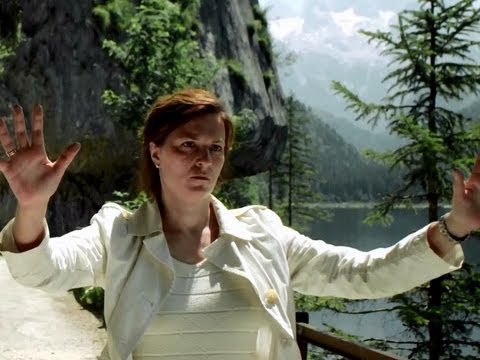
When it comes to isolationist cinema like Cast Away or Moon, none are quite as simple and direct as The Wall, an Austrian-German film about a young woman whose visit to a mountain cabin becomes permanent when an invisible wall cuts her off from the outside world. The concept may be reminiscent of Stephen King’s Under the Dome, but it plays out like an extended episode of The Twilight Zone, with the nameless woman (Martina Gedeck) forced to survive with this one simple, unavoidable wrench thrown into the works of her life.

Image result for die wand 2012

It’s also a sublimely quiet film with a bare minimum of spoken dialogue, instead relying on Gedeck’s voiceover recounting her experience via journal entries, like Robinson Crusoe detailing his survival methods. Yet, beyond the activity, there’s a substantial focus on the woman’s feelings, doubts, fears, and inner reflections, from her relationships with her animal companions to her nightmares of her world continuing to shrink and deep ruminations of life and death.

Because it’s such a philosophical and contemplative film, it’s not something to watch if you’re sleepy and will probably bore you even if you’re not. Plus, it ends in Twilight Zone fashion with some raw emotion and little closure. Yet, set amidst the classical violin score and some absolutely gorgeous German countryside, there’s a subdued tranquility to the struggles of a tortured soul struggling in silence. It’s sad and lovely and probably something I’d only watch again if I couldn’t sleep.

Best line: (the woman) “There is no rational emotion as love. Love makes the life of the lovers and the beloved ones more bearable. We have to just recognize in time that this was our only option. Our only hope for a better life.”


Rank: Honorable Mention


© 2017 S.G. Liput
462 Followers and Counting


The Imitation Game (2014)

Tags

, ,

Image result for the imitation game film

(Today’s NaPoWriMo prompt was to incorporate an “enigma” or something hidden into the poem, so I thought a movie about solving Enigma would be perfect. For my own secret message, try stringing together the underlined letters.)

The German Codes in safety rode
Upon the winds of radio,
And passed with ease their strategies
To Mystify the Allied foe.

Bright minds were scratched and Egos matched,
The Riddle daily taxing Brains
Who knew their best At this math Test
Could still Harm lives and Squander gains.

Unraveling this Risky thing
Was not for one man to Explain.
What Cracked And tamed the Numbers game?
A mind Combined To break the chain.
________________

MPAA rating: PG-13

Benedict Cumberbatch seems most comfortable playing the smartest guy in the room, even if he only thinks he’s the smartest guy in the room. Sherlock, Doctor Strange, etc. exemplify this, and The Imitation Game allowed him to apply that proven characterization to a real-life figure, Alan Turing, a mathematical computer pioneer who helped crack the German Enigma code during World War II.

Cumberbatch is the film’s strongest asset, channeling the same troubled-genius mentality as Russell Crowe in A Beautiful Mind, not so much in the mental health aspects as in his blinding self-confidence and difficulty working with others. His acting, as always, is beyond reproach and distinguishes Turing as a man of vision frustrated by the inflexibility of his superior (Charles Dance) but too single-minded himself to recognize the need for collaboration with the rest of his team of genius mathematicians. Keira Knightley’s Joan Clarke serves as an attractive reminder that a talent for numbers is not Turing’s alone, and it’s an insightful pleasure watching Cumberbatch engage with her and his fellow teammates to perfect his decoding machine. The espionage angle involving a major general from MI6 (Mark Strong) is also peppered with intrigue.

Image result for the imitation game film

The performances, Alexandre Desplat’s score, and the period-piece re-creations are top-notch, but the film’s historical accuracy leaves much to be desired. Many “based-on-a-true-story” movies take artistic license, but learning after the fact that most of the events of the film occurred completely differently is rather disappointing. Likewise, the film’s ultimate transition from code breaking and war strategies to a social tragedy centered on the treatment of Turing’s homosexuality lost my interest. This aspect of Turing’s life was clearly important and lamentable, but it felt tacked on and even a tad manipulative when paired with the historical liberties. The Imitation Game is handsome and well-acted and even consummate in its first half, but the dual intentions of the filmmakers to merge two kinds of stories, one about war decoders and one about social injustice, feel like a forced fit that doesn’t live up to its early promise.

Best line: (Turing’s childhood friend Christopher, and later Joan) “Sometimes it’s the very people who no one imagines anything of who do the things no one can imagine.”


Rank: Honorable Mention


© 2017 S.G. Liput
461 Followers and Counting


Rabbit Hole (2010)

Tags

Image result for rabbit hole film

(Today’s NaPoWriMo prompt was for an elegy with some kind of unorthodox focus. I don’t know about unusual, but a film about loss seemed a good fit for a mournful elegy.)


The boy who died filled a hole, you know,
Before he lost his chance to grow,
Before the accident defined
And left the hole behind.

Where he’d have been, there’s no one there
To fill his kindergarten chair,
To chase the dog or yet annoy
His parents with a toy.

Where he’d have been, his parents frame
And argue who is more to blame.
The empty frame can comfort bring
Or aggravate the sting.

His loss unravels and unrolls
A family into separate souls,
Two wondering if they can fill
The name of parent still.

While life goes on, the hole will stay,
Though cloaked in time till Judgment Day.
To build from it is not a sin,
The hole where he’d have been.
__________________

MPAA rating: PG-13

Based on a play by David Lindsay-Abaire, Rabbit Hole is a deeply affecting portrait of realistic familial grief, much in the vein of Ordinary People and Manchester By the Sea, though closer in appeal to the former. It’s not so much about tragedy as how people cope with it and tackles the subject in an intimate way that draws phenomenal performances from its main actors, most notably Aaron Eckhart and Oscar nominee Nicole Kidman as parents grieving the death of their little boy.

Months after their son Danny is killed by a car, Becca (Kidman) and Howie Corbett (Eckhart) attend group therapy sessions and go about life as normal, but life is not the same. With every reminder of Danny, the two react in opposite ways: Howie values every smudge and picture made by his son, while Becca wants to give away his clothes and even sell the house to escape his ever-present memory. Likewise, they seek out comfort in different people, whether a sympathetic acquaintance who understands grief (Sandra Oh) or the very person responsible for Danny’s death (Miles Teller). Through it all, the Corbetts’ everyday life is like a scab covering the wound, quick to be torn off at any mention of Danny, which leads to some uncomfortable and heart-rending emotional fireworks. Nicole Kidman received the lion’s share of the praise, including an Oscar nomination, but I thought Eckhart was just as good, matching the high quality of all the performances.

Image result for rabbit hole film miles teller

Rabbit Hole brings home how elusive comfort can be in the wake of an unspeakable grief and how it may be found in unexpected places, perhaps a comic book, a dog, or a conversation that once provoked resentment. I would have liked Becca to see the value in the religious solace she denounces at first, but her mother Nat (Dianne Wiest) mentions the support of her church, and it’s something of an irony that Becca does find some comfort in a different perception of the supernatural. Eckhart and Kidman deliver nuance and pain in their award-worthy roles and, with the rest of the excellent cast, evoke so many facets of the grieving process, making Rabbit Hole a heartbreaking watch that nevertheless doesn’t lose sight of the light at the end of the tunnel.

Best line: (Becca) “Does it ever go away?”
(Nat) “No, I don’t think it does. Not for me, it hasn’t – has gone on for eleven years. But it changes, though.”
(Becca) “How?”
(Nat) “I don’t know… the weight of it, I guess. At some point, it becomes bearable. It turns into something that you can crawl out from under and… carry around like a brick in your pocket. And you… you even forget it, for a while. But then you reach in for whatever reason, and – there it is. Oh, right, that. Which could be awful – not all the time. It’s kinda… not that you like it exactly, but it’s what you’ve got instead of your son. So, you carry it around. And uh… it doesn’t go away. Which is…”
(Becca) “Which is what?”
(Nat) “Fine, actually.”


Rank: List-Worthy (tied with Ordinary People)


© 2017 S.G. Liput
460 Followers and Counting