NaPoWriMo 2018 Recap

Once again, National Poetry Writing Month has come to an end, and looking back, it’s hard to believe that I was able to keep up for the most part. The last two days’ poems were a bit delayed, but thirty poems in thirty days still makes me tired just thinking about it, though it helped that I had some of my reviews already done in reserve to speed up the process. The fact that I finished up my semester projects at the same time just adds to the exhaustion.

Yet I also read some great work by other poets, found inspiration, and got to see and review some really phenomenal movies this month, most of which were fairly recent due to my catching up on films of late, so I thought I’d post another recap of my NaPoWriMo exploits. A huge thank you to everyone who liked, followed, and commented along the way, and to everyone else who participated in NaPoWriMo this year, I’d like to say “Well done!”


April 1 – The Greatest Showman (2017) – Top-100-Worthy (my favorite movie reviewed this month)

April 2 – Marjorie Prime (2017) – List Runner-Up

April 3 – Trollhunter (2010) – List Runner-Up

April 4 – Wonderstruck (2017) – Honorable Mention

April 5 – Munyurangabo (2007) – Honorable Mention

April 6 – Fits and Starts (2017) – List Runner-Up

April 7 – The Breadwinner (2017) – List Runner-Up

April 8 – Chronesthesia (Love and Time Travel) (2016) – List-Worthy

April 9 – Girls und Panzer der Film (2015) – List Runner-Up

April 10 – The Man Who Invented Christmas (2017) – List Runner-Up

April 11 – When We First Met (2018) – Honorable Mention (my personal favorite poem this month)

April 12 – Bad Lucky Goat (2017) – Honorable Mention

April 13 – The Best Years of Our Lives (1946) – List Runner-Up

April 14 – 50 First Dates (2004) – List Runner-Up (my most popular post this month)

April 15 – Thor: The Dark World (2013) – List-Worthy

April 16 – Jumanji: Welcome to the Jungle (2017) – List Runner-Up

April 17 – The Last Days (2013) – List-Worthy

April 18 – The Darkest Hour (2011) – Honorable Mention

April 19 – Still Mine (2013) – List Runner-Up

April 20 – Darkest Hour (2017) – List-Worthy

April 21 – Ready Player One (2018) – List-Worthy

April 22 – April and the Extraordinary World (2015) – List-Worthy

April 23 – Pitch Perfect 3 (2017) – Honorable Mention

April 24 – In This Corner of the World (2016) – List Runner-Up (for now)

April 25 – Pirates of the Caribbean: Dead Men Tell No Tales (2017) – List-Worthy (due to joining its predecessors)

April 26 – The Light Between Oceans (2016) – Honorable Mention

April 27 – Mojin: The Lost Legend (2015) – Honorable Mention

April 28 – A Monster Calls (2016) – List-Worthy

April 29 – True Lies (1994) – List Runner-Up

April 30 – Clue (1985) – List Runner-Up (my Blindspot pick for the month)


Now to rest a little and write my poems and reviews at a more relaxed pace. As always, I’m still looking forward to next year’s NaPoWriMo, so have a wonderful year until then!

2018 Blindspot Pick #4: Clue (1985)

Tags

,

See the source image

(This is my last poem/review for NaPoWriMo, still playing catch-up. Yesterday’s final NaPoWriMo prompt was for a poem dealing with a strange or obscure fact, so I just included a lesser-known one about the famous board game.)


Someone is dead, but all others must stay,
For once his heart stops
And we wait for the cops,
It’s time to determine who made him that way.

Someone is dead, and someone here did it.
They picked a good room
To exact the man’s doom
With one of these weapons, since nobody hid it.

Someone is dead, and Miss Scarlet’s suspicious.
Old Mustard looks nervous,
The maid’s out of service,
And both Plum and Peacock appear most pernicious.

Someone is dead; White shows little contrition
And might have begun it,
Or Green could have done it,
Or maybe Miss Peach (in an ‘80s edition).

Someone is dead; someone offed him, but who?
It’s time to be candid
And catch them red-handed,
For every detail is considered a clue!
________________________

MPAA rating: PG

For me, Clue is sort of like The Goonies, an ‘80s film that seems to have developed a cult following out of nostalgia yet I never got to see it as a kid, which is when I probably would have loved it even more. As it is, I truly enjoyed this campy comedy and see why it is considered one of the only good adaptations of a board game.

See the source image

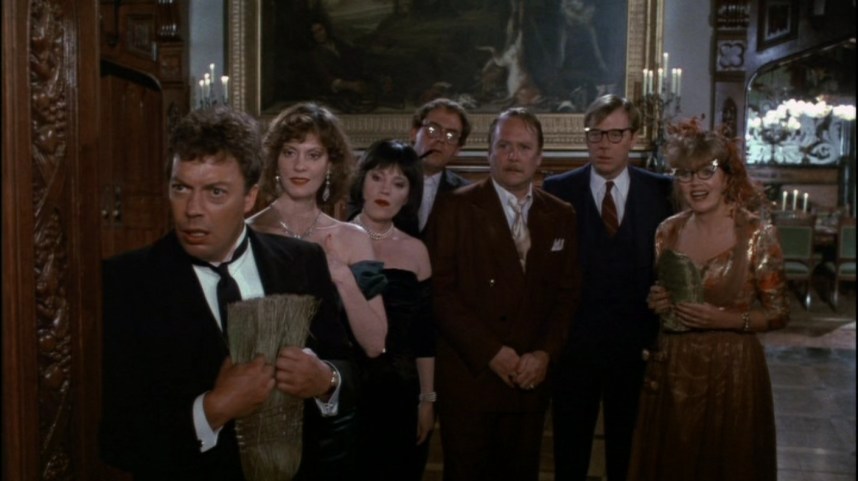
It’s been so long since I played Clue that I don’t really remember the gameplay, only the variety of characters, locations, and weapons, all of which are included in its film version. The beginning is a bit too slow, but it introduces us one by one to the collection of fake-named strangers who arrive at a mansion on a dark and stormy night: Colonel Mustard (Martin Mull), Miss Scarlet (Lesley Ann Warren), Mrs. White (Madeline Kahn), Mr. Green (Michael McKean), Mrs. Peacock (Eileen Brennan), and Professor Plum (Christopher Lloyd). (Kellye Nakahara from M*A*S*H also has a cameo as the Cook.) All of them are greeted by the house’s butler Wadsworth (Tim Curry) and are soon confronted by Mr. Boddy (Lee Ving), the man who has been blackmailing all of them and who soon ends up dead under mysterious circumstances, leading those gathered to try to figure out who killed him, where, why, and with what weapon.

How much you enjoy Clue likely depends on your capacity for campiness. My VC, who had also not seen Clue before, wished that events had played out with a more serious tone, but considering the number of plot twists and holes, I don’t think the story could work without its tongue-in-cheek levity. The script by John Landis and director Jonathan Lynn is full of chuckle-worthy wordplay and potent quotables, but it’s also so convoluted that, by the end, the characters themselves are pointing out how ridiculous things have gotten (“There’s one thing I don’t understand.”  “One thing?”) Some of the jokes don’t work (Madeline Kahn gets weirdly tongue-tied in one scene), but I was still thoroughly amused, from the Scooby Doo-like exploration of the mansion as the group splits up to the light black comedy as the body count rises.

Clue is also notable for having three alternate endings, which were apparently handed out at random to different theaters. I can see how that gimmick might have affected some opinions at the time since not every ending works as well. The first one is somewhat plausible, the second less so, but I preferred the third ending, which is the one the movie says “really happened.” Still, it’s a cool eccentricity that heightens its board game connection and makes you pay greater attention on the next viewing.

See the source image

I do wish I had seen Clue when I was younger; if I’d watched it years ago and many times since, I could see it being a favorite. It’s silly but knowingly so, and all of the actors are “game” for the fun (especially Tim Curry), even if some of them can barely keep up with the convoluted dialogue they’re spouting. The mystery itself even kept me guessing. I can see why it has a cult following, and given some time, that might include me as well.

Best line: (Wadsworth) “Professor Plum, you were once a professor of psychiatry specializing in helping paranoid and homicidal lunatics suffering from delusions of grandeur.”   (Professor Plum) “Yes, but now I work for the United Nations.”   (Wadsworth) “So your work has not changed.”


Rank: List Runner-Up


© 2018 S.G. Liput
567 Followers and Counting


True Lies (1994)

Tags

, ,

See the source image

(Once again, I’m catching up for yesterday thanks to schoolwork. Yesterday’s NaPoWriMo prompt was for a response to a Sylvia Plath poem, but since I don’t understand or like Plath’s work much, I went with a nice simple limerick.)


There once was a debonair spy
Who told all his loved ones a lie.
His espionage
Was beneath camouflage,
But don’t ask him why or you die.
____________________

MPAA rating: R (for language, sex, and violence; you know, the usual)

What if the Terminator played an American James Bond and had a family? I always thought that might have been how James Cameron pitched True Lies, until I found out it was actually a remake of a French film called La Totale! with basically the same plot. I might see that one someday just for comparison’s sake, but remake or not, True Lies is a funny actioner that fits nicely in Schwarzenegger’s and Cameron’s filmographies.

See the source image

Schwarzenegger plays Harry Tasker, a deadly and debonair secret agent, with “secret” carrying over into his personal life, since he keeps his counter-terrorism gig hidden from his wife Helen (Jamie Lee Curtis) and daughter Dana (Eliza Dushku, who recently revealed a sad account of sexual harassment during filming). Harry’s family thinks he’s just a mild-mannered bore, but he tends to spend his nights sneaking into high-security Russian parties and beating the crap out of bad guys in hotel bathrooms. Then one day he discovers evidence that his wife may be cheating with a wussy con man (Bill Paxton), and Harry’s jealousy threatens more than just his secrets.

True Lies is at its best as a popcorn action movie, especially a few bravura chase sequences, like Harry chasing a motorcycle baddie up a building while on horseback. The entire climax stretching from the Florida Keys to a skyscraper crane also ranks among the most thrilling finales out there, complete with a great cheesy one-liner that Donald Trump may have borrowed. Schwarzenegger and Curtis are in fine form, the one uber-capable, the other mousy and frantic when things spiral out of control; and they both benefit from strong support, whether comedic (Paxton and Tom Arnold) or villainous (Tia Carrere, Art Malik).

Unfortunately, it’s not all fun and explosions. The lies Harry tells go beyond just keeping his career secret, and his actions while he suspects his wife of cheating are morally suspect, never minding the fact that he had been dancing the tango with another woman earlier in the film with not a second thought. When he recruits his wife into a fake mission to give her a thrill, it becomes a somewhat funny but mostly distasteful charade that he should have thought better of beforehand.

See the source image

That unsavory deception is the main thing that keeps True Lies from rising to the level of other action classics like Die Hard. It has everything you could want in the action department, but the familial reconciliation is only half-successful, considering the loss of trust. If you can put that aspect out of your mind, though, True Lies is a reminder of how entertaining ‘90s actioners could be.

Best line: (Gib, Harry’s partner) “Women. Can’t live with ‘em. Can’t kill ‘em!”


Rank: List Runner-Up


© 2018 S.G. Liput
567 Followers and Counting


A Monster Calls (2016)

Tags

, ,

See the source image

(I’m running a bit behind with this post, but yesterday’s NaPoWriMo prompt was for a prose poem in the vein of a postcard, so I wrote one that I think everyone would like to receive.)

 
Hello, my love,
It’s as wonderful here as we always hoped,
But I miss you terribly, as I know you miss me.
Don’t despair that you couldn’t join me just yet;
I’ve saved you a place next to me
And can’t wait to show you everything I’ve seen.

Hope all is well at home, with life whirling on without me.
I’m just fine here, thank you very much.
Wish you were here (but not too soon)!

Love from Heaven,
Mom
___________________

MPAA rating: PG-13 (only for heavy themes, content is closer to PG)

Based on a novel by Peter Ness (who also wrote the movie), A Monster Calls is a strange beast, a deeply emotional dark fantasy that contrasts a young boy’s fears about mortality with seemingly random lessons taught by a giant tree monster (Liam Neeson). Making a tree monster work as more than just a visual boogeyman is no small task, and chances are that you’ll be surprised at just how much poignancy this concept holds.

The boy of this story is Connor O’Malley (Lewis MacDougall), an oft-bullied twelve-year-old who is plagued by a nightmare and dealing with his mother’s (Felicity Jones) worsening cancer. One night, the yew tree on a nearby hill comes to life like Groot on steroids and promises to tell him three stories, after which Connor must tell “the truth” in a story of his own. At first, Connor refuses, then thinks perhaps these stories are meant to help him with his critical grandmother (Sigourney Weaver) or his distant father (Toby Kebbell), yet the fairy tales told to him elude easy explanation and challenge the way he faces his own grief.

See the source image

There’s something timeless about this story. Until Connor used a smartphone, I couldn’t tell in what year it was set. The tone, the music, the warm cinematography, the subtle direction by J.A. Bayona (The Impossible and the next Jurassic World sequel) all lend themselves to a sense of dark enchantment and poetry that can swing from quite creepy to quite profound in a matter of minutes, such as how major events repeatedly happen at 12:07. The stories told by the monster are depicted with a unique 3D watercolor-style animation, and while I might have liked them to be more straightforward in their lessons, they leave the viewer and Connor pondering their implications and applications.

The performances really help sell the film’s more fantastical elements, MacDougall especially proving himself to be a child actor worth watching. Anyone who has endured the death of a loved one should easily relate to Connor’s progression through the five stages of grief; at least I know I did. Jones and Weaver provide outstanding support as well. Following a shocking outburst, there’s one almost wordless scene between Connor and his grandmother in which the turmoil of emotions on their faces is intensely felt, making me wonder why this movie was largely ignored by the major awards.

See the source image

I had a feeling that A Monster Calls would appeal to me, but its emotional depth sneaked up on me in ways you wouldn’t expect from a film with a giant tree monster. Despite its difficulties at the box office, I can see it being rediscovered in the coming years and hailed as a darkly imaginative classic.

Best line: (Connor) “So you didn’t get ‘happily ever after’?”  (his dad) “No, but that’s life, you know. Most of us just get messily ever after. That’s all right.”


Rank: List-Worthy


© 2018 S.G. Liput
565 Followers and Counting


Mojin: The Lost Legend (2015)

Tags

, , , , , , ,

See the source image

(Today’s NaPoWriMo prompt was for a poem inspired by our choice of tarot cards, whether the image on it or the symbolism behind it. I went with the Moon, which has some personification and mentions imagination, light, and the unknown.)


Where we’ve wandered, none can trace,
For none now live who knew this place.
The darkness creeps from stone to stone
And makes us feel we’re not alone.
Then, from above, the moon appears,
Perhaps to soothe our growing fears.

She peers below through open cave
At we who thought ourselves so brave
And lends us light to glance about
In search of some departure route.
Yet what she shows us haunts our dreams,
And only she can hear our screams.
____________________

MPAA rating: Not Rated (PG-13 content, though the profanity in the subtitles can get strong)

At least one good thing came out of my watching the utter waste of time that was The Assassin: I saw a trailer for Mojin: The Lost Legend and was intrigued enough to seek out this rather fun Chinese adventure movie. Apparently based on a Chinese book series, this tale of three grave robbers may have its weaknesses, but it’s also evidence of the blockbuster action and visual merit that Chinese cinema has to offer.

See the source image

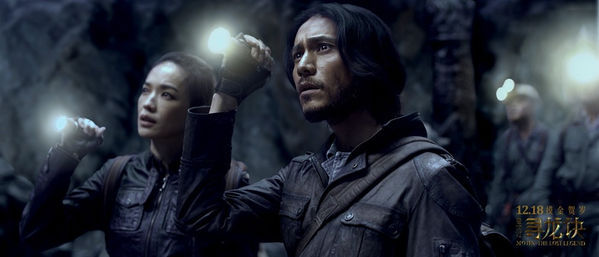
Hu Bayi (Chen Kun), his temperamental girlfriend Shirley (Shu Qi), and his reckless longtime friend Wang (Huang Bo) were all once Mojin, official treasure seekers and tomb raiders (Lara wasn’t available), but have since fallen into disgrace. Fed up with their washed-up lives in America, Wang is approached by a wealthy patron to locate an ancient Mongolian tomb. Compelled by a personal connection from his past, Wang accepts, dragging Hu Bayi and Shirley back into the dangerous business of booby traps, double-crossing villains, and supernatural(?) threats.

While the acting is all serviceable and sometimes quite good (the heroes are better than the villains), Mojin: The Lost Legend is most interesting as an example of how the Chinese do an Indiana Jones-style adventure. It takes a little while to get into tomb-raiding mode, but once it does, the pace stays brisk, and the set designs are impressive and elaborate, like the Moria of the Orient mixed with the Temple of Doom.  Anyone who enjoyed The Mummy or National Treasure should also find much to enjoy, from the playful banter to the horror elements of a particularly thrilling flashback to the way Chinese history and myth are used as clues and solutions along the way, not that I understood all of it.

See the source image

While it does mix a lot of aspects of adventure films I love, it is hard not to view those ingredients as copied or borrowed, even if there’s originality in how they are combined. Likewise, the special effects are one of the film’s strengths, yet there are moments that overuse slow motion and CGI to the point of being overblown and almost laughable, especially during the climax. Plus, the whole thing is a little too long for its own good. Yet it’s still a highly visual treasure hunt that even manages to work in some deeper emotions and themes of letting go of past tragedy. Flawed but fun, Mojin: The Lost Legend is an entertaining ride for those curious to see China’s take on their own National Treasure.


Rank: Honorable Mention


© 2018 S.G. Liput
565 Followers and Counting


The Light Between Oceans (2016)

Tags

,

See the source image

(Today’s NaPoWriMo prompt was for a poem that engages all five senses, so I took some inspiration from the setting of this movie, which is largely set on a remote lighthouse isle.)


The sun that was forged in the east at dawn
Is now melted down at the end of the day.
The sparks of its smelting paint our horizon
And leave the world glowing from lighthouse to bay
And leave its spectators with nothing to say.

The seagulls are mourning the loss of their light,
Suffusing the sky with cacophony’s croaks,
But no matter how they lament to the night,
They cannot drown out the sea’s unceasing strokes,
So constant to calm the coastline that it soaks.

The smell of the salt in the darkening dusk
Invades through the nose to try brining the tongue,
But I barely notice the maritime musk,
For all that I feel is your hand to mine clung
As we watch the sunset with passion still young.
________________________

MPAA rating: PG-13

I knew The Light Between Oceans would be well-acted based on its two leads alone. Michael Fassbender and Alicia Vikander have proved themselves as still-rising stars, the latter already with an Oscar and the former likely to get one eventually. Based on a novel by M.L. Stedman, it’s a story full of high and subtle emotion that ultimately veers too far into the bitter side of bittersweet.

See the source image

Fassbender plays Tom Sherbourne, a shaken World War I veteran who accepts self-imposed isolation as a lighthouse keeper on a small island called Janus Rock off the Australian coast. His brief encounters on land ultimately result in a romance with well-to-do Isabel (Vikander), who marries him and moves out to Janus Rock in hopes of raising a family together. After several failed attempts at having children, though, an unlikely but convenient opportunity arrives when a boat washes up with a dead man and a baby inside. Isabel is all too eager to adopt the girl she names Lucy, regardless of whose baby she might be, challenging Tom’s morality in the process.

The first half of The Light Between Oceans is beautiful, not simply in its lustrous cinematography, but in the sweetness of Tom and Isabel’s romance. Despite his brokenness from the Great War, Isabel is drawn to Tom and offers him a happiness he didn’t think he deserved, and when he welcomes her into his heart and home, he turns out to be a faithful and generous husband. The heart breaks for them when Isabel suffers miscarriages, and it really is a moral quandary when they are faced with a chance at a family at the cost of their honesty, particularly when Tom learns of Lucy’s real mother (Rachel Weisz).

See the source image

Up to that point, everything was superb, but soon Tom’s ethical struggle becomes frustrating as he vacillates between right and wrong long after the decision should have been settled. The way he tries to make things right while keeping his wife’s secret only paves the way for its reveal, and I felt that, if he couldn’t do right at the beginning, he should have kept his mouth shut after a certain point, at least for the sake of the child. Eventually, things just keep going downhill, getting more and more depressing, until the plot buoys up for a poignant ending that’s not as bad as it could have been but not as satisfying as I wished either.

As I said, it’s beautifully shot and consistently touching thanks to its praiseworthy actors with great chemistry, but the story frustrated me. I can see how my opinion about Tom isn’t a purely moral one, and the fact that the film poses such a complex ethical question is a point in its favor, as is the theme of all sins eventually coming to light. Yet it hardly made for a satisfying movie-watching experience, and it just left me wishing for better circumstances for the characters.

See the source image

Best line: (Frank Roennfeldt, Lucy’s real father) “You only have to forgive once. To resent, you have to do it all day, every day, all the time. You have to keep remembering the bad things. It’s too much work.”


Rank: Honorable Mention


© 2018 S.G. Liput
565 Followers and Counting


Pirates of the Caribbean: Dead Men Tell No Tales (2017)

Tags

, , ,

See the source image

(Today’s NaPoWriMo prompt was for a human warning label, so instead of one for myself, I wrote one for Captain Jack Sparrow.)


Caution:
Exposure to this individual
May well endanger your health.
Symptoms include a desire to say “Arrgh”
And insatiable cravings for wealth,
As well as impulses to slap and/or kill
And maybe a seafaring curse,
Which can cause vendettas and lusting for vengeance,
Resulting in death or much worse.

Alert your witch doctor if death should occur
Or unbridled hating of guts.
Always use “Captain” preceding his name.

Warning: May contain nuts.
___________________

MPAA rating: PG-13

Perhaps people didn’t expect much from what is now the fifth installment in the Pirates of the Caribbean franchise, since the series was already showing signs of fatigue with the fourth. On Stranger Tides remains my least favorite of the bunch because it lacks the three-way dynamic between Jack Sparrow, Will Turner, and Elizabeth Swann that made the original trilogy so enjoyable. Sure, Penelope Cruz adds some sexual tension with Jack, but it feels more like a spinoff than a genuine part of the series. Dead Men Tell No Tales, on the other hand, is thankfully a truer continuation; granted, it’s a paler, less original version of its predecessors but close enough still to feel of a piece with them.

See the source image

Orlando Bloom and Keira Knightley aren’t exactly back in action here, both instead offering cameos that must have been the easiest paychecks imaginable, but they’re still part of the story, with Will and Elizabeth’s son Henry (Brenton Thwaites) taking Will’s place as the earnest adventurer searching to free his father from the curse of the Flying Dutchman. In Elizabeth’s role, we get Kaya Scodelario as Carina Smyth, an educated woman (gasp!) whose smarts get her constantly accused of being a witch, which never seemed to be a problem for Elizabeth, but oh well. They’re at least better than Sam Claflin and his mermaid girlfriend(?).

And of course, Johnny Depp returns as Captain Jack Sparrow, whom most people seem to think is past his prime as a character. I could see why at first, since Depp does seem to sleepwalk through the first half, but, keeping in mind that Jack was largely hung over for that half, he grows back into the role and is back to his old self by the end. It’s Geoffrey Rush that offers especially strong support, with Barbossa actually getting a worthwhile character arc rather than being shoehorned in like with On Stranger Tides. As the latest antagonist with a grudge against Jack, Javier Bardem’s Captain Salazar may not have the best backstory (he hates pirates and was outsmarted by Jack; oh, and he’s cursed as a ghost…for some reason), but he still has great screen presence between Bardem’s intensity and some impressive floaty ghost effects. It’s never made clear why his curse was linked to Jack’s compass, though.

See the source image

I’ve seen quite a lot of negative reviews for Dead Men Tell No Tales, and indeed I haven’t been exactly glowing with this review either. It’s not nearly as good as the first three, and even the impressive effects aren’t quite as seamless as the past films, which is a little weird. Yet it still has all the ingredients that made the original films so much fun, in particular the visually awesome action and occasional cleverness, and even rights some of the more dubious creative choices of past movies, like bottling the Black Pearl in On Stranger Tides. Plus, Paul McCartney’s got a great unrecognizable cameo! And even with all the copycat characters and less-than-inspired plot points, it has a perfectly fitting end to the story begun fifteen years earlier. At least until the eyebrow-raising after-credits scene segues into a sixth movie. Yep, it’s gonna happen apparently, and I’ll be there once again to be entertained while hoping they don’t mess it up.

Best line: (Carina) “I’m not looking for trouble!”   (Captain Jack Sparrow) “What a horrible way to live.”


Rank: List-Worthy? (it’s really Runner-Up material, but it does continue the trilogy’s story and I usually group such series together)


© 2018 S.G. Liput
565 Followers and Counting


In This Corner of the World (2016)

Tags

, , , , , ,

See the source image

(Today’s NaPoWriMo prompt was for a hopeful elegy, so I wrote mine about the mourning of a way of life.)


What’s almost as sad as a person’s death
Is the death of the way that they lived.

They once woke up, knowing what their day
Would likely hold,
And they’d watch unfold
A normal we’d say
Was strange and old,
But they took pride
And personified
A life that bloomed till the world went cold.

Disasters sudden or a cancer slow
Or new breakthroughs
Would cause them to lose
What was status quo.
They could not refuse,
For who can tell
A dead bloom, “Get well,”
When its winter’s come and it’s paid its dues?

But people live on, like roots that remain
For new blooms to rise
Once the former dies
And forgets the pain
Of its sad demise.
Our ways of life fade
Daily and are remade.
Remember that grief is short-lived for the wise.
___________________

MPAA rating: PG-13

And the number of award-worthy animated films of 2016 just keeps on growing. When I heard that a crowdfunded project called In This Corner of the World had beaten out Your Name and A Silent Voice for Japan’s Best Animated Feature award, I rolled my eyes that anything could top those two emotional hits. I still would have preferred one of them to win, but I can now at least see why In This Corner of the World would deserve to win. (It’s also further proof that the American Academy can’t seem to recognize an award-worthy animation if it hails from another country.)

Set before, during, and after the Hiroshima bombing of August 6, 1945, this Japanese period drama has a slice-of-life charm and simplicity that endures the ever-looming shadow of death. In many ways, it is reminiscent of Grave of the Fireflies (a painful favorite of mine), yet while that film is essentially grief and desperation from start to finish, In This Corner of the World uses its long runtime to show the daily life of its characters and how the approaching war changed that way of life for the sake of survival.

See the source image

It begins with the childhood of Suzu Urano, an often absent-minded artist who grows up in an idyllic seaside town close to Hiroshima. After receiving an offer of marriage from a man she doesn’t know, she hesitantly leaves her own family to marry into the Hojo family in Kure, a Navy dockyard about an hour away by train. There is a wealth of humorous vignettes as Suzu adjusts to her new surrounding and family members, including a short-tempered sister-in-law and her daughter, and many aspects of their daily life are steeped in Japanese culture, from the fashioning of kimonos and later pants to the preparation of traditional field-to-table meals, which require resourcefulness once wartime rationing is implemented. From amusing asides and sweet romantic moments, the tone gets more and more serious and even dire as the war gets closer, the bombing raids become more frequent, and we the audience wait for the inevitable bomb to drop, wondering how it will affect Suzu and her loved ones.

The abrupt editing of all those vignettes does contribute to a sometimes unfocused storyline that puts certain details in doubt, and a few forays into Suzu’s imagination left me confused as to whether surrounding scenes were supposed to be real or not. Yet such negatives don’t detract too much from the humane power of the whole. Perceptive details and lovely snapshots abound, notably a post-war scene where the town’s lamps are uncovered (no longer in fear of air raids) and one by one shine into the night. The animation is not your typical anime style, with more of a gentle, hand-drawn impressionism that can be reminiscent of either a comic strip or a museum piece, depending on the tone of the scene. It’s surprisingly effective in its consistency depicting both Suzu’s carefree early life and the grief-stricken toll of war, and the filmmakers put great and laudable care into re-creating the pre-bomb city of Hiroshima accurately.

See the source image

Once again, I’m torn on how to rank what is clearly a great film, trying to judge my personal opinion of it. It’s absolutely worthy of Japan’s top animation prize, and I can see why they would opt for the more historically significant choice, even over the box-office juggernaut that was Your Name. Despite its winsome animation and gradually developed poignancy, it didn’t bring me close to tears like Your Name or A Silent Voice or Grave of the Fireflies, which matters to me as a way of measuring the emotional impact. Even so, I feel like I’m growing fonder of this film the more I think about it. Perhaps its ultimate ranking is a wait-and-see. It requires some patience, but I highly recommend In This Corner of the World for its touching civilian-level view of World War II.

Best line: (Suzu, comparing her current life to a dream) “I don’t want to wake up because I’m happy to be who I am today.”   (Shusaku, her husband) “I see. The past and the paths we did not choose, they’re like a dream.”


Rank: List Runner-Up (for now)


© 2018 S.G. Liput
564 Followers and Counting


Pitch Perfect 3 (2017)

Tags

,

See the source image

(Today’s NaPoWriMo prompt was for a poem based in sound, such as using a song lyric. So, thinking of this movie, I tried to incorporate a different song lyric, possibly altered, for each line or two and combine them together. It’s a little different, but hopefully it turned out okay.)


Am I part of the cure or am I part of the disease,
Or is that just how I feel? Am I wrong
For feeling so lonely, for feeling so blue?
It’s something to do.
All I know are sad songs.

There’s an old voice in my head that’s holding me back—
You said you loved me; you’re a liar.
There’s not much love to go around
Till I reach the highest ground.
We didn’t light the fire.

Some never pray, but tonight we’re on our knees;
Take my tears and that’s not nearly all.
There will be an answer, let it be;
One day, my father—he told me,
“A tiny rock can make a giant fall.”

(Songs used, in order: “Clocks” by Coldplay, “Am I Wrong” by Nico & Vinz, “Crazy” by Patsy Cline, “I Took a Pill in Ibiza” by Mike Posner (two lines), “Little Talks” by Of Monsters and Men, “Grenade” by Bruno Mars, “Land of Confusion” by Genesis, “Higher Ground” by Stevie Wonder, “We Didn’t Light the Fire” by Billy Joel, “Bittersweet Symphony” by The Verve, “Tainted Love” by Soft Cell, “Let it Be” by The Beatles, “The Nights” by Avicii, “Dream Small” by Josh Wilson)

___________________________

MPAA rating: PG-13

I wanted to hope that the Pitch Perfect series might avoid the slump that often comes with a third installment in a franchise, but Pitch Perfect 3 is what I would call a slump, not a total disaster but a slump nonetheless. I was in the minority in actually enjoying Pitch Perfect 2 more than the original, simply because I found it funnier, but Pitch Perfect 3 is undoubtedly the weakest of the three, though still fitfully entertaining.

See the source image

Things seemed to be looking up for the Barden Bellas at the end of the second movie, but in order to make another sequel, this third film saddles all of the now-graduated a cappella singers with dead-end jobs and unfulfilling lives, also jettisoning their boyfriends. That way, they eagerly reunite for a new tour/competition, this time entertaining troops in Europe with the USO and vocally sparring against bands with actual instruments for the opportunity to open for DJ Khaled (who is apparently a big deal, though I’d never heard of him before this). That plot sounds too simple of a cut-and-paste from its predecessors, so there’s also a kidnapping spy plot thrown in involving Fat Amy’s conniving father (John Lithgow).

I will say that my enjoyment of Pitch Perfect 2 helped me to bring a lot of good will to this follow-up, and it was nice to see all the Bellas together again for the last(?) time. The colorful personalities are much the same, from Fat Amy’s (Rebel Wilson) boorish self-confidence (why was she so mean to Hailee Steinfeld?) to Lilly’s (Hana Mae Lee) soft-spoken weirdness, which gets an unexpected explanation/punchline near the end. Brittany Snow is still the prettiest of the Bellas (in my humble opinion), and Beca (Anna Kendrick) is still figuring out what she really wants out of the music industry. In fact, one Bella’s absence from the tour (sex-obsessed Stacy, played by Alexis Knapp) due to her pregnancy is a sign that they’re all getting older and indeed need to find their place in the world.

See the source image

Aside from the characters, though, the plot is a bit of a mess, with the competition losing much of its weight by the end and Lithgow’s needless villain helming an over-the-top subplot that does feel like the franchise jumping the shark. As evidenced by the strained presence of Elizabeth Banks’ and John Michael Higgins’ aca-commentators, the jokes are also not as funny as in the other films, and the musical moments less memorable. Still, the ending felt like a fitting one for the series, even using one of my and my VC’s favorite songs (George Michael’s “Freedom”). It’s still amusing and I still liked Pitch Perfect 3, but unless they really bring new life to another reunion, I do hope it’s the last one.

Best line: (Calamity, introducing the members of the band Evermoist) “I’m Calamity. This is Serenity, Veracity, and Charity.”   (Fat Amy) “If I joined your group, I could be obesity.”


Rank: Honorable Mention


© 2018 S.G. Liput
564 Followers and Counting


April and the Extraordinary World (2015)

Tags

, , , , , ,

See the source image

(Today’s NaPoWriMo prompt was to write about how one of a list of impossible things could actually happen, so I thought of a certain highly imaginative film.)


“Pigs can’t fly,”
They said. “Of course,
And cats can’t join
The labor force.”

“Clocks can’t chime
Thirteen,” they vowed,
“Nor rewind time.
That’s not allowed.”

But some will hear
Such sober laws,
And ask with thought,
“Why not?” because

The present world
They recognize
Is changing more
Before their eyes.

If they dislike
Such rules, they dream
Worlds where clocks strike
Thirteen, where steam

Propels machines,
Where pigs can fly,
Where magic beans
Grow greens so high,

Where men can grow
Beyond their flaws.
Imagination
Knows no laws.
___________________

MPAA rating: PG

I love animation, and I love discovering hidden gems that remind me why I love animation. April and the Extraordinary World is a delightful case in point. At a time when the U.S. and Japan seem to rule the animation industry, it’s also an important reminder that Europe has no shortage of talent and is just as likely to churn out an instant classic for those willing to search for it.See the source imageA French-Belgian-Canadian co-production, April and the Extraordinary World is one of the most imaginative films I’ve seen in a while, broadly rewriting history to create a unique steampunk setting, one in which science and technology couldn’t develop beyond the Steam Age. Vegetation has been decimated by fuel needs, and the air is thick with industrial smoke, while the scientists that could improve things have vanished without a trace. After a fast-paced introduction in which everything is significant, we meet April Franklin (Marion Cotillard in the French version, Angela Galuppo in the English dub) and her brilliant family of fugitive scientists. Due to events best seen rather than described, April grows up alone with only her talking cat Darwin (a product of SCIENCE!), and her chemist’s quest for an immortality serum soon turns into a whirlwind adventure as the French government and a mysterious group with advanced technology vie for the scientific secrets of her family.

Animation allows its creators to fashion worlds limited only by their imagination, but most cartoons are content to imagine small. It’s usually Pixar or Ghibli that brings the medium to its full potential, but so does April and the Extraordinary World, which often feels like something one of those two powerhouses would have conceived. Where else are you going to see giant cable cars that run from Paris to Berlin or a helicopter plane escaping an underwater prison? The animation has the distinctive look of a European comic (apparently based on the work of French comic artist Jacques Tardi), and although it seems like it would take some getting used to, it actually flows quite nicely, with plenty of clever detail in the settings and backgrounds. It has strong characters to boot, from resourceful April herself to her quick-witted grandfather, though, as a cat lover, my favorite has to be the talking cat Darwin (Tony Hale in the dub, which also includes Paul Giamatti, J.K. Simmons, and Susan Sarandon).See the source imageWhile the imagination is impressive, I could still recognize prior influences for April, most notably 2004’s Steamboy, another steampunk adventure featuring a young protagonist caught in the middle of a scientific power struggle with a similarly explosive ending. Plus, it’s hard to avoid comparisons to Ghibli when there’s an actual house atop mechanized legs á la Howl’s Moving Castle or a polluted atmosphere contrasted with a clean underground biome á la Nausicaä. You might also pick up on traces of Atlas Shrugged and Tomorrowland, though the latter was released the same year as this film. Regardless, April and the Extraordinary World brings all these disparate elements together into a thrilling package that’s better than most of the films I just mentioned.

With a complex and fast-paced storyline and a number of off-screen deaths, it does feel more intelligent and mature than your typical American cartoon (not to mention the detail put into Darwin’s backside), but there’s nothing to make it un-kid-friendly either. By the surprisingly satisfying end, I was just happy to have stumbled upon such an underrated gem, one that no fan of animation should miss.


Rank: List-Worthy


© 2018 S.G. Liput
563 Followers and Counting