Toy Story 4 (2019)

Tags

, , , ,

See the source image

The life that you pour into somebody else’s
Is just as much fuel as a life for one’s self is,
A reason to get up each morning, assured
That you have a purpose by which you are spurred.

But what of the time when the mission is done,
The journey completed, the races well-run?
When nobody needs you and life seems bereft,
What purpose remains here? What journeys are left?

Such crises are normal for those left behind,
But purpose is everywhere. Those who seek find.
_________________

MPAA rating: G (the highest grossing G-rated movie ever, in fact)

I’m sure I wasn’t alone in my groan when Toy Story 4 was announced. Toy Story 3 ended the series with such a definitively satisfying conclusion, being handed off from college-bound Andy to little Bonnie, that I just wanted Pixar to leave it there. A cute little short would pop up occasionally, and I kept wishing they would leave the characters alone. No more sequels, or, Lord help us, a remake! Yet Pixar has pulled off the unlikely so many times before that there was no way they were going to screw up their best franchise. Toy Story 4 still feels unnecessary, but it’s a sweet epilogue to Woody and Buzz’s story.

See the source image

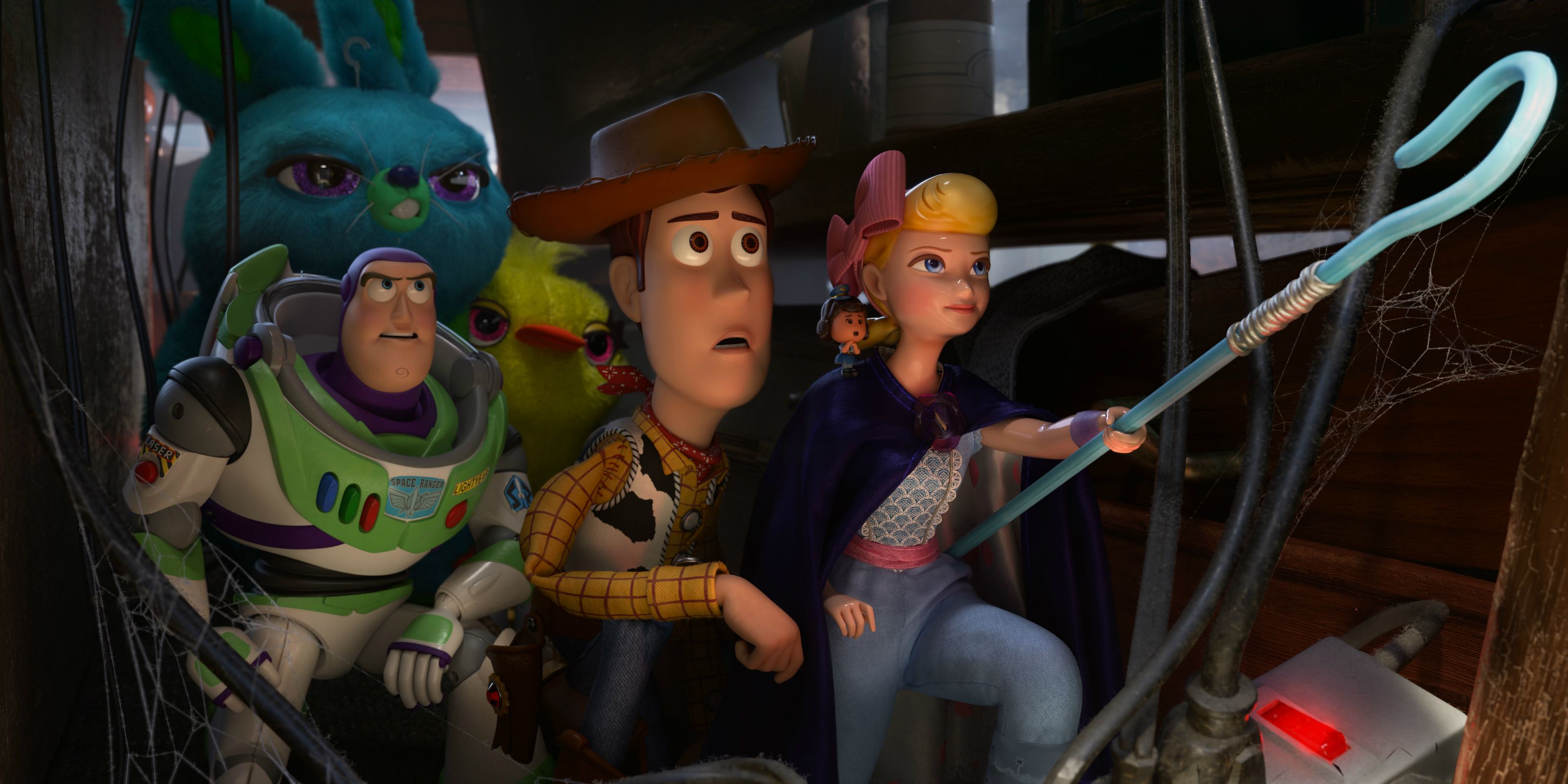
The Toy Story films have always thrived off their diverse cast of toy characters, and Toy Story 4 still does, joined by a collection of hilarious and welcome additions, but this particular tale is clearly meant to offer full-circle closure for Woody (Tom Hanks). The cowboy doll was always Andy’s favorite, and it’s no surprise that he’s lost that status in Bonnie’s room, yet he finds new purpose in protecting her newest friend, a googly-eyed spork she crafts and names Forky (Tony Hale). Being made of trash, Forky only sees himself as something to be thrown away, yet Woody strives to get the cobbled-together toy to see his own value, running into more than their fair share of trouble when the two are separated from Bonnie during a road trip.

In addition to new characters ranging from a Canadian stuntman plagued by self-doubt (Keanu Reeves) to a pair of plush carnival toys named Ducky and Bunny (Jordan Peele and Keegan-Michael Key), Woody is reunited with Bo Peep (Annie Potts), whom we get to learn much more about than in the first two films. The main change, which is practically a retcon, is that she’s a natural, daring leader who’s grown beyond needing the love of a single child. (I also learned she and her sheep were part of a lamp. Did I just not notice that before?) Also new to the cast is the genteel doll Gabby Gabby (Christina Hendricks), whose deep-seated neediness casts her in the role of villain, though the movie presents her with far more empathy than the other films’ antagonists, to the point of offering her redemption without so much as an apology to earn it (something I only realized after reading another review).See the source imageBo offers Woody an alternative to his desperate attempts to stay relevant, and I felt like this conflict resulted in some mixed messages. There’s a clear parallel between the toys watching their kids outgrow them and the empty-nest anxiety of parents, so it’s a worthwhile lesson that life doesn’t have to end once “the mission” is complete, that one can find another purpose. Yet with Woody’s repeated pleas throughout the series that “Andy/Bonnie needs us,” it vaguely feels by the end that he’s contradicting the loyalty he’s instilled in everyone else. My VC was more bothered by the end than I was, but it is a complication worth pointing out.

Yet for all these philosophical holes poked in the plot, the world and players of Toy Story never fail to entertain and remain as lovable now as they were back in 1995. With the spotlight so much on Woody, much of the extended cast, like Rex, Hamm, and Slinky, don’t get much screen time, but that doesn’t diminish the entertainment factor. (P.S. Ducky and Bunny are hilarious.) In some ways, the plot mishmashes elements from the other three films, yet it still bears that Pixar polish and lump-in-throat sweetness that never gets old.

See the source image

I hope that Pixar has now finally gotten the need for an epilogue out of their system and can let Toy Story rest in peace. Toy Story 4 is easily the least of the bunch and not quite as good an ending as the third film, but it still satisfies, as well as dwarfs most other animated fare these days. All good things come to an end, or should, Toy Story included.

Best line: (Trixie) “I have a question. No, wait. I have all the questions.” [As someone with a reputation for asking questions ad nauseum in any class, this line spoke to me.]


Rank: List-Worthy (joining its forebears)


© 2019 S.G. Liput
655 Followers and Countin

The Majestic (2001)

Tags

,

See the source image

There are people who thrive in the hustle and bustle
Of populous cities that never slow down.
The traffic and masses sustain like a muscle
That can’t stand the thought of a do-nothing town.

Yet others, like me, prefer tapping the brake.
For us, the slow motion is no handicap.
I’ll visit a city, but home I will make
In a place that’s not easily found on a map.

Such do-nothing places do more than their share,
Preserving the values that all nations need.
We listen and learn more in quieter air;
We merely must slow down enough to take heed.
_______________________

MPAA rating: PG (has occasional language but pretty clean overall)

Why have I not seen this movie sooner? The Majestic has been in my Netflix queue for a while now, but it feels like the kind of movie I should have seen when I was 12, largely clean and with a valuable message that has only gained in social importance. As a fan of The Truman Show, I was mainly curious to see Jim Carrey in another serious role, and, as with the other film, The Majestic ranks among his very best, making it a shame that its poor box office likely turned him and director Frank Darabont away from developing similar movies.

See the source image

The year is 1951, and Hollywood screenwriter Peter Appleton (Carrey) is dumbfounded when his promising career is stalled by the Second Red Scare, leaving him blacklisted and expected to testify before Congress as a potential Communist. In his despair, he has an accident, waking with amnesia near the small town of Lawson, California. There, he is mistaken for Luke Trimble, the war hero son (thought to be dead) of the local theater owner (Martin Landau), who welcomes his long-lost boy home. Over time, he bonds with the town, grows closer to Luke’s girlfriend Adele (Laurie Holden), and helps breathe life back into the family theater, the Majestic, yet you know it is not meant to last. (I can’t help but mention David Ogden Stiers, whose presence in the small town visited by a humbled would-be hot shot immediately brought to mind the similarity with Doc Hollywood.)

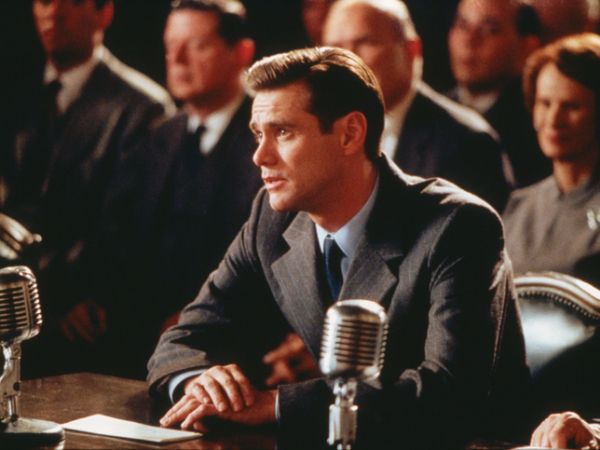
Throughout The Majestic, I was trying to figure out how I felt about it and kept settling on “it depends.” It depends how the lie/mistake is revealed. It depends how all this Communist finger-pointing plays out. I just wasn’t sure where the film would ultimately end up, so I couldn’t decide if I truly liked it or not, wavering on the edge between List-Worthy and List Runner-Up. By the end, though, I was sure. Despite my unease, it definitely stuck the landing. The climax, a culminating speech before the House Un-American Activities Committee clearly echoing Jimmy Stewart in Mr. Smith Goes to Washington, is an absolute standout scene, made even more powerful by its extreme timeliness. At a time with so many fingers being pointed and voices being silenced, it’s a cinematic plea for Constitutional truth, tolerance, and patriotism that should be seen by every American.

See the source image

Frank Darabont was clearly channeling Frank Capra with this movie, and just as Capra’s movies were derided at the time as “Capra-corn,” The Majestic didn’t fly with critics wary of anything remotely sentimental, which is a crying shame. I’ll admit it’s a bit too long and predictable, but it’s also an endorsement of nostalgia, decency, and the magic of movies, with emotional performances and strong direction throughout. It’s modern Capra-corn, and, when it’s done this well, there’s nothing wrong with that.

Best line: (Peter, speaking to Congress) “That’s the First Amendment, Mr. Chairman. It’s everything we’re about if only we’d live up to it! … It’s the most important part of the contract every citizen has with this country. And even though these contracts – the Constitution, and the Bill of Rights! – even though they’re just pieces of paper with signatures on them, they’re the only contracts we have that are most definitely not subject to renegotiation… not by you, Mr. Chairman… not by you, Mr. Clyde… Not by anyone, ever. Too many people have paid for this contract in blood!”


Rank: List-Worthy


© 2019 S.G. Liput
655 Followers and Counting


2019 Blindspot Pick #11: Run Lola Run (1998)

Tags

,

See the source image

(Best sung to “Lola” by The Kinks)

I’m not the world’s most observant guy,
So I lost a lot of money, and I’m gonna die,
But for Lola, Lo-lo-lo-lo-lola.

She ran across town to fix my mistake,
Since I dropped about a hundred thousand, give or take,
Lots o’ moolah, moo-moo-moo-moo-moolah.

Only twenty minutes left to recover it,
So we might have had a better chance surviving spit
With ebola, bo-bo-bo-bo-bola.

Luckily for me, she can run really fast,
And possibly replay what happened in the past,
That’s my Lola, Lo-lo-lo-lo-lola.

And if I get to live to see another dawn,
I’ll let her handle all the money from now on,
Good ol’ Lola, Lo-lo-lo-lo-lola!
_______________________

MPAA rating: R (mainly for language in the subtitles, other content is more PG-13)

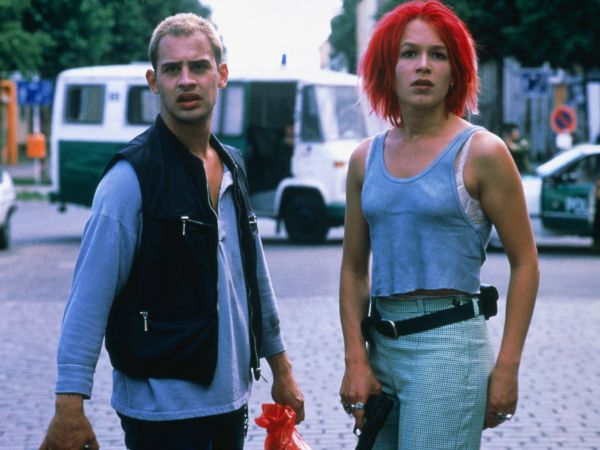
I didn’t realize when I chose both Mr. Nobody and Run Lola Run as Blindspots this year that they would end up having so much thematic similarity. And they’re both German, the former an English-language co-production while this film is actually in German. Both have to do with how people’s choices can result in vastly different outcomes, which are presented in an impartial, what-if manner. Yet, whereas Mr. Nobody explored huge, cosmic potential across a lifetime, Run Lola Run deals with a crucial twenty-minute window in the lives of red-haired Lola and her boyfriend.

See the source image

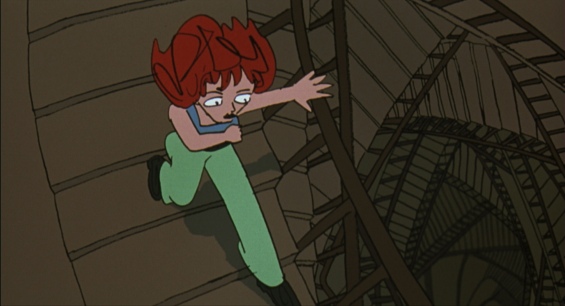
At the most basic level, the events of Run Lola Run (or Lola Rennt in German) are fairly straightforward: Boyfriend Manni (Moritz Bleibtreu) loses 100,000 marks earned from a drug deal and is a goner if he and Lola (Franka Potente) can’t deliver the money within twenty minutes. Yet, as evidenced from the imaginatively animated opening credits sequence, this isn’t your ordinary thriller. While Lola’s running is a constant across each of the three timelines presented, the events play out with vast differences, sometimes based on something as small as distracting a driver at just the right moment. Whether it’s robbing a store or begging Lola’s banker father (Herbert Knaup) for the money, their efforts rarely work out as planned, but it’s as if fate is driving the story at times, allowing the interaction of side characters to determine how everything will play out.

I usually love this kind of butterfly-effect conceit, and I enjoyed Run Lola Run for that aspect, but it felt like something was missing for me. It might be that I didn’t really have a reason to care about the characters except for their desperate circumstances. The plot’s divergences don’t really explain themselves either; each time events start over, there’s some existential pillow talk between Lola and Manni that lets things momentarily slow down, and then it all begins again. In addition, Lola frequently passes people, and a series of still images shows either their past or future. That’s the thing, though; I didn’t know for sure, and it wasn’t clear what changed for that person between the timelines to get such different outcomes.

See the source image

Such complaints are probably no big deal for people who like to ponder a film’s deeper meaning, but Run Lola Run works better as an inventive thriller than a philosophical treatise and would have benefited from more clarity, like why Lola kept breaking glass with her screams. The finer points aside, though, this film was still a fun ride, and, with its riffing on fate vs. individual choice, I can see why director Tom Tykwer was drawn to co-direct Cloud Atlas fourteen years later. The later film had far more to say and a wider scope to say it, but Run Lola Run felt like an indie step toward bigger things.

Best line: (unseen narrator at the beginning) “Man… probably the most mysterious species on our planet. A mystery of unanswered questions. Who are we? Where do we come from? Where are we going? How do we know what we think we know? Why do we believe anything at all? Countless questions in search of an answer… an answer that will give rise to a new question… and the next answer will give rise to the next question and so on. But, in the end, isn’t it always the same question? And always the same answer?”

(I still don’t know the question, but, as we all know, the answer is 42… of course.)


Rank: List Runner-Up


© 2019 S.G. Liput
654 Followers and Counting


Aladdin (2019)

Tags

, , , , ,

See the source image

There once was a popular tale
That viewers would watch without fail.
So Disney said, “Wait,
Let’s remake and update
A classic that never was stale.”
Despite the naysayers
And unanswered prayers,
That’s just what they did for resale.
And we, the civilians,
Still offered them billions
And all the support they entail.
__________________________

MPAA rating: PG

Like so many others, I rolled my eyes when I heard Disney was continuing their trend of recycling their animated hits into live-action by setting their sights on 1992’s Aladdin. Even so, I thought Aladdin at least had plenty of additional story material in the 1001 Arabian Nights to draw from, so it could potentially be not terrible. Even the Internet freakout over Will Smith’s blue CGI genie didn’t seem like that big of a deal to me. (I swear, people judge movie effects far too quickly, whether it’s Alita’s eyes or photorealistic Pokemon, and usually it turns out fine once you get used to it.) So despite Disney’s so-so track record with these films, I guess I was optimistic but not exactly excited about another Aladdin, and now that I’ve seen it, my opinion hasn’t changed much.

See the source image

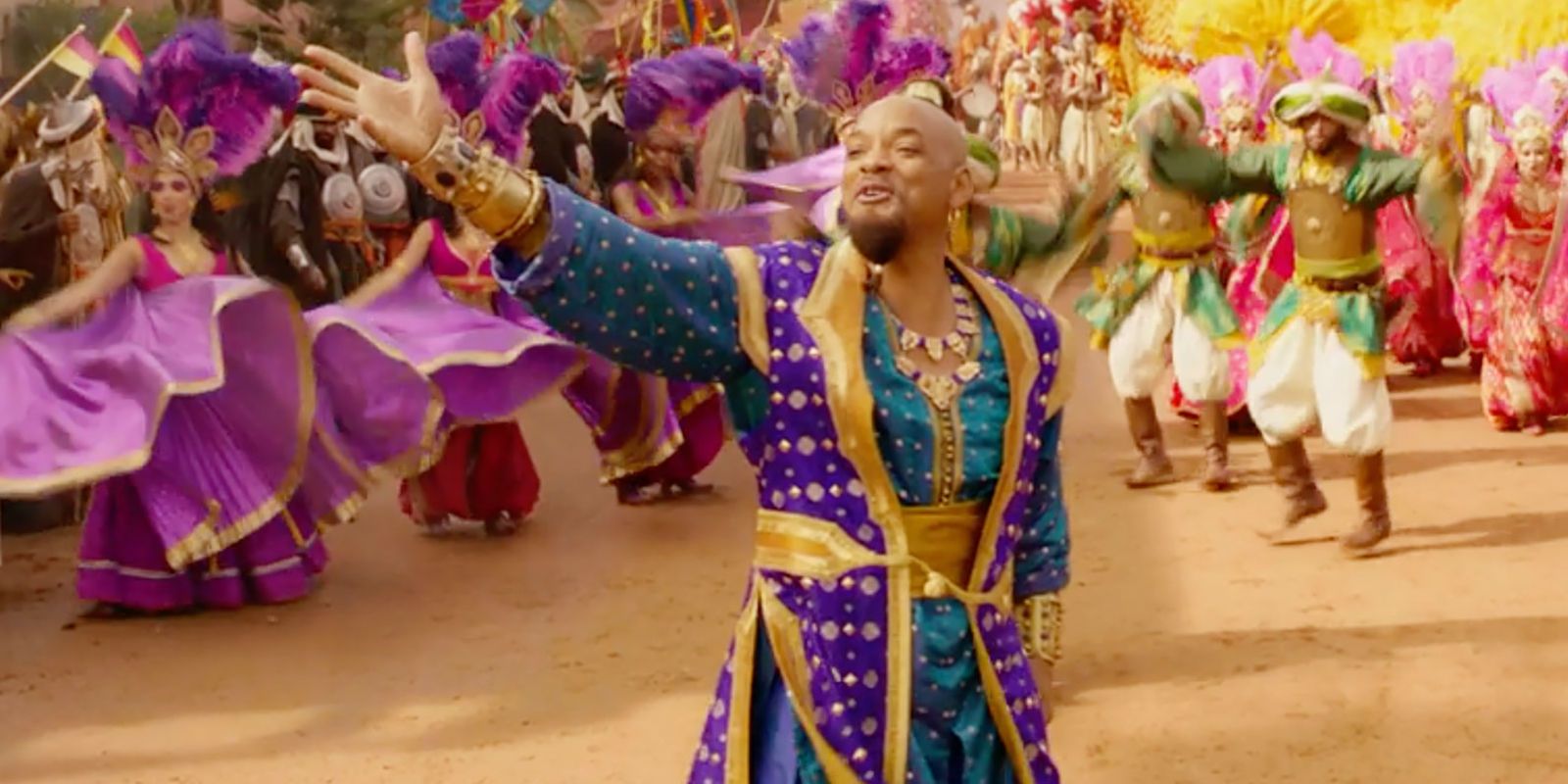
The biggest weakness of these live-action remakes is that they repeatedly tread the same ground, replicating entire scenes and musical numbers that were already perfect in the original and cannot help but pale in comparison. It’s why I despised 2017’s Beauty and the Beast, yet Aladdin somehow seems more forgivable and entertaining, even if it does suffer from the same fault. I think the actors help immensely in this regard: Mena Massoud is a spot-on charming Aladdin, sporting great chemistry with Naomi Scott’s equally well cast Jasmine, who now champions some non-subtle feminism. And while Will Smith as Genie is no Robin Williams, he isn’t really trying to be, instead replacing some of the frenetic jokes with more of a hip-hop swagger. Plus, he even gets his own love interest in Jasmine’s handmaid, a welcome addition played by SNL’s Nasim Pedrad.

Director Guy Ritchie doesn’t really bring much of his unique action style to the proceedings, but it’s all still competent, fast-paced, colorful, and just different enough from the original to make you say, “Hey, why didn’t Jafar fool Aladdin by dressing up as a little old crazy man?!” Honestly, Jafar is the main weak point. Marwan Kenzari does fine with the role, playing him with more of an inferiority complex, but he’s missing so many aspects that made Jafar an iconic villain – Jonathan Freeman’s deep voice, the imposing stature, the goatee – and Iago and the snake staff don’t make up the difference to make him particularly memorable. The musical numbers are similarly not quite as vibrant as their animated counterparts (although the effects team did better with “Friend Like Me” than I was expecting), and Jasmine’s added girl power anthem is lovely but awkwardly placed as far as pacing.

See the source image

It’s hard to judge these movies on their own merits since it’s hard not to compare them to the original, but if the original Aladdin didn’t exist, I think this one would be an amazing and innovative family film. As it is, it’s a pretty entertaining if uninspired family film with a laudable message, which still isn’t a bad thing these days. It’s at least not the kind of remake that does a disservice to the original, and since Disney insists on making more and more of these, that might be the best case scenario.

Best line: (Jafar) “Steal an apple, and you’re a thief. Steal a kingdom, and you’re a statesman.”


Rank: List Runner-Up


© 2019 S.G. Liput
653 Followers and Counting

And a very Happy Thanksgiving to all!


Jojo Rabbit (2019)

Tags

, ,

See the source image

Prejudice is a peculiar emotion,
The product of bitterness, pain, or devotion.
No one is born with it right from the start,
And no one desires it deep in their heart.

And yet it takes hold and is likely to grow
Through dubious facts people think that they know:
A rumor that no one can track to its source,
An outrage that should have long since run its course,
A fact or a fiction passed on by those who
Just don’t care enough to find out if it’s true.

It’s no surprise then, in this world of pretense,
That people believe things that strain common sense.
And once it digs deep, ‘tis not easy to loose,
For bias breeds bias in search of excuse.

Don’t think it’s impossible, though, to break free
Of such silly cycles that plague history.
It takes a rare person, both brave and sincere,
To listen to someone they don’t want to hear.
__________________________

MPAA rating: PG-13

I was skeptical when I first saw the trailer for Taika Waititi’s latest film Jojo Rabbit, what with its jokey Nazi satire. Waititi’s humor has been hit-and-miss for me with films like Thor: Ragnarok, so I wasn’t sure exactly what to expect. Luckily, I’m pleased to report that Jojo Rabbit is easily my new favorite of his movies, a triple threat of humor, heart, and pathos that didn’t disappoint at all.

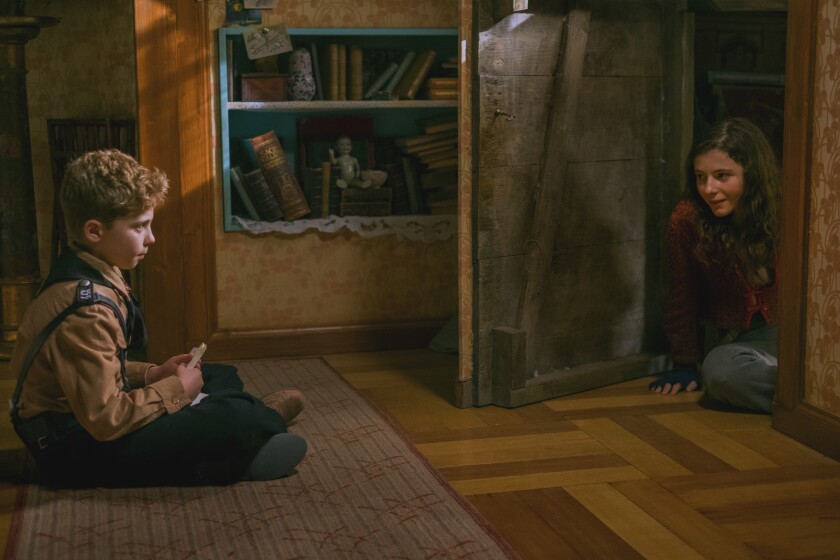
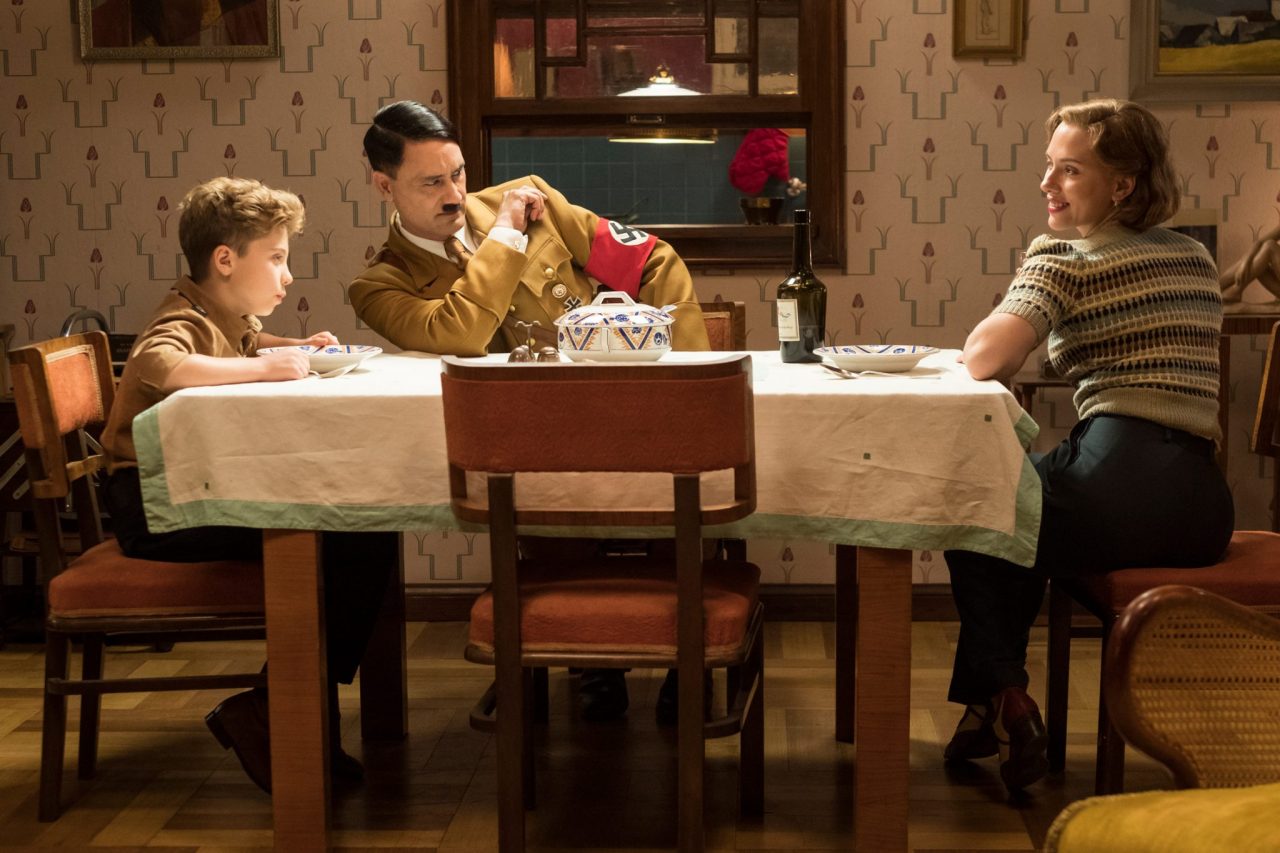
Set in the latter days of World War II, Jojo Rabbit follows young Jojo (Roman Griffin Davis), a devoted young boy who is excited to go to a Nazi youth training camp, with the encouragement of his imaginary friend Adolf Hitler (Waititi himself). After an accident, Jojo is forced to stick close to home, where he discovers that his mother (Scarlett Johansson) has been hiding a teenage Jewish girl named Elsa (Thomasin McKenzie of Leave No Trace) in their house, prompting him to reconsider his preconceived prejudices.

See the source image

It may sound like a cliché, but this movie is one of those rare full-package films: you’ll laugh, you’ll feel your heart break, you’ll hold your breath at tense moments. The amazing thing is that there are scenes where all three happen in quick succession. Waititi’s sense of humor can be an acquired taste, but here he brilliantly plays up the absurdity of Nazism, from the blind loyalty to the exaggerated picture of Jews promoted by Jojo’s training officers (including Sam Rockwell as a washed-up soldier and Rebel Wilson as a gung-ho instructor). He even manages to make the repeated use of “Heil Hitler” increasingly hilarious.

Yet, unlike the similar irreverence of The Producers, the comedy isn’t just for shock value laughs, instead being accompanied by some surprisingly profound statements challenging how Jojo sees the world, Jews, and himself. Young Davis does a wonderful job as Jojo, both as a naïve Nazi boy scout and a more world-weary doubter later on, and McKenzie brings a ferocious defiance to Elsa, bitter to the cruel world and far from the shrinking victim she could have been. Likewise, Johansson exudes warmth and good humor in her maternal role, and she finally gets to hit Sam Rockwell, where she never got the chance in Iron Man 2. And as for Waititi, he really hams it up as the imaginary Hitler, acting as Jojo’s friendly shoulder devil as the boy deals with Elsa and bristling at the wavering of Jojo’s loyalty.

See the source image

It’s not often I say this, but Jojo Rabbit really felt to me like an instant classic, a perfect blend of irreverent tragicomedy that confidently overcomes its own weirdness to be both memorably entertaining and affecting. I loved the bright, meticulous set design, sometimes reminding me of a less pedantic Wes Anderson movie, and a spinning tracking shot over time echoed a similarly impressive scene from Waititi’s Hunt for the Wilderpeople. The film’s main fault for me was some unnecessary profanity, but otherwise, it’s definitely one of the best movies I’ve seen this year and further cements Taika Waititi as a filmmaker of unique vision, which just happens to include Hitler eating a unicorn.


Rank: List-Worthy


© 2019 S.G. Liput
653 Followers and Counting


2019 Blindspot Pick #10: Mr. Nobody (2009)

Tags

, ,

See the source image

This poem is a couplet, a two-liner rhyme,
For readers and poets who haven’t much time.

Or rather it could have been, if I’d decided,
But maybe I’ll make it a villanelle instead.
Which bears repetition by which it is guided.

You ask who would make such a change? Answer: I did.
So this is a villanelle now, as you’ve read,
Or rather it could have been, if I’d decided.

Let’s not be verbose.
A haiku might be better
To save syllables.

But then again, a sonnet I’d allow.
For fourteen lines in length would be provided
If only I would end this poem right now.

So what kind of poem was this one?
All four that I’ve named, or else none?
You can only decide
Once you’ve finished and tried
Looking backward when all’s said and done.
________________________

MPAA rating: R (mostly for sensuality and 2 F-words, seemed closer to a PG-13)

Well, this movie was a trip. I’ve been curious about Mr. Nobody for a while now, based on what I’d read about its unusual nonlinear story, and I can confirm it’s certainly unique. On one level, it’s a mind-bending, provocative tale of the potential directions life can take, which is exactly the kind of story I love, but it also is a bit too abstract for its own good.

See the source image

The title character is Nemo Nobody (Jared Leto), a man born in 1975 who ends up living till 2094 as the oldest and last mortal in a world that has achieved quasi-immortality through science. Plagued by memory loss, he is interviewed on his deathbed by a tattooed psychiatrist (Allan Corduner) and a journalist (Daniel Mays), both of whom are perplexed by the unusually disparate histories he recounts, lives that split at major crossroads in his life, particularly a train station when he had to choose which divorcing parent to stay with at the age of nine.

To call Mr. Nobody peculiar is an understatement; it’s a full-blown experimental film. It’s amazing to me that such a film was made at all, and even more amazing that it was made three years before Cloud Atlas, which is the closest film I can compare it to in terms of cosmic ambition and madcap editing. Due to Nemo’s ability to see possible futures, it swings back and forth between Nemo’s potential lives: the three women he could marry, the jobs he could have taken, the mistakes and accidents he endures or avoids. Also interspersed are more fantastical detours, such as a future journey to Mars that doubles as a story written by a teenage Nemo and a surreal argyle-themed dream world that may or may not be part of Nemo’s subconscious.

See the source image

Sometimes, these various storylines seem designed to confuse: The beginning shows bits and pieces of all the timelines in quick succession, like a sneak peek that leads to moments of revelation but is bewildering in the moment. In other cases, it gives a particular story more time to develop emotions, such as a romance between a teenage Nemo (Toby Regbo) and his stepsister Anna (Juno Temple; Diane Kruger as an adult) or the mental illness of one of Nemo’s other wives (Sarah Polley). Most of these timelines end in tragedy, yet others retain a sense of hope that one of Nemo’s decisions could lead to happiness.

At a certain point, the journalist interviewing the 118-year-old Nemo asks what the truth is, since not all of these lives could have happened, and Mr. Nobody’s answer extols the endlessness of possibility without providing a real answer. In that vein, one of Nemo’s professions is as the host of a TV science show, which allows him to ask big cosmic what-if questions that some might consider deep but ultimately boil down to “No one knows,” to the point that they’re almost meaningless, which may excite philosophers but can be frustrating to viewers who desire concrete answers. Plus, there’s uncertainty about whether some timelines are “real” at all, like the Mars mission that doesn’t always seem like something Nemo made up. Likewise, the ending is a strange mix of long-awaited satisfaction, pseudo-science that I at least didn’t fully understand, and a sweet conclusion undercut by a lack of context.

See the source image

So, while Mr. Nobody frustrated me more, I suppose my final opinion is the same as for Cloud Atlas: a magnificent mess that individual viewers must decide whether it’s a masterpiece or a trainwreck. It certainly never fails to enchant visually, particularly several sequences that depict the butterfly effect (reminding me of similar scenes in Ink and The Curious Case of Benjamin Button), and the special effects, cinematography, and Pierre Van Dormael’s score are exceptional. At times, it seems to borrow individual motifs from the likes of Forrest Gump, When Harry Met Sally…, and Harold and Maude, yet all of the ingredients come together to form something wholly distinctive and idiosyncratic, for good or ill. It’s a film like no other, featuring Jared Leto’s best performance I’ve seen and individual scenes I loved, and, though its complexity and length will not be for everyone, it’s an experiment worth experiencing.

Best line: (Nemo Nobody) “At my age the candles cost more than the cake. I’m not afraid of dying. I’m afraid I haven’t been alive enough. It should be written on every school room blackboard: Life is a playground… or nothing.”


Rank: List Runner-Up


© 2019 S.G. Liput
652 Followers and Counting


Glass (2019)

Tags

, , ,

See the source image

We live in a world in which evil and good
Are warring in hopes that each be understood.

The good share a dream in which righteousness reigns,
Dispelling all ignorance, chaos, and chains,
And could be considered one-note or naïve
In hoping for changes no man can achieve.

But evil, for lack of a worthier word,
Is interesting in how it seeks to be heard.
It pleads its own case, it redirects blame,
It covers its face, it covets more fame,
It craves vindication, it bristles at scorn,
It scatters temptation, it toots its own horn,
It seeks self-redemption and curses regrets,
It wants an exemption that no one else gets.

It does entertain, but does it satisfy?
The good know the answer, and Goodness knows why.
_____________________

MPAA rating: PG-13

I feel like Unbreakable has grown in reputation over the years. Its unconventional take on the superhero genre predated the majority of big-budget comic book films, and the decline in M. Night Shyamalan’s output quality afterward made its excellence stand out even more. Naturally, it was a surprise when 2017’s Split made a post-credits revelation that it was set in the same universe, prompting speculation on what the inevitable third film would do to bring the characters together. Now that Glass has finally answered that question, I doubt I’m the only one thinking that we might have been better off not knowing.

See the source image

Now nineteen years after the events of Unbreakable and three weeks after the events of Split, David Dunn (Bruce Willis) has become an experienced vigilante called the Overseer with the help of his son (Spencer Treat Clark) and sets his sights on Kevin Wendell Crumb (James McAvoy), whose murderous Horde personalities are running amok. However, both David and Kevin are soon captured and imprisoned in a mental hospital, alongside Elijah Price/Mr. Glass (Samuel L. Jackson), where psychiatrist Dr. Ellie Staple (Sarah Paulson) seeks to convince them their superhero/villain abilities are merely figments of their imagination.

I wanted to like Glass, and in some ways, I did. Like Unbreakable, it’s a rare slow-burn superhero film, where the action is infrequent but scrappy, and the psychological questions raised are given just as much time (or more) than the plot. I certainly can’t fault the performances, particularly Jackson and McAvoy. The former lets Mr. Glass’s cunning bubble under the surface for most of the film and later revels in his mastermind status, while the latter continues the bravura flurry of performances that made Split such a showcase of acting skill. Paulson also does well in making her psychiatrist a seemingly sympathetic mystery, with intentions you can’t help but suspect.

Some might complain that Glass takes too long to get to the showdown to which it is clearly building up, but that’s not the extent of the film’s problems, which also include the outcome of said showdown. Of course, Shyamalan has to pull out a last-minute twist to subvert expectations, but, despite some intriguing implications, it’s far from a satisfying one. Bruce Willis may have the least charismatic character, but his David Dunn, in particular, deserved so much better than this film. With time to think about the ending, I’ve come to appreciate its attempt at refocusing the narrative on side characters, but it still left a bitter taste in my mouth.

See the source image

So, I suppose you could say that Shyamalan strikes again. It’s neither his best nor his worst movie, but it’s the least of this comic-themed trilogy and had so much potential to be more. It’s still very well-produced and directed and worth watching for Jackson and McAvoy’s performances, but it only works as a where-are-they-now story (I liked the continuity of Shyamalan’s cameos), not so much as a conclusion. The next time I watch Unbreakable and Split, I might just pretend they’re stand-alone films.

Best line: (Glass) “There are unknown forces that don’t want us to realize what we are truly capable of. They don’t want us to know the things we suspect are extraordinary about ourselves are real. I believe that if everyone sees what just a few people become when they wholly embrace their gifts, others will awaken. Belief in oneself is contagious. We give each other permission to be superheroes.”


Rank: Honorable Mention (on the edge of Dishonorable)


© 2019 S.G. Liput
652 Followers and Counting


My Top Twelve Movie Villains of the 21st Century

Tags

See the source image

During the early 2000s, I loved the 100 Years… series of movie lists released by the American Film Institute, counting down film’s top Laughs, Thrills, Passions, and such. They served as a great introduction to the cinematic highs of various genres, some of which I knew and others I got to experience vicariously for the first time. It’s really a shame that they stopped after 2008; I would have at least liked another ten-year update of the Top 100 Movies list.

Yet one list seemed like it could particularly use an update. In 2003, the AFI counted down the top 50 heroes and top 50 villains, and I couldn’t help but notice that the only villain from the 21st century was Denzel Washington’s crooked cop in Training Day at #50. Over the last 19 years, though, there have been plenty of other villainous characters that I think could have earned placement on that villain list. Therefore, I thought I’d do my own updated villain countdown for the current century, leaving heroes for another time.

I’m not necessarily in favor of celebrating evil, but a memorable villain can make a good movie great and a bad movie watchable. One villain I do think should be on the list is Mr. Smith from The Matrix series, but he’s technically ineligible since the first film was released in 1999. And sidenote: I’m ignoring TV, as much as I’d like to include Ben from Lost, Bill Cipher from Gravity Falls, or Kyubey from Puella Magi Madoka Magica. Thus, with consideration for how iconic each has become, here are my own picks for the top villains of the 21st century:


  1. Mr. Glass from Unbreakable/Glass

See the source image

Unbreakable was an unconventional superhero movie, and true to M. Night Shyamalan form, its villain proved to be a surprise. Samuel L. Jackson’s brittle-boned antagonist seemed so harmless at first, yet his role as a mastermind and the unhealthiness of his comic book fascination became clear by the end. I laughed during a recent rewatch of Parks and Recreation where they ask what Mr. Glass is up to and “Why no sequel?” Of course, we did get one this past year, with mixed results, but the “strength” of the character remains.


  1. President Snow from The Hunger Games series

See the source image

A mere vaguely threatening presence in the first Hunger Games film, President Snow proved just how ruthless and dastardly he was in the next three. From blackmailing Katniss to ordering the deaths of countless citizens, he became an increasingly dangerous mastermind, and Donald Sutherland played him with an icy pragmatism right up to the very end.


  1. Doctor Octopus from Spider-Man 2

See the source image

I think it’s telling that of the original Spider-Man trilogy villains, only Doc Ock hasn’t had some kind of “reboot” in the Spider-Man films since. (Well, at least in live-action; Into the Spider-Verse went a little different with its version.) I think that’s because of how perfectly Alfred Molina became the character, brought to life with an awesome mix of CGI and puppetry. Uniquely sympathetic due to his Jekyll-and-Hyde complex with his robotic arms, he remains one of the franchise’s best villains.


  1. The Babadook from The Babadook

See the source image

Few horror films have genuinely scared me like The Babadook, thanks largely to its titular creature. This Australian scarefest features a picture book that described the top-hatted terror in detail, letting people’s fear and suspicion make it real and inescapable. As movie monsters go, it’s definitely up there with the most chilling, even more so due to what it represents psychologically.


  1. Voldemort from the Harry Potter series

See the source image

Granted, I haven’t seen any of the Harry Potter films, but the reputation of Ralph Fiennes’ Voldemort precedes him. The very name of He Who Must Not Be Named has become synonymous with villainy, so even if I only know him by cultural presence, the significance of that presence deserves placement on any list of cinematic villains.


  1. Captain Barbossa from The Pirates of the Caribbean series

See the source image

I had considered putting Bill Nighy’s Davy Jones on the list, but in the end, Geoffrey Rush’s Captain Barbossa won out. With his smarmy dealing and sneering delivery, he’s just the perfect pirate antagonist, whether as a skeleton or less-than-trustworthy ally, and Rush always looks like he’s having a blast. Plus, he’s got one of the best surprise entrances in movie history.


  1. Hans Landa from Inglourious Basterds

See the source image

Another film I haven’t actually seen all of, Quentin Tarantino’s Inglourious Basterds nonetheless delivered a villain for the ages in Christoph Waltz’s Oscar-winning portrayal of Hans Landa, the wicked Nazi “Jew Hunter.” Able to shift easily from casual courtesy to racist murder, he’s a true psychopath, and his opening scene alone was enough to convince me of his placement here.


  1. Magneto from the X-Men franchise

See the source image

As far as which version of the character, take your pick. Whether played by Ian McKellen or Michael Fassbender, Magneto is the ideal archrival to Charles Xavier, bitter enough about his traumatic past to hate all non-mutants. He’s suffered so much that you can’t help but sympathize with him, even as he uses his power over metal to cause havoc. Plus, he’s not too different from Charles in his end goals; he’s just far more ruthless in his means of achieving them.


  1. Pennywise from It and It Chapter Two

See the source image

I still haven’t gotten around to watching the latest version of Stephen King’s It, but I must give props to Bill Skarsgård for helping this incarnation of Pennywise the Dancing Clown rival the great Tim Curry’s. His frightening painted face has become an instant icon of scary clowns (just look at the Halloween costumes), so that makes him the most recent entry on the list.


  1. Joker from The Dark Knight

See the source image

“Why so serious?” Speaking of clowns, we mustn’t forget the other Oscar-winning villain role on this list. You’re welcome to include Joaquin Phoenix’s most recent version of the Joker here, but I have Heath Ledger in mind. I can’t help but wonder if the darkness required to personify the Joker contributed to his death, but he certainly made the role his own and, in effect, his legacy. Edgy and grimy to match the underworld of Gotham, his Joker is a compulsive liar and a true criminal mastermind, a man whose goal is simply, in the words of Michael Caine’s Alfred, “to watch the world burn.”


  1. Sauron – The Lord of the Rings films

See the source image

Few villainous images are as iconic as the Eye of Sauron. Watching from atop the tower of Barad-dûr, it’s an all-watching representation of evil, especially the evil of the One Ring, the source and reason for Frodo’s quest across Middle-earth. I could easily have sided with Saruman, the Ringwraiths, or Gollum as well, but Sauron is the big bad to end all fantasy big bads.


  1. Thanos from Avengers: Infinity War and Endgame

See the source image

Yet when it comes to big bads, who can question Thanos, the final boss of 20+ films in the Marvel Cinematic Universe? No other villain has achieved his goals as successfully as did Thanos in Infinity War, and it has to be a new height in villainy to wipe out half of all life in the universe. Marvel has often been criticized for its weak villains, but Thanos blew them all away (literally) and may well be the best villain of the new millennium.


And here are some other contenders that could deserve placement on a list of 21st-century villains, a list of nefarious runners-up, so to speak:


Loki – Thor, The Avengers, etc.

Red Skull – Captain America: The First Avenger

Ultron – Avengers: Age of Ultron

Killmonger – Black Panther

Severus Snape – Harry Potter series

Syndrome – The Incredibles

Davy Jones – The Pirates of the Caribbean 2 & 3

The White Witch – The Chronicles of Narnia: The Lion, the Witch, and the Wardrobe

No-Face – Spirited Away

The Green Goblin – Spider-Man

Other Mother – Coraline

Eris – Sinbad: Legend of the Seven Seas

Kylo Ren – Star Wars: Episodes VII-IX

The Armitage Family – Get Out

Daniel Plainview – There Will Be Blood

Khan (Benedict Cumberbatch) – Star Trek into Darkness

Raoul Silva – Skyfall

Owen Davian – Mission: Impossible III

Solomon Lane – Mission: Impossible – Rogue Nation and Fallout

Bane – The Dark Knight Rises

Smaug – The Hobbit: The Desolation of Smaug

Immortan Joe – Mad Max: Fury Road

Annabelle / The Nun – The Conjuring franchise

David – Prometheus and Alien: Covenant

Anton Chigurh – No Country for Old Men

Patrick Bateman – American Psycho

Jigsaw – Saw franchise

Kevin Wendell Crumb – Split and Glass

Wilson Fisk/Kingpin – Spider-Man: Into the Spider-Verse


So do you agree? What cinematic villains would you suggest are worthy of such a list? I’d love to know what you think!


Under the Shadow (2016)

Tags

, ,

See the source image

The night is black,
A bleak throwback
To when the world was without shape.
A shadow shifts,
The darkness drifts
And snares your eye with no escape.

You crane your neck
To merely check
That all is well outside your bed.
And pray no face
Or graver case
Will give you reason for your dread.
________________

MPAA rating: PG-13

I’m not really into horror generally, but it’s become something of a tradition for me to watch a scary movie alone at night, just to review it for Halloween. Like The Conjuring, The Babadook, and Lights Out in years past, I decided to check out an acclaimed creepfest that focuses more on atmospheric tension rather than gross-out gore. This time, though, I went outside the English-speaking world to watch Under the Shadow, a Persian-language horror (with a 99% on Rotten Tomatoes) set in 1980s Tehran.

See the source image

Of course, 1980s Tehran wasn’t the best place to be, especially during the increasingly frequent bombings of the Iran-Iraq War. It’s already a tense setting, as the inhabitants of an apartment building must head downstairs into the basement at the sound of bomb sirens, much to the chagrin of mother Shideh (Narges Rashidi) and her daughter Dorsa (Avin Manshadi). Disgruntled by her country’s rigid decrees keeping her from becoming a doctor, Shideh is further unsettled when her husband is sent off to war, and as strange events start to occur late at night, she wonders if there is indeed something haunting her family.

In many ways, Under the Shadow is exactly the kind of horror movie I like, with a creeping dread serving as the main source of fear, knowing that something could happen at any moment and jumping out of your skin when it occasionally does. There’s zero blood on display, and it doesn’t need it. While it taps into the mythology of malevolent air spirits or djinns, it’s surprising how well the frights work when they stem from what is essentially the most minimalist ghost, a floating sheet (technically a chador, a Persian women’s cloak). The uncanny fear conjured by its sudden appearances is potent stuff.

See the source image

However, there’s nothing especially notable about the story itself, aside from its unique cultural setting, which is itself a danger, since Shideh can be punished for even fleeing her home without a head covering. Yet the plot isn’t too far from that of The Amityville Horror, and the mother/child dynamic, while showing growth, has been done with better closure elsewhere. Even so, Under the Shadow provided exactly what I look for in a scary movie, while excluding what I avoid in the genre. Well-acted with a slow-burn anxiety, it’s an excellent addition to my Halloween reserve, even if it’s made me look over my shoulder more often than before.


Rank: List Runner-Up


© 2019 S.G. Liput
652 Followers and Counting


VC Pick: Terms of Endearment (1983)

Tags

, ,

See the source image

You love her so dearly,
And not insincerely,
Your mother, your mom whom you know loves you, clearly,
And yet you resent
Her distinct discontent
That causes her love to be dealt so austerely.

Your choices, your bearing,
The clothes that you’re wearing
Are always subject to her stare and found erring.
All that you’d withstand,
Every vague reprimand,
For the knowledge or hope that behind it is caring.
____________________

MPAA rating: PG (should be PG-13)

I know I haven’t posted in a while, being busy with a college class, but I’m back now and thought it was about time to review something chosen by my dear VC (Viewing Companion, for the uninitiated). I saw Terms of Endearment years ago and never gave it much of a thought since. I recalled it being good and sad by the end, and, sure, it won Best Picture in 1983 alongside several other Oscars, but for some reason, it never really stuck with me. At my VC’s urging, I finally got around to it again, and found to my surprise that I remembered a lot more than I thought I did. Even so, it was helpful to remind myself of a lot of the context that inevitably slips through the memory cracks, which further convinced me that it’s a great movie that’s just not one of my favorites.

See the source image

The film’s greatest strength is its actors, particularly the dueling mother/daughter portrayals of Shirley MacLaine and Debra Winger, as Aurora and Emma Greenway, respectively. MacLaine is the quintessential disapproving parent, distant by default, content to let love be implied, and rarely allowing her emotions to show themselves. Winger as her daughter is hungry for that love and emotion and constantly trying to balance her love for her mother with their mutual exasperation. It’s a dynamic that my VC had with her own mother, so I can completely understand why it hit close to home for her, particularly a line about how the fighting between them doesn’t always feel mutual but simply a facet of their relationship. And the part about Aurora always being the first to let go of a hug certainly imitated life. I, on the other hand, have a largely warm and loving relationship with my own mom, making the emotional constipation onscreen less relatable for me but no less frustrating.

Supporting the main two women are Jeff Daniels as Emma’s less-than-faithful professor husband, John Lithgow as her own secret lover, and Oscar-winning Jack Nicholson as Aurora’s self-absorbed astronaut boyfriend, who is honestly insufferable half the time but skates by with that Nicholson swagger. The drama can get heavy, what with strained parental bonds, failed romances, and familial loss, but the accomplished actors do an expert job balancing the dramatic material with its comedic flourishes. With both MacLaine and Nicholson winning Oscars, though, I rather wish Debra Winger had garnered the same acclaim, since this is easily one of her best roles.

See the source image

It’s no surprise that Terms of Endearment was an Oscar magnet, including its engaging script, based on a 1975 novel by Larry McMurtry. It’s an unabashed tearjerker about the messiness of family life, and while it does touch the heart, it will undoubtedly touch some more than others. I suppose it depends how much you see yourself or your parent in this classic mother-daughter relationship.

Best line: (Aurora Greenway) “I just don’t want to fight anymore.”
(Emma) “What do you mean? When do we fight?”
(Aurora) “When do we fight? I always think of us as fighting!”
(Emma) “That’s because you’re never satisfied with me.”


Rank: List Runner-Up


© 2019 S.G. Liput
652 Followers and Counting