Mr. Church (2016)

Tags

See the source image

A life lived in service is seen as disgrace,
For service is wholly ignoble and lowly,
A shame to escape and oppose.
For so many saints, though, this wasn’t the case;
To serve was a method to mimic the Holy,
A sacrifice God only knows.

A life lived in service is never a waste;
A volunteer’s spirit’s congratulatory,
And oh, that all servants could know!
Such angels of earth are not easily replaced,
For not all bear burdens as badges of glory
And not all saints lived long ago.
_________________

MPAA rating:  PG-13 (for limited profanity)

Mr. Church has been in my Netflix queue for so long that I was considering making it one of next year’s Blindspots just to finally get myself to watch it. The film was written by Susan McMartin, who based it off her own short story “The Cook Who Came To Live With Us,” drawing from her own life. I was curious to see a rare serious role for Eddie Murphy after four years of inactivity, and lo and behold, it turned out to be one of his best films, though you wouldn’t know it based on critical reviews or its scathing box office (less than a million dollars on an $8 million budget).

See the source image

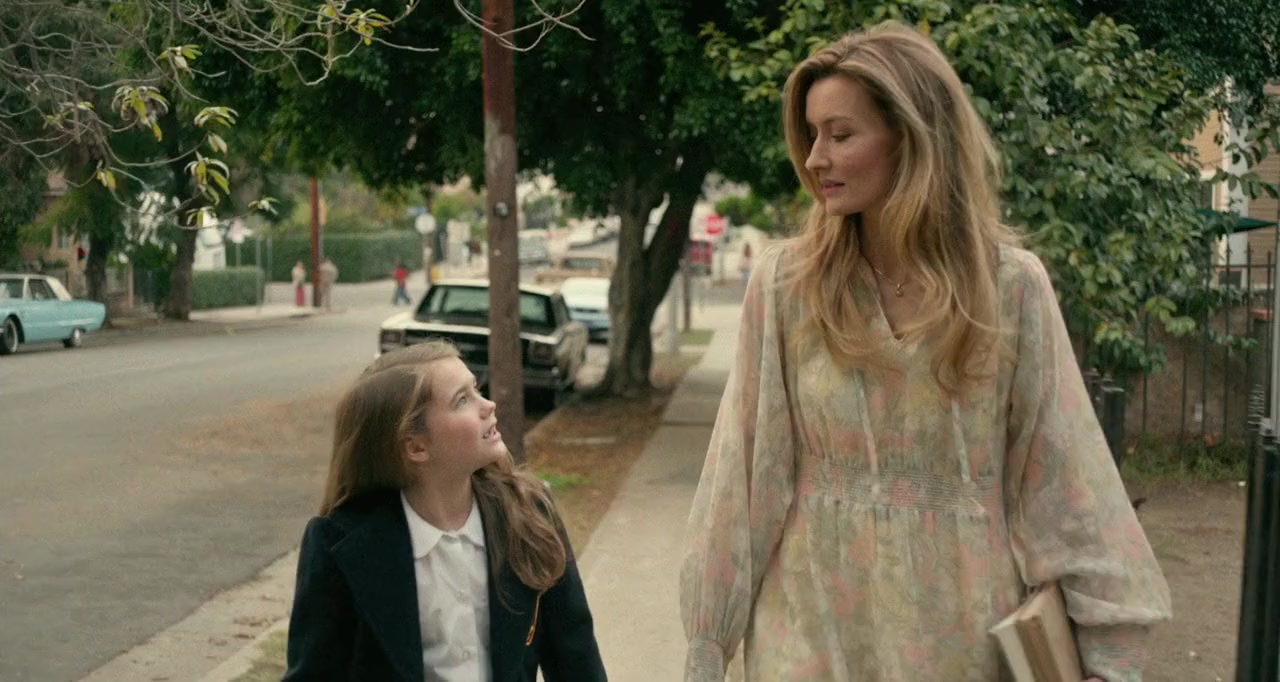
Murphy plays the titular mister, a cook in 1965 assigned to single mother Marie Brooks (Natascha McElhone) by the dying wish of his employer/Marie’s former lover. Tasked with caring for Marie through her treatment for breast cancer, he expects to only stay for six months, much to the chagrin of her daughter Charlie (played by Natalie Coughlin, and later by Britt Robertson), but, as Marie outlives her diagnosis, Mr. Church becomes a mainstay of the home and their family.

There’s something about this kind of movie that just gets me, an irresistible sweetness that stays in my heart when the credits roll. Mr. Church’s presence spans decades as Charlie grows from a callow girl to a young woman with a daughter of her own, and he imparts to her things that are near and dear to my own heart: a love of cooking, classic literature, music. And like Forrest Gump, Charlie’s poetic narration fits perfectly with this kind of nostalgic, generational story.

Robertson and McElhone excel in their emotional roles, but the surprise is a much-subdued Murphy, who instills Church with evident depth at arm’s length, making Charlie and the audience want to know more about him even as he self-effacingly insists on retaining his privacy. Critics have complained that, despite the film bearing his name, he is too much of a one-note character, there merely to serve his white “family,” and while that argument might have some merit, I fear they miss the point. It may not check the “woke” boxes of what critics expect in a black character these days, but that shouldn’t detract from the sweetness of the relationship forged between Charlie and Mr. Church, one of shared interests and quiet service, which becomes mutual over time.

See the source image

Professional reviewers may decry it as sappy and sentimental, but Mr. Church deserves so much better than a 24% on Rotten Tomatoes. Many compared it to a Hallmark movie, but that shouldn’t be an insult by default, since such films can be deeply affecting when done well. I was disappointed that Mr. Church was such a box-office failure, since that likely makes Hollywood less likely to make these kinds of movies. If they’re as poignant as this one, I wish they’d make more.

Best line: (Charlie) “People act strange around death. There are those who talk about everything but the person who died. Those who talk about only the person who died. Those who try to cheer you up. And those who can’t help but make you cry. And then there are those who say nothing at all, because they don’t have to.”


Rank:  List-Worthy


© 2019 S.G. Liput
651 Followers and Counting


2019 Blindspot Pick #9: Vertigo (1958)

Tags

, , , , ,

See the source image

The birds in flight
May love their height
And laugh at bounded, grounded man,
But gravity
Can guarantee
That staying low’s a better plan.

Some love the thrill,
The view, the will
To see a limit and defy,
Yet none deny
That when you’re high,
It’s so much easier to die.
_____________________

MPAA rating: PG

Vertigo has to be the most critically lauded among my Blindspots this year, and I was quite curious to see whether it would match its reputation, since so many Hitchcock movies have fallen short, for me at least. Vertigo lands somewhere in the middle, confirming my opinion that Hitchcock mostly excelled in creating tension in individual scenes rather than whole movies.

See the source image

The fourth and last collaboration between Hitchcock and star Jimmy Stewart, Vertigo is a tale of obsession that toys with the possibility of the supernatural. Stewart plays John “Scottie” Ferguson, a cop who retired after a deadly experience with heights but is commissioned by wealthy friend Gavin Elster (Tom Helmore) to investigate Elster’s wife Madeleine (Kim Novak) and her sudden strange behavior. As he learns more about her connection to a suicidal ancestor and develops a relationship with her, he encounters secrets and mysteries that shake him to his core.

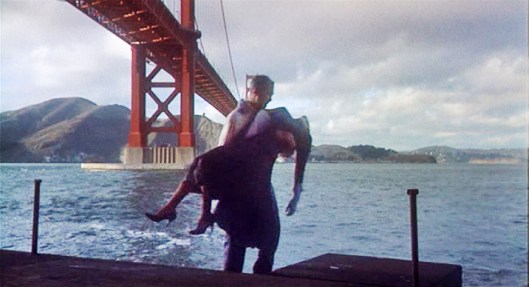
As a fan of film, I can say that I am definitively glad to have finally seen this classic of cinema, an oversight that represents exactly what this Blindspot series is meant to solve. Yet it doesn’t hold the same fascination for me that it apparently does for so many. Perhaps it’s because the film’s intrigue was such a rollercoaster. It starts out interesting enough with Stewart as his ever-likable self, but the story really drags during his investigation, which consists of far too much of him wordlessly following Madeleine by car. Maybe it’s just me, but the picture below doesn’t do much for me in the way of tension.

See the source image

Then comes a famous scene in a bell tower, which is indeed one of Hitchcock’s best for buildup and shock value. Not too much longer, and the reveal of the mystery left my brain working overtime, surprised at the unanticipated twist and giving me a new appreciation for the storyline. Yet what follows becomes a somewhat uncomfortable exercise in obsessive grief (including a weirdly unnecessary psychedelic dream), played out through what would be a deeply unhealthy relationship if not for the audience’s knowledge of its psychological underpinnings. How it ends, while effective, is also anything but satisfying, so abrupt that it made me recall how much I despise the final scenes in North by Northwest and An American Werewolf in London. I know Hitchcock knew how to end a movie, but I wouldn’t know it based on this one.

I certainly can’t fault the actors. Stewart is always good, always, and Kim Novak might be one of my favorites of Hitchcock’s blonde leading ladies. Barbara Bel Geddes is also great as Scottie’s casual friend/former crush, who is short-changed by the ending’s lack of closure. I also liked a cameo by Ellen Corby, who also appeared with Stewart briefly in It’s a Wonderful Life (“Could I have $17.50?”) Likewise, Bernard Herrmann’s hypnotic score is an outstanding accompaniment, and, like the score of Psycho, adds so much to the film’s atmosphere.

See the source image

All in all, Vertigo is the second best one-word Hitchcock film that ends with an O, as well as the second best Hitchcock film that begins with an injured Jimmy Stewart. Sorry if that doesn’t sound like high praise, though I do appreciate its cinematic contribution of that vertigo effect above. I can see why film enthusiasts like it and why its filming locations around San Francisco have become iconic, and I have half a mind to see it again just to pick up on the hints to the twist that I might have missed the first time. Yet, considering it’s been ranked both 1st and 9th on lists of the best films ever made, I feel like its reputation is somewhat overblown. Psycho is still Hitchcock’s masterpiece as far as I’m concerned.

Best line: (Madeleine) “Only one is a wanderer; two together are always going somewhere. ”

Rank: Honorable Mention

© 2019 S.G. Liput
649 Followers and Counting

Circle (2015)

Tags

, , ,

See the source image

Someone must die one minute from now.
You lack any power on why, when, and how.
But someone must die, and it could be you,
Unless you choose somebody else.
But who?

You don’t know a soul as you look all around.
They’re nothing but strangers, their eyes on the ground,
For they have the same choice, deciding who dies,
And may well have voted for your own demise.

So who will you pick, knowing death is no joke?
The seediest? Noisiest? Least of the woke?
Will you choose at random, no malice or spite?
And if you survive, then does that make it right?

Ten seconds to lose,
So judge them and choose.
_____________________

MPAA rating:  Not Rated (should be R for plentiful language)

This is my contribution to MovieRob’s Genre Grandeur for September, which focused on Ensemble Films.

If an ensemble means that the entire cast are on equal footing with no clear main characters, then few films match that description as closely as Circle, a sci-fi chamber piece currently available on Netflix. I have MovieRob to thank for even alerting me to this low-profile film’s existence, and it’s a fine example of a simple premise expertly executed.

See the source image

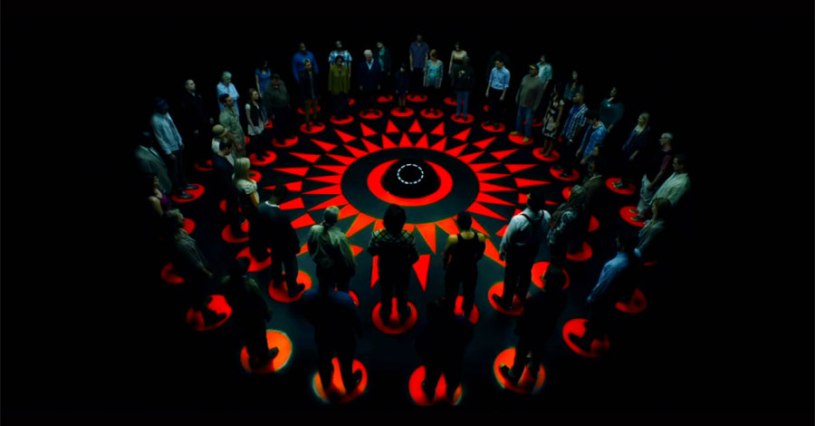
Partially inspired by 12 Angry Men, the plot can be summed up in one sentence: a group of fifty people wake up standing in a circle, unable to move or touch each other else they die, and they discover they collectively decide who dies every two minutes. That is practically the whole movie, people standing in a circle debating who should be the next to die. Yet that simple, disturbing idea turns out to be something intense and thought-provoking from start to finish, buoyed by a talented cast of totally unfamiliar actors who give no clue as to who will survive.

After the disorientation of coming to grips with what’s happening, assumed to be an alien experiment of some kind, the deliberation among the “survivors” illustrates how easily people judge each other, delving into such a diversity of social debates, from race to gender to religion. While some of the stressed characters seem to act rash and stupid at times, the film lets the characters’ words and actions speak for themselves, not judging them but allowing them (and the audience) to judge each other. As the bodies keep dropping, a major split concerns the presence of a young girl and a pregnant woman, half the group believing one of them deserves to be the last one standing while others see them as obstacles to their own chance at survival. The film asks, without a clear answer, how evil is the desire to live?

See the source image

While laden with far too much profanity for my liking, Circle is nonetheless a fascinating study into human nature. The deaths, carried out by a lightning strike, have shock value, always unpredictable in their selection, yet are mercifully bloodless. Some of the logistics aren’t 100% clear, such as how people make their choice with an implant in their hand. And while I would have liked some last-minute twist (or rather a different twist), its final scene is more about sparking conversation, theory, and ethical soul-searching than providing a satisfying end. Compelling in its moral grayness, Circle is an ensemble thriller that asks uncomfortable questions through an alarming, improbable situation as only science fiction can.


Rank:  List Runner-Up


© 2019 S.G. Liput
648 Followers and Counting


2019 Blindspot Pick #8: How Green Was My Valley (1941)

Tags

,

See the source image

How green was my valley
So many years back!
No paychecks to tally,
No perils to track,
When people seemed good
And the future seemed bright,
Before my childhood
Had receded from sight.

How green was my valley,
How grand the coal mine,
How buoyant my sally
Beneath the sun’s shine!
Now I view the same scene,
As every man does,
Wishing it were as green
As I know it once was.
___________________

MPAA rating:  G

Time again for one of my Blindspots, this time going back to the Best Picture of 1941, which I chose in all honesty because Alex Trebek has said several times on Jeopardy! that it’s his favorite film. Based off a popular book at the time, How Green Was My Valley has never been on my radar for some reason, despite its status as an all-time classic and the fact that it beat Citizen Kane for Best Picture that year. And despite a somewhat excessive length, it’s a moving opus that deserves its accolades.

See the source image

What How Green Was My Valley most reminded me of was The Waltons, the classic ‘70s show about a Depression-era family in Virginia. Just as The Waltons had periodic narration detailing the poetic remembrances of Earl Hamner, Jr., the narrator of this film (voiced by Irving Pichel) fondly recalls his large family and town life in a 19th-century Welsh mining village. That narrator is Huw Morgan (played by a very young Roddy McDowall), who as a child watches the changes in his town: the labor strike when the miners rebel against lowered wages, much to the chagrin of his traditional father Gwilym (Donald Crisp); the romantic yearnings of his sister Angharad (Maureen O’Hara) and the new preacher (Walter Pidgeon); the dangers of mining accidents and the unforgiving elements; the religious hymns sung as the miners return home; and the indelible memories and scars all these events leave.

While melodramatic at times and honest about the unsatisfying turns life can take, How Green Was My Valley has an undeniable sweetness to it, both from the familial love among the Morgans and the frequent camaraderie of the townspeople. Individual vignettes stand out, such as a local boxer flippantly defending Huw against a cruel schoolteacher or the village rallying at the recovery of one of their sick members. Of course, there is also small-minded meanness to contend with, suitably denounced by a brilliant speech by Pidgeon’s Mr. Gruffudd, but what remains beyond the heartache are the sweet moments, made bittersweet by the film’s end.

See the source image

I’m glad to check this film off of my Blindspot list, another classic I probably should have seen long ago. While John Ford’s composition and the cinematography (both Oscar-winning) is stunning, my VC and I agreed that we really wished it had been shot in color (you know, so we could see how green was the valley), especially a scene with a daffodil field, but shooting in black-and-white was a logistical sacrifice since World War II prevented actually shooting in Wales. California works as a colorless substitute, though, and it certainly feels authentic otherwise; oddly enough, the village itself reminded me of the one in Hayao Miyazaki’s Laputa: Castle in the Sky, which isn’t too surprising since the animators based its architecture off of a Welsh mining town. While I think I appreciate Citizen Kane a touch more, How Green Was My Valley deserved its win too.  I’ve heard that, whereas Citizen Kane represented the head, this film represented the cinematic heart of that year. I like that comparison and might have been persuaded to vote the same way back in 1941; classic is classic, after all.

Best line: (Mr. Gruffudd, pre-dating the similar sentiment of Spider-Man’s Uncle Ben) “But remember, with strength goes responsibility, to others and to yourselves. For you cannot conquer injustice with more injustice, only with justice and the help of God.”


Rank:  List Runner-Up


© 2019 S.G. Liput
648 Followers and Counting


The Chronicles of Riddick (2004)

Tags

, ,

See the source image

Evil is as evil does,
And such it is and ever was,
But when an evil worse than most
Endangers all on every coast,
Perhaps what once was evil might
Defend the day against the night.
___________________

MPAA rating:  PG-13

I watched Pitch Black for the first time earlier this year, curious about Richard B. Riddick’s reputation as an anti-hero and the cult classic status of the series, and I liked it for the most part. Vin Diesel radiated cool danger as the shiny-eyed criminal, and it echoed Aliens while being just different enough. The Chronicles of Riddick distances itself from the Aliens comparisons, widening its scope perhaps too far but still preserving the coolness that made Riddick memorable.

Whereas Pitch Black was confined to a single alien-infested planet, The Chronicles of Riddick opens up a wealth of previously unknown sci-fi lore: a fanatical force of Necromongers under the supernaturally powered Lord Marshal (Colm Feore), a prophecy about the Lord Marshal’s downfall, a race of Furians thought to have been wiped out. It sometimes comes off as ridiculous and I couldn’t help but wonder what Karl Urban or Dame Judi Dench thought of their careers as they were delivering certain lines, but it’s just as often camp-tinged fun with enough fast-paced action, imaginative set and costume design, and genuinely awesome set pieces to forgive its faults. The effects sometimes belie their low budget, yet that somehow just adds to their appeal.

See the source image

For some reason, writer-director David Twohy chose to target a PG-13 rating for this sequel, and I was grateful for it. I stand by my conviction that extreme gore and profanity are largely unnecessary, and The Chronicles of Riddick still delivers plenty of sometimes brutal badassery without them. (I mean, Riddick kills a guy with a tea cup, for Pete’s sake!) I’ve been shown to be very forgiving with science fiction movies, but once again I think this film’s mere 29% on Rotten Tomatoes is far too low and personally found it more watchable than Pitch Black, though my VC disagrees.

Of course, I recognize its faults as well, from occasional histrionics, a lackluster script, and meh villains. (The main villain’s past motives are basically the same as the peacock in Kung Fu Panda 2.) Yet I think the film’s worst aspect is its insistence on Riddick alone being the one character worth keeping around. I was disappointed with how Pitch Black ended by killing off the main character worth rooting for, but at least it had thematic significance at the time. The sequel continues that trend by showing that anyone who’s not Riddick is just there to be either an enemy or a sacrifice, which I think hurts the film as part of a series.

See the source image

Despite this drawback and an admittedly dumb final scene, The Chronicles of Riddick was still great fun for this sci-fi fan, an underrated entry that replaced the first film’s horror with a partially successful stab at space epic. Now two films in, there’s just one left to watch in the series, 2013’s Riddick (which incidentally returned to an R rating), and I’m curious to see how the series ends. Unless Twohy and Diesel decide to keep it going, which I wouldn’t mind at all.

Best line: (Aereon, in the intro monologue) “In normal times, evil would be fought by good. But in times like these, well, it should be fought by another kind of evil.”


Rank:  List Runner-Up


© 2019 S.G. Liput
646 Followers and Counting
 

Version Variations: Goodbye, Mr. Chips (1939, 1969)

Tags

, , , , ,

See the source imageSee the source image

A young boy’s mind is a fallow field
With unknown promise yet to yield,
And every word their minds import
Of criticism or support,
Of firm reproof or merely sport,
Contributes to the man revealed
At last when boyhood is cut short.

To nobly tend this field with care,
Since parents can’t be always there,
Requires a person resolute,
Profuse with passion, temper mute,
With love of learning absolute.
Such people tasting praise is rare,
But they produce the finest fruit.
_____________________

MPAA rating of 1939 version:  Not Rated (should be G)
MPAA rating of 1969 version:  G

Those who’ve seen my Top 365 movie list might know that I love Mr. Holland’s Opus.  I’ve just always been drawn to the story of an unassuming teacher finding worth in the service of his students.  I’ve always vaguely known that 1939’s Goodbye, Mr. Chips, based on a 1934 novella, was the original version of such a story, but I’d never gotten around to seeing it. When I then learned it had been remade as a musical in 1969, I figured it would be a prime chance to compare the two in one of my overdue Version Variation posts.

See the source image

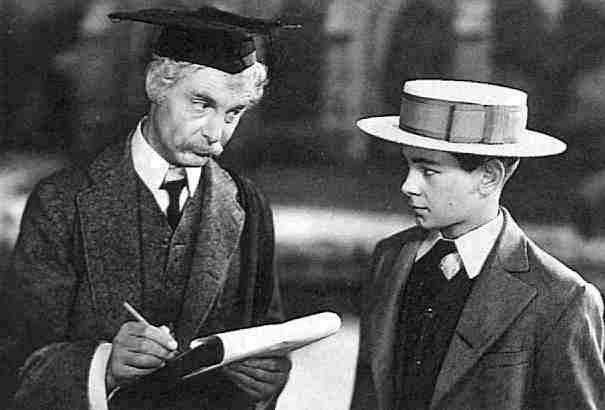
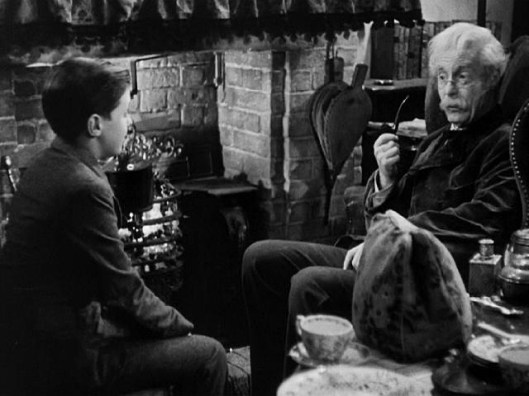
The first Goodbye, Mr. Chips is known as one of the members of the great movie year of 1939, managing to win Robert Donat the Best Actor Oscar over some stiff competition, including Clark Gable in Gone with the Wind. Having seen the winning performance, I can now see why Donat edged out the rest, letting his range of sometimes inscrutable emotions play out with great subtlety as he ages from a fresh-faced new Latin teacher in 1870 to a celebrated educator in 1933, weighed down with all the joys and sorrows of a lifetime. (My VC enjoyed the film a lot, but as a huge Rhett Butler fan, her loyalties still lie with Gable.) Like Mr. Holland, the respect Mr. Chipping ends up with is hard-won, but much of it stems from his marriage to the lovely Kathy Ellis (Greer Garson), whom he meets on a European holiday. I would have loved for Garson’s role to have been longer, but, even with limited screen time, her warm presence successfully brings the prosaic Chipping out of his shell, improving his reputation at the school.

In many ways, Goodbye, Mr. Chips is exactly the kind of movie I like, a film spanning decades wherein one character meets various people and experiences alongside the ebb and flow of time, fostering a sense of fond nostalgia. I particularly liked his run-ins with successive generations of the Colley family, showing how static his life at school is while his students go on to have lives of their own. Mr. Holland’s Opus had some similarities, but whereas that film allowed time for characters to be eventually remembered, the turnaround in Goodbye, Mr. Chips is sometimes too fast, introducing a character only for us to learn what happened to them years later in a few minutes’ time. Ultimately, Goodbye, Mr. Chips is well-deserving of its classic status, and while there’s no danger of it supplanting my preference for Mr. Holland’s Opus, it was wonderful seeing a forerunner of a story I’ve come to love.

See the source image

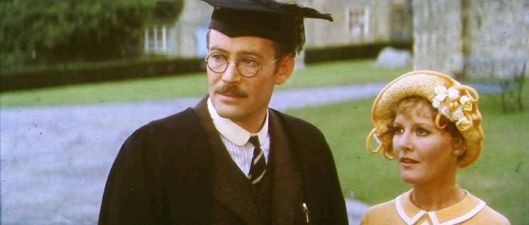
And then there’s the 1969 remake with Peter O’Toole and Petula Clark, which fits into the not-so-modern sentiment that remakes hardly ever match the original. There’s nothing wrong with making it a musical, allowing the songs to mainly serve as interior monologues, but the songs are largely forgettable, except for a couple clever lyrics, and O’Toole just isn’t much of a singer, trying out the Rex Harrison method of talk-singing but less successfully.

See the source image

The plot has the same basic elements: Chipping is a somewhat unpopular Latin teacher at a boys’ school who meets and marries a girl named Katherine (Clark) and eventually becomes a mainstay of the institution. There are still the lines of boys sounding off their attendance and a very similar ending, but the filmmakers made significant plot changes elsewhere. For one, the time period is moved up, no longer starting in the 1800s but in the 1920s with Chipping already an established teacher; thus, the war he experiences is World War II rather than World War I.

The worst change, though, is that Katherine is no longer a cycling suffragette Chips meets on a mountain but a music hall singer with an unsavory past, and their formerly brief courtship takes up the entire first half of the film, which also features an intermission to pad out its greater length. There’s pushback against their marriage where there was none before, along with Roaring ’20s parties and O’Toole’s wife-at-the-time Siân Phillips as an annoying socialite. I know I said that I wished Chipping’s wife was in the original more, but I was referring to Greer Garson’s version; the writers of the remake essentially rewrote her whole character, and while Petula Clark was great in the role, it was such a weirdly unnecessary change from the original.

Even so, the latter half (or really third) of the film is much more similar to the first film and is better for it. O’Toole and Clark do well with their roles (O’Toole even got an Oscar nomination and won a Golden Globe), although O’Toole’s Chipping is slightly more stiff and crotchety, even in scenes supposed to be romantic. The film overall was solid enough, but, as with so many remakes, it just doesn’t compare with the original.

See the source image

I guess films about long-suffering teachers who touch the lives of their students just naturally appeal to me, and Goodbye, Mr. Chips, whatever the incarnation, fits that mold. The original is clearly the better of the two, though, and certainly the one I’d recommend first. While the scene wasn’t in the 1939 movie, I couldn’t help but recall Mr. Holland’s Opus when the second film’s Kathy organizes a school musical with the students, which made me wonder how much either version of Goodbye, Mr. Chips really inspired the 1995 film. They’re so different in setting and character, and yet so similar in theme, particularly in their final heartwarming sentiments (see below). I suppose that’s what speaks to me most of all.

Best line (from 1939 film but something similar in both): (Mr. “Chips”) “I thought I heard you saying it was a pity… pity I never had any children. But you’re wrong. I have… thousands of them, thousands of them… and all boys.”


Rank of 1939 version:  List Runner-Up

Rank of 1969 version:  Honorable Mention


© 2019 S.G. Liput
646 Followers and Counting


Eighth Grade (2018)

Tags

See the source image

That awkward time between the ages,
Not adult and not a child,
One of life’s most stalling stages
Is a source of trauma shared.
Whether normal, shy, or wild,
These are years we all are scared,
Negligent and unprepared,
And yet so fondly reconciled
Once we’ve turned to other pages,
Just a chapter when compiled,
Just a molehill when compared.
_________________

MPAA rating: R (for five F-words and a couple sexual situations)

Every now and then, a movie comes along that totally encapsulates a time and place, a cinematic time capsule for future generations to watch when they ask, “What was it like back then?” The most notable such film would probably be Saturday Night Fever for the ‘70s, but Eighth Grade is a time capsule for Generation Z, an excellent coming-of-age story for awkward high-schoolers everywhere, especially those of the 2010s.

See the source image

Elsie Fisher plays Kayla Day, a girl whose diffident demeanor has left her largely friendless as she goes from middle school to high school. She films vague but encouraging vlog posts about having the self-confidence she lacks herself, and she pines for a boy in class while ignoring her dad (Josh Hamilton) behind the sullen wall of her phone. In short, she’s painfully real, and although her Instagram addiction and overuse of the work “like” can be as irritating as it is in real life, you can’t help but empathize with her desire to be liked amid a sea of academic and online indifference. Fisher is anything but glamorous in this movie, but her natural sensitivity brings great heart to several scenes; plus, her talent is evident from the fact that she’s supposedly much more outgoing than her character.

As I said, Bo Burnham’s feature debut includes quite a few details that add to the film’s snapshot of present-day culture, nods to the dab, the floss, Adventure Time, Rick and Morty, and drills for school shootings. Yet, there’s also something universal to Kayla’s anxiety and desire for belonging that I feel strikes a chord of poignancy with more than just the current youth generation. Not much actually happens, so I could see some naturalistic version of this film being presented with no incidental music, which would make it unnecessarily boring; luckily, an electronic score pops in at ideal moments, and I loved the use of Enya’s “Orinoco Flow” to elevate a web browsing session.

See the source image

For being R-rated, the film is largely tame, if only they’d left out a couple F-bombs, but there are some uncomfortable moments related to Kayla’s budding sexuality, which do at least stop short when she realizes she’s not ready for such things. Yet, as I said, reality is the film’s greatest strength, and there’s nothing that doesn’t seem very likely to be happening in any number of towns across America. I wasn’t entirely sold on the story until the last quarter, especially a moving scene between Kayla and her dad that has to be one of the sweetest father-daughter moments in film. By the end, even Kayla’s halting videos carry greater meaning than I expected at the beginning. Eighth Grade may have been spurned by the Oscars (though Fisher did get a Golden Globe nom), but there’s a good reason it made AFI’s Top Ten Films of 2018. It’s ultimately one of the most relatable movies in recent years.

Best line: (Kayla’s dad to her) “And if you could just see yourself the way I see you, which is how you are, how you really are, how you always have been, I swear to God, you wouldn’t be scared either.”


Rank: List Runner-Up


© 2019 S.G. Liput
646 Followers and Counting


Spider-Man: Far From Home (2019)

Tags

, , , ,

See the source image

Don’t you just hate it
When you’re on vacation
Intent on enjoying some hard relaxation,
And then all at once,
With distinct irritation,
Your work calls, demanding your consideration?

You reach for the phone
With a slight hesitation,
But then you ignore it with smug indignation.
But if the world ends
Due to your recreation,
You just might regret your own preoccupation.
_____________________________________________

MPAA rating: PG-13

How do you follow up a monumental universe-changing achievement like Avengers: Endgame? With a light-hearted high-school romp, of course! Just as Ant-Man and the Wasp lightened the mood following Infinity War last year, Spider-Man: Far From Home brings the scale of mayhem and destruction down a bit while delivering yet another marvelously entertaining entry to the MCU.

Spider-Man: Homecoming was a fun new version of the webslinger, but actors other than Tom Holland hadn’t quite settled into their roles and there was a tad too much “gee whiz, this is awesome” mentality, albeit an understandable one since they’re high school kids. In Far From Home, all the pieces just fit more comfortably, and characters like Zendaya’s MJ and Angourie Rice’s Betty Brant are given more presence than the first film. And, of course, the other big difference is the absence of Robert Downey, Jr.’s, mentoring Iron Man (for reasons everyone should know by now), though his legacy still plays a role.

See the source image

This time around, after most of Peter’s class was snapped out of existence by Thanos and then returned five years later in what is understatedly called the Blip, things have largely gone back to normal, and Peter and friends are eager to enjoy a school trip to Europe. Enter Nick Fury (Samuel L. Jackson) and the new interdimensional hero Mysterio (Jake Gyllenhaal) to interrupt Peter’s carefree vacation with the threat of elemental monsters wreaking havoc, which is almost as stressful as telling MJ he likes her.

Anyone familiar with the comics should know what to expect in regards to Mysterio, but there’s still plenty of action to enjoy, as well as some hilarious running gags and a few genuinely surprising twists. The subplots are all good fun, from the impromptu romance of Peter’s friend Ned (Jacob Batalon) to a rivalry between Peter and a handsome classmate (Remy Hii) for MJ’s affections. And of course, the visual effects are staggeringly well-executed, including a hallucinatory sequence that would feel right at home in a Doctor Strange movie.

It’s not above complaints, such as an unrealistic scene of the villain monologuing about his plan in detail or the uncertainty of why Peter is somehow expected to fill Iron Man’s shoes. Plus, Holland and Zendaya probably have the least chemistry as far as spider-couples go. Yet Far From Home serves as an enjoyable epilogue to the ambitious gravitas of Endgame, a teen comedy in superhero guise that ends Marvel’s Phase 3 on a high note, as well as a cliffhanger.

See the source image

Looking forward in Marvel’s timeline, it stings to notice that it looks like there’s no forward motion in the current storyline until late 2020 with The Falcon and the Winter Soldier on Disney+. But maybe that’s best, what with the time jump of Endgame and the threat of people getting “superheroed out.” Not that I’m in danger of that. No, I’m still very much on the Marvel bandwagon and hoping, like so many, that Disney and Sony can come to some agreement on letting Spider-Man continue in the MCU. I don’t expect him to take Iron Man’s place, but he fits so well in this universe that it would be a shame for the powers that be to yank him out of it.

Best line: (Happy Hogan) “You handle the suit. I’ll handle the music.” [‘Back in Black’ by AC/DC plays]
(Peter) “Oh, I love Led Zeppelin!”


Rank: List-Worthy (joining Spider-Man: Homecoming)


© 2019 S.G. Liput
646 Followers and Counting
 

2019 Blindspot Pick #7: Royal Space Force: The Wings of Honneamise (1987)

Tags

, , ,

See the source image

The depths of space have tempted man
For years while holding him at bay
Through distance, death, and lack of breath,
Insisting that we humans stay.

But mankind rarely takes a hint,
For us, a challenge is a lure,
Inviting us to sojourn thus
And learn how far we can endure.
___________________

MPAA rating: Unrated (an attempted rape scene probably would make it R, but otherwise, it’s an easy PG-13)

Unless you’re a diehard anime fan, you probably read the title of this movie and said, “What the heck is that?” Well, now that I’ve seen most of the mainstream films anime has to offer, I’m now seeking out the obscure, and I was surprised at the glowing reviews this unknown film has gotten since its 1987 release, growing into an apparent classic of the medium with 100% on Rotten Tomatoes. (Imagine my surprise when Netflix didn’t have it, but my local library did.) Royal Space Force is a hard film to categorize, but it’s undoubtedly well-made with unexpected thematic depth.

Imagine an anime mixture of The Right Stuff and Contact, and you’ve got Royal Space Force, the title referring to the poorly organized space program of the fictional country of Honnêamise. (Hun-ee-a-meece? Honey-mice? I don’t know how it’s pronounced since I don’t recall the name ever being spoken.) While no one takes the program seriously with its poor management and frequent failures, a slacker recruit named Shirotsugh Lhadatt finds a new passion and ambition for the project after a run-in with a young female evangelist named Riquinni. Despite the innate dangers of this unprecedented venture, including hostilities from a rival nation, Lhadatt literally shoots for the stars in a quest for peace and meaning.

See the source image

Beyond the plot or characters, what makes Royal Space Force really unique is its comprehensive world-building. It’s not quite straight fantasy or science fiction: there are a couple futuristic machines and some unique animals, but otherwise there aren’t many fantastical elements to the setting. It’s just different, a vision of what our world might have looked like during the Space Race if history had taken a different route. Windows slide downwards; plane propellers spin on the tail of the plane; currency is made up of small needle-shaped pins instead of coins. The architecture of the cities is ornate yet believable, often a mish-mash of cultural styles that create something new. I would watch it again just to appreciate the imagination on display, the fashioning of an alter-earth with creativity sadly lacking in so many other animated films.

As someone with direct family ties to the space program, I was also intrigued at how this film would approach its version. The filmmakers went to NASA to study space flight, and their efforts at authenticity mix surprisingly well with the otherworldly setting. The training contraptions for preparing Lhadatt for his mission are more slapdash and home-made than NASA’s, but their crudeness highlights how big of a scientific leap space travel is for this world, as it was for our own. And by the time the launch day comes amid self-doubt and international turmoil, the event has a similar gravitas and grandeur as the real thing.

See the source image

Another unique aspect of this film was the role of religion. Riquinni’s faith is clearly a fictional one based off a couple stories mentioned, but her discussions of God and nightly dispersal of tracts are clearly an analog to Evangelical Christianity. And unlike Contact, which annoyed me by pitting faith and science against each other as if they were antithetical, Royal Space Force depicts faith as a positive influence, encouraging Lhadatt to believe he is part of something bigger than himself and push toward a brighter future. There have been plenty of anime with Christian elements and themes, but this movie climaxes with a sincere and moving prayer that is one of the most explicit declarations of faith I’ve seen in animation.

While it’s a significant achievement in the medium, Royal Space Force does suffer somewhat from a deliberate pace and not quite enough resolution by the end. It’s not boring and has a few thrilling sections, but you shouldn’t expect constant humor or action from its grounded drama. The biggest problem is a scene of attempted rape that saps a lot of the sympathy for Lhadatt, even if he seems repentant later, and also serves no other purpose than to put the film into “mature” territory. The scene was cut in its video release, and it would have been better if the initial editors had done the same.

See the source image

Now at least, I can check off another Blindspot from my list, an anime film that has held my curiosity for some time now. I think anyone interested in the development of space travel and speculative fiction would find much to appreciate, and fans of animation even more so, since this feature was the first project of Studio Gainax, which went on to the fame of producing series like Neon Genesis Evangelion and Gurren Lagann. Royal Space Force: The Wings of Honnêamise may have an ungainly name, but it deserves its low-key classic status, making me wonder if the sequel that’s been rumored for years will ever get off the ground.

Best line: (Riquinni, reading from her holy book) “And you shall find that prayer is the greatest of all things, and it is also the smallest. You’ll find nothing more noble than prayer, nothing more humble.”

Rank: List Runner-Up

© 2019 S.G. Liput
645 Followers and Counting


I Am Mother (2019)

Tags

, ,

See the source image

Mothers care,
And mothers bear
The heavy weight
Of a child’s welfare.

They guard the gate;
They mind and wait
Until that child
Can negotiate

The world so wild
And be exiled
From all that Mother
Once reconciled.
_________________

 
MPAA rating: TV-14 (aka PG-13, mainly due to heavy themes; nothing gratuitous)

It’s a good time to be a fan of science fiction, and Netflix has been supplying a steady stream of it, with I Am Mother immediately catching my eye with its trailer. One part dystopian sci-fi, one part psychological thriller, it’s a futuristic chamber piece that keeps the audience guessing as it asks whether humans or robots are the more trustworthy.

See the source image

The film starts with some unknown catastrophe that prompts a robot called Mother (voiced by Rose Byrne) to activate in an underground facility and begin the development of one of thousands of embryos stored there. We then cut to 38 years later, when a girl only referred to as Daughter (Clara Rugaard) grows into a teenager with Mother as her sole teacher and companion. (And if you recognize a discrepancy between the 38-year time skip and the teenage girl, rest assured that there’s a reason.) Daughter, however, entirely trusts and helps Mother, who has warned her of radiation outside, but the arrival of an injured woman (Hilary Swank) who warns her against her robotic guardian throws everything she’s ever known in doubt.

Those who know dystopian fiction might be able to guess the most likely explanation for what’s going on (though perhaps not all of it), but I Am Mother thrives on its atmospheric uncertainty. Mother seems to be a dutiful, even tender parent to Daughter, yet sci-fi has shown us too many times that advanced robotics are rarely sympathetic to mankind. Similarly, Swank as the unnamed woman knows more of the world and shares a common humanity with Daughter, yet she’s a survivor whose motivations are similarly hazy. There are lies and accusations of lies that can’t be proven, forcing Daughter to choose who has her best interest at heart and letting themes of truth, trust, and motherhood play out as only sci-fi can.

See the source image

Both Swank and Rugaard are excellent in their roles, while Byrne makes a surprisingly good female HAL, and the effects are every bit as impressive as a big budget Hollywood version of this story might have been. In many ways, it’s a coming-of-age story, one that shatters the Bechdel test while delivering a thriller that may have familiar elements but still delivers on its thought-provoking suspense. There are plenty of Netflix movies that only got there because they wouldn’t make it as a big-screen film, but I Am Mother is not one of them.
 

Rank: List Runner-Up


© 2019 S.G. Liput
644 Followers and Counting