(Today’s NaPoWriMo prompt was for a poem based on a news article. It seems like I’ve seen several headlines about missing children recently, so this film’s themes seemed to fit well.)
“She’s gone,” they told her mother.
A day had passed like any other;
The next one dawned
And moved beyond,
And she was gone for good.
“She’s missing,” said the mother,
Not one to dote or smother,
For she was sure
Her daughter pure
Could still endure and would.
“She’s gone,” they would update her,
First weeks and then years later.
The mother knew,
Kept out of view
That deadly true falsehood.
“She’s gone,” and grief grew greater.
Mom crawled into the crater.
She mourned the one
Whose race was run.
She cried and understood.
________________________
MPA rating: R (all for language)
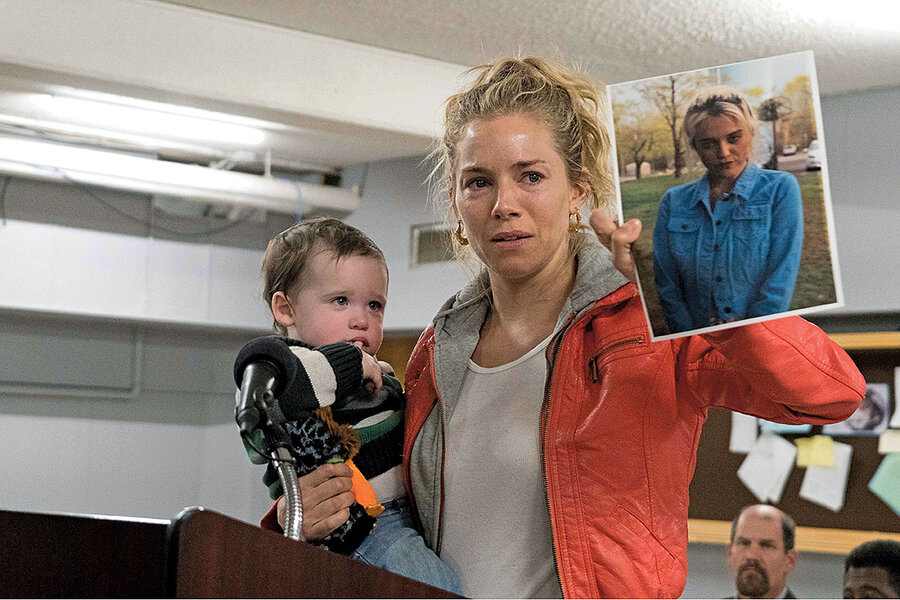
I’m not sure why I sought out this film. Perhaps I was just looking for new releases and was curious about the lauded performances, but it’s not exactly my preferred kind of movie. Even so, American Woman proved to be a moving story, grounded by a committed performance by Sienna Miller.
Miller plays Deb Callahan, a small-town Pennsylvania mother in her 30s living with her teenage daughter Bridget, who has a baby of her own. One night, Bridget simply doesn’t come home, leaving Deb devastated as she searches for her and raises her grandson over the next eleven years. Along the way, she gets support from her sister Katherine (Christina Hendricks) and her family and grows stronger from a series of boyfriends that prove her poor taste in men, including Aaron Paul of Breaking Bad.
Directed by Jake Scott and produced by his father Ridley Scott, this is one of those movies that feels immersively real, like you’re watching how people really live and interact. However, in Deb’s case, that reality often consists of white trash crudeness and much familial yelling, making it not always a likable world in which to immerse oneself. I liked Hendricks’ responsible sister more than the main character.
Despite this, there are moments of genuine tenderness and growing maturity by the end, which showcases Miller’s underrated acting skills. Ultimately, the film’s story struck me like an episode of Criminal Minds from the perspective of the victim’s family. Such crime shows are more concerned with the killer and the forensics while the loss and drama are kept largely off-screen; in American Woman, the loss and drama are the focus, leaving the rest as background information. It’s a sad tale but realistic and well-acted, one I would have enjoyed more with less swearing.
(Today’s NaPoWriMo prompt was to write a poem from the viewpoint of a character or creature from Hieronymus Bosch’s The Garden of Earthly Delights, which is so full of bizarre imagery that he must have been high on something for the twenty years he painted it. After drawing an initial blank, I decided to write something from the viewpoint of the animals since Creation.)
I’m a pet, and you’re a pet,
But let us never once forget
That, when the world was new at birth,
We animals ruled all the earth.
The dogs and cats and tall giraffes,
The fish and lizards, foals and calfs
Held full dominion over all,
Utopia before the Fall!
And then the next day, God made man,
And nothing since has gone to plan.
________________________
MPA rating: PG
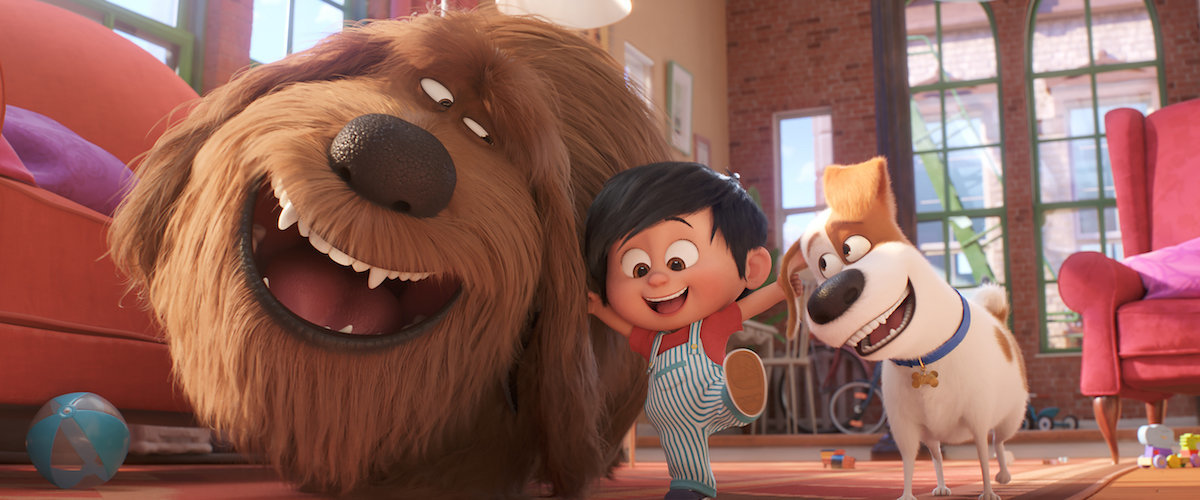
I wasn’t expecting much out of The Secret Life of Pets 2. It seems that, with any recent American animation that isn’t Disney or Pixar, it’s best to lower your expectations. Occasionally, you find a pleasant surprise like Klaus. More often, you get a cute movie that you’ll likely only ever watch again if you have kids. That’s The Secret Life of Pets 2.
It’s not bad, just uninspired, but so was the first one too, with its mish-mash of Toy Story with pets. The obvious imitation of the Woody/Buzz conflict with dogs Max and Duke was resolved in the first film, so the second has a little more room to do its own thing with its charming cast of characters, such as little dog Max (Patton Oswalt, replacing Louis C.K. after the latter’s scandal) wanting to rediscover his fearless side during a weekend farm visit, or tough-guy bunny Snowball (Kevin Hart) trying to pass himself off as a superhero by saving a tiger.
New additions include Harrison Ford as a pleasantly grizzled farm dog and Tiffany Haddish as a Shih Tzu with attitude. As a cat lover, I especially got a kick out of Chloe’s (Lake Bell) teaching the way of the cat to Pomeranian Gidget (Jenny Slate), who is still the best thing about this franchise and gets the funniest scenes.
It’s all cute and harmless with very little depth, but some clever comedic moments make it enjoyable and perhaps a bit better than the first film. Even when the plot tries to bring its many loose threads together at the end, it still feels like a bunch of potential TV episodes pasted into a feature film. This is clearly a franchise meant to appeal to the kids with little effort for their parents, but I can see those kids growing up with fond memories of it. Not every animated film has to break the mold, I suppose.
Best line: (Snowball) “I just freed a tiger. That’s not bragging; I’m just saying what happened. When you’re awesome, everything you say sounds like bragging.”
(Today’s NaPoWriMo prompt was to incorporate twenty random elements into a poem, but, since using all of them would likely result in nonsense, I tried to use at least 8 or 9 in a poem from the viewpoint of a tortured reflection.)
My life is death, for I don’t live. I imitate. I mock.
A mirror image knows its cage, no need for bars or lock,
A mime condemned to emulate another round the clock.
“I’m just so happy,” says my smile, when I am forced to wear it.
My joie de vivre is copy-pasted, hollow when I bare it.
Only when my twin shows grief can I completely share it.
“Keep up! No rest!” the glass wall cries between my twin and I.
The fluid hardness of its bounds compels me to comply.
I do the simulated dance, no understudy nigh.
I am, therefore I think, but no one else can hear my thoughts.
For no one thinks that life is real for something so ersatz.
A mime depicting stories based on someone else’s plots.
______________________
MPA rating: R
After the cultural splash that Get Out made, Jordan Peele had a lot to live up to with his next foray into horror, and in light of some strange confusion surrounding his first film’s genre, he left no doubt that Us is straight-up horror. Peele is definitely an auteur, able to brilliantly craft tension and chills and blessed with gifted actors to bring his stories to life, but Us feels like a tale he didn’t think through enough.
At the beginning, we meet Adelaide (Madison Curry as a child, Lupita Nyong’o as an adult), a young girl who wanders off at a beachside carnival and comes face to face with a terrifying doppelganger in a hall of mirrors. Many years later, she’s married to Gabe (Winston Duke, Nyong’o’s Black Panther co-star), and together with daughter Zora (Shahadi Wright Joseph) and son Jason (Evan Alex), the Wilson family goes on vacation not far from that same beach that has haunted Adelaide ever since. Without warning one night, an identical family breaks into their house with bloodthirsty intentions, and the Wilsons must fight to survive against their doubles.
Us does a lot of things really well, from the visceral panic of the home invasion to Peele’s skillful direction that keeps the adrenaline up and only shows you what he wants you to see. And like his previous film, he manages to incorporate some dark comedy, more successfully than in Get Out I thought, such as the Wilsons comparing their kill counts during a break in the action. Indeed, the first two thirds of Us are a horror masterclass, albeit a bit too bloody for my liking, but undeniably well done, even taking a rap song and turning it into a creepy segment of the score. All the actors do wonders with their dual roles, Nyong’o especially, nailing both their frightened and malevolent personas with apparent ease.
But then there’s the last third, which seeks to offer explanation where none suffices. The origins and previous lives of the doppelgangers are purposely bizarre, but their “way of life” simply makes no sense. Why are they sometimes compelled to mirror the Wilsons’ actions and other times not? Where do the rabbits come from? What is the purpose of the “Hands Across America” re-creation? I could go into a lot more spoiler-y detail, but suffice to say, the logical side of my brain was left screaming, “What the heck? This. Doesn’t. Make. Sense!” I see the intended symbolism of a grotesque mirror image of our world, as well as the overplayed theme of one person’s prospering resulting in another’s suffering, but it’s as if Peele forced the story to fit the message and no one wanted to tell him how illogical it had become.
For a film that initially feels so well-made, it’s a shame that the plot is ultimately so half-baked. I will admit the final twist packs a surprising and disturbing punch, which was unfortunately spoiled for me by none other than Lupita Nyong’o herself on Inside the Actor’s Studio. I didn’t think Get Out was the masterpiece many people said it was, but it at least didn’t leave me bewildered with its own implausibility, as Us did. I hope Jordan Peele takes more time for his next film to flesh out the story with the same talent he brings to the scares.
Best line: (Jason) “When you point a finger at someone else, you have three pointing back at you.”
(Today’s NaPoWriMo prompt was to write something inspired by a dream’s imagery. Since I don’t remember most of my dreams, I incorporated a more general theme of dreaming that tied in with today’s movie.)
My eyelids are a diving board,
And when they close, I leap
To worlds no other human’s seen
In waking or in sleep,
Ephemeral new universes
Born of counted sheep.
I fly on wings of opal skin
And climb inverted mountaintops.
I live a life that’s not my own
And wait until my bubble pops.
I test the limits of a dream
And hope to God it never stops.
______________________
MPAA rating: PG-13
Considering Avatar was the biggest movie ever for a time, this review is probably long overdue. I suppose the reason it took so long was simply because I considered it vastly overrated. I remember making a point of watching it before I started my Top 365 list back in 2014, just to check whether it deserved placement. It didn’t make the cut. That’s not to say James Cameron’s monster hit is bad; it’s an impressive sci-fi epic with a brilliantly rendered world held back by a painfully unoriginal plot.
In 2154, mankind has reached out into space and formed a colony on the distant moon of Pandora, where their mining endeavors run into conflict with the big, blue native Na’vi. In an effort to connect with the aliens and convince them to move, scientists have created Na’vi-human hybrids called Avatars, which a human consciousness can control while their real body sleeps. Jake Sully is one such candidate, a paraplegic Marine who is only brought to Pandora because he shares DNA with his dead brother and can control his brother’s Avatar. There, he forms a bond with the fierce Neytiri and the other Na’vi and must choose between the nature-centric natives and the unsympathetic military.
Not to be confused with the beloved Nickelodeon cartoon, the film Avatar can be summed up in various ways, but my favorites are Pocahontas with blue aliens or Dances with Wolves in space. My VC noted FernGully as another clear inspiration. The whole nature vs. industry/natives vs. military conflict has clearly been done before, and there’s nothing about the overlong plotline or the romance that makes it any better than those other two films. James Cameron’s New Age, environmental sentiments are worn on the film’s sleeve, and it’s anything but subtle. And honestly, Sam Waterston is rather bland as the main character, though I enjoyed Sigourney Weaver’s scientist and Stephen Lang’s macho villain (Lost alert for Michelle Rodriguez as well).
What Avatar does have going for it are its groundbreaking motion capture and 3D special effects, which leave no doubt why it won Oscars for Art Direction, Visual Effects, and Cinematography. The flora and fauna of Pandora are full of colorful, eye-popping wonders, and the scenes of flight after Jake tames a dragon-like creature are exhilarating as he swoops between gravity-defying midair mountains. And the epic battle scene at the end is one of the biggest, most awesome action sequences ever made. Plus, James Horner’s score adds a perfect majesty to the visuals. If only the story had the same imaginative effort as the rest….
Avatar is a well-made sci-fi adventure that isn’t the transcendent blockbuster it tries to be, even if its box office haul says otherwise. I was glad when Avengers: Endgame passed it as the highest-grossing film of all time (not adjusted for inflation), simply because that record and Avatar’s Best Picture nomination indicates that it’s better than it is, which irks me a little. Perhaps it just doesn’t feel as innovative now as it was in 2009. Even so, I’m interested to see what the repeatedly delayed sequels will do to continue the story and how certain characters will return for another three films. Perhaps they’ll avoid clichés better than Cameron’s first film… whenever they finally come out.
Best line: (Jake, narrating) “I was a warrior who dreamed he could bring peace. Sooner or later, though, you always wake up.”
(Today’s NaPoWriMo prompt was to take a list of random words and use Rhymezone.com, which I do all the time incidentally, to find rhymes and similar words to use with them, which naturally leads to some welcome alliteration.)
I crave a crunch within my keep
And crawl and creep from out the deep
And sleekly sneak and slink toward prey
To snag the snack that runs away.
The peril of my pool is plain,
But how I prowl is not in vain;
The haunted hunted hate the wait
And heed the hazard much too late.
Before the fear is fully felt,
My sudden strike of death is dealt.
The walking world has one more dead,
And I, the predator, am fed.
____________________________
MPA rating: R
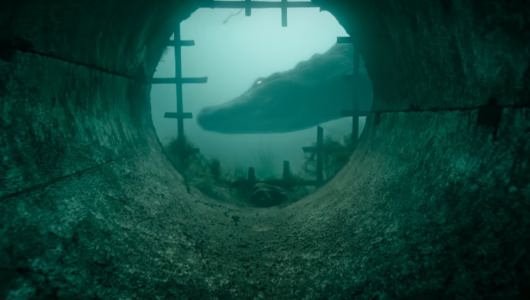
I enjoy a good creature feature and got Crawl from my library, thinking it was PG-13; I was wrong. If I’d known gorehound director Alexandre Aja was behind it, I probably would not have sought it out at all, but I’m glad I gave Crawl a chance. It’s an effectively pulse-pounding thriller that does for gators what Jaws did for sharks.
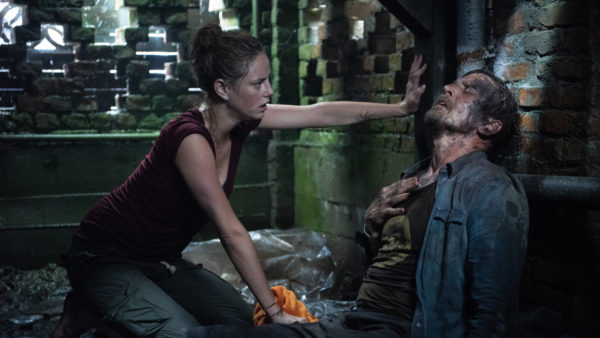
Kaya Scodelario plays Haley, a swimmer who drives into a flood zone as Hurricane Wendy bears down upon the Florida coast. She searches for her unresponsive dad (Barry Pepper) who hasn’t evacuated, and when she finds him, wounded beneath his house, the two humans and a dog are caught between the rising flood waters and a hoard of hungry alligators.
Crawl doesn’t need to be more than it is, a white-knuckle man/woman-against-nature flick with ravenous reptiles, and it succeeds. It develops the tension and the characters laudably well, providing convincing throw-away victims to up the stakes while the strained father-daughter dynamic grows stronger through the peril.
Like nearly all horror flicks, there are moments of foolishness that smarter-than-thou audiences can shake their heads at, but I doubt I’d fare as well as the main characters do. It has a few gruesome scenes on the level of Jaws, but Crawl’s violence is surprisingly restrained overall, considering the director, and turned out to be an unrealistic but enjoyably tense watch.
(Today’s NaPoWriMo prompt was for a poem describing a place in detail. I didn’t quite do that, but I used the theme of details to versify a mystery climax.)
The floorboards near the bookcase creaked,
And everyone’s concern was piqued
As, slow and calm, the expert sleuth
Prepared to publicize the truth.
She said, “I know who did the deed”
And eyed all three suspects to read
The guilt or panic on their faces,
Gathered near two fireplaces.
“Mr. Jones, you’re known as mean,
And as the gardener, less than clean,
But you are guiltless thanks to dirt
That’s caked upon your shoes and shirt.
The night in question, I could see
The room was spotless as could be,
And so your dirt is now defense
To soundly prove your innocence.
“And Mrs. Garber, you could well
Have been the culprit, but for smell.
Your strong perfume is hard to miss,
But as I think and reminisce,
The air was mildewy that day
And not at all like your bouquet.
So that leaves you, Miss Jefferson.”
Upon her heel, the Sherlock spun.
“You had the chance, the time, the aim,
Yet you are also not to blame.
The crime scene held a scrap of robe
Too rough and plain for your wardrobe.
Your taste is clear from how you’re clad,
(You really do look good in plaid),
And so I know you too are clean.”
The three, confused, looked round the scene.
“The culprit, though, is present still,
Too curious about my skill
To not be here tonight and see
If I could solve the mystery.”
She stepped two paces to the right
And huffed and heaved with all her might
To push the bookcase from the wall
And show the man behind it all.
He stood in shock, his pant leg torn,
For still he wore the clothes he’d worn
That fateful night, and as police
Led him away, he needed peace
And asked the sleuth, “How did you know?”
She donned a smirk and faced her foe.
“To notice things is my technique.
I heard the bookcase floorboards creak.”
____________________
MPA rating: PG
My VC has recently become enamored of mysteries and true crime stories, but the origin of that interest probably originated in her early love of the Nancy Drew books. I was curious to see what she’d think of a modern interpretation, and Nancy Drew and the Hidden Staircase, based on the second book in the series, was a fairly decent adaptation.
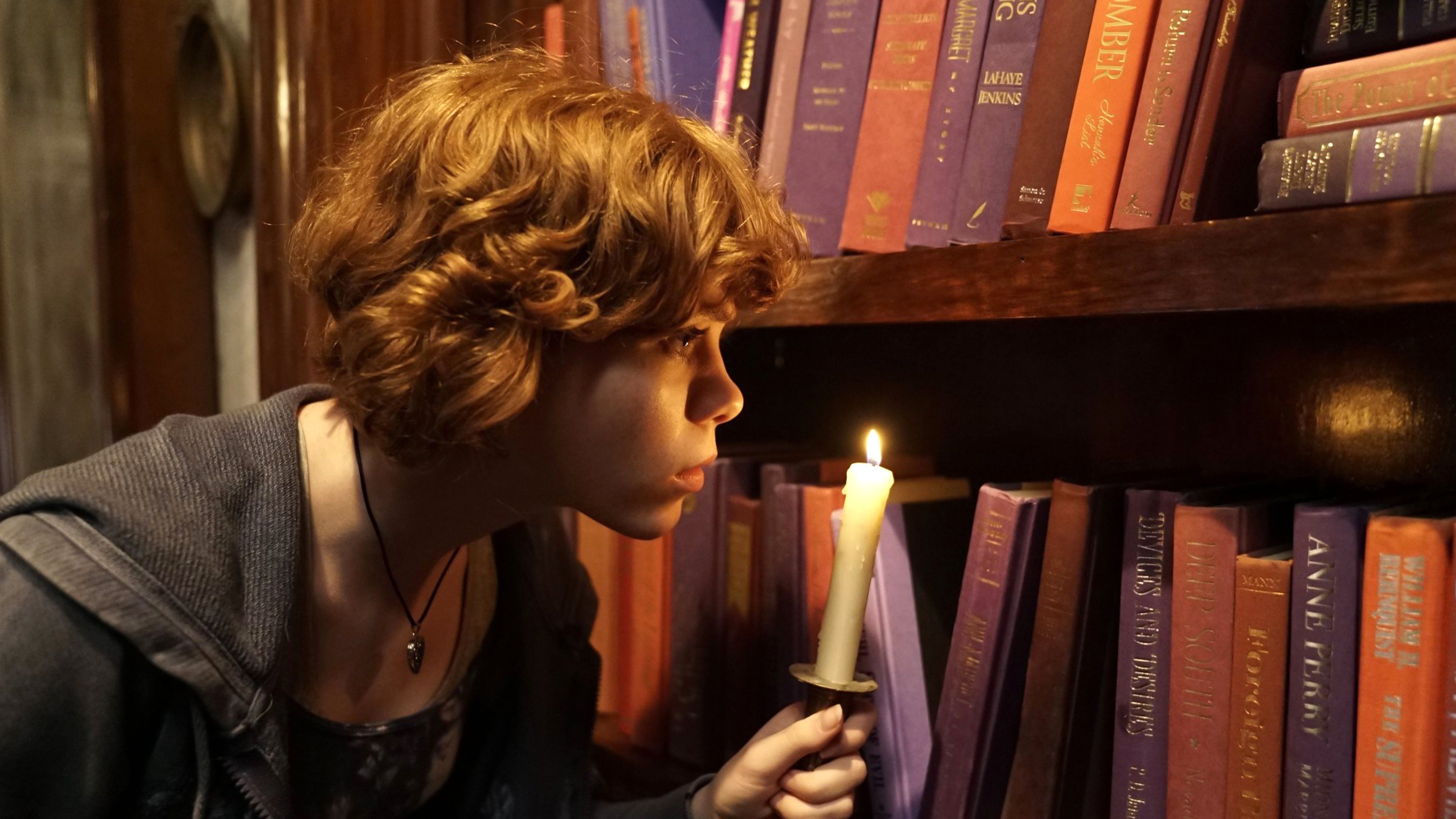
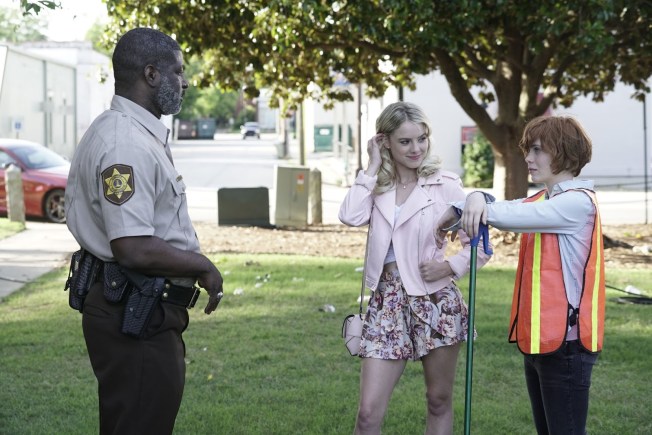
Sophia Lillis of It fame plays the titular teenage sleuth (is it all right to call her the It girl?) and gives her some likable spunk and humor as she must deal with a catty rival (Laura Slade Wiggins, who looked a little older than a teenager) and a haunted house. The production values are on the level of a Hallmark TV movie, but the mystery tries to keep you guessing, even as it’s kept at a tween-friendly level. I suppose the best part was its moral development; Nancy pulls a cruel prank on a bully early on, and it was nice to see her slowly recognize her own faults and choose to be better.
With the fond memory of reading the Nancy Drew series when she was little, my VC wasn’t particularly impressed with this film version, which she said was greatly changed from the source material, but it still felt like a more faithful attempt than the new CW series trying to be edgy like Riverdale. There are plenty of better mysteries out there, but Nancy Drew and the Hidden Staircase has a pleasant innocence to it that works well for the younger would-be sleuths.
(For Day 1 of NaPoWriMo, the prompt was for a metaphor poem comparing life to a particular action, so I took inspiration from a movie that heavily focused on a similar metaphor of surfing.)
I live upon a wooden board
That glides along the ocean swell.
So many others stood and fell,
So on my belly, safe I dwell.
My wiping out I can’t afford,
And so I hug the firm and known,
And watch the few whose comfort zone
Is so much wider than my own.
They call to me with one accord
To stand within the arching wave,
And though I fear it, still I crave
The confidence of being brave.
I close my eyes and let my board
Convey me to the tunneled tide
And find the worries, from inside,
Have dwindled down and liquefied.
_______________________
MPA rating: Not Rated (should be PG-13, for some adult themes and brief nudity)
I love that the last two years, I’ve been surprised by anime films I wasn’t expecting. Maquia: When the Promised Flower Blooms proved to be the anime of the year in 2018, and Masaaki Yuasa’s Ride Your Wave was a similar pleasant surprise, considering I’d never heard of it until a preview before Weathering with You. Star-crossed love is a common anime trope, but Ride Your Wave puts a uniquely emotional spin on it, also standing out for its characters being young adults rather than the usual highschoolers.
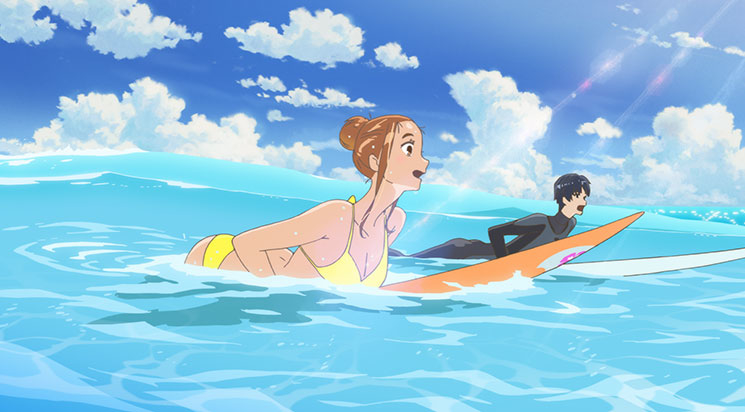
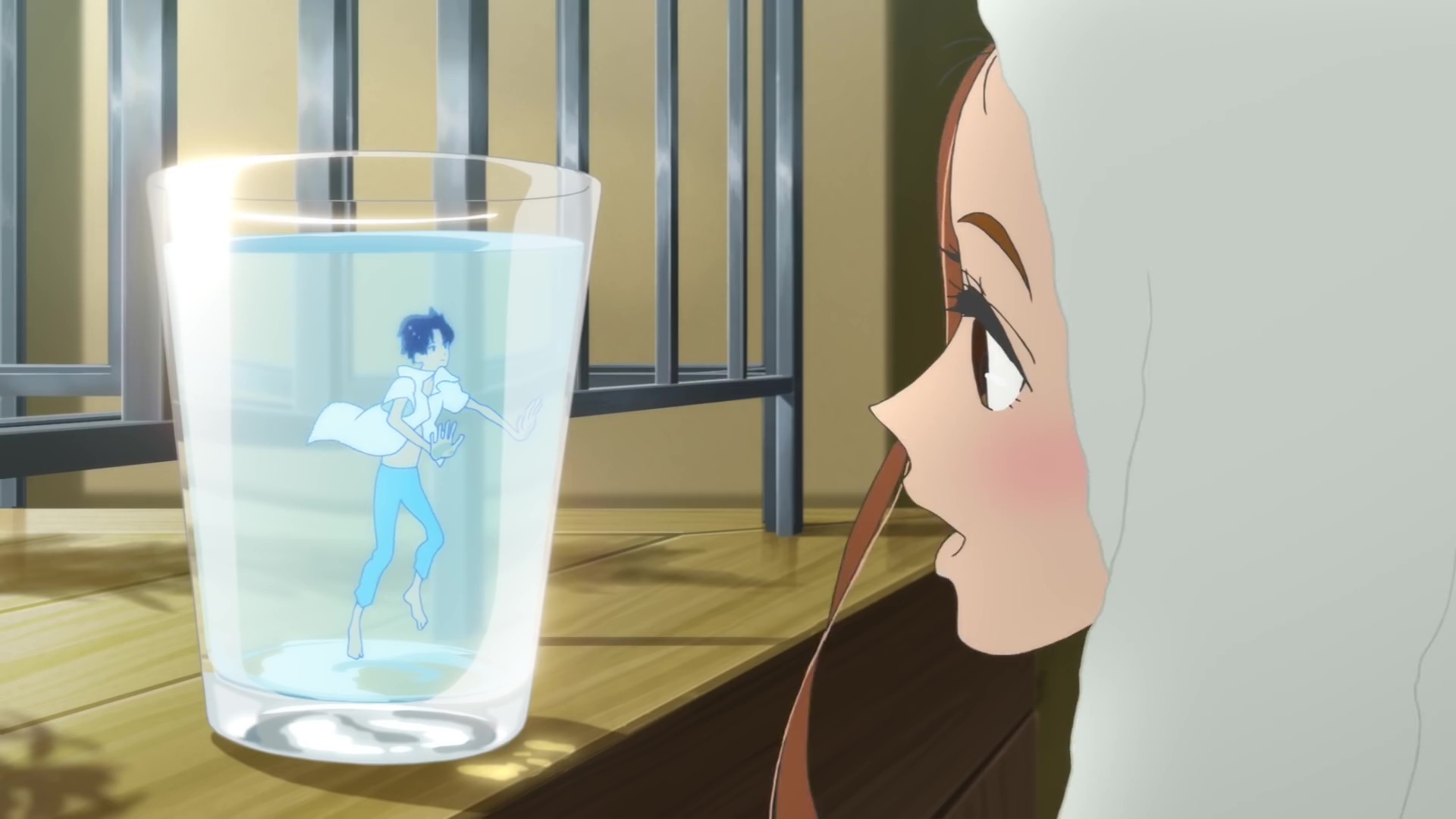
Hinako Mukaimizu has just moved into a new apartment near the ocean, allowing her to regularly partake in her favorite hobby of surfing. After a fire threatens her building, she falls in love with handsome firefighter Minato Hinageshi, and their romance is wholesomely reminiscent of the beginning of Up. And like Up, it ends in tragedy, leaving Hinako alone and unable to move on. Soon, though, she begins seeing Minato in water when she sings their favorite song, leading to hilarious misunderstandings and an unhealthy situation that clearly cannot stay the way it is.
I’ve tended to steer clear of Yuasa’s other works (like Lu Over the Wall or The Night Is Short, Walk on Girl), perhaps because his unique art style didn’t seem to appeal to me, but I must admit that I loved Ride Your Wave, and it’s made me curious to check out his past work. His hyper-fluid animation really complements the prevalence of water in the film and creates some unique angles and perspectives to ravish the eye. It’s a more cartoon-ish style than Makoto Shinkai’s photorealistic scenes, but it’s still detailed and pleasing in its own way. (It’s interesting to note the coincidence of this film and Weathering with You both coming out the same year and both featuring an emphasis on water and a notable scene with fireworks.)
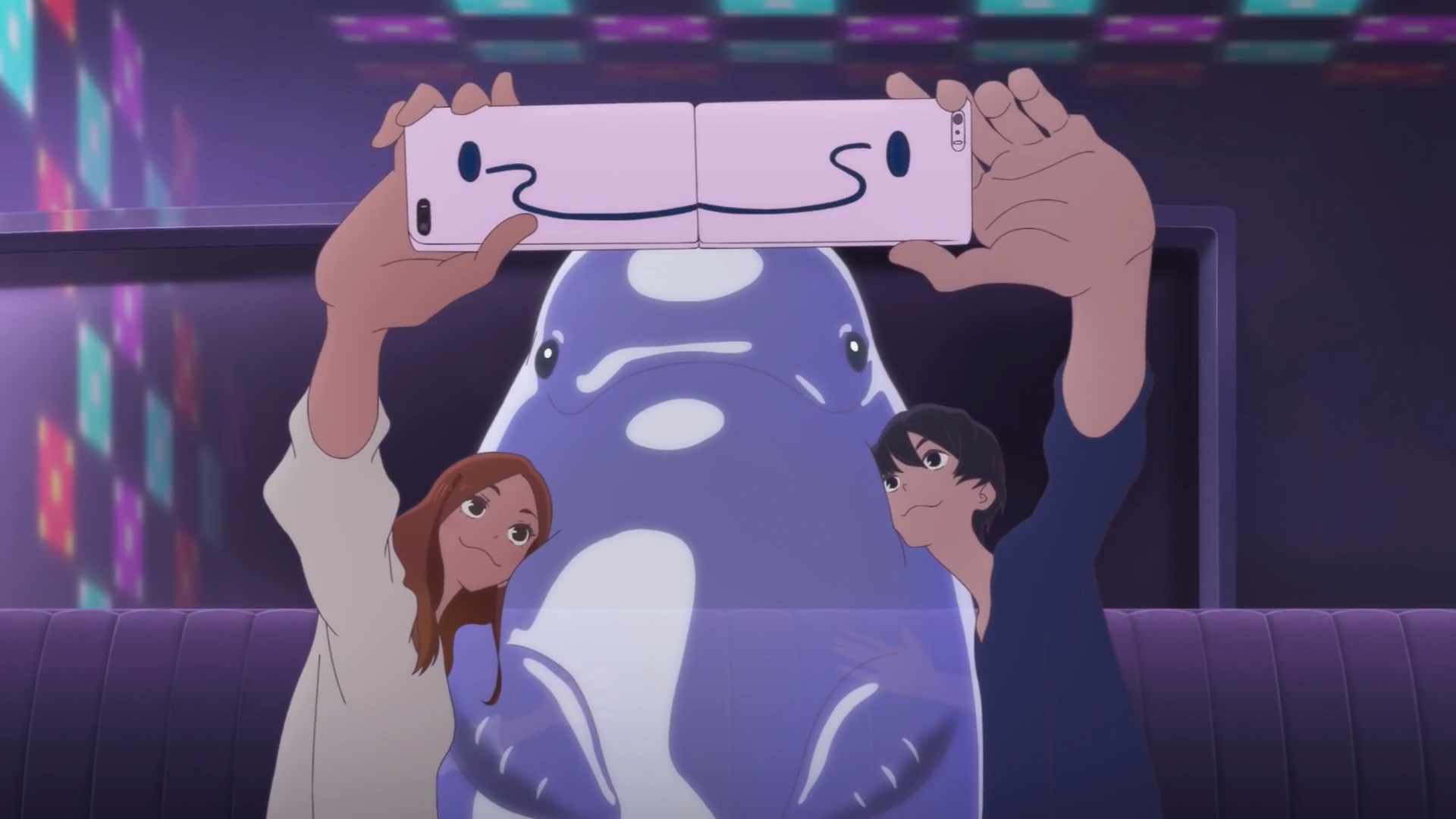
Beyond the technical, Ride Your Wave has real heart to it and does a great job developing its central couple, as well as side characters like Minato’s churlish younger sister. And that focus on likable characters is essential because there’s certainly absurdity to swallow here, such as Hinako walking around town with an inflatable porpoise filled with water (and Minato) in an effort to relive the days when Minato was still alive. The climax is wilder than that, so let’s just say it’s hard to imagine this film in anything but animation. It didn’t hit me until afterward, but the plot has many similarities to 1990’s Ghost, though with more of a rom-com sensibility than that film’s thriller elements. By the end, though, it definitely knows how to tap the emotions hard, even while retaining a sense of hope.
Since I can’t be all positive, Ride Your Wave is sometimes too on the nose with its blatant metaphor of learning to “ride the wave” of life. Plus, at only 94 minutes, the film’s relationships might feel too rushed to some, yet one could also say it presents what it needs to economically. I feel like Weathering with You is objectively a better film, yet Ride Your Wave made me feel more deeply, identifying at times with its exploration of grief. Yuasa’s blending of the poignant and the surreal is an unexpected treat for any fan of bittersweet romance.
Best line: (Minato) “If you stay with your head underwater, you’ll never learn to ride the waves.”
It’s no April Fool! Today marks the beginning of another year of National Poetry Writing Month (NaPoWriMo), aka Global Poetry Writing Month (GloPoWriMo)! As in past years and like so many other poets out there, I’ll be attempting one poem a day for the whole month, which in my case also means a movie post a day. This month has always been a fantastic way to get the creative juices flowing and to clear out my backlog of films to review.
I’ll do my best to follow along with the optional daily prompts at the NaPoWriMo website and use them as inspiration for each day’s poem/review, and I encourage anyone reading to take part in the poetry extravaganza, even if it’s a small contribution. You’ll be thrilled to have 30 new poems by the end of the month! With the whole pandemic situation and work and educational demands, I may fall behind, but I’ll do my utmost to keep up. Here’s to NaPoWriMo 2020!
Wow, what a year it has been! I usually post my year-end song list in January, but between the passing of my dad and the coronavirus pandemic, things have been rather hectic. Perhaps it’s just the comparison with this year so far, but 2019 was largely a really good year, for me at least, and the music released was a big part of that. I was finally able to become a web developer and get a desk job, and that allowed me to listen to a whole slew of songs and artists I might never have stumbled upon otherwise. And naturally, I had to compile a Top Twelve list of my favorites.
In past years, there were certain artists I discovered that defined the year and became instant favorites (Florence and the Machine in 2016, Kygo in 2017, Aurora and Chvrches in 2018), but 2019 revealed artist after artist that I was thrilled to discover for the first time: Saint Motel, September, Kensington, Kaiser Chiefs, Sigala, The Naked and Famous, TWRP, Skyhill, Foxes, The Protomen, Sigma, Parade of Lights, and the list goes on. Fans of those artists may wonder what rock I’ve been under, but I’m certainly glad to join their ranks. While not all of these released new albums, there was still so much good music last year, and so little of it is actually on the radio. I can only shake my head over Billie Eilish’s “Bad Guy” getting the most attention.
As always, my list below is strictly my personal choices based on my personal tastes. There are plenty of other good songs out there for other tastes, so I wanted to recommend Chris’s list at Movies and Songs 365 as an alternate Top 10. I was particularly hard-pressed to pare down my honorable mentions, and in the end, I still ended up with over 60. Forgive me for the length, but it could have been longer, and they all deserve mention. And no doubt, I’ll likely discover some songs in the next year that slipped through the cracks and will make me wish I could include them here. I certainly wish I could have highlighted TWRP’s “Starlight Brigade” or Metric’s “Now or Never Now” on last year’s song list.
Without further ado, let the Top 12 countdown of 2019 songs commence!
“Tokyo” – White Lies
I agonized over what should be #12 for a long time, because there were at least eight songs that might as well have been a tie. In the end, with the assistance of my tie-breaking VC, I decided to go with the instant earworm of “Tokyo.” The chorus is one of those instantly-recognizable tunes that most bands wish they could conjure, and it’s an ethereal delight. Special mention also for their “Hurt My Heart.”
“Something Unreal” – The Script
In addition to discovering artists new to me, I also realized how much I had underrated bands I’d known for years. The Script’s new album made me recognize how good the Scottish band can be, and the melodic, pulsing beat of “Something Unreal” might be my favorite song of theirs. Special mention for “The Hurt Game,” “Same Time”, and “Hot Summer Nights.”
“It Only Gets Better” – WILD
I always like to highlight lesser-known bands with songs that deserve more attention, the kind that never see airplay and can only be found by those tooling around YouTube. WILD doesn’t even have a Wikipedia page, but boy, do they deserve one and so much more. “It Only Gets Better” is a joyous, indie, sing-along type of song that never gets old, guaranteed to raise the spirits of those lucky enough to stumble upon it.
“In Case You Don’t Live Forever” – Ben Platt
Not many songs can bring me close to tears, but this one did. Releasing his first solo album after the Tony-winning success of Dear Evan Hansen, Ben Platt delivered a haunting ballad expressing a child’s appreciation for a parent, which all too often is realized too late. With the loss of my dad fresh in my mind, this song strokes the deepest feelings of grief and love and is beautiful to boot. Special mention for “Bad Habit” and “Grow As We Go.”
“Timebomb” – Walk the Moon
And Walk the Moon returns to the year-end song list, last placing #2 back in 2017! Ever since “Shut Up and Dance,” they’ve been among my favorite bands, and this is a fine addition to the quartet’s stellar record of radio bangers. Special mention for “Eat Your Heart Out” and “If I Lose You.”
“Almost (Sweet Music)” – Hozier
It took a while, but I’ve come to appreciate Hozier’s distinct vocals and lyrical ingenuity. “Almost” or “Sweet Music” has such a lilting joy and a smooth mellifluence that it feels like a song that will be enjoyed for years to come. Special mention for “Dinner and Diatribes,” “Movement,” and “Would That I.”
“What Lies Ahead” – Kensington
The Dutch band Kensington was one of the best discoveries I made last year, and I was delighted when they then released new music for their brand new fan. Perhaps not as good as “Do I Ever” or “Slicer,” but “What Lies Ahead” is a great example of their special brand of catchy semi-hard rock that I’ve come to love. Special mention for “Bats” and “Uncharted.”
“Save Me” – Saint Motel
Of all the bands I was lucky enough to discover last year, I think Saint Motel is my favorite. Nearly every single song of theirs is consistently lovely, inventive, memorable, invigorating, haunting, or some combination of all five. To my mind, they’re like a modern-day version of The Beatles. And “Save Me” is a smooth, let-your-eyes-roll-back-in-your-head kind of song, with a strangely nostalgic aura. How did I not hear of them sooner?! Special mention for “Diane Mozart,” “Van Horn,” and “Old Soul.”
“Fireman and Dancer” – Royal Republic
Walk the Moon doesn’t corner the market on bangers; Royal Republic may be their steepest competition. This infectiously dance-worthy jam is a should-be hit with an unabashedly ‘80s aesthetic. How is this not all over the radio? Special mention for “Boomerang” and “Anna-Leigh.”
“Wild Roses” – Of Monsters and Men
Of Monsters and Men is another band that has only grown in my estimation the more I hear of them. The Icelandic group’s latest album is a bit more pop-ish than their usual folk style, but that’s hardly a bad thing when it produces songs like this. “Wild Roses” is an immersive earworm, at once soothing and energizing. Put simply, it makes my ears very happy. Special mention for “Wars” and “Alligator.”
“The Upside” – Lindsey Stirling
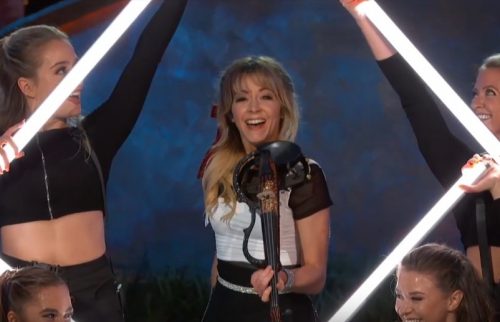
In addition to Walk the Moon, Lindsey Stirling has also graced a past list, snagging #4 back in 2016. Not to be confused with the Bryan Cranston/Kevin Hart movie of the same name last year, “The Upside” is Lindsey’s best song in years. With its exuberant lilting energy, it shows how rip-roaring a violin can be in the hands of the right person. Although she teamed with Elle King for vocals, I prefer the pure instrumental track for sheer audio euphoria. Special mention for “Darkside,” “Sleepwalking,” “Between Twilight,” and the whole Artemis album.
“Never Be the Same” – Tritonal, feat. Rosie Darling
When I heard “The Upside,” I was convinced it would be my #1 by the end of the year, but no, there can only be one. And this is the one! “Never Be the Same” isn’t your typical progressive house song. No, this is the culmination of progressive house at its best. With possibly the finest drop I’ve ever heard, this song fills me with a primal, head-banging rhapsody that makes me worry about dain bramage afterward. It is my favorite song of 2019. Special mention for “Little by Little,” “Bloom,” and “Shivohum.”
And those are my Top Twelve Songs of 2019! What did you think? Solid picks or totally off-base? Even with all the music I’ve found in the last year, I’m sure I’ve only scratched the surface of what’s out there. Let me know your favorites in a comment and maybe I’ll find a new favorite too!
As promised above, I’ll now list my many, many runners-up, continuing the ranking in descending order (#13, #14, etc.), and if any of these are unfamiliar, I’d love for you to give them a listen. Songs and artists are only obscure until they get enough fans, and these deserve fans. 😊
“Don’t Throw Out My Legos” and “Karma” – AJR
“It’s Mine,” “Without You,” “Stronger,” and “Dying for You” – Mystery Skulls
“Chances”, “Sober”, and “Lies” – Ashton Love
“Back in My Body,” “Love You for a Long Time”, and “Fallingwater” – Maggie Rogers
“Nostalgic,” “Find Someone,” “Where You Are,” and “Problems” – Arizona
“Slide Away” – Miley Cyrus
“I Say No” – new song from Heathers musical
“Die Young” – Sheppard
“The River”, “The Seed”, and “Dance on the Moon” – Aurora
“Safe Place” – Pelago, feat. Maximus
“Golden Oldies,” “Lucky Shirt,” “Northern Holiday,” “Wait,” and the whole Duck album – Kaiser Chiefs
“Think About You” (feat. Valerie Broussard) and “Carry On” (feat. Rita Ora) – Kygo
“Lion” – Hearts & Colors
“Longshot” – Catfish and the Bottlemen
“Bismarck” and “Fields of Verdun” – Sabaton
“555” – Jimmy Eat World
“Orphans” and “Arabesque” – Coldplay
“Black Gold” – Editors
“Inferno” and “Nexus” – Hiroyuki Sawano (from the film Promare)
“Fences,” “Feels Like,” and “Home” – Vicetone
“Into the Unknown,” “Some Things Never Change,” and “Show Yourself” – Frozen II
“Wish You Well” – Sigala, Becky Hill
“I Get No Joy” – Jade Bird
“Free to Go” – Seeb, feat. Highasakite
“The Bones” – Maren Morris, with Hozier
“So Am I”, “Torn”, and “Freaking Me Out” – Ava Max
“Talk” – Two-Door Cinema Club
“So Heavy I Fell Through the Earth,” “4ÆM,” and “Violence” – Grimes
“Love Me” – Felix Cartal & Lights
“In Degrees” – Foals
“The Best” and “California Halo Blue” – AWOLNATION
“Nomad” – Jeremy Renner
“Heavenly” – Cigarettes After Sex
“Heart upon My Sleeve” (feat. Imagine Dragons) and “Never Leave Me” (feat. Joe Janiak) – Avicii
“Paper Rings” and “Cornelia Street” – Taylor Swift
“Hidden Potential” – TWRP
“The Way I Feel” and “Love Too Much” – Keane
“You Mean the World to Me” and “Castles” – Freya Ridings
“Hurt People” – Gryffin, with Aloe Blacc
“Sad Forever” – Lauv
“Missed Connection” – The Head and the Heart
“Fight,” “Touch Your Body,” and “Mermaids” – Deamn
“LPs” – Jeffrey Lewis & the Voltage
“Walk Me Home” – P!nk
“One Day” – Sam Feldt and Yves V
“Mama” – Clean Bandit, feat. Ellie Goulding
“Dear Future Self (Hands Up)” – Fall Out Boy, feat. Wyclef Jean
“Globetrotter” – Ludvigsson
“Start Stoppin’” and “I Got You” – The O’Jays
“Stand Up” – Cynthia Erivo (from the film Harriet)
“Death Stranding” – Chvrches
“mother tongue” – Bring Me the Horizon
“Coming Home” – Adon, Nicolas Haelg, Sam Halabi
“Sucker” – Jonas Brothers
“Your Light” – The Big Moon
“Juice” – Lizzo
“Gloryhammer” – Gloryhammer
“Never Really Over” – Katy Perry
“Forgotten Kids” – Callum Pitt
“I Dare You” – The Regrettes
“Living in the Future”, “Forgot Your Name,” and “Tears in Her Eyes” – Mini Mansions
“Midas” – Skott
“Seventeen” – Sharon Van Etten
“Alive” – Dabin, feat. RUNN
“Dylan Thomas” by Better Oblivion Community Center
Despite everything going on with COVID-19, let’s hope 2020 will offer another year of great music!
And to end this musical extravaganza, like in past years, I wanted to provide a small tribute to all the musical artists lost in the last year, including Michel Legrand, Peter Tork of The Monkees, Andy Anderson of The Cure, Doug Sandom of The Who, Nipsey Hussle, Doris Day, Ian Gibbons of The Kinks, Jeff Fenholt, Eddie Money, Ric Ocasek of The Cars, Robert Hunter of the Grateful Dead, Jerry Naylor of The Crickets, Marie Fredriksson of Roxette, Kelly Fraser, Jack Sheldon, and so many others. Thank you for the music, and may you all rest in peace.
Whenever some genius succeeds in inventing a teleportation device,
Whoever created it ought to be wary and test the darn thing at least twice.
For things can go well in initial experiments; but, due to bug or pollutant,
It only takes one time for things to go wrong, and next thing you know, you’re a mutant.
_________________________
MPA rating: R (very R)
Remakes often get a bad reputation, but certain remakes are more well-known than the original. Although I haven’t seen all of it, the original version of The Fly has that famous scene of a woman screaming into the compound eyes of a fly-headed scientist. Yet I’ll bet most people think of Jeff Goldblum before anything else in the 1958 film (except maybe the high-pitched “Help me! Help me” scene). That’s probably because David Cronenberg’s version of The Fly is extremely… memorable, one of the great gross-out flicks that still carries something of a message in its extreme body horror.
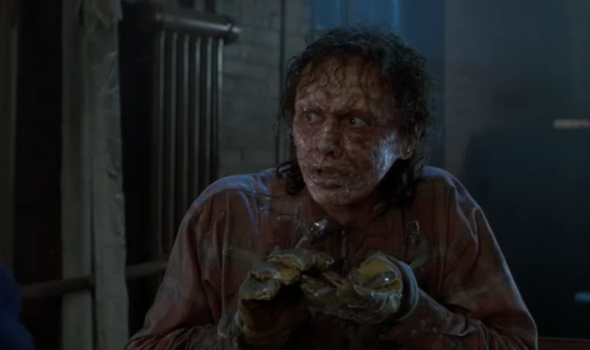
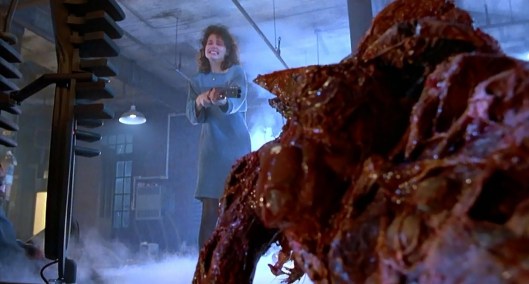
The Fly works well because of its gradual nature. Goldblum’s Seth Brundle, a scientist working out of a deserted warehouse, proudly shows attractive journalist Ronnie Quaife (Geena Davis) what he’s been working on, a pair of teleportation pods. They’re unfinished, though, and despite the horrific results of testing it on a baboon, he perseveres until he believes it safe for human testing. Spoiler alert: it’s not. Whereas the original film had an immediate head-and-arm swap between the man and the fly inside the telepod, Brundle’s transformation is gradual, taking a while for him to realize what went horribly wrong, and the results are anything but pretty.
The transmogrification of Seth Brundle is a pitiful sight, and Goldblum succeeds in exposing the character’s initial hubris and later desperation, even while being covered in more and more disfiguring makeup. Comparisons with unstoppable diseases like cancer or leprosy are unmistakable. One scene felt like a precursor to a similar scene in Prometheus that I’ve always found deeply disturbing. And then there are the final scenes, in which the visual effects and Oscar-winning makeup make the most of a gruesome finale. The ending is a bit too abrupt, not unlike An American Werewolf in London, but it has staying power, haunting the brain and keeping the heartbeat elevated even after the credits roll.My VC thinks this is possibly Jeff Goldblum’s best role, but I’m still surprised that she recommended this movie, considering she is far from a fan of shock horror, and neither am I. Still, The Fly felt like a higher form of it, one that’s hard to ignore. It was also a nice surprise when I was reminded that the famous line below originated in this film. If you don’t enjoy grotesque imagery, The Fly is not for you, but if you can stomach some for the sake of compelling sci-fi, it’s a classic of its genre.
Best line: (Ronnie, to a potential victim of Seth’s) “No. Be afraid. Be very afraid.”









 My VC thinks this is possibly Jeff Goldblum’s best role, but I’m still surprised that she recommended this movie, considering she is far from a fan of shock horror, and neither am I. Still, The Fly felt like a higher form of it, one that’s hard to ignore. It was also a nice surprise when I was reminded that the famous line below originated in this film. If you don’t enjoy grotesque imagery, The Fly is not for you, but if you can stomach some for the sake of compelling sci-fi, it’s a classic of its genre.
