• Home
  • About Me
  • The List
  • THE LIST (2016 Update)
  • THE LIST (2017 Update)
  • THE LIST (2018 Update)
  • THE LIST (2019 Update)
  • THE LIST (2020 Update)
  • THE LIST (2021 Update)
  • THE LIST (2022 Update)
  • Top Twelves and More
  • The End Credits Song Hall of Fame

Rhyme and Reason

~ Poetry Meets Film Reviews

Rhyme and Reason

Category Archives: Reviews

Congo (1995)

16 Saturday Dec 2017

Posted by sgliput in Movies, Poetry, Reviews, Writing

≈ Leave a comment

Tags

Action, Sci-fi, Thriller

See the source image

The boldest and most daring men
Have braved the jungle’s many threats:
Conquerors with no regrets,
Explorers seeking new assets,
Missionaries and cadets,
Who often stormed the devil’s den
And rarely came back out again.
Ha! What chance do you have then?
__________________

MPAA rating: PG-13

Sometimes you can just tell how hard a film is trying to be good, desperately striving to exceed its own mediocrity, and usually it doesn’t get there. I wouldn’t say Congo does either, but it sort of works its way around to so-bad-it’s-good status, which is more than some movies can say.

See the source image

As an adaptation of a Michael Crichton novel, I admire what Congo tries to be, an adventure story in the classic mold of King Solomon’s Mines or the Indiana Jones movies.  A research team for communications corporation Travicom goes missing in the jungles of Africa, and a collection of colorful characters converge to investigate the dangerous area for different reasons. Laura Linney’s Karen goes in search of the team; Tim Curry’s brilliantly smarmy Herkermer Homolka has shady designs on an ancient diamond legend; and Dylan Walsh’s Dr. Peter Elliot wants to return to the wild a gorilla he taught to speak with sign language and a robotic translator. Best of all is Ernie Hudson as their mercenary guide, whose cultured expertise proves invaluable, giving Hudson a role he clearly enjoyed.

There’s some great potential for this adventure as the team deal with unfriendly militias and a mystery jungle creature. To be honest, recalling it so soon after Kong: Skull Island, I couldn’t help but see a few similarities as the unsuspecting explorers are picked off in the jungle, though the killers are far smaller here. One scene with automatic sentry guns also brought to mind Aliens and Predator as the trespassers are besieged by simian beasts. By the time we get a lost city, a random volcano explosion, and an anti-ape laser, it’s obvious that this is more escapist silliness than anything.See the source imageWhile its adventure elements keep trying to spice up the absurd clichés, the growing daftness of the plot is hard to escape. It wouldn’t be so bad if one of the key characters wasn’t an animatronic gorilla with a hand-controlled robotic voice. I can’t say no movie can get away with signing apes since Rise of the Planet of the Apes did, but at least Caesar didn’t have a computerized translator. The rest almost works, but it’s hard to get past the talking, martini-drinking gorilla. Thus, despite its multiple Razzie nominations, Congo may not be an objectively “good” movie, but it’s not altogether bad either. Roger Ebert liked it; it’s a favorite of one of my coworkers; and I too found its cheesiness strangely watchable and entertaining.

Best line (or at least the most ridiculous): (Dr. Elliot) “Oh, no! The bad apes have the crystal lasers!”


Rank: Honorable Mention


© 2017 S.G. Liput
519 Followers and Counting


Déjà Vu (2006)

15 Friday Dec 2017

Posted by sgliput in Movies, Poetry, Reviews, Writing

≈ 2 Comments

Tags

Action, Drama, Mystery, Sci-fi, Thriller

See the source image

It’s hard to run from déjà vu.
It always straggles up on you,
And when you least expect to feel
This creeping sense of the surreal,
It seems you’ve done this all before,
Now back for some half-known encore.

You tell yourself it’s nothing, but
Deep down you have to wonder what
This inkling is: mere happenstance
Or time’s stab at a second chance?
It’s hard to run from déjà vu.
Didn’t I just say that too?
_______________________

MPAA rating: PG-13

Now that I’m finally done with this semester’s finals, I can now get back into review mode. Last year, I did a review a day throughout December, and while that may not be feasible, I’m planning to post a little more often through the end of the year.

See the source image

I guess all I need to do to discover a new favorite is to find a sci-fi movie that received middling reviews, and chances are that I’ll enjoy it far more than the critics did. I’ve noticed that trend with the likes of Surrogates, In Time, and Cloud Atlas, and now Déjà Vu joins the list. I’ve always been partial to time travel stories, and this one played to everything I love about the genre—intricate plotting, cool gadgetry, twists both expected and unexpected—making me wonder why the critics found it so lackluster.

Denzel Washington is good as always as ATF agent Douglas Carlin (pronounced car-LIN), who proves his experience and investigative talent after a crowded New Orleans ferry is destroyed by a terrorist’s bomb. Recruited by an FBI agent (Val Kilmer), Carlin is pulled into a secret government program with access to a temporal window into the past, allowing investigators a comprehensive look at the scene four days prior. However, time flows at the same speed through this window, so they have one go-round to figure out the bomber’s identity and his connection to a separate murder victim (Paula Patton). But let’s just say things are less than transparent, and there’s more to this technology than meets the eye, as Carlin discovers firsthand.

See the source image

I wasn’t sure how much I’d like Déjà Vu based on Tony Scott’s directing style: bright, kinetic, and reminiscent of his later film Unstoppable, though with less zooming of the camera. Yet it kind of works in the film’s favor, particularly for the time window that allows the FBI to buzz around from any angle in the past. The fast pacing also adds to the thrill of the action scenes, like a just plain cool car chase in which Carlin pursues the killer (Jim Caviezel) in the past, trying to drive through past and present-day traffic.  There’s plenty of technobabble from the FBI scientists, including that pencil-through-paper wormhole explanation also used in Event Horizon and Interstellar, but Carlin’s grounded approach keeps the device’s practical uses from getting too confusing.

Time travel movies are often judged on how well they avoid the pitfalls of the genre.  Plot holes can often spoil such films for some people, from Kate and Leopold to The Lake House to About Time (though I still loved that one), while careful attention to the paradoxes involved can elevate a story to classic status. Déjà Vu falls somewhere in between. I believe it does follow the proper mechanics of time travel but simply doesn’t explain it as clearly as it could, mainly at the end. There’s a lot of careful setup, as when Carlin investigates crime scenes only for us to later see how everything got that way, and watching such attention to continuity always gives me an odd satisfaction as the full story is revealed. One idea mentioned is parallel timelines being created by significant enough changes to the past, a concept that reminded me a lot of the anime Steins;Gate, and this is the key to explaining what appears to be the most glaring plot hole of the climax. Now that I think about it, though, there’s one character who shouldn’t remember…. Oh, I don’t care; the rest of the movie is good enough that a little plot hole at the end can be easily forgiven.

See the source image

Déjà Vu has all the right ingredients for a great time travel thriller, and while I can recognize what others would consider drawbacks (minor plot holes, slightly disappointing villain, a victim who can’t seem to stay fully clothed in her own apartment), the whole package was still splendidly entertaining. I like my mind teased every now and then, so finding this unexplored member of the time travel genre made my day.

Best line: (Carlin) “For all of my career, I’ve been trying to catch people after they do something horrible. For once in my life, I’d like to catch somebody before they do something horrible, all right? Can you understand that?”


Rank: List-Worthy


© 2017 S.G. Liput
519 Followers and Counting


Kong: Skull Island (2017)

10 Sunday Dec 2017

Posted by sgliput in Movies, Poetry, Reviews, Writing

≈ 2 Comments

Tags

Action, Fantasy, Horror, Thriller

See the source image

We laud and admire explorers who dare
To venture to regions unknown,
Who journey to jungles with risk in the air
Where most men would heed all the signs to beware,
But not they who roam to the eye of nowhere
And cherish each uncharted zone.

Yet one thing to note of these men who beseech
The thrill of what’s hidden ahead:
Although they may find every mountain and beach
And give all the teachers more titles to teach
And seek out the truths that lie just out of reach,
Most of them do end up dead.
______________________

MPAA rating: PG-13 (some of the violence is rather strong, though)

If you thought the world didn’t need another remake of King Kong, you’d be right, but that’s not about to stop Hollywood. Following 2014’s Godzilla and paving the way for 2020’s Godzilla vs. Kong prize fight of the so-called MonsterVerse, Kong: Skull Island isn’t the same story in past films featuring the giant ape. There’s no film crew, no screaming damsel in distress, no Empire State Building, so it might seem that Kong: Skull Island simply features a different (and much larger) version of the character and isn’t an actual remake. But it is, just a remake of the first half of the original King Kong tale, that being the story of ill-fated visitors to Kong’s home of giant critters. As much as the film tries to make a whole out of this half-story, it doesn’t quite work.

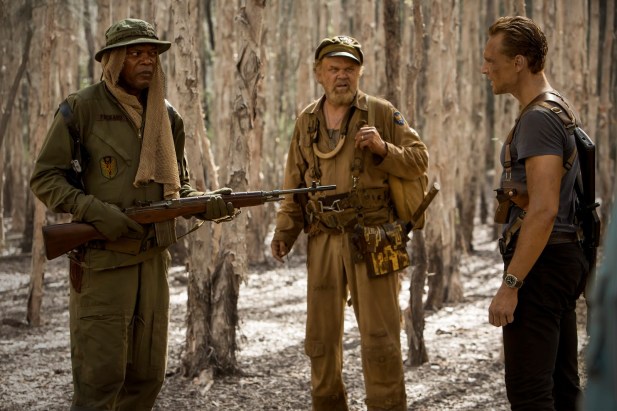
Those ill-fated visitors include a team of surveyors, a military escort fresh from Vietnam, and a few scientists from Monarch (the secret monster-studying organization from Godzilla), all led by the shady desire of Bill Randa (John Goodman) to explore the newly discovered Skull Island. There are plenty of big names here, from Goodman to Tom Hiddleston’s manly tracker to Brie Larson’s intrepid photojournalist to Samuel L. Jackson’s overly devoted army commander, boasting plenty of Jacksonian intensity. In addition, the Vietnam War-era setting warrants a great soundtrack of 1970s rock staples that make the team assembly of the first half quite enjoyable and promising. And when we actually see Kong himself, skyscraper-sized and none too happy about the unwanted guests and their explosives, it’s an action-packed debut that reminds us how frightening a giant gorilla can be.

See the source image

Yet as the film wears on, and the dangers of Skull Island make themselves known, it becomes clear that this is less of an adventure movie and more of a CGI-laden horror film. Oversized creatures take out redshirt after redshirt, often in gruesome ways, until the only source of mystery is who’s going to be on the menu next. By the time one unsuspecting fellow was carried off by lizard birds and torn apart in silhouette, my VC had had enough of the carnage and didn’t want to keep watching. It might help if the characters had some meat to them (literal or otherwise), but they’re really only there as potential beast fodder, even Hiddleston and Larson whose roles are clearly main character material yet don’t really go anywhere. It was also annoying that the military immediately makes the stupid decision in these films of “shoot the giant monster” instead of retreating, like any sensible person would in that situation.

There are bright spots. John C. Reilly livens up the cast significantly as a castaway stranded on the island since World War II, offering some good heart and humor and exposition for the island’s inhabitants, including a tribe of natives much more sympathetically depicted than in past versions. The big battles with Kong are also CGI wonders, perhaps not on par with Peter Jackson’s triple T. Rex fight but still marvelous to watch.

See the source image

Despite the relatively positive reviews for both Godzilla and Kong: Skull Island, I’m still not sold on this MonsterVerse franchise. The monsters created are well visualized with properly awesome action, but the human characters are thin as paper. It’s not a good sign when the scene played during the end credits has more human interest than the whole rest of the film. And I have other questions, like “How are Kong and Godzilla supposed to battle when Godzilla is still much bigger?” or “Will it turn out the same as the 1962 Japanese version of King Kong vs. Godzilla?” or “Will none of the surviving characters from Skull Island return, considering they will have aged between the ‘70s and the modern-day time frame of Godzilla?” Basically, Kong: Skull Island is about a bunch of people who go to an island, and a lot of them die. There has to be more than that for me to care.

Best (and most ironic) line: (Randa, as hippies in D.C. protest the war) “Mark my words. There’ll never be a more screwed up time in Washington.”


Rank: Honorable Mention


© 2017 S.G. Liput
518 Followers and Counting


Thor: Ragnarok (2017)

06 Wednesday Dec 2017

Posted by sgliput in Movies, Poetry, Reviews, Writing

≈ 2 Comments

Tags

Action, Comedy, Sci-fi, Superhero

See the source image

When terrorized by Ragnarok,
(The end of the world? What a shock!),
Mighty Thor will not shrink.
With a boom and a wink,
He’ll prevail while the rest of us gawk.
_______________________

MPAA rating: PG-13

It’s safe to say that the Thor movies are probably the least loved of the Marvel Cinematic Universe (except maybe The Incredible Hulk, but with Mark Ruffalo’s recast, that one’s barely even connected). Thor and Thor: The Dark World aren’t bad films and are still perfectly entertaining fusions of Shakespearean drama and alien hammer battles, but compared with the rest of the MCU, they’re just not that memorable, despite being the source of Marvel’s best villain thus far, Tom Hiddleston’s Loki. Hiddleston’s trickery and Chris Hemsworth’s muscular appeal helped the Thor movies not drag down their more acclaimed cousins, but it seems that Thor has finally found his hit, not with earth-threatening gravitas but tongue-in-cheek comedy, courtesy of New Zealand director Taika Waititi.

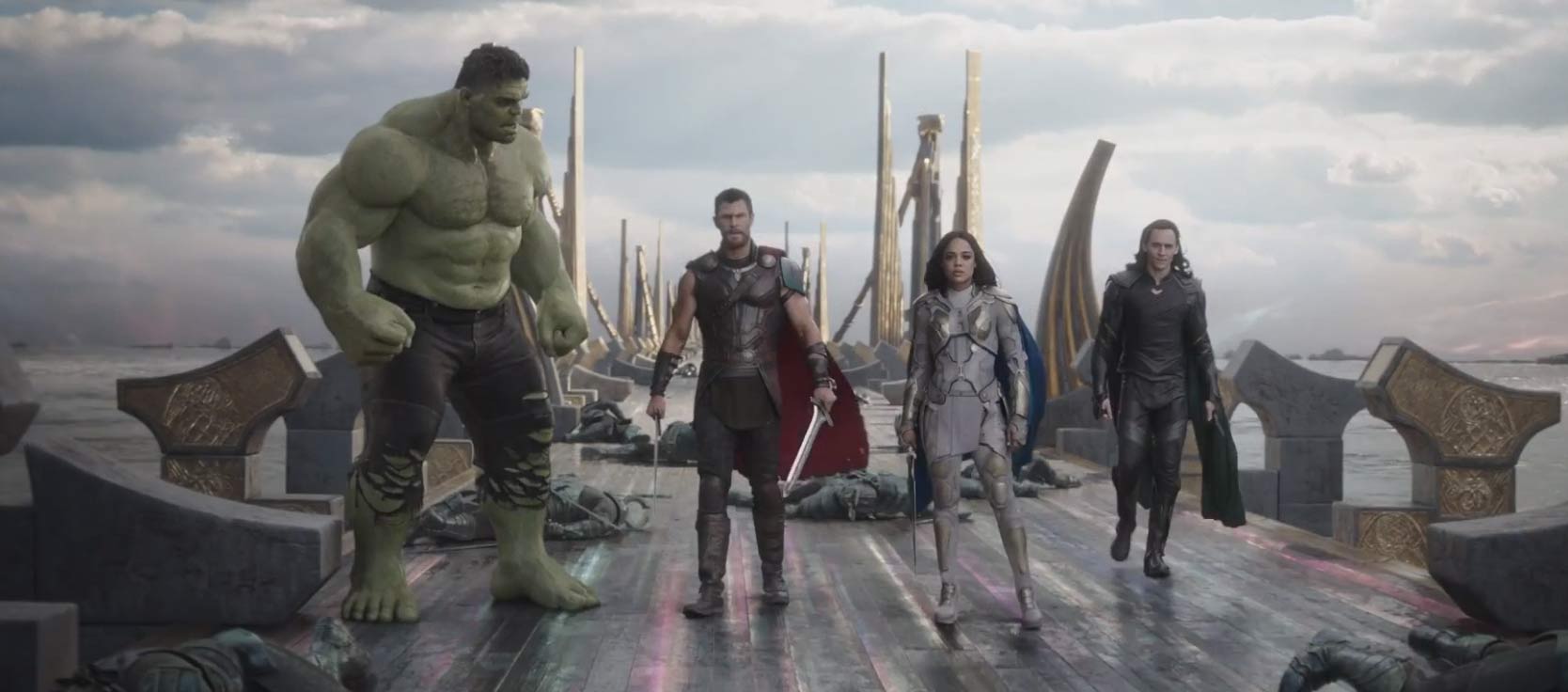
Those paying attention during Captain America: Civil War might have noticed that two of the Avengers were absent from the whole schism. So what were Thor and the Hulk up to in the meantime? Quite a lot actually. The post-credits scene of Doctor Strange hinted that Thor would be looking for his father Odin, but aside from a neat little cameo for the Sorcerer Supreme, the search for Odin isn’t a main plot point. Instead, there’s the arrival of Thor’s long-banished sister Hela (Cate Blanchett), the goddess of death, whose power overwhelms Thor and his hammer and sends him hurtling onto a distant planet of garbage and gladiators. There he encounters both the sadistic Grandmaster (ever-colorful Jeff Goldblum) and the long lost Hulk, whose two-year leave has widened his vocabulary and made the big green guy more of an actual character than merely a secret weapon, borrowing from the Planet Hulk storyline of the comics.

See the source image

While most of the buzz for Ragnarok has been positive, there is a minority who find that the lighter tone cheapens the proceedings, especially considering how dark Hela’s takeover gets. I can definitely see that; the body count is high, including characters from past Thor movies, yet only one gets even some brief token grief, while the others are sloughed off without a passing glance. This might seem callous in a film so filled with gags that it clearly doesn’t want you to dwell on anything but the entertainment. But entertaining it is.

Fans of Guardians of the Galaxy should be quite pleased with how Ragnarok emulates its quirky alien diversity, but Waititi adds his own Kiwi sense of humor, in person actually playing a soft-spoken rock-covered gladiator named Korg. He also brings along Rachel House (as the Grandmaster’s assistant) and a briefly seen Sam Neill (as an Odin actor) from his previous film Hunt for the Wilderpeople. I was also shocked to learn that Matt Damon has a cameo I totally missed. The jokes are many, often droll and sometimes at the expense of past Marvel films, stepping back from the expected superheroics to chuckle before doing them anyway. It’s a fun mix, particularly the rivalry/rapport between Thor and Loki, and although Ragnarok also follows Guardians of the Galaxy in thinking it’s funnier than it actually is, there’s enough varied humor here to please anyone, especially when the whole cast seems to have had so much fun making it.

The action, though, is where Thor: Ragnarok really ups the ante. From the big Thor vs. Hulk fight to a Guardians-ish spaceship chase, the effects are an epic thrill to behold, augmented by the presence of Hemsworth’s more cheeky Thor and likely fan favorite Valkyrie (Tessa Thompson). Karl Urban also has a nice little character arc as a would-be lackey of Hela’s, along with one of the many awesome scenes of the finale. But there’s no beating Thor’s big battle toward the end, made brilliantly epic by Led Zeppelin’s “Immigrant Song.”

See the source image

So yes, Thor: Ragnarok is far more memorable than its predecessors, attracting every conceivable synonym of “fun,” “epic,” and “awesome.” While it has its dramatic moments, the constant jokery keeps things so light that the gravity of certain situations only sinks in later. Despite the fact that Ragnarok leaves several lasting impacts on the MCU, it still feels oddly disposable, like really amusing filler meant to set the stage for next year’s Infinity War. (Can’t wait!) It may or may not go down as one of Marvel’s best, but even if it doesn’t, it’s still Thor-oughly entertaining.

Best line: (Bruce Banner, to Loki) “Last time we saw you, you were trying to kill everyone. What are you up to these days?”   (Loki) “It varies from moment to moment.”


Rank: List-Worthy


© 2017 S.G. Liput
517 Followers and Counting


VC Pick: Fletch (1985)

03 Sunday Dec 2017

Posted by sgliput in Movies, Poetry, Reviews, Writing

≈ Leave a comment

Tags

Comedy, Mystery, Thriller, VC Pick

See the source image

Hello, sir, I’m Roland Dough,
I work for someone you don’t know,
And last I checked,
I must inspect
The volume of your stereo.

While I’m here, I thought I’d ask
If you’ve seen any shady stuff,
Like backroom deals
Or big reveals
Or guys like me who just can’t bluff.

Of course, you’ve not seen me before;
I think I’d know if I was seen.
I just stopped by
To satisfy
My need to be in every scene.

No, no, don’t bother getting up.
Your stereo broke; what a shame!
I’m finished, so
I’d better go.
It’s time to pick another name.
__________________

MPAA rating: PG (perhaps PG-13 nowadays)

My VC has a habit of having me rewatch films I saw only once years ago, just to see if my vague memories are reliable. In this case, I recalled Fletch favorably, even if every detail of the plot had long ago been jettisoned from my mind. But now that I’ve seen it again, that’s a crying shame, because I enjoyed Fletch a lot more than I expected. Chevy Chase’s comedy can be hit-and-miss for me, but when he’s good, he’s good.

See the source image

Chase plays investigative reporter Irwin Fletcher (one guess what his nickname is), who is in the middle of an undercover drug bust when he is picked up by dying millionaire Alan Stanwyck (Tim Matheson), who promises to pay Fletch to kill him. Since not asking questions isn’t in his DNA, Fletch then sets out doing what he does best, following leads, dressing up, and lying through his teeth in pursuit of the truth.

While it’s based on a book series I didn’t know existed, I felt Fletch might have been intended to mirror the success of Beverly Hills Cop. Both of them cast an SNL alum as an improvisational investigator, backed by similar-sounding Harold Faltermeyer scores. Whereas Axel Foley had a gun to do off-hours police work, Fletch is entirely dependent on his wit and sharp tongue, and it’s great fun watching him scramble to plug the holes in his stories. Throughout the film, he impersonates a doctor, a beach bum, a country club guest, an insurance investigator, and probably some I’m forgetting, all with hilarious fake names, and Chevy Chase sells the verbal gymnastics with aplomb.

See the source image

It was also fun recognizing some of the secondary cast, from Geena Davis as his news office buddy, Joe Don Baker as a corrupt police chief, and even The Waltons’ Jim-Bob (David W. Harper) as a young car thief, not to mention small roles for George Wyner, Kenneth Mars, George Wendt, and M. Emmet Walsh. (The “Moon River” scene with Walsh as a doctor was literally the only thing I remembered from last time.) It’s a talented cast and an intriguing, weaving plot, but Chase is the anchor, whose wry narration and slick spontaneity make Fletch possibly his best role, though I still prefer Foul Play overall. Now to remind myself of the sequel I also saw only once called Fletch Lives, though I hear Fletch Dies never got off the ground. Just kidding, though there’s still talk of a re-cast prequel called Fletch Won. This franchise may not be dead yet.

Best line: (Dr. Dolan, speaking of someone Fletch doesn’t know) “You know, it’s a shame about Ed.”
(Fletch) “Oh, it was. Yeah, it was really a shame. To go so suddenly like that.”
(Dr. Dolan) “He was dying for years.”
(Fletch) “Sure, but… the end was very… very sudden.”
(Dr. Dolan) “He was in intensive care for eight weeks.”
(Fletch) “Yeah, but I mean the very end, when he actually died. That was extremely sudden.”


Rank: List Runner-Up (a very close one)


© 2017 S.G. Liput
517 Followers and Counting


2017 Blindspot Pick #11: Giovanni’s Island (2014)

01 Friday Dec 2017

Posted by sgliput in Blindspot, Movies, Poetry, Reviews, Writing

≈ Leave a comment

Tags

Animation, Anime, Drama, History

See the source image

‘Tis futile to wish our lives never to change,
To stay in the bliss of a child’s outlook.
We’re always disturbed by the new and the strange,
Priorities puzzled as they rearrange,
Things hardly confined to the page of a book.

The friends that we make and the loved ones we lose
Accompany us just as far as they can.
And when we have finally paid all our dues
And traveled the path that each person must choose,
Perhaps we will see ‘twas all part of a plan.
____________________

MPAA rating: Not Rated (probably PG)

Boy, just like with Donnie Darko, finding a copy of this film for my Blindspot was harder than I thought, hence why I’m a day late for this November pick. I’m always on the lookout for emotional anime films, and Giovanni’s Island promised to have something of the tragic quality of Grave of the Fireflies, which still makes me cry every time I see it. Giovanni’s Island undoubtedly borrows from the 1988 film and actually reminded me of several others as well, from the Russian exile of Doctor Zhivago to the childish friendship disrupted by war of The Boy in the Striped Pajamas. It also draws explicit inspiration from the Japanese novel Night on the Galactic Railroad, which is apparently a great classic in Japan, though it’s not surprising if most are unfamiliar with it. Some knowledge of that story might help one’s understanding of certain scenes in the movie. (It does have an anime adaptation too, which is dream-like, very slow, full of symbolism and Christian references, and might have vaguely influenced The Polar Express.)

See the source image

The first parallel to Night on the Galactic Railroad is the names of the two brothers who live in a small fishing village in the far northern Japanese islands toward the close of World War II. Junpei (nicknamed Giovanni) and Kanta (nicknamed Campanella) draw their Italian-sounding names from the main characters of the book, a favorite in their family, which ignites their fascination with both the stars and trains. While the villagers expect the Americans to take control after the war is lost, it’s instead the Soviets, who waste no time in establishing themselves and commandeering the Japanese homes and school building. Despite being driven from their house, young Giovanni and Campanella befriend a Russian girl named Tanya, but the conflict and stresses of the adults around them soon strain their relationship and send the brothers away from their beloved island into the unknown.

Despite being produced by Production I.G., the same studio behind Ghost in the Shell, the animation in Giovanni’s Island is different from their other works. The sketched environments and setting details are masterful, and one scene of a front-lit toy locomotive passing between two rooms showed an amazing attention to light and shadow. The character animation, on the other hand, wasn’t bad, but I found it somewhat distracting at times. Despite all anime sharing similarities of style, character design can vary significantly, and it’s a distinction that can be very subjective with its appeal. It’s not as if it was ugly (like One Piece, in my opinion), but the look of the characters sometimes brought me out of the story, though I did get used to it with time.

See the source image

There’s a lot to enjoy about Giovanni’s Island, particularly scenes designed to tug at the heartstrings. In an early scene, the school building is divided between the Russian and Japanese children, and each classroom sings their own national songs to try to drown the other out, while each room later sings the other’s song. Similarly, Giovanni becomes quite close to Tanya, and though the language barrier is barely addressed, it was encouraging to remember that children’s interactions are so much simpler than adults harboring resentment and hate. Another touchstone seemed to be Empire of the Sun, as the two siblings are soon separated from their father and cast into the harsh post-war realities of internment camps, all seen through the eyes of a child. The parallels to Grave of the Fireflies are blatant toward the tearful end, though there are differences, such as the fact that Giovanni and Campanella are never completely abandoned, at least accompanied by their teacher and uncle most of the way. Despite the similarities, it’s not a complete ripoff since the familiarly tragic end also draws from Night on the Galactic Railroad, along with several wondrous dream sequences that recreate scenes from the book.

Giovanni’s Island has plenty of moving drama, some of it probably seen before, but it presents it with warmth and sincerity, as well as grief. It didn’t make me cry like Grave of the Fireflies, but the final scene brought me close. I’m just a sucker for those kinds of poignant death-transcending reunion scenes, so it ended on a high note for me. I also enjoyed a repeated musical cue I recognized as “Those Were the Days,” a Mary Hopkins hit from the ‘60s, which recycled the tune of a traditional Russian folk song, making its use in the film more authentic. A somber tale of loss and survival that never becomes objectionable, Giovanni’s Island may combine elements from better films, but they’re combined beautifully nonetheless.

See the source image

Also, you can click here for a somewhat less rosy review from Rachel of Reviewing All 56 Disney Animated Films and More!, who also had this as her November Blindspot.

Best line:  (Giovanni, when asked what Night on the Galactic Railroad is about) “When people die, they rise up into the heavens and become stars in the night sky. Those countless stars fill the sky, shining brightly and eternally, and we live our lives down here, basking in their light. That’s what the story is about.”


Rank: List Runner-Up


© 2017 S.G. Liput
517 Followers and Counting


The Diving Bell and the Butterfly (2007)

26 Sunday Nov 2017

Posted by sgliput in Movies, Poetry, Reviews, Writing

≈ 2 Comments

Tags

Biopic, Drama, Foreign

See the source image

To watch the world outside a shell,
One window in a tiny cell—
Is this mere pain or is this hell?

‘Tis hell if I but make it so.
While others pity, I must know
That self alone brings spirits low.

From out my shell, my soul must fly
Through fancy, passion, mind, and eye
Before my body dares to die.

I’d view the lives of others crossed
By tragedy and tempest-tossed,
And value things they have not lost.

The world is cruel, yet majesty
Is found in places hard to see,
And both extremes have staggered me.
__________________

MPAA rating: PG-13 (for two brief scenes with topless women)

There are some movies that remind you how blessed you are and how grateful you ought to be. Films like Cast Away and Room show us people deprived of life as usual, and things once taken for granted gain far greater value when they are reclaimed. The Diving Bell and the Butterfly may lack such recovery of normal life, yet the story of Jean-Dominique Bauby made me value everything he lost so suddenly.

See the source image

Formerly the editor of Elle magazine, Bauby (Mathieu Amalric) suffered a sudden stroke in 1995, awakening after a twenty-day coma to discover that his entire body was paralyzed except for his left eye, a rare condition called “locked-in syndrome.” The film begins as he wakes up, and the camera’s first-person view lets the audience hear Bauby’s thoughts and see what he sees. It reminded me a lot of the season 7 M*A*S*H episode “Point of View,” where the audience sees the typical M*A*S*H operations through the eyes of a wounded soldier. As in that episode, doctors and visitors speak directly to the camera, delivering bad news and hollow encouragement alike. Although flashbacks and third-person views are more prevalent later on, a good chunk of the film is furnished through Bauby’s perspective, which is uncannily effective, such as when the screen blinks to portray Bauby’s only means of communication or when his right eyelid is unnervingly sewn shut to prevent infection.

I can envision a present-day version of this story turning into a pro-euthanasia tale bemoaning his pitiful quality of life, but The Diving Bell and the Butterfly is thankfully instead a reminder of the humanity hidden behind Bauby’s withered form. Amalric does a fine job, both in the pre-stroke sequences and his rigid paralysis afterward, managing to convey emotion with just one eye, even more minimalist acting than Eddie Redmayne in The Theory of Everything. Hearing his thoughts reminds us that there is still an active mind behind the expressionless face, one able to think, compose, regret, gripe, and even laugh at himself now and then. At one point, Bauby does wish for death, only to have his nurse scold him for even considering it, urging him to remember everyone who still cares about him. Plus, despite being called a vegetable, he shows the initiative of writing the memoir on which the film is based, dictated a letter at a time by blinking with a special alphabet method and a very patient nurse. Although he points out the ineffectiveness of prayers offered for him by his children and various religious groups, even Bauby ends up acknowledging the reality of miracles.

See the source image

The other actors playing friends, loved ones, and nurses are also phenomenal, from Emmanuelle Seigner as the still-devoted mother of Bauby’s children (whom he regrets not marrying) to Anne Consigny and Marie-Josée Croze as his faithful nurses/therapists. Moving comparisons are made between Bauby’s situation and that of a friend who was imprisoned by terrorists, as well as of his apartment-bound father (Max von Sydow), and an indirect phone call between Bauby and his father is particularly emotional.

I’m typically not a fan of films like this with artsy editing and high-minded metaphors, but it doesn’t come off as pretentious here. There’s plenty of symbolic imagery, like collapsing ice-shelves or the diving suit and butterfly of the title, which seem to represent Bauby’s confinement and the freedom of his imagination, respectively. The Oscar-nominated cinematography is luminous and frequently out of focus when seen through Bauby’s vision, and the first-person views really exhibit the talents of the cast. Bauby’s dream sequences and flashbacks serve more of a purpose than escaping his affliction; they manifest the simple things he once took for granted: a sumptuous meal, a passionate kiss, a mere drive through the countryside, things we forget to value until they’re gone.

See the source image

Deservingly nominated for four Oscars, The Diving Bell and the Butterfly is a paean to life and empathy, to the selflessness of nurses and caretakers, to the bright side of a wretched situation. Despite the sadness of it, the film’s end fosters a unique sense of inspiration, reinforced by the rewound images played over the credits to the song “Ramshackle Day Parade” (worthy of my End Credits Song Hall of Fame). One wonders why such a terrible thing would happen to someone, but the way Bauby’s story ends, I can’t help but wonder if it was simply to supply the world with a much-needed tale of encouragement amid adversity.

Best line: (Roussin) “Hold fast to the human inside of you, and you’ll survive.”


Rank: List-Worthy


© 2017 S.G. Liput
517 Followers and Counting


Valerian and the City of a Thousand Planets (2017)

21 Tuesday Nov 2017

Posted by sgliput in Movies, Poetry, Reviews, Writing

≈ Leave a comment

Tags

Action, Sci-fi, Thriller

See the source image

How primitive we’ll likely seem
To generations yet unborn.
They’ll look at microchips and deem
Them obsolete, as we do steam.
Our present will be like a dream
Before the future’s morn.

I wish that I could see such things,
As interplanetary trips,
And alien discoverings
And cars that fly with plasma wings.
I’d rather see what that dream brings
Than some apocalypse.
__________________

MPAA rating: PG-13

It boggles my mind that people complain about no originality in Hollywood anymore, and then the fifth Transformers film makes millions while Valerian flops. Luc Besson’s French import based on a classic French comic immediately sparked my interest based on the trailer alone, and I knew I had to catch it on the big screen. Valerian and the City of a Thousand Planets is easily one of the most visually imaginative films I’ve seen, resplendent in its CGI-heavy universe that resembles Star Wars, Star Trek, and Avatar on steroids.

See the source image

It starts out with one of the rosiest visualizations of first contact ever, a brief but brilliant montage of mankind’s collaborative camaraderie expanding to include thousands of alien races. Centuries in the future, the diverse species of the galaxy will converge aboard the space metropolis of Alpha, and human government agents Valerian (Dane DeHaan) and Laureline (Cara Delevingne) are tasked with protecting it when a mysterious danger arises. That’s about as general a description I can give, because the plot is fairly simple at its core but so surrounded by frenetic action and less-than-necessary tangents that it seems more complicated than it is. Yes, it probably didn’t need a memory-eating jellyfish or a shape-shifting pole dance, but Luc Besson’s exuberance for his material is obvious and fun in this all-over-the-place approach.

Most of the criticisms aimed at Valerian focus on the casting, and I’ll admit Dane DeHaan and Cara Delevingne would not have been my first choices to play the two leads. Neither imbues their character with anything very unique, and their personalities are rather flat as a result. Yet I wouldn’t say they were bad but rather passable. There’s nothing overtly mockable in their relationship like Anakin and Padme, and their chemistry and interactions are enough to maintain our interest in everything that happens around them. While Clive Owen, Ethan Hawke, Herbie Hancock, and Rutger Hauer show up to lend some brief recognizable star power, the more interesting characters are the CGI alien creations, like the three gremlin-bird-things that wander around trading information like money-grubbing Ferengi. Rihanna as a shapeshifter offers an especially enjoyable addition to the lead duo, though I wish she had had more screen time.

See the source image

More than anything else, I enjoyed Valerian and the City of a Thousand Planets because it showed me things I’d never even imagined before:  pristine alien beaches for harvesting energy pearls, glowing butterflies you do not want to touch, extra-dimensional shopping malls located in the middle of a desert. For an independent film, the Oscar-worthy visual effects rival anything that Hollywood has put out. The action scenes were spectacularly thrilling, and I didn’t stop to care about the film’s flaws when I was watching Valerian escape from a crime boss through a multi-level alien bazaar while his arm is trapped in another dimension. It was just a fun ride, particularly an extended shot of Valerian bashing through wall after wall of Alpha’s various alien habitats.

I will gladly defend Valerian based on how much it entertained me, and I wouldn’t doubt that it will become a cult classic, not unlike Besson’s other quirky, polarizing sci-fi The Fifth Element. Nevertheless, I’m torn on how to personally rank it because the closer I get to the end of the year, the more I realize I’ll have to remove genuinely good films from my Top 365 list to make room for this year’s additions. At this point, I’m not sure that Valerian warrants that, since I must acknowledge the relative weakness of the characters and plot, including an extended glimpse of life on one alien planet that goes on for too long. Even so, it’s a film I greatly enjoyed and plan to see again soon, so perhaps it will rise further in my estimation after another awesome visit to the future.

See the source image


Best line:  (Doghan-Dagui, the three information traders) “We know how humans work. They are all so predictable.”   (Laureline) “Clearly, you have never met a woman.”


Rank:  List Runner-Up


© 2017 S.G. Liput
517 Followers and Counting


A Happy Thanksgiving to all!

It Could Happen to You (1994)

19 Sunday Nov 2017

Posted by sgliput in Movies, Poetry, Reviews, Writing

≈ Leave a comment

Tags

Comedy, Drama, Romance

See the source image

“If I won the lottery,” so many say.
“If I won the lottery,” oh, what a day!
“The things I would buy and the bills I could pay,
The dreams I could fill and the places I’d stay!”
And that’s why so many will plead and will pray
For six random numbers confirming their luck.

If you won the lottery, what would you do?
If you won the lottery, would it change you?
Dreams can be marvelous when they come true
But often result in more pain than you knew.
While waiting for fortune and fame to break through,
Enjoy life a bit before you’re money-struck.
(And then make it count when you do make a buck.)
_________________

MPAA rating: PG

There’s something refreshingly old-fashioned about It Could Happen to You. For a ‘90s rom-com with Nicolas Cage and Bridget Fonda, I can easily envision a 1940s version with Jimmy Stewart and June Allyson. (It’s easy for me to picture them together after The Glenn Miller Story.) There’s a wholesomeness here that you just don’t see nowadays, strengthened by the “Once upon a time” fairy tale narration by Isaac Hayes.

For all his nuttier roles, Cage is admirably down-to-earth as responsible NYPD officer Charlie Lang, who’s beloved of the whole neighborhood except for his critical wife Muriel (Rosie Perez). Strapped for cash at a diner one day and too upstanding to not leave a tip, he promises down-and-out waitress Yvonne (Bridget Fonda) that he’ll split his lottery ticket with her if he wins. Lo and behold, he does, much to Yvonne’s delight and Muriel’s chagrin. Everyone uses their newfound fortune differently, and it doesn’t take long to see Charlie and Yvonne deserve each other far more than greedy Muriel or Yvonne’s also-greedy husband (a barely recognizable Stanley Tucci).

See the source image

Based on and greatly exaggerating a real life story from ten years prior, It Could Happen to You begins with a universal what-if question of winning the lottery and extends that to ask whether Charlie should uphold his promise and how best to wield such riches. We as the audience may not be as humanitarian as Charlie and Yvonne, who freely share their wealth with the less fortunate, but we’re hopefully not as heartless as the scheming Muriel. Most people probably fall somewhere between the two extremes, but seeing them side by side reminds us just how laudable a Charlie or an Yvonne is in this selfish world. Yvonne even points out that, as decent people, they seem to be “freaks” in a place like New York City, but the end suggests that there are far more lovers of decency than the news headlines would have us believe.

Despite having an all-around charm to it, I must admit that It Could Happen to You isn’t very strong in the comedy department. I don’t remember laughing once, though Cage and Fonda largely made up for that with their sweet chemistry. On the other hand, Rosie Perez’s grating voice made her excessively unpleasant, as if the courtroom scenes with her calculating lawyer weren’t enough. Don’t you hate those scenes where some devious lawyer twists the facts to paint the worst possible picture of an innocent defendant who’s too inarticulate to escape being backed into a corner? I do, so the film’s second half was a tad annoying before it bounced back to satisfying.

See the source image

With the classic tune “Young at Heart” sung by both Frank Sinatra and Tony Bennett, the film evokes a vaguely similar tone as Sleepless in Seattle but could have used a more humorous script. Still, lacking much profanity or objectionable content, it’s a reminder that Hollywood once did PG-rated romances just as well as the R-rated ones. Fonda and Cage have rarely been so appealing, and the end is likely to leave you with a smile.

Best line: (Charlie, about Muriel) “It’s like we’re on two different channels now. I’m CNN, and she’s the Home Shopping Network.”


Rank: Honorable Mention


© 2017 S.G. Liput
517 Followers and Counting


The Zookeeper’s Wife (2017)

17 Friday Nov 2017

Posted by sgliput in Movies, Poetry, Reviews, Writing

≈ Leave a comment

Tags

Biopic, Drama, History

Image result for the zookeeper's wife

Animals hold no ill will
Like we humans when we kill.
Animals cannot relate
To we who brand and scorn and hate.

Life is simple in their eyes,
Where we confuse and compromise,
Yet, when all the world grows cruel,
Survival is our common rule.

Man can treat his fellow man
Far worse than other creatures can.
Likewise, mankind stands apart
In sharing greater depths of heart.
______________________

MPAA rating: PG-13

There are some movies that, no matter how well made they are, just tend to fall into the second tier of their genre. The Zookeeper’s Wife is one such film, yet another historical drama based on true events of endangered Europeans dealing with the Nazi occupation and risking all to help Jews during the Holocaust. Such films are guaranteed to be emotional and impactful as they strive to emulate Schindler’s List, but although I haven’t been able to bring myself to watch Schindler’s List for comparison, I can tell that The Zookeeper’s Wife likely won’t win any Oscars, if its March release date wasn’t already a hint.

Image result for the zookeeper's wife

Jessica Chastain as Antonina Żabiński is the titular wife to Johan Heldenbergh’s zookeeper Jan Żabiński, both of whom happily run the Warsaw Zoo in the days leading up to the German invasion. As someone who has always enjoyed visits to the zoo, I enjoyed the scenes with the diverse animals, which are charmingly natural, as if it’s perfectly normal in this family to cuddle with a white lion cub. Of course, those scenes are quickly upended by Nazi bombers who decimate the city and many of the exhibits, leaving released camels and big cats to add to the chaos. These scenes and the deaths that result can be distressing for animal lovers, but the film doesn’t dwell on the animals themselves for long, as the zoo is promptly emptied by Hitler’s chief zoologist Lutz Heck (Daniel Bruhl). Without a zoo to care for, the Żabińskis turn their attention to the impounded Jews of the Warsaw Ghetto, choosing to take part in an Underground Railroad to help them to safety and hide them in the zoo.

All three of the main actors do excellent work here, particularly Chastain, fake accent and all. While his character is far more actively involved in the resistance movement, smuggling Jews from the ghetto in a garbage truck, Heldenbergh is oddly sidelined at times, hence why the film isn’t called The Zookeeper. Having played a Nazi before in Inglourious Basterds, Bruhl is respectably menacing in his romantic advances toward Antonina, which she humors for the sake of keeping him off the scent of her hidden friends. When he does catch on, his jilted fury is frighteningly unpredictable during a heart-in-the-throat scene toward the end. While some details are given at the end, I do wish there was a little more information about what became of the Żabińskis afterward.

Image result for the zookeeper's wife

There’s little negative to say about The Zookeeper’s Wife. My VC read the book and found this to be an admirable adaptation, despite certain changes. The music, the locations, the moments of shocking inhumanity and heartening empathy are all commendably effective, but not quite as involving as they would seem on paper. It’s ultimately more encouraging than some of its devastating cousins, perhaps owing to the restraint afforded by its PG-13 rating. There is no shortage of Holocaust movies, and considering how easily mankind forgets, even today, there need to be many more, so The Zookeeper’s Wife deserves to be seen, even if it’s not one of the stand-outs of the group.

Best line: (Antonina) “You can never tell who your enemies are or who to trust. Maybe that’s why I love animals so much. You look in their eyes, and you know exactly what’s in their hearts. They’re not like people.”


Rank: List Runner-Up


© 2017 S.G. Liput
517 Followers and Counting


← Older posts
Newer posts →

Recent Posts

  • We Didn’t Start 2025 (Recap)
  • NaPoWriMo 2025 Recap (Finally)
  • Sonic the Hedgehog 3 (2024)
  • It Happened One Night (1934)
  • Spellbound (2024)

Recent Comments

associatesofshellymann's avatarassociatesofshellyma… on My Top Twelve La La La So…
Kit's avatarKit Nichols on Bonnie and Clyde (1967)
lifelessons's avatarlifelessons on Look Back (2024)
Carol Jackson's avatarCarol Jackson on The Thief of Bagdad (1940…
Stephen's avatarStephen on Love Story (1970)

Archives

  • January 2026
  • December 2025
  • May 2025
  • April 2025
  • March 2025
  • February 2025
  • January 2025
  • December 2024
  • May 2024
  • April 2024
  • March 2024
  • February 2024
  • January 2024
  • December 2023
  • November 2023
  • October 2023
  • September 2023
  • July 2023
  • June 2023
  • May 2023
  • April 2023
  • March 2023
  • February 2023
  • January 2023
  • December 2022
  • November 2022
  • October 2022
  • September 2022
  • August 2022
  • July 2022
  • June 2022
  • May 2022
  • April 2022
  • March 2022
  • February 2022
  • January 2022
  • December 2021
  • November 2021
  • October 2021
  • September 2021
  • August 2021
  • July 2021
  • June 2021
  • May 2021
  • April 2021
  • March 2021
  • February 2021
  • January 2021
  • December 2020
  • November 2020
  • October 2020
  • September 2020
  • August 2020
  • July 2020
  • June 2020
  • May 2020
  • April 2020
  • March 2020
  • February 2020
  • January 2020
  • December 2019
  • November 2019
  • October 2019
  • September 2019
  • August 2019
  • July 2019
  • June 2019
  • May 2019
  • April 2019
  • March 2019
  • February 2019
  • January 2019
  • December 2018
  • November 2018
  • October 2018
  • September 2018
  • August 2018
  • July 2018
  • June 2018
  • May 2018
  • April 2018
  • March 2018
  • February 2018
  • January 2018
  • December 2017
  • November 2017
  • October 2017
  • September 2017
  • August 2017
  • July 2017
  • June 2017
  • May 2017
  • April 2017
  • March 2017
  • February 2017
  • January 2017
  • December 2016
  • November 2016
  • October 2016
  • September 2016
  • August 2016
  • July 2016
  • June 2016
  • May 2016
  • April 2016
  • March 2016
  • February 2016
  • January 2016
  • December 2015
  • November 2015
  • October 2015
  • September 2015
  • August 2015
  • July 2015
  • June 2015
  • May 2015
  • April 2015
  • March 2015
  • February 2015
  • January 2015
  • December 2014
  • November 2014
  • October 2014
  • September 2014
  • August 2014
  • July 2014
  • June 2014
  • May 2014
  • April 2014
  • March 2014
  • February 2014
  • January 2014
  • December 2013

Categories

  • Blindspot
  • Blogathon
  • Christian
  • Movies
  • Music
  • NaPoWriMo
  • Poetry
  • Reviews
  • TV
  • Writing

Meta

  • Create account
  • Log in
  • Entries feed
  • Comments feed
  • WordPress.com

Recent Posts

  • We Didn’t Start 2025 (Recap)
  • NaPoWriMo 2025 Recap (Finally)
  • Sonic the Hedgehog 3 (2024)
  • It Happened One Night (1934)
  • Spellbound (2024)

Recent Comments

associatesofshellymann's avatarassociatesofshellyma… on My Top Twelve La La La So…
Kit's avatarKit Nichols on Bonnie and Clyde (1967)
lifelessons's avatarlifelessons on Look Back (2024)
Carol Jackson's avatarCarol Jackson on The Thief of Bagdad (1940…
Stephen's avatarStephen on Love Story (1970)

Archives

  • January 2026
  • December 2025
  • May 2025
  • April 2025
  • March 2025
  • February 2025
  • January 2025
  • December 2024
  • May 2024
  • April 2024
  • March 2024
  • February 2024
  • January 2024
  • December 2023
  • November 2023
  • October 2023
  • September 2023
  • July 2023
  • June 2023
  • May 2023
  • April 2023
  • March 2023
  • February 2023
  • January 2023
  • December 2022
  • November 2022
  • October 2022
  • September 2022
  • August 2022
  • July 2022
  • June 2022
  • May 2022
  • April 2022
  • March 2022
  • February 2022
  • January 2022
  • December 2021
  • November 2021
  • October 2021
  • September 2021
  • August 2021
  • July 2021
  • June 2021
  • May 2021
  • April 2021
  • March 2021
  • February 2021
  • January 2021
  • December 2020
  • November 2020
  • October 2020
  • September 2020
  • August 2020
  • July 2020
  • June 2020
  • May 2020
  • April 2020
  • March 2020
  • February 2020
  • January 2020
  • December 2019
  • November 2019
  • October 2019
  • September 2019
  • August 2019
  • July 2019
  • June 2019
  • May 2019
  • April 2019
  • March 2019
  • February 2019
  • January 2019
  • December 2018
  • November 2018
  • October 2018
  • September 2018
  • August 2018
  • July 2018
  • June 2018
  • May 2018
  • April 2018
  • March 2018
  • February 2018
  • January 2018
  • December 2017
  • November 2017
  • October 2017
  • September 2017
  • August 2017
  • July 2017
  • June 2017
  • May 2017
  • April 2017
  • March 2017
  • February 2017
  • January 2017
  • December 2016
  • November 2016
  • October 2016
  • September 2016
  • August 2016
  • July 2016
  • June 2016
  • May 2016
  • April 2016
  • March 2016
  • February 2016
  • January 2016
  • December 2015
  • November 2015
  • October 2015
  • September 2015
  • August 2015
  • July 2015
  • June 2015
  • May 2015
  • April 2015
  • March 2015
  • February 2015
  • January 2015
  • December 2014
  • November 2014
  • October 2014
  • September 2014
  • August 2014
  • July 2014
  • June 2014
  • May 2014
  • April 2014
  • March 2014
  • February 2014
  • January 2014
  • December 2013

Categories

  • Blindspot
  • Blogathon
  • Christian
  • Movies
  • Music
  • NaPoWriMo
  • Poetry
  • Reviews
  • TV
  • Writing

Meta

  • Create account
  • Log in
  • Entries feed
  • Comments feed
  • WordPress.com

Blog at WordPress.com.

  • Subscribe Subscribed
    • Rhyme and Reason
    • Join 814 other subscribers
    • Already have a WordPress.com account? Log in now.
    • Rhyme and Reason
    • Subscribe Subscribed
    • Sign up
    • Log in
    • Report this content
    • View site in Reader
    • Manage subscriptions
    • Collapse this bar