• Home
  • About Me
  • The List
  • THE LIST (2016 Update)
  • THE LIST (2017 Update)
  • THE LIST (2018 Update)
  • THE LIST (2019 Update)
  • THE LIST (2020 Update)
  • THE LIST (2021 Update)
  • THE LIST (2022 Update)
  • Top Twelves and More
  • The End Credits Song Hall of Fame

Rhyme and Reason

~ Poetry Meets Film Reviews

Rhyme and Reason

Category Archives: Reviews

Testament of Youth (2014)

17 Wednesday Jan 2018

Posted by sgliput in Movies, Poetry, Reviews, Writing

≈ Leave a comment

Tags

Biopic, Drama, History, Romance, War

See the source image

How keenly and eagerly do wars begin,
When winners and losers have yet to be picked,
Before its true horror and hardship set in
And man is reminded how great is its sin!
The world returns ever, a careless addict,
To battle and blood, as the wise can predict.

Each new generation discovers firsthand
The truth only mastered when foolishness dies.
It cannot be scheduled; it cannot be planned;
It comes only when the naïve understand
That war is a futile and grave exercise.
Then do the innocent fools become wise.
___________________

MPAA rating: PG-13

Alicia Vikander broke onto most people’s radars with 2015’s Ex Machina and her Oscar-winning role in The Danish Girl, but Testament of Youth not long before them should not be forgotten. Based on the same-titled World War I memoir by Vera Brittain, Testament of Youth features the kind of lead performance that makes one wonder why it didn’t get more awards attention. As Brittain herself, Vikander plays an early feminist whose academic dreams are dashed by the onset of war and its unforeseen tragedies.

See the source image

I’d never heard of Vera Brittain or her apparently famous memoir before this movie, but that’s why I love well-done adaptations that introduce me to new and worthwhile stories. Early on, Brittain is a relatively carefree girl whose greatest challenge is convincing her father to let her go to Oxford. Thanks to the intervention of her brother Edward (Taron Edgerton in one of his first roles) and a sympathetic professor (Anna Chancellor), she is able to attend her dream school, right as she’s also finding love with one of Edward’s friends, Roland (Kit Harington of Game of Thrones fame). Before long, though, the Great War begins, and when all her male friends enlist, Vera’s priorities shift as well, compelling her to join the war effort as a nurse, first on the home front and later in France.

Testament of Youth may seem like your typical beautifully mounted British period piece, and if you don’t like beautifully mounted British period pieces, you might find it boring. Yet the cinematography is sumptuous and the acting of everyone involved stellar, with Vikander in particular embodying the wartime transformation of the nation as she develops from a naïve schoolgirl who advocates her brother joining the military to a war-weary mourner reeling from all that was lost. There are times when it seems to be treading familiar ground, such as a shot lifted straight from Gone with the Wind, but a scene where Vera declares to a vengeful crowd the best way to respond to the defeated Germans is especially powerful. While the end could have been depressing as heck, there are glimmers of hope as she discovers how to move beyond misfortune.

See the source image

As far as style, the closest thing I can compare Testament of Youth to is the John Keats biopic Bright Star, which also imbues a tragic true romance with a poignant beauty and literary passion. The anti-war themes center on loss and empathy, which is strongly endorsed through Brittain’s nurse experiences, as when she cares for both British and German soldiers as if they were her own brother or fiancé. Whether you’ve heard of it or not, Testament of Youth is a prime choice the next time you’re in the mood for a beautifully mounted British period piece.

Best line: (Vera’s college partner Winifred Holtby) “All of us are surrounded by ghosts. Now we need to learn how to live with them.”


Rank: List Runner-Up


© 2018 S.G. Liput
530 Followers and Counting


Deep Impact (1998)

12 Friday Jan 2018

Posted by sgliput in Movies, Poetry, Reviews, Writing

≈ Leave a comment

Tags

Disaster, Drama, Sci-fi, Thriller

See the source image

One day the world will end, they say,
In ice and dark or fiery doom,
And there’s been many a prior day
When men believed such tales of gloom
Would make a certain day their tomb.

If true, then what’s the point of life
If it should be cut short so soon?
The universe with readied knife
Will strike when most inopportune,
And in its wake, our deaths are strewn.

If such you think, make peace with fact,
For die you will someday indeed.
But till I feel my death’s impact,
Such prophecies I will not heed,
For life’s too precious to concede.
___________________

MPAA rating: PG-13

It’s been almost two years since I reviewed Armageddon, so it’s about time I watched the other catastrophic asteroid movie from the summer of 1998. I’ve heard varying opinions on whether Deep Impact or Armageddon is the better film, and I see why now. They’re both great for end-of-the-world spectacle, but they approach the disaster in different ways that make the question of “which is better” simply a matter of preference. Do you want Michael Bay-style cheesiness and frenetic action, or a somewhat more serious take on how the world might react in an apocalyptic scenario (dark cheese, you might say)? The latter is Deep Impact.

See the source image

Technically, Deep Impact features a world-ending comet rather than an asteroid, a comet discovered by high school student Leo Biederman (Elijah Wood). Once a nosy reporter (Téa Leoni) stumbles upon this government secret, the President (Morgan Freeman) announces a space mission to divert it, as well as some extreme evacuation and protection measures should the worst happen. Like Armageddon, there’s a game all-star cast to elevate the disaster flick, including Maximilian Schell, Vanessa Redgrave, James Cromwell, Jon Favreau, Kurtwood Smith, Denise Crosby, and Robert Duvall as the most experienced astronaut on the earth-saving mission. Together, they provide varied views of the incoming cataclysm, from reporters to politicians to would-be heroes to everyday folks, but the best has to be Freeman as the President we’d all want in such a situation: calm, honest, and willing to invoke God and prayer in encouraging people.

Despite the life-and-death stakes, Armageddon had that Michael Bay action movie quality with strong doses of humor from the rough-and-ready drillers, but Deep Impact has much more weight to it and isn’t afraid to embrace the tragedy of the disaster. I’d heard it was darker, which led me to believe the characters’ efforts would wind up being hopeless and futile. The fact that I was proven wrong was a pleasant surprise and helped me enjoy the movie far more than I expected going in.

See the source image

It still can’t quite escape shades of the cheesy and impractical. For example, my VC found it totally unrealistic for Leoni’s reporter to get on TV covering the astronaut’s mission and just leave dead air as she stares at the screen with everyone else. Still, it’s easier to take seriously than Armageddon, with good effects and the benefit of being easier on the eyes than Michael Bay’s editing. It also affirms heroism and hope in the face of apparent doom, and on retrospect, I liked how some characters’ seemingly foolish clinging to that hope actually paid off compared with others’ resignation to death. They both have their strengths, but as far as which of the two “asteroid” disaster movies is objectively better, I think Deep Impact gets my vote.

Best line: (President Tom Beck) “Cities fall, but they are rebuilt. And heroes die, but they are remembered. We honor them with every brick we lay, with every field we sow, with every child we comfort and then teach to rejoice in what we have been re-given: our planet, our home. So now, let us begin.”


Rank: List Runner-Up


© 2018 S.G. Liput
527 Followers and Counting


War for the Planet of the Apes (2017)

30 Saturday Dec 2017

Posted by sgliput in Movies, Poetry, Reviews, Writing

≈ 1 Comment

Tags

Action, Drama, Sci-fi, Thriller, War

See the source image

As long as wars and battles rage,
The world will yearn for peace;
So says the pacifist with sage
Detachment and release.

Yet when the battles come too close
And reap their ruthless wound,
How quick is he made bellicose,
His former faith impugned!

Yes, grief can make the wholesome hate,
The peaceful prime for war.
Sometimes their conscience wakes too late,
With much to answer for.
_________________

MPAA rating: PG-13

Perhaps the most surprising thing about these new Planet of the Apes movies is how good they are compared with how bad they could have been. Think about it: apes using sign language, sparse and simple dialogue, “monkeys riding horses,” as Everybody Loves Raymond once put it, concepts that could so easily become laughable. And yet both Rise and Dawn of the Planet of the Apes raised the bar for what this science fiction series could be, and 2017’s War for the Planet of the Apes continued the high quality and stuck the landing, so to speak.

Picking up two years after Dawn, this end to the trilogy sees Caesar (Andy Serkis) and his band of intelligent apes embattled with a military garrison led by the fanatical Colonel (Woody Harrelson, in grand villainous mode). There is plenty of wreckage still from Koba’s uprising in Dawn, from defecting gorillas siding with the humans against Caesar to the emotional baggage of Koba’s and Caesar’s actions. When the Colonel exacts a personal toll on Caesar’s family, the ape leader starts to share in Koba’s hatred and soon sets out with his most loyal friends on a quest for revenge. The story morphs several times as it goes, from western-like journeying through snowy mountains to brutal incarceration to a thrilling prison escape tale, all while following Caesar’s emotional rollercoaster and completing the allegorical Moses narrative begun in Rise.

See the source image

With each film in this trilogy, the visual effects have gotten more and more polished. The previous two still had moments when I could tell the apes weren’t real, but War makes them as realistic as any effect I’ve seen. Even if motion-capture technology  is perhaps not entirely perfected, it’s jaw-droppingly convincing at this point, which allows the apes’ emotions to be as clearly conveyed as any of the human characters’. The characters behind that effects façade are also better defined here than in prior films. The chimp Rocket and orangutan Maurice have been with Caesar since the first film, and while they barely registered in Dawn, the fact that they join Caesar on his trek allows them to stand out better from the rest of the apes. Also joining them is the eccentric Bad Ape (Steve Zahn), a zoo escapee who adds some much-needed humor to an otherwise bleak tale.

My VC has had a more restrained appreciation for these movies, admiring the visual skill but finding the execution a bit plodding and slow-paced. Even so, she found the story of War to be the strongest of the three, and although I prefer Dawn, War had the clearest character arc of the three, continued the subtle references to past movies, and worked in some evidence of how the world becomes as Charlton Heston found it in the original.

See the source image

I agree with her that the pacing could be tighter, particularly during the grueling prison scenes, but these films aren’t content to be mere action spectacles. They instead tackle deeper moral questions and universal themes of humanity, enlivened by moments of refreshing sweetness and stunning action. They’re a rare breed of blockbuster, and if their example overran Hollywood, that wouldn’t be such a bad thing.

Best line: (Caesar) “If we strive but fail, and the world remains armed against itself, then we’ve been divided, because the hunger for peace is in the hearts of all.”


Rank: List-Worthy (joining the previous two)


© 2017 S.G. Liput
524 Followers and Counting


Spider-Man: Homecoming (2017)

29 Friday Dec 2017

Posted by sgliput in Movies, Poetry, Reviews, Writing

≈ Leave a comment

Tags

Action, Comedy, Sci-fi, Superhero, Thriller

See the source image

If there is money to be milked,
Hollywood is there!
If there are empires to be built,
Hollywood will dare!
If there are purists they can jilt,
If there are wishes they can wilt,
Hollywood won’t care!

If franchises refuse to die,
Some revel at the sight,
While others weakly question why
And still tune in despite.
But if you silence your outcry,
Hollywood might satisfy.
They sometimes get it right.
_________________

MPAA rating: PG-13

I was among the most skeptical when yet another Spider-Man was announced, and as amazing as Tom Holland’s debut in Captain America: Civil War was, I still wasn’t sold on Homecoming’s potential. I’m one of those people who grew up loving Tobey Maguire’s Spider-Man, and I’m firmly convinced that no other Spider-Man will replace him as my favorite or Spider-Man 2 as the best in the series. All that said, I loved Spider-Man: Homecoming far more than I was expecting and certainly more than the Andrew Garfield films (which I didn’t exactly hate either).

The trick that this new Disney/Sony partnership pulls off successfully is making this version of Spider-Man sufficiently different that it doesn’t feel like a rehash of what we’ve already seen. For example, Peter Parker’s origin story is completely skipped, assuming the audience already knows the basics about a radioactive spider and the death of his Uncle Ben. Instead, it focuses much more on Peter’s high school life, with fawning crushes, scholastic decathlon training, and his geeky friend Ned (Jacob Batalon) and more nonchalant friend Michelle (Zendaya). The typical Mary Jane, Gwen Stacy, and Harry Osborne aren’t here (mostly), and instead we have some fantastic continuity with the MCU, embodied in Tony Stark (Robert Downey, Jr.) as Peter’s detached mentor/benefactor.

See the source image

In avoiding past Spider-Man movies, we also get a new villain in Michael Keaton’s Adrian Toomes, who becomes the Vulture using alien tech left over from the Chitauri battle in The Avengers. Aside from the priceless in-joke of casting Birdman himself as the Vulture, Keaton makes his embittered contractor-turned-weapons dealer one of the best and smartest Marvel villains in a while, one who’s not evil for evil’s sake but who is still ruthless in doing what he thinks is necessary and justifying it as a family man. His battles with Spider-Man are far more thrilling than I expected from a second-rate villain like Vulture, and the fact that his motivations don’t involve world domination or destruction is actually refreshing at this point in the MCU.

Of course, the biggest challenge goes to Holland, who embraces Peter Parker’s inexperience and high school geeky side with appealing charm and an amusing tendency of being awestruck by all the coolness he encounters. What’s missing is his reason for helping people, which is unavoidable if you leave out Uncle Ben, but the filmmakers managed to create a decent replacement inspiration. With the high-tech suit provided by Stark, there’s a lot of fun to be had as Peter learns the bells and whistles available to him, including his own A.I. he names Karen (Jennifer Connelly), but he also begins thinking that the suit is what makes him a hero. How he comes to terms with that is quite well-handled, even if “With great power comes great responsibility” is still better.

See the source image

Surprisingly, Spider-Man: Homecoming exceeded my expectations (especially an awesome action scene at the Washington Monument), which is always welcome. There are still things I would have changed, from an off-hand porn joke to a few politically correct jabs. Plus, I’m not a fan of Marisa Tomei as the new “hot” Aunt May, who is no longer the wise and pious counselor of past versions and made me miss Rosemary Harris from the first three films. Even so, the plentiful humor and overall entertainment value of the whole made up for these lesser elements, though my VC was less pleased with the constantly joking tone.  So, although it doesn’t exceed Tobey Maguire’s movies for me, I’m largely satisfied with a new generation growing up with this Spider-Man (especially since they’ll likely still watch the original to get the full origin story).

Best line: (Peter) “I’m nothing without the suit!”  (Tony) “If you’re nothing without the suit, then you shouldn’t have it.”


Rank: List-Worthy


© 2017 S.G. Liput
524 Followers and Counting


2017 Blindspot Pick #12: Cinema Paradiso (1988)

28 Thursday Dec 2017

Posted by sgliput in Blindspot, Movies, Poetry, Reviews, Writing

≈ 5 Comments

Tags

Drama, Romance

See the source image

The world might keep more hope and zeal,
Might waver closer to ideal,
Might capture greater curb appeal
If life were like the movies.

Our friends might longer stay our friends,
Our enemies might make amends,
Our chances rise for happy ends
If life were like the movies.

But no, they’re not, we’re often told.
Such dreams decay as we grow old.
And yet they never lose their hold;
That’s why we watch the movies.
_____________________

MPAA rating: PG (should perhaps be PG-13, though the director’s cut is R)

It’s time now for my final Blindspot of the year, the Italian classic Cinema Paradiso (or to use the Italian title, Nuovo Cinema Paradiso). I’ve been curious about this film for a while since it seems that everyone who sees it loves it to pieces, not least of all Cinema Parrot Disco, who named her blog after it. Of the three different versions that are apparently floating around, I watched the original international release of 123 minutes, as opposed to the 155-minute Italian release or the 173-minute director’s cut. Even apart from the long list of accolades that were listed prior to the film’s actual start, I undoubtedly recognize why it is hailed as such a classic, but it also left me a tad perplexed simply because I wanted to absolutely love it but instead just really, really, really liked it. That is to say, it didn’t quite bridge the tiny gap between fondness and favorite, but fondness isn’t too shabby.

See the source image

Told mostly in flashback, Cinema Paradiso is at its heart a coming-of-age tale about a young boy named Salvatore (Salvatore Cascio), who is enamored of his post-war Italian village’s local theater, the Nuovo Cinema Paradiso, and constantly pesters the big-hearted projectionist Alfredo (Philippe Noiret). Their bond is the sweetest aspect of the whole story. Despite Alfredo’s tendency to make hyperbolic threats while waving his hands around as Italians do, his affection for young “Toto” is unmistakable, from teaching him how to operate the projector to encouraging him to seek out bigger things than their rural village.

The town at large is also full of colorful characters, from the rich man who spits on the poorer folks from the theater balcony to the crazy tramp who claims the entire town square as his own. It’s a community of mischievous lads, indignant priests, and avid movie lovers, perhaps idealized by Salvatore’s nostalgia, but still feeling dynamic and genuine. It’s also a look at an era long past. While many today scorn the old black-and-white films of yesteryear, Cinema Paradiso shows a time when they thrilled the whole neighborhood, where theaters erupted with laughter and chair-stealing mobs would form if they were denied their latest favorite. Film itself is a prominent character here, a reminder of how magical it once was, how dangerous it could be, and how beloved it still is.

See the source image

Deserving Winner of the Academy Award for Best Foreign Language Film, Cinema Paradiso is full of moments designed to make you smile and even tear up by the end, and it presents them with good humor and romantic sweetness that never loses its honesty. With such strong performances, appealing sentimentality, and sincere love of film, it’s hard to pin down why it didn’t quite affect me the way I was hoping. I can’t really point to anything specific, aside from perhaps its length or the less-than-satisfying romance aspect, but I also feel that my appreciation will only grow if I see it again. It’s easily a five-star movie and an affecting tribute to the magic of film.

Best line:  (Alfredo, to Salvatore) “Get out of here! Go back to Rome. You’re young, and the world is yours. I’m old. I don’t want to hear you talk anymore. I want to hear others talking about you…. Whatever you end up doing, love it. The way you loved the projection booth when you were a little squirt.”


Rank: List Runner-Up


© 2017 S.G. Liput
523 Followers and Counting


Star Wars: The Last Jedi (2017)

27 Wednesday Dec 2017

Posted by sgliput in Movies, Poetry, Reviews, Writing

≈ Leave a comment

Tags

Action, Drama, Sci-fi, Thriller

See the source image

In a galaxy far, far away, I’ve been told,
There are stories that fit in an orthodox mold
Of Death Stars and daring
And Jedi preparing
To free all from some evil emperor’s hold.

There are stories as well that are harder to tell,
That leave our hopes answered or dashed where they fell.
The many may mourn
With rebuttals of scorn,
For isn’t it always correct to rebel?

But stories in galaxies distant and near
Can hold fans and fault-finders equally dear.
Some waver and jeer;
Some stand up and cheer.
Does it matter who’s right when we’re both so sincere?
____________________

MPAA rating: PG-13

I don’t get it. I just don’t get it. Despite desperately avoiding spoilers, I quickly realized that The Last Jedi was to be a divisive entry in the Star Wars canon. Everything I did hear has been the critics lauding it and my fellow movie bloggers and “regular people” coming away with mixed feelings, thinking it falls somewhere in the middle of the pack and certainly below The Force Awakens. There’s even a petition to have it struck from the Star Wars canon. Now that I’ve seen it, I just don’t get the backlash because I LOVED IT! That’s right; for every divisive movie, you’re bound to get the full spectrum of audience reactions, and to balance out all the half-hearted ones, I’m here for a fully positive, non-spoiler review. My tastes probably differ from the majority. After all, I’m the guy who still loves La La Land, but personally I think The Last Jedi is head-and-shoulders above Force Awakens.

See the source image

Let me explain that perhaps shocking claim. I liked The Force Awakens and liked it even better upon a rewatch, but I’ll always consider it “the one where they killed Han Solo.” I remember walking out of the theater with my whole family shell-shocked, not high from a rousing film as it sounds like most people did. Not to mention, it’s too similar to the original movies. I now joke that, if it was a drinking game to take a swig every time there’s some parallel to the originals, you’d be drunk by the halfway point. Thus, I’ve come to value originality, which might be why I enjoyed Rogue One more than most as well. And The Last Jedi has originality to spare. There are still clear echoes of its forerunners (Jedi training in solitude, escaping from a besieged base), but those are broad strokes in a film that is far from a retread of what came before.

Last Jedi follows several plotlines that converge by the end: the Resistance trying to escape the overwhelming attacks of the First Order, Poe Dameron (Oscar Isaac) taking matters into his own hands for the sake of their survival, Finn (John Boyega) and newcomer Rose Tico (Kelly Marie Tran) endeavoring to shut down an enemy tracking device, and of course Rey (Daisy Ridley) training and trying to convince Luke Skywalker (Mark Hamill) to return to the fight while also finding a connection with Kylo Ren (Adam Driver). I didn’t find any of these plotlines to be boring, though it’s true that Finn’s role is fairly inconsequential by the end, and the stakes are as high as they’ve ever been in a Star Wars movie. In fact, one of my concerns is the sheer number of casualties on both sides. Still, hope is one of the key themes, as it has been since the beginning of the franchise, and despite how dark things get, it never failed to be entertaining, helped by a good dose of humor. (Again, I welcomed the levity that others have criticized. My mom still talks about how the entire theater was erupting with laughter during Episode IV’s theatrical run, so I don’t see what’s wrong with the humor here or how it’s not Star Wars-y enough. Again, maybe I’m just different, considering I’ve never hated the Ewoks or even Jar Jar Binks.)

See the source image

The originality I mentioned is explicitly acknowledged by Luke’s warning that “This is not going to go the way you think.” Whenever you think you know how something will play out, it veers in another direction. Granted, that sometimes makes certain actions meaningless, but it also keeps things continually fresh and unpredictable, spicing up what could easily have been a paint-by-numbers sequel. A key thematic struggle is what the best course of action is, not in a morally gray sense, but as far as whether to fight or flee and whether to obey orders, sort of tapping into the same fearful desperation as Dunkirk.

The new cast continues to be engaging, with the advancement of Rey, Kylo, and Poe’s characters especially, and unexpected callbacks to the original trilogy deepen the emotion of several scenes. There were new characters I liked, like Rose, and new characters I didn’t hate, like Benicio Del Toro’s codebreaker named DJ, but all the performances were excellent. Luke and Leia have plenty to do as well, and each has their standout scenes. (Unfortunately, one of Leia’s is also the most eye-rolling moment of the film.)

See the source image

Yes, there are disappointments, particularly for the much-theorized questions about Supreme Leader Snoke (Andy Serkis) and Rey’s origins, but those didn’t detract too much for me, especially because I’m not convinced they’re entirely settled. Remember that Luke and Leia being siblings wasn’t revealed until the third film. Plus, the vacuum of space doesn’t seem to be as deadly as it is in real life, something I’ve also noticed in Guardians of the Galaxy, for example. Perhaps the biggest disappointment that none of these more recent films can escape is the fact that Luke and Leia and Han didn’t get the happy ending we assumed after Return of the Jedi. That’s inherent to any continuation, but given the story established in Force Awakens of Luke becoming discouraged by yet another rebellious apprentice, The Last Jedi builds the plot admirably and respectfully, just perhaps not as die-hard fans might wish. One potentially problematic flashback is made more understandable when viewed as a moment of weakness and a misunderstanding, and I found the ending open enough to expect great things from Episode IX. And I’m sorry, there’s nothing here nearly as traumatic as Han Solo’s death at the hands of his own son. Why weren’t people rallying petitions to undo that?!

One aspect the prequel trilogy always excelled at was the action sequences, and The Last Jedi did not disappoint, especially since the whole movie is practically one long space battle. Laura Dern’s Admiral Holdo gets one of the film’s most epic sequences, while Mark Hamill gets the scene of the year, in my opinion. Even Rose and Finn’s jaunt on a casino planet was a fun diversion from the life-and-death struggle of the main plot. John Williams’ still-iconic score, the visual effects, and the odd creatures (don’t hate on the Porgs) were every bit as Star Wars-y as Force Awakens, in my opinion, and the light saber duels are as awesome as we’ve come to expect from this series.

See the source image

I guess I do understand some of the gripes people have had, such as the out-of-left-field new aspects of the Force or how wasted Gwendoline Christie’s Captain Phasma is, but for the larger uncertainty, I’d like to cite The Empire Strikes Back. Everyone hails it as the best of the franchise (I disagree), but think of how many questions were left at the end of that film. Was Lando Calrissian any better developed at that point than some of the new characters here? I mention this because my mom remembers how disheartened she was back in 1980 and how she would poke holes of her own, complaining that she couldn’t understand Yoda and the whole training part was boring and it was disappointing that the hyperdrive kept failing. Middle movies are often trickier than beginnings and finales, and based on my own initial enjoyment and how much happens in The Last Jedi, I do think that people will come to appreciate it more with time. So don’t overreact.

Unlike The Force Awakens, I did walk out of The Last Jedi beaming at the thrill of a great movie, and I compliment Rian Johnson’s divisive direction. In fact, it might be my favorite film of the year. My one big complaint is how long it is and how desperate I was for a bathroom by the end. I have no idea where Episode IX will take this tale, and that’s a good thing, to my mind, though I do hope it ends on a high note. While I was nervous going in, The Last Jedi had me guessing, laughing, sweating, and silently cheering from start to finish, and while I’m sorry for those who had less positive experiences, the controversies didn’t diminish my enjoyment one bit.

See the source image

Best line: (Rose) “We’re going to win this war not by fighting what we hate, but saving what we love.”


Rank: Top 100-Worthy


© 2017 S.G. Liput
523 Followers and Counting
 

Serendipity (2001)

24 Sunday Dec 2017

Posted by sgliput in Movies, Poetry, Reviews, Writing

≈ 4 Comments

Tags

Christmas, Comedy, Romance

See the source image

The incidence of miracles is far too low these days.
Coincidence is cited now, when “accidents” amaze,
But when it seems that chance is too unlikely an excuse,
We start to dream of destiny and what it might produce.

Call it what you will, my friends: coincidence or fate,
Or more precisely, Providence that makes our courses straight.
Though some may call it all a crock, a universe of chance,
When once you glimpse the grand design, ‘tis more than happenstance.
____________________

MPAA rating: PG-13

Around Christmas, I tend to watch traditional movies I’ve seen a million times (It’s a Wonderful Life, Miracle on 34th Street, The Polar Express, etc.), so I wasn’t sure at first what would be best for the season. Then, I remembered that Serendipity begins and ends at Christmastime, making it a good fit for a Christmas Eve post. Somehow, I thought that most rom coms since the ‘90s just weren’t worth my time, but Serendipity surprised me as a wholly charming and enjoyable member of a genre that deserves a better reputation.

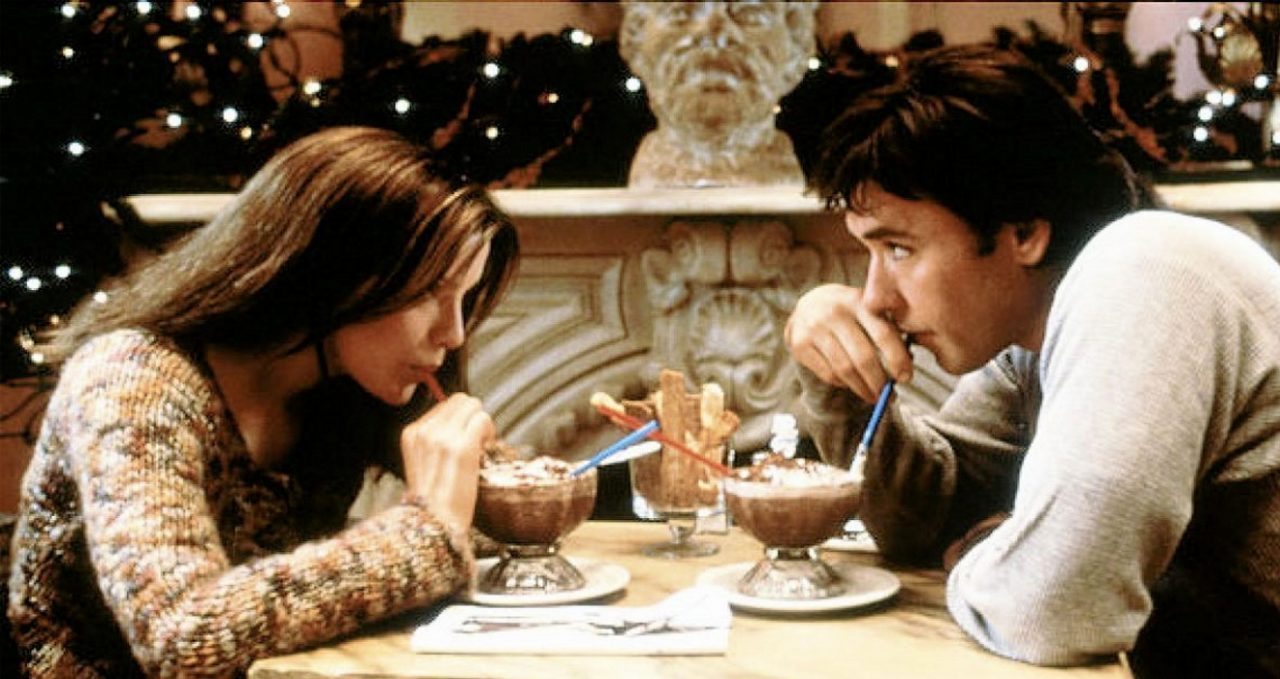
It begins with a classic meet-cute for Jonathan Trager (John Cusack) and Sara Thomas (Kate Beckinsale), both Christmas shoppers after a pair of gloves at Bloomingdale’s. Despite already having partners, there’s an instant connection as they have dessert together at a restaurant called Serendipity 3, and while Jonathan is quick to acknowledge it, Sara is more hesitant and unconvinced that they were “destined” to meet. Using a dollar bill, a book, and an elevator, she decides to test fate a bit too far, and the two potential lovebirds go their separate ways. Fast forward a few years, and both of their relationships have progressed to engagement. Yet, there’s also a gnawing sense of what-could-have-been, and they both decide to search out what might be destiny.

See the source image

No romantic comedy can be successful without two appealing leads, and Cusack and Beckinsale have marvelous chemistry together, that hard-to-define bond that simply either works or doesn’t. It definitely works here, and I could see how their short time together at the beginning could give them pause on whether this stranger might be “the one.” Beckinsale is lovely as always, though for some reason, even with his sweetly obsessive role in Say Anything, neither I nor my VC thought of Cusack as a romantic lead, yet he affably fills the kind of role that could have gone to Tom Hanks a few years earlier.

The dialogue may not be on the level of Nora Ephron’s, but there’s a good number of chuckles along the way as Jonathan and Kate go on a scavenger hunt for clues as to where their mystery lover might be. Eugene Levy puts in an amusingly offbeat side role, while Jeremy Piven and Molly Shannon are perfect companions in trying to keep the two star-crossed lovers relatively grounded. The themes of fate vs. coincidence are nicely laced throughout as well, sometimes for comedy (“Maybe the absence of signs is a sign!”) but also in more thoughtful ways, especially how the audience gets to see connections and near-misses that the characters don’t.

See the source image

I wasn’t sure exactly how much I liked Serendipity at first. One minorly major complaint was in how Jonathan and Sara’s other love interests are treated. Usually, this kind of movie shows that the initial relationship is doomed from the start, making the breakup inevitable, but while that is the case with Sara and her weird fluting boyfriend, Jonathan’s alternative girl is a little too viable a match, making me feel sorry for her by the end. I thought that might be a deal-breaker for me in deciding Serendipity’s ranking, but after seeing it a second time with my VC (who also enjoyed it), it’s a minor complaint in an otherwise satisfying romance. Predictable but very watchable, it falls a bit short of my absolute favorite rom coms, but I’ve come to value any movie that leaves me smiling by the end.

Best line: (Jonathan’s friend Dean) “If you want to improve, be content to be thought foolish and stupid.”


Ranking: List-Worthy


© 2017 S.G. Liput
522 Followers and Counting


A Merry Christmas to all and to all a good night!

45 Years (2015)

20 Wednesday Dec 2017

Posted by sgliput in Movies, Poetry, Reviews, Writing

≈ 2 Comments

Tags

Drama, Triple A

See the source image

A tree that grows as decades fly
Has proved its will to live.
And most may think a tree so high
Will yield all it can give.

Indeed it may, as many do,
Its strength confirmed by age,
But age can also rot it through,
A cancer hard to gauge.

We cannot know its fortitude
Until the tempest blows,
And if its weakened roots protrude,
Then everybody knows.
_______________

MPAA rating: R (for language and a bedroom scene)

I can usually admire what I call Triple A movies, those that are All About the Acting, but even the best actors need a worthwhile story to tell. I had hoped 45 Years would have the right combination, but not so. This golden-years pairing of Tom Courtenay and Charlotte Rampling has a pretty simple concept and doesn’t expand too much on it, filling the performances with subtlety but leaving the plot an unsatisfying bore.

See the source image

Norfolk retirees Kate (Rampling) and Geoff Mercer (Courtenay) are approaching their 45th anniversary, only to have their bucolic married bliss disturbed by a letter informing Geoff that the body of his former sweetheart in the ‘60s has been found frozen in a Swiss glacier. Geoff had told Kate about how he had lost his girlfriend Katya in an accident, so this isn’t too much of a surprise, but the flood of memories from this news overcomes Geoff and makes him obsess over his days with Katya. This sets off a chain of false fronts and hidden distress as Geoff says he’s all right but won’t let Katya and Switzerland go, while Kate insists it doesn’t bother her even though she’s clearly troubled.

The two stars carry off this slow escalation of emotion with expert nuance, and I can see why they were both nominated for several awards, with Rampling winning far more than Courtenay. Yet, as Kate’s irritation comes to a head, her deep-seated insecurity seems rather overblown considering that the whole film takes place over the course of a single week. If Geoff were to continue his preoccupation with Katya for weeks or months, I could better understand Kate’s objections, but shouldn’t she give him a chance to grieve when his buried sorrow is unearthed? I realize she loses some trust at his half-truths, but she takes it all much too personally. I mean, does she really expect to lose her husband of 45 years to a dead woman? By the end, it doesn’t matter how sincere Geoff’s professions of love seem; she’s let her unquieted doubts ruin her 45th anniversary, probably for nothing.

See the source image

Perhaps that’s the point (or should be) of this well-made and melancholy film, the danger of letting little troubles eat away at your inner peace, as when Kate sloughs off a potential source of agitation but adds on the word “Still….” That’s a worthwhile moral, but the film doesn’t pull it off as well as it could have. Looking back at it, the news Geoff got was only a big deal because their lives were so boring and uneventful. With 97% approval, Rotten Tomatoes describes 45 Years as a gem “for fans of adult cinema,” so perhaps I’m not adult enough to overlook the flimsy reason for this story to even be worth telling.

Best line: (Geoff) “What? You really believe you haven’t been enough for me?”   (Kate) “No. I think I was enough for you, I’m just not sure you do.”


Rank:  Dishonorable Mention


© 2017 S.G. Liput
520 Followers and Counting


Creed (2015)

19 Tuesday Dec 2017

Posted by sgliput in Movies, Poetry, Reviews, Writing

≈ 2 Comments

Tags

Drama, Sports

See the source image

When all the world is calling you
A mere mistake, appalling you
And casting cruel and galling new
Abuse upon your back,

Perhaps you want to rage and hit
Or simply disengage and quit
Or seek out wars to wage a bit
Till no one’s left to smack,

But if you see through all the slights
And find the wherewithal that writes
A bigger man for taller fights,
You’ll scoff at their attack.
________________

MPAA rating: PG-13

The Rocky franchise has certainly had its ups and downs over the years, and despite some positive aspects, 2006’s Rocky Balboa was a downer for me, which is why it took me this long to give its 2015 follow-up Creed a chance. Here, Sylvester Stallone’s iconic character is now a secondary player in the story of Adonis Creed (Michael B. Jordan), the illegitimate son of his old friend and rival Apollo. Adonis chooses the family business of boxing, much to the chagrin of his adopted mother/Apollo’s wife (Phylicia Rashad), and Rocky grudgingly becomes the trainer of this hotheaded rising star as he seeks to make a name for himself separate from that of his famous father.

See the source image

I’ll say up front that Creed is probably the best directed of all the Rocky movies, with Ryan Coogler proving himself as a highly proficient talent behind the camera, giving me high expectations for the upcoming Black Panther. He changes the aesthetic of the series a bit to reflect his black protagonist, but also adds impressive tracking shots and an elegance to the camera movements and shot composition, which I suppose are also credited to cinematographer Maryse Alberti. The actual boxing scenes are just a fraction of the film’s rather long runtime, but they pack a “punch.” I’d say they’re some of the finest boxing scenes on film, particularly Adonis’s first official fight, which is marvelously captured as one continuous shot from start to finish.

Likewise, the performances measure up to the production quality, with Jordan and Stallone making the most of their conflicted characters. Jordan isn’t as luggishly lovable as Stallone was in his first outing, but his connection with the Italian Stallion, whom he fittingly calls “Unc,” is still engaging, as is his journey of finding a balance between distancing himself from and embracing the name of the father he never knew. Oscar-nominated again, Stallone steps easily into the trainer role Burgess Meredith played so well in the original, amusingly old-fashioned in the modern world but preserving some of the classic training methods that served him well. The script’s best parallel between the two comes when Rocky’s health takes an inevitable downturn, and Adonis encourages Rock to fight just like the young boxer he’s training. Because of that theme and despite Rocky’s being older and wearier here than in Rocky Balboa, Creed manages to be somehow far less depressing than that movie.

See the source image

(I don’t know if it’s worth a spoiler warning for films that came out thirty-plus years ago, but spoilers in this paragraph.) The Rocky sequels can easily be accused of just killing off characters for the sake of some drama, starting with Mickey in Rocky III and followed by Apollo in Rocky IV, but Creed successfully deepens the tragedy of Apollo’s death in the fourth film. It meant he wasn’t there for his kids and that, even if he died a legend, he could have lived as a father. His shadow hangs over Adonis’s budding career, and the way it shapes him in the end makes for an inspiring conclusion to rival any of the previous Rocky films.

All that said, Creed doesn’t measure up in one big way, the music. For a series that gave us iconic montages to outstanding theme songs like “Eye of the Tiger” and “No Easy Way Out,” there’s nothing even remotely that good in the musical department. Adonis’s girlfriend (Tessa Thompson from Thor: Ragnarok) is even a musician, but the hip hop and rap are pale modern shadows of those good ole ‘80s tunes.

See the source image

Thus, Creed isn’t my favorite of the Rocky series, but its superior quality tells me it should be high. Despite some differences in tone and style, it has all the familiar underdog elements of a Rocky movie and even ends pretty comparably to the first. You know what? I’m done trying to separate these in my Top 365 List, which I usually only do for series where the quality varies widely between installments. Rocky IV may not be on the same technical level as this or the Oscar-winning original, but I still enjoy it. Therefore, I’m just going to group Creed with the other “good” Rocky movies, which I consider to be Rocky through Rocky IV. Creed succeeds where Rocky V and Rocky Balboa failed, and I personally hope the saga ends here. Stallone had planned to direct another sequel, but after his being caught up in the recent Hollywood accusation scandals, that may not happen, which I think is for the best. Leave both the new and the old Rocky on a high note.

Best line: (Rocky, pointing to Adonis’s reflection in the mirror) “That’s the toughest opponent you’re ever going to have to face.”


Rank: List-Worthy


© 2017 S.G. Liput
520 Followers and Counting


The Disappearance of Haruhi Suzumiya (2010)

18 Monday Dec 2017

Posted by sgliput in Movies, Poetry, Reviews, TV, Writing

≈ Leave a comment

Tags

Animation, Anime, Christmas, Drama, Mystery, Sci-fi

See the source image

The world can vex,
Annoy, perplex,
Explicitly and in subtext,
Till one objects
“Life’s too complex!
Just pain in our collective necks.”

Yet when life’s skewed
And comes unglued
And changes unforeseen intrude,
One’s sour mood
And attitude
Can be renewed by gratitude.
___________________

MPAA rating: Not Rated (should be PG-13)

Setting aside the multitude of stand-alone anime films, like those from Studio Ghibli, there are just as many movies based on anime series, which tend to fall into certain categories. There are those that essentially provide a recap for the series, such as the first two films based on Puella Magi Madoka Magica. Then there are those that tie into a series but can stand apart and be enjoyed with or without prior knowledge of the franchise, such as Cowboy Bebop: The Movie. But more often than not, a film designed to follow up the events of a TV series relies on previous knowledge of said series, which is hard to get just right. Sometimes it’s difficult to capture the same magic the show had or the spin-off just falls flat; as much as I loved the time travel story of Steins;Gate, for example, its reasonably good film continuation didn’t feel necessary. (By the way, I highly recommend all these shows I’m namedropping.) Yet if any movie proves that it’s possible to revive a series and deepen everything that came before, it’s The Disappearance of Haruhi Suzumiya.

See the source image

For those who don’t know, The Melancholy of Haruhi Suzumiya is a 2006 anime adaptation of a light novel series, which quickly grew in popularity, and its title character is one of the more recognizable anime icons. The main character, though, is Kyon (in the middle above), a high school student who falls into the orbit of the lovely, pushy, and highly capricious Haruhi (with the headband), involuntarily becoming a member of her new fun-seeking club dubbed the SOS Brigade. The other three club members Haruhi recruits turn out to be less-than-normal students and inform Kyon that Haruhi has godlike powers to reshape reality, which she doesn’t and mustn’t know about. Thus, the 2-season series follows their everyday adventures with the robot-like alien observer Yuki Nagato (the girl with purple hair), the time-traveling pushover Mikuru Asahina (girl with orange hair), and the good-natured but mysterious esper/psychic and king of exposition Itsuki Koizumi (the boy on the far left).

All of that information is much easier to digest in the series, which is light-hearted and charming for the most part. Haruhi tends to be obnoxiously bossy, such as exploiting poor Miss Asahina for sex appeal, but her craziness is nicely contrasted by Kyon’s straight man, who always complains and offers some perfectly amusing deadpan commentary. It’s a series that periodically incorporates science fiction into its prosaic high school setting and can be both fantastically complex and aggressively mundane, such as one episode with a four-minute stretch of nothing but Nagato silently reading or the infamous Endless Eight, in which eight consecutive episodes replayed the same events because the characters were stuck in a time loop. (The show gets a lot of heat and accusations of laziness for the Endless Eight, but it’s actually pretty impressive that the animators found eight different ways to present the same events and redrew each one.)

See the source image

If you’re not sure if all this sounds worth watching, it is, and not just because there’s a murder mystery and a talking cat and a giant alien cricket. It’s not because Melancholy itself is particularly amazing or great, though it is pretty entertaining. It’s because the show allows you to fully enjoy The Disappearance of Haruhi Suzumiya, the 2010 movie that supposedly drew plot from season 2 and forced the showrunners to fill time with the Endless Eight. It’s quite a feat that the movie makes the show worth watching, rather than the other way around. I honestly can’t think of another series-based movie that can say the same.

I’ve heard all kinds of praise for Disappearance, with fans naming it their favorite anime movie or claiming it ought to place in iMDB’s Top 250 (it’s currently #42 on iMDB’s animation list). And now that I’ve seen it, I can’t say I disagree. It’s an outstanding piece of animation that surpassed my expectations in every way. As the title indicates, Haruhi suddenly vanishes on December 18 (yes, I waited till today to post this review), the world apparently rewritten so that no one remembers her, except for Kyon, who is understandably perplexed at this inexplicable change. All the supernatural characters seem to be ordinary people now, and Kyon must figure out how to return the world to “normal” and perhaps even question which world is better.

See the source image

One of the more notable aspects of Disappearance is that it’s 163 minutes long, making it the second longest animated film of all time. It’s basically the equivalent of eight episodes of the series, yet despite its length, I was never bored. It’s hard to explain how unusual that is because the film is by no means action-packed. In contrast to the humor of the series, its tone is slow, serious, and melancholy. Unlike most anime films, there are no sweeping vistas or high-flying adventure; instead, it’s mostly winter cityscapes and interior scenes. How is it then that it held my attention from start to finish?

Well, aside from the fact that I’ve grown very fond of these characters, the plot manages to maintain interest in both the story and characters with some truly incredible pacing. Even with such a long runtime, there’s a lot of plot to cover, and the increased time allows characters’ motivations and the significance of their actions to sink in and add so much to their development. I don’t usually like to watch long movies, but this is one case where its length is carried largely by narrative and dialogue alone, and I’m glad nothing was cut, though I suppose Kyon’s awkward disorientation over his changed life could have been shortened.

See the source image

Whenever the pace threatens to lag, something significant is revealed and the moving orchestral score kicks in, making for some memorable scenes that feel like momentous turning points (the kind of scenes that would probably end an episode if this were broken up as part of the series). For example, the reappearance of one murderous character who should be dead is filled with the same looming menace as the coming of Jaws. In addition, despite the restraint compared with more fantastical anime, the animation is exceptional and quite detailed, with special attention paid to very expressive faces and the clouds of smoke that are breathed out in the cold Christmastime weather.

As much as I wish I could say to everyone “go watch this movie” with no strings attached, I must admit that the series is a prerequisite for understanding who everyone is. Even though seventeen minutes are spent establishing the status quo before Haruhi’s disappearance, almost every episode of the show is referenced at some point, which is great for those who’ve seen it, less so for those who haven’t. To cut some corners, I’d say you’d only really have to watch the first six episodes of season 1, the first episode of season 2, and the last entry in the Endless Eight. The rest aren’t as necessary, though you may not understand little things like Kyon trying to talk to a cat. I especially loved when time travel entered the equation of the film, and we got to revisit past scenes with a Back to the Future-style altered perspective, again something new viewers could just roll with but nostalgic viewers will understand better.

See the source image

Despite its potentially burdensome length, The Disappearance of Haruhi Suzumiya is a brilliant conclusion to a good series, transforming the show’s bright charm into subtle emotion and atmosphere. Hyperactive Haruhi herself can be irritating in large doses, so her absence for part of the film actually helps it and allows for some strong development for Kyon and especially Nagato, whose typically robotic face and voice finally get to reveal emotion in this alternate world. I also must point out, as others have before, that the English dub is one of the best out there. As the most significant voice actor, Crispin Freeman as Kyon provides some extensive and superb dialogue, such as an 8-minute soliloquy justifying a fateful decision, one which manages to engender both sympathy for him and regret for how it impacts another character. I’ve seen people refer to this speech as one of the greatest interior monologues of all time and with good reason, as it’s a key validation of his character.

I can usually tell how I feel about an animated film by whether I want to immediately watch it again after it’s over, and yes, all 163 minutes of Disappearance did just that. No, it’s not my new favorite anime film, but to those hesitant to watch a series just to see an overlong movie, I’ll just say you’re missing out.

See the source image

Best line: (Haruhi, to Kyon about Christmas) “You have to believe in a dream if you want to have one in the first place. If you don’t believe, even the dreams that can come true won’t.”


Rank: List-worthy


© 2017 S.G. Liput
519 Followers and Counting


← Older posts
Newer posts →

Recent Posts

  • We Didn’t Start 2025 (Recap)
  • NaPoWriMo 2025 Recap (Finally)
  • Sonic the Hedgehog 3 (2024)
  • It Happened One Night (1934)
  • Spellbound (2024)

Recent Comments

associatesofshellymann's avatarassociatesofshellyma… on My Top Twelve La La La So…
Kit's avatarKit Nichols on Bonnie and Clyde (1967)
lifelessons's avatarlifelessons on Look Back (2024)
Carol Jackson's avatarCarol Jackson on The Thief of Bagdad (1940…
Stephen's avatarStephen on Love Story (1970)

Archives

  • January 2026
  • December 2025
  • May 2025
  • April 2025
  • March 2025
  • February 2025
  • January 2025
  • December 2024
  • May 2024
  • April 2024
  • March 2024
  • February 2024
  • January 2024
  • December 2023
  • November 2023
  • October 2023
  • September 2023
  • July 2023
  • June 2023
  • May 2023
  • April 2023
  • March 2023
  • February 2023
  • January 2023
  • December 2022
  • November 2022
  • October 2022
  • September 2022
  • August 2022
  • July 2022
  • June 2022
  • May 2022
  • April 2022
  • March 2022
  • February 2022
  • January 2022
  • December 2021
  • November 2021
  • October 2021
  • September 2021
  • August 2021
  • July 2021
  • June 2021
  • May 2021
  • April 2021
  • March 2021
  • February 2021
  • January 2021
  • December 2020
  • November 2020
  • October 2020
  • September 2020
  • August 2020
  • July 2020
  • June 2020
  • May 2020
  • April 2020
  • March 2020
  • February 2020
  • January 2020
  • December 2019
  • November 2019
  • October 2019
  • September 2019
  • August 2019
  • July 2019
  • June 2019
  • May 2019
  • April 2019
  • March 2019
  • February 2019
  • January 2019
  • December 2018
  • November 2018
  • October 2018
  • September 2018
  • August 2018
  • July 2018
  • June 2018
  • May 2018
  • April 2018
  • March 2018
  • February 2018
  • January 2018
  • December 2017
  • November 2017
  • October 2017
  • September 2017
  • August 2017
  • July 2017
  • June 2017
  • May 2017
  • April 2017
  • March 2017
  • February 2017
  • January 2017
  • December 2016
  • November 2016
  • October 2016
  • September 2016
  • August 2016
  • July 2016
  • June 2016
  • May 2016
  • April 2016
  • March 2016
  • February 2016
  • January 2016
  • December 2015
  • November 2015
  • October 2015
  • September 2015
  • August 2015
  • July 2015
  • June 2015
  • May 2015
  • April 2015
  • March 2015
  • February 2015
  • January 2015
  • December 2014
  • November 2014
  • October 2014
  • September 2014
  • August 2014
  • July 2014
  • June 2014
  • May 2014
  • April 2014
  • March 2014
  • February 2014
  • January 2014
  • December 2013

Categories

  • Blindspot
  • Blogathon
  • Christian
  • Movies
  • Music
  • NaPoWriMo
  • Poetry
  • Reviews
  • TV
  • Writing

Meta

  • Create account
  • Log in
  • Entries feed
  • Comments feed
  • WordPress.com

Recent Posts

  • We Didn’t Start 2025 (Recap)
  • NaPoWriMo 2025 Recap (Finally)
  • Sonic the Hedgehog 3 (2024)
  • It Happened One Night (1934)
  • Spellbound (2024)

Recent Comments

associatesofshellymann's avatarassociatesofshellyma… on My Top Twelve La La La So…
Kit's avatarKit Nichols on Bonnie and Clyde (1967)
lifelessons's avatarlifelessons on Look Back (2024)
Carol Jackson's avatarCarol Jackson on The Thief of Bagdad (1940…
Stephen's avatarStephen on Love Story (1970)

Archives

  • January 2026
  • December 2025
  • May 2025
  • April 2025
  • March 2025
  • February 2025
  • January 2025
  • December 2024
  • May 2024
  • April 2024
  • March 2024
  • February 2024
  • January 2024
  • December 2023
  • November 2023
  • October 2023
  • September 2023
  • July 2023
  • June 2023
  • May 2023
  • April 2023
  • March 2023
  • February 2023
  • January 2023
  • December 2022
  • November 2022
  • October 2022
  • September 2022
  • August 2022
  • July 2022
  • June 2022
  • May 2022
  • April 2022
  • March 2022
  • February 2022
  • January 2022
  • December 2021
  • November 2021
  • October 2021
  • September 2021
  • August 2021
  • July 2021
  • June 2021
  • May 2021
  • April 2021
  • March 2021
  • February 2021
  • January 2021
  • December 2020
  • November 2020
  • October 2020
  • September 2020
  • August 2020
  • July 2020
  • June 2020
  • May 2020
  • April 2020
  • March 2020
  • February 2020
  • January 2020
  • December 2019
  • November 2019
  • October 2019
  • September 2019
  • August 2019
  • July 2019
  • June 2019
  • May 2019
  • April 2019
  • March 2019
  • February 2019
  • January 2019
  • December 2018
  • November 2018
  • October 2018
  • September 2018
  • August 2018
  • July 2018
  • June 2018
  • May 2018
  • April 2018
  • March 2018
  • February 2018
  • January 2018
  • December 2017
  • November 2017
  • October 2017
  • September 2017
  • August 2017
  • July 2017
  • June 2017
  • May 2017
  • April 2017
  • March 2017
  • February 2017
  • January 2017
  • December 2016
  • November 2016
  • October 2016
  • September 2016
  • August 2016
  • July 2016
  • June 2016
  • May 2016
  • April 2016
  • March 2016
  • February 2016
  • January 2016
  • December 2015
  • November 2015
  • October 2015
  • September 2015
  • August 2015
  • July 2015
  • June 2015
  • May 2015
  • April 2015
  • March 2015
  • February 2015
  • January 2015
  • December 2014
  • November 2014
  • October 2014
  • September 2014
  • August 2014
  • July 2014
  • June 2014
  • May 2014
  • April 2014
  • March 2014
  • February 2014
  • January 2014
  • December 2013

Categories

  • Blindspot
  • Blogathon
  • Christian
  • Movies
  • Music
  • NaPoWriMo
  • Poetry
  • Reviews
  • TV
  • Writing

Meta

  • Create account
  • Log in
  • Entries feed
  • Comments feed
  • WordPress.com

Blog at WordPress.com.

  • Subscribe Subscribed
    • Rhyme and Reason
    • Join 814 other subscribers
    • Already have a WordPress.com account? Log in now.
    • Rhyme and Reason
    • Subscribe Subscribed
    • Sign up
    • Log in
    • Report this content
    • View site in Reader
    • Manage subscriptions
    • Collapse this bar