• Home
  • About Me
  • The List
  • THE LIST (2016 Update)
  • THE LIST (2017 Update)
  • THE LIST (2018 Update)
  • THE LIST (2019 Update)
  • THE LIST (2020 Update)
  • THE LIST (2021 Update)
  • THE LIST (2022 Update)
  • Top Twelves and More
  • The End Credits Song Hall of Fame

Rhyme and Reason

~ Poetry Meets Film Reviews

Rhyme and Reason

Category Archives: Poetry

Rashomon (1950)

21 Saturday Nov 2015

Posted by sgliput in Blogathon, Movies, Poetry, Reviews, Writing

≈ 1 Comment

Tags

Drama, Foreign


While weather is windy and bitterly pouring,
Four stories are told when the truth needs exploring,
Four different accounts with the witnesses warring,
But no outright answer for askers imploring.
While some simply welcome whatever’s not boring,
The doubt is too heavy for easy ignoring.
Both lies and the truth can leave consciences roaring,
But everyone’s faith is in need of restoring.
_________________

MPAA rating: Not Rated (should be PG for mature themes)


This is a last-minute contribution to the Criterion Blogathon, hosted by Criterion Blues, Speakeasy, and Silver Screenings, in order to honor the old and new film classics selected by the Criterion Collection. After thoroughly admiring Akira Kurosawa’s epic Seven Samurai, I thought I might check out his earlier work, in this case Rashomon, the film that sparked pioneering interest in Asian cinema throughout the West. The story of Rashomon is simple yet profound, intimate yet eclectic, an art film with plenty of moral insight and a technique that has inspired everything from Western remakes (The Outrage, Hoodwinked!) to TV episodes (such as Star Trek: The Next Generation’s “A Matter of Perspective”).

Rashomon itself is an abandoned gate between Kyoto and Nara, though its name always sounds to me like a character from Digimon. The rain-drenched frame story allows a woodcutter and a priest to recount a trial they just witnessed to a surly passerby as they all take shelter beneath the decrepit Rashomon gate. The two watched as the infamous bandit Tajōmaru was tried for the murder of a samurai and the rape of his wife, and both are clearly shaken, having had their faith in humanity cast in doubt.

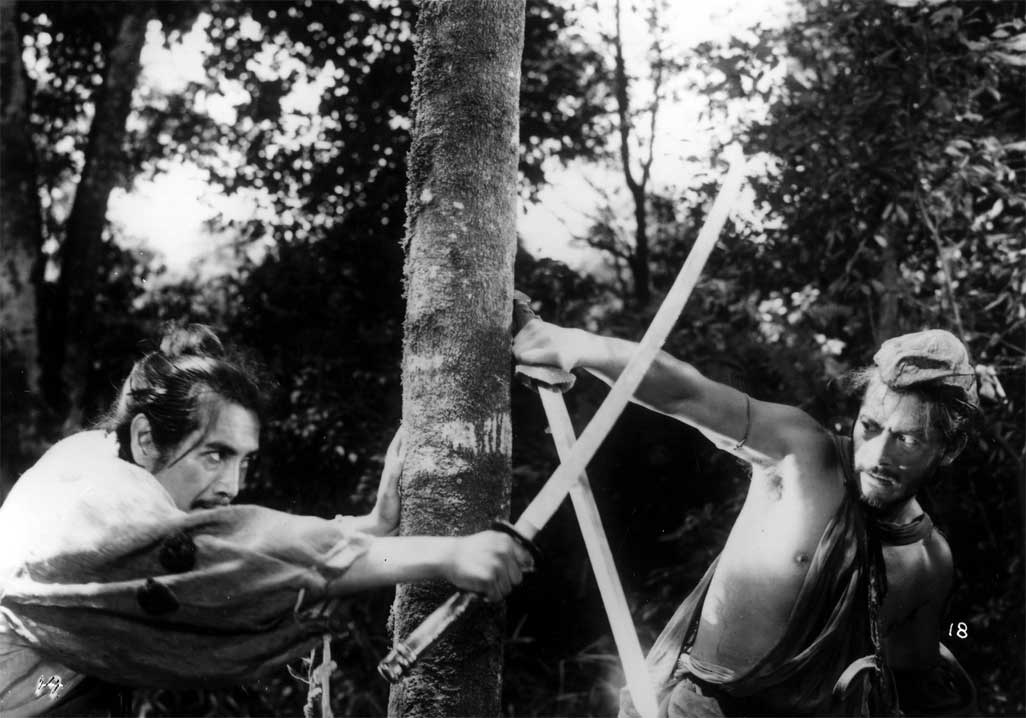
What follows are four stories of the fateful encounter from four different perspectives. All have the same outcome, yet none are the same. The bandit (Toshiro Mifune of Seven Samurai and other Kurosawa projects) boasts about his daring, recounting an admittedly impressive swordfight against the samurai (Masayuki Mori) after having his way with the woman (Machiko Kyō). The woman ignores any mention of a fight and casts herself as a victim of both men. The samurai may be dead, but a possessed medium explains his viewpoint with rather disturbing behavior, casting more blame on the woman than on the bandit. And then there’s the truth. Or is it? While the final tale seems to be the most plausible in spreading the guilt around, there’s still the smack of hypocrisy, and one can’t help but wonder what all four may be leaving out to suit their own point of view. Ambiguity and doubt are prevalent, yet Kurosawa doesn’t try to discount morality in general through his questioning of what really happened. The world may be full of liars, but human kindness can still have its say.

In addition to its morally debatable themes, Rashomon is also noted for its cinematography and tight editing. As commendable as these are, the film does embrace certain excesses in the way it is told. The opening scene, for example, in which the woodcutter wanders through the dense forest foliage before coming upon the crime scene, is meant to build tension and recall the silent film era, but it unfortunately drags, just one scene that stretches the audience’s patience to the edge of boredom. While much of the acting is subtle and faultless, other moments are acutely overacted, such as the crazy outbursts of two of the players and the woman’s incessant sobbing. These criticisms can doubtless be attributed to the acting conventions of the time, since this film is far from the only aged offender in that regard.

Yet despite the shortcomings of individual scenes, Rashomon is still the classic so many critics have hailed, well deserving of its honorary Academy Award five years before the Oscar for Best Foreign Language Film was established. Influential in its uncertainty and thought-provoking in its divergent narrative, Rashomon helped to solidify Kurosawa as an esteemed director the world over.

Best line: (the surly peasant, defending yet impugning everyone from liars to storytellers) “I don’t mind a lie if it’s interesting.”


Rank: List Runner-Up


© 2015 S. G. Liput

345 Followers and Counting


Guardians of the Galaxy (2014)

19 Thursday Nov 2015

Posted by sgliput in Movies, Poetry, Reviews, Writing

≈ 1 Comment

Tags

Action, Comedy, Sci-fi, Superhero


While Iron Man, Thor, and the heroes we know
Are saving the planet from many a foe,
Way out in the cosmos, a misfit or five
Are trying to stay on their toes and survive.

One’s seeking revenge, two are out for the loot,
One’s plotting betrayal, and the last’s in pursuit
Of a powerful stone that is death’s guarantee
If it falls in the hands of a villainous Kree.

Five mavericks not fitting the hero-type mold,
Five pasts black as sin and five hearts made of gold,
May find that a battle alongside a friend
Can give them a reason to bond and defend.
_______________

MPAA Rating: PG-13


Everyone seems to love Guardians of the Galaxy. Coworkers, friends, critics, and random bloggers were singing its praises last year, and I was eager to see it in the theater. Unfortunately, I knocked a sideview mirror off my dad’s car, and the movie money went elsewhere. So when I finally got to see it on DVD, I was ready to be impressed, and though I wanted it to be the best Marvel movie yet, well, it wasn’t.

Don’t get me wrong. It’s an enjoyable space ride of an origin story, yet perhaps my expectations were a bit too high. I had hoped for constant laughs, but the script seemed to be trying too hard at times (the fake laugh, for example). I can’t help but wonder if my appreciation might have been heightened by seeing it in the theater, where I could have shared in that unique experience of an entire audience laughing out loud (like how my mom has described her 8-½ screenings of Star Wars back in 1977). The story was also so crammed full of unfamiliar information with Xandarians and Ravagers and varied motivations that I couldn’t completely keep up, and my VC was totally lost at times. I know we’re supposed to just roll with it and enjoy it and let future viewings show how layered and intricate it is, but being confused can detract from a film’s enjoyment.

Okay, complaints aside, I’m glad to say that I saw it again, and my opinion has improved. I still don’t believe it’s Marvel’s best film, but it is up there. For some reason, the humor was much more appealing this time, and I was able to follow the plot more fully, and I can admit that Guardians of the Galaxy is a small miracle. Iron Man was never as popular as Batman or Superman, but at least people had heard of him. When Marvel gambled on an entire film dedicated to a rebooted superhero team from as recent as 2008, most non-comic experts went “Who?,” a joke the film itself toys with right from the start. Without widespread knowledge of these characters, the filmmakers were able to flesh them out in their own way, with lots of quick-mouthed humor along the way.

The film is full of strengths, from the nostalgic, retro-cool soundtrack of 1970s tunes to spot-on performances from the main cast: heroic rogue Peter Quill (Chris Pratt), assassin with a heart Gamora (Zoe Saldana, continuing her apparent attempt to star in every major franchise), literal-minded avenger Drax the Destroyer (wrestler Dave Bautista), experimental raccoon Rocket (Bradley Cooper), and lovable living tree Groot (Vin Diesel, who could probably have been replaced by anyone who could say three words in a deep voice). The special effects are phenomenal, particularly the final battle and the CGI creation of Rocket and Groot, who are both surprisingly endearing. As I said, there is a lot, and I mean A LOT going on, but my second viewing allowed me to recognize the impressive balance between nonstop action, spitfire wit, and sweet character moments, like Groot’s flower gift or Drax’s comforting of Rocket. (Who didn’t want to pet him after all?) I also noticed a potential recurring gag when Quill states he has 12% of a plan; remember the beginning of The Avengers, when Tony offers 12% of the credit for Stark Tower to Pepper? Hmm.

It’s true that it’s not perfect. The villains Ronan and Nebula (Lee Pace and Karen Gillan) are generic baddies, people can somehow survive exposure to space, the bigger names like Benicio del Toro as the Collector (also Glenn Close and John C. Reilly) are vastly underused, and it might have been more kid-friendly considering it’s gotten its own animated spin-off series. Yet these gripes matter little amidst the fun of escaping a weightless prison or dive-bombing an attacking spaceship. Guardians of the Galaxy throws a lot at the screen, and most of it sticks to provide a fun space adventure that’s part Star Wars, part Marvel, but mostly its own unique adventure.

Best line: (Gamora) “I’m a warrior, an assassin. I don’t dance.” (Peter) “Really? Well, on my planet, we have a legend about people like you. It’s called Footloose. And in it, a great hero named Kevin Bacon teaches an entire city full of people with sticks up their butts that dancing, well, is the greatest thing there is.”  (Gamora) “Who put the sticks up their butts? That is cruel.”


Rank: List-Worthy


© 2015 S. G. Liput

344 Followers and Counting


The Miracle Worker (1962)

15 Sunday Nov 2015

Posted by sgliput in Movies, Poetry, Reviews, Writing

≈ 3 Comments

Tags

Drama, History, Triple A

Darkness in the light of day,
Silence in the loudest noise.
Close and also faraway,
Vacant at the gladdest joys,

Only feeling with the hand,
Needing, taking in the dark,
Slow to know or understand
And lacking means to try till hark!

A firmer hand arrives to guide,
A stronger arm, both cruel and kind,
To teach the words she’d been denied
And show them all love isn’t blind.
_________________

MPAA rating: the equivalent of G

True life stories are often the most inspiring, and one of the most incredible is the life of Helen Keller. Born healthy but struck deaf and blind by a childhood infection, she grew up in total darkness, knowing the world solely through touch. She had no concept of light or love or even that objects had names, and yet she grew to be an accomplished author and lecturer (and apparently introduced the Akita dog to the U.S. Who knew?). As I read her autobiography The Story of My Life, her diction and facility of language make it hard to believe that she once had no understanding of it whatsoever. Her story is and has been a true inspiration for the handicapped, and The Miracle Worker brilliantly presents her difficult early years.

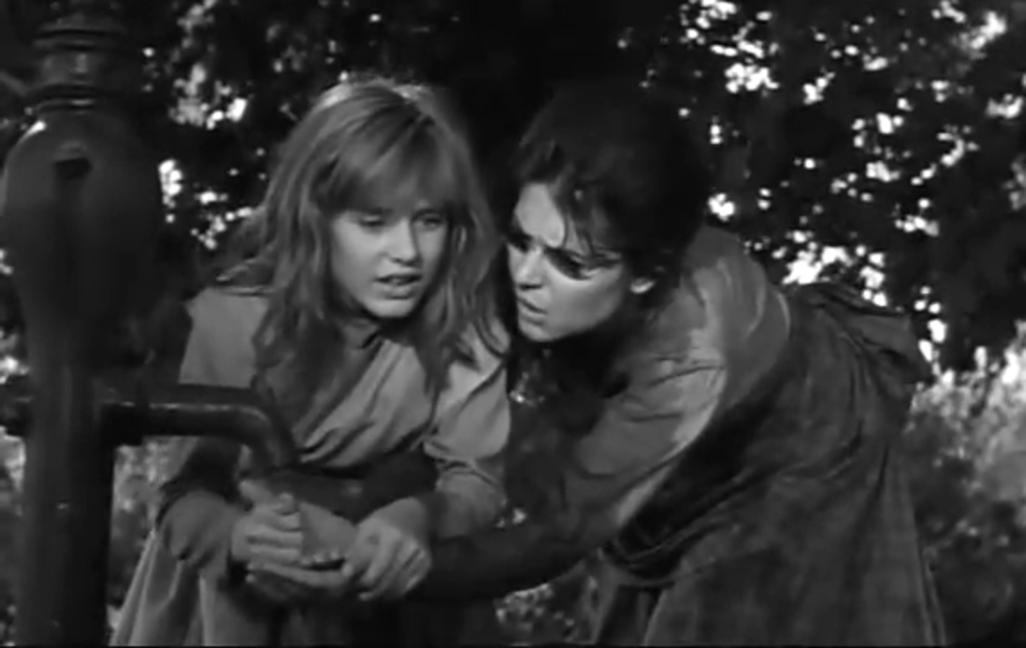
Both Patty Duke and Anne Bancroft won Oscars for their surprisingly physical roles, Duke as the young Keller and Bancroft as her tenacious teacher Anne Sullivan. The film very much reflects Keller’s memoirs, focusing solely on her tumultuous childhood and initial relationship with Sullivan. Duke acts convincingly detached as she gropes her way along, oblivious to the significance of what she touches yet petulant and violent when annoyed. She grabs food from others’ plates and locks people in rooms, while her parents cite her handicaps as a good reason to tolerate her behavior. Enter Ms. Sullivan. Her history with blindness gives her a special sympathy, yet her Irish temperament puts her at odds with Helen’s surliness and her parents’ enabling. Bancroft in particular deserved her Oscar; she exhibits the patience of Job as she reins Helen in, wrestles with her just to get her to hold a spoon, and deals with the uncertainty of teaching a seemingly unteachable pupil.

Boasting a 100% on Rotten Tomatoes, The Miracle Worker depicts quite the extraordinary relationship between a student who doesn’t know how to be taught and a teacher who sees potential no one else can. After an initially overacted introduction, everyone slips into perfectly natural roles from Helen’s antagonistic father (Victor Jory) to her concerned mother (Inga Swenson), all dwarfed by the two lead performances. When that “ah-ha” moment finally arrives with the hard-won breakthrough, the celebration feels genuine and earned and meant as only the beginning of Helen’s progress. It’s interesting to note that while Patty Duke won an Oscar playing Keller, she later won an Emmy playing Ms. Sullivan, opposite Little House on the Prairie’s Melissa Gilbert. Whenever an uninformed viewer wonders who that woman on the Alabama state quarter was, The Miracle Worker will give them a new appreciation for Helen Keller and the educator who opened the world to her.

Best line: (Anne) “It’s less trouble to feel sorry for her than it is to teach her anything better.”

Rank: List-Worthy

© 2015 S. G. Liput

344 Followers and Counting

The Hundred-Foot Journey (2014)

08 Sunday Nov 2015

Posted by sgliput in Movies, Poetry, Reviews, Writing

≈ 5 Comments

Tags

Comedy, Drama, Family

One hundred feet can be a wall if those on either side of it
Insist the other is a foe too slow or stubborn to submit.

One hundred feet can be a window hewn by wisdom through the wall,
To let the foes perhaps perceive a new perspective to it all.

One hundred feet can be a door where friends once foes come face to face,
Where worlds combine to mix and dine, and fresh potential finds a place.

One hundred feet can be a line between suspicion and respect;
One hundred feet can separate or help two cultures to connect.
_________________

Rating: PG

There aren’t too many food-centric movies that get special advertising on the Food Network (Julie and Julia was the last I can recall), but The Hundred-Foot Journey warranted it. Produced by Steven Spielberg and Oprah Winfrey, this story of Indian restaurateurs immigrating to the world of French cuisine hits all the right flavor notes of a cinematic feast, more low-key than some blockbuster or awards contender but no less satisfying.

Not unlike Life of Pi, the film starts in India, where a food-loving family is forced to flee from civil unrest, and instead of cruising to Canada, they voyage to the lovely French highlands. Led by the unflappable Papa Kadam (Om Puri), they renovate and open their own Indian restaurant, just one hundred feet from an esteemed haute cuisine establishment with a coveted Michelin star. The transplants are immediately seen as a threat by the French restaurant’s owner Madame Mallory (Golden Globe nominee Helen Mirren), and a series of sneaky skirmishes between her and Kadam make them seemingly permanent enemies. Yet when racism rears its ugly head and Kadam’s cook son Hassan (Manish Dayal) displays his culinary talent, both Kadam and Mallory reconsider their biases for the sake of this budding star, food, and friendship.

Hassan’s development in French cuisine brought to mind Remy’s parallel journey in Pixar’s Ratatouille, another story of a culinary superstar “from the gutter,” as it were, who achieves success despite the antagonism between French cooking and his hesitant family. Like Ratatouille, the food is gorgeously rendered and treated as a silent character, whether it be the Indian dishes with curry and garam masala, the petite and elegant portions of Mallory’s Le Saule Pleureur, or the chic molecular gastronomy of Paris. All of the actors evoke a passion for food, and Puri, Dayal, and especially Mirren provide enjoyable performances that grow more endearing with time.

My VC and I both agreed that The Hundred-Foot Journey was among the best films we’ve seen lately, leading to my frustration that it didn’t receive more exposure. It thankfully earned money and reasonably favorable reviews, yet I believe it deserves far more attention. Lasse Hallström’s direction, paired with cleverly subtle special effects and succulent cinematography, made for a delightful culture-spanning watch, though it was wholly snubbed by the awards (except for Mirren’s Globe nomination). The worst thing critics could complain about was that it was predictable, but sometimes the familiar can be just as surprisingly fresh and gratifying as the food with which you grew up. So what if the awards judges can’t seem to recognize a clean, feel-good family drama? It won some stars in my book.

Best line: (Hassan, reminiscing) “Food is memories.”

Rank: List-Worthy

© 2015 S. G. Liput

342 Followers and Counting

Almost Famous (2000)

30 Friday Oct 2015

Posted by sgliput in Blogathon, Movies, Poetry, Reviews, Writing

≈ Leave a comment

Tags

Comedy, Drama

Rock and roll was on a roll,
Exciting body, heart, and soul.
They played it loud to please the crowd,
Sublimely out of all control.

These kings of cool were glad to rule,
And much too groovy to be cruel.
Their fame would rise amid the highs
And make it wise to play the fool.

Each touring band that spanned the land
Had rabid fans at their command.
The highs and lies were some disguise
From what they did not understand:
The value of what’s close at hand.
_________________

MPAA rating: R (for much language and brief nudity)

This review is a last-minute addition to Rocktober, hosted by Carly Hearts Movies, celebrating the best (or worst) in rock-and-roll cinema. Being a big fan of Cameron Crowe’s Elizabethtown, I thought it was about time to explore one of his earlier films, and Rocktober helped decide which one it would be.

Rock and roll is a hard thing to quantify. Some love any reason to bang their heads and party; some are excessively picky about how they discern good music from populist trash; and some turn their noses up at its very nature of sex and drugs. Almost Famous captures all three viewpoints and so much else that makes rock both diverting and dangerous, all through the eyes of a fifteen-year-old fan based on Crowe himself.

Young William Miller (Patrick Fugit) loves rock music to the dread of his high-strung mother, whose overprotective opinions already drove away his rebellious older sister. Though teased for being the youngest in his grade, he listens and writes and eventually gets noticed, first by Creem Magazine (thanks to music critic Lester Bangs, played by Philip Seymour Hoffman), then by Rolling Stone, and William is whisked into the radical world of the backstage rock scene. His ticket in is the up-and-coming quartet Stillwater, led by Russell Hammond (Billy Crudup) and Jeff Bebe (Jason Lee), whom he accompanies on a cross-country tour.

Though William knows and admires the music, he is still an outsider and a journalist, “the enemy” as the band nicknames him, and he is able to objectively watch the world of rock music unfold before him, much like an uninitiated viewer. In addition to his trusty notepad, he is always “taking notes with his eyes,” as Russell says, observing the inner squabbling among the bandmates, the wild lives they lead while on tour, the frequent drug-induced stupidity, and the inner workings of these “swill merchants,” who talk frankly about the chicks and then wax philosophical about the brain vs. instinct.

Yet for all the talk of the music and the fans being everything, he also experiences firsthand the dark, false side of this world, in which not even William can remain clean. Everyone seems to be pretending they’re something better than they are. Stillwater grows to enjoy William’s tagging along, but they trust that he’ll clean up their messy shenanigans when it comes time to actually write the article about them. An entourage of dedicated fangirls called the Band Aids accompany the band everywhere they go, and despite their focus on sex and drugs rather than the music, they insist they’re not just ordinary groupies. One in particular known as Penny Lane (Oscar nominee Kate Hudson) puts much effort into her enigmatic persona, sure to be the life of the party. While William sees through most of these facades, even he pretends in order to be taken seriously by Rolling Stone. As much as everyone wants to be loved, too often people are used for the sake of “lifestyle maintenance.”

All this may make Almost Famous sound overly heavy, and while its dramatic moments are perceptive, there is just as much appealing comedy, from the eccentricities of William’s backstage acquaintances to the seriocomic emergency that prompts some unexpected honesty. I especially got a kick out of William’s mother (Frances McDormand), whose increasingly worried phone calls to check up on him are priceless.

Cameron Crowe obviously knows the ins and outs of the rock scene, and despite its dark side, he found the right balance of honesty and feel-good drama, along with a classic rock soundtrack that includes five original songs by Crowe, then-wife Nancy Wilson, and Peter Frampton. With his insightful, Oscar-winning screenplay, Crowe brings to life a world of “drunken buffoons” and making something “poetic” out of it. I still prefer Elizabethtown, but Almost Famous is an entertaining inside look at “the industry of cool.”

Best line: (Russell and a hotel clerk, to William) “Your mom kind of freaked me out.”

Rank: List-Worthy

© 2015 S. G. Liput

342 Followers and Counting

The Conjuring (2013)

29 Thursday Oct 2015

Posted by sgliput in Movies, Poetry, Reviews, Writing

≈ 2 Comments

Tags

Horror

Can you see it? Can you hear it?
Can you bear an evil spirit,
Claiming your home as its own
And wishing ill on all who near it?

Darkness deepens; who can light it?
Wrong runs rampant; who can right it?
One can’t stop a ghost alone
For only higher help can fight it.
________________

MPAA rating: R (only because it’s intense; the actual content is more like PG-13)

Since I don’t really celebrate Halloween anymore, I was tempted to avoid reviewing horror movies this month and leave them to the more experienced horror aficionados. (You know who you are.) Yet with my latest list of scary movies and that general Halloween “spirit”, I couldn’t stay away from such films entirely.

Upon release, The Conjuring was just one more horror movie, a genre I typically ignore nowadays. Putting director James Wan’s name on it may have excited Saw fans, but it only convinced me that it wasn’t for me. But then, I read some reviews, reviews that mentioned how this new movie recalls a time when horror didn’t mean inventing new ways to kill people, but rather focused on atmosphere and that creepy look-over-your-shoulder feeling. What’s more, I heard that religion was positively depicted as a weapon against evil, which seems to be more and more uncommon lately. So I gave The Conjuring a chance…alone…at night, which probably wasn’t the wisest thing to do.

The beginning starts out like an episode of The Twilight Zone or The Outer Limits, with some stupid twenty-somethings describing how they invited a presence to live in a doll, at which point this Annabelle becomes the kind of possessive plaything they can’t throw away. (The doll even got its own poorly received spinoff movie.) They get help from Ed and Lorraine Warren (Patrick Wilson and Vera Farmiga), a Catholic couple who are described as demonologists, ghost hunters, or wackos but generally take these kinds of stories seriously when others won’t. They act as paranormal investigators, laymen who refer priests when an exorcism is needed and keep their own private Warehouse 13 of cursed items in a room in their house, which probably ought to be locked.

Cut then to the Perron family (led by Ron Livingston and Lili Taylor), who are moving into a nice, spacious, diabolical house, with no idea that a witch used to live there. Even with the few horror movies I’ve seen, I could tell that The Conjuring borrows from so many other movies that one might be tempted to call it derivative. Like Poltergeist, there’s a possessed doll, a don’t-look-under-the-bed scene, experts setting up surveillance technology, and a snowy television set (a brief but obvious reference). Like The Sixth Sense, the Perrons complain about the cold whenever spirits are about, and one scene is blatantly borrowed (hint: “Look what you made me do!”). Perhaps the closest similarity is with the original Amityville Horror. Both are based on true stories, creepy things happen at the same time every night, the family discovers a sealed room/basement, the dog reacts badly, the youngest daughter befriends an invisible playmate, and one parent is compelled to follow in another’s murderous footsteps. At the end, the Amityville story is even referenced as the Warrens’ next case, which they did indeed investigate.

Yet for all its appropriations from past horror, The Conjuring is arguably scarier than its predecessors, thanks to an overall atmosphere of dread. While there are some jump scares, more often the scary moments are drawn out, making you think something will happen and often going with a subtler but spookier option. The moody lighting and resourceful camerawork add to the film’s quality, making it no surprise that it became one of the most successful horror films ever. Ultimately, The Conjuring proves that filmmakers don’t need buckets of blood to frighten their audience; sometimes a pair of hands or a rocking chair or a door moving on its own will do the trick. Often the simpler scares are the more potent.

In addition, religion is positively portrayed, in contrast to The Amityville Horror, where the evil presence chases a priest away and later blinds him. As Ed Warren states, placing crucifixes around the house “pisses off” evil spirits, and though the Catholic bureaucracy is slow in responding to the Warrens’ pleas for an exorcism, the actual rite gets quite a reaction from the ghost and proves dominant when paired with the power of familial love. I personally found this to be refreshing and one of the film’s greatest strengths. Filmmakers are free to scare the crap out of moviegoers, but it’s less common for them to follow up the chills with a religious message and some assurance that good can still conquer evil. Bravo for that!

Best line: (closing note from the real Ed Warren) “Diabolical forces are formidable. These forces are eternal, and they exist today. The fairy tale is true. The devil exists. God exists. And for us, as people, our very destiny hinges upon which one we elect to follow.”

Rank: List-Worthy

© 2015 S. G. Liput

342 Followers and Counting

VC Pick: Cousins (1989)

21 Wednesday Oct 2015

Posted by sgliput in Movies, Poetry, Reviews, Writing

≈ Leave a comment

Tags

Comedy, Drama, Romance, VC Pick

Her husband cheated with his wife,
The ruiners of married life,
So Larry and Maria planned
To let them suffer doubt firsthand.

A walk and talk or two or three
Let friendship flourish fluently,
And is not romance at its best
When friendship fully has progressed?

A marriage undermined by lies
Will likely lead to compromise,
But truer love is worth a chance
To lose the doubt and share a dance.
______________________

MPAA rating: PG-13

This is a film my VC adores so I couldn’t put it off any longer. Seriously, it’s in her top 50, and while I’m not as much of a fan, I do agree that Joel Schumacher’s Cousins deserves more recognition. Based on the 1975 French film Cousin Cousine, this growing romance seems to both condemn and embrace marital infidelity while balancing the heavy stuff with playful interactions among an extended Polish-French family.

At Phil and Edie Kozinski’s middle-aged wedding, all manner of quirky relatives pour in, from a pair of overly critical slobs to an old lady who thinks Edie killed her last husband by feeding him too much butter. Among the extended kith are two couples, Larry and Tish (Ted Danson and Sean Young) and Tom and Maria (William Peterson and Isabella Rossellini). Larry and Maria happen to meet while looking for their respective spouses, and what could have remained familial rapport is strengthened by the mutual belief that their spouses are cheating with each other. Hoping to “get back” at Tish and Tom, Larry and Maria take walks, break fish, and revel in the knowledge that their spouses must be seething with jealousy. Nothing happens, but that’s not to say they don’t want it to. When their marriages are further strained, propriety finally takes a back seat, and a romance born from conversation and a personal connection is able to blossom.

Marriage is very much at the forefront. The progression of Larry and Maria’s relationship plays out against the diverse spectrum of their large family, from wedding to funeral to wedding. Charming subplots provide detached vignettes that still hold an air of romance, such as Larry’s father (Lloyd Bridges) in search of love with the help of his weird grandson (Keith Coogan). Ultimately, though, Larry and Maria must face the fact that they love each other and weigh that love against the strained marriages they already have.

My VC finds this film entirely romantic and enjoys the different kinds of marriages depicted, from the wedded bliss of the older couples to Larry and Tish, who share a bohemian spirit, to Tom and Maria, whose uneasy awareness of infidelity doesn’t foster the most loving home for their daughter. My VC also loves the lesson that you’re never too old to fall in love and get married, and she admires the fact that the protagonists actually care enough about their marriage to hesitate, unlike their unfaithful spouses.

As much as I wanted to love, love, love Cousins as much as my VC, it never rose above charming in my estimation. Thanks to a clever script and their unmistakable chemistry, Danson and Rossellini do make an appealing couple, and I had no problem with their initial plan against their unfaithful spouses. It all seemed rather innocent at first, but as much as I believed they were better off with each other, it’s hard for me to fully agree with cheating on cheaters, especially when their marriages might have stabilized without the added doubt. Even so, in the end, this is a film in which we recognize who is meant for whom, and we might as well enjoy watching the characters figure it out. If you don’t focus too hard on the failed marriages, the successful romances will leave you smiling.

Best line: (Aunt Sofia, who has been talking with Larry’s strange son Mitch throughout the film) “You still want to kill people?”   (Mitch) “Nah, they’re too stupid.”

Rank: List Runner-Up

© 2015 S. G. Liput

342 Followers and Counting

Being There (1979)

18 Sunday Oct 2015

Posted by sgliput in Movies, Poetry, Reviews, Writing

≈ 3 Comments

Tags

Comedy, Drama

Being there is everything,
To look and listen silently,
Even if you may not understand or feel the need to ponder.
Whether poor or richest king,
No good came from an absentee,
And though the wise may disagree, mere presence makes the heart grow fonder.
_________________

MPAA Rating: PG (PG-13 would be better)

Some actors trade in great early roles for lackluster later ones, but Peter Sellers went out on a high note in his last film released during his lifetime, Being There. A heavy mix of absurdist comedy and social drama, Being There seems to foreshadow Forrest Gump fifteen years later in placing an apparent moron in ever more unlikely and beneficial positions, even meeting the President. Whereas Forrest, though, was self-aware and achieved his status through action in addition to luck, Sellers as Chance the gardener goes literally from rags to riches through a series of ridiculous yet effective coincidences.

Kept in seclusion within a large townhouse, Chance knows nothing about the world except gardening and what he sees on television. He’s been cared for his entire life and is as helpless as he is oblivious. The reasons for his isolation and care by the wealthy “old man” are never made clear, but Chance is an afterthought when his benefactor dies. Thrust into the wilds of Washington, D.C., one would expect him to be either beaten up by punks as a weirdo or ignored to the point of death. (He can’t even prepare his own meals.) Yet against all probability, he ends up the guest of aging businessman Ben Rand (Oscar winner Melvyn Douglas), who sees unexpected wisdom in Chance’s clueless silences and vague gardening tips. With his passive demeanor and assumed sophistication, Chance captures the attention of the nation and of Rand’s wife Eve (Shirley MacLaine).

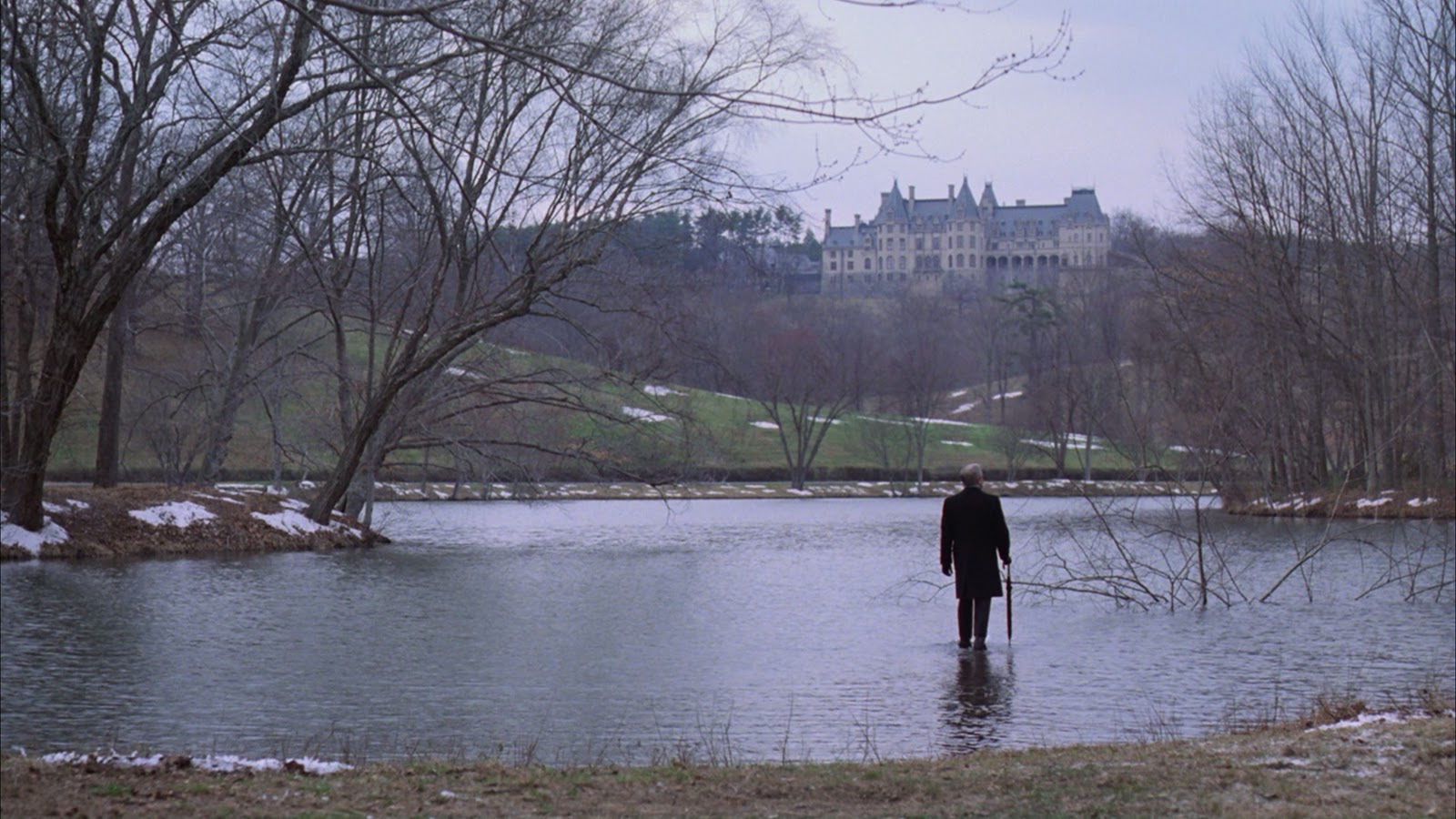
While the Oscar went to Douglas for his thoughtful performance as a dying millionaire, this is Sellers’ film. His presence is uncanny in its earnest simplicity. He smiles, he nods, he provides basic responses, and he remains entirely unmoved by his effect on others. While people are praising him or reminiscing to him or throwing themselves passionately at him, he stays placid and blank. Of course, this is where much of the humor comes from. Probably the funniest scene is a series of outtakes that play over the end credits, in which not even Sellers could utter his droll lines with a straight face. (He supposedly blamed this scene for his failure to win Best Actor, but I think Dustin Hoffman in Kramer vs. Kramer deserved to edge him out.) Indeed, Douglas and MacLaine turn in excellent performances as well, the latter offering a semi-explicit sex scene that is both awkward and hilarious. The film also stands out for its location shooting at the lavish Biltmore Estate in Asheville, North Carolina, which I recognized from my own visit to the grand property.

Being There becomes something a bit deeper in its final scenes, in which Chance begins to take on almost messianic qualities. With this, the filmmakers seem to be encouraging debate over the meaning of it all. Is it that the most important people achieve their status by their mere presence rather than their actions? Is it that simplicity and gentle innocence are so refreshing that they can get you further in life than the opposite? Shakespeare’s Macbeth said that life “is a tale told by an idiot,” so is Being There implying that only a complete idiot can effectively traverse it? Does the film mean to expose the inanity of business and power by comparing politics with nonsense? Yes to one or all, the film remains ripe for whatever interpretation you please. Films with this kind of ambiguity are rare and rarely as good as Being There.

Best line: (Chance, who is naturally misunderstood) “I like to watch.”

Rank: List-Worthy

© 2015 S. G. Liput

340 Followers and Counting

Quiz Show (1994)

11 Sunday Oct 2015

Posted by sgliput in Movies, Poetry, Reviews, Writing

≈ 2 Comments

Tags

Drama, History

Can you be sure of where you stand
And how you’ll keep your footing when
A bit of guile gets out of hand,
And lies are needed once again?

They say the truth can set you free,
But when has someone crossed the line
Of giving up on honesty
Because to err is not divine?

When baby steps grow up too fast
And liars find them ill-advised,
They see the slope that cannot last
Began when first they compromised.
________________

Rating: PG-13 (solely for language)

For a year like 1994 that had acclaimed films like Forrest Gump, The Shawshank Redemption, and Pulp Fiction, it’s not surprising that a good but lesser film would be swept under the rug, so to speak. With so many good films that year, Quiz Show remained an afterthought, both during the awards season and for my own to-watch list, even if it was directed by Robert Redford. This really is a shame because this is a potent exploration of intellectual and personal honesty and might have performed much better in a less competitive year (1996 perhaps).

Quiz Show is based on the memoir of Richard Goodwin, an investigator for the Legislative Oversight Committee of the House of Representatives back in the 1950s. Rob Morrow plays Goodwin in the film, a lawyer who notices some peculiarities on a popular quiz show called Twenty One and follows a hunch to investigate. Apparent genius and champion Herb Stempel (John Turturro) is told to take a dive by the show’s producers (David Paymer and Hank Azaria) and loses on an easy question to allow the advent of Charles Van Doren (Ralph Fiennes). As likable Van Doren’s star rises, Stempel is ignored as he alleges corruption on the supposedly upstanding quiz show. As the investigation progresses, ethics are stretched, and new information comes to light that blurs the lines of right and wrong.

Thanks to excellent casting, Turturro and Fiennes really steal the show here. The missing teeth and, shall we say, homely appearance of the former ideally casts him as the ugly step-contestant, while the verbal grace and perfect hair of the latter offer a striking contrast to his predecessor. It leaves no doubt as to the reasoning of the showrunners. To them, Stempel should be the pitiful reject who can’t cope with losing, and Van Doren should be the shining example of virtue and erudition. In the hands of a lesser filmmaker, Stempel might have become the browbeaten underdog and Van Doren the haughty record holder. Yet while these characterizations are somewhat true, there are many more nuances and complex motivations behind them.

Van Doren, in particular, is depicted as a right decent chap, one who values honesty and intelligence but edges down a slippery slope. Fame can be quite the drug. Why else do so many people do such stupid stunts and post them on the internet? Why else would a successful college professor risk his career for a game show? One might take comfort in the “no one will ever know” mentality, but Van Doren seemed from the start as someone to respond with the “I would know” answer and refuse. Yet the web is woven. He revels in his newfound popularity but buckles under the weight of his own complicity, all while remaining entirely likable, both to us and to Mr. Goodwin. Though liberties are said to have been taken with the details, the ethical conflict rings true for this true story. After all, game shows are still watched as a matter of trust that they aren’t rigged. (I remember when Ken Jennings lost shockingly to a one-night wonder on Jeopardy! several years back. He claims that he simply didn’t know the final question, but I still have my doubts, though I tend to think he might have gotten tired of it all and “taken a dive” on his own without any behind-the-scenes intervention.)

Redford paints the moral dilemmas with a steady hand and, like some statements during the Congressional hearings near the end, offers sympathy when proper and reproof when needed. Quiz Show’s strength is that it is far from black and white. Like other films such as The Prestige or Rashomon, there is no clear-cut good guy to root for, just many victims and varying levels of blame. In the end, justice may be said to be done, but not perfectly. Corporate string-pulling proves too persuasive, but Quiz Show isn’t just about an official scandal or the innate duplicity of show business. It’s about honesty, whether tested, lost, or regained.

Best line: (Herb Stempel, offering rugalach to Goodwin) “Come on, they’re a Jewish delicacy. Before Toby eats it.” (Toby Stempel, his wife) “I’m retaining water, for your information.”   (Herb) “You and the Grand Coulee Dam.”

Rank: List-Worthy

© 2015 S. G. Liput

341 Followers and Counting

Frozen River (2008)

04 Sunday Oct 2015

Posted by sgliput in Movies, Poetry, Reviews, Writing

≈ 1 Comment

Tags

Drama, Thriller

Who would cross a frozen river,
Doubtful of its permanence,
And brave the temperature extremes?
One lacking lawful common sense
Or thawing frozen hopes and dreams?

Who would risk the little had
To aim for better plans ahead?
Perhaps one with a choice to face,
Where desperation dims the dread
And needed greed can turn to grace.
__________________

MPAA rating: R (solely for language)

When you hear stories on the news about illegal activities like smuggling, it’s easy to imagine that the perpetrators are wicked scum-of-the-earth types. While there are undoubtedly plenty of this sort out there, sometimes it takes a movie like Frozen River to put people’s actions in context.

Melissa Leo plays Ray Eddy, a woman just trying to get by on her dollar store paycheck while raising two sons. Intent on leasing a larger mobile home, her plans are devastated by her husband after he disappears with the money to satisfy his gambling addiction. Set against the freezing temperatures of upstate New York, the situation immediately gives the viewer reason to pity Ray’s predicament. From there, her gradual introduction into one leg of a smuggling operation is entirely believable, even as the movie earns its thriller classification with the tension of her potentially being caught. Ray isn’t alone in being sympathetic. Lila Littlewolf (the late Misty Upham), the Mohawk woman who persuades her to help transport illegal immigrants across the Canadian border, has problems of her own with her health, family, and job prospects. While she knows the ins and outs of the smuggling process, she’s no hardened criminal, and the two women form a tenuous but profitable bond.

With all of the debates about illegal immigration in this country, Frozen River thankfully doesn’t have an agenda. Like the Italian film Bicycle Thieves, it doesn’t try to justify the actions of its characters but rather helps us comprehend their motivations. Those scum-of-the-earth types are certainly part of the operation, but Ray and Lila are simply putting their family above the law, which is understandable if not altogether right. Moments of selfishness and concern give way to compassion and maternal solidarity, and though the ending could have benefited from an extra scene of closure, the moral climax plays out as it should. I certainly see why Leo earned a Best Actress nomination (and went on to win for The Fighter), and director Courtney Hunt also received an Oscar nod for her screenplay, which clarifies that not all who break the law have bad intentions.

Rank: List Runner-Up

© 2015 S. G. Liput

341 Followers and Counting

← Older posts
Newer posts →

Recent Posts

  • We Didn’t Start 2025 (Recap)
  • NaPoWriMo 2025 Recap (Finally)
  • Sonic the Hedgehog 3 (2024)
  • It Happened One Night (1934)
  • Spellbound (2024)

Recent Comments

associatesofshellymann's avatarassociatesofshellyma… on My Top Twelve La La La So…
Kit's avatarKit Nichols on Bonnie and Clyde (1967)
lifelessons's avatarlifelessons on Look Back (2024)
Carol Jackson's avatarCarol Jackson on The Thief of Bagdad (1940…
Stephen's avatarStephen on Love Story (1970)

Archives

  • January 2026
  • December 2025
  • May 2025
  • April 2025
  • March 2025
  • February 2025
  • January 2025
  • December 2024
  • May 2024
  • April 2024
  • March 2024
  • February 2024
  • January 2024
  • December 2023
  • November 2023
  • October 2023
  • September 2023
  • July 2023
  • June 2023
  • May 2023
  • April 2023
  • March 2023
  • February 2023
  • January 2023
  • December 2022
  • November 2022
  • October 2022
  • September 2022
  • August 2022
  • July 2022
  • June 2022
  • May 2022
  • April 2022
  • March 2022
  • February 2022
  • January 2022
  • December 2021
  • November 2021
  • October 2021
  • September 2021
  • August 2021
  • July 2021
  • June 2021
  • May 2021
  • April 2021
  • March 2021
  • February 2021
  • January 2021
  • December 2020
  • November 2020
  • October 2020
  • September 2020
  • August 2020
  • July 2020
  • June 2020
  • May 2020
  • April 2020
  • March 2020
  • February 2020
  • January 2020
  • December 2019
  • November 2019
  • October 2019
  • September 2019
  • August 2019
  • July 2019
  • June 2019
  • May 2019
  • April 2019
  • March 2019
  • February 2019
  • January 2019
  • December 2018
  • November 2018
  • October 2018
  • September 2018
  • August 2018
  • July 2018
  • June 2018
  • May 2018
  • April 2018
  • March 2018
  • February 2018
  • January 2018
  • December 2017
  • November 2017
  • October 2017
  • September 2017
  • August 2017
  • July 2017
  • June 2017
  • May 2017
  • April 2017
  • March 2017
  • February 2017
  • January 2017
  • December 2016
  • November 2016
  • October 2016
  • September 2016
  • August 2016
  • July 2016
  • June 2016
  • May 2016
  • April 2016
  • March 2016
  • February 2016
  • January 2016
  • December 2015
  • November 2015
  • October 2015
  • September 2015
  • August 2015
  • July 2015
  • June 2015
  • May 2015
  • April 2015
  • March 2015
  • February 2015
  • January 2015
  • December 2014
  • November 2014
  • October 2014
  • September 2014
  • August 2014
  • July 2014
  • June 2014
  • May 2014
  • April 2014
  • March 2014
  • February 2014
  • January 2014
  • December 2013

Categories

  • Blindspot
  • Blogathon
  • Christian
  • Movies
  • Music
  • NaPoWriMo
  • Poetry
  • Reviews
  • TV
  • Writing

Meta

  • Create account
  • Log in
  • Entries feed
  • Comments feed
  • WordPress.com

Recent Posts

  • We Didn’t Start 2025 (Recap)
  • NaPoWriMo 2025 Recap (Finally)
  • Sonic the Hedgehog 3 (2024)
  • It Happened One Night (1934)
  • Spellbound (2024)

Recent Comments

associatesofshellymann's avatarassociatesofshellyma… on My Top Twelve La La La So…
Kit's avatarKit Nichols on Bonnie and Clyde (1967)
lifelessons's avatarlifelessons on Look Back (2024)
Carol Jackson's avatarCarol Jackson on The Thief of Bagdad (1940…
Stephen's avatarStephen on Love Story (1970)

Archives

  • January 2026
  • December 2025
  • May 2025
  • April 2025
  • March 2025
  • February 2025
  • January 2025
  • December 2024
  • May 2024
  • April 2024
  • March 2024
  • February 2024
  • January 2024
  • December 2023
  • November 2023
  • October 2023
  • September 2023
  • July 2023
  • June 2023
  • May 2023
  • April 2023
  • March 2023
  • February 2023
  • January 2023
  • December 2022
  • November 2022
  • October 2022
  • September 2022
  • August 2022
  • July 2022
  • June 2022
  • May 2022
  • April 2022
  • March 2022
  • February 2022
  • January 2022
  • December 2021
  • November 2021
  • October 2021
  • September 2021
  • August 2021
  • July 2021
  • June 2021
  • May 2021
  • April 2021
  • March 2021
  • February 2021
  • January 2021
  • December 2020
  • November 2020
  • October 2020
  • September 2020
  • August 2020
  • July 2020
  • June 2020
  • May 2020
  • April 2020
  • March 2020
  • February 2020
  • January 2020
  • December 2019
  • November 2019
  • October 2019
  • September 2019
  • August 2019
  • July 2019
  • June 2019
  • May 2019
  • April 2019
  • March 2019
  • February 2019
  • January 2019
  • December 2018
  • November 2018
  • October 2018
  • September 2018
  • August 2018
  • July 2018
  • June 2018
  • May 2018
  • April 2018
  • March 2018
  • February 2018
  • January 2018
  • December 2017
  • November 2017
  • October 2017
  • September 2017
  • August 2017
  • July 2017
  • June 2017
  • May 2017
  • April 2017
  • March 2017
  • February 2017
  • January 2017
  • December 2016
  • November 2016
  • October 2016
  • September 2016
  • August 2016
  • July 2016
  • June 2016
  • May 2016
  • April 2016
  • March 2016
  • February 2016
  • January 2016
  • December 2015
  • November 2015
  • October 2015
  • September 2015
  • August 2015
  • July 2015
  • June 2015
  • May 2015
  • April 2015
  • March 2015
  • February 2015
  • January 2015
  • December 2014
  • November 2014
  • October 2014
  • September 2014
  • August 2014
  • July 2014
  • June 2014
  • May 2014
  • April 2014
  • March 2014
  • February 2014
  • January 2014
  • December 2013

Categories

  • Blindspot
  • Blogathon
  • Christian
  • Movies
  • Music
  • NaPoWriMo
  • Poetry
  • Reviews
  • TV
  • Writing

Meta

  • Create account
  • Log in
  • Entries feed
  • Comments feed
  • WordPress.com

Blog at WordPress.com.

  • Subscribe Subscribed
    • Rhyme and Reason
    • Join 814 other subscribers
    • Already have a WordPress.com account? Log in now.
    • Rhyme and Reason
    • Subscribe Subscribed
    • Sign up
    • Log in
    • Report this content
    • View site in Reader
    • Manage subscriptions
    • Collapse this bar