• Home
  • About Me
  • The List
  • THE LIST (2016 Update)
  • THE LIST (2017 Update)
  • THE LIST (2018 Update)
  • THE LIST (2019 Update)
  • THE LIST (2020 Update)
  • THE LIST (2021 Update)
  • THE LIST (2022 Update)
  • Top Twelves and More
  • The End Credits Song Hall of Fame

Rhyme and Reason

~ Poetry Meets Film Reviews

Rhyme and Reason

Category Archives: Poetry

Jurassic World (2015)

24 Sunday Jan 2016

Posted by sgliput in Movies, Poetry, Reviews, Writing

≈ 3 Comments

Tags

Action, Sci-fi, Thriller


“What have we learned?” they knowingly say.
“Life has evolved to show us the way.
Dangerous creatures and habits have filled
The past, and on them the near-future will build.”

“What have we learned?” they foolishly ask.
“Our forerunners clearly weren’t up to the task.
What they could not do we will better complete.
Mistakes of the past we will never repeat.”

“What have we learned?” they say, sure of their touch.
Those who see clearly say “Clearly, not much.”
________________

MPAA rating: PG-13


In many ways, 2015 was the year of the unexpected sequel/reboot. I’d bet that not too many people wanted or expected Hollywood to resurrect franchises like Jurassic Park, Mad Max, The Terminator, or Fantastic Four. (Lots of fans wanted another Star Wars so that doesn’t count.) Some of those turned out better than others, but the mammoth hit of the summer was Jurassic World.

The film starts out with two brothers, older punk Gray and younger whiz kid Zach, as their parents send them off to a theme park on none other than Isla Nublar. The audience’s nostalgia is tapped early on as we enter the famous giant gates and behold Jurassic World in all its glory. There’s a baby dinosaur petting zoo and a big glass hamster ball for safaris and a SeaWorld-style splash show with something a little bigger than a killer whale. Tourists and merchandise are everywhere, and there’s a certain satisfaction to seeing John Hammond’s dream so triumphantly realized.

By the looks of things, the creators of the park seem to have worked out all the bugs, with financing from owner Simon Masrani (Irrfan Khan) and scientific guidance from Dr. Henry Wu (B. D. Wong, the only returning cast member from the original film). But as Ian Malcolm said in The Lost World, they’re not making the same mistakes twice, they’re “making all new ones.” Just as the whole frog DNA idea backfired for Hammond, the park runners do a little too much genetic manipulation to create an uber-dinosaur, the Indominus Rex. As the park’s operational manager, Zach and Gray’s Aunt Claire (Bryce Dallas Howard) seems coldly confident that there’s nothing wrong with toying with nature. You can guess what happens next.

Like Star Wars: The Force Awakens, Jurassic World seems to directly parallel the original film in order to balance the new with the familiar. There’s the gate entrance, a hands-on scene involving a sick/dying dinosaur, an intense glass scene that lets kids in danger look directly into a predator’s maw, a flare scene involving a T. Rex, and a vehicle being chased by a rogue dino. While I like The Force Awakens more, I have to admit that Jurassic World better differentiates those scenes from their original counterparts. It also nails the most important element of an effects-driven movie like this, the dinosaurs. Some creatures may be more obviously CGI than others, but the life-and-death action and dino duels are exhilarating to behold, if rather vicious in their body count.

Jurassic World is quite an improvement over the last two Jurassic Park sequels, but it’s a Procompsognathus next to Spielberg’s original. Its greatest weakness is its characters, who lack the appealing personalities of the first gang of ill-fated visitors. After Guardians of the Galaxy, Chris Pratt was the hot actor and the obvious choice for the hero in the latest addition to the Jurassic Park series. His role as Owen Grady is the most persuasive, acting as the practical conscience for the shocked park leaders and the personable trainer for the park’s four semi-trained Velociraptors. Pratt can’t carry the whole movie, though, and everyone else is rather interchangeable. Howard is your typical half-empowered damsel; the kids are your typical kids in danger, with a troubled home life that is left unresolved; and Vincent D’Onofrio is your typical dense, single-minded fool of a villain, who is convinced that the raptors can be used as weapons even after that very plan blows up in his face.

By the end, the human characters become almost irrelevant during a big dino brawl, dumbly running parallel to the fight and trying to just stay out of the way. The end almost reminded me of 2014’s Godzilla, in transforming a former monster into something of a hero who battles whatever rival to its superiority but leaves man alone since he’s too trivial to matter much. These last two paragraphs sound perhaps more critical than I mean to be. Jurassic World is an entertaining summer movie that revitalized the franchise; I just don’t know why it nearly became the highest grossing film of the year. Hopefully, the next installment will put a little more focus on the characters. I love a good dino flick; it just helps when I connect more to the people in danger.

Best line: (Masrani) “You created a monster!”   (Dr. Wu) “Monster is a relative term. To a canary, a cat is a monster. We’re just used to being the cat.”


Rank: List Runner-Up


© 2016 S. G. Liput

356 Followers and Counting


Armageddon (1998)

21 Thursday Jan 2016

Posted by sgliput in Movies, Poetry, Reviews, Writing

≈ 7 Comments

Tags

Action, Disaster


An asteroid with nothing to slow it
Will hit the earth unless we blow it.
Some experts, therefore,
Must destroy it before
The end of the world as we know it.

Don’t bother the National Guard,
The Navy Seals, or Scotland Yard.
What we need right now
Are the skilled and lowbrow
Who know how to dig and dig hard.

They’ve known ever since they began it
This mission needs real men to man it,
The tough and untried
With professional pride,
Emerging to save the whole planet.
_____________________

MPAA rating: PG-13

Armageddon has pretty much everything you could expect from a Michael Bay film: cocky and attractive hotshots, semi-serious life-and-death circumstances, underdogs rising up for their moment of truth, special effects up the wazoo, and explosions, lots and lots of explosions. It’s a film that can be both written off as scientifically inaccurate baloney and enjoyed as unreasonably entertaining baloney. Essentially, it’s a beautiful disaster.

It starts out a lot like Gravity, with a space shuttle spacewalk being cut short by a storm of debris, or in this case meteoroids. NASA quickly investigates the recent rash of destructive meteor showers and discovers that the big Texas-sized mama of them all is headed for a direct collision that will undoubtedly extinguish all life on Earth (except cockroaches, of course). Mankind’s only hope is to bring in a band of drilling experts, blue-collar ruffians who would normally be the last people called in during a disaster but who have the know-how to drill through the asteroid’s surface so NASA can blow it up with a nuke. There’s the leader Harry Stamper (Bruce Willis); self-confident A.J. (Ben Affleck), who is in love with Harry’s daughter (Liv Tyler) much to Harry’s chagrin; the unhinged genius (Steve Buscemi); the faithful sidekick with family issues (Will Patton); the big muscle (Michael Clarke Duncan); the fat guy (Ken Hudson Campbell); and that other guy (Owen Wilson). Throw in Billy Bob Thornton as a NASA scientist, William Fichtner as the military astronaut leader, and Peter Stormare as a semi-crazy Russian cosmonaut, and you’ve got a star-studded blowout of a movie.

Most of these actors have gone on to serious dramatic roles, but seeing them all together in a film like Armageddon brings to mind the big disaster films of the 1970s. Like some of those (Earthquake, for example), it’s certainly an open question as to whether this disaster is actually a good movie. The science is borderline silly, the editing choppy, the dialogue often corny, and plenty of unrealistic clichés abound, including not one but two down-to-the-last-second countdowns. I, for one, thought that the surface of the asteroid was absurdly crystalline in appearance, unlike any actual space surface I’ve seen, and the title shows an annoying lack of Biblical knowledge, since Armageddon isn’t the generic end of the world but an actual place where a battle of armies takes place in Revelation.

However, these complaints don’t really detract from what Armageddon the movie is: eye candy entertainment on a big, exciting, not-to-be-taken-too-seriously scale. The race against time is engrossing, not because we deeply care about these characters, but because the stakes are so high that suspension of disbelief goes out the airlock in favor of simply enjoying the ride. All the actors fill their roles well, particularly Willis as the experienced and heroic leader, and even if many of them come off as caricatures, they look like they had fun taking part. While the editing is erratic during some of the action scenes, Bay taps into that primal satisfaction of watching things blow up, whether it be New York streets or the surface of a space rock. The most thrilling scene takes place in the ISS, when a fire breaks out—wait, this reminds me of Gravity too.

Armageddon fits into that half-honored genre of popcorn blockbusters, the likes of which critics deride and ordinary moviegoers pay to see in droves. Its flaws are self-evident yet oddly insignificant in the face of the overall package. While end-of-the-world movies have become grim and somewhat more realistic over the years, Armageddon is an example of a big, long, funny, appealing disaster.

Best line: (one of Harry’s drillers, as Harry is trying to shoot A.J. for sleeping with his daughter) “This is illegal, man.” (Harry) “I’m temporarily insane, Rock. It’s all right.”

VC’s best line: (Harry, listing his drillers’ demands) “Yeah, one more thing. Um, none of them wanna pay taxes again…ever.”

Rank: List Runner-Up

© 2016 S. G. Liput
356 Followers and Counting


Memento (2000)

13 Wednesday Jan 2016

Posted by sgliput in Movies, Poetry, Reviews, Writing

≈ Leave a comment

Tags

Drama, Thriller


(In honor of this film’s unique storyline, try reading this poem backwards too.)

 
“Where am I?”
You ask and wonder;
You are someplace yet unknown,
Lacking memories of your own.
Your life’s asunder;
Know not why.

Every scar
Helps you recall
The pain that drives you every day
Without a doubt as to your prey,
Assuming all,
Here you are.
_______________

MPAA rating: R (for much language and brief violence)


Since I’ve very much enjoyed Christopher Nolan’s other films, especially Inception and The Prestige, I thought I should check out Memento, his first studio-funded project, which was based on his brother Jonathan’s short story “Memento Mori.” I watched it and found it to be everything people said it was: confusing, daring, intricate, and mind-bending, adjectives that have come to be synonymous with Nolan’s brand of filmmaking. Non-linear storytelling can be a love-it or hate-it selling point. I was willing to be confused in the hope of a payoff, while I knew from the start that this was not a film my VC would enjoy. If you want a film to enjoy casually, Memento is not it. You can watch it all the way through and still may be lost; heaven help you if you miss a piece of this tightly edited puzzle.

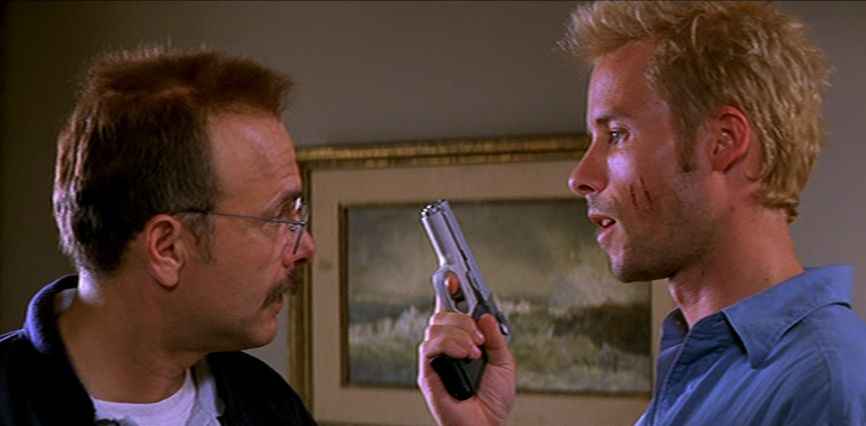
Leonard (Guy Pearce) is a man with anterograde amnesia; unable to store recent memories, his brain resets every fifteen minutes or so to completely forget where he is, how he got there, and what happened since the event that caused the amnesia. To get his bearings, he keeps photographs and notes and, for very important facts, tattoos, most of which explain to him that his wife was raped and murdered by someone named John G. whom he must seek out to exact his revenge.

In order to replicate the disorienting effect of Leonard’s lapses in memory, everything is broken up into disjointed sections that begin in medias res, with each division explaining the part before it. The film starts with a picture of a murder; then you see the murder itself. Leonard wakes in a hotel room with a man tied up in the closet; two segments later, you understand how that came about, even if Leonard himself will never remember the details.

One of the first questions for me kicked in when I wondered just how he knew the murderer was named John G. and how he obtained John G.’s license plate, despite his seemingly debilitating handicap. Doubt like that is exactly the point. Leonard’s “condition” leaves him entirely at the mercy of his notes and the explanations of others, if he chooses to listen to them. An apparent friend named Teddy (Joe Pantoliano from The Matrix) seems to want to help Leonard, but Leonard doesn’t know who he is. He could be his closest friend or his mortal enemy, and all he has to go by is a picture through which he has told himself not to trust Teddy, advice completely dependent on Leonard’s mindset at the time he wrote it. The same goes for a woman named Natalie (Carrie-Anne Moss, also from The Matrix), whose involvement with Leonard ranges from sympathetic to abusive depending on which piece of the puzzle we’re watching. Right when you think you know what’s going on, the next segment casts a new light on things.

This kind of storytelling is extremely fascinating, but confusion is unavoidable at times. It took me half the movie to realize that a series of intermixed black-and-white scenes of Leonard talking on the phone were happening chronologically in the past so that they would meet the scenes that were happening backwards. I’m still not sure I understand everything, and a second viewing is almost required.

Christopher Nolan’s first big mindbender is both his most puzzling and his most alienating work. While I was intrigued to find out what would happen (or rather what happened) and a perspective-changing tragedy tugged the mental heartstrings, the film felt cold overall. Most of Nolan’s work has some light to it, whether it be the dubiously heartwarming conclusions of Inception and Interstellar, the one-sided happy ending of The Prestige, or the humanity of the boat hostages in The Dark Knight. In Memento, there’s no satisfaction for anyone, no good will or unqualified concern. Brighter elements like these perhaps might seem out of place in a story about mental illness and revenge, but without them, Memento is not as emotionally engaging as it is mentally. Combine that with the fact that it features more foul language than all of Nolan’s later films combined, and it falls toward the bottom of his filmography for me, even if it is a riveting and wholly original piece of work.

Best line: (Leonard, to his wife while she’s re-reading a book) “I always thought the joy of reading a book is not knowing what happens next.”


Rank: List Runner-Up


© 2016 S. G. Liput

356 Followers and Counting


Ant-Man (2015)

10 Sunday Jan 2016

Posted by sgliput in Movies, Poetry, Reviews, Writing

≈ Leave a comment

Tags

Action, Comedy, Sci-fi, Superhero


Smaller, better, faster, stronger—
Now the world must wait no longer.
Here comes Ant-Man, skilled at shrinking;
Watch and try to keep from blinking.

Armed with ants and talents stranger,
He won’t shrink from wicked danger.
Shrink or grow for each endeavor,
Tiny minds can still be clever.

Though the Ant-Man may seem minor,
No insect-sized man is finer.
Maximizing, minimizing,
Heroes don’t depend on sizing,
________________

MPAA rating: PG-13


While Ant-Man was given an understandably smaller reception upon release last year, my dad helped make it a bigger film for us. For some reason, he connected to Ant-Man on some deep cosmic level, having read the old Ant-Man comics with Hank Pym back in the day. He was singing the praises of both the character and the film long before we finally got to see it, and while this might have raised my expectations too high (like with Guardians of the Galaxy), it instead piqued my interest and enjoyment for one of the silliest Avengers yet.

It starts off in 1989, upholding the always cool Marvel continuity by mixing some familiar faces from past films with the latest S.H.I.E.L.D.-connected supergenius, Hank Pym (Michael Douglas), a master of physics and entomology (since atoms and bugs just go together). Jump ahead to the present, and we find Scott Lang (Paul Rudd) getting out of jail and meeting up with his Latino ex-cellmate Luis (Michael Peña). However, Scott faces an uphill battle toward normalcy since his criminal record mars job opportunities, even as his ex-wife bars him from seeing his young daughter. Little does he know that he’s a potential pawn in the cold war between Pym and his former protégé, the power-hungry CEO Darren Cross (Corey Stoll), who has grown ruthless from years of turning life forms into tiny piles of goo in an effort to replicate Pym’s fabled shrinking technology. Got all that?

Ant-Man isn’t as jam-packed as Guardians, but its convoluted plotline does require attention and may not entirely make sense. Yet, according to Marvel’s prized strategy, it doesn’t take itself too seriously. Hank and his estranged daughter Hope (Evangeline Lilly of Lost fame) may be wholly familiar with the concepts of quantum realms and communicating with ant armies, but Scott and Luis offer hilarious reactions to it all even as they embrace the role of hero over crook. Despite his history with raunchy comedies, Rudd manages to combine self-deprecating humor with relatable sincerity as he works to be with his daughter and, you know, save the world.

While on one level, Ant-Man may seem like just another brick in Marvel’s multimillion-dollar wall, it stands out in unexpected ways. For one thing, the origin story is more reminiscent of the early days of the Marvel Cinematic Universe, the Phase 1 films like Iron Man, and features more of a Mission: Impossible-style heist tone, aided by Christophe Beck’s bombastic score. While the Avengers are present and even referenced, their involvement in Ant-Man’s covert operation isn’t as starkly missed as in The Winter Soldier or Thor 2, in which only one main Avenger seemed to care about the end of the world as we know it. Here, the fate of the world is at stake, since the propagation of Cross’s shrinking suits would change the balance of power and “the texture of reality,” but it’s on a much more personal level than just stopping the latest baddie from blowing up the world. These characters have history with each other, whether it be Cross’s resentment toward Hank or Hope’s need for reconciliation with her father, not to mention Scott’s concern for his daughter who becomes plot-relevant in the finale. Even Scott’s ex-con accomplices are different from the professional agents or warriors we’ve become used to; they’re his beer-and-waffle buddies who have useful skills but are still down-to-earth, like how Luis remembers to save the guy he just knocked out before the building is destroyed.

Another unique aspect is how Scott becomes Ant-Man. Rather than self-experimenting with newfound powers or tapping into latent heroism, he is actually trained by the previous wearer of the Ant-Man suit. I can’t recall seeing this different dynamic of passing the mantle from one generation of hero to the next since an aged Bruce Wayne did so in the futuristic Batman Beyond (and before that, The Mask of Zorro). It’s an advantage that most superheroes don’t get, and shows onscreen what the comic books have done for years in letting more than one character inhabit the super persona. I wouldn’t mind learning more about Hank Pym’s missions back in the ‘80s.

Technically, Ant-Man should have been in Marvel’s Phase 1, since Ant-Man and the Wasp were founding members of the original Avengers in the comics (along with Iron Man, Thor, and the Hulk). Yet I suppose it’s hard to take seriously a tiny guy in a mask who controls bugs. Like Guardians of the Galaxy, Ant-Man was a gamble that I think paid off. It offers a new hero, new history, new technology, and a new way of looking at things from an ant’s perspective, from a bathtub to a toy train set. The incredible special effects help to sell both the shrinking concept and the almost cute ants, and are just one strength in Marvel’s latest hit. I enjoyed Ant-Man. On a more muted level, my VC and my mom liked it too. But my dad loved it.

Best line: (Luis, about his girlfriend, in a line that my dad has made his own for anytime bad things pile up) “Ah, she left me. And my mom died too. And my dad got deported…. But I got the van!”


Rank: List-Worthy


© 2015 S. G. Liput

354 Followers and Counting


Star Wars: The Force Awakens (2015)

27 Sunday Dec 2015

Posted by sgliput in Movies, Poetry, Reviews, Writing

≈ 4 Comments

Tags

Action, Drama, Sci-fi


I recall the feeling still,
The fascination and the thrill
Of seeing something fresh and new,
Of satisfaction sown with skill.
I remember it; don’t you?

Over time, the feeling’s stayed.
The prize is praised; the piper’s paid,
And yet I wait for even more,
For further fun that will not fade,
Another epic to explore.

Waiting is rewarded, yes,
And yet I feel I must confess
I doubt if ever it will be
That future favorites and success
Will bear the same delight for me.
________________________

MPAA rating: PG-13


At last, I’ve seen the biggest movie of the year, combining two of my favorite things, Star Wars and J.J. Abrams’ directorial talent. Ever since I heard Abrams would direct the next entry in the Star Wars canon, I knew he was the right guy for the job. Lost is phenomenal, his Star Trek reboots were sheer fun, and he has a special talent for both visual storytelling and character-building. Here, he brings it all to George Lucas’s beloved space opera franchise, the continuation of the story last visited on film in 1983’s Return of the Jedi, the film that has been endlessly marketed and hyped for over a year now, and…I’m left divided.

Some spoiler-free reviews I’ve read have been the “oh-my-gosh-this-movie-is-just-so-great-and-wonderful-I-could-burst” type, but most seem to be the “this-is-a-really-good-movie-but…” kind of opinions. I wanted it to be the former, but sure enough, it’s the latter for me. Time to think it over has only deepened my ambivalence. On the other hand, my mom (with whom I saw it) has grown more displeased with it. She saw the original Star Wars in the theater eight-and-a-half times and, based on the reviews, had high hopes, which weren’t exactly dashed but at least unfulfilled.

Let me try to explain my feelings about Star Wars: Episode VII. I won’t get into specifics, but I’ll probably go into more detail than some reviews, so a warning for those like me who have tried to remain spoiler-free. First, the Light Side. Like so many critics have said, The Force Awakens does feel like the original trilogy, a little less polished than the prequels and with far more humor and natural dialogue. Abrams’ talent with ensembles comes through, balancing both the new characters and old with fresh concepts and proper nostalgia. Harrison Ford as Han Solo, Carrie Fisher as Leia, Peter Mayhew as the apparently ageless Chewbacca, and (barely) Mark Hamill as Luke Skywalker all make triumphant returns, and despite the thirty-two-year hiatus, it feels as if they never left. Of the new cast, Daisy Ridley’s heartfelt Rey and John Boyega’s excitable Finn are the standouts, dropping hints at guessable but unconfirmed backstories that will surely play a larger part in the inevitable sequels. The backstory we do get is that of Kylo Ren, the Darth Vader wannabe whose conflicted allegiance to the Dark Side keeps him interesting, even as the other villains are given little to do. While many have complained about the underuse of various actors, the most overlooked to me seemed to be Gwendoline Christie as Stormtrooper Captain Phasma; like in Mockingjay – Part 2, Christie oddly lands a role in a big-budget blockbuster and then has hardly any screen time. Those secondary players who do get screen time make the most of it, including Oscar Isaac’s daring pilot Poe Dameron and, of course, the cute beachball droid BB-8. I also enjoyed seeing Ken Leung (Miles from Lost) as a Resistance admiral, a token actor from Abrams’ past work.

There, I liked it, right? But then, the Dark Side makes itself felt. For one thing, it’s sad that, within thirty years, the galaxy is right back in the middle of tyrant-battling war, with the Republic barely present. In addition, with the exception of Episode III, which everyone knew would be dark and tragic, all the Star Wars movies end with a thrill, whether it be a smile of success or an urge to learn what’s next. While both types of thrill are attempted, they are overshadowed by a climactic blow to the childhood that hit my mom especially hard. When the credits had finished, we didn’t leave the theater reveling in the glow of a great movie; we left in silence, trying to digest what J.J. Abrams had done. It makes for potent drama, but it stings nonetheless.

In addition, the story itself becomes weak in its attempt to pay homage to the original Star Wars. Plot elements are recycled a bit too often, and the originality suffers. There’s a wanted droid with important hidden information; there’s a cantina full of exotic aliens; there’s a desert planet (Jakku, not Tatooine); there’s a planet-destroying weapon; there’s a black-masked villain reporting to a holographic uber-villain (head of the First Order, not the Empire); there’s a Jedi apprentice turning against his master; there’s a close shave with a tentacled creature; there’s the difficult scene I mentioned that recalls Darth Vader’s run-in with Ben Kenobi; and there’s a mission to blow up the enemy base, which is even cooler and less simple than the Death Star’s destruction. There’s also a deleted star system, a la Attack of the Clones. For all their faults, the prequels always presented something new, even if the new didn’t please fans. In trying to appeal to everyone’s nostalgia for the original trilogy, the writers made the story far too similar. I wonder if Episode VIII will feel like The Empire Strikes Back.

At this point, I can’t tell if I’m trying to be honest or overly critical. It’s still a fantastic action-packed movie, the one we’ve been waiting for for decades. Despite the overly familiar plot points, I love everything original in The Force Awakens, from the new protagonists to the impeccable visual effects and awesome action. I still can’t decide where it ranks next to the prequels (I like them; sue me), but it’s certainly worthy of the Star Wars name. My mom and I will still see it many more times, and our admiration will surely improve. (She didn’t like Forrest Gump the first time either, and now it’s a family favorite.) I doubt The Force Awakens will ever have the same appeal as the original trilogy, but just as I grew up with the prequels, this is the Star Wars of the next generation.

Best line: (Han, about the enemy weapon) “How do we blow it up? There’s always a way to do that.”


Rank: List-Worthy


© 2015 S. G. Liput

352 Followers and Counting


VC Pick: The Christmas Card (2006)

24 Thursday Dec 2015

Posted by sgliput in Movies, Poetry, Reviews, Writing

≈ Leave a comment

Tags

Christmas, Drama, Family, Romance


You speak a word or you write a card,
And think perhaps that they have no effect,
The same clichés by triteness marred
That lead to an “Aww,” then most likely neglect.

But none can know where their kindness ends
And where a larger design can begin,
Where welcomed strangers grow into friends
And holiday spirit makes room at the inn.

You might send a hundred clichés someone’s way.
A heartfelt word may brighten more than their day.
____________________

MPAA rating: Not Rated (definitely G)


I’m sorry I’m getting into the Christmas spirit a little late this year. I thought about compiling a top Christmas movie list, but it would be the same old popular favorites for the most part (A Christmas Story, Home Alone, etc.). Instead, I decided to turn over the holiday reins to my VC, who is fond of this little Hallmark movie that I gave her as a Christmas gift a couple years back.

While it’s perfect for the holidays, The Christmas Card is far from the best Hallmark has to offer. It starts out in Afghanistan, where Sgt. Cody Cullen (John Newton) receives an encouraging Christmas card from a woman out west. When a comrade is killed in action and Cody visits his widow on leave, it turns out that she lives conveniently in the same town as the woman who sent him the card. That would be Faith Spelman (Alice Evans), who conveniently has the same tastes as he does and attends the same church he visits. Conveniently, she has a father (Ed Asner) who takes an instant liking to the handsome soldier and would like nothing more than to fix him up with his daughter. Then, of course, there’s her jealous fiancé and split affections and, well, you see where this is going. While the plot is wholly predictable romantic novel stuff, it’s still rather sweet and enjoyable, though that’s largely due to the scenery.

The Christmas Card always fills my VC with drooling envy, thanks to its setting. The Spelmans live in the quaint mountain town of Nevada City, California, a beautiful hamlet brimming with holiday spirit and warm small-town hospitality. Not only is it the kind of town that could lure my earthquake-phobic VC to California, but the Spelman’s home looks like an HGTV dream house, a palatial but cozy log cabin with a roaring fireplace and a Christmas tree that stands above the rafters. Just looking at this snug residence is enough to put us in the Christmas spirit, perhaps to wrap in a blanket and sip hot chocolate. While the environment keeps my VC’s attention, Alice Evans keeps mine, with her sweatered loveliness and charm holding the affections of two jealous men, though I’m surprised half the town isn’t after her. It’s also cool to recognize her as the younger Eloise Hawking on Lost.

The Christmas Card is nothing deep. John Newton is particularly wooden as the stoic veteran, and neither the acting nor the script is great, though Ed Asner did get an Emmy nomination for his role as the buoyant matchmaker father. While its technical merit is low, it nevertheless rings with Christmas warmth and generosity and brings attention to the soldiers who are away from their families during the holidays. There are better Christmas movies out there, but we keep coming back to The Christmas Card. Merry Christmas to all!

Best line: (Cody, upon meeting Faith’s father Luke) “It’s a real honor to meet you, sir.”   (Luke Spelman) “Honor? I guess you haven’t caught wind of my reputation.”


Rank: List Runner-Up


© 2015 S. G. Liput

352 Followers and Counting


Serenity (2005)

20 Sunday Dec 2015

Posted by sgliput in Movies, Poetry, Reviews, Writing

≈ 4 Comments

Tags

Action, Drama, Sci-fi


When we reach the distant future,
Full of ships traversing space,
What if life were not that different
With the same self-seeking race,
Governments with dark agendas,
And the sins we can’t replace?

How could anyone continue
In ideals that aren’t esteemed?
Only with a firm believing,
Truer than it ever seemed,
Can a world of lies and secrets
Be perhaps in part redeemed.
__________________

MPAA rating: PG-13


After my introduction to Joss Whedon’s cult classic TV show Firefly (and its inclusion on my Top Twelve TV Series list), I had to check out its big-screen conclusion Serenity, and it was a home run! In the same way that Firefly was criminally underrated when aired and was canceled after merely eleven episodes, I’ve seen Serenity in the bargain DVD bin for $3.99 when it deserves so much better. Putting all of Whedon’s considerable talent on display, Serenity offers an equally entertaining alternative to Star Wars and Star Trek.

Luckily, all of the main cast of the show returned to reprise their roles, a winning ensemble of mostly lesser-known TV actors, with the villain played by then-lesser-known Chiwetel Ejiofor. The crew of the Firefly-class spaceship Serenity aren’t freedom fighters against the imperialistic Alliance nor noble voyagers exploring the ‘verse; instead, they are simply in search of their next job, which typically entails smuggling or some other less-than-legal enterprise. Captained by hard-nosed Malcolm Reynolds (Nathan Fillion, who continues to reference the show in other roles since), Serenity includes his old war comrade Zoe (Gina Torres), her pilot husband Wash (Alan Tudyk), amusing cutthroat Jayne (Adam Baldwin), cute engineer Kaylee (Jewel Staite), and the Tam siblings Simon (Sean Maher) and River (Summer Glau), who are fugitives from the Alliance and grudgingly welcome guests aboard the ship. Also included are those who have left the ship, peaceful but secretive Shepherd Book (Ron Glass) and Mal’s unacknowledged love interest Inara (Morena Baccarin), a Companion or respectable prostitute.

With all that information and more previously established in the show, Serenity is an impressive balancing act, offering a conclusive episode for the fans hungry for more and a surprisingly accessible adventure that can still appeal to newbies. Such is Whedon’s talent with ensembles, whether it be his cult TV series or movies like The Avengers. In some ways, I might compare Serenity with Guardians of the Galaxy, another fast-paced space tale with an ensemble of potential unknowns. Like Guardians, Serenity throws out all the information viewers need to know along with ample humor and characterization and doesn’t waste time ensuring that the audience is keeping up. Instead of the pop culture references of Guardians, though, Serenity combines its sci-fi trappings with a western desperado style to craft a unique blend of East, West, and future.

Serenity also proved to be an outlet for Whedon’s creativity. Within the first fifteen minutes, there’s a dream within a holographic log and an ingenious four-and-a-half minute tracking shot that introduces us to the entire ship and crew. Likewise, the dialogue is another Whedon trademark, full of clever colloquialisms, Chinese exclamations, and so much breakneck wit that I wonder why it wasn’t nominated for Best Original Screenplay. I also admire that, despite his atheism, Whedon emphasized the presence of religion and belief in this space-faring future, something Star Trek only did with alien cultures. (No aliens here.) In the first few minutes, I even recognized a knockout gadget that Whedon reused in his Agents of S.H.I.E.L.D. series.

All this fawning over it, and I’ve hardly said anything about the actual plot. Throughout the series, River had acted consistently weird due to the government’s experiments on her, and brother Simon acted as her rescuer and advocate, though there were hints that she could take care of herself. While the actual explanation and solution for her behavior don’t make total sense, the film offers insights and resolutions for many elements that the show didn’t have time to conclude: River’s actual rescue, Kaylee’s crush on Simon, the Alliance’s reasons for wanting River back so adamantly, River’s untapped talents, and the nightmarish Reavers, the bands of space maniacs as mindless as zombies and ten times as ferocious. Mal is not only caught between the Alliance’s coolly murderous Operative (Ejiofor) and an unrecognized threat on board his ship; he’s also caught in a web of right and wrong, heroism and disillusionment, cynicism and belief. This futuristic world is unforgiving and sometimes painfully harsh, but Whedon keeps a masterful balance among the dramatic, comedic, and jaw-droppingly awesome. One scene toward the end is especially stunning and practically gave me goosebumps.

If you haven’t seen Firefly and happen to have fourteen hours to burn, watch it first, but there’s so much excellence evident in Serenity that I recommend everyone see it regardless. A few aspects of the end may not be ideal, but the film as a whole is an exciting success as both a standalone film and the finale Firefly never got. Like Firefly, it’s an underrated science fiction treat.

Best line: (Mal) “Half of writing history is hiding the truth.”


Rank: Top 100-Worthy


© 2015 S. G. Liput

350 Followers and Counting


The Hunger Games: Mockingjay – Part 2 (2015)

17 Thursday Dec 2015

Posted by sgliput in Movies, Poetry, Reviews, Writing

≈ 2 Comments

Tags

Action, Drama, Sci-fi, Thriller


Children fought within the Games,
As posh patricians praised their names,
And through the safety of TV,
Let death abound for all to see.

Now death has bounded through the screen,
And at the urging of a teen,
The poor plebeians meant to lack
Have gained the courage to fight back.

When tyrannies use violent means
And worship death on TV screens,
It then should come as no surprise
In violence do the people rise.
For freedom, violence intervenes,
For can mankind learn otherwise?
________________

MPAA rating: PG-13


After watching the final Hunger Games film and contemplating whether I liked it or Catching Fire best, I’ve come to the conclusion that Mockingjay – Part 2 is the best installment of the series. The final chapter of any franchise is typically meant to be the grandest and most important, a rare but desirable feat that is indeed met by this last portion of Katniss Everdeen’s story.

Though I’m one of the few people not to have read the books, I’m well aware that Mockingjay is the least favored of Suzanne Collins’s trilogy, and some reviews for Mockingjay’s two film adaptations have been similarly blasé, since they say the book is better and its predecessors are better still. Yet Part 2 delivers on the setup of Part 1, trading in the previous film’s relative lack of thrills for the fast-paced intensity of the Maze Runner series.

I’ll try to be general to avoid spoilers: Katniss (ever-outstanding Jennifer Lawrence) and President Coin’s rebels aim for President Snow and the Capitol, even as the archer struggles with her split affections and Peeta’s recent brainwashing. Considering how Part 1 used Peeta’s sudden indoctrination as its climax, I was glad that it wasn’t swept away as a minor setback; instead, it becomes an ongoing risk, as well as a satisfying method of ironing out the reality among all the lies. The actual mission grows in importance as they continue, and the Hunger Games-style dangers encountered make Mockingjay – Part 2 the most intense film of the franchise, with one sequence that seemed fit for a horror movie.

Considering everything that has come before, it should be no surprise that there are many deaths along the characters’ difficult journey, and I suspect this is part of what many fans disliked. Killing off characters is most painful when it seems unfair, and such displeasing deaths can cause fans to be angrier at the storyteller than the characters responsible. (A recent example I disliked was in How to Train Your Dragon 2). Mockingjay – Part 2 has twists that aren’t exactly what fans would want or expect, but the story makes the best of them and ends up sadder but wiser, yet still fulfilling.

While the biggest complaint about Mockingjay is how it has been split into two parts for the sake of money, Part 2 actually served to vindicate that decision for me on the narrative level, at least somewhat. One hope I had for the Hobbit trilogy was that, by stretching the dwarves’ screen time, their characters would grow more familiar and not just be thirteen interchangeable companions. While Jackson failed in that regard, I felt Mockingjay succeeds. With so many new characters introduced between Parts 1 and 2, it made sense to establish some earlier on to distinguish them from the redshirts who don’t have enough screen time to leave an impression. (To use a Marvel comparison, whose death had more impact, that of Coulson, who was seen in multiple films, or that of Quicksilver, who had one?) While the decision did Part 1 no favors, it works to Part 2’s advantage.

As the capstone of The Hunger Games franchise, Mockingjay – Part 2 is both an exciting blockbuster and a dark climax for a dark series. While some elements may not satisfy, such as the resolution to the whole love-triangle friction, the majority do. The expansive cast perhaps aren’t fully utilized, but plot progression is more important than characterization at this point, since we’ve already gotten to know the important players over three films. (I was glad that Philip Seymour Hoffman’s role as Plutarch Heavensbee wasn’t much affected by his death earlier this year; his absence was only felt in one scene and was well sidestepped.) Most importantly, amid the chaotic action and sci-fi spectacle, the film reaffirms the franchise’s ultimate message. As Katniss has grown from fighting for survival to fighting for freedom or revenge, the struggle has not simply been against monosyllabic presidents but against anyone with contempt for life. It’s a theme still very much relevant today and one I hope will be ever in our favor.

Best line: (Katniss) “There are much worse games to play.”


Rank: List-Worthy (joining the other three in the series)


© 2015 S. G. Liput

349 Followers and Counting


The Silence of the Lambs (1991)

11 Friday Dec 2015

Posted by sgliput in Movies, Poetry, Reviews, Writing

≈ 3 Comments

Tags

Drama, Horror, Thriller


Evil comes in many forms,
In the loner and the swarms,
In the wielder of the knife,
In the prober of your life.
Though it hides or means to try,
It draws your interest and your eye.

Dark are deeds we’d never do,
Yet they still are dared by few.
Justice runs to halt the spread,
But if it wins, there’s still the dread.
Evil loves to carve its notch,
But why do any choose to watch?
_________________

MPAA rating: R
After years of hearing how great it is and seeing most of Anthony Hopkins’s performance through clips, I decided to finally watch the Best Picture of 1991. The Silence of the Lambs is everything critics have praised over the years: a dark mystery, a dramatic powerhouse, a compelling character study of two opposing forces, one seeking justice and the other too demented to be fully understood. It is both Hopkins’s and Jodie Foster’s finest hours, winning both of them Academy Awards, as well as Oscars for Best Director and Best Screenplay. And it is a great film which I have little desire to see again. The Silence of the Lambs is one of those movies that I can admire without being able to fully embrace as a favorite, more due to my personal sensitivities than to any flaws on the film’s part.

It’s an ingenious setup, pitting an eager but untested FBI agent-in-training (Foster) against the memorably evil serial killer Buffalo Bill (Ted Levine) with the aid of the even more memorably evil killer Hannibal Lecter (Hopkins). Clarice Starling is a woman trying to prove herself to her superior Jack Crawford (Scott Glenn) and to save other women, who are being killed and skinned by Bill across the Midwest. Jonathan Demme’s directorial tactic of filming actors as they look directly into the camera is even more effective than in his next film Philadelphia (which perhaps served to compensate for the allegedly homophobic aspects of Silence). As Crawford or Lecter or various men stare at Clarice and by extension the audience, it feels as if she is being sized up, measured, evaluated as an asset, a threat, or a toy. It’s an uncomfortable sensation but unique and intriguing enough to constantly hold our attention and keep us and Clarice on our toes.

Of course, the most remarkable element of the film is Anthony Hopkins, who amazingly won Best Actor for only sixteen minutes of screen time. He’s unflinchingly malevolent yet unsettlingly polite, a performance so captivating that it nearly dwarfs the rest of the film (hence, Best Actor rather than Best Supporting Actor). As diabolical and conniving as Lecter is, it’s Levine’s performance as Buffalo Bill that I found deeply disturbing. While Demme used much restraint in depicting the violence, Bill’s perverse cruelty doesn’t leave the mind easily, and I’ll probably just skip his scenes whenever I attempt a rewatch. It’s a wonder Levine has been able to move on from such a vile role.

Beyond Bill’s foul obsessions, I suppose my tepid appreciation stems from the fact that The Silence of the Lambs made me consider why serial killers are so popular. I don’t mean the supernatural types like Freddy Krueger (though I don’t like them either), but the modern focus on potentially real people who commit horrendous acts. Real-life killers like Ed Gein and Ted Bundy have inspired films like Psycho and Silence of the Lambs, and serial killers are still trendy in TV shows like Dexter and Hannibal. What is it that is so compelling about these experts of violence? Most people would never dream of committing such acts, and yet we watch them or hear about them; we study their modus operandi and are fascinated.

The Silence of the Lambs offers some insight into its killers, whether it be the deductive clue-chasing of the FBI agents tracking Bill down or the dehumanizing way Bill refers to his victims as “it.” Lecter represents the enthralling, psychological aspect of these butchers, while Bill epitomizes the disgust. It’s fascinating, yet I can’t help but feel guilty and repulsed by my own fascination. The Silence of the Lambs is a masterfully disturbing thriller, but I don’t often like being disturbed. I don’t want Hannibal Lecter inside my head.

Best line: (Hannibal Lecter, with his most iconic line) “A census taker once tried to test me. I ate his liver with some fava beans and a nice Chianti. Sssffff.”


Rank: List Runner-Up


© 2015 S. G. Liput

348 Followers and Counting


VC Pick: Soul Man (1986)

06 Sunday Dec 2015

Posted by sgliput in Movies, Poetry, Reviews, Writing

≈ 3 Comments

Tags

Comedy


Being black and being white
Can form opinions, wrong and right,
Attitudes and points of view
Based solely on another’s hue.

Most get only one perspective,
Rarely totally objective.
Maybe, though, we’d change our views
If we were in another’s shoes.

Although we may be still behind
On growing fully colorblind,
Insight instead of reprimand
Might help us further understand.
_____________________

MPAA rating: PG-13

When I watched Soul Man at my VC’s suggestion, I had no idea it was considered a controversial movie. After I’d seen it, I was surprised at the number of sites that listed it as shamelessly racist alongside films like The Birth of a Nation and Song of the South. It also seemed to impede C. Thomas Howell’s rise to stardom, since he’s mostly been resigned to TV and low-quality roles ever since. And yet, I liked Soul Man, which may be surprising too since I’m not a racist. I suppose, as a precaution, I should say up front that I am not black, and I apologize for anyone that this movie or my appreciation of it might offend. But I liked Soul Man.

In addition to Red Dawn and Gettysburg, I would even go so far as to call it one of C. Thomas Howell’s best movies. In it, he plays Mark Watson, a spoiled white guy whose father seeks to teach him a lesson by cutting off his funds right on the eve of his freshman year at Harvard Law School. Faced with giving up his college plans, Mark applies for and gets a scholarship…an African American scholarship. He does so by overdosing on tanning pills, an improbable and inadvisable method which doesn’t make sense, is never further explained, and serves merely as a superficial reason for Mark passing himself off as black.

With just his one friend Gordon in the know (Arye Gross), he goes in with several presumptuous, perhaps racist ideas of what being black is all about, such as assuming a black professor (James Earl Jones) will give him special treatment. “This is the Cosby decade,” he says. “America loves black people.” It doesn’t take long, though, for him to get a taste of other people’s racism, whether it be the prejudiced jokes of the local school bigots or the overly suspicious eye of a policeman (and those kinds of reports are still in the news). Over time, his perspective changes, based on both his own experience and his gradual relationship with fellow classmate Sarah (Rae Dawn Chong, whom Howell later married…for a year). Of course, this is a comedy, so the drama usually gives way to Mark’s hilarious attempts to avoid detection as his ill-conceived plan spirals out of control, and I must say that Soul Man had me laughing harder than I have in a long time, particularly when Mark does his Stevie Wonder impression.

So beyond whether I enjoyed it or not, I suppose the main question is this: is Soul Man racist? No, I don’t believe it is. Yes, there are racist stereotypes present, such as when Mark visits a girlfriend’s family (including an underused Leslie Nielsen), who all have ridiculously prejudiced views of Mark just because he appears black. Yes, most of the white characters have biased opinions of African Americans, from assuming they must all be good at basketball to automatically expecting to be robbed by them. Yes, the N word is uttered, though not nearly as much as in other movies. And yes, C. Thomas Howell wears black face to pretend to be black. If that in and of itself offends you, then steer clear of Soul Man.

Yet I have to believe that a film can present negative elements without endorsing them. The film could be compared to Arye Gross’s rather overblown legal argument toward the film’s end, offensive and derogatory if taken at face value but actually with the opposite meaning for those willing to see it. Viewing racism through a comedic lens may not carry universal appeal, but Soul Man is not meant to be a comprehensive critique of the subject, and even Mark admits that he couldn’t possibly understand what it means to be black. Characters and their viewpoints can be absurdly racist, but the movie intends for us to laugh at them and perhaps consider our own views and assumptions about others at the same time. Some jokes also happen to be funnier in retrospect, such as Mark’s white girlfriend suggesting an erotic novel called Shades of Gray. Very interesting…. Soul Man may be anathema to the politically correct, but if not for the controversy, I bet it would be an ‘80s classic by now.

Best line: (Gordon to his roommate, with impeccable timing) “We should get an ocelot!”


Rank: List-Worthy


© 2015 S. G. Liput

347 Followers and Counting


← Older posts
Newer posts →

Recent Posts

  • We Didn’t Start 2025 (Recap)
  • NaPoWriMo 2025 Recap (Finally)
  • Sonic the Hedgehog 3 (2024)
  • It Happened One Night (1934)
  • Spellbound (2024)

Recent Comments

associatesofshellymann's avatarassociatesofshellyma… on My Top Twelve La La La So…
Kit's avatarKit Nichols on Bonnie and Clyde (1967)
lifelessons's avatarlifelessons on Look Back (2024)
Carol Jackson's avatarCarol Jackson on The Thief of Bagdad (1940…
Stephen's avatarStephen on Love Story (1970)

Archives

  • January 2026
  • December 2025
  • May 2025
  • April 2025
  • March 2025
  • February 2025
  • January 2025
  • December 2024
  • May 2024
  • April 2024
  • March 2024
  • February 2024
  • January 2024
  • December 2023
  • November 2023
  • October 2023
  • September 2023
  • July 2023
  • June 2023
  • May 2023
  • April 2023
  • March 2023
  • February 2023
  • January 2023
  • December 2022
  • November 2022
  • October 2022
  • September 2022
  • August 2022
  • July 2022
  • June 2022
  • May 2022
  • April 2022
  • March 2022
  • February 2022
  • January 2022
  • December 2021
  • November 2021
  • October 2021
  • September 2021
  • August 2021
  • July 2021
  • June 2021
  • May 2021
  • April 2021
  • March 2021
  • February 2021
  • January 2021
  • December 2020
  • November 2020
  • October 2020
  • September 2020
  • August 2020
  • July 2020
  • June 2020
  • May 2020
  • April 2020
  • March 2020
  • February 2020
  • January 2020
  • December 2019
  • November 2019
  • October 2019
  • September 2019
  • August 2019
  • July 2019
  • June 2019
  • May 2019
  • April 2019
  • March 2019
  • February 2019
  • January 2019
  • December 2018
  • November 2018
  • October 2018
  • September 2018
  • August 2018
  • July 2018
  • June 2018
  • May 2018
  • April 2018
  • March 2018
  • February 2018
  • January 2018
  • December 2017
  • November 2017
  • October 2017
  • September 2017
  • August 2017
  • July 2017
  • June 2017
  • May 2017
  • April 2017
  • March 2017
  • February 2017
  • January 2017
  • December 2016
  • November 2016
  • October 2016
  • September 2016
  • August 2016
  • July 2016
  • June 2016
  • May 2016
  • April 2016
  • March 2016
  • February 2016
  • January 2016
  • December 2015
  • November 2015
  • October 2015
  • September 2015
  • August 2015
  • July 2015
  • June 2015
  • May 2015
  • April 2015
  • March 2015
  • February 2015
  • January 2015
  • December 2014
  • November 2014
  • October 2014
  • September 2014
  • August 2014
  • July 2014
  • June 2014
  • May 2014
  • April 2014
  • March 2014
  • February 2014
  • January 2014
  • December 2013

Categories

  • Blindspot
  • Blogathon
  • Christian
  • Movies
  • Music
  • NaPoWriMo
  • Poetry
  • Reviews
  • TV
  • Writing

Meta

  • Create account
  • Log in
  • Entries feed
  • Comments feed
  • WordPress.com

Recent Posts

  • We Didn’t Start 2025 (Recap)
  • NaPoWriMo 2025 Recap (Finally)
  • Sonic the Hedgehog 3 (2024)
  • It Happened One Night (1934)
  • Spellbound (2024)

Recent Comments

associatesofshellymann's avatarassociatesofshellyma… on My Top Twelve La La La So…
Kit's avatarKit Nichols on Bonnie and Clyde (1967)
lifelessons's avatarlifelessons on Look Back (2024)
Carol Jackson's avatarCarol Jackson on The Thief of Bagdad (1940…
Stephen's avatarStephen on Love Story (1970)

Archives

  • January 2026
  • December 2025
  • May 2025
  • April 2025
  • March 2025
  • February 2025
  • January 2025
  • December 2024
  • May 2024
  • April 2024
  • March 2024
  • February 2024
  • January 2024
  • December 2023
  • November 2023
  • October 2023
  • September 2023
  • July 2023
  • June 2023
  • May 2023
  • April 2023
  • March 2023
  • February 2023
  • January 2023
  • December 2022
  • November 2022
  • October 2022
  • September 2022
  • August 2022
  • July 2022
  • June 2022
  • May 2022
  • April 2022
  • March 2022
  • February 2022
  • January 2022
  • December 2021
  • November 2021
  • October 2021
  • September 2021
  • August 2021
  • July 2021
  • June 2021
  • May 2021
  • April 2021
  • March 2021
  • February 2021
  • January 2021
  • December 2020
  • November 2020
  • October 2020
  • September 2020
  • August 2020
  • July 2020
  • June 2020
  • May 2020
  • April 2020
  • March 2020
  • February 2020
  • January 2020
  • December 2019
  • November 2019
  • October 2019
  • September 2019
  • August 2019
  • July 2019
  • June 2019
  • May 2019
  • April 2019
  • March 2019
  • February 2019
  • January 2019
  • December 2018
  • November 2018
  • October 2018
  • September 2018
  • August 2018
  • July 2018
  • June 2018
  • May 2018
  • April 2018
  • March 2018
  • February 2018
  • January 2018
  • December 2017
  • November 2017
  • October 2017
  • September 2017
  • August 2017
  • July 2017
  • June 2017
  • May 2017
  • April 2017
  • March 2017
  • February 2017
  • January 2017
  • December 2016
  • November 2016
  • October 2016
  • September 2016
  • August 2016
  • July 2016
  • June 2016
  • May 2016
  • April 2016
  • March 2016
  • February 2016
  • January 2016
  • December 2015
  • November 2015
  • October 2015
  • September 2015
  • August 2015
  • July 2015
  • June 2015
  • May 2015
  • April 2015
  • March 2015
  • February 2015
  • January 2015
  • December 2014
  • November 2014
  • October 2014
  • September 2014
  • August 2014
  • July 2014
  • June 2014
  • May 2014
  • April 2014
  • March 2014
  • February 2014
  • January 2014
  • December 2013

Categories

  • Blindspot
  • Blogathon
  • Christian
  • Movies
  • Music
  • NaPoWriMo
  • Poetry
  • Reviews
  • TV
  • Writing

Meta

  • Create account
  • Log in
  • Entries feed
  • Comments feed
  • WordPress.com

Blog at WordPress.com.

  • Subscribe Subscribed
    • Rhyme and Reason
    • Join 814 other subscribers
    • Already have a WordPress.com account? Log in now.
    • Rhyme and Reason
    • Subscribe Subscribed
    • Sign up
    • Log in
    • Report this content
    • View site in Reader
    • Manage subscriptions
    • Collapse this bar