To celebrate Thanksgiving, Drew of Drew’s Movie Reviews has invited me and many other fellow bloggers to explain why we’re thankful for our blogging experience. A big thanks to Drew and to the ever-friendly blogging community!
Today is a day here in the States that we give thanks for what we have and the people in our lives. A time we gather around our table eating gravy-smothered turkey, stuffing, beats, and pumpkin pie. A time we gather around the television, screaming and cheering at the football game. A time we talk with those not seen often, catching up on lost time. A time we remember those who are special in ours lives, especially those no longer with us. No matter how Thanksgiving is spent, it is always with family and loved ones.
We all have something to be thankful for in our lives. For me, this blog has become something extra special to me, way more than I ever imagined when I first started in the summer of 2013. Now, I don’t know about you, but I am a horrible (great?) procrastinator. At any…
If someday I should forget you
Or the moment that I met you,
I hope, easing your regret, you
Know, although you fade
In memory, your soul and mine
Are too attached to disentwine.
You are the one for whom I’ll pine
Till all the world’s unmade.
__________________
MPAA rating: Not rated yet (should be PG, maybe PG-13)
I’ve been awaiting Makoto Shinkai’s next feature film for some time now, and it seems that his latest movie has finally earned him acclaim and notice outside of anime fan circles. Kimi No Na Wa, or Your Name, is being heralded as proof of Shinkai coming into his own as “the new Hayao Miyazaki,” and this his fifth feature film has been hugely successful in Japan, where it is currently the seventh highest-grossing film ever.
Honestly, I’m just thrilled that I was able to see Your Name so soon after its release (as opposed to waiting perhaps a year for the DVD), but the fact that it is such a winner for writer/director Shinkai makes it even better. I’ve had a rocky regard for his past films, which are always visually beautiful and emotional but range from confusing (The Place Promised in Our Early Days) to depressing (5 Centimeters Per Second) to absolutely wondrous (Children Who Chase Lost Voices). I can’t say Your Name is the faultless masterpiece that many reviewers are making it out to be, but it’s an enchanting and praiseworthy fantasy drama that seems like the culmination of all that his less successful films tried to be.
On the surface, Your Name is a body-swap comedy between a city boy named Taki in Tokyo and a country girl named Mitsuha. Sick of her provincial surroundings and embarrassed by her feminine duties at her grandmother’s Shinto shrine, Mitsuha wishes she could be a handsome boy in Tokyo in her next life, a fancy that soon becomes reality. At random times, the two wake up in each other’s bodies and awkwardly try to live each other’s lives until they can get back to their own the next day. Their memories of the other-body experiences remain hazy afterward, like a dream, but the reactions of their friends and family make it clear that the switch is indeed real. Through notes, advice, and complaints left for each other, they get to know each other on a deeper level than most, while having a key element of any relationship—face-to-face contact—just out of reach.
Based on the trailers, one might think the body-swap humor was the main point of the film, but it actually makes up only the first third, with the rest of the film taking a far deeper and more meaningful course. Had the film remained like the first forty minutes, it would have been a somewhat fun and strange if unremarkable story, but as long as the tonal shift doesn’t bother viewers, it’s the final hour that explains Your Name’s popular acclaim, going off in unexpected and poignant directions. While publicity shots like the one below suggest that Taki and Mitsuha have greater contact, they’re separated by more than distance for the majority of the film. When they do have fleeting connections, it’s the stuff of cosmic, tragic romance, which brings people like me close to tears, even if I don’t quite get there.
Your Name does stumble on occasion, particularly when Shinkai indulges in repeated music video-like montages, like the one at the end of 5 Centimeters Per Second. The J-pop contributions of the band Radwimps actually complement the film well, but the montages sometimes give the film a rushed quality that could have been improved. The non-linear storyline also leaves the significance of some scenes in doubt, especially at the beginning… that is, until the importance of certain flashbacks becomes clearer. I would highly recommend seeing the film more than once, since the layers of its plot are better appreciated when viewed with the whole picture.
Other traces of Shinkai’s past work actually improve on his portfolio. Like The Place Promised in Our Early Days, there are a boy and girl’s sci-fi-ish separation and the threat of massive destruction, while the presence of a comet streaking across the sky brings to mind the space probe of 5 cm. One moment toward the end was even straight out of the unsatisfying conclusion of 5 Centimeters Per Second, prompting me to say “No, don’t you dare end it like that!” Luckily, it didn’t. I also appreciated a neat little cameo for a character from Shinkai’s previous film The Garden of Words.
Your Name is as beautifully animated a film as any I’ve seen in recent memory, with Shinkai’s usual attention to detail for light and shadow being exemplified. A sojourn to an expansive crater out in the countryside is especially memorable, with some gorgeous fall colors on display. Details abound, both in the scenery and the story, and attention is paid to fleshing out not only Taki and Mitsuha but also their friends and family members, making for a comprehensively touching film.
There’s so much to admire in Your Name, from the intricate but engaging plot to the moments of visual beauty, that few should mind its weaknesses, such as the quasi-spiritual “explanation” for the body swap itself. It has a good chance at snagging a Best Animated Feature nomination at the Oscars, which would make it the first non-Studio Ghibli anime film to do so, and even if I suspect Zootopia is the favored winner, Your Name would also be deserving. I still consider Children Who Chase Lost Voices to be Shinkai’s unsung masterpiece, but films like it and Your Name are what might make him a household name one of these days.
Best line: (Mitsuha’s grandmother, to Mitsuha/Taki) “Treasure the experience. Dreams fade away after you wake up.”
The criminals and crimes they did gave rise to dirty streets
And muddy avenues and lanes walked on by dirty feets
And filthy boulevards and drives walked on by dirty cheats,
And that dirty alleyway on Main where no one really meets.
(In fact, the roads are so unclean from litterbug repeats,
The city’s starting to regret not keeping its receipts.)
But anyway, a town this bad needs help that’s never bored—
A Dyson vacuum would be great, but that we can’t afford.
Instead, we have that guy above to fight the felon hoard,
And even though his I.Q. is too meager to record,
We got him for a bargain at the county mental ward.
The vacuum’s better, but at least he doesn’t have a cord.
The drugs and thugs and dirty streets must now beware, for he
Will vanquish every villain with his sheer stupidity!
____________________
MPAA rating: PG-13
I added The Naked Gun to my Top 365 Movie List last year (along with several other films I need to hurry up and review before the end of 2016), but part of the reason I’ve put off this one is that I’m not sure what to say about it except…it’s hilarious! That’s as simple a review as I can give, though I suppose I should elaborate.
To use its full name, The Naked Gun: From the Files of Police Squad! is one of the funniest parody films from the trio of Zucker, Abrahams, and Zucker, with heartier laughs than the earlier Top Secret! and only surpassed (in my book, anyway) by the classic Airplane! As if Airplane! wasn’t enough, The Naked Gun also solidified Leslie Nielsen as the king of deadpan humor, returning in the role of Lieutenant Frank Drebin that he had played in the short-lived Police Squad TV series. As Drebin, Nielsen is utterly oblivious to the absurdity around him, whether it be his squad car rolling away down a hill or the obvious clues to a crime conspiracy that are right under his nose. His no-nonsense delivery only makes the unbridled nonsense funnier, aided by similarly serious yet ridiculous roles for George Kennedy, Priscilla Presley, and Ricardo Montalbán as evil assassination plotter Vincent Ludwig.
Like Airplane!, the classic scenes of silliness come quick and thick, sometimes verbal like a hospital called Our Lady of the Worthless Miracle, sometimes visual like the collage of outrageous baseball moments or the disparity of seeing Drebin and his girlfriend laughing as they walk out of a screening of Platoon. Watching O.J. Simpson as the long-suffering Officer Nordberg before he became infamous is retroactively satisfying as he endures numerous physical traumas in succession, and the recognition of various cameos is still amusing all these years later. My favorite of the film’s extravagant absurdities is the fate of Ludwig, which caught me completely off guard on my first viewing and triggered one of my longest bouts of laughter in memory.
It may be a cliché, but they don’t make them like this anymore, not even the Zuckers themselves. Plenty of the gags are off-color, we’ll say, but unlike many modern comedies that try to be gross or shocking, The Naked Gun doesn’t forget to be genuinely funny in its silliness. I ought to see the two sequels sometime, because they should be worthwhile even if they have half the laughs of the original.
Best lines (too many to count): (Frank) “Jane, since I’ve met you, I’ve noticed things that I never knew were there before… birds singing, dew glistening on a newly formed leaf, stoplights.”
(Frank) “It’s true what they say: Cops and women don’t mix. It’s like eating a spoonful of Drano; sure, it’ll clean you out, but it’ll leave you hollow inside.”
(Frank) “It’s the same old story. Boy finds girl, boy loses girl, girl finds boy, boy forgets girl, boy remembers girl, girls dies in a tragic blimp accident over the Orange Bowl on New Year’s Day.” (Jane) “Goodyear?” (Frank) “No, the worst.”
(a nurse) “Mrs. Nordberg, I think we can save your husband’s arm. Where would you like it sent?”
I dreamed a man deprived of soul
Had drifted to the shore.
He waited, though I did not know
What he was waiting for.
At last, a passerby took note,
And, soon borne by a crowd,
The body seemed within my dream
To be uniquely proud.
The passive face had made its way
From sea to land to grave,
And none could tell this empty shell
Had come more lives to save.
I wouldn’t know myself, except,
I saw his soul, which wore
A knowing glance, pleased with the chance
To be worth waiting for.
______________________
MPAA rating: G
Hollywood loves to find those fascinating true-life stories, especially if they involve war, Nazis, and spies, and The Man Who Never Was proves that was the case even back in the 1950s. Based off a novel written by Ewen Montagu, who headed the World War II operation that occurred only thirteen years before the film’s release, The Man Who Never Was details the British plan to convince the Axis Powers that the Allies would invade Greece rather than Sicily, a plan that involved an anonymous dead body and fake intelligence reports.
After a half-serious suggestion from his assistant (Robert Flemyng), Navy Lieutenant Commander Ewen Montagu (Clifton Webb) ponders how to possibly divert German forces from Sicily, where the Allies will invade within months. He decides that the enemy could be misled by a dead body found with false documents but only if the ruse is convincing enough. It seems like a straightforward plan and one that had actually been used in the past, but the film presents this Operation Mincemeat as quite a tricky challenge, as Montagu and his team ensure that every detail is thoroughly persuasive in crafting the persona of “Major William Martin.” Nothing is taken for granted, from the signatures of real generals endorsing the fake letters to the everyday contents of the man’s pockets, which must appear to reflect Martin’s habits and even his love life. And of course, there’s the sticky task of cajoling the family of the recently deceased to release his body for an unspecified undertaking for the greater good.
In many ways, I doubt The Man Who Never Was could have been made nowadays, at least in its original form. The military strategies are never dull, but there’s no wow factor that would make this a blockbuster. It fascinates with its procedural shrewdness and attention to detail. Even when the mostly true story embellishes with a Nazi spy (Stephen Boyd, three years before playing Messala in Ben-Hur) sent to London to verify Martin’s identity, his tactics are subtle, and the climax is a rare example of the best course of action being no action at all. As Montagu says with a well-placed poem quote from Milton, “They also serve who only stand and wait.”
The only element that keeps this film from being List-Worthy in my opinion is Gloria Grahame, who plays the lover of a real soldier while doubling as William Martin’s fake fiancée. In a film where every other performance is kept earnest and believable, Grahame’s emotional histrionics feel out of place, even if they do play a role in the plot. Plus, her face seemed strangely shiny in all of her scenes, though that’s a personal quibble on my part.
As realistic spy stories go, The Man Who Never Was is an understated gem, with a well-deserved 100% on Rotten Tomatoes. While it appears several details fall short of historical accuracy, it’s a thoughtful and well-acted procedural sure to please those in search of neglected tales from World War II.
Best line: (Admiral Cross, after hearing the plan) “It’s the most outrageous, disgusting, preposterous, not to say barbaric idea I’ve ever heard, but work out full details and get back to me in the morning!” (Montagu) “Thank you, sir!”
In a world
Where the prisons are cities walled in,
Realms of wrongdoing and centers of sin,
Where breakers of laws have a death wish when caught,
Thrown in with the worst of a dangerous lot…
In this world
When the President’s stranded inside,
Held captive by villains who know how to hide,
One man and his eyepatch must enter this strife
To rescue this hostage…and save his own life!
_________________
MPAA rating: R
The ‘80s was a decade full of cheesy action movies that were forgivably, entertainingly so, but there are different categories of action cheese. Take The Running Man, for instance. Its dystopian world of reality show violence run amok could have been kept on a serious level, but Arnold Schwarzenegger reveled in terrible one-liners that kept the dark plot as tongue-in-cheek as possible. John Carpenter’s Escape from New York, on the other hand, bears a different kind of shabby grit that may have preposterous elements but at least takes itself seriously.
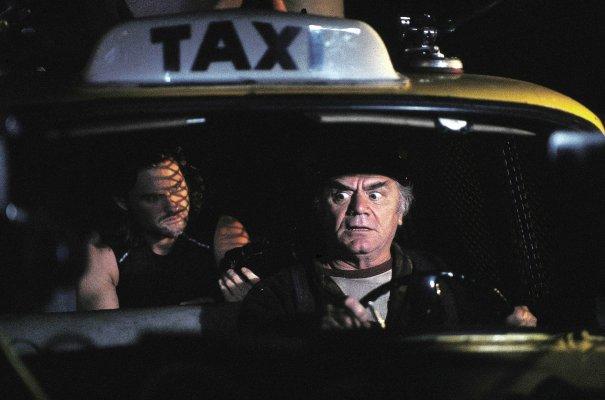
Surely the best thing about Escape from New York is its iconic main character. Kurt Russell as the eye-patched prisoner Snake Plissken is the embodiment of the tough-guy anti-hero, a self-interested mercenary with an attitude. When he’s injected with an explosive on a timer and tasked by gruff police chief Bob Hauk (Lee Van Cleef) with rescuing the captured President (Donald Pleasence), Plissken must venture into the walled-in prison that is New York City to recover his target before time runs out. The distant dystopia of 1997 (I must have blinked and missed it) seems to include more than a little source material for The Purge series, full of shadowy alleyways and sewers full of crazies, at least as far as the film depicts, not showing anything of the world outside the lawless prison-city. It’s not all gloom, though; the film does have its own sense of humor, but it’s a bit more low-key than cheesy one-liners, like how everyone comments that they thought Snake was dead or when Snake takes shelter from roaming loonies in Chock Full O’Nuts.
Of course, as an action movie, the dingy urban setting is only the backdrop for Plissken’s exploits, with a car chase through enemy territory being the standout thrill. The personalities he encounters along the way may be underdeveloped, but their actors make memorable characters out of them, from Ernest Borgnine’s amicable Cabbie to Harry Dean Stanton’s calculating Brain to Isaac Hayes’s menacing Duke. The budget and limited special effects are felt in certain scenes, such as only showing the President’s plane crash through some radar animation, but the film and its hero thrive on aggressive moxie that makes the most of their resources.
A world-building action movie with more atmosphere than pyrotechnics, Escape from New York is among John Carpenter’s best cult classics. It may not be one of my favorite action movies, but I see why it’s popular with my VC and many others. While I suspect it is inevitable, something in me hopes that it never gets a remake.
Best line: (Bob Hauk, who sends Snake in) “You going to kill me, Snake?” (Snake) “Not now, I’m too tired. [pause] Maybe later.”
Be sure to vote for your favorite Franchise Serial Killer (if favorite is the right word?) in the latest Opinion Battle at Movie Reviews 101. There’s only one I know of who won an Oscar, so I went with Anthony Hopkins’s star turn as the evil Hannibal Lecter. Check out the other choices if you dare!
It is Halloween today and what better choice for a subject that looking at our favourite franchise serial killer. We have had many franchises in horror come in with a bang only to fizzle out with mindless sequels but then we have a few that stand the test of time.
If you want to take part in the next round of opinion battles we will be picking our favourite Guilty Pleasure and you will need to send your entries to moviereviews101@yahoo.co.ukby 13th November 2016.
Darren – Movie Reviews 101
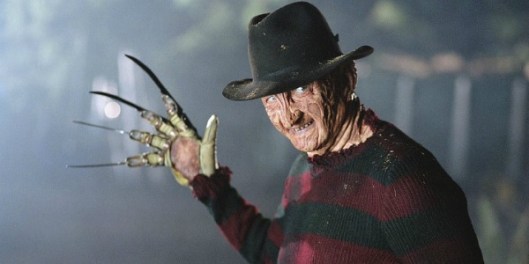
Freddy Krueger – Nightmare on Elm Street
One, Two Freddy’s coming for you, three, four better lock your door, five, six grab your crucifix, seven, eight better stay up late, nine, ten never sleep again. How many serial killers can haunt your dreams? How many serial killers have their own rhyme?…
Evil is as evil does,
And evil doesn’t mind because
While good is following the rules,
The baddies laugh them off as fools.
To be a nut or psychopath,
You dwell in envy, greed, and wrath
And do your best to put the pest
Of conscience finally to rest.
Despite the evil laugh and smirk,
A qualm or two may be at work.
Though hearts of darkness look askance,
Perhaps the good just needs a chance.
_________________
MPAA rating: PG-13
Suicide Squad proves that an awesome trailer does not always mean an awesome movie. Like many, I was disappointed with the dreary excesses of Batman v. Superman and had real hope that Suicide Squad would be a much-needed dose of cheeky fun for the DC Extended Universe. While it could be seen that way, the packaging leaves much to be desired. Suicide Squad continues the DC trend of jamming as many plots and characters as possible into a feature-length film and never reaching the full potential of any of them. I keep coming back to what one of my coworkers said after watching it. As a DC purist, she excitedly announced, “That movie was… [I expected descriptors like “awesome,” “thrilling,” “hilarious,” but no, she said] …not bad.” Okay, I’ll give her that.
Suicide Squad is DC’s version of The Dirty Dozen. Ruthless government official Amanda Waller (Viola Davis) decides to recruit the most skilled prisoners of Belle Reve Prison as an insurance policy against rogue metahuman threats, one of which crops up from her own meddling with supernatural beings. I have to admit that it’s a talented cast they’ve assembled here. Will Smith as gunmeister Deadshot could be considered the heart of the team, with his concern for his young daughter, and Smith’s natural likability makes him the most sympathetic of the group, along with Jay Hernandez’s fire-wielding Diablo. Margot Robbie gets all of the attention as bat-crazy Joker groupie Harley Quinn, while Adewale Akinnuoye-Agbaje (Lost alert!) and Jai Courtney can’t quite represent Killer Croc and Captain Boomerang as more than one-note characters with some occasional comic relief. And that’s not even mentioning team chaperone Rick Flag (Joel Kinnaman), his dark-sided lover June Moone/Enchantress (Cara Delevingne), his sword-swinging bodyguard Katana (Karen Fukuhara), and one other member of the Squad who is given such little attention that he might as well have “REDSHIRT” taped to his back. Oh, and wasn’t the Joker in this too?
Let’s be honest: this is DC trying to do what Marvel did with Guardians of the Galaxy, teaming up purported baddies as a ragtag fighting force that falls somewhere in between the definitions of “hero” and “anti-hero.” Guardians succeeded with that middle ground, thanks to the fact that one was repentant, one was driven by grief until a moment of realization, and the other three weren’t all that bad at heart, but Suicide Squad stumbles by giving us actual villains without much in the way of reform. This commitment to anti-heroism leaves the audience grasping for someone to root for. Every time you start sympathizing with a character, you’re reminded that they’re an unrepentant psychopath or a brutal enforcer, and that’s supposedly okay? Waller herself is no better than her minions, willing to kill her subordinates without a second glance or any repercussions.
The tone and look of the film also fall short of the mark. The special effects are top-of-the-line, but the editing and visual aesthetic are frequently choppy and muddled. What was intended as gritty, fun, and irreverent turns out to be loud, garish, and confusing. Perhaps the latest version of the Joker exemplifies the film’s unsavory aspects. Jared Leto is not a bad actor, but as the Joker, he’s no Heath Ledger or Jack Nicholson. Instead of the maniacal jokester we’ve come to expect, he’s basically a gaudy gangster whose craziness fails to stand out from that of the other characters. While some have complained about his limited screen time, I didn’t mind.
It wasn’t my intention for this to be an entirely negative review. Suicide Squad is not without its strengths; they’re just buried in the mountain of plot that the filmmakers couldn’t bear to part with. While Deadshot and Harley Quinn have received most of the acclaim, I preferred some of the less developed characters. Diablo’s remorse for his past misdeeds made him the most admirable of the group, coupled with some cool powers, and I would have liked to have seen more of Katana and her soul-capturing sword. One moment of hallucinations revealed the positive dreams that even villains have, and I wish they could have built on that source of sympathy. Flashbacks aside, the plot actually made for a decently paced action movie, even if it yielded to the familiar overblown climax toward the end. And though there was nothing laugh-out-loud, I suppose I appreciate the fact that Suicide Squad wasn’t afraid to chuckle at itself. Plus, it at least didn’t have any obviously stupid twist like Batman v. Superman.
I wanted to enjoy Suicide Squad more than I did, but while my respect for many films often increases with time and thought, this one has actually lessened in my estimation the more I think of it. It’s not terrible, just muddy and flawed. DC may still be a powerhouse moneymaker, but if they can’t churn out a better superhero movie soon, they won’t have the longevity of Marvel. Wonder Woman looks pretty darn good at this point, and I just hope that the trailer is actually a good representation next time.
Best line: (Griggs, a petty prison guard afraid of Deadshot) “Ames, If this man shoots me, I want you to kill him, and I want you to go clear my browser history.”
Rank: Honorable Mention (only because I’d probably see it again)
In ages long past, a boy dazzled his town
With music and magic and tales of renown,
With legends and stories he conjured and staged
As fierce paper battles and paper wars waged.
His paper-fold figures delighted the folk,
Who sang the boy’s praises before the spell broke,
But no one would guess that the sagas he spun
Held echoes of truth for this samurai’s son.
The rush of a rousing adventure well-told
Can wither as soon as the papers unfold,
But when real adventure emerges from lore,
The tales and their memories mean a bit more.
________________
MPAA rating: PG
I had the pleasure of seeing Kubo and the Two Strings as a sort-of double feature with Suicide Squad, and as the reviews of the latter would suggest, Kubo was easily the better film. In fact, I believe it has surpassed Chicken Run as my favorite stop-motion animated film, and mainly because it did something no other stop-motion movie has. The jerky movements or macabre aesthetic of past such films have defined the medium for years, but for the first time, Kubo made me forget I was watching stop motion. That makes it not only a visually incredible adventure with an imaginative story to boot, but a new high-point of achievement that Laika Entertainment can claim in their chosen field.
Kubo and the Two Strings is a heroic adventure influenced by ancient Japanese myth. Young Kubo (Art Parkinson) has been brought up in a seaside cave by his mother, who tells tales of how she saved him from her father, the Moon King, in an escape that cost Kubo one of his eyes and left her in a faltering mental state. Despite her warnings not to stay out after dark, one mistake leads to them being discovered by her menacing sisters (Rooney Mara), and, joined by a protective Monkey (Charlize Theron) and a dim-witted Beetle (Matthew McConaughey), Kubo is launched on a mystical quest to find his father’s lost armor, his only hope of survival.
Of course, the film’s most immediately remarkable trait is its animation. For once, Laika’s animation isn’t set on the creepy or grotesque, leaving such weirdness to only a few unnerving threats along Kubo’s journey (such as a preoccupation with eyes, also seen in Coraline). The freedom of the camera to capture all kinds of angles and both sweeping vistas and carefully crafted details sets the animation bar so high that only Laika will probably be able to outdo themselves in the future.
Despite the eerie effect that usually accompanies stop motion, Kubo and the Two Strings succeeds in balancing a variety of tones, from light and humorous during Beetle’s introduction to poignant during the mother’s backstory to absolutely wondrous when Kubo unleashes his magical shamisen (Japanese banjo) that controls origami puppets for his live performances. The plot may veer into some odd territory as it progresses, but Kubo and the Two Strings is aware of it, even encouraging viewers to hang with it in Kubo’s opening address. In doing so, the audience is taken on a dazzling ride with some darker-than-usual plot directions.
Alas, Kubo is not without some faults. Kubo admits to not being very good at ending his stories, and the filmmakers mirror that shortcoming to some extent. The final confrontation between Kubo and the Moon King is a bit randomly overblown with sentiment, and the resolution feels strange and manipulative, especially considering the importance the film places on memories. In a way, I see what the filmmakers were attempting, but they weren’t wholly successful. In addition, describing the Moon King as a celestial ruler of cold perfection might be seen as a criticism of God, but its basis in myth softens that objection, especially if compared with the cold “perfection” of other villains, like the Borg in Star Trek. Nevertheless, these complaints don’t ruin an otherwise outstanding film, and even if the ending could have been improved, I liked how the seemingly awkward title was given touching significance.
In an age of remakes and constant adaptations, Kubo stands out first and foremost as a work of pure originality. Animated films like The Secret Life of Pets are content to borrow other movies’ plot elements wholesale, but the folks at Laika have crafted something unique and presented audiences with sights they’ve never seen before. In a perfect world, that’s what a great film should do.
Best line: (Kubo, at the start of his stories) “If you must blink, do it now.”
Who else loves fast songs? I don’t mean fast music necessarily since there are quite a few guitar solos that are anything but slow; I’m talking about lyrics that roll off a singer’s tongue faster than the Flash after an espresso. I always marvel at the practice it must have taken to learn such lyrics by heart, and I often take it as a challenge to see how well I can memorize those musical tongue twisters.
So here are my picks for the top twelve songs sung fast, based on both the relative speed at which they exit the singer’s mouth and how well I enjoy the song. (Billy Joel’s “We Didn’t Start the Fire,” for example, may be fun to learn and one of my favorites, but it’s not really that fast. “Sam” by the Meat Puppets, on the other hand, might be the fastest song I’ve heard, but its catchiness suffers.) Let’s see how fast I can list these speed demons off.
“Got the Time” – Joe Jackson
Fans may prefer the Anthrax cover version, which is even more sped up, but Joe Jackson’s original is fast enough for me.
“Sold” – John Michael Montgomery
Drawing inspiration from the auctioneer’s chatter that goes “a mile a minute,” this country single is just pure fun to sing along to and isn’t too hard to keep up with.
“I Really Don’t Hate Christmas” – Phineas and Ferb
Disney Channel’s Phineas and Ferb had a song in every episode, and quite a few had a breakneck pace. These were the ones I most enjoyed memorizing, like “I’m Me,” “Mom, Look,” and “The History of the Tri-State Area.” The swiftest tongue-twister, though, came from the Christmas special where the evil scientist Dr. Doofenshmirtz complains about not despising Christmas. I know this song is hard to sing, and I’m impressed the voice actor kept up even with that annoying accent.
“One Week” – Barenaked Ladies
Any number of rap songs could be faster than the ones on my list, but as a non-rap fan, this awesome, rambling song is as close as I get, thanks to the catchy tune surrounding the verbal gymnastics. By the way, I always try to incorporate a movie tie into these lists, and “One Week” has lyrics mentioning Harrison Ford in Frantic and Kurosawa’s samurai films.
“Cloudburst” – Barry Manilow’s version
This speedy jazz favorite was also performed by Miles Davis and the Pointer Sisters, but I prefer Barry Manilow’s version, especially for how he ends the breathless tune with “I don’t believe I really sang this song!”
“Nations of the World” – Animaniacs / “The New Periodic Table Song” – AsapSCIENCE
Remember what I said about fast songs being almost like a dare to learn them? Well, some took that idea and wrote educational songs that were made fun for kids with their zippy lyrics and familiar tunes. Animaniacs was a favorite show of mine as a kid and helped me learn the state capitals, U.S. Presidents, and nations of the world, while AsapSCIENCE is a science-focused YouTube Channel with an especially fast-paced way to learn the Periodic Table of Elements.
“Getting Married Today” from Company – Stephen Sondheim
I cannot imagine the stress on the poor actresses who have had to perform this rapid-fire song from the musical Company live on stage over and over. I’ve barely been able to learn the lyrics myself, but it’s a true challenge that’s strangely satisfying when it all blurts out correctly. Sondheim, you rascal!
“Goin’ Down” – The Monkees
This upbeat, mumbly rocker showing off Micky Dolenz’s talented tongue is probably the hastiest single from the Monkees, a dreamboat group for my mom back in the day.
“Life Is a Rock” – Reunion
Just as “We Didn’t Start the Fire” was like a musical overview of the ‘50s through the ‘80s, Reunion’s “Life Is a Rock” is a blistering recap of pop music history, even incorporating other famous songs like Three Dog Night’s “Celebrate” and Sly and the Family Stone’s “I Want to Take You Higher.” For the record, this is my VC’s favorite fast song.
“Get Out of Denver” – Bob Seger
One of my favorite classic rock songs, this pell-mell earworm is among Bob Seger’s very best.
“The End of the World As We Know It” – R.E.M.
I couldn’t possibly leave this song out. R.E.M.’s oddly feel-good anthem is a go-to soundtrack for alien invasions, Mayan apocalypses, and presidential elections.
“Hardware Store” – “Weird Al” Yankovic
You want a fast song? Well, this is it. In addition to his hilarious parodies, “Weird Al” writes some of his own songs too, including this ridiculously fast-paced paean to the local hardware store. I’m proud to say I know it by heart, except for the absurdly long list of hardware items that seems impossible to sing in one go. Supposedly this is the only song “Weird Al” refuses to sing live, and I see why.
Here are some runners-up as well. What other fast songs do you like?
“Subterranean Homesick Blues” – Bob Dylan
“Johnny B. Goode” – Chuck Berry
“Johnny McEldoo” – The Clancy Brothers and Tommy Makem
“A Story Told” – The Count of Monte Cristo musical
“Turn to Stone” – ELO (one fast part toward the end)
“Ain’t Going Down” – Garth Brooks
“I’ve Been Everywhere” – Hank Snow
“Just Leave Everything to Me” – Hello, Dolly!(another movie reference) “Thank God I’m a Country Boy” – John Denver
“The Auctioneer Song” – Leroy Van Dyke
“Once Was a Time I Thought” – The Mamas and the Papas
“Airegin” – Manhattan Transfer
“Supercalifragilisticexpialidocious” – Mary Poppins(and another) “Sam” – Meat Puppets
“Again” – Yui
Here’s a final shout-out to the original super-fast patter song from Gilbert and Sullivan’s The Pirates of Penzance, the hard-to-sing “Major-General’s Song.” (It’s performed by the late, great George Rose, and yes, that’s also Kevin Kline and Linda Ronstadt in the 1983 film adaptation.)
Here’s my review of Christopher Nolan’s The Prestige, for MovieRob’s October Genre Grandeur of Psychological Thrillers. Stage magicians, secret tricks, and a deadly rivalry make this period piece another fascinating installment in Nolan’s filmography.