• Home
  • About Me
  • The List
  • THE LIST (2016 Update)
  • THE LIST (2017 Update)
  • THE LIST (2018 Update)
  • THE LIST (2019 Update)
  • THE LIST (2020 Update)
  • THE LIST (2021 Update)
  • THE LIST (2022 Update)
  • Top Twelves and More
  • The End Credits Song Hall of Fame

Rhyme and Reason

~ Poetry Meets Film Reviews

Rhyme and Reason

Tag Archives: Drama

Avengers: Age of Ultron (2015)

05 Tuesday May 2015

Posted by sgliput in Movies, Poetry, Reviews, Writing

≈ 6 Comments

Tags

Action, Drama, Sci-fi, Superhero


With S.H.I.E.L.D. out of service,
At least on the surface,
Six awesome Avengers defend the world still.
Since HYDRA arose,
They’ve empowered new foes,
Quicksilver and Scarlet Witch, twins with ill will.
 
Once Tony Stark’s had
An epiphany bad,
He then starts preparing for “peace in our time,”
But Ultron’s created
And quickly upgraded,
Equating true peace with a murderous crime.
 
Against these new threats
And alarming skill sets,
Our heroes must deal with their goals and their fear,
And when all agree
To save Earth mightily,
The smackdown is epic and worth a good cheer.
____________________
 

As my first review for a film still in theaters, Avengers: Age of Ultron is luckily just the kind of film to see on the big screen, with all the eye-popping action and comic book culmination that drive superhero fans like me nuts. The first Avengers stands as one of the most breathtaking feats of any superhero franchise, bringing together characters from past films and achieving a surprising balance between action, heart, and geek heaven character interaction. It’s a high point in the superhero genre that won’t be easily topped, and though Age of Ultron doesn’t quite match it, it comes close enough to still be worthy of the Avengers name.

Like X-Men: Days of Future Past, the cast is potentially unwieldy. There’s the heroes we already know and love: Iron Man (Robert Downey, Jr.), Captain America (Chris Evans), Thor (Chris Hemsworth), Hulk (Mark Ruffalo), Black Widow (Scarlett Johansson), and Hawkeye (Jeremy Renner), plus other familiar faces like Nick Fury (Samuel L. Jackson), Maria Hill (Cobie Smulders), War Machine (Don Cheadle), and at least three others. Add to that Ultron, Quicksilver, Scarlet Witch, and at least three others, and you’ve got a likely mess in the wrong hands. Luckily, we have Joss Whedon’s hands to mold it into a mostly satisfying blockbuster, with all the wit, humor, pathos, and awesomeness you might expect from his name.

With the glut of old and new characters, their treatment and screen time necessarily vary. Iron Man and Captain America get little more than some funny exchanges about foul language and disagreements about how to make safe the world, while there’s some unexpected development for Hawkeye, Widow, and Hulk, making the most and least super of the group sympathetically human. Though the presence of recognizable faces from past films will fill hardcore fans with glee, a few are so fleeting that the filmmakers could have left them out, if only to avoid confusing the less initiated. The same goes for would-be antagonists like Baron von Strucker (Thomas Kretschmann) and Ulysses Klaue (Andy Serkis), who barely stick around long enough to make an impression. (I find it interesting that those two previously appeared together as shipmates in Peter Jackson’s King Kong, though with opposite fates.) As for Quicksilver (Aaron Taylor-Johnson) and Scarlet Witch (Elizabeth Olsen), the two newest an/pro-tagonists don’t stand out as much they should have, in some cases being treated as afterthoughts amid all else happening. Quicksilver isn’t quite as fast or memorable as Evan Peters’ version of the character in Days of Future Past, but he and his Eastern European sister manage at least a couple scenes that highlight their eventual importance to the still growing team.

As you would expect from so many characters, there’s a lot going on. If your mind wanders at the wrong moment, you might be wondering why everyone is suddenly headed to a fictional African nation to visit Gollum or why Thor is skinny-dipping in a mystical Norse pool. (I’m still not sure I understand that last one). A couple added plot elements are even introduced with little to no explanation, trusting the audience to simply keep up. Just as the first film has Thor and Iron Man going toe to toe, this one sees Iron Man and Hulk duking it out. Despite all the urban devastation throughout the film, the end places special importance on the safety of civilians, and some sacrifices toward the end do touch the heart, if not very deeply.

Ultron himself is more charismatic than just some bloodthirsty robot, and James Spader’s voice gives him a compelling personality with darkly humorous and strangely religious overtones. Yet his motivations and origins are consistently murky, similar to Peter Dinklage in Days of Future Past, a villain who deep down admires his prey but intends to extinguish them for nebulous reasons. His evil plot is astonishingly inventive (though one of his creations leads to a promising new character and his inevitable downfall), and the battle to thwart it is eye-popping, including one of those goose-bump-raising extended shots with all the heroes kicking enemy butt like only the Avengers can.

I didn’t intend to make three references to Days of Future Past here, but I suppose both of these films exemplify the trend in superhero films, to bring past triumphs together into an overstuffed but breathtaking array of comic book goodness. These films and Guardians of the Galaxy seem to draw their energy from a “the more characters, the better” mentality, so long as an even-handed writer and director keep everything balanced and entertaining. Time will tell if DC can pull the same thing off with their Justice League intentions or if Marvel is destined to remain the big name in superhero hits. Age of Ultron was almost everything I had hoped, yet another sign that Marvel has yet to stumble.

Best line:  (Tony Stark) “We’re the Avengers; we can bust weapons dealers the whole doo-da-day, but how do we cope with something like that?”
(Steve Rogers) “Together.”
(Stark) “We’ll lose.”
(Rogers) “We do that together too.”
 
 
Rank: Top 100-Worthy (to join the first one)
 

© 2015 S. G. Liput

305 Followers and Counting

Coma (1978)

02 Saturday May 2015

Posted by sgliput in Movies, Poetry, Reviews, Writing

≈ 1 Comment

Tags

Drama, Thriller


Surgeries happen every day,
Routine and clean, so doctors say.
You simply go to sleep and then
They ought to wake you up again.
 
What’s that? You’ve heard, through some mistake,
That sometimes people never wake?
That’s possible, but don’t dismay;
It’s very rare, so doctors say.
 
You need not worry of a coma;
Trust the doc and his diploma.
Never fear about foul play
That can’t occur, so doctors say.
 
Statistics prove how safe you are;
The surgeon’s been ideal so far.
He’ll deftly take the pain away,
And you’ll be fine, so doctors say.
________________
 

Michael Crichton’s second film, after Westworld, was this adaptation of Robin Cook’s novel, about (you guessed it!) comas. More specifically, it concerns the investigations of young medical resident Dr. Susan Wheeler (Genevieve Bujold), who notices suspicious similarities among routine surgeries which result in unexplained brain deaths.

I had never even heard of this film before my VC recommended it, but it was actually quite entertaining, a mystery/thriller that keeps viewers guessing with its overriding paranoia. It starts off a bit rocky with a lover’s quarrel between Drs. Wheeler and Mark Bellows (Michael Douglas), which escalates quickly with too little characterization as yet for us to know with whom we should sympathize. Add to this a slightly disturbing early scene involving a “routine” abortion, and I was dubious about whether the rest of the film would improve. It did. As Susan proceeds from apparently overthinking these cases to uncovering genuinely suspect evidence of foul play, the danger grows more and more real, with shady voyeurs and ruthless conspiracies. A couple scenes may seem like science fiction, but the film is even more frightening for the fact that its core concept is chillingly plausible. The reveals are best left for actually watching the film (don’t even see the spoiler-ific trailer), since it’s a glued-to-the-screen experience from the midpoint on.

I can’t say I’ve seen any of Bujold’s films, so I was interested to see the actress who was almost Captain Janeway on Star Trek: Voyager. To be honest, I prefer Kate Mulgrew, but Bujold could have pulled it off. She deftly carries the bulk of the film, first with some women’s lib independence, then with an increasingly paranoid race for the truth and survival. Richard Widmark, Rip Torn, and Michael Douglas also provide commendable performances, even though I’ll always see the latter as either Jack Colton from Romancing the Stone or Gordon Gekko from Wall Street. The most surprising appearances are the film debuts of not only Ed Harris, but also an ill-fated Tom Selleck.

Now that I’ve seen the original film, I should also check out the A&E miniseries remake from 2012, if only for comparison. I doubt it could match this film’s burgeoning tension, but you never know. Thanks to my VC, Coma is yet another nearly forgotten film of the ‘70s to add to my list.

Best line: (a nurse) “Doctors make the worst patients. They know too much.”

 
Rank: List-Worthy
 

© 2015 S. G. Liput

303 Followers and Counting

The Hunger Games: Mockingjay — Part 1 (2014)

30 Thursday Apr 2015

Posted by sgliput in Movies, NaPoWriMo, Poetry, Reviews, Writing

≈ 3 Comments

Tags

Action, Drama, Sci-fi


In District 13, Katniss Everdeen waits,
Unsettled by District 12 citizens’ fates.
Deep under the ground with her saved family,
She worries for Peeta interminably.
Both Plutarch and resolute President Coin
Are eager for her to recover and join.
 
Insisting that Peeta be rescued someday,
Poor Katniss agrees to be their Mockingjay,
The hero for all districts, sure to inspire
The masses and light an unquenchable fire.
Since staged propaganda does not work as well,
She heads to the war zones to get mad as hell.
 
Her anger at Snow for the cruel devastation
Extends to the people who rise from privation.
Yet who should appear on the Capitol screens
But Peeta, denouncing the riotous scenes?
The boy’s brain seems washed, but he still tries to warn
The rebels of sudden barrages that morn.
 
When Capitol power is violently cut,
The rebels move in ere the window is shut.
The three captive tributes that Snow has been holding
Are surely a part of his scheme still unfolding.
Though Katniss is eager for Peeta’s return,
She’s shocked at the lesson Snow wants her to learn.
_________________
 

(Since this is the last day of NaPoWriMo, my reviews will probably be less frequent from now on, but I thought I’d go out on a more well-known film.)

This latest installment of the Hunger Games franchise wasn’t as well-received as its predecessors, and it does stand apart from those films in some crucial ways. For one thing, there are no actual Hunger Games, the televised blood sport that managed to thrill both the citizens of Panem and countless readers and viewers. Instead, the film chooses to focus on District 13 and its commissioning of everyone’s favorite grieving archer to lead the revolt against the Capitol and President Snow. They basically have her do what she’s done in the past: grieve for the fallen, land awesome arrow shots, and make rebellious statements against tyranny, just more forcefully than in the past and this time caught on camera. In this case, there’s quite a bit of Katniss grieving: for the decimated District 12, for Snow’s current victims, for her captive boyfriend Peeta (their love was real; who knew?), and the comparatively brief scenes of action and tension don’t exactly balance out her emotional turmoil. Every time Peeta came on screen and people either booed him or asked what Snow had done to him, I kept wondering why no one considered that he had been brainwashed. That seemed like the most obvious explanation. And of course, the film’s greatest weakness is the stigma of being Part 1, a film in which the first half of a relatively short book is dragged out and concluded on a far from satisfying note.

All that being said, Mockingjay — Part 1 is still an important piece of the franchise, however financially exploitative it may be. The events following Catching Fire are given greater emotional weight, and Jennifer Lawrence continues to project a compelling mix of strength, vulnerability, and concern for both friends and family. While it’s a bit jarring for her to go from fighting for survival to filming propaganda pieces, Katniss’s transition from tribute to freedom fighter feels well-earned and depicts the motivating power that revolutionary media can have on a volatile populace. The film’s best scene is the dam attack in which a haunting folk song (with lyrics drawn from Suzanne Collins’ book) is employed as an anthem of rebellion. “The Hanging Tree” is one of those unique aspects of this franchise that transcends the story itself (like the three-finger salute or that familiar whistle), and it stayed with this viewer much more than Lorde’s Globe-nominated “Yellow Flicker Beat.”

Thus, while it would have been better to film Mockingjay as one film, this one still has merit. We get to meet Julianne Moore as District 13’s President Coin and see more of the late Philip Seymour Hoffman as Plutarch Heavensbee. The few moments of tension certainly are thrilling, and that twist at the end surely took everyone who hadn’t read the books by surprise (even if that’s just me and five other people). While much of the film does feel unnecessarily prolonged, such as Katniss’s repetitive calls to Snow at the climax, I for one was still glad to spend more time with this story and these characters. Plus, the film fulfilled its main purpose; I’ll be there with countless others to see Part 2 this November.

By the way, here’s a musical version for those of you who could use a laugh. This is just one of three hilarious parody videos, all of which are well worth seeing. Enjoy!

https://www.youtube.com/watch?v=am1tzttZ8Pc

Best line: (Effie Trinket, who apparently wasn’t much in the third book) “They’ll either want to kill you, kiss you, or be you.”

 
Rank: List-Worthy (joining the other two as one series)
 

© 2015 S. G. Liput

302 Followers and Counting

Bottom-Dweller: 5 Centimeters Per Second (2007)

29 Wednesday Apr 2015

Posted by sgliput in Movies, NaPoWriMo, Poetry, Reviews, Writing

≈ 3 Comments

Tags

Animation, Anime, Bottom-Dweller, Drama, Romance


(Today’s NaPoWriMo prompt was for a poem written in the form of a review. Perfect for a poet/movie reviewer, right? In this case, I combined my usual poem and review into the single rant below.)

For those who might think I like all animation,
I’ll simply refer to this dreadful creation.
I’ve mentioned before that I cherish the art
And story of Ghibli’s Whisper of the Heart,
And after I saw it, I searched on my own
For anime like it that might be well-known
For a similar quiet and intimate tone.
 
I read some good things about this little flick
From Makoto Shinkai and hoped it would click.
I watched it, this 5 Centimeters Per Second,
And found it was not at all what I had reckoned.
This Japanese drama with praise was anointed.
Did no critic see how delayed and disjointed
This tearjerker is? Was just I disappointed?
 
The film’s broken up into three distinct parts,
With each saying more of the breaking of hearts.
It starts off with promise; two thirteen-year-olds
Are both separated as each life unfolds.
By train, the boy Tono then travels through white,
Through blizzard and blockages to reunite
With distant Akari who waits through the night.
 
This first part alone could have stayed on its own
And is rather sweet, though it’s tedium-prone,
But Parts 2 and 3 are unduly depressing,
With one girl downcast by love she’s not professing,
And then we see Tono grown up, while Akari
Has moved on without him, with both feeling sorry
And gazing at petals and skies dark and starry.
 
The film lasts an hour, with a pace so not vital
It seems twice as long, with less speed than the title,
Which fondly refers to the unhurried crawl
At which cherry blossoms supposedly fall.
When all’s said and done, out of nowhere appears
A strange music video meant to draw tears
To recap this great waste of time for the ears.
 
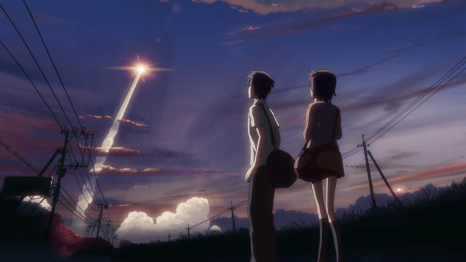
The film’s greatest strength is the beautiful art,
A treat for the eyes if not quite for the heart.
The landscapes are lovely, replete with details,
But that’s not enough, for the story still fails.
There’s much symbolism with petals and birds,
With launches of space probes and unspoken words,
And some of it’s poignant, though broken in thirds.
 
The imagery may be the film’s biggest draw,
But how it’s employed is a signature flaw.
Most anime’s mingled with peaceful transitions,
A still or an object, like small intermissions,
But actions in this film are drawn out and laced
With tons of these images, ploddingly paced,
Which may bear some beauty but aren’t to my taste.
 
Yet what do I draw from these touching vignettes,
That love sure can stink when it’s full of regrets?
A drama needs more than some symbols about
The fact that some romances just don’t work out.
There aren’t even reasons implied to explain
Why two former lovebirds broke up in such pain.
I grieved by the end, for my hour spent in vain.
 
 
Rank: Bottom-Dweller
 

© 2015 S. G. Liput

302 Followers and Counting

Becoming Jane (2007) (Full Version)

28 Tuesday Apr 2015

Posted by sgliput in Movies, NaPoWriMo, Poetry, Reviews, Writing

≈ 2 Comments

Tags

Drama, History, Romance


The author Jane Austen
Refused to get lost in
Romance of her own,
Though for that she’s well-known.
__________________
 

(Here’s the full review for the poem I wrote a couple days ago. Since I already have my NaPoWriMo poem for today with X-Men: Days of Future Past, I thought today would be a good day to finish this one.)

Becoming Jane follows in the footsteps of biopics like Cross Creek and Shakespeare in Love in asking, “Why remake an author’s work when you can depict the supposed events in their life that inspired that work?” Anne Hathaway is a lovely Jane Austen, and James McAvoy is a debonair Tom LeFroy, the brief acquaintance from Austen’s life whom the film expands into a full-on would-be love interest. Even if their romance isn’t entirely true to history, Hathaway and McAvoy have all the chemistry they need to make for a heart-throbbing Janeite passion.

It’s a film that seems to have everything going for it: an evocative score, ravishing costumes and production design, compelling cinematography with vivid views of nature and framed scenes shot through corridors, and a cast of renowned thespians, such as James Cromwell, Julie Walters, and Maggie Smith. Its dialogue even bears the eloquent wit and civilized sauciness of Austen’s work, and therein lies an issue for me. As elegant as Austen’s writing is (“accomplished” as McAvoy’s LeFroy judges), its flowery language isn’t as appealing to a modern audience as it once was. Certainly there are plenty of Janeites out there who still swoon over her sophisticated style, and it isn’t as pretentious as The Philadelphia Story, but it takes more effort than usual sometimes to decipher the meaning behind her carefully constructed prose. Perhaps that’s the fault of me, too low-brow to keep up with her urbane language, but I doubt I’m the only one. I keep thinking of Tom Hanks in You’ve Got Mail, rolling his eyes as he slogs through Pride and Prejudice.

Like that film, Becoming Jane borrows the initial setup of her most famous novel, with Jane becoming instantly prejudiced against LeFroy’s arrogance toward her. Scenes involving Jane’s disagreeing parents and a country dance in which she and LeFroy trade polished barbs will certainly remind viewers of past productions of Pride and Prejudice. Yet since Austen is known to have never married, it’s clear that any attraction between the two is doomed to failure; herein lies the film’s uniqueness among Austen-like works. While all of her novels conclude basically with happy endings, such marital felicity was not to be hers, and the film’s final moments highlight the bittersweet sentiments of what-might-have-been. My VC agrees with me about the ornate dialogue but was still brought to tears by the denouement. It’s not necessarily a tragedy, since female independence has its last word over societal convention even if it can’t defy it, but Becoming Jane has its foundation in the real world, a world of desirable affection and indispensable money, a world meant to be perfected by a sadder but wiser novelist.

Best line: (Mrs. Austen, when Jane starts writing instead of attending to a suitor) “Jane!”
(Lady Gresham) “What is she doing?”
(Mr. Wisley, the suitor) “Writing.”
(Lady Gresham) “Can anything be done about it?”
 
 
Rank: List Runner-Up
 

© 2015 S. G. Liput

302 Followers and Counting

Song of the Sea (2014)

27 Monday Apr 2015

Posted by sgliput in Movies, NaPoWriMo, Poetry, Reviews, Writing

≈ 1 Comment

Tags

Animation, Drama, Family, Fantasy

Review: 'Song of the Sea' is a masterwork by director Tomm Moore - LA Times
 
Children
Are rarely
Prepared for tragedy.
 
Ben’s
Little sister
Can transform magically.
 
Selkies
Sing peace,
Only wearing coats.
 
Saoirse
Needs hers,
Freeing silent throats.
 
Fantasy
And emotion
Animate the ocean.
__________________
 

(Today’s NaPoWriMo prompt was for a hay(na)ku, a haiku variant with three lines, one word in the first, two in the second, and three in the third. In this case, I connected several, and since the word hay(na)ku sounds rather Celtic, even if it probably isn’t, I wrote them for last year’s Song of the Sea.)

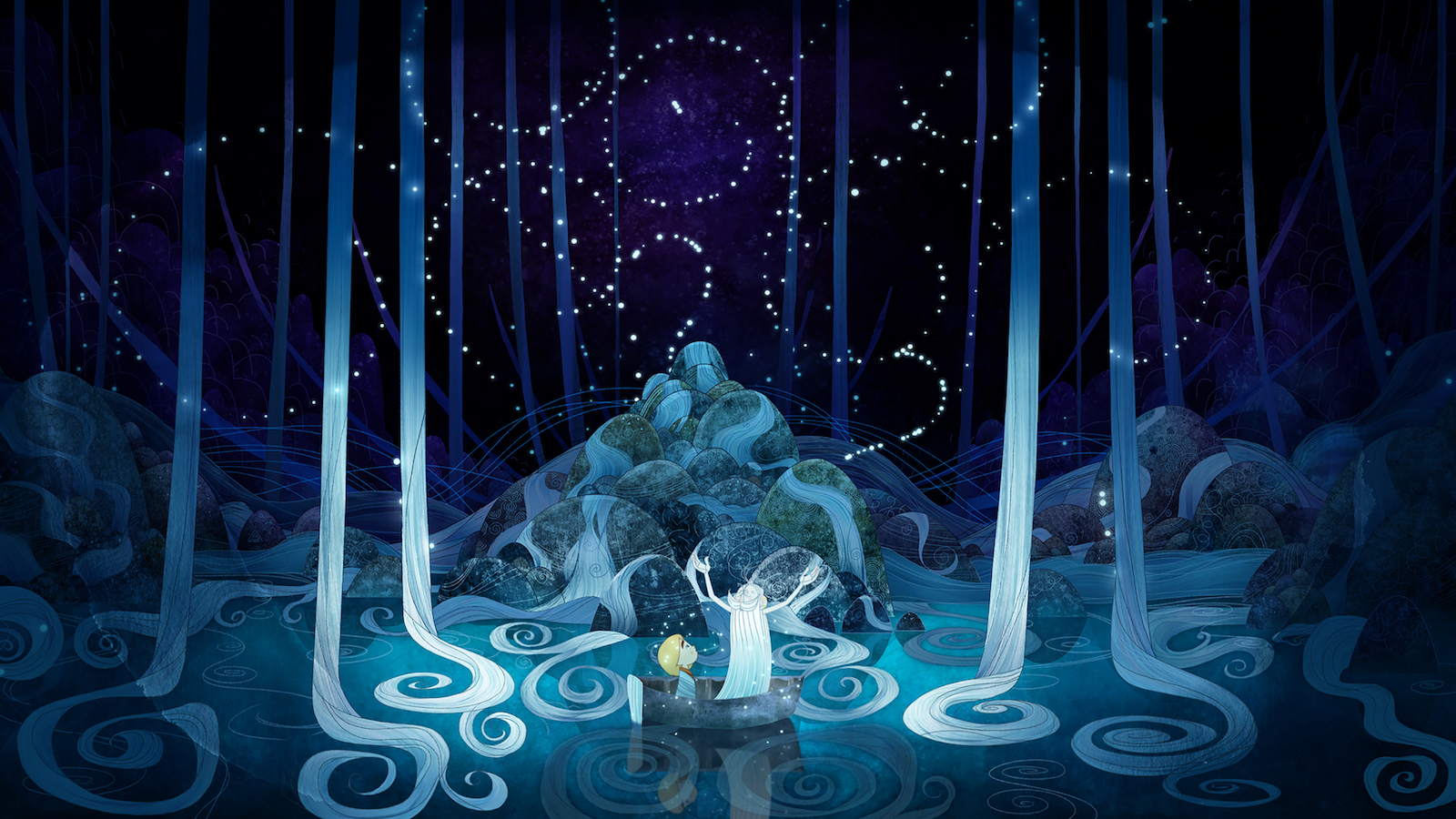
Just as The Secret of Kells came out of nowhere when it was nominated for Best Animated Feature in 2009, director Tomm Moore’s second film Song of the Sea was released with little fanfare (at least here in the U.S.) but luckily received another Oscar nod to lend it some added exposure. I very much enjoyed Kells, but this follow-up is even better, with deeper themes and more relatable characters. Like its predecessor, Song of the Sea boasts meticulously hand-drawn animation designed to resemble medieval Celtic art, a haunting Gaelic-infused lullaby sung by a magical child, and an intriguing mix of Christian motifs and Irish mythology. Five years in the making, the animation truly is a wonder; every frame has a beauty and balance, replete with gentle curves, jagged spikes, serene curlicues, and other geometric phenomena. Like Kells, nearly every scene could be a work of art, but here the animation connecting them is smoother and the plot more involving. Even modern sights absent from Kells are opportunities for entrancing symmetry, such as roundabouts and power lines. The character designs are more appealing as well, particularly little Saoirse, one of the cutest animated children since Boo in Monsters, Inc. (It also provides a reliable pronunciation for the Irish word for “freedom,” [SEER-sha]. Who hasn’t wondered how to say it ever since they first saw Saoirse Ronan’s name?)

Song of the Sea | Coolidge Corner Theater

After the loss of their mother, Ben is bitter toward his mute little sister, who discovers her mystical roots as a selkie, the seal equivalent of a mermaid. When their grief-stricken father (Brendan Gleeson, who was also in The Secret of Kells) finally agrees to send them to the city with their grandmother (Lost alert: Fionnula Flannigan), the children journey cross-country to reunite Saoirse with her selkie coat, encountering various members of the Deenashee, or faerie folk, along the way. This main plot could have been enough for the typical filmmaker, but Moore invests special symbolism in the mythological backstory of the giant Mac Lir, who suffered a great tragedy, and Macha the Owl Witch, his mother who turned him to stone. The story can be taken at face value, but it carries certain parallels to Ben’s family (made explicit in the voice acting) to provide unexpected depth for those looking for it.

Both of Moore’s films have attracted comparisons with the works of Hayao Miyazaki, with their relaxed pacing and earnest natural beauty. Ben’s efforts to reverse the transformative curse of a large-headed witch may remind some of Spirited Away, but Song of the Sea is a far more emotional journey than most of Miyazaki’s films. Through magical intervention, Ben becomes more responsible and aware of his brotherly role, and a maternal moment toward the end could either confuse or extract a few tears. For me, it almost did the latter. The accents and the music clearly mark the film as a product of Ireland, and it fits in well with my personal attraction to everything Celtic (including the actual “Song of the Sea,” which wins a spot in my End Credits Song Hall of Fame). It’s the very definition of an animated gem, the kind of lovingly crafted project that may never attract a vast audience but certainly deserves one.

Best line: (Bronach, the selkie/mother) “My son, remember me in your stories and in your songs. Know that I will always love you, always.”

 
Rank: List-Worthy
 

© 2015 S. G. Liput

302 Followers and Counting!

Genre Grandeur – Harrison Bergeron (1995) – Rhyme and Reason

27 Monday Apr 2015

Posted by sgliput in Movies, NaPoWriMo, Poetry, Reviews, Writing

≈ 2 Comments

Tags

Drama, Sci-fi

Here’s my review of Harrison Bergeron for MovieRob’s latest Genre Grandeur of dystopian films. Thanks, Rob!

movierob's avatarMovieRob

dystopia__

For this month’s next review for Genre Grandeur – Dystopian Movies, here’s a review of Harrison Bergeron (1995) by S.G. Liput of Rhyme and Reason

Thanks again to James of Back to the Viewer for choosing this month’s genre.

Next month’s Genre has been chosen by S.G. Liput of Rhyme and Reason.  We will be reviewing our favorite fantasy/sci-fi animated movies (non-Disney or Pixar) . Please get me your submissions by 25th May by sending them to animated@movierob.net  Try to think out of the box! Great choice S.G.!

Let’s see what S.G. thought of this movie:

__________________________

Harrison Bergeron

hb

Harrison Bergeron lives in the future,

Where everyone’s forced to be equal and fair.

Those cursed with talent must quench it and wear

A handicap band that will help to impair.

Harrison Bergeron’s blamed as a genius

And wishes that he could be average as well,

Until he discovers that…

View original post 731 more words

The Towering Inferno (1974)

26 Sunday Apr 2015

Posted by sgliput in Movies, NaPoWriMo, Poetry, Reviews, Writing

≈ 1 Comment

Tags

Action, Disaster, Drama, Thriller


I am the fire that burns out of sight,
Starting my rampage as merely a wisp.
Celebrate victory into the night;
I will burn you and your spire to a crisp.
 
Why do they build these skyscrapers so high,
Making it simpler with every floor
For me to cut off and trap in the sky
Everyone over my fiery roar?
 
Look at the people who panic and flee,
Visitors boasting illustrious names.
Look at the firemen battling me,
Feeble to fight in the face of my flames.
 
I am inferno, the new height of heat,
No other bastion of bragging is hotter.
Top of the world, Ma! None can defeat
Me or my mayhem, except—oh no—water!
________________
 

(Today’s NaPoWriMo prompt was for a persona poem, one written in the voice of someone/something else. I’ve written a few like that recently, but this film offered another good opportunity.)

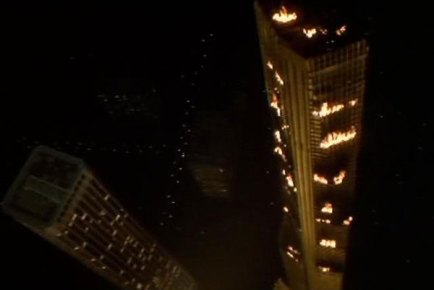
Released at the height of the 1970s fascination with disaster films, The Towering Inferno is one of the best films produced by “Master of Disaster” Irwin Allen. Featuring one of those great ensembles of former power players, the film plays as a modern land-based version of the Titanic story. Just as the Titanic set out without enough lifeboats for everyone aboard, the Glass Tower’s builder (William Holden) sees no problem with holding a top-floor party in a 138-story building with no working fire suppression system and later refuses to understand the severity of the situation. Likewise, the Titanic did have all the boats it was required to, just as the corner-cutting engineer (a loathsome Richard Chamberlain) insists that all the systems he installed were “up to code,” which is just not good enough, as the high-reaching disaster starkly proves.

In addition to the danger of irresponsible cost-saving measures, which are most commonly to blame for human-liable disasters, the film is an early realistic tribute to the heroism of firefighters, embodied in Steve McQueen’s Chief Mike O’Halloran. While he at first blames the tower’s architect Doug Roberts (Paul Newman), he wastes no time in taking charge and using everything at his disposal to stop the conflagration and rescue the stranded partygoers, from helicopters to a breeches buoy to a life-risking explosive mission. Not only does it foreshadow more recent firefighter stories, but certain scenes may even remind you of Die Hard or, more soberingly, the 9/11 attacks.

There’s everything you expect from a big disaster movie: building tension, children in danger, ill-fated lovers, lamentable panic, harrowing visual effects (the stars did their own stunts for the wet finale, which was filmed in one take), daring rescues, and an enormous cast of big-ish names, some of which aren’t necessarily safe from flaming death. In addition to the ones above, there are Faye Dunaway, an aging Fred Astaire, Robert Wagner, Robert Vaughn, model Susan Blakely, everyone’s favorite football player O. J. Simpson, Dabney Coleman, and the final film role of Jennifer Jones. Reportedly, Paul Newman and Steve McQueen clashed egos in who would receive top billing, resulting in a clever compromise in the credits, with McQueen’s name on the left but lower than Newman’s. Plus, those who remember 1970s TV might recognize the sheriff from The Waltons (as an electrical worker), Gregory Sierra from Barney Miller (as the bartender), and The Brady Bunch’s Mike Lookinland/Bobby Brady (as a boy in peril).

Rising from its B-movie potential, The Towering Inferno is surprisingly well-done, though not without some faults (a few overlong suspense scenes and victim incompetence), and it won Oscars for Best Cinematography, Editing, and Song, as well as a Best Picture nomination. While I prefer The Poseidon Adventure (which also won Best Song two years prior for “The Morning After,” which was also sung commercially by Maureen McGovern), this film has enough star power and thrills to still entertain. If Jaws made you afraid to go in the water and The Poseidon Adventure turned you off from cruise ships, The Towering Inferno may give you pause the next time you head to the top of a skyscraper.

Best line: (Doug Roberts, to the tower’s ambitious builder) “Don’t you think you’re suffering from an edifice complex?”

VC’s best line: (Doug Roberts) “If you had to cut costs, why didn’t you cut floors instead of corners?”

 
Rank: List-Worthy
 

© 2015 S. G. Liput

299 Followers and Counting

Becoming Jane (2007) (Short Version)

25 Saturday Apr 2015

Posted by sgliput in Movies, NaPoWriMo, Poetry, Reviews, Writing

≈ 2 Comments

Tags

Drama, History, Romance

The author Jane Austen
Refused to get lost in
Romance of her own,
Though for that she’s well-known.
 ___________________
 

In keeping with NaPoWriMo’s prompt for the day, I wanted to do a Clerihew, an eponymous quatrain poking fun at another person. Since I didn’t have much time today, though, I’m just posting the poem and will have to write the review for Becoming Jane later. Until then….

Wait until Dark (1967)

24 Friday Apr 2015

Posted by sgliput in Movies, NaPoWriMo, Poetry, Reviews, Writing

≈ 1 Comment

Tags

Drama, Thriller

 
Dark, be not proud, though some have cause
To fear when you fall, for you’re not that bad.
For those with blind eyes, you’re vexing a tad,
But not so much when all live by your laws.
You’re at your worst when men barge in because
They want some drugs that they can’t seem to find.
It’s hard to tell their truthfulness of mind
When I can’t see their flimsily-veiled flaws.
Thou art slave to caves, blinds, clouds, and Audrey Hepburn
And dost with broken lights and switchblades dwell,
But lighters and fridge doors can your shadow quell,
And thwart your hopeful fortunes, which (yep) turn.
One long night past, with you and deadly men,
And I won’t dare unlock the door again.
__________________
 

(In following today’s NaPoWriMo prompt, today’s poem is a parody/satire poem, in this case of John Donne’s “Death, Be Not Proud.”)

The movies have taught us quite a lot about stranger danger. Innerspace bade us to be wary of sudden injections, or else you may end up with Dennis Quaid inside your body. Twilight Zone: The Movie warned us against hitchhikers, even those as friendly-looking as Dan Aykroyd. And this film, Wait until Dark, teaches us not to accept heroin-filled dolls from people you just met on a transatlantic flight, especially if you have a blind wife and habitually leave your front door unlocked. Such is the setup for the most Hitchcockian film I’ve seen that doesn’t bear his name.

After a coworker recommended this one-room thriller to me, I was intrigued to see the lovely Audrey Hepburn in a less glamorous role, as housewife Susy Hendrix, a damsel in distress who is easily distressed due to her blindness. Her tense performance garnered an Oscar nomination, and, even if some of her reactions seem overacted, she does it well enough to never tip into histrionics. Alan Arkin is outstanding as Mr. Roat, one of the original creepy, single-minded killers with a bad haircut (you know the type), and his character might have become one of the great iconic villains had he benefited from more screen time. Richard Crenna and Jack Weston are also well and good as Roat’s bribed/blackmailed allies.

The main issue with this film is the suspension of disbelief throughout the middle. The movie starts out with a compelling setup and certainly ends well, but the bulk of the plot involves an elaborate ploy by the three baddies to trick Mrs. Hendrix into searching for the missing doll. Not only is it hard to believe that they would go to all that trouble, but Hepburn’s naiveté is equally improbable. She at first seems to immediately accept whoever walks through her door, and, though she proves to be more wise and perceptive than she first appears, her initial gullibility is just one of the film’s plot holes.

Yet once all the subterfuge is over and the narrative builds to its semi-famous climax, it becomes sheer tension. Let’s just say that the finale earns the “Dark” in the title as it morphs from Hitchcock into a precursor to Halloween. Whatever the faults of the film’s middle, the end certainly deserves a watch and teaches that other important movie lesson: just because you stab someone doesn’t mean they’re dead!

Best line: (Susy) “How would you like to do something difficult and terribly dangerous?”   (Gloria, her young helper) “I’d love it!”

  
Rank: List Runner-Up
 

© 2015 S. G. Liput

298 Followers and Counting

← Older posts
Newer posts →

Recent Posts

  • We Didn’t Start 2025 (Recap)
  • NaPoWriMo 2025 Recap (Finally)
  • Sonic the Hedgehog 3 (2024)
  • It Happened One Night (1934)
  • Spellbound (2024)

Recent Comments

associatesofshellymann's avatarassociatesofshellyma… on My Top Twelve La La La So…
Kit's avatarKit Nichols on Bonnie and Clyde (1967)
lifelessons's avatarlifelessons on Look Back (2024)
Carol Jackson's avatarCarol Jackson on The Thief of Bagdad (1940…
Stephen's avatarStephen on Love Story (1970)

Archives

  • January 2026
  • December 2025
  • May 2025
  • April 2025
  • March 2025
  • February 2025
  • January 2025
  • December 2024
  • May 2024
  • April 2024
  • March 2024
  • February 2024
  • January 2024
  • December 2023
  • November 2023
  • October 2023
  • September 2023
  • July 2023
  • June 2023
  • May 2023
  • April 2023
  • March 2023
  • February 2023
  • January 2023
  • December 2022
  • November 2022
  • October 2022
  • September 2022
  • August 2022
  • July 2022
  • June 2022
  • May 2022
  • April 2022
  • March 2022
  • February 2022
  • January 2022
  • December 2021
  • November 2021
  • October 2021
  • September 2021
  • August 2021
  • July 2021
  • June 2021
  • May 2021
  • April 2021
  • March 2021
  • February 2021
  • January 2021
  • December 2020
  • November 2020
  • October 2020
  • September 2020
  • August 2020
  • July 2020
  • June 2020
  • May 2020
  • April 2020
  • March 2020
  • February 2020
  • January 2020
  • December 2019
  • November 2019
  • October 2019
  • September 2019
  • August 2019
  • July 2019
  • June 2019
  • May 2019
  • April 2019
  • March 2019
  • February 2019
  • January 2019
  • December 2018
  • November 2018
  • October 2018
  • September 2018
  • August 2018
  • July 2018
  • June 2018
  • May 2018
  • April 2018
  • March 2018
  • February 2018
  • January 2018
  • December 2017
  • November 2017
  • October 2017
  • September 2017
  • August 2017
  • July 2017
  • June 2017
  • May 2017
  • April 2017
  • March 2017
  • February 2017
  • January 2017
  • December 2016
  • November 2016
  • October 2016
  • September 2016
  • August 2016
  • July 2016
  • June 2016
  • May 2016
  • April 2016
  • March 2016
  • February 2016
  • January 2016
  • December 2015
  • November 2015
  • October 2015
  • September 2015
  • August 2015
  • July 2015
  • June 2015
  • May 2015
  • April 2015
  • March 2015
  • February 2015
  • January 2015
  • December 2014
  • November 2014
  • October 2014
  • September 2014
  • August 2014
  • July 2014
  • June 2014
  • May 2014
  • April 2014
  • March 2014
  • February 2014
  • January 2014
  • December 2013

Categories

  • Blindspot
  • Blogathon
  • Christian
  • Movies
  • Music
  • NaPoWriMo
  • Poetry
  • Reviews
  • TV
  • Writing

Meta

  • Create account
  • Log in
  • Entries feed
  • Comments feed
  • WordPress.com

Recent Posts

  • We Didn’t Start 2025 (Recap)
  • NaPoWriMo 2025 Recap (Finally)
  • Sonic the Hedgehog 3 (2024)
  • It Happened One Night (1934)
  • Spellbound (2024)

Recent Comments

associatesofshellymann's avatarassociatesofshellyma… on My Top Twelve La La La So…
Kit's avatarKit Nichols on Bonnie and Clyde (1967)
lifelessons's avatarlifelessons on Look Back (2024)
Carol Jackson's avatarCarol Jackson on The Thief of Bagdad (1940…
Stephen's avatarStephen on Love Story (1970)

Archives

  • January 2026
  • December 2025
  • May 2025
  • April 2025
  • March 2025
  • February 2025
  • January 2025
  • December 2024
  • May 2024
  • April 2024
  • March 2024
  • February 2024
  • January 2024
  • December 2023
  • November 2023
  • October 2023
  • September 2023
  • July 2023
  • June 2023
  • May 2023
  • April 2023
  • March 2023
  • February 2023
  • January 2023
  • December 2022
  • November 2022
  • October 2022
  • September 2022
  • August 2022
  • July 2022
  • June 2022
  • May 2022
  • April 2022
  • March 2022
  • February 2022
  • January 2022
  • December 2021
  • November 2021
  • October 2021
  • September 2021
  • August 2021
  • July 2021
  • June 2021
  • May 2021
  • April 2021
  • March 2021
  • February 2021
  • January 2021
  • December 2020
  • November 2020
  • October 2020
  • September 2020
  • August 2020
  • July 2020
  • June 2020
  • May 2020
  • April 2020
  • March 2020
  • February 2020
  • January 2020
  • December 2019
  • November 2019
  • October 2019
  • September 2019
  • August 2019
  • July 2019
  • June 2019
  • May 2019
  • April 2019
  • March 2019
  • February 2019
  • January 2019
  • December 2018
  • November 2018
  • October 2018
  • September 2018
  • August 2018
  • July 2018
  • June 2018
  • May 2018
  • April 2018
  • March 2018
  • February 2018
  • January 2018
  • December 2017
  • November 2017
  • October 2017
  • September 2017
  • August 2017
  • July 2017
  • June 2017
  • May 2017
  • April 2017
  • March 2017
  • February 2017
  • January 2017
  • December 2016
  • November 2016
  • October 2016
  • September 2016
  • August 2016
  • July 2016
  • June 2016
  • May 2016
  • April 2016
  • March 2016
  • February 2016
  • January 2016
  • December 2015
  • November 2015
  • October 2015
  • September 2015
  • August 2015
  • July 2015
  • June 2015
  • May 2015
  • April 2015
  • March 2015
  • February 2015
  • January 2015
  • December 2014
  • November 2014
  • October 2014
  • September 2014
  • August 2014
  • July 2014
  • June 2014
  • May 2014
  • April 2014
  • March 2014
  • February 2014
  • January 2014
  • December 2013

Categories

  • Blindspot
  • Blogathon
  • Christian
  • Movies
  • Music
  • NaPoWriMo
  • Poetry
  • Reviews
  • TV
  • Writing

Meta

  • Create account
  • Log in
  • Entries feed
  • Comments feed
  • WordPress.com

Blog at WordPress.com.

  • Subscribe Subscribed
    • Rhyme and Reason
    • Join 814 other subscribers
    • Already have a WordPress.com account? Log in now.
    • Rhyme and Reason
    • Subscribe Subscribed
    • Sign up
    • Log in
    • Report this content
    • View site in Reader
    • Manage subscriptions
    • Collapse this bar