• Home
  • About Me
  • The List
  • THE LIST (2016 Update)
  • THE LIST (2017 Update)
  • THE LIST (2018 Update)
  • THE LIST (2019 Update)
  • THE LIST (2020 Update)
  • THE LIST (2021 Update)
  • THE LIST (2022 Update)
  • Top Twelves and More
  • The End Credits Song Hall of Fame

Rhyme and Reason

~ Poetry Meets Film Reviews

Rhyme and Reason

Tag Archives: Drama

VC Pick: Saturday Night Fever (1977) / Staying Alive (1983)

14 Wednesday Mar 2018

Posted by sgliput in Movies, Poetry, Reviews, Writing

≈ Leave a comment

Tags

Drama, Musical, Romance, VC Pick

See the source image

See the source image

Though we may think our minds are broad,
Aware of worlds beyond our own,
We all are uniformly flawed
In being tunnel vision-prone.

We often only grasp this fact
When dreams we barely comprehend
Provoke our minds. How we react
Determines where our path will end.
_________________________

MPAA rating for Saturday Night Fever: R (but there’s a PG version too)
MPAA rating for Staying Alive: PG

I wasn’t looking forward to watching Saturday Night Fever because I had a feeling it would be a lot like my VC’s last pick Dirty Dancing, a movie where I’ve seen all the best parts with little interest in the connective tissue. Yet she really wanted me to see its critically ravaged sequel Staying Alive (yes, SNF had a sequel), which I knew nothing about and of course had to watch the first movie to fully understand.  Now that I’ve seen both, conventional wisdom would say I should love Saturday Night Fever and deride its cheap sequel, but apparently I missed that convention. My feelings aren’t that strong on either one, but my sympathies are definitely flipped from the critical consensus I’ve seen.
See the source image

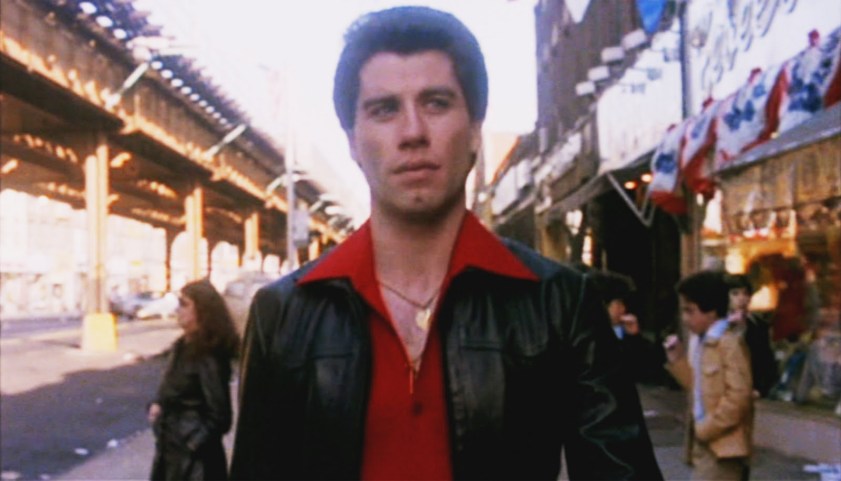
As far as Saturday Night Fever, it fit my expectations to some extent. I had seen all the best parts already, but they’re still iconic for a good reason, especially the dancing prowess of Tony Manero (John Travolta in his star-making role). The soundtrack is one of the catchiest ever, full of high-pitched Bee Gees and even disco-fied classical music, all of which adds to the overwhelming ‘70s-ness of the whole production. Few movies capture their contemporary time and place so completely as Saturday Night Fever does, from the wide-collared shirts and weirdly high-heeled shoes to the background details like the posters of Rocky and Farrah Fawcett on Tony’s bedroom wall. Its status as a snapshot of a decade makes it significant, in a way that comes off as transportive rather than dated.

Knowing already the basic plot, I was mainly concerned that Saturday Night Fever would be too much like a certain movie I love to hate, John Travolta’s other lifestyle-snapshot film Urban Cowboy (worst movie ever, by the way). It has a lot in common, with its young Travolta protagonist being a self-absorbed punk who prefers to spend his nights drinking and playing his money away. Yet while Urban Cowboy seemed perfectly content with its white-trash carousing, Saturday Night Fever is at least self-aware about it. It rings bitingly true when Tony’s dance partner Stephanie (Karen Gorney) calls him “a cliché. You’re nowhere, on your way to no place.”

See the source image

I could appreciate how Tony wakes up to how narrow and directionless his existence is, but the film gets bumpy on its way there. For one thing, I watched the R-rated original (I didn’t know there was a PG edited version until afterward) and was shocked at the amount of profanity, proving that the ‘70s were hardly better on that front than nowadays, perhaps worse. Tony’s friends are consistently scuzzy throughout as well, and by the time they were taking turns raping his wannabe girlfriend in the backseat of a car, I realized how much I wasn’t liking this movie. As I said, I recognized Tony’s experiences as a gritty and all-too-realistic journey to rock-bottom, which is often the only way to start improving, but outside of the music, it was hardly a journey I’d want to take again.

And then there’s Staying Alive, the 1983 sequel that has a 0% on Rotten Tomatoes. I don’t think it deserves such scorn because it was a far more enjoyable film to watch; you just have to embrace the way the original’s ‘70s drama has been largely replaced with ‘80s cheesiness. It all depends on how you approach it; I loved looking at the iMDB reviews, which swing wildly from 1/10 terrible reviews and 10/10 glowing ones. Travolta’s performance is also pretty comparable to the first movie, so I don’t know why he’d get an Oscar nomination for one and a Razzie nomination for the other.

See the source image

Directed by Sylvester Stallone, Staying Alive features Travolta’s return as Tony Manero; the only other returning cast member is Tony’s very Italian mother (Julie Bovasso), though I understand a few other cameos were cut. Instead of dancing for fun in Brooklyn, Tony has instead moved to Manhattan to become a modern dancer on Broadway. The Bee Gees are still on hand for the soundtrack, but there’s a decidedly more ‘80s vibe to the music, rounded out by several great additions by the director’s brother Frank Stallone, who also has a small role. The glitzy strobe-lit dance floor has been replaced by synchronized on-stage athleticism that sees Tony leaping through lens flares and showing off a lot more muscle than in Saturday Night Fever.

Some may miss the grittiness of the original, but when Tony points out that he’s quit swearing, smoking, and drinking, I see it as a genuine personal improvement, not just a way to segue from R to PG. Of course, he’s still got a long way to go, particularly in his treatment of women. He’s still the same ladies’ man who can’t recognize the good thing he’s got with his fellow dancer and girlfriend Jackie (Cynthia Rhodes), choosing instead to continually pursue proven diva Laura (Finola Hughes). It’s frustrating how oblivious he is at times, getting jealous when Laura cheats on him and never considering what he’s doing to Jackie, but at least he comes around eventually. It’s true that Staying Alive hardly feels like a sequel to Saturday Night Fever, but I don’t think it’s that bad a film. The music and choreography aren’t as memorable as its predecessor, but they’re still impressive, even if the big number at the end grows dull with how long and overproduced it is.

See the source image

I’d gladly watch Staying Alive again, while Saturday Night Fever I think I’d only watch the PG version and only if I was in the mood for something depressing. The main reason I like Staying Alive more is how it does build on the first film. Saturday Night Fever was all about waking Tony up to his directionless lifestyle but didn’t get to show much after he comes to his senses. Staying Alive shows how he struggles to improve, put his talent to good use, and make something of himself, which is a more laudable purpose, despite the decline in nuance. When Tony struts along in his very first scene of SNF, he’s showing off mere bravado; when the same scene is echoed in Staying Alive, he actually has a reason to strut.

Best line from Saturday Night Fever: (Tony) “There’s ways of killing yourself without killing yourself.”
Best line from Staying Alive: (Tony, jealous of Jackie’s friend Carl) “Don’t worry. She’s in good hands.”   (Carl) “And what are you, Allstate, pal?”   (Tony) “Yeah, you want disability?”


Rank for Saturday Night Fever: Honorable Mention (barely)
Rank for Staying Alive: Honorable Mention (but higher)


© 2018 S.G. Liput
539 Followers and Counting


Black Panther (2018)

09 Friday Mar 2018

Posted by sgliput in Movies, Poetry, Reviews, Writing

≈ Leave a comment

Tags

Action, Drama, Sci-fi, Superhero, Thriller

See the source image

Our forefathers and ancestors we honor decades hence,
Their contributions critical, their heritage immense,
Yet generations prior had no guarantee of sense.

They faced headaches and made mistakes with little recompense
And bore their blunders as we do, and often more intense,
And sometimes leaving faults to fester at their kids’ expense.

Although we honor them and should, their good points as defense,
They’re no more perfect than we are who live in present tense.
To learn from them is wiser still than harboring offense.
____________________

MPAA rating: PG-13

When I heard Black Panther was scheduled just two months before Avengers: Infinity War, I had to recognize the wisdom of it. After all, Black Panther would probably be one of the smaller stand-alone entries in the MCU, right? And placing it so close before a hype machine like Infinity War seemed like a good way to ensure its success. Little did I know what a juggernaut Black Panther would become, breaking records and earning rave reviews left and right, which only compounds the wisdom of Marvel’s schedule. But I suppose I shouldn’t be surprised; it is after all the first stand-alone feature for a black superhero, and a lot of effort clearly went into it to make it worth the wait.

See the source image

Another clever point is how three separate characters were all previously introduced, Andy Serkis’s vibranium smuggler Ulysses Klaue in Avengers: Age of Ultron, Martin Freeman’s CIA agent Everett Ross in Captain America: Civil War, and of course Chadwick Boseman’s Prince T’Challa/Black Panther, also from Civil War. Having grown beyond his revenge arc in that movie, T’Challa returns home to deal with the fallout from his father’s death, namely fighting any challengers to his claim on the throne of Wakanda, a fictional country that hides an advanced African utopia behind the guise of a third world country. Yet an unexpected ghost from his family’s past returns in the form of Michael B. Jordan’s Erik Stevens, who gets the evocative villain name “Killmonger” and doesn’t get as much screen time as he deserves.

Many have noted the film’s biggest strength is its characters, and not just Boseman’s regal hero or Jordan’s complex villain. Compared with other Marvel outings, there’s a strong supporting cast here, especially the three women in T’Challa’s life: his not-quite-ex Nakia (Lupita N’yongo), the general of Wakanda’s all-female special forces unit Okoye (Danai Gurira), and his little sister Shuri (Letitia Wright). There’s a reason Wright seems to be everyone’s favorite; as T’Challa’s over-eager sister, she’s both a hilarious tease and a Q-style genius, providing him with gadgets and specializing in the many uses of vibranium technology, advances that would make Tony Stark jealous. There’s also Angela Bassett as T’Challa’s queen mother, and Daniel Kaluuya of Get Out is clearly having a good year, between his Best Actor nomination and a chance to ride a war rhino. And then there’s the two token white people in Freeman and Serkis, both refugees from Middle Earth who must have enjoyed working together again.

See the source image

I’ve been rewatching Marvel’s movies leading up to Infinity War and noticed how much more serious earlier films like Iron Man were, compared with the flippant comedy of 2017’s offerings. Black Panther is a return to that more straight-faced comic book style (albeit still with some laughs) and actually has pretty deep conflicting themes at its heart. I agree with one review I heard comparing T’Challa and Killmonger to Martin Luther King, Jr., and Malcolm X, both intending to help their people yet disagreeing fundamentally on how to do it. Killmonger is all about force and revenge, while T’Challa prefers the isolationism that has preserved Wakanda from the history of colonialism. T’Challa’s clearly the good guy, but it’s interesting how his position still changes in the light of past mistakes. To complement the thematic complexity, writer/director Ryan Coogler also displays his skill behind the camera, including a couple of those extended action tracking shots that elevated Creed as well.

I’ve read plenty of reviews saying things like “Is it as good as everyone says? Heck, yes and better!” I wanted to be the same way, but, as has been common with some of Marvel’s recent installments, I must be a bit more restrained in my praise. I liked it and have liked it more upon reflection, but it’s not among my favorite MCU movies. I suppose the main reason is all the African mysticism; while some of it is significant to the story and adds to the culture building, I’ve never particularly liked that kind of strange tradition and ritual, whether it’s African, Far Eastern, or something alien from Star Trek. Sorry if that sounds not multicultural enough, but it just doesn’t connect with me. Parts of it also seem to undercut how advanced Wakanda otherwise is, like deciding its leadership with a fight to the death.

See the source image

I can’t help but wonder, based on its historic place in comic book movie history, whether I’m racially obligated to love Black Panther, and no, I don’t think anyone should be. It is a good movie, exploring a hitherto unexplored corner of the MCU, but I personally don’t see it as top-three-Marvel-movie material. I enjoyed it overall, particularly the characters and the action, and the entire big battle at the end was absolutely awesome. I do think I’ll appreciate it more upon a rewatch, especially getting to see it again with subtitles. (I’m terrible with deciphering accents, and almost everyone had one, so I’m sure there’s stuff I missed.)

Like I said before, I shouldn’t be surprised at Black Panther’s success. I remember an episode of the cartoon Static Shock (itself a great superhero show with a black protagonist), where the main character was awestruck at meeting a professional hero from Africa, even though he himself had superpowers. There’s a lot to be said for being able to look up to a hero who looks like you. Turning out in droves, the black community deserves to see themselves in this noble and heroic character. Marvel, Coogler, Boseman, and everyone involved have much to be proud of, and even if certain elements will appeal more to others than to me, I’m glad Black Panther has found such success on the big screen.

See the source image

Best line: (T’Challa, with a very timely message) “Now, more than ever, the illusions of division threaten our very existence. We all know the truth: more connects us than separates us. But in times of crisis, the wise build bridges, while the foolish build barriers. We must find a way to look after one another, as if we were one single tribe.”


Rank: List Runner-Up


© 2018 S.G. Liput
537 Followers and Counting


VC Pick: Dirty Dancing (1987)

27 Tuesday Feb 2018

Posted by sgliput in Movies, Poetry, Reviews, Writing

≈ 2 Comments

Tags

Drama, Musical, Romance, VC Pick

See the source image

Innocence, it might be said,
Lasts only till our first romance.
When youthful hearts begin to dance
And steal more than a passing glance
And seize (they think) their only chance
Without a thought to circumstance,
Naiveté is shed,
Adulthood in its stead.

For whether it concludes in shame
Or love that lasts a lifetime still,
A heart that’s met another’s will
And tried a second heart to fill
And felt the pain and seized the thrill
Of deeper love, for good or ill,
Will never be the same
As when their first love came.
___________________

MPAA rating: PG-13

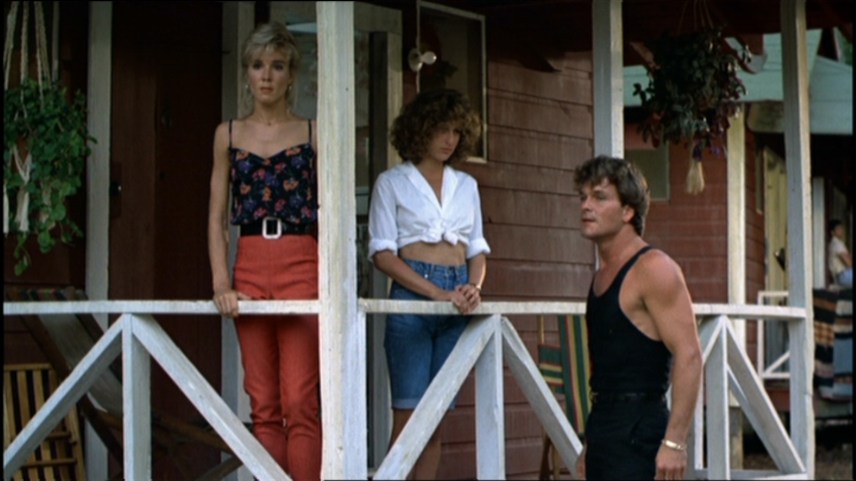
Sometimes a movie is so iconic that you feel like you’ve seen it even when you’ve only seen the highlights. Dirty Dancing fits that mold because, although I’ve seen every dance scene and the entire ending before, I hadn’t watched it all the way through, despite my VC’s persistence. Now that I finally have… well, I was just fine with the highlights.

See the source image

Before I anger any of its many ardent fans, it’s not that I disliked Dirty Dancing; it’s just that I’d already seen all the best parts. Maybe if I’d seen those classic moments as part of the whole for the first time, I’d appreciate the whole more. As it was, my viewing was essentially to fill in the gaps. I got to see how exactly “Baby” (lovely Jennifer Grey) arrived on vacation at the distinguished Kellerman’s mountain resort in 1963. I got to find out how she first met the ruggedly handsome dance instructor Johnny Castle (Patrick Swayze). And of course, I got to enjoy the cheesy but romantic quotes and the dance numbers so classic they’re still being parodied to death (like in this recent Super Bowl ad—priceless!).

But there were also things that detracted along the way, like the fact that the whole reason Baby and Johnny perform together is so she can cover for his other partner Penny (Cynthia Rhodes) who gets an abortion. The distress of her botched abortion is done tastefully enough, but what really bugged me is how Baby starts her sexual relationship with Johnny right afterward. She doesn’t know him that well at this point, and Penny literally just told her that the one who got her pregnant seemed different and true before he abandoned her. I know infatuation can be both strong and stupid, but the way Baby dives in without considering that the same thing could happen to her felt downright foolish.

See the source image

Of course, lucky for her, Johnny is a good guy, or at least trying to be better, and Grey and Swayze have such chemistry together that I can see why a lot of female viewers wouldn’t give it a second thought. Sort of like how the final dance number, set to the Oscar-winning “(I’ve Had) The Time of My Life” is so timelessly satisfying that no one minds how hastily and conveniently everything wraps up with a little bow. With its dance-fueled passion and exceptional soundtrack of ‘60s hits and two original songs, it’s easy to see why Dirty Dancing is popular. For me, though, the highlights are better than the whole.

Best line: (Baby) “Me? I’m scared of everything. I’m scared of what I saw, I’m scared of what I did, of who I am, and most of all I’m scared of walking out of this room and never feeling the rest of my whole life the way I feel when I’m with you.”


Rank:  Honorable Mention


© 2018 S.G. Liput
538 Followers and Counting


Coco (2017)

23 Friday Feb 2018

Posted by sgliput in Movies, Poetry, Reviews, Writing

≈ Leave a comment

Tags

Animation, Comedy, Drama, Family, Fantasy, Musical, Pixar

See the source image

Everybody, young and old,
Desires that their life be told
One day with fondness in past tense.
We think that we must spread our name
And earn our quarter hour of fame
To be remembered decades hence.

We need not awe the world so vain
When others close at hand remain
For us to serve and love instead.
The world may never know, it’s true,
How you have lived, but those who do
Are those who matter once we’re dead.
___________________

MPAA rating: PG

It’s nice to know that in a pretty lackluster year for American animation, Pixar can still come through. Coco was undoubtedly a risky film for the famous studio, their first musical and one delving into another country’s culture as none of their past movies have. Even dicier, it threatened to be one of Pixar’s least original stories, coming three years after The Book of Life already did the whole Day of the Dead theme in animation. Yet Pixar not only beat the odds but hit them out of the park. (Am I mixing my idioms? Anyway….)

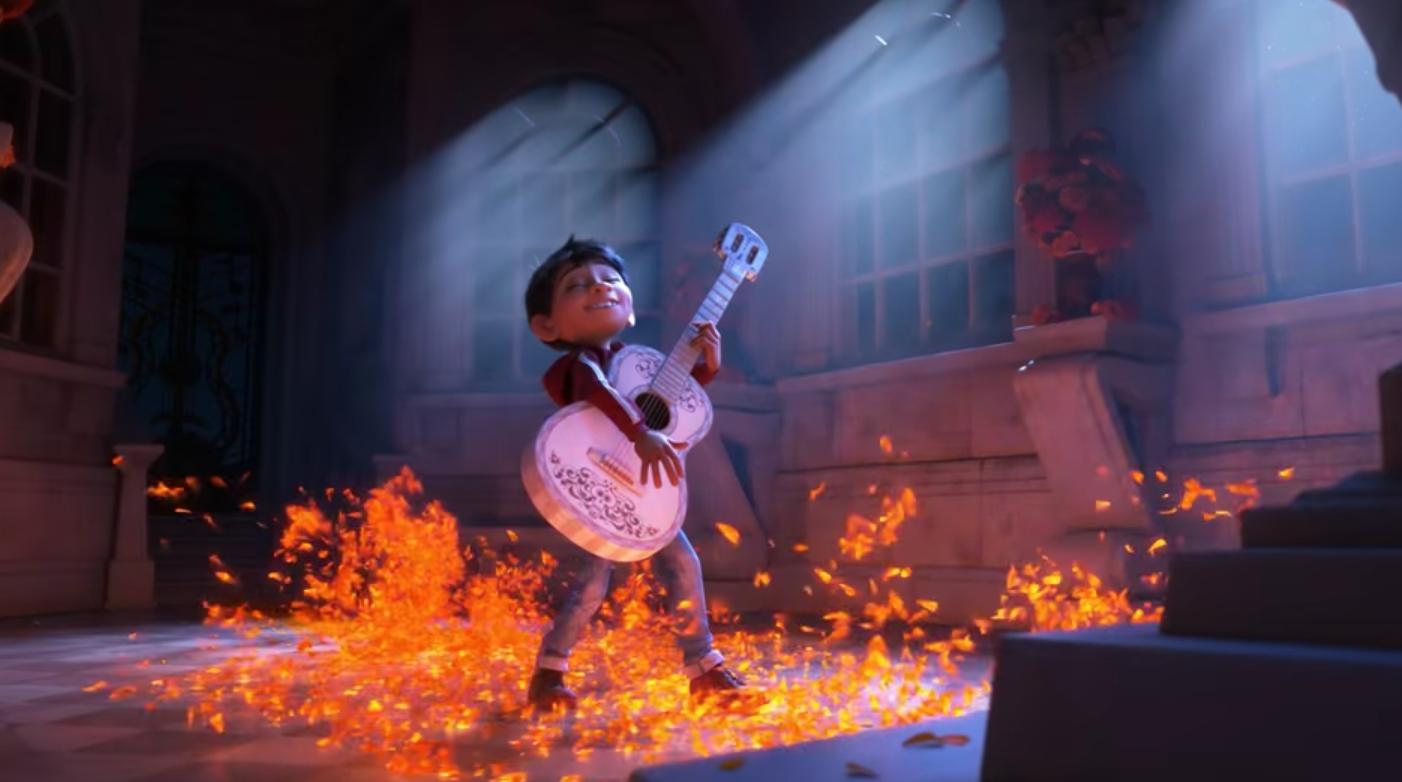
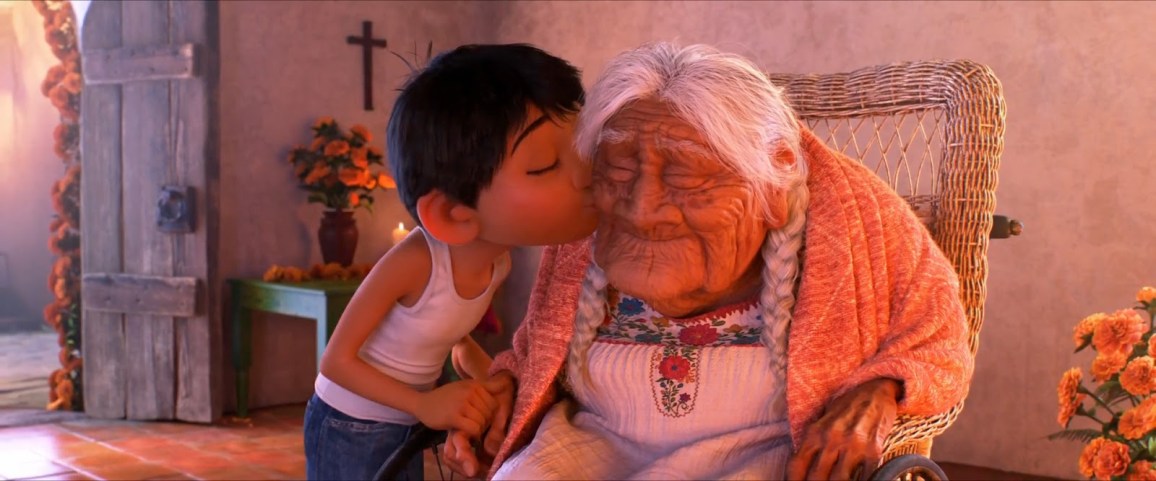
Starting with a prologue explaining why the Rivera family has hated music for generations, Coco introduces us to Miguel Rivera (Anthony Gonzalez) and his extended family of shoemakers, including his rocking chair-bound great-grandmother Coco. Although his Abuelita (grandmother) forbids music of any kind, Miguel is an unashamed fan, particularly of the dead superstar Ernesto de la Cruz (Benjamin Bratt). While the rest of his family celebrates the traditional Mexican holiday of Día de Muertos or the Day of the Dead, the one day their dead relatives can visit them, Miguel’s passion for music accidentally transfers him to the Land of the Dead, and, if he doesn’t want to become a skeleton himself, he must find a way back before the end of the day, accompanied by a misfit named Héctor (Gael García Bernal).

See the source image

It’s true that Coco isn’t the most exceptionally original film in Pixar’s canon. It not only reuses some elements of The Book of Life (skeletons in the Land of the Dead, musical aspirations suppressed by the family business) but will certainly remind some of Ratatouille in the way its talented protagonist dreams of emulating his dead idol against the wishes of his stern family. There are echoes of Up as well, but that might go into spoiler territory. Yet from these all too familiar ingredients, Coco still finds ways to enchant, impress, and touch in ways we haven’t seen before.

For one thing, Pixar continues to reach new heights in the quality of their CGI animation. From the semi-2D prologue told through traditional Mexican paper cuttings (papel picado) to the glory of the Land of the Dead’s fantasy metropolis and its bridge of marigold petals, the level of detail on display is spectacular. I saw Coco with my dad, and it seemed like I heard him whisper “Wow” every ten minutes or so.

See the source image

Simply put, the animation is flawless, but I was glad to see that the same effort went into the story. It undoubtedly captures the traditions and culture of Mexico (it’s now the highest grossing film there), from its exclusively Hispanic cast to the exuberant gritos (the equivalent of a yahoo) to the particulars of celebrating Día de Muertos, yet it backs up that cultural specificity with themes that are universal, especially familial love and devotion. Strengthened by the Oscar-nominated song “Remember Me,” the emotions run deep toward the end, and although Pixar didn’t bring me to tears this time, I can easily see why many viewers’ hearts have melted, especially those who have lost family members.

There are a few points to maybe not object to but at least mention, which run a bit deeper than a  bizarre moment or two. Despite Mexico’s Catholic heritage, Día de Muertos does include pagan and mythological elements, and its concept of the afterlife isn’t exactly a Christian one. Despite the laudable lesson in both Coco and The Book of Life of remembering those who have died, I don’t believe that their existence in the afterlife is dependent on our memory. It’s a concept that works well for the story and its fantasy aspects but one that parents should probably discuss with their kids afterward.

See the source image

That being said, Coco is still a triumph for Pixar, from its funny and poignant moments to its catchy soundtrack (I loved the final song especially). Its twists and turns may be guessable or not, but they do leave an impact. In typical Pixar fashion, it also appeals to kids and adults on different levels. Kids can root for Miguel’s love for music, but as they get older, they might pick up more on how an excess of that passion is problematic, putting him in more danger than was necessary. This may not have been intentional, but a couple parts even seemed to comment on the whole Confederate statue debate, offering a little support for both sides of the argument. Or maybe I’m just reading into it, but the point is that you don’t find such subtlety and food for thought in the majority of Western animation. It’s easily better than The Book of Life, and I’ll probably have to update my Top Twelve Pixar Movies now. As much as I’m still miffed at the Academy for spurning A Silent Voice for a Best Animated Feature nomination, I must admit that even if they had, Coco deserves to win.

Best line: (Miguel) “Although you may never forgive him, you should never forget him!”


Rank: List-Worthy


© 2018 S.G. Liput
538 Followers and Counting
 

2018 Blindspot Pick #2: Yi Yi (2000)

20 Tuesday Feb 2018

Posted by sgliput in Blindspot, Movies, Poetry, Reviews, Writing

≈ Leave a comment

Tags

Drama, Foreign, Romance

See the source image

What is life
But fate’s plaything,
Where some men die while others cling
To watch new youths discover truths
They could have learned from listening?

What is life
But joy in wait,
A chance to show the few who hate
That love profound can still surround
If one will only demonstrate?

What is life
But one big slog
Reminding you you’re just a cog
In systems built to cover guilt
And stoke the nearest demagogue?

What is life
But bittersweet
In every breath and each heartbeat,
As memories refuse to freeze,
A former friend in full retreat?

What is life
But grief, concerns,
And happiness all taking turns?
Each person braves their own such waves
Until at last each human learns
What is life.
____________________

MPAA rating: Not Rated (the number of F-words in the subtitles and fleeting nudity might warrant an R, but it’s really more of a PG-13)

Finally, a critically acclaimed “masterpiece” of world cinema that doesn’t require the quotation marks! In my limited forays into international filmmaking, I’ve found that just because critics laud a movie, that doesn’t mean it will actually be any good (for example, The Assassin *shudder*). In addition to celebrating the Chinese New Year with a Chinese movie, I added Yi Yi to my list of Blindspots this year because I was curious to see whether it deserved its renown as “one of the major films of the 21st century” and “the third most acclaimed film of the 21st century among critics,” according to Wikipedia. Thankfully, it does, and even if it’s not destined to be among my personal favorites, I am 100% behind its status as one of the all-time greats.

See the source image

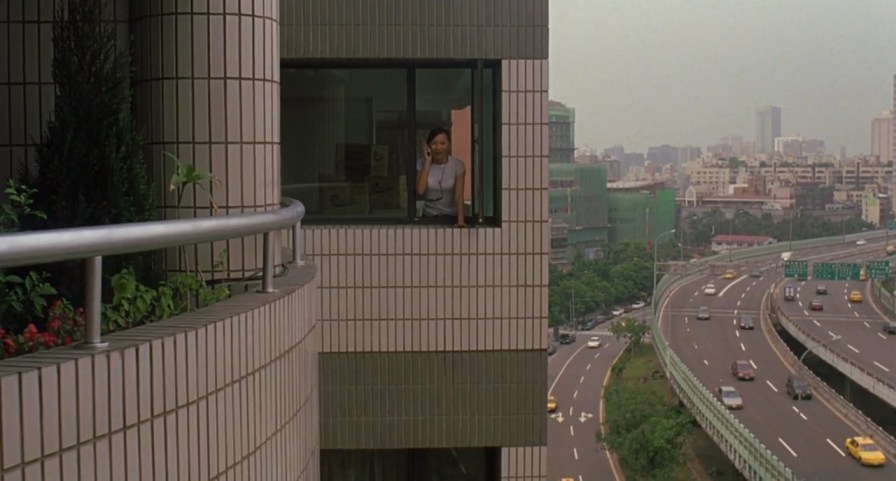
Translated as A One and a Two…, but more literally as One One or One by One, Yi Yi is hard to describe in a way that doesn’t make it sound incredibly dull, since it’s about the everyday life of the Jian family of Taipei and runs for 2 hours and 53 minutes.  Yet, I was surprised at how engaging a three-hour movie about everyday life could be, thanks largely to a deep and insightful script from writer/director Edward Yang and several diverse characters that are relatable on multiple levels.

The Jians include the father NJ (famed director Wu Nien-jen), who must deal with both a high-risk business deal and an unexpected run-in with a former lover; the mother Min-Min (Elaine Jin), who suffers a midlife crisis; their teenage daughter Ting-Ting (Kelly Lee), who enters a love triangle with her best friend; their young son Yang-Yang (Jonathan Chang), who gets bullied at school; and the perpetually unlucky brother-in-law A-Di, who gets caught between two strong-willed women. It’s a film of both broad plot strokes (NJ’s self-doubt and potential affair, A-Di’s money troubles) and more minor vignettes (Yang-Yang’s photography, the birth of A-Di’s son) that nonetheless feel vital in getting to know the large cast.

See the source image

The grandmother of the family is only briefly active at the beginning, spending most of the film in a coma and serving as an ingenious sounding board for her family, who are told to talk to her in hope of her recovery. Those who sit by her bedside bare their inner doubts more fully than anywhere else, such as Ting-Ting’s guilt over whether she’s to blame for her grandmother’s condition, and NJ even compares it to prayer, not knowing for sure how much the listener is hearing.

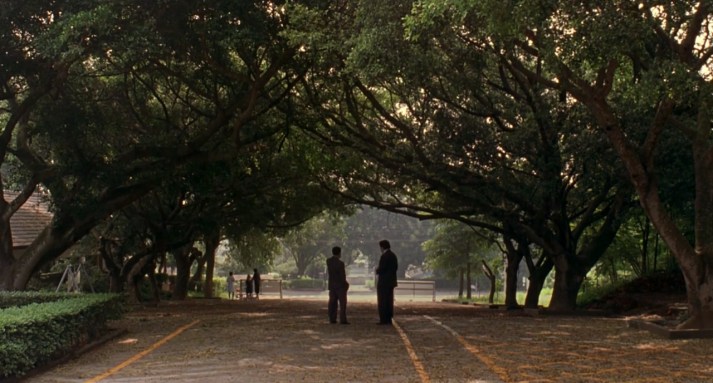
Despite its apparent simplicity, Edward Yang’s direction is also worth praising, not only in its composition but in its economy. Scenes are kept wide with very few close-ups. Long extended takes are the rule, with no scene or edit being wasted, yet the camera is fairly static. It doesn’t follow the characters around but allows events to play out off-screen, often letting us see part of what’s happening through reflections in windows and mirrors, which provides both visual interest and a strong sense of place.

See the source image

Even masterpieces can have room for improvement, though, and Yi Yi is no different. While its mundaneness is part of its charm, the pacing does lag several times, and there are many scenes that could have been trimmed to shave off perhaps a half hour from the runtime. It takes an investment of time and patience to sit through, yet I can say it’s a rewarding experience, even if its full power is only half understood when the credits roll. There are highs and lows, joys and sorrows, laughter and tears, both a marriage and a funeral, history repeating itself and wisdom coming from the mouth of babes. The film is mostly warm and gentle, never judging the characters and their flaws, yet the wisdom of right decisions shines against the foolish passion of mistakes. I don’t know that I’ll make the time to watch it again, but it will still live in my mind as a genuinely great film.

Best line: (Fatty, Ting-Ting’s boyfriend) “Life is a mixture of sad and happy things. Movies are so lifelike; that’s why we love them.”
(Ting Ting) “Then who needs movies? Just stay home and live life!”
(Fatty) “My uncle says ‘we live three times as long since man invented movies.’”
(Ting Ting) “How can that be?”
(Fatty) “It means movies give us twice what we get from daily life. For example, murder—we never killed anyone, but we all know what it’s like to kill. That’s what we get from the movies…. It’s only one example; there are other things. Like he also said, ‘There’s no cloud, no tree that isn’t beautiful, so we should be too.’”


Rank: List Runner-Up


© 2018 S.G. Liput
537 Followers and Counting


The Big Sick (2017)

14 Wednesday Feb 2018

Posted by sgliput in Movies, Poetry, Reviews, Writing

≈ 2 Comments

Tags

Comedy, Drama, Romance

See the source image

How can you know that it’s love close at hand
And deeper romance than the rest understand
Until there is distance to feel
The pain of the parting, detachment’s demand,
The grief that goodbye makes more real?

Things taken for granted, more often than not,
Are prized more profoundly than we would have thought.
Their value is only revealed
When losing such treasures leaves lovers distraught,
Confessing what once was concealed.
___________________

MPAA rating: R (solely for language)

A happy Valentine’s Day to all, and in the spirit of love, I thought I’d review one of the best romantic comedies of recent years.

See the source image

Unfortunately, I don’t know how to review The Big Sick without sounding like a complaining puritan. It’s certainly one of the best films of 2017 and one worth recommending to others, but I suppose I’ll get my objections out of the way first. (Sorry to any who disagree, but please hear me out or skip the next two paragraphs.) As much as I enjoyed it, the amount of profanity really disappointed me, despite the fact that I usually ignore it. It’s impossible to escape the F-word these days since it’s now an ingrained part of everyday speech for the apparent majority of people, and it’s no longer as offensive as it once was. Yet more than two (if I’m correct) can still give a movie an R rating, and the simple truth is that The Big Sick did not need to be R. There’s no violence or nudity, but there are stretches where every noun has to be preceded by F-ing. Why? Could they not think of some better adjective? It’s not so much offensive to me as it is annoying and not reflective of the creativity in the rest of the script.

This is why I don’t watch much Tarantino or Scorsese, but usually R-rated films like theirs have more than just objectionable language. Here, the frequent language is the only thing that makes it R, and that annoys me because not only would I rather not hear it but it limits the audience. This is an extremely worthwhile film that I think everyone, even older kids and teenagers, could greatly appreciate, if it weren’t for the language (though that probably doesn’t stop most kids these days either). Despite what writer/star Kumail Nanjiani says, the F-word is not inherently funny, and there are plenty of good and clean rom coms that have proved how unnecessary it is.

See the source image

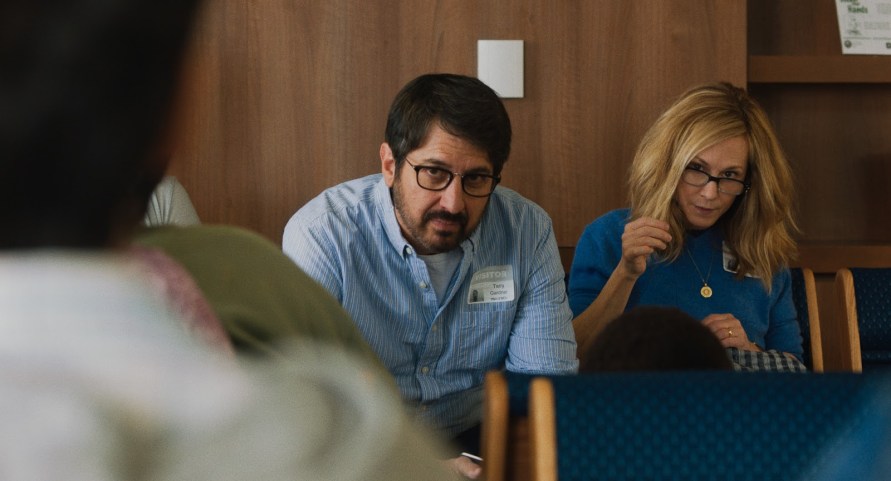
So there, I’ve had my rant, and I will now praise The Big Sick as if the language weren’t there. Without it, the script is a brilliant balance of funny and poignant, drawing both from Kumail’s job as a stand-up comedian and from his first-hand brush with tragedy. It was written by Nanjiani and his wife Emily V. Gordon (both now nominated for Best Original Screenplay) and based off of their own experiences, with Nanjiani playing himself and Zoe Kazan as Emily. After their initial meeting at a comedy club and a series of charming dates, their romance hits a snag due to Kumail’s traditional Pakistani family, who keep trying to coax him into an arranged marriage. When things seem over between them, Emily suddenly falls ill and is placed in a medically induced coma, leaving Kumail to decide how much he really cares for her while also getting to know her worried parents Terry and Beth (Ray Romano, Holly Hunter).

I suppose the best thing about The Big Sick is its authenticity, both in its dialogue and performances, the kind that can find amusement in a 9/11 joke yet quickly acknowledge its inappropriateness. It’s easy to believe that this is based on a true story, and Kumail’s connection with Emily is entirely natural, as is the older coupling of Romano and Hunter, whom I’m glad to see getting such strong roles. I loved the way that Hunter’s dislike of Kumail (based solely on how Emily had described their break-up) slowly melted into fondness, helped along by the ever-likable Romano. Even Kumail’s comedy seemed like an honest work-in-progress, since he repeatedly has to tell people when he’s joking. The realness extends to the end as well, where things don’t wrap up as quickly and easily as one might have hoped, yet strong themes of forgiveness, faithfulness, and sincerity are fostered in more satisfying ways than one.

See the source image

Perhaps it was Romano’s presence, but I couldn’t help but notice traces of Everybody Loves Raymond in Kumail’s family dynamics, particularly with his overbearing but loving mother. The Muslim family is depicted in a largely relatable and sympathetic way, contrasted no less sympathetically with Kumail’s agnosticism, and one heated conversation between Kumail and his parents feels like a talk that many traditional immigrants might have with their more free-thinking children.

So yes, I was able to look past the language and recognize The Big Sick as the outstanding film it is. I’m just sorry that others with similar objections (such as my VC) might not. I’ve overlooked such objectionable content before, which is why I’m still awarding it a List-Worthy ranking. As much as I wish it were cleaner, I can’t help but admire the total package.

Best line: (Kumail) “You’ve never talked to people about 9/11?”
(Terry) “No, what’s your, what’s your stance?”
(Kumail) “What’s my stance on 9/11? Oh, um, anti. It was a tragedy; I mean, we lost nineteen of our best guys.”
(Beth) “Huh?”
(Kumail) “That was a joke, obviously. 9/11 was a terrible tragedy. And it’s not funny to joke about it.”


Rank: List-Worthy


© 2018 S.G. Liput
536 Followers and Counting
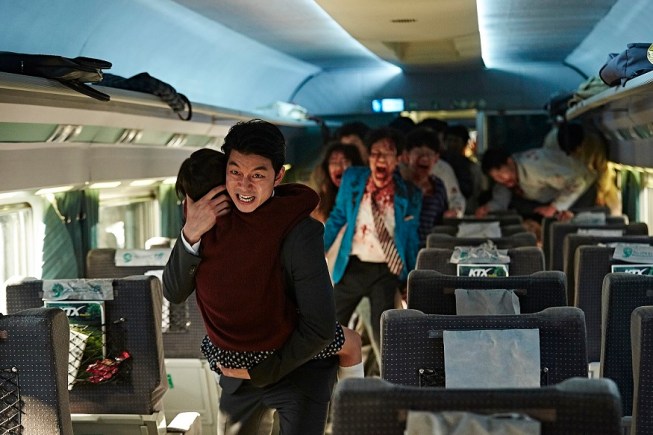
 

Cartoon Comparison: Train to Busan (2016) / Seoul Station (2016)

07 Wednesday Feb 2018

Posted by sgliput in Movies, Poetry, Reviews, Writing

≈ 2 Comments

Tags

Action, Animation, Anime, Cartoon Comparisons, Drama, Foreign, Horror, Thriller

See the source image

See the source image

When certain death surrounds you,
You’d be foolish not to fear,
To run and hide and save yourself
And those few you hold dear.

Yet in the face of jeopardy,
What will you sacrifice?
Your conscience and humanity?
For those too have a price.

For some, to care for more than self,
The risk may be too high,
But ask yourself how proud you’ll be
Both if and when you die.
________________________

MPAA rating for Train to Busan: Not Rated (I guess R but it’s not as bad as some)
MPAA rating for Seoul Station: Not Rated (should be R)

If someone had told me last year that the first movie I’d love in 2018 was a South Korean zombie flick, I’d never have believed it. I only half-believed all the positive buzz around Train to Busan because hey, it’s a zombie movie, and I don’t watch zombie movies. I’ve never seen Dawn of the Dead or The Walking Dead and have only really liked a precious few of that genre (World War Z, Warm Bodies). The living dead concept is intriguing, but usually it seems like an excuse for excessive gore and end-of-the-world futility. But for some reason I checked out Train to Busan, which I can now say is my favorite of the genre and honestly one of my favorite horror films period, mainly because it goes beyond its horror limitations to deliver exceptional thrills and emotional stakes worth caring about too. Since I loved Train to Busan then, I had to check out its animated prequel, if only for comparison’s sake, a prequel that reminded me exactly why I don’t typically enjoy zombie movies.

See the source image

First, let’s focus on the good one. Train to Busan seems like such a simple idea: zombies on a train. It could easily have been the concept of a B-grade cheesefest, but the filmmakers went above and beyond to make it gripping. A big part of that is giving us worthwhile characters, particularly Seok-woo (Gong Yoo), a disengaged father who decides to accompany his young daughter Soo-an (Kim Su-an) as she returns to his ex-wife in Busan. There are various other passengers that quickly stand out as “survivor characters”: a man and his pregnant wife, a traumatized tramp, two high school students, and a self-serving businessman, among others. Things seem to start normally as the train sets out, but an abundance of warning signs builds the tension as a zombie outbreak engulfs the nation and the train itself. From there, it’s an all-out flight of survival with a few much-needed moments to catch one’s breath (even a disarming chuckle or two), but the suspense is ever-present. I don’t think I’ve been this tense during a movie since Dunkirk.

What’s impressive about Train to Busan is that it delivers the scares and shocks alongside an insightful character arc without sacrificing either. Seok-woo starts out as an apparent coward, fearfully closing a door in the face of someone fleeing the zombie onslaught, yet his self-first philosophy is called out in the criticisms of his daughter, while also playing out to an extreme in the uncaring actions of other passengers. The contrast between these mindsets imparts to the action some deeper themes behind it. There are sacrifices aplenty, some meaningful, some pointless, but the film seems to affirm the importance of helping others in the face of desperation rather than just oneself. To that end, the conclusion is surprisingly emotional as well, right up to the film’s anxious final moments.See the source imageSince I’ve said I don’t like the gory side of zombie movies, I should address that part of it. There is blood, but Train to Busan is still greatly restrained compared with a lot of others out there. Heck, some of the commercials for Walking Dead are worse than anything in Train to Busan. A big part of that is the absence of knives and guns, which draw maximum blood while also dehumanizing the still human-like zombies. (Sorry, but all the head-shots and such bother me.) Here, baseball bats are as bad as it gets, and most of the blood comes from the initial outbreak of zombies biting people’s necks. The fact that the victims quickly “turn” also does away with the whole flesh-eating element while also making the ever-growing horde even scarier. So I was thankful that the film didn’t rely on violence for its scares. In fact, after the initial outbreak, it’s really more of a fast-paced thriller than a horror. The zombies are the running type also seen in World War Z, and there are several moments that had me going “oh my gosh” as things devolve from bad to worse, often making great use of the visual effects.

How then does Seoul Station, from the same director Yeon Sang-ho, compare? It’s not exactly anime since it’s Korean rather than Japanese, but it has a similar visual style. I think it purports to be a prequel showing the origin of the zombie apocalypse, but it doesn’t really give any further details about the actual cause. A wounded homeless man is apparently patient zero, and while he slowly “turns,” we meet a runaway girl named Hye-sun who has a falling out with her cash-strapped and selfish boyfriend. The boyfriend is soon confronted by her father, and the two of them go in search for Hye-sun right as the city starts spiraling into zombie-infested chaos.See the source imageSeoul Station has some merit to it, mainly in the strictly horror department. There are some moments of genuine terror, particularly a white-knuckle encounter with a crazy woman, so if you enjoy zombie movies for the situational tension alone, you might like it. I, however, found plenty to dislike. For one, the animation, while mostly good, has the stilted look that 3-D-ish anime hasn’t gotten past, such as the way the characters walk. In addition, the gore and foul language (subtitled) are more pronounced here than in Train to Busan, and the characters are dumber compared to the rather clever survival techniques in its live-action counterpart. For one thing, everyone seems very slow to grasp the idea of a zombie outbreak, as if they’ve never heard of a zombie before, whereas Train to Busan showed that “zombies” were exactly where people’s minds went.

Still, I could look past most of that if the ending were worthwhile, but this is one case where the ending completely ruined it for me. The film pulls out a dark twist that pounds in the whole end-of-the-world futility I mentioned earlier I didn’t like. The characters are far less sympathetic, and the end only amplifies that. I didn’t hate the movie as I was watching it, but by the end, I did. Seoul Station tries harder to focus on its themes of class warfare, which were much more subtle in Train to Busan, yet it comes off as a cheaper offshoot of a much better original.See the source imageI’ve said before that I have very particular tastes when it comes to horror movies, but seeing two ostensibly similar zombie films side by side made me consider why exactly I loved one and hated the other. I can say I prefer genuine creepiness and atmosphere over gore, but in this case, I think it comes down to this (spoiler warning): I don’t like stories whose main purpose is killing off its characters. If there’s no survivor by the end, then everything that came before was pointless. If I actually care about the characters who live and die, then the end product becomes even better. That’s why Train to Busan exceeded my expectations. Clearly, I’m not about to become a fan of zombie movies in general, but I’m glad to have found one member of the genre that truly impressed me.

Best line (from Train to Busan): (Soo-an, pricking her father’s conscience) “Dad, you only care about yourself. That’s why mommy left.”


Rank for Train to Busan : List-Worthy
Rank for Seoul Station: Dishonorable Mention


© 2018 S.G. Liput
536 Followers and Counting


2018 Blindspot Pick #1: All Is Lost (2013)

04 Sunday Feb 2018

Posted by sgliput in Blindspot, Movies, Poetry, Reviews, Writing

≈ Leave a comment

Tags

Disaster, Drama

See the source image

It isn’t easy to admit
That all my effort was in vain.
I’m not the type to whine and quit,
And seldom do I dare complain.
I gave my all;
I fought the squall;
I beat my chest at each downfall,
Until my lowest point was hit,
My lowest while still staying sane.

Don’t pity me, who did decide
To hold to life long as I could.
Perhaps I’ll fathom, once I’ve died,
That all this effort did no good.
But till my end
By God is penned,
With my own fate I must contend.
All is lost, yet still I tried,
As all beset by struggle should.
____________

MPAA rating: PG-13 (for brief language)

Well, I’m kicking off this year’s Blindspot series a bit late, but what’s a few days’ difference? I was nonetheless eager to see how my Blindspot picks this year would measure up to last year’s, especially since my #1 last year (Shuffle) was the first one I saw. I had high hopes for All Is Lost as well, due to its simple survival narrative that I knew would have echoes of Cast Away. Yet, while those echoes are present and the film overall is well executed, I was rather disappointed in the end product.

All Is Lost is notable for being essentially a one-man show, in which Robert Redford is the sole actor on screen in a straightforward survival tale of man vs. nature. Credited as “Our Man,” Redford barely speaks throughout (though there were a few more words than I was expecting), instead reacting to the various maritime dangers that plague him as a lone sailor, from destructive debris to vicious storms. It’s a credit to Redford’s acting ability that he can hold a movie completely on his own while in his seventies, and his nameless protagonist remains admirably calm through much of his travail, finding clever survival solutions others might not think of while also doing an inexplicable action now and then (like going up on deck in a storm for reasons I didn’t quite grasp).

See the source image

As an acting showcase for Redford and a no-frills survival story, All is Lost delivers reasonably well, with an understated Golden Globe-winning score and convincing effects and aquatic photography to create the man’s seafaring isolation. But somehow I expected more. My VC pointed out right away that we’re given no details about Our Man, no background or reason to care about him other than that he’s in the plight he is. Again, it’s easy to point to other isolation movies for comparison: In Cast Away or Life of Pi (both favorites of mine), we get to know the main characters before they’re thrown to the elements, strengthening our sympathy because we see what they’ve lost and what brought them to their predicament. Even with an oddly vague opening voiceover, we know literally nothing about “Our Man” except his immediate circumstances; that was likely the successful intent, but it doesn’t keep me as invested as those other films.

Plus, there’s the simple fact that the film was rather boring. I probably shouldn’t have tried to watch it after a long day at work, but I stuck with it still. My Redford-loving VC, on the other hand, gave up after a half hour, despite the fact she once thought she’d be happy watching Robert Redford read the phone book. (I guess that would have more dialogue, though.) I’m sure the lack of dialogue is more realistic, but there’s a reason Tom Hanks had a volleyball to talk to in Cast Away. Wilson allowed for greater character engagement, just as Richard Parker the tiger did in Life of Pi, which also benefited from a consistent voiceover narration. They gave us a glimpse into the mindset of the human character, while Our Man’s actions don’t really reveal anything about him, even though his story is propelled by action and reaction alone. Redford evokes his growing desperation and despair, but those emotions only go so far. Without fully engaging with the character, we’re simply watching what any competent person would do in this situation, and that detachment was a bit of a letdown.

See the source image

I can’t impugn Redford’s acting ability or the production values since All Is Lost does what it means to do expertly. It just wasn’t as involving as other survival stories. And it’s not solely because of the sparse dialogue either, nor the lack of character development alone. The Red Turtle held my attention with literally no dialogue at all, while Dunkirk was absolutely thrilling with hardly any character backgrounds. I guess it’s the combination of its monotonous pace and surface-only protagonist that made it feel wanting compared with more engaging films of its genre. While my VC might disagree, it’s by no means a bad film, just one I can’t see myself spending time on again.

Best line: (part of opening lines) “I’m sorry. I know that means little at this point, but I am. I tried; I think you would all agree that I tried. To be true, to be strong, to be kind, to love, to be right. But I wasn’t. And I know you knew this… in each of your ways. And I am sorry. All is lost here, except for soul and body, that is, what’s left of them, and a half day’s ration.”


Rank: Honorable Mention


© 2018 S.G. Liput
536 Followers and Counting


Get Out (2017)

26 Friday Jan 2018

Posted by sgliput in Movies, Poetry, Reviews, Writing

≈ 2 Comments

Tags

Drama, Horror, Mystery, Thriller

See the source image

“Get out! Get out!” said common sense,
“You know that something’s wrong.
You linger at your own expense,
But shan’t do so for long.
You feel your muscles growing tense,
Your nerves a warning gong.
Would safety ever cause suspense?”
Yet still you play along.

When signs of danger first commence,
You’ll surely waver on the fence,
But when the strangeness of events
Grows ever more and more intense,
You’ll quickly wish you’d scorned pretense
And listened to your common sense
And all the warning signs about
The fact you should have gotten out!
_____________________

MPAA rating: R (for frequent language and some violence)

Not being a big fan of horror, I tend to only watch those that have a significant amount of positive buzz, and Get Out is about as positively buzzy as any movie of 2017, especially now that it’s received several Oscar nominations. Despite his reputation as a comedian, director Jordan Peele crafted a narrative that clearly tapped into America’s social consciousness more than anyone expected, and now that I’ve watched it, I can see why.

Get Out definitely has influences from other films, notably The Stepford Wives, but it’s really more of a dark twist on Guess Who’s Coming to Dinner, another ripple-causing film about race. When black photographer Chris (Daniel Kaluuya) goes with his white girlfriend Rose (Allison Williams) to meet her family, he’s hesitant about how he’ll be received, but her parents (Bradley Whitford and Caroline Keener) seem generous and warm to him, perhaps a bit too warm. More troubling is the odd behavior of the black servants and visitors on their wealthy estate, who seem bizarrely genteel and, well, don’t act like black people, one telling contradiction being when a fist bump from Chris is met with an oblivious handshake. The horror!

See the source image

Despite its loose categorization as a horror-comedy (the comedy is relegated to one side character), Get Out does seem to hearken back to an older class of horror movie, the kind where a large chunk of the movie is kept tame and spent noticing strange causes for unease before coming to a crazy head near the end. For an apparently low budget production, though, Peele makes it look excellent, creating that uneasy mood with disquieting music and some evocative visuals. Plus, it starts with one of those extended one-shot scenes I so admire. The acting is also good across the board, though I don’t think Kaluuya’s performance warranted a Best Actor nomination, despite a few strong dramatic moments.

Of course, the quality of the movie is beside the point since everyone seems much more interested in its social satire, and the fact that wealthy liberals are the target did come as a surprise. Rose’s parents are textbook white liberal elites, as are their wealthy friends at a dinner party, all of whom fawn over Chris to an uncomfortable degree. “Black is in fashion,” as one guest states. It’s a cogent example of passive racism. Get Out shows that the way progressives often highlight racial differences, even in an apparently supportive or positive manner, can still make minorities uncomfortable. Shouldn’t the goal be for such differences to not matter at all? While there were still a few moments that annoyed me (why are cops always implied to be racist?), the social themes help Get Out aspire to a higher class of horror, reminding me of how The Silence of the Lambs (another February release) also stayed relevant throughout a whole year and transcended its genre at the Oscars.

See the source image

As strong a film as Get Out is overall, I still wouldn’t have foreseen its Best Picture nomination, but I can understand it. As much as I suspect that its many nominations were an easy way for the Academy to avoid the whole #OscarsSoWhite controversy, its timeliness does deserve recognition. That said, with its 99% Rotten Tomatoes score, it does veer into the overhyped category, for me at least. Plus, there’s something about the ending that makes me feel it missed a chance for an ideal final moment. I won’t say it for spoilers’ sake, but one extra line at the end would have been a perfect closer, so I can’t help but feel a tiny bit disappointed when I think a film squandered an opportunity, however small it may be. It’s still a better ending than the alternate one I’ve heard about, though. Get Out has exceeded more than a few expectations, and even if it’s not as faultless as many say, the fact that it’s still being talked about a year later means it did something right.

Best line: (Chris, with a good reminder of how minorities can feel) “All I know is sometimes, when there’s too many white people, I get nervous, you know?”

Rank: List Runner-Up

© 2018 S.G. Liput
535 Followers and Counting


VC Pick: The Mountain Between Us (2017)

19 Friday Jan 2018

Posted by sgliput in Movies, Poetry, Reviews, Writing

≈ Leave a comment

Tags

Drama, Romance, VC Pick

See the source image

Higher than most men would dare,
The mountains stand in sparser air
To touch the blue abyss above
And tempt mankind’s desire to share
In their ambitious love.

Yet those who underestimate
The mountain’s ever lofty state
Will find what awed from lower heights
Can rapidly retaliate,
To prove how beauty bites.
_________________

MPAA rating: PG-13

Since I’m the bigger movie fan, it’s unusual for my VC to watch a movie in the theater before me, but The Mountain Between Us was so clearly her kind of movie that she did and I just now caught up. Kate Winslet and Idris Elba in a gradual romance? Stunning mountain scenery? Survival story based on a book she had to read beforehand? Yep, definitely her kind of movie.

See the source image
That doesn’t necessarily mean it’s not my kind of movie too. The survival story and romance work hand in hand as Ben (Elba) and Alex (Winslet) go from sharing a chartered plane to braving the elements together after their pilot (Beau Bridges) has a stroke midflight, crashing them in the gorgeous but treacherous Rockies. While it could be said that they help each other survive, the bulk of the helping comes from Ben, who’s a doctor luckily enough, but as the two disagree on how to respond to their predicament, it quickly becomes clear that they need someone else to rely on (aside from the dog).

Maybe you’ve had this experience where you watch a movie with someone who’s read the book and mentions throughout all the differences between them, how so-and-so was actually married or she was injured much worse or there’s a whole subplot and twist they left out. It’s hard to say whether that helps or hurts the viewing experience, but thanks to my VC, I at least feel like I read Charles Martin’s novel vicariously. I do wonder, though, why they let Elba keep his British accent while Winslet hid it. One thing the book didn’t have is the actual scenery on display, and the Canadian Rockies where filming took place are among our favorite places to behold in awe, at least in pictures (hopefully in person one day, though maybe not by charter plane).

See the source image
The Mountain Between Us isn’t an objectively great movie nor an awards contender, but it gets three things very right: the casting, the setting, and the end. When you’re watching high-caliber actors go a little schmaltzy in such breathtaking environs, it’s easy to appreciate the tale for what it is, especially when it sticks the landing.

Best line: (Ben, who later questions this) “The heart’s nothing but a muscle.”


Rank: List Runner-Up


© 2018 S.G. Liput
533 Followers and Counting


← Older posts
Newer posts →

Recent Posts

  • We Didn’t Start 2025 (Recap)
  • NaPoWriMo 2025 Recap (Finally)
  • Sonic the Hedgehog 3 (2024)
  • It Happened One Night (1934)
  • Spellbound (2024)

Recent Comments

associatesofshellymann's avatarassociatesofshellyma… on My Top Twelve La La La So…
Kit's avatarKit Nichols on Bonnie and Clyde (1967)
lifelessons's avatarlifelessons on Look Back (2024)
Carol Jackson's avatarCarol Jackson on The Thief of Bagdad (1940…
Stephen's avatarStephen on Love Story (1970)

Archives

  • January 2026
  • December 2025
  • May 2025
  • April 2025
  • March 2025
  • February 2025
  • January 2025
  • December 2024
  • May 2024
  • April 2024
  • March 2024
  • February 2024
  • January 2024
  • December 2023
  • November 2023
  • October 2023
  • September 2023
  • July 2023
  • June 2023
  • May 2023
  • April 2023
  • March 2023
  • February 2023
  • January 2023
  • December 2022
  • November 2022
  • October 2022
  • September 2022
  • August 2022
  • July 2022
  • June 2022
  • May 2022
  • April 2022
  • March 2022
  • February 2022
  • January 2022
  • December 2021
  • November 2021
  • October 2021
  • September 2021
  • August 2021
  • July 2021
  • June 2021
  • May 2021
  • April 2021
  • March 2021
  • February 2021
  • January 2021
  • December 2020
  • November 2020
  • October 2020
  • September 2020
  • August 2020
  • July 2020
  • June 2020
  • May 2020
  • April 2020
  • March 2020
  • February 2020
  • January 2020
  • December 2019
  • November 2019
  • October 2019
  • September 2019
  • August 2019
  • July 2019
  • June 2019
  • May 2019
  • April 2019
  • March 2019
  • February 2019
  • January 2019
  • December 2018
  • November 2018
  • October 2018
  • September 2018
  • August 2018
  • July 2018
  • June 2018
  • May 2018
  • April 2018
  • March 2018
  • February 2018
  • January 2018
  • December 2017
  • November 2017
  • October 2017
  • September 2017
  • August 2017
  • July 2017
  • June 2017
  • May 2017
  • April 2017
  • March 2017
  • February 2017
  • January 2017
  • December 2016
  • November 2016
  • October 2016
  • September 2016
  • August 2016
  • July 2016
  • June 2016
  • May 2016
  • April 2016
  • March 2016
  • February 2016
  • January 2016
  • December 2015
  • November 2015
  • October 2015
  • September 2015
  • August 2015
  • July 2015
  • June 2015
  • May 2015
  • April 2015
  • March 2015
  • February 2015
  • January 2015
  • December 2014
  • November 2014
  • October 2014
  • September 2014
  • August 2014
  • July 2014
  • June 2014
  • May 2014
  • April 2014
  • March 2014
  • February 2014
  • January 2014
  • December 2013

Categories

  • Blindspot
  • Blogathon
  • Christian
  • Movies
  • Music
  • NaPoWriMo
  • Poetry
  • Reviews
  • TV
  • Writing

Meta

  • Create account
  • Log in
  • Entries feed
  • Comments feed
  • WordPress.com

Recent Posts

  • We Didn’t Start 2025 (Recap)
  • NaPoWriMo 2025 Recap (Finally)
  • Sonic the Hedgehog 3 (2024)
  • It Happened One Night (1934)
  • Spellbound (2024)

Recent Comments

associatesofshellymann's avatarassociatesofshellyma… on My Top Twelve La La La So…
Kit's avatarKit Nichols on Bonnie and Clyde (1967)
lifelessons's avatarlifelessons on Look Back (2024)
Carol Jackson's avatarCarol Jackson on The Thief of Bagdad (1940…
Stephen's avatarStephen on Love Story (1970)

Archives

  • January 2026
  • December 2025
  • May 2025
  • April 2025
  • March 2025
  • February 2025
  • January 2025
  • December 2024
  • May 2024
  • April 2024
  • March 2024
  • February 2024
  • January 2024
  • December 2023
  • November 2023
  • October 2023
  • September 2023
  • July 2023
  • June 2023
  • May 2023
  • April 2023
  • March 2023
  • February 2023
  • January 2023
  • December 2022
  • November 2022
  • October 2022
  • September 2022
  • August 2022
  • July 2022
  • June 2022
  • May 2022
  • April 2022
  • March 2022
  • February 2022
  • January 2022
  • December 2021
  • November 2021
  • October 2021
  • September 2021
  • August 2021
  • July 2021
  • June 2021
  • May 2021
  • April 2021
  • March 2021
  • February 2021
  • January 2021
  • December 2020
  • November 2020
  • October 2020
  • September 2020
  • August 2020
  • July 2020
  • June 2020
  • May 2020
  • April 2020
  • March 2020
  • February 2020
  • January 2020
  • December 2019
  • November 2019
  • October 2019
  • September 2019
  • August 2019
  • July 2019
  • June 2019
  • May 2019
  • April 2019
  • March 2019
  • February 2019
  • January 2019
  • December 2018
  • November 2018
  • October 2018
  • September 2018
  • August 2018
  • July 2018
  • June 2018
  • May 2018
  • April 2018
  • March 2018
  • February 2018
  • January 2018
  • December 2017
  • November 2017
  • October 2017
  • September 2017
  • August 2017
  • July 2017
  • June 2017
  • May 2017
  • April 2017
  • March 2017
  • February 2017
  • January 2017
  • December 2016
  • November 2016
  • October 2016
  • September 2016
  • August 2016
  • July 2016
  • June 2016
  • May 2016
  • April 2016
  • March 2016
  • February 2016
  • January 2016
  • December 2015
  • November 2015
  • October 2015
  • September 2015
  • August 2015
  • July 2015
  • June 2015
  • May 2015
  • April 2015
  • March 2015
  • February 2015
  • January 2015
  • December 2014
  • November 2014
  • October 2014
  • September 2014
  • August 2014
  • July 2014
  • June 2014
  • May 2014
  • April 2014
  • March 2014
  • February 2014
  • January 2014
  • December 2013

Categories

  • Blindspot
  • Blogathon
  • Christian
  • Movies
  • Music
  • NaPoWriMo
  • Poetry
  • Reviews
  • TV
  • Writing

Meta

  • Create account
  • Log in
  • Entries feed
  • Comments feed
  • WordPress.com

Blog at WordPress.com.

  • Subscribe Subscribed
    • Rhyme and Reason
    • Join 814 other subscribers
    • Already have a WordPress.com account? Log in now.
    • Rhyme and Reason
    • Subscribe Subscribed
    • Sign up
    • Log in
    • Report this content
    • View site in Reader
    • Manage subscriptions
    • Collapse this bar