

(Today’s NaPoWriMo prompt was to write about how one of a list of impossible things could actually happen, so I thought of a certain highly imaginative film.)
“Pigs can’t fly,”
They said. “Of course,
And cats can’t join
The labor force.”
“Clocks can’t chime
Thirteen,” they vowed,
“Nor rewind time.
That’s not allowed.”
But some will hear
Such sober laws,
And ask with thought,
“Why not?” because
The present world
They recognize
Is changing more
Before their eyes.
If they dislike
Such rules, they dream
Worlds where clocks strike
Thirteen, where steam
Propels machines,
Where pigs can fly,
Where magic beans
Grow greens so high,
Where men can grow
Beyond their flaws.
Imagination
Knows no laws.
___________________
MPAA rating: PG
I love animation, and I love discovering hidden gems that remind me why I love animation. April and the Extraordinary World is a delightful case in point. At a time when the U.S. and Japan seem to rule the animation industry, it’s also an important reminder that Europe has no shortage of talent and is just as likely to churn out an instant classic for those willing to search for it.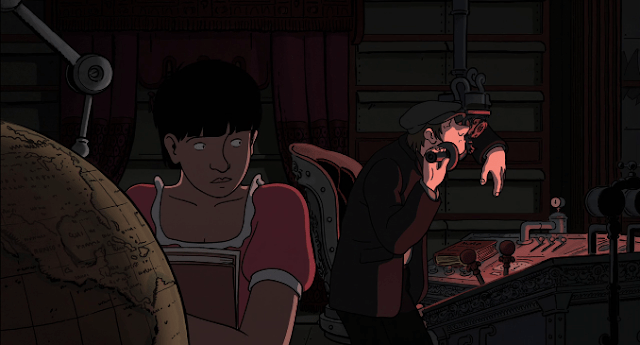 A French-Belgian-Canadian co-production, April and the Extraordinary World is one of the most imaginative films I’ve seen in a while, broadly rewriting history to create a unique steampunk setting, one in which science and technology couldn’t develop beyond the Steam Age. Vegetation has been decimated by fuel needs, and the air is thick with industrial smoke, while the scientists that could improve things have vanished without a trace. After a fast-paced introduction in which everything is significant, we meet April Franklin (Marion Cotillard in the French version, Angela Galuppo in the English dub) and her brilliant family of fugitive scientists. Due to events best seen rather than described, April grows up alone with only her talking cat Darwin (a product of SCIENCE!), and her chemist’s quest for an immortality serum soon turns into a whirlwind adventure as the French government and a mysterious group with advanced technology vie for the scientific secrets of her family.
Animation allows its creators to fashion worlds limited only by their imagination, but most cartoons are content to imagine small. It’s usually Pixar or Ghibli that brings the medium to its full potential, but so does April and the Extraordinary World, which often feels like something one of those two powerhouses would have conceived. Where else are you going to see giant cable cars that run from Paris to Berlin or a helicopter plane escaping an underwater prison? The animation has the distinctive look of a European comic (apparently based on the work of French comic artist Jacques Tardi), and although it seems like it would take some getting used to, it actually flows quite nicely, with plenty of clever detail in the settings and backgrounds. It has strong characters to boot, from resourceful April herself to her quick-witted grandfather, though, as a cat lover, my favorite has to be the talking cat Darwin (Tony Hale in the dub, which also includes Paul Giamatti, J.K. Simmons, and Susan Sarandon). While the imagination is impressive, I could still recognize prior influences for April, most notably 2004’s Steamboy, another steampunk adventure featuring a young protagonist caught in the middle of a scientific power struggle with a similarly explosive ending. Plus, it’s hard to avoid comparisons to Ghibli when there’s an actual house atop mechanized legs á la Howl’s Moving Castle or a polluted atmosphere contrasted with a clean underground biome á la Nausicaä. You might also pick up on traces of Atlas Shrugged and Tomorrowland, though the latter was released the same year as this film. Regardless, April and the Extraordinary World brings all these disparate elements together into a thrilling package that’s better than most of the films I just mentioned.
With a complex and fast-paced storyline and a number of off-screen deaths, it does feel more intelligent and mature than your typical American cartoon (not to mention the detail put into Darwin’s backside), but there’s nothing to make it un-kid-friendly either. By the surprisingly satisfying end, I was just happy to have stumbled upon such an underrated gem, one that no fan of animation should miss.
Rank: List-Worthy
© 2018 S.G. Liput
563 Followers and Counting










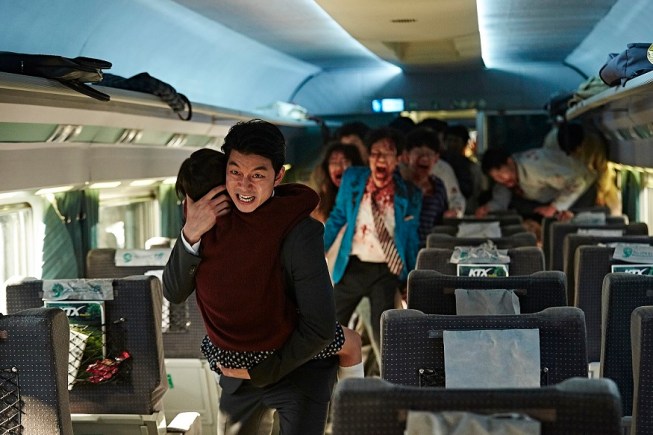


 Since I’ve said I don’t like the gory side of zombie movies, I should address that part of it. There is blood, but Train to Busan is still greatly restrained compared with a lot of others out there. Heck, some of the commercials for Walking Dead are worse than anything in Train to Busan. A big part of that is the absence of knives and guns, which draw maximum blood while also dehumanizing the still human-like zombies. (Sorry, but all the head-shots and such bother me.) Here, baseball bats are as bad as it gets, and most of the blood comes from the initial outbreak of zombies biting people’s necks. The fact that the victims quickly “turn” also does away with the whole flesh-eating element while also making the ever-growing horde even scarier. So I was thankful that the film didn’t rely on violence for its scares. In fact, after the initial outbreak, it’s really more of a fast-paced thriller than a horror. The zombies are the running type also seen in World War Z, and there are several moments that had me going “oh my gosh” as things devolve from bad to worse, often making great use of the visual effects.
 Seoul Station has some merit to it, mainly in the strictly horror department. There are some moments of genuine terror, particularly a white-knuckle encounter with a crazy woman, so if you enjoy zombie movies for the situational tension alone, you might like it. I, however, found plenty to dislike. For one, the animation, while mostly good, has the stilted look that 3-D-ish anime hasn’t gotten past, such as the way the characters walk. In addition, the gore and foul language (subtitled) are more pronounced here than in Train to Busan, and the characters are dumber compared to the rather clever survival techniques in its live-action counterpart. For one thing, everyone seems very slow to grasp the idea of a zombie outbreak, as if they’ve never heard of a zombie before, whereas Train to Busan showed that “zombies” were exactly where people’s minds went.