

• Home
  • About Me
  • The List
  • THE LIST (2016 Update)
  • THE LIST (2017 Update)
  • THE LIST (2018 Update)
  • THE LIST (2019 Update)
  • THE LIST (2020 Update)
  • THE LIST (2021 Update)
  • THE LIST (2022 Update)
  • Top Twelves and More
  • The End Credits Song Hall of Fame

Rhyme and Reason

~ Poetry Meets Film Reviews

Rhyme and Reason

Category Archives: Writing

Genre Grandeur – Harrison Bergeron (1995) – Rhyme and Reason

27 Monday Apr 2015

Posted by sgliput in Movies, NaPoWriMo, Poetry, Reviews, Writing

≈ 2 Comments

Tags

Drama, Sci-fi

Here’s my review of Harrison Bergeron for MovieRob’s latest Genre Grandeur of dystopian films. Thanks, Rob!

movierob's avatarMovieRob

dystopia__

For this month’s next review for Genre Grandeur – Dystopian Movies, here’s a review of Harrison Bergeron (1995) by S.G. Liput of Rhyme and Reason

Thanks again to James of Back to the Viewer for choosing this month’s genre.

Next month’s Genre has been chosen by S.G. Liput of Rhyme and Reason.  We will be reviewing our favorite fantasy/sci-fi animated movies (non-Disney or Pixar) . Please get me your submissions by 25th May by sending them to animated@movierob.net  Try to think out of the box! Great choice S.G.!

Let’s see what S.G. thought of this movie:

__________________________

Harrison Bergeron

hb

Harrison Bergeron lives in the future,

Where everyone’s forced to be equal and fair.

Those cursed with talent must quench it and wear

A handicap band that will help to impair.

Harrison Bergeron’s blamed as a genius

And wishes that he could be average as well,

Until he discovers that…

View original post 731 more words

The Towering Inferno (1974)

26 Sunday Apr 2015

Posted by sgliput in Movies, NaPoWriMo, Poetry, Reviews, Writing

≈ 1 Comment

Tags

Action, Disaster, Drama, Thriller


I am the fire that burns out of sight,
Starting my rampage as merely a wisp.
Celebrate victory into the night;
I will burn you and your spire to a crisp.
 
Why do they build these skyscrapers so high,
Making it simpler with every floor
For me to cut off and trap in the sky
Everyone over my fiery roar?
 
Look at the people who panic and flee,
Visitors boasting illustrious names.
Look at the firemen battling me,
Feeble to fight in the face of my flames.
 
I am inferno, the new height of heat,
No other bastion of bragging is hotter.
Top of the world, Ma! None can defeat
Me or my mayhem, except—oh no—water!
________________
 

(Today’s NaPoWriMo prompt was for a persona poem, one written in the voice of someone/something else. I’ve written a few like that recently, but this film offered another good opportunity.)

Released at the height of the 1970s fascination with disaster films, The Towering Inferno is one of the best films produced by “Master of Disaster” Irwin Allen. Featuring one of those great ensembles of former power players, the film plays as a modern land-based version of the Titanic story. Just as the Titanic set out without enough lifeboats for everyone aboard, the Glass Tower’s builder (William Holden) sees no problem with holding a top-floor party in a 138-story building with no working fire suppression system and later refuses to understand the severity of the situation. Likewise, the Titanic did have all the boats it was required to, just as the corner-cutting engineer (a loathsome Richard Chamberlain) insists that all the systems he installed were “up to code,” which is just not good enough, as the high-reaching disaster starkly proves.

In addition to the danger of irresponsible cost-saving measures, which are most commonly to blame for human-liable disasters, the film is an early realistic tribute to the heroism of firefighters, embodied in Steve McQueen’s Chief Mike O’Halloran. While he at first blames the tower’s architect Doug Roberts (Paul Newman), he wastes no time in taking charge and using everything at his disposal to stop the conflagration and rescue the stranded partygoers, from helicopters to a breeches buoy to a life-risking explosive mission. Not only does it foreshadow more recent firefighter stories, but certain scenes may even remind you of Die Hard or, more soberingly, the 9/11 attacks.

There’s everything you expect from a big disaster movie: building tension, children in danger, ill-fated lovers, lamentable panic, harrowing visual effects (the stars did their own stunts for the wet finale, which was filmed in one take), daring rescues, and an enormous cast of big-ish names, some of which aren’t necessarily safe from flaming death. In addition to the ones above, there are Faye Dunaway, an aging Fred Astaire, Robert Wagner, Robert Vaughn, model Susan Blakely, everyone’s favorite football player O. J. Simpson, Dabney Coleman, and the final film role of Jennifer Jones. Reportedly, Paul Newman and Steve McQueen clashed egos in who would receive top billing, resulting in a clever compromise in the credits, with McQueen’s name on the left but lower than Newman’s. Plus, those who remember 1970s TV might recognize the sheriff from The Waltons (as an electrical worker), Gregory Sierra from Barney Miller (as the bartender), and The Brady Bunch’s Mike Lookinland/Bobby Brady (as a boy in peril).

Rising from its B-movie potential, The Towering Inferno is surprisingly well-done, though not without some faults (a few overlong suspense scenes and victim incompetence), and it won Oscars for Best Cinematography, Editing, and Song, as well as a Best Picture nomination. While I prefer The Poseidon Adventure (which also won Best Song two years prior for “The Morning After,” which was also sung commercially by Maureen McGovern), this film has enough star power and thrills to still entertain. If Jaws made you afraid to go in the water and The Poseidon Adventure turned you off from cruise ships, The Towering Inferno may give you pause the next time you head to the top of a skyscraper.

Best line: (Doug Roberts, to the tower’s ambitious builder) “Don’t you think you’re suffering from an edifice complex?”

VC’s best line: (Doug Roberts) “If you had to cut costs, why didn’t you cut floors instead of corners?”

 
Rank: List-Worthy
 

© 2015 S. G. Liput

299 Followers and Counting

Becoming Jane (2007) (Short Version)

25 Saturday Apr 2015

Posted by sgliput in Movies, NaPoWriMo, Poetry, Reviews, Writing

≈ 2 Comments

Tags

Drama, History, Romance

The author Jane Austen
Refused to get lost in
Romance of her own,
Though for that she’s well-known.
 ___________________
 

In keeping with NaPoWriMo’s prompt for the day, I wanted to do a Clerihew, an eponymous quatrain poking fun at another person. Since I didn’t have much time today, though, I’m just posting the poem and will have to write the review for Becoming Jane later. Until then….

Wait until Dark (1967)

24 Friday Apr 2015

Posted by sgliput in Movies, NaPoWriMo, Poetry, Reviews, Writing

≈ 1 Comment

Tags

Drama, Thriller

 
Dark, be not proud, though some have cause
To fear when you fall, for you’re not that bad.
For those with blind eyes, you’re vexing a tad,
But not so much when all live by your laws.
You’re at your worst when men barge in because
They want some drugs that they can’t seem to find.
It’s hard to tell their truthfulness of mind
When I can’t see their flimsily-veiled flaws.
Thou art slave to caves, blinds, clouds, and Audrey Hepburn
And dost with broken lights and switchblades dwell,
But lighters and fridge doors can your shadow quell,
And thwart your hopeful fortunes, which (yep) turn.
One long night past, with you and deadly men,
And I won’t dare unlock the door again.
__________________
 

(In following today’s NaPoWriMo prompt, today’s poem is a parody/satire poem, in this case of John Donne’s “Death, Be Not Proud.”)

The movies have taught us quite a lot about stranger danger. Innerspace bade us to be wary of sudden injections, or else you may end up with Dennis Quaid inside your body. Twilight Zone: The Movie warned us against hitchhikers, even those as friendly-looking as Dan Aykroyd. And this film, Wait until Dark, teaches us not to accept heroin-filled dolls from people you just met on a transatlantic flight, especially if you have a blind wife and habitually leave your front door unlocked. Such is the setup for the most Hitchcockian film I’ve seen that doesn’t bear his name.

After a coworker recommended this one-room thriller to me, I was intrigued to see the lovely Audrey Hepburn in a less glamorous role, as housewife Susy Hendrix, a damsel in distress who is easily distressed due to her blindness. Her tense performance garnered an Oscar nomination, and, even if some of her reactions seem overacted, she does it well enough to never tip into histrionics. Alan Arkin is outstanding as Mr. Roat, one of the original creepy, single-minded killers with a bad haircut (you know the type), and his character might have become one of the great iconic villains had he benefited from more screen time. Richard Crenna and Jack Weston are also well and good as Roat’s bribed/blackmailed allies.

The main issue with this film is the suspension of disbelief throughout the middle. The movie starts out with a compelling setup and certainly ends well, but the bulk of the plot involves an elaborate ploy by the three baddies to trick Mrs. Hendrix into searching for the missing doll. Not only is it hard to believe that they would go to all that trouble, but Hepburn’s naiveté is equally improbable. She at first seems to immediately accept whoever walks through her door, and, though she proves to be more wise and perceptive than she first appears, her initial gullibility is just one of the film’s plot holes.

Yet once all the subterfuge is over and the narrative builds to its semi-famous climax, it becomes sheer tension. Let’s just say that the finale earns the “Dark” in the title as it morphs from Hitchcock into a precursor to Halloween. Whatever the faults of the film’s middle, the end certainly deserves a watch and teaches that other important movie lesson: just because you stab someone doesn’t mean they’re dead!

Best line: (Susy) “How would you like to do something difficult and terribly dangerous?”   (Gloria, her young helper) “I’d love it!”

  
Rank: List Runner-Up
 

© 2015 S. G. Liput

298 Followers and Counting

Bottom-Dweller: One Flew over the Cuckoo’s Nest (1975)

23 Thursday Apr 2015

Posted by sgliput in Movies, NaPoWriMo, Poetry, Reviews, Writing

≈ 2 Comments

Tags

Bottom-Dweller, Drama, Triple A


When R.P. McMurphy gets bored,
He’s sent to a hospital board
To see if he’s nuts
Or just faking with guts
To reach the relaxed mental ward.
 
He starts to make unstable friends
And bucks what the nurse recommends.
Nurse Ratched cruelly
Won’t let him watch TV,
But Mac sees how far a rule bends.
 
Before ol’ Mac busts out, the bum
Carouses with each crazy chum.
When in comes the nurse,
Words and actions are terse,
But one inmate will not succumb.
___________________
 

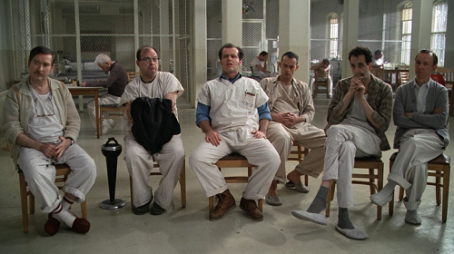
Everyone has at least one hugely acclaimed movie that they simply do not like, for whatever reason. “It’s in black and white.” “It’s too boring.” “It’s got subtitles.” “It’s too violent.” “It’s got so-and-so I dislike in it.” “It’s too long or confusing or uninvolving.” Everyone has one, and One Flew over the Cuckoo’s Nest is mine. Based on Ken Kesey’s novel, this film is an excellent example of how a bottom-dweller can be a good film and still cause a personal distaste, at least for me.

First of all, I want to point out that this film is a great one in terms of strictly filmmaking. It deserved every one of its awards and probably more. Jack Nicholson as R. P. McMurphy and Louise Fletcher as Nurse Ratched won Best Actor and Actress, and the uniformly excellent cast is a who’s who of thespians known for looking rather unhinged or crazy, such as Brad Dourif, Christopher Lloyd, and Vincent Schiavelli (the subway ghost in Ghost). Will Sampson as Chief, William Redfield as Harding, and Danny Devito as Martini are also marvelous, and Sydney Lassick as Cheswick is especially expressive with his psychosis and deserved a Best Supporting Actor Oscar nom that only Dourif received. Cuckoo’s Nest remains one of only three films to win the Big Five: Best Picture, Actor, Actress, Director (Milos Forman), and Screenplay. My objections do not involve its acting or quality, but its characters and how its message is presented.

I suppose the most troubling aspect of the film is its chosen hero and villain. The film’s sentiments obviously lie with McMurphy because he’s got a personality and enjoys the World Series, and someone with a name like Mildred Ratched must be a wretched villain, right? Yet McMurphy is established as a crook and a rapist, lazy and belligerent, right from the beginning, and he’s clearly only there at the asylum to fake his way to an easy confinement (he thinks). He’s meant to represent bucking the system, a rebel to inspire the inmates to try, yet what does he ultimately inspire them to do: chug booze, have sex, cuss like sailors, lose control, euthanize the catatonic? That’s hardly what I would call heroic. In certain scenes, he seems to care about the patients more than the cold nurses, yet he doesn’t help them any more than the staff does, except to have a bit more enjoyment through debauchery.

On the other side of the conflict is Fletcher’s Nurse Ratched, who I consider an antagonist, not a villain. She’s certainly hard-nosed, manipulative, and prone to unwise remarks that make bad situations worse, but when you think about it, she’s simply doing her job as she knows how, even displaying a sense of responsibility to her patients. Her worst moment comes near the end, where she crushes Billy Bibbit’s budding individuality under a domineering thumb, yet she couldn’t know the tragic results of her words. Plus, Billy’s fate is as much McMurphy’s fault for putting him in a situation sure to cause embarrassment in the long run. With her little devil-horn hairdo and glacial demeanor, she’s meant to represent the evil system, but the unstable people she cares for are little more than big children, unable to handle the outside world, and, in my opinion, people in need of the system. I find it laughable that AFI placed her at #5 on their list of movie villains, above truly evil characters like the Joker, Amon Goeth from Schindler’s List, or the demon in The Exorcist. Even at her worst, she’s nothing compared with them.

One Flew over the Cuckoo’s Nest is a film I can admire for its acting, but every time I think of it, the words “I don’t like it” come to mind. The painting of the irresponsible, foul-mouthed antihero as the good guy and the cold but overly demonized nurse as the bad guy makes it a distasteful experience overall. A much better example of McMurphy’s kind of “inspiring” character would be Andy Dufresne from The Shawshank Redemption. From the beginning, the audience knows (or at least assumes) that he is innocent, and his uplifting rebellion against authority is that of a wronged man yearning to be free rather than a guilty man yearning to play the system so he can continue his criminal life. Perhaps my complaints don’t matter to most. My VC agrees with most of my points, yet still finds much to enjoy, mainly in the performances. She may not classify it as such, but for me, this Oscar-winning classic is still a bottom-dweller.

Best line: (McMurphy, speaking of his shock treatments) “They was giving me ten thousand watts a day, you know, and I’m hot to trot! The next woman takes me on’s gonna light up like a pinball machine and pay off in silver dollars!”

 
Rank:  Bottom-Dweller
 

© 2015 S. G. Liput

297 Followers and Counting

Cross Creek (1983)

22 Wednesday Apr 2015

Posted by sgliput in Movies, NaPoWriMo, Poetry, Reviews, Writing

≈ 2 Comments

Tags

Drama, Romance


Cities are a dying breed,
Though those who live in them know not.
They’re full of people, noise, and need,
Yet lack the treasures man forgot,
The joys of wind and sprouting seed
And peace of mind that can’t be bought.
 
Here in Cross Creek, my writing wakes,
Surrounded by the Spanish moss,
By sylvan streams that link the lakes
And tiny boats to get across.
I moved here for the silence’ sakes;
The lack of clamor is no loss.
 
My neighbors are a different folk;
Like me, they tend to stay apart,
To work beneath the ancient oak
And never reckon to depart.
We hear the frogs in chorus croak
And know the creatures’ songs by heart.
 
Cities are a dying breed,
Though some say nature will go first.
Yet renters ever will secede
To find the home for which they thirst.
Cross Creek and peace will thrive indeed
When all the cities have dispersed.
__________________
 

(In honor of Earth Day, today’s NaPoWriMo prompt, and Marjorie Kinnan Rawlings’ distaste for cities, the poem today is a pastoral, focusing on nature and a bucolic setting, of which Cross Creek has no shortage.)

Cross Creek could be considered a VC Pick, since she loves this film dearly, but I’ve come to enjoy it nearly as much. It should have made my original list, but I couldn’t remember it well enough at the time. Based on the memoir of Marjorie Kinnan Rawlings, it stars Mary Steenburgen as the strong-willed but reclusive author who in 1928 bought a dilapidated house and orange grove in the Florida boondocks. Having lived in central Florida myself, I recognize the film as a tribute to the Florida “cracker” lifestyle, the rural frontiersmen who made a home out of the balmy wilderness. (I even remember taking field trips to Cracker Country, a living history museum that promotes knowledge of their early culture.) Rawlings comes to Cross Creek in search of silence to write but finds inspiration and love (with Peter Coyote!) in this unexpectedly homey landscape.

Watching the film again, it reminded me of another film about a famous divorced female writer who moves to a steamy countryside, falls in love with one of the first people she meets there, grows a tropical crop, bonds with the natives, and finds the inspiration for her best-known work, that film being 1985’s Out of Africa. Yet Cross Creek was released two years earlier and is less epic and more folksy than the later film. Instead of being a remake of Rawlings’ The Yearling, it offers a different yet recognizable sideplot involving the relationship of a child (a girl instead of the boy in the book) and a fawn (one of the most adorable things on four legs).

Made with the assistance of Rawlings’ husband Norton Baskin (who has a cameo toward the beginning), Cross Creek is charming and cozy, peaceful but tragic, and very well-acted. Rip Torn as Rawlings’ backwoods neighbor and Alfre Woodard as her devoted maid both received Oscar nominations, as did the costume design and the score (which is also slightly reminiscent of Out of Africa). Despite these honors, it’s a film that seems to have been forgotten for the most part, which is a shame. It’s most pertinent message for me as a writer is to write what you know, what you’re passionate about, rather than what is simply popular. Despite some awkward scenes and a conclusion that could have been strengthened by some added information, Cross Creek is a river well worth traveling down.

Best line: (Marjorie Rawlings, after a drunken night) “That is just the way I am. I go along quietly for a while and then out of the clear blue sky, I don’t know what happens to me, I just pick up a gun, and I shoot whatever makes me angry. I’m so afraid one day it just might be a person.”

 
Rank: List-Worthy
 

© 2015 S. G. Liput

297 Followers and Counting

Rebecca (1940)

21 Tuesday Apr 2015

Posted by sgliput in Movies, NaPoWriMo, Poetry, Reviews, Writing

≈ 2 Comments

Tags

Drama, Hitchcock, Romance


Rebecca is dead, but her room is the same.
The servants still miss her and whisper her name.
Her husband is grieving, and tries to move on,
But Mrs. de Winter is not fully gone.
 
Her secrets remain, as do Mr. de Winter’s,
Secrets that torture him daily like splinters.
His new wife is innocent, nervous, and shy;
She shouldn’t learn them, nor understand why.
 
But secrets have habits of being found out,
Casting suspicion and panic and doubt.
Rebecca is dead, Mrs. Danvers knows well,
And yet Manderley is still under her spell.
________________
 

After seeing Hitchcock’s last great film based off a Daphne du Maurier story (The Birds), I thought I’d see his first great American film based off a Daphne du Maurier story, Rebecca. A Gothic tale with distinct similarities to Jane Eyre, Rebecca won the 1940 Academy Award for Best Picture and was indeed far better than a certain disliked competitor (ahem, The Philadelphia Story.)

Laurence Olivier is both dashing and brusque as Maxim de Winter, a widower haunted by the loss of his first wife Rebecca. When he runs into the lovely Joan Fontaine, her naiveté and complete contrast to Rebecca attract him, and a somewhat comedic whirlwind romance makes the unnamed heroine the second Mrs. de Winter. When they return to de Winter’s sprawling estate of Manderley, his new bride begins to feel more and more uncomfortable as semi-famous villain Mrs. Danvers psychologically torments her with unfortunate comparisons. By the end, the narrative takes some unexpected twists that either improve or destroy certain characters.

In contrast to many old Gothic films (like Merle Oberon’s laughable scenes in 1939’s Wuthering Heights), Rebecca avoids old-fashioned histrionics and provides some genuinely great performances from Olivier, Fontaine, and Dame Judith Anderson as Mrs. Danvers, the black-clothed matron with an unhealthy fascination with her late employer. (My VC became frustrated with Fontaine’s constant timidity, but I thought it was handled well, considering her age and limited experience. Her apprehensions are much like a child’s, like when she accidentally breaks a statue and hides it, only to feel and look foolish when the truth comes out.) The film transitions thrice, first from an unexpected romance to a dark psychological mystery and then to a whodunit in which the audience actually hopes the investigation is unsuccessful. That’s no mean feat, and Hitchcock’s direction creates just the right aura of intrigue, meant to fascinate and frighten both the protagonist and the audience. While it owes much to past classics of the genre and the ending is a bit abrupt, Rebecca promised that America could expect some great things from Alfred Hitchcock.

Best line: (Mrs. Van Hopper, the heroine’s employer) “Most girls would give their eyes for the chance to see Monte [Carlo]!”   (Maxim de Winter) “Wouldn’t that rather defeat the purpose?”

 
Rank: List Runner-Up
 

© 2015 S. G. Liput

297 Followers and Counting

The Truman Show (1998)

20 Monday Apr 2015

Posted by sgliput in Movies, NaPoWriMo, Poetry, Reviews, Writing

≈ 2 Comments

Tags

Comedy, Drama, Sci-fi


Did you ever feel that you were being watched,
That someone saw each time you won or botched?
No one’s watching; don’t despair
(At least as far as I’m aware),
Yet Truman Burbank’s on TV,
Living life for all to see,
Quite contented in his dome,
Which he doesn’t know is home.
 
He has fans around the world who watch him daily
As he greets Seahaven every morning gaily.
No reality show’s greater,
Thanks to Christoff, its creator.
Due to Christoff’s shrewd promotion,
Truman’s frightened of the ocean,
So he never leaves his isle,
Though he’s tempted for a while.
 
Truman’s been content with blinders since his youth,
But he starts to have an inkling of the truth.
From a star that might be fake
To a radio mistake
To endorsements from his wife,
Things revolve around his life,
Such that he begins to wonder
What conspiracy he’s under.
 
He attempts to leave his quaint, idyllic course
But is urged to linger, even if by force.
When at last he gets away,
Sailing off across the bay,
Christoff tries to be his guide
From the unknown world outside.
Truman doesn’t want ideal;
He would rather have what’s real.
________________
 

(I had fully intended for The Truman Show to be part of my original list, and I even wrote the review last year. Yet, in looking over my archives, I found that I apparently never posted it. I don’t know how I could have missed it, but it’s time to correct that oversight. Better late than never, right?)

Who would have thought from films like Ace Ventura: Pet Detective, The Mask, and Dumb and Dumber that Jim Carrey could muster such a subtle, earnest performance? The Truman Show is without a doubt his finest film. I want to call it one of the most original stories of the last twenty years, but a little research revealed that it did have some forerunners, particularly a similar 1989 Twilight Zone episode entitled “Special Service.” While that episode had some perceptive themes, such as how some people are famous just because they’re on television (Snooki, Housewives, etc.), the movie improved on those themes, creating a film that both entertains and challenges our sense of paranoia and privacy. It’s also funny and pleasantly intelligent, shrewdly depicting certain rules of Truman’s world before they’re even fully explained.

Jim Carrey gets a chance to intermittently employ his trademark goofy grin and mannerisms, but he proves he can handle weightier material as he slowly discovers all is not right in his world. One of his best scenes occurs when his suspicions are first aroused, and accompanied by a mood-setting score, he wordlessly changes up his routine just to witness what will happen. Oscar nominee Ed Harris as show creator Christoff isn’t wholly unlikable as the overlord of Truman’s life, and his few scenes make it clear that he does care for Truman in a twisted way and believes that this charade is somehow in his subject’s best interest. Of the other actors, Noah Emmerich offers the most convincing deception, effortlessly earning Truman’s trust while giving little indication that he’s just an actor.

As a Christian, I might have taken issue with The Truman Show’s symbolic renunciation of its God stand-in, except that Christoff is just a stand-in. He’s a pretender, believing himself benevolent while using Truman for ratings and engaging often ridiculously obvious methods to keep him from discovering the truth. It’s a thought-provoking notion that all of our situations are pre-ordained and many groups have latched onto such concepts, but I believe God allows the multitude of human beings on this planet to choose their actions. Though He knows what will happen, He doesn’t interfere in the ways Christoff does but lets us choose, sometimes to our detriment. In addition, there’s no sacrifice on Christoff’s part, no desire for a real relationship, as God desires. While the filmmakers most likely intended Truman’s rejection of Christoff to mirror a rejection of Christ, Christoff’s actions are ultimately not God-like enough to warrant the comparison, unless you count watching from the sky. The film does challenge one’s view of God but not in an insulting or dogmatic way. I choose to perceive it as a critique, not of God, but of authoritarian frauds, posers, and maybe even governmental control freaks.

The Truman Show continues to be insightful and socially relevant in our fake reality-obsessed world and stands as Jim Carrey’s most Oscar-worthy performance. It continues to have an influence on modern films like Bolt and The Hunger Games and reinstated fears of surveillance to a post-1984 world. If only Jim Carrey would seek out more roles like this….

Best line: (Truman, as a kid in school) “I’d like to be an explorer, like the great Magellan.”  (his teacher, trying to convince him to not want to leave) “Oh, you’re too late. There’s really nothing left to explore.”

 
Rank: List-Worthy (should have been #100)
 

© 2015 S. G. Liput

296 Followers and Counting

The Ultimate Life (2013)

19 Sunday Apr 2015

Posted by sgliput in Movies, NaPoWriMo, Poetry, Reviews, Writing

≈ 2 Comments

Tags

Drama, Family


A man is sadly at his least wise
When he prefers work above his own loveliest prize.
 
Wisdom can spring from pain or the past;
How you and I choose is our generation’s contrast.
 
Journals and annals have much to tell:
Listen and look to find in them what lessons may dwell.
 
Dreams are perhaps best when advertised:
Speaking them may render them more potent when realized.
 
Regret grows when foolish sleepers wake;
Contentment grows from dodging someone else’s mistake.
___________________
 

(Today’s NaPoWriMo prompt is for a landay, a 22-syllable couplet that exists as an oral poetic form among women in Afghanistan. Above, I strung several together to be taken individually or together as lessons drawn from the film.)

I’ve always loved the 2006 film The Ultimate Gift, a clean-cut drama that plays like a high-quality Hallmark film but won me over with its moral wake-up call and some fine performances from Abigail Breslin and James Garner. I had heard it had been given a television sequel, but just now got around to seeing it. Directed by Michael Landon, Jr., The Ultimate Life is a less-publicized tale of the continuing struggles of Jason Stevens, the reformed playboy who was given twelve gifts from his dead grandfather Red Stevens (Garner), which changed his world view, won him a girlfriend, and prepared him to take over Red’s billion-dollar corporation. It picks up where the first left off, proving that his spoiled relatives wouldn’t so easily accept his sudden turnaround and happy ending, yet it doesn’t take long for his story to be supplanted by an extended flashback involving Red’s youth and rise to fame and fortune.

I’ll come right out and say it: this film is not nearly as good as the original, but it’s not all bad either. Drew Fuller has been replaced as Jason Stevens by Logan Bartholomew and Garner is absent save for a single recording, but at least most of the actors from the first film return, including Bill Cobbs, Lee Meriwether, and Ali Hillis as Drew’s sweetheart Alexia. Sadly, the chemistry between Jason and Alexia is lost for the most part by the recasting, and their early tension is awkward and unconvincing. The film thankfully doesn’t dwell on Drew’s still misplaced priorities, for Red’s faithful lawyer friend Hamilton supplies him with Red’s personal journal, which will undoubtedly hold whatever lesson Jason needs to learn.

The story of young Red’s endeavors to become a billionaire ranges from corny to inspiring, but the film’s greatest enjoyment comes from recognition of known characters’ younger selves and the depiction of events only mentioned in The Ultimate Gift. There’s romance and labor, success and obsession, and the film does show how a man as seemingly wise as Red Stevens could have such rotten ungrateful offspring. (Basically, when a tree isn’t tended and grows crooked, it’s hard to straighten it after the fact.)

Unfortunately, The Ultimate Life falters toward the end of Red’s story. His loss of priorities leads him to make a self-serving choice, which is never really admonished, and after doing something kind and noble, he suddenly realizes the error of his ways and comes up with his famous twelve gifts seemingly out of nowhere. The film should have been more explicit about what inspired this list. It suggests the interesting forerunner of a golden list (a morning habit of listing ten things for which to be grateful), but that’s ten items, not twelve, and any comparison is never made clear.

Ultimately (hee hee), it’s a worthy companion piece for The Ultimate Gift but a far cry from the original’s power and appeal. It extols family and hard work and offers a generic but sweet confession of love that may tug someone’s heartstrings (like my dad’s). Whereas the first was slightly higher than usual Hallmark fare, The Ultimate Life fits comfortably into that less-than-favored mold.

Best line: (young Hamilton) “Your family is your legacy.”

 
Rank: Honorable Mention
 

© 2015 S. G. Liput

295 Followers and Counting

The Way Back (2010)

18 Saturday Apr 2015

Posted by sgliput in Movies, NaPoWriMo, Poetry, Reviews, Writing

≈ 1 Comment

Tags

Drama, History


Deep in Siberia, prison of nature,
Brig of the barbarous Soviet ship,
Men were convinced there could be no escapers;
No one could hope to survive such a trip.
 
Janusz, a Pole locked away by betrayal,
Hoped and gave hope when it nearly was dead.
Rushing from Russians through snow-glutted gale,
Seven escaped from the Gulag and fled.
 
Journeying south through the frost and the firs,
Through hunger and fears that they may not arrive,
Ever they traveled with personal spurs,
Keeping the world-weary rovers alive.
 
Onward and onward, from hills unto lakes,
Lakes unto hills unto plains unto sand,
Onward through nature’s unbearable aches,
Onward they walked over merciless land.
 
Husband and artist, accountant and priest,
Father and criminal—all carried on.
Though they were free, some were further released
To journey no farther until the last dawn.
 
Sojourning south through the sting of the sun,
Through thirst and through fears that they may not arrive,
Ever they traveled till travels were done,
Clinging to that which keeps all men alive.
________________
 

(On this eighteenth of April, in honor of “Paul Revere’s Ride,” one of my favorite poems, the NaPoWriMo prompt was for a poem about an urgent, epic journey. This quest certainly qualifies.)

Not to be confused with the 2013 coming-of-age film The Way, Way Back, The Way Back is the very definition of an epic, “based-on-a-true-story” journey, drawing its inspiration from Slawomir Rawicz’s 1956 memoir The Long Walk. While the truth of the story has been questioned over the years, several similar stories exist, and though the film also takes some artistic liberties, its authenticity concerning the Soviet Gulag was well-researched. The Way Back has even been called the first Hollywood film to tackle a tale of the Communist Gulags.

Regardless of its source material’s accuracy, The Way Back is a moving and well-acted tribute to what is indeed a very long walk, 4000 miles from Siberia to India, through hostile terrains of all kinds. Like past hits (Witness, The Truman Show), director Peter Weir brings an eye for detail and beauty, particularly in the sweeping landscapes the characters traverse. While the cinematography alone is enough to recommend the film, the acting is equally outstanding. Several lesser-known actors from Eastern Europe are joined by Jim Sturgess, Colin Farrell, Ed Harris, Mark Strong and Saoirse Ronan, giving varied performances that never falter in their emotional resonance. Though the film’s lone Oscar nomination was for Best Makeup (lost to The Wolfman), it was an underrated spurn for the Academy to omit any directing or acting nominations, especially for Sturgess and Harris.

While The Way Back features much suffering and heartache, it’s a thankfully restrained portrait of an awe-inspiring escape to freedom, one which stands on its own with limited references to jailbreak predecessors like The Great Escape (one escapee is somewhat blind, but that’s about it). My only qualm about the film is that it took some effort to understand the Eastern European accents, mainly Colin Farrell’s; it’s a prime example of a film best seen with subtitles too, just as an added reference.

While the film could have ended with a simple arrival in India, its poignancy takes a dramatic surge as one long walk becomes an even longer walk, its length adding to its tear-jerking potential. While its positive reviews were halfhearted for the most part, I consider The Way Back to rank among Weir’s finest films and proof that he is still an expert director.

Best line: (Mr. Smith) “In the camps, some saw death as freedom.”   (Janusz) “Then why didn’t you just kill yourself?”   (Mr. Smith) “Survival was a kind of protest. Being alive was my punishment.”

  
Rank: List-Worthy
 

© 2015 S. G. Liput

295 Followers and Counting

← Older posts
Newer posts →

Recent Posts

  • We Didn’t Start 2025 (Recap)
  • NaPoWriMo 2025 Recap (Finally)
  • Sonic the Hedgehog 3 (2024)
  • It Happened One Night (1934)
  • Spellbound (2024)

Recent Comments

associatesofshellymann's avatarassociatesofshellyma… on My Top Twelve La La La So…
Kit's avatarKit Nichols on Bonnie and Clyde (1967)
lifelessons's avatarlifelessons on Look Back (2024)
Carol Jackson's avatarCarol Jackson on The Thief of Bagdad (1940…
Stephen's avatarStephen on Love Story (1970)

Archives

  • January 2026
  • December 2025
  • May 2025
  • April 2025
  • March 2025
  • February 2025
  • January 2025
  • December 2024
  • May 2024
  • April 2024
  • March 2024
  • February 2024
  • January 2024
  • December 2023
  • November 2023
  • October 2023
  • September 2023
  • July 2023
  • June 2023
  • May 2023
  • April 2023
  • March 2023
  • February 2023
  • January 2023
  • December 2022
  • November 2022
  • October 2022
  • September 2022
  • August 2022
  • July 2022
  • June 2022
  • May 2022
  • April 2022
  • March 2022
  • February 2022
  • January 2022
  • December 2021
  • November 2021
  • October 2021
  • September 2021
  • August 2021
  • July 2021
  • June 2021
  • May 2021
  • April 2021
  • March 2021
  • February 2021
  • January 2021
  • December 2020
  • November 2020
  • October 2020
  • September 2020
  • August 2020
  • July 2020
  • June 2020
  • May 2020
  • April 2020
  • March 2020
  • February 2020
  • January 2020
  • December 2019
  • November 2019
  • October 2019
  • September 2019
  • August 2019
  • July 2019
  • June 2019
  • May 2019
  • April 2019
  • March 2019
  • February 2019
  • January 2019
  • December 2018
  • November 2018
  • October 2018
  • September 2018
  • August 2018
  • July 2018
  • June 2018
  • May 2018
  • April 2018
  • March 2018
  • February 2018
  • January 2018
  • December 2017
  • November 2017
  • October 2017
  • September 2017
  • August 2017
  • July 2017
  • June 2017
  • May 2017
  • April 2017
  • March 2017
  • February 2017
  • January 2017
  • December 2016
  • November 2016
  • October 2016
  • September 2016
  • August 2016
  • July 2016
  • June 2016
  • May 2016
  • April 2016
  • March 2016
  • February 2016
  • January 2016
  • December 2015
  • November 2015
  • October 2015
  • September 2015
  • August 2015
  • July 2015
  • June 2015
  • May 2015
  • April 2015
  • March 2015
  • February 2015
  • January 2015
  • December 2014
  • November 2014
  • October 2014
  • September 2014
  • August 2014
  • July 2014
  • June 2014
  • May 2014
  • April 2014
  • March 2014
  • February 2014
  • January 2014
  • December 2013

Categories

  • Blindspot
  • Blogathon
  • Christian
  • Movies
  • Music
  • NaPoWriMo
  • Poetry
  • Reviews
  • TV
  • Writing

Meta

  • Create account
  • Log in
  • Entries feed
  • Comments feed
  • WordPress.com

Recent Posts

  • We Didn’t Start 2025 (Recap)
  • NaPoWriMo 2025 Recap (Finally)
  • Sonic the Hedgehog 3 (2024)
  • It Happened One Night (1934)
  • Spellbound (2024)

Recent Comments

associatesofshellymann's avatarassociatesofshellyma… on My Top Twelve La La La So…
Kit's avatarKit Nichols on Bonnie and Clyde (1967)
lifelessons's avatarlifelessons on Look Back (2024)
Carol Jackson's avatarCarol Jackson on The Thief of Bagdad (1940…
Stephen's avatarStephen on Love Story (1970)

Archives

  • January 2026
  • December 2025
  • May 2025
  • April 2025
  • March 2025
  • February 2025
  • January 2025
  • December 2024
  • May 2024
  • April 2024
  • March 2024
  • February 2024
  • January 2024
  • December 2023
  • November 2023
  • October 2023
  • September 2023
  • July 2023
  • June 2023
  • May 2023
  • April 2023
  • March 2023
  • February 2023
  • January 2023
  • December 2022
  • November 2022
  • October 2022
  • September 2022
  • August 2022
  • July 2022
  • June 2022
  • May 2022
  • April 2022
  • March 2022
  • February 2022
  • January 2022
  • December 2021
  • November 2021
  • October 2021
  • September 2021
  • August 2021
  • July 2021
  • June 2021
  • May 2021
  • April 2021
  • March 2021
  • February 2021
  • January 2021
  • December 2020
  • November 2020
  • October 2020
  • September 2020
  • August 2020
  • July 2020
  • June 2020
  • May 2020
  • April 2020
  • March 2020
  • February 2020
  • January 2020
  • December 2019
  • November 2019
  • October 2019
  • September 2019
  • August 2019
  • July 2019
  • June 2019
  • May 2019
  • April 2019
  • March 2019
  • February 2019
  • January 2019
  • December 2018
  • November 2018
  • October 2018
  • September 2018
  • August 2018
  • July 2018
  • June 2018
  • May 2018
  • April 2018
  • March 2018
  • February 2018
  • January 2018
  • December 2017
  • November 2017
  • October 2017
  • September 2017
  • August 2017
  • July 2017
  • June 2017
  • May 2017
  • April 2017
  • March 2017
  • February 2017
  • January 2017
  • December 2016
  • November 2016
  • October 2016
  • September 2016
  • August 2016
  • July 2016
  • June 2016
  • May 2016
  • April 2016
  • March 2016
  • February 2016
  • January 2016
  • December 2015
  • November 2015
  • October 2015
  • September 2015
  • August 2015
  • July 2015
  • June 2015
  • May 2015
  • April 2015
  • March 2015
  • February 2015
  • January 2015
  • December 2014
  • November 2014
  • October 2014
  • September 2014
  • August 2014
  • July 2014
  • June 2014
  • May 2014
  • April 2014
  • March 2014
  • February 2014
  • January 2014
  • December 2013

Categories

  • Blindspot
  • Blogathon
  • Christian
  • Movies
  • Music
  • NaPoWriMo
  • Poetry
  • Reviews
  • TV
  • Writing

Meta

  • Create account
  • Log in
  • Entries feed
  • Comments feed
  • WordPress.com

Blog at WordPress.com.

  • Subscribe Subscribed
    • Rhyme and Reason
    • Join 814 other subscribers
    • Already have a WordPress.com account? Log in now.
    • Rhyme and Reason
    • Subscribe Subscribed
    • Sign up
    • Log in
    • Report this content
    • View site in Reader
    • Manage subscriptions
    • Collapse this bar