Children fought within the Games,
As posh patricians praised their names,
And through the safety of TV,
Let death abound for all to see.
Now death has bounded through the screen,
And at the urging of a teen,
The poor plebeians meant to lack
Have gained the courage to fight back.
When tyrannies use violent means
And worship death on TV screens,
It then should come as no surprise
In violence do the people rise.
For freedom, violence intervenes,
For can mankind learn otherwise?
________________
MPAA rating: PG-13
After watching the final Hunger Games film and contemplating whether I liked it or Catching Firebest, I’ve come to the conclusion that Mockingjay – Part 2 is the best installment of the series. The final chapter of any franchise is typically meant to be the grandest and most important, a rare but desirable feat that is indeed met by this last portion of Katniss Everdeen’s story.
Though I’m one of the few people not to have read the books, I’m well aware that Mockingjay is the least favored of Suzanne Collins’s trilogy, and some reviews for Mockingjay’s two film adaptations have been similarly blasé, since they say the book is better and its predecessors are better still. Yet Part 2 delivers on the setup of Part 1, trading in the previous film’s relative lack of thrills for the fast-paced intensity of the Maze Runnerseries.
I’ll try to be general to avoid spoilers: Katniss (ever-outstanding Jennifer Lawrence) and President Coin’s rebels aim for President Snow and the Capitol, even as the archer struggles with her split affections and Peeta’s recent brainwashing. Considering how Part 1 used Peeta’s sudden indoctrination as its climax, I was glad that it wasn’t swept away as a minor setback; instead, it becomes an ongoing risk, as well as a satisfying method of ironing out the reality among all the lies. The actual mission grows in importance as they continue, and the Hunger Games-style dangers encountered make Mockingjay – Part 2 the most intense film of the franchise, with one sequence that seemed fit for a horror movie.
Considering everything that has come before, it should be no surprise that there are many deaths along the characters’ difficult journey, and I suspect this is part of what many fans disliked. Killing off characters is most painful when it seems unfair, and such displeasing deaths can cause fans to be angrier at the storyteller than the characters responsible. (A recent example I disliked was in How to Train Your Dragon 2). Mockingjay – Part 2 has twists that aren’t exactly what fans would want or expect, but the story makes the best of them and ends up sadder but wiser, yet still fulfilling.
While the biggest complaint about Mockingjay is how it has been split into two parts for the sake of money, Part 2 actually served to vindicate that decision for me on the narrative level, at least somewhat. One hope I had for the Hobbit trilogy was that, by stretching the dwarves’ screen time, their characters would grow more familiar and not just be thirteen interchangeable companions. While Jackson failed in that regard, I felt Mockingjay succeeds. With so many new characters introduced between Parts 1 and 2, it made sense to establish some earlier on to distinguish them from the redshirts who don’t have enough screen time to leave an impression. (To use a Marvel comparison, whose death had more impact, that of Coulson, who was seen in multiple films, or that of Quicksilver, who had one?) While the decision did Part 1 no favors, it works to Part 2’s advantage.
As the capstone of The Hunger Games franchise, Mockingjay – Part 2 is both an exciting blockbuster and a dark climax for a dark series. While some elements may not satisfy, such as the resolution to the whole love-triangle friction, the majority do. The expansive cast perhaps aren’t fully utilized, but plot progression is more important than characterization at this point, since we’ve already gotten to know the important players over three films. (I was glad that Philip Seymour Hoffman’s role as Plutarch Heavensbee wasn’t much affected by his death earlier this year; his absence was only felt in one scene and was well sidestepped.) Most importantly, amid the chaotic action and sci-fi spectacle, the film reaffirms the franchise’s ultimate message. As Katniss has grown from fighting for survival to fighting for freedom or revenge, the struggle has not simply been against monosyllabic presidents but against anyone with contempt for life. It’s a theme still very much relevant today and one I hope will be ever in our favor.
Best line: (Katniss) “There are much worse games to play.”
Rank: List-Worthy (joining the other three in the series)
Evil comes in many forms,
In the loner and the swarms,
In the wielder of the knife,
In the prober of your life.
Though it hides or means to try,
It draws your interest and your eye.
Dark are deeds we’d never do,
Yet they still are dared by few.
Justice runs to halt the spread,
But if it wins, there’s still the dread.
Evil loves to carve its notch,
But why do any choose to watch?
_________________
MPAA rating: R
After years of hearing how great it is and seeing most of Anthony Hopkins’s performance through clips, I decided to finally watch the Best Picture of 1991. The Silence of the Lambs is everything critics have praised over the years: a dark mystery, a dramatic powerhouse, a compelling character study of two opposing forces, one seeking justice and the other too demented to be fully understood. It is both Hopkins’s and Jodie Foster’s finest hours, winning both of them Academy Awards, as well as Oscars for Best Director and Best Screenplay. And it is a great film which I have little desire to see again. The Silence of the Lambs is one of those movies that I can admire without being able to fully embrace as a favorite, more due to my personal sensitivities than to any flaws on the film’s part.
It’s an ingenious setup, pitting an eager but untested FBI agent-in-training (Foster) against the memorably evil serial killer Buffalo Bill (Ted Levine) with the aid of the even more memorably evil killer Hannibal Lecter (Hopkins). Clarice Starling is a woman trying to prove herself to her superior Jack Crawford (Scott Glenn) and to save other women, who are being killed and skinned by Bill across the Midwest. Jonathan Demme’s directorial tactic of filming actors as they look directly into the camera is even more effective than in his next film Philadelphia (which perhaps served to compensate for the allegedly homophobic aspects of Silence). As Crawford or Lecter or various men stare at Clarice and by extension the audience, it feels as if she is being sized up, measured, evaluated as an asset, a threat, or a toy. It’s an uncomfortable sensation but unique and intriguing enough to constantly hold our attention and keep us and Clarice on our toes.
Of course, the most remarkable element of the film is Anthony Hopkins, who amazingly won Best Actor for only sixteen minutes of screen time. He’s unflinchingly malevolent yet unsettlingly polite, a performance so captivating that it nearly dwarfs the rest of the film (hence, Best Actor rather than Best Supporting Actor). As diabolical and conniving as Lecter is, it’s Levine’s performance as Buffalo Bill that I found deeply disturbing. While Demme used much restraint in depicting the violence, Bill’s perverse cruelty doesn’t leave the mind easily, and I’ll probably just skip his scenes whenever I attempt a rewatch. It’s a wonder Levine has been able to move on from such a vile role.
Beyond Bill’s foul obsessions, I suppose my tepid appreciation stems from the fact that The Silence of the Lambs made me consider why serial killers are so popular. I don’t mean the supernatural types like Freddy Krueger (though I don’t like them either), but the modern focus on potentially real people who commit horrendous acts. Real-life killers like Ed Gein and Ted Bundy have inspired films like Psycho and Silence of the Lambs, and serial killers are still trendy in TV shows like Dexter and Hannibal. What is it that is so compelling about these experts of violence? Most people would never dream of committing such acts, and yet we watch them or hear about them; we study their modus operandi and are fascinated.
The Silence of the Lambs offers some insight into its killers, whether it be the deductive clue-chasing of the FBI agents tracking Bill down or the dehumanizing way Bill refers to his victims as “it.” Lecter represents the enthralling, psychological aspect of these butchers, while Bill epitomizes the disgust. It’s fascinating, yet I can’t help but feel guilty and repulsed by my own fascination. The Silence of the Lambs is a masterfully disturbing thriller, but I don’t often like being disturbed. I don’t want Hannibal Lecter inside my head.
Best line: (Hannibal Lecter, with his most iconic line) “A census taker once tried to test me. I ate his liver with some fava beans and a nice Chianti. Sssffff.”
Being black and being white
Can form opinions, wrong and right,
Attitudes and points of view
Based solely on another’s hue.
Most get only one perspective,
Rarely totally objective.
Maybe, though, we’d change our views
If we were in another’s shoes.
Although we may be still behind
On growing fully colorblind,
Insight instead of reprimand
Might help us further understand.
_____________________
MPAA rating: PG-13
When I watched Soul Man at my VC’s suggestion, I had no idea it was considered a controversial movie. After I’d seen it, I was surprised at the number of sites that listed it as shamelessly racist alongside films like The Birth of a Nation and Song of the South. It also seemed to impede C. Thomas Howell’s rise to stardom, since he’s mostly been resigned to TV and low-quality roles ever since. And yet, I liked Soul Man, which may be surprising too since I’m not a racist. I suppose, as a precaution, I should say up front that I am not black, and I apologize for anyone that this movie or my appreciation of it might offend. But I liked Soul Man.
In addition to Red Dawn and Gettysburg, I would even go so far as to call it one of C. Thomas Howell’s best movies. In it, he plays Mark Watson, a spoiled white guy whose father seeks to teach him a lesson by cutting off his funds right on the eve of his freshman year at Harvard Law School. Faced with giving up his college plans, Mark applies for and gets a scholarship…an African American scholarship. He does so by overdosing on tanning pills, an improbable and inadvisable method which doesn’t make sense, is never further explained, and serves merely as a superficial reason for Mark passing himself off as black.
With just his one friend Gordon in the know (Arye Gross), he goes in with several presumptuous, perhaps racist ideas of what being black is all about, such as assuming a black professor (James Earl Jones) will give him special treatment. “This is the Cosby decade,” he says. “America loves black people.” It doesn’t take long, though, for him to get a taste of other people’s racism, whether it be the prejudiced jokes of the local school bigots or the overly suspicious eye of a policeman (and those kinds of reports are still in the news). Over time, his perspective changes, based on both his own experience and his gradual relationship with fellow classmate Sarah (Rae Dawn Chong, whom Howell later married…for a year). Of course, this is a comedy, so the drama usually gives way to Mark’s hilarious attempts to avoid detection as his ill-conceived plan spirals out of control, and I must say that Soul Man had me laughing harder than I have in a long time, particularly when Mark does his Stevie Wonder impression.
So beyond whether I enjoyed it or not, I suppose the main question is this: is Soul Man racist? No, I don’t believe it is. Yes, there are racist stereotypes present, such as when Mark visits a girlfriend’s family (including an underused Leslie Nielsen), who all have ridiculously prejudiced views of Mark just because he appears black. Yes, most of the white characters have biased opinions of African Americans, from assuming they must all be good at basketball to automatically expecting to be robbed by them. Yes, the N word is uttered, though not nearly as much as in other movies. And yes, C. Thomas Howell wears black face to pretend to be black. If that in and of itself offends you, then steer clear of Soul Man.
Yet I have to believe that a film can present negative elements without endorsing them. The film could be compared to Arye Gross’s rather overblown legal argument toward the film’s end, offensive and derogatory if taken at face value but actually with the opposite meaning for those willing to see it. Viewing racism through a comedic lens may not carry universal appeal, but Soul Man is not meant to be a comprehensive critique of the subject, and even Mark admits that he couldn’t possibly understand what it means to be black. Characters and their viewpoints can be absurdly racist, but the movie intends for us to laugh at them and perhaps consider our own views and assumptions about others at the same time. Some jokes also happen to be funnier in retrospect, such as Mark’s white girlfriend suggesting an erotic novel called Shades of Gray. Very interesting…. Soul Man may be anathema to the politically correct, but if not for the controversy, I bet it would be an ‘80s classic by now.
Best line: (Gordon to his roommate, with impeccable timing) “We should get an ocelot!”
Not sure what a Meet-‘Em-and-Move-On movie is? That’s not surprising since it’s a label I invented, but you’ve surely seen many such films. It’s an unofficial subgenre that I am always deeply moved by and includes many of my favorite movies. In fact, this list may mirror my top movie list overall due to my personal connection with many of these examples.
I call them Meet-‘Em-and-Move-On movies (MEAMOs) because they follow a single character or group throughout a journey of some kind, sometimes a quest, sometimes a personal mission, sometimes the key events of life itself. Throughout said journey, they meet various, often quirky characters who somehow affect them or vice versa and move on, sometimes meeting the same characters later. Usually (though not always) there is some climactic reunion or a look back at all those met along the way, and it is this element that especially tugs at my heartstrings with powerful themes of friendship, love, or forgiveness.
It took me a while to realize the commonalities among these movies and why I enjoy most of them so much. My earliest encounter with the Meet-‘Em-and-Move-On, which helped solidify my admiration for such stories, was Kate DiCamillo’s picture book The Miraculous Journey of Edward Tulane, one of my favorite children’s books since it brought me and my mom to tears. Stories like this especially rely on how well they are told, building character in the diverse travelers on the road of life and suffusing increasing meaning and interest into the trip and its destination. Most of these films I count among my favorites, though I’m ranking them on both my personal preference and on how well they fit the criteria of a Meet-‘Em-and-Move-On. I’m always on the lookout for new examples of this personal genre, so feel free to comment! On to the list!
Not to be confused with The Way or The Way, Way Back, The Way Back tells the supposedly true story of a group of prisoners, who escape from a Russian gulag in Siberia. They then proceed to walk all the way to India. The journey is incredibly harsh, ranging from frigid taigas to scorching deserts, yet they carry on, supporting each other along the dangerous road. Jim Sturgess, Ed Harris, Colin Farrell, and Saoirse Ronan are all in top form, and the reunion at the end touched me deeply.
When Thomas Avery (Martin Sheen) must travel to France to claim the body of his dead son (director and Sheen’s real son Emilio Estevez), he’s not planning a journey, but he decides to take up his son’s unfinished pilgrimage along the Camino de Santiago de Compostela in Spain. Carrying his son’s ashes, he encounters an overweight Dutchman (Yorick van Wageningen), a snide Canadian (Deborah Kara Unger), and an Irish writer (James Nesbitt), all walking for different reasons, along with various other travelers and locals. While Avery first sees the hike as a self-imposed obligation, he transforms over the journey from cynic to pilgrim, and everyone finds realistic catharsis, even if it’s not what they expected.
While this fantastical Brad Pitt opus is a prime example of a meet-‘em-and-move-on film, there are others that I just enjoy more. Adapted by Eric Roth (who also wrote #3 on this list) from an F. Scott Fitzgerald story, The Curious Case of Benjamin Button follows the titular character throughout a backwards life. Born as an old man, Benjamin grows younger over the years as he meets and learns from his adopted mother (Taraji P. Henson), a brief lover (Tilda Swinton), his first employer (Jared Harris), and of course his true love Daisy (Cate Blanchett). I love how some of the unique characters he meets pop up later in the story, and the final scenes add an epic and magical sweep to all those who touched Benjamin’s uncommon life.
While I was only recently introduced to this underappreciated modern classic from HBO (thanks again to MovieRob), I realized after seeing it that part of its power stems from its MEAMO trappings. Kevin Bacon won an Emmy playing Lt. Colonel Michael Strobl, who escorted the body of slain soldier Chance Phelps back home. During the trip, he briefly connects with fellow Americans, who render due reverence and small but meaningful offerings of respect to the deceased and his escort. As Strobl meets and moves on, he experiences the gratitude and grief of a nation.
A favorite of mine since childhood, Paulie is a film that I like to call a mix of Forrest Gump and Lassie but with a parrot. Many MEAMOs are actually recollections of a main character, and in this case the caged Paulie (voiced by Jay Mohr) recounts his life to a Russian janitor (Tony Shalhoub). Beginning with his first dear owner Marie, who taught him to speak, Paulie describes his separation from her and his ongoing quest to reunite. Gena Rowlands, Cheech Marin, and Mohr himself play his varied owners along the way, who teach him everything from manners to burglary, but Marie is always his goal. This was a personal tearjerker of mine for a long time.
Further proof that a MEAMO can also follow an animal, even one less anthropomorphized than Paulie, War Horse is modern Spielberg at his best. The bond between English farm boy Albert Narracott (Jeremy Irvine) and his horse Joey is established early, and when Joey is sent to serve as a steed in World War I, that bond serves as strength to sustain them through the horrors of war. As he survives where other don’t, Joey journeys between owners, from a British captain (Tom Hiddleston) to two German brothers to a French farmer and his granddaughter. While Joey himself may be seen as a blank slate, he acts as witness to the stresses, reliefs, and camaraderie of battle.
It may not seem like an obvious fit, but Shawshank is an example of how a Meet-‘Em-and-Move-On can focus on a static character as others drift through his life rather than the other way around. Tim Robbins is Andy Dufresne, a wrongfully convicted prisoner of Shawshank State Penitentiary. While his friendships are mainly with a small group of jailbirds, particularly Red (Morgan Freeman), he also endures cruel inmates, placates hostile guards, and connects with more sympathetic prisoners, whose moving on can be sharply tragic. It does end with a reunion too, so it counts.
Mitch Albom’s ingenious novel deserved a good adaptation, and this Hallmark film delivered it in a truly affecting style. After Eddie (Jon Voight), an aged amusement park maintenance man, dies from an accident, he meets five key people from his life, which is unveiled through flashbacks of his childhood, his service in World War II, and his seemingly worthless life afterward. These five people serve to emphasize the theme of many MEAMOs, that people leave unexpected influences on those they meet and one cannot fully know in life how they have affected others for good or ill. Seeing this made clear to Eddie is both heartwarming and heartbreaking, and the reunion at film’s end is one of the few things that can still bring me to tears.
While not the only animated MEAMO, Finding Nemo is the best, following the familiar but unparalleled formula of separation, journey, and reconciliation. Marlin the clownfish (Albert Brooks) loses his son to human divers and must brave the entire ocean to save him. Accompanied by lovable Dory (Ellen DeGeneres), he encounters a multitude of marine acquaintances, from sharks to sea turtles to jellyfish to whales. By the end, the journey has transformed his relationship with Nemo in all the best ways. I can only hope that next year’s Finding Dory can even come close to this Pixar classic.
The quintessential example of a Meet-‘Em-and-Move-On film, Oscar winner Forrest Gump follows Tom Hanks’s devoted dimwit from rural Alabama to the jungles of Vietnam to the shrimping waters of Louisiana. All the MEAMO elements are here: a key protagonist, quirky adventures, acquaintances who pop up again later on, and a longed-for reunion (though that part isn’t as prominent as in other films). In addition to the fictional characters Forrest meets and moves on from, he also bumps into various historical figures during his life, leaving an impact on them and vice versa. This is the film that helped me to define what it is I love about this kind of movie, and it’s one to which I keep returning time after time.
As much as I love Forrest Gump, Mr. Holland’s Opus still edges it out. Another example of a stationary protagonist, this is the story of a music teacher (Richard Dreyfuss), who inspires class after class of high school students while struggling with his deaf son and personal lack of fulfillment. The teacher-student relationship is a perfect example of how one’s actions can have a far-reaching influence on another’s life. When Mr. Holland’s full impact is revealed to him along with the culmination of his musical aspirations, it’s one of the most satisfying lump-in-the-throat scenes ever.
Imagine my delight when I realized that my favorite movie trilogy fits into my favorite genre. Since the MEAMO might simply be considered a quest movie, Frodo’s quest to destroy the one Ring definitely qualifies. He and fellow hobbit Sam meet dwarves, elves, men, monsters, Gollum, more men, a giant spider, and more orcs, and in true MEAMO fashion, these comrades and enemies tend to fall away and resurface as the quest continues. Once the Fellowship breaks up, there are actually three intertwining “quests,” and though there are separations and returns aplenty, the final reunion is nobly poignant, enhancing the sense of just how far these characters have come on their journey, which is what Meet-‘Em-and-Move-On movies are all about.
Here are some other examples of the MEAMO style, in alphabetical order. I don’t particularly like a few of these, and some barely qualify, but thanks to the power of the genre, they all have their potent moments.
A League of Their Own(1992) – This dramedy about women’s baseball is a rather tenuous example, but the reunion at the end seems to make it fit the mold.
The Color Purple(1985) – This adaptation of Alice Walker’s novel features one of the most touching reunions ever filmed.
Extremely Loud and Incredibly Close(2011) – This affecting drama follows a boy who scours New York City and interviews many citizens for any clue about a key left by his father, who died on 9/11.
The Killing Fields(1984) – This real-life drama about Communist Cambodia isn’t exclusively a MEAMO, but the latter half has elements of it.
Life of Pi(2012) – Again, the lifeboat scenes don’t quite fit the mold, but the colorful lead-up stories do.
Little Big Man (1970) – Something of a Western precursor to Forrest Gump, with an age-spanning performance from Dustin Hoffman.
The Odd Life of Timothy Green (2012) – A sentimental tale of a perfect son with leaves.
Over the Garden Wall (2014) – An Emmy-winning animated miniseries with a basis in fairy tales; overly weird in spots but with a unique style.
The Power of One (1992) – An occasionally cruel but touching drama set in South Africa.
Secondhand Lions(2003) – A sweet and quirky tale of a boy sent to live with his two grumpy great-uncles with colorful pasts.
Slumdog Millionaire (2008) – Best Picture winner with a feel-good ending, even if the rest doesn’t always feel good; another good example of minor interactions influencing the main character’s journey.
The Straight Story (1999) – A rather boring but pleasant tale of a man’s cross-country trek on a riding lawn mower.
Watership Down(1978) – Another animated example with rabbits in search of a new home.
The Wizard of Oz(1939) – Dorothy’s journey through Oz is as classic as classic can be.
While weather is windy and bitterly pouring,
Four stories are told when the truth needs exploring,
Four different accounts with the witnesses warring,
But no outright answer for askers imploring.
While some simply welcome whatever’s not boring,
The doubt is too heavy for easy ignoring.
Both lies and the truth can leave consciences roaring,
But everyone’s faith is in need of restoring.
_________________
MPAA rating: Not Rated (should be PG for mature themes)
This is a last-minute contribution to the Criterion Blogathon, hosted by Criterion Blues, Speakeasy, and Silver Screenings, in order to honor the old and new film classics selected by the Criterion Collection. After thoroughly admiring Akira Kurosawa’s epic Seven Samurai, I thought I might check out his earlier work, in this case Rashomon, the film that sparked pioneering interest in Asian cinema throughout the West. The story of Rashomon is simple yet profound, intimate yet eclectic, an art film with plenty of moral insight and a technique that has inspired everything from Western remakes (The Outrage, Hoodwinked!) to TV episodes (such as Star Trek: The Next Generation’s “A Matter of Perspective”).
Rashomon itself is an abandoned gate between Kyoto and Nara, though its name always sounds to me like a character from Digimon. The rain-drenched frame story allows a woodcutter and a priest to recount a trial they just witnessed to a surly passerby as they all take shelter beneath the decrepit Rashomon gate. The two watched as the infamous bandit Tajōmaru was tried for the murder of a samurai and the rape of his wife, and both are clearly shaken, having had their faith in humanity cast in doubt.
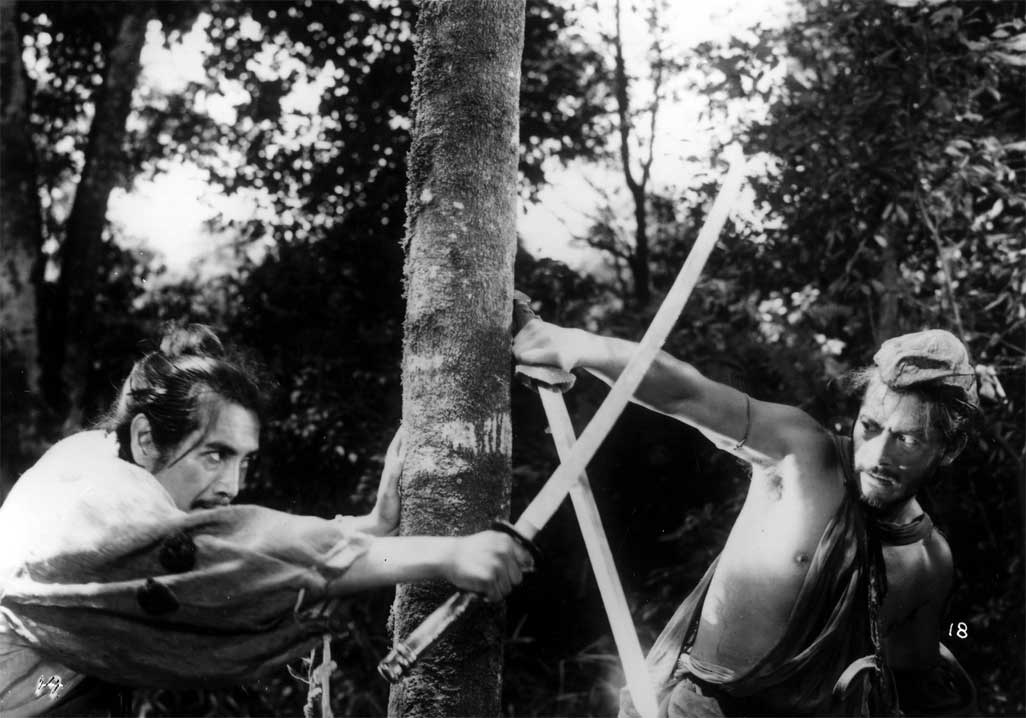
What follows are four stories of the fateful encounter from four different perspectives. All have the same outcome, yet none are the same. The bandit (Toshiro Mifune of Seven Samurai and other Kurosawa projects) boasts about his daring, recounting an admittedly impressive swordfight against the samurai (Masayuki Mori) after having his way with the woman (Machiko Kyō). The woman ignores any mention of a fight and casts herself as a victim of both men. The samurai may be dead, but a possessed medium explains his viewpoint with rather disturbing behavior, casting more blame on the woman than on the bandit. And then there’s the truth. Or is it? While the final tale seems to be the most plausible in spreading the guilt around, there’s still the smack of hypocrisy, and one can’t help but wonder what all four may be leaving out to suit their own point of view. Ambiguity and doubt are prevalent, yet Kurosawa doesn’t try to discount morality in general through his questioning of what really happened. The world may be full of liars, but human kindness can still have its say.
In addition to its morally debatable themes, Rashomon is also noted for its cinematography and tight editing. As commendable as these are, the film does embrace certain excesses in the way it is told. The opening scene, for example, in which the woodcutter wanders through the dense forest foliage before coming upon the crime scene, is meant to build tension and recall the silent film era, but it unfortunately drags, just one scene that stretches the audience’s patience to the edge of boredom. While much of the acting is subtle and faultless, other moments are acutely overacted, such as the crazy outbursts of two of the players and the woman’s incessant sobbing. These criticisms can doubtless be attributed to the acting conventions of the time, since this film is far from the only aged offender in that regard.
Yet despite the shortcomings of individual scenes, Rashomon is still the classic so many critics have hailed, well deserving of its honorary Academy Award five years before the Oscar for Best Foreign Language Film was established. Influential in its uncertainty and thought-provoking in its divergent narrative, Rashomon helped to solidify Kurosawa as an esteemed director the world over.
Best line: (the surly peasant, defending yet impugning everyone from liars to storytellers) “I don’t mind a lie if it’s interesting.”
While Iron Man, Thor, and the heroes we know
Are saving the planet from many a foe,
Way out in the cosmos, a misfit or five
Are trying to stay on their toes and survive.
One’s seeking revenge, two are out for the loot,
One’s plotting betrayal, and the last’s in pursuit
Of a powerful stone that is death’s guarantee
If it falls in the hands of a villainous Kree.
Five mavericks not fitting the hero-type mold,
Five pasts black as sin and five hearts made of gold,
May find that a battle alongside a friend
Can give them a reason to bond and defend.
_______________
MPAA Rating: PG-13
Everyone seems to love Guardians of the Galaxy. Coworkers, friends, critics, and random bloggers were singing its praises last year, and I was eager to see it in the theater. Unfortunately, I knocked a sideview mirror off my dad’s car, and the movie money went elsewhere. So when I finally got to see it on DVD, I was ready to be impressed, and though I wanted it to be the best Marvel movie yet, well, it wasn’t.
Don’t get me wrong. It’s an enjoyable space ride of an origin story, yet perhaps my expectations were a bit too high. I had hoped for constant laughs, but the script seemed to be trying too hard at times (the fake laugh, for example). I can’t help but wonder if my appreciation might have been heightened by seeing it in the theater, where I could have shared in that unique experience of an entire audience laughing out loud (like how my mom has described her 8-½ screenings of Star Wars back in 1977). The story was also so crammed full of unfamiliar information with Xandarians and Ravagers and varied motivations that I couldn’t completely keep up, and my VC was totally lost at times. I know we’re supposed to just roll with it and enjoy it and let future viewings show how layered and intricate it is, but being confused can detract from a film’s enjoyment.
Okay, complaints aside, I’m glad to say that I saw it again, and my opinion has improved. I still don’t believe it’s Marvel’s best film, but it is up there. For some reason, the humor was much more appealing this time, and I was able to follow the plot more fully, and I can admit that Guardians of the Galaxy is a small miracle. Iron Man was never as popular as Batman or Superman, but at least people had heard of him. When Marvel gambled on an entire film dedicated to a rebooted superhero team from as recent as 2008, most non-comic experts went “Who?,” a joke the film itself toys with right from the start. Without widespread knowledge of these characters, the filmmakers were able to flesh them out in their own way, with lots of quick-mouthed humor along the way.
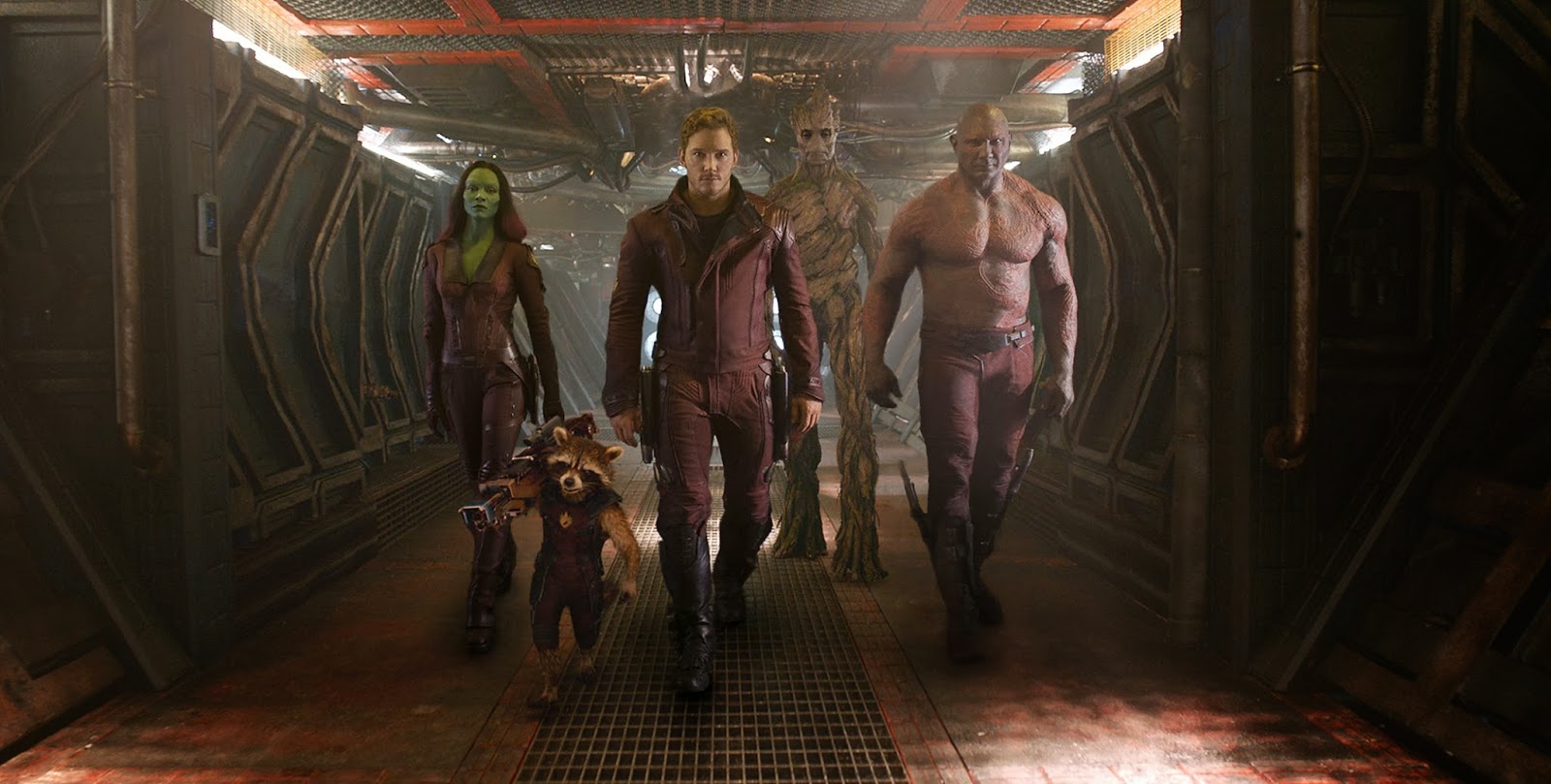
The film is full of strengths, from the nostalgic, retro-cool soundtrack of 1970s tunes to spot-on performances from the main cast: heroic rogue Peter Quill (Chris Pratt), assassin with a heart Gamora (Zoe Saldana, continuing her apparent attempt to star in every major franchise), literal-minded avenger Drax the Destroyer (wrestler Dave Bautista), experimental raccoon Rocket (Bradley Cooper), and lovable living tree Groot (Vin Diesel, who could probably have been replaced by anyone who could say three words in a deep voice). The special effects are phenomenal, particularly the final battle and the CGI creation of Rocket and Groot, who are both surprisingly endearing. As I said, there is a lot, and I mean A LOT going on, but my second viewing allowed me to recognize the impressive balance between nonstop action, spitfire wit, and sweet character moments, like Groot’s flower gift or Drax’s comforting of Rocket. (Who didn’t want to pet him after all?) I also noticed a potential recurring gag when Quill states he has 12% of a plan; remember the beginning of The Avengers, when Tony offers 12% of the credit for Stark Tower to Pepper? Hmm.
It’s true that it’s not perfect. The villains Ronan and Nebula (Lee Pace and Karen Gillan) are generic baddies, people can somehow survive exposure to space, the bigger names like Benicio del Toro as the Collector (also Glenn Close and John C. Reilly) are vastly underused, and it might have been more kid-friendly considering it’s gotten its own animated spin-off series. Yet these gripes matter little amidst the fun of escaping a weightless prison or dive-bombing an attacking spaceship. Guardians of the Galaxy throws a lot at the screen, and most of it sticks to provide a fun space adventure that’s part Star Wars, part Marvel, but mostly its own unique adventure.
Best line: (Gamora) “I’m a warrior, an assassin. I don’t dance.” (Peter) “Really? Well, on my planet, we have a legend about people like you. It’s called Footloose. And in it, a great hero named Kevin Bacon teaches an entire city full of people with sticks up their butts that dancing, well, is the greatest thing there is.” (Gamora) “Who put the sticks up their butts? That is cruel.”
Darkness in the light of day,
Silence in the loudest noise.
Close and also faraway,
Vacant at the gladdest joys,
Only feeling with the hand,
Needing, taking in the dark,
Slow to know or understand
And lacking means to try till hark!
A firmer hand arrives to guide,
A stronger arm, both cruel and kind,
To teach the words she’d been denied
And show them all love isn’t blind.
_________________
MPAA rating: the equivalent of G
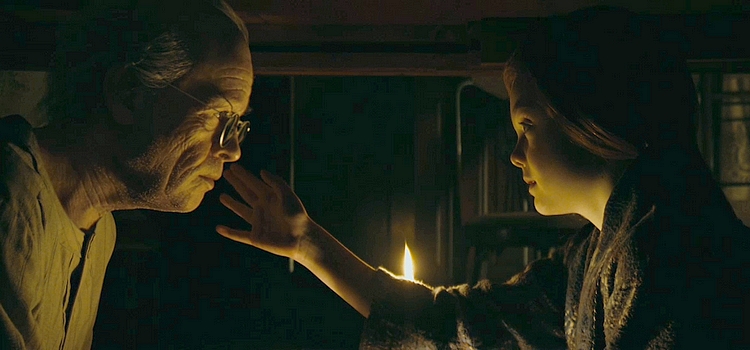
True life stories are often the most inspiring, and one of the most incredible is the life of Helen Keller. Born healthy but struck deaf and blind by a childhood infection, she grew up in total darkness, knowing the world solely through touch. She had no concept of light or love or even that objects had names, and yet she grew to be an accomplished author and lecturer (and apparently introduced the Akita dog to the U.S. Who knew?). As I read her autobiography The Story of My Life, her diction and facility of language make it hard to believe that she once had no understanding of it whatsoever. Her story is and has been a true inspiration for the handicapped, and The Miracle Worker brilliantly presents her difficult early years.
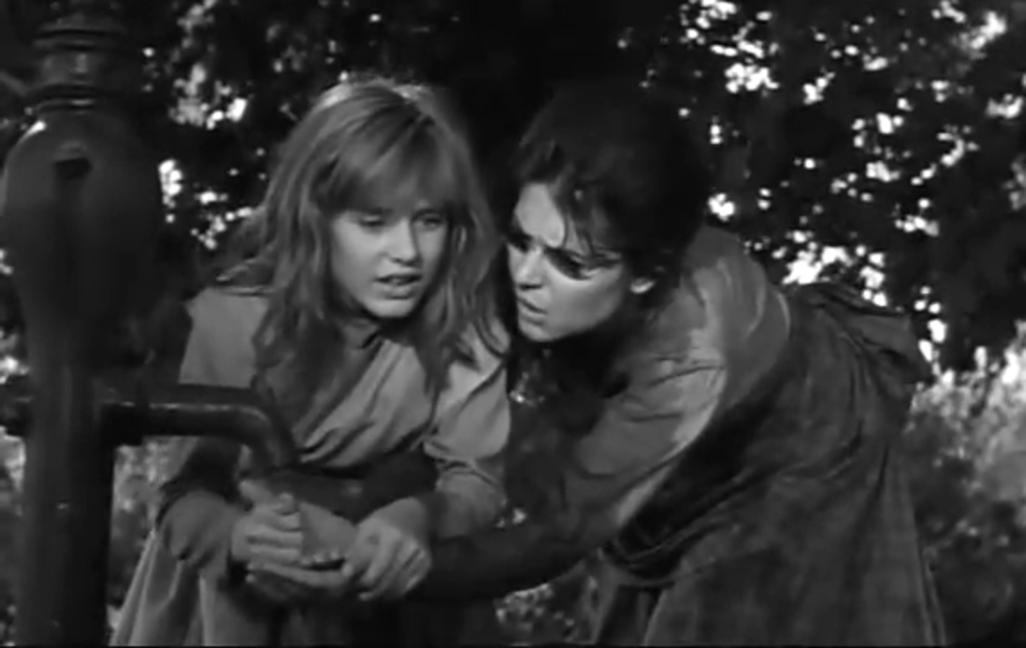
Both Patty Duke and Anne Bancroft won Oscars for their surprisingly physical roles, Duke as the young Keller and Bancroft as her tenacious teacher Anne Sullivan. The film very much reflects Keller’s memoirs, focusing solely on her tumultuous childhood and initial relationship with Sullivan. Duke acts convincingly detached as she gropes her way along, oblivious to the significance of what she touches yet petulant and violent when annoyed. She grabs food from others’ plates and locks people in rooms, while her parents cite her handicaps as a good reason to tolerate her behavior. Enter Ms. Sullivan. Her history with blindness gives her a special sympathy, yet her Irish temperament puts her at odds with Helen’s surliness and her parents’ enabling. Bancroft in particular deserved her Oscar; she exhibits the patience of Job as she reins Helen in, wrestles with her just to get her to hold a spoon, and deals with the uncertainty of teaching a seemingly unteachable pupil.
Boasting a 100% on Rotten Tomatoes, The Miracle Worker depicts quite the extraordinary relationship between a student who doesn’t know how to be taught and a teacher who sees potential no one else can. After an initially overacted introduction, everyone slips into perfectly natural roles from Helen’s antagonistic father (Victor Jory) to her concerned mother (Inga Swenson), all dwarfed by the two lead performances. When that “ah-ha” moment finally arrives with the hard-won breakthrough, the celebration feels genuine and earned and meant as only the beginning of Helen’s progress. It’s interesting to note that while Patty Duke won an Oscar playing Keller, she later won an Emmy playing Ms. Sullivan, opposite Little House on the Prairie’s Melissa Gilbert. Whenever an uninformed viewer wonders who that woman on the Alabama state quarter was, The Miracle Worker will give them a new appreciation for Helen Keller and the educator who opened the world to her.
Best line: (Anne) “It’s less trouble to feel sorry for her than it is to teach her anything better.”
I love good television, whether it be a comedy, a drama, science fiction, or even a cartoon, and any movie lover is bound to have numerous favorite shows. That being said, I will mention up front that I have not seen nearly as many as the pop culture experts, mainly because of how time-consuming catching up on a show can be. I’ve never seen Buffy or Breaking Bad or Bonanza, and my aversion to violence has prevented me from checking out acclaimed but notorious shows like Game of Thrones or The Walking Dead. Still, when I find a show I like, I enjoy watching and rewatching it and tend to know it inside and out. I can thank my parents for introducing me to many of the older shows on this list, while others I stumbled upon as a pleasant surprise. I may not be the most well-versed TV viewer, but I can say for a fact that all of these are great television.
TIE: Little House on the Prairie (1974-1983)/ The Waltons (1972-1981)
I’m probably one of the only guys my age who can see the merit in these two old-fashioned shows. I grew up with reruns of both of them on Hallmark Channel, and even as more modern and edgy shows have replaced them, I still carry a special fondness for rural family dramas.
Little House on the Prairie is based off of the book series by Laura Ingalls Wilder and similarly paints a lovable picture of frontier life from the viewpoint of young Laura (Melissa Gilbert). Michael Landon as her wise Pa is one of the quintessential TV fathers, and while the show grew stale in its later seasons, most of its run was deeply endearing, whether it be Laura’s quarrels with mean Nellie Oleson or the sad season where sister Mary went blind.
The Waltons is also based on the youth and work of an author, producer Earl Hamner, Jr., replaced by John-Boy Walton (Richard Thomas). Growing up in Depression-era Virginia with his parents, grandparents, and six siblings, John-Boy faces moral questions and personal challenges as he becomes a writer, goes to college, and also depends on the wisdom of his father (Ralph Waite). Again, later seasons degraded in quality, but The Waltons built an enduring family and community that faced financial difficulty and still came out happy. Both of these shows may seem boring and saccharine by today’s standards, but they serve as reminders to me of the simple comfort of the simple past. The first notes of both opening themes make me feel like I’m going home to visit old family and friends.
TIE: Phineas and Ferb (2007-2015) / Gravity Falls (2012-present)
Recent shows like these have confirmed that cartoons can be enjoyed by adults just as much as by kids. Both of these are Disney Channel shows (probably the best in its history), which take place over one very eventful summer. Both have attracted adult fan bases and many talented voice actors.
Phineas and Ferb is very formulaic. Stepbrothers Phineas (Vincent Martella) and Ferb (Thomas Sangster) and their friends go to crazily fun lengths to make the most of the summer, while their sister Candace (Ashley Tisdale) tries to “bust” them to their mother, while their pet platypus escapes to fight an evil scientist. First, it’s odd; then it’s utterly familiar. Yet the showrunners find every opportunity to alter expectations and make it fresh with consistent humor and surprisingly impressive songs in every single episode. You know what to expect, but you never know what will change. The show sadly ended just this year, but even in the final episode, they were toying with the space-time continuum and making one of the funniest spoon jokes ever. Am I a fan of this show? Yes, yes, I am. Here’s one of the best musical numbers:
Gravity Falls was another surprise, as it’s quickly surpassed my expectations with its addictive mystery. Twins Dipper (Jason Ritter) and Mabel (Kristen Schaal) are sent to Gravity Falls, Oregon, to stay for the summer with their con artist Great Uncle Stan (show creator Alex Hirsch). Small, silly mysteries give way to huge ones, with cleverly hidden clues and hints sprinkled throughout each episode via background details and encoded backwards messages. (That whispering at the end of the theme song below is a backwards message for how to decode another message during the end credits.) Gravity Falls has some of that modern cartoon weirdness (anyone who’s seen Cartoon Network’s current lineup knows what I mean), but it works, with spoofs of movies like The Thing, The Exorcist, or those horror anthologies. Think, childish antics one minute and possessed mounted heads bleeding from the mouth the next. Yeah, on a supposed kid’s show (not so much). The early episodes don’t fully prepare you for how epic Gravity Falls becomes. It’s also hilariously written, and recent cliffhanger episodes have left me craving more.
St. Elsewhere (1982-1988)
Predating the more recent hospital dramas like ER or Grey’s Anatomy, St. Elsewhere was one of the best dramas of the 1980s. Doctors and nurses at Boston’s unprestigious teaching hospital St. Eligius dealt with all kinds of current issues, from bombers and rapists and missing children to cancer and organ transplants. It also featured an amazingly talented ensemble cast, including many actors in before-they-were-famous roles, such as Denzel Washington, Howie Mandel, Ed Begley, Jr., David Morse, Alfre Woodard, Bruce Greenwood, and Helen Hunt, not to mention two-time Emmy winner and five-time nominee William Daniels as irascible Dr. Mark Craig. Full of memorable, often heartbreaking episodes, this show is one not to be forgotten.
Gilligan’s Island (1964-1967)
From an acclaimed drama to a silly favorite, I could not not put Gilligan’s Island on this list. Again, I grew up watching reruns, and the slapstick interactions of those seven people trapped on an island (without polar bears, hatches, or smoke monsters) never cease to be entertaining. Anyone who’s anyone has to know the easily singable theme song. From the odd couple antics of Gilligan and the Skipper to the pompous vanity of the Howells to the ridiculously inventive contraptions made by the Professor, Gilligan’s Island has a timeless quality, and I expect to be laughing at it with my grandchildren many years hence.
Sherlock (2010-present)
I hesitated to include Sherlock since it is essentially a series of TV movies, but it qualifies well enough. Benedict Cumberbatch and Martin Freeman are terrifically watchable actors on their own, but putting them together in a modern-day take on the famous detective was downright genius. The writing, humor, and editing are phenomenal, but it all comes down to their chemistry and delivery. Cumberbatch nails the self-assured, single-minded intensity of everyone’s favorite high-functioning sociopath, while Freeman’s down-to-earth Watson offers the perfect contrast with his quick wit and muted reactions. The show continues to deliver constant inventiveness and intrigue. Like Sherlock himself, it’s clever, and it knows it’s clever, and it relishes being clever in all the best ways. Can’t wait for the Christmas special!
TIE: Firefly (2002) / Cowboy Bebop (1998)
I’m not the first to compare these two shows, and I just couldn’t resist combining them here due to their many similarities. Both are about thirteen hours long and feature believable, occasionally violent, space-faring settings with a mixed Western vibe; the crew of a rundown spaceship seeking their next job; an awesome lead character who can shoot hostage takers in the head; a young girl genius who acts weird and adds little to individual episodes; and a spinoff movie to satisfy fans’ demands for more.
In truth, Firefly is the better of the two shows. Joss Whedon’s retroactively popular science fiction deserved a much longer lifespan than just half a season. With impressive special effects for the time and Whedon’s shrewd dialogue, which can only be described as “shiny,” Captain Mal Reynolds and the crew of the Serenity turned Firefly into more than just another canceled show. They became a ragtag family aboard that ship, while the combination of futuristic technology and old-fashioned shootouts clinched Firefly as something truly unique.
As unique as it is, though, there were forerunners. I’ve heard that another anime show called Outlaw Star had a frozen girl in a box a few years before Whedon did. Cowboy Bebop may not have directly influenced it, but it’s still an excellent show with fantastic music. Hailed as one of the best anime shows ever, Cowboy Bebop follows the small crew of the Bebop, bounty hunters (not the Jubal Early kind) who catch bad guys while coming to terms with their pasts. Spike Spiegel is as cool as they come, and his kick-butt adventures with ship owner Jet Black, amnesiac femme fatale Faye Valentine, and a girl named Edward typically start slow and build to an action-packed finale. Whereas Firefly has a more explicitly Western tone, Cowboy Bebop incorporates more crime drama, jazz, and film noir, with subtle characterization and artsy editing. Each episode is distinct (one episode is like space-age Midnight Run, while another is a serio-comic version of Alien), but major plot threads tie together (for the most part) for an exceptionally sad conclusion. The worst thing I can say about the show is that each 30-minute episode is so full of plot that it easily could have warranted an hour runtime to avoid feeling rushed. Still, Cowboy Bebop is concise storytelling at its best.
Quantum Leap (1989-1993)
Time travel is a concept full of possibility, and Quantum Leap was the first show to do it justice. Amnesiac Sam Beckett (Scott Bakula) “leaps” into other people’s bodies throughout modern history, solving problems and righting wrongs with the indirect aid of his friend Al (Dean Stockwell), who appears to him as a hologram. Sam gets to know the family or acquaintances of his host body and resolve the minor setbacks of history, and though he typically only bumps into famous people, sometimes he leaps right into them, whether for awkward humor (Dr. Ruth) or drama (Lee Harvey Oswald). Right when you think the writers have run out of ideas, they come up with some brilliant or silly variation of the main concept, and the result was always entertaining. Oh, boy.
M*A*S*H (1972-1983)
TV dramedy doesn’t get any better than M*A*S*H, a show that garnered eleven seasons, eight Golden Globes, fourteen Emmys, and more than one hundred Emmy nominations. Through the motley bunch of surgeons and soldiers at the 4077th Mobile Army Surgical Hospital, viewers got an eleven-year look at the three-year Korean War, which perhaps seemed just as long to those who fought in it. M*A*S*H was at the forefront of innovative television, whether it be an episode filmed in real time or one from the first-person view of a patient. For such a long-running show, it surprisingly got better with time. The first couple of seasons were more generally comedic, while later seasons cranked up the drama, even killing a main character offscreen. From Alan Alda’s likable joker Hawkeye to Harry Morgan’s stoic but soft-hearted Colonel Potter, viewers truly got to know and love these characters, making the historic finale a genuine tearjerker.
Avatar: The Last Airbender (2005-2008) / The Legend of Korra (2012-2014)
Predating James Cameron’s similarly named blockbuster, Avatar: The Last Airbender was quite a surprise. Nickelodeon up to that point was known for pure silliness like SpongeBob or The Fairly OddParents, yet Avatar mingled its comedy with a startlingly awesome world with elemental superpowers called bending and an ongoing storyline that became more serious with each season. The last surviving airbender is discovered as the lost peace-bringing Avatar, and with Katara and Sokka of the Water Tribe, he sets out to master Water, Earth, and Fire and defeat the evil, warmongering Fire Lord. I’ve heard Avatar compared with Star Wars, another franchise with a young protagonist learning to master mystical powers to topple a dark tyrant. The characters are lovable and surprisingly deep, while the action and elemental showdowns are all levels of cool. Despite some mysticism, I consider Avatar the best animated show ever. (I’m also including The Legend of Korra here since it continues the story and world of Avatar seventy years later. It’s not quite as good, but it has a similar blend of fantasy and excitement while tackling more mature themes.)
Star Trek: The Next Generation (1987-1994)
Star Trek is a staple in my house. From television to movies, it has been a consistent source of thought-provoking science fiction for nearly fifty years now. While I still very much enjoy the original Star Trek with Kirk and Spock and McCoy, it’s a bit dated, and The Next Generation helped to reinvigorate the Trek universe for yes, the next generation of fans. Next Gen started slow and had its cheesy moments too, but it’s a prime example of a show’s actors and writers finding their groove over time. As much as I like Kirk and Spock, I learned to love Captain Picard (Patrick Stewart), Data (Brent Spiner), Dr. Crusher (Gates McFadden), Geordi Laforge (LeVar Burton), and the rest of the new Enterprise crew even more. Now that another Star Trek show is in the works, I can only hope it will have a similar effect on another “next generation” of fans.
Star Trek: Voyager (1995-2001)
I may be in the minority (and I haven’t fully explored Deep Space Nine and Enterprise), but I am convinced that Voyager is the best Star Trek series of them all, breaking ground with its strong female captain and exploring questions of identity, truth, and principles. It follows something of the same exploration theme as the three Enterprise shows but hurls the titular ship to the Delta Quadrant, allowing the entire show to be a sci-fi Odyssey, a mission to get home. Again, the actors take time adjusting to their roles, but once they do, they become almost like family. From the contrast between logical Tuvok (Tim Russ) and gregarious Neelix (Ethan Phillips) to the warm rapport between Captain Janeway (Kate Mulgrew) and Chakotay (Robert Beltran) to the endearing ego of the holographic Doctor (Robert Picardo), the characters grow on their journey, amid all manner of alien attacks and ethical quandaries. Science fiction provides an opportunity to ask moral questions that aren’t as feasible in real-life scenarios, and Voyager (and Star Trek in general) excels at just that. This is probably the show I’ve seen the most frequently since I never get tired of it.
Lost (2004-2010)
J.J. Abrams, you’re my hero. This ranking should come as no surprise to anyone who’s read more than a few of my posts. I’m grateful for the words “in my opinion,” because with them I can gush to my heart’s content. In my opinion, Lost is the greatest show ever made. IMO, no other show can compare with the level of character development reached through all the flashbacks and flash-forwards. IMO, Lost is an addictive drug of a show right from the explosive opening, with ongoing mysteries and intense emergencies and character deaths both unexpected and heart-rending. I know J.J. Abrams and the writers did not preplan Lost in its entirety, but that only makes the end product an even more incredible feat of storytelling. Characters pop up in others’ flashbacks, details nearly forgotten reassert their importance, and no other show has made me and my family cry because we became so attached to this diverse ensemble of beloved characters. Even if many did not like or understand the final season, it wrapped everything up well enough to leave the perfect bittersweet glow that the end of a great show should. Now I have to go rewatch it. J
Runners-Up
Arrow (2012-present) – Further proof that Marvel rules the box office, but DC excels with TV.
The Bugs Bunny Show (1960-2000) – My VC insisted I included her favorite cartoon, even if it was a collection of shorts rather than a typical TV show.
The Cosby Show (1984-1992) – Despite all the Bill Cosby scandals, I still enjoy the original show that made him a household name.
Everybody Loves Raymond (1996-2005) – Ray Romano’s dysfunctional family still puts a smile on my face.
Full House (1987-1995) – It seems overly sweet now, but it was one of my favorite sitcoms growing up.
Good Eats (1999-2012) – Alton Brown’s quirky cooking show with many movie references. I’ll never make coq au vin, but it’s fun watching him do it.
Hey, Arnold! (1996-2004) – A likable and down-to-earth cartoon with admirable morals.
Jeopardy! (1964-present) – Everyone’s favorite game show is mine too. I’m still insisting I’ll be a contestant one of these days.
Marvel’s Agents of S.H.I.E.L.D. (2013-present) – Proof that Marvel can excel at TV too, especially with Joss Whedon’s involvement.
The Mary Tyler Moore Show (1970-1977) – There’s something about Mary and her TV station coworkers that still wins hearts all these years later.
Star Trek: The Original Series (1966-1969) – Dated yet classic, this is the Trek show that started it all.
Star Wars: Clone Wars (2003) – Not to be confused with the less appealing CGI show, this short-form series added just the right action and background information in between Episodes II and III.
Taxi (1978-1983) – A classic comedy with Judd Hirsch and Danny DeVito.
Teen Titans (2003-2006) – A fun anime-influenced superhero show that could get surprisingly dark.
The Twilight Zone (1959-1964) – Rod Serling’s classic anthology series ranged from chilling horror to memorable what-if science fiction.
One hundred feet can be a wall if those on either side of it
Insist the other is a foe too slow or stubborn to submit.
One hundred feet can be a window hewn by wisdom through the wall,
To let the foes perhaps perceive a new perspective to it all.
One hundred feet can be a door where friends once foes come face to face,
Where worlds combine to mix and dine, and fresh potential finds a place.
One hundred feet can be a line between suspicion and respect;
One hundred feet can separate or help two cultures to connect.
_________________
Rating: PG
There aren’t too many food-centric movies that get special advertising on the Food Network (Julie and Juliawas the last I can recall), but The Hundred-Foot Journey warranted it. Produced by Steven Spielberg and Oprah Winfrey, this story of Indian restaurateurs immigrating to the world of French cuisine hits all the right flavor notes of a cinematic feast, more low-key than some blockbuster or awards contender but no less satisfying.
Not unlike Life of Pi, the film starts in India, where a food-loving family is forced to flee from civil unrest, and instead of cruising to Canada, they voyage to the lovely French highlands. Led by the unflappable Papa Kadam (Om Puri), they renovate and open their own Indian restaurant, just one hundred feet from an esteemed haute cuisine establishment with a coveted Michelin star. The transplants are immediately seen as a threat by the French restaurant’s owner Madame Mallory (Golden Globe nominee Helen Mirren), and a series of sneaky skirmishes between her and Kadam make them seemingly permanent enemies. Yet when racism rears its ugly head and Kadam’s cook son Hassan (Manish Dayal) displays his culinary talent, both Kadam and Mallory reconsider their biases for the sake of this budding star, food, and friendship.
Hassan’s development in French cuisine brought to mind Remy’s parallel journey in Pixar’s Ratatouille, another story of a culinary superstar “from the gutter,” as it were, who achieves success despite the antagonism between French cooking and his hesitant family. Like Ratatouille, the food is gorgeously rendered and treated as a silent character, whether it be the Indian dishes with curry and garam masala, the petite and elegant portions of Mallory’s Le Saule Pleureur, or the chic molecular gastronomy of Paris. All of the actors evoke a passion for food, and Puri, Dayal, and especially Mirren provide enjoyable performances that grow more endearing with time.
My VC and I both agreed that The Hundred-Foot Journey was among the best films we’ve seen lately, leading to my frustration that it didn’t receive more exposure. It thankfully earned money and reasonably favorable reviews, yet I believe it deserves far more attention. Lasse Hallström’s direction, paired with cleverly subtle special effects and succulent cinematography, made for a delightful culture-spanning watch, though it was wholly snubbed by the awards (except for Mirren’s Globe nomination). The worst thing critics could complain about was that it was predictable, but sometimes the familiar can be just as surprisingly fresh and gratifying as the food with which you grew up. So what if the awards judges can’t seem to recognize a clean, feel-good family drama? It won some stars in my book.
Best line: (Hassan, reminiscing) “Food is memories.”
Rock and roll was on a roll,
Exciting body, heart, and soul.
They played it loud to please the crowd,
Sublimely out of all control.
These kings of cool were glad to rule,
And much too groovy to be cruel.
Their fame would rise amid the highs
And make it wise to play the fool.
Each touring band that spanned the land
Had rabid fans at their command.
The highs and lies were some disguise
From what they did not understand:
The value of what’s close at hand.
_________________
MPAA rating: R (for much language and brief nudity)
This review is a last-minute addition to Rocktober, hosted by Carly Hearts Movies, celebrating the best (or worst) in rock-and-roll cinema. Being a big fan of Cameron Crowe’s Elizabethtown, I thought it was about time to explore one of his earlier films, and Rocktober helped decide which one it would be.
Rock and roll is a hard thing to quantify. Some love any reason to bang their heads and party; some are excessively picky about how they discern good music from populist trash; and some turn their noses up at its very nature of sex and drugs. Almost Famous captures all three viewpoints and so much else that makes rock both diverting and dangerous, all through the eyes of a fifteen-year-old fan based on Crowe himself.
Young William Miller (Patrick Fugit) loves rock music to the dread of his high-strung mother, whose overprotective opinions already drove away his rebellious older sister. Though teased for being the youngest in his grade, he listens and writes and eventually gets noticed, first by Creem Magazine (thanks to music critic Lester Bangs, played by Philip Seymour Hoffman), then by Rolling Stone, and William is whisked into the radical world of the backstage rock scene. His ticket in is the up-and-coming quartet Stillwater, led by Russell Hammond (Billy Crudup) and Jeff Bebe (Jason Lee), whom he accompanies on a cross-country tour.
Though William knows and admires the music, he is still an outsider and a journalist, “the enemy” as the band nicknames him, and he is able to objectively watch the world of rock music unfold before him, much like an uninitiated viewer. In addition to his trusty notepad, he is always “taking notes with his eyes,” as Russell says, observing the inner squabbling among the bandmates, the wild lives they lead while on tour, the frequent drug-induced stupidity, and the inner workings of these “swill merchants,” who talk frankly about the chicks and then wax philosophical about the brain vs. instinct.
Yet for all the talk of the music and the fans being everything, he also experiences firsthand the dark, false side of this world, in which not even William can remain clean. Everyone seems to be pretending they’re something better than they are. Stillwater grows to enjoy William’s tagging along, but they trust that he’ll clean up their messy shenanigans when it comes time to actually write the article about them. An entourage of dedicated fangirls called the Band Aids accompany the band everywhere they go, and despite their focus on sex and drugs rather than the music, they insist they’re not just ordinary groupies. One in particular known as Penny Lane (Oscar nominee Kate Hudson) puts much effort into her enigmatic persona, sure to be the life of the party. While William sees through most of these facades, even he pretends in order to be taken seriously by Rolling Stone. As much as everyone wants to be loved, too often people are used for the sake of “lifestyle maintenance.”
All this may make Almost Famous sound overly heavy, and while its dramatic moments are perceptive, there is just as much appealing comedy, from the eccentricities of William’s backstage acquaintances to the seriocomic emergency that prompts some unexpected honesty. I especially got a kick out of William’s mother (Frances McDormand), whose increasingly worried phone calls to check up on him are priceless.
Cameron Crowe obviously knows the ins and outs of the rock scene, and despite its dark side, he found the right balance of honesty and feel-good drama, along with a classic rock soundtrack that includes five original songs by Crowe, then-wife Nancy Wilson, and Peter Frampton. With his insightful, Oscar-winning screenplay, Crowe brings to life a world of “drunken buffoons” and making something “poetic” out of it. I still prefer Elizabethtown, but Almost Famous is an entertaining inside look at “the industry of cool.”
Best line: (Russell and a hotel clerk, to William) “Your mom kind of freaked me out.”