Some have their goals and their futures all mapped, People who know where their aptitudes lie, but Endless potential is often untapped, Loath to step out and wholeheartedly try, but Longing one day to catch somebody’s eye.
You may have dreams that remain in your head Only to wither away over time. Useless are hopes overlooked and unsaid, and Rare is the victor unwilling to climb.
Hear not the people who doubt every rung, Echoing doubts they themselves have received. Attend to the words of the more fruitful tongue, Ready and willing, no thoughts preconceived, To trust and to see what great deeds are achieved.
Open your notions of what you can do; Utter a cheer for still others like you, and Try, for indeed that is how dreams come true.
____________________
MPAA rating: PG
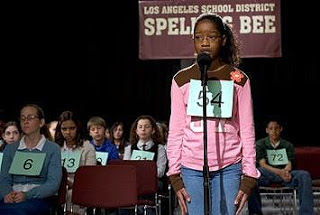
I’ve often enjoyed watching the Scripps National Spelling Bee, a contest that mainly serves as an outlet for everyone to marvel at how kids can do what so many adults can’t. While it’s heartbreaking to watch the loser’s hopes dashed with the ding of a bell after words like ptyalagogue and apparatchik, the winning moment is a well-deserved shot of feel-good triumph, for the winner and those watching. Such is the appeal of Akeelah and the Bee, a story of hard work rewarded.
Keke Palmer is excellent as Akeelah Anderson, a young black girl who tries to merely blend in at her inner-city school. What makes her different, though, is her uncommon interest in spelling, which is little more than a hobby, but when she is urged to take part in the school’s spelling bee, it becomes more than that. Suddenly, her principal (Curtis Armstrong) has high hopes for her and encourages her to train with Dr. Larabee (Laurence Fishburne), who himself participated in the National Spelling Bee as a child. Though her own confidence is fragile, she commits to the effort of studying and preparing for the National Bee.
Akeelah and the Bee could easily have been a ho-hum inspirational tale, but its nuance and heart win the day. Akeelah is almost trapped by a system that expects the least of her, while others see her potential. Fishburne is especially admirable as her spelling coach, acting not unlike Sydney Poitier in To Sir, with Love, patient with his pupil’s progress but adamant that she not become complacent or “talk ghetto” when their focus is the English language. He enshrines a quote by Marianne Williamson as his cogent argument against self-doubt, and even as he feels himself getting more invested in Akeelah than he had planned, he provides an example for her and an implicit call for her to be a role model for others.
The Scripps National Spelling Bee itself is recreated perfectly, right down to the same moderator whose recognizably uninflected voice reads out those difficult terms that no one would really use in a sentence. The pressure on the contestants is also very real and not just for Akeelah. Her rival Dylan Chiu (Sean Michael Afable) is constantly pressured by his father to win, and some scenes made me question the merit of putting kids under so much strain for the sake of an unlikely win. Yet Akeelah also makes friends through her newfound ambition, and even wins the encouragement of her mother (Angela Bassett) and her entire community. One seemingly shady punk named Derrick briefly reveals a softer side that seems to have been quashed by his environment, and his backing of Akeelah’s goals is like a chance to lend the support he never gave his own.
Akeelah and the Bee occasionally drifts into predictable territory, but by the end, the plot and characters take the unexpected high road to a happy ending well-earned. It’s hard to find fault when a film’s message of self-confidence and accomplishment is so earnestly and realistically presented (for the most part), and Akeelah and the Bee is a perfect example of an inspirational story done right.
Best line: (Derrick) “Kick his butt, Akeelah! B-U-T-T, butt!”
Just another normal day,
Just keeping normal cares at bay,
But then to everyone’s dismay,
The ground begins to shake.
The rocks and hills begin to play,
The soundest structures start to sway,
Entire buildings fall away
Amid the sudden quake.
If you make it through the scare,
You wonder how your loved ones fare.
Do they live and how and where?
You worry more for them.
The worst disasters we must bear
At best encourage us to dare
To save the ones for whom we care,
Whom danger might condemn.
__________________
MPAA rating for Earthquake: PG
MPAA rating for San Andreas: PG-13
There’s something strangely entertaining about a disaster. Whether it be the dated survival tales of the 1970s or the modern effects-heavy world-wreckers, it seems clear that it’s not just the Joker who likes to watch the world burn. Of course, this doesn’t apply to real-life disasters. Films like The Impossible and World Trade Center are serious and painful reminders of tragedies, but others like San Andreas are enjoyed as popcorn fun simply because they’re not real. This seems like a puzzling dichotomy, but it’s no less true.
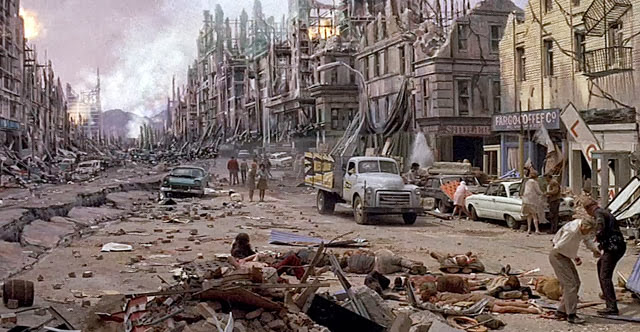
I thought I’d do a comparison of two similar films from different eras that exploit people’s fondness for destruction: 1974’s Earthquake and last year’s San Andreas. Both revolve around earthquakes blind-siding California and people’s struggles to survive. Both include experts who saw the quake coming but didn’t act fast enough, crumbling cityscapes, characters getting trapped in a parking garage, and a dam’s destruction and subsequent deluge (one at the beginning, one at the climax). While a few of the shaking scenes are even similar (both show a glimpse of a cook suffering at the hands of his stove), the two films are on entirely different levels. Earthquake was groundbreaking at the time and even won an uncontested Oscar for Best Visual Effects, but it seems quaint next to the comprehensive devastation of San Andreas, which is ironic since the quake in Earthquake is a 9.9 on the Richter scale while those in San Andreas only reach 9.6. (Yeah, only.)
I was curious to see Earthquake because of its tie-in to an episode of Quantum Leap, in which Sam leaps into a stuntman who features in a famous scene from this movie, complete with a clip showing Lorne Greene. It’s clear now as it surely was then that Earthquake is a gimmick film. Released at the height of the ‘70s disaster craze and the same year as The Towering Inferno, it seemed to be the result of producers saying to themselves, “Let’s see, we know of movies with a plane disaster, a ship disaster, a hurricane disaster, a fire disaster…What’s left? I know! An earthquake!” Plus, the film was accompanied by a new speaker system called Sensurround, which was meant to heighten the feeling of experiencing an earthquake and which was shorter-lived than the early 3-D craze. With so much effort put into accentuating the quake itself, everything else about the movie seems secondary, even though the actual shaking is relatively short.
Like other disaster films of the era, Earthquake is jam-packed with stars: Charlton Heston as a businessman unhappy with his marriage, Ava Gardner as his sullen wife, Genevieve Bujold as his lover, Lorne Greene as his boss, George Kennedy as a policeman, Richard Roundtree as a stuntman, Walter Matthau (under a pseudonym) as a drunk, and Marjoe Gortner as a psychopathic National Guardsman who uses the disaster for his own empowerment. And that’s not even half of the ensemble. It’s clear what the filmmakers were trying to do, focusing on a large swath of the population dealing with a huge disaster in different ways, yet only five or so characters really matter and even the film seems to forget about many secondaries by the end. Certain scenes are impressive for their time, and several are tense as characters try to escape the aftermath of the quake. I just wish that the cast and the narrative overall had been streamlined, perhaps with a less downbeat ending.
San Andreas, on the other hand, is everything a disaster movie should be, with all the unmitigated damage you could want. We see dams bursting, cars crashing, helicopters crashing, buildings toppled or chipped apart, and entire cities reduced to a flooded, smoking ruin, and it’s cool! Of course, it would be horrific if this actually happened (and I suppose it could), but it’s a feast for the eyes boasting an astronomical body count with no actual bodies. While I don’t really buy the causes for disasters like The Day after Tomorrowor 2012, an earthquake is more plausible and thus more alarming, though I was confused by the inclusion of a tsunami. (Seriously, wouldn’t a tsunami go out toward the sea and hit Hawaii instead of doubling back toward the source of the quake?)
Dwayne Johnson (whom everyone still calls the Rock) isn’t what most would consider a consummate actor, but he certainly knows how to play a tough, capable lead such as air rescue pilot Ray Gaines. Returning as his co-star from Race to Witch Mountain, Carla Gugino plays his soon-to-be ex-wife, whom Ray must save from certain death, along with their daughter Blake (Alexandra Daddario of the Percy Jackson films). There’s also Paul Giamatti’s worried seismologist and Ioan Gruffudd’s architect/home-wrecker, whose character is tested by stress and easily written off as selfish. While there are still many minor players, Ray’s family is the focus, which proves to be far more entertaining than the scattered attention of Earthquake. Screenwriter Carlton Cuse gives just enough emotional baggage and stress-kindled romance to be relatable, while throwing in a few moments that seemed directly drawn from his experience with Lost.
Neither film is what I’d call great cinema, but as a disaster movie, San Andreas is easily the better movie and one of the more exciting entries in the genre. I enjoyed watching it a second time even more because I got to watch my easily excitable dad jump out of his seat with two dozen “OMG” moments. Watching the two films side-by-side did emphasize one of the differences between the old wave and the new wave of disaster movies. While the likes of The Poseidon Adventure and Earthquake weren’t afraid to kill off main roles and leave the audience sharing some grief with the characters, more recent films are more concerned with keeping the protagonists together and finding a silver lining. It’s hard to say which is a better method, but one thing is for sure: movies like San Andreas and Earthquake are why I will never move to California!
Best line from Earthquake (which ties in to my elevator list): (dam caretaker, when told things seem fine after an elevator incident) “Right. People drown in elevators every damn day of the week!”
Best line from San Andreas: (young Ollie, after getting Blake’s phone number for his older brother) “I can’t wait to be twenty.”
I’m not the first guy to compile favorite elevator scenes, but I do believe that this particular ranking is my own. I was surprised by just how many significant elevator scenes there have been over the decades, from comedies to action movies. This doesn’t count just any film that happens to have a random elevator in it, but films with elevator scenes that are actually memorable with special props to those with more than one elevator scene. This does only refer to movies, but I’ll give a shout-out to notable elevators in TV as well, such as the Star Trek turbolifts, the anime Death Parade, and that infamous death scene in L.A. Law. I’m also well aware of violent elevator scenes in films like Drive, Cabin in the Woods, and The Departed, but since I haven’t seen those, they don’t count.
It’s time then to elevate my top twelve movie scenes involving elevators.
I’ve never been trapped in an elevator, but this is probably what it would be like. When Tom Hanks’ Joe Fox is stranded with his girlfriend and two others in an elevator, his character has a turning point.
As I said before, most elevators take you where you want to go, but some do the opposite. When aspiring rocketeer Homer Hickam must take his father’s place in the West Virginia coal mine he’s been dreading, it is an elevator that drags him from the starry beauty above to the oppressive darkness below.
When the girl you’re trying to rescue is many levels below the flight deck with your one chance of escaping an exploding planet, there’s bound to be an elevator involved. Both Ripley and the Alien Queen make good use of the rising cages, and the tension is palpable. The scene that really gets me, though, is when Ripley and Hicks are waiting for an elevator door to close and an alien leaps from the darkness. Why won’t those doors close faster?!
Don’t you just love elevator music? I didn’t think so, but the Blues Brothers make it hilarious as they stoically ascend the floors while all hell is breaking loose outside. SWAT teams yell “Hut, hut, hut” like those “mine” seagulls in Finding Nemo and overkill is an understatement, but all is well within the blissful ignorance of the elevator.
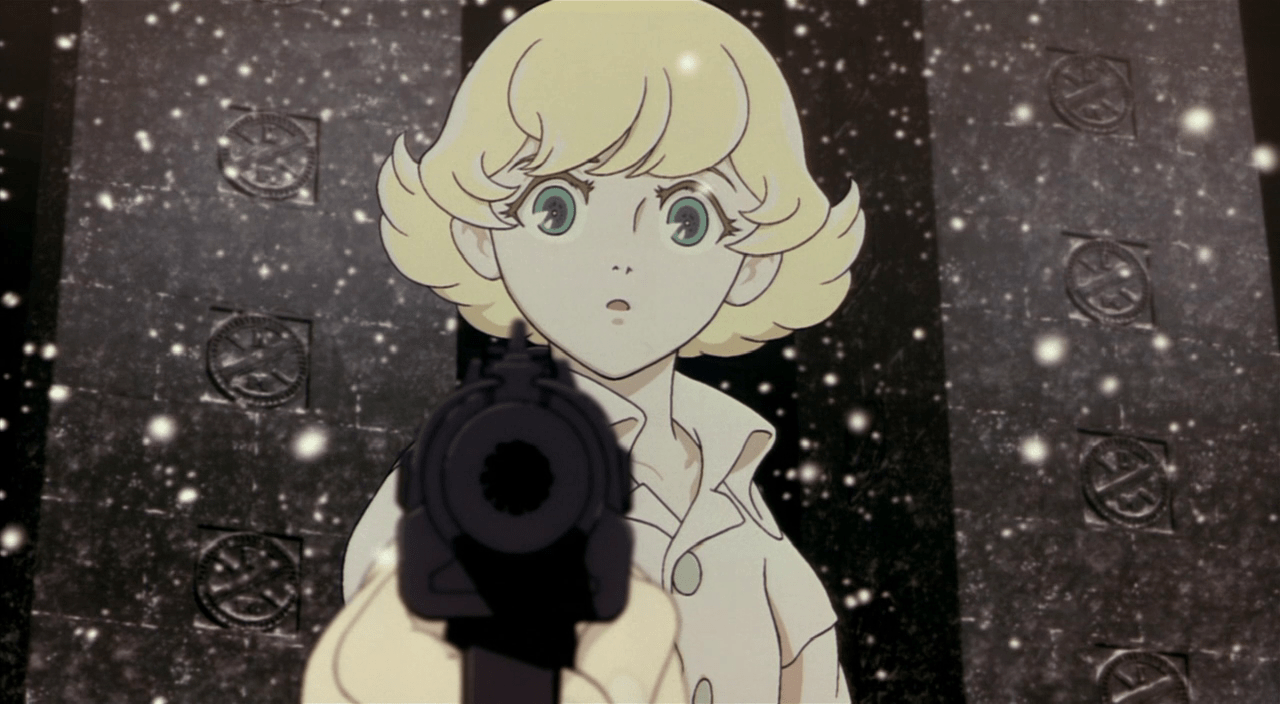
Inception has two great elevator scenes, the coolest being Arthur’s zero-gravity wake-up call. The first, though, bears enough suspicious similarity to the surreal anime film Paprika that I had to include these two together. Both movies are about dreams, and an elevator serves as a vertical means of navigating various levels of the subconscious.
Two Jedi walk onto an elevator full of droids…. Okay, there’s no punchline, but it is cool. Not only does this scene give Anakin a neat move in the elevator shaft, it confirmed that R2-D2 is the coolest droid. Let’s see BB-8 do that!
When Woody is kidnapped, of course he has to be taken to the top of a huge apartment building, and since toys can’t very well ride an elevator like people can, his friends hitch a ride on top. The first elevator scene is funny enough, but later when Zurg shows up, it’s comedy gold as the climax begins.
Captain America: The Winter Soldier (2014) / Die Hard with a Vengeance (1995)
Both of these scenes have something in common: the lone protagonist is crowded in an elevator by bad guys just waiting to ambush him. Cap and John McClane are too formidable to be taken by surprise and gain the upper hand against all odds. McClane’s method is more violent, but Cap also has to worry about getting out of the elevator as more enemies approach.
Both adaptations of Roald Dahl’s classic children’s book include the Great Glass Elevator. Gene Wilder’s version of the button-filled box serves as the film’s finale, while the Johnny Depp version utilizes the elevator a little more. I’d love to ride in both of them. I wonder how it would have turned out if Dahl’s sequel Charlie and the Great Glass Elevator could have been filmed to make the elevator the star. Spoiler warning!
If disaster movies have taught us anything, it should be to NEVER get in an elevator during a disaster. Of course, when a glass high-rise is going up in flames, people panic and pay for it in the elevator. If that weren’t enough, the stakes are elevated higher (pun intended) when another elevator on the outside of the building dangles precariously. Its rescue is the highlight of the film.
James Cameron knew how to employ elevators. Instead of an Alien Queen, this time there’s a liquid metal cyborg on the loose, who’s not about to let an elevator door or roof stop him from completing his assassination mission. The effects and action are both scary and impressive.
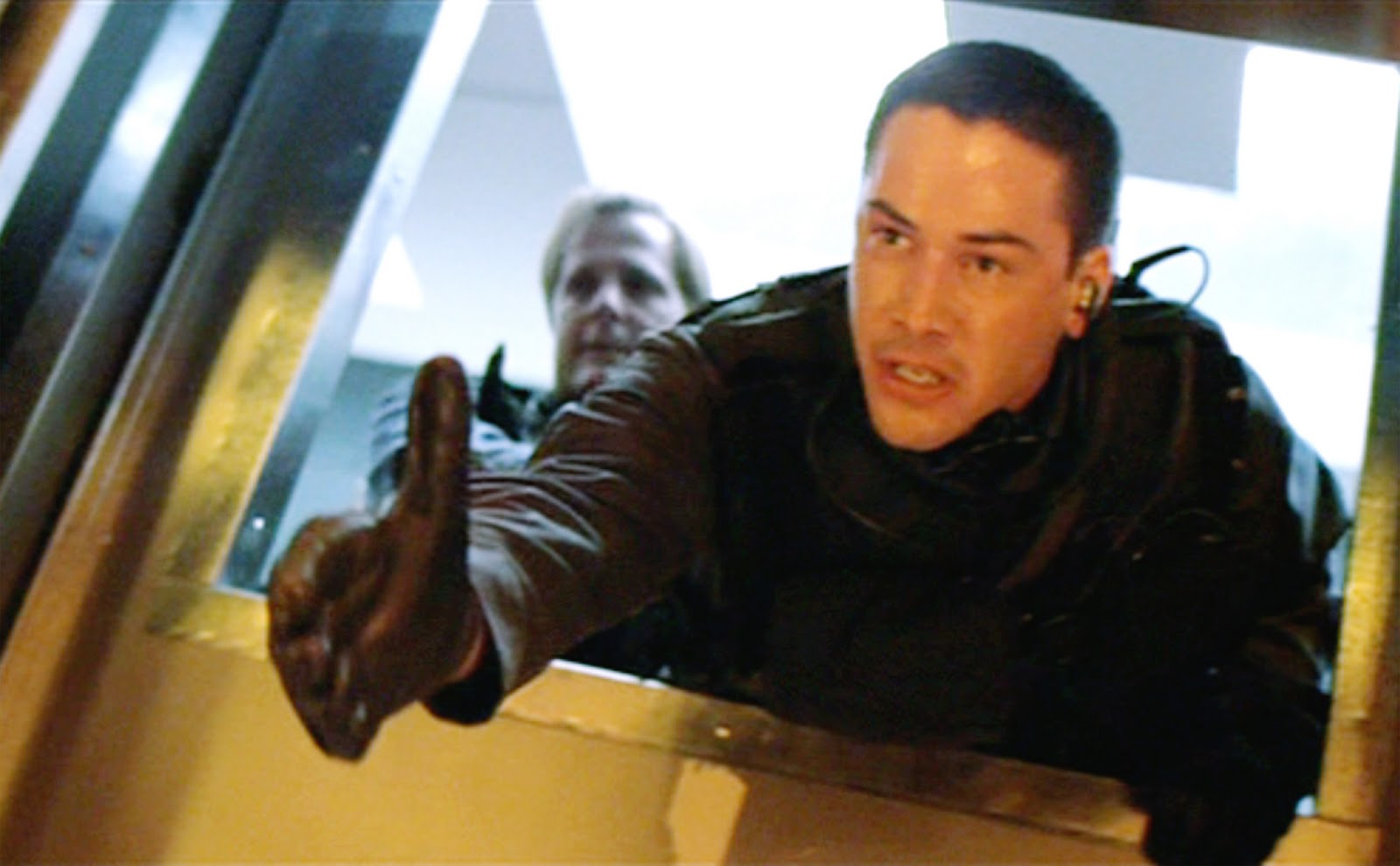
No film captures the terror of an elevator’s worst case scenario like Speed. Before we even get to Sandra Bullock and the runaway bus, Keanu Reeves and his SWAT team must rescue an elevator’s passengers from a bomber (Dennis Hopper). When the elevator hangs from an unstable crane, the rescue keeps you literally on the edge of your seat, and the confrontation with the bomber just happens to take place on an elevator too. It’s a shame I couldn’t find a video for the scene, but trust me, not many elevator scenes can compare with this one.
Die Hard (1988) – “Now I have a machine gun. Ho, ho, ho.”
Earthquake (1974) – The first hint of a problem in this disaster flick involves a flooded elevator, and later more panickers prove why an elevator is a death trap in an earthquake.
Ghost (1990) – I like the little scene where Patrick Swayze and Tony Goldwin prank everyone in the crowded elevator.
Gremlins 2: The New Batch (1990) – When gremlins take control of your elevator, be afraid.
The Hunger Games(2012) and Catching Fire (2013) – The tributes are elevated into the arena as suspense builds. Plus, there’s that awkward stripping scene with Johanna in the elevator.
Kate and Leopold (2001) – Apparently if the inventor of the elevator never invented elevators, elevators would still exist but wouldn’t work? Yeah, time travel.
My Favorite Wife (1940) – A great little moment in this Cary Grant charmer takes place in an elevator when Grant sees his presumably dead wife alive again. (See the picture at the top.)
National Treasure (2004) – Not only does Nicholas Cage abscond with the Declaration of Independence in an elevator, but he uses an eighteenth-century equivalent to descend to the treasure.
Oh, God! (1977) – If you rise past the top floor, you may be on your way to talk to God.
Outland (1981) – Have you ever wondered what would happen if a spacesuit decompressed in an elevator? It ain’t pretty.
Panic Room (2002) – It’s more of a dumbwaiter, but Jodie Foster uses her mini-elevator to outsmart the home invaders.
Scrooged (1988) – Bill Murray’s reaction to the Ghost of Christmas Future is priceless.
The Shining (1980) – I didn’t even know that flood of blood was coming out of an elevator until I looked it up.
Grab the wheel and rev the motor;
Shift the gear for overload;
Brace yourself and lock and load her;
Hit the gas and hit the road!
Don’t look back at what has been;
Drive for lives and don’t delay.
High on pure adrenaline,
Floor it through a lovely day!
_____________
MPAA rating: R
After reading almost nothing but great things about this movie, I finally decided to check out Mad Max: Fury Road, and I can’t say that I was disappointed. I haven’t seen any of the original Mad Max trilogy, but since each one seems to be its own adventure with one constant character, what’s there to know? The world has been reduced by war to a barren wasteland, with mankind relying on jacked-up vehicles to survive amid ruthless gangs and dangers. While I consider this automotive dystopia entirely unbelievable, Fury Road is a movie meant to be experienced, not watched or analyzed or taken overly seriously, though you’re welcome to do that too once the adrenaline dies down. Directed by George Miller, the 70-year-old director who surprisingly also gave us Babe and Happy Feet, it’s an assault on the senses, and you’re just along for the ride.
I tried watching this with my very hesitant VC, who has seen some of the first three movies and considers them weird. “Weird” still applies. The costumes, makeup, characters, vehicles, and overall package are bizarre, superfluous, and often grotesque but certainly imaginative and oddly cool (seriously, a whole rig dedicated to a background guitar solo?). The central baddies are a fanatical cult led by Immortan Joe (Hugh Keays-Byrne, the first Mad Max’s villain), who rules the mountainous Citadel by controlling his War Boys’ religious fervor and the people’s access to the life-giving fluids of water, milk, gasoline, and blood. When one of his right hands, Imperator Furiosa (Charlize Theron), escapes for freedom with Joe’s scantily clad harem, his entire army takes off in hot pursuit. Oh, yeah, and there’s a guy named Max (Tom Hardy) along for the ride.
I was dubious about many critics considering Fury Road one of the greatest action movies ever, but it kind of is, if only because the entire story relies on action. Details like the War Boys’ method of suicide or Furiosa’s robotic forearm are never explained. They’re just presented while the thin plot and explosions roll along, letting action take the place of any in-depth characterization.
We don’t even get much in the way of character bonding or motivation until about two-thirds of the way through, but somehow it’s forgiven because we’ve already seen everyone in action, from Joe’s five wives with names like Toast and Capable to the dedicated War Boy Nux (Nicholas Hoult). My VC was a bit turned off by the frantic, sometimes sped-up editing, but it did make it hard to look away. The explosions are amazing, and all the more amazing for relying on practical effects and stunts, though one obviously CGI scene at the climax almost spoiled the effect. I also liked how it managed a happy ending that served as an inverse of the beginning, even if the final scene seemed needlessly set up for a sequel.
One aspect that I’ve seen mentioned over and over is how violent the film is, and while it’s certainly R-rated action, I wasn’t that bothered by it. I was fearing something really graphic, but the truth is that Fury Road is nowhere near as gory as things like The Walking Dead or the Deadpool trailer (both of which I’ve seen once and won’t again). There are shootings and stabbings and people being thrown off of fast-moving vehicles, but save for a couple of scenes, the R is really owed to the film’s overall intensity, and even the violent scenes are so brief in the kinetic editing that they didn’t detract for me. The bloodiest scene actually serves a latent purpose in punishing the very weird excesses I mentioned earlier, sort of like the cape critique in The Incredibles. You want to wear over-the-top costumes? Well, you may regret it. In addition, I was pleased that, for once, a gritty actioner was almost entirely free of foul language. Granted, there’s not a lot of dialogue in the first place, but think about it. Was it really missed?
Whether you watch for Hardy’s and Theron’s strong laconic leads or for the girl power thrill of women with guns or for the nonstop epic action, this is one nitro-fueled bandwagon I can’t help but jump aboard, despite its innate strangeness. While I agree on its awesome status among action films, when was the last pure action movie to be nominated for Best Picture? I rather wish Inside Out had been nominated instead. But that’s me. Brilliant at best and entertaining at worst, Mad Max: Fury Road is an unexpectedly great sequel that viewers didn’t know they wanted.
Best line: (Nux, in a line that could be even more iconic if it had been repeated; after all, it’s a lot better than “Witness me”) “Oh, what a day! What a lovely day!”
Out in the marsh where the sandpipers wade
And the reeds allow breezes to bend every blade,
Visions appear in the moonlight and fade
And leave witnesses with a curious scare.
Some think they’re nothing but eyes playing tricks,
And others fear ghosts have escaped from the Styx,
But some explore further with sorrows to fix
And find answers they didn’t know would be there.
___________________
MPAA rating: PG
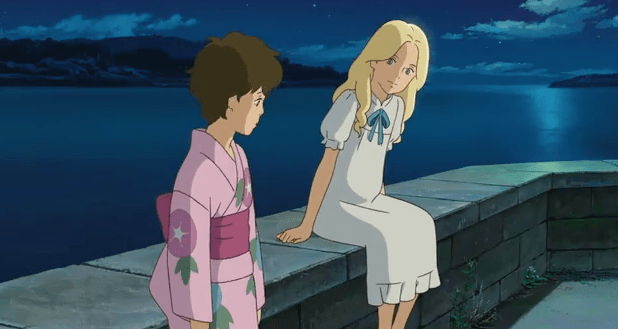
Studio Ghibli has been crafting outstanding animations for the last three decades, and now that co-founder Hayao Miyazaki is officially retired (again), it looks as if its present hiatus may be permanent. Before the hiatus, though, the studio gave us one more Ghibli gift in When Marnie Was There. Is it among the best Ghibli has to offer? No, but it still has a magical and earnest quality that can hold fast with the likes of Porco Rosso and The Secret World of Arrietty (also directed by Hiromasa Yonebayashi).
Based on Joan G. Robinson’s 1965 YA novel, which is one of Miyazaki’s favorites, When Marnie Was There is also one of Ghibli’s more mature works, not in a graphic sense like Princess Mononoke, but in an emotional sense. Anna (voiced by Hailee Steinfeld in the English dub) is a deeply troubled girl who keeps all of her griefs inside. As she says, she hates herself, for having asthma, for not fitting in at school, for not feeling at home with her foster parents. When she is sent to the countryside to live with friendly relatives, she remains uncomfortably stoic until she encounters a rundown mansion and the mysterious blonde girl Marnie (Kiernan Shipka) who only appears to her. When Anna crosses the tidal marsh to the mansion, she seems to step back in time, and their friendship grows, allowing Anna to regain her emotions and her self-confidence.
Many Ghibli films are leisurely paced, and this is no exception. The beginning takes time in establishing the characters: the nosy but nice would-be friend, the laconic neighborhood fisherman, the habitual painter fond of Marnie’s mansion. This community is merely a quaint backdrop for the central friendship and mystery between Anna and Marnie. The slowness of the mystery taxes the patience more than the film overall, but luckily there is a payoff, even if the line between dreams and reality becomes more ambiguous over time.
Some comments on the film have considered the girls’ bond in a romantic context with words like “infatuation,” and there were times that I was wondering where exactly their relationship was going. By today’s standards, when two twelve-year-olds meet secretly and dance in the moonlight and express their love, romance is assumed over friendship, while the opposite probably would have been true in the past. Perhaps modern sensibilities have colored people’s perceptions, like the humorous assumptions on Sherlock or the way some people mistake Sam and Frodo’s brotherly camaraderie in The Lord of the Rings for longing. Ultimately, the girls are meant to be only friends, yet the solving of the mystery reveals that their connection is indeed deeper than first thought. Actually, the revelation casts certain scenes in a much more tender and meaningful light, with subtle psychological details unseen in most Ghiblis. (Note the doll that Anna holds during a painful flashback.)
Though it’s not obvious at first, Anna’s greatest misery is being ignored or not wanted. Even the nicest people who seem to pay her attention are easily distracted, leaving her with nothing but personal distaste. Is Marnie merely the subconscious product of her desire for attention or a supernatural answer to it? By the end, it doesn’t really matter. Wishing to belong is nothing new in family films, but When Marnie Is There supplies a satisfying reply with more realistic resonances than most. With so much emotional depth, it’s unfortunate that the film’s visual style can’t quite match it. It has its fair share of memorable Ghibli-style scenes (a moonlit rowboat, wading through a rising tide), but its beauty just doesn’t compare with their best. Though Marnie has earned a nomination for Best Animated Feature, Inside Out is still a shoo-in. Despite this, When Marnie Is There is a bittersweet swan song for one of the great animation studios.
Best line: (Anna, watching her classmates) “In this world, there’s an invisible magic circle. There’s an inside, and an outside. Those people are inside the circle, and I’m outside.”
When Sophie plans to wed, she wants to meet her dad,
But from what she has read, her mom loved a triad.
So she invites the trio there,
To their hotel in Greece.
Sam, Bill, and Harry show; will wonders never cease?
When Donna meets her lovers there, it eats her.
What a mess!
Though they intrigue her, Sophie isn’t eager
To confess.
Donna’s stressed,
And the beaus play it close to the vest.
Sophie tries
To sightsee with all three of the guys.
The wedding closer draws, and she is still unsure
Which of the three it was that really fathered her.
As all three come to know the truth
And Sophie’s plans collapse,
Old griefs and tensions rise that once were under wraps.
With Sophie’s wedding, things come to a heading.
No more stress!
With all the bother, why choose just one father?
Take a guess!
And instead,
It is not who we thought would be wed.
And the throng
Celebrates and hydrates with a song!
________________
MPAA rating: PG-13 (for sexual dialogue)
It’s been a while since I let my VC pick a movie (although Flash Gordon was sort of hers) so I finally let her talk me into seeing Mamma Mia! again. There are so many fantastic musicals out there, and then there are those in which the plot is so flimsy that it only serves as a framework for musical numbers. Mamma Mia! definitely fits into the latter category, stringing together a number of 1970s hits amid a convoluted and loose-moralled story of uncertain identity. The catch is that this is all it tries to be, and it does it very well.
Let’s start with the plot. After reading her mother Donna’s youthful diary, Sophie (Amanda Seyfried) discovers that her father is one of three men who hooked up with Donna (Meryl Streep) about twenty years ago, all around the same time. Since Sophie is soon to be married, she wants her real father to walk her down the aisle and so invites all three to the Greek island where she lives. What could possibly go wrong? This setup is implausible and more than a little silly, and it goes nowhere fast as Sophie and Donna are both frazzled, while little side-plots with their friends chip away at ABBA’s discography.
But, as I said, the plot is secondary to the music, and there’s no shortage of great ABBA songs. While I was aware of the Swedish pop quartet before this movie, the only songs I associated with them were “Dancing Queen” and “Super Trouper,” but there are far more memorable tunes than I had given them credit for. Some I’d heard but didn’t really know (“Honey, Honey,” “Our Last Summer”), and others I had never even encountered before (“Lay All Your Love on Me” and the title song “Mamma Mia”). The way that all these disparate pop songs are combined into a barely cohesive whole is rather impressive, and if anything, it introduces whippersnappers like me to an uber-band from the ‘70s that deserves to be remembered.
The other reason to see Mamma Mia! is the privilege(?) of seeing famous actors play against type. It’s no secret that Amanda Seyfried sings beautifully (Les Miserables), but who would expect Meryl Streep to belt out surprisingly good vocals while wearing overalls or in a duet with James Bond? Plus, Julie Walters and Stellan Skarsgard are entirely different in “wild-and-crazy-old-people” roles, Dominic Cooper sounds nothing like the MCU’s Howard Stark, and Colin Firth is a far cry from Mr. Darcy. These uncharacteristic castings are also a problem, though. As much as he tries, Pierce Brosnan is simply not a singer, and every song with Julie Walters is uncomfortably grating. In fact, Walters and Christine Baranski as Donna’s friends are consistently grating as two overly frisky cougars whose attempts at not being old aren’t exactly flattering.
As if that didn’t sound negative enough, I also take issue with the ending. Not to give away specifics, but the overall message that the finale pushes is that love is for everybody but marriage is just for old people. I may be old-fashioned (in fact, I know I am), but why does marriage always seem to come after the honeymoon in movies, if it comes at all? Sophie’s choice at the end implies that she didn’t learn very much from her mother’s mistakes.
With the last two negative paragraphs, I was planning on ranking Mamma Mia! as a dishonorable mention, but my VC’s fondness for it tipped the scales. She says that “yes, it’s immoral and silly and all, but I like it.” The music, the exotic Greek scenery, the choreography, the appeal of good actors having fun with roles that might have gone to has-beens – these are what she enjoys, and I can’t really say I disagree. The truth is that I do love the music, which should understandably be the star of a musical. ABBA’s songs make up for the film’s abundant flaws so that its groovy appeal still shines through.
Best line: (Sophie) “I want the perfect wedding, and I want my father to give me away.” (Ali, her friend) “Better be a wide aisle!”
Bless all brothers near and far,
The sensitive and callous ones,
The playmates prone to jealousy
Yet somehow fond of family,
The boys who tease and rib and spar
Yet love their parents’ other sons.
Maybe brothers don’t realize
The privilege that I never had,
A friend you maybe did not want,
A buddy quicker to confront,
Yet one whose love your name implies,
Who shares more than a mom and dad.
______________
MPAA rating: PG-13
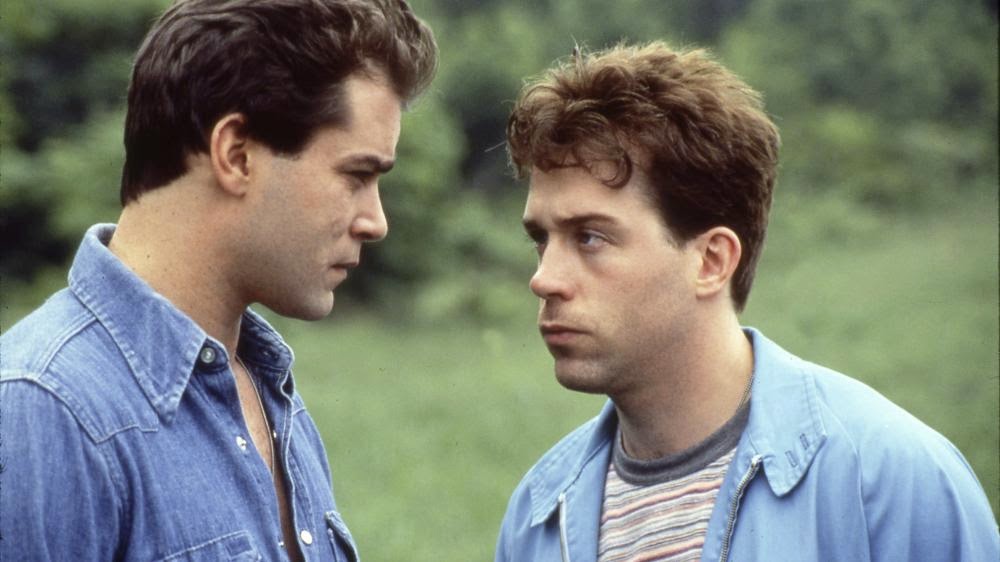
I recently found a local movie channel that shows more obscure films, and checking out one such sleeper just for the heck of it, I discovered this underrated drama. Dominick and Eugene seems like a prime award magnet. It features a nuanced fraternal relationship, a superb performance from an Oscar nominee (Tom Hulce), strong supporting roles for Ray Liotta and Jamie Lee Curtis, and a 100% rating on Rotten Tomatoes. Yet I’d never heard of it, and the most it received in 1988 was a Golden Globe nom for Hulce before fading away into the sea of forgotten ‘80s movies. Maybe its title was too generic, but this is a shame.
The titular duo are twins living together in Pittsburgh. Liotta is Eugene, a doctor-to-be who tries to start a relationship with a colleague (Curtis) and further his career while dealing with his mentally challenged brother. Hulce as Dominick is the star here. He is child-like, earnest, and hopelessly gullible, often falling for the tricks or suggestions of his coworker Larry and the local hoodlums, and when an idea gets in his head, he doesn’t let it go easily. Despite his disability, though, Nicky is the breadwinner, and his job as a garbage man serves to fund his brother’s education. Eugene is both protective of and frustrated by his brother, for reasons not clear at first, and life, love, and tragedy get in the way of their close relationship.
Dominick and Eugene could have drawn comparisons to the other drama about brotherly bonds and mental illness from that same year Rain Man, which did earn Best Picture and Best Actor Oscars and had far more advertising and better known stars. Hulce can’t quite compare with Dustin Hoffman’s role there (few can), but his fragile and earnest performance surely deserved more attention. One scene in particular stood out to me, as the camera centers on Hulce’s first-person view and reaction to a shocking act and a personal realization. The relationship between the two brothers is both strained yet unbreakable and more believable than in Rain Man, helping Dominick and Eugene to succeed as a subtle and touching affirmation of family ties.
Best line: (Dominick, who is a Christian but discouraged, looking at a crucifix) “If I was God, I wouldn’t let that happen to my boy.”
Cancer—I have seen your pitiless work,
The way you so silently grow from within.
The experts have learned how you burgeon and lurk,
A game meant to study but never to win.
So many have felt your pale fingers intrude;
So many have borne the despair in your wake;
So many have prayed that you might be subdued;
So many have suffered and cursed for your sake.
Physicians give odds with no true guarantee,
Less interest in me than my cunning disease.
They can’t cure themselves, and they cannot cure me;
They fight off the chorus, then wait for reprise.
Oh, cancer, your name is a tyrant for now,
But after your reign, we will nevermore bow.
________________
MPAA rating: PG-13 (for themes and brief nudity and language)
I’ve seen a lot of great movies lately, yet none have touched me as profoundly as Wit, such a simple title for such a powerful film. In fact, I think everyone ought to see this underrated HBO film, especially those fond of poetry or having any experience with medicine and hospitals. Directed by Mike Nichols, Wit is based on the play by Margaret Edson, which very deservedly won the 1999 Pulitzer Prize for Drama.
The always wonderful Emma Thompson gives one of her finest performances as Professor Vivian Bearing, a renowned scholar of metaphysical poetry. When diagnosed with advanced metastatic ovarian cancer, she has little choice but to submit to a rigorous experimental treatment prescribed by her Dr. Kelekian (a surprisingly straight-laced Christopher Lloyd). What she at first approached with cool confidence quickly becomes a constant hardship, and the treatment becomes more traumatic than the disease. While Bearing interacts with doctors and her sympathetic nurse (Audra McDonald), much of the film is her speaking directly to the camera, describing her passion for poetry, the trials of her chemotherapy, and her internal musings and doubts. When scenes of hospital room waiting start to drag, she makes note of the tedium and points out that as boring as these few scenes are for us, just consider how they feel for her. Thompson shaved her head for this role, and while Judy Davis stole Emmy and Golden Globe wins for the biopic Life with Judy Garland: Me and My Shadows and was indeed excellent, I think Thompson should have won something for her phenomenal performance here.
Bearing has spent her life dedicated to the work of John Donne, the master of 17th-century metaphysical poetry, full of conceits and metaphors so deep that lifetimes are spent unraveling their full meaning. I remember reading his poem “The Compass” (which is quoted in the film) in my literature class and being at first confused and then blown away by the depth of meaning, the kind of depth that appeals to English professors like Bearing and made Helene Hanff “dizzy for Donne” in 84 Charing Cross Road. One of the amazing things about Wit is that it is almost a cinematic version of a Donne poem, much more understandable on the surface but boasting ever more profound layers of wisdom the further one goes.
So many concepts are touched on with earnest emotion: her doctors’ cold scrutiny of her as “research” rather than a human being; the disconnect between studying the concept of death and confronting it in reality; the inconveniences and ineptitude of health care, which anyone who has endured a hospital stay has experienced to some extent; and the universal desire for pity, even when one has denied it to others. Of all the ideas discussed, empathy is perhaps the most prominent. McDonald plays the best kind of nurse, possessing a firm hand while demonstrating genuine concern for her patients, even in the details, in marked contrast to the ambitious but indifferent young doctor Jason (Jonathan M. Woodward, from the Firefly episode “The Message”). While the doctors are able to view Bearing’s degenerating condition with clinical dispassion, she admits that her life has reached the point of corny sentiment, when the most desired by someone in pain is the touch of human kindness.
Despite a sweet flashback with her father, Bearing is sadly bereft of friends and loved ones. Throughout her ordeal, she gets only one visitor, whose tenderness offers one of the most tear-jerking scenes in recent memory and places Bearing’s life and life in general within a subtle religious context. It’s also a reminder that, after a life dedicated to mature wisdom and the quest for knowledge and meaning, even the simplest of acts and themes can mean more. Wit is a masterpiece of insight and emotion, which as Bearing’s own professor states about Donne’s poetry, is not merely concerned with wit but truth.
Best line: (Vivian Bearing, near the end) “It came so quickly after taking so long.”
VC’s best line: (Dr. Jason) “What do you do for exercise?” (Bearing) “Pace.”
While I like quite a few bands, from recent groups like The Band Perry and Walk the Moon to classic acts like the Beatles, Genesis, and U2, I’d have to say that my favorite is Coldplay, made up of lead singer Chris Martin, guitarist Jonny Buckland, bassist Guy Berryman, and drummer Will Champion. This quartet has produced some of the most memorable alternative rock of the last two decades, and while I’d heard some of their songs before, I was truly introduced to their music ironically by a top ten list I found online.
Since they’ll be headlining Super Bowl 50 this Sunday, February 7, I thought it appropriate that things come full circle and I count down my own list of favorites. I normally just watch the Super Bowl for the commercials (or if there’s a favored team playing), but this is one of the few halftime shows I’m actually looking forward to. Here, therefore, are my all-time favorite songs by Coldplay.
“Atlas” from The Hunger Games: Catching Fire – Original Motion Picture Soundtrack (2013)
I like to make some movie connection even on my non-movie lists, and the end credits song for Catching Fire earned Grammy and Golden Globe nominations for Coldplay. Right on the heels of bad news for District 12 and that smoldering look from Katniss, this atmospheric number slowly builds with beauty and depth.
“Speed of Sound” from X&Y (2005)
This is one song that I keep noticing as background music in restaurants and such, and when I recognized it on that other top ten list, I said, “Oh, that’s who does that song!” It’s a good representation of Coldplay’s style, with some high notes and airy blend of piano, guitar, and drums; it just doesn’t quite stand out as much as their best songs.
“Life in Technicolor ii” from Prospekt’s March (2008)
Starting off with a tinny dulcimer called a yangqin (yes, I looked that up), the Grammy-nominated “Life in Technicolor ii” gradually adds layers of rock instrumentation to this base, which sort of parallels the music video. It’s just one of Coldplay’s many unique videos, with a small puppet show that jumps from Punch and Judy to pyrotechnics and helicopters. I should point out that the yangqin part was used at the end of Night at the Museum 2.
“A Sky Full of Stars” from Ghost Stories (2014)
A dreamy beginning yields to club-style headbanging in this hit, again nominated for a Grammy. It’s one of the few Coldplay songs still common on my local pop station, though it is more clubby than their usual style.
“The Scientist” from A Rush of Blood to the Head (2002)
Boasting probably their most fascinating music video, “The Scientist” is a simple but beautiful song from beginning to end. Repetitive but heartfelt, this song was also featured in the end credits of The Judge, performed by Willie Nelson of all people. Coldplay’s version is much better.
“Talk” from X&Y (2005)
Plagiarism is always a danger for artists, but isn’t it nice when a band actually gets permission to incorporate someone else’s work and expand on it? Kraftwerk’s “Computer Love” is an okay ‘80s techno song, but Coldplay’s “Talk” blows it away with its own melody. “Talk” also builds to an awesome rock crescendo that could get a giant robot’s attention.
“Violet Hill” from Viva la Vida or Death and All His Friends (2008)
With a bitter anti-war theme clearly felt in the lyrics, double-Grammy nominee “Violet Hill” rages as a brilliant rock ballad yet ends in sullen peace.
“Paradise” from Mylo Xyloto (2011)
How could anyone not love this song? While the music video seems to be trying to make a meme out of elephant costumes, “Paradise” is about a girl with dreams of an elusive home, and the wistful lyrics are among the band’s best. I’m always touched by the metaphor of “Life goes on; it gets so heavy. The wheel breaks the butterfly.”
“Every Teardrop Is a Waterfall” from Mylo Xyloto (2011)
Coldplay’s U2 influences are most felt in this phenomenal single with a breakneck Irish flavor that builds to a headbanging finale. Unfortunately, that drum solo at the end wraps up too soon. The video is also one of my favorites, with blended time-lapse images keeping time with the beat.
“Viva La Vida” from Viva la Vida or Death and All His Friends (2008)
This was the #1 song on that first list I discovered and with good reason. With an orchestral focus on strings and a medley of Biblical allusions, double-Grammy winner “Viva La Vida” is unlike anything else in Coldplay’s discography or in mainstream pop music. They played it during the closing ceremonies of the London Olympics, and Chris Martin once referred to it as “our best song.” It’s beautiful and bittersweet and utterly catchy.
“Clocks” from A Rush of Blood to the Head (2002)
One of the quintessential Coldplay tracks, Grammy winner “Clocks” is easily my VC’s favorite, and I’ve gotten into the habit of playing it for her whenever she’s stressed – I won’t say just how often that is. It’s a refreshing breeze of a song with an iconic piano melody. We both love everything about it, from the nonsensical yet deep and passionate lyrics to the way it builds and balances between relaxing and headbanging. It’s mesmerizing, layered, and perfect. “Home, home, where I wanted to go.”
“Charlie Brown” from Mylo Xyloto (2011)
It may be the unconventional choice, but “Charlie Brown” is my favorite Coldplay song. It begins with a celestial meowing that I’ve always thought of as the sound of midichlorians and then segues into a rocking riff just as iconic as that of “Clocks.” Even if the song itself has hardly any connection to its title, the upbeat buoyancy of this track is just infectious, the kind meant to get stuck in your head in the best way.
Runners-Up (in alphabetical order with links):
“Adventure of a Lifetime” – From their most recent album A Head Full of Dreams, this jammer has a great beat and a unique music video – Planet of the Apes: The Musical!
“Birds” (A Head Full of Dreams) – This ‘80s-ish track is brisk and immersive.
“Everglow” (A Head Full of Dreams) – A beautiful song sadly overshadowed by their catchier tunes.
“Fix You” (X&Y) – Slower than my favorites, but a beautiful crowd pleaser.
“Gravity” (B-side of “Talk”) – This more obscure song written for the band Embrace is slow but lovely and has a poignant unofficial video with animated ballet.
“The Hardest Part” (X&Y) – Like “Speed of Sound,” this is a solid track that just doesn’t stand out as much as it could.
“In My Place” (A Rush of Blood to the Head) – An excellent middle-of-the-road song that won a Grammy.
“Lost!” (Viva la Vida or Death and All His Friends) – Another great beat from the masters.
“Lovers in Japan” (Viva la Vida or Death and All His Friends) – This one starts out with a fantastic tempo that the rest of the song doesn’t quite live up to.
“Magic” (Ghost Stories) – Another good example of a strong central beat wonderfully and slowly building.
“Major Minus” (Mylo Xyloto) – Energetic and hard-edged, this song doesn’t get enough attention.
“Midnight” (Ghost Stories) – Atmospheric and haunting in a different way than Coldplay’s usual.
“Miracles” (Unbroken soundtrack) – Written for the end credits of 2014’s Unbroken, this song may be more inspiring than the movie itself.
“Strawberry Swing” (Viva la Vida or Death and All His Friends) – A light and breezy song with one of the most incredibly animated videos I’ve ever seen.
I stand here and smile on the gallery wall,
Watching the patrons who stare and pass on,
And sometimes the curator comes in to call
To boast of my grace and my era long gone.
I’m used to the gaze of dispassionate eyes,
But I once adorned a more intimate wall
When I was a gift, not a national prize,
A visage of somebody few now recall.
Not many remember my former abode,
But my memory, like my smile, never dies,
Corrupt men and hatred marked that episode
That stole me away as mere rare merchandise.
Suppose me content with my grace and my smile
After what I have seen on my difficult road?
I won’t be content until we reconcile.
I wait for my family; to them I am owed.
______________
MPAA rating: PG-13
Woman in Gold may be the most underrated drama of 2015. Reviews were mixed, and its two award-worthy performances have been pretty much ignored by any of the awards, aside from a single SAG nomination for Helen Mirren. While everyone has their own personal grumble about the Academy’s choices, this one is mine. Woman in Gold deserves so much better.
The film’s greatest assets are its two appealing leads, played by Helen Mirren and Ryan Reynolds. Mirren is Maria Altman, an elegant grandmother who fled Nazi Germany as a young newlywed and now wishes to reclaim a painting she left behind, Gustave Klimt’s Portrait of Adele Bloch-Bauer I, otherwise known as The Woman in Gold. The problem is that, while Maria sees it as a fond portrait of her late aunt, the nation of Austria guards it as a national treasure, their own Mona Lisa. That’s where Reynolds’ Randy Schoenberg comes in, a less-than-successful lawyer whose familial connections trump the fact that he knows nothing of art restitution cases. Together, the old lady and the bookish attorney make an unlikely team against Austria and the injustice of the past.
Many films have touched upon the Nazis’ forced appropriation of great artwork, from 1964’s The Train to 2014’s The Monuments Men, but rarely do these films present the personal cost of those crimes. They weren’t just stealing valuables, but precious antiques and family heirlooms. Art isn’t exactly my favorite subject, and Woman in Gold could have come off as just some stuffy lady wanting back what’s hers; instead, flashbacks to Maria’s life in Vienna elucidate just how much these treasures meant to her, not merely because of their monetary value but because of their memory and affection that only she can fully understand. It’s personal, and the film translates that fact effectively.
Mirren is a brilliant Maria with her grandmotherly concerns and dry wit, but when the long road to restitution takes its toll, Reynolds’ Randy steps up to keep the crusade going. Randy lives in the shadow of his judge father and famous composer grandfather, and when pushed to look into Maria’s case, he decides to give it his all, right up to the overwhelming challenge of the Supreme Court. As the case moves forward, it’s clear that it’s personal for Randy too, and visits to Vienna reinforce the importance of his Jewish-German heritage.
Woman in Gold also features welcome smaller roles from Daniel Bruhl, Frances Farmer, and Jonathan Pryce and a witty, at times tense screenplay that bounces nicely between past and present. With all these positives, why then has the film been snubbed? Perhaps because the pacing lags at times or because it isn’t entirely historically accurate. Neither of these faults bothered me, and the historical deviations don’t seem to bother the real Randy Schoenberg, who was interviewed for the film’s bonus features. Woman in Gold turns a legal battle over art into a personal underdog story, and by the Titanic-style ending, my VC was in tears and I wasn’t far behind.
Best line: (ignorant court house employee) “I want to go to Austria sometime with my daughter. She loves kangaroos!”