(Today’s NaPoWriMo prompt was a tritina, which has three set words to end each line in a pattern of ABC, CAB, BCA, and a final line with all three words in it. I decided to use the form for a creepy effect.)
Hark to the promise of pleasure and play.
Heed all the whispers that bid you come in.
Enter and leave your old world at the door.
Rest and don’t fret at the slow-closing door.
We’re glad that you had a good reason to play.
It’s been quite a while since a human came in.
I told you, don’t worry about the way in,
Or out for that matter; I’ve hidden the door.
It’s time that we all wear a smile and play.
I’m so glad the door brought in someone to play.
___________________
MPAA rating: PG
While I enjoy various kinds of animation, stop-motion isn’t my favorite. I love Chicken Run, but I’m less dazzled by the more macabre usages of this kind of puppetry, like The Nightmare before Christmas. That being said, stop-motion does lend itself to an unnatural movement perfect for creepiness, and Coraline utilizes this uncanny quality judiciously. From the first masterful shots of needle-composed fingers sewing up a little girl’s doll, it’s clear that experts of both animation and spookiness have put their craft on display.
Based on Neil Gaiman’s novel and with a Roald Dahl sensibility, Coraline first applies its technical finesse to the real world, as Coraline Jones (Dakota Fanning) and her parents move into a ramshackle apartment building. Coraline explores the neglected gardens and meets the eccentric neighbors and ultimately becomes bored and disgruntled at her surroundings. Then she finds a mysterious door which leads to an alternate universe where everything dull and mundane in the old world is bright and colorful and fun. Her Other Mother (Teri Hatcher) and Other Father are everything she wishes her parents could be, except they have buttons for eyes, and she has second thoughts when they want to sew buttons on her eyes.
Coraline cleverly manifests how a dream can so easily segue into a nightmare. Everything is fun and innocent at first (although some cartoon nudity goes a bit far), but as soon as Coraline becomes wise to her Other Mother’s sinister plans, the wondrous quickly turns monstrous. This disquieting wonderland is a perfect outlet for the animation, and many of the stunts and deft camerawork make one wonder how the filmmakers accomplished so much fluidity within the confines of tiny detailed models.
Perhaps because Tim Burton wasn’t involved, Coraline’s dark fantasy won me over, making it probably my favorite of the creepy genre of stop-motion animation. Some of the characters are still unnecessarily weird for my taste, but the central adventure has a winning blend of awe and fright that will make children think twice about too-good-to-be-true reveries.
Best line: (Other Mother, to Coraline) “They say even the proudest spirit can be broken…with love.”
(Today’s NaPoWriMo prompt was to write a poem about food. I had to stretch the topic a bit, but here it applies to a ritualistic meal.)
In olden days, when Death dropped by
To whisk away a willing soul,
The folk believed that sin’s control
Still clung to what was left.
And so one chosen with a sigh
Was tasked with eating bread and wine
That represented as a sign
The dead one’s every lie and theft.
How heavy was this obligation,
Living only for the dead!
The taste of wine and sin-soaked bread
Lay bitter on the tongue.
This ritual owed its foundation
To the oldest of traditions,
But the cure for superstitions
Lay in faith held by the young.
_________________
MPAA rating: PG-13
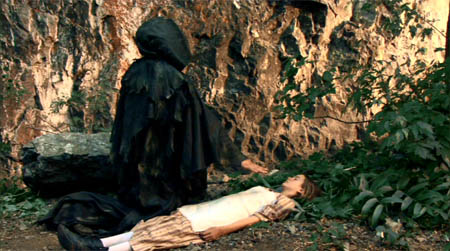
My VC has grown extremely fond of the works of Francine Rivers, a best-selling Christian author whose one hit to garner a film adaptation is The Last Sin Eater. One of the weaknesses of Christian films is that the evangelical message is often the only reason it exists, at the expense of a worthwhile story. Luckily, The Last Sin Eater, directed by Michael Landon, Jr., has a good story. Focusing on an obscure but fascinating 19th-century tradition of some Celtic immigrants of Appalachia, the film paints a compelling tale of guilt amid a rural community with a surprisingly dark secret.
Young Cadi Forbes (Liana Liberato) is overcome with guilt for the death of her sister and seeks out the village’s reclusive Sin Eater to take away her iniquity. The Sin Eater dresses in a black robe and is treated like the boogeyman of a horror movie, even though he’s merely a victim of an alienating tradition. When Cadi meets a man of God (a grown-up Henry Thomas from E.T.), she becomes dubious of the necessity of a sin eater in light of someone named Jesus. This Christian element is key to the story’s resolution, but the core mystery remains separate and interesting.
While the acting isn’t always entirely convincing, Liberato is an earnest Cadi, and Henry Thomas and Louise Fletcher add some star power to an otherwise lesser-known cast. The woodland cinematography is also charmingly picturesque and a step above other low-budget films, even if the special effects aren’t. While it may please mainly faith-based audiences, The Last Sin Eater is a quaint and positive tale of redemption which, according to my VC, is not quite as good as the book.
(Today’s NaPoWriMo prompt was to write a poem inspired by an unusually named fruit or vegetable, and…I got nothing, at least as far as movies. So here’s a poem that mentions fruit.)
When Adam and Eve in the garden dwelt,
They had no sin to tempt their heart,
But even after the fruit was dealt,
One kind of vice had yet to start.
For jealousy to turn one green,
Another man must bear his glare,
And envy chanced to grow between
The sons of Adam, heir to heir.
As soon as two men shared the earth,
One’s jealousy did thin the herd,
And every day as more give birth,
More envy burgeons undeterred.
____________________
MPAA rating: PG-13
Post-apocalyptic stories are all the rage these days, as are films about isolation (Moon, The Martian, Room). Based loosely off a 1974 novel, Z for Zachariah combines these two trends into a slow but intriguing drama. After some unspecified nuclear disaster, Ann Burden (Margot Robbie) occupies a rare safe zone, where her family’s farm is protected by the natural valley. Into this valley comes John Loomis (Chiwetel Ejiofor), a scientist dependent till now on a radiation suit. Their relationship is respectful but restrained, since they both know that they would never be attracted if not for these dire circumstances. Despite their differences, such as their religious views, they seem to understand that a man and a woman alone will most likely go the way of Adam and Eve. However, potential bliss is hindered by the arrival of another survivor named Caleb (Chris Pine).
Z for Zachariah makes the most of its triad cast, with all three delivering excellent performances. The setting is also beyond reproach, with the briefly seen nuclear ruins outside the valley contrasting starkly with the lush greenery of Ann’s home. Where the film could easily lose viewers is in the pacing. On the one hand, the film’s leisurely pace is building up the bond between the characters and how it’s tested. On the other hand, you may be too bored to really care. I liked how the ending was a bit ambiguous, leaving room for some hope of a different outcome from the obvious. Strengthened mainly by its trio of fine actors, Z for Zachariah is a surprisingly restrained post-apocalyptic fable that illustrates how even the smallest of communities can turn “Adam and Eve” into “Cain and Abel.”
(Today’s NaPoWriMo prompt was to describe “the cruelest month.” While I wouldn’t go as far as cruel, I applied it to the month of a certain fateful holiday.)
Of all the months throughout the year,
September haunts my soul.
The summer wanes; its dying pains
Serenely take their toll.
The children mourn that school awaits
And wish that time would freeze.
It never does; so says the buzz
Of insects in the trees.
When Labor Day arrives once more
And time begins to slow,
My mind returns and softly yearns
For that time years ago—
When he was in my mother’s house
And shared his every skill
Till Labor Day was snatched away
And trembling hearts were still.
As long as we are incomplete,
September days are dim.
The luster waits to gild those dates
Until we welcome him.
___________________________
MPAA rating: PG-13
Labor Day is the most romantic movie you’ll ever see about an escaped murderer taking a mother and son hostage. What sounds like a horror movie set-up becomes heartfelt and touching instead. Frank Chambers (Josh Brolin) gives his keepers the slip and hitches a ride home with Adele (Kate Winslet) and her adolescent son Henry (Gattlin Griffith). Instead of threatening them in the basement or the like, Frank instead fixes doors and pipes, changes tires, and bakes pies, and when he ties up Adele strictly for show and then cooks for her and spoon-feeds her, it’s almost surreal. Quickly, it becomes clear that Frank is not dangerous, and Adele’s fragile need for intimacy becomes one more trouble Frank can fix. Of course, he’s a wanted man, and the police are closing in.
Labor Day excels in its warm atmosphere. The radiant summer and subtle quietude brought to mind the tone of some of Studio Ghibli’s calm films, and I could believe how a three-day weekend could have felt much longer to the characters. I did also like the thoughtful details, like hearing a snippet of a Jerry Lewis telethon that used to air every Labor Day weekend. Kate Winslet and Josh Brolin are darn near perfect and have instant chemistry together, although their relationship transitions from dubious to surreal to madly in love a bit too easily. By the end, the film could have become one of those bittersweet tearjerkers that tear me up inside (like Somewhere in Time), but it wasn’t quite involving enough to trigger the waterworks. I’m unsure why, but it was still a poignant romance/coming-of-age tale that touches the heart in all the right ways.
Best line: (Henry) “I don’t think losing my father broke my mother’s heart, but rather losing love itself.”
(Today’s NaPoWriMo prompt was for a fan letter, and I knew just the film.)
Dear Mr. Lucas,
I thought I would write you a letter to say
That my miserable life was fulfilled on the day
That I first saw that brilliant creation of yours:
That glorious franchise you christened Star Wars.
I know every line, every creature and place.
I can name every extra-terrestrial face.
I love Figrin D’an, who played in Mos Eisley,
And ol’ Ponda Baba, who didn’t choose wisely,
And Porkins and Bossk and Salacious B. Crumb.
I know them all more than I know my own thumb.
In details and lore, I am masterfully versed,
And though you deny, I know Solo shot first.
I know set design secrets and last-minute edits
And every last name that goes by in the credits.
I quote every movie by heart easily;
I even like Episodes I, II, and III.
You must see that I am a passionate fan
Of the greatest of tales in the annals of man.
The Force is with me, as I know it’s with you,
So I ask only one little favor to do.
Would you cancel that order, as if I’m a threat,
That needlessly dictates how close I can get?
______________________
MPAA rating: PG-13
I’m not quite as big a Star Wars fan as the poem indicates, but I love it enough to enjoy a good comedy about it. Fanboys isn’t it. What could have been an enjoyable road movie poking fun at obsessive fan bases turned out to be a crude and unflattering dud.
When four sophomoric fans learn that one of their own will die of cancer before the release of Star Wars: Episode I – The Phantom Menace, they decide to travel to Skywalker Ranch and steal a copy of the film. Some of the jokes aimed at Star Wars are actually funny, but the rest languish in awkward silliness. Should I laugh at an Ewok humping someone’s leg? One running gag is the feud between fans of Star Wars and Star Trek, which is ramped up to ridiculous levels. (I’ve never really understood the rivalry there, since I like both franchises.) Ultimately, the best thing about Fanboys is some unexpected cameos.
Aside from much of the film just not being funny, its treatment of fans is actually rather insulting. The group of friends includes mostly immature nerds of the type who have no experience with the opposite gender. Their pathetic antics are rather desperate, and eventually fanboys are literally equated with sex-starved bums. Weren’t the filmmakers actually targeting Star Wars fans as their audience? I’m sure they didn’t mean all fans are like that, but the characterization remains. Fanboys has a decent concept but poor execution, so for a good fan-related comedy, watch Galaxy Quest instead.
Best line: (Zoe, as someone is talking to George Lucas on the phone) “I can hear his beard!”
(Today’s NaPoWriMo prompt was to involve a family portrait. I went a little unorthodox and saw a movie heirloom as a different kind of portrait.)
Photographs fade with the passing of time.
Families usually settle for that.
But one family has a sturdier portrait:
A weathered piano where fathers have sat.
One gifted forefather made art from the wood
And carved images of his daughter and wife
And kept right on carving as long as he could,
Remembering many a long-faded life.
There that piano sits, solid as ever.
The faces hewn into its surface still stare,
And when someone plays on those ivory keys,
The faces almost seem to whisper a prayer.
Now some fail to see that piano as more
Than a heavy old relic with stale memories,
But portraits, pianos, and relics can store
Significance only their family sees.
____________________
MPAA rating: PG
The Piano Lesson is a Hallmark Hall of Fame movie adapted from the all-black Broadway play by August Wilson. Several of the actors from the play grace the screen as well, including Charles S. Dutton and Carl Gordon (who also co-starred on the ‘90s TV show Roc). Dutton plays Boy Willie, who visits his sister Berniece (Alfre Woodard) in Pittsburgh in order to sell her antique piano for land.
What The Piano Lesson has is a debate-worthy dilemma of the best kind. As I described in the poem, the piano is carved with images of their ancestors, dating back to slavery, the kind of keepsake that Berniece could never imagine parting with. Yet Boy Willie views its worth in monetary terms: if he can sell it (and the truckful of watermelons he brought along), he can return to the South and buy the very land their ancestors once worked as slaves. The piano is a gift, but is it one to be kept and admired, or used to benefit the family? Both Berniece and Boy Willie have good points, so who’s right?
The Piano Lesson is also a warm picture of African-Americans in the 1930s. At first glance, the politically correct might disapprove of the poor dialect and grammar spoken, names like Boy Willie or Wining Boy, or the sight of black people with watermelons. Yet August Wilson himself was black and included such elements for a reason. After all, Boy Willie is showing initiative and business savvy by selling the watermelons and seeks to keep on progressing away from slavery. Religion, superstition, and music are also elemental to the story, with an a cappella rendition of “Berta, Berta” being a highlight.
All of the actors give great performances, but the story itself doesn’t quite know how to resolve its provocative argument. The culmination of the dispute takes a supernatural turn that is not well visualized and ends up just confusing. Even so, I’m glad the playwright sided with my opinion on how the piano ought to be used. The Piano Lesson might have ended better, but it’s a thought-provoking portrait of African-American heritage.
(Today’s NaPoWriMo prompt was for a lune, a haiku variant with a 5-3-5 syllable scheme, and I ended up stringing three together.)
What you see on screens
Is half of
What’s behind the scenes.
Each proud, polished face
On the news
Most fears their disgrace.
The best journalists
Never change
Truth as it exists.
________________________
MPAA rating: R (for language)
Broadcast News can be summed up in one word: professional. It’s a professionally created film about professionals. It’s also a good reminder that television news isn’t as simple as what we see, a few well-dressed anchors reading the headlines. There’s also toil and creativity and last-minute changes and sudden updates and delays and unbridled panic behind the scenes.
A love triangle forms our comprehensive tour of the news studio. Jane Craig (Holly Hunter) is an impassioned woman-on-the-edge producer and enjoys working with Aaron (Albert Brooks), whose encyclopedic knowledge and quick wit make him an ideal reporter. Then comes Tom Grunick (William Hurt) as a newly hired anchor who knows he’s unqualified but still presents well to the camera. Jane is first and foremost a career woman, but Tom attracts her even while testing her staunchly held opinions.
It’s prime acting across the board, with all three leads earning Oscar nominations, and Albert Brooks delivers some terrifically trenchant retorts. I also like how much is tested in the high-pressure news business – ethics, ambitions, competence, loyalty – and in believable, often amusing ways.
Broadcast News has plenty of strengths, but it couldn’t stick the landing. I suppose in trying to stand out from rom com clichés, the love triangle went in the one direction that leaves everyone unsatisfied. It’s an example of being unnecessarily sadder but wiser. What’s worse, as more time passes, I’ve come to realize just how forgettable the film overall is. With the exception of one funny epic fail scene, very little stands out in retrospect, which isn’t flattering for a Best Picture nominee. Broadcast News is as professional as the real TV news networks, but I’m unsure which I’d rather watch again. Probably the film; it’s less depressing.
Best line: (Aaron, to Jane) “I’ll meet you at the place near the thing where we went that time.”
Once again, April is about here, and it’s not just Jazz Appreciation Month or Mathematics Awareness Month. It’s National Poetry Writing Month, a.k.a. NaPoWriMo, and that means a challenge for poets to write a poem every day. My posts have gotten more and more infrequent lately, sometimes only two a week, but I’ll be doing just what I did last April. A poem a day means a movie review a day too, and that will help me catch up on some of the backlog of films I’ve seen but not reviewed. I’ve also noticed a few of my posts have been getting rather long, so I’ll be keeping these relatively short, which will help when I may not have much to say about some of them.
I may fall behind in my posts, but NaPoWriMo is supposed to be fun. The prompts for each day often test one’s creativity, and April’s the perfect month to celebrate poetry. Happy NaPoWriMo! 🙂
I’ve not beheld a parted sea
Or outlived an emergency.
I’ve never seen a patient healed
Or glimpsed divine eternity.
I’ve never viewed a battlefield
With some celestial might revealed.
I wish I had, for maybe then
My faith in God would be more sealed.
Despite the things beyond my ken,
I’ve seen the warmth and faith of men,
And maybe that’s a miracle
Worth noticing time and again.
______________________
MPAA rating: PG
I had considered watching Risen or The Young Messiah for Easter, but the only faith-based film with a good show time (and an A+ CinemaScore) was Miracles from Heaven, which I’m rather glad I ended up seeing. I wasn’t won over by Heaven Is For Real, the previous film from producers T.D. Jakes and Joe Roth; it was an intriguing story but not one to sustain a full-length film, and the conflict felt forced coming from supposed people of faith. While that film showed a child’s heavenly vision early on and focused on people’s reactions, Miracles from Heaven does better in leaving it for the climax and focusing on a more relatable crisis of faith, with a far better chance for both smiles and tears.
Based on the true story of the Beam family from Burleson, Texas, the film depicts the family of five as real people whose faith is just one part of their lives. The parents flirt with each other; one daughter is obsessed with Taylor Swift; and another has a passion for soccer championships. Tragedy is the last thing they expect or deserve. Jennifer Garner outdoes herself as Christy Beam, who lives every parent’s worst nightmare when her daughter Anna (Kylie Rogers) is diagnosed with a severe and incurable gastrointestinal disease. Already stressed financially, she must endure constant worry, hospital waiting lists, incompetent doctors who won’t do more, competent doctors who can’t do more, and a host of unanswered prayers. Skeptics aren’t the only ones who question the goodness of God when bad things happen, and Christy’s faith becomes buried in feelings of grief and abandonment. Why did this have to happen to a sweet little girl? No one can offer her answers.
Obviously, the title indicates that something miraculous happens, but it’s more than that. In following this mother and daughter to their darkest point, moments of light shine out the brighter. Queen Latifah plays a kind waitress who befriends them while away from home and offers needed comic relief, and Eugenio Derbez is splendid as a Patch Adams-style child specialist who balances cheerful encouragement with inner knowledge that most of his patients will die. In these and many more side characters, the film reminds us that big miracles come from God, but small ones can originate in those random acts of kindness of which anyone is capable.
Doubt is everyone’s first reaction to miracles, and the film doesn’t forget that, nor does it try to explain why some people are so blessed while others are not. Miracles are rare but no less extraordinary, and for those willing, the unexplainable can remind people of hope when they have none. Miracles from Heaven has a few moments of familiar Christian themes that might get atheists rolling their eyes, but it’s an inspiring, well-acted, and emotional tale with which anyone who believes or hopes in miracles can identify.
Best line: (Christy) “Miracles are God’s way of telling us He’s here.”
I know this list will probably have less wide appeal than my usual lists and reviews, but I am a Christian and wanted to do something in honor of Lent and Holy Week. At first, I thought I’d do a list of Christian movies, but the sad truth is that most Christian films just don’t compare with “regular” cinema as far as quality and are often written off as preachy. (For the record, that list would have been topped by The Passion of the Christ, The Nativity Story, and Sheffey.)
So, upon second thought, I decided to count down my favorites of the Christian music scene, which surpasses movies in actually matching its secular counterpart. While many Christian songs rely on inspiring lyrics over a rather bland sound, my choices below feature unique instrumentation and catchy rhythms that can stand toe to toe with much of what’s on the radio nowadays, IMO. In fact, if not for the religious lyrics, these songs would probably be much bigger hits, and some of the artists actually have enjoyed crossover appeal. These are songs that I would gladly listen to whether they’re Christian or not, but the fact that they feature uplifting lyrics is icing on the cake. I’m only including one placement per band, and I’m not counting superficially Christian songs like ”Spirit in the Sky” or songs from musicals like Jesus Christ Superstar, Godspell, or The Prince of Egypt(though I love those too). Whether you’re a Christian or not, I have no doubt that there’s a song here for everyone to enjoy.
“Hallelujah” from The Call (2016) – Joy Enriquez
Joy Enriquez jumped from a backup singer to a solo artist over a decade ago, and one of her most recent digital releases is now a personal favorite of mine. With some background violin courtesy of Lindsey Stirling, “Hallelujah” is an instant modern classic of praise, and the homey music video is just plain sweet.
“Beat the System” from Beat the System (1985) – Petra
Just as many recent Christian rock songs don’t appear much different from the usual radio fare, the Christian songs of the ‘80s had the same ‘80s sound. Petra was the shining example of a hit Christian band back then and a favorite of my mom’s. While their style has evolved over the years, my favorite is the Journey-like “Beat the System,” boasting a video replete with early MTV imagery. “The Battle Belongs to the Lord” is also another great song of theirs.
TIE:
“Believe” from One (2004) – Andy Chrisman
“Can’t Keep a Good Man Down” from Pictures on Mantles (2004) – Russ Lee
I got both of these albums as gifts around the same time and played them to death while doing my homework. These two songs (probably the most evangelical on the list) are the standouts. “Believe” is one of those uplifting professions of faith that gets people testifying and just barely edged out “Complete” from the same album.
Not to be confused with the Alabama hit, “Can’t Keep a Good Man Down” is also a Christian single from Russ Lee, who left the band Newsong to go solo. Before returning as their lead singer, his solo efforts delivered underrated beauties like “Pictures on Mantles” and “Living Life Upside Down.” “Can’t Keep a Good Man Down” is the best, though, with its blend of acoustic and electric guitar and country-ish beat. Sadly, I couldn’t find his solo version of the song, but the slightly altered version from when he rejoined Newsong is still great.
“Call My Name” from Revelation (2004) – Third Day
Third Day is one of the biggest bands in contemporary Christian music, thanks in part to the husky voice of lead singer Mac Powell. “Call My Name” is their masterpiece with an encouraging message second to none.
“My Last Amen” from Ending Is Beginning (2008) – downhere
Having a completely different, almost quirky vibe compared with most of these songs, “My Last Amen” from Canadian band downhere is just a fun song worth singing along to. It also has drawn some comparisons to the music of Queen.
“Beating My Heart” from OK Now (2008) – Jon McLaughlin
This energizing hit may not be an exclusively Christian song, since it climbed through both Christian and secular Billboard charts, but it’s a good example of how lyrics can be written to appeal to both audiences. The words might refer to God or to a romance, and McLaughlin’s high voice lends “Beating My Heart” a Coldplay-style quality.
“Give It All to You” from Yellow Cavalier (2009) – Yellow Cavalier (now Anthem Lights)
Why this song isn’t more well-known I don’t know, except that Yellow Cavalier promptly changed their name to Anthem Lights after this one EP. “Give It All to You” has a swelling, dance-worthy rhythm with some fantastic background trumpets at the end.
“Alive Again” from Alive Again (2009) – Matt Maher
As far as straight, rousing inspiration that could get hands raised in praise, few can compare with “Alive Again.” The Canadian Catholic Matt Maher won the Dove Award for Songwriter of the Year last year, and it’s clear that his musical talents are still going strong.
“Galaxies” from All Things Bright and Beautiful (2011) – Owl City
The best example of a Christian artist with crossover appeal would have to be Owl City, aka Adam Young. His electronic stylings have graced films like Wreck-It Ralph and Legend of the Guardians (I knew I could work in some movie references!), and songs like “Good Time” and “Fireflies” are still played semi-regularly on pop stations. One of his best songs looks upward to the galaxies and the glory of God, with Young’s uniquely offbeat lyrics and strong synthesizer at play.
“Dive” from Speechless (1999) – Steven Curtis Chapman
“Dive” is the kind of energetic earworm that gets a crowd excited, starting slow and then bopping along with increasing buoyancy. I remember being scared stiff on a high diving board at camp as a kid, but this song could have had me leaping for joy.
“Hard to Believe” from VOTA (2008) – VOTA
After changing their name from Casting Pearls, VOTA gave the world this awesome track along with one of my favorite music videos ever. This song is meant to be sung along with and deserves so much more air time than it’s gotten. The groovy syncopation matches the kaleidoscopic video, and I never get tired of it.
TIE:
“Way Beyond Myself” from Born Again (2010) and
“Stay Strong” from The Greatest Hits (2007) – Newsboys
I confidently assert that the Newsboys are the greatest Christian rock band. Since their formation in Australia in the 1980s, they’ve supplied so many hits that I could probably do a top twelve list of just their songs (“Shine,” “Take Me to Your Leader,” “The Way We Roll,” “In the Hands of God,” “In the Belly of the Whale,” and “Escape,” for example). Their style is so varied and distinctive that it’s too bad that their song “God’s Not Dead” got its own movie instead of their greater work. It’s a good song (and so-so movie) but far from their best.
My top spot is shared by two different but equally deserving tracks. “Stay Strong” has the best lyrics, inspiring and devout while its melody matches perfectly, especially the synthesizer bridge proclaiming “This race can be won!” On the other hand, “Way Beyond Myself” places the fast-paced beat as the star, the kind that gets a huge crowd undoubtedly pumped. One is a heart-winner, and the other’s a head-banger. Together, these two songs exemplify the greatest strengths of contemporary Christian music.
Runners-Up (quite a few, in alphabetical order by artist):
“My Savior My God” – Aaron Shust
“Breath of Heaven” – Amy Grant
“Kings and Queens” – Audio Adrenaline
“What Life Would Be Like” – Big Daddy Weave
“Give Me Your Eyes” – Brandon Heath
“Where I Belong” – Building 429
“Jesus, Take the Wheel” and “Something in the Water” – Carrie Underwood (another good example of crossover with country music)
“More of You” – Colton Dixon
“Shine” – David Crowder Band (really beautiful and unique stop-motion video)
“Dear X (You Don’t Own Me)” – Disciple (the hardest rock song in the list)
“Oh Happy Day” – Edwin Hawkins Singers
“It’s Not Over Yet” – for KING & COUNTRY
“Christmas with a Capital C” – Go Fish
“Alive” – Hillsong Young and Free
“The River” – Jordan Feliz
“He Is with You” – Mandisa
“The Motions” – Matthew West
“Move” and “You Reign” – MercyMe
“Lay ‘em Down” – NEEDTOBREATHE
“Remember” – Passion
“Be Still, My Soul” – The Imperials
“Therapy” – Relient K
“Forgiven” – Sanctus Real
“The Words I Would Say” and “Live Like That” – Sidewalk Prophets
“Something Holy” – Stellar Kart
“Stand in the Rain” – Superchick
“You Are More” – Tenth Avenue North
“City on Our Knees” – TobyMac
With Easter around the corner, I think the best way to end this post is with the ultimate uplifting Gospel song, “He’s Alive” by the Gaither Vocal Band with David Phelps. Hallelujah and Amen!