Mothers are ours from the start of our lives,
The source from which much of our own self derives.
Our culture and friends,
Open doors and dead ends
May shape who we are,
But their impact depends
On the person who held us and taught right from wrong
And lived an example both tender and strong.
All moms are different; some dote, some oppress.
Some pick you apart; some are quick to impress.
And some are so dear,
Sharing each joy and fear,
That it’s hard to conceive
Of a day or an eve
Without her near-eternal, maternal sunshine.
It’s those we love most and why I so love mine.
_____________________
MPAA rating: PG
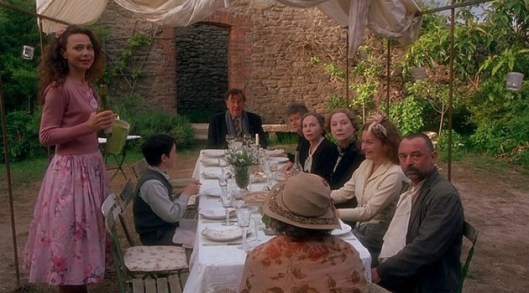
A very Happy Mother’s Day to all the mothers out there and to my own in particular. Hi, Mom! I’ll admit I picked this film to review today due to its maternal themes offering an excuse to write the above poem, but I do wish it were a better film overall for Mother’s Day (certainly not on par with Wolf Children, which was my Mother’s Day review last year). I watched Dim Sum: A Little Bit of Heart with my mom, hoping it would be an understated gem, and while it’s definitely understated, I wouldn’t go so far as to call it a gem, despite its 100% Rotten Tomatoes score.
Dim Sum focuses on the uneventful lives of the Chinese-American family of Geraldine Tam (Laureen Chew), who cares for her old-fashioned immigrant mother (Kim Chew; I’m still not sure if the actresses were actually related). Her mom seems content with her quiet life but is always encouraging Geraldine to get married, and her goading grows fatalistic as Mrs. Tam enters the year it was foretold she would die. While I’ve seen the film described as a comedy, the chuckles are few and far between, but Victor Wong adds some genial charm as Mrs. Tam’s barkeeper brother-in-law.
Events move along with a snail-paced eye for detail, particularly the unique blending of American and Chinese culture, such as changing from shoes to slippers at the front door. Since she mainly interacts with her close-knit Chinese friends, Mrs. Tam strictly speaks Chinese, while Wong’s more outgoing character freely converses in English. This contrast extends to the generational divide between Geraldine and her mom, as evidenced in a scene of Mrs. Tam’s mahjong club of women friends, followed by an identical game in English with their second-generation daughters.
I have no doubt that Dim Sum: A Little Bit of Heart is a realistic glimpse of Chinese-American life in San Francisco, and director Wayne Wang’s fondness for it is felt throughout. However, the extended scenes of little happening grow boring after a while, and the slightly heartwarming but open-ended conclusion doesn’t quite make the watch worthwhile. My mom did get a nostalgic kick out of some extremely ‘80s moments, like a mention of Betamax, but the strongest point I got from Dim Sum was when Mrs. Tam has a health scare. Since Geraldine never learned her mom’s traditional Chinese recipes, Uncle Tam mourns the classic dishes that will inevitably be lost forever. It’s a relatable and sobering reflection that transcends culture, since my own mom also wishes my grandmother had shown her more of her home cooking before she died. Luckily, my mom has written down and taught me many of her own recipes, so at least I won’t be left without the re-creatable memory of her food. Even if Dim Sum drags with its tranquil restraint, at least its “Little Bit of Heart” feels genuine.
As much as I enjoy compiling my periodic lists, it hit me that I didn’t actually have a page listing them. So, apart from the List of my Top 365 movies, with its incarnations at the top, here are the smaller lists I’ve posted thus far, including my Top Twelves, my Top 50 Movie Scores countdown, blogiversary lists, and special features like Cartoon Comparisons and Version Variations. I guarantee I’ll be adding to it with more lists to come, and at least now I have a central place to index them. I’m such a list nerd!
I’ve good news and bad news for those still alone,
Who pine for somebody to love as their own.
The good news is that there is someone for you,
Who’s hoping there’s someone for them to love too.
They’re out there, out somewhere, far off or close by;
You’re made for each other, as tales testify.
The bad news is that things may get in the way,
Like not recognizing true romance at play.
In not waiting long enough, you might pick wrong,
And they may do likewise, not where they belong.
Beware the missed moments and chances you shirk;
Your own asininity may be at work.
So keep an eye out for that promised soul mate,
And you may have good news to soon celebrate.
___________________
MPAA rating: Approved (an easy G)
After enjoying the compilation of classic MGM musical numbers in That’s Entertainment! and its Part II, I had to satisfy my curiosity over at least one of the featured films that caught my eye. The educational setting and youthful dance scenes of Good News made me think of it as a forerunner to High School Musical, and indeed that’s what it is. Just as Grease predated High School Musical, Good News anticipated Grease, and its romantic entanglements backed by buoyant musicality are still entertaining all these decades later.
While those later films were set in high school, though, Good News takes place at Tait College, the kind of carefree movie college where studies take a backseat to parties and football games. Peter Lawford plays the ever-confident athlete Tommy, while June Allyson fills the role of the mousy school librarian Connie, both of whom discover each other when Lawford’s smitten hotshot tries to impress the gold-digging it-girl, played by Patricia Marshall. The wholesome interactions between romance-seeking students brought to mind the original Archie comics, even incorporating a jealous bully named Beef (as opposed to Moose) who makes up part of an adjacent love triangle.
The story may remind you of many imitators since, but Good News is good clean fun, though I understand it’s a remake of a racier Pre-Code version from 1930. The best part is clearly the musical scenes, many of which feel like lesser-known classics, like “The Best Things in Life Are Free” or “Lucky in Love,” which benefits from the smooth voice of Mel Tormé. Between the lyrical cleverness (“The French Lesson”) and the exuberant dancing (“Pass That Peace Pipe,” which was nominated for a Best Song Oscar), Good News has tuneful talent and charm to spare.
Best line: (Tommy, when chided on speaking French) “Guess I can’t help it, Poochy. Language comes easy to me. I’ve only been in class five days, and already I speak like a native. I don’t know of what country, but, uh, like a native.”
After a whole month of NaPoWriMo poems, I don’t want anyone to think I just sit around watching movies and thinking up words that rhyme with orange. Like everyone else, I have a wild side too, even if claiming I have a wild side probably means it’s rather tame, but the best way to manifest it for me is to listen to the head-banging goodness of rock and/or good pop music. These are songs that I can’t help but let loose and bash my cranium against the atmosphere. (Warning: Bashing one’s head against the atmosphere is a known cause of headaches, seeing spots, and other forms of dain bramage. Bash responsibly.)
I feel I should preface this list with a caveat, namely that my taste in what constitutes “head-banging” may be unconventional next to the definition of the hardcore metal-heads out there. For me, it’s a fine line between “head-banging” and just noise, so the majority of metal does not appeal to me, and the same goes for a lot of hard rock with those endless guitar solos. I think my list is actually pretty varied, but be aware that it’s unlikely to match the majority of similar lists. Because the head-banging quality is rather subjective, I’ll also be including my mom’s list at the end, which errs more on the side of classic rock. That will provide a different generation’s contrasting opinion and show where I got my head-banging genes; there’s an asterisk by my picks that would be runners-up for her list. I don’t know if anyone will agree with my picks here, but at least now I’ll have all of them compiled in one place anytime I feel like giving myself whiplash!
“Don’t Leave Me This Way” – Thelma Houston (1977) *
Written by Kenneth Gamble, Leon Huff, and Cary Gilbert, this catchy tune transitioned from soul to disco when Thelma Houston made it into a hit two years after its original recording by Harold Melvin and the Blue Notes. The Communards later 80s-fied it in the next decade, but, as good as all three incarnations are, Thelma Houston’s is the best, in my opinion. It killed me when her version was included in the soundtrack of The Martian but was cut off right before it really took off.
“Delilah” – Florence and the Machine (2015)
After discovering Florence and the Machine last year, I’ve become quite a fan of their unique sound and Florence Welch’s voice, and I think “Delilah” is the high point of their discography thus far. The way it builds and lets loose after those stark piano notes is genius, making this a good example for my idea of an unconventional head-banger.
“Bohemian Rhapsody” – Queen (1975) *
Well, I don’t think I’ll get much dissent on this one. Thanks to that classic scene from the beginning of Wayne’s World, Queen’s “Bohemian Rhapsody” is almost synonymous with head-banging (and singing along to weird lyrics). This one speaks for itself.
“One More Night” – Cascada (2004), Nightcore version
For those who don’t know what Nightcore is, it’s basically a lazy YouTube version of a remix which just speeds a song up and slaps a random anime picture on it; a side effect is that it sounds like Alvin and the Chipmunks, but the faster tempo often enhances the instrumental beats, especially in the Eurodance music of Cascada. Pretty much all of their songs sound even better sped up, but for some reason “One More Night” most gets my head jamming.
“Good Time” – Owl City and Carly Rae Jepsen (2012)
This little collaboration was one of the most feel-good summer hits in recent years, and it’s a shame that a now-defunct copyright lawsuit kept it off the airwaves for a time. I remember mowing the lawn to this wholesome headbanger back in 2012 and loving every minute of it.
“Flyers” – BRADIO (2015)
Have you ever seen an anime series called Death Parade? No? Neither have I, but boy, do I know its opening theme song. Beginning with possibly the greatest opening note of any song, this is upbeat funk at its finest, and I don’t even mind that it’s in Japanese. I especially love the guitar solo.
“Livin’ on a Prayer” – Bon Jovi (1986) *
Possibly Bon Jovi’s biggest hit, “Livin’ on a Prayer” doesn’t know when to culminate. The chorus just keeps building, and it’s head-banging glory.
“Timber” – Pitbull, featuring Ke$ha (2013)
As much as I usually detest rap, Pitbull actually has some decent songs to his name, though they’re usually good in spite of his rapping, as is the case with this country-ish dance hit. Leave out the rap entirely, and it’s infinitely better with just Ke$ha’s vocals and that harmonica. This is one I always crank up by the end.
“Shut Up and Dance” – Walk the Moon (2015)
Yes, perhaps my subconscious youthful bias for recent music is showing, but “Shut Up and Dance” has a strangely ‘80s vibe to it too. Its dance-floor exhilaration instantly made Walk the Moon one of my favorite modern bands. This song might also have fit on a list of songs I can’t stay still to, but that’s another list and shall be told another time.
“Free Bird” – Lynyrd Skynyrd (1974)
One of the quintessential staples of looooong rock ‘n roll, “Free Bird” isn’t just here to prove I do have a taste for classic rock. It’s simply an undeniably awesome rocker, and I’ll always associate it with that also awesome scene from Elizabethtown with the sprinklers and the flaming bird. There’s also a wistfulness to the tune, especially considering how several of the band members died.
“No Way Out” – Vicetone, featuring Kat Nestel (2015)
Oh, this song…this song is like a shot of adrenaline for me, making me wonder why I’d never heard it until recently. When the chorus builds to its climax with those heavy piano notes, I’m lucky if my head doesn’t go flying.
“Wake Me Up” – Avicii (2013) *
Like “Timber,” I’ve seen “Wake Me Up” described as folktronica so maybe I should explore that hybrid subgenre more. Sung by Aloe Blacc, this self-confidence anthem may have grown a little less “head-bangy” for me with repeated listens, but it had to be #1. I remember when I used to work late, this song would come on the radio while I was driving home, and I’d let out all the frustrations of the day by giving myself a concussion to this tune. Great stuff!
Mom’s List
She didn’t have the heart to rank them, so here are my mom’s personal favorite head-bangers in alphabetical order, all of which are runners-up of mine as well:
“Abacab” (Live version) – Genesis
“Don’t Fight It” – Kenny Loggins and Steve Perry
“Free Bird” – Lynryd Skynyrd
“Get It On (Bang a Gong)” – The Power Station
“Long Time” and the whole of the Boston album – Boston
TIE: “Panama” and “Jump” – Van Halen
TIE: “Rockin’ the Paradise” and “Come Sail Away” – Styx
“Roll with the Changes” – REO Speedwagon
“Rosalita” – Bruce Springsteen
“Roundabout” – Yes
“Thunderstruck” – AC/DC
“Who’s Behind the Door?” – Zebra
And here are my many runners-up, not including my mom’s list above, which also rank among my favorite head-bangers but just couldn’t quite crack the top 12:
“Angel” – angela, opening song to the anime series Coppelion
“Anytime” (Live version) – Journey *
“Carry On, My Wayward Son” – Kansas
“Cherry Pie” – Warrant
“Come with Me Now” – Kongos
“Done” – The Band Perry *
“Don’t Look Back” and “Let Me Take You Home Tonight” – Boston
“Drumming Song” – Florence and the Machine
“Every Teardrop Is a Waterfall” – Coldplay
“Get ‘em Up” and “Burn It to the Ground” – Nickelback
“Hell to Your Doorstep” – The Count of Monte Cristo musical
“Hot n Cold” – Katy Perry
“I Bet My Life” and “Believer” – Imagine Dragons
“It’s My Life” – Bon Jovi
“I Love Rock ‘n’ Roll” – Joan Jett & the Blackhearts version *
“Little Talks” – Of Monsters and Men (just one little part)
“Pour Some Sugar on Me” – Def Leppard
“Pyromania” and “Runaway” – Cascada (Nightcore versions)
“You’re Gonna Go Far, Kid” – The Offspring (preferably the clean version)
“You’re Not Ferb” – from Phineas and Ferb, episode “Invasion of the Ferb Snatchers”
And I have to end this post with the song that inspired it, Kansas’s “Carry On, My Wayward Son,” which is among my favorite rock songs ever (I remember exactly where I was the first time I heard it), but was sadly beaten off the list by stronger head-banging competition.
Thanks to anyone who banged their heads along with me for this list! (Sorry for any neck injuries.)
If I were a twin, I’d be half of a pair,
Beside myself always, with one me to spare.
We’d wear the same clothes, and without a reveal,
We’d simply switch places whenever we feel.
We’d play mirror games in the door to our room
To see who’d be first to stop copying whom,
And, asked if I had any sibs of my own,
I’d say “I don’t think, but I do have a clone.”
When I stubbed my toe, we would both feel the pain,
As if we’re connected by waves of the brain.
So, happy or sad or aware of a threat,
Our emotions would match like a Gemini set.
That’s how it would be, if I did have a twin,
But I don’t have anyone that close of kin.
I can’t help but wonder what life I would share
If someone like me had been half of a pair.
_____________________
MPAA rating: PG-13
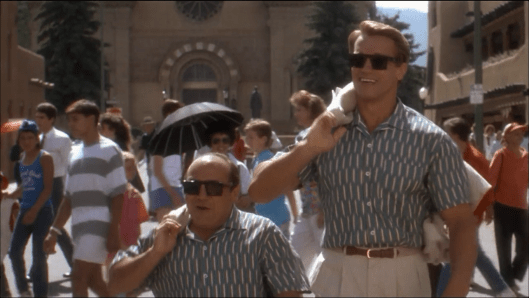
After thirty straight days of NaPoWriMo without touching one of her picks, it’s time to set things right with my faithful Viewing Companion, so I’ll be reviewing three of her chosen movies this month. The first is Twins, the 1988 odd-couple pairing of Arnold Schwarzenegger and Danny DeVito, which she chose in response to continued rumors that there will be a sequel called Triplets, co-starring Eddie Murphy of all people.
It’s an absurd notion that Schwarzenegger and DeVito could be brothers, much less twins, but the film knows it and sidesteps the stigma of being unrealistic with a fictitious genetics experiment that involved six fathers and produced one perfect specimen (Schwarzenegger) and one, um, imperfect side effect (DeVito). Where Eddie Murphy will fit in, I don’t know. Since the flawless Julius Benedict is raised on a utopian island, he only learns of his brother as an adult and searches for him, only to discover short Vincent is a two-bit criminal on the edge of a dangerously profitable scheme.
What Twins most reminded me of was 1999’s Blast from the Past, which I also saw and reviewed for the first time recently. Both Brendan Fraser in that film and Schwarzenegger here are clean-cut golden boys raised in isolation, and their first exposure to the big bad world (at age 35 in both) finds humor in their geeky fish-out-of-water charm and naïve misunderstandings of slang. But whereas Fraser was looking for love, Schwarzenegger’s Julius only cares about finding and helping his brother, from saving Vincent from vengeful loan sharks to encouraging that both of them find their long-lost mother (Bonnie Bartlett, whom I recognized from St. Elsewhere).
Twins isn’t quite a constant laugh riot, and its minor classic status owes more to its stars and its age than anything else; but it features a wealth of amusement, thanks to the interplay of DeVito’s comic experience and Schwarzenegger’s surprising capacity for humor—surprising because I believe this was his first entirely comedic role after years of building his action-hero reputation. Schwarzenegger even gets some wink-wink nods to his other films, from his action roots to a line that I think was reused in Batman and Robin. I also liked how the story morphs into a road trip movie, similar to that other 1988 film about someone discovering he has a brother he never knew about. Also along for the ride as joint love interests are the lovely Kelly Preston and Chloe Webb, whom I best know as that crazy alien abduction lady on Venkman’s TV show in Ghostbusters II.
Though Twins is one of the lesser classics from director Ivan Reitman, there’s enough buddy humor from the silly premise alone to make it worthwhile, and it actually finds a good deal of heart in Vincent’s realized desire for a family after growing up an orphan. I shudder at what convolutions Triplets may take to wedge in a third absurd sibling, but Twins fulfills its preposterous concept with light-hearted fun.
Best line: (Julius) “Actually, I hate violence.” (Vincent) “But you’re so good at it!”
Well, 2017’s National/Global Poetry Writing Month has finally come to an end, and I’m both proud and relieved to have made it through with thirty poems and reviews to show for it. Some are better than others, but at least I got through a backlog of films I wasn’t sure I’d get around to reviewing. A big thank you to everyone who liked, followed, commented, and supported me through the busy month of April, as well as the NaPoWriMo website for all the thought-provoking prompts for each day.
Here is a list of the films I reviewed, each with its own poem, in case you missed a day:
April 30 – About Time (2013) – List-Worthy (My favorite film reviewed this month)
Now that NaPoWriMo is over with, I’ll be writing at a much more relaxed pace, back to the two or three a week that I averaged before, but I’m already looking forward to the same challenge next year!
(Today’s final NaPoWriMo prompt of the month was for a poem about something that happens over and over. Following the theme of this time-travel charmer, I applied that to the hypothetical potential of living life repeatedly.)
Days and weeks and months repeat,
The same in name but each one new,
But wouldn’t it be quite the treat
To start them over and redo?
When in the mood for favorite foods,
Just think back to your grandest meal,
And when your second course concludes,
You’re free for thirds whene’er you feel.
When life becomes mundane or glum,
Just jump back to your fondest thrill,
A theme park ride or concert’s thrum
Or Wordsworth-worthy daffodil.
And how sought-after to rewind
To change regrets to words unsaid,
Slips untripped and frauds declined,
And dominoes unplummeted!
The twists and weaves of life one-way
Are seldom smooth to navigate,
But wouldn’t life, upon replay,
Have less distress to complicate?
___________________
MPAA rating: R (except for 5 F-words, there’s little reason this couldn’t be PG-13)
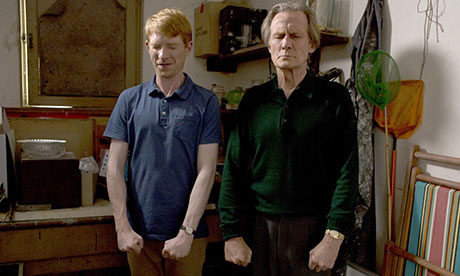
Rachel McAdams must have a thing for time travelers. Only four years after playing the titular Time Traveler’s Wife opposite Eric Bana, she again fell in love with a man possessing inherent time-traveling abilities, this time Domhnall Gleeson, in 2013’s About Time. Whereas the first film was bittersweet drama, About Time takes its subject in a lighter rom-com direction; for instance, the time-jumping ability that was random and uncontrollable in The Time Traveler’s Wife is little more than a super-powered perk in About Time, an inherited trait for only the men in the Lake family.
When Tim Lake (Gleeson) is called into his father’s study on his twenty-first birthday to be told a family secret, I can think of many worse revelations than being told you can now travel back along your own lifetime. Being rather awkward, one of Tim’s first thoughts is to win himself a girlfriend with his newfound ability, and after a less than successful attempt with the lovely Margot Robbie, he moves to London and seeks out his soul mate. All of this is done with a delightful comedic touch that makes Tim and his eccentric family feel real and lovable, and when Mary (McAdams) comes on the scene via a winsomely literal “blind date,” it’s clear from the first moments that love is inevitable…as long as time travel doesn’t get in the way.
I can’t remember the last time I was so thoroughly charmed by a movie. Well, maybe I do; it was probably La La Land, which is a more prestigious film all around, but both of them left me smiling and touched in a way most modern films don’t anymore. The repartee and chemistry between Tim and Mary put them up there with my favorite screen couples, even apart from the time travel aspect, which often adds some comedic wish fulfillment, undoing those little gaffes we all want to live over. In addition to Gleeson and McAdams, Bill Nighy delivers both warmth and pathos as Tim’s more experienced father, and his fellow Pirates of the Caribbean bad guy, Tom Hollander (almost unrecognizable with a beard), is likably sardonic as Tim’s first London friend.
As much as I loved it, I won’t claim that About Time is without flaws, such as a poorly explained revision that Tim performs when one of his time-altering good intentions goes awry. Likewise, I’ve heard a common complaint that the film doesn’t follow its own time travel rules and pays less attention than others of its genre to continuity and the butterfly effect. Yet, even these issues that would normally annoy me (like in The Lake House) couldn’t detract from a highly enjoyable romance or its bittersweet denouement. It’s a smartly written and delightful story worth going back in time to watch all over again.
Best line: (Tim) “There’s a song by Baz Luhrmann called ‘Sunscreen.’ He says worrying about the future is as effective as trying to solve an algebra equation by chewing bubble gum. The real troubles in your life will always be things that never crossed your worried mind.”
(For today’s NaPoWriMo prompt, we were to take a specific noun from a favorite poem and write a new poem inspired by it. I decided on Bliss Carman’s autumnal “A Vagabond Song,” specifically the word vagabond in the final line.)
We vagabonds sadly are rarer these days,
And nature’s beseeching has grown ever thinner.
She prays the same plea that once clouded men’s gaze,
But now only coaxes the set-in-their-ways
And the restless, romantic, unruly beginner.
The vagabonds dare where the rest stay at home,
For all the wide world is their chosen abode.
In life, let their hearth be wherever they roam;
In death, let the sea be their vast catacomb,
For no destination is end to the road.
The world calls us fools from their stolid safe spot,
But valleys and hills are the best way to cope
With life’s many miseries. I hear them not
When a waterfall’s all that’s within my earshot.
They may mock our style, but envy our scope.
Heed not the vain whispers of schedule and stress
When catching the call of the wilds beyond.
The creeks and cascades, while awaiting a yes,
Will yet preserve peace for the wide wilderness,
For the lucky old fool and the young vagabond.
_____________________
MPAA rating: PG-13
Based on the book Wild Pork and Watercress, Hunt for the Wilderpeople from New Zealand director Taika Waititi is an excellent example of one of those hidden gem movies that you might only learn about from a movie blogger singing its praises. It’s a quirky little film that more often than not allows “quirk” to equal absurd charm rather than mere weirdness, and not since Uphas the kid/old man dynamic worked so well. (There’s even a scene where a boy calls “ca-caw” to an old man on a porch. Coincidence?)
The film starts out suspiciously like an obscure Irish film I saw a while back called A Shine of Rainbows. Like the orphan boy in that movie, young troublemaker Ricky Baker (Julian Dennison) is taken in by a remote couple made up of a doting “Auntie” (Rima Te Wiata) and her surly and distant husband Hec (Sam Neill). After his new mother helps him feel at home, she sadly dies, leaving Ricky to form a grudging relationship with “Uncle” Hec instead. Beyond this point, though, the film goes in a wholly different direction from A Shine of Rainbows, sending Ricky and Hec out into the wooded wild, where a misunderstanding makes them fugitives and subjects of a national manhunt.
It’s a fine line between Ricky being obnoxious or just a normal kid rebelling against an unforgiving world, but Julian Dennison treads it quite well, especially with someone of Sam Neill’s caliber to rebel with. Neill elevates the whole movie, despite having undergone a Jeff Bridges-style transformation into a grizzled mountain man, and the development of the mismatched pair from tolerating each other to respecting and even loving each other is entirely natural and endearing (and uses haiku). Rima Te Wiata is also a great presence early on as Ricky’s foster “Auntie,” whose forced attempts at making him feel comfortable pay off with time.
The film’s offbeat sensibilities extend to its cinematography and music as well. The soundtrack blends folk, electronic, and even some kind of strange opera, and the camerawork is exceptional, as when a time-lapse is replaced by a spinning continuous shot that seamlessly switches from scene to scene while musically backed by Leonard Cohen. As we all know from The Lord of the Rings, New Zealand also boasts some truly spectacular scenery, which the film flaunts in glorious fashion. I was reminded too of Babe in how events were labeled like storybook chapters. Its unique style certainly made me wonder how Waititi will shake up the MCU by directing Thor: Ragnarok later this year.
With the sweet satisfaction that this film left me, I struggled on how exactly to rank Hunt for the Wilderpeople. Ultimately, it does have its downsides, mainly in its quirkiness not always working to its advantage. Several scenes meant to be funny just come off as odd, such as a man’s obsession with selfies or a priest’s rambling sermon, and I can see its style not being for every taste. Yet much of the humor did make me laugh, such as the Terminator references and Rhys Darby’s backwoods nutcase Psycho Sam, and I still found Hunt for the Wilderpeople to be a rewarding experience and very close to being List-Worthy, a hidden gem that deserves to be found.
Best line: (Ricky, reading his uncle’s wanted poster) “’Faulkner is Cauc-asian.’ Well, they got that wrong because you’re obviously white.”
(Today’s NaPoWriMo prompt was to employ Skeltonic verse, or short lines with rapid-fire, tumbling rhymes, which are always fun.)
A know-it-all
With quick recall
Will stand tall
Next to egos small
Because he knows
The stuff that goes
Toward beating those
On trivia shows,
Like sporting pros
And ratios,
Obscure logos
Of studios,
And poems and prose
And names of clothes
And things that few
Would say they knew
Unless they too
Enjoyed a clue
Or fact review
Like me and you;
At least I do.
__________
MPAA rating: PG-13
Every now and then, there’s a movie that just appeals to your interests specifically, and Starter for 10 appealed to mine. I had heard this British film starring James McAvoy had something to do with trivia, in this case the University Challenge TV show of the 1980s, and within the first few minutes, I felt this was a film for me, thanks to my personal love for shows like Jeopardy! Now I just had to hope the rest didn’t ruin it, and despite some inconsistencies along the way, it was an enjoyable little film all the way through.
Many people have fond memories of those ‘80s films full of stars before they were famous, you know, Stand By Me, The Outsiders, Taps, Red Dawn, and the like. But it makes sense that other generations would have the same kind of films, and Starter for 10 is one for the 21st century, even if it’s set in the 1980s. As McAvoy’s trivia-crazed freshman Brian goes off to college for the first time, I was surprised at how many actors I recognized. His two mates at home are Dominic Cooper and James Corden, while his two potential love interests at college are Alice Eve and Rebecca Hall, not to mention Benedict Cumberbatch as the uptight captain of the University Challenge team, again playing someone who believes himself to be the smartest person in the room. I was actually chuckling at their very presence together after seeing them all in the franchise films that have since earned them greater recognition (Eve and Cumberbatch in Star Trek into Darkness, Cooper and Hall and Cumberbatch in the Marvel Cinematic Universe, Cumberbatch and Mark Gatiss in Sherlock). I never expected to see a fight between Howard Stark and Doctor Strange, much less for Stark to win while Professor X watches in horror. It’s like a huge retroactive crossover! Or not.
Aside from the pleasure of seeing these young stars in their early roles, there are a lot of worthwhile themes here, ranging from infatuation and responsibility to academic honesty and learning from personal mistakes. Brian’s experience at college felt very realistic, both for good and ill, such as how he suddenly absorbs all manner of liberal causes and how the drama of college itself can often get in the way of one’s education. The humor can be hit-and-miss at times (one “meet-the-parents” scene was very awkward), but it made me laugh more than most comedies these days, further helped by a strong ‘80s soundtrack, most of which I’d never heard before. (I’m not too familiar with The Cure; sorry, Britain!)
I suppose I especially identified with Brian himself, and along with Shizuku from Whisper of the Heart, he’s probably the movie character in which I most see myself. He’s committed to being as clever as he can, learning things like literature, history, and why people like jazz. (Just watch La La Landfor that answer.) He finds more excitement in the mental stimulation of a trivia challenge than a pointless drinking party, and through his interactions with his mother, friends, and girlfriends, he’s still trying to figure himself out and overcome his mistakes. McAvoy is a great fit for him, even if he desperately needs a haircut, and the rest of the cast help give potentially shallow characters more depth than expected and match the early talent that would eventually make many of them household names. Similar to 2015’s Paper Towns, Starter for 10 has its imperfections and clumsy moments, but it’s a charming film that I connected with and which left me smiling by the end.
Best line: (Brian’s mom) “The people who really care about you don’t mind if you make mistakes. It’s what you do next that matters.”
(Today’s NaPoWriMo prompt was to focus on the sense of taste, so I had to go with one of the greatest foods known to man.)
Dear Chocolate, Chocolate, friend of mine,
How sweetly do you intertwine
With fruit or nuts, desire or fear,
A comfort in my worries drear,
A flavorful apotheosis
Of the highest form of sweet!
From pickiness when I was young,
I never spurned you from my tongue.
At holidays made consummate
And in between, dear Chocolate,
Your need’s my daily diagnosis,
My closest friend that I can eat.
_____________________
MPAA rating: PG-13
By all accounts, Chocolat is a film I should love. I am an admitted chocolate addict, and I love lighthearted romances with its kind of charm, especially when they have the added emotional depth this one retains. Yet for all its strengths and five Oscar nominations, I was more annoyed than charmed by Chocolat.
The story centers on a wandering chocolatier named Vianne (Juliette Binoche) and her young daughter, who move to a quiet and staunchly religious French village to open a chocolate shop. The problem is that they do so just as Lent begins, and Vianne’s atheist disregard for this traditional season of self-denial inevitably draws the ire of the town’s mayor Reynaud (Alfred Molina). Yet nothing can halt the power of chocolate, and Vianne’s natural charisma slowly wins over many of the town’s residents, as well as a member of a visiting gypsy band (Johnny Depp).
There’s much to enjoy about Chocolat, not least its whimsical tone and Rachel Portman score, and the full appeal of a mostly excellent cast. Binoche is infectious with her passion for chocolate and catering to others’ unacknowledged needs, while Depp displays a sweet and romantic allure he doesn’t usually get to show off in his weirder roles. Best of all is Oscar-nominated Judi Dench as Vianne’s landlady and first chocolate convert, whose cynicism and desire to reconnect with her grandson make this among her best roles and certainly worthier of an Oscar than her short appearance in Shakespeare in Love. Chocolate itself is also very much a star, and Vianne’s creations should make any chocoholic’s mouth water, which is why it placed #7 on my Candy in Movies list.
Yet all these positives only make the film’s religious vilification more frustrating. Perhaps it’s because I do fast for Lent every year, but I couldn’t root for Vianne’s campaign to make the townspeople yield to their temptations. I was hoping instead her business could survive until Lent was over, but no, Lent and fasting are seen as obstacles to be overcome, repression to be vanquished. The film’s characters, writers, and probably Joanne Harris, on whose novel the film is based, clearly misunderstand sin and the meaning of Lent, that personal abstinence is meant to bring its adherents closer to God by their sacrifice. There should be no conflict here if Vianne had not come during Lent, but instead, the people of the village seem to view any and all pleasure as a sin, whether it’s during Lent or not. Their indulgent awakening would have been more heartening if Lent and the Church weren’t scapegoats to spoil everyone’s fun. Molina’s Reynaud is the embodiment of the town’s religious stricture, even if he does have a rare humanizing moment or two. The turning point of his own surrender to “temptation” is a wholly ridiculous scene that most reminded me of a SpongeBob SquarePants episode called “Just One Bite,” where Squidward yields to his craving for Krabby Patties, a scene which (now that I think about it) was probably inspired by Chocolat. Yet what’s funny in a cartoon just felt strange and absurd in a film like this.
Chocolat would have been better as simply a Mary Poppins-ish tale of Vianne helping the town, such as how she inspires an abused wife to escape from actual oppression, but its antagonism was misplaced. Every time I started enjoying Chocolat, it kept reminding me that “chocolate good, religious oppression bad,” and while I wholeheartedly embrace the former point, the latter kept spoiling it for me. The fine acting and passion for one of the best foods ever invented are clearly key to Chocolat‘s appeal, but it could have been so much better if religion and tradition weren’t depicted as such finger-wagging killjoys.
Best line: (the village priest, giving a sermon) “I’d rather talk about [our Lord’s] humanity. I mean, you know, how He lived His life, here on Earth. His kindness, His tolerance… Listen, here’s what I think. I think that we can’t go around measuring our goodness by what we don’t do. By what we deny ourselves, what we resist, and who we exclude. I think… we’ve got to measure goodness by what we embrace, what we create… and who we include.”








 There’s much to enjoy about Chocolat, not least its whimsical tone and Rachel Portman score, and the full appeal of a mostly excellent cast. Binoche is infectious with her passion for chocolate and catering to others’ unacknowledged needs, while Depp displays a sweet and romantic allure he doesn’t usually get to show off in his weirder roles. Best of all is Oscar-nominated Judi Dench as Vianne’s landlady and first chocolate convert, whose cynicism and desire to reconnect with her grandson make this among her best roles and certainly worthier of an Oscar than her short appearance in Shakespeare in Love. Chocolate itself is also very much a star, and Vianne’s creations should make any chocoholic’s mouth water, which is why it placed #7 on