• Home
  • About Me
  • The List
  • THE LIST (2016 Update)
  • THE LIST (2017 Update)
  • THE LIST (2018 Update)
  • THE LIST (2019 Update)
  • THE LIST (2020 Update)
  • THE LIST (2021 Update)
  • THE LIST (2022 Update)
  • Top Twelves and More
  • The End Credits Song Hall of Fame

Rhyme and Reason

~ Poetry Meets Film Reviews

Rhyme and Reason

Category Archives: Reviews

Kelly’s Heroes (1970)

04 Thursday Jul 2019

Posted by sgliput in Movies, Poetry, Reviews, Writing

≈ 1 Comment

Tags

Action, Comedy, War

See the source image

Patriotism’s the best motivation
To battle a foe in defense of one’s nation,
But riches can be a compelling incentive
To make soldiers patient, resolved, and inventive.
So to end a war quickly, our side should begin
By telling our troops, to our rivals’ chagrin,
“They’ve got tons of gold, and it’s yours if you win!”
_________________

MPAA rating:  GP (PG-13 by today’s standards)

I kind of wish I could have written about a more patriotic film for July 4 than a heist film about soldiers stealing Nazi gold, but at least it was an American effort! Kelly’s Heroes has a lot of the same star-studded military appeal as other World War II films like The Dirty Dozen or The Great Escape, and it owes quite a bit to a stellar cast that seemed to be having fun making it.

With big names like Clint Eastwood, Telly Savalas, Don Rickles, Donald Sutherland, and Carroll O’Connor (a year before All in the Family started), you’d think that most of the film’s budget went into collecting its stars, which also include other recognizable faces like Harry Dean Stanton, Stuart Margolin, and Gavin MacLeod. But they still had plenty to spend on explosions and certainly don’t disappoint in the pyrotechnics department. Eastwood is his usual squinty-eyed self as the titular Kelly, who comes up with the heist plan when he learns of a bank full of gold bars behind enemy lines, but Donald Sutherland is easily the stand-out as the tank commander Oddball, an anachronistic hippy who always seems high as he exalts the power of positive thinking. Between him and Rickles, Kelly’s Heroes has much more comedy than your typical war film, though its lighthearted tone is somewhat undercut when the death toll starts rising.
See the source image

It’s funny that I can’t help but associate this film now with the anime Girls und Panzer, a ridiculous but fun exercise in tank war games, since the series actually shows some characters watching Kelly’s Heroes (specifically the scene where the German tank’s turret is stuck between a building and a tree) and one character goes undercover under the code name “Oddball.” So Kelly’s Heroes is clearly popular overseas as well. I’m not sure how much of it carries truth, since it was based on an apparently real wartime robbery that was covered up, but it’s a likable blending of genres that exemplifies collaboration through mutual self-interest and overcomes my usual reservations about heist movies, since it’s not illegal if you’re stealing from Nazis, right? It may not have gotten as much contemporary critical love as other war movies of that year, like MASH or Patton, but, for me, Kelly’s Heroes is easily the most watchable of the bunch.

Happy 4th of July, everyone!

Best line:  (Rickles as Crapgame, while they creep through a minefield) “Hey! I found one!”
(Big Joe) “What kind is it?”
(Crapgame) “The kind that blows up! How the hell do I know what kind it is?”


Rank:  List Runner-Up


© 2019 S.G. Liput
636 Followers and Counting


Green Book (2018)

01 Monday Jul 2019

Posted by sgliput in Movies, Poetry, Reviews, Writing

≈ Leave a comment

Tags

Biopic, Comedy, Drama, History

See the source image

Road trips are an odd affair,
The constant movement far from home,
A different bed come every night,
The landscape shifting out of sight
As cars continuously roam
On quests their occupants must share.

Friends may think they have rapport,
Until the road bares every irk
In ways that cannot be ignored,
And likewise those with no accord
May find that under quarrels lurk
A bond they never knew before.
_________________

MPAA rating:  PG-13

Who doesn’t love a movie about unlikely friendships? From Lethal Weapon to Driving Miss Daisy, there’s something universally appealing about two very different people overcoming those differences in favor of mutual respect, and, as with those two examples and this film, race is often one of those separators. Green Book is the latest crowd-pleasing member of the genre that also dives into that racial divide, and while some have accused it of not diving deeply enough, it hit an amusing and poignant balance that I enjoyed enormously.

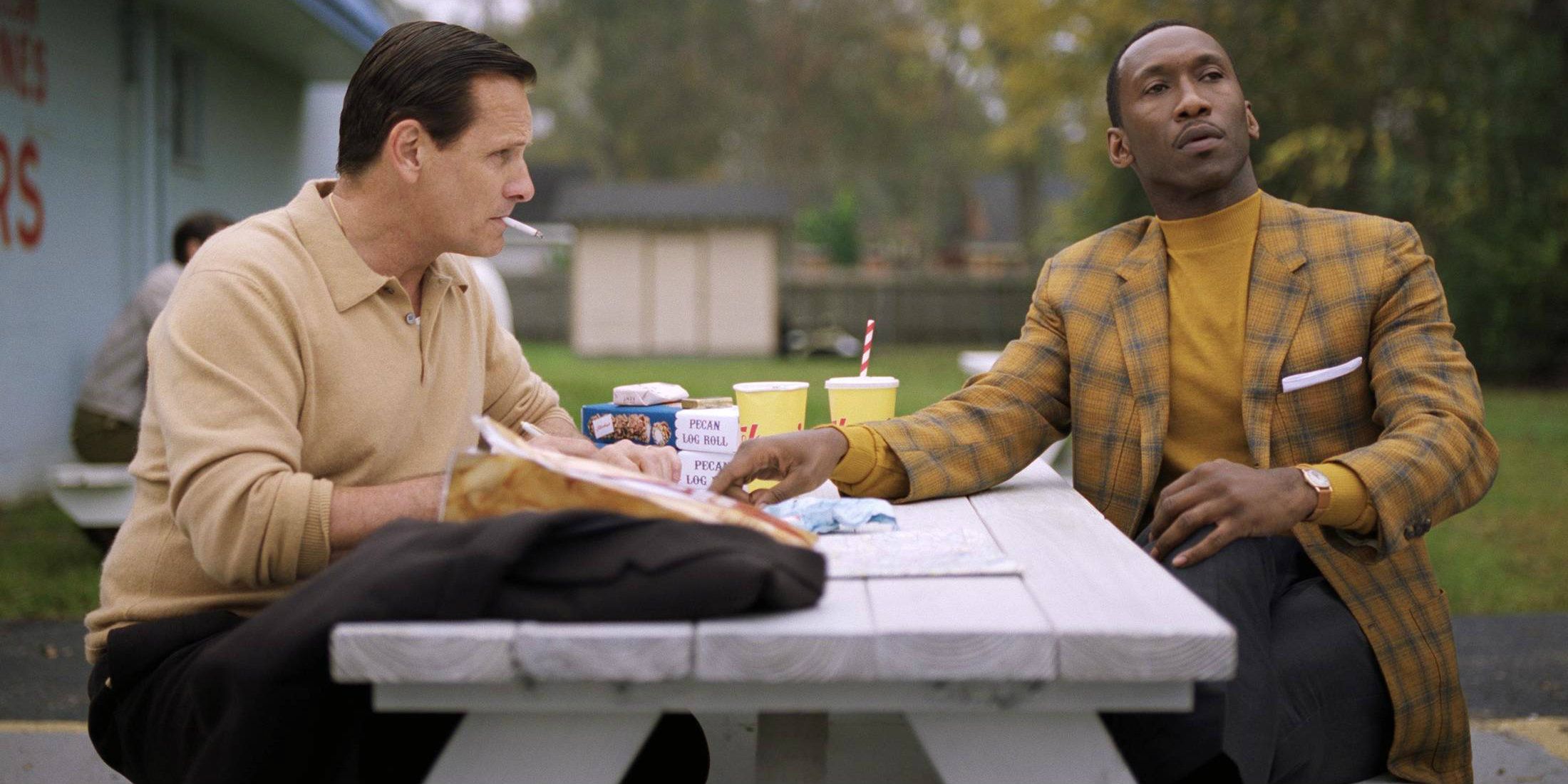
It’s hard to believe that Viggo Mortenson is Danish, much less that he once played Aragorn in Lord of the Rings, considering how perfectly he inhabits the role of an overweight Italian-American bouncer named Tony Vallelonga, a.k.a. Tony Lip. Despite some latent racism, he grudgingly accepts a job as a driver for famed black pianist Dr. Don Shirley (Mahershala Ali), who needs transportation and protection during a two-month concert tour of the South in 1962. Even beyond race, they couldn’t be more different, Tony crude and confrontational, Dr. Shirley sophisticated and haughty; hence, the unlikely friendship. It’s a role reversal of expected stereotypes of the era, and the two actors embrace the dichotomy while forming unexpected bonds through food, music, language, and the recognition of right and wrong.

See the source image

Many have called Green Book a reversal of Driving Miss Daisy, and while the point is not unfounded, Green Book has a more socially conscious goal in mind. It may not dive as deeply as some people may have wanted, but its view of race relations still feels honest and ultimately hopeful. (Incidentally, “some people” also say that Driving Miss Daisy and this film were unworthy Best Picture winners, but, in my opinion, “some people” are wrong.)

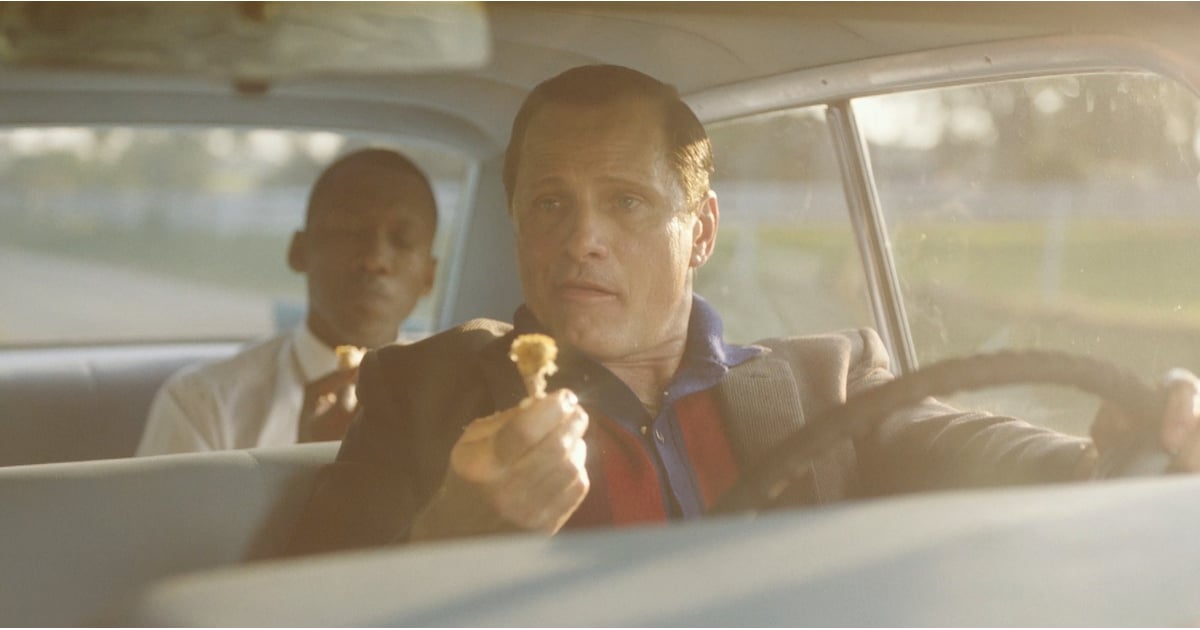
I really don’t get a lot of the backlash toward this movie, like the supposedly tone-deaf scene where Tony teaches Dr. Shirley how to eat fried chicken. It’s like critics are trying to filter it through every potential-racism, social justice lens they have at their disposal, while I don’t see it as anything but an example of the different worlds to which these two characters have been exposed. They each share pieces of those worlds with each other during their journey, whether it be Shirley’s eloquence in composing Tony’s letters home for him or Tony’s unwillingness to accept any insult. And while there are shades of the dreaded “white savior” tropes that critics make far too much of, I’d argue that Tony gets more from Dr. Shirley than the other way around, particularly a changed perspective on his former prejudice.

Contrary to the assertions of writer/producer (and Tony’s son) Nick Vallelonga, some of Dr. Shirley’s family have denounced Green Book as untruthful, claiming that his and Tony’s relationship was nothing more than that of employer and employee, while other sources have come out with evidence that they were in fact friends. Either way, Green Book takes its historical inspiration and creates a wholly satisfying road-trip movie, especially for those who don’t try to psychoanalyze its themes too deeply.

See the source image

Though it could have focused more on The Negro Motorist Green Book of its title, I, for one, am glad for its Oscar success, including Best Picture, Best Original Screenplay, and Best Supporting Actor for Ali. The performances and script are full of charm, humor, and empathy, and Green Book fits comfortably among the great unlikely friendship road movies, with an ending that even directly recalls the last scene of Planes, Trains, and Automobiles. Race is a touchy subject these days, and while many may disagree, this movie serves as a welcome reminder that mutual understanding can seem unlikely but is always within reach.

Best lines:  (Tony Lip) “The world’s full of lonely people afraid to make the first move.”

and

(Dr. Shirley, channeling MLK) “You never win with violence. You only win when you maintain your dignity.”


Rank:  List-Worthy


© 2019 S.G. Liput
636 Followers and Counting


First Man (2018)

24 Monday Jun 2019

Posted by sgliput in Movies, Poetry, Reviews, Writing

≈ Leave a comment

Tags

Biopic, Drama, History

See the source image

Space is a place where dreams are sent,
And there they wait for man’s ascent.
They wait and know that man was meant
To problem-solve, defy, invent,
And once the atmosphere is rent,
They’ll welcome us and our event
And say our effort was well-spent.

Space is a place of ill intent
That never gave man its consent
To test and dare and circumvent
The earth’s frontiers which won’t relent.
It waits to challenge and prevent
Man’s mystifying discontent,
So resolute and heaven-bent.

Space can hold wonders and laments,
Our certain death or will to thrive.
All these things it represents;
We’ll know for sure when we arrive.
_______________________

MPAA rating:  PG-13

Having loved La La Land, I was eagerly awaiting director Damien Chazelle’s next feature, especially when I learned it would be about Neil Armstrong and the moon landing. Both my mom and I have a special tie to the space program, since my grandfather worked for NASA and worked on the Apollo missions. When we heard some mixed reviews, we assumed that those naysayers just weren’t very interested in the space program, but our personal connection would be enough to overcome any faults. I wish that were true, because, as much as we wanted to love First Man, it was a bitter disappointment for my family.

See the source image

I’ve always enjoyed movies about space, whether it’s Gravity, The Right Stuff, or Apollo 13, not to mention any number of sci-fi films, yet I haven’t been so bored by one since Marooned. First Man had a tough job in detailing the life and work of a man who was famously laconic and understated, and while Ryan Gosling’s portrayal of Neil Armstrong is both of those things, he doesn’t add enough to the blank face and muted reactions to keep Armstrong from seeming just dull. The same goes for Claire Foy as his long-suffering wife Janet; she outshines Gosling with a few emotional fireworks, but their final scene together is a weird conclusion of emotional constipation, which also doesn’t mention their eventual divorce.

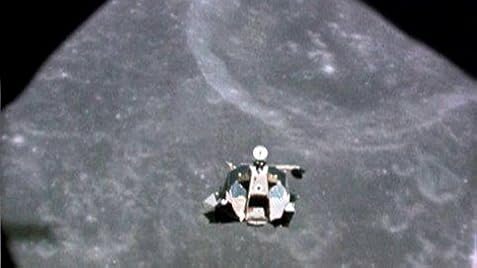
As for its portrayal of the space program, First Man does feature some riveting moments that showcase Armstrong’s levelheadedness and which haven’t been put to film before, such as a close call during one of his experimental test flights or the near disaster of Gemini 8. (I don’t recall the Apollo 1 fire being re-created before now in as much detail either.) The problem is that Chazelle chooses to focus on the claustrophobia of these moments by giving most of them a first-person, shaky-cam view that stays inside the cockpit, rarely letting us see what’s happening outside the spacecraft. It’s a clear artistic choice that gets old fast, and while I heard the moon landing itself makes it all worth it, there was nothing particularly special about that scene either. I appreciated its silent poignancy, but I was also distracted by the bizarre absence of stars. What makes it more bizarre is that I looked back at actual Apollo 11 photos, and there were no stars visible there either! Did I just never notice the black emptiness of space? Why wouldn’t there be stars? I realize that gripe is no longer the movie’s fault, but it still puzzles me on an astrophysical level.

See the source image

The subject may be historic, the casting may be full of recognizable faces, and the filmmaking pedigree may be impressive, but First Man was an unfortunate misfire for me. Compared with La La Land, it’s certainly a testament to Chazelle’s range as a director, but all those pluses just couldn’t overcome a weak script that didn’t spark enough interest in its potentially prosaic subject. And considering the visual extravaganzas that took place in Avengers: Infinity War and Ready Player One, it makes no sense to me that this would win the Oscar for Best Visual Effects. I wanted to like it, and I still think a great movie could be made about Armstrong and Apollo 11, but sadly First Man is not it.

Best line:  (Armstrong) “I don’t know what space exploration will uncover, but I don’t think it’ll be exploration just for the sake of exploration. I think it’ll be more the fact that it allows us to see things. That maybe we should have seen a long time ago. But just haven’t been able to until now.”


Rank:  Dishonorable Mention


© 2019 S.G. Liput
635 Followers and Counting


Shazam! (2019)

17 Monday Jun 2019

Posted by sgliput in Movies, Poetry, Reviews, Writing

≈ 2 Comments

Tags

Action, Comedy, Drama, Fantasy, Superhero

See the source image

Deep in a magic dimension few know,
A once mighty wizard in weakness resides,
Guarding great evil since eons ago,
And keeping it sealed, he yet watches and hides.
With the rise of a hero, his fall coincides.

Somewhere it’s certain this champion waits
To prove himself worthy and purest of heart,
But waiting has led to the direst of straits,
And now the old wizard has need to impart
His power to one perhaps not quite as smart
Or noble or unselfish as he prefers,
But beggars aren’t choosers for superpowers.
Perhaps in this boy, a new champion stirs.
_____________________

MPAA rating:  PG-13

It’s amazing that, within months of each other, both Marvel and DC put out films about their respective characters named Captain Marvel. DC’s version predates Marvel’s but is now known as Shazam, a word that was apparently just his catchphrase for transforming into a muscle-bound hero. This superhero-now-known-as-Shazam may date back to 1939 and have two TV series from the 1970s/80s to his name, but I was unfamiliar with the character and greatly enjoyed this introduction to him.

See the source image

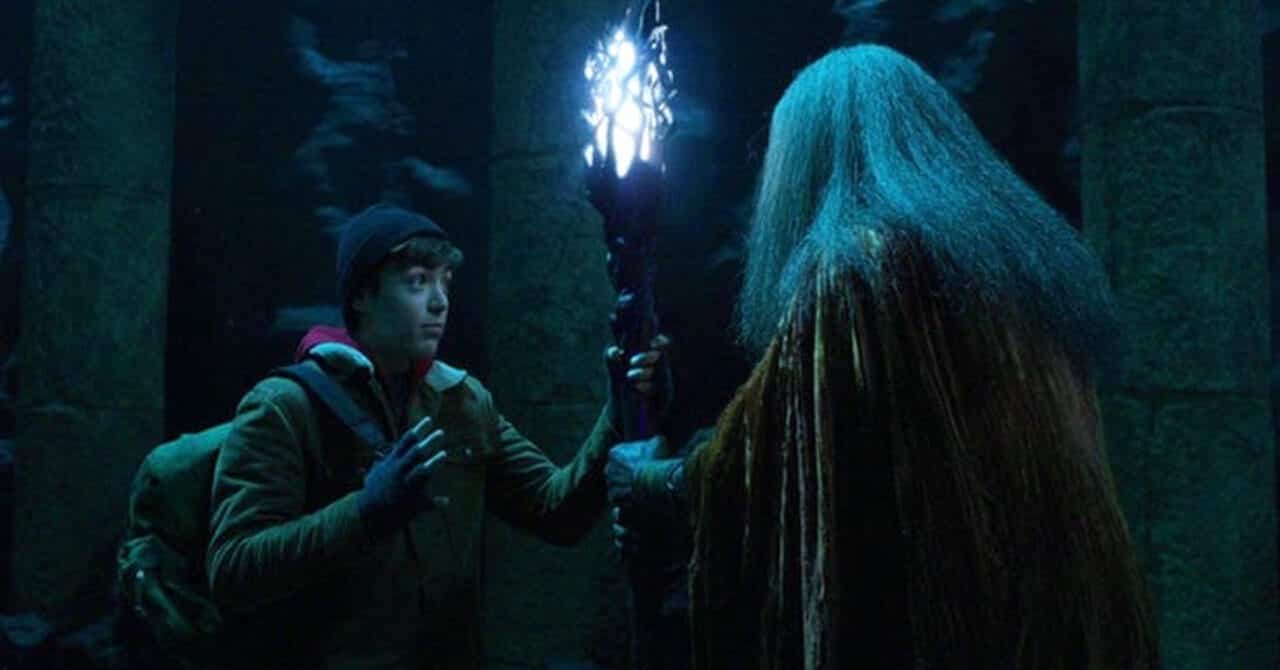
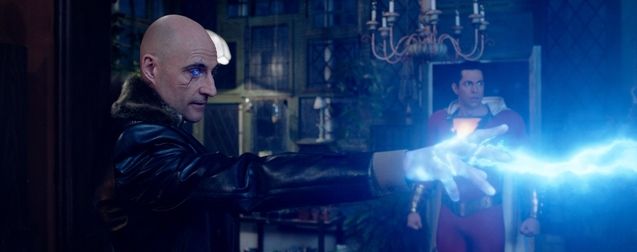
As expected from the trailers, Shazam is basically Big with superpowers, but it does quite a bit right in taking the same concept of a boy in an adult’s body and running with it in unexpected and largely fun directions. After being separated from his mother, young Billy Batson (Asher Angel) grows up as a foster kid desperate to find her and always landing in trouble. Eventually, he’s taken in by the generous Vasquezes (Cooper Andrews and Marta Milans) and their gaggle of fellow foster kids, including superhero-fan Freddy Freeman (Jack Dylan Grazer). Soon, Billy is unexpectedly summoned by a weakening wizard named Shazam (Djimon Hounsou) and gifted with the body and abilities of a superhero, in order to stop a raging villain (Mark Strong) with the power of the seven deadly sins.

Like I said, I wasn’t aware of Shazam’s existence, much less the fact that his name is an acronym, representing his gifts of the Wisdom of Solomon, the Strength of Hercules, the Stamina of Atlas, the Power of Zeus, the Courage of Achilles, and the Speed of Mercury. (I suppose I’ll ignore the historical/Biblical figure of Solomon being lumped in with Greek and Roman myths.) Yet not knowing about the character helped me appreciate the story without any preconceived opinions about how it should be, as would be the case with Superman or Batman. It was interesting then to research afterward and realize how much of the plot had its roots in the comics. (I’m just nerdy like that; I always study a movie’s backstory before or after seeing it.)

See the source image

The kid actors are delightful, and Zachary Levi is perfectly cast as Billy’s adult form, nailing the juvenile mentality and wide-eyed wonder of a boy turned into a man and discovering what superpowers he has. It’s goofy and frequently hilarious, which is quite the contrast to Strong’s scenes as the magic-obsessed Doctor Sivana. The shifts in tone can be quite jarring at times, with Sivana’s Sins manifesting in one surprisingly violent scene that could have been toned down. Nevertheless, I appreciated how Billy’s sense of feeling unworthy reflected Sivana’s, like the latter was a dark reflection of the former, making Sivana prime archenemy material.

Shazam might just be my favorite installment yet of the DC Extended Universe, a fun exercise in wish fulfillment that is deepened by a heartwarming message of adoptive family. For anyone who enjoyed the familial themes of Meet the Robinsons or Spy Kids, Shazam is similarly gratifying. As an origin story, this is the rare DC property that can hold its own next to Marvel, and I, for one, look forward to more superhero movies like it.


Rank: List-Worthy (tied with Captain Marvel, because I can)


© 2019 S.G. Liput
634 Followers and Counting
 

2019 Blindspot Pick #5: Best in Show (2000)

10 Monday Jun 2019

Posted by sgliput in Blindspot, Movies, Poetry, Reviews, Writing

≈ Leave a comment

Tags

Comedy

See the source image

Behold, the yearly dog parade,
A purebred canine cavalcade,
Where dogs and humans side by side
Will strut their stuff with puppy pride.

Akitas, corgis, Komondors,
So many march upon all fours,
From toys that bring to mind a rat
To mastiffs who could eat a cat.

There goes the Rottweiler and hound,
Content to prance around and round.
And there’s the Yorkshire terrier
Who broke the cuteness barrier.

There’s Marmaduke and Lassie here,
And dear Old Yeller (sheds a tear),
And Hachi, Benji, Beethoven,
With Scooby Doo and Rin Tin Tin.
(I’d say their breeds, but for the young,
Their screen names just roll off the tongue.)

There goes a walking mop on paws,
And poodles barbered…well, because,
And pugs and shar peis that are set
With ugly charm I don’t quite get.

And by each furry quadrupedal
Rival vying for a medal
Walk the humans with concern,
Who reap rewards their pooches earn.
_____________________

MPAA rating:  PG-13

I can’t recall exactly what prompted me to add Best in Show to my list of Blindspots this year, but I’d gotten the general impression that it was a great classic comedy that I’d somehow missed out on until now. Directed and co-written by Christopher Guest, clearly inspired by his time starring in This Is Spinal Tap, this mockumentary about the weird world of dog shows isn’t quite worthy of the blue ribbon I was expecting.

See the source image

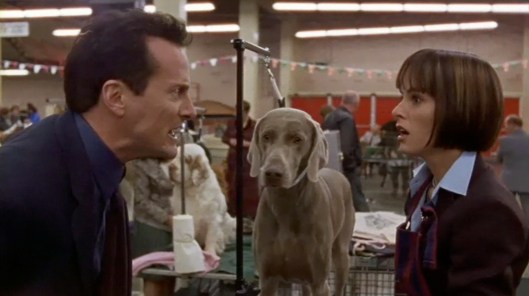
These mockumentary films seem to me an acquired taste, so dependent on improv and awkwardness, and with this film and This Is Spinal Tap being the only two I’ve seen, I don’t think I’ve acquired it yet. My family watches the National Dog Show every Thanksgiving, so I was interested in seeing a comedy built around the backstage drama of quirky competitors. And quirky they are, including an obsessively competitive couple (Parker Posey and Michael Hitchcock), a suburban schmoe (Eugene Levy) and his formerly promiscuous wife (Catherine O’Hara), a pair of gay Shih Tzu lovers (Michael McKean and John Michael Higgins), a backwoods fisherman (Guest), and a trophy wife (Jennifer Coolidge) and her stressed trainer (Jane Lynch).

Through their interactions and direct interviews, we see all of their insecurities, secrets, checkered pasts, and eccentricities firsthand, and while there’s no denying the talent of the cast, the material never rises above mere amusement. Some of the shenanigans, such as Posey and Hitchcock’s fanaticism over their dog’s toy, are actually more sad than funny, and Fred Willard’s role as the dog show’s absent-minded commentator struggles so hard to be constantly funny that he’s sort of annoying instead. (Interestingly, John Michael Higgins would go on to play a similar but IMO funnier announcer in the Pitch Perfect films.)

See the source image

Yet, even if it could use more belly laughs, Best in Show was still amusing, and, based on my own dog preferences, I was pleased with the eventual winner of the competition. Plus, I did enjoy the large and recognizable cast, which also included Ed Begley, Jr. and Bob Balaban. Best in Show might not have been as funny as I’d hoped, but it did reaffirm something about myself: I’m much more of a cat person.

Best line: (Sherri Ann Cabot, about her decrepit rich husband) “We have so much in common; we both love soup and snow peas, we love the outdoors, and talking and not talking. We could not talk or talk forever and still find things to not talk about.”


Rank: Honorable Mention


© 2019 S.G. Liput
634 Followers and Counting
 

2019 Blindspot Pick #4: The Longest Day (1962)

06 Thursday Jun 2019

Posted by sgliput in Blindspot, Movies, Poetry, Reviews, Writing

≈ 4 Comments

Tags

Action, Classics, Drama, History, War


See the source image

“Damn the torpedoes.” “Remember the Maine!”
“Remember the Alamo!” was the refrain
Of the boys and the men
Who fought time and again,
Who offered their country their blood and their pain.

And on June the sixth of 1944,
Such men charged the beaches of Normandy’s shore.
They leaped from the sky
Knowing well they could die,
And waded through carnage that had been their corps.

The weather unfriendly, the Germans less so,
The struggle brought many a foe and friend low.
The Allies that day
Put their grit on display,
And paid a debt we who are living still owe.
_____________________

MPAA rating: G (should be at least PG)

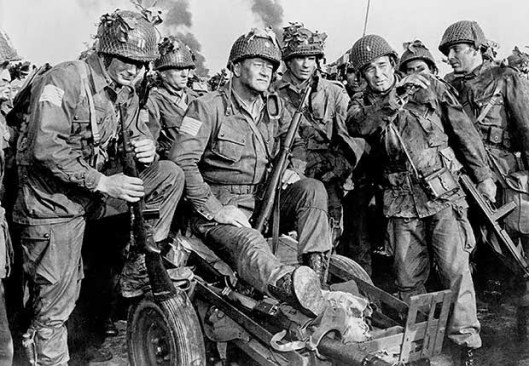
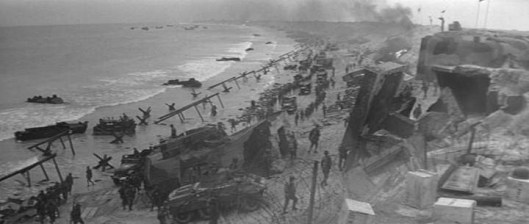
About two years ago, I reviewed Saving Private Ryan, one of that year’s Blindspots, so it seemed only fitting to review another Blindspot pick about D-Day on June 6, the day the world was saved by the Allied forces. The Longest Day may be an older film, but its re-creation of the struggle on the beaches of Normandy is more expansive than Spielberg’s and well worthy of being ranked among the great war movies of all time.

While Saving Private Ryan had a focused plot with developed characters, The Longest Day is much more concerned with the broader history of the D-Day landings: the cautious planning, the German belief that no invasion would come that June, the watching of weather reports, the confusion of battle, and the plethora of individual stories, most of which have a basis in truth. At nearly three hours long, it might have been called The Longest Movie, yet it’s rarely boring. It may take two thirds of its runtime to reach the point that Saving Private Ryan begins, but it offers much more insight into the strategy and planning that went into the assault and the various efforts of the Americans, British, French, paratroopers, and French civilians, as well as the German side, all presented realistically with dialogue in their native tongue.

See the source image

Saving Private Ryan may be known for its battle scenes, but The Longest Day is no slouch either, depicting the invasion on an impressively epic scale. After the ships hit the beaches, there are a number of jaw-dropping aerial tracking shots that offer an incredible view of the battlefield, and without CGI, I can only imagine the work that went into creating such carefully orchestrated scenes. The fact that many of the cast and crew actually saw action on D-Day and contributed their first-hand accounts, along with many of those who are actually depicted in the film, only adds to the authenticity of the production, something no film in the future could hope to match.

The one thing The Longest Day doesn’t have is clearly defined characters, despite a cast jam-packed with stars of the day. It may have won deserving Oscars for its cinematography and special effects, but there’s a reason it didn’t get any acting nominations, simply because there’s not enough for any one actor to do.  John Wayne, Henry Fonda, and Robert Mitchum are probably the biggest stars, but you’ll likely recognize the names or faces of Red Buttons, Jeffrey Hunter, Roddy McDowall, Rod Steiger, Richard Burton, Sean Connery, and Peter Lawford, to name only a few. With such a who’s who of talent, it was just a tad disappointing that we spend so little time with any of them, sometimes only a single scene, and don’t always find out what became of them. Yet this is a film about the events rather than the people (the name and rank labels are more for context than for actually keeping track of the characters), and there’s nothing wrong with that, especially with so many triumphant, sad, or ironic episodes throughout that are worth telling but don’t necessarily warrant a movie of their own.

See the source image

My own grandfather was among the men who stormed the beaches of Normandy, and films like Saving Private Ryan and The Longest Day really help me as a detached viewer to appreciate the sacrifices of what was truly the Greatest Generation. As for which film is better, I’m torn. Saving Private Ryan held much more visceral emotion but largely through extreme violence I usually steer clear of; for normal viewing, I think I prefer The Longest Day’s presentation of bloodless action that still denotes the grand and hellish reality of war. Both have their place, one raw and poignant, the other detailed and comprehensive, and I’m grateful to have finally seen both through this Blindspot series. One ship commander tells his men, “You remember it. Remember every bit of it, ’cause we are on the eve of a day that people are going to talk about long after we are dead and gone.” Thanks in part to films like this, he’s absolutely right.

Best line: (said by both an American and a German, an insightful contrast) “Sometimes I wonder which side God is on.”


Rank: List-Worthy (tied with Saving Private Ryan)


© 2019 S.G. Liput
633 Followers and Counting


Mary Poppins Returns (2018)

05 Wednesday Jun 2019

Posted by sgliput in Movies, Poetry, Reviews, Writing

≈ Leave a comment

Tags

Disney, Family, Fantasy, Musical

See the source image

They say that you cannot return to the days
When the world held the awe it no longer displays.
The people and scenes are no more in their prime,
And you aren’t the you that you were at the time.
The flavors and sounds may be echoing still,
But the farther you get, the more gone is the thrill.

The memory seals them away as in glass,
Preserving their pricelessness as the years pass.
And even as foolish modernity tries
Revisiting heirlooms to revitalize,
Nostalgia may warrant a smile and sigh
At the echoes that fade but are sure not to die.
_______________________

MPAA rating: PG

There are some movies that shouldn’t be touched by Hollywood’s incessant need to remake its old classics, not necessarily because the originals are better by default, but because there’s no way they can compete with a film that was, is, and always will be a classic. I thought for sure that Mary Poppins was one of those movies, but Disney had other ideas. What they delivered in Mary Poppins Returns is as close as the modern day can come to the old-school style that created its predecessor, but try as it might, there’s just something missing.

See the source image

Julie Andrews is irreplaceable, but when I heard Emily Blunt was to play Poppins, I figured she had the best chance of anyone to fill her shoes. And in many ways, she does, right from the moment she floats in on the end of a kite flown by one of Michael Banks’s children. Michael (Ben Whishaw) is all grown up now, a widower still reeling from the loss of his wife and struggling to hold onto the family home. Despite his and Jane’s (Emily Mortimer) best efforts, Michael’s three largely responsible kids are in need of some comfort and whimsy, and thus Mary Poppins steps in, perhaps a bit more smile-prone than before but close to the way they/we all remember her.

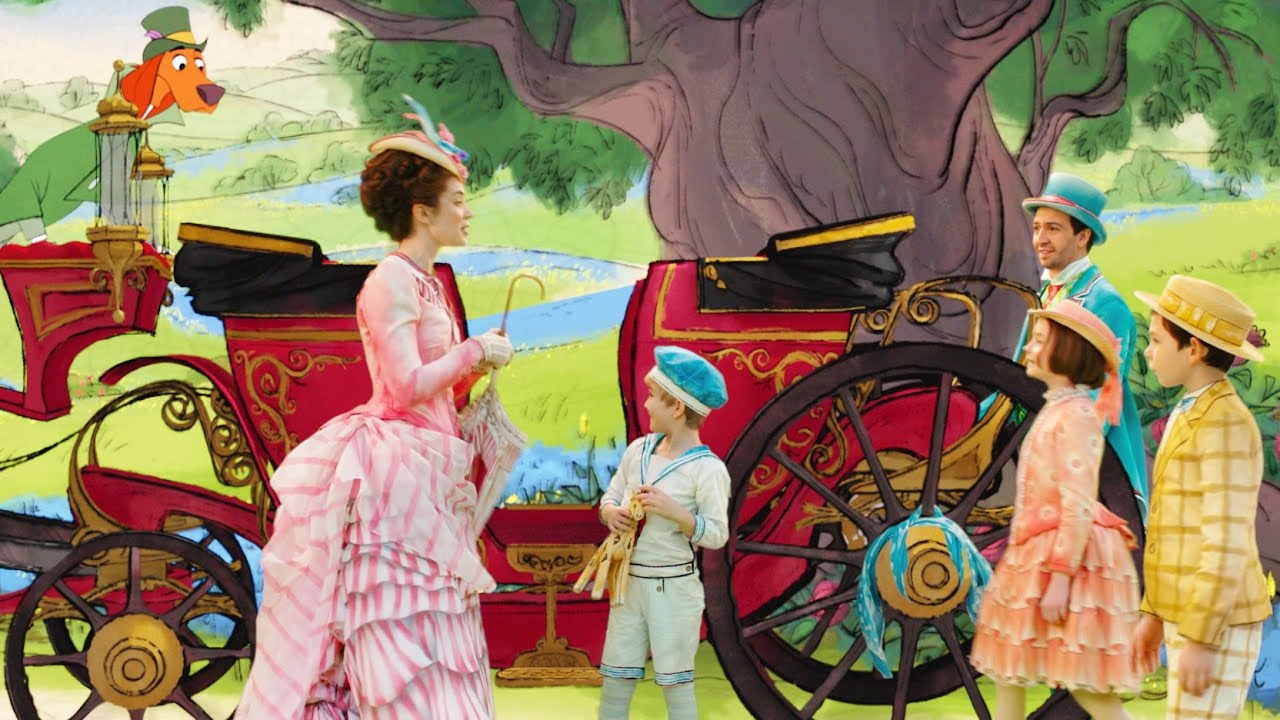
Mary Poppins Returns is a lot like Star Wars: The Force Awakens in its faithful adherence to the original (some might say too faithful). It follows the general plot of its forerunner to a tee, the same character types, the same sequence of events. Instead of jumping into a chalk drawing, they spin into a cracked ceramic bowl for another semi-animated holiday; instead of floating with Mary’s Uncle Albert, they turn upside-down with her cousin Topsy (Meryl Streep). In place of Dick Van Dyke’s chimney sweep Bert, there’s Lin-Manuel Miranda as lamplighter Jack, doing an excellent job at being casually charming. There are differences, of course, such as the presence of a genuine villain in Colin Firth’s bank president, but sticking so close to the original formula just begs for direct comparison, and Mary Poppins Returns just doesn’t quite match the first.

See the source image

Yet it’s so close to the spirit of the original that I can’t help but wonder how much the original relies on nostalgia. Mary Poppins is an incomparable, wholesome family movie, but I am surprised at times to think that Julie Andrews won her Oscar for it rather than The Sound of Music. Its plot is loose and episodic, so I can’t criticize the sequel for being the same. I knew my VC, as a staunch fan of the first film, would have the hardest time accepting Mary Poppins Returns, and while she gave it a good try and liked the beginning, she essentially checked out when it no longer conformed to her idea of what Mary Poppins should be.

At one point in the entertaining segment with animation, Mary gets up on stage to perform with Jack and sings some slightly risqué lyrics. My VC immediately thought, “Mary Poppins would never do that,” and the facsimiled magic was broken. That’s why revisiting such classics is so potentially treacherous; while original content is subject to the creator’s whims, sequels and remakes depend on the audience’s. The same happened with The Last Jedi and the whole “not my Luke” debacle; I loved the film but couldn’t deny all of its criticisms. As with Mary Poppins Returns, it’s simply a matter of whether it bothers you or not.

See the source image

It probably sounds like I didn’t like Mary Poppins Returns, but I did, just not as much as its classic forebear. The music and choreography aren’t as memorable, and by the two-thirds mark, it was bordering on boring, making me think it could have benefited from a shorter runtime than 130 minutes. Yet it has an old-school charm, evident in both the vintage streets of live-action London and the small but welcome return of some 2D Disney animation. In many ways, I’m just glad that movies like this can still be made today and perhaps capture the hearts and future nostalgia of another generation. It at least does no harm to the legacy and spirit of the original and, especially toward the end, comes closer than I ever thought a modern-made Mary Poppins sequel could come.

Best line: (Mary Poppins, singing) “Nothing’s gone forever, only out of place.”


Rank: List Runner-Up


© 2019 S.G. Liput
633 Followers and Counting


VC Pick: Patton (1970)

27 Monday May 2019

Posted by sgliput in Movies, Poetry, Reviews, Writing

≈ Leave a comment

Tags

Biopic, Classics, Drama, History, VC Pick, War

See the source image

What wins wars?
It’s a question hard to answer
That no army can refuse.
For if every side could answer it,
No side would ever lose.

What wins wars?
Some would say that it’s commitment
Or resolve to reach the goal.
But commitment breeds fanaticism
If it lacks control.

What wins wars?
Some would point to their resources,
Which are squandered easily.
Some would point to perseverance
Or to strength or bravery.

What wins wars?
All of these are necessary,
But they’re not the final trade.
There’s a risk to every battle;
There’s a price that must be paid.

What wins wars?
‘Tis the soldiers wielding courage
And the strength to persevere,
Those committed to their country,
Without whom we’d not be here.
__________________

MPAA rating:  GP/PG (more of a PG-13 for language)

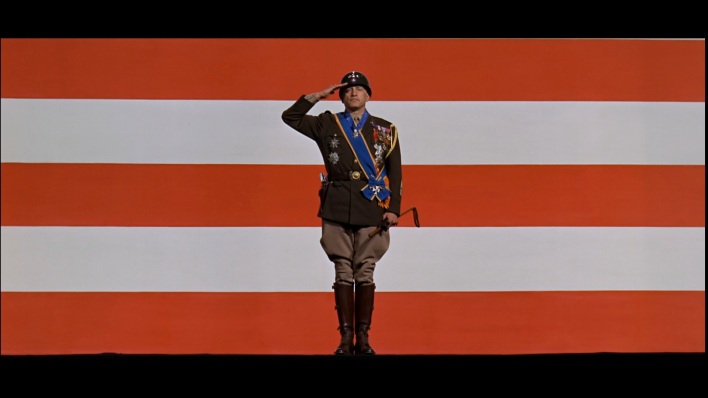
My VC has been urging me to review Patton for some time now, and I figured Memorial Day was the perfect time for this World War II biopic. Patton benefits from an Oscar-winning performance from George C. Scott and the Oscar-winning screenplay from none other than Francis Ford Coppola, who interestingly credits this film’s success with his being allowed to direct The Godfather.

See the source image

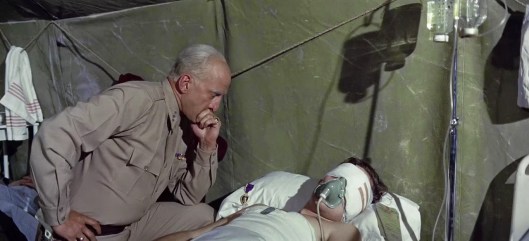
While other actors are good, including Karl Malden as General Omar Bradley, this movie lives and dies by the effectiveness of Scott in the title role, and from the first iconic speech he delivers in the film’s opening, speaking to the troops in front of an enormous American flag, he embodies General George S. Patton’s patriotic resolve and uncompromising will. The score is similarly iconic, providing perfect accompaniment to Patton’s military ambitions, and certain scenes are distinctly memorable, like Patton’s slapping of a shell-shocked soldier or his shoot-off with a swooping enemy plane.

All that said, war movies from the ‘70s aren’t what they are today. While I’m grateful for the lack of extreme content, there’s not much action, with the focus instead on Patton as a character. That’s hardly a bad thing, but at nearly three hours, the plot loses steam at times and didn’t need to be that long. I also found it odd that the film stopped short of Patton’s unexpected death in a car accident, not even mentioning it in an ending footnote.

See the source image

As a fan of history, though, I found Patton a great character study of one of America’s greatest generals, providing insight into his lesser known activities as well, such as his passive role in the D-Day invasion and his many difficulties with censoring himself in interviews. He was a monstrous warmonger to some and a nationalist hero to others, a dichotomy of characterizations that the film embraces in equal measure. Considering its balanced treatment and biographical importance, I can see why it won Best Picture that year, in addition to Best Director, Original Screenplay, Film Editing, Sound, Art Direction, and Actor (which Scott famously refused). It also reminded me that Patton himself was a poet, so I ought to add this film to my list of poems used in movies. It’s a bit too long and slow to watch often, but it definitely ranks among the greatest war biopics.

Best line: (Patton) “Now I want you to remember that no bastard ever won a war by dying for his country. He won it by making the other poor dumb bastard die for his country.”


Rank: List Runner-Up


© 2019 S.G. Liput
632 Followers and Counting
 

Pulp Fiction (1994)

24 Friday May 2019

Posted by sgliput in Movies, Poetry, Reviews, Writing

≈ Leave a comment

Tags

Drama, Thriller

See the source image

It’s a dark and sordid world we dwell in,
Home to many a thug and felon,
Home to murderers and liars,
Thieves and daily hell suppliers,
Wickedness and base desires.

I don’t deny such things exist.
I’ve heard the tales; I get the gist.
Too much can hurt the human heart,
But watching it’s the easy part.
It’s realistic, life as art.

The darkness, yes, can entertain,
But how untouched do we remain?
Such things we cannot just ignore,
But when we laugh or cheer at gore,
I fear for what is at our core.
________________

MPAA rating:  a hard R

Unlike so many other cinephiles out there, I am not a fan of Quentin Tarantino. And I can say that even without having seen any of his movies…well, except for this one. His reputation precedes him, you might say, and I’ve never been eager to seek out the work of a director known for the severity of his R ratings. Nevertheless, Pulp Fiction has become such a mainstay of cinema that I felt I had to check it out, especially when it aired on TV, minus its 265 F-words (according to IMDb).

See the source image

It’s too absolute to say I didn’t like Pulp Fiction because there’s quite a lot to appreciate about it. That is to say, I liked its style but not its content. It’s chock full of colorful characters, including two bantering hit men (John Travolta and Samuel L. Jackson), a mob boss (Ving Rhames) and his girlfriend (Uma Thurman), a boxer on the run (Bruce Willis), and a seemingly unrelated pair of lovers/thieves (Tim Roth and Amanda Plummer). The nonlinear story is especially well-executed, with characters’ stories jumping back and forth in time; though I could see that becoming confusing for some, it all fits together like a puzzle, cleverly offering backstory or glimpses of what’s to come. In addition, stripping away all the profanity, I can see why Tarantino has been praised for his dialogue, crafting banter that feels like a natural conversation yet provides some eloquent insight into how his characters view the world.

So yes, on some level, I enjoyed Pulp Fiction’s style, but its substance is clearly not for me. Even without the language, its dive into the seedy underbelly of Los Angeles isn’t as much fun as the film’s soundtrack tries to make it, nor does the flippancy with which it treats an accidental murder and its cleanup make it any less disturbing. The film is sorely lacking a character to root for, because although there are plenty of motley personalities, there’s not a moral compass to be found among them. You might root for Bruce Willis, but his reaction to inadvertently killing somebody doesn’t paint him as much better than the rest. The one gleam of hope is Samuel L. Jackson’s intense turn as Jules Winfield, who does at least question his life of violence, culminating in an admittedly brilliant stand-off at the end.

See the source image

From Marcellus Wallace’s glowing briefcase to John Travolta’s dance with Uma Thurman (love that Fall Out Boy song!), I can appreciate Pulp Fiction for its influence on pop culture and how it has inspired other works, particularly the anime Baccano, another non-linear, unnecessarily violent story that I enjoyed far more than this one. Yet I doubt I’ll ever have the desire to watch this iconic movie again. I loved the story structure, but not the rampant murder, drug abuse, and rape. It’s a cultural touchstone I’ll only touch once.

Best line: (Harvey Keitel’s The Wolf, summing up so much of this movie) “Just because you are a character doesn’t mean that you have character.”


Rank: Dishonorable Mention


© 2019 S.G. Liput
632 Followers and Counting


Mortal Engines (2018)

17 Friday May 2019

Posted by sgliput in Movies, Poetry, Reviews, Writing

≈ Leave a comment

Tags

Action, Drama, Sci-fi, Thriller

See the source image

We all survive in different ways
When struggles line our path.
We cry, we grieve, we carry on
And curse the aftermath.

There’s healthy ways to deal with loss,
Like, say, the world’s demise.
Yet most dystopias suggest
That man won’t be so wise.

Authoritarian regimes
Are now a stock motif.
But giant cities set on wheels?
That takes some disbelief!

Yet who can say what man might do?
His foolishness is nothing new.
_________________

MPAA rating: PG-13

I’m clearly more forgiving than most critics when it comes to the fantasy and sci-fi genres. In fact, I could probably compile a list of sci-fi films that critics have savaged and I’ve still enjoyed (note to self: make such a list for later). I was eagerly awaiting the release of the Peter Jackson-produced Mortal Engines, which promised a young-adult Mad Max: Fury Road on an even bigger scale, but then it tanked at the box office and earned a mere 26% on Rotten Tomatoes. That made me question my prior expectations, but now that I’ve seen it, it definitely fits into the category of movies that are better than their reviews indicate.

See the source image

Based on the first of a quartet of novels and directed by Christian Rivers, who has worked on the effects of many Jackson films, Mortal Engines is one of those far-flung, highly unlikely post-apocalyptic futures where the world has radically changed and forgotten its past, as evidenced by the amusingly misinterpreted “relics” of our present day. In this world, a terrible war has led to a system of “municipal Darwinism” in which cities have become mobile, mounted upon enormous tank tracks so they can hunt smaller towns for their resources, with London being the strongest. A scarred girl named Hester (Hera Hilmar) seeks revenge on London’s Deputy Lord Mayor Valentine (Hugo Weaving in familiar villain mode) for the death of her mother, and when a museum worker named Tom (Robert Sheehan) learns the truth, he is thrust into a journey with Hester to stop Valentine’s plans for world domination.

Mortal Engines has its imperfections, particularly in the way it blatantly echoes many better movies, such as Star Wars and Howl’s Moving Castle. (Really, Star Wars is a huge influence.) Yet there’s nothing that would warrant the film’s poor box office, unless people just don’t connect with the story’s post-apocalyptic quest and relatively unmemorable characters. The actors do their best, though, and I thought the film more than made up for its weaknesses with its epic steampunk visuals and fast-paced storyline.

See the source image

There are many references to unfamiliar places and events that are unique to the film’s internal history, and while this might make it hard to follow at times, I love this kind of world-building, making the story’s universe feel bigger than what we see onscreen. The moving cities crafted by Weta Digital reflect the same level of commitment and detail that the company brought to Peter Jackson’s Middle-Earth films. And while the plot can feel derivative at times, one subplot featuring Stephen Lang as an undead cyborg adds great tension and a surprisingly emotional payoff. Mortal Engines may not be the blockbuster I thought it could be and certainly isn’t on par with The Lord of the Rings, but for fans of the genre, it’s a large-scale, effects-heavy adventure that deserved much better.

Best line: (Katherine Valentine) “How can a society so advanced, so scientific, be so stupid?”   (Tom) “Well, no more stupid than people today.”


Rank: List Runner-Up


© 2019 S.G. Liput
632 Followers and Counting
 

← Older posts
Newer posts →

Recent Posts

  • We Didn’t Start 2025 (Recap)
  • NaPoWriMo 2025 Recap (Finally)
  • Sonic the Hedgehog 3 (2024)
  • It Happened One Night (1934)
  • Spellbound (2024)

Recent Comments

associatesofshellymann's avatarassociatesofshellyma… on My Top Twelve La La La So…
Kit's avatarKit Nichols on Bonnie and Clyde (1967)
lifelessons's avatarlifelessons on Look Back (2024)
Carol Jackson's avatarCarol Jackson on The Thief of Bagdad (1940…
Stephen's avatarStephen on Love Story (1970)

Archives

  • January 2026
  • December 2025
  • May 2025
  • April 2025
  • March 2025
  • February 2025
  • January 2025
  • December 2024
  • May 2024
  • April 2024
  • March 2024
  • February 2024
  • January 2024
  • December 2023
  • November 2023
  • October 2023
  • September 2023
  • July 2023
  • June 2023
  • May 2023
  • April 2023
  • March 2023
  • February 2023
  • January 2023
  • December 2022
  • November 2022
  • October 2022
  • September 2022
  • August 2022
  • July 2022
  • June 2022
  • May 2022
  • April 2022
  • March 2022
  • February 2022
  • January 2022
  • December 2021
  • November 2021
  • October 2021
  • September 2021
  • August 2021
  • July 2021
  • June 2021
  • May 2021
  • April 2021
  • March 2021
  • February 2021
  • January 2021
  • December 2020
  • November 2020
  • October 2020
  • September 2020
  • August 2020
  • July 2020
  • June 2020
  • May 2020
  • April 2020
  • March 2020
  • February 2020
  • January 2020
  • December 2019
  • November 2019
  • October 2019
  • September 2019
  • August 2019
  • July 2019
  • June 2019
  • May 2019
  • April 2019
  • March 2019
  • February 2019
  • January 2019
  • December 2018
  • November 2018
  • October 2018
  • September 2018
  • August 2018
  • July 2018
  • June 2018
  • May 2018
  • April 2018
  • March 2018
  • February 2018
  • January 2018
  • December 2017
  • November 2017
  • October 2017
  • September 2017
  • August 2017
  • July 2017
  • June 2017
  • May 2017
  • April 2017
  • March 2017
  • February 2017
  • January 2017
  • December 2016
  • November 2016
  • October 2016
  • September 2016
  • August 2016
  • July 2016
  • June 2016
  • May 2016
  • April 2016
  • March 2016
  • February 2016
  • January 2016
  • December 2015
  • November 2015
  • October 2015
  • September 2015
  • August 2015
  • July 2015
  • June 2015
  • May 2015
  • April 2015
  • March 2015
  • February 2015
  • January 2015
  • December 2014
  • November 2014
  • October 2014
  • September 2014
  • August 2014
  • July 2014
  • June 2014
  • May 2014
  • April 2014
  • March 2014
  • February 2014
  • January 2014
  • December 2013

Categories

  • Blindspot
  • Blogathon
  • Christian
  • Movies
  • Music
  • NaPoWriMo
  • Poetry
  • Reviews
  • TV
  • Writing

Meta

  • Create account
  • Log in
  • Entries feed
  • Comments feed
  • WordPress.com

Recent Posts

  • We Didn’t Start 2025 (Recap)
  • NaPoWriMo 2025 Recap (Finally)
  • Sonic the Hedgehog 3 (2024)
  • It Happened One Night (1934)
  • Spellbound (2024)

Recent Comments

associatesofshellymann's avatarassociatesofshellyma… on My Top Twelve La La La So…
Kit's avatarKit Nichols on Bonnie and Clyde (1967)
lifelessons's avatarlifelessons on Look Back (2024)
Carol Jackson's avatarCarol Jackson on The Thief of Bagdad (1940…
Stephen's avatarStephen on Love Story (1970)

Archives

  • January 2026
  • December 2025
  • May 2025
  • April 2025
  • March 2025
  • February 2025
  • January 2025
  • December 2024
  • May 2024
  • April 2024
  • March 2024
  • February 2024
  • January 2024
  • December 2023
  • November 2023
  • October 2023
  • September 2023
  • July 2023
  • June 2023
  • May 2023
  • April 2023
  • March 2023
  • February 2023
  • January 2023
  • December 2022
  • November 2022
  • October 2022
  • September 2022
  • August 2022
  • July 2022
  • June 2022
  • May 2022
  • April 2022
  • March 2022
  • February 2022
  • January 2022
  • December 2021
  • November 2021
  • October 2021
  • September 2021
  • August 2021
  • July 2021
  • June 2021
  • May 2021
  • April 2021
  • March 2021
  • February 2021
  • January 2021
  • December 2020
  • November 2020
  • October 2020
  • September 2020
  • August 2020
  • July 2020
  • June 2020
  • May 2020
  • April 2020
  • March 2020
  • February 2020
  • January 2020
  • December 2019
  • November 2019
  • October 2019
  • September 2019
  • August 2019
  • July 2019
  • June 2019
  • May 2019
  • April 2019
  • March 2019
  • February 2019
  • January 2019
  • December 2018
  • November 2018
  • October 2018
  • September 2018
  • August 2018
  • July 2018
  • June 2018
  • May 2018
  • April 2018
  • March 2018
  • February 2018
  • January 2018
  • December 2017
  • November 2017
  • October 2017
  • September 2017
  • August 2017
  • July 2017
  • June 2017
  • May 2017
  • April 2017
  • March 2017
  • February 2017
  • January 2017
  • December 2016
  • November 2016
  • October 2016
  • September 2016
  • August 2016
  • July 2016
  • June 2016
  • May 2016
  • April 2016
  • March 2016
  • February 2016
  • January 2016
  • December 2015
  • November 2015
  • October 2015
  • September 2015
  • August 2015
  • July 2015
  • June 2015
  • May 2015
  • April 2015
  • March 2015
  • February 2015
  • January 2015
  • December 2014
  • November 2014
  • October 2014
  • September 2014
  • August 2014
  • July 2014
  • June 2014
  • May 2014
  • April 2014
  • March 2014
  • February 2014
  • January 2014
  • December 2013

Categories

  • Blindspot
  • Blogathon
  • Christian
  • Movies
  • Music
  • NaPoWriMo
  • Poetry
  • Reviews
  • TV
  • Writing

Meta

  • Create account
  • Log in
  • Entries feed
  • Comments feed
  • WordPress.com

Blog at WordPress.com.

  • Subscribe Subscribed
    • Rhyme and Reason
    • Join 814 other subscribers
    • Already have a WordPress.com account? Log in now.
    • Rhyme and Reason
    • Subscribe Subscribed
    • Sign up
    • Log in
    • Report this content
    • View site in Reader
    • Manage subscriptions
    • Collapse this bar