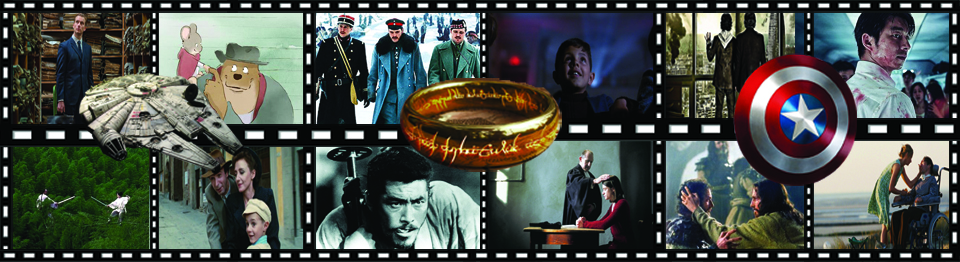
• Home
  • About Me
  • The List
  • THE LIST (2016 Update)
  • THE LIST (2017 Update)
  • THE LIST (2018 Update)
  • THE LIST (2019 Update)
  • THE LIST (2020 Update)
  • THE LIST (2021 Update)
  • THE LIST (2022 Update)
  • Top Twelves and More
  • The End Credits Song Hall of Fame

Rhyme and Reason

~ Poetry Meets Film Reviews

Rhyme and Reason

Category Archives: Movies

Spirit: Stallion of the Cimarron (2002)

05 Tuesday Aug 2014

Posted by sgliput in Movies, Poetry, Reviews, Writing

≈ Leave a comment

Tags

Action, Animation, Drama, Dreamworks, Family, Western

(Can be sung to Bryan Adams’s “Where I Belong”)
 
A horse was born so long ago,
Out in the West where free things grow,
An unfettered mustang, an ace in his prime,
Free to run, as they have for all time.
 
Leading his happy herd, defending each foal,
This Spirit’s unrestrained, till he falls under man’s control.
His homeland’s behind him; his future’s unknown,
Yet he keeps on fighting to live on his own.
 
He shows up his captors and earns their distaste,
But, helped by an Indian, he breaks out in haste.
Persistent young Little Creek tries riding in vain,
But he introduces his fair mare named Rain.
 
Though Spirit is shocked that the human and she
Display some connection that lets her run free,
He sees for himself that the Two-Legs possessed
More room for kindness than he had first guessed.
 
Though Spirit could run home, he opts to go back
And rescues the boy from a sudden attack.
Though poor Rain is injured, he still finds his hope
As he helps drag a train up a slope.
 
He halts all their efforts, escaping from flame,
Relieved loyal Little Creek thankfully came.
They flee from pursuers and leap for their lives;
Spirit’s glad when a healed Rain arrives.
 
Goodbyes are not easy when trust has been earned,
But they know it’s time that the mustang returned.
With Rain by his side, Spirit’s now free to roam
And at last he again embraces his home.
____________________
 

Spirit: Stallion of the Cimarron was one of my favorite movies growing up. As I’ve said, movies that have made me cry hold a special place in my heart, and Spirit is one such Childhood Tearjerker. DreamWorks knew from the start that most adults and kids alike love horses, and seeing such a wild and free creature dragged from his home was enough to get my waterworks going. It still touches me, though I don’t weep like I used to.

The animation is absolutely stunning. While some of the CGI from the opening is obvious, still lovely but paling in comparison to that of Dinosaur, the rest of the Western landscapes and the hand-drawn horses are gorgeous (especially the gorges). I’m no artist, but most agree that horses are among the most difficult creatures to draw: after all, Maurice Sendak illustrated Where the Wild Things Are with assorted beasts only because he realized he couldn’t draw horses. Not only are the horses arrestingly beautiful and convincing, but their facial features evoke the full spectrum of emotions without ever lapsing into anthropomorphic talking animal territory. Spirit himself has some inward monologues, provided by Matt Damon, who could have varied his voice more, but the rest of the animal interaction is done skillfully with emotion-filled neighs, whinnies, wickers, nickers, brays, and countless other equine ejaculations. So well is the wordless interplay handled that much of Damon’s voiceover, which ranges from stirring to funny, seemed unnecessary, though my VC felt it served to break up all the whinnying.

Then again, that is why Bryan Adams’s excellent anthems were included. Along with a rousing orchestral score that once again proves Hans Zimmer’s musical facility, Adams’s songs provide the melodious heart of the film. Though some critics decried the soundtrack as “whiny” or “insipid,” I felt they added so much to the film. It may not be on the level of what Phil Collins provided for Tarzan, but every song strikes the right chord of emotion, from free-wheeling liberty to depression to rekindled hope. “Don’t Let Go,” which features Sarah McLachlan with a haunting harmony, certainly deserves a place in my End Credits Song Hall of Fame.

Over the years, I have still seen some flaws: the intruding humans are uniformly bad because of their enslavement of horses, and I don’t usually like to feel guilty for wanting to ride a horse. Since all the Indians’ horses appear happy, the film seems to imply that only they built any relationship with their ponies. All the soldiers’ horses seem to hate their masters and frequently sabotage them, not allowing for the fact that I’m sure plenty of cowboys shared a connection with their steeds. After all, even broken horses can be happy.

Spirit: Stallion of the Cimarron is nonetheless a lovely, G-rated adventure with fantastic music and some genuinely exciting action sequences. It was DreamWorks Animation’s second-to-last hand-drawn film (before Sinbad) and causes me to miss the days before CGI became the only animation style successfully used in film.

Best line: (part of Spirit’s opening monologue) “I was born here, in this place that would come to be called the Old West. But, to my kind, the land was ageless. It had no beginning and no end, no boundary between earth and sky. Like the wind and the buffalo, we belonged here; we would always belong here. They say the mustang is the spirit of the West. Whether that west was won or lost in the end, you’ll have to decide for yourself….”

 
Artistry: 7
Characters/Actors: 7
Entertainment: 7
Visual Effects: 10
Originality: 7
Watchability: 8
Other (crying effect): +1
 
TOTAL: 47 out of 60
 

Next: #156 – As Good As It Gets

© 2014 S. G. Liput

172 Followers and Counting


Ella Enchanted (2004)

04 Monday Aug 2014

Posted by sgliput in Movies, Poetry, Reviews, Writing

≈ Leave a comment

Tags

Comedy, Family, Fantasy, Romance

When Ella of Frell was first born,
She’s given a gift that’s a thorn.
She’s forced to obey
Every word others say,
Which makes her the object of scorn.
 
She gets a new stepmother too
With two new stepsisters, who view
The girl with disdain;
When they notice her chain,
They tell her some bad things to do.
 
Once Ella encounters Prince Char,
Whom she thought was vain and subpar,
She chooses to leave
And to seek a reprieve
From Lucinda, a fairy afar.
 
A talking book off of a shelf,
As well as a law-leaning elf,
Assist Ella’s quest
To no longer be “blessed”
To obey with no choice for herself.
 
With help from Prince Char, the small band
Enjoy a stop in giant land,
Where Char is distressed
To see how they’re oppressed
By Edgar, his uncle who’s panned.
 
When Edgar learns Ella must do
Whatever someone tells her to,
He tells her to kill
Char, against her own will,
So he’ll keep the crown that he’s due.
 
Although she attempts to resist
And Lucinda won’t help her desist,
She nears the dark deed
Till, with firmness, she’s freed,
But Edgar makes sure she’s dismissed.
 
With help from her friends, Ella tries
To tell Char about Edgar’s lies.
At last, the truth’s out,
Leaving very small doubt,
And Edgar does something unwise.
 
Since Ella is freed from her curse,
Her stepsisters cannot coerce.
With charm and romance
And a song and a dance,
Both Ella and Char sing a verse.
______________________
 

As a kid, I attended a summer day camp at a church, and in addition to games both physical and electronic, there were plenty of movies to watch as well. One day, I was given the choice to join two groups; I could either go with the majority of boys and watch the classic that is The SpongeBob SquarePants Movie or I could side with the girls for some new film called Ella Enchanted. I decided to break out of the box and try something different, even if it did have that girl from The Princess Diaries. I was pleasantly surprised to find it was not just a girly fairy tale but a creative and enjoyable adventure perhaps most akin to Rob Reiner’s beloved The Princess Bride. In a world of elves that sing and ogres with familiarly deep voices, Ella Enchanted is not as subversive as the likes of Shrek, but it’s humorously aware of its own fairy tale conventions, such as Eric Idle’s rhyming narration.

Anne Hathaway was still relatively unknown when she played the spunky Ella of Frell, and though the film was less than a hit, it and The Princess Diaries films strengthened her appeal and gave her more exposure for future roles. Hugh Dancy is appropriately dreamy as Prince Char, one of the only recent movie princes to be both genuinely heroic and likable (compared with Shrek’s Prince Charming, Enchanted’s Prince Edward, and Frozen’s Prince Hans). Having previously starred with Hathaway in Studio Ghibli’s The Cat Returns, Cary Elwes gets in touch with his villainous side as evil Uncle Edgar, and does so with such wicked glee as to make the farmboy-formerly-known-as-Westley almost unrecognizable. The rest of the cast is uniformly funny, including Minnie Driver, Vivica A. Fox, and Aidan McArdle as the grouchy Slannen, who dreams of becoming a lawyer.

Much of the humor derives from Shrek-y anachronisms, such as a fairy’s FWI (Flying While Intoxicated), as well as classic songs that seemingly come out of nowhere. Long before Tom Hooper’s Les Miserables, Anne Hathaway proved her singing chops with her hilarious rendition of Queen’s “Somebody to Love.” The final song and dance number is also a hoot and ends the whole film on a high note.

While the whole idea of obedience being a curse has potential for being a less-than-ideal lesson for kids, Ella herself is a good role model, showing concern for the underprivileged of the kingdom and not seeking freedom from the curse for any particularly selfish or rebellious reason. Despite a bit of crude humor, Ella Enchanted is an appealing, kid-friendly fantasy that made me glad that I picked the “girly” choice. (P.S. It’s not all that girly.)

Best line: (Benny, who was accidentally turned into a book by his fairy girlfriend) “I would have left her ages ago, except I love her so darn much. Plus, I have no legs.”

 
Artistry: 5
Characters/Actors: 8
Entertainment: 9
Visual Effects: 7
Originality: 8
Watchability: 10
 
TOTAL: 47 out of 60
 

Next: #157 – Spirit: Stallion of the Cimarron

© 2014 S. G. Liput

172 Followers and Counting


Splash (1984)

03 Sunday Aug 2014

Posted by sgliput in Movies, Poetry, Reviews, Writing

≈ Leave a comment

Tags

Comedy, Fantasy, Romance

When he was a little boy,
Allen met a little joy
When he jumped into the sea
To see a thing that couldn’t be.
 
When he’s grown and in a suit,
Making money selling fruit,
He bemoans the fact that he
Can’t seem to love, and girls agree.
 
When he’s dumped, he’s acting odd
And feels attracted to Cape Cod.
Falling in the sea again,
He’s rescued by a woman then.
 
Back in New York, he is down
Till that nude girl comes to town.
Though she seems a little dim,
She can’t keep her hands off him.
 
She’s a mermaid, on the sly,
Growing legs when she is dry.
Learning English in a day,
She and Allen bond and play.
 
As this human world amuses,
Madison’s the name she chooses.
Allen’s brother tells him plain
That he’s in love, and not in vain.
 
When he tries to then propose,
Though she’s new to ice and clothes,
She insists she cannot stay,
But then decides that it’s okay.
 
A scientist who saw her fins
Tries to prove his claim and wins.
Vindicated, this Kornbluth
Regrets soon that he showed the truth.
 
Allen’s shocked that she’s a fish;
She may end in a petri dish.
When he’s sure he loves her still,
He tries to thwart the experts’ will.
 
Kornbluth helps him save the lass,
But then troops give chase, alas!
To the sea, both Allen and she
Flee to be free happily.
________________________
 

Directed by Ron Howard, Splash is a fun romantic comedy with some great lines and several distinctions under its belt. Not only was it Tom Hanks’s first mainstream film, but also Disney’s first foray into more mature films using their Touchstone Films production company. It certainly could have been more family-friendly by omitting the language and hiding Madison’s nudity better, but it’s still an enjoyably funny film on the whole.

Bringing his famous likability in full force, Hanks continued the comedic charm from his TV show Bosom Buddies, and it’s no wonder Daryl Hannah as Madison was so attracted to him. Her beauty, naiveté, and obvious love for Allen give Madison the right amount of character development, even though we learn very little about her past life under the sea or the rules she is forced to obey concerning her visit to dry land. It’s unfortunate that Allen turns into such a jerk when Madison doesn’t immediately agree to marry him and then again when he finds out her secret. Yes, I can understand his shock and confusion, but he practically treats her like she’s a different person. Second City alumni Eugene Levy and John Candy are also hilarious as the eccentric and unlucky Dr. Kornbluth and Allen’s pervert of a brother Freddie, respectively.

Mermaids are often seen in passing in fantasy movies, but Splash is one of the few that makes it the main focus, and quite entertainingly too. Its underwater scenes are well-filmed, though the scenes at the bottom of Cape Cod had some glaringly out-of-place tropical coral reefs. Credited with single-handedly popularizing Madison as a girl’s name, Splash excels in its endearing chemistry between Hanks and Hannah (long before Meg Ryan became his go-to girl). With its legs-when-dry/fins-when-wet precedent, re-used in other media like the film Aquamarine and the show H2O, it offers the best live-action mermaid story I’ve seen.

Best line: (Allen, talking about their planned marriage) “It just so happens I come from a very long line of married people.”

VC’s best line: (Dr. Kornbluth, to Allen) “I’m really a nice guy. If I had friends, you could ask them.”

 
Artistry: 7
Characters/Actors: 9
Entertainment: 9
Visual Effects: 7
Originality: 8
Watchability: 9
Other (language, nudity): -2
 
TOTAL: 47 out of 60
 

Next: #158 – Ella Enchanted

© 2014 S. G. Liput

171 Followers and Counting


#160: Monsters, Inc. (2001)

03 Sunday Aug 2014

Posted by sgliput in Movies, Poetry, Reviews, Writing

≈ Leave a comment

Tags

Animation, Comedy, Family, Fantasy, Pixar

Did anybody think that there were monsters in their closet?
Did anybody hear each noise and think a beast must cause it?
The monsters, yes, are in there to collect kids’ every scream,
But it is just a job for them; they’re nicer than they seem.
In fact, they’re scared of children, who are toxic, so it’s said;
The screams are used for power, which throughout the town is spread.
 
The famous James P. Sullivan’s the best of all the scarers,
The kind of kindly ball of fur who gives the kids their terrors.
His partner Mike Wazowski, who has romance on the brain,
Desires to break a record ere one Randall can attain.
Day in, day out, this Monsters, Inc. is known for perseverance
In generating power with no child’s interference.
 
But then while Randall’s sneaking, Sully finds by accident
A terrifying child with mysterious intent.
He takes it to a restaurant, where she causes quite a scene,
And all the city panics, and the SWAT teams intervene.
But as he gets to know her, Sully starts to think the tot
May not be quite as deadly as their world has always thought.
 
When he and Mike try smuggling her to the factory,
They learn of Randall’s plot to kidnap kids and screams for free,
When Sully tries to stop him, they both end up in Nepal,
But both get back to save her with no need to even stall.
A journey through the door vault poses dangers and a thrill,
But they get rid of Randall and his envious ill will.
 
When Sully must return his little “Boo” back to her room,
He hugs her and vacates it for the last time, they assume.
Though Monsters, Inc.’s kaput, their little escapade revealed,
Compared to children’s screams, their laughter bears a greater yield.
So Sully helps to lead the way in sparking laugh’s debut,
And as the business flourishes, he reunites with Boo.
____________________
 

Fresh off the success of Toy Story 2, Pixar once again proved their animated prowess with Monsters, Inc., an utterly original take on monsters in closets. My VC has said that all the wacky diversity in the monster world seems almost drug-induced, and with Pixar’s penchant for nonstop sight gags and visual inventiveness, it deserves multiple re-watches.

Aside from the unique, detailed CGI animation, much of the film’s success comes from the buddy pairing of deep-and-friendly-voiced John Goodman as Sully and frenetic comedian extraordinaire Billy Crystal as Mike. Their funny banter and frequent disagreement make their friendship seem real and better realized than Sully’s relationship with Boo, which is certainly more touching. It would have been nice to have some character development for Boo, who has no backstory to speak of or a meaningful personality beyond generic cuteness, unlike Russell in Up. Steve Buscemi’s nasally voice is surprisingly villainous as Randall Boggs, and James Coburn and Jennifer Tilly round out the voice cast nicely. Of course, John Ratzenberger had to have his requisite cameo, and it’s certainly one of his funniest and most unexpected. Also, can you believe that Bob Peterson, who played icky, monotone Roz, was also the voice of Dug in Up?

While the animation was not yet at the level reached by Ratatouille or WALL-E, it’s still colorful and seamless. The door vault scene is especially exciting and impressive, a classic among animated action sequences. Thanks to the humor, my VC enjoys this Pete Docter-directed film more than his later work in Up. Whereas Up’s plot was almost schizophrenic with all the disparate elements crammed in, Monsters, Inc. possesses one core concept and milks the hilarity and ingenuity from it as only Pixar can.

Pixar’s films tend to have some kind of social commentary, some more obvious than others, and Monsters, Inc.’s is quite subtle, only being presented in a few scenes. The driver for Randall’s plot to extract screams forcefully is the fact that kids are harder to scare, indirectly explained by their watching scary or violent television. Similarly, the scene at the end with Mike’s comedy routine indicates that what makes kids laugh has changed over time as well. Whereas verbal humor, such as in Leave It to Beaver and The Andy Griffith Show, used to keep kids (as well as adults) entertained, such shows don’t fly nowadays, having been replaced by frantic, sometimes gross comedy, such as Mike’s belch. This analysis is certainly not the film’s focus, existing mainly in some throwaway gags, but it’s something I’ve noticed after several viewings.

Overall, Monsters, Inc. may not be as emotionally engaging as their other work, but it’s another Pixar favorite that cemented their reputation as leaders in the animation industry, even if it lost the Best Animated Feature Academy Award to DreamWorks’ Shrek. (It did win Best Original Song for “If I Didn’t Have You.”) Hint: Now that I’ve covered their lesser masterpieces (A Bug’s Life, Cars, etc.), you may not see Pixar’s other films on my list for a while, but there are definitely more on the way.

Best line: (Abominable Snowman, offering yellow snow) “Snow cone?  [Mike icks in disgust]  “No, no, no, don’t worry. It’s lemon.”

 
Artistry: 6
Characters/Actors: 7
Entertainment: 8
Visual Effects: 8
Originality: 10
Watchability: 8
 
TOTAL: 47 out of 60
 

Next: #159 – Splash

© 2014 S. G. Liput

171 Followers and Counting


Chitty Chitty Bang Bang (1968)

01 Friday Aug 2014

Posted by sgliput in Movies, Poetry, Reviews, Writing

≈ 1 Comment

Tags

Comedy, Family, Fantasy, Musical

(I added a verse or two, but this one is best sung to the title song)
 
Back when cars were rather rare,
A couple little kids admire one.
Though it’s needing some repair,
The both of them are keen to see it run.
 
Their dad by the name of Potts
Assembles new inventions, odd but cool.
It’s clear that he loves them lots,
But doesn’t quite ensure they go to school.
 
That’s why pretty Truly comes,
For Truly Scrumptious is her name.
Potts does not approve her prying,
Though she’s right all the same.
There’s a candy he’s been trying
That might just earn him fame.
 
He tries then to sell his sweets,
Which one toots before he eats,
And Truly assists him with the treats.
They call dogs regrettably,
But not too forgettably,
And Potts is distressed by defeats.
 
But he tries to buy the car,
Because his kids have said it will be scrap,
So he grows into a star
By dancing after shaving bald a chap.
 
When he’s got it looking new,
And Truly joins them for a picnic drive,
Potts tells them a tale or two
With characters that seem to come alive.
 
In this story that he tells,
Their magic car is wanted by
Some fat villain known as Bomburst,
Who sees it float and fly.
He steals Grandpa, who is coerced
To build the car or die.
 
The four follow, as they ought,
But soon both the kids are caught,
For children are outlawed, they forgot.
Potts rescues the kids with skill,
Assisted by Benny Hill;
To Bomburst, a lesson is taught!
 
Back in the real world, where things are not as bright,
Both Mr. Potts and Truly show they care.
But it is not till his doggie treats take flight
That they discern they make a lovely pair.
 
Since both the children delightedly approve,
They take another wondrous drive,
On their Chitty Chitty Bang Bang,
The finest car alive,
On their Chitty Chitty Bang Bang,
The finest car alive!
_________________
 

With a script written by director Ken Hughes and the great children’s author Roald Dahl, Chitty Chitty Bang Bang is no Oscar-winning drama or beautiful piece of cinematic art; it’s a fun, kid-friendly romp and an entertaining bit of nostalgia from my and my parents’ childhoods. It’s not quite on the level of Mary Poppins, but it’s in the same vein of musical rollick through the imagination. Based off the book by Ian Fleming (yes, that Ian Fleming), the film’s focus on two children, songs written by the Sherman brothers, and the presence of Dick Van Dyke may make it seem like a Mary Poppins wannabe, but it’s an imaginative classic in its own right.

Like Poppins’ Bert, the role of Caractacus Potts puts Dick Van Dyke in his element, sprightly dancing, vivid imagination, and lovable chemistry with the two kids. The film’s plot is rather thin, to be honest, but the characters and songs fill it with charm. Baron Bomburst is made hilariously childish by Gert Fröbe (a.k.a. Goldfinger; the James Bond tie-ins continue; Albert Broccoli produced as well), and Robert Helpmann is genuinely frightful as the wicked Child Catcher. Did I mention Benny Hill is in it too?

Though some critics were rather harsh toward them, the Sherman brothers’ musical numbers are especially memorable. The title song is one of those classic 1960s tunes that easily get stuck in one’s head, but then again, so are most of them. “Posh!” puts Lionel Jeffries’ distinctive voice to good use, and “The Roses of Success” is a catchy little motivational speech. While “Hushabye Mountain” is a sweet lullaby (used in a much darker scene in Spielberg’s War of the Worlds), my favorite is “Me Ol’ Bamboo,” which easily matches Van Dyke’s energy in Poppins’ “Step in Time.” “Toot Sweets” probably has the best choreography though. The Bombursts’ “Chu-Chi Face” is the only song that serves little to no purpose and definitely could have been cut.

Much of the film’s appeal is for children and those who fondly remember seeing it as children. It’s certainly not perfect. The “magic” of bluescreen is obvious in the driving scenes, and the other special effects are lacking as well, though Mr. Potts’s inventions are fascinating to look at. Portions of the story within the plot are overly silly too, such as the bumbling spies sent to capture the car, who might as well be called the Two Stooges.

Chitty Chitty Bang Bang may not be award-worthy or deep in any meaningful sense, but it’s the kind of innocent, nostalgia-generating tale that isn’t made anymore. Kids’ movies nowadays have to include talking animals or constant explosions or toilet humor or pop culture references to hold their attention; this film succeeds with its own earnestness and inventive sense of fun. Which do you think is better?

Best line: (old inventor #1, describing to Grandpa the realities of working for Baron Bomburst) “They have terrible tortures: the thumb-screw, the rack….”
(old inventor #2) “They stretch you and streeeetch you.”
(unusually tall inventor #3, walking up) “When I first got here, I was a midget.”


Artistry: 5
Characters/Actors: 8
Entertainment: 9
Visual Effects: 3
Originality: 9
Watchability: 9
Other (memorable music): +3
 
TOTAL: 46 out of 60
 

Next: #160 – Monsters, Inc.

© 2014 S. G. Liput

171 Followers and Counting


Rain Man (1988)

31 Thursday Jul 2014

Posted by sgliput in Movies, Poetry, Reviews, Writing

≈ Leave a comment

Tags

Drama, Triple A

While Charlie Babbitt’s under stress
To sell off cars to pay off debts,
His distant father dies and, yes,
His selfish son has few regrets.
 
He’s hurt and shocked and quite irate
When he gets little from the will.
He learns that most of Dad’s estate
Has gone to someone else, $3 mil.
 
This newly wealthy, unnamed other
Turns out to be Raymond Babbitt,
Charlie’s undiscovered brother,
Whom he never knew, dagnabbit!
 
This Raymond clearly is autistic,
A savant with great recall,
Emotion-lacking and simplistic,
Who depends on routines small.
 
Since Charlie plans to get his share,
He takes Ray from the institution.
Charlie doesn’t seem to care
About his bro, just restitution.
 
Due to Raymond’s fearful quirks,
They cannot fly back to L.A.
Instead, they drive, and Raymond irks
His brother Charlie all the way.
 
Ray’s repetition and strange habits
Drive his brother near-insane,
But as they go, the broken Babbitts
Share in memories and pain.
 
Though Charlie’s business nears its doom,
A visit to Las Vegas thrills
And grants them money and a room,
All thanks to Raymond’s counting skills.
 
When they at last get to L.A.,
It seems that Charlie’s changed his tune.
He wants his brother now to stay,
Regardless if it’s opportune.
 
He sees Ray as a brother dear,
Because of what he since has learned,
Yet, to the doctors, it seems clear
That Raymond ought to be returned.
 
Still, Charlie bids goodbye to “Rain Man,”
No more just a crazy loon.
As Raymond leaves his newfound “main man,”
Charlie says he’ll visit soon.
___________________
 

Rain Man is what I call a Triple A movie because it is All About the Acting. The entire movie revolves around Dustin Hoffman’s amazing portrayal of autistic savant Raymond Babbitt. It’s one of those roles of a lifetime that actors probably take just to prove how skilled they are. Every movement, every line, every step of his walk, every blank stare contributes to our believing that we’re watching a real person and not just someone putting on a show. That is acting, and Hoffman certainly deserved his second Best Actor Oscar win. Considering that he’s also played a woman, a 121-year-old man, and Captain Hook, it’s also a testament to his versatility.

Almost as impressive is Tom Cruise as Charlie Babbitt. His performance is not as nuanced as Hoffman’s, but he’s still quite convincing, both as a selfish jerk for most of the movie and a more compassionate brother by the end. Charlie is a main reason the film is as low as it is on my list; even if we sympathize with his wanting a share of his father’s estate, his egocentric behavior, frequent obscenities, and all-around unkindness toward his brother get old, even if the mental torment Charlie endures from Raymond’s quirks is often funny. Where Cruise really comes into his own is the Las Vegas scene, which not only has the best music of the film but also sees more touching moments between the brothers, such as Charlie finally appreciating Ray and teaching him to dance. Scenes like that make Charlie’s turnaround believable, even if the doctors remained incredulous.

Though the final scene was burdened by the 1988 writer’s strike, I found the ending mostly satisfying. Though I believe Charlie had changed and did have Raymond’s best interests at heart, he proved that he can be impulsive and probably didn’t realize what a responsibility life-long custody of his brother would have been. Raymond ended up in the right place for his needs, but at least the road trip helped Charlie to truly care for his brother, even if he got no special compensation (though Raymond did save his business).

The film also won the Academy Awards for Best Picture, Best Original Screenplay, and Best Director (Barry Levinson), and I’d say that Hans Zimmer’s iconic, oddly African-sounding score also deserved to win. Despite quite a bit of unfortunate language, Rain Man is a powerful movie, thanks to a winning script and the chemistry of two fine actors, just the kind of film that’s best seen cut.

Best line: (Raymond, his best repeated line) “97-X. Baaam! The future of rock ‘n’ roll.”

 
Artistry: 9
Characters/Actors: 10
Entertainment: 8
Visual Effects: N/A
Originality: 9
Watchability: 8
Other (great script, music, and chemistry): +5
Other (language): -3
 
TOTAL: 46 out of 60
 

Next: #161 – Chitty Chitty Bang Bang

© 2014 S. G. Liput

168 Followers and Counting


Enchanted (2007)

30 Wednesday Jul 2014

Posted by sgliput in Movies, Poetry, Reviews, Writing

≈ Leave a comment

Tags

Action, Disney, Fantasy, Musical, Romance

 (Best sung to Giselle’s “Happy Working Song”)
 
Pretty girl Giselle is just swell and is animated all day long;
Woodland creatures help her sing a song.
She expects her prince to come and be her new love;
When he does, they sing of true love,
Since there’s nothing wrong.
 
Then an evil witch, Edward’s stepmother, has a diabolic plan,
To evict Giselle because she can.
So she sends the princess down a well descending
Where there is no happy ending
And no perfect man.
 
In the callous streets of New York, poor Giselle is both afraid and lost,
Till one Robert finds his path has crossed
With this somewhat crazy fairy tale freethinker,
Who’s a tailor, not a drinker,
And cleans at no cost.
 
When he hears the news, Edward hunts for his darling on a hero’s trip,
With her talking chipmunk sidekick Pip,
But they stick out like a sore thumb in the city,
Searching for his dearest pretty,
Like he’s lost his grip.
 
As he tries to help out Giselle, Robert’s reeled in by her fresh appeal,
And his girlfriend Nancy has to deal.
Yet Giselle assists him with romance and crooning,
But she ends up nearly swooning
When love grows more real.
 
Edward soon arrives, but Giselle is no longer visibly naïve,
And she’s hesitant to up and leave.
So Edward and she try dating to get closer,
But it’s Robert who’ll engross her
At a ball that eve.
 
But the evil queen shows herself since her henchman hasn’t done too well
In his efforts to dispatch Giselle.
So she employs tactics you may have seen elsewhere
And scares everybody else there
With a fearsome spell.
 
Once the queen is stopped and destroyed when a hero steps up to the plate,
Robert and Giselle conclude their date.
It is clear that they both share a love enchanted,
But Edward’s not emptyhanded,
For his loves won’t often wait.
 
Robert and his young daughter have Giselle,
Settled in this world into which she fell,
Merrily,
Happy ever after, verily,
Now that everyone has found their perfect mate.
___________________
 

Before The Princess and the Frog revisited the princess genre (with iffy results), Disney created Enchanted, a modern mish-mashing of classic fairy tales and contemporary cynicism. The animated beginning could easily have been a rejected idea from the Disney Renaissance, but the overtly saccharine telling is clearly meant to be a contrast for the rest of the film. Once Giselle actually gets to New York and its live-action acrimony, the real humor starts flowing from the disparity between her naiveté and our world’s unfriendliness.

While Edward is certainly not the perfect prince of Disney’s early films, Enchanted succeeds in its combination of opposites by being both realistic and idealistic. Based on Giselle’s first encounters with New Yorkers, she would be justified in considering it the least nice place on earth, but later on, as she explains to Robert the importance of affection, all of Central Park turns into a completely willing musical cast. This serves to accentuate how innocence and idealism can bring out the best in people, even when the world can seem so hostile at times. At the same time, Giselle’s introduction to the joys of the real world convince her these are preferable to the unsubstantial romance she had known before with Edward. That point, of course, doesn’t apply to everyone since Nancy, apparently fed up with the pitfalls of “real” relationships, obviously preferred the love-at-first-sight kind of courtship.

This is the film that hoisted Amy Adams to stardom, at least for me, and continues to be the role in which I always envision her, one of innocence. Her voice, face, and acting all lend themselves to her upright damsel persona. Roles that have allowed for this image, such as in Doubt or Night at the Museum 2, play to her strengths, while films where she attempts to act the “bad girl,” such as the recent American Hustle, just don’t seem to fit her. Patrick Dempsey took a break from Grey’s Anatomy to play single father Robert, who may be a pessimist but has obvious appeal for Nancy and Giselle. James Marsden portrays Prince Edward as an entertaining buffoon, but I do wish he had more to contribute to the plot. Susan Sarandon and Timothy Spall look like they’re enjoying their hammy villainous roles as Queen Narissa and bumbling servant Nathaniel. Lastly, I had no idea who Broadway star Idina Menzel (Nancy) was at the time, but after hearing her in Frozen, it’s a shame she didn’t get a chance to sing in this film: her one song with Marsden was cut.

The choreography and songs, written by winning duo Alan Menken and Stephen Schwartz, are outstanding, a welcome return to the good old days of both Disney excellence and classic musicals. The show-stopping “That’s How You Know” is particularly awesome, but the fact that all three of its Oscar-nominated songs lost (not unlike the previous year’s Dreamgirls) is a crying shame.

The film isn’t all good, of course. Certain scenes toward the end vacillate between an homage and a ripoff of Disney classics, and some scenes involving Pip the chipmunk, such as his defecation and Nathaniel’s cruelty toward him, were unnecessary. Still, Enchanted brings Disney’s animation to life in a fresh and funny way that my family watches whenever it’s on TV. It’s enchanting.

Best line: (a child-stressed mother, played by Judy Kuhn from Pocahontas, when she sees “Prince Charming” Edward) “You’re too late.”

 
Artistry: 6
Characters/Actors: 8
Entertainment: 8
Visual Effects: 9
Originality: 6
Watchability: 9
 
TOTAL: 46 out of 60
 

Next: #162 – Rain Man

© 2014 S. G. Liput

166 Followers and Counting


Up (2009)

30 Wednesday Jul 2014

Posted by sgliput in Movies, Poetry, Reviews, Writing

≈ Leave a comment

Tags

Action, Animation, Comedy, Drama, Fantasy, Pixar

When Carl Fredricksen was young,
Self-conscious with a timid tongue,
He heard his hero’s praises sung,
The fearless Charles Muntz.
A skeleton Muntz found with zeal
Sparked doubts on whether it was real.
Muntz vowed to catch one and appeal,
The greatest of his hunts.
 
For Carl, this did not deter
His zeal as an adventurer,
Nor Ellie’s. Carl promised her
That they would fly some day
To Paradise Falls and do stuff.
They wed, and plans seemed like enough.
But plans were changed as times grew rough,
And life got in the way.
 
They still both lived in happiness
At their beloved home address,
Till Ellie’s death served to depress
Her aging husband’s heart.
Though builders offered quite a fee,
He guarded their house jealously.
Evicted by a court decree,
He planned a whole new start.
 
He chooses not to gripe and grouse
But blows balloons to lift his house
And fill his promise to his spouse
To take this thrilling trip.
To Paradise Falls he intends
To fly, but as his house ascends,
A wilderness explorer lends
His help to this airship.
 
To South America, they float
But fall out in this land remote,
Where Carl is dismayed to note
They have a ways to walk.
Connected to the house o’erhead,
They journey through the jungle, led
By Carl, who is stopped instead
By birds, and dogs that talk.
 
He meets the ancient Charles Muntz,
Still on that greatest of his hunts,
Who first seems nice but then confronts
The duo with suspicion.
A giant bird that Russell found
Is what Muntz wants to still impound.
His blimp and many a talking hound
Have not achieved his mission.
 
When Carl and Russell flee the nut,
With help from bird and friendly mutt,
The pair are shocked and scared somewhat
But aid the injured bird.
Muntz still sneaks up and apprehends
The bird, with whom the boy’s made friends,
And Carl will not make amends,
But Russell’s undeterred.
 
Though Carl makes it to the falls,
With Ellie’s help he then recalls
That their life meant more than four walls,
And he assists the scout.
He follows Russell in the air
To get the bird from Muntz’s lair.
The good and bad guys face off there
Till gravity wins out.
 
Though Carl bids his house goodbye,
They take the bird back home nearby.
He uses Muntz’s blimp to fly
Young Russell to his home.
Since Russell’s dad won’t show his face
To grant him patches and embrace,
Old Carl comes to take his place
And share an ice cream cone.
______________________
 

From the very beginning, Up has all the promise of a masterpiece. The first eleven minutes, detailing Carl and Ellie’s life together, have been rightfully hailed as a high point in animation history. The rest of the film is similarly brilliant, just in a very different way from most of Pixar’s canon, contrasting the beautiful opening with utter cartoonish wackiness.

Like WALL-E, Up is rather controversial for me. I consider it another Pixar classic, worthy of its Oscar nomination for Best Picture, while my VC was left cold. She certainly enjoyed everything pertaining to Ellie but felt the random inclusion of a giant “snipe” (my dad once fell for that same snipe joke) and talking dogs was just too silly to swallow. She also has poked holes in the plot, such as the fact that Muntz was still alive, since he must have been in his nineties; maybe he found the fountain of youth down in South America, or the Holy Grail. While the film was unique for featuring an elderly protagonist, even I have to admit that Carl’s and Muntz’s athleticism toward the end did strain credulity. While these issues sadly spoiled the film for her, I can overlook them with the help of Coleridge’s famous concept, the suspension of disbelief. Some people got it; some don’t.

I have more of an issue with Russell’s thin attachment to the giant bird he names “Kevin.” The relationship doesn’t seem to be any deeper than that of an owner and pet, yet Russell is willing to risk his life for the pet he found days before. What’s more, he blames Carl for “giving her away” when he did no such thing. Considering the situation, Muntz would have captured the bird regardless of Carl’s actions, so Russell’s guilt trip seemed unjustified and unfair.

All right, now that I got that out of my system, I’ll mention the gorgeous animation, the excellent voice acting (led by Ed Asner as Carl, Christopher Plummer as Muntz, and Bob Peterson as the squirrel-distracted dog Dug), the high-flying action sure to give someone acrophobia, and Michael Giacchino’s buoyant score. The main idea of a mobile dwelling that ends up damaged and abandoned may have been borrowed from Howl’s Moving Castle, of which director Pete Docter directed the English translation as well, but the plot is otherwise wholly original and frequently inspired.

Up isn’t quite on par with Pixar’s greatest work, but it’s an animated gem that earns both laughs and tears and has a timely message about life’s real adventures that tugs my heartstrings every time.

Best line: (Russell, after describing a simple pleasure he had with his dad) “That might sound boring, but I think the boring stuff is the stuff I remember the most.”

 
Artistry: 9
Characters/Actors: 7
Entertainment: 7
Visual Effects: 10
Originality: 9
Watchability: 7
Other (aforementioned issues): -3
 
TOTAL: 46 out of 60
 

Next: #163 – Enchanted

© 2014 S. G. Liput

166 Followers and Counting


What’s Up, Doc? (1972)

28 Monday Jul 2014

Posted by sgliput in Movies, Poetry, Reviews, Writing

≈ Leave a comment

Tags

Comedy, Romance

Four plaid bags appear the same;
One holds jewels of a wealthy dame;
One holds stolen documents
That really are the government’s.
One holds Judy Maxwell’s clothes;
The last holds rocks (stay on your toes).
 
Howard Bannister, Ph.D.,
Needs a grant since art ain’t free.
His music theory based on rocks
Is how he thinks outside the box.
He’s dense, as everyone discerns,
Like his fiancée Eunice Burns.
 
Judy, eager for romance, is
Sending Howard bold advances.
Hounding him, she calls him Steve
And rips his coat and will not leave.
Smooth-talking, smart, and hazard-prone,
She will not leave the guy alone.
 
As she impersonates Miss Burns,
Ignoring Howard’s dazed concerns,
The grant she’s quick to guarantee
By schmoozing Mr. Larrabee.
Howard picks this over trueness,
Thus abandoning poor Eunice.
 
While all this is going on,
Those jewels are stolen by a con.
A secret agent on pretense
Attempts to steal the documents,
But everybody’s lodged as well
On one floor in the same hotel.
 
As bags are hidden, moved, and switched,
Traded, stolen, sneaked, and ditched,
And as Howard tries to hide
Judy when she sneaks inside,
Utter anarchy ensues.
There’s no telling whose is whose.
 
When the morning comes at last,
Howard’s being still harassed,
But he doesn’t mind as much;
Judy simply has the touch.
They go, because he won the grant,
To Larrabee’s, but Eunice can’t.
 
She’s abducted by jewel thieves,
Who got the rocks of Howard’s/Steve’s.
Since Howard has the documents
And jewels as well (if that makes sense),
They all converge at Larrabee’s,
Demanding all four bags to seize.
 
Both Howard and Judy flee the scene
With all the bags, and they careen
Through San Francisco’s every place,
As everybody else gives chase.
With lots of damage done that day,
They all then plunge into the bay.
 
Before the judge, confusion reigns,
Which nearly lands them all in chains.
Yet everything works out, it seems,
Though some are still involved in schemes.
The grant is won thanks to a hoax,
And Judy’s won, with guile and jokes,
Her loving Howard. That’s all, folks!
_________________
 

What’s Up, Doc? Is a comedy classic with a plot I doubt even the filmmakers could fully follow. An homage to other classics like Bringing Up Baby, it throws in countless characters, each with their own agenda, who end up colliding in hilarious ways thanks to the four identical overnight bags. There’s Ryan O’Neal as the absentminded Howard Bannister, Madeline Khan (in her debut) as his controlling and “unbalanced” fiancée Eunice, Barbra Streisand as the pushy but endearing disaster area known as Judy Maxwell, and Kenneth Mars as the other grant finalist Hugh Simon, whose accent is impossible to trace. Not to mention, there’s Mr. Larrabee and the musicologists (was that Randy Quaid?!), the jewel thieves, the dueling document thieves, the old lady with the jewel bag, the hotel manager, the judge, the waiter, the bailiff, and that guy who freely gives his car to “the government.”

The comic situations are priceless, from the convoluted mixing of the bags from hotel room to hotel room to one thief’s strange version of “charm” to the big slapstick fight where everyone converges. The best scenes, though, are the hotel destruction sequence, which hilariously spirals out of control, and the awesome car chase through San Francisco’s streets, easily the funniest chase scene put on film.

The script is likewise ingenious and moves along at such a fast clip that further viewings are practically a necessity. The jokes come fast and furious and include everything from a world-weary, pill-popping judge to the meaning of “propriety” to supposed women soldiers dressing for battle.

My VC absolutely loves this film, despite her usual aversion to silliness. It would be somewhere in her top 50, but I have some reservations. While the film is entirely suitable for all audiences (if they can keep up), I found Barbra Streisand’s character to be both the film’s greatest asset and its worst liability. Her antics are side-splitting, to be sure, but that doesn’t change the fact that she lies throughout the film, puts Howard through hell, and somehow ends up getting her way by the end. Not only does she act as indifferent to Howard’s engagement as the trolls in Frozen, but she sends Eunice on a cruel wild goose chase that leaves her in the hands of criminals. She also sneaks into a hotel without paying, helps to steal a car and some costumes, and makes a nuisance of herself, all without any lasting consequences. As funny as she is, her ethics are definitely in doubt, and I would have put up more resistance had I been Howard.

Nevertheless, What’s Up, Doc? is a fun and lighthearted screwball of a comedy that never fails to leave my family smiling. It’s proof that excellent comedy doesn’t need to depend on constant sexual jokes and language, as so many modern films do. If only there were more films like this….

Best line: (Fritz, the hotel manager, trying to take a bag by lying about an escaped snake) “Calm yourself, Miss Burns. May I suggest you shut yourself in the bathroom for a few moments while I search your room?”
(Eunice) “What if it’s in there?”
(Fritz) “Impossible, madam. Snakes, as you know, live in mortal fear of… tile.”
 
VC’s best line: (Judy) “I know I’m different, but from now on I’m going to try and be the same.”
(Howard) “The same as what?”
(Judy) “The same as people who aren’t different.”


Artistry: 5
Characters/Actors: 8
Entertainment: 10
Visual Effects: 7
Originality: 9
Watchability: 9
Other (Judy’s pushiness): -2
 
TOTAL: 46 out of 60


Next: #164 – Up

© 2014 S. G. Liput

165 Followers and Counting


200th Post! The Dark Knight Trilogy

27 Sunday Jul 2014

Posted by sgliput in Movies, Poetry, Reviews, Writing

≈ 1 Comment

Tags

Action, Drama, Sci-fi, Superhero, Thriller

(This one is long and detailed; major spoiler alert)
 
When Bruce Wayne was a child, he fell down a chilly well,
And bats flew all around him, sparking panic and nightmares.
His father came to rescue him, explaining why he fell,
To learn to rise again as one of Gotham’s billionaires.
 
An opera they attended scared him, prompting them outside,
Where Chill, a desperate thug, shot both his parents but was caught.
Years later, one Falcone, a crime boss whom Chill defied
Had Chill killed, beating Bruce, who wanted justice done (he thought).
 
Bruce spoke with smug Falcone, who said Wayne did not “get” crime,
So Bruce departed secretly and lived like felons do.
But now Ducard gives Bruce a better outlet for his time,
To train with Ra’s al Ghul and battle fears he must subdue.
 
Bruce conquers guilt and fear of bats thanks to Ducard’s routine,
Excelling as a ninja on the Eastern mountainside,
But when he learns this League of Shadows wishes Gotham clean,
To purify by killing, he resists his former guide.
 
He fights the master Ra’s al Ghul, who’s killed within a fire,
But Bruce saves Ducard’s life and leaves him with a man to stay.
Then Wayne returns to Gotham, for his training helped inspire
A plan to battle evil in a much less lethal way.
 
He finds beneath his parents’ mansion bat-infested caves,
Which he at once remodels as his base of operations,
And Lucius Fox provides, in case some sinner misbehaves,
A hard, protective suit, as well as more high-tech donations.
 
At last, the Batman’s ready to contend with Gotham’s scum
And captures smuggled drugs, as well as old mob boss Falcone.
But there’s one Dr. Jonathan Crane who frequently has come
To court to plead insanity for every gangster crony.
 
He does this through a gas that makes the men hallucinate
And brings to life horrific fears that turn them all insane.
When Batman gets a breath of it, it almost is too late,
But Lucius and the faithful butler Alfred rescue Wayne.
 
With Fox’s antidote, Bruce tries to figure Crane’s designs,
But his old girlfriend Rachel beats him to it, though unwise.
She sees fear poison’s being dumped in Gotham’s water lines,
And Rachel gets some gas herself and nears her own demise.
 
But Batman gets her out of there with Sergeant Gordon’s aid
And drives a bit destructively to save her life in time.
He gives her extra antidote so that more can be made,
But Alfred’s getting troubled at how Bruce is fighting crime.
 
At Bruce’s birthday party, he comes quickly face to face
With old Ducard, who wants revenge, for he is Ra’s al Ghul.
Al Ghul burns down the house and has a city to erase,
Which he intends to do with his most recent stolen tool.
 
A microwave emitter taken from Wayne Enterprises
Ra’s uses to evaporate the city’s water store,
Releasing all the gas so when the populace arises,
Their terror will destroy each other in an inner war.
 
As chaos reigns and convicts run amok out on the street,
The Batman chases Ra’s upon an elevated train.
While Gordon takes the Batmobile and blasts the train’s supports,*
Bruce battles with his mentor, whom he saved before in vain.
 
Yet Batman flies away this time and leaves al Ghul to crash,
Averting more destruction had the train continued on.
The city’s saved (to some extent), but still there’s human trash,
For many criminals, like Crane, escaped and now are gone.
 
As Bruce rebuilds his mansion, fortifying the foundation,
Where no one knows his secret, save his butler and girlfriend,
A Joker has arisen, product of an escalation
That threatens Gotham City, but the Batman will defend.
______________________
 
The Joker’s on the rampage, stealing money from the mob,
A homicidal maniac who’s letting chaos reign,
But DA Harvey Dent is Gotham’s white knight for the job.
He’s fighting crime in ways that are respected by Bruce Wayne.
 
For Batman’s done his service, but he’d rather allow Dent
To prosecute the legal way with no need for a mask.
Dent’s also drawn in Rachel, causing Bruce to still lament,
But he and Gordon let Dent join them in their secret task.
 
A Chinese businessman named Lau is working with mob bosses,
Protecting all their money by escaping to Hong Kong,
But Batman has no jurisdiction and recoups his losses
By spiriting Lau back to Gotham, where he’ll play along.
 
The mob is desperate for some help and turns then to the Joker
To rid the town of Batman lest more obstacles occur.
The Joker then fills his new role as Gotham’s power broker,
By killing both a judge and the police commissioner.
 
He tries to take out Dent as well and Rachel by extension,
But Batman saves them both but lets the Joker get away.
When Gotham’s mayor’s targeted, the center of attention,
Lieutenant Gordon saves him but is killed to Dent’s dismay.
 
The Joker says that more will die if Batman doesn’t act,
Revealing who he really is, and Bruce is tempted to,
But Dent comes out and claims that he’s the hooded man in fact
And gets himself arrested, even though it isn’t true.
 
When Dent is off to prison, Joker follows for the kill,
But Batman saves the DA (though the Batmobile is toast).
He stops the Joker cold, and Gordon comes back for a thrill
To catch the laughing nutcase as a very living ghost.
 
They’re glad that he’s in custody, but he seems self-composed.
It seems that Dent and Rachel Dawes have somehow disappeared.
The Batman pounds the Joker for their place to be disclosed,
But Joker poses him a choice, the worst that he has feared.
 
For he can rescue only one before they blow sky high
And tries to go for Rachel, but he ends up saving Dent.
Police are too late saving her, and she’s the one to die,
And half of Harvey’s face is burned, which he comes to resent.
 
The Joker also got away with Lau in his possession.
When one of Wayne’s employees claims he knows who Batman is,
The Joker threatens hospitals to stimulate aggression
And get the town to kill this man and this secret of his.
 
When Bruce and Gordon save his life, a hospital is blown,
But not before the Joker frees a crazed and vengeful Dent.
The DA targets crooked cops and gangsters to atone
And lets a coin toss choose their fates to punish and torment.
 
The Joker next takes aim at ferries and the people’s will.
With criminals on one and all civilians on the other,
He gives them each a detonator for the other’s kill
And plans to kill them both if they do not blow up their brother.
 
The Batman fights his henchmen, who are not quite what they seem,
Confronting Joker high above the scene of anxious stress.
The people on the ferry don’t give in to Joker’s scheme,
And Batman hangs him up to dry but will not kill the pest.
 
He next goes after Harvey, who has Gordon’s wife and son
And plans to take revenge on those who didn’t kill his love.
They try to reason with him, but his mind is too far gone,
And Batman tackles Two-Face, who then falls from high above.
 
With Dent, the city’s shining hope, now made a villain, dead,
The Batman says he’ll bear his crimes to let the city cope.
As Gordon praises Harvey, lying as the Batman said,
Bruce Wayne retires cape and cowl, preserving Gotham’s hope.
______________________
 
Eight years have passed since Harvey Dent met his untimely end,
And in his name, the city’s cleaned itself from filth and crime.
Yet evil still is brewing, though the city’s on the mend,
And masked guerilla Bane waits underground to bide his time.
 
The Batman’s still retired, since he took the rap for Dent,
And Bruce Wayne is less agile, not the man he was before.
He meets a fair cat burglar, robbing him at an event,
But this Selina Kyle seems to covet something more.
 
She sells Wayne’s fingerprints in hopes of getting a device
To wipe her from all databases, granting a clean slate.
The deal turns sour when the buyer will not pay her price,
And when police come, Gordon’s caught by Bane, who lies in wait.
 
Though Gordon flees and is discovered by policeman Blake,
Bane finds a note revealing Gordon’s Dent-exalting lie.
The fiend attacks the stock market to wipe out Bruce’s stake,
And Batman un-retires to arrest a lone bad guy.
 
Bruce lets Miranda Tate, a lovely woman on his board,
Take over his whole company before a rival does.
This rival’s worked with Bane, who doesn’t act nice when deplored
And plans to be more lethal than the Joker ever was.
 
Though Alfred won’t approve of Bruce’s comeback with the cape,
Wayne listens to Miss Kyle to unearth Bane and attack.
Still hoping for that clean slate, she traps him with no escape,
And Bane confronts the Batman and breaks both his will and back.
 
Bane takes him to a foreign prison, deep within a pit,
To let him watch as Gotham is destroyed (or will be soon).
Then Bane takes over Gotham with a bomb to threaten it,
Employing Batman’s weapons to enforce a foul commune.
 
He corners all policemen underground and traps them there,
While forcing quarantine of Gotham City or else BOOM.
Meanwhile, in his prison, Bruce receives some painful care
And learns that Ra’s al Ghul’s offspring escaped this pit of doom.
 
He heals and trains for several months to climb out of the jail,
And somehow gets to Gotham, where the bomb will detonate.
He teams with Blake and Gordon, who have been on that bomb’s trail,
And frees the trapped police to battle Bane, who’s captured Tate.
 
Police and convicts clash as Bruce again confronts his foe
And bests Bane and demands to know who holds the hidden trigger.
Then Tate reveals that she in fact is Talia al Ghul so
She is the mastermind who climbed out of that prison’s rigor.
 
She leaves to detonate the bomb, which Gordon barely blocked.
Selina Kyle helps Batman and brings an end to Bane.
To their dismay, the bomb’s own timer has mere minutes clocked,
And ere she passes, Talia’s sure their efforts will be vain.
 
Since Batman knows what he must do, he uses his new plane
To haul the bomb across the bay, where it explodes apart.
The city’s saved, and Gordon sees the Batman was Bruce Wayne,
Who finally is honored as a hero from the start.
 
Though Lucius Fox believed the autopilot had been broken,
He learns that Bruce had fixed it ere his solemn sacrifice.
When Alfred is abroad, he sees a wish he once had spoken,
That Bruce would be there happy (with Selina), void of vice,
And Blake (or also Robin) gains the Batcave, free of price.
_______________________
 

When Christopher Nolan began to reboot the Batman film franchise, no one knew how audacious the end result would be, a trilogy of dark, deeply layered superhero stories that transcended the camp and silliness of the original incarnations. Unlike many of the underrated films on my list, The Dark Knight trilogy had no trouble garnering effusive praise and is considered to consist of three of the best superhero films ever made. Rather than going for the humor and colorful characters (and entertainment value) of Iron Man or Spider-Man, Nolan and company created a weighty, brooding three-part storyline that takes itself wholly seriously, with the requisite glimpses of light and hope and victorious good to make it all worthwhile.

Batman Begins is quite the successful origin story, cementing all the main characters, Bruce’s reason for fighting crime, his relationship with villain Ra’s al Ghul, and the inception (insert Nolan joke) of the Batcave, Batmobile, and Bat-everything else. Unlike the obvious cramming of villains seen in Spider-Man 3, it pulls off the adroit introduction of Falcone, the Scarecrow, and Ra’s al Ghul as simply extra layers in Nolan’s trademark complex brand of filmmaking.

I can envision someone else playing Batman (I don’t know about Ben Affleck, though), but Christian Bale is the best of all of the actors so far. Gary Oldman isn’t particularly developed as Gordon other than being one of the few trustworthy cops, but he plays important roles in all three films, and Morgan Freeman as Lucius Fox brought some much-needed humor and scientific experience to the proceedings. Liam Neeson goes against type as the villain Ra’s al Ghul and pulls it off better than I would have expected. Katie Holmes is the least successful of the actors, but she fills the role of Rachel well enough.

After hearing about the death of Heath Ledger and the extreme evil of his character the Joker, everyone seemed to be eager to see The Dark Knight, except me. Despite the exceptional reviews, it took me awhile to finally see the film, and, to be honest, it was good but not top 10 quality, as so many have said. Heath Ledger’s Oscar-winning performance rivals the depravity of Anthony Hopkins in Silence of the Lambs, but I’m not in the habit of watching such evil for fun. I found the moral dilemmas he poses to the people of Gotham to be thought-provoking, as were the ethical ramifications of Bruce’s utilization of NSA-style spy equipment to protect the city. While Ledger made the role his own, just as Jack Nicholson did in the original 1989 Batman, I’ll always consider the best Joker to be Mark Hamill in Batman: The Animated Series, whose voice had the right balance of humor and villainous insanity. Aaron Eckhart was a much better Two-Face, though, than Tommy Lee Jones, and while his death was a tad anti-climactic, the statement about heroes living long enough to become villains was thoughtfully played out in his character. While it has its good points, The Dark Knight is the least emotionally involving (despite Rachel’s death) and my least favorite of the three films, due to its oppressively dark tone and the head-scratching ending, with Batman’s acceptance of Dent’s crimes for the sake of “hope” making little sense to me. (I will expound on that in a later post.)

Strangely, unlike the critical majority, The Dark Knight Rises is my favorite. Rather than the chaos of the Joker’s anarchic “plot,” we’re back to Batman preventing the more straightforward destruction of Gotham City, while retaining the intricacy and twists and turns of Nolan’s past films. Tom Hardy is chillingly menacing in a very different way than the Joker, again creating a much better version of the character Bane than the one in Batman and Robin. Unlike the constant shadowy cityscapes of The Dark Knight, this one also has a better balance of environments, including a daytime football stadium and a foreign prison (The Dark Knight never even visited the Batcave). Anne Hathaway is an outstanding Catwoman, and her moral ambiguity is better handled than similarly conflicted characters.

Though I’ve failed to mention him thus far, the best actor of the whole cast is Nolan favorite Michael Caine as butler Alfred Pennyworth, whose scenes hold more emotional weight than everyone else’s put together. His few scenes in The Dark Knight Rises are testaments to that. Also, (Lost alert) Nestor Carbonell, who played Richard Alpert on my favorite show, plays Gotham’s mayor, and Brett Cullen (Lost’s Goodwin) has a bit role in the third film as a kidnapped congressman.

Ignoring the dark tone of the films, the visual effects are truly impressive. From the train finale in Batman Begins to the overturned truck scene in The Dark Knight, the filmmakers created some great action sequences and explosions, while mostly avoiding the bombast of the Marvel films.

My VC had set ideas about what to expect from a Batman movie and did not care for Bruce’s aimless wandering and his ninja training that took up the beginning of Batman Begins. The first two films weren’t her cup of tea, but she at least liked the third film as well. Though she couldn’t get into Nolan’s impressive work, I admire many of his artistic touches as well, such as the pit-like prison in the third film being analogous to the well Bruce fell into as a child. Overall, The Dark Knight trilogy does not include my favorite superhero films, just as Batman isn’t my favorite superhero, but it’s a praiseworthy achievement that will be hard to top, even if further Batman films arise.

Best line: (Alfred, after young Bruce falls in the well) “Took quite a fall, didn’t we, Master Bruce?”  (Thomas Wayne) “And why do we fall, Bruce? So we can learn to pick ourselves up.”

 
Artistry: 10
Characters/Actors: 9
Entertainment: 8
Visual Effects: 10
Originality: 8
Watchability: 6
Other (dark tone, violence, language): -5
 
TOTAL: 46 out of 60
 

Next: #165 – What’s Up, Doc?

© 2014 S. G. Liput

165 Followers and Counting


← Older posts
Newer posts →

Recent Posts

  • We Didn’t Start 2025 (Recap)
  • NaPoWriMo 2025 Recap (Finally)
  • Sonic the Hedgehog 3 (2024)
  • It Happened One Night (1934)
  • Spellbound (2024)

Recent Comments

associatesofshellymann's avatarassociatesofshellyma… on My Top Twelve La La La So…
Kit's avatarKit Nichols on Bonnie and Clyde (1967)
lifelessons's avatarlifelessons on Look Back (2024)
Carol Jackson's avatarCarol Jackson on The Thief of Bagdad (1940…
Stephen's avatarStephen on Love Story (1970)

Archives

  • January 2026
  • December 2025
  • May 2025
  • April 2025
  • March 2025
  • February 2025
  • January 2025
  • December 2024
  • May 2024
  • April 2024
  • March 2024
  • February 2024
  • January 2024
  • December 2023
  • November 2023
  • October 2023
  • September 2023
  • July 2023
  • June 2023
  • May 2023
  • April 2023
  • March 2023
  • February 2023
  • January 2023
  • December 2022
  • November 2022
  • October 2022
  • September 2022
  • August 2022
  • July 2022
  • June 2022
  • May 2022
  • April 2022
  • March 2022
  • February 2022
  • January 2022
  • December 2021
  • November 2021
  • October 2021
  • September 2021
  • August 2021
  • July 2021
  • June 2021
  • May 2021
  • April 2021
  • March 2021
  • February 2021
  • January 2021
  • December 2020
  • November 2020
  • October 2020
  • September 2020
  • August 2020
  • July 2020
  • June 2020
  • May 2020
  • April 2020
  • March 2020
  • February 2020
  • January 2020
  • December 2019
  • November 2019
  • October 2019
  • September 2019
  • August 2019
  • July 2019
  • June 2019
  • May 2019
  • April 2019
  • March 2019
  • February 2019
  • January 2019
  • December 2018
  • November 2018
  • October 2018
  • September 2018
  • August 2018
  • July 2018
  • June 2018
  • May 2018
  • April 2018
  • March 2018
  • February 2018
  • January 2018
  • December 2017
  • November 2017
  • October 2017
  • September 2017
  • August 2017
  • July 2017
  • June 2017
  • May 2017
  • April 2017
  • March 2017
  • February 2017
  • January 2017
  • December 2016
  • November 2016
  • October 2016
  • September 2016
  • August 2016
  • July 2016
  • June 2016
  • May 2016
  • April 2016
  • March 2016
  • February 2016
  • January 2016
  • December 2015
  • November 2015
  • October 2015
  • September 2015
  • August 2015
  • July 2015
  • June 2015
  • May 2015
  • April 2015
  • March 2015
  • February 2015
  • January 2015
  • December 2014
  • November 2014
  • October 2014
  • September 2014
  • August 2014
  • July 2014
  • June 2014
  • May 2014
  • April 2014
  • March 2014
  • February 2014
  • January 2014
  • December 2013

Categories

  • Blindspot
  • Blogathon
  • Christian
  • Movies
  • Music
  • NaPoWriMo
  • Poetry
  • Reviews
  • TV
  • Writing

Meta

  • Create account
  • Log in
  • Entries feed
  • Comments feed
  • WordPress.com

Recent Posts

  • We Didn’t Start 2025 (Recap)
  • NaPoWriMo 2025 Recap (Finally)
  • Sonic the Hedgehog 3 (2024)
  • It Happened One Night (1934)
  • Spellbound (2024)

Recent Comments

associatesofshellymann's avatarassociatesofshellyma… on My Top Twelve La La La So…
Kit's avatarKit Nichols on Bonnie and Clyde (1967)
lifelessons's avatarlifelessons on Look Back (2024)
Carol Jackson's avatarCarol Jackson on The Thief of Bagdad (1940…
Stephen's avatarStephen on Love Story (1970)

Archives

  • January 2026
  • December 2025
  • May 2025
  • April 2025
  • March 2025
  • February 2025
  • January 2025
  • December 2024
  • May 2024
  • April 2024
  • March 2024
  • February 2024
  • January 2024
  • December 2023
  • November 2023
  • October 2023
  • September 2023
  • July 2023
  • June 2023
  • May 2023
  • April 2023
  • March 2023
  • February 2023
  • January 2023
  • December 2022
  • November 2022
  • October 2022
  • September 2022
  • August 2022
  • July 2022
  • June 2022
  • May 2022
  • April 2022
  • March 2022
  • February 2022
  • January 2022
  • December 2021
  • November 2021
  • October 2021
  • September 2021
  • August 2021
  • July 2021
  • June 2021
  • May 2021
  • April 2021
  • March 2021
  • February 2021
  • January 2021
  • December 2020
  • November 2020
  • October 2020
  • September 2020
  • August 2020
  • July 2020
  • June 2020
  • May 2020
  • April 2020
  • March 2020
  • February 2020
  • January 2020
  • December 2019
  • November 2019
  • October 2019
  • September 2019
  • August 2019
  • July 2019
  • June 2019
  • May 2019
  • April 2019
  • March 2019
  • February 2019
  • January 2019
  • December 2018
  • November 2018
  • October 2018
  • September 2018
  • August 2018
  • July 2018
  • June 2018
  • May 2018
  • April 2018
  • March 2018
  • February 2018
  • January 2018
  • December 2017
  • November 2017
  • October 2017
  • September 2017
  • August 2017
  • July 2017
  • June 2017
  • May 2017
  • April 2017
  • March 2017
  • February 2017
  • January 2017
  • December 2016
  • November 2016
  • October 2016
  • September 2016
  • August 2016
  • July 2016
  • June 2016
  • May 2016
  • April 2016
  • March 2016
  • February 2016
  • January 2016
  • December 2015
  • November 2015
  • October 2015
  • September 2015
  • August 2015
  • July 2015
  • June 2015
  • May 2015
  • April 2015
  • March 2015
  • February 2015
  • January 2015
  • December 2014
  • November 2014
  • October 2014
  • September 2014
  • August 2014
  • July 2014
  • June 2014
  • May 2014
  • April 2014
  • March 2014
  • February 2014
  • January 2014
  • December 2013

Categories

  • Blindspot
  • Blogathon
  • Christian
  • Movies
  • Music
  • NaPoWriMo
  • Poetry
  • Reviews
  • TV
  • Writing

Meta

  • Create account
  • Log in
  • Entries feed
  • Comments feed
  • WordPress.com

Blog at WordPress.com.

  • Subscribe Subscribed
    • Rhyme and Reason
    • Join 814 other subscribers
    • Already have a WordPress.com account? Log in now.
    • Rhyme and Reason
    • Subscribe Subscribed
    • Sign up
    • Log in
    • Report this content
    • View site in Reader
    • Manage subscriptions
    • Collapse this bar