For the love of brains, be sure to vote for your favorite zombie movie in the latest Opinion Battle. I went the action route by picking World War Z, since I’m not a horror buff, but there are quite a few undead flicks to choose from.
Zombie movies have become one of the most popular sub genres of horror and while we do get plenty of stinkers we always get to see the best director give us a fresh spin on them. This round we have a large amount of films but which do you think is the best choice.
I will not be accepting any entries for the next round because I will be having a holiday but if you want to enter the round after we are picking our Favourite Clive Owen Roles which has a deadline of 2nd October 2016 and the choice will need to be entered to moviereviews101@yahoo.co.uk.
Darren – Movie Reviews 101
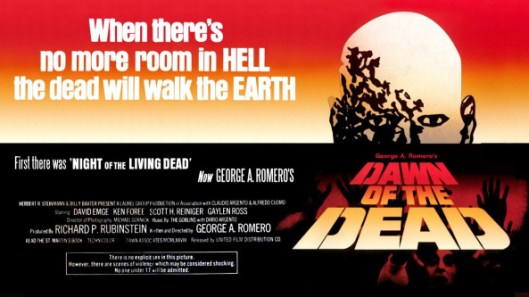
Dawn of the Dead
Dawn of the Dead was the second entry of the George A Romero Of the Dead franchise and the film also sent out the message…
Right-side up is upside down
To those who smile when they frown,
To those who plunge whene’er they jump
Or rise when tripping on a bump
Or gobble down and up their meals
And sink a little in high heels,
To those who elevate a bit
If they lean over, kneel, or sit,
To those who set a precedent
When they descend on their ascent.
Up and down can be subjective.
‘Tis a matter of perspective.
____________________
MPAA rating for Upside Down: PG-13
MPAA rating for Patema Inverted: should be PG
For the next Cartoon Comparison, I’ve chosen two science fiction films with wildly imaginative concepts that happen to be suspiciously similar. Both the live-action Upside Down from Canada and the anime Patema Inverted from Japan feature the idea of opposite gravities: people walking on the ceilings, objects falling up, and the unlikelihood of two oppositely oriented young people overcoming the hatred of their politically hostile worlds. What differs is the way their worlds interact and the pseudo-scientific “explanation” for the curious gravitational situation.
Upside Down came first so if there was any copying being done, the live-action film can claim to be the original. Here, as explained by the narration of Adam (Jim Sturgess), two planets orbit each other so closely that there is essentially no sky. Looking up from either world, one simply sees the other planet’s surface, about as far away as a skyscraper, echoing perhaps the folding city street in Inception. One planet is considered Up Top, full of wealth and societal power, while the other is the economically exploited Down Below, though there’s no telling how they were named, considering the potential confusion of “up” and “down.” Luckily, the extraordinary visuals elevate the film’s none-too-subtle class struggle. Even if there were moments that I wasn’t sure what I was seeing at first, the remarkable effects were a marvel to the eye.
As for the love story, Adam from Down Below happens to meet Eden (Kirsten Dunst) from Up Top, and they share remote romantic rendezvous in the mountains until the government breaks them apart. Years later, as Adam experiments with a practical anti-gravity serum, he seizes a chance to see Eden again at Transworld, the tower-like corporate bridge between the two worlds. The two leads certainly have chemistry, but due to a certain plot point, they don’t get to take much advantage of it, and Sturgess’s behavior can be awkward at times.
Yet Adam’s quest to reunite with Eden without being caught by the authorities leads to a good deal of inventiveness, such as his attempt to weigh himself “up” and pose as a citizen of Up Top. Unfortunately, logic gets in the way at times, including the film’s own invented gravitational rules. For instance, Adam never seems to have a problem with the blood flowing to his head when upside down. Wouldn’t that be both uncomfortable and a possible give-away to anyone who might notice? In addition, one of the planetary laws is that matter from opposite worlds eventually burns, but the time it takes for this to happen seems inconsistent. By film’s end, the conclusion is peculiarly rushed, offering a blanket resolution to crucial issues it couldn’t hope to address and doesn’t try. Upside Down is brilliant in concept, less so in execution, but the visuals alone are worth the watch.
Upside Down may have come first, but Patema Inverted utilizes the notion of inverse gravity far better, in my opinion. Perhaps the fantastical image of falling up is simply more credible in animation rather than live-action CGI, but it certainly captured the imagination of director Yasuhiro Yoshiura, who previously directed the compelling series-turned-movie Time of Eve. (I was impressed by both Patema and Time of Eve separately but didn’t realize till afterward that they shared the same director.)
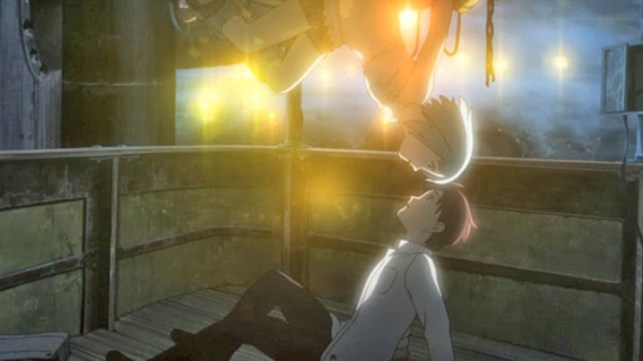
Instead of the up-front exposition of Upside Down, Patema Inverted takes its time to show and develop the gravitational anomalies as the characters discover them. Patema is a girl living in a City of Ember-like underground bunker and seems to be one of the few inhabitants to show an interest in the Forbidden Zone, where dust floats upward and “bat people” are rumored to lurk. After a close encounter, she finds herself dangling from a fence with the sky looming “below” her. Luckily, she is saved by the equally curious surface boy Age, who seems upside down to her. Age lives under a totalitarian dystopian government, whose leader is determined to root out the surviving inverts, who made their way underground after a catastrophic accident sent most of them falling into the sky years ago.
Upside Down basically lacked any sky; there was only so far someone could fall. Patema Inverted, however, makes the sky an imposing threat, a beautiful but dangerous abyss ready to swallow Patema without Age’s assistance. The animation is frequently dazzling, especially when the point of view shifts to contrast Age’s perspective with Patema’s. As Patema ventures into Age’s world and he ventures into hers, the distinction of up and down becomes fluid. The plot even takes some initially confusing twists that challenge the viewer’s perceptions and require some extra thought to fully comprehend. Some might be befuddled, but I found it fascinating. Plus, the musical score is enchanting and perfectly complements the film, including the gorgeous credits song “Patema Inverse,” which is sung in Esperanto and earns a place in the End Credits Song Hall of Fame. Between this and Time of Eve, I’m definitely hoping that Yoshiura continues to create such intriguing films.
I will admit that Patema Inverted seems to draw some inspiration from Upside Down. The cause of the inverted gravity differs (natural phenomenon vs. manmade disaster), but how the two gravities interact is the same: the lesser weight lightens the gravity of the other. This leads to the couples in both films holding on to each other to prevent the other from falling away, and being able to defy gravity by using each other’s weight. Writing about it doesn’t seem to do it justice, but it’s clever, cool, and undeniably similar in both films. As original as Patema Inverted is, I can’t help but wonder how much inspiration it drew from the earlier film. In addition, Patema is also rather slow in its gradual plot progression, and the villain is stereotypically bad for bad’s sake.
Despite these minor “down”-sides, Patema Inverted is easily the better film. Upside Down may have brought gravitational sci-fi to life first, but its conventional plot can’t compare with the thought-provoking vision of its animated counterpart.
Best line from Upside Down: (Adam) “Gravity, they say you can’t fight it. Well, I disagree. What if love was stronger than gravity?”
Best line from Patema Inverted: (Age, when holding onto Patema) “I get it! Your weight makes me light.” (Patema) “Girls don’t like it when you talk like that!”
Rank for Upside Down: List Runner-Up
Rank for Patema Inverted: List-Worthy
Do you recall the sirens?
The smoke-enveloped holes?
The billow blurred
And heavenward
Conveyed the victims’ souls.
Do you recall the terror
Of what was next to come,
The utter hell
As bodies fell
And minds and hearts went numb?
I didn’t watch the pictures
Ingrained on every brain.
I’ve seen them since
And felt the wince
That others bore with pain.
Like me, a generation
Has grown up towerless.
The shock and awe
That once was raw
We’ve had years to suppress.
One might regard us lucky,
The way we understand,
A distance free
From history
That many saw firsthand.
Although the blow is muted
For those younger than I,
We won’t let fade
The price once paid
By heroes when they die.
________________
MPAA rating: PG-13
Last year, I wanted to commemorate 9/11 by seeing the deeply effective United 93, and this year I did the same with World Trade Center, the slightly less acclaimed film from the same year. Based on the real-life experiences of Port Authority police officers John McLoughlin and Will Jimeno, who were buried under the rubble of Ground Zero, World Trade Center poignantly recreates the cavalcade of emotions of that infamous day.
From the first scenes, the film conjures the calm before the storm as everyday people perform their morning routines. Neither Jimeno (Michael Peña) nor his no-nonsense sergeant McLoughlin (Nicolas Cage) seems notable in their roles, yet when a plane flies into the North Tower of the World Trade Center, neither hesitates to venture into its lower levels. These early scenes highlight the uncertainty of the moment: conflicting reports of the severity of the damage, falling bodies, officers and civilians alike staring in shock at the smoking tower; and most of the scenes of the building seemed to be actual footage rather than a re-creation.
Despite the potent depiction of familiar events, most of the film is concerned with the aftermath, from McLoughlin and Jimeno struggling to stay alive beneath the debris to their worrying families. While a few scenes are confusing and the pacing becomes a bit paralyzed during their wait, the story still holds a relatable force in each family’s agonizing anticipation and the relieved cheer at any good news. Both Cage and Peña deliver excellent performances, as do Maria Bello and Maggie Gyllenhaal as their respective wives, and the ordeal is compelling enough that tears are probable by the end. (Also, Lost alert for William Mapother or “Ethan” as a Marine.)
World Trade Center is an admirable tribute to the first responders of 9/11, an impartial testimony thankfully free of the political messages for which its director, Oliver Stone, is known. I especially respect the religious overtones so often absent or limited in disaster movies; here, they extend to desperate prayers, God-led duties, and even a literal manifestation of Jesus. Even so, with its recognizable stars and anxieties common to most disaster films, it feels like a 9/11 movie, whereas United 93 felt like observing the actual events. Nonetheless, both are worthwhile commemorations of the courageous sacrifices made fifteen years ago.
Best line: (McLoughlin) “9/11 showed us what human beings are capable of. The evil, yeah, sure. But it also brought out the goodness we forgot could exist. People taking care of each other for no other reason than it was the right thing to do. It’s important for us to talk about that good, to remember. ‘Cause I saw a lot of it that day.”
Aw, candy, how do I love thee? Let me count the ways. No, I’m not referring to John Candy, Candy Crush, or a girl named Candy. I’m talking about sweets, the confections, desserts, and snacks that help make life worth living. And like most foods, candy has had its place in the spotlight in many, many movies. Thus, before I raid my secret stash, it’s time to count down my favorite uses of candy in movies (No cookies, cakes, pies, or baked goods allowed, for that is another list and shall be told another time.)
Only true fans of the famous actioner would probably remember this tiny but laughable scene. Right before the SWAT team invades the Nakatomi building, one of the baddies named Uli takes his position at a food counter and can’t resist the free candy bars on display. It’s a Crunch bar so I don’t blame him. It’s funny that the actor Al Leong also proved his sweet tooth the next year as the Twinkie-eating Genghis Khan in Bill and Ted’s Excellent Adventure.
This movie has no shortage of food, but among the many of types of candy on display is the monkey Steve’s obsession with gummy bears. When giant gummies attack the flying car like buzz droids, Steve goes psycho on them.
Did anyone know what Turkish Delight was before this book/movie? It looks like some kind of rugalach, but no, it’s “a family of confections based on a gel of starch and sugar,” according to Wikipedia. I’m still not sure what it tastes like, but it’s obviously addictive enough to make Edmund betray his brother and sisters to an evil witch. Enchanted or not, I’ve got to try some of that stuff!
Apparently large South American cryptid birds are partial to chocolate. Russell’s chocolate bars serve to attract the giant colorful bird he names Kevin and even play a role in the vertiginous climax.
Caddyshack
In a scene that made you rethink what exactly a Baby Ruth looks like, a swimming pool is quickly cleared when people see an unidentified candy bar floating around and leap to the worst possible conclusion. Bill Murray, you slob you.
Chocolat
I haven’t seen most of the movies with candy in the title, like Hard Candy,Candyman, Like Water for Chocolate, or Looking for Mr. Goodbar, but Chocolat’s place on this list should be self-explanatory. While I have some issues with the film itself, it’s a true love letter to the seductive power of chocolate.
A classic example of product placement, Elliott lures E.T. out with a trail of Reese’s Pieces. If I visited a strange planet with treats like that, I’d be happy too. Mars, Inc., no doubt regretted their decision to not allow M&M’s to be used instead.
On a much more sober note, the Sakuma Drops in Grave of the Fireflies serve as a slowly depleted vestige of Seita and Setsuko’s life before the war. Eventually, the fruit drop tin takes on far sadder and more bitter contents. Commemorative tins like the one in the film are now collector’s items.
Two words: toot sweets. This underrated childhood classic features an entire musical numbers dedicated to Dick Van Dyke’s newly invented confection. Let’s not forget also the Child Catcher, who lures children with promises of lollipops.
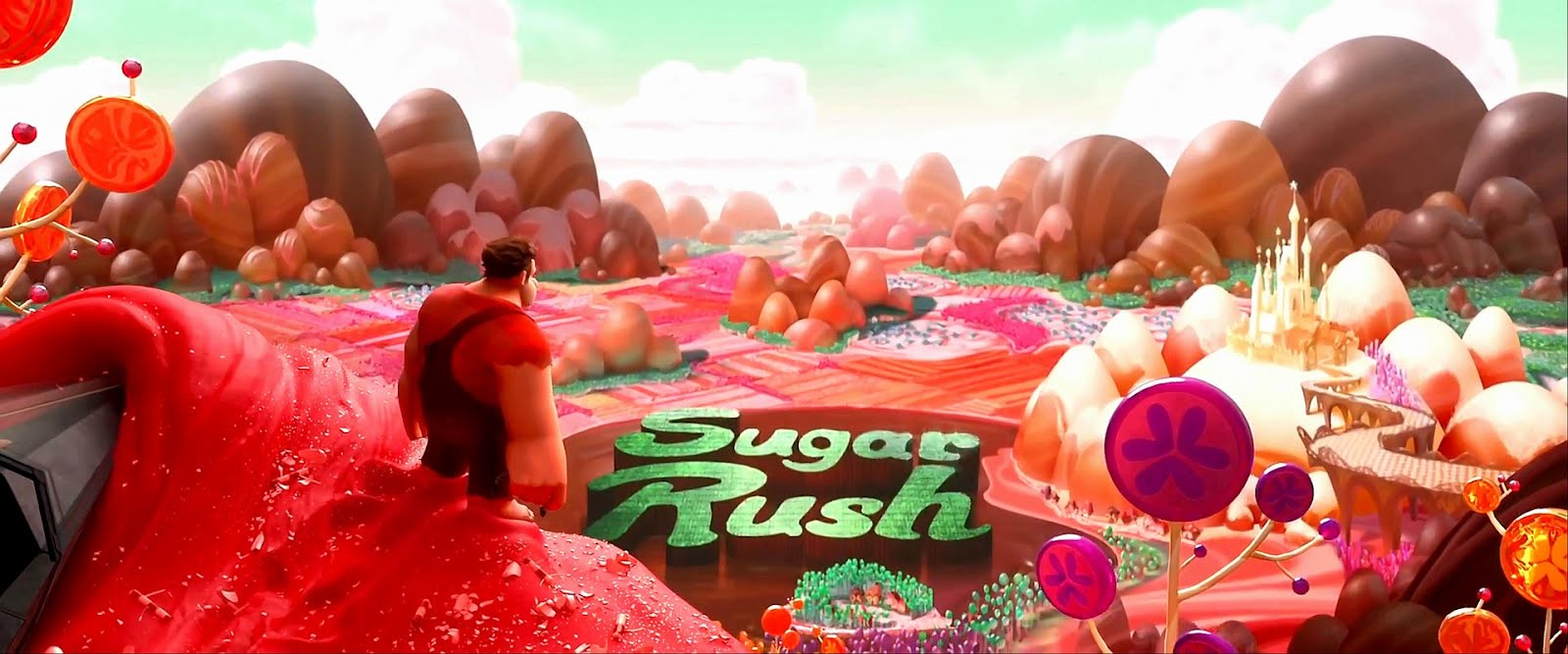
In the world of the Sugar Rush racing game, ruled by King Candy, there’s all manner of sweets as part of the landscape and the population (Laffy Taffy, Sour Bill). Many elements seem suspiciously similar to the Candy Kingdom in the cartoon series Adventure Time, but both are a sweet tooth’s dream.
Was there ever any doubt? The late Gene Wilder brought Willy Wonka to life, and his incredible edibles did justice to Roald Dahl’s candy-centric book. From the Wonka bar that holds the Golden Ticket to the Everlasting Gobstoppers and the entirely edible Chocolate Room, it’s enough to make any candy lover drool. For all its missteps (ahem, Johnny Depp), the remake does get the candy side of the story right. As Charlie Bucket says, “Candy doesn’t have to have a point. That’s why it’s candy.”
Runners-Up (though I’m sure I’ve missed some so feel free to mention others):
Not knowing where you’re headed
Or even where you’re from
Can lead you to frontiers remote
And thrills to keep yourself afloat
And friends you never thought you’d meet,
And yet you still feel incomplete.
You may seem empty-headed,
But none should think you dumb.
With memories returning
And hopes you can’t subdue,
You may pursue the past one day
In hopes that what you lost will stay.
The blanker slate is worry-free,
But most would fill it happily.
The answer to your yearning
Is waiting there for you.
_____________________
MPAA rating: PG
Of all the studios churning out unnecessary sequels to films widely considered untouchable, I trust Pixar the most. Finding Nemo is one of my most beloved films, animated or not, and when a sequel is announced for one of your favorites, I think most people are torn between excitement and fear of disappointment. I wanted Finding Dory to be good, but how could it compare to the original? Luckily, as they’ve proven in every case but Cars 2, Pixar isn’t content to drop the ball for sequels and managed to create a worthwhile story dedicated to everyone’s favorite forgetful fish.
From the very beginning, as the adorable short film Piper segues to an equally adorable baby Dory, Finding Dory cleverly builds a film based entirely on a single line from the first film: Dory’s brief mention of family and the quickly forgotten question “Where are they?” It seemed like a throwaway gag at the time, but Dory is no throwaway character. We see in repeated flashbacks how her parents (Diane Keaton and Eugene Levy) struggled to train and encourage her to overcome her short-term memory loss, and the separation that follows highlights what a disability it is. As hilarious as Dory’s antics are, I never really considered how vulnerable and directionless her condition made her. It’s no wonder that Marlin’s mission filled such a void in her life, and now it’s his and Nemo’s turn to help Dory find her own family, which happens to lead them to the Marine Life Institute in California.
One thing that should be said of Finding Dory is that Pixar has not limited themselves for believability. A gleeful absurdity runs through many parts and particularly during the hilarious climax, not unlike the off-the-wall creativity in Inside Out. But whereas that was inside a girl’s head, this is ostensibly the real world, and a greater suspension of disbelief is required as fish jump between every body of water in sight, big or small. Most examples can be easily overlooked, but it is odd that the first film made an epic quest out of the distance between the Great Barrier Reef and Sydney, while this one transports the characters from Australia to California within minutes. I guess the destination is more important than the journey in this case. Other questions abound, like “Do whale sharks really speak whale (when they are actual sharks, not whales)?” and “Does underwater echolocation really work outside the water too?” But if you just roll with the filmmakers’ indulgences, none of these should affect one’s enjoyment.
The animation is just as spectacular as the first film’s and greater in many cases, especially a first-person slide-away that heightens the trauma of the moment. Seeing the diversely populated exhibits at the institute reminded me of the wonder I always relished whenever I’d visit an aquarium as a kid. That was always my favorite kind of field trip, and Finding Dory reminded me how much I miss those visits, though I have an entirely new view of those innocent little touch pools. The voice cast is also superb, between the return of Ellen DeGeneres as Dory and Albert Brooks as Marlin, and the addition of a host of supporting players, from barking sea lions (Idris Elba and Dominic West) to the grumpy octopus Hank (Ed O’Neill), whose lithe acrobatics facilitate most of the out-of-water experiences. My VC can’t stand the sight of octopi, and while she has yet to see Finding Dory, I’m hoping Hank will alleviate her dislike a bit. I would have liked a little more backstory for him (Could the next movie be Finding Hank?), but he’s a welcome addition, especially on a visual level.
In a way, Finding Dory is like a much improved version of what Cars 2 attempted: giving a popular side character the spotlight to have an adventure of their own and affirm their worth. But whereas Cars 2 had little to say about Mater other than “he’s a lovable idiot so love him,” Dory’s situation has far more depth and empathy. Essentially a fish version of Leonard from Memento without the benefit of tattoos, she’s a constantly rebooting blank slate whose desire to remember is both heartbreaking and warmly resolute. Even if I don’t quite agree with her assertion that “the best things happen by chance,” Dory remains as endearing and sincere a presence as ever.
I won’t try to pretend that Finding Dory is as good as its predecessor, but I’ve seen Finding Nemo countless times. I remember crowing with laughter at Dory speaking whale, yet when you know a film practically by heart, sometimes it loses something and you wish you could see it again for the first time. Above all, Finding Dory let me laugh-out-loud with these characters again and many new ones besides. For example, I never expected Pixar to pull off such a hilarious parody of a scene from Alien and the unrelated casting of Sigourney Weaver just made it better. Finding Dory filled in gaps I didn’t think needed answering and brought me somewhat of that same feeling I had watching the first film as a ten-year-old. If a sequel had to be made, I’m glad it was this one.
Best line: (Dory) “Sigourney Weaver is going to help us!”
Planes are too risky, and cars are too slow,
And don’t get me started on cruises and ships.
It seems that the safest conveyance for trips
Is travel by train; ‘tis the best way to go.
The scenery passes in hurtling flashes,
And movies have proven how romance can bloom.
But murderers too ride the train, I assume,
And safety is sometimes as rare as a crash is.
If you beware of endangered females
And manage to somehow remain on your train
Or if you fall off, to get on it again,
Then maybe your travels won’t go off the rails.
_____________________
MPAA rating: PG (should be PG-13 for innuendo and language)
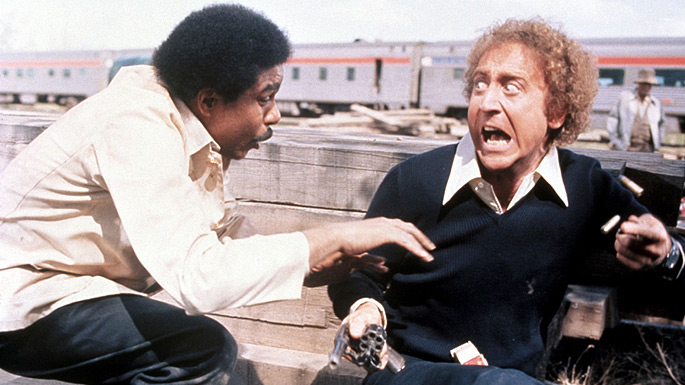
In honor of the late Gene Wilder, I thought I’d review one of my VC’s favorite films of his. Murder on a train has certainly been seen before, like in 1974’s Murder on the Orient Express, but Silver Streak two years later milks the concept for sheer entertainment rather than mystery. Wilder plays George Caldwell, an editor in search of the boredom of riding a train, who meets his flirty room neighbor Hilly (Jill Clayburgh) and shares some garden-related pillow talk with her. And then a dead body appears outside the window. Talk about a mood killer.
Wilder isn’t quite as neurotic as his Leo Bloom in The Producers, but he’s likably nervous while he uncovers the conspiracy on board the Silver Streak, which connects L.A. and Chicago. There are shoot-outs and FBI agents and hidden evidence and a spear gun, and even if the plot gets a bit convoluted, the intrigue never falters.
The humor tends to stick with innuendo and mild amusement, that is, until Richard Pryor as the helpful criminal Grover joins the party. Silver Streak was the first partnership between Wilder and Pryor, and while I haven’t seen their other films together, they were no doubt striving to recreate the buddy chemistry on display here. There’s no real depth in their relationship, no moment of bonding, but they get along so well that it’s not needed. Their black-and-white appeal delivers some of the best moments, such as Wilder’s attempt at acting black to avoid the police.
The rest of the cast also get their memorable moments, including Ned Beatty, Scatman Crothers, Patrick McGoohan, Clifton James, Ray Walston, and Richard Kiel, playing a metal-toothed thug a year before he played Jaws in The Spy Who Loved Me. Perhaps the most memorable scene is the big unstoppable climax, which has been echoed in other train scenes like that in Hugo. While it’s not the best or funniest of Gene Wilder’s films (those would be Willy Wonka and Young Frankenstein for me), Silver Streak is an entertaining ride combining the American countryside, conspiratorial mystery, excellent casting, and a reminder of its star’s inimitable talent. RIP Gene Wilder.
Here’s my review of last year’s Goosebumps, which barely qualified for MovieRob’s August Genre Grandeur for horror movies. Let’s just say it’s the kind of “horror” anyone can handle.
For this month’s next review for Genre Grandeur – Horror Films, here’s a review of Goosebumps (2015) by SG of Rhyme and Reason
Thanks again to Jane of 500 Days of Film for choosing this month’s interesting (if not uncomfortable for me) genre.
Next month’s Genre has been chosen by Prime Six. He has chosen another unique genre for this coming month. We will be reviewing our favorite Realistic Films.
Here’s his interpretation of the genre:
We all put reviews in for films we think are realistic, for example Gravity has real physics behind it and Saving Private Ryan is a realistic depiction of war.
To be clear, not ‘real’, not a true story or documentary. What comes to mind when you think of the most realistic film you’ve ever seen? So Fast and Furious and Comic book films are all (mostly?) out.
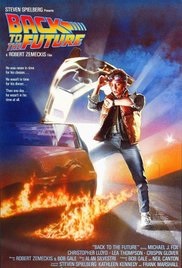
Don’t forget to vote for your favorite Time Travel Movie in the latest Opinion Battle. While many went with Back to the Future, I chose its even more complex Part II. Make the time to vote!
Time Travel movies have people talking for years to come after seeing them with people discussing the ideas of time travel, the good, the bad or the side effects and while it was The Time Machine that really put the genre on the map we have seen people take a fresh approach to the genre for years now. We have come together to give what should be a wonderful amount of time travel films to see which most people consider the best.
If you want to take part in the next opinion battles the subject is favourite Zombie movie you will need to have your choice by 3rd September 2016 and email your choices to moviereviews101@yahoo.co.uk
Darren – Movie Reviews 101
Back to the Future
Back to the Future is on the list of films I will be showing my children…
Once upon a time there lived a boy named Charlie Brown,
Who everybody liked until he gave them cause to frown;
For Charlie Brown was quick to frown and sadly slow to smile,
And had the same effect on all his class’s rank and file.
Whenever his attempts at triumph went from bad to worse
And friends would laugh about his gaffe, he’d blame the universe.
Yet those who knew him well enough had faith in Charlie Brown
And knew that there would come a day he wouldn’t be let down.
Every foolish down-and-out and football-missing goof
Believes the talk of failure, thinking they are living proof.
Yet even then the heavy-hearted, unimpressive mourner
Should know that every failure still has Someone in his corner.
____________________
MPAA rating: G
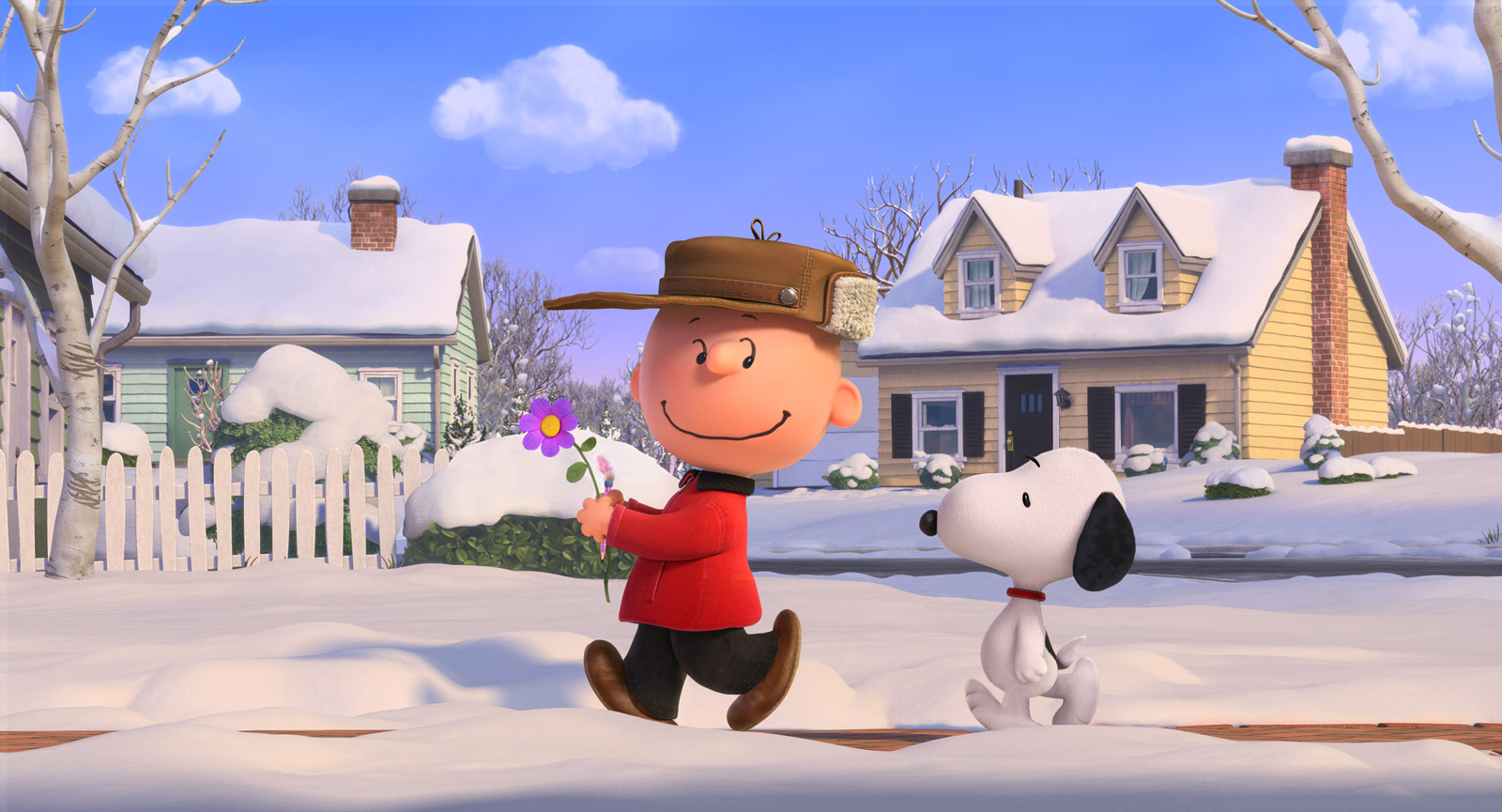
With so many old properties being revamped and rebooted in ways no one ever asked for or wanted, it’s easy to imagine a modern version of Charles Schulz’s Peanuts comic strip going off the rails. I shudder at the thought of some misguided writer combining Charlie Brown and Linus with smartphones and hip hop in a sad attempt at making them accessible to today’s youth. Yet, thankfully, someone thought better of it; that’s why The Peanuts Movie is such a wonder. Not only is it extremely faithful to its source material, but it effortlessly captures the charm of the classic cartoons. Like them, its appeal seems timeless, and there aren’t many animated films these days that fit that description.
Blue Sky Studios has found a nice balance between the original 2D and more recent 3D animation; it allows the same character appearances and comic-strip-style reaction lines while adding depth to their surroundings. The updated look is both vintage and current, working well for the everyday antics of the kids and bringing Snoopy’s WWI flying-ace dream sequences to a thrilling new level.
Luckily, though, the animation is really all that has been brought into the 21st century. There’s still the gentle pessimism of lovable Charlie Brown, the wise counsel of Linus, the goofy antics of Snoopy and Woodstock, the bossy hostility of Lucy, the distinct quirks of their various friends. While Linus’s religiosity has been dropped and the humor is more fast-paced, it all feels of a piece with the classic cartoons of the ‘60s and ‘70s, capturing their spirit better than the more recent 2D attempts on TV. Yet, as episodic as it seems at times, the filmmakers created a perfect connection among Charlie Brown’s misadventures: his attempts to impress the Little Red-Haired Girl in his class. I don’t remember the old Charlie Brown ever being as industrious (reading War and Peace in one weekend?!) or as kind as he is here (Snoopy too for that matter), but even with his classmates’ teasing, it’s clear what a role model the movie’s Charlie Brown is.
Throughout the film, I felt it was charming and likable, but it wasn’t until the end that I realized how much I truly admired The Peanuts Movie. Fans of the original specials will surely feel more of a connection with it, but it’s a film with all the earmarks of an instant classic, perhaps not a laugh-out-loud favorite, but a bit of warm nostalgia worth watching for years to come. It’s easily the best film Blue Sky has ever created and one I would feel proud to watch with kids of my own someday.
Best line: (Charlie Brown) “You’ve got to help me, Linus! I’m not sure I can handle being partners with the Little Red-Haired Girl! How will I support her? I can’t afford a mortgage! What if I’m put into escrow?” (Linus) “Charlie Brown, you’re the only person I know who can turn a simple book report into a lifelong commitment.”
The X-Men are back…yet again, it would seem.
Professor X still is collecting a team
Of mighty good mutants, both young men and ladies,
But what kind of evil would threaten the ’80s?
An evil so great none remember his name,
Who’s awfully annoyed at the loss of his fame
And wants to subdue the whole world since he can.
Now that’s an original motive and plan!
A good thing for us that some teens will defend us
From egos tremendous and costumes horrendous.
Destruction is nigh…yet again, it would seem,
But we know the future, so don’t worry, team.
____________________
MPAA rating: PG-13
Most were doubtful as to whether Bryan Singer could follow up the success of Days of Future Past with a worthy sequel. X-Men: Apocalypse confirmed that those doubts were not unfounded, yet this is no The Last Stand. Singer has proven that he can produce a great X-Men movie, so it stands to reason that he can also give us a mostly good one. Even if Apocalypse is the awkward third child of the most recent reboot trilogy, it still received enough care and attention to be a worthwhile member of the family.
Set in the 1980s, ten years after mutants were revealed to the world in Days of Future Past, the film reintroduces younger versions of other characters from the original trilogy: Cyclops (Tye Sheridan), Nightcrawler (Kodi Smit McPhee), Storm (Alexandra Shipp), and Jean Grey (Sophie Turner). In Cyclops’s case, we get a firsthand example of a new student being introduced to the school (through his brother Alex Summers/Havoc from First Class) and learning about his new powers, echoing the early days of Rogue’s arrival in the first X-Men. In addition, there’s quite a bit of globe-hopping, from Magneto’s too-good-to-last family life in his native Poland to Mystique’s mutant rescue missions to Moira McTaggert’s discovery of the long-dormant super-mutant known as En Sabah Nur or Apocalypse (unrecognizable Oscar Isaac). As Apocalypse gathers empowered minions to his cause of, you know, the end of the world, it’s up to the X-Men to band together and stop him.
I do want to make it clear that I enjoyed X-Men: Apocalypse, seeing all of the characters together again, the action-packed showdowns and references to other films, from Nightcrawler’s Catholicism to an explanation for Xavier’s baldness. While the reason for his presence is never really resolved, a visit from Evan Peters’ Quicksilver proved to be the highlight of the whole movie; he got the best scene in Days of Future Past, and once again his standout moment alone was worth the price of admission.
I liked a good deal of this Apocalypse, but there are some unavoidable flaws that bothered me as well. The most noticeable issue is an excess that’s hard to put into words. Certain scenes were just a bit…much. The opening scene, in which ancient Egyptian rebels bury Apocalypse under a very poorly constructed pyramid, has a lot of noise and effects without much context. Other scenes are similarly over-the-top. One big oh-no calamity is blaringly melodramatic, intercut with worldwide reactions and an extravagant “you-are-nothing-compared-with-me” speech from Oscar Isaac. Likewise, the pacing sometimes lags in the big fights as the clearly overpowered Apocalypse delivers “I-will-destroy-you” monologues while the heroes encourage each other to “release your power!” which they, of course, do. It’s rather wearisome by the end.
The other problem is one that seems to have annoyed me more than others: continuity. I love and value attention to continuity, and it’s one of the aspects that made Days of Future Past so amazing, since it delivered a satisfying and believable closure to both timelines. Yet for the events of X-Men: Apocalypse to make any sense with the original trilogy, we must assume that Days of Future Past began an alternate timeline, such that the other films never will happen or at least not as the movies depict events. In Apocalypse, characters meet when they shouldn’t yet, Wolverine shows up with Stryker in a way that seems to ignore Origins, and the writers have given up trying to make Mystique into the villain from the first X-Men. Remember that last tantalizing little Stryker/Mystique scene from the end of Future Past? It’s entirely disregarded. The other prequels had their continuity issues too, but so much in Apocalypse has to be taken separate from the other films that it indeed feels like an alternate timeline, making one wonder why Singer had to muddy the waters. I suppose that’s not hard to believe; unlike the Marvel Cinematic Universe, the X-Men films have probably gone on far longer than anyone expected them to, leading different filmmakers to essentially make it up as they go along. It’s just made more confusing for us continuity seekers when Singer actively tries to reference events that will happen, like the whole Dark Phoenix debacle.
I’m not the first to point out Jean Grey’s self-referential line as she and her friends exit a screening of Return of the Jedi: “Well, at least we can all agree the third one’s always the worst.” As X-Men films go, Apocalypse falls squarely in the middle of the pack; it’s nowhere near the best, but DC’s efforts this year have at least saved it from being labelled the worst superhero movie of 2016. As much as I enjoy these movies, I can’t help but feel that, after nine films, the X-Men franchise might be ready to end. Hugh Jackman is supposedly hanging his claws up after one more outing as Wolverine, which is allegedly set up by the after-credits scene that will make no sense to non-comic readers. There’s so much comic material still uncovered, but I wonder if the X-Men have been played out. I wish the franchise could end on a high note like Days of Future Past, but only time will tell.
Best line: (Charles, defying Apocalypse and still able to sum up the entire point of the X-Men) “Those with the greatest power… protect those without. That’s my message to the world.”










 Rhyme and Reason