• Home
  • About Me
  • The List
  • THE LIST (2016 Update)
  • THE LIST (2017 Update)
  • THE LIST (2018 Update)
  • THE LIST (2019 Update)
  • THE LIST (2020 Update)
  • THE LIST (2021 Update)
  • THE LIST (2022 Update)
  • Top Twelves and More
  • The End Credits Song Hall of Fame

Rhyme and Reason

~ Poetry Meets Film Reviews

Rhyme and Reason

Monthly Archives: December 2016

The Finest Hours (2016)

06 Tuesday Dec 2016

Posted by sgliput in Movies, Poetry, Reviews, Writing

≈ Leave a comment

Tags

Drama, History, Thriller

Image result for the finest hours


The wind was tired of being still
And spun its wings with fearful will.
It threaded threats with every thrust
And shook the sea with every gust,
Reminding man he was but dust
In fear of nature’s means to kill.

Beneath the atmospheric rant
That conjured waves with every pant
Were men in danger of the gale
And men who braved the wintry wail,
Enrolled to risk, too bold to fail
Or yield to whisper-winds of “Can’t.”
________________

MPAA rating: PG-13

The Finest Hours is essentially The Perfect Storm with a happier ending, but this is one case where the tragedy outshines the victory. Despite this, The Finest Hours is a good film and a worthy tribute to the brave men who, in 1952, saved the crew of a bisected ship in a daring tempest-tossed rescue.

The heroism is admirable, but the characters performing it are less than memorable. Chris Pine is the strongest player, playing Bernie Webber, a Coast Guard crewman whose diffident nature is the polar opposite of Pine’s Captain Kirk persona. Due to a past failed rescue, Bernie doubts himself, as do several residents of his Massachusetts town, but he proves himself by rising to the occasion when he is sent out in search of the distressed SS Pendleton. As honorable as Bernie is, there are moments where his character is peculiarly hesitant, such as an early moment where a marriage proposal is met by an unexplained, glossed-over “no.” On the other side of the disaster, Casey Affleck as the Pendleton’s engineer Ray Sybert rallies the crew with his expertise and good sense, but despite hints to the contrary, he’s never developed past a heroic blank slate.

Image result for the finest hours


Smaller moments with side characters work better, such as the helpful resolve of Bernie’s fiancée Miriam (Holliday Grainger) or a discerning realization of one of the townsfolk who blamed Bernie for his past failure. It was also nice to see Graham McTavish from The Hobbit trilogy outside of his dwarf makeup. In addition, the inclement effects recreate the danger of the nor’easter threatening everyone at sea and keep the extended rescue scenes tense and treacherous.

I can’t say I didn’t care for the characters in The Finest Hours, but I didn’t know them well enough. As much as I usually prefer happy endings, The Perfect Storm is a better film, if only for the stronger characterization, but The Finest Hours still brings a laudable dose of maritime valor to the screen.

Best line: (Bernie) “They say you gotta go out. They don’t say you gotta come back.”


Rank: List Runner-Up


© 2016 S.G. Liput
434 Followers and Counting


Princess Mononoke (1997)

05 Monday Dec 2016

Posted by sgliput in Movies, Poetry, Reviews, Writing

≈ Leave a comment

Tags

Action, Animation, Anime, Drama, Fantasy

Image result for princess mononoke


The forest stood for centuries,
In peace made permanent by trees
Whose roots sucked deep of earthen milk,
Whose branches guarded all.
And then came humans and their ilk
Who made the trees to fall.

/\/\/\/\/\/\/\/\/\/\/\/\/\/\/\/

Mankind pushed on for centuries
Through mountains, deserts, woods, and seas.
From cave to tent to town, they rose
With wonders underway.
Too often, nature did oppose
And kept progress at bay.

/\/\/\/\/\/\/\/\/\/\/\/\/\/\/\/

Both stories hold an equal truth.
Both man and nature from their youth
Have wished romantically for truce
That ended in conquest.
Cooperation or abuse—
We choose which path is best.
___________________

MPAA rating: PG-13

Hayao Miyazaki has a filmography full of films considered great cinema, and each of them seems to fit a particular target age group. While they are all beautifully drawn, the maturity level for his features could be generally ranked something like this: Ponyo (5 years old and up), My Neighbor Totoro (6 and up), Kiki’s Delivery Service (7 and up), Castle in the Sky (8 and up), Porco Rosso (9 and up), Spirited Away (10 and up), Howl’s Moving Castle (11 and up), Nausicaä of the Valley of the Wind (12 and up), The Castle of Cagliostro (13 and up), The Wind Rises (13 and up), and the one most clearly meant for adults, Princess Mononoke (14 and up).

Princess Mononoke is different from any other Studio Ghibli film, both in its narrative complexity and its level of violence, and when I discovered the Ghibli films and had myself an anime marathon, it caught me completely off-guard. I was shocked that heads and arms were being lopped off within the first fifteen minutes, and I turned it off then and there. It took me some time to give it another try and look past the savagery of certain scenes. Luckily, those scenes are the exception rather than the rule, and I found that Princess Mononoke was something few animated films can claim to be—an epic. From the sweeping landscapes and moving Joe Hisaishi score (he really is one of my favorite movie composers) to the huge cast of characters and nuanced themes, it’s a film so ambitious that I don’t know if there’s anything else to compare it to.

Image result for princess mononoke irontown

The story follows Prince Ashitaka (Billy Crudup in the English dub) in ancient tribal Japan, before forest gods and demons became mere legends. While defending his village from a demon boar, his arm is infected with a curse, and he must journey to a distant forest in the hopes of a spiritual cure. What he finds is an ongoing struggle between industry and nature, as the hardworking folk of the lakeside Irontown battle against the forest gods, led by the giant wolf Moro (Gillian Anderson) and her adopted human daughter San (Claire Danes).

Before Spirited Away came along, Princess Mononoke had every right to be called Miyazaki’s masterpiece, and while it’s far from my favorite of his films, I certainly see why it is deserving of that distinction, more so than Spirited Away, to be honest. Princess Mononoke is as expansive an experience as one can find in an anime film, with Ghibli’s ever-detailed artwork transporting viewers to another time and place full of action, beauty, and menace. It’s not a film I connected with personally, and certain things detract from it in my eyes: the aforementioned violence, the heavy pagan mythology, some grotesque imagery, an ending that doesn’t seem to punish the character most deserving of it. Yet there’s so much to impress that objections like these seem small by comparison.

Image result for princess mononoke irontown


The plot and characters are the most impressive ingredients on display. The conflict between humans and nature has resonances of Miyazaki’s Nausicaä of the Valley of the Wind, from the strong female characters right down to the final scene of both, but there are more than two sides to the dispute, and every side has its own distinct motivations that are far from black and white or simple good and evil. There’s Lady Eboshi (Minnie Driver) and her Irontown loyalists, who are embattled with San and the wolves, while a herd of vengeful boar also joins the fray, while a devious monk (Billy Bob Thornton) plots to steal the head of the Great Forest Spirit, while some iron-greedy samurai make war too. And in the middle of everything is Ashitaka, urging peace on all sides as he seeks to heal his cursed arm, which gives him super-strength but will eventually kill him. How all these various factions clash is key to the film’s epicness, yet Miyazaki’s knack for character is also on display. Lady Eboshi, for instance, isn’t a typical villain, trying to act in the best interest of her people and demonstrating concern for the lepers and women under her care. It’s unfortunate then that the multitude of characters proves too much to negotiate by the end, where the strife is wrapped up a bit too neatly, but the bulk of the film balances it all amazingly well.

Image result for princess mononoke moro


The sheer length and scope of Princess Mononoke are enough to make it a landmark anime, even if it’s not for all ages. It played a role in bringing Studio Ghibli to greater attention in the West and, like Akira, showed audiences that anime could be intricate and mature and more than Saturday morning cartoon fare. Though I find several of his films more engaging than Princess Mononoke, if you want proof of Hayao Miyazaki’s talent as a filmmaker, this is it.

Best line: (Hii-sama, the wise woman of Ashitaka’s village) “You cannot change fate. However, you can rise to meet it, if you so choose.”


Rank: List-Worthy


© 2016 S.G. Liput
433 Followers and Counting

 

Tomorrowland (2015)

04 Sunday Dec 2016

Posted by sgliput in Movies, Poetry, Reviews, Writing

≈ 2 Comments

Tags

Action, Disney, Sci-fi, Thriller

Image result for tomorrowland film


Tomorrow, tomorrow,
With no time to borrow,
The future may very well sink into sorrow.

It’s hard to predict
When our views contradict,
And the fears that some carry are dreams others picked.

The future is ever
In danger; however,
We mustn’t believe it’s a futile endeavor.

Are trends that we set then
The kind we’ll regret? Then,
It’s clear dark tomorrows will come…if we let them.
____________________

MPAA rating: PG

What happens when everyone says a movie is bad and you like it anyway? Every review I read of Tomorrowland painted it as an unwieldy flop in which every positive element was spoiled by a negative. Thus, I skipped it, preferring to spend my 130 minutes on something more critically favored. Yet, when I finally gave it a chance, Tomorrowland proved to be a highly enjoyable ride, a sci-fi wonder in which every negative had a positive to mostly redeem it, at least in my opinion.

Beginning at the 1964 New York World’s Fair, young Frank Walker presents David Nix (Hugh Laurie) with a homemade jet pack that isn’t quite fully functional, and Nix’s girl companion Athena (Raffey Cassidy) is impressed enough to invite Frank to the titular technology wonderland. Cut then to teenage Casey Newton (Britt Robertson), who goes out of her way to keep alive the hopes of the Space Age by prolonging her engineer dad’s NASA contract through sabotage. She’s an incorrigible optimist, unwilling to bend to the downbeat world, and when Athena appears again to give her a mysterious pin and a glimpse of Tomorrowland, Casey is eager to pursue it. Joining with a bitter, grown-up Frank (George Clooney), they embark on a thrilling chase to reach the other-dimensional utopia where all does not seem to be well.

Image result for tomorrowland film

I’ll focus first on everything Tomorrowland has going for it. All the actors excel, especially Raffey Cassidy who shines in a wise-beyond-her-years type of role. As a director, Brad Bird also knows how to direct a visually exciting film. With its jetpacks, robots, and floating swimming pools, the striking metropolis of Tomorrowland that appears whenever Casey touches the pin has wonders tailored to both 1960s and present-day tastes. In addition, many aspects of the film feel inspired by the intrigue of Men in Black, incorporating imaginative gadgets, geeky thrills, and futuristic plot devices hidden in plain sight. With all the killer android chases and high-tech detours, it’s easy to let the plot carry you along and ignore the fact that it’s not really going anywhere worthwhile. By the time we see Tomorrowland itself, it feels like a hollow piece of false advertising, though that does make sense for the plot. I do wish that we were able to see Tomorrowland the city as more than just an unreached potential, but it’s a case of the journey overshadowing the destination, with the journey being pretty entertaining.

I see what others have criticized about the uneven plot, the disappointing goal, and the borderline creepy relationship between Clooney and 12-year-old Raffey Cassidy, and they’re not wrong. But Tomorrowland is a prime example of a film that depends on how much the viewer is willing to let such faults bother them. While the two films are nowhere near the same league, I could point to 2012’s Les Miserables as another such film; half of viewers complained about the singing of Hugh Jackman and Russell Crowe and couldn’t take the constant singing seriously, while the other half (me included) were captivated by the film’s emotional and musical power. I can’t say those of the other opinion are wrong; their objections just didn’t ruin the film for me. Sometimes, if the majority of a film delights, a half-baked ending can be forgiven. And the objection about Clooney and Cassidy depends entirely on the strength of your suspension of disbelief; based on Athena’s character as written, it doesn’t have to be creepy.

Image result for tomorrowland film

What Tomorrowland tries to be is an antidote to the constant stream of dystopian fiction in our media. Zombie outbreaks, totalitarian governments, natural disasters—it seems that Star Trek is the only proposed future that is actually worth looking forward to. Tomorrowland takes that fatalism literally and suggests that such warnings are more harmful than good if no one heeds them, a cautious lesson worth more than a casual thought. Perhaps, the film insists, optimism itself can change the world for the better. Yes, it sounds corny, going overboard in the soapy commercial-like final scene, but if the constant pessimism of grim social commentaries can captivate audiences, can’t the polar opposite have its day too? I recognize the flaws of Tomorrowland, not least of which are smacks of elitism in the recruiting of the best and brightest to populate a separated utopia that doesn’t seem to directly better the world at large, but it appeals to the dreamer, the hoper, and the lover of sci-fi adventure. That’s good enough for me.

Best line: (Casey) “There are two wolves, and they are always fighting. One is darkness and despair. The other is light and hope. Which wolf wins?”
(her dad) “Come on, Casey.”
(Casey) “Okay, fine. Don’t answer.”
(dad) “Whichever one you feed.”


Rank: List-Worthy


© 2016 S.G. Liput
431 Followers and Counting


The Breakfast Club (1985)

03 Saturday Dec 2016

Posted by sgliput in Movies, Poetry, Reviews, Writing

≈ 2 Comments

Tags

Comedy, Drama

Image result for the breakfast club


How much of you is who you are
And how much how you’re seen?
We like to think we’re unconstrained
By powers over us ordained
That keep us quelled or entertained.
We break the mold; we think anew
(At least I like to think I do),
And yet we linger in routine.

As independent as we are,
Our views are molded like the rest.
Your parents, teachers, habits, friends,
And daily life in all its trends
Have fashioned you. How much depends
On how well you can recognize
The truth among the many lies.
There’s more of both than most have guessed.
_______________

MPAA rating: R (for frequent language)

I’ve caught John Hughes’ classic teen drama The Breakfast Club on TV several times over the years, but only recently watched it from the beginning. As great a film as it is, I’ve got to say that I wasn’t missing much. The first half hour sets up the plot, of course, settling five diverse high school archetypes into a grumpy Saturday morning detention under the strict but ineffectual eye of Vice Principal Vernon (Paul Gleason). We get to meet Andy the jock (Emilio Estevez), Brian the nerd (Anthony Michael Hall), Claire the popular girl (Molly Ringwald), John Bender the rebel (Judd Nelson), and Allison the “basket case” (Ally Sheedy). Aside from some reinforcing of their character traits, such as Ally Sheedy’s bizarre breakfast sandwich, the beginning of the film is limited to prickly exchanges between Bender and Vernon and everyone generally not getting along. It’s after Vernon leaves the quintet to themselves that the film becomes the classic it’s known as, and that’s about when I’ve typically tuned in in the past, not intentionally, just by chance, I guess.

Image result for the breakfast club

Hughes’s script so humanizes these teenagers and makes them so relatable that their interactions are some of the most memorable conversations put to film. Everyone will relate to at least one of these characters and their teenage pressures. Perhaps it’s the parental stress placed on Andy over sports or Brian over his grades; perhaps it’s the peer pressure put on Claire by her friends and the need to remain popular; perhaps it’s the dysfunctional home life that Bender rages over yet accepts. It’s probably not Allison’s “nothing better to do” mentality, but even her wildcard status and embraced weirdness have their source in a painfully common family fault. (For the record, though, I do get along with my parents. No lie.) Every discussion feels natural and holds some discerning truth, even the grumbling of Vernon as he complains about the kids to the janitor. Mingled among these dialogues are some classic ’80s moments of fun: the students running through the halls to avoid Vernon, the awesomely classic dancing scene in the library, the final monologue set to Simple Minds’ “Don’t You (Forget About Me).”

Oh, boy. Starting this review, I fully intended to rank The Breakfast Club as a List Runner-Up simply because I’ve never considered it one of my favorite films, but, as has happened a couple other times, expounding on all of its strengths has made me second-guess myself. It’s a quotable ’80s classic through and through, one that will fill that generation with nostalgia but still appeal to this generation with its universal themes of teen angst and resenting stereotypes. Even if the beginning pales next to the second half, it’s certainly List-Worthy. How can I give it any other score?

Best line: (Andy) “We’re all pretty bizarre. Some of us are just better at hiding it, that’s all.”


Rank: List-Worthy


© 2016 S.G. Liput
429 Followers and Counting


The Conversation (1974)

02 Friday Dec 2016

Posted by sgliput in Movies, Poetry, Reviews, Writing

≈ 5 Comments

Tags

Drama, Mystery, Thriller

Image result for the conversation film


Relax, I can calm all your eavesdropping fears;
Don’t worry; we’re shielded from unwelcome ears.
I’ve turned off my phone, which I’ve hid in my lawn,
So it’s muffled in case it’s remotely turned on.

I’ve checked every lampshade and drawer that I’ve got
And crushed every bug, whether living or not.
I’ve emptied the bookcases, checked every crack,
And covered the windows with tarps painted black.

I’ve wrapped my computer and cameras in wool,
So no one can use them to get an earful.
And while I apologize for all the noise,
It’s safest to speak while I blast Beastie Boys.

So now we can talk, privately and secure.
And yet, in this world, can we ever be sure?
_______________________

MPAA rating: PG

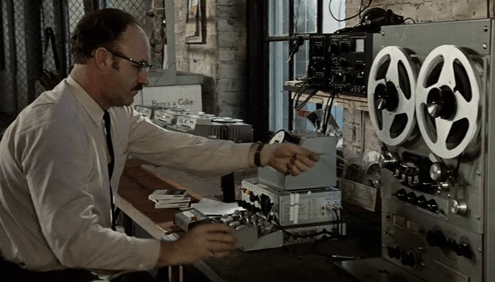
Francis Ford Coppola had a good year in 1974, where both The Conversation and The Godfather Part II were nominated for Best Picture, the latter winning, of course. Both have solid critical acclaim, but it’s easy for The Conversation to be overshadowed by its more epic cousin. It’s a slow-moving thriller very different from Coppola’s other films, hanging predominately on Gene Hackman in the lead role of Harry Caul, a surveillance expert who believes he’s overheard evidence of a potential murder yet to happen.

Hackman is always excellent, and while I can’t say it’s one of his most memorable performances, he makes the mustached Caul sympathetic with his intensely private, loner lifestyle and his guilt over a past job gone wrong. Next to him are early appearances by Cindy Williams, John Cazale (Fredo in The Godfather films), and even Harrison Ford, but the other star of the film is the surveillance equipment Caul employs. In our current world of advanced electronics, The Conversation feels significant if only to capture the methods and technology of the surveillance profession decades ago, such as the huge reel tape machine that Caul uses to listen to the same enigmatic sentences over and over throughout the film. While most of it seems antiquated, I was actually surprised by one gadget that could remotely turn a telephone into a listening device, and those were old-fashioned corded phones!

Image result for the conversation film

All that being said, The Conversation is a thriller of a different style than we’re used to nowadays with constant car chases and explosions. It’s slow and meant to be slow, relying on suggestion and paranoia that doesn’t always keep it interesting. That does change toward the end, as the truth of the conversation comes to light, especially with a memorable scene involving a toilet. After the masterfully enacted twist, though, it’s as if the film doesn’t know how to end. The final scene boasts some powerful paranoia (enough even to overwhelm Caul’s religious devotion), but it’s not what I consider an ending. Perhaps it would have benefited from a little less ambiguity toward a climactic irony, which I only learned of while reading about the film afterward.

The Conversation may not be my cup of tea, as far as thrillers go, but it’s an anxiously plausible and well-made meditation on privacy or the lack thereof and a reminder that the meaning of a conversation can hinge on the stress of a single word.

Best line: (Caul) “I’m not afraid of death, but I am afraid of murder.”


Rank: Honorable Mention


© 2016 S.G. Liput
429 Followers and Counting


The Age of Adaline (2015)

01 Thursday Dec 2016

Posted by sgliput in Movies, Poetry, Reviews, Writing

≈ 2 Comments

Tags

Drama, Fantasy, Romance

Image result for the age of adaline


If I had all the years ahead,
My future stretching infinite,
I’d laugh at death and waste my breath
And take my time to start and quit
And eat more than I would admit.

No matter what the daily rut,
I’d rarely worry with my glut
Of days and decades in reserve,
For patience straightens every curve
And makes all roads a new shortcut.

Or so I think….
As days and decades further sink
Into the endless stream I cross,
Along with friends and love that ends,
This gift may be an albatross.
Who wants an eternity of loss?
________________

MPAA rating: PG-13 (could even be PG)

The Age of Adaline is the kind of film that I knew I would enjoy based solely on the trailer and the ingenious title with a double meaning. I love films that follow one character through decades of drama, and The Age of Adaline does so with a fantasy twist reminiscent of The Curious Case of Benjamin Button and Winter’s Tale. As the opening narration explains, Adaline Bowman lived a normal life in the early 1900s, full of the typical joys and sorrows, but an accident that should have killed her instead gave her inexplicable longevity. She never ages past her original 29 years, and while many women would consider that a blessing, it feels more and more like a curse as the decades pass, friends and family get older, the world changes, and she doesn’t.

Blake Lively was the perfect choice for Adaline, embodying both World War II-era and modern-day elegance and giving the audience an essential glimpse into her emotional state. A tear-jerking look-back at all the dogs she has owned over the decades was a brilliant way to help us understand her magnified grief. Flashbacks are used to good effect with the same purpose, clarifying why Adaline is always on the run from potential love interests and anyone who might catch on to her secret…that is, until she meets the charismatic Ellis (Michiel Huisman) and the familiar William (Harrison Ford).

Image result for the age of adaline

The Age of Adaline fulfills its fantastical, romantic purpose with a sophisticated polish, both in the big picture and the details. (Anthony Ingruber as a young William was scarily good with his Harrison Ford impression. Look at him in the picture above; why isn’t he being considered for that Han Solo spinoff?) Unfortunately, the film does slip on occasion, specifically when Adaline’s “miracle” takes place, the narrator giving some hogwash about an undiscovered trait of DNA that freezes the aging process. Groundhog Day didn’t try to explain Bill Murray’s time loop, nor did Benjamin Button spell out Brad Pitt’s backwards aging. They didn’t have to, and The Age of Adaline’s attempt to explain the unexplainable falls flat, I’m afraid. In addition, the emotions at play aren’t as deeply wrought as in similar films, and I couldn’t help but feel that I’d seen the final scene of hopefulness somewhere else before.

My VC and I have similar tastes for this genre, and she enjoyed it too, sort of, saying afterward, “It was a great movie, except it’s ridiculous.” Blame the pseudo-science I mentioned earlier for that, but the “great movie” part still remains, thanks in large part to the outstanding performances across the board. Sometimes when a film is my kind of movie, I can forgive and even ignore its faults. The Age of Adaline fits that bill, and my expectations were met.

Best line: (Ellis) “You know they have a saying in Italy. ‘Anni, amori, e bicchieri di vino, no che contato mai.'”
(Adaline) “Years, lovers… wine cups?”
(Ellis) “Years, lovers, and glasses of wine. These are things that should never be counted.”
(Adaline) “You have no idea.”


Rank: List-Worthy


© 2016 S.G. Liput
428 Followers and Counting


Pre-Christmas Marathon Announcement!

01 Thursday Dec 2016

Posted by sgliput in Movies, Reviews, Writing

≈ 3 Comments

I don’t know about other bloggers out there, but I’ve seen far more movies lately than I have time to review, especially since I typically stick to two or three posts a week. With the end of the year fast approaching and Christmas almost upon us, I thought I should try to catch up on my backlog.

Thus, I’m announcing my Pre-Christmas Marathon, where I’ll be posting a review a day, at least until December 25. I know a lot of people out there post more often than that regularly, but this will be a good challenge for me, one that’s typically been limited to NaPoWriMo in past years. Stay tuned for my first review later today.

Newer posts →

Recent Posts

  • We Didn’t Start 2025 (Recap)
  • NaPoWriMo 2025 Recap (Finally)
  • Sonic the Hedgehog 3 (2024)
  • It Happened One Night (1934)
  • Spellbound (2024)

Recent Comments

associatesofshellymann's avatarassociatesofshellyma… on My Top Twelve La La La So…
Kit's avatarKit Nichols on Bonnie and Clyde (1967)
lifelessons's avatarlifelessons on Look Back (2024)
Carol Jackson's avatarCarol Jackson on The Thief of Bagdad (1940…
Stephen's avatarStephen on Love Story (1970)

Archives

  • January 2026
  • December 2025
  • May 2025
  • April 2025
  • March 2025
  • February 2025
  • January 2025
  • December 2024
  • May 2024
  • April 2024
  • March 2024
  • February 2024
  • January 2024
  • December 2023
  • November 2023
  • October 2023
  • September 2023
  • July 2023
  • June 2023
  • May 2023
  • April 2023
  • March 2023
  • February 2023
  • January 2023
  • December 2022
  • November 2022
  • October 2022
  • September 2022
  • August 2022
  • July 2022
  • June 2022
  • May 2022
  • April 2022
  • March 2022
  • February 2022
  • January 2022
  • December 2021
  • November 2021
  • October 2021
  • September 2021
  • August 2021
  • July 2021
  • June 2021
  • May 2021
  • April 2021
  • March 2021
  • February 2021
  • January 2021
  • December 2020
  • November 2020
  • October 2020
  • September 2020
  • August 2020
  • July 2020
  • June 2020
  • May 2020
  • April 2020
  • March 2020
  • February 2020
  • January 2020
  • December 2019
  • November 2019
  • October 2019
  • September 2019
  • August 2019
  • July 2019
  • June 2019
  • May 2019
  • April 2019
  • March 2019
  • February 2019
  • January 2019
  • December 2018
  • November 2018
  • October 2018
  • September 2018
  • August 2018
  • July 2018
  • June 2018
  • May 2018
  • April 2018
  • March 2018
  • February 2018
  • January 2018
  • December 2017
  • November 2017
  • October 2017
  • September 2017
  • August 2017
  • July 2017
  • June 2017
  • May 2017
  • April 2017
  • March 2017
  • February 2017
  • January 2017
  • December 2016
  • November 2016
  • October 2016
  • September 2016
  • August 2016
  • July 2016
  • June 2016
  • May 2016
  • April 2016
  • March 2016
  • February 2016
  • January 2016
  • December 2015
  • November 2015
  • October 2015
  • September 2015
  • August 2015
  • July 2015
  • June 2015
  • May 2015
  • April 2015
  • March 2015
  • February 2015
  • January 2015
  • December 2014
  • November 2014
  • October 2014
  • September 2014
  • August 2014
  • July 2014
  • June 2014
  • May 2014
  • April 2014
  • March 2014
  • February 2014
  • January 2014
  • December 2013

Categories

  • Blindspot
  • Blogathon
  • Christian
  • Movies
  • Music
  • NaPoWriMo
  • Poetry
  • Reviews
  • TV
  • Writing

Meta

  • Create account
  • Log in
  • Entries feed
  • Comments feed
  • WordPress.com

Recent Posts

  • We Didn’t Start 2025 (Recap)
  • NaPoWriMo 2025 Recap (Finally)
  • Sonic the Hedgehog 3 (2024)
  • It Happened One Night (1934)
  • Spellbound (2024)

Recent Comments

associatesofshellymann's avatarassociatesofshellyma… on My Top Twelve La La La So…
Kit's avatarKit Nichols on Bonnie and Clyde (1967)
lifelessons's avatarlifelessons on Look Back (2024)
Carol Jackson's avatarCarol Jackson on The Thief of Bagdad (1940…
Stephen's avatarStephen on Love Story (1970)

Archives

  • January 2026
  • December 2025
  • May 2025
  • April 2025
  • March 2025
  • February 2025
  • January 2025
  • December 2024
  • May 2024
  • April 2024
  • March 2024
  • February 2024
  • January 2024
  • December 2023
  • November 2023
  • October 2023
  • September 2023
  • July 2023
  • June 2023
  • May 2023
  • April 2023
  • March 2023
  • February 2023
  • January 2023
  • December 2022
  • November 2022
  • October 2022
  • September 2022
  • August 2022
  • July 2022
  • June 2022
  • May 2022
  • April 2022
  • March 2022
  • February 2022
  • January 2022
  • December 2021
  • November 2021
  • October 2021
  • September 2021
  • August 2021
  • July 2021
  • June 2021
  • May 2021
  • April 2021
  • March 2021
  • February 2021
  • January 2021
  • December 2020
  • November 2020
  • October 2020
  • September 2020
  • August 2020
  • July 2020
  • June 2020
  • May 2020
  • April 2020
  • March 2020
  • February 2020
  • January 2020
  • December 2019
  • November 2019
  • October 2019
  • September 2019
  • August 2019
  • July 2019
  • June 2019
  • May 2019
  • April 2019
  • March 2019
  • February 2019
  • January 2019
  • December 2018
  • November 2018
  • October 2018
  • September 2018
  • August 2018
  • July 2018
  • June 2018
  • May 2018
  • April 2018
  • March 2018
  • February 2018
  • January 2018
  • December 2017
  • November 2017
  • October 2017
  • September 2017
  • August 2017
  • July 2017
  • June 2017
  • May 2017
  • April 2017
  • March 2017
  • February 2017
  • January 2017
  • December 2016
  • November 2016
  • October 2016
  • September 2016
  • August 2016
  • July 2016
  • June 2016
  • May 2016
  • April 2016
  • March 2016
  • February 2016
  • January 2016
  • December 2015
  • November 2015
  • October 2015
  • September 2015
  • August 2015
  • July 2015
  • June 2015
  • May 2015
  • April 2015
  • March 2015
  • February 2015
  • January 2015
  • December 2014
  • November 2014
  • October 2014
  • September 2014
  • August 2014
  • July 2014
  • June 2014
  • May 2014
  • April 2014
  • March 2014
  • February 2014
  • January 2014
  • December 2013

Categories

  • Blindspot
  • Blogathon
  • Christian
  • Movies
  • Music
  • NaPoWriMo
  • Poetry
  • Reviews
  • TV
  • Writing

Meta

  • Create account
  • Log in
  • Entries feed
  • Comments feed
  • WordPress.com

Blog at WordPress.com.

Is this your new site? Log in to activate admin features and dismiss this message
Log In
  • Subscribe Subscribed
    • Rhyme and Reason
    • Join 814 other subscribers
    • Already have a WordPress.com account? Log in now.
    • Rhyme and Reason
    • Subscribe Subscribed
    • Sign up
    • Log in
    • Report this content
    • View site in Reader
    • Manage subscriptions
    • Collapse this bar