Now, justice out West could be spotty at best,
From the stories of outlaws I’ve heard,
Where the reach of the law often wound to a draw
With the lines of what’s ethical blurred.
The days of the lone desperados have gone
Into textbook and legend and grave,
But their daring unrest still lives on in the West
In the folks who just barely behave.
___________________
MPAA rating: R
If not for its Oscar nominations, it’s doubtful I’d ever have watched Hell or High Water, since a modern heist western with an R rating isn’t the kind of film that would normally catch my interest. Yet this film turned out to be a pleasant surprise, and even if it had zero chance of winning Best Picture, I see why it was counted among the best films of 2016.
Chris Pine and Ben Foster play two brothers, Toby and Tanner Howard, who embark on a robbery spree of Texas Midlands Bank branches, taking only small scores early in the morning. While Foster’s Tanner is the wild card who enjoys the criminal undertaking a bit too much, Pine’s Toby is the level head behind it all, revealing much more clever planning than Tanner’s improvised antics might indicate. Opposite these masked outlaws are Jeff Bridges as Texas Ranger Marcus Hamilton and Gil Birmingham as his half-Indian deputy Alberto, trying to track down the robbers and figure out their motives. While the Howard brothers are ostensibly the bad guys, the conflict isn’t good versus evil; it’s the law against the desperate. Toby and Tanner sticking it to the banks is part revenge but also done with selfless intentions, and Pine’s natural Captain Kirk likability ensures that the robbers never lose our sympathy, despite his criminal brother’s recklessness.
While the whole cast are in top form, with Bridges especially fitting his grizzled lawman role like a glove, the true star to me is the screenplay. There’s an evident bitterness toward the financial crash and predatory banks, as seen in building after building being foreclosed, and a perceptive commentary of the state of the classic West: cowboys coexist with neon green sports cars, and Alberto comments on the karmic irony of the land once again being taken away from its former owners. As for characterization, the relationships and conversations between characters seem to share a kind of grudging respect. The brothers bicker and cuss at each other but are still loving brothers at the end of the day, while Bridges’ Ranger enjoys teasing Alberto with all manner of Indian insults, but they know each other well enough to recognize the fondness behind the traded barbs. Even in the final scene, after things hardly turn out as any of them hoped, there’s a hint of respect behind the antagonism.
In addition, the film captures the down-to-earth attitude of Texas in general. As Ranger Hamilton says, “I love West Texas,” where the waitresses tell you what to order and the populace isn’t afraid to fight back. I loved when the patrons of one of the robbed banks actually peppered Toby’s car with gunfire and gave chase to the bandits; I doubt you’d see that kind of reaction anywhere else.
Hell or High Water still had too much language for my taste and a few violent moments, but overall it’s proof positive that Westerns are far from dead, even the familiar cops-and-robbers story. With a script that should have won the Oscar and an ending at once sad and fitting, it’s got all the grit and heart of a potential modern classic.
Best line: (Alberto) “I’m starving.”
(Hamilton) “I doubt they serve pemmican.”
(Alberto) “You know I’m part Mexican, too.”
(Hamilton) “Yeah, well, I’m gonna get to that when I’m through with the Indian insults, but it’s gonna be a while.”
(Bank manager) “You rangers are an odd bunch.”
(Alberto) “No, just him.”
I don’t know what dangers wait
Within the dark beyond the door.
Since entering in safety’s gate,
I’ve heard that horrors populate
The world outside and nothing more.
I feel the urge of tempting fate
And venturing where none explore,
But such is not up for debate.
I’m told the danger is too great,
And no one’s looking anymore.
The threats without intimidate,
But those within are growing sore.
And if I realize it too late,
I fear my safety will stagnate
Within the dark inside the door.
__________________
MPAA rating: PG-13
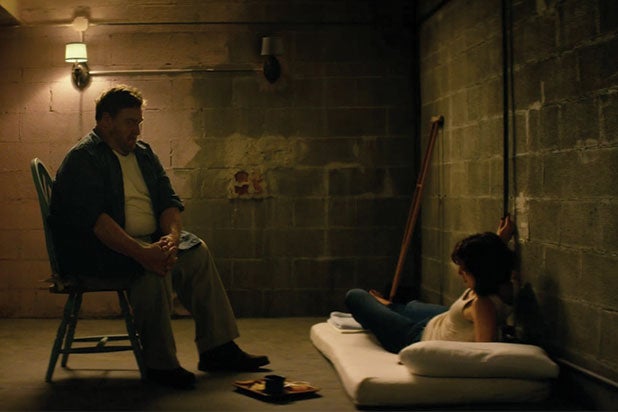
Who could have foreseen a follow-up to J.J. Abrams’ 2008 monster movie Cloverfield eight years later, especially when the first trailer for 10 Cloverfield Lane was released just two months before its release? I actually haven’t seen Cloverfield yet, but this not-quite-sequel is its own animal, following neither the first’s found-footage style nor apparently any of its characters. Instead, it’s a tense and claustrophobic thriller with only three main characters locked in an apocalyptic bunker.
While many have lauded 10 Cloverfield Lane as an outstandingly pleasant surprise from last year, my praise will be a bit more muted, but I don’t mean to write it off completely. It was indeed a pleasant surprise if for no other reason that no one expected it, and when an unexpected film is as effective as this one, there’s nothing wrong with giving due acclaim to the film and its debuting director Dan Trachtenberg. Particularly praiseworthy are the three central performances. Mary Elizabeth Winstead plays Michelle, a woman who awakes from a car wreck to find herself trapped underground by a creepily benevolent John Goodman. This Howard gradually explains that some disaster has occurred on the surface, and after rescuing her, he has graciously allowed Michelle and another local named Emmett (John Gallagher, Jr.) to stay in the confined comfort of his well-furnished safe space. The simple but menacing setup is reminiscent of M. Night Shyamalan in his heyday, and we’re never quite sure what to believe. Is Howard prudent or just crazy with his conspiracy theories, and are Michelle and Emmett better off staying inside, placating his demands, or trying to escape? Goodman is brilliantly unpredictable here, and even if there’s not a lot of development for the other two, having to deal with him is enough to spark concern for his captives.
For all its strengths, one thing that 10 Cloverfield Lane does not have is much in the way of originality. Many times I was reminded of two similar films: Misery, with John Goodman taking the place of Annie Wilkes’ possessive caretaker, and 2015’s underrated Hidden, where a family resides in an underground bunker in uncertain fear of what lies above. Putting these two concepts together essentially gives you 10 Cloverfield Lane, and even when it breaks free of the bunker for a slam-bang awesome finale, it still had echoes of War of the Worlds and The Terminator. Another point of comparison is Trachtenberg’s 2011 short film Portal: No Escape, which begins very similarly with a woman awaking in an austere cell with no memory of how she got there. It was that short that helped get Trachtenberg enough notice to earn him the director’s chair, so the parallels there aren’t surprising. (The short also proves he’d be a great choice to direct a feature-length Portal movie, and I, for one, hope it’s soon. You can check it out here.)
It’s unfortunate that 10 Cloverfield Lane lacks the originality of Misery or the emotional resonance of Hidden, but even as an amalgamation of prior ideas, it’s an impressively constructed nerve-jangler that balances shock and restraint and turned its world into a viable franchise overnight. With a third Cloverfield-universe film called God Particle slated for this October, there’s no denying the success of 10 Cloverfield Lane.
Best line: (Howard) “People are strange creatures. You can’t always convince them that safety is in their best interest.”
Life is hard enough in order,
Each day in succession gone,
Until one day we look behind and see mistakes a plenty,
And all in twenty-twenty.
It might seem harder out of order,
Jumping years to days thought gone,
But might that give our stubborn minds a little new perspective
And make us more reflective?
Our destinies are ours to order,
Rampant chances till they’re gone,
And some forget fulfillment rests on what we each will do.
The question is, will you?
_________________
MPAA rating: PG-13
Since I’m new to this Blindspot series and a notorious procrastinator, of course I waited to the last day of the month to review my first Blindspot pick, but I surely did choose a good one to start with in Shuffle. I have my good friend MovieRob to thank for recommending this time travel puzzler after he became a big fan of independent director Kurt Kuenne. I see why, because Shuffle combines so much of what I love about the time travel genre with a unique and compelling story.
Shuffle is as lean a narrative as I’ve seen, diving right into the tale of a man displaced within his own lifetime with every scene adding something to the plot. From the first moments, Lovell Milo explains to a psychiatrist that every time he falls asleep (which is often), he awakens on a different day in his life, sometimes as an old man, sometimes as a child, or anywhere in between. It takes an exhausting toll on him, and he has no idea why it’s happening, explaining away potential plot holes with the mystery that he “just knows” certain facts about himself, such as his age at every jump in time. While he’s tempted to despair at this seemingly endless headache, different strangers at certain points urge him to “pay attention” because there’s something to learn from all this, and indeed there is.
There are a lot of touchstones or spiritual predecessors one could point to with Shuffle, and they’re a pantheon of great stories. The choppy editing and sudden shifts in place and time might recall Christopher Nolan’s Memento, though Shuffle is much easier to follow and much more rewarding. The theme of redemptive second chances brings to mind A Christmas Carol and It’s a Wonderful Life, and the time travel jumps echo the great sci-fi elements of Quantum Leap, The Time Traveler’s Wife, and the Star Trek: Voyager episode “Before and After,” where Kes periodically lives her life backwards. I also loved the fleeting moments of prayer, where Lovell pleads desperately with God for help, though in a general sense, like how Quantum Leap’s Sam Beckett recognizes that there must be a higher power directing his experiences.
One of the most impressive aspects of Shuffle is how well it was made on what was clearly a small budget. The production values are obviously limited, which is felt on occasion, but it’s often covered quite nicely. A behind-the-scenes featurette revealed that the same living room was used as an all-purpose set for most of the interior scenes, but I couldn’t tell at all. Unlike so many small-budget films, the acting and script are also above average, with special attention to revealing plot points gradually as Lovell learns of them and never getting lost amid the flurry of time leaps. The actors aren’t big-name stars (unless you watch the TV show Bones), but everyone involved provides good performances, even the child actors and especially T. J. Thyne as Lovell.
Again, a big thank-you to Rob for his recommendation; it being an under-the-radar film that had trouble getting noticed before becoming a festival hit, I doubt I’d ever have seen Shuffle otherwise. My VC loved it as well, proving this is a film that deserves far more recognition. There’s a lot to admire about this film, from its structure and subtle foreshadowing to individual emotional scenes that just might put a lump in your throat. Stylistic choices also add visual interest, such as the backlighting that often imparts a luminous quality to certain scenes, and the color brightness changes depending on the timeframe. The director’s cut is apparently all in black-and-white, but I preferred the usage of color, particularly in the final scene.
I’ve read that many people disliked the ending, thinking it veers into overly satisfying territory, but I thought the whole final act was beautiful, a couple creative choices notwithstanding. In its testament of hope, Shuffle still acknowledges that mistakes and heartache can’t always be undone, but how we react to them can make the difference between a life fulfilled and a life wasted.
Best line: (Lovell’s mother, when he’s a grown man) “It seems like just yesterday, he was eight.” (Lovell) “Actually, that was two days ago.”
When I am dead, my soul no longer here,
What happens to my body is unknown.
‘Tis but a shell, an empty souvenir
Of my time in a world from which I’ve flown.
Most likely, it will end up in the ground,
A monument for time to chip away,
But if some more productive use were found,
Its former owner would not have a say.
If man no longer buried his remains
And flouted promises of “rest in peace,”
His conscience would be numb as it disdains
What once deserved respect upon decease.
What world of Frankensteins I’d leave behind
If man were to defile his own kind!
________________
MPAA rating: should be PG-13 or maybe older
The Empire of Corpses looks like an incredible, action-packed, thought-provoking movie, but it’s not. It just looks like one. Based on a novel by a Japanese author dubbed Project Itoh, who died of cancer before the book’s completion, this anime zombie film sets up an alternative steampunk version of Victorian England, where technology has allowed mankind to reanimate the dead as essentially robotic slaves, programming them to perform menial labor as a growing workforce in the world economy. These walking corpses can be recognized by their pale gray skin and passive expressions, but though they seem to understand and follow orders, they are without a soul. Into this hypothetical world is placed an amalgamation of historic and literary figures, a la The League of Extraordinary Gentlemen. John Watson is the hero, a corpse scientist who has resurrected a dead friend he renames Friday and now searches for a way to return his soul. Blackmailed by M of the James Bond franchise, he sets out in search of the fabled research of Dr. Victor Frankenstein, aided and impeded by the likes of Ulysses Grant, Thomas Edison, and characters from The Brothers Karamazov and The Future Eve.
While that description sounds rather awesome, especially when paired with a world full of brainwashed zombies, The Empire of Corpses seems eager to spoil a good thing. After the adventure begins on a thrilling note, it quickly descends into opaque philosophical pondering and inscrutable character motivations. After watching it all the way through, I recognize a worthwhile, imaginative story, full of food for thought, but actually watching it scene by scene can easily frustrate and confuse. By the end, the villain’s revealed plot (the second villain since one wasn’t enough) is baffling and poorly explained, making it clear just how vaguely defined the laws of this corpse technology are.
I hate to be so negative, especially when The Empire of Corpses looks so amazing. The animation is crisp and atmospheric and brings this theoretical world to life in ways that far surpass the deficient script. I’m glad I saw it, if only for the visual flair, such as the thrill of seeing a woman on the back of a galloping stagecoach mowing down zombies with a flamethrower. The action scenes are exceptional, but it makes it that much more disappointing that the rest of the film couldn’t measure up.
The Empire of Corpses is not without its virtues; I would just like it much more if it made more sense. It does feature some intriguing themes about life and death and manages to create a unique entry in the zombie genre, complete with zombie suicide bombers. The English dub is actually quite good, but the animation is the main attraction for fans of the medium, though certain scenes can get bloody (begging the question of why a dead corpse would bleed). This film is one of three anime movies based on Project Itoh’s novels (the others being last year’s Harmony and this year’s Genocidal Organ), and I certainly hope the other two have more than visual merit alone.
The story of One-Eyed Willy’s hoard
Has haunted the dreams of the greedy and bored,
But, though men have suffered both peril and pain,
Their seeking and sneaking have all been in vain.
Until the momentous event heaven-sent
When a map was discovered by mere accident,
And a cluster of kids, their homes soon to be sold,
Endeavored to find Willy’s ill-gotten gold.
Through tunnels and traps only pirates would build,
The friends followed through, some alarmed and some thrilled.
While saving their home, all the Goonies, now grown,
Sought out golden legends and so wrote their own.
_________________
MPAA rating: PG (maybe PG-13)
The Goonies is a film I really wish I had seen when I was younger. I remember seeing it on the shelf at Blockbuster when I was a kid and never having enough interest to rent it, but I’ve been meaning to ever since. In fact, it probably would have been one of my Blindspot picks if I hadn’t caught it on TV at the end of 2016. Despite my late introduction to this beloved ‘80s flick, I still enjoyed it a lot, much in the way I enjoy YA books or cartoons that are clearly juvenile but still entertaining.
Of course, the biggest claim to fame that this Steven Spielberg/Chris Columbus story has is the talented cast of young stars-to-be, like The Outsiders, Stand By Me, or Red Dawn. Jonathan Ke Huy Quan may be otherwise known only as Short Round in Indiana Jones and the Temple of Doom, but it’s a little surreal to see so many other well-known actors at the start of their careers, from Joe Pantoliano and Josh Brolin to Corey Feldman and cute little Sean Astin as Mikey Walsh. Little did they know at the time….
The film starts out in fun fashion as a jailbreak orchestrated by the criminal Fratelli family triggers a car chase across town, whizzing past the main characters and introducing us one by one to the club of young Goonies and their individual quirks. To their dismay, their neighborhood is soon to be destroyed by an encroaching country club, and no one wants to see it saved as much as Mikey. When they find a hidden map in his attic that may lead to a lost pirate treasure, he convinces his pals to follow him. Joined later by Mikey’s brother Brand (Brolin) and his female friends (Kerri Green and Martha Plimpton), they discover more adventure and danger than they imagined, both from booby traps along the way and from the Fratellis hot on their trail.
I can imagine everyone having a favorite Goonie. Maybe someone loves Data (Quan) and his anti-bully inventions or poor chubby Chunk (Jeff Cohen) and his klutzy anxiety. I thought Corey Feldman as Mouth stole his scenes, and I especially loved his hilarious “translations” to the Walsh’s Spanish-speaking maid. Astin makes for a wholly likable leader of the bunch, and despite their eccentricities, it was neat how each of them got a moment to shine by using their unique skills. The traps they encounter are actually quite inventive and nail-biting in a Scooby-Doo sort of way, and though I’m not the first to notice this, the family dynamic of the Fratelli family reminded me of the air pirates in Castle in the Sky, headed by a mean and cantankerous mother (although Mama Fratelli is much meaner than Dola).
It did seem that the filmmakers were aiming for different age demographics depending on the scene. In some cases, the language and menace seem a bit much for young kids, and until the end, the Fratellis are more threatening than the cartoonish villains I expected. Other times, the danger devolves into juvenile panic, possibly stretching one’s patience for kids screaming at each other. I wasn’t much of a fan of Sloth, the deformed and simple-minded Fratelli brother whose presence seems pointless until needed by the plot, and the final confrontation with the Fratellis seemed rather poorly planned. I mean, one minute, the kids are being forced to walk the plank as if it’s some great peril, and the next, everyone’s jumping off as if it’s no big deal. Even so, the very end was heartwarming, despite the fact that no one seems eager to recover what’s disappearing in the distance.
All in all, I’m glad I finally got to enjoy The Goonies, even without the nostalgia goggles with which all those children of the ‘80s view it. I can certainly understand it being a childhood favorite, and I suspect it would have been for me too, had I chanced to rent it from Blockbuster all those years ago. (Boy, I’m making myself sound old.) The Goonies may be a bit puerile at times, but its lovable cast of youngsters and adventurous spirit still make it a classic.
Best line: (Andy, trying to play a piano booby trap) “I can’t tell… if it’s an A sharp or if it’s a B flat!” (Mikey) “Heh, if you hit the wrong note, we’ll all ‘B flat!’”
The glaring lights of other cars assault the driver’s eyes,
A father’s eyes that have not slept a wink.
His son is sleeping in the back or reasonably tries,
As far behind, the passing headlights shrink.
Their own light slices through the dark to blindly find the road,
Its end concealed by more than just the night.
Throughout their drive, the father’s pace has hardly ever slowed,
Lest thoughts of past or future cloud his sight.
The worries of a father’s love cannot be put to rest,
No matter where the son may chance to go.
Not even when they reach the destination of their quest
Will bonds of son and father cease to glow.
___________________
MPAA rating: PG-13
I haven’t seen any other films from director Jeff Nichols, but based on his reputation and the high expectations for his foray into science fiction, I anticipated something special, especially since Midnight Special was meant as a homage to classic ‘80s sci-fi. In fact, it has more than a passing resemblance to one of my favorite ‘80s sci-fi films, John Carpenter’s Starman, sharing a road trip to an important destination, a hunted protagonist with mysterious powers, and government agents hot on his trail.
In place of the romantic angle of Starman is a devoted father-son dynamic between Roy Tomlin (Michael Shannon) and his son Alton (Jaeden Lieberher), who has strange seizures during which his eyes glow and he picks up radio signals. There’s little set-up as we immediately join Roy’s odyssey, having already rescued Alton, with the help of his friend Lucas (Joel Edgerton), from a Texas cult that views the boy as a messianic savior. Alarmed to learn that the cult learned sensitive information through Alton, the government is eager to find him, as are the enforcers sent by the cult to retrieve him.
As much as I was looking forward to Midnight Special, this is one case where the description sounds better than the finished product. It’s certainly not a bad film, but much of the runtime seemed to hover on the edge of being dull. After the initial curiosity of what’s going on wears off, the tension and wonder are only felt in short bursts that aren’t always as compelling as they try to be. One stylistic choice that annoyed me with its frequency was how the characters are sometimes plunged into darkness where it’s hard to see what’s happening; naturally, these scenes are meant to accentuate the light that eventually appears, such as during a momentous sunrise, but the technique got old quickly.
What often kept the film from tipping into boredom was the performances, which are excellent across the board. Michael Shannon is a conflicted protagonist as he seeks the best for his son while never knowing where that may lead, and the extent of his ruthlessness is cleverly kept in doubt. Edgerton also excels in the role of a hesitant believer, as do Kirsten Dunst as Alton’s mother and Adam Driver as the NSA agent who ends up sympathizing with the boy’s quest (not unlike Charles Martin Smith in Starman). It’s the performances that save Midnight Special, along with some spurts of action that are exceptionally well-timed.
Midnight Special had plenty of potential from the start, but by the end, it’s hard not to feel that something is missing. It’s not that I need my sci-fi to be non-stop action; heck, I’ve heard people complain that Starman is boring. Yet whereas Starman wasn’t afraid to have a bit of fun with its hammy concept, Midnight Special is almost one-note in its seriousness and might have benefited from a less sober tone and a less ambiguous resolution. It undoubtedly has moments of brilliance, but such moments can only help a film so much.
Best line: (Alton) “You don’t have to worry about me.”
(Roy) “I like worrying about you.”
(Alton) “You don’t have to anymore.”
(Roy) “I’ll always worry about you, Alton. That’s the deal.”
The centuries are full of tales,
Not all of which are told for sales.
Some barely dent; some tip the scales,
And those who lived them rarely knew
If theirs for others would ring true.
The choices made for centuries
By king and kid and star and sleaze,
By massive and minute degrees
Affect, destroy, create, and bless
More fates than anyone could guess.
____________________
MPAA rating: R
Remember that feeling of being blown away that I mentioned back when I reviewed Inception and King of Thorn? Well, it’s back with a vengeance. After the credits of Cloud Atlas began rolling, I was left speechless and strangely satisfied. As Tom Hanks said in one of the DVD featurettes, upon reading the script, “I didn’t have any questions.” When the interviewer then asked, “So you understood it?” he replied with an unabashed “No.” Cloud Atlas is such a huge, epic, multi-layered piece of work that it’s no surprise that the most common descriptor from both admirers and detractors has been “ambitious.” It’s one of those rare films that found its way onto the best-of and worst-of lists of different critics, and I can easily understand both opinions. I feel I should recommend it to everyone, yet I can guarantee not everyone will like it. But I did.
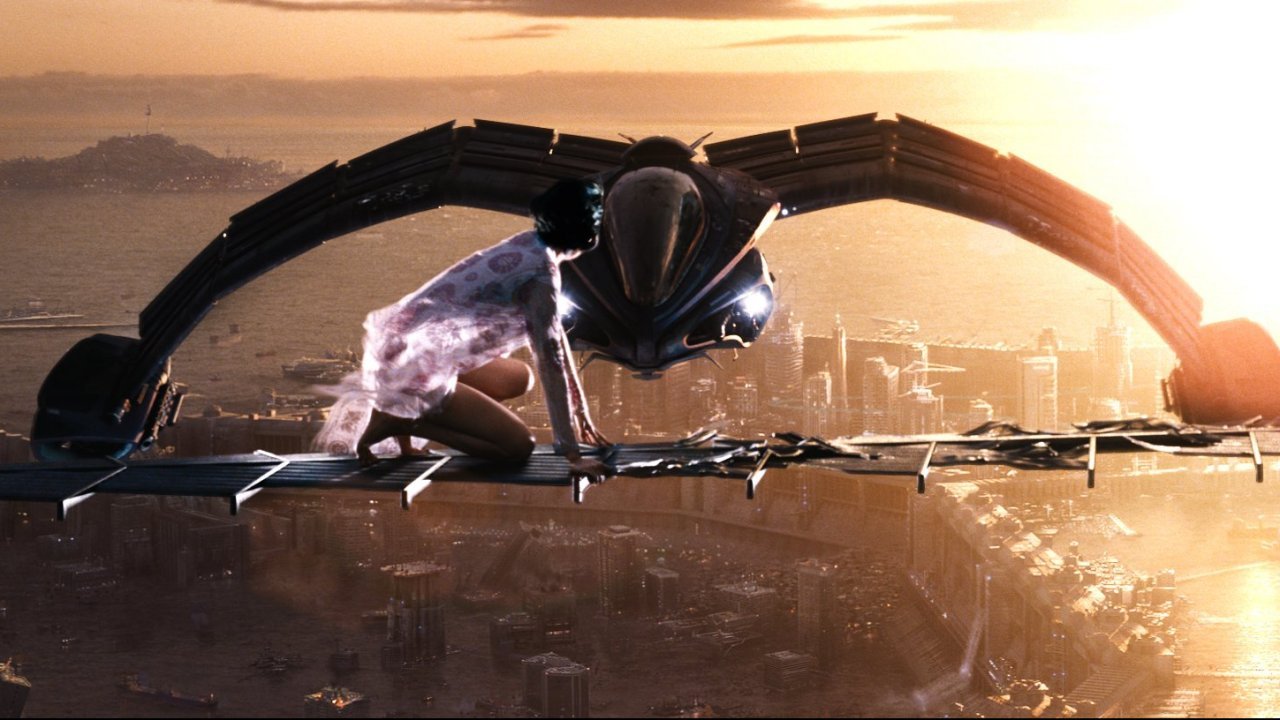
I’m having trouble even coming up with a succinct way to describe Cloud Atlas, if there is one. Based on David Mitchell’s novel and adapted by Tom Tykwer and the Wachowskis of Matrix fame, it’s six separate stories in one, all linked by the continuity of souls and the bonds of literature, love, faith, music, kindness, and loss. The first tale is a 19th-century seafaring voyage of a dying lawyer (Jim Sturgess) and a runaway slave (David Gyasi). The lawyer’s journal is later read by a gay composer (Ben Whishaw), whose dealings with a famous maestro (Jim Broadbent) are like The Imitation Game with sheet music. The former’s letters are later read by Luisa Rey (Halle Berry), a journalist whose investigations play out like Silkwood meets Coma and inspire a mystery novel read later by Timothy Cavendish (Broadbent) as he plots against his Cuckoo’s Nest-style incarceration. Then, there’s the distant future, where a submissive clone named Sonmi-451 (Doona Bae) is saved by a resistance fighter (Sturgess) in Neo-Seoul, plus an even further post-apocalyptic future where Zachry (Tom Hanks) and a technologically advanced stranger (Berry) journey to potentially save what is left of mankind. How’s that for succinct?
With so much sheer plot to cover, it’s no surprise that the film stretches for close to three hours and could easily have been lengthened into a mini-series event. One of the most divisive aspects of Cloud Atlas is how it was edited, not with each story being told individually (as is the case in the novel, I’ve heard), but with every other scene jumping randomly to another time period to continue one of the other plotlines. One minute, we’re watching Tom Hanks as an apocalyptic goat herder, the next he’s playing a murderous author in 2012. I don’t know how the editing team kept track of everything, and it so easily could have turned into a confusing mess, but as odd as it seems, this unorthodox strategy works. It’s not every film that begins by explaining that, if the audience “can extend [their] patience for just a moment, you will find that there is a method to this tale of madness.” Each story is straightforward enough that I was able to follow it, especially with the settings and costumes differentiating them from each other. The method works too to drive home certain similarities between the timelines, in one instance someone walking along a precarious perch, in another a villain being knocked out from behind just before killing someone.
Each story seems to have its own genre too, whether it be the corporate espionage of the 1970s plot or the British comedy of the Cavendish tale. Probably the most entertaining are the futuristic Neo-Seoul segments, which also have the coolest visuals. Watching how these stories are connected in ways big and small, with questions raised early and answered late, is a journey which requires patience but which I found rewarding as some of the stories end tragically but some with great satisfaction. I also recognized quite a few little influences from other films, ranging from Silkwood,Soylent Green, and Mad Max to Logan’s Run, Wrinkles, and The Fellowship of the Ring.
As I alluded to earlier, the extensive cast make cameos of varying importance in the six stories, often playing such wildly deviating roles that I can imagine the actors viewing this film as a special treat and challenge for their abilities. Luckily, the entire cast rises to the occasion to make every character distinct, sometimes even playing roles of different gender and ethnicity. It’s practically a game trying to spot every recognizable face. Hanks, Berry, Broadbent, and Sturgess are the most significant presences throughout the film, but also making important impacts on the story are Susan Sarandon, Hugh Grant, Keith David, James D’Arcy, and Hugo Weaving. Weaving may be inescapably recognizable in every role, but he’s certainly diverse as a villain, playing a Nurse Ratched wannabe, a Korean board member, and a specter of the devil called Old Georgie. The care taken to hiding the actors in plain sight is incredible, and not to invalidate that Tom Hanks quote from earlier, but my main question afterward was where they incorporated everyone, even in unrecognizable cameos.
I suppose I should answer why Cloud Atlas appealed to me, when it clearly turns off so many others. I remember seeing the monumental 5+-minute trailer back in 2012, honestly the best trailer I think I’ve ever seen (see the bottom), and I’ve had a burning curiosity about it ever since, which has been delayed by reports of its confusing and objectionable narrative. And yet, I had to see it. I guess I’m simply an enormous appreciator of continuity, the idea that a storyteller knows where he’s going from the start and mixes the myriad ingredients and characters of his tale in subtle but memorable ways. That’s why I love Lost; all the little flashbacks converge at times, with characters bumping into each other long before they meet in earnest, hinting at a larger story and hand at work. I’m a sucker for this concept of cosmic connections which Cloud Atlas manages to capture across centuries; when the tapestry threads of the story come together and the music swells, I…I just can’t help but get goosebumps.
Yet I must admit that it’s not done in a particularly Christian way. Aside from the frequent language and occasional sex and violence, the plot hinges on the idea of reincarnation and the continuity of souls, things in which I do not believe. In fact, I usually roll my eyes at this kind of New Age metaphysical mumbo-jumbo, yet I can accept it as a movie concept for the sake of appreciating the bigger picture it paints, if only in a three-hour movie. Similarly, the long runtime and jarring changes of place and tone can be a bear to sit through, but it’s worth it once you get over the hump in the middle. Oh, and by the way, watch with subtitles; the furthest future segment has a crazily stylized pigeon-English that is admirable in a cultural sense but hard to understand without reading along.
Love it or hate it, Cloud Atlas is a film hard to forget, a piece of crazy cinematic art that is as bizarre and challenging as it is beautiful and daring. If its methods were a bit more mainstream, I could see it as a Best Picture nominee, but it’s a crime that it didn’t receive one Oscar nomination, not even for the effects or the universally lauded score. (It should have effortlessly won Makeup and Hairstyling, at least.) The cinematography and talented cast clearly mark it as a noble effort, and I suppose it’s up to each individual viewer to decide whether it’s a masterpiece or a train wreck. It’s a monument of a film, one full of ideas and themes I do not endorse or believe in and others that are simply universal. This is not a film to watch casually, but it is undoubtedly worth watching.
Best line: (Haskell Moore, played by Weaving) “There is a natural order to this world, and those who try to upend it do not fare well. This movement will never survive; if you join them, you and your entire family will be shunned. At best, you will exist a pariah to be spat at and beaten; at worst, to be lynched or crucified. And for what? For what? No matter what you do, it will never amount to anything more than a single drop in a limitless ocean.” (Adam Ewing, played by Sturgess) “What is an ocean but a multitude of drops?”
Into a drug plot are drawn
A father, a nut, and a con.
These unlikely three
Prove a sequel can be
Even funnier than the first one.
_________________
MPAA rating: R
Earlier this year, I enjoyed a little marathon of the Lethal Weapon movies, at least the first three and part of the fourth. (I probably didn’t miss much with 4.) Unfortunately, too much time has passed for me to feel like I can write about most of them, but that time has proven something to me that I suspected at the time too: the second film is the best. How do I know that? Because it’s the one I still remembered months later, and a more recent viewing confirmed how funny and enjoyable an actioner it is.
The first film was a solid buddy-cop tale that established the odd couple chemistry of Martin Riggs (Mel Gibson) and Roger Murtaugh (Danny Glover), but it was rather depressing with Riggs’ suicidal tendencies and a less-than-memorable climax. (Mud-wrestling, wasn’t it?) Without the need to introduce the leads and their relationship, Lethal Weapon 2 picks up right from the start with Riggs and Murtaugh in a thrilling car chase that exemplifies the humor of their quirky partnership, summed up by Riggs as “We’re back, we’re bad, you’re black, I’m mad.” This time, the two cops are pitted against ruthless, racist South African drug dealers, which worked well for the time since the film was released during the height of apartheid when South Africa was viewed in villainous terms anyway.
While Riggs and Murtaugh could have carried the film on their own, the writers (Shane Black and Warren Murphy) add in a third unlikely partner in Joe Pesci’s neurotic book-cooker Leo Getz, whom the duo are ordered to protect as a witness. The odd couple are even more entertaining as an odd trio, and Leo brings another great slant of humor to the proceedings with his constant, semi-annoying catchphrase of “Okay, okay, okay, okay!” Luckily, Riggs and Murtaugh are no less entertaining too, with Riggs still his devil-may-care self and Murtaugh playing the weary straight man to these two eccentrics. It’s telling too that the next two sequels kept Pesci around for no other reason than to uphold the buddy triangle from this movie.
The villains are still menacing and merciless, particularly in relation to Riggs’ past, but the film never forgets to have fun with its buddy cop conventions. It’s full of memorable scenes, from earnest ones like Riggs’ discussion of his late wife to action ones like the nail gun ambush to hilarious ones like Murtaugh’s unfortunate encounter with a toilet and his priceless visit to the South African consulate.
As much as I prefer it without the violence and profanity, Lethal Weapon 2 is undeniably entertaining, and I stand by the idea that a film’s virtues can be measured by how well it’s remembered months or years later. That’s why only Lethal Weapon 2 makes my list and why it’s the member of the franchise to which I’ll most readily return.
Best line: (Dr. Stephanie Woods, after Riggs hurts himself to win a bet) “Why do you do this to yourself, Riggs?” (Riggs) “Well, who else am I supposed to do it to? None of them’ll let me. Besides, I need the money.”
The past has haunted me before,
Mistakes, heartaches I tried to flee,
And when at last I think they’ve gone,
I find not everyone’s moved on,
Sometimes including me.
My enemies have bones to pick,
A few more personal than most.
When bullets make their presence known,
I’ll gladly help to pick the bone
And silence any ghost.
________________
MPAA rating: PG-13
After the exceptional storyline of Skyfall, it was certainly a difficult task for the next installment in the Bond franchise to match it, and it’s not very surprising that it doesn’t. Spectre is a solid Bond adventure, but even with Sam Mendes returning as director, it pales next to its predecessor, if only because it returns to predictable action-movie formulas.
Spectre does start in style, with a long flowing shot that follows a masked Bond from the Mexico City streets up to a sniper position on a hotel roof. The subsequent destruction and helicopter chase exemplify what makes Daniel Craig’s Bond so entertaining in the action department, but after he returns to London for a slap on the wrist, he sinks into suave spy mode with the same ease. From investigations into yet another mysterious international organization to rendezvous with women and an old foe, the plot does what one would expect of a Bond movie, and all of the supporting “good guys” do excellent work with it, including Ralph Fiennes’ M, Ben Whishaw’s Q, and Léa Seydoux as the latest Bond girl named Madeline Swann, who has an interesting connection to Bond’s past adventures.
However, it’s the villains who are the biggest letdown. After Javier Bardem’s malicious Silva in Skyfall, Christoph Waltz fails to make as much of an impression, which is a shame since we know he can play an expert villain. Part of the problem is that he’s absent from the picture for too long, floating in and out of events more like a plot device than an evil genius. Another character is so obviously working for him that I’m not sure if that was meant to be a surprise, especially when he’s played by the clearly untrustworthy Andrew Scott (a.k.a. Moriarty on Sherlock). The sad part is that Waltz’s character is meant as Bond’s arch-nemesis but isn’t given the screen-time or strong motive to warrant that title, even with his supposed mastermind status over Bond’s past exploits.
The film’s technical aspects also feel more pedestrian next to Skyfall. After that initial continuous shot I mentioned, the artistry Mendes showed in the past is hardly noticeable, and the action scenes feel born more out of necessity than creativity. One kidnapping car chase, for instance, takes place in the snowy Alps, and Bond decides to pursue in a small plane, begging the question how he intended to rescue the hostage from the air.
I sound like I’m being harsh, don’t I? It’s a James Bond movie, and I shouldn’t expect much, but after thoroughly enjoying Skyfall, it was hard not to feel a bit let down by Spectre. Nevertheless, taken by itself, formula and all, it’s still an entertaining mission and a deserving member of the Bond franchise. It fits comfortably among the franchise’s second tier, making it probably my least favorite of the Daniel Craig movies, but on the List-Worthy level of Bond’s older, more conventional escapades.
Best line: (C) “You can’t tell me an agent in the field can last long against all those drones and satellites.” (M) “Yes, you have information. You can find out all about a man, track him down, keep an eye on him. But you have to look him in the eye. All the tech you have can’t help you with that. A license to kill also means a license not to kill.”
Rank: List-Worthy (tied with the older Bond movies I’ve seen, which are headed up by A View to a Kill)
When morn dawns optimistically,
Like all the morns before,
No thought have we for jeopardy
That could be yet in store;
No thought for smoke or lives at stake
Or bodies in the street,
For blasts and chaos in their wake
Or desperate, dazed retreat;
No thought for tears and tattered nerves
And hopes soon left for dead,
Or courage once in vast reserves
Reduced to helpless dread.
No thought for such, and why should we
Let life be worry-marred?
That’s how we maintain normalcy
And why we’re caught off-guard.
_______________________
MPAA rating: R
In the unnerving tradition of The Twilight Zone, Right at Your Door thrusts ordinary people into an alarming situation, a worst-case scenario that is compellingly realistic because it is so possible. As Brad (Rory Cochrane) bids farewell to his wife Lexi (Mary McCormack) as she heads to work in Los Angeles, a typical day takes a sharp turn when the news reports explosions downtown. His incredulous panic growing, Brad listens as reporters give ever-worsening descriptions of the damage done by a suspected dirty bomb. When Brad tries to reach Lexi and is forced to return home, he and a desperate passerby (Tony Perez) seal themselves into the house with tape and plastic covers, isolating themselves from the reported toxins and anyone who might be infected.
The film’s low budget and limited locations actually work to its advantage, focusing its scope on Brad’s home and increasing the apprehension and doubt of what may or may not be happening. Except for some billowing smoke and ash, most of the disaster is kept to news reports, begging the question of how much we hear is truth, conjecture, or misinformation. The film emphasizes just how little we’d know in a quarantine during a disaster, and as Brad and others must make stressful personal decisions, it’s disconcerting to see how even small impulses or mistakes can mean the difference between life and death.
Written and directed by first-time filmmaker Chris Gorak, Right at Your Door is a potently plausible what-if scenario spoiled only by the near-constant profanity, which, considering the stressful circumstances, is at least understandable. The three main actors emote that fear effectively, selling the tension that might have petered out with less convincing performances. We rarely can tell the best course of action in a disaster, and while everyone hopes they’ll never have to experience it firsthand, Right at Your Door brings that anxiety closer to home than most disaster films even try.