• Home
  • About Me
  • THE LIST Through the Years
  • Top Twelves and More
  • The End Credits Song Hall of Fame

Rhyme and Reason

~ Poetry Meets Film Reviews

Rhyme and Reason

Tag Archives: Sci-fi

Cartoon Comparison: Ghost in the Shell (1995, 2017)

05 Sunday Nov 2017

Posted by sgliput in Movies, Poetry, Reviews, Writing

≈ Leave a comment

Tags

Action, Animation, Anime, Cartoon Comparisons, Drama, Sci-fi, Thriller

Image result for ghost in the shell 1995

Machine and man will merge one day,
Inevitably, some would say,
And what that day will look like
It is hard to visualize:

Computers in our brains perhaps,
Robotic limbs that won’t collapse,
And access to the Net unlike
The world can now surmise.

Yet as the world drives faster still
Our cybernetic dreams to fill,
Did any on this Progress Pike
Doubt whether this is wise?
__________________

MPAA rating for 1995 version: Not Rated (should undoubtedly be R for violence and nudity)
MPAA rating for 2017 version: PG-13

Ghost in the Shell is widely considered a classic, a game-changer for anime and the cyberpunk genre, and its growing niche popularity was bound to get Hollywood’s attention sooner or later. I, however, had little desire to see it due to its prominent violence and nudity, and it was only when the live-action adaptation with Scarlett Johansson was released that I felt I had to see it for comparison’s sake. And to be quite honest, I’m not much of a fan of the original or its remake, though that doesn’t mean they weren’t worth watching, and I found different things to appreciate in both versions.
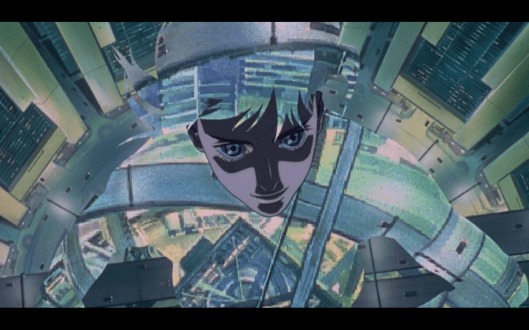
Image result for ghost in the shell 1995

The original 1995 film has plenty of ardent fans, but I’d be lying if I didn’t admit that it’s a tad overrated. I can’t deny its influence on the cyberpunk subgenre, particularly The Matrix, which borrowed its falling lines of green data and the characters’ neck interfaces to plug into the Net. After seeing it, the Wachowskis even reportedly told producer Joel Silver that they wanted to “do that for real,” though at least they had the imagination to come up with an original story rather than a straight adaptation. Ghost in the Shell was also a forerunner for other dark cyberpunk anime like Ergo Proxy and Psycho-Pass, but I guess I just don’t find such soulless, cyberized dystopias very appealing.

Yet it’s not the world it creates that falls short, since the terrifically detailed animation doesn’t disappoint, but the story itself does. After an assassination mission that establishes Section 9 as a no-nonsense branch of the future Japanese police force, we get a convoluted tale of a rogue hacker called the Puppet Master, which has more twists than substance and culminates by the end with very little resolution. The main character named Major Makoto Kusanagi, a cyborg officer who works best without clothes, delivers sober monologues about identity and technology but doesn’t really have much personality. The side characters are actually more interesting than her, like her lens-eyed partner Batou or non-cyberized member Togusa.

Image result for ghost in the shell 1995

I suppose it’s easy for Ghost in the Shell to coast on its visuals and supposed depth; it does have some thrillingly iconic scenes, like an invisible smackdown on a fleeing thug, and some worthwhile themes about the necessity for variety and growth do manage to counter the moments of ponderous introspection. I will say the nudity is gratuitous. You could argue that Kusanagi’s thermoptic camouflage is built into her skin so she has to be naked for it to work, but other Ghost in the Shell installments show that there are entire uniforms that can go invisible. Critics have delved into deep themes like posthuman femininity, but I’m convinced it’s just fan service.

The 1995 Ghost in the Shell film is the franchise’s most famous incarnation, but it’s not the best. Even if the film left me cold, I was impressed by its two-season spinoff series called Ghost in the Shell: Stand Alone Complex. It’s got some of the same hard-to-follow philosophizing and excessive violence, but the overarching stories carry more depth when developed over a season’s length, which also allows far better characterization for Kusanagi and everyone else too, like the other members of Section 9 that are barely acknowledged in the movie. After seeing the two films that summarize Stand Alone Complex (and a follow-up film called Solid State Society), I find that the 1995 film’s story is even less impressive by comparison. I can’t bash the original Ghost in the Shell too much since it does appeal to some people more than me, but I would suggest that its fans check out the series for some much better storylines. (On a side note, Stand Alone Complex might also have had some influence in the West. For fans of The Dark Knight, remember when the Joker threatens a hospital to convince random civilians to try to kill Coleman Reese? I now see that it’s suspiciously similar to a scene from SAC’s season 1, in which a super-hacker takes over the minds of random citizens to carry out an assassination attempt. Interesting….)
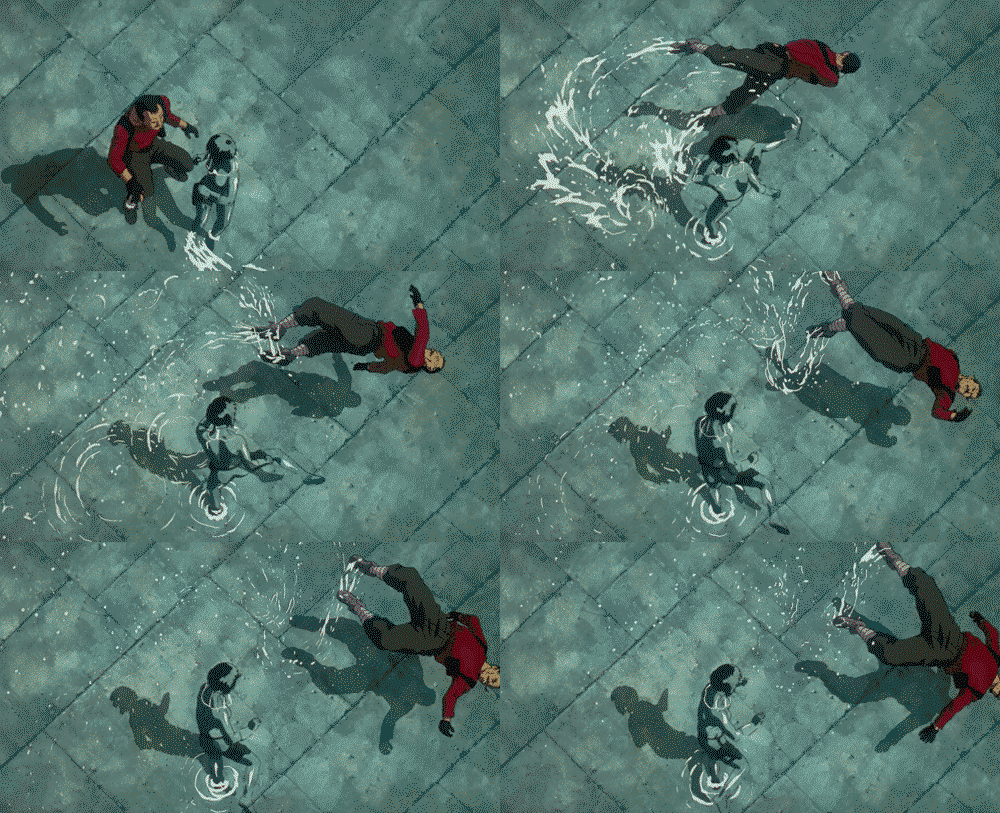
Image result for ghost in the shell 1995 beatup

Now what about America’s take on Ghost in the Shell, which didn’t do much to improve people’s poor opinions of live-action anime adaptations? It’s actually not that bad an adaptation in my opinion because I consider many of its flaws to be flaws the first film had. I, for one, don’t mind Scarlett Johansson’s casting, regardless of the inevitable whitewashing accusations, since others have pointed out that the cast is still plenty diverse and needed a bankable star. Even if her character is renamed Major Mira Killian, her status as a cyborg with only her brain remaining human makes her appearance relative and changeable, and the film even works in a way to contrast her current appearance with her original identity. I’ve seen critics complain about potentially deep themes that aren’t fleshed out enough, a lack of personality for Johansson’s character, and a generally lackluster story, but I felt that was the case for the original too.
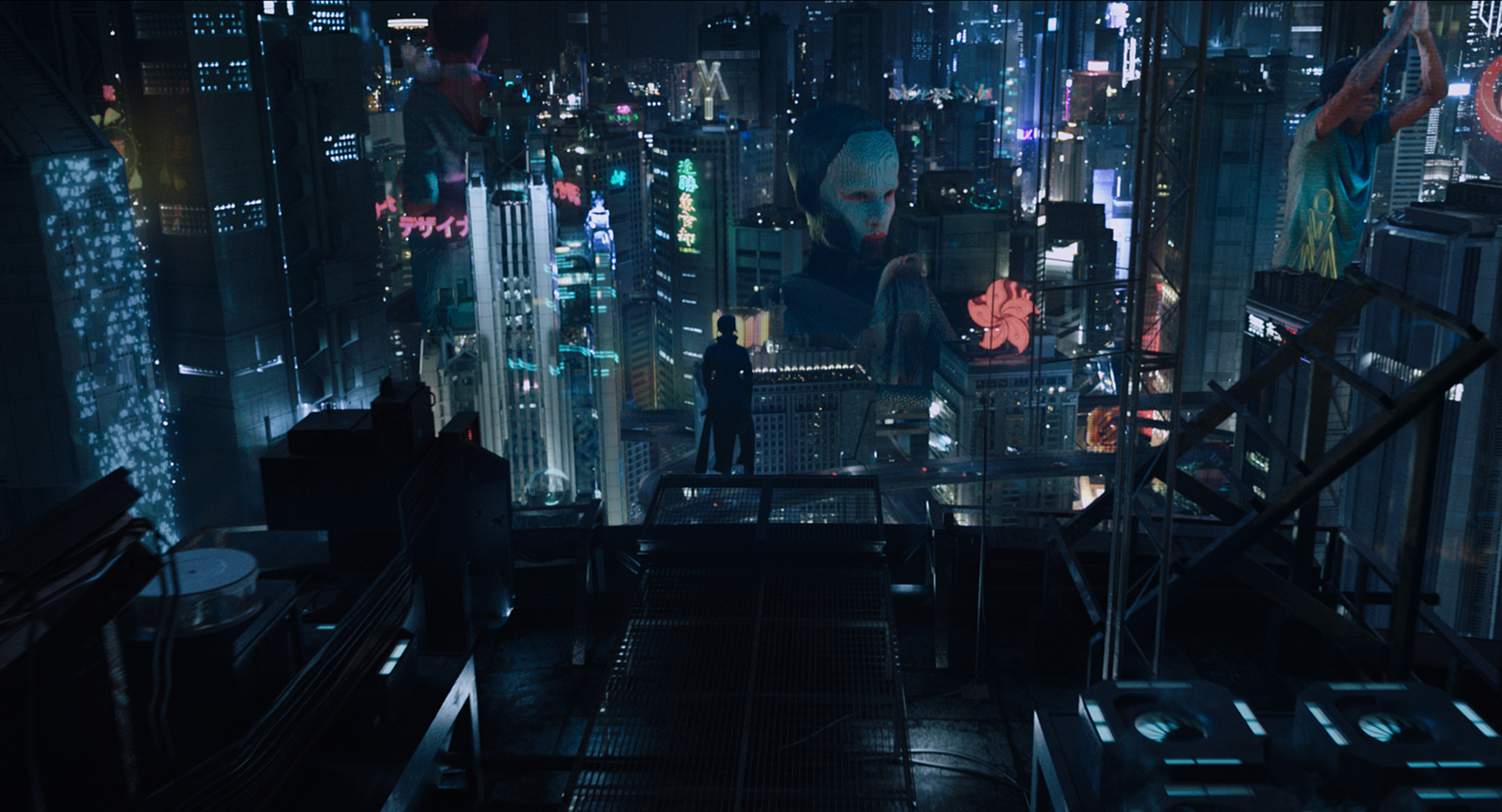
Image result for ghost in the shell 1995

The strangest thing for me was something that I haven’t seen any other reviews point out, namely that 2017’s Ghost in the Shell isn’t just a straight remake of the 1995 one, but an odd amalgamation of several Ghost in the Shell incarnations, including the Stand Alone Complex series. There are numerous scenes lifted shot for shot from the 1995 film, like the invisible beat-up, the spider tank fight, and the opening montage of creating the Major’s body, but they are all placed in a completely different context. The first action scene with the robotic geishas is straight from the first episode of SAC. There’s also a scheme to pick off Section 9’s members (like SAC’s first season about the Laughing Man), the incorporation of Major’s antagonist/counterpart Kuze (from SAC’s second season), and a secret government kidnapping plot (from the Solid State Society movie). It was seeing all these disparate elements combined with a totally new story of Major questioning her identity that felt strange to me, like I wasn’t sure which story they would try integrating next.

One aspect of remakes that Hollywood can be expected to get right more often than not is the impressive visuals, and like the anime, the world of seedy, hologram-laden skyscrapers it creates is far more intriguing than the characters in it. That’s not to say it’s a place I’d want to visit, but its visuals at least honor the original and its predecessors, like Blade Runner, even if it’s also alienating.
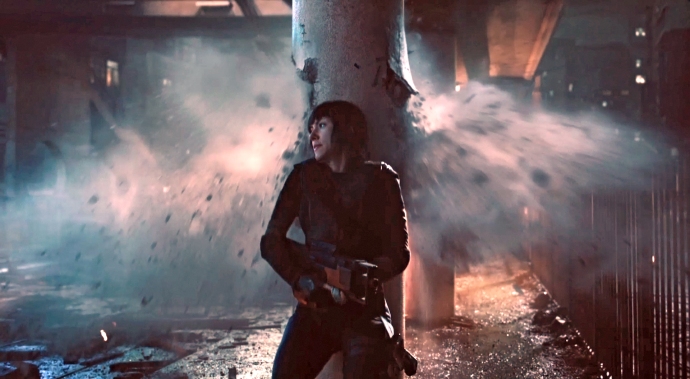
Image result for ghost in the shell 2017 batou

With its obvious nudity, I never would have thought a live-action Ghost in the Shell would receive a PG-13 rating, but that reflects the fact that the 2017 film tries to soften the harder edges of an anime that is definitely not for all tastes. Johansson’s robot body is more like a skin-color body suit, like the blue Mystique from the X-Men movies, and its intentionally manufactured appearance makes it less flagrant than the original. The same goes for the violence: the film does its best to make itself gritty and unpleasantly ruthless, but at least there aren’t any of the graphic head shots from the film and series. Even Major’s characterization is less stone-faced than her animated version (though I’ve heard every version of her is somehow different from the manga). In contrast to the emotionless ambiguity of the 1995 film’s ending, the search of Johansson’s Major for her past offers a shred of poignancy to hold onto, something I actually felt was an improvement.

Neither Ghost in the Shell is perfect or even close to perfect, in my opinion, but they have enough atmosphere and intrigue to be worth discussing. Both do have the repeated Ghost in the Shell plotline, which the TV series helped me recognize, that being “Super-hacker seems like bad guy until it turns out to be an evil government/corporate conspiracy.” I suppose the 1995 film could be seen as a philosophical sci-fi film with some action, while the remake is an action film with some philosophy. Although the 2017 version is considered a flop, it might be the best anime-to-live-action adaptation so far (I’m hesitant to see the widely panned Death Note), at least nailing the original’s distinct visual merit. With more anime adaptations on the way, including Your Name (please don’t ruin it, J.J. Abrams!), there might be hope for future efforts to do better with more appealing source material.
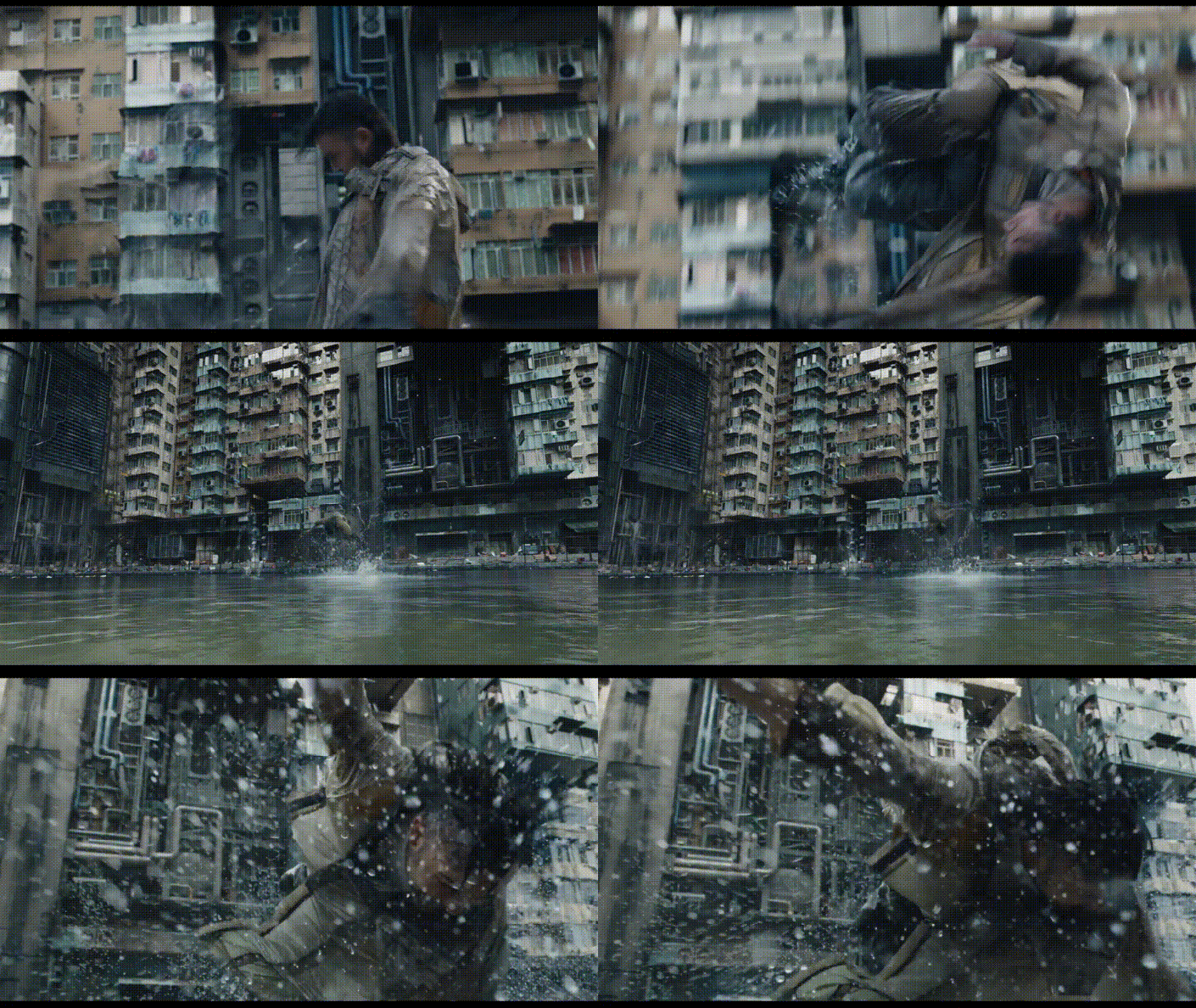
Image result for ghost in the shell 2017 water scene

Best line from 1995 film: (Kusanagi) “You talk about redefining my identity. I want a guarantee that I can still be myself.”  (Puppet Master) “There isn’t one. Why would you wish to? All things change in a dynamic environment. Your effort to remain what you are is what limits you.”

Best line from 2017 film: (Dr. Ouelet) “We cling to memories as if they define us, but they really don’t. What we do is what defines us.”


Rank for both: Honorable Mention


© 2017 S.G. Liput
517 Followers and Counting


Dawn of the Planet of the Apes (2014)

22 Sunday Oct 2017

Posted by sgliput in Movies, Poetry, Reviews, Writing

≈ Leave a comment

Tags

Action, Drama, Sci-fi, Thriller, War

Image result for dawn of the planet of the apes

They said no bridge could cross the divide,
Too far and different were each side,
And yet two chose
To still propose
A bridge to span the gap so wide.

They slowly worked with cautious hope
To lay foundations, tighten rope,
And earn the trust
That is a must
For silencing the misanthrope.

Naysayers had their efforts spurned,
Yet look what trust can build when earned!
Then fast as fire,
The doubters’ ire
Had lit the bridge and down it burned.
_____________________

MPAA rating: PG-13

Wow! If Rise of the Planet of the Apes was a prime reboot, Dawn of the Planet of the Apes is an exemplary sequel. It continues the storyline of its predecessor while establishing a new yet complementary scenario with far more depth than the simple “rise of the apes” concept could have had in the hands of lesser writers.

Image result for dawn of the planet of the apes

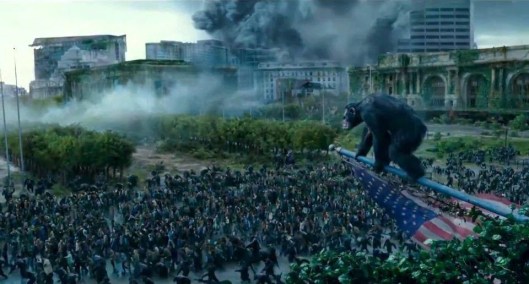
Set ten years after Rise, Dawn sees Caesar (Andy Serkis) and his band of intelligent esc-ape-ees having built their own mini-civilization, hidden in a dense redwood forest, while humanity has been decimated by the same virus that gave the apes their heightened intelligence. When a band of immune human survivors stumbles upon the apes, tensions immediately flare, especially because the humans’ energy needs won’t allow them the logical course of keeping their distance. Yet the human leader Malcolm (Jason Clarke) actually tries to reach out to Caesar and his apes and work toward mutual trust, something of which apes and humans alike disapprove, especially Caesar’s second-in-command Koba (Toby Kebbell).

The roles of both Caesar and Malcolm are very much representative of Rudyard Kipling’s poem “If—” as they try to “keep [their] head when all about [them] are losing theirs and blaming it on [them].” They both want what’s best for their respective groups, and they know that that includes peace between   them. We as level-headed viewers recognize the wisdom of their actions, and yet so many of their subordinates carry far too much baggage and resentment to trust that wisdom. Whether it be humans who automatically associate the word “ape” with the virus epidemic or surly Koba, who still hates humans for using him as a research guinea pig, they question their leader’s judgment and even his loyalties without questioning if he might be right. It’s frustrating and yet all too believable, considering humanity’s known weakness and intolerance.

Image result for dawn of the planet of the apes

Another major theme is that the apes and humans are not as different as either side would think. That weakness and intolerance are common to both, as is the tendency to view such opponents as a group rather than individuals who don’t necessarily all believe the same thing. The act of a rogue can quickly spiral into “us versus them” violence that makes such perceptions harder to undo. What’s astounding about Dawn is how it gets these complex messages across with minimal dialogue, utilizing the apes’ broken English and hand motions to their fullest. The motion-capture CGI is also even more impressive than in Rise, wowing with the action battle scenes, as well as benefiting the story in less flashy ways, like the clearly recognizable emotions that play out on Caesar’s face, courtesy of the talented Andy Serkis.

In addition to the Oscar-nominated visuals, all the performances are outstanding, especially Clarke, Serkis, Keri Russell as Malcolm’s wife, and Gary Oldman as Malcolm’s less trusting counterpart. James Franco is sadly departed from the story, but there are affecting reminders of him and Caesar’s past. Caesar’s ape friends who do carry over from Rise don’t stand out that much, making me glad I still remembered them from having just seen the first film, but Koba’s role is greatly expanded as an antagonist, with the ending directly mirroring one of his actions in Rise. Also, as a fan of tracking shots, I must point out a scene I loved in which the camera follows Malcolm as he stumbles through a maze of hallways trying to avoid invading apes. It made me think that a tracking shot could be a running element for the series, since Rise had the scene with young Caesar swinging throughout Will’s house.

Image result for dawn of the planet of the apes

Dawn is a sober movie that views the ape versus human struggle with far more nuance and regret than any earlier installment, precisely because the film shows it didn’t have to turn out the way it did. An action blockbuster is expected to have awesome visuals, but it’s a rare and pleasant surprise when there’s this much depth too. With so much tension between various groups nowadays, the film remains as timely as ever, a potent reminder to not let the worst parts of our nature carry us to destruction.

Best line: (Caesar) “I always think… ape better than human. I see now… how much like them we are.”


Rank: List-Worthy (joining Rise)


© 2017 S.G. Liput
516 Followers and Counting


Rise of the Planet of the Apes (2011)

18 Wednesday Oct 2017

Posted by sgliput in Movies, Poetry, Reviews, Writing

≈ 2 Comments

Tags

Action, Drama, Sci-fi

Image result for rise of the planet of the apes

Dystopias and futures grim
Are but a writer’s dismal whim.

No wasteland stark
Or desert dark
Or dictatorial monarch,
No virus spread
Or walking dead
Or culture built upon bloodshed,
No overthrow
Of status quo
Could happen to the world we know.

‘Twill be too late when mankind learns
To heed dystopians’ concerns.
_____________________

MPAA rating: PG-13

I’ve been skipping the recent Planet of the Apes reboot series because I considered them just another example of Hollywood’s idea-starved habit of milking past franchises. Although I was surprised at how positive the critical reactions were, that’s why it took me so long to finally explore this reboot, and now that I’ve seen it, I’m surprised again by how good it really is. Rise of the Planet of the Apes is a sterling example of a reboot done right, taking the basic ingredients of a prior film and building on them in new and unexpected ways.

Of all the earlier Planet of the Apes installments, this film most resembles the fourth one, Conquest of the Planet of the Apes, which happens to be where the original film series took a nosedive on quality and believability, even more so than in the second film. Whereas the Caesar in Conquest (played by Roddy McDowall) was the product of a time leap from the ape future seen in the original Planet of the Apes, the Caesar in Rise (played by Andy Serkis via ever-improving motion capture) is born from a captured chimpanzee being used for experimental drug tests. When an incident causes his mother and the other test cases to be killed, baby Caesar is taken in by Will Rodman (James Franco), the head of the project, and his father (John Lithgow), whose Alzheimer’s disease spurs Will to keep working on his cure. Although raised by humans, the unusually intelligent Caesar eventually learns of his origin and the fate of others of his kind and sparks a simian revolt.

Image result for rise of the planet of the apes

As the first in the series to use CGI for an authentic appearance for the apes, Rise of the Planet of the Apes is a huge improvement over the originals on a visual level alone. The apes look astoundingly real, even if there’s still that slight CGI-ness that lets me tell they’re not, and the motion capture allows for entirely credible movements, as well as emotive facial expressions in the case of Caesar. Franco and Lithgow also deliver solid human support that adds heart to a tale of science run amok, while Daniel Oyelowo plays the typical corporate corner-cutter who’s the “real” villain. The film’s “rise” to its action climax is not only a great thrill but one that also shows early on Caesar’s moral reluctance to take any human lives.

Although Rise is clearly rewriting the history of the original Planet of the Apes series, there are plenty of callbacks to please those like my VC who are wary of any change to a cherished franchise. Iconic lines are recycled, like “It’s a madhouse” and “Take your stinking paw off me, you d*mn dirty ape.” Easter eggs are dropped, like Caesar’s mother being nicknamed Bright Eyes, as Charlton Heston’s character was in the first film, and Heston himself even has a blink-and-you’ll-miss-it cameo. There’s an added reason to the references too, particularly in how Caesar is imprisoned in a cruel ape cagehouse, implicitly suggesting that, as bad as Heston was treated, the apes were treated that way first.

I also liked the subtlety of how Caesar’s arc is analogous to Moses in the Bible. Like Moses, Caesar was rescued when the rest of his “people” were killed; he was raised by the “enslavers” until an act of violent rebellion gets him in trouble; and after a time of exile, he leads his “people” to freedom. It’s a nice subtext that allows the story to be enjoyed as both a solid sci-fi movie and a semi-allegorical narrative.

Image result for rise of the planet of the apes

Rise of the Planet of the Apes does so much right that it makes me wonder why it’s so hard for other reboots to succeed. Certainly, it has respect for the source material but also the nerve to tell its own story, including a parting hint as to how mankind’s decline will play out. It’s a very promising start for a series that, from what I understand, will only get better.

Best line: (Jacobs, Will’s boss) “I swear, you know everything about the human brain except the way it works.”


Rank:  List-Worthy


© 2017 S.G. Liput
516 Followers and Counting


Predator (1987)

10 Tuesday Oct 2017

Posted by sgliput in Movies, Poetry, Reviews, Writing

≈ 1 Comment

Tags

Action, Sci-fi, Thriller

Image result for predator 1987 film

Can you feel the eyes upon you,
Every move within their sight?
Where they are you cannot know
Regardless if it’s day or night.
Vainly, you attempt to flee
Or foolishly prepare to fight.

It
awaits the perfect moment,
Preying on your fear’s last thread.
Though some fail to see the danger,
Blood is ready to be shed.
Once you know you’re being hunted,
You’re already good as dead.
_________________

MPAA rating: R (for much violence and language)

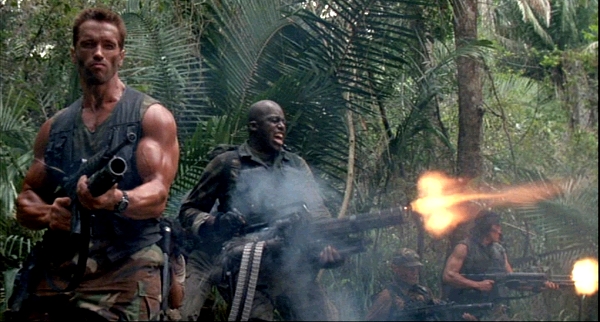
Predator is about a bunch of elite commandos, led by the Terminator himself, fighting an alien hunter in the Central American jungle. And I thought Sylvester Stallone arm-wrestling was macho! This Arnold Schwarzenegger vehicle supposedly stands alongside the Alien movies as a great sci-fi actioner (thanks in part to the whole Alien vs. Predator spinoff), and while it definitely nails the action part, it’s certainly not on the level of the first two Alien films.

This is a prime example of a film in which the plot serves the action rather than the other way around. The storyline is as thin as it gets, with Schwarzenegger’s “Dutch” Schaefer sent on a rescue mission with his team of professional soldiers (Bill Duke, Jesse Ventura, future writer/director Shane Black, who will be helming another sequel due out next year), joined by Carl Weathers as former friend and CIA agent George Dillon. After an assault on the local guerrillas reveals they were misled as to their true mission, the soldiers head back, only to be picked off by an invisible alien poacher. As I said, the plot serves the action, and so do the simple but enjoyable enough characters, all of whom are oozing testosterone with lines like “I ain’t got time to bleed.” (Spoiler: He finds the time.)

Image result for predator 1987 film

You don’t watch a movie like Predator for the narrative or any complex themes. It’s a turn-your-brain-off-and-watch-the-explosions kind of movie and an entertaining and not too dumb one at that. There’s not much horror to the ugly, cloaked alien himself (who feels a lot like a relative of the Hirogen hunters from Star Trek: Voyager), but he’s an intimidating and well-armed antagonist, especially from how easily he takes down most of the group, though he also seems to have some kind of honor code for worthy prey. My VC felt that the reveal of its face was rather a letdown, but it was followed by a fight and an explosion so I can’t complain too much. A solid sci-fi actioner, Predator is perhaps not what I’d consider “great,” but it’s machismo-fueled entertainment that still excites thirty years later.

Best line: (Dutch, adhering to the Batman school of alien killing) “If it bleeds, we can kill it.”


Rank: List Runner-Up


© 2017 S.G. Liput
516 Followers and Counting


VC Pick: Runaway (1984)

17 Sunday Sep 2017

Posted by sgliput in Movies, Poetry, Reviews, Writing

≈ 5 Comments

Tags

Action, Sci-fi, Thriller, VC Pick

Image result for runaway 1984 film

How will you know when the future has come?
When robots reside in your workplace or home.

How will you know where technology goes?
When robots start rising right under your nose.

How will you know when sci-fi meets real life?
When robots can handle the kids…or a knife.

How will you know if man’s made a mistake?
When robots and darker intentions awake.
___________________

MPAA rating: PG-13

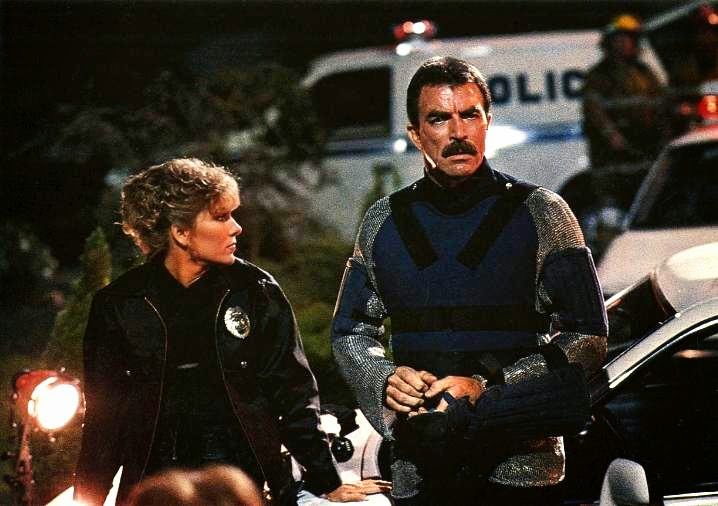
Runaway isn’t that great a sci-fi film but it is an enjoyably watchable one, only occasionally owing that appeal to its cheesy ‘80s-ness, which seems to appeal to my VC more than to me sometimes. Written and directed by Michael Crichton, this Tom Selleck vehicle features yet another potential future where robots have become common appliances at home and work, and wouldn’t you know it, they start killing people! It’s not about vengeful A.I.’s fighting back; it’s a bit more ordinary than that, since they’ve instead been reprogrammed by a leering baddie played by Gene Simmons (yes, from KISS!), and it’s up to Selleck’s policeman Jack Ramsay and his new partner Karen (Cynthia Rhodes) to stop him.

As a robot movie, Runaway has futuristic innovations both odd and pretty cool. You might question why it takes police intervention to pick up a malfunctioning pest control bot that doesn’t seem very dangerous, but then we get to marvel at the innovation of a heat-seeking missile bullet, with some first-person shots from the bullet’s point of view. To be honest, the robots are lame in design and execution, and while I’m sure they were impressive for 1984, seeing wobbly robotic spiders “sneak up” on hapless police has a distinctive B-movie quality. Even so, the machines can still be dangerous, like one murderous runaway modified to shoot a gun, the threat of a thrilling early scene slightly spoiled by the stupidity of one of its victims. One caring nanny robot also happened to remind me of the similar THX droid in the anime series/film Time of Eve.

Image result for runaway 1984 filmMy VC has introduced me to a lot of ‘80s movies, and thanks to her, I know Crichton could direct science fiction both innovative (Westworld) and memorably tense (Coma, which was one of Selleck’s first brief film roles). Though Runaway falls a little short of his earlier work in terms of originality, it was still a fun ‘80s popcorn movie. I can’t say I was ever bored since the police investigation moves along at a brisk pace between moments of well-wrought tension. It helps too that all the actors acquit themselves fairly well, from Selleck’s likeable, afraid-of-heights lead to Simmons’ malicious villain, though Simmons didn’t help his potential acting career with a gratuitous scene literally thrown in just for a jump scare. There may not be much depth to the characters or themes, but as a diverting little thrill ride into the future, Runaway ran far enough to entertain.

Best line: (Ramsay, after a wild goose chase) “Congratulations, guys, you just staked out a roll of toilet paper.”


Rank: List Runner-Up


© 2017 S.G. Liput
507 Followers and Counting


Marooned (1969)

10 Sunday Sep 2017

Posted by sgliput in Movies, Poetry, Reviews, Writing

≈ Leave a comment

Tags

Classics, Drama, Sci-fi, Thriller

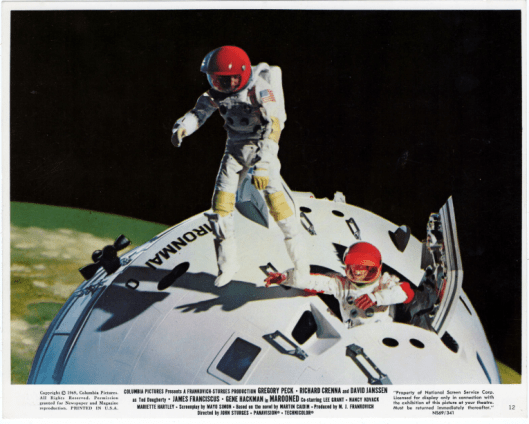
Image result for marooned film

Although it looks down at mankind from the sky,
And we behold it every night,
The dark void of space is no friend or ally.
‘Tis death on our borders to push and defy,
An ever-black vacuum that wills us to die
If we from our atmosphere venture too high,
Which man will endeavor despite,
Despite the dread silence our fears amplify,
Despite the expanses too vast for the eye.
Despite all the dangers that could go awry,
Mankind will dare every new height.
___________________

MPAA rating: G (should be PG, for light language)

This one is a special request of my mom’s. I’ve been putting off reviewing Marooned for a long time, despite my mom’s insistence, because I remember her showing it to me as a kid, and I was bored out of my skull. Since that first viewing, I’ve always viewed it as boredom incarnate. To my mind for the last several years, it’s been “Marooned = dull.” Yet she finally convinced me to give it another chance, and I must admit it’s better than I recalled, perhaps because I’ve grown in patience over the years. (Plus, I have a new standard for boring-as-heck cinema, which I’ll review soon.)

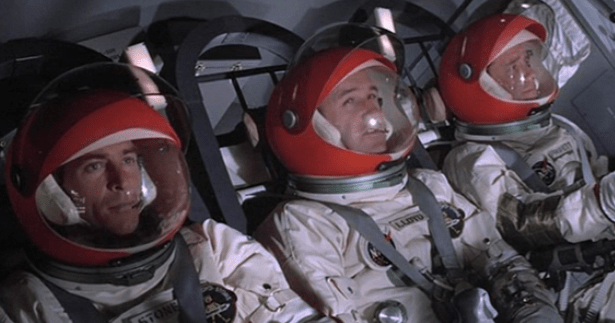
It might seem that this story of a space shuttle mission gone wrong drew inspiration from the Apollo 13 incident, but surprisingly it came out shortly after Apollo 11, a year before the similar events of Apollo 13. Richard Crenna, Gene Hackman, and James Franciscus play the three NASA astronauts who are stranded in their capsule (called Ironman One) when main engine failure leaves them without enough fuel to return home or to their space station. Unable to do anything but conserve oxygen and wait, the astronauts rest their hopes on Mission Control, led by Gregory Peck’s flight director Charles Keith, and a daring last-ditch rescue mission.

Image result for marooned film gregory peck

Marooned is still rather slow in its execution, but my mom has a special connection with any movie about NASA, this included, since my grandfather worked on the Mercury, Gemini, and Apollo missions at Cape Canaveral and she also worked there during the Space Shuttle Program. In fact, she sees her dad in Gregory Peck’s administrator and, as a kid, imagined her father similarly calling the shots, though he actually played more of a background role. I too have that fondness to some extent, which helped me appreciate Marooned more than I was expecting this time.

One thing that I recognized with this viewing is how Marooned has influenced other stranded-in-space films. Ron Howard’s Apollo 13 is an obvious comparison, though that had a direct historical basis, while this is fictional. I could also point, though, to the rallying of support and resources for a risky rescue that was also seen in The Martian, and the emotional farewells between the astronauts and their wives were echoed in the video goodbyes of the space crew in Deep Impact. And of course, the desperate space-walking finale bears some resemblance to the whole concept of Gravity, though Gravity’s jaw-dropping effects make the Oscar-winning effects in Marooned look pitiful. (They’re decent, but at one point, I could see a string suspending a supposedly floating object.) In a way, this climax represents the problem with Marooned: it’s meant to be tense and gripping, but the now-hokey effects and lack of music (only space sounds) make it anticlimactic and far less engaging than it was meant to be, especially when we have films like Gravity that took similar ingredients and did them better.

Image result for marooned film

Yet I can’t be too hard on Marooned anymore. It does feature some excellent performances, exemplified in the tearful calls between the astronauts and their wives, and Gregory Peck is in top form. Plus, that investment in the space program that must be in my blood helped me appreciate it overall, especially Keith’s impassioned defense of space travel, regardless of regrettable losses incurred, making the scrapping of our modern space program all the more disappointing. It’s still a bit dry, procedural, and overlong for my taste, but Marooned has at least moved up in my estimation, which at least should make my mom happy.

Best line: (reporter) “Are the results you’ve gained worth the lives you’ve lost?”  (Keith) “You’re damn right they are! You want to know what they accomplished living up there in a tin can for five months? Because of men like these, we’ve taken the first step off this little planet. A trip to the moon was just a walk around the block; we’re going to the stars, to other worlds, other civilizations. Men will be killed in this effort, just as they’re killed in cars and airplanes and bars and in bed.”


Rank: Honorable Mention


© 2017 S.G. Liput
506 Followers and Counting


Guardians of the Galaxy Vol. 2 (2017)

12 Wednesday Jul 2017

Posted by sgliput in Movies, Poetry, Reviews, Writing

≈ Leave a comment

Tags

Action, Comedy, Sci-fi, Superhero


Image result for guardians of the galaxy vol. 2

The galaxy sure has its share
Of foes waging cosmic warfare.
It’s a good thing that you
On the earth have no clue
That extinction is not all that rare.
It’s also a plus
Heroes do fight for us,
Though we earthlings are still unaware.
_______________

MPAA rating: PG-13

My regard for the first Guardians of the Galaxy makes me feel like I’m in the minority. I missed its theatrical run, and the hype was so positive that, when I finally got around to seeing it, it didn’t hit me the same as everyone else. Don’t get me wrong; I enjoyed it, but not like everyone who immediately fell in love with this offbeat surprise among Marvel’s roster. Seeing it again has helped me warm up to it more, but I still don’t quite think it’s one of the best Marvel movies ever like so many others out there do. So I approached Volume 2 from the viewpoint of a fan but not a zealous one, and I don’t think my expectations were too high. Given that opinion, I can say that I think I enjoyed Volume 2 more, at least on my first watch.

Guardians of the Galaxy Vol. 2 has much of the appeal of the first film, first and foremost its diverse cast of misfits: roguish leader Peter Quill (Chris Pratt), skilled former assassin Gamora (Zoe Saldana), muscle-bound comic relief Drax (Dave Bautista), ornery tech genius Rocket the Raccoon (Bradley Cooper), and lovable tree Groot (voice-lightened Vin Diesel), who after being “destroyed” in the last movie has regrown as the cutest piece of dancing wood you’ll ever see. Their very first scene together is like a snapshot of their group appeal, combining action, humor, and a toe-tapping ‘70s song into one of the most fun opening credits scenes I can think of. From that high point, the film delves into further universe-building as the team manages to anger an alien empire, become a bounty target, and meet Peter’s absentee father Ego, a godlike entity who’s eager to reconnect with his son and looks a lot like Kurt Russell.

Image result for guardians of the galaxy vol. 2 2017

Between Volumes 1 and 2, I’m still not decided on which Guardians film is better, but I do recognize one advantage of Volume 2, which is directly owed to its status as a sequel. Even with all the praise you can throw at the first one, you must admit it’s a heavily stuffed caper. People criticize Spider-Man 3 and Batman v. Superman for being overstuffed with plot and characters, but Guardians of the Galaxy does the same thing, throwing together five completely unknown characters and multiple exotic alien locations, with the sole reference point for the rest of the MCU being the barely seen uber-villain Thanos. Guardians blithely sidestepped the usual issues of being so jam-packed with its highly entertaining music and sense of humor, but it’s still a lot to take in, or was upon a single viewing.

Volume 2 has the benefit of building on everything the first film introduced without the potential confusion, like the discussion of getting the stone back from Ronin to save Xandar to give to Yondu while Colonel Mustard uses the wrench in the library. (It’s the same principle that makes me favor Marvel’s tactic of assembling the Avengers from heroes who already had stand-alone movies, as opposed to DC’s throwing together its Justice League characters and then giving them their own stories.) Here, we already know the main five, and they’re broken into two groups, which allows different relationships to develop and the secondary characters to get the much-needed development the first film couldn’t afford. Peter’s lawless adoptive father Yondu is given much more depth and backstory than his first appearance (as well as a stylish action centerpiece) and grows as both a captain among the Ravagers and in his relationship with Peter. Likewise, we get a telling look into the motivations of Gamora’s rival sister Nebula (Karen Gillan), who had little impact at all in the first movie but now actually seems relevant to the team. I also rather liked the naïve newest member, Mantis (Pom Klementieff), who gets some strange bonding moments with Drax. Kurt Russell does well too as Ego, and the uncertainty of his intentions is made clear with what I found to be a shocking reveal.

Image result for guardians of the galaxy vol. 2 baby groot

One common semi-complaint I’ve seen for Guardians 2 is that it’s a little too eager to please, coming on the heels of its surprisingly successful predecessor. I suppose that’s the case, but I felt the same way about the first film, which had several jokes that I thought were trying too hard to be funny.  Volume 2 has the same ribald sense of humor, which is still hilarious more often than not. Rocket’s sense of humor is still a little off, but Baby Groot is an adorable improvement over his adult version, and Drax in particular is a reliable hoot every time he bursts into raucous laughter, even if his original misunderstanding of metaphor has been replaced by wildly inappropriate honesty.

As a follow-up to the original lark that caught everyone off-guard, Guardians of the Galaxy Vol. 2 is great fun and a winning example of a summer blockbuster, complete with laughs, awe-inspiring visuals, a surprisingly emotional conclusion, and some healthy doses of ELO and Cat Stevens, though I’ll admit I didn’t recognize most of the soundtrack. (It’s still great, but maybe not quite as memorable as the first film’s.) There are still things I would do differently, especially with some of the more off-color jokes, and I am a little bothered by the huge body count of what was meant to be one of the best scenes and by the fact that Rocket, who with Groot has his own Disney XD cartoon for kids, has to be the most sociopathic and foul-mouthed of the group. Even so, I was thoroughly entertained from the awesome opening to the tearful denouement, plus the mid-credits scenes which only the most well-versed comic fans will completely understand (I didn’t). I may be the only one who enjoyed Volume 2 more, but I think most would agree that the Guardians are better developed for their inevitable meeting with the Avengers in Infinity War. That will really be something to see!

Best line: (Drax) “There are two types of beings in the universe: those who dance, and those who do not.”   (Peter) “I get it, yes. I am a dancer, Gamora is not.”   (Drax) “You need to find a woman who’s pathetic, like you.”


Rank: List-Worthy (joining the first film)


© 2017 S.G. Liput
495 Followers and Counting


Alien: Covenant (2017)

05 Wednesday Jul 2017

Posted by sgliput in Movies, Poetry, Reviews, Writing

≈ Leave a comment

Tags

Action, Horror, Sci-fi, Thriller

Image result for alien covenant

When choosing to visit a faraway planet,
Some strange world never examined by man,
Those who can claim to be smarter than granite
May favor caution as part of the plan.

Instead of just landing and waltzing around,
Content to breathe air you know nothing about,
Perhaps wearing helmets would seem rather sound
Or keep parties small, if you have any doubt.

If common sense fails and you go out exposed,
With most of your redshirt crew ready to fall,
You’ll wish you’d seen all that this movie proposed,
Though you may have feared then to leave Earth at all.
___________________

MPAA rating: R

Earlier this year, I made up a Top Twelve list of 2017 movies I hoped would be good, and this is the first of the twelve I’ve gotten to see. I hesitated to give it a watch after hearing of the increased violence and mixed reviews, but my curiosity and loyalty to the Alien franchise won out. So, is it good? Well, sort of and no. It’s a thoroughly mixed bag of a follow-up to 2012’s Prometheus and the first chance Ridley Scott has gotten to directly sequelize one of his own films (since Prometheus was a prequel).

Image result for alien covenant

Unlike many, I quite liked Prometheus, especially upon a rewatch. It’s a different animal than the first Alien, more concerned with thought-provoking philosophical questions than extraterrestrial jump scares, though there are still enough of those for me. Alien: Covenant does indeed return to the dominant horror of Scott’s original film, but it feels more indebted to its predecessors, even if it does spice up some of the familiar beats. For one thing, it’s as if the story of Prometheus has started over, just instead of scientists seeking out humanity’s origins, we have a ship full of colonists headed for a distant new world, again all in stasis and again monitored by a Michael Fassbender android, this time the American-accented Walter. When a Passengers-style space wave damages the ship and kills the captain (James Franco, barely), the remaining crew who awaken pick up a signal from a closer planet and investigate its source as a new potential colony site. As you might imagine, the planet’s infection of alien DNA is out to get them from the start, and there’s a good deal of death and dismemberment, as well as the return of David, the other synthetic Fassbender from Prometheus.

If you liked Alien and Aliens, you’ll enjoy all the scary survival stuff that reminds you of those two, but Scott is still bent on explaining his alien mythos, with David as the creative force behind the biological set-up for the aliens we all know. In doing so, Scott’s bound to divide opinions on what David does and why. In fact, he’s far more interested with David than with the human characters, who are all couples for this colony mission and at least earn token sympathy when their spouses inevitably bite the dust. Katherine Waterston is the prominent Ripley of the group and does a reasonably good job at remaining sane while others make poor decisions out of panic. The acting is secondary, though; where the film excels most is in the dark visual wonder of the planet and the frightening intensity of the action. The double climax at the end may be suspiciously similar to that of Aliens, but it’s ratcheted up to even more thrilling levels. Those two scenes alone were worth seeing on the big screen.

Image result for alien covenant katherine waterston

Yet, two awesome scenes don’t quite make up for the fact that the rest adds up to an unsatisfying mess. (Moderate spoilers in this paragraph!) I had really hoped for more, considering the open questions at the end of Prometheus, where Noomi Rapace’s Elizabeth Shaw took off with David to search for the Engineers. Shaw is sadly only a memory here, with David’s actions toward her only slightly clearer than his intentions, and unless a future film provides another perspective, it’s a frustrating letdown for a character who deserved more. Likewise, casting David as a sort of Frankenstein figure obsessed with creation at all costs is more than a bit perplexing. Fassbender plays him well with a coldly self-righteous zeal, but I wish I knew why David is so enamored with these grotesque alien spawn. He clearly admires human art and music, so why does he see creative humans as unworthy next to these mindless killing machines? And then there’s the end, the twist I easily saw coming which follows a trend in horror movies I dislike where the villain gains the upper hand. It’s chilling but not a way to end a movie, especially when these Alien films aren’t reliable in picking up the plot threads and characters of what came before. It’s like the beginning of Alien 3 tacked on to the end of Aliens; if Aliens had ended like that, it wouldn’t nearly have the same respect it does.

On top of all the disappointing plot developments, Alien: Covenant has far more profanity and gore than its predecessors, which might please fans of those things but are inevitably a turnoff for me. The first two Alien movies may have had their notorious shock scenes, but the rest of the film usually thrived on the terror of what you didn’t see (Dallas in the tunnels, Burke opening that door), which is the kind of tension I prefer over the gruesome sort. I’m also not sure what to make of the film’s religious overtones. Billy Crudup as Oram, the insecure first officer who takes command after the captain’s death, is “a man of faith” and is intent on proving himself reliable and clear-minded, even if it also makes him cruel and unpopular. The trouble is that this early character point goes nowhere. I liked the simple but sincere and unbroken faith of Shaw in Prometheus, but considering what happens to her and Oram, I’m not sure why the subject of faith is even broached.

Image result for alien covenant david

Thus, despite my high hopes, Alien: Covenant was a disappointment, even with its high-quality production, a few truly awesome scenes, and some perceptive literary references. Yet I had a similar initial reaction to Prometheus too, so maybe a rewatch will help, though I doubt it. Scott has stated that he’s willing to keep making Alien movies as long as fans want them, a prospect that doesn’t hold much hope for me anymore since, as much as I want more of this franchise’s strengths, its weaknesses are becoming more and more plain.

Best line: (Walter, with a naïve sentiment the film doesn’t support) “I think if we are kind, it will be a kind world.”


Rank: Honorable Mention


© 2017 S.G. Liput
491 Followers and Counting


2017 Blindspot Pick #5: Blade Runner (1982)

28 Sunday May 2017

Posted by sgliput in Blindspot, Movies, Poetry, Reviews, Writing

≈ 4 Comments

Tags

Action, Drama, Sci-fi, Thriller

Image result for blade runner film

Darkly do the raindrops fall
Upon society’s withdrawal,
No innocence on which to land,
A wet and distant reprimand
On social rust and moral dusk and nobody who cares to feel.

Remember purer days of light?
They pale to darkness’ appetite,
For dark is omnipresent here
And only dreams escape the drear,
Mere memories that spark unease when we mistrust if they are real.
__________________

MPAA rating: R

There’s always bound to be movies out there that others hail as classics and you just don’t see the appeal. That’s Blade Runner for me. I picked it as one of my Blindspots this year because it’s been hailed as one of the greatest science fiction films of all time and its sequel Blade Runner 2049 is due out this October, returning Harrison Ford to one of his many iconic roles. Yet I found the story of Rick Deckard’s hunt for human-like replicants immensely lacking in both pacing and human interest, even as I recognized why it has become so well-respected.

Image result for blade runner film
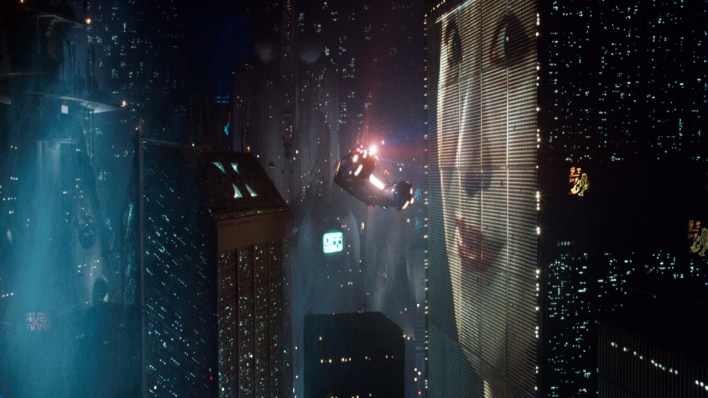
Based off a Philip K. Dick novel and directed by Ridley Scott following his hit with Alien, Blade Runner is often cited as a touchstone and forerunner for the cyberpunk and neo-noir genres, thanks to its grimy rain-soaked visuals of a future Los Angeles. With flying police cars traversing the neon-lit cityscape, I could clearly see this film’s influence on the likes of Minority Report, Ghost in the Shell, and The Matrix. Ghost in the Shell is perhaps the clearest borrower, also boasting a cerebral plot about man-made androids questioning their humanity, so there’s no denying Blade Runner’s impact on the style of much modern sci-fi. The non-digital effects hold up remarkably well, and the cinematography really heightens the bleak otherness of this particular dystopia.

If only this adeptly stylized world were worth spending time in. For all its technical finesse and shadowy cinematography, the strangeness of this future was a turn-off for me, with some of the surreal posturing of its characters reminding me of Dune from two years later. Whereas Dune was dragged down by a surplus of exposition, though, Blade Runner could have benefited from more, with far too many drawn-out scenes left in tedious silence. (I saw Ridley Scott’s Final Cut, but I understand the original theatrical version has a noir-style narration. Honestly, my curiosity about that difference is probably the only thing that would get me to watch Blade Runner again.) It’s a highly visual film, but the visuals weren’t enough to overcome a lackluster story.

Image result for blade runner film

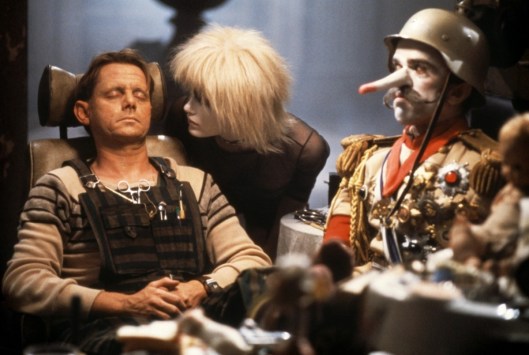
The actors are all decent for the most part, with Harrison Ford playing a good tenacious policeman but never making much of an impression. Likewise, Sean Young as the femme-fatale love interest fills her role in the noir plot, but there’s not much to her thinly written character or to anyone else’s for that matter. Rutger Hauer is perhaps the most memorable as the main villain, Roy Batty, a murderous replicant who seeks to lengthen the programmed four-year lifespan for himself and his fellow rogues (Brion James, Joanna Cassidy, Daryl Hannah). Yet we never get to know the replicants any more than the human characters, and their plight is only half-felt with any sympathy by the end. Batty’s final scenes are also bizarrely anticlimactic after he chases Deckard like Hannibal Lecter on crack.

I recognize a lot of potential depth to the story, with themes of what makes us human, the unreliability of memories, the moral questioning of doing one’s job, and the despair and anger toward the arrogance of a creator (which Scott also incorporated into Prometheus). Yet none of these themes are compelling or explored with any depth, and the intentional ambiguity of several scenes only heightened their underdeveloped potential. Blade Runner is a film such that I can see how critics could watch it repeatedly and wring profound merit from its narrative, but its reputation as a masterful classic is more merit than this slow story deserves, in my opinion.

Image result for blade runner film roy batty

Owing its R rating to only two scenes (one with nudity, one uncomfortably violent), Blade Runner was quite the disappointment, especially because I typically love science fiction. (I’m not alone too; my equally sci-fi-loving VC was bored and uninterested by the halfway point.) I just don’t understand how a style-over-substance film like this is labeled a masterpiece, when far more entertaining tales, like In Time or Surrogates, are written off as sci-fi hack jobs. The letdown has also spoiled much of my interest in the upcoming sequel, though I’m still curious to see Denis Villeneuve’s take on this world, after the intellectual emotion of last year’s Arrival. Blade Runner is a grittily surreal blending of future and noir, with admirable effects and cinematography and an unmistakable impact on science fiction to come, but it’s also proof that just because something shapes a genre doesn’t necessarily make it a masterpiece.

Best line: (Tyrell, Roy’s designer) “The light that burns twice as bright burns half as long, and you have burned so very, very brightly, Roy.”


Rank: Dishonorable Mention


© 2017 S.G. Liput
487 Followers and Counting


VC Pick: Moonraker (1979)

26 Friday May 2017

Posted by sgliput in Movies, Poetry, Reviews, Writing

≈ 2 Comments

Tags

Action, Comedy, James Bond, Sci-fi, Thriller

Image result for moonraker

(Best sung to “Moon River” because, as Bond says at the end, “Why not?”)

Moonraker,
Where did you go wrong?
You started off so strong, and yet….
Your sense of humor
Became a tumor
When Jaws in his folly
And Dolly first met.

Filmmakers
Learned from your mistake:
Don’t go, for humor’s sake, too far.
It’s just not the same James Bond style,
Veering juvenile.
Still you make me smile,
Moonraker,
Low bar.
___________________

MPAA rating: PG

I certainly hope it’s mere coincidence that Sir Roger Moore died not long after I watched Moonraker, especially considering that I saw Rogue One the day Carrie Fisher passed. This had better not be a trend for me. Moonraker is easily Moore’s weakest outing as Bond (though also his highest-grossing), but my VC enjoys it and I thought it appropriate after seeing his name in the headlines for the last time recently.

Like most other entries in the franchise, Moonraker follows all the familiar story beats of Bond surviving enemies, confronting a clearly shady industrialist with an accent, seducing beautiful fellow agents, and narrowly saving the world. This installment, though, was clearly meant to capitalize on the growing public interest in space and science fiction, since Moonraker was released just two years after Star Wars and incorporated space shuttles into the plot, predating actual shuttle flights by a couple of years.

Image result for moonraker

Moonraker benefits from the natural charm of Moore, who remains my and my VC’s favorite incarnation of Bond himself, and the explosive escapes and elitist villain played by Michael Lonsdale are perfect fits for this kind of movie. There’s even a nice bit of continuity in the return of the seemingly unkillable henchman-for-hire Jaws (Richard Kiel), who previously appeared in The Spy Who Loved Me. For most of its runtime, Moonraker is an all-around solid Bond flick and then…oh, where to begin?

I never minded the campier elements of Moore’s Bond and always thought he found the right balance of humor to match the debonair action, like when he and Jaws merely smile at each other every time they face off. Yet Moonraker takes it too far, extending beyond good fun into unabashed parody. Whose idea was it to give Jaws a random pig-tailed girlfriend named Dolly and back their love-at-first-sight gaze with the theme from Romeo and Juliet? Likewise, I was willing to stomach the villain’s Noah’s Ark-style space station, but I was left speechless when the U.S. sends a shuttle to investigate and a host of space-suited astronauts quickly engage in a laser battle. Really??? Sure it looks impressive for the time and even earned an Oscar nomination for Visual Effects, and I realize Star Wars was popular, but this is just ridiculous!

Image result for moonraker jaws

I’m not alone in rolling my eyes at the absurdity of Moonraker’s second half, and mixed reviews at the time thankfully led future writers to reel in their overactive imaginations to more reasonable levels of silliness. Even so, Moonraker remains as entertaining as its Bond brethren in most other respects with some impressive stunts and an excellent score by John Barry, and its outlandishness somewhat works as a so-bad-it’s-good advantage. As long as you aren’t looking for Bond to be grounded in reality, it’s a campily fun episode, and Moore, as always, looks like he enjoyed himself as Bond. Even in his weaker efforts, he’ll always be the best Bond for me. RIP, Roger Moore.

Best line: (Drax, with typical Bond villain panache) “Mr. Bond, you defy all my attempts to plan an amusing death for you.”


Rank: Honorable Mention


© 2017 S.G. Liput
485 Followers and Counting


← Older posts
Newer posts →

Recent Posts

  • Dust Bunny (2025)
  • Don’t Breathe (2016)
  • The Sheep Detectives (2026)
  • The Black Phone (2021)
  • Godzilla Minus Zero (2026)

Recent Comments

The Sheep Detectives… on Wildwood (2026)
The Sheep Detectives… on #40: Babe (1995)…
The Black Phone (202… on Halloween Kingathon – Mi…
Godzilla Minus Zero… on Godzilla Minus One (2023)
If You Were the Last… on The Martian (2015)

Archives

  • November 2026
  • September 2026
  • June 2026
  • May 2026
  • January 2026
  • December 2025
  • May 2025
  • April 2025
  • March 2025
  • February 2025
  • January 2025
  • December 2024
  • May 2024
  • April 2024
  • March 2024
  • February 2024
  • January 2024
  • December 2023
  • November 2023
  • October 2023
  • September 2023
  • July 2023
  • June 2023
  • May 2023
  • April 2023
  • March 2023
  • February 2023
  • January 2023
  • December 2022
  • November 2022
  • October 2022
  • September 2022
  • August 2022
  • July 2022
  • June 2022
  • May 2022
  • April 2022
  • March 2022
  • February 2022
  • January 2022
  • December 2021
  • November 2021
  • October 2021
  • September 2021
  • August 2021
  • July 2021
  • June 2021
  • May 2021
  • April 2021
  • March 2021
  • February 2021
  • January 2021
  • December 2020
  • November 2020
  • October 2020
  • September 2020
  • August 2020
  • July 2020
  • June 2020
  • May 2020
  • April 2020
  • March 2020
  • February 2020
  • January 2020
  • December 2019
  • November 2019
  • October 2019
  • September 2019
  • August 2019
  • July 2019
  • June 2019
  • May 2019
  • April 2019
  • March 2019
  • February 2019
  • January 2019
  • December 2018
  • November 2018
  • October 2018
  • September 2018
  • August 2018
  • July 2018
  • June 2018
  • May 2018
  • April 2018
  • March 2018
  • February 2018
  • January 2018
  • December 2017
  • November 2017
  • October 2017
  • September 2017
  • August 2017
  • July 2017
  • June 2017
  • May 2017
  • April 2017
  • March 2017
  • February 2017
  • January 2017
  • December 2016
  • November 2016
  • October 2016
  • September 2016
  • August 2016
  • July 2016
  • June 2016
  • May 2016
  • April 2016
  • March 2016
  • February 2016
  • January 2016
  • December 2015
  • November 2015
  • October 2015
  • September 2015
  • August 2015
  • July 2015
  • June 2015
  • May 2015
  • April 2015
  • March 2015
  • February 2015
  • January 2015
  • December 2014
  • November 2014
  • October 2014
  • September 2014
  • August 2014
  • July 2014
  • June 2014
  • May 2014
  • April 2014
  • March 2014
  • February 2014
  • January 2014
  • December 2013

Categories

  • Blindspot
  • Blogathon
  • Christian
  • Movies
  • Music
  • NaPoWriMo
  • Poetry
  • Reviews
  • TV
  • Writing

Meta

  • Create account
  • Log in
  • Entries feed
  • Comments feed
  • WordPress.com

Blog at WordPress.com.

  • Subscribe Subscribed
    Rhyme and Reason
    Join 799 other subscribers

    Have a WordPress.com account? Log in now.

  • Rhyme and Reason
    View site in Reader
    Manage subscriptionsSign upLog in
    Report this content
    Collapse this bar