(Today’s NaPoWriMo prompt was for a poem centered on some aspect of the natural world, so I picked a film with beautiful scenery.)
A stone in the mountains was where I would sit
When my mind became tenuous, troubled, and torn,
And there I would gaze at the dips and ascents
Of a green countryside so serene and immense
That I doubt it had changed since the planet was born.
The sun had God’s view where the clouds would allow,
And outcrops of trees bent to frame the landscape.
A forested quilt full of patches and glades
Extended below me in emerald shades;
A mist hovered o’er with no hope of escape.
My limited world, feeling smaller each day,
In view of this limitless vista below,
Was somehow bestowed with more peace and more hope
That this life on this stone on this sumptuous slope
Was not so confined and had room still to grow.
_________________
MPAA rating: Not Rated (PG, nothing much objectionable, except some animal deaths)
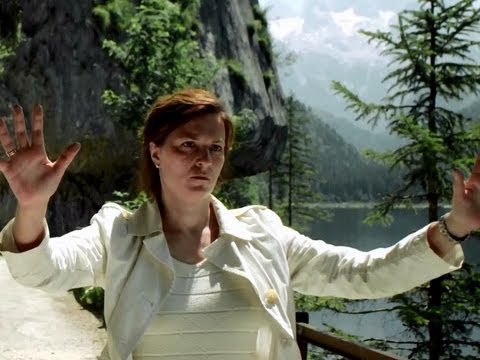
When it comes to isolationist cinema like Cast Away or Moon, none are quite as simple and direct as The Wall, an Austrian-German film about a young woman whose visit to a mountain cabin becomes permanent when an invisible wall cuts her off from the outside world. The concept may be reminiscent of Stephen King’s Under the Dome, but it plays out like an extended episode of The Twilight Zone, with the nameless woman (Martina Gedeck) forced to survive with this one simple, unavoidable wrench thrown into the works of her life.
It’s also a sublimely quiet film with a bare minimum of spoken dialogue, instead relying on Gedeck’s voiceover recounting her experience via journal entries, like Robinson Crusoe detailing his survival methods. Yet, beyond the activity, there’s a substantial focus on the woman’s feelings, doubts, fears, and inner reflections, from her relationships with her animal companions to her nightmares of her world continuing to shrink and deep ruminations of life and death.
Because it’s such a philosophical and contemplative film, it’s not something to watch if you’re sleepy and will probably bore you even if you’re not. Plus, it ends in Twilight Zone fashion with some raw emotion and little closure. Yet, set amidst the classical violin score and some absolutely gorgeous German countryside, there’s a subdued tranquility to the struggles of a tortured soul struggling in silence. It’s sad and lovely and probably something I’d only watch again if I couldn’t sleep.
Best line: (the woman) “There is no rational emotion as love. Love makes the life of the lovers and the beloved ones more bearable. We have to just recognize in time that this was our only option. Our only hope for a better life.”
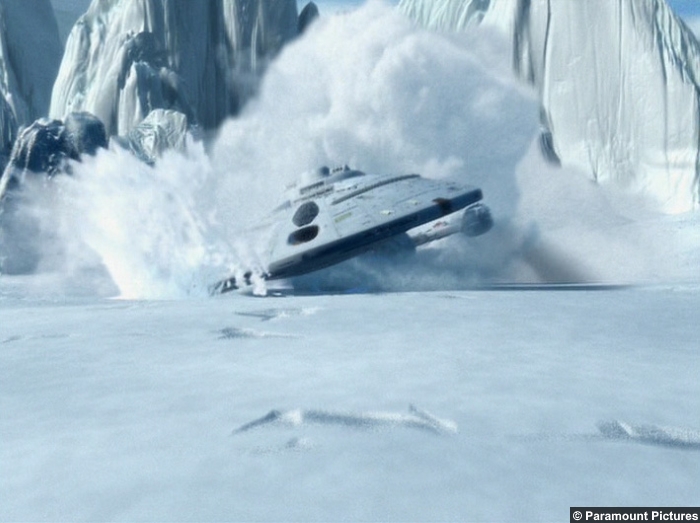
Of all the Star Trek series I’ve seen, my favorite is undoubtedly Voyager, a classic example of a show that started with promise and kept getting better as it went. I wavered on whether or not to make a list of my top episodes, unsure if anyone would even care, but after learning of other fans, namely the lovely ladies of Violet’s Veg*n E-Comics, I couldn’t resist any longer. I’ll likely do a favorites list for all my favorite shows at some point.
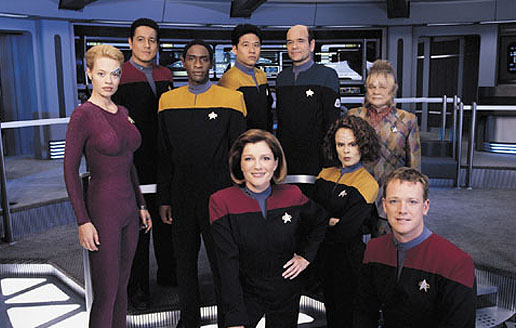
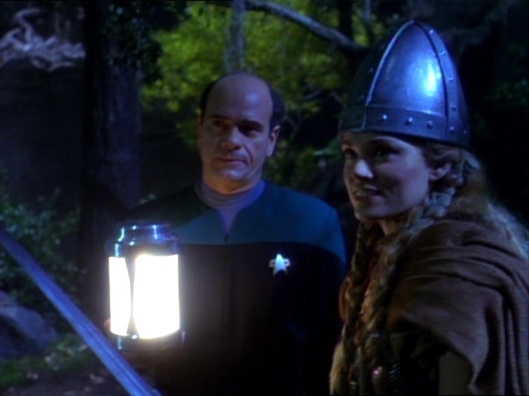
For those who don’t know, Voyager is in the same universe as all the other Star Trek series and is the last to occur chronologically. It’s basically a space-faring version of The Odyssey, with the title ship (and a rebel Maquis ship) being blasted into the Delta Quadrant 70,000 light years from Earth, and the two crews must combine to begin the 75-year journey home, with quite a few adventures along the way. The best part of Voyager is its characters, all of whom feel like a family by the end, from Kate Mulgrew’s first female Trek series Captain Kathryn Janeway to Robert Picardo’s egotistical holographic Doctor (“I’m a doctor, not a tricorder.”) to Ethan Phillips’ ever lovable Talaxian cook Neelix. With its far-flung setting, it also explores planets, aliens, and themes unseen in other Trek series and features some of the best time travel episodes of the franchise.
Of course, no series is immune to some duds, and I don’t want anyone’s first exposure to Voyager to be “Threshold” or “The Fight” or “Barge of the Dead.” Thus, for fans and not-yet-fans alike, here are my top twelve episodes of Star Trek: Voyager. I say “not-yet-fans” because I would hope seeing the show at its best would win over any potential viewer. Because Voyager rules! And so the countdown begins….
“11:59” – Season 5
Oddly enough, the first episode here doesn’t even take place on Voyager. When Captain Janeway recounts the story of one of her forebears, we’re treated to an endearing flashback of her ancestor (also played by Mulgrew) falling in love with a nostalgic bookstore owner (Kevin Tighe of Lost) on New Year’s Eve of 2001.
“Before and After” – Season 3
The episodes with Kes (Jennifer Lien) weren’t always the best, despite the uniqueness of a budding telepath with a nine-year lifespan, but “Before and After” was easily her best episode. She begins to live her life backwards, starting as an old woman and trying to figure out what’s happening before she jumps further back in time.
“Shattered” – Season 7
Every series likes to have some kind of recap episode for the more nostalgic fans, and “Shattered” again uses time travel for that very purpose. After a warp core accident, first officer Chakotay finds himself the only one unaffected when the ship is broken up into different sections of its own history. Kudos for all the references to past episodes!
“Nemesis” – Season 4
Another Chakotay episode, this time he crash-lands in the middle of an alien war and becomes a pawn in the struggle. There’s a potent message about how both sides of war encourage hate for the enemy, and I love the unique alien vocabulary used (“glimpses” in place of eyes, “trunks” in place of trees). Seriously, this episode should have won an Emmy for its writing.
“Rise” – Season 3
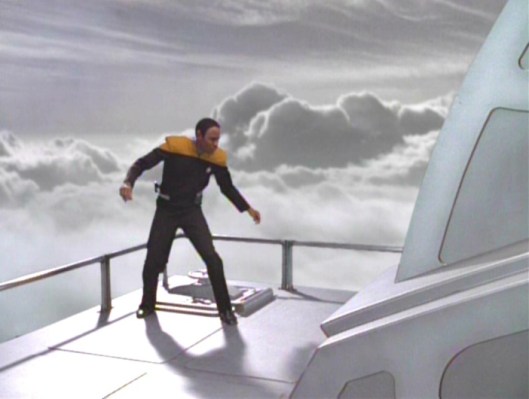
There was always a great odd-couple dynamic between gregarious Neelix and logical Vulcan Tuvok, and the tension finally bubbled to the surface in “Rise,” where they must work together with some disaster survivors to escape a planet’s atmosphere via a literal ground-to-space elevator. The concept alone is cool!
“Equinox, Parts 1 and 2” – Seasons 5/6
Yes, I’m counting two-parters together. Guest-starring John Savage and Titus Welliver (aka “the Man in Black” from Lost), this double-header that segued from season 5 to season 6 provided an excellent contrast between the straight-laced Starfleet ideals of Voyager and the more ruthless tactics of another stranded ship, the Equinox. Ghost-like aliens and an evil Doctor made this a memorable season finale/opener.
“Year of Hell, Parts 1 and 2” – Season 4
Fleshing out a future time period seen in “Before and After,” “Year of Hell” pit Voyager against Kurtwood Smith’s Annorax, a man with a time-altering ship trying to erase other species to restore his own people’s former glory. This episode shows Janeway and her crew at their most desperate, proving why she’s such a resilient leader.
“Blink of an Eye” – Season 6
With subtly transcendent themes, “Blink of an Eye” has one of the more unique set-ups for a Trek episode, a planet that revolves so rapidly that years and centuries on its surface pass within hours outside its atmosphere. When Voyager is caught in its gravity, the crew watches an entire civilization develop before their eyes, and the viewers get to see a closer perspective from the ground. Lost alert for Daniel Dae Kim as one of the planet’s inhabitants.
“Timeless” – Season 5
It’s always a big deal when a series reaches its 100th episode, and Voyager marked the milestone with a fantastic time travel tale. When the ship is destroyed during an attempt to get home sooner, two survivors risk everything to undo the doomed mission.
“Future’s End, Parts 1 and 2” – Season 3
Wow, there sure were a lot of time travel episodes, and all great ones. In this two-parter, a timeship captain from the future tries to destroy Voyager to prevent an eventual disaster, and a mishap sends both ships back to the 21st century. With shades of Star Trek IV: The Voyage Home, it also boasts an unlikely villain in Ed Begley, Jr., and introduces an important plot device for the Doctor that would prove invaluable in future episodes. Oh, and early Sarah Silverman is in it too.
“Deadlock” – Season 2
While it doesn’t seem to get much attention compared with, say, the two-parters, “Deadlock” is science fiction at its best. When the ship is attacked (which happens a lot, now that I think about it), a spatial anomaly divides the ship in two in a most unique way.
“Scorpion, Parts 1 and 2” – Seasons 3/4
To compare it to a classic Next Generation episode, “Scorpion” is Voyager’s “Best of Both Worlds.” With a story set in the Delta Quadrant, it was only a matter of time before their journey ran into the home turf of the Borg. A turning point for the series between seasons three and four, it pits Janeway and company against not only the Borg but a new species unlike any seen before, which threatens even the Borg collective. A tense and rather scary tone, a great new background score, and the introduction of Jeri Ryan’s Seven of Nine make this one of the high points of the series.
And here are the runners-up, which were not easy to whittle down, considering how fantastic all of them are. My VC likes most of my picks but also has a few episodes I didn’t choose that she is fond of and wanted to highlight. In the order they aired:
Season 1:
“Caretaker” – Series premiere
“Faces” – First major development for B’Elanna Torres
VC Picks: “Time and Again” and “Heroes and Demons”
Season 2:
“Resistance” – Sad episode for Janeway with a great guest role for Joel Grey
“Meld” – Tuvok tries to help a psychopath on board (Brad Dourif)
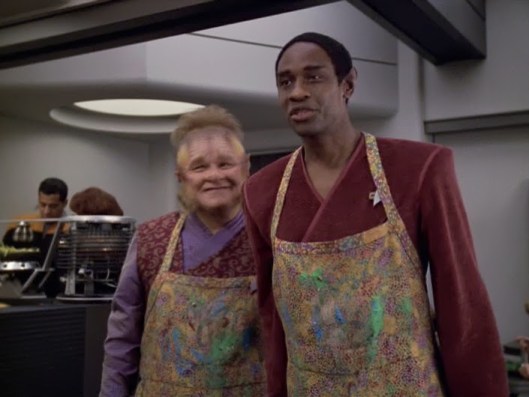
“Tuvix” – Tuvok and Neelix fuse in a transporter accident; silly concept exploring serious sci-fi themes
“Resolutions” – Janeway and Chakotay: what could have been….
“Basics, Parts 1 and 2” – Season 2 finale with the crew forced onto a primitive planet
VC Picks: “The 37s” and “Lifesigns”
Season 3:
“Flashback” – A cool revisiting of the events of Star Trek VI, complete with George Takei and Grace Lee Whitney
“Real Life” – Possibly the show’s biggest tearjerker with the Doctor
“Displaced” – The crew is slowly replaced by aliens.
VC Picks: “Remember” and “Blood Fever”
Season 4:
“Scientific Method” – Do you ever feel like a headache is torture? There could be a scary reason why.
“The Killing Game, Parts 1 and 2” – A race of hunters brainwash the crew for holographic sport. It’s the only place you’ll see Nazis and Klingons side by side.
“Living Witness” – An amazing what-if episode questioning the accuracy of history.
VC Picks: “Day of Honor,” “Hunters,” “Prey,” “Unforgettable,” and “Demon”
Season 5:
“Night” – Season 5 premiere with Janeway at her most self-doubting.
“Nothing Human” – Deep ethical questions, guest-starring David Clennon as a Cardassian
“Counterpoint” – Music, romance, and mistrust abound
“Macrocosm” – Attack of the giant killer germs! The new movie Life might have drawn some inspiration from this.
“Bride of Chaotica!” – Just a fun, silly homage to old-fashioned cheesy sci-fi
“Gravity” – Tuvok and Tom Paris stranded on an invisible desert planet, guest-starring Lori Petty
“Course: Oblivion” – Deeply sad what-if episode
“Think Tank” – Alien geniuses make an offer Voyager can’t refuse, guest-starring Jason Alexander
“Juggernaut” – Awesome horror-thriller episode on a deserted(?) toxic waste vessel
“Someone to Watch Over Me” – Poor Doctor!
“Relativity” – Voyager does it again with an amazing use of time travel.
VC Picks: “In the Flesh,” “Thirty Days,” and “The Disease”
Season 6:
“Riddles” – Tuvok and Neelix bond when Tuvok is mentally impaired.
“One Small Step” – A testament to the importance of “early” space travel
“Fair Haven” – The crew enjoy a holographic Irish village.
“Life Line” – The Doctor gets to meet the scientist who designed him after himself.
“Unimatrix Zero, Parts 1 and 2” – Season finale and a game-changer for the Borg collective.
VC Picks: “Pathfinder,” “Memorial,” “Ashes to Ashes”, “Live Fast and Prosper,” and “Muse”
Season 7:
“Flesh and Blood, Parts 1 and 2” – The Doctor must choose between his crew and renegade holograms.
“Lineage” – Big character development for B’Elanna
“Workforce, Parts 1 and 2” – The crew is once again brainwashed as workers on an industrial planet.
“Homestead” – Oh, Neelix. *sniff*
“Endgame, Parts 1 and 2” – Not perfect, but satisfying series finale
VC Picks: “Body and Soul,” “Author, Author,” and “Friendship One”
And to wrap it all up, here’s the beautiful opening theme and credits, which I also included in my post of Voyager musical highlights. Now I want to watch this show again!
I don’t know what dangers wait
Within the dark beyond the door.
Since entering in safety’s gate,
I’ve heard that horrors populate
The world outside and nothing more.
I feel the urge of tempting fate
And venturing where none explore,
But such is not up for debate.
I’m told the danger is too great,
And no one’s looking anymore.
The threats without intimidate,
But those within are growing sore.
And if I realize it too late,
I fear my safety will stagnate
Within the dark inside the door.
__________________
MPAA rating: PG-13
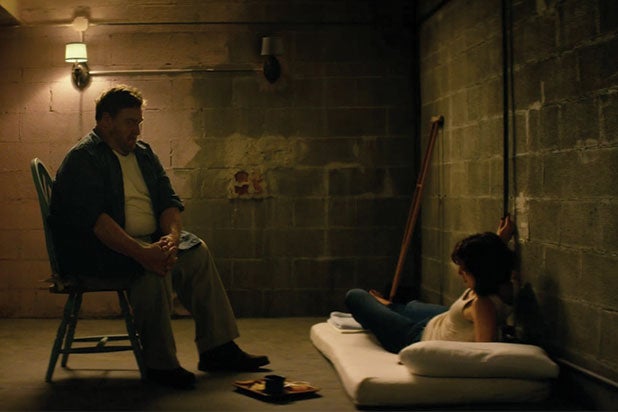
Who could have foreseen a follow-up to J.J. Abrams’ 2008 monster movie Cloverfield eight years later, especially when the first trailer for 10 Cloverfield Lane was released just two months before its release? I actually haven’t seen Cloverfield yet, but this not-quite-sequel is its own animal, following neither the first’s found-footage style nor apparently any of its characters. Instead, it’s a tense and claustrophobic thriller with only three main characters locked in an apocalyptic bunker.
While many have lauded 10 Cloverfield Lane as an outstandingly pleasant surprise from last year, my praise will be a bit more muted, but I don’t mean to write it off completely. It was indeed a pleasant surprise if for no other reason that no one expected it, and when an unexpected film is as effective as this one, there’s nothing wrong with giving due acclaim to the film and its debuting director Dan Trachtenberg. Particularly praiseworthy are the three central performances. Mary Elizabeth Winstead plays Michelle, a woman who awakes from a car wreck to find herself trapped underground by a creepily benevolent John Goodman. This Howard gradually explains that some disaster has occurred on the surface, and after rescuing her, he has graciously allowed Michelle and another local named Emmett (John Gallagher, Jr.) to stay in the confined comfort of his well-furnished safe space. The simple but menacing setup is reminiscent of M. Night Shyamalan in his heyday, and we’re never quite sure what to believe. Is Howard prudent or just crazy with his conspiracy theories, and are Michelle and Emmett better off staying inside, placating his demands, or trying to escape? Goodman is brilliantly unpredictable here, and even if there’s not a lot of development for the other two, having to deal with him is enough to spark concern for his captives.
For all its strengths, one thing that 10 Cloverfield Lane does not have is much in the way of originality. Many times I was reminded of two similar films: Misery, with John Goodman taking the place of Annie Wilkes’ possessive caretaker, and 2015’s underrated Hidden, where a family resides in an underground bunker in uncertain fear of what lies above. Putting these two concepts together essentially gives you 10 Cloverfield Lane, and even when it breaks free of the bunker for a slam-bang awesome finale, it still had echoes of War of the Worlds and The Terminator. Another point of comparison is Trachtenberg’s 2011 short film Portal: No Escape, which begins very similarly with a woman awaking in an austere cell with no memory of how she got there. It was that short that helped get Trachtenberg enough notice to earn him the director’s chair, so the parallels there aren’t surprising. (The short also proves he’d be a great choice to direct a feature-length Portal movie, and I, for one, hope it’s soon. You can check it out here.)
It’s unfortunate that 10 Cloverfield Lane lacks the originality of Misery or the emotional resonance of Hidden, but even as an amalgamation of prior ideas, it’s an impressively constructed nerve-jangler that balances shock and restraint and turned its world into a viable franchise overnight. With a third Cloverfield-universe film called God Particle slated for this October, there’s no denying the success of 10 Cloverfield Lane.
Best line: (Howard) “People are strange creatures. You can’t always convince them that safety is in their best interest.”
When I am dead, my soul no longer here,
What happens to my body is unknown.
‘Tis but a shell, an empty souvenir
Of my time in a world from which I’ve flown.
Most likely, it will end up in the ground,
A monument for time to chip away,
But if some more productive use were found,
Its former owner would not have a say.
If man no longer buried his remains
And flouted promises of “rest in peace,”
His conscience would be numb as it disdains
What once deserved respect upon decease.
What world of Frankensteins I’d leave behind
If man were to defile his own kind!
________________
MPAA rating: should be PG-13 or maybe older
The Empire of Corpses looks like an incredible, action-packed, thought-provoking movie, but it’s not. It just looks like one. Based on a novel by a Japanese author dubbed Project Itoh, who died of cancer before the book’s completion, this anime zombie film sets up an alternative steampunk version of Victorian England, where technology has allowed mankind to reanimate the dead as essentially robotic slaves, programming them to perform menial labor as a growing workforce in the world economy. These walking corpses can be recognized by their pale gray skin and passive expressions, but though they seem to understand and follow orders, they are without a soul. Into this hypothetical world is placed an amalgamation of historic and literary figures, a la The League of Extraordinary Gentlemen. John Watson is the hero, a corpse scientist who has resurrected a dead friend he renames Friday and now searches for a way to return his soul. Blackmailed by M of the James Bond franchise, he sets out in search of the fabled research of Dr. Victor Frankenstein, aided and impeded by the likes of Ulysses Grant, Thomas Edison, and characters from The Brothers Karamazov and The Future Eve.
While that description sounds rather awesome, especially when paired with a world full of brainwashed zombies, The Empire of Corpses seems eager to spoil a good thing. After the adventure begins on a thrilling note, it quickly descends into opaque philosophical pondering and inscrutable character motivations. After watching it all the way through, I recognize a worthwhile, imaginative story, full of food for thought, but actually watching it scene by scene can easily frustrate and confuse. By the end, the villain’s revealed plot (the second villain since one wasn’t enough) is baffling and poorly explained, making it clear just how vaguely defined the laws of this corpse technology are.
I hate to be so negative, especially when The Empire of Corpses looks so amazing. The animation is crisp and atmospheric and brings this theoretical world to life in ways that far surpass the deficient script. I’m glad I saw it, if only for the visual flair, such as the thrill of seeing a woman on the back of a galloping stagecoach mowing down zombies with a flamethrower. The action scenes are exceptional, but it makes it that much more disappointing that the rest of the film couldn’t measure up.
The Empire of Corpses is not without its virtues; I would just like it much more if it made more sense. It does feature some intriguing themes about life and death and manages to create a unique entry in the zombie genre, complete with zombie suicide bombers. The English dub is actually quite good, but the animation is the main attraction for fans of the medium, though certain scenes can get bloody (begging the question of why a dead corpse would bleed). This film is one of three anime movies based on Project Itoh’s novels (the others being last year’s Harmony and this year’s Genocidal Organ), and I certainly hope the other two have more than visual merit alone.
Each day, I passed an ancient wall,
And, written on its face,
Were symbols of an arcane scrawl
Seen only in that place.
They sometimes gave me déjà vu,
But what they meant nobody knew.
One day, I met a stranger there,
Mysterious and odd,
Who offered me the talent rare
To read the wall’s façade.
I hesitated at the gift,
But curiosity is swift.
Although I can decipher now
The words upon the wall,
I wonder if not knowing how
Would change my life at all.
For knowledge is both curse and grace,
Yet neither one would I erase.
_______________
MPAA rating: PG-13
I went into Arrival expecting a great sci-fi movie, based on all the praise it has received from critics and bloggers alike, but I must admit that it caught me off-guard. After the film ended, I had to sit there in the theater a while to process my thoughts, walked back to my car, and broke down crying. It’s hard for me to determine why this movie more than similar ones had such an effect on me, but that’s proof to me that it is indeed one of the best films of 2016.
I’ve seen Arrival compared more favorably to Christopher Nolan’s Interstellar, and while I recognize some thematic similarities, it improved upon a different alien film I disliked, Robert Zemeckis’s Contact. I was irritated by how Contact constantly pitted faith and science against each other, but in Arrival’s case, language and science collaborate instead in the persons of linguist Louise Banks (Amy Adams) and physicist Ian Donnelly (Jeremy Renner). While the idea of pairing Lois Lane and Hawkeye in the same movie has appeal in itself, both actors display utter commitment to their respective fields as their characters are recruited to attempt communication with alien visitors that have (almost) landed twelve lenticular ships at various spots around the globe. Before we even see the extraterrestrials, there’s an epic wonder to their inexplicable arrival, facilitated by momentous cinematography and a striking gravitational doorway.
What Louise and Ian find when they encounter the tentacled aliens is a linguistic challenge that seems unconquerable to most, a written language that is circular with a conceptual density lacking letters, syllables, or anything recognizable. With frazzled militaries urging them to find out the aliens’ purpose, the two experts attempt to unravel this strange form of communication, sparking some deep questions along the way. Even beyond the stated debates, like whether immersing oneself in another language changes how one thinks, I was struck by how much we take language for granted. If I were confronted by someone without any relatable language skills, I don’t know how I would explain the basics, much less abstract concepts I can’t point to and call a name. I can’t say Arrival provided any practical pointers if I were in that position, but it’s fascinating in a logical, over-my-head sort of way.
There’s also the natural distrust of a human race exposed to far more War of the Worlds than E.T.s, and further themes of how one wrongly understood word can ruin a tentative peace. It was hard for me to understand some people’s panic, since the aliens’ giant watermelon-seed ships show no signs of hostility, but I suppose we have Independence Day to thank for whatever paranoia would come from such a situation. Plus, there’s the added tension of other nations reacting in more belligerent ways and the potential fallout of humanity’s own lack of unity.
Thus, Arrival clearly has the intellectual side of science fiction down, but as the translation attempts wore on, I was hoping something more would come. I was not disappointed. For the first half, it was basically what I expected based on the trailers, yet there comes a moment past the half-way point that something becomes clear and lands a gut punch to both the intellect and emotions. The ramifications of a certain decision are laced with value and regret, and I found the results to be a profoundly pro-life sentiment, in sharp contrast to the pro-death sympathy of the film I last reviewed, Me Before You. At the time, I felt that Arrival was holding back a bit on the emotion, similar to The Wind Rises; if certain scenes and themes were pressed further, I would have been a blubbering mess right then and there. But instead, the filmmakers present what they want to, and the web of sci-fi ideas and emotional threads were left for me to unravel, with tearful results.
I’ve often said that Grave of the Fireflies is the only film that can still make me cry, but that’s not altogether true. It may make me cry the hardest, but what do other past personal tearjerkers like Somewhere in Time, The Five People You Meet in Heaven, Inside Out, and now Arrival have in common? For me, it seems to be the complex merging of sorrow and joy, events that may end sadly but are not without a worthwhile silver lining. At its heart, Arrival endowed me with an intense and unexpected bittersweetness. Even if its immediate resolutions seem to be wrapped up a bit too easily, its long-term story and life-affirming subtext made it a very special experience for me.
Best line: It would be a spoiler to include the best quote, but it’s one of Louise’s final lines.
The glaring lights of other cars assault the driver’s eyes,
A father’s eyes that have not slept a wink.
His son is sleeping in the back or reasonably tries,
As far behind, the passing headlights shrink.
Their own light slices through the dark to blindly find the road,
Its end concealed by more than just the night.
Throughout their drive, the father’s pace has hardly ever slowed,
Lest thoughts of past or future cloud his sight.
The worries of a father’s love cannot be put to rest,
No matter where the son may chance to go.
Not even when they reach the destination of their quest
Will bonds of son and father cease to glow.
___________________
MPAA rating: PG-13
I haven’t seen any other films from director Jeff Nichols, but based on his reputation and the high expectations for his foray into science fiction, I anticipated something special, especially since Midnight Special was meant as a homage to classic ‘80s sci-fi. In fact, it has more than a passing resemblance to one of my favorite ‘80s sci-fi films, John Carpenter’s Starman, sharing a road trip to an important destination, a hunted protagonist with mysterious powers, and government agents hot on his trail.
In place of the romantic angle of Starman is a devoted father-son dynamic between Roy Tomlin (Michael Shannon) and his son Alton (Jaeden Lieberher), who has strange seizures during which his eyes glow and he picks up radio signals. There’s little set-up as we immediately join Roy’s odyssey, having already rescued Alton, with the help of his friend Lucas (Joel Edgerton), from a Texas cult that views the boy as a messianic savior. Alarmed to learn that the cult learned sensitive information through Alton, the government is eager to find him, as are the enforcers sent by the cult to retrieve him.
As much as I was looking forward to Midnight Special, this is one case where the description sounds better than the finished product. It’s certainly not a bad film, but much of the runtime seemed to hover on the edge of being dull. After the initial curiosity of what’s going on wears off, the tension and wonder are only felt in short bursts that aren’t always as compelling as they try to be. One stylistic choice that annoyed me with its frequency was how the characters are sometimes plunged into darkness where it’s hard to see what’s happening; naturally, these scenes are meant to accentuate the light that eventually appears, such as during a momentous sunrise, but the technique got old quickly.
What often kept the film from tipping into boredom was the performances, which are excellent across the board. Michael Shannon is a conflicted protagonist as he seeks the best for his son while never knowing where that may lead, and the extent of his ruthlessness is cleverly kept in doubt. Edgerton also excels in the role of a hesitant believer, as do Kirsten Dunst as Alton’s mother and Adam Driver as the NSA agent who ends up sympathizing with the boy’s quest (not unlike Charles Martin Smith in Starman). It’s the performances that save Midnight Special, along with some spurts of action that are exceptionally well-timed.
Midnight Special had plenty of potential from the start, but by the end, it’s hard not to feel that something is missing. It’s not that I need my sci-fi to be non-stop action; heck, I’ve heard people complain that Starman is boring. Yet whereas Starman wasn’t afraid to have a bit of fun with its hammy concept, Midnight Special is almost one-note in its seriousness and might have benefited from a less sober tone and a less ambiguous resolution. It undoubtedly has moments of brilliance, but such moments can only help a film so much.
Best line: (Alton) “You don’t have to worry about me.”
(Roy) “I like worrying about you.”
(Alton) “You don’t have to anymore.”
(Roy) “I’ll always worry about you, Alton. That’s the deal.”
While Luke was still on Tatooine,
Before his escapades were seen,
The rebels fought
With secret plot
For every desperate, daring shot.
Some fled, some died, and some were caught,
For freedom’s never cheaply bought.
Before the rebels found success,
They found a chance that none would guess,
A chance that few
Would dare pursue
But those who hopes were overdue.
The groundwork of the tried and true
Was laid by names we never knew.
__________________
MPAA rating: PG-13
I’ve been a little disconcerted at Rogue One’s mixed reception, with half the people loving it and the other half accepting it halfheartedly. I know how the latter group feels since that’s how I reacted to The Force Awakens last year, but not this year, not with Rogue One. I enjoyed it a lot, probably more than The Force Awakens, mainly because The Force Awakens will always have the shadow of Han Solo’s death hanging over it. No matter how many times I see it, it will always be “the one where they killed Han Solo.” I remember gloomily walking out of the theater in shock last year, but I left Rogue One as one should leave a Star Wars movie, exhilarated and satisfied, even if the film is meant for a more bittersweet kind of appreciation. I wanted to love it, and there was nothing that kept me from loving it.
What many find iffy about Rogue One is that it doesn’t quite feel like a Star Wars movie. There’s no in-your-face opening crawl and no Jedi; the overall tone is darker and grittier than the other films, and the rebellion is depicted in a more ruthless and morally ambiguous light. All this is true, yet the settings and sci-fi trappings feel enough like Star Wars that it seems more like an unexplored region of the franchise than an entirely separate affair. And of course, since Rogue One is set between the fall of the Jedi and the beginning of A New Hope, there are clear connections to both trilogies, most notably in the return of Darth Vader and another character whose very presence brings the magic of CGI to new heights.
Yet unlike The Force Awakens and its unoriginal blow-up-yet-another-Death-Star climax, Rogue One has no lack of originality. It does take its time getting started, establishing the various rebels and their motivations, particularly Jyn Erso (Felicity Jones), the daughter of the scientist (Mads Mikkelsen) forced to build the Death Star, and Cassian Andor (Diego Luna), a rebel fighter committed to following orders no matter what. The ragtag band that collects around them is especially highlighted with some humor by the blind kicker-of-butt Chirrut Îmwe (Donnie Yen) and the tall droid K-2SO (Alan Tudyk), who combines the snarkiness of R2 and the grumbling of C-3PO.
None of these characters are particularly deep or destined to be fan favorites, but as they band together to find Jyn’s father and the plans for the Death Star, most of them have some moment of truth or coolness that makes them memorable, like the machine-gun blaster of Chirrut’s friend Baze Malbus (Jiang Wen). I can’t say I had that much more connection with the new characters of Force Awakens after one viewing, but at least they have the benefit of further sequels. Rogue One is clearly a stand-alone film with characters that could be viewed as disposable, but by the time sacrifices were made, I cared enough about the characters that they were clearly more than cardboard cutouts. It’s a good balance, one that kept me invested without being overcome by grief like last year.
Even in the most mocked of the prequels, George Lucas always proved his skill at action sequences, and director Gareth Edwards does the same here. The film breaks out of that slow start with some highly entertaining thrills, ranging from ground combat to close escapes, and the big battle at the end had several “whoa” moments to bring out my inner Star Wars geek. Michael Giacchino’s score also complemented every scene, deftly incorporating the original John Williams music where apt. I also liked how the film provided an explanation for the Death Star’s glaring design flaw, which Luke so famously took advantage of. You know, one shot and the whole thing blows up—who thought that up? Well, someone did, and there’s actually a good reason.
Riding high after leaving the theater yesterday, I was brought down a bit by the sad news of Carrie Fisher’s death. Considering how Rogue One ends, it seemed strangely fitting that I picked that day to visit the movies. Now, of course, the film and its final scene will have a touch of bittersweet to it, even more than it already had, but at least I got to see it the first time without the sad connection. Rest in peace, Leia.
Rogue One may not be a perfect Star Wars film. Perhaps the characters are a bit thin; perhaps the effect used in the final scene is a little imperfect; perhaps the tone is a bit different from the familiar stories we grew up with. Forest Whitaker as extremist rebel Saw Gerrera isn’t as important as he seems at first, and he’s probably the reason some of the early scenes felt off. Likewise, I might have liked a little more screen time for known characters like Vader. Yet Rogue One isn’t about the movers and shakers of that galaxy far, far away; it’s about the rough-and-ready rebels on the front lines, the previously unknown players who made the heroics of Luke and Leia possible, and in that it’s a more than worthy addition to the Star Wars universe.
Best line: (Jyn and Cassian) “Rebellions are built on hope.”
The centuries are full of tales,
Not all of which are told for sales.
Some barely dent; some tip the scales,
And those who lived them rarely knew
If theirs for others would ring true.
The choices made for centuries
By king and kid and star and sleaze,
By massive and minute degrees
Affect, destroy, create, and bless
More fates than anyone could guess.
____________________
MPAA rating: R
Remember that feeling of being blown away that I mentioned back when I reviewed Inception and King of Thorn? Well, it’s back with a vengeance. After the credits of Cloud Atlas began rolling, I was left speechless and strangely satisfied. As Tom Hanks said in one of the DVD featurettes, upon reading the script, “I didn’t have any questions.” When the interviewer then asked, “So you understood it?” he replied with an unabashed “No.” Cloud Atlas is such a huge, epic, multi-layered piece of work that it’s no surprise that the most common descriptor from both admirers and detractors has been “ambitious.” It’s one of those rare films that found its way onto the best-of and worst-of lists of different critics, and I can easily understand both opinions. I feel I should recommend it to everyone, yet I can guarantee not everyone will like it. But I did.
I’m having trouble even coming up with a succinct way to describe Cloud Atlas, if there is one. Based on David Mitchell’s novel and adapted by Tom Tykwer and the Wachowskis of Matrix fame, it’s six separate stories in one, all linked by the continuity of souls and the bonds of literature, love, faith, music, kindness, and loss. The first tale is a 19th-century seafaring voyage of a dying lawyer (Jim Sturgess) and a runaway slave (David Gyasi). The lawyer’s journal is later read by a gay composer (Ben Whishaw), whose dealings with a famous maestro (Jim Broadbent) are like The Imitation Game with sheet music. The former’s letters are later read by Luisa Rey (Halle Berry), a journalist whose investigations play out like Silkwood meets Coma and inspire a mystery novel read later by Timothy Cavendish (Broadbent) as he plots against his Cuckoo’s Nest-style incarceration. Then, there’s the distant future, where a submissive clone named Sonmi-451 (Doona Bae) is saved by a resistance fighter (Sturgess) in Neo-Seoul, plus an even further post-apocalyptic future where Zachry (Tom Hanks) and a technologically advanced stranger (Berry) journey to potentially save what is left of mankind. How’s that for succinct?
With so much sheer plot to cover, it’s no surprise that the film stretches for close to three hours and could easily have been lengthened into a mini-series event. One of the most divisive aspects of Cloud Atlas is how it was edited, not with each story being told individually (as is the case in the novel, I’ve heard), but with every other scene jumping randomly to another time period to continue one of the other plotlines. One minute, we’re watching Tom Hanks as an apocalyptic goat herder, the next he’s playing a murderous author in 2012. I don’t know how the editing team kept track of everything, and it so easily could have turned into a confusing mess, but as odd as it seems, this unorthodox strategy works. It’s not every film that begins by explaining that, if the audience “can extend [their] patience for just a moment, you will find that there is a method to this tale of madness.” Each story is straightforward enough that I was able to follow it, especially with the settings and costumes differentiating them from each other. The method works too to drive home certain similarities between the timelines, in one instance someone walking along a precarious perch, in another a villain being knocked out from behind just before killing someone.
Each story seems to have its own genre too, whether it be the corporate espionage of the 1970s plot or the British comedy of the Cavendish tale. Probably the most entertaining are the futuristic Neo-Seoul segments, which also have the coolest visuals. Watching how these stories are connected in ways big and small, with questions raised early and answered late, is a journey which requires patience but which I found rewarding as some of the stories end tragically but some with great satisfaction. I also recognized quite a few little influences from other films, ranging from Silkwood,Soylent Green, and Mad Max to Logan’s Run, Wrinkles, and The Fellowship of the Ring.
As I alluded to earlier, the extensive cast make cameos of varying importance in the six stories, often playing such wildly deviating roles that I can imagine the actors viewing this film as a special treat and challenge for their abilities. Luckily, the entire cast rises to the occasion to make every character distinct, sometimes even playing roles of different gender and ethnicity. It’s practically a game trying to spot every recognizable face. Hanks, Berry, Broadbent, and Sturgess are the most significant presences throughout the film, but also making important impacts on the story are Susan Sarandon, Hugh Grant, Keith David, James D’Arcy, and Hugo Weaving. Weaving may be inescapably recognizable in every role, but he’s certainly diverse as a villain, playing a Nurse Ratched wannabe, a Korean board member, and a specter of the devil called Old Georgie. The care taken to hiding the actors in plain sight is incredible, and not to invalidate that Tom Hanks quote from earlier, but my main question afterward was where they incorporated everyone, even in unrecognizable cameos.
I suppose I should answer why Cloud Atlas appealed to me, when it clearly turns off so many others. I remember seeing the monumental 5+-minute trailer back in 2012, honestly the best trailer I think I’ve ever seen (see the bottom), and I’ve had a burning curiosity about it ever since, which has been delayed by reports of its confusing and objectionable narrative. And yet, I had to see it. I guess I’m simply an enormous appreciator of continuity, the idea that a storyteller knows where he’s going from the start and mixes the myriad ingredients and characters of his tale in subtle but memorable ways. That’s why I love Lost; all the little flashbacks converge at times, with characters bumping into each other long before they meet in earnest, hinting at a larger story and hand at work. I’m a sucker for this concept of cosmic connections which Cloud Atlas manages to capture across centuries; when the tapestry threads of the story come together and the music swells, I…I just can’t help but get goosebumps.
Yet I must admit that it’s not done in a particularly Christian way. Aside from the frequent language and occasional sex and violence, the plot hinges on the idea of reincarnation and the continuity of souls, things in which I do not believe. In fact, I usually roll my eyes at this kind of New Age metaphysical mumbo-jumbo, yet I can accept it as a movie concept for the sake of appreciating the bigger picture it paints, if only in a three-hour movie. Similarly, the long runtime and jarring changes of place and tone can be a bear to sit through, but it’s worth it once you get over the hump in the middle. Oh, and by the way, watch with subtitles; the furthest future segment has a crazily stylized pigeon-English that is admirable in a cultural sense but hard to understand without reading along.
Love it or hate it, Cloud Atlas is a film hard to forget, a piece of crazy cinematic art that is as bizarre and challenging as it is beautiful and daring. If its methods were a bit more mainstream, I could see it as a Best Picture nominee, but it’s a crime that it didn’t receive one Oscar nomination, not even for the effects or the universally lauded score. (It should have effortlessly won Makeup and Hairstyling, at least.) The cinematography and talented cast clearly mark it as a noble effort, and I suppose it’s up to each individual viewer to decide whether it’s a masterpiece or a train wreck. It’s a monument of a film, one full of ideas and themes I do not endorse or believe in and others that are simply universal. This is not a film to watch casually, but it is undoubtedly worth watching.
Best line: (Haskell Moore, played by Weaving) “There is a natural order to this world, and those who try to upend it do not fare well. This movement will never survive; if you join them, you and your entire family will be shunned. At best, you will exist a pariah to be spat at and beaten; at worst, to be lynched or crucified. And for what? For what? No matter what you do, it will never amount to anything more than a single drop in a limitless ocean.” (Adam Ewing, played by Sturgess) “What is an ocean but a multitude of drops?”
Far, far away, both in distance and year,
On a planet of sand known as Dune,
Spice was the word they all wanted to hear,
Its wealth their desire, its dearth their worst fear,
But the devious monarchs would learn all too soon
That they would not easily conquer this sphere.
Though long ago, a great prophecy stood
Of a savior to liberate Dune.
Though rivals and emperors did what they could
To see that he never would reach adulthood,
His destiny rose like the taciturn moon
To rescue this coveted planet for good.
____________________
MPAA rating: PG-13
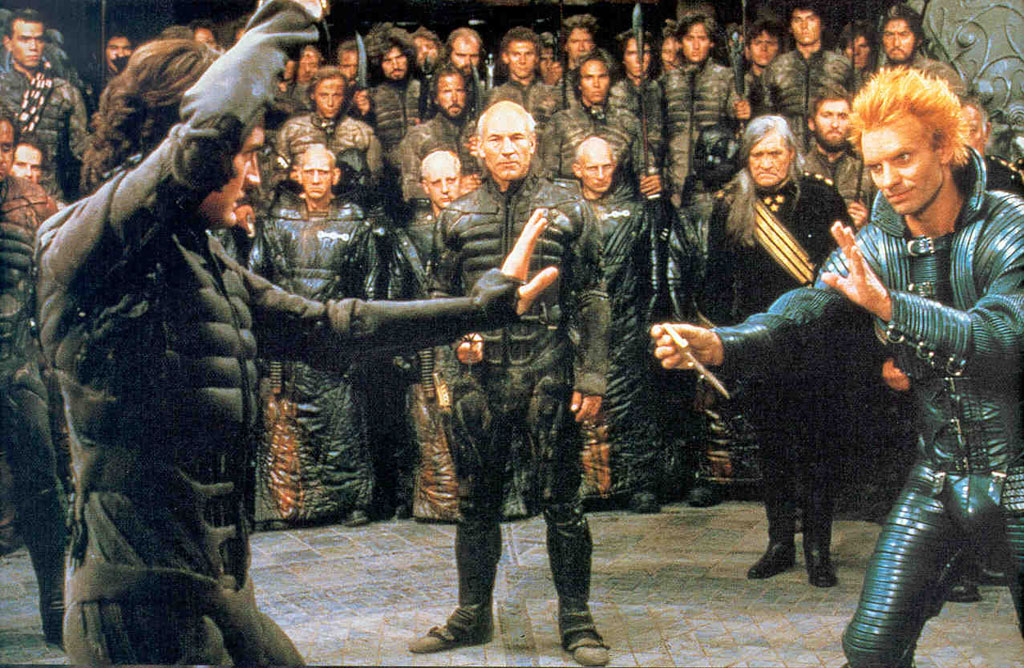
Since I mentioned Dune in my post yesterday, guess what movie my VC wanted me to review next? While some of her picks end up being pleasant surprises for me, I’ve seen Dune enough times (thanks to her) that I knew this latest viewing wasn’t about to change my opinion. She loves it; I don’t, and neither of us are alone. David Lynch’s long, tiresome adaptation of Frank Herbert’s celebrated sci-fi novel was savaged by critics at the time, but over the years, it’s gained more appreciation, even a cult following. I can understand why it warrants a cult following, but the simple truth remains, it’s not a very good movie.
Perhaps the hardest challenge facing Lynch as director and screenwriter was somehow compressing Herbert’s enormous otherworldly tale into a feature-length film. The story has so many characters, foreign names and gadgets, and plot-specific terminology that it’s no wonder casual viewers were thoroughly lost. Luckily, my VC has read the book, which I’m sure helps her, and I’ve seen the film enough times that I can follow what’s going on well enough. However, it’s hard to ignore the fact that the first 20 or 30 minutes is spent with different characters taking turns to spout exposition. Before the story even begins in earnest, we have to learn about the four key planets and their rulers, and the drug-like Spice that enables space travel and is only found on Arrakis/Dune, and the subterfuge of the emperor (José Ferrer) in pitting the houses of Atreides and Harkonnen against each other, and the telepathic Bene Gesserit sisterhood that has breeding rules broken by Duke Leto Atreides’ concubine (Francesca Annis) in order to give her love a son named Paul (Kyle MacLachlan), who may have a dangerous messianic destiny. You got all that? Well, I guarantee that it’s easier reading it than listening to it all in one go, which is probably why Herbert’s book was so much more popular than Lynch’s film.
The 137-minute film is so packed with plot that there’s literally no time for character building. Every character is formed solely by how they’re explained to us and what they do to further the plot. When Paul meets a lovely Fremen girl (Sean Young) after he’s been banished to the desert, you know they’ll end up together, not because of their chemistry or anything, but because Paul had visions of her and it makes sense for the plot. There are smaller quibbles too, whether it be the constant internal monologuing, the bizarre intentions of a traitor in the Atreides house, or the casting of an important character from the books only to kill him off in a trice, not to mention the strange and disgusting Harkonnen villains and the sudden ending.
Wow, sometimes I convince myself to like a film more by writing about all its strengths, but I think the opposite has happened here. I don’t hate Dune by any means, nor am I sorry to have seen it since it is not without some redeeming factors. True, most of the actors are in “serious sci-fi mode,” but it was enjoyable to see so many familiar faces before their more recognizable roles, which were often still in the realm of science fiction. There are Patrick Stewart (Star Trek: The Next Generation), Dean Stockwell (Quantum Leap), Brad Dourif (Voyager and Lord of the Rings), Jürgen Prochnow (Air Force One), Max von Sydow (Dreamscape, Flash Gordon), and even Sting (yes, the singer), among many others. Plus, I must commend Lynch and his set design team for bringing these extraterrestrial deserts and palaces to life. Even if some of the effects are still dated, the giant worms are admittedly impressive too, especially when backed by the symphonic rock score supplied by the band Toto.
As much as I wish I could count Dune among my favorites, its negatives are just too conspicuous to overlook. Even I will concede, though, that it was a valiant effort for all those involved, one which my VC and other fans clearly appreciate more than most.
Best line: (Duke Leto Atreides) “I’ll miss the sea, but a person needs new experiences. They jar something deep inside, allowing him to grow. Without change, something sleeps inside us and seldom awakens. The sleeper must awaken.”
Tomorrow, tomorrow,
With no time to borrow,
The future may very well sink into sorrow.
It’s hard to predict
When our views contradict,
And the fears that some carry are dreams others picked.
The future is ever
In danger; however,
We mustn’t believe it’s a futile endeavor.
Are trends that we set then
The kind we’ll regret? Then,
It’s clear dark tomorrows will come…if we let them.
____________________
MPAA rating: PG
What happens when everyone says a movie is bad and you like it anyway? Every review I read of Tomorrowland painted it as an unwieldy flop in which every positive element was spoiled by a negative. Thus, I skipped it, preferring to spend my 130 minutes on something more critically favored. Yet, when I finally gave it a chance, Tomorrowland proved to be a highly enjoyable ride, a sci-fi wonder in which every negative had a positive to mostly redeem it, at least in my opinion.
Beginning at the 1964 New York World’s Fair, young Frank Walker presents David Nix (Hugh Laurie) with a homemade jet pack that isn’t quite fully functional, and Nix’s girl companion Athena (Raffey Cassidy) is impressed enough to invite Frank to the titular technology wonderland. Cut then to teenage Casey Newton (Britt Robertson), who goes out of her way to keep alive the hopes of the Space Age by prolonging her engineer dad’s NASA contract through sabotage. She’s an incorrigible optimist, unwilling to bend to the downbeat world, and when Athena appears again to give her a mysterious pin and a glimpse of Tomorrowland, Casey is eager to pursue it. Joining with a bitter, grown-up Frank (George Clooney), they embark on a thrilling chase to reach the other-dimensional utopia where all does not seem to be well.
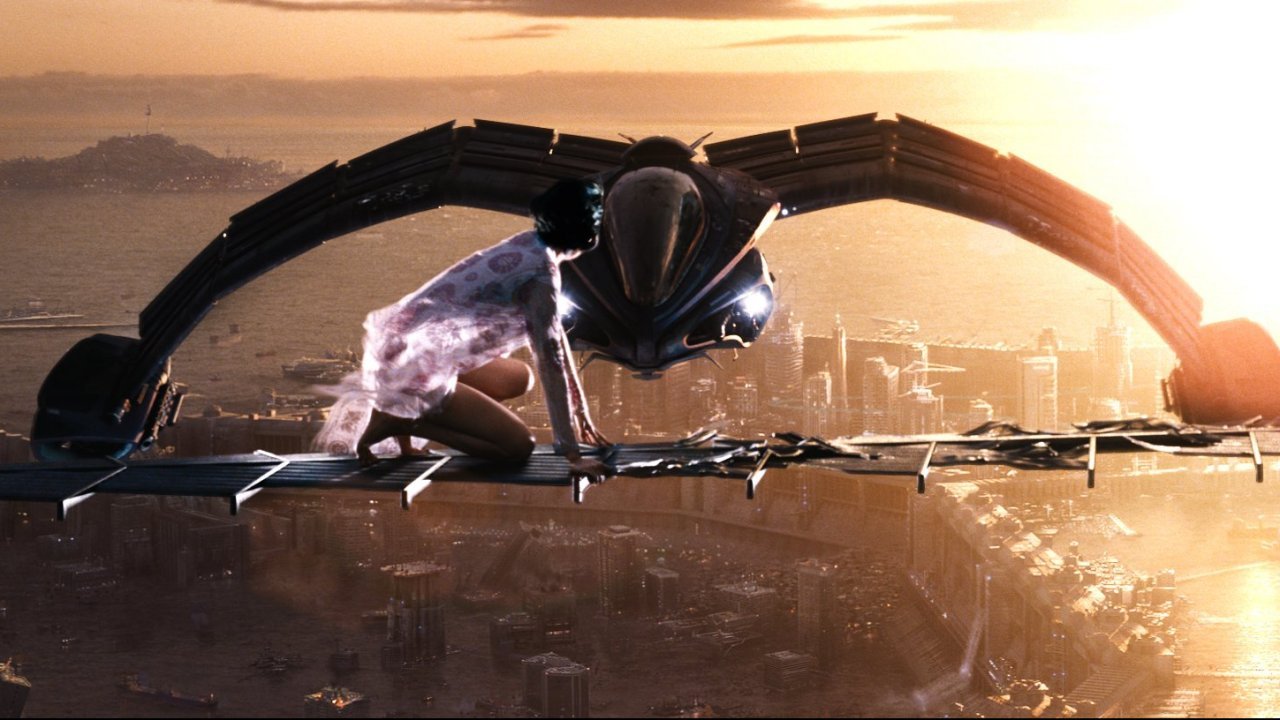
I’ll focus first on everything Tomorrowland has going for it. All the actors excel, especially Raffey Cassidy who shines in a wise-beyond-her-years type of role. As a director, Brad Bird also knows how to direct a visually exciting film. With its jetpacks, robots, and floating swimming pools, the striking metropolis of Tomorrowland that appears whenever Casey touches the pin has wonders tailored to both 1960s and present-day tastes. In addition, many aspects of the film feel inspired by the intrigue of Men in Black, incorporating imaginative gadgets, geeky thrills, and futuristic plot devices hidden in plain sight. With all the killer android chases and high-tech detours, it’s easy to let the plot carry you along and ignore the fact that it’s not really going anywhere worthwhile. By the time we see Tomorrowland itself, it feels like a hollow piece of false advertising, though that does make sense for the plot. I do wish that we were able to see Tomorrowland the city as more than just an unreached potential, but it’s a case of the journey overshadowing the destination, with the journey being pretty entertaining.
I see what others have criticized about the uneven plot, the disappointing goal, and the borderline creepy relationship between Clooney and 12-year-old Raffey Cassidy, and they’re not wrong. But Tomorrowland is a prime example of a film that depends on how much the viewer is willing to let such faults bother them. While the two films are nowhere near the same league, I could point to 2012’sLes Miserables as another such film; half of viewers complained about the singing of Hugh Jackman and Russell Crowe and couldn’t take the constant singing seriously, while the other half (me included) were captivated by the film’s emotional and musical power. I can’t say those of the other opinion are wrong; their objections just didn’t ruin the film for me. Sometimes, if the majority of a film delights, a half-baked ending can be forgiven. And the objection about Clooney and Cassidy depends entirely on the strength of your suspension of disbelief; based on Athena’s character as written, it doesn’t have to be creepy.
What Tomorrowland tries to be is an antidote to the constant stream of dystopian fiction in our media. Zombie outbreaks, totalitarian governments, natural disasters—it seems that Star Trek is the only proposed future that is actually worth looking forward to. Tomorrowland takes that fatalism literally and suggests that such warnings are more harmful than good if no one heeds them, a cautious lesson worth more than a casual thought. Perhaps, the film insists, optimism itself can change the world for the better. Yes, it sounds corny, going overboard in the soapy commercial-like final scene, but if the constant pessimism of grim social commentaries can captivate audiences, can’t the polar opposite have its day too? I recognize the flaws of Tomorrowland, not least of which are smacks of elitism in the recruiting of the best and brightest to populate a separated utopia that doesn’t seem to directly better the world at large, but it appeals to the dreamer, the hoper, and the lover of sci-fi adventure. That’s good enough for me.
Best line: (Casey) “There are two wolves, and they are always fighting. One is darkness and despair. The other is light and hope. Which wolf wins?”
(her dad) “Come on, Casey.”
(Casey) “Okay, fine. Don’t answer.”
(dad) “Whichever one you feed.”


















 Rhyme and Reason