• Home
  • About Me
  • The List
  • THE LIST (2016 Update)
  • THE LIST (2017 Update)
  • THE LIST (2018 Update)
  • THE LIST (2019 Update)
  • THE LIST (2020 Update)
  • THE LIST (2021 Update)
  • THE LIST (2022 Update)
  • Top Twelves and More
  • The End Credits Song Hall of Fame

Rhyme and Reason

~ Poetry Meets Film Reviews

Rhyme and Reason

Tag Archives: Romance

Cartoon Comparisons: Upside Down (2012) / Patema Inverted (2014)

15 Thursday Sep 2016

Posted by sgliput in Movies, Poetry, Reviews, Writing

≈ 2 Comments

Tags

Animation, Anime, Cartoon Comparisons, Drama, Romance, Sci-fi

Image result for upside down 2012 film

Image result for patema inverted


Right-side up is upside down
To those who smile when they frown,
To those who plunge whene’er they jump
Or rise when tripping on a bump
Or gobble down and up their meals
And sink a little in high heels,
To those who elevate a bit
If they lean over, kneel, or sit,
To those who set a precedent
When they descend on their ascent.
Up and down can be subjective.
‘Tis a matter of perspective.
____________________

MPAA rating for Upside Down: PG-13
MPAA rating for Patema Inverted: should be PG

For the next Cartoon Comparison, I’ve chosen two science fiction films with wildly imaginative concepts that happen to be suspiciously similar. Both the live-action Upside Down from Canada and the anime Patema Inverted from Japan feature the idea of opposite gravities: people walking on the ceilings, objects falling up, and the unlikelihood of two oppositely oriented young people overcoming the hatred of their politically hostile worlds. What differs is the way their worlds interact and the pseudo-scientific “explanation” for the curious gravitational situation.

Upside Down came first so if there was any copying being done, the live-action film can claim to be the original. Here, as explained by the narration of Adam (Jim Sturgess), two planets orbit each other so closely that there is essentially no sky. Looking up from either world, one simply sees the other planet’s surface, about as far away as a skyscraper, echoing perhaps the folding city street in Inception. One planet is considered Up Top, full of wealth and societal power, while the other is the economically exploited Down Below, though there’s no telling how they were named, considering the potential confusion of “up” and “down.” Luckily, the extraordinary visuals elevate the film’s none-too-subtle class struggle. Even if there were moments that I wasn’t sure what I was seeing at first, the remarkable effects were a marvel to the eye.

Image result for upside down 2012 film

As for the love story, Adam from Down Below happens to meet Eden (Kirsten Dunst) from Up Top, and they share remote romantic rendezvous in the mountains until the government breaks them apart. Years later, as Adam experiments with a practical anti-gravity serum, he seizes a chance to see Eden again at Transworld, the tower-like corporate bridge between the two worlds. The two leads certainly have chemistry, but due to a certain plot point, they don’t get to take much advantage of it, and Sturgess’s behavior can be awkward at times.

Yet Adam’s quest to reunite with Eden without being caught by the authorities leads to a good deal of inventiveness, such as his attempt to weigh himself “up” and pose as a citizen of Up Top. Unfortunately, logic gets in the way at times, including the film’s own invented gravitational rules. For instance, Adam never seems to have a problem with the blood flowing to his head when upside down. Wouldn’t that be both uncomfortable and a possible give-away to anyone who might notice? In addition, one of the planetary laws is that matter from opposite worlds eventually burns, but the time it takes for this to happen seems inconsistent. By film’s end, the conclusion is peculiarly rushed, offering a blanket resolution to crucial issues it couldn’t hope to address and doesn’t try. Upside Down is brilliant in concept, less so in execution, but the visuals alone are worth the watch.

Image result for upside down 2012 film adam and eden

Upside Down may have come first, but Patema Inverted utilizes the notion of inverse gravity far better, in my opinion. Perhaps the fantastical image of falling up is simply more credible in animation rather than live-action CGI, but it certainly captured the imagination of director Yasuhiro Yoshiura, who previously directed the compelling series-turned-movie Time of Eve. (I was impressed by both Patema and Time of Eve separately but didn’t realize till afterward that they shared the same director.)

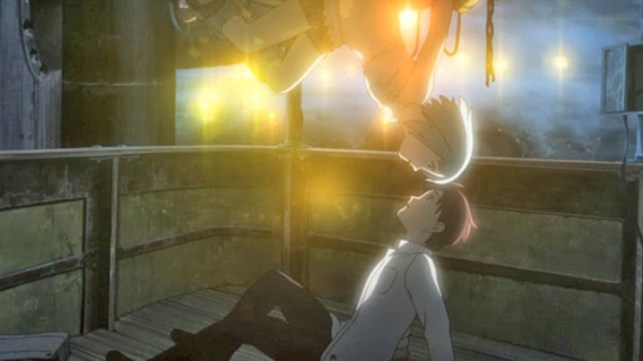
Instead of the up-front exposition of Upside Down, Patema Inverted takes its time to show and develop the gravitational anomalies as the characters discover them. Patema is a girl living in a City of Ember-like underground bunker and seems to be one of the few inhabitants to show an interest in the Forbidden Zone, where dust floats upward and “bat people” are rumored to lurk. After a close encounter, she finds herself dangling from a fence with the sky looming “below” her. Luckily, she is saved by the equally curious surface boy Age, who seems upside down to her. Age lives under a totalitarian dystopian government, whose leader is determined to root out the surviving inverts, who made their way underground after a catastrophic accident sent most of them falling into the sky years ago.

Image result for patema inverted

Upside Down basically lacked any sky; there was only so far someone could fall. Patema Inverted, however, makes the sky an imposing threat, a beautiful but dangerous abyss ready to swallow Patema without Age’s assistance. The animation is frequently dazzling, especially when the point of view shifts to contrast Age’s perspective with Patema’s. As Patema ventures into Age’s world and he ventures into hers, the distinction of up and down becomes fluid. The plot even takes some initially confusing twists that challenge the viewer’s perceptions and require some extra thought to fully comprehend. Some might be befuddled, but I found it fascinating. Plus, the musical score is enchanting and perfectly complements the film, including the gorgeous credits song “Patema Inverse,” which is sung in Esperanto and earns a place in the End Credits Song Hall of Fame. Between this and Time of Eve, I’m definitely hoping that Yoshiura continues to create such intriguing films.

I will admit that Patema Inverted seems to draw some inspiration from Upside Down. The cause of the inverted gravity differs (natural phenomenon vs. manmade disaster), but how the two gravities interact is the same: the lesser weight lightens the gravity of the other. This leads to the couples in both films holding on to each other to prevent the other from falling away, and being able to defy gravity by using each other’s weight. Writing about it doesn’t seem to do it justice, but it’s clever, cool, and undeniably similar in both films. As original as Patema Inverted is, I can’t help but wonder how much inspiration it drew from the earlier film. In addition, Patema is also rather slow in its gradual plot progression, and the villain is stereotypically bad for bad’s sake.

Image result for patema inverted


Despite these minor “down”-sides, Patema Inverted is easily the better film. Upside Down may have brought gravitational sci-fi to life first, but its conventional plot can’t compare with the thought-provoking vision of its animated counterpart.

Best line from Upside Down: (Adam) “Gravity, they say you can’t fight it. Well, I disagree. What if love was stronger than gravity?”

Best line from Patema Inverted: (Age, when holding onto Patema) “I get it! Your weight makes me light.”  (Patema) “Girls don’t like it when you talk like that!”


Rank for Upside Down: List Runner-Up
Rank for Patema Inverted: List-Worthy


© 2016 S. G. Liput
408 Followers and Counting

Paper Towns (2015)

21 Thursday Jul 2016

Posted by sgliput in Movies, Poetry, Reviews, Writing

≈ Leave a comment

Tags

Comedy, Drama, Romance

Image result for paper towns film


A paper town stands as a dot on a map,
The mapmaker’s special distinguishing mark
To make it his own and to fool any sap
Who happens to visit the place on a lark.

You may well have hopes for that fake little dot,
Which only arrival can fully repeal.
When maps are affirmed by a town that is not,
The rest of the dots become all the more real.
_____________________

MPAA rating: PG-13

After John Green’s The Fault in Our Stars was translated into such a successful young-adult film in 2014, the same studio heads apparently hoped that lightning could strike again with a second Green adaptation, this time Paper Towns. Since Paper Towns was written in 2008 without all the hype of Fault in Our Stars, the film version was an understandably lesser release, and mixed reviews didn’t help. And yet…I enjoyed it a lot, perhaps not more than Fault but on something of a more personal level.

After playing Gus’s friend going blind in Fault, Nat Wolff steps up to lead character status as Quentin Jacobsen, or Q, one of those awkward, easily relatable high-schoolers that tend to be YA protagonists. As a kid, he befriended his adventurous neighbor Margo Roth Spiegelman (Cara Delevingne), but as the years passed, he settled into mundane normalcy while she became an ever more reckless local legend. His crush on Margo doesn’t diminish with their lack of contact, though, and when she unexpectedly asks for his assistance on a daring night of revenge, he tags along with sheepish compliance and has one of the best nights of his life. And then she vanishes, apparently to satisfy her wanderlust, but Q finds clues to her whereabouts and feels compelled to follow her.

Paper Towns has identifiable ingredients from other recent YA films, from The Fault in Our Stars (Green’s subtly profound dialogue, an urging to live life to the fullest) to Me and Earl and the Dying Girl (the sex-obsessed friend, the quirky family details). Whereas both of those dealt with the serious issue of cancer, Paper Towns keeps itself lighter, transitioning from enigmatic mystery to memory-making road trip, peppered with endearing character interactions. It was these small moments between the characters that left me with a smile more often than not. Q’s pals Radar and Ben are archetypal buddies, the former a slight nerd with girlfriend anxiety and the latter a swaggering goofball, but their conversations felt realistic and fun, like when they all segue into a Sean Connery accent. I do that myself sometimes! Probably my favorite moment came when a suggestion to sing leads the three to start in on the Pokémon theme song with growing exuberance. I know not everyone is into Pokémon (and I couldn’t care less about the recent Pokémon Go fad), but that original theme song is an ever appealing source of nostalgia for my generation. After all, how many people still remember the words to some show’s opening that they grew up watching? For me anyway, it was a terrific scene.

Despite the enjoyable moments, including a great little cameo, the end of the film’s journey is almost sure to disappoint the audience as much as it does the characters. It’s meant to be disappointing, and yet it still finds an uplifting message through it all. Q’s course seems analogous to that of Tom in (500) Days of Summer, keeping romantic hope alive until reality makes him recognize his target girl is someone not meant to be followed. It’s rather jarring, but the breaking of Q’s obsession helps him to see what he’s been missing and, as cliché as it may seem, to value the journey over the destination.

Paper Towns is by no means perfect or free of annoyances. I was frustrated, for instance, with how not one, but two characters bemoan how others see them when they themselves promote that very image. While the performances in Paper Towns are worthy all around, The Fault in Our Stars is probably the better film, if only for its more sober subject matter. Yet, as I said, I found myself enjoying Paper Towns more than its film predecessor, and since they’re both John Green adaptations, I don’t mind putting them on the same level in my esteem.

Best line: (Q) “What a treacherous thing to believe that a person is more than a person.”


Rank: List-Worthy (tied with The Fault in Our Stars)


© 2016 S. G. Liput
399 Followers and Counting


VC Pick: Waitress (2007)

12 Tuesday Jul 2016

Posted by sgliput in Movies, Poetry, Reviews, Writing

≈ 2 Comments

Tags

Comedy, Drama, Romance, VC Pick

Image result for waitress 2007 film


A pie on a plate is worth two in the sky,
So if your life’s sucking your happiness dry
With an unloving spouse
Or a big lonely house
Or the latest annoyance you greet with a sigh,

Don’t run off and have a clandestine affair,
Not even with someone with Mal Reynolds’ hair.
Just sit yourself down
And flip over that frown
With a big piece of pie to suspend your despair.

‘Tis the good kind of guilt when you pick from the shelf
A pie (if you want; I’m a cake man myself).
__________________

MPAA rating: PG-13

After seeing Waitress recently for the first time, my VC liked it enough that she insisted I review it as one of her picks. Directed, written, and co-starring the late Adrienne Shelly and recently adapted into a Broadway musical, Waitress might have had one main draw at first glance, my VC’s beloved Nathan Fillion, but as we watched it (two nights in a row actually), its overall appeal became more apparent. It’s an unconventional love story full of wry small-town charm and a craveable passion for pie. Seriously, there’s a lot of delicious pies on display, though they make them look far easier to prepare than in reality.

Keri Russell plays Jenna, whose waitress job at a Southern pie diner is one of the only things her cloddish husband Earl (Jeremy Sisto) will let her do. He’s so needy and controlling that Jenna feels positively smothered and eager to leave him, even dreaming up pies named in his dishonor, and thus she’s none too thrilled when she discovers she’s pregnant. On her first prenatal visit to the gynecologist, in comes Nathan Fillion as Dr. Pomatter, certainly no Mal Reynolds (his character from Firefly) but a likably nervous sort, and one can see his awkward chemistry with Jenna a mile away. In a predictable version of this story, there would probably be an affair with passionate smooching and a confrontation between the men and maybe a breakup before a final tearjerking declaration of love, but Waitress only borrows a few such aspects, clinging to cynical honesty before yielding to surprising sweetness. My VC was glad they kept the passionate smooching with Fillion, though.

Films aiming for quirk don’t always come off as realistic. I love the provincial antics in Doc Hollywood, for instance, but it’s full of movie characters rather than people I might expect to find in a real Southern town. Waitress has some of the same earnest loopiness but toned down to believable levels. (Okay, that may not apply to the ridiculously love-struck date of one of Jenna’s coworkers, but hey, it’s still a comedy.) The dialogue often reaches gentle amusement rather than big laughs, not only because of the dramatic side of Jenna’s depressing life but because real life isn’t always full of zingers. Sometimes, eloquence is found in frank simplicity, such as an unexpectedly straight answer about life from Jenna’s surly boss.

Image result for waitress 2007 film

Aside from the underplayed pro-life aspect of Jenna respecting her baby’s “right to thrive” despite not really wanting it, I admired how the characters were gradually developed. Most come off rather unlikable at first, whether it be Jenna’s demanding boss or the diner’s schadenfreude-prone owner Joe (Andy Griffith). Only over time are their more sympathetic facets revealed without undercutting their prickly exteriors. Even Earl with all of his loathsome clinginess shows a few glimpses of affection that could have once convinced Jenna to marry him. In addition, an important scene toward the end speaks to the immediacy of meeting someone face to face. Jenna sees two previously unseen characters for the first time, completely changing her opinions of them and the direction of her life. While what follows isn’t the fairy tale ending that one might hope or expect, it’s sweetly realistic and mature on Jenna’s part.

By the end of Waitress, my VC and I weren’t quite sure how to feel about it, but after thought, a rewatch, and some craving for pie, we both agreed in the simplest of terms: we liked it. (Did I mention, though, that she loved watching Nathan Fillion? Women.)

Best line: (Dawn, played by Shelly, speaking of her awkward beau) “They are poems that just occur to him on the spot. Last night, he said to me, ‘Dawn, your face is a brilliant moon in my empty room. Your love is like a beating drum. Ba bum ba bum ba bum ba bum.’”

VC’s best line: (Jenna, writing to her unborn baby) “Dear Baby, I hope someday somebody wants to hold you for twenty minutes straight, and that’s all they do. They don’t pull away. They don’t look at your face. They don’t try to kiss you. All they do is wrap you up in their arms and hold on tight, without an ounce of selfishness to it.”


Rank: List Runner-Up


© 2016 S. G. Liput
394 Followers and Counting


VC Pick: Music and Lyrics (2007)

15 Wednesday Jun 2016

Posted by sgliput in Movies, Poetry, Reviews, Writing

≈ Leave a comment

Tags

Comedy, Musical, Romance


Music alone can be grand in all kinds,
For banging of heads or relaxing of minds,
And lyrics alone, whether plain or highbrow,
Can be poetry, like what you’re reading now.

But lyrics can caper and dance with the notes
When coupled and wed by the truest of throats,
And music can whisk up the words in its pull
And render fair splendor from mere doggerel.

Just one by itself could exist happily
Alone, on its own, not unlike you and me.
But if they can merge as a unified song,
We still will be humming it all our life long.
_______________

MPAA rating: PG-13

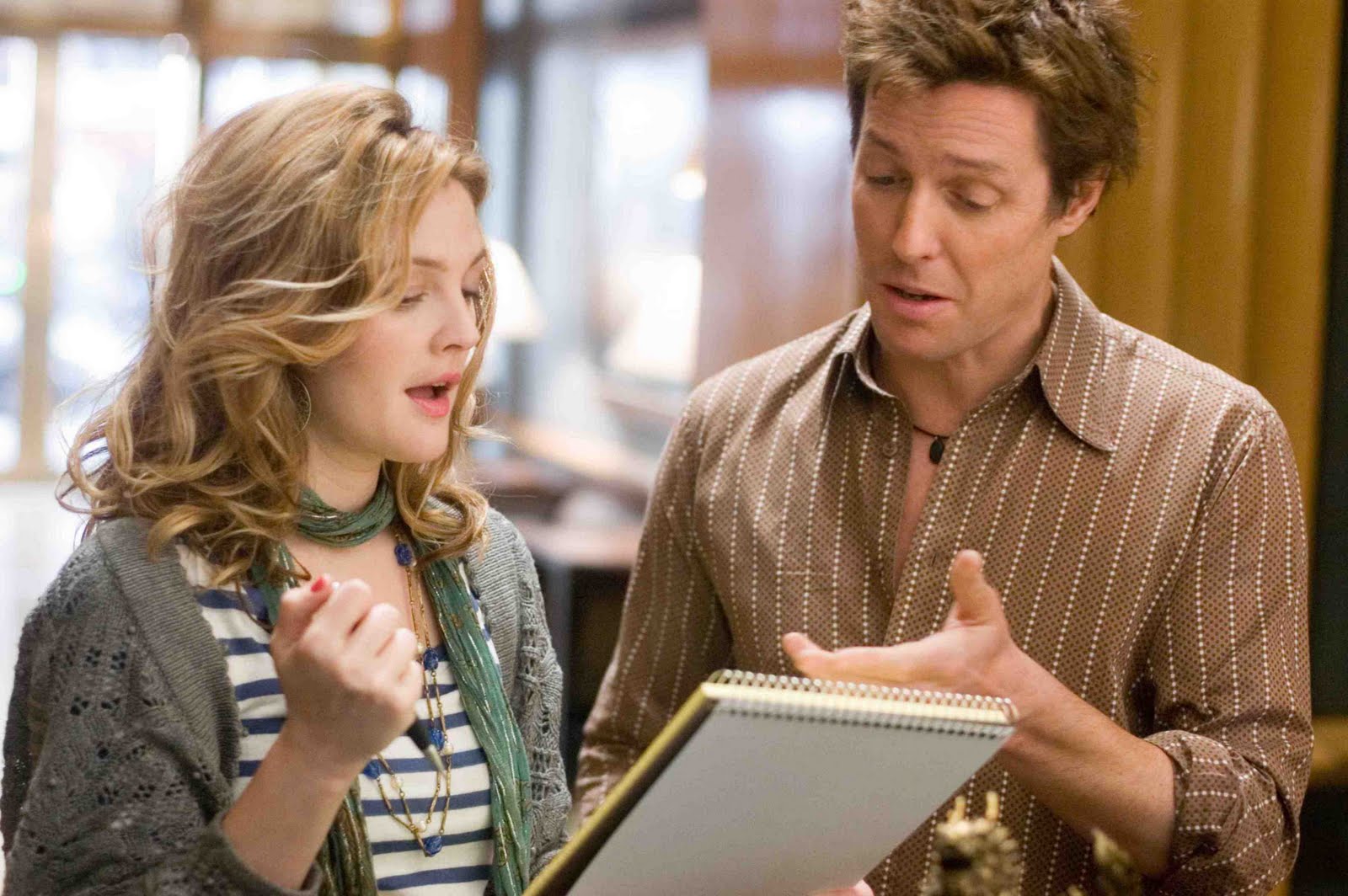
I love a good rom-com, and there aren’t nearly as many as I’d like that could actually be described as good. So many fall flat, whether because they’re more crude than romantic or because they’re just not funny, and their success always hinges on two key ingredients: chemistry and the script. One without the other leaves the film wanting, but when both are present, it’s magic, like the blissful merging of words and music. For me, When Harry Met Sally… and You’ve Got Mail rule the genre, but Music and Lyrics takes a comfortable spot not too far beneath them, thanks to (you guessed it) the script and its two leads (Hugh Grant and Drew Barrymore).

Alex Fletcher (Grant), formerly of the popular ‘80s band PoP!, is content to coast on his past fame, a “happy has-been” whose career consists mainly of state fairs and throwback nights. When his manager (a welcome Brad Garrett of Everybody Loves Raymond) urges him to salvage his career by writing a song for megadiva Cora Corman (Haley Bennett), he grudgingly agrees to the music but needs a lyricist. Enter Sophie Fisher (Barrymore), a mousy substitute plant waterer, who accidentally lets her talent for lyrics show and is drafted to assist Alex in writing a hit song.

As far as the plot is concerned, Music and Lyrics is wholly predictable, with Alex and Sophie’s relationship budding and rollercoastering exactly as you’d expect in such a film. Alex has confidence issues and an ego; Sophie has a painful past romance. They need each other professionally and then on a deeper level. It’s all stuff we’ve seen before, but what could easily be written off as clichéd is enlivened by amusing character quirks, some surprisingly catchy tunes, and clever dialogue that ensures frequent chuckles. Grant’s dry wit mixes well with Sophie’s slight neurosis, and rare chemistry is the result.

In addition, many modern romances manage to turn me off with some kind of boundary-pushing crudity, but Music and Lyrics is a pretty clean affair. While Cora delights in her “steamy and sticky” dance routines, she actually serves as a reminder of how a lot of modern music has degraded from Alex’s good ol’ days of the ‘80s and acts somewhat as a critique of overly sexualized pop stars with fans far too young for their on-stage gyrations. Heck, Katy Perry’s “Dark Horse” sounds exactly like something Cora Corman would sing. Ugh. (Not to offend Katy Perry fans; I do love “Wide Awake.”)

I’d rather have PoP’s “Pop Goes My Heart” any day; played at the beginning and end, this little earworm perfectly recreates the cheesy charm of ‘80s pop, and though Alex himself derides it as “dessert,” the song and film alike are my kind of dessert. I convinced my VC to watch Music and Lyrics after a rough day at work when she was in the mood for some undemanding fluff, and she ended up enjoying it even more than I, even insisting I review it as a VC pick. Sure, it’s not the most original of rom-coms, but when clichés are done this well, it doesn’t detract from the entertainment one bit.

Best line: (Sophie’s sister Rhonda, calling to her kids in the bedroom) “Okay, okay, everybody goes to bed. I’m sending your father in there.”
(one of the kids, giggling) “Whoa, we’re so scared!”
(Rhonda) “And then I’m coming in!”
[giggling immediately stops]
(Rhonda’s husband) “I’ll just go check to make sure they’re still breathing.”

VC’s best line: (Sophie) “How was the movie?”
(Rhonda’s husband) “I enjoyed it.”
(Rhonda) “He fell asleep.”
(her husband) “I enjoy sleeping.”


Rank: List-Worthy


© 2016 S. G. Liput

388 Followers and Counting


Love Story (1970)

28 Thursday Apr 2016

Posted by sgliput in Movies, NaPoWriMo, Poetry, Reviews, Writing

≈ 2 Comments

Tags

Drama, Romance


(Today’s NaPoWriMo prompt was to write a story told in reverse, so I chose a film that begins with its famously tragic end.)


No one expected a young wife to die.
The shock of injustice preceded the tears.
Her husband’s bereft
At the hole that she left
In their fleeting but passionate years.

No one expected, when they found success,
And scraping at pennies at last found reward.
Their happiness shone
At what they called their own
Before happiness fell on its sword.

No one expected, when poverty galled
And left them with little but love to sustain.
Their family fund
Had been purposely shunned
For unstable financial terrain.

No one expected, when vows were exchanged,
And hopes for the future loomed higher than fears.
Parental objections
Swayed not their affections,
Romantic and rash pioneers.

No one expected, when sweethearts were paired
In college, where many a romance is born.
They teased and poked fun
Till true love had begun
And devotion had discarded scorn.

No one expected a young wife would die
When she and her unlikely husband first met.
Yet if they had read
Of the heartaches ahead,
I know from love’s source
They’d have sailed the same course,
A course neither of them would regret.
___________________

MPAA rating: PG (probably should be PG-13 for the language)

Decades before John Green’s The Fault in Our Stars captured people’s hearts and minds with its intelligent but doomed romance, Love Story did the same thing for the children of the ‘70s, first as a book, then as a 1970 film. With two appealing leads in Ali McGraw and Ryan O’Neal and an Oscar-winning Francis Lai score that brings tears to my VC’s eyes, Love Story is considered one of the great romantic movies.

That distinction is accompanied by a reputation for sappiness, and somehow I expected to be more amused than moved by the melodrama. Love Story exceeded my expectations in that regard, thanks in large part to the sardonic banter between young Oliver Barrett IV (O’Neal) and Jenny Cavalleri (McGraw) as their initial love/hate relationship quickly drops the hate part. The chemistry is both obvious from the start and confirmed gradually until Oliver dismisses assumptions of a temporary affair and proposes marriage. Their bond is further proven by Oliver’s dismissal of his wealthy father’s objections, despite the loss of his financial support. Of course, living on love alone is nobly impractical, but watching the couple support each other just heightens the romance further.

And then she dies…. That’s not really a spoiler since the very first line and scene reveal it, but it still comes as a devastating tragedy after all that came before. The mawkish sentimentality that I was expecting is kept to a minimum, mainly during the pristine hospital scenes in which McGraw doesn’t look particularly ill and the most famous line: “Love means never having to say you’re sorry.” That quote is the main reason I expected silly schmaltz, since it’s both mystifying and utterly untrue. Having seen What’s Up, Doc? first, I always follow up that line with O’Neal’s comedic answer from 1972: “That’s the dumbest thing I’ve ever heard.”

Since I now know that Love Story is actually a good movie, I suppose the main question is how it compares with its spiritual successors like The Fault in Our Stars. In this case, I definitely side with Fault in Our Stars, mainly because of a key fault in Love Story. My VC saw it long before I did and has told me that her main sticking point was the modern, areligious beliefs of the characters; my complaint is the same. The stated lack of belief in God only illustrates atheistic emptiness since the closing scenes end with no comfort or hope. She dies; it’s depressing. The end. At least The Fault in Our Stars leaves open the possibility of God and heaven, thanks to the optimism of Augustus Waters, and though the ending is equally heartbreaking, the one who died has extended meaning into the life of the one left behind. Love Story is tragic, and that’s it. Perhaps the poorly received sequel Oliver’s Story was meant to compensate for this weakness. Despite said flaw, the bulk of Love Story still provides a perfect dose of chick flick romance that can make women sob and men perhaps discreetly wipe a tear away.

Best line: (Oliver) “You know, Jenny, you’re not that great looking.”   (Jenny) “I know. But can I help it if you think so?”


Rank: List Runner-Up


© 2016 S. G. Liput

384 Followers and Counting


Austenland (2013)

24 Sunday Apr 2016

Posted by sgliput in Movies, NaPoWriMo, Poetry, Reviews, Writing

≈ 12 Comments

Tags

Comedy, Romance


(Today’s NaPoWriMo prompt was to combine highfalutin language with unpoetic words, so I reviewed a film that mixed 19th-century and modern comedy.)


When life gets infelicitously boring or abhorrent,
One may become a little smitten
With the literature of Britain,
Perchance a smidgen more besotted than one’s misadventures warrant.

For those who hate ornate oration,
I’ll provide a rough translation:

When life goes down the toilet, some folks get more stupid and obsess
With either lunar landing theories
Or some British mini-series,
Forgetting that the times ahead of indoor plumbing were a mess.
__________________

MPAA rating: PG-13

I’m not much of a Jane Austen fan, but many are. There are fans and then there are fans on the level of those in Austenland, where people obsessed with Regency-era manners and Mr. Darcy can live out their corset-wearing, side-saddle-riding, man-in-need-of-a-wife dreams. Keri Russell plays starry-eyed Jane Hayes, whose apartment is decked out in Austen paraphernalia, including a life-size cardboard cutout of Colin Firth as Mr. Darcy in BBC’s 1995 Pride and Prejudice mini-series. (My mom and grandmother always had a soft spot for Firth because of that very role.) Being such a fan, she expends her limited resources to travel to her Jane Austen paradise, only to find it’s not quite as perfect as she had hoped.

Austenland has its strengths, but its weaknesses are much more noticeable. Jennifer Coolidge is dreadfully obnoxious as Jane’s fellow attendee Miss Charming, whose wealth compensates for her behavior and earns her far more attention than the lower-tier Jane. Likewise, Georgia King as the other visitor to Austenland is so effusively melodramatic that she seems to be acting more than the Austenland employees.

It is these employees that catch Jane’s eye since her Austenland experience is meant to end with “true love.” JJ Feild is the Mr. Darcy of the bunch, treating everything with equal disdain, while Bret McKenzie (Figwit from Return of the King, if you can believe it, and there’s a joke for that) is the handsome, down-to-earth handyman. Neither seems fully part of the theme park charade, and Jane can’t be entirely sure where the masquerade ends and “real” love begins.

Austenland is a mixed bag of a rom-com. Russell, the men, and Jane Seymour as Austenland’s snobbish owner are quite decent, but the other females range from amusing to annoying, especially when combined in an awkward “performance” toward the end. As inelegant as it gets at times, Russell and the ending are winsome enough to be worthwhile, and big Jane Austen fans, such as producer Stephanie Meyer, will probably enjoy the film’s Janeite appeal.

Best line: (Miss Charming, offering encouragement after Jane has been slighted) “Besides, you’ll feel totally different tomorrow. Think about all the people in the world that hang themselves. And then, the next day, they feel different, but there’s nothing they can do about it. Don’t hang yourself, Jane.”


Rank: Honorable Mention


© 2016 S. G. Liput

383 Followers and Counting


How to Make an American Quilt (1995)

19 Tuesday Apr 2016

Posted by sgliput in Movies, NaPoWriMo, Poetry, Reviews, Writing

≈ 7 Comments

Tags

Drama, Romance


(Today’s NaPoWriMo prompt was for a didactic “how to” poem, and I just so happened to have the perfect film in mind.)

How does one make an American quilt?
How is a life or a good marriage built?
Not from one cloth but from many combined:
It’s fashioned from stories, gold thread of mankind,
From tales and details
And the blazing of trails,
From losses and crosses
And dead albatrosses
And windmills at which many tilt.

Gather the patches that everyone gives,
The plugs for the holes in our memories’ sieves,
And just as our fortunes are linked to our neighbors’,
Sew up the loose swatches of everyone’s labors.
Recall passion’s thrall,
Both its rise and its fall.
Every weakness or peak
Of which few live to speak.
Love, guilt and tears spilt
Make a worthwhile quilt
That warns us and warms us and lives.
__________________

MPAA rating: PG-13

Marriage is a tough business. Not that I have personal experience with it, but there are enough soured romances in books, films, and personal accounts that it’s clearly not easy. Falling in love is simple; it’s what comes after that’s hard. Such is the main lesson of How to Make an American Quilt, a female ensemble about an engaged woman named Finn (Winona Ryder) who has second thoughts about marriage after hearing the various stories of the women in her grandmother’s quilting bee.

This is undoubtedly a chick flick, with everything coming from the women’s perspective. The accounts of their past loves are rather varied, ranging from one-night stands, impulsive affairs, disappointing married lives, and unfulfilled dreams, most of which casts marriage and particularly husbands in an unavoidably depressing light. Finn has trouble with commitment in her academic life, and hearing all these tales of woe is the last thing she should be doing on the eve of marriage. It’s no surprise then that her engagement is endangered.

It’s not all bad. The acting is consistently good, particularly from old pros like Anne Bancroft, Ellen Burstyn, Jean Simmons, and Alfre Woodard, and I was surprised at some small roles for Jared Leto, Claire Danes, and Mykelti Williamson. While their individual stories are full of repeated disillusionment, little details become more significant as these stories do indeed weave themselves into a tapestry or quilt of life, from which different meanings may be drawn. Thus, How to Make an American Quilt seems to endorse hope and a willingness to try for success, even though the idea of marriage itself doesn’t quite recover from all the disillusionment that came before.

P.S. To be honest, the main reason I found this worth watching was Winona Ryder. I never realized just how gorgeous she was, based on the roles I’ve seen of hers, like Beetlejuice. Here, she’s like a cross between Kate Winslet in Titanic and Shailene Woodley in The Fault in Our Stars. I can’t help but feel I have a new screen crush.

Best line: (Finn) “Young lovers seek perfection. Old lovers learn the art of sewing shreds together and of seeing beauty in a multiplicity of patches.”


Rank: List Runner-Up


© 2016 S. G. Liput

382 Followers and Counting


VC Pick: The Ghost and Mrs. Muir (1947)

17 Sunday Apr 2016

Posted by sgliput in Movies, NaPoWriMo, Poetry, Reviews, Writing

≈ 14 Comments

Tags

Classics, Drama, Fantasy, Romance


(Today’s NaPoWriMo prompt suggested using at least ten words from a specialty dictionary. In honor of Rex Harrison’s ghostly captain, I chose nautical terms, many of which were used in the film.)


A seaman in the truest sense is ne’er content on land,
And I have lived a life of which a captain may be proud:
Kept my ship in Bristol fashion,
Kept my crew content with rations,
Kept alert for mares’ tails warning tempests to withstand.
Yet now I wish, my beard more ashen,
That I’d found a second passion,
Plucking me a darling from the vast landlubber crowd.

I don’t mean some brief harbor love, although I’ve had a few;
I mean the kind worth waiting for through months before the mast.
I’d hoist the anchor eagerly
To reunite with such as she
And boast from stern to scuttlebutt to share a love so true.
The ship may list from weather to lee
And on her beam ends she may be,
But I’d have stronger cause to live and hold the tiller fast.

A lover in the truest sense is ne’er content at sea
But charts and stays the swiftest course from ocean unto wife.
When in the offing I appeared,
She’d stand upon a headland, cheered
And counting seconds till we both could reach the nearest quay.
I wish in such a course I’d steered
Before grey crept into my beard,
But maybe love can find a seaman even after life.
________________

MPAA rating: Not Rated (might as well be G)

It’s been a while since my trusty Viewing Companion (a.k.a. VC) got to choose a movie, and The Ghost and Mrs. Muir is one of her favorite romances. I’ve seen it a few times before, and for some reason, its full appeal never hit me until this latest viewing.

Gene Tierney plays the widowed Mrs. Lucy Muir, who moves with her daughter (Natalie Wood) and maid (Edna Best) to a large house by the English seaside, which she comes to realize is haunted by the deceased Captain Gregg (Rex Harrison). After a halfhearted attempt to scare her off, Gregg admires her spunk enough to let her stay, and the two of them allow their testily heartfelt conversations to bloom into unadmitted love. The captain’s blustery manner complements Mrs. Muir’s obstinance, and while she cares for the house they both love, he acts as her friend, security system, and inspiration to write a money-making memoir. Of course, romance can be strained between flesh and blood and spirit, and their relationship is soon threatened by the suavely courting Miles Fairley (George Sanders, known as the deep voice of Shere Khan in 1967’s The Jungle Book), who might be more seductive if he didn’t have a creepy disregard for personal space.

Both Tierney and Harrison are at the top of their games here, with Harrison in particular exceeding all but his My Fair Lady role in bringing to life the gruffly affectionate captain (whose coarse sailor language never extends beyond “blasted”). One scene in which he remains invisible to Lucy’s unwelcome in-laws seems to anticipate the similar dynamic between Sam and the holographic Al in Quantum Leap, while the tear-jerking final scenes match the best romantic endings. I also find it interesting to note that The Ghost and Mrs. Muir was turned into a 1968 sitcom, in which the ghost was played by Edward Mulhare, who also took over Harrison’s role of Professor Henry Higgins in My Fair Lady on Broadway.

Sometimes it takes several viewings to help one fully appreciate a film, and The Ghost and Mrs. Muir deserves such appreciation and its 100% Rotten Tomatoes score. It’s a well-scripted, non-physical romance of the best kind, managing to be mildly spooky, delightfully charming, or tenderly bittersweet when it needs to be. It may not make my VC cry anymore, but it arouses the same emotions (minus the tears) in both of us.

Best line: (Lucy Muir) “You can be much more alone with other people than you are by yourself, even if it’s people you love.”


Rank: List-Worthy


© 2016 S. G. Liput

381 Followers and Counting


The Curse of the Jade Scorpion (2001)

13 Wednesday Apr 2016

Posted by sgliput in Movies, NaPoWriMo, Poetry, Reviews, Writing

≈ 6 Comments

Tags

Comedy, Mystery, Romance


(Today’s NaPoWriMo prompt was to draw inspiration from a fortune cookie. The best fortune I’ve seen was, “Sorry, wrong cookie.” Instead, though, I chose my movie and poem based on one that said, “Don’t expect romantic attachments to be strictly logical or rational!”.)


That woman they just hired
Makes me wish I could get fired,
And what’s worse she has authority to do it.
Whatever hospital conferred her
On this world so ripe for murder,
I’ve a mind to find the big behind and sue it.

Her sarcasm is offending,
And she’s always condescending
And expects me to stay silent as a mime.
She’s an ever-present itch;
Her heart and soul are black as pitch;
And she’s other unattractive words that rhyme.

She’s conceited; she’s annoying,
And I know that she’s enjoying
Every day that brings me close to suicide.
But to see if I can win her,
I’ll be taking her to dinner
In the hopes that I can put all that aside.
__________________

MPAA rating: PG-13

I don’t have much experience with Woody Allen’s films. I’ve only seen Midnight in Paris, which I rather liked, and Hannah and Her Sisters, which I really don’t remember, but those whose opinions I trust often write him off as a sex-obsessed dirty old man. Of course, even sex-obsessed dirty old men can make good movies, and The Curse of the Jade Scorpion is a good example.

Allen plays C.W., a 1940s investigator for an insurance company who butts heads with the new efficiency expert Betty Ann (Helen Hunt), secretly in the middle of an affair with their boss (Dan Aykroyd). The two of them have a textbook case of anti-chemistry: everything about each of them gets under the other’s skin, and they both revel in colorful insults and behind-the-back complaints. Their coworkers love the irony when C.W. and Betty Ann are hypnotized by a magician into believing they are in love, but when that same magician (David Ogden Stiers) uses their trances to turn them into thieves, how can anyone discover the truth?

Allen himself considers this one of his worst films, but except for one key aspect, I can’t see why. The insults and innuendo are sharp and clever without ever crossing the line into distasteful, and the mystery is consistently amusing. The one less-than-ideal element is Allen as the lead, with which the director was himself dissatisfied. A younger and more appealing actor as C.W. would have been more likable and would have made the development of C.W. and Betty Ann’s relationship a bit more believable.

Toward the end, the film threatens to go in a manipulative direction, but rights itself with romantic aplomb, showing that Allen knew what he was doing as the screenwriter. As it is, The Curse of the Jade Scorpion still succeeds on the strength of its dialogue and warmly nostalgic period setting, but I’d love to have seen Tom Hanks in the lead. (A Cast Away reunion with Hunt! I can see it.)

Best line: (C.W.) “The house is messy. If I knew you were coming, I’d have rearranged the dirt.”

Other best line: (Laura Kensington, a socialite) “You have a fresh mouth. I don’t think I like it.”   (C.W.) “I tend to grow on people. We could meet later, and I could grow on you.”


Rank: List Runner-Up


© 2016 S. G. Liput

380 Followers and Counting


Dead Men Don’t Wear Plaid (1982)

10 Sunday Apr 2016

Posted by sgliput in Movies, NaPoWriMo, Poetry, Reviews, Writing

≈ 1 Comment

Tags

Comedy, Romance


(Today’s NaPoWriMo prompt was for a “book spine” poem made up of book titles. In this case, I strung together movie titles, which are underlined, with the perfect movie for this kind of composite idea.)


This gun for hire, Rigby Reardon knows indeed the facts of life,
That little women seeking justice bring a touch of class and strife.
In the bedroom, on the town, and everywhere pulp fiction goes,
The cheap detective gets his man, although how only heaven knows.

One time, his dangerous liaisons, full of dark secrets & lies,
Brought a new fatal attraction, sure to tempt the other guys.
The mission stuck, but was her father missing or a saboteur?
The hours spent in sly suspicion made him fall in love with her.

The night and the city complement the risky business of a sleuth:
The malice of the usual suspects running from the awful truth,
The prestige of that awkward moment when a wrong turn stalls the chase,
The signs that stink like my left foot and help the clueless crack the case.
_________________

MPAA rating: PG (probably could be PG-13 due to innuendo)

Boasting a genius idea that seems ripe for a modern incarnation, Carl Reiner’s Dead Men Don’t Wear Plaid lets Steve Martin play hard-boiled detective while interacting with extracted clips from various old movies of the 1940s. While names and key events are drawn mainly from 1949’s The Bribe, fans of classic film noir will also recognize scenes from The Killers, Double Indemnity, White Heat, and The Postman Always Rings Twice, among others. I for one am not well-versed in the black-and-white classics, and the only one that I’ve actually seen is Hitchcock’s Notorious, the scene from which I didn’t even recognize. Part of the fun, though, is playing “name that face” as stars like Cary Grant, Kirk Douglas, Charles Laughton, and Humphrey Bogart grace the screen.

Of course, this is a spoof, and while Martin’s comedic talents aren’t at their best, he’s still effortlessly amusing, as is Rachel Ward as the alluring femme fatale. Certain gags get funnier with repetition, especially when they’re fused into the old films, and my life is now fuller having witnessed Steve Martin shave his tongue.

A lot of praise is also owed to the set and costume designers, who matched everything from crowds to crown molding with what is seen in the old footage. Old film noirs have a habit of shooting scenes over a character’s shoulder which lends itself to the interactions on display, and the costumes brilliantly uphold the illusion. While those less interested in vintage movies may not get as much out of it, Dead Men Don’t Wear Plaid is a cleverly mounted parody.

Best line: (Rigby) “All dames are alike: they reach down your throat so they can grab your heart, pull it out, and they throw it on the floor, and they step on it with their high heels. They spit on it, shove it in the oven, and they cook the s*** out of it. Then they slice it into little pieces, slam it on a hunk of toast, and they serve it to you. And they expect you to say, ‘Thanks, honey, it’s delicious.’”


Rank: List Runner-Up


© 2016 S. G. Liput

378 Followers and Counting


← Older posts
Newer posts →

Recent Posts

  • We Didn’t Start 2025 (Recap)
  • NaPoWriMo 2025 Recap (Finally)
  • Sonic the Hedgehog 3 (2024)
  • It Happened One Night (1934)
  • Spellbound (2024)

Recent Comments

associatesofshellymann's avatarassociatesofshellyma… on My Top Twelve La La La So…
Kit's avatarKit Nichols on Bonnie and Clyde (1967)
lifelessons's avatarlifelessons on Look Back (2024)
Carol Jackson's avatarCarol Jackson on The Thief of Bagdad (1940…
Stephen's avatarStephen on Love Story (1970)

Archives

  • January 2026
  • December 2025
  • May 2025
  • April 2025
  • March 2025
  • February 2025
  • January 2025
  • December 2024
  • May 2024
  • April 2024
  • March 2024
  • February 2024
  • January 2024
  • December 2023
  • November 2023
  • October 2023
  • September 2023
  • July 2023
  • June 2023
  • May 2023
  • April 2023
  • March 2023
  • February 2023
  • January 2023
  • December 2022
  • November 2022
  • October 2022
  • September 2022
  • August 2022
  • July 2022
  • June 2022
  • May 2022
  • April 2022
  • March 2022
  • February 2022
  • January 2022
  • December 2021
  • November 2021
  • October 2021
  • September 2021
  • August 2021
  • July 2021
  • June 2021
  • May 2021
  • April 2021
  • March 2021
  • February 2021
  • January 2021
  • December 2020
  • November 2020
  • October 2020
  • September 2020
  • August 2020
  • July 2020
  • June 2020
  • May 2020
  • April 2020
  • March 2020
  • February 2020
  • January 2020
  • December 2019
  • November 2019
  • October 2019
  • September 2019
  • August 2019
  • July 2019
  • June 2019
  • May 2019
  • April 2019
  • March 2019
  • February 2019
  • January 2019
  • December 2018
  • November 2018
  • October 2018
  • September 2018
  • August 2018
  • July 2018
  • June 2018
  • May 2018
  • April 2018
  • March 2018
  • February 2018
  • January 2018
  • December 2017
  • November 2017
  • October 2017
  • September 2017
  • August 2017
  • July 2017
  • June 2017
  • May 2017
  • April 2017
  • March 2017
  • February 2017
  • January 2017
  • December 2016
  • November 2016
  • October 2016
  • September 2016
  • August 2016
  • July 2016
  • June 2016
  • May 2016
  • April 2016
  • March 2016
  • February 2016
  • January 2016
  • December 2015
  • November 2015
  • October 2015
  • September 2015
  • August 2015
  • July 2015
  • June 2015
  • May 2015
  • April 2015
  • March 2015
  • February 2015
  • January 2015
  • December 2014
  • November 2014
  • October 2014
  • September 2014
  • August 2014
  • July 2014
  • June 2014
  • May 2014
  • April 2014
  • March 2014
  • February 2014
  • January 2014
  • December 2013

Categories

  • Blindspot
  • Blogathon
  • Christian
  • Movies
  • Music
  • NaPoWriMo
  • Poetry
  • Reviews
  • TV
  • Writing

Meta

  • Create account
  • Log in
  • Entries feed
  • Comments feed
  • WordPress.com

Recent Posts

  • We Didn’t Start 2025 (Recap)
  • NaPoWriMo 2025 Recap (Finally)
  • Sonic the Hedgehog 3 (2024)
  • It Happened One Night (1934)
  • Spellbound (2024)

Recent Comments

associatesofshellymann's avatarassociatesofshellyma… on My Top Twelve La La La So…
Kit's avatarKit Nichols on Bonnie and Clyde (1967)
lifelessons's avatarlifelessons on Look Back (2024)
Carol Jackson's avatarCarol Jackson on The Thief of Bagdad (1940…
Stephen's avatarStephen on Love Story (1970)

Archives

  • January 2026
  • December 2025
  • May 2025
  • April 2025
  • March 2025
  • February 2025
  • January 2025
  • December 2024
  • May 2024
  • April 2024
  • March 2024
  • February 2024
  • January 2024
  • December 2023
  • November 2023
  • October 2023
  • September 2023
  • July 2023
  • June 2023
  • May 2023
  • April 2023
  • March 2023
  • February 2023
  • January 2023
  • December 2022
  • November 2022
  • October 2022
  • September 2022
  • August 2022
  • July 2022
  • June 2022
  • May 2022
  • April 2022
  • March 2022
  • February 2022
  • January 2022
  • December 2021
  • November 2021
  • October 2021
  • September 2021
  • August 2021
  • July 2021
  • June 2021
  • May 2021
  • April 2021
  • March 2021
  • February 2021
  • January 2021
  • December 2020
  • November 2020
  • October 2020
  • September 2020
  • August 2020
  • July 2020
  • June 2020
  • May 2020
  • April 2020
  • March 2020
  • February 2020
  • January 2020
  • December 2019
  • November 2019
  • October 2019
  • September 2019
  • August 2019
  • July 2019
  • June 2019
  • May 2019
  • April 2019
  • March 2019
  • February 2019
  • January 2019
  • December 2018
  • November 2018
  • October 2018
  • September 2018
  • August 2018
  • July 2018
  • June 2018
  • May 2018
  • April 2018
  • March 2018
  • February 2018
  • January 2018
  • December 2017
  • November 2017
  • October 2017
  • September 2017
  • August 2017
  • July 2017
  • June 2017
  • May 2017
  • April 2017
  • March 2017
  • February 2017
  • January 2017
  • December 2016
  • November 2016
  • October 2016
  • September 2016
  • August 2016
  • July 2016
  • June 2016
  • May 2016
  • April 2016
  • March 2016
  • February 2016
  • January 2016
  • December 2015
  • November 2015
  • October 2015
  • September 2015
  • August 2015
  • July 2015
  • June 2015
  • May 2015
  • April 2015
  • March 2015
  • February 2015
  • January 2015
  • December 2014
  • November 2014
  • October 2014
  • September 2014
  • August 2014
  • July 2014
  • June 2014
  • May 2014
  • April 2014
  • March 2014
  • February 2014
  • January 2014
  • December 2013

Categories

  • Blindspot
  • Blogathon
  • Christian
  • Movies
  • Music
  • NaPoWriMo
  • Poetry
  • Reviews
  • TV
  • Writing

Meta

  • Create account
  • Log in
  • Entries feed
  • Comments feed
  • WordPress.com

Blog at WordPress.com.

  • Subscribe Subscribed
    • Rhyme and Reason
    • Join 814 other subscribers
    • Already have a WordPress.com account? Log in now.
    • Rhyme and Reason
    • Subscribe Subscribed
    • Sign up
    • Log in
    • Report this content
    • View site in Reader
    • Manage subscriptions
    • Collapse this bar